

oSIST prEN 13076:2026
(Main)Devices to prevent pollution by backflow of potable water - Unrestricted air gap-Family A - Type A
- Abstract
This document specifies the characteristics and the requirements of unrestricted air gap Family A, Type A for nominal flow velocity not exceeding 3 m/s. Air gaps are devices for protection of potable water in water installations from pollution by backflow. This document applies to air gaps in factory-assembled products and to constructed air gaps in situ and specifies requirements and methods to verify and ensure compliance with this document during normal working use.
The fluid in the receiving vessel is assumed to have similar properties to the water supply. Where this is not the case, additional care or tests could be required to verify the efficacy of the solution in practical use.
The AA device is intended to be used in potable water installations according to EN 806 (series).
Sanitary tapware when installed onto a receiving vessel (e.g. washbasin etc.) might have some restriction of its overflow. This will not compromise the water supply as the tapware might have an air gap, as detailed for example in EN 200 (dimension E), that provides an air gap disconnection. If this is the case, then backflow protection will be assumed to be adequate, and no further testing/verification will be needed.
- Status
- Not Published
- Public Enquiry End Date
- 04-Sep-2026
- Technical Committee
- IOVO - Water supply and waste water engineering
- Current Stage
- 4020 - Public enquire (PE) (Adopted Project)
- Start Date
- 14-Jul-2026
- Due Date
- 01-Dec-2026
- Completion Date
- 07-Sep-2026

oSIST prEN 13076:2026 is a draft European Standard from CEN for unrestricted air gaps, Family A, Type A, used to prevent pollution of potable water by backflow. It specifies the characteristics, design features and verification methods for air gaps in factory-assembled products and for constructed air gaps in situ. oSIST prEN 13076:2026 applies to potable water installations with nominal flow velocity not exceeding 3 m/s, including arrangements used in the EN 806 series.
What does oSIST prEN 13076:2026 specify?
oSIST prEN 13076:2026 specifies the requirements for unrestricted air gap Family A, Type A, and how to check them during normal working use. The document covers the device itself, how it is designated and marked, the materials in contact with drinking water, and the measurement and test methods used to confirm performance.
oSIST prEN 13076:2026 is organized into clauses on scope, normative references, terms and definitions, designation, symbolization, materials, requirements, marking and technical documents. The core technical content is in Clause 7, which sets the installation geometry and the verification methods.
What are the key requirements of oSIST prEN 13076:2026?
oSIST prEN 13076:2026 focuses on keeping the potable-water inlet physically separated from the receiving vessel and from any liquid in that vessel. In practice, the air gap must remain visible, permanent and unrestricted so that backflow cannot reach the upstream potable water parts.
- Materials - Materials in contact with water intended for human consumption shall not create a health risk or change water quality, appearance, smell or taste. They also have to be compatible with each other and with the water and any substances they may meet.
- Assembly and layout - The protection assembly consists of a water inlet device and a receiving vessel. The feed pipe and any flow-control device must be outside the vessel walls, and the arrangement must be fixed so the air gap cannot be lost in use.
- Overflow and lids - The overflow of the receiving vessel must discharge immediately into free air. A lid or cover may be used, but it must not cause splashing, foaming or turbulence, and the water entering through the inlet must all go into the vessel.
- Air gap distance - The air gap distance A is measured from the lowest point of the inlet orifice to the spillover level, or to the top of a fitted lid. For single supply arrangements, oSIST prEN 13076:2026 requires A to be at least 2D and at least 20 mm; multiple supplies use an equivalent diameter D' based on all feed bores.
- Verification - oSIST prEN 13076:2026 uses both measurement and test. Clause 7.7 sets the order of checking D, A, radial clearance and feed angle, and it includes a test for contamination of upstream components for smaller diameters.
- Backflow under pressure - If positive pressure backflow can occur, the inlet orifice must be positioned so returning fluid cannot contaminate it. The upstream installation may also need flow-limiting measures, such as a non-return valve before the pressurization unit.
- Marking and documents - Appliances incorporating the air gap must be permanently and visibly marked with the manufacturer identity, the AA symbol, the EN 13076 reference, the type or model, serial number where applicable, and D. The technical documents must state installation requirements and maintenance references.
What terms does oSIST prEN 13076:2026 define?
oSIST prEN 13076:2026 defines the main geometry terms used to design and test the air gap.
- Air gap with unrestricted spillover Family A, Type A - the visible, permanent vertical distance between the lowest point of the inlet orifice and the spillover level, with a complete unrestricted spillover.
- Spillover level - the level at which water starts to overflow the receiving vessel when all outlets are closed.
- Maximum level - the highest water level H reached above the spillover level while flow rate Q is applied and all outlets are closed.
- Diameter of feed pipe outlet orifice (bore D) - the internal diameter of the outlet orifice, or the diameter calculated from an equivalent cross-sectional area.
- Equivalent diameter D' - the diameter used for multiple supplies, calculated from the bores of all feeds.
Who uses oSIST prEN 13076:2026?
oSIST prEN 13076:2026 is used by manufacturers, installers, designers and test laboratories working on potable water protection devices and water installations. It is also relevant to quality managers and technical writers who need to document installation conditions, marking, verification and maintenance for air-gap devices. The document is particularly relevant where sanitary tapware, receiving vessels and water supply systems must prevent backflow pollution.
What changed in oSIST prEN 13076:2026 from the previous edition?
oSIST prEN 13076:2026 will supersede EN 13076:2003. The foreword states that the update includes a redrawn Figure 3, a redefined dimension D, a new test to check that upstream components are not contaminated by downstream fluid through splashing or turbulence, an introduced validation procedure, and an overall editorial revision.
Which standards are used with oSIST prEN 13076:2026?
oSIST prEN 13076:2026 refers to these standards for connected requirements and context:
- EN 806-1 - general specifications for installations inside buildings conveying water for human consumption.
- EN 806-5:2012 - operation and maintenance requirements for those installations.
- EN 1717 - protection against pollution of water intended for human consumption and the general requirements for backflow protection devices.
- EN 200 - cited in the scope as an example of sanitary tapware that can provide an air gap disconnection.
What does the oSIST prEN 13076:2026 document contain?
oSIST prEN 13076:2026 contains the design principle figure, the graphic symbol, and the assembly and lid figures used to explain the unrestricted air gap arrangement. It also contains measurement rules, tolerances, instrument accuracy requirements and the detailed verification procedures in Clause 7. Those procedures are used for design checking, product testing and on-site validation. Clause 8 covers marking, and Clause 9 lists the information that the manufacturer has to supply in technical documents.
Relations
- Effective Date
- 11-Jun-2025
Get Certified
Connect with accredited certification bodies for this standard

DIBt (Deutsches Institut für Bautechnik)
German Institute for Building Technology.

DIN CERTCO
DIN Group product certification.

Kiwa BDA Testing
Building and construction product certification.
Sponsored listings
Frequently Asked Questions
oSIST prEN 13076:2026 is a draft published by the Slovenian Institute for Standardization (SIST). Its full title is "Devices to prevent pollution by backflow of potable water - Unrestricted air gap-Family A - Type A". This standard covers: This document specifies the characteristics and the requirements of unrestricted air gap Family A, Type A for nominal flow velocity not exceeding 3 m/s. Air gaps are devices for protection of potable water in water installations from pollution by backflow. This document applies to air gaps in factory-assembled products and to constructed air gaps in situ and specifies requirements and methods to verify and ensure compliance with this document during normal working use. The fluid in the receiving vessel is assumed to have similar properties to the water supply. Where this is not the case, additional care or tests could be required to verify the efficacy of the solution in practical use. The AA device is intended to be used in potable water installations according to EN 806 (series). Sanitary tapware when installed onto a receiving vessel (e.g. washbasin etc.) might have some restriction of its overflow. This will not compromise the water supply as the tapware might have an air gap, as detailed for example in EN 200 (dimension E), that provides an air gap disconnection. If this is the case, then backflow protection will be assumed to be adequate, and no further testing/verification will be needed.
This document specifies the characteristics and the requirements of unrestricted air gap Family A, Type A for nominal flow velocity not exceeding 3 m/s. Air gaps are devices for protection of potable water in water installations from pollution by backflow. This document applies to air gaps in factory-assembled products and to constructed air gaps in situ and specifies requirements and methods to verify and ensure compliance with this document during normal working use. The fluid in the receiving vessel is assumed to have similar properties to the water supply. Where this is not the case, additional care or tests could be required to verify the efficacy of the solution in practical use. The AA device is intended to be used in potable water installations according to EN 806 (series). Sanitary tapware when installed onto a receiving vessel (e.g. washbasin etc.) might have some restriction of its overflow. This will not compromise the water supply as the tapware might have an air gap, as detailed for example in EN 200 (dimension E), that provides an air gap disconnection. If this is the case, then backflow protection will be assumed to be adequate, and no further testing/verification will be needed.
oSIST prEN 13076:2026 is classified under the following ICS (International Classification for Standards) categories: 13.060.20 - Drinking water; 23.060.01 - Valves in general; 91.140.60 - Water supply systems. The ICS classification helps identify the subject area and facilitates finding related standards.
oSIST prEN 13076:2026 has the following relationships with other standards: It is inter standard links to SIST EN 13076:2003. Understanding these relationships helps ensure you are using the most current and applicable version of the standard.
oSIST prEN 13076:2026 is associated with the following European legislation: EU Directives/Regulations: 305/2011. When a standard is cited in the Official Journal of the European Union, products manufactured in conformity with it benefit from a presumption of conformity with the essential requirements of the corresponding EU directive or regulation.
oSIST prEN 13076:2026 is available in PDF format for immediate download after purchase. The document can be added to your cart and obtained through the secure checkout process. Digital delivery ensures instant access to the complete standard document.
Standards Content (Sample)
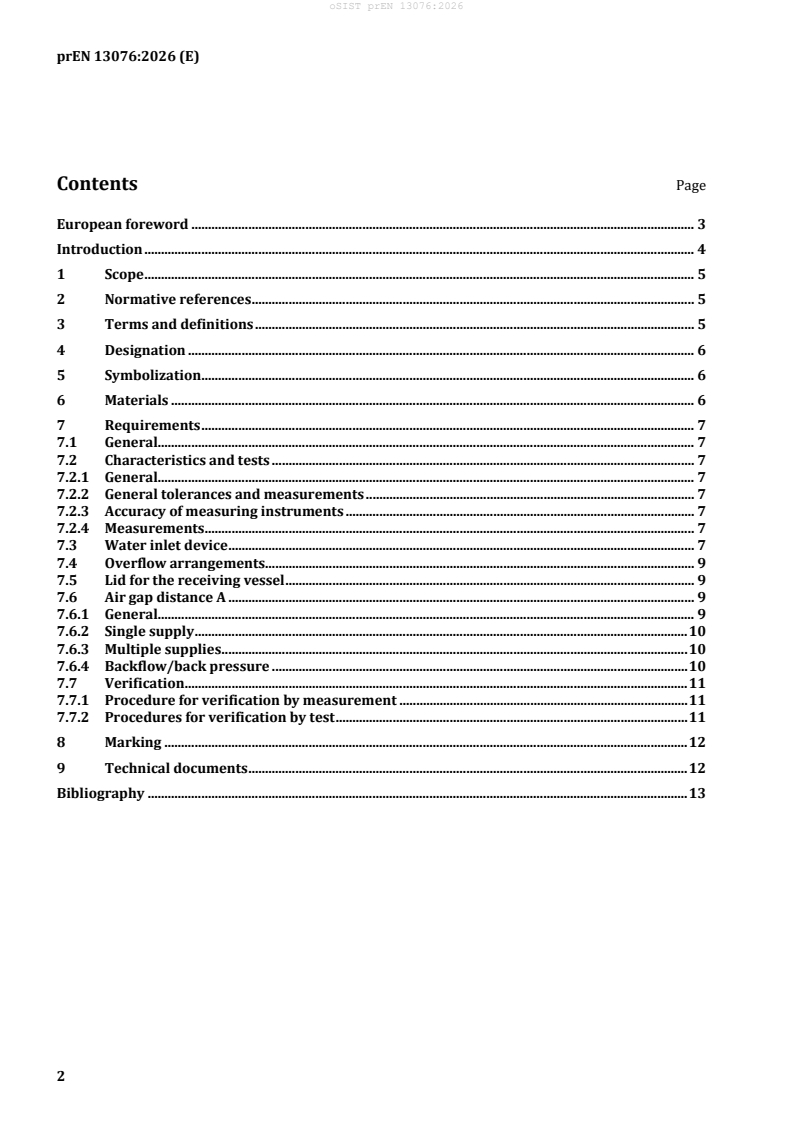
Contents
- Introduction
- 1 Scope
- 2 Normative references
- 3 Terms and definitions
- 3.1 air gap with unrestricted spillover Family A, Type A
- 3.2 spillover level
- 3.3 maximum level
- 3.4 diameter of feed pipe outlet orifice (bore D)
- 4 Designation
- 5 Symbolization
- 6 Materials
- 7 Requirements
- 7.1 General
- 7.2 Characteristics and tests
- 7.3 Water inlet device
- 7.4 Overflow arrangements
- 7.5 Lid for the receiving vessel
- 7.6 Air gap distance A
- 7.7 Verification
- 8 Marking
- 9 Technical documents
- Bibliography
Introduction
In respect of potential adverse effects on the quality of water intended for human consumption, caused by the product covered by this document:
a) this document provides no information as to whether the product might be used without restriction in any of the Member State of the EU or EFTA; b) while awaiting the adoption of verifiable European criteria, existing national regulations concerning the use and/or the characteristics of this product remain in force.
oSIST prEN 13076:2026 prEN 13076:2026 (E)
1 Scope
This document specifies the characteristics and the requirements of unrestricted air gap Family A, Type A for nominal flow velocity not exceeding 3 m/s. Air gaps are devices for protection of potable water in water installations from pollution by backflow. This document applies to air gaps in factory-assembled products and to constructed air gaps in situ and specifies requirements and methods to verify and ensure compliance with this document during normal working use.
The fluid in the receiving vessel is assumed to have similar properties to the water supply. Where this is not the case, additional care or tests could be required to verify the efficacy of the solution in practical use.
The AA device is intended to be used in potable water installations according to EN 806 (series). Sanitary tapware when installed onto a receiving vessel (e.g. washbasin etc.) might have some restriction of its overflow. This will not compromise the water supply as the tapware might have an air gap, as detailed for example in EN 200 (dimension E), that provides an air gap disconnection. If this is the case, then backflow protection will be assumed to be adequate, and no further testing/verification will be needed.
2 Normative references
The following documents are referred to in the text in such a way that some or all of their content constitutes requirements of this document. For dated references, only the edition cited applies. For undated references, the latest edition of the referenced document (including any amendments) applies. EN 806-1, Specifications for installations inside buildings conveying water for human consumption — Part 1: General EN 806-5:2012, Specifications for installations inside buildings conveying water for human consumption — Part 5: Operation and maintenance EN 1717, Protection against pollution of water intended for human consumption in potable water installations and general requirements for devices to prevent pollution by backflow
3 Terms and definitions
For the purposes of this document, the terms and definitions given in given in EN 806-1 and EN 1717 and the following apply.
ISO and IEC maintain terminology databases for use in standardization at the following addresses:
- ISO Online browsing platform: available at https://www.iso.org/obp/
- IEC Electropedia: available at https://www.electropedia.org/
3.1 air gap with unrestricted spillover Family A, Type A
visible, permanent and vertical distance between the lowest point of the inlet orifice and the spillover level of the receiving vessel having a complete and unrestricted spillover Note 1 to entry: See Figure 1 for the design principle.
oSIST prEN 13076:2026 prEN 13076:2026 (E)
Figure 1 — Design principle
3.2 spillover level
level at which water will start to overflow the receiving vessel with all outlets closed
3.3 maximum level
highest water level H reached above the spillover level with flow rate Q applied and all outlets closed
3.4 diameter of feed pipe outlet orifice (bore D)
internal diameter size of the outlet feed orifice (or calculated from the equivalent cross sectional area)
4 Designation
An unrestricted air gap Family A, Type A is designated by its:
- name;
- reference to this document, EN 13076;
- family and type;
- diameter D (see 3.4).
EXAMPLE Air gap, EN 13076, Family A, Type A, 12 mm.
5 Symbolization
The graphic representation of the air gap with non-circular overflow (unrestricted) Family A, Type A is as follows (see Figure 2).
Figure 2 — Graphic symbol
6 Materials
All materials coming into contact with water intended for human consumption shall present no health risk nor cause any change of the drinking water in terms of quality, appearances, smell or taste. All materials shall be compatible among themselves and with the water supplied and with the fluids or substances that can come into contact with them.
oSIST prEN 13076:2026 prEN 13076:2026 (E) There are no special requirements concerning the materials downstream of the feed orifice provided they do not have any harmful effect on the upstream part or the overflow arrangement.
7 Requirements
7.1 General
The protection assembly comprises two parts:
- water inlet device;
- receiving vessel (container); The feed pipe and any flow control device shall be external to any of the receiving vessel walls. The assembly shall be fixed so that the air gap is permanently maintained and unrestricted.
7.2 Characteristics and tests
7.2.1 General
Performance tests shall be carried out on the device as installed in accordance with the manufacturer’s technical documents. If not specified, all tests shall be performed with water at an ambient temperature.
...