

oSIST prEN IEC 63544:2026
(Main)Horticultural lighting - Luminaires incorporating LED sources for horticultural lighting - Performance
General Information
- Abstract
- Status
- Not Published
- Public Enquiry End Date
- 04-Mar-2026
- Technical Committee
- STV - Steklo, svetloba in razsvetljava v gradbeništvu
- Current Stage
- 5020 - Formal vote (FV) (Adopted Project)
- Start Date
- 29-Sep-2026
- Due Date
- 17-Nov-2026

Overview
oSIST prEN IEC 63544:2026 is a CLC standard for horticultural lighting performance focused on luminaires incorporating LED light sources for horticultural lighting. It addresses how these products are specified, measured, and verified for type testing, with emphasis on photon-based performance metrics rather than general lighting photometric values.
This standard is relevant for manufacturers, test laboratories, designers, and conformity assessment teams working with LED horticultural luminaires used in controlled growing environments. It supports more consistent product information, clearer performance declarations, and practical comparison of lighting solutions for crops and plant growth applications.
The document also aligns with the broader IEC framework for luminaires and horticultural equipment, while recognizing that horticultural lighting has unique requirements linked to wavelength ranges, growth stages, and the relationship between light output and crop performance.
Key Topics
The standard covers several important areas for horticultural LED lighting performance:
- Performance requirements and measurement methods for horticultural luminaires incorporating LED sources
- Photon flux, photon flux efficacy, and photon intensity distribution
- Spectral distribution of photon quantity with declared wavelength interval resolution
- Photon irradiance at typical installation height
- Maintenance characteristics of photon flux and related reporting
- Dimensions and construction requirements tied to installation
- Thermal radiation effect and its relevance to plant growth conditions
It also defines product information that should be provided by the manufacturer or responsible vendor, such as:
- Rated photon flux
- Initial photon flux for blue, green, red, and far-red radiation
- Rated photon flux efficacy
- Rated spectral distribution of photon quantity
- Dimming characteristics and configuration instructions
- Installation guidance, weight, dimensions, and maintenance instructions
A key practical feature of the standard is its distinction between type A and type B horticultural luminaires, helping users understand which test evidence and component-level data may be used for verification.
Applications
oSIST prEN IEC 63544:2026 is especially useful in environments where horticultural lighting LEDs are evaluated for reliable performance and product consistency, including:
- Plant factories
- Greenhouses
- Field applications
- Home growing applications
- Inter-plant supplementary lighting
- Top lighting systems
For industry stakeholders, the standard supports:
- Product development and specification
- Technical procurement
- Laboratory testing
- Performance comparison across LED horticultural luminaires
- Better communication of lighting behavior for plant-related applications
It is particularly valuable where light output must be described in photon metric terms and where thermal effects, installation height, and spectral tuning are relevant to plant growth.
Related Standards
oSIST prEN IEC 63544:2026 is closely related to the following standards and references:
- IEC 62722-1 - Luminaire performance - General requirements
- IEC 62722-2-1:2023 - Luminaire performance - Particular requirements for LED luminaires
- IEC 63545 - Horticultural lighting - Luminaires for horticultural lighting - Safety
- IEC 60068-2-78 - Environmental testing - Damp heat, steady state
- IEC 63013 - LED packages - Long-term luminous, radiant and photon flux maintenance
This makes oSIST prEN IEC 63544:2026 a useful standard for organizations seeking structured, testable, and market-ready horticultural lighting performance documentation.
Get Certified
Connect with accredited certification bodies for this standard

Control Union Certifications
Global certification for agriculture and sustainability.

ECOCERT
Organic and sustainability certification.

FSC International
Forest Stewardship Council certification.
Sponsored listings
Frequently Asked Questions
oSIST prEN IEC 63544:2026 is a draft published by the Slovenian Institute for Standardization (SIST). Its full title is "Horticultural lighting - Luminaires incorporating LED sources for horticultural lighting - Performance". This standard covers: Horticultural lighting - Luminaires incorporating LED sources for horticultural lighting - Performance
Horticultural lighting - Luminaires incorporating LED sources for horticultural lighting - Performance
oSIST prEN IEC 63544:2026 is classified under the following ICS (International Classification for Standards) categories: 29.140.40 - Luminaires; 65.060.70 - Horticultural equipment. The ICS classification helps identify the subject area and facilitates finding related standards.
oSIST prEN IEC 63544:2026 is available in PDF format for immediate download after purchase. The document can be added to your cart and obtained through the secure checkout process. Digital delivery ensures instant access to the complete standard document.
Standards Content (Sample)
SLOVENSKI STANDARD
01-marec-2026
Vrtnarska razsvetljava - Svetila z vgrajenimi LED viri za vrtnarsko razsvetljavo -
Zmogljivost
Horticultural lighting - Luminaires incorporating LED sources for horticultural lighting -
Performance
Ta slovenski standard je istoveten z: prEN IEC 63544:2025
ICS:
29.140.40 Svetila Luminaires
65.060.70 Vrtnarska oprema Horticultural equipment
2003-01.Slovenski inštitut za standardizacijo. Razmnoževanje celote ali delov tega standarda ni dovoljeno.
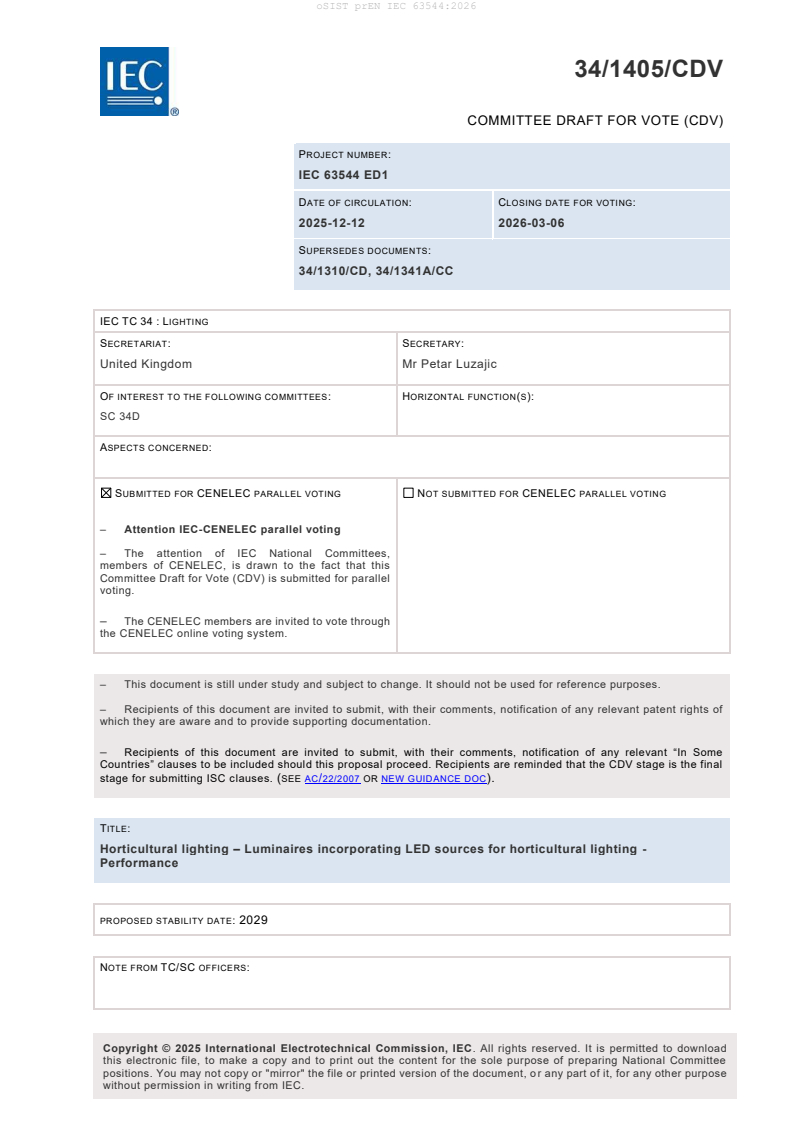
34/1405/CDV
COMMITTEE DRAFT FOR VOTE (CDV)
PROJECT NUMBER:
IEC 63544 ED1
DATE OF CIRCULATION: CLOSING DATE FOR VOTING:
2025-12-12 2026-03-06
SUPERSEDES DOCUMENTS:
34/1310/CD, 34/1341A/CC
IEC TC 34 : LIGHTING
SECRETARIAT: SECRETARY:
United Kingdom Mr Petar Luzajic
OF INTEREST TO THE FOLLOWING COMMITTEES: HORIZONTAL FUNCTION(S):
SC 34D
ASPECTS CONCERNED:
SUBMITTED FOR CENELEC PARALLEL VOTING NOT SUBMITTED FOR CENELEC PARALLEL VOTING
– Attention IEC-CENELEC parallel voting
– The attention of IEC National Committees,
members of CENELEC, is drawn to the fact that this
Committee Draft for Vote (CDV) is submitted for parallel
voting.
– The CENELEC members are invited to vote through
the CENELEC online voting system.
– This document is still under study and subject to change. It should not be used for reference purposes.
– Recipients of this document are invited to submit, with their comments, notification of any relevant patent rights of
which they are aware and to provide supporting documentation.
– Recipients of this document are invited to submit, with their comments, notification of any relevant “In Some
Countries” clauses to be included should this proposal proceed. Recipients are reminded that the CDV stage is the final
stage for submitting ISC clauses. (SEE AC/22/2007 OR NEW GUIDANCE DOC).
TITLE:
Horticultural lighting – Luminaires incorporating LED sources for horticultural lighting -
Performance
PROPOSED STABILITY DATE: 2029
NOTE FROM TC/SC OFFICERS:
this electronic file, to make a copy and to print out the content for the sole purpose of preparing National Committee
positions. You may not copy or "mirror" the file or printed version of the document, o r any part of it, for any other purpose
without permission in writing from IEC.
IEC CDV 63544 © IEC 2025
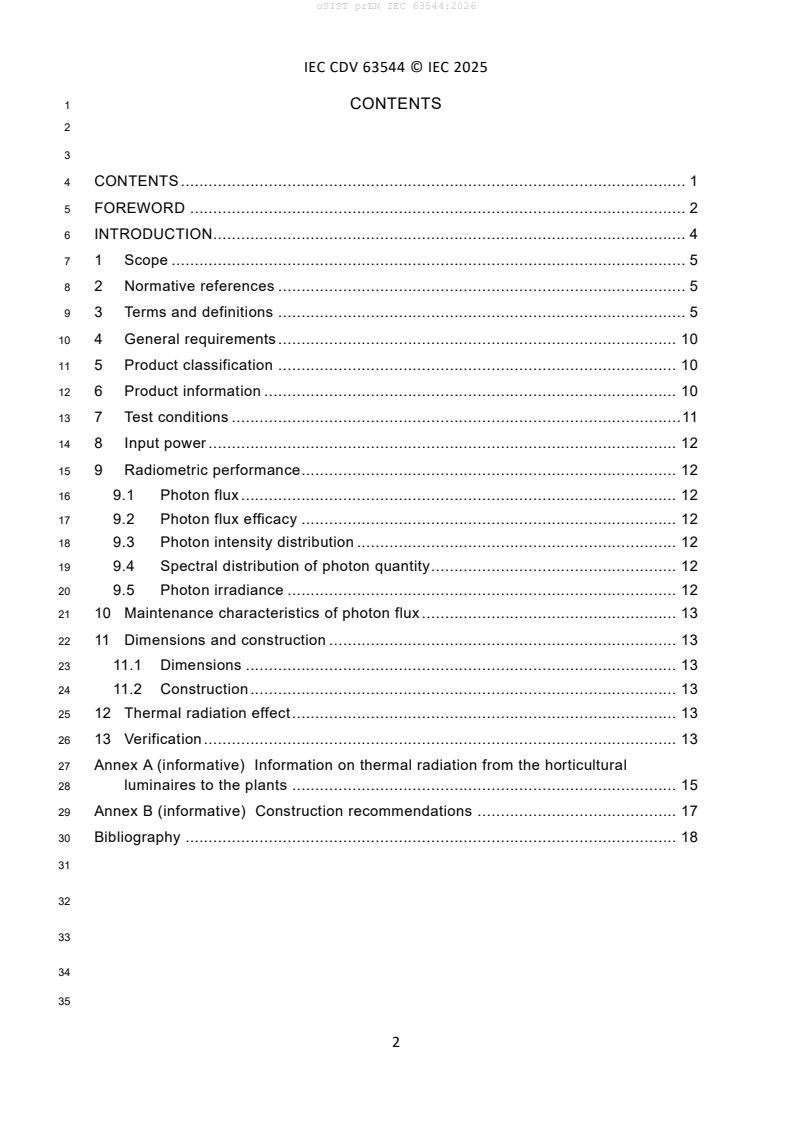
1 CONTENTS
4 CONTENTS . 1
5 FOREWORD . 2
6 INTRODUCTION . 4
7 1 Scope . 5
8 2 Normative references . 5
9 3 Terms and definitions . 5
10 4 General requirements . 10
11 5 Product classification . 10
12 6 Product information . 10
13 7 Test conditions . 11
14 8 Input power . 12
15 9 Radiometric performance . 12
16 9.1 Photon flux . 12
17 9.2 Photon flux efficacy . 12
18 9.3 Photon intensity distribution . 12
19 9.4 Spectral distribution of photon quantity. 12
20 9.5 Photon irradiance . 12
21 10 Maintenance characteristics of photon flux . 13
22 11 Dimensions and construction . 13
23 11.1 Dimensions . 13
24 11.2 Construction . 13
25 12 Thermal radiation effect . 13
26 13 Verification . 13
27 Annex A (informative) Information on thermal radiation from the horticultural
28 luminaires to the plants . 15
29 Annex B (informative) Construction recommendations . 17
30 Bibliography . 18
IEC CDV 63544 © IEC 2025
36 INTERNATIONAL ELECTROTECHNICAL COMMISSION
37 ____________
39 Horticultural lighting – Luminaires incorporating LED sources for
40 horticultural lighting – Performance
43 FOREWORD
44 1) The International Electrotechnical Commission (IEC) is a worldwide organization for standardization comprising
45 all national electrotechnical committees (IEC National Committees). The object of IEC is to promote
46 international co-operation on all questions concerning standardization in the electrical and electronic fields. To
47 this end and in addition to other activities, IEC publishes International Standards, Technical Specifications,
48 Technical Reports, Publicly Available Specifications (PAS) and Guides (hereafter referred to as “IEC
49 Publication(s)”). Their preparation is entrusted to technical committees; any IEC National Committee interested
50 in the subject dealt with may participate in this preparatory work. International, governmental and non -
51 governmental organizations liaising with the IEC also participate in this preparation. IEC collaborates closely
52 with the International Organization for Standardization (ISO) in accordance with conditions determined by
53 agreement between the two organizations.
54 2) The formal decisions or agreements of IEC on technical matters express, as nearly as possible, an international
55 consensus of opinion on the relevant subjects since each technical committee has representation from all
56 interested IEC National Committees.
57 3) IEC Publications have the form of recommendations for international use and are accepted by IEC National
58 Committees in that sense. While all reasonable efforts are made to ensure that the technical content of IEC
59 Publications is accurate, IEC cannot be held responsible for the way in which they are used or for any
60 misinterpretation by any end user.
61 4) In order to promote international uniformity, IEC National Committees undertake to apply IEC Publications
62 transparently to the maximum extent possible in their national and regional publications. Any divergence
63 between any IEC Publication and the corresponding national or regional publication shall be clearly indicated in
64 the latter.
65 5) IEC itself does not provide any attestation of conformity. Independent certification bodies provide conformity
66 assessment services and, in some areas, access to IEC marks of conformity. IEC is not responsible for any
67 services carried out by independent certification bodies.
68 6) All users should ensure that they have the latest edition of this publication.
69 7) No liability shall attach to IEC or its directors, employees, servants or agents including individual experts and
70 members of its technical committees and IEC National Committees for any personal injury, property damage or
71 other damage of any nature whatsoever, whether direct or indirect, or for costs (including legal fees) and
72 expenses arising out of the publication, use of, or reliance upon, this IEC Publication or any other IEC
73 Publications.
74 8) Attention is drawn to the Normative references cited in this publication. Use of the referenced publications is
75 indispensable for the correct application of this publication.
76 9) Attention is drawn to the possibility that some of the elements of this IEC Publication may be the subject of
77 patent rights. IEC shall not be held responsible for identifying any or all such patent rights.
78 IEC 6XXXX has been prepared by IEC technical committee 34: Lighting. It is an International
79 Standard.
80 The text of this International Standard is based on the following documents:
Draft Report on voting
34/XX/FDIS 34/XX/RVD
IEC CDV 63544 © IEC 2025
82 Full information on the voting for its approval can be found in the report on voting indicated in
83 the above table.
84 The language used for the development of this International Standard is English.
85 This document was drafted in accordance with ISO/IEC Directives, Part 2, and developed in
86 accordance with ISO/IEC Directives, Part 1 and ISO/IEC Directives, IEC Supplement, available
87 at www.iec.ch/members_experts/refdocs. The main document types developed by IEC are
88 described in greater detail at www.iec.ch/publications.
89 The committee has decided that the contents of this document will remain unchanged until the
90 stability date indicated on the IEC website under webstore.iec.ch in the data related to the
91 specific document. At this date, the document will be
92 reconfirmed,
93 withdrawn,
94 replaced by a revised edition, or
95 amended.
IEC CDV 63544 © IEC 2025
97 INTRODUCTION
98 This document acknowledges the need for defining performance data to be provided for
99 horticultural luminaires using LED as the electric source. Information to support the responsible
100 horticultural lighting environmental use is also included.
101 Compared with general lighting, the major differences for horticultural lighting are as follows:
102 Changing of performance metric system from photometric to photon system, which is
103 normally based on specific wavelength range;
104 Increased concern for the endurance properties because of the close relevance to the
105 crop yield.
106 The provisions in this document represent the technical knowledge of experts from the field of
107 the horticultural lighting, and are developed in close context with IEC 62722-1 (the performance
108 standard for luminaires in general) and IEC 62722-2-1 (the performance standard for LED
109 luminaires for general lighting purpose).
IEC CDV 63544 © IEC 2025
113 Horticultural lighting – Luminaires incorporating LED sources for
114 horticultural lighting – Performance
117 1 Scope
118 This document specifies the performance requirements together with the measurement method
119 and conditions for horticultural luminaires incorporating LED sources.
120 The requirements of this document relate to type testing.
121 The lifetime of horticultural luminaires incorporating LED sources is in most cases much longer
122 than practical test times. Consequently, the verification of manufacturer’s lifetime claim is out
123 of the scope of this document.
124 This document does not contain requirements on action spectra, which are dependent on plant
125 species and growth stages.
126 2 Normative references
127 The following documents are referred to in the text in such a way that some or all of their content
128 constitutes requirements of this document. For dated references, only the edition cited applies.
129 For undated references, the latest edition of the referenced document (including any
130 amendments) applies.
131 IEC 60068-2-78, Environmental testing - Part 2-78: Tests - Test Cab: Damp heat, steady state
132 IEC 62722-1, Luminaire performance – Part 1: General requirements
133 IEC 62722-2-1:2023, Luminaire performance – Part 2-1: Particular requirements for LED
134 luminaires
135 IEC 63545, Horticultural lighting – luminaires for horticultural lighting – Safety
136 3 Terms and definitions
137 For the purposes of this document, the terms and definitions given in IEC 62722-2-1, IEC 63545
138 and the following apply.
139 ISO and IEC maintain terminology databases for use in standardization at the following
140 addresses:
141 IEC Electropedia: available at https://www.electropedia.org/
142 ISO Online browsing platform: available at https://www.iso.org/obp
143 3.1
144 LED source
145 source of optical radiation based on LED technology
146 Note 1 to entry: An LED source can take the form of an LED module or an LED lamp.
IEC CDV 63544 © IEC 2025
147 Note 2 to entry: LED source can be the source emitting optical radiation other than visual radiation.
148 3.2
149 photobiologically active radiation
150 PBAR
151 optical radiation in the wavelength range from 280 nm to 800 nm for which plants are
152 photobiologically active
153 Note 1 to entry: Quantities that are related to PBAR should be labelled using the subscript “PBAR”.
154 3.3
155 photosynthetically active radiation
156 PAR
157 optical radiation in the wavelength range from 400 nm to 700 nm
158 Note 1 to entry: The range between 400 nm to 700 nm for horticultural lighting is commonly subdivided into:
159 blue: 400 nm to 500 nm;
160 green: 500 nm to 600 nm;
161 red: 600 nm to 700 nm.
162 Note 2 to entry: Quantities that are related to photosynthetically active radiation should be labelled using the
163 subscript “PAR”.
164 3.4
165 far-red radiation
166 optical radiation in the wavelength range from 700 nm to 800 nm
167 3.5
168 photon flux
169 Fp
170 F
171 rate of photon number per time interval
𝒅𝑵
𝐩
172 𝛷 =
𝐩
𝒅𝒕
173 where 𝑁 is photon number, transmitted or received, and t is time.
p
𝛷
e
174 Note 1 to entry: Photon flux, 𝛷 , is related to radiant flux, 𝛷 , of monochromatic radiation by 𝛷 = ,where ℎ is the Planck
p e p
ℎ𝜈
175 constant, and 𝜈 is the frequency of the corresponding electromagnetic wave.
d𝛷 (λ) d𝛷 (λ)
e e
176 Note 2 to entry: For a beam of radiation whose spectral distribution is or , the photon flux can be expressed by 𝛷 =
p
𝑑λ 𝑑𝜈
λ 𝛷 (λ) λ λ 𝛷 (v) λ
𝟐 e 𝟐 e
177 ∙ 𝑑λ = ∙ 𝑑𝜈, where ℎ is Planck's constant, 𝑐 is the speed of light in vacuum.
∫ ∫
λ 𝑑λ ℎ𝑐 λ 𝑑ν ℎ𝜈
𝟏 𝟏
178 Note 3 to entry: The corresponding radiometric quantity is "radiant flux". The corresponding photometric quantity is "luminous
179 flux".
−1
180 Note 4 to entry: The photon flux is expressed in second to the power minus one (s ).
-
181 Note 5 to entry: Unit for photon flux for horticultural lighting purpose is normally expressed as micromoles per second (μmol × s
1 23 6
182 ). The quantity is calculated by dividing ᶲ by Avogadro’s number N (6.022 × 10 photons per mole) and then multiply by 10 .
p A
IEC CDV 63544 © IEC 2025
183 Note 6 to entry: Photon flux is normally associated with specific wavelength ranges. Examples are photosynthetic photon flux,
184 ultraviolet photon flux, far-red photon flux.
185 [SOURCE: IEC 60050-845:2020, 845-21-040 modified – The note 5 to entry and note 6 to
186 entry have been added.]
187 3.6
188 photobiologically active photon flux
189 photon flux in the wavelength range from 280 nm to 800 nm for which plants are photobiologically
190 active
191 3.7
192 photon flux efficacy
193 𝜂
p
194 emitted photon flux divided by the electrical input power
𝛷
p
195 𝜂 =
p
𝑃
196 where 𝛷 is photon flux and P is the electrical input power
p
197 Note 1 to entry: Whether the input power includes power dissipated by auxiliary equipment such as controlgear should be
198 specified.
−1
199 Note 2 to entry: Photon flux efficacy for horticultural lighting is expressed in micromole per Joule ( μmol·J ).
200 Note 3 to entry: Photon flux efficacy is normally associated with specific wavelength ranges. Examples are
201 photosynthetic photon flux efficacy, ultraviolet photon flux efficacy, far-red photon flux efficacy.
202 3.8
203 photon intensity
204 I ;
p
205 I
206 density of photon flux with respect to solid angle in a specified direction
𝑑𝛷
p
207 𝐼 =
p
𝑑Ω
208 where Φp is the photon flux emitted in the given direction, and Ω is the solid angle containing that
209 direction
210 Note 1 to entry: The distribution of the photon intensities as a function of the direction of emission, e.g. given by the polar angles
211 (θ, Φ), is used to determine the photon flux, Φp, within a certain solid angle, Ω, of a source:
( )
212 𝛷 = ∬ 𝐼 𝜃, 𝜑 sin 𝜃 𝑑𝜑𝑑𝜃
P P
Ω
213 Note 2 to entry: The corresponding radiometric quantity is "radiant intensity". The corresponding photometric quantity is
214 "luminous intensity".
215 Note 3 to entry: The photon intensity is expressed in second to the power minus one times steradian to the power minus one
−1 −1
216 (s ·sr ).
217 Note 4 to entry: Photon intensity is normally associated with specific wavelength ranges. Examples are photosynthetic photon
218 intensity, ultraviolet photon intensity, far-red photon intensity.
219 [SOURCE: IEC 60050-845:2020, 845-21-046 modified – The note 4 to entry has been added.]
220 3.9
221 photon intensity distribution
IEC CDV 63544 © IEC 2025
222 photon intensity of a source as a function of direction in space
223 3.10
224 photon irradiance
225 photon flux density
226 E
p
227 E
228 density of incident photon flux with respect to area at a point on a real or imaginary surface
𝑑𝛷
p
229 𝐸 =
p
𝑑𝐴
230 where 𝛷 is photon flux and 𝐴 is the area on which the photon flux is incident
p
231 Note 1 to entry: The corresponding radiometric quantity is "irradiance". The corresponding photometric quantity is
232 "illuminance".
−1 −2
233 Note 2 to entry: The photon irradiance is expressed in second to the power minus one per square metre (s ∙ m ).
234 Note 3 to entry: Unit for photon irradiance for horticultural lighting purpose is normally expressed as micromoles per second per
-1 -2 23
235 square meter (μmol × s × m ). The quantity is calculated by dividing E by Avogadro’s number N (6.022 × 10 photons per
p A
236 mole) and then multiply by 10 .
237 Note 4 to entry: Photon irradiance is normally associated with specific wavelength ranges. Examples are photosynthetic photon
238 irradiance, ultraviolet photon irradiance, far-red photon irradiance.
239 [SOURCE: IEC 60050-845:2020, 845-21-058, modified – The alternative term name, the note
240 3 to entry and note 4 to entry have been added.]
241 3.11
242 spectral distribution
243 spectral concen
...