

SIST EN 18087:2026
(Main)Devices for in situ generation of biocides - Chlorine dioxide generated from sodium chlorite by acidification or oxidation
General Information
- Abstract
This document specifies requirements for dosing systems for chlorine dioxide generation according to the chlorite-chlorine gas process, the chlorite-acid process and the chlorite-sodium peroxodisulphate process, which are used for the disinfection and oxidation of substances in water.
The chlorine dioxide (ClO2) solution is produced on site (in situ) by automated mixing of chemical precursors.
NOTE According to EN 12671, chlorine dioxide is suited for the use of the treatment of water intended for human consumption (drinking water).
- Status
- Published
- Public Enquiry End Date
- 11-Sep-2024
- Publication Date
- 08-Feb-2026
- Technical Committee
- IOVO - Water supply and waste water engineering
- Current Stage
- 6060 - National Implementation/Publication (Adopted Project)
- Start Date
- 04-Feb-2026
- Due Date
- 11-Apr-2026
- Completion Date
- 09-Feb-2026

Overview
SIST EN 18087:2026 establishes standardized requirements for devices and systems that generate chlorine dioxide (ClO₂) on-site (in situ) for use as a biocide. This European standard, developed by SIST and aligned with EN 18087:2026, applies to dosing systems that create chlorine dioxide from sodium chlorite by three main processes: chlorite-chlorine gas, chlorite-acid, and chlorite-sodium peroxodisulphate. These systems are primarily used for the disinfection and oxidation of substances in water, including applications in drinking water treatment, industrial water purification, and general water sanitation.
The document outlines the essential criteria for system design, operational safety, installation, and maintenance to ensure effective, consistent, and safe production of chlorine dioxide solution directly at the use site.
Key Topics
In Situ Generation Processes:
SIST EN 18087:2026 covers three technologies for chlorine dioxide generation:- Chlorite-acid process: Produces chlorine dioxide by acidifying sodium chlorite.
- Chlorite-chlorine gas process: Involves oxidation using chlorine gas.
- Chlorite-sodium peroxodisulphate process: Uses sodium peroxodisulphate for oxidation.
System Components and Requirements:
- Automated mixing chambers and dosing devices for precise chemical handling
- Buffer tanks for safe storage and dosing of generated chlorine dioxide solutions
- Safety features including gas tightness to prevent toxic gas release and backflow prevention mechanisms
- Requirements for precursor purity and water quality, referencing related standards for each chemical
Operational Considerations:
- Modes of operation: Continuous (direct dosing) or discontinuous (buffering with tanks)
- Monitoring and control for correct dosing, dilution, and prevention of hazardous concentrations
- Specific reaction conditions, including temperature control, reaction time, and concentration bounds to maximize yield and minimize hazardous by-products
Health & Safety:
Emphasizes minimizing occupational exposure to chlorine dioxide gas-highly toxic and harmful upon inhalation-and preventing explosive conditions through controlled concentrations and system monitoring.
Applications
The standardized requirements for in situ generation of chlorine dioxide solutions are particularly relevant in the following fields:
Drinking Water Treatment:
Enables the safe, controlled disinfection of potable water, aligning with EN 12671 and ensuring compliance with European regulations for water intended for human consumption.Industrial and Municipal Water Purification:
Applied in treating process water, cooling systems, and wastewater, supporting both oxidation and pathogen control.Pool and Recreational Water Treatment:
Used for the disinfection of pool water and washing water for filter systems, enhancing water quality and public health.Surface and Equipment Disinfection:
Suitable for air treatment systems and disinfection of contact surfaces in various industrial and public settings.Regulatory Compliance:
Helps installations comply with Biocidal Products Regulation (EU) 528/2012 and the REACH Regulation (EC) 1907/2006, ensuring safety and environmental protection.
Related Standards
For proper use and compliance, SIST EN 18087:2026 should be applied alongside these relevant standards:
- EN 12671: Chlorine dioxide generated in situ for water treatment
- EN 901: Sodium hypochlorite specifications
- EN 937: Chlorine for water treatment
- EN 938: Sodium chlorite for water treatment
- EN 939: Hydrochloric acid for water treatment
- EN 1717: Protection against pollution of potable water installations
- EN 12926: Sodium peroxodisulfate for water treatment
- EN 15363: Chemicals for swimming pool water
- EN ISO 3696: Specifications for laboratory water
- EN ISO 12100: Machinery safety and risk assessment
Practical Value
Utilizing SIST EN 18087:2026 ensures:
- Consistent and high-quality chlorine dioxide generation
- Safe operation in diverse water treatment environments
- Protection for operators and end-users through risk mitigation
- Compliance with European regulatory frameworks
By following this standard, organizations enhance their water disinfection processes, improve public health safeguards, and meet critical safety and quality benchmarks in biocide device implementation.
Relations
- Effective Date
- 05-Aug-2026
- Effective Date
- 05-Aug-2026
- Effective Date
- 01-Apr-2026
- Effective Date
- 09-Feb-2026
- Effective Date
- 04-Feb-2026
- Effective Date
- 04-Feb-2026
- Effective Date
- 04-Feb-2026
- Effective Date
- 04-Feb-2026
- Effective Date
- 04-Feb-2026
- Effective Date
- 04-Feb-2026
- Effective Date
- 04-Feb-2026
- Effective Date
- 04-Feb-2026
- Effective Date
- 04-Feb-2026
- Effective Date
- 04-Feb-2026
- Effective Date
- 04-Feb-2026
Get Certified
Connect with accredited certification bodies for this standard

ECOCERT
Organic and sustainability certification.

CIS Institut d.o.o.
Personal Protective Equipment (PPE) certification body. Notified Body NB-2890 for EU Regulation 2016/425 PPE.

Eurofins Food Testing Global
Global leader in food, environment, and pharmaceutical product testing.
Sponsored listings
Frequently Asked Questions
SIST EN 18087:2026 is a standard published by the Slovenian Institute for Standardization (SIST). Its full title is "Devices for in situ generation of biocides - Chlorine dioxide generated from sodium chlorite by acidification or oxidation". This standard covers: This document specifies requirements for dosing systems for chlorine dioxide generation according to the chlorite-chlorine gas process, the chlorite-acid process and the chlorite-sodium peroxodisulphate process, which are used for the disinfection and oxidation of substances in water. The chlorine dioxide (ClO2) solution is produced on site (in situ) by automated mixing of chemical precursors. NOTE According to EN 12671, chlorine dioxide is suited for the use of the treatment of water intended for human consumption (drinking water).
This document specifies requirements for dosing systems for chlorine dioxide generation according to the chlorite-chlorine gas process, the chlorite-acid process and the chlorite-sodium peroxodisulphate process, which are used for the disinfection and oxidation of substances in water. The chlorine dioxide (ClO2) solution is produced on site (in situ) by automated mixing of chemical precursors. NOTE According to EN 12671, chlorine dioxide is suited for the use of the treatment of water intended for human consumption (drinking water).
SIST EN 18087:2026 is classified under the following ICS (International Classification for Standards) categories: 13.060.20 - Drinking water; 71.100.80 - Chemicals for purification of water. The ICS classification helps identify the subject area and facilitates finding related standards.
SIST EN 18087:2026 has the following relationships with other standards: It is inter standard links to SIST ISO 3165:1995, SIST ISO 6206:1995, SIST EN 1717:2025+A1:2026, SIST EN IEC 60751:2022, SIST EN ISO 8751:2001, SIST EN ISO 3696:1998, SIST EN 939:2016, SIST EN 901:2025, SIST EN 12671:2016, SIST EN ISO 12100:2011, SIST EN 15363:2014, SIST EN 1717:2025, SIST EN 1998-6:2005, SIST EN ISO 10304-4:2022, SIST EN 938:2016. Understanding these relationships helps ensure you are using the most current and applicable version of the standard.
SIST EN 18087:2026 is associated with the following European legislation: EU Directives/Regulations: 1907/2006. When a standard is cited in the Official Journal of the European Union, products manufactured in conformity with it benefit from a presumption of conformity with the essential requirements of the corresponding EU directive or regulation.
SIST EN 18087:2026 is available in PDF format for immediate download after purchase. The document can be added to your cart and obtained through the secure checkout process. Digital delivery ensures instant access to the complete standard document.
Standards Content (Sample)
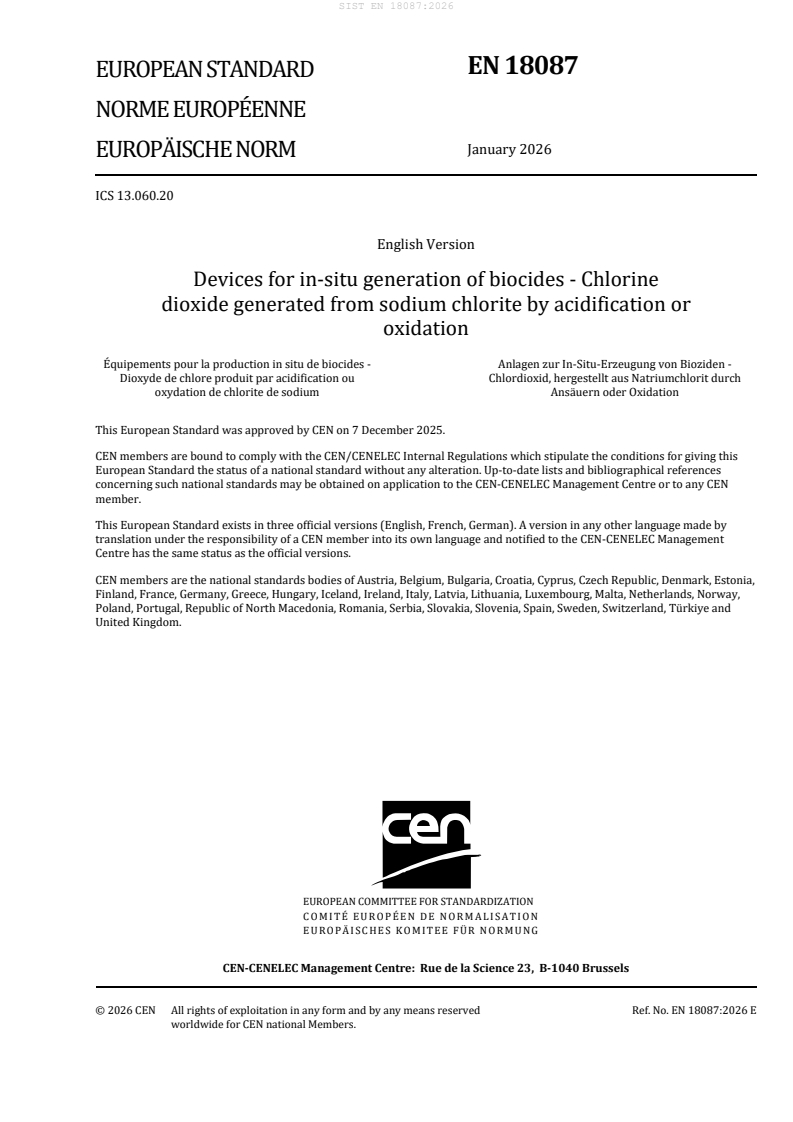
SLOVENSKI STANDARD
01-marec-2026
Naprave za proizvodnjo biocidov na kraju samem - Klorov dioksid, proizveden iz
natrijevega klorida z acidifikacijo (nakisanjem) ali oksidacijo
Devices for in situ generation of biocides - Chlorine dioxide generated from sodium
chlorite by acidification or oxidation
Anlagen zur In-Situ-Erzeugung von Bioziden - Chlordioxid, hergestellt aus Natriumchlorit
durch Ansäuren oder Oxidation
Équipements pour la production in situ de biocides - Dioxyde de chlore produit par
acidification ou oxydation de chlorite de sodium
Ta slovenski standard je istoveten z: EN 18087:2026
ICS:
13.060.20 Pitna voda Drinking water
71.100.80 Kemikalije za čiščenje vode Chemicals for purification of
water
2003-01.Slovenski inštitut za standardizacijo. Razmnoževanje celote ali delov tega standarda ni dovoljeno.
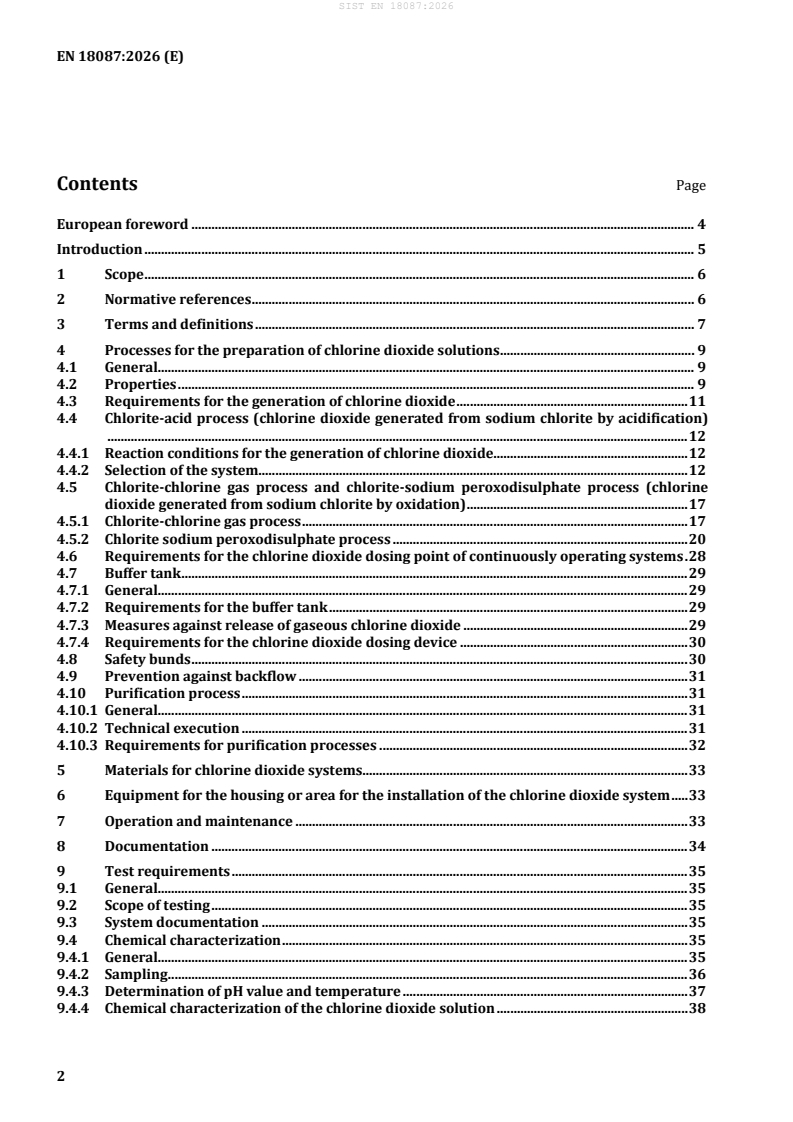
EN 18087
EUROPEAN STANDARD
NORME EUROPÉENNE
January 2026
EUROPÄISCHE NORM
ICS 13.060.20
English Version
Devices for in-situ generation of biocides - Chlorine
dioxide generated from sodium chlorite by acidification or
oxidation
Équipements pour la production in situ de biocides - Anlagen zur In-Situ-Erzeugung von Bioziden -
Dioxyde de chlore produit par acidification ou Chlordioxid, hergestellt aus Natriumchlorit durch
oxydation de chlorite de sodium Ansäuern oder Oxidation
This European Standard was approved by CEN on 7 December 2025.
CEN members are bound to comply with the CEN/CENELEC Internal Regulations which stipulate the conditions for giving this
European Standard the status of a national standard without any alteration. Up-to-date lists and bibliographical references
concerning such national standards may be obtained on application to the CEN-CENELEC Management Centre or to any CEN
member.
This European Standard exists in three official versions (English, French, German). A version in any other language made by
translation under the responsibility of a CEN member into its own language and notified to the CEN-CENELEC Management
Centre has the same status as the official versions.
CEN members are the national standards bodies of Austria, Belgium, Bulgaria, Croatia, Cyprus, Czech Republic, Denmark, Estonia,
Finland, France, Germany, Greece, Hungary, Iceland, Ireland, Italy, Latvia, Lithuania, Luxembourg, Malta, Netherlands, Norway,
Poland, Portugal, Republic of North Macedonia, Romania, Serbia, Slovakia, Slovenia, Spain, Sweden, Switzerland, Türkiye and
United Kingdom.
EUROPEAN COMMITTEE FOR STANDARDIZATION
COMITÉ EUROPÉEN DE NORMALISATION
EUROPÄISCHES KOMITEE FÜR NORMUNG
CEN-CENELEC Management Centre: Rue de la Science 23, B-1040 Brussels
© 2026 CEN All rights of exploitation in any form and by any means reserved Ref. No. EN 18087:2026 E
worldwide for CEN national Members.
Contents Page
European foreword . 4
Introduction . 5
1 Scope . 6
2 Normative references . 6
3 Terms and definitions . 7
4 Processes for the preparation of chlorine dioxide solutions . 9
4.1 General. 9
4.2 Properties . 9
4.3 Requirements for the generation of chlorine dioxide . 11
4.4 Chlorite-acid process (chlorine dioxide generated from sodium chlorite by acidification)
............................................................................................................................................................................. 12
4.4.1 Reaction conditions for the generation of chlorine dioxide. 12
4.4.2 Selection of the system . 12
4.5 Chlorite-chlorine gas process and chlorite-sodium peroxodisulphate process (chlorine
dioxide generated from sodium chlorite by oxidation) . 17
4.5.1 Chlorite-chlorine gas process . 17
4.5.2 Chlorite sodium peroxodisulphate process . 20
4.6 Requirements for the chlorine dioxide dosing point of continuously operating systems . 28
4.7 Buffer tank . 29
4.7.1 General. 29
4.7.2 Requirements for the buffer tank . 29
4.7.3 Measures against release of gaseous chlorine dioxide . 29
4.7.4 Requirements for the chlorine dioxide dosing device . 30
4.8 Safety bunds . 30
4.9 Prevention against backflow . 31
4.10 Purification process . 31
4.10.1 General. 31
4.10.2 Technical execution . 31
4.10.3 Requirements for purification processes . 32
5 Materials for chlorine dioxide systems . 33
6 Equipment for the housing or area for the installation of the chlorine dioxide system . 33
7 Operation and maintenance . 33
8 Documentation . 34
9 Test requirements . 35
9.1 General. 35
9.2 Scope of testing . 35
9.3 System documentation . 35
9.4 Chemical characterization . 35
9.4.1 General. 35
9.4.2 Sampling . 36
9.4.3 Determination of pH value and temperature . 37
9.4.4 Chemical characterization of the chlorine dioxide solution . 38
9.5 Yield of chlorine dioxide generation . 46
9.5.1 General . 46
9.5.2 Calculation of the yield . 46
Annex A (informative) Decomposition conditions for chlorine dioxide in solution . 48
Annex B (informative) Determination of chlorine dioxide in solutions in the concentration range
0,05 mg/l to 10 mg/l . 49
Annex C (informative) Determination of chlorine dioxide in solutions within the concentration
range 10-30 mg/l . 51
Bibliography . 53
European foreword
This document (EN 18087:2026) has been prepared by Technical Committee CEN/TC 164 “Water
supply”, the secretariat of which is held by AFNOR.
This European Standard shall be given the status of a national standard, either by publication of an
identical text or by endorsement, at the latest by July 2026, and conflicting national standards shall be
withdrawn at the latest by July 2026.
Attention is drawn to the possibility that some of the elements of this document may be the subject of
patent rights. CEN shall not be held responsible for identifying any or all such patent rights.
Any feedback and questions on this document should be directed to the users’ national standards body.
A complete listing of these bodies can be found on the CEN website.
According to the CEN-CENELEC Internal Regulations, the national standards organisations of the
following countries are bound to implement this European Standard: Austria, Belgium, Bulgaria, Croatia,
Cyprus, Czech Republic, Denmark, Estonia, Finland, France, Germany, Greece, Hungary, Iceland, Ireland,
Italy, Latvia, Lithuania, Luxembourg, Malta, Netherlands, Norway, Poland, Portugal, Republic of North
Macedonia, Romania, Serbia, Slovakia, Slovenia, Spain, Sweden, Switzerland, Türkiye and the United
Kingdom.
Introduction
Systems according to this document may be used in different fields of application, e.g. drinking water,
rinsing water for swimming pool filters, wastewater, air treatment, surface disinfection, etc. Additional
requirements to this document should be observed, where appropriate for the specific application.
NOTE 1 Regarding the in situ generation of active substances, in particular chlorine dioxide, attention is drawn
to Biocidal Products Regulation (EU) 528/2012 (BPR) [1].
NOTE 2 Regarding the in situ generation of chlorine dioxide for non-biocidal applications, e.g. oxidation
purposes, attention is drawn to REACH (Registration, Evaluation, Authorization and Restriction of Chemicals) [2]
Regulation (EC) 1907/2006.
1 Scope
This document specifies requirements for dosing systems for chlorine dioxide generation according to
the chlorite-chlorine gas process, the chlorite-acid process and the chlorite-sodium peroxodisulphate
process, which are used for the disinfection and oxidation of substances in water.
The chlorine dioxide (ClO ) solution is produced on site (in situ) by automated mixing of chemical
precursors.
NOTE According to EN 12671, chlorine dioxide is suited for the use of the treatment of water intended for
human consumption (drinking water).
2 Normative references
The following documents are referred to in the text in such a way that some or all of their content
constitutes requirements of this document. For dated references, only the edition cited applies. For
undated references, the latest edition of the referenced document (including any amendments) applies.
EN 901, Chemicals used for treatment of water intended for human consumption — Sodium hypochlorite
EN 937, Chemicals used for treatment of water intended for human consumption — Chlorine
EN 938, Chemicals used for treatment of water intended for human consumption — Sodium chlorite
EN 939, Chemicals used for treatment of water intended for human consumption — Hydrochloric acid
EN 1717, Protection against pollution of water intended for human consumption in potable water
installations and general requirements of devices to prevent pollution by backflow
EN 12671, Chemicals used for treatment of water intended for human consumption — Chlorine dioxide
generated in situ
EN 12926, Chemicals used for treatment of water intended for human consumption — Sodium
peroxodisulfate
EN 15363, Chemicals used for treatment of swimming pool water — Chlorine
EN ISO 3696, Water for analytical laboratory use — Specification and test methods (ISO 3696)
EN ISO 10304-4, Water quality — Determination of dissolved anions by liquid chromatography of ions —
Part 4: Determination of chlorate, chloride and chlorite in water with low contamination (ISO 10304-4)
EN ISO 12100, Safety of machinery — General principles for design — Risk assessment and risk reduction
(ISO 12100)
EN IEC 60751, Industrial platinum resistance thermometers and platinum temperature sensors
ISO 3165, Sampling of chemical products for industrial use — Safety in sampling
ISO 6206, Chemical products for industrial use — Sampling — Vocabulary
3 Terms and definitions
For the purposes of this document, the following terms and definitions apply.
ISO and IEC maintain terminology databases for use in standardization at the following addresses:
— ISO Online browsing platform: available at https://www.iso.org/obp/
— IEC Electropedia: available at https://www.electropedia.org/
3.1
chlorine dioxide system
ClO system
combination of a mixing chamber and dosing devices which introduce various chemical precursors in
fixed or controlled proportions into the mixing chamber with the intention of producing chlorine dioxide
in-situ by mixing the precursors and making the chlorine dioxide available for short-term use
3.2
precursor
substance that is fed to the chlorine dioxide system for production of the chlorine dioxide
3.3
mixing chamber
component of a chlorine dioxide system in which the precursors are mixed and converted to chlorine
dioxide
3.4
bypass
partial flow to dilute chlorine dioxide solutions to lower concentrations, which can also be achieved by
dilution with feed water
3.5
outgassing
release of chlorine dioxide from its aqueous solution
3.6
purification process
process for purifying the freshly produced chlorine dioxide from impurities from precursors and
synthesis, e.g. via a gas phase transfer
3.7
reaction time
retention time of the precursors after complete mixing in the mixing chamber under operating conditions
to achieve the nominal output
3.8
nominal output
maximum chlorine dioxide output of a chlorine dioxide system determined under specified conditions
and declared by the manufacturer
3.9
metering device
device for dosing precursors, including dosing pump or injector, dosing line, mixing device, injection
point and fittings
3.10
expert
person who, due to their technical scientific training, work experience and knowledge of applicable
standards and regulations, is capable to assess a chlorine dioxide system with regard to functions and
safety
Note 1 to entry: This person can be from the manufacturer or an independent third-party organization (such as a
test institution) without limitations; an inspector according to EN ISO/IEC 17020, Type C [3], fulfills this criterion.
3.11
chlorine dioxide dosing
controlled process of adding chlorine dioxide solutions
3.12
dosing capacity
flow rate per time or flow rate of the metering device
3.13
feed water
water supplied to the chlorine dioxide system in accordance with the chemical requirements of the
corresponding manufacturer’s specifications which, in addition to diluting the product or the precursors,
can also be supplied to the reaction or used as motive water
3.14
dilution water
feed water supplied to the system, which serves to dilute the chlorine dioxide produced or the precursors
3.15
buffer tank
tank for temporary provision of the generated chlorine dioxide solution that is intended for the
application
Note 1 to entry: There can be one or several tanks.
3.16
yield
indication of how completely the reaction from chlorite to chlorine dioxide shown in the chemical
reaction equation proceeds under practical conditions
Note 1 to entry: The difference between the actual yield and 100 % yield is due to unreacted precursors or side
reaction products that were not represented in the chemical reaction equation
EXAMPLE If 9,5 g of chlorine dioxide are obtained in a reaction batch instead of according to the reaction
equation
5 NaClO + 4 HCl → 4 ClO + 5 NaCl + 2 H O
2 2 2
of the expected 10 g chlorine dioxide, the ClO yield would be 95 %.
3.17
turnover rate
indication of the percentage of molecules of chlorine dioxide that is formed from one molecule of the
starting component according to the chemical reaction equation (i.e. the stoichiometric ratio)
EXAMPLE The chlorite-acid process is based on the following reaction equation:
5 NaClO2 + 4 HCl → 4 ClO2 + 5 NaCl + 2 H2O
From 5 molecules of the precursor sodium chlorite, 4 molecules of chlorine dioxide are formed, the turnover rate is
therefore 80 %.
3.18
stability curve
representation of the concentration of chlorine dioxide and by-products at the specified temperature
over time
Note 1 to entry: In systems with buffer tanks, this forms a basis in order to ensure that the chlorine dioxide content
and the amount of by-products such as chlorate in the generated chlorine dioxide solution in the buffer tank do not
change unacceptably during the time between generation and metering the chlorine dioxide solution into the
application
4 Processes for the preparation of chlorine dioxide solutions
4.1 General
Chlorine dioxide is used in water treatment not only for disinfection but also for pre-oxidation, among
other things, because of its high normal potential it oxidises phenols, other organic substances and
complex-bound metals without forming chlorinated by-products [4]. EN 12671 shall be applied to the
treatment of water for human consumption.
4.2 Properties
Chlorine dioxide is a yellow-orange substance with a boiling point of 11 °C and a melting point of −59 °C
at atmospheric pressure. Unlike chlorine, for example, it dissolves in water as a gas without dissociation
(see Henry’s law) and therefore tends to outgas strongly. At 25 °C and under atmospheric pressure, the
chlorine dioxide concentration in the aqueous phase is approx. 25 times higher than in the supernatant
gas phase (see Don Gates et al. [5]).
Chlorine dioxide is not stable. When heated, under pressure or under the influence of light, it may
explosively decompose into chlorine and oxygen. Gaseous chlorine dioxide is explosive above a
concentration of 300 g/m . The concentration of chlorine dioxide solutions with excess gas space shall
therefore be kept below the explosion limit (see Figure 1).
Key
X chlorine dioxide in water
Y1 chlorine dioxide in air (Vol% at 1 013 mbar)
Y2 chlorine dioxide in air (partial pressure)
Y3 chlorine dioxide in air (concentration at 1 013 mbar and 293 K)
1 range of unsafe handling
2 range of safe handling
Figure 1 — Solubility of chlorine dioxide in water (see Gates et al. [5] and Ishi [6])
In a solution containing 8 g/l chlorine dioxide, there is a risk of the formation of an explosive atmosphere
in the supernatant gas space at a temperature of more than 20 °C.
Depending on the pressure and temperature, liquid chlorine dioxide can precipitate in aqueous solutions.
Pure chlorine dioxide in liquid status explodes above −40 °C with an explosive force equivalent to about
1/3 that of TNT (2,4,6-trinitrotoluene) (see Sattelberger et al. [7]).
− − −
In aqueous solutions, chlorine dioxide decomposes to chlorate (ClO ), (chlorite ClO ) and chloride (Cl )
3 2
depending on temperature, light irradiation, pH-value and impurities. The rate of decay is essentially
determined by the initial concentration of chlorine dioxide. While the chlorine dioxide concentration in
solutions of 20 g/l at room temperature, for example, produced by the hydrochloric acid process,
decreases by half within hours, diluted solutions can remain stable over longer periods of time (see also
Annex A). Concentrated solutions are therefore either diluted to a concentration < 3 g/l immediately
after preparation or dosed immediately into the water to be treated without intermediate storage.
Further information on the decomposition reactions can be found in Annex A.
Solutions with a chlorine dioxide concentration < 3 g/l do not require labelling.
NOTE CLP Regulation (Regulation (EC) 1272/2008 amended by Regulation (EU) 2018/1480 of 04. 10. 2018
concerns, in part, chlorine-dioxide solutions.
Chlorine dioxide gas is very toxic and causes extremely life-threatening lung damage when inhaled.
Therefore, when handling chlorine dioxide solutions, care shall be taken to ensure gas tightness. The
occupational exposure limit of chlorine dioxide is 0,28 mg/m (0,1 ppm) and is below the odour
perception limit.
Information on the determination of chlorine dioxide in the respective application concentration is given
in Annex B and Annex C.
4.3 Requirements for the generation of chlorine dioxide
In situ generated chlorine dioxide is generated from sodium chlorite and a second precursor by mixing
both in the chlorine dioxide system. Two different process types are considered in this standard, they are
described in the subsequent clauses, 4.4 and 4.5.
When designing chlorine dioxide systems, it shall be ensured that the precursors are completely mixed
quickly and that the reaction time required for a high yield is maintained. Particularly in systems with
alternating output, the residence time of highly concentrated chlorine dioxide solution in the mixing
chamber shall be restricted in order to prevent the decomposition of the chlorine dioxide.
The quality of the water and the precursors for the production of the chlorine dioxide solutions shall not
have any adverse effects on the production of chlorine dioxide. To this end, the purity criteria of the
following document shall be met, if applicable: among others, chlorine according to EN 937, sodium
chlorite according to EN 938, sodium hypochlorite according to EN 901, hydrochloric acid according to
EN 939 and sodium peroxodisulphate according to EN 12926.
When water is added together with precursors inside the mixing chamber by a metering device in order
to achieve safe chlorine dioxide concentration, it shall be ensured that a sufficient dosage of water is
added to prevent a potentially explosive chlorine dioxide liquid phase. Hence a proved safety system to
monitor the water dosage shall be ensured, and if a risk assessment is performed according
EN ISO 12100, the severity and extend of the harm shall be estimated to the highest foreseeable severity,
e.g. “death of several persons”.
Chlorine dioxide is not a stable substance, but decomposes depending on temperature, pH value and the
− −
concentration of the chlorine dioxide solution to form chlorite (ClO ) and chlorate (ClO ):
2 3
− − +
2 ClO + H O → ClO + ClO + 2 H (1)
2 2 2 3
Higher pH values, exposure to light, heat and even traces of impurities reduce the stability of the chlorine
dioxide solution produced. Further information on the decomposition of chlorine dioxide to chlorate and
chloride is given in Annex A. When selecting the production process and the conditions for dosing the
chlorine dioxide or making it available for dosing, the shelf life shall be taken into account, including the
application-specific requirements. To achieve a high yield with the minimum content (relative to the
yield) of chlorite and chlorate in the output of the chlorine dioxide system at the same time, the following
conditions shall be fulfilled:
— optimized reaction time (depending on temperature, reaction process, precursors used);
— the highest possible reaction concentration (depending on the production process);
— rapid and complete mixing of the precursors;
— immediate consumption in the case of direct dosing or immediate rapid dilution of the highly
concentrated mixing chamber effluent for more stable provision in the buffer tank.
The following processes are used for the in situ production of chlorine dioxide:
1) chlorite-acid process (chlorine dioxide generated from sodium chlorite by acidification);
2) chlorite chlorine gas process and chlorite sodium peroxodisulphate process (chlorine dioxide
generated from sodium chlorite by oxidation).
4.4 Chlorite-acid process (chlorine dioxide generated from sodium chlorite by
acidification)
4.4.1 Reaction conditions for the generation of chlorine dioxide
The chlorite acid process is based on the reaction of sodium chlorite solutions according to EN 938 with
hydrochloric acid according to EN 939 in excess.
Reaction equation: 5 NaClO + 4 HCl → 4 ClO + 5 NaCl + 2 H O (2)
2 2 2
Above a concentration of e.g. c ≥ 8 g/l at 20 °C, an explosive atmosphere of more than 300 g/Nm chlorine
dioxide develops in the gas space above the solution. No gas cushion may form in the mixing chamber.
Immediately after preparation, the solution is usually diluted to a safe concentration of max. 3 g/l or
added directly to the water to be treated without intermediate storage.
NOTE 1 In practice, a threefold molar amount of hydrochloric acid (related to the chlorite in reaction
Formula (2)) has proven to be effective, e.g. by using commercial 9 % hydrochloric acid and 7,5 % sodium chlorite
solution in a mixing ratio of 1 : 1.
NOTE 2 Other strong mineral acids such as sulphuric acid can also be used. However, a lower yield and increased
chlorate formation is expected with these acids.
A common chlorine dioxide concentration in the mixing chamber is 20 g/l. Higher concentrations are
possible, provided that a suitable combination of pressure and temperature ensures that no pure liquid,
highly explosive chlorine dioxide can separate in the aqueous solution (see also 4.2). In particular, when
using concentrated precursors such as e.g. 25 % to 36 % hydrochloric acid and 25 % to 31 % sodium
chlorite, safe conditions for the chlorine dioxide concentration in the mixing chamber shall be ensured. A
functional safety required for this shall be achieved e.g. by an intrinsically safe pre-dilution of
concentrated precursors.
The temperature for preparing a solution of, for example, 20 g/l is at least 10 °C and should not exceed
35 °C. The reaction time is strongly temperature-dependent and decreases with increasing temperature.
An increase in temperature leads to increased formation of reaction by-products, therefore low
temperatures are preferable. The reaction time should be at least at the following temperatures in the
mixing chamber:
— 10 °C to 15 °C: 15 minutes to 10 minutes;
— 15 °C to 25 °C: 10 minutes to 7 minutes;
— 25 °C to 35 °C: 7 minutes to 3 minutes.
NOTE 3 Systems working with other concentrations might have different reaction times at different temperature
ranges and different maximum temperature limits.
4.4.2 Selection of the system
4.4.2.1 General
A distinction is made between systems:
a) with diluted or concentrated precursors;
b) with continuous or discontinuous operation;
c) with direct dosing of the prepared solution and systems with a buffer tank.
The precursors shall meet the purity criteria according to EN 938 for sodium chlorite (NaClO ) and
EN 939 for hydrochloric acid (HCl). Systems working with diluted chemicals typically use 7,5 % sodium
chlorite solution and 9 % hydrochloric acid. As higher safety requirements shall be observed when
handling concentrated precursors, systems operating with these are mainly used for higher chlorine
dioxide production rates. Typical concentrations are 25 % to 31 % for sodium chlorite solution and 25 %
to 36 % for hydrochloric acid.
Continuously operating systems shall be operated in the range between 20 % and 100 % of their nominal
output in order to minimize excessive retention time and the associated decomposition of the chlorine
dioxide to the by-product chlorate. Information on the decomposition of chlorine dioxide to chlorate is
given in Annex A. These limits are referred to the nominal output of the working mixing chamber.
However, a system may work with wider range if equipped with selectable mixing chambers of different
or variable capacity. For the same reason, interruptions in production during intended operation shall be
kept as short as possible. In the case of interruptions, it shall be assessed for each individual case whether
the lower chlorine dioxide concentration and the higher concentration of by-products (chlorate) can be
tolerated in the corresponding application or whether the aged solution in the mixing chamber shall be
discarded before the chlorine dioxide is used. Continuously operating systems shall be designed
according to the maximum demand for chlorine dioxide prevailing in the specific application.
Discontinuously operating systems are designed for production interruptions of a few hours to a few days
in the intended use and operate with a buffer tank in which a chlorine dioxide solution of lower
concentration and thus longer storability is kept. Discontinuously operating systems can be designed
according to the average demand for chlorine dioxide prevailing in the application, provided that the
buffer tank and the dosing capacity are designed sufficiently to be able to serve peak loads.
Buffer tanks can also be filled with a continuously operating system, but care shall be taken in the design
that sufficient chlorine dioxide solution is taken from the buffer tank to minimize interruptions in the
operation of the chlorine dioxide production.
4.4.2.2 Continuously operating systems
4.4.2.2.1 General
In these systems, the precursors are continuously fed into the mixing chamber and the chlorine dioxide
produced is diluted in a water stream outside the mixing chamber to a safely manageable concentration
according to Figure 1. A typical structure of such systems is shown in Figure 2, whereas the mixing
chamber 3 may also be positioned directly in the dilution water stream or in the water to be treated.
Key
1 precursor metering device
2 dilution water
3 mixing chamber
5 ClO2 dosing point or buffer tank
Figure 2 — Typical block diagram of a chlorine dioxide system operating continuously according
to the chlorite-hydrochloric acid process
4.4.2.2.2 Requirements for the precursor metering device
The precursor metering device shall meet the following requirements:
a) precise and reproducible dosing performance: the addition of precursors shall be adjustable in such
a way that precise chemical dosing takes place. Automatic restart after interruptions of chlorine
dioxide production shall not change the dosing. The system manufacturer shall specify a
maintenance interval within which the dosing rate is to be checked and readjusted;
b) monitoring of chemical addition: it shall be ensured that the precursors are fed to the mixing
chamber in the required quantity at all times. For example, in the case of diaphragm dosing pumps
that can be calibrated, this can be done by single-stroke monitoring; in the case of other pumps or
injector systems, it can be done with flow or quantity monitoring. Deviations from the set flow rate
shall be recognized as a fault condition within the measuring accuracy of the monitoring device and
lead to the system being switched off;
c) interlocking with the dilution water: dosing of the precursors may only take place if a sufficient
quantity of dilution water is available at the same time. This shall be interlocked with a flow rate
monitoring of the dilution water.
4.4.2.2.3 Requirements for dilution
The following requirements shall be met when adding dilution water:
a) purity: the dilution water shall be largely free of particles and shall be at least of drinking water
quality if the use is in the field of drinking water disinfection. Compounds in the feed water can react
with chlorine dioxide as well as with its precursors and reduce both yield and purity;
b) protection against uncontrolled venturi effect: the dilution water line shall be at such a pressure to
prevent uncontrolled suction of precursors through the mixing chamber. Suitable pressure control
shall be put in operation to avoid this condition. If such a condition is possible due to peripheral
hydraulic conditions, a vacuum breaker may be installed in the dilution water line, for example;
c) protection against running dry: the dilution water line shall always be completely filled with water
to prevent the formation of explosive gas phases in the mixing chamber.
4.4.2.2.4 Requirements for the mixing chamber
The mixing chamber shall meet the following requirements:
a) mixing and reaction time: the reaction flow shall be hydraulically designed in such a way that the
precursors mix quickly and completely, and their homogeneous mixture is then achieved as far as
possible by uniform flow with the required reaction time (compare 4.4.1) through the container;
b) backflow prevention: It shall be ensured that the acidic chlorine dioxide solution cannot flow back
into the precursor discharge system;
c) pressure: the mixing chamber can be operated under pressure and under negative pressure. In both
modes of operation, the formation of gas phases shall be precluded, if there is a gas phase in the
mixing chamber in accordance with Figure 1 dangerous chlorine dioxide concentration can form.
When operating under pressure, the chlorine dioxide concentration, pressure and temperature shall
be coordinated in such a way that the formation of highly explosive liquid chlorine dioxide is
excluded.
4.4.2.3 Discontinuously operating systems
4.4.2.3.1 General
In discontinuously operating systems, a specific quantity of precursors is mixed in the mixing chamber.
After complete conversion to a safely manageable concentration according to Figure 1 it is diluted and
held in the buffer tank (see Figure 3).
Key
1 precursor metering device
2 feed water
3 mixing chamber
4 buffer tank
5 dosing device chlorine dioxide
6 device for preventing the escape of chlorine dioxide into ambient air
Figure 3 — Typical block diagram of a chlorine dioxide system operating discontinuously
according to the chlorite-hydrochloric acid process
4.4.2.3.2 Requirements for the precursor metering device
The precursor metering device shall meet the following requirements:
a) precise and reproducible dosing performance: the addition of the precursors shall be adjustable in
such a way that an exact chemical dosing takes place. Automatic restart after interruptions of
chlorine dioxide production shall not change the dosing. The system manufacturer shall specify a
maintenance interval within which the dosing rate is to be checked and readjusted;
b) monitoring of chemical addition: it shall be ensured that the precursors are added to the mixing
chamber in the required quantity. For example, in the case of diaphragm dosing pumps that can be
calibrated, this can be done by means of a single-stroke counting system; in the case of other pumps
or injector systems, it can be done by means of a flow and quantity monitoring system. Deviations
from the target addition quantity shall be detected as a fault condition within the scope of the
measuring accuracy of the monitoring device and lead to the system being switched off.
4.4.2.3.3 Requirements for the mixing chamber
The mixing chamber shall fulfil the following requirements:
a) mixing and reaction time: the reaction chamber shall be hydraulically designed in such a way that
the precursors mix quickly and completely and that the reaction mixture is immediately diluted with
feed water to a safe concentration according to Figure 1 after the required reaction time (compare
4.4.1). In the case of installations with an unsafe reaction concentration according to Figure 1, the
reaction shall take place in a room without gas phase;
b) backflow prevention: It shall be ensured that the acidic chlorine dioxide solution cannot flow back
into the precursor feed system;
c) pressure: the mixing chamber is operated without pressure and, together with the buffer tank, is
open to the atmosphere via the device to prevent the escape of chlorine dioxide into the ambient air.
4.4.2.3.4 Requirements for the feed water
The following requirements shall be met when adding feed water:
a) purity: the feed water shall be largely free of particles and shall be at least of drinking water quality
if the use is in the field of drinking water disinfection. Impurities can react with chlorine dioxide and
reduce both yield and purity;
b) protection against backflow: the feed water line shall be protected against backflow from the mixing
chamber;
c) feed water used as dilution water: if the correct quantity of dilution water is necessary for safe
operation, control of the dilution water dosed into the mixing chamber and/or into the buffer tank is
essential and the system shall isolate the complete chlorine dioxide generation process in case of a
failure situation.
4.5 Chlorite-chlorine gas process and chlorite-sodium peroxodisulphate process
(chlorine dioxide generated from sodium chlorite by oxidation)
4.5.1 Chlorite-chlorine gas process
4.5.1.1 General
The chlorite-chlorine gas process describes the use of the reaction of aqueous solutions of sodium chlorite
with chlorine gas (Cl ) (Formula (3)) or hypochlorous acid (HOCl) (Formula (4) and Formula (5)) on the
one hand and sodium chlorite (NaClO ) with sodium hypochlorite (NaOCl) and hydrochloric acid (HCl)
on the other (Formula (6)).
Reaction equations:
2 NaClO + Cl → 2 ClO + 2 NaCl (3)
2 2 2
Cl + H O ↔ HOCl + HCl (4)
2 2
2 NaClO + HOCl + HCl → 2 ClO + 2 NaCl + H O (5)
2 2 2
2 NaClO2 + NaOCl + 2 HCl → 2 ClO2 + 3 NaCl + H2O (6)
The chlorine solution shall be prepared from chlorine gas according to EN 937 or EN 15363. The sodium
chlorite solution according to EN 938 is fed from the precursor tank, e.g. with a dosing pump or with a
vacuum system, and fed to the mixing chamber at the same time as the chlorine solution (see Figure 4).
Key
1a chlorine gas
1b mixing and metering device hypochlorous acid
1c metering device NaClO
2 feed water
3 mixing chamber
4 buffer tank
5 dosing device chlorine dioxide
6 device for preventing the escape of chlorine dioxide into ambient air
Figure 4 — Typical block diagram of a chlorine dioxide system operating according to the
chlorite-chlorine gas process
Alternatively, the chlorine solution can be prepared by acidifying sodium hypochlorite solution with
hydrochloric acid (see reaction Formula (6)).
Sodium hypochlorite solution is subject to decomposition due to storage. This shall be taken into account
in order to maintain the quantity ratios of the precursors used. Furthermore, when using this process,
special attention shall be paid to minimize the chlorate content of the used sodium hypochlorite solution
as well the chlorate content of the produced chlorine dioxide solution. Further information on the
decomposition of chlorine dioxide to chlorate is given in Annex A.
The pH value in the reaction mixture shall be below pH < 3,5. (Gordon et al. [8]) This can be achieved by
a chlorine concentration of at least 2 g/l Cl of the prepared chlorine solution and a 1,3-fold stoichiometric
chlorine quantity related to reaction Formula (2) NaClO + 1,3 Cl → 2 ClO + 2 NaCl + 0,3 Cl . Depending
2 2 2 2
on the use, the excess chlorine can be adjusted between 0 % and 300 %.
For reaction temperatures between 10 °C and 30 °C, a reaction time of at least 4 minutes shall be specified
(Gordon et al. [8]).
The concentration of chlorine dioxide after completion of the reaction is 5 g/l to 8 g/l, the pH value is in
the range of 2 to 3.
In order to achieve a constant product concentration, the chlorine dioxide solution produced is made
available at a concentration between 1 g/l and 3 g/l chlorine dioxide in a buffer tank after leaving the
mixing chamber and adding dilution water. This ensures a constant back pressure for the chlorine gas
injector and for the dosing device of the sodium chlorite solution. The buffer tank allows multiple dosing
points to be supplied from a single preparation unit and allows dosing at very high back pressures above
the maximum allowable pressure for the preparation unit.
NOTE There are systems that are suitable for single point applications without a buffer tank. These include
processes in which undiluted precursors are reacted mixed by means of an injector in the negative pressure range
and immediately diluted to a concentration of less than 3 g/l.
4.5.1.2 Requirements for the precursor metering device
The precursor metering device shall meet the following requirements:
a) precise and reproducible dosing performance: the addition of the precursors shall be adjustable so
that prec
...