

SIST EN 1302:2025
(Main)Chemicals used for treatment of water intended for human consumption - Aluminium-based coagulants - Analytical methods
General Information
- Abstract
This document is applicable to aluminium-based coagulants used for treatment of water intended for human consumption. It specifies analytical methods to be used for products described in EN 878, EN 882, EN 885, EN 886, EN 887, EN 935 and EN 17034.
- Status
- Published
- Public Enquiry End Date
- 31-Jul-2023
- Publication Date
- 17-Dec-2024
- Technical Committee
- IOVO - Water supply and waste water engineering
- Current Stage
- 6060 - National Implementation/Publication (Adopted Project)
- Start Date
- 17-Dec-2024
- Due Date
- 21-Feb-2025
- Completion Date
- 18-Dec-2024

Overview
EN 1302:2024 - published by CEN in December 2024 - is the European standard that defines analytical methods for aluminium-based coagulants used in the treatment of water intended for human consumption (drinking water). The standard applies to products covered by EN 878, EN 882, EN 885, EN 886, EN 887, EN 935 and EN 17034. EN 1302:2024 specifies laboratory analysis procedures, sampling guidance and how results should be expressed for quality control and regulatory compliance.
Key topics and technical requirements
- Scope and applicability: Analytical methods for aluminium-based coagulants (aluminium sulfate, sodium aluminate, polyaluminium products, aluminium chloride variants, etc.) used in drinking-water treatment.
- Normative methods: Detailed procedures are given in Annex A (aluminium content) and Annex B (chemical parameters); Annex C lists alternative/informative methods.
- Analytical techniques covered:
- Complexometric titrations (EDTA, CDTA), gluconate methods for aluminium.
- Instrumental methods: ICP‑OES, ICP‑MS, FAAS for aluminium, iron, sodium, calcium, silicon and trace metals (arsenic, cadmium, chromium, nickel, lead, antimony, selenium).
- Specific determinations: chloride (potentiometric titration), sulfate (barium sulfate gravimetric), free acid and basicity (acidimetric titrations and calculation methods).
- Trace mercury by cold‑vapour AAS and atomic fluorescence spectrometry (AFS).
- Sampling: Follows ISO guidance (ISO 3165, ISO 8213, ISO 6206) with prescriptions for solids, drums/bottles, tanks and tankers (surface, bottom and depth sampling).
- Expression of results: Aluminium and other analytes reported as mass fraction (%) or g/kg; free acid expressed as g H2SO4/kg or g HCl/kg; basicity as g OH−/kg or OH/Al ratio; insoluble matter as % or g/kg.
- Quality aspects: Includes repeatability considerations and references ISO 5725 for accuracy (trueness and precision).
Practical applications and who uses this standard
EN 1302:2024 is essential for:
- Water utilities and treatment plant operators - to verify coagulant quality and dosing specifications.
- Analytical and environmental laboratories - to adopt validated methods (ICP‑OES/ICP‑MS, titrations, gravimetry) and report results consistently.
- Coagulant manufacturers and suppliers - for product quality control, certification and conformity with product standards (EN 878, EN 882, etc.).
- Regulators and procurement teams - for acceptance testing, contract specifications and compliance checks. Use cases include incoming material testing, supplier verification, regulatory compliance, and troubleshooting coagulation performance in drinking-water treatment.
Related standards
- EN 878, EN 882, EN 885, EN 886, EN 887, EN 935, EN 17034 (product standards for aluminium coagulants)
- ISO 3165, ISO 8213, ISO 6206 (sampling)
- ISO 5725 (measurement precision)
- EN ISO 3696 (laboratory water)
Keywords: EN 1302:2024, aluminium-based coagulants, analytical methods, drinking water, ICP-OES, sampling, basicity, aluminium content, water treatment, CEN standard.
Relations
- Effective Date
- 11-Dec-2024
- Effective Date
- 28-Jan-2026
- Effective Date
- 28-Jan-2026
- Effective Date
- 28-Jan-2026
- Effective Date
- 28-Jan-2026
- Effective Date
- 28-Jan-2026
- Effective Date
- 28-Jan-2026
- Effective Date
- 28-Jan-2026
- Effective Date
- 28-Jan-2026
- Effective Date
- 28-Jan-2026
- Effective Date
- 28-Jan-2026
- Effective Date
- 28-Jan-2026
- Effective Date
- 28-Jan-2026
- Effective Date
- 28-Jan-2026
- Effective Date
- 28-Jan-2026
Get Certified
Connect with accredited certification bodies for this standard

ECOCERT
Organic and sustainability certification.

CIS Institut d.o.o.
Personal Protective Equipment (PPE) certification body. Notified Body NB-2890 for EU Regulation 2016/425 PPE.

Eurofins Food Testing Global
Global leader in food, environment, and pharmaceutical product testing.
Sponsored listings
Frequently Asked Questions
SIST EN 1302:2025 is a standard published by the Slovenian Institute for Standardization (SIST). Its full title is "Chemicals used for treatment of water intended for human consumption - Aluminium-based coagulants - Analytical methods". This standard covers: This document is applicable to aluminium-based coagulants used for treatment of water intended for human consumption. It specifies analytical methods to be used for products described in EN 878, EN 882, EN 885, EN 886, EN 887, EN 935 and EN 17034.
This document is applicable to aluminium-based coagulants used for treatment of water intended for human consumption. It specifies analytical methods to be used for products described in EN 878, EN 882, EN 885, EN 886, EN 887, EN 935 and EN 17034.
SIST EN 1302:2025 is classified under the following ICS (International Classification for Standards) categories: 13.060.20 - Drinking water; 71.100.80 - Chemicals for purification of water. The ICS classification helps identify the subject area and facilitates finding related standards.
SIST EN 1302:2025 has the following relationships with other standards: It is inter standard links to SIST EN 1302:2000/AC:2002, SIST EN 887:2016, SIST EN 883:2005, SIST EN 882:2016, SIST EN 878:2016, SIST EN 935:2005, SIST EN 885:2005, SIST EN 887:2005, SIST EN 881:2005, SIST EN 882:2005, SIST EN 17034:2018, SIST EN 15031:2022, SIST EN 15031:2014, SIST EN 886:2005, SIST EN 878:2004. Understanding these relationships helps ensure you are using the most current and applicable version of the standard.
SIST EN 1302:2025 is available in PDF format for immediate download after purchase. The document can be added to your cart and obtained through the secure checkout process. Digital delivery ensures instant access to the complete standard document.
Standards Content (Sample)
SLOVENSKI STANDARD
01-februar-2025
Nadomešča:
SIST EN 1302:2000/AC:2002
Kemikalije, ki se uporabljajo za pripravo pitne vode - Koagulanti na osnovi
aluminija - Analitske metode
Chemicals used for treatment of water intended for human consumption - Aluminium-
based coagulants - Analytical methods
Produkte zur Aufbereitung von Wasser für den menschlichen Gebrauch -
Flockungsmittel auf Aluminiumbasis - Analytische Methoden
Produits chimiques utilisés pour le traitement de l'eau destinée à la consommation
humaine - Coagulants à base d'aluminium - Méthodes d'analyse
Ta slovenski standard je istoveten z: EN 1302:2024
ICS:
13.060.20 Pitna voda Drinking water
71.100.80 Kemikalije za čiščenje vode Chemicals for purification of
water
2003-01.Slovenski inštitut za standardizacijo. Razmnoževanje celote ali delov tega standarda ni dovoljeno.
EN 1302
EUROPEAN STANDARD
NORME EUROPÉENNE
December 2024
EUROPÄISCHE NORM
ICS 71.100.80 Supersedes EN 1302:1999
English Version
Chemicals used for treatment of water intended for human
consumption - Aluminium-based coagulants - Analytical
methods
Produits chimiques utilisés pour le traitement de l'eau Produkte zur Aufbereitung von Wasser für den
destinée à la consommation humaine - Coagulants à menschlichen Gebrauch - Flockungsmittel auf
base d'aluminium - Méthodes d'analyse Aluminiumbasis - Analytische Methoden
This European Standard was approved by CEN on 2 September 2024.
CEN members are bound to comply with the CEN/CENELEC Internal Regulations which stipulate the conditions for giving this
European Standard the status of a national standard without any alteration. Up-to-date lists and bibliographical references
concerning such national standards may be obtained on application to the CEN-CENELEC Management Centre or to any CEN
member.
This European Standard exists in three official versions (English, French, German). A version in any other language made by
translation under the responsibility of a CEN member into its own language and notified to the CEN-CENELEC Management
Centre has the same status as the official versions.
CEN members are the national standards bodies of Austria, Belgium, Bulgaria, Croatia, Cyprus, Czech Republic, Denmark, Estonia,
Finland, France, Germany, Greece, Hungary, Iceland, Ireland, Italy, Latvia, Lithuania, Luxembourg, Malta, Netherlands, Norway,
Poland, Portugal, Republic of North Macedonia, Romania, Serbia, Slovakia, Slovenia, Spain, Sweden, Switzerland, Türkiye and
United Kingdom.
EUROPEAN COMMITTEE FOR STANDARDIZATION
COMITÉ EUROPÉEN DE NORMALISATION
EUROPÄISCHES KOMITEE FÜR NORMUNG
CEN-CENELEC Management Centre: Rue de la Science 23, B-1040 Brussels
© 2024 CEN All rights of exploitation in any form and by any means reserved Ref. No. EN 1302:2024 E
worldwide for CEN national Members.
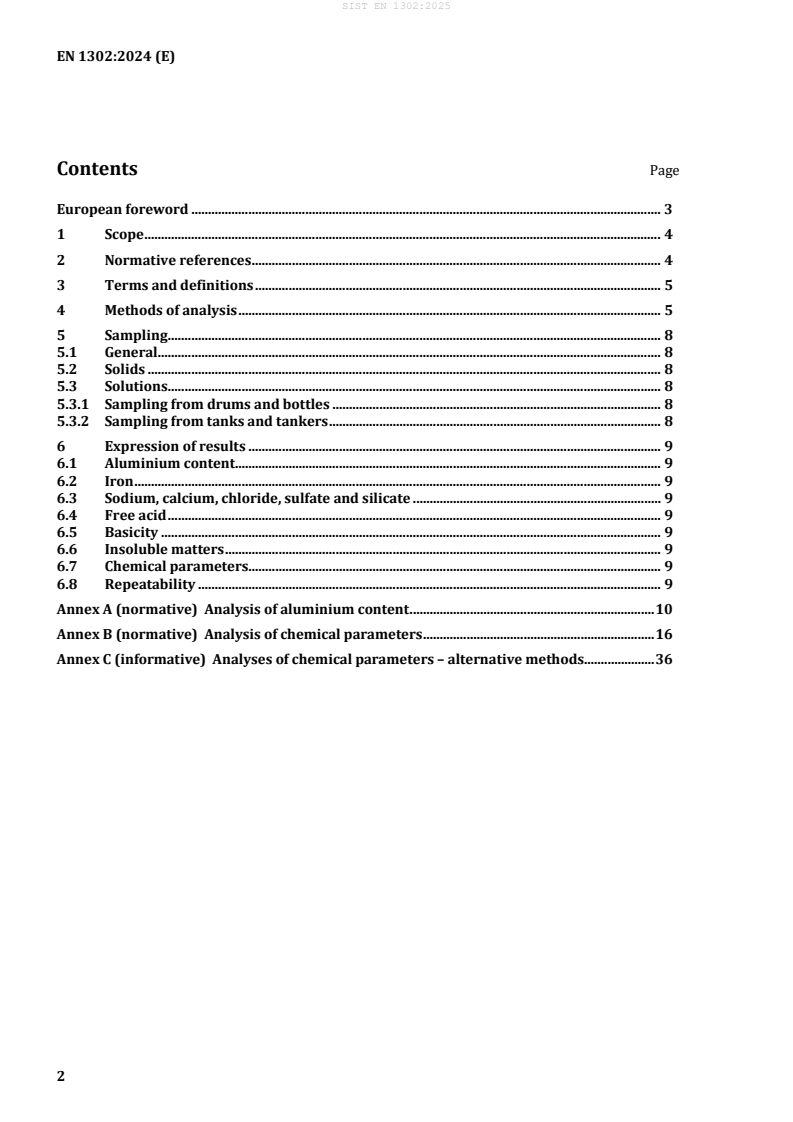
Contents Page
European foreword . 3
1 Scope . 4
2 Normative references . 4
3 Terms and definitions . 5
4 Methods of analysis . 5
5 Sampling . 8
5.1 General. 8
5.2 Solids . 8
5.3 Solutions . 8
5.3.1 Sampling from drums and bottles . 8
5.3.2 Sampling from tanks and tankers . 8
6 Expression of results . 9
6.1 Aluminium content. 9
6.2 Iron . 9
6.3 Sodium, calcium, chloride, sulfate and silicate . 9
6.4 Free acid . 9
6.5 Basicity . 9
6.6 Insoluble matters . 9
6.7 Chemical parameters. 9
6.8 Repeatability . 9
Annex A (normative) Analysis of aluminium content . 10
Annex B (normative) Analysis of chemical parameters . 16
Annex C (informative) Analyses of chemical parameters – alternative methods . 36
European foreword
This document (EN 1302:2024) has been prepared by Technical Committee CEN/TC 164 “Water supply”,
the secretariat of which is held by AFNOR.
This European Standard shall be given the status of a national standard, either by publication of an
identical text or by endorsement, at the latest by June 2025, and conflicting national standards shall be
withdrawn at the latest by June 2025.
Attention is drawn to the possibility that some of the elements of this document may be the subject of
patent rights. CEN shall not be held responsible for identifying any or all such patent rights.
This document supersedes EN 1302:1999.
In comparison with the previous edition, the following technical modifications have been made:
— Replacement of the withdrawn aluminium product standards EN 881 and EN 883 by EN 17034.
— Replacement of the withdrawn mercury analysing standard ISO 5666-1:1983 by ISO 12846:2012.
— Removal of the withdrawn standard ISO 6382:1981. As there was no replacement, the analysing
method for silicate content based on this standard was removed. To analyse silicon this standard
applies ICP-OES as given in Annex B.
— Removal of routine methods used to determinate arsenic. Method: Silver diethyldithiocarbamate
spectrophotometric method based on standard ISO 6595:1982 as this standard has been withdrawn
without replacement. This standard applies ICP-OES as given in Annex B.
— Removal of routine methods used to determinate iron. Method: 1,10-Phenanthroline
spectrophotometric method based on standard ISO 6685:1982 as this standard has been withdrawn
without replacement. This standard applies ICP-OES as given in Annex B.
2+
— Removal of a method for determination of iron (total and Fe ) (volumetric method) as the method
uses potassium dichromate and there are other options for iron determination. This standard applies
ICP-OES as given in Annex B.
— Update of the clause titles to correspond the CEN Standard form.
— Update of Table 1 and 2 to correspond the analytical methods available in the standard.
Any feedback and questions on this document should be directed to the users’ national standards body.
A complete listing of these bodies can be found on the CEN website.
According to the CEN-CENELEC Internal Regulations, the national standards organisations of the
following countries are bound to implement this European Standard: Austria, Belgium, Bulgaria, Croatia,
Cyprus, Czech Republic, Denmark, Estonia, Finland, France, Germany, Greece, Hungary, Iceland, Ireland,
Italy, Latvia, Lithuania, Luxembourg, Malta, Netherlands, Norway, Poland, Portugal, Republic of North
Macedonia, Romania, Serbia, Slovakia, Slovenia, Spain, Sweden, Switzerland, Türkiye and the United
Kingdom.
1 Scope
This document is applicable to aluminium-based coagulants used for treatment of water intended for
human consumption. It specifies analytical methods to be used for products described in EN 878, EN 882,
EN 885, EN 886, EN 887, EN 935 and EN 17034.
2 Normative references
The following documents are referred to in the text in such a way that some or all of their content
constitutes requirements of this document. For dated references, only the edition cited applies. For
undated references, the latest edition of the referenced document (including any amendments) applies.
EN 878, Chemicals used for treatment of water intended for human consumption — Aluminium sulfate
EN 882, Chemicals used for treatment of water intended for human consumption — Sodium aluminate
EN 885, Chemicals used for treatment of water intended for human consumption — Polyaluminium chloride
hydroxide silicate
EN 886, Chemicals used for treatment of water intended for human consumption — Polyaluminium
hydroxide silicate sulfate
EN 887, Chemicals used for treatment of water intended for human consumption — Aluminium iron (III)
sulfate
EN 935, Chemicals used for treatment of water intended for human consumption — Aluminium iron(III)
chloride (monomeric) and aluminium iron(III) chloride hydroxide (monomeric)
EN 17034, Chemicals used for treatment of water intended for human consumption — Aluminium chloride
anhydrous, aluminium chloride basic, dialuminium chloride pentahydroxide and aluminium chloride
hydroxide sulfate
EN ISO 3696, Water for analytical laboratory use — Specification and test methods (ISO 3696)
ISO 3165, Sampling of chemical products for industrial use — Safety in sampling
ISO 5725-2, Accuracy (trueness and precision) of measurement methods and results — Part 2: Basic method
for the determination of repeatability and reproducibility of a standard measurement method
ISO 6206:1979, Chemical products for industrial use — Sampling — Vocabulary
ISO 6227:1982, Chemical products for industrial use — General method for determination of chloride
ions — Potentiometric method
ISO 8213, Chemical products for industrial use — Sampling techniques — Solid chemical products in the
form of particles varying from powders to coarse lumps
3 Terms and definitions
For the purposes of this document, the following terms and definitions apply.
ISO and IEC maintain terminology databases for use in standardization at the following addresses:
— ISO Online browsing platform: available at https://www.iso.org/obp/
— IEC Electropedia: available at https://www.electropedia.org/
3.1
laboratory sample
sample as prepared for sending to the laboratory and intended for inspection or testing
[SOURCE: ISO 6206:1979]
3.2
test sample
sample prepared from the laboratory sample and from which test portions will be taken
[SOURCE: ISO 6206:1979]
3.3
test portion
quantity of material drawn from the test sample (or from the laboratory sample if both are the same) and
on which the test or observation is actually carried out
[SOURCE: ISO 6206:1979]
4 Methods of analysis
The methods of analysis are used to analyse the product quality. Table 1 lists the methods which shall be
used for analysis of aluminium-based coagulants composition as commercial product and the principles
of each method. The normative methods which shall be used are described in full in Annexes A and B.
Other methods can be used for quality control. Examples of other methods are mentioned in Annex C.
Table 2 lists the methods which shall be used for analysis of other chemical parameters. These are
applicable to all aluminium based coagulants (EN 878, EN 882, EN 885, EN 886, EN 887, EN 935
and EN 17034). The relevant limit value for each coagulant is available in the product standard.
Table 1 — Methods of analysis of the composition of commercial product
Reference Informative
Determination EN 878 EN 882 EN 885 EN 886 EN 887 EN 935 EN 17034 Principle Annex
method method
a
Aluminium x x x x x x x EDTA complexometric titration A.1
Aluminium x x x x x x x CDTA complexometric titration C.8.
Aluminium x x Gluconate A.2
Iron x x x x x x x x ICP-OES B.7
Iron x x x x x x x x FAAS C.4
b
Iron x x x x x x x x ICP-MS C.2
Sodium x x x x x x x ICP-OES B.7
Sodium x x x FAAS C.5
Sodium x x Gluconate A.2
Calcium x x x x FAAS C.6
Calcium x x x x ICP-OES B.7
Chloride x x x x Potentiometric titration B.1
Sulfate x x x x x Barium sulfate gravimetric titration B.2
Silicon x x x x x x x x ICP-OES B.7
Free acid x x x x Acidimetric titration B.3
Basicity x x x x x x Acidimetric titration, oxalate method B.4
Basicity x x x Acidimetric titration, KF method B.5
Basicity x Calculation method C.7
Key
FAAS: Flame Atomic Absorption Spectrometry
AFS: Atomic Fluorescence Spectrometry
ICP-OES: Inductively Coupled Plasma Optical Emission Spectrometry
ICP-MS: Inductively Coupled Plasma Mass Spectrometry
a
If the concentration of iron is higher than 0,1 %, the calulation needs to be corrected due to interferences of iron.
b
This document does not give a description for this method of analysis.
Table 2 — Applicability methods of analysis to other parameters
Reference Routine
Determination Principle
method method
Insoluble matter B.6 Gravimetry
Arsenic B.7 ICP-OES
C.3 ICP-MS
C.2 AAS
Cadmium B.7 ICP-OES
C.3 ICP-MS
C.2 AAS
Chromium B.7 ICP-OES
C.3 ICP-MS
C.2 AAS
Mercury B.9 AAS (cold vapour)
B.8 AFS
Nickel B.7 ICP-OES
C.3 ICP-MS
C.2 AAS
Lead B.7 ICP-OES
C.3 ICP-MS
C.2 AAS
Antimony B.7 ICP-OES
C.3 ICP-MS
C.2 AAS
Selenium B.7 ICP-OES
C.3 ICP-MS
C.2 AAS
Key
AAS: Atomic Absorption Spectrometry
AFS: Atomic Fluorescence Spectrometry
ICP-OES: Inductively Coupled Plasma Optical Emission Spectrometry
ICP-MS: Inductively Coupled Plasma Mass Spectrometry
5 Sampling
5.1 General
Observe the general recommendations in ISO 3165 and take into account ISO 6206.
5.2 Solids
Prepare the laboratory sample required by the relevant procedure described in ISO 8213.
From the laboratory sample, prepare the test sample by grinding the solid samples until the particle size
is below 2,5 mm and homogenizing, and homogenize the liquid samples.
5.3 Solutions
5.3.1 Sampling from drums and bottles
5.3.1.1 General
Mix the contents of each container to be sampled by shaking the container, by rolling it or by rocking it
from side to side, taking care not to damage the container or spill any of the liquid.
If the design of the container is such (for example, a narrow-necked bottle) that it is impracticable to use
a sampling implement, take a sample by pouring after the contents have been thoroughly mixed.
Otherwise, proceed as described in 5.3.1.3.
Examine the surface of the liquid. If there are signs of surface contamination, take samples from the
surface as described in 5.3.1.2. Otherwise, take samples as described in 5.3.1.3.
5.3.1.2 Surface sampling
Take a sample using a suitable ladle. Lower the ladle into the liquid until the rim is just below the surface,
so that the surface layer runs into it. Withdraw the ladle just before it fills completely and allow any liquid
adhering to the ladle to drain off. If necessary, repeat this operation so that, when the other selected
containers have been sampled in a similar manner, the total volume of sample required for subsequent
analysis is obtained.
5.3.1.3 Bottom sampling
Take a sample using an open sampling tube, or a bottom-valve sampling tube, suited to the size of
container and the viscosity of the liquid.
When using an open sampling tube, close it at the top and then lower the bottom end to the bottom of the
container. Open the tube and move it rapidly so that the bottom of the tube traverses the bottom of the
container before the tube is filled. Close the tube, withdraw it from the container and allow any liquid
adhering at the outside of the tube to drain off.
When using a bottom-valve sampling tube, close the valve before lowering the tube into the container
and then proceed in a similar manner to that when using an open sampling tube.
5.3.2 Sampling from tanks and tankers
A representative sample should be taken as appropriate:
a) from the surface of the liquid, using a ladle as described in 5.3.1.2;
b) from the bottom of the tank or tanker, using a sampling tube as described in 5.3.1.3 or using specially
designed bottom-sampling apparatus;
c) from one or more positions, depending on the overall depth, between the bottom and the surface
using a weighted sampling can.
6 Expression of results
6.1 Aluminium content
The aluminium content shall be expressed as aluminium mass fraction in % or as Al in grams per kg of
product.
6.2 Iron
The iron content shall be expressed as iron mass fraction in % or ar Fe in grams per kg of product
depending on analytical method.
6.3 Sodium, calcium, chloride, sulfate and silicate
The sodium, calcium, chloride or sulfate content shall be expressed as grams of substance per kilogram
of product or as mass fraction in % depending on analytical method.
6.4 Free acid
Free acid shall be expressed as in grams of sulfuric acid per kilogram of product (H SO g/kg) or in grams
2 4
of hydrochloric acid per kilogram of product (HCl g/kg) or as mass fraction in %.
6.5 Basicity
–
The basicity shall be expressed in grams of hydroxide per kilogram of product (OH g/kg) or as the
–
relative basicity expressed in moles of OH per moles of Al (OH/Al) or as in % (OH/AL *100/3).
6.6 Insoluble matters
Insoluble matters shall be expressed in mass fraction in % or in grams per kilogram of product.
6.7 Chemical parameters
The chemical parameters mentioned in Table 2 shall be expressed as milligrams of element per kilogram
of product.
6.8 Repeatability
Each laboratory shall calculate the repeatability of the method under their laboratory conditions
according to the procedure defined in ISO 5725-2.
Annex A
(normative)
Analysis of aluminium content
A.1 Determination of aluminium (EDTA complexometric method)
A.1.1 General
This method shall be used for the determination of aluminium in aluminium-based coagulants used for
treatment of water intended for human consumption, as a reference method for products described in
EN 878, EN 885, EN 886, EN 887, EN 935 and EN 17034.
If iron concentration is lower than 0,1 % Fe, the calculation needs to be corrected due to interference of
Fe (see A.1.2)
A.1.2 Principle
Dissolution in water, in the case of solid products, or dilution with water in the case of products in
solution, of a test sample.
Complexation of aluminium, in a hot acidic medium with an excess of ethylenediaminetetraacetic acid
(EDTA) solution. Titration of the excess EDTA with a standard volumetric solution of zinc in the presence
of xylenol orange as indicator.
3+ 4- -
Al + EDTA → AlEDTA
2+ 4- 2-
Zn + EDTA → ZnEDTA
If the Fe concentration is > 0,1 %, the concentration X will be corrected, due to interferences of Fe, using
the calculation mentioned in A.1.6.
A.1.3 Reagents
All reagents shall be of a recognized analytical grade and the water used shall conform to grade 3 in
accordance with EN ISO 3696.
A.1.3.1 Sodium acetate solution, 80 g/l.
A.1.3.2 Sodium hydroxide solution, 100 g/l.
A.1.3.3 Hydrochloric acid solution 1:1
Dilute one volume of hydrochloric acid (P = 1,19 g/ml) with one volume of water.
A.1.3.4 Hydrochloric acid, 36,5 g/l, c(HCl) = 1 mol/l.
A.1.3.5 Disodium ethylenediaminetetraacetate dihydrate (NaEDTA), standard volumetric solution,
c(C H N O Na ·2H O) = 0,05 mol/l. Weigh to the nearest 0,000 1 g, 18,625 g of NaEDTA. Dissolve in
10 14 2 8 2 2
water, transfer the solution quantitatively to a 1 000 ml volumetric flask. Dilute to volume with water and
homogenize.
NOTE Commercial standard volumetric solution could be used.
A.1.3.6 Zinc, standard volumetric solution, c(Zn) = 0,05 mol/l. Weigh to the nearest 0,000 1 g, 6,537 g
(m)of pure zinc (minimum content 99,9 % (m/m)).
Dissolve in 60 ml of hydrochloric acid solution (A.1.3.3). During the reaction, cover the beaker with a
watch-glass. At the end of the reaction, boil the solution for 10 min, then cool to room temperature. Dilute
to about 500 ml with water and add sodium acetate solution (A.1.3.1) until a pH of 5,5 ± 0,1 is obtained.
Transfer the solution quantitatively to a 2 000 ml volumetric flask. Dilute to volume with water and
homogenize.
NOTE 1 If the mass of zinc is not exactly that stated above, the zinc concentration is given by the equation:
m
c Zn =
( )
2× 65,37
where
m is the mass in grams of zinc weighed;
65,37 is the relative molecular mass of zinc;
c(Zn) is the concentration of zinc solution, in moles per litre, calculated to the fourth
significant figure.
NOTE 2 Commercial standard solution could be used.
A.1.3.7 Buffer solution, pH 5,5.
Weigh 50 g of sodium acetate trihydrate (CH COONa·3H O). Dissolve in 500 ml of water and add glacial
3 2
acetic acid (CH COOH) until a pH of 5,5 ± 0,1 is obtained.
A.1.3.8 Xylenol orange.
Grind 1,0 g of xylenol orange with 99 g of potassium nitrate in a mortar until a homogeneous mass is
obtained.
A.1.4 Apparatus
Ordinary laboratory apparatus and glassware, and optionally:
A.1.4.1 Automatic titrator and photometer with fibre optic probe.
A.1.4.2 Microwave equipment.
A.1.5 Procedure
A.1.5.1 Preparation of the test solution
Weigh, to the nearest 0,001 g, about 25 g of the test sample (m ) into a 400 ml beaker.
Add approximately 150 ml of water at 80 °C to 90 °C. Stir until dissolved, using a glass stirrer.
Transfer quantitatively to a 500 ml volumetric flask. Dilute to volume with water and homogenize. Filter
if necessary through a filter paper (particle retention size 2,5 μm) (test solution V ).
Place V ml of this solution (see Table A.1) into a 200 ml volumetric flask. Dilute to volume with water
and homogenize (diluted test solution V ).
Table A.1 — Aliquot portion V for Al determination (EDTA method)
Expected content Volume V
Al g/kg ml
< 27 100
27 to 66 50
66 to 133 20
133 to 265 10
A.1.5.2 Blank test
Perform a blank test following the same procedure and using the same quantities of all the reagents as
indicated in A.1.5.3. Record the volume used for the titration (V ).
A.1.5.3 Determination
Transfer 100,0 ml of solution (A.1.5.1) (V ) to a 250 ml beaker and adjust to pH 5 to 6 with hydrochloric
acid solution (A.1.3.3) or sodium hydroxide solution (A.1.3.2). Add 5 ml of hydrochloric acid
solution (A.1.3.4) and 50,0 ml of the standard volumetric solution of EDTA (A.1.3.5). Cover with a watch
glass. Heat the solution at 80 °C to 90 °C for at least 20 min. Cool to room temperature. Rinse the watch
glass with water into the beaker. Neutralize with sodium acetate solution (A.1.3.1). The pH value shall be
between 7 to 7,5 and add 10 ml of the buffer solution (A.1.3.7).
Add 30 mg to 50 mg of xylenol orange mixture (A.1.3.8). Titrate with the standard volumetric zinc
solution (A.1.3.6) until the indicator changes from yellow to definite red or determine the equivalence
point using an automatic titrator. Record the volume (V ) used.
If microwave equipment (A.1.4.2) is used, the volume V and the volume of the aliquot portion (A.1.5.1)
can be different from those indicated above. Transfer the test portion to a 250 ml conical flask and adjust
to pH 5 to 6 with hydrochloric acid (A.1.3.3) or sodium hydroxide solution (A.1.3.2). Add 5 ml of
hydrochloric acid solution (A.1.3.4) and the suitable volume of the standard volumetric solution of
EDTA (A.1.3.5). Transfer to the microwave equipment. Operate the microwave equipment at a power
setting to achieve a temperature at 80 °C to 90 °C for 15 min. Then cool to room temperature. Transfer
quantitatively to a 250 ml beaker or to the automatic titration cell.
If an automatic titrator (A.1.4.1) is used, the volume of the aliquot portion (A.1.5.1) and the volumes of
the reagents can be different from those indicated above. They should be such that the required precision
is achieved.
A.1.6 Expression of results
The aluminium content, X expressed in grams of aluminium per kilogram of product (Al g/kg) is given
by the equation:
V V
1 000
2 0
X 0,026 98× VV−××c××
( )
1 54
VV m
3 1 0
=
where
m is the mass, in grams, of the test sample;
V is the volume, in millilitres, of the test solution;
V is the volume, in millilitres, of test solution diluted to V ;
1 2
V is the volume, in millilitres, of the diluted test solution;
V is the volume, in millilitres, of the aliquot for the determination;
V is the volume, in millilitres, of the standard volumetric solution of zinc used for the
titration of the sample test;
V is the volume, in millilitres, of the standard volumetric solution of zinc used for the
titration of the blank test;
c is the actual concentration, in moles per litre, of the standard volumetric solution of
zinc;
0,02698 is the mass of Al, in grams, corresponding to 1 ml of standard volumetric solution of
zinc, c(Zn) = 1 mol/l.
with V = 500 ml, V = 200 ml, V = 100 ml:
0 2 3
VV− × c
( )
X 26 980×
Vm
If the Fe concentration is higher than 0,1 %, the concentration X will be corrected, due to interferences
of Fe, using below calculation. The corrected Al concentration X is given by the equation
Fe × M Al
( )
tot W
XX−
M
W Fe
( )
where
Fe is the mass of iron, in grams per kilogram of Al, of the test sample;
tot
M (Al) is the molar mass of aluminium, in grams per moles, of the test solution;
W
M (Fe) is the molar mass of iron, in grams per moles, of the test solution;
W
A.2 Determination of aluminium and sodium in sodium aluminate
A.2.1 General
This method shall be used for determination of Na and Al in sodium aluminate described in EN 882.
If the carbonate content is high the calculated sodium content shall be corrected (A.2.2.2).
The measuring range of this method is 2 5 to 30 % Na and 2 % to 30 % Al.
A.2.2 Principle
A.2.2.1 General
The composition of sodium aluminate solutions can be written:
NaAl(OH) + a NaOH (excess) + b Na CO .
4 2 3
=
=
Sodium and aluminium are determined by titration methods:
A.2.2.2 Determination of sodium
Gluconate is added and after that the solution is titrated to pH 9,0 with hydrochloric acid. When the
gluconate is added the following reaction takes place:
NaAl(OH) + n Gl → Al(OH) Gl + NaOH
4 3 n
When the pH is lowered to 9,0 the carbonate is mainly transformed to hydrogen carbonate:
Na CO + H O → NaHCO + NaOH
2 3 2 3
The total amount of acid used in the titration thus is:
1 + a + b mole HCl/mole Al = 1 + a + 2b mole Na/mole Al
A.2.2.3 Determination of aluminium
Potassium fluoride is added to the titrated solution from a):
– +
Al(OH) Gln + 6 KF → K AlF + 3 OH + 3 K + n Gl
3 3 6
An excess of hydrochloric acid is added and back titration to the pH 9,0 is carried out with sodium
hydroxide. Three moles of acid consumed are thus equivalent to one mole of Al.
A.2.3 Reagents
All reagents shall be of a recognized analytical grade and the water used shall conform to grade 1 in
accordance with EN ISO 3696.
A.2.3.1 Hydrochloric acid, HCl, 0,2 mol/l.
A.2.3.2 Sodium hydroxide, NaOH, 0,2 mol/l.
A.2.3.3 Sodium gluconate, C H (OH) COONa.
5 6 5
A.2.3.4 Sodium gluconate solution, 200 g/l.
Dissolve 40 g sodium gluconate (A.2.3.3) in 200 ml water. Adjust the solution to pH 9,0. Add 5 drops of
phenolphthalein solution (A.2.3.7). Store the solution in a plastic bottle.
A.2.3.5 Potassium fluoride, KF, pa.
A.2.3.6 Potassium fluoride (KF) solution, 3,5 mol/l.
Dissolve 200 g KF (A.2.3.5) in water up to 1000 ml and adjust pH to 8,9. Fluoride ions react with glass,
therefore store this solution in a plastic bottle.
A.2.3.7 Phenolphthalein solution, 0,5 g in 100 ml ethanol.
A.2.4 Apparatus
A.2.4.1 pH meter
A.2.4.2 Balance
Balance capable of weighing accurately 1 mg.
A.2.5 Procedure
A.2.5.1 Sample solution
Weigh 0,5 to 0,6 g weighted to the nearest 0,001 g homogenized liquid sample or 0,25 to 0,3 g weighted
to the nearest 0,001 g solid sample in a 250 ml beaker. Add about 50 ml water and stir. This is the sample
solution.
A.2.5.2 Determination
Analysis of the Na content
Add 15 ml of sodium gluconate solution (A.2.3.4) and 3 to 5 drops of the phenolphthalein solution
(A.2.3.7) to the sample solution (A.2.5.1).
Titrate immediately the solution with hydrochloric acid (A.2.3.1) to pH 9,0. Record the volume, V .
Continue using this solution when analysing the Al content.
Analysis of the Al content.
Continue with the sample from the analysis of the Na content and add 15 ml of KF solution (A.2.3.6).
Titrate immediately and quickly the solution with hydrochloric acid (A.2.3.1) until the colour has
disappeared and add an excess of 5 to 6 ml of hydrochloric acid (A.2.3.1). Record the total volume, V .
Titrate immediately the solution with sodium hydroxide (A.2.3.2) to pH 9,0. Record the volume, V .
A.2.6 Calculation and expression of results
The sodium content X and the aluminium content Y, expressed in weight % of product (%), are given by
the equations:
Vc×× 23,00× 100
X % Na
m× 1 000
% Na O = 1,348 × % Na
V ×−×c Vc × 26, 98× 100
( ) ( )
21 3 2
Y % Al
m××3 1 000
% Al O = 1,890 × % Al
2 3
where
V is the volume of HCl in ml;
c is the concentration of HCl in mole/l;
V is the volume of HCl in ml;
V is the volume of NaOH in ml;
c is the concentration of NaOH in mole/l;
m is the mass of sample in grams.
==
==
Annex B
(normative)
Analysis of chemical parameters
B.1 Determination of chloride (potentiometric method)
B.1.1 General
This method shall be used for the determination of chloride in aluminium-based coagulants used for
treatment of water intended for human consumption, as a normative method for products described in
EN 881, EN 885, EN 935 and EN 17034.
B.1.2 Principle
Dissolution in water, in the case of solid products, or dilution with water, in the case of products in
solution of a test sample.
Potentiometric titration with silver nitrate, in an acetone and water medium to reduce the solubility of
silver chloride:
- +
Cl + Ag → Ag Cl
B.1.3 Reagents
All reagents shall be of a recognized analytical grade and the water used shall conform to grade 3 in
accordance with EN ISO 3696.
Use the reagents described in ISO 6227:1982, Clause 4.
B.1.4 Apparatus
Use the apparatus described in ISO 6227:1982, Clause 5.
B.1.5 Procedure
B.1.5.1 Preparation of the test solution
Weigh, to the nearest 0,001 g, about 25 g of the test sample (m ) into a 400 ml beaker.
Add approximately 150 ml of water at 80 °C to 90 °C. Stir until dissolved, using a glass stirrer.
Transfer quantitatively to a 500 ml volumetric flask. Dilute to volume with water and homogenize. Filter
).
if necessary through a filter paper (particle retention size 2,5 μm) (test solution V0
B.1.5.2 Blank test
Perform a blank test following the same procedure and using the same quantities of all the reagents as
indicated in B.1.5.3.
B.1.5.3 Determination
If necessary, dilute the test solution as indicated in Table B.1.
Pipette the volume (V ) of solution or of diluted solution indicated in Table B.1.
Proceed as described in ISO 6227:1982, Clause 6.
-
Table B.1 — Dilutions and aliquot portion V for Cl determination
-
Corresponding
Expected Cl in
-
Dilution V1/V2 Volume V3
Expected Cl content
-
test solution
mass of Cl
g/kg ml/ml mg/l ml mg
5 to 25 250 to 1 250 50 12,5 to 62,5
25 to 50 1 250 to 2 500 25 31,25 to 62,5
50 to 125 2 500 to 6 250 10 25 to 62,5
125 to 250 20/100 1 250 to 2 500 25 31,25 to 62,5
250 to 625 20/100 2 500 to 6 250 10 25 to 62,5
B.1.6 Expression of results
-
The chloride content, X , expressed in grams of chloride per kilogram of product (Cl g/kg) is given by the
equation:
V V
1 000
2 0
X 0,035 45 V− V××c××
( )
6 4 5
VV m
3 1 0
where
m is the mass, in grams, of the test sample;
V is the volume, in millilitres, of the test solution;
c is the actual concentration, in moles per litre, of the silver nitrate solution used for
the determination (ISO 6227:1982, 6.2.4);
V is the volume, in millilitres, of test solution diluted to V ;
1 2
V is the volume, in millilitres, of the diluted test solution;
V is the volume, in millilitres, of the diluted test solution used for the determination;
V is the volume, in millilitres, of silver nitrate solution used for the determination;
V is the volume, in millilitres, of silver nitrate solution used for the blank test;
0,035 45 is the mass of chloride, in grams, corresponding to 1 ml of a standard volumetric
+
solution of silver nitrate, c(Ag ) = 1 mol/l.
B.2 Determination of sulfate (gravimetric method)
B.2.1 General
This method shall be used for the determination of sulfate in aluminium-based coagulants used for
treatment of water intended for human consumption, as a normative method for products described in
EN 878, EN 886, EN 887 and EN 17034.
B.2.2 Principle
Dissolution in water, in the case of solid products, or dilution with water, in the case of products in
solution, of a test sample.
Gravimetric determination of sulfate as barium sulfate.
=
B.2.3 Reagents
All reagents shall be of a recognized analytical grade and the water used shall conform to grade 3 in
accordance with EN ISO 3696.
B.2.3.1 Hydrochloric acid, P = 1,19 g/ml, (approximately 12,5 mol/l).
B.2.3.2 Barium chloride, 100 g/l.
B.2.3.3 Silver nitrate, 20 g/l.
B.2.4 Apparatus
Ordinary laboratory apparatus and glassware, and:
B.2.4.1 Ash-free filter paper with slow filtration speed.
B.2.4.2 Electric furnace, capable of being controlled at 800 °C ± 20 °C.
B.2.4.3 Platinum crucible.
B.2.5 Procedure
B.2.5.1 Preparation of the test solution
Weigh, to the nearest 0,001 g, about 25 g of the test sample (m ) into a 400 ml beaker.
Add approximately 150 ml of water at 80 °C to 90 °C. Stir until dissolved, using a glass stirrer.
Transfer quantitatively to a 500 ml volumetric flask. Dilute to volume with water and homogenize. Filter
if necessary through a filter paper (particle retention size 2,5 μm) (test solution V ).
Place V ml of this solution (see Table B.2) into a 250 ml beaker.
2−
Table B.2 — Aliquot portion V for SO determination
2−
Expected SO content Volume V
g/kg ml
< 50 100
50 to 300 50
> 300 20
B.2.5.2 Determination
If necessary, dilute to about 100 ml with water. Adjust the pH to 2,0 to 2,5 by dropwise addition of
hydrochloric acid solution (B.2.3.1). Heat the solution to boiling and add slowly 5 ml barium chloride
solution (B.2.3.2).
Allow the solution to stand for 2 h to 3 h at 70 °C to 80 °C to allow the precipitate to coagulate.
Transfer quantitatively the precipitate of barium sulfate to the filter (B.2.4.1). Filter the solution. Wash
the filter and the precipitate repeatedly, with hot water (60 °C to 70 °C) until the filtrate is chloride free
on testing with silver nitrate solution (B.2.3.3). Place the filter in a weighed (to the nearest 0,0001 g)
platinum crucible (B.2.4.3) (m ). After drying for combustion place the crucible in the furnace (B.2.4.2) at
800 °C for 30 min. After cooling in a desiccator, weigh the crucible (m ) to the nearest 0,0001 g.
B.2.6 Expression of results
2−
The sulfate content, X7, expressed in grams of sulfate per kilogram of product ( SO g/kg) is given by the
equation:
V
1 000
X 0, 411 568× mm−××
( )
7 2 1
Vm
where
m is the mass, in grams, of the test sample (B.2.5.1);
V is the volume, in millilitres, of the test solution;
V is the volume, in millilitres, of the aliquot for analysis;
m is the mass in grams of the crucible used (dry);
m is the mass in grams of the crucible containing the precipitate;
0,411 568 2−
is the ratio of relative molecular masses SO /BaSO
.
with V = 500 ml
mm−
( )
2 1
X 205 784×
mV×
0 1
B.3 Determination of free acid (titrimetric method)
B.3.1 General
This method shall be used for the determination of free acid in aluminium-based coagulants used for
treatment of water intended for human consumption, as the reference method for products described in
EN 878, and EN 887: free acid expressed as sulfuric acid, and in EN 935 and EN 17034: free acid
expressed as hydrochloric acid. In both cases, free acid can be expressed also as mass fraction.
B.3.2 Principle
Dissolution in water, in the case of solid products, or dilution with water, in the case of products in
solution, of a test sample.
Addition of an excess of sulfuric acid. Addition of potassium fluoride to complex aluminium. Titration of
the excess sulfuric acid with a titrated solution of sodium hydroxide in the presence of phenolphthalein
or using an automated titrimetric procedure with a pH electrode.
B.3.3 Reagents
All reagents shall be of a recognized analytical grade and the water used shall conform to grade 3 in
accordance with EN ISO 3696.
B.3.3.1 Potassium fluoride solution, 200 g/l
Dissolve 200 g of potassium fluoride in 1 l of water in a 2 l beaker. Add 1 ml of phenolphthalein solution
(B.3.3.4) and potassium hydroxide solution (5 g/l) dropwise until the appearance of a permanent faint
pink colour. Transfer into a flask.
B.3.3.2 Sodium hydroxide, standard volumetric solution, c(NaOH) = 0,1 mol/l
=
=
B.3.3.3 Sulfuric acid, standard volumetric solution, c (H SO ) = 0,05 mol/l
2 4
B.3.3.4 Phenolphthalein
Dissolve 1,0 g of phenolphthalein in 100 g of ethanol.
B.3.4 Apparatus
Ordinary laboratory apparatus and glassware and optionally automatic titrator with glass and reference
electrodes.
B.3.5 Procedure
B.3.5.1 Preparation of the test solution
Weigh to the nearest 0,001 g, about 25 g of the test sample (m ) into a 400 ml beaker.
Add approximately 150 ml of water at 80 °C to 90 °C. Stir until dissolved, using a glass stirrer.
Transfer quantitatively to a 500 ml volumetric flask. Dilute to volume with water and homogenize. Filter,
if necessary, through a filter paper (particle retention size 2,5 μm) (test solution V ).
B.3.5.2 Blank test
Perform a blank test following the same procedure and using the same quantities of all the reagents as
indicated in B.3.5.3. Record the volume (V ) used for the titration.
B.3.5.3 Determination
Transfer an appropriate volume V of the test solution (B.3.5.1) (see Table B.3) depending on the
expected free acid content, to a 250 ml beaker.
Table B.3 — Aliquot portion V for free acid, titrimetric method
Expected free acid Volume of solution V
g/kg ml
as H SO as HCl
2 4
< 50 < 35 100
> 50 > 35 25
Add 25,0 ml of sulfuric acid (B.3.3.3), 20 ml of potassium fluoride solution (B.3.3.1) and 3 or 4 drops of
phenolphthalein solution (B.3.3.4). Titrate the solution with sodium hydroxide solution (B.3.3.2) to the
appearance of a faint permanent pink colour, or to the equivalence point using an automatic titrator.
Record the volume (V ) used for the titration.
B.3.6 Expression of results
B.3.6.1 Expression as sulfuric acid
The free acid, X , expressed in grams of sulfuric acid per kilogram of product (H SO g/kg) is given by the
9 2 4
equation:
V
1 000
X 0,049× V− V××c ×
( )
9 23
Vm
=
where
m is the mass, in grams, of the test sample;
V is the volume, in millilitres, of the test solution;
V is the volume, in millilitres, of the aliquot for the determination;
V is the volume, in millilitres, of the standard volumetric solution of sodium
hydroxide used for the titration of the aliquot;
V is the volume, in millilitres, of the standard volumetric solution of sodium
hydroxide used for the titration of the blank test;
c is the actual concentration, in moles per litre, of the standard volumetric solution of
sodium hydroxide;
0,049 is the mass of sulfuric acid, in grams, corresponding to 1 ml of standard volumetric
solution of sodium hydroxide, c(NaOH) = 1,000 mol/l.
with V = 500 ml, c = 0,100 0 mol/l
V − V
( )
X 2 450×
Vm
The result can be expressed as mass fraction:
+
% H S 0 w / w mol H / 100g× 98,/08 2
( )
( )
B.3.6.2 Expression as hydrochloric acid
The free acidity, X' , expressed in grams of hydrochloric acid per kilogram of product (HCl g/kg) is given
by the equation:
V
1 000
X ',0 036 5× V− V××c ×
( )
9 23
Vm
where
m is the mass, in grams, of the test sample;
V is the volume, in millilitres, of the test solution;
V is the volume, in millilitres, of the aliquot for the determination;
V is the volume, in millilitres, of the standard volumetric solution of sodium hydroxide
used for the titration of the aliquot;
V is the volume, in millilitres, of the standard volumetric solution of sodium hydroxide
used for the titration of the blank test;
c is the actual concentration, in moles per litre, of the standard volumetric solution of
sodium hydroxide;
0,0365 is the mass of hydrochloric acid, in grams, corresponding to 1 ml of standard
volumetric solution of sodium hydroxide, c(NaOH) = 1,000 mol/l.
with V = 500 ml, c = 0,100 0 mol/l
=
=
=
V − V
( )
X ' 1 825×
Vm
The result can be expressed as mass fraction:
+
% HCl w/ w mol H / 100g× 36, 46
( )
( )
B.4 Determination of basicity (titrimetric oxalate method)
B.4.1 General
This method shall be used for the determination of basici
...