

SIST EN 1998-6:2005
(Main)Eurocode 8: Design of structures for earthquake resistance - Part 6: Towers, masts and chimneys
- Abstract
Complementary to material related Eurocode parts dealing with towers, masts and chimneys. Design rules for the earthquake resistant design of tall, slender structures: towers, including bell-towers and intake towers, masts, industrial chimneys and lighthouses constructed in reinforced concrete or steel.
- Status
- Published
- Publication Date
- 30-Sep-2005
- Technical Committee
- KON - Structures
- Current Stage
- 6060 - National Implementation/Publication (Adopted Project)
- Start Date
- 01-Oct-2005
- Due Date
- 01-Oct-2005
- Completion Date
- 01-Oct-2005


SIST EN 1998-6:2005 is the Slovenian adoption of EN 1998-6:2005, published by SIST and identical to the European standard Eurocode 8, Part 6. It gives seismic design rules for tall, slender structures such as towers, masts and chimneys, for use by structural designers, reviewers and project teams working on reinforced concrete and steel structures.
What does SIST EN 1998-6:2005 specify?
SIST EN 1998-6:2005 specifies requirements, criteria and design rules for the earthquake-resistant design of towers, including bell-towers and intake towers, radio and TV towers, masts, industrial chimneys, free-standing chimneys and lighthouses. It is complementary to the material-related Eurocode parts and adds seismic provisions for these slender structures.
The scope excludes cooling towers and offshore structures. Towers supporting tanks are covered by EN 1998-4.
| Annex | What it covers |
|---|---|
| Annex A | Linear dynamic analysis with rotational components of ground motion |
| Annex B | Modal damping in modal response spectrum analysis |
| Annex C | Soil-structure interaction |
| Annex D | Number of degrees of freedom and modes of vibration |
| Annex E | Masonry chimneys |
| Annex F | Electrical transmission towers |
The document is organised into general provisions, performance and compliance criteria, seismic action, general design rules, then separate sections for reinforced concrete chimneys, steel chimneys, steel towers and guyed masts.
What are the key requirements of SIST EN 1998-6:2005?
SIST EN 1998-6:2005 is built around no-collapse and damage limitation requirements. In practice, the structure must protect life and nearby assets under the design earthquake, and it must also limit damage where continued operation matters, such as telecom, power and industrial facilities.
Seismic input and analysis
The standard allows translational ground motion and, for tall structures in high seismicity, rotational ground motion to be considered. For design spectra, the behaviour factor q may be limited to 1.5 when elastic behaviour is intended, and time-history or response spectrum analysis may be used with suitable damping and independent components.
This matters because tall, flexible structures are sensitive to long-period and rotational effects, so the model and spectrum choice can change the design forces and displacements.
Modelling and analysis rules
The model should include foundation rocking and translation, enough masses and degrees of freedom to capture significant elements, cable and guy stiffness, and relevant equipment interactions. The lateral force method is only for relatively regular structures with limited higher-mode influence; otherwise, modal response spectrum analysis or 3D dynamic analysis is needed.
In practice, this determines whether a simplified design is acceptable or whether a more detailed dynamic model is required.
Verification and behaviour factor
The standard requires checks for resistance of elements and connections, second-order effects, stability, ductility and foundations. The behaviour factor q is based on a basic value q0 modified by k_r if the structure has irregularities such as eccentric mass, large openings or concentrated top mass.
This means the designer must match the seismic dissipation strategy to the actual structural form and detailing.
Special rules by structure type
Section 5 gives reinforced concrete chimney rules, including dissipative design, critical regions, reinforcement detailing and limits on wall proportions. Section 6 covers steel chimneys, including material properties, cross-section class limits and connection rules. Section 7 covers steel towers, including concentric bracing forms and special rules for electrical transmission towers. Section 8 covers guyed masts and requires low dissipative behaviour with q = 1.5.
What terms does SIST EN 1998-6:2005 define?
- Angle tower - A transmission tower used where the line changes direction by more than 3° in plan.
- Dead-end towers - Transmission towers that can take dead-end pulls from all wires on one side as well as vertical and transverse loads.
- Tangent tower - A transmission tower used on a straight line or at an angle not exceeding 3° in plan.
- Transmission tower - A tower that supports low or high voltage electrical transmission cables.
- Trussed tower - A tower whose joints are not designed to resist the plastic moment of the connected elements.
- Telescope joint - A joint between tubular elements without a flange, where one tube fits into another.
- Importance factor, γI - A factor used to distinguish seismic importance classes and reflect the consequences of failure.
- Behaviour factor, q - A factor used in seismic design to represent ductility and energy dissipation capacity.
Who uses SIST EN 1998-6:2005?
Structural engineers use SIST EN 1998-6:2005 when designing or checking tall slender structures in seismic regions. It is also used by geotechnical engineers, connection designers, tower and chimney specialists, and reviewers who need to confirm that analysis, detailing and verification follow Eurocode 8.
It is relevant to telecom and broadcast infrastructure, power transmission structures, industrial plants, water and civil protection facilities, and chimney projects in reinforced concrete, steel or masonry-related applications.
What changed in SIST EN 1998-6:2005 from the previous edition?
SIST EN 1998-6:2005 supersedes ENV 1998-3:1996.
Which standards are used with SIST EN 1998-6:2005?
- EN 1998-1 - Provides the general seismic design framework, spectra, action combinations, behaviour factor rules and general limit-state provisions.
- EN 1998-5 - Covers foundations, retaining structures and geotechnical aspects, including soil-structure interaction and foundation design.
- EN 1990 - Provides the basis of structural design and, in Annex A3, the application rules for towers and masts.
- EN 1992-1-1 / EN 1992-1-2 - Supply concrete design and fire design rules used for reinforced concrete chimneys and other concrete elements.
- EN 1993-1-1, EN 1993-1-2, EN 1993-1-4, EN 1993-1-5, EN 1993-1-6, EN 1993-1-8, EN 1993-1-10, EN 1993-1-11 - Provide steel design, joints, fracture toughness, tension components and shell rules.
- EN 1993-3-1 / EN 1993-3-2 - Provide the base rules for towers, masts and chimneys in steel.
- EN 1994-1-1 / EN 1994-1-2 - Apply where composite steel and concrete members are relevant.
- EN 13084-2 / EN 13084-7 - Add chimney-specific concrete and high-temperature steel provisions.
- EN 1998-2 / EN 1998-4 - Are referenced for specific dynamic and tank-support situations.
What does the SIST EN 1998-6:2005 document contain?
The document includes the main seismic design rules, compliance criteria, classification tables, analysis methods, verification rules and structure-specific provisions. It also contains figures and equations for response spectra, behaviour factors, cable stiffness, reinforcement detailing and tower bracing forms.
The informative annexes add methods and guidance for rotational ground motion, modal damping, soil-structure interaction, degrees of freedom and modes, masonry chimneys, and electrical transmission towers. These parts are the practical reference sections for detailed modelling, testing assumptions, project-specific checks and design documentation.
Relations
- Effective Date
- 25-Mar-2026
- Effective Date
- 25-Mar-2026
- Effective Date
- 25-Mar-2026
- Refers
kSIST FprEN 1993-1-11:2025 - Eurocode 3 - Design of steel structures - Part 1-11: Tension components - Effective Date
- 25-Mar-2026
- Effective Date
- 25-Mar-2026
- Effective Date
- 28-Jan-2026
- Effective Date
- 28-Jan-2026
- Effective Date
- 28-Jan-2026
- Effective Date
- 28-Jan-2026
- Effective Date
- 28-Jan-2026
- Effective Date
- 28-Jan-2026
- Effective Date
- 28-Jan-2026
- Effective Date
- 28-Jan-2026
- Effective Date
- 28-Jan-2026
- Effective Date
- 28-Jan-2026
Get Certified
Connect with accredited certification bodies for this standard

DIBt (Deutsches Institut für Bautechnik)
German Institute for Building Technology.
DIN CERTCO
DIN Group product certification.

Aboma Certification B.V.
Specialized in construction, metal, and transport sectors.
Sponsored listings
Frequently Asked Questions
SIST EN 1998-6:2005 is a standard published by the Slovenian Institute for Standardization (SIST). Its full title is "Eurocode 8: Design of structures for earthquake resistance - Part 6: Towers, masts and chimneys". This standard covers: Complementary to material related Eurocode parts dealing with towers, masts and chimneys. Design rules for the earthquake resistant design of tall, slender structures: towers, including bell-towers and intake towers, masts, industrial chimneys and lighthouses constructed in reinforced concrete or steel.
Complementary to material related Eurocode parts dealing with towers, masts and chimneys. Design rules for the earthquake resistant design of tall, slender structures: towers, including bell-towers and intake towers, masts, industrial chimneys and lighthouses constructed in reinforced concrete or steel.
SIST EN 1998-6:2005 is classified under the following ICS (International Classification for Standards) categories: 91.010.30 - Technical aspects; 91.060.40 - Chimneys, shafts, ducts; 91.120.25 - Seismic and vibration protection. The ICS classification helps identify the subject area and facilitates finding related standards.
SIST EN 1998-6:2005 has the following relationships with other standards: It is inter standard links to kSIST FprEN 1994-1-2:2025, kSIST FprEN 1993-3:2025, kSIST FprEN 1998-1-2:2025, kSIST FprEN 1993-1-11:2025, kSIST FprEN 1994-1-1:2025, SIST EN 13084-7:2013, kSIST FprEN 1993-1-10:2024, SIST EN 13084-2:2007, SIST EN 1993-1-11:2007, kSIST FprEN 1993-1-1:2022, kSIST FprEN 1998-2:2024, kSIST FprEN 1993-1-4:2024, SIST EN 1994-1-2:2006, kSIST FprEN 1992-1-2:2023, kSIST FprEN 1998-1-1:2024. Understanding these relationships helps ensure you are using the most current and applicable version of the standard.
SIST EN 1998-6:2005 is associated with the following European legislation: EU Directives/Regulations: 2005-01-4408, 305/2011, 89/106/EEC, TRRTP129; Standardization Mandates: M/265, M/BC/CEN/89/11. When a standard is cited in the Official Journal of the European Union, products manufactured in conformity with it benefit from a presumption of conformity with the essential requirements of the corresponding EU directive or regulation.
SIST EN 1998-6:2005 is available in PDF format for immediate download after purchase. The document can be added to your cart and obtained through the secure checkout process. Digital delivery ensures instant access to the complete standard document.
Standards Content (Sample)
2003-01.Slovenski inštitut za standardizacijo. Razmnoževanje celote ali delov tega standarda ni dovoljeno.Eurocode 8: Design of structures for earthquake resistance - Part 6: Towers, masts and chimneysEvrokod 8: Projektiranje potresnoodpornih konstrukcij – 6. del: Stolpi, jambori, dimnikiEurocode 8: Calcul des structures pour leur résistance aux séismes - Partie 6 : Tours, mâts et cheminéesEurocode 8: Auslegung von Bauwerken gegen Erdbeben - Teil 6: Türme, Maste und SchornsteineTa slovenski standard je istoveten z:EN 1998-6:2005SIST EN 1998-6:2005en91.120.25YLEUDFLMDPLSeismic and vibration protection91.060.40Dimniki, jaški, kanaliChimneys, shafts, ducts91.010.30Technical aspectsICS:SLOVENSKI
STANDARDSIST EN 1998-6:200501-oktober-2005
EUROPEAN STANDARD NORME EUROPÉENNE EUROPÄISCHE NORM
EN 1998-6
June 2005 ICS 91.120.25 Supersedes ENV 1998-3:1996 English version
Eurocode 8: Design of structures for earthquake resistance - Part 6: Towers, masts and chimneys
Eurocode 8: Calcul des structures pour leur résistance aux séismes - Partie 6 : Tours, mâts et cheminées
Eurocode 8: Auslegung von Bauwerken gegen Erdbeben - Teil 6: Türme, Maste und Schornsteine This European Standard was approved by CEN on 25 April 2005.
CEN members are bound to comply with the CEN/CENELEC Internal Regulations which stipulate the conditions for giving this European Standard the status of a national standard without any alteration. Up-to-date lists and bibliographical references concerning such national standards may be obtained on application to the Central Secretariat or to any CEN member.
This European Standard exists in three official versions (English, French, German). A version in any other language made by translation under the responsibility of a CEN member into its own language and notified to the Central Secretariat has the same status as the official versions.
CEN members are the national standards bodies of Austria, Belgium, Cyprus, Czech Republic, Denmark, Estonia, Finland, France, Germany, Greece, Hungary, Iceland, Ireland, Italy, Latvia, Lithuania, Luxembourg, Malta, Netherlands, Norway, Poland, Portugal, Slovakia, Slovenia, Spain, Sweden, Switzerland and United Kingdom.
EUROPEAN COMMITTEE FOR STANDARDIZATION
COMITÉ EUROPÉEN DE NORMALISATION EUROPÄISCHES KOMITEE FÜR NORMUNG
Management Centre: rue de Stassart, 36
B-1050 Brussels © 2005 CEN All rights of exploitation in any form and by any means reserved worldwide for CEN national Members. Ref. No. EN 1998-6:2005: E
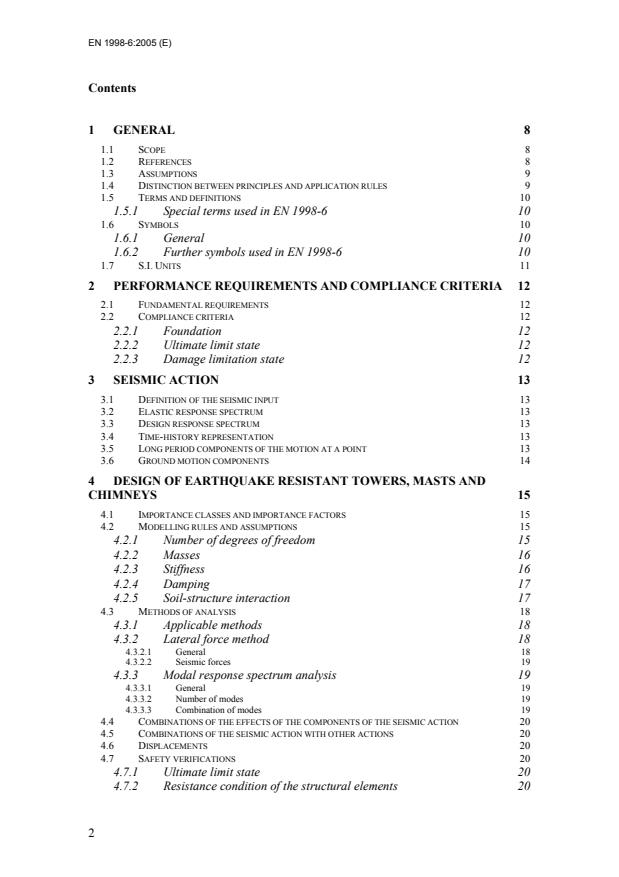
1 GENERAL 8 1.1 SCOPE 8 1.2 REFERENCES 8 1.3 ASSUMPTIONS 9 1.4 DISTINCTION BETWEEN PRINCIPLES AND APPLICATION RULES 9 1.5 TERMS AND DEFINITIONS 10 1.5.1 Special terms used in EN 1998-6 10 1.6 SYMBOLS 10 1.6.1 General 10 1.6.2 Further symbols used in EN 1998-6 10 1.7 S.I. UNITS 11 2 PERFORMANCE REQUIREMENTS AND COMPLIANCE CRITERIA 12 2.1 FUNDAMENTAL REQUIREMENTS 12 2.2 COMPLIANCE CRITERIA 12 2.2.1 Foundation 12 2.2.2 Ultimate limit state 12 2.2.3 Damage limitation state 12 3 SEISMIC ACTION 13 3.1 DEFINITION OF THE SEISMIC INPUT 13 3.2 ELASTIC RESPONSE SPECTRUM 13 3.3 DESIGN RESPONSE SPECTRUM 13 3.4 TIME-HISTORY REPRESENTATION 13 3.5 LONG PERIOD COMPONENTS OF THE MOTION AT A POINT 13 3.6 GROUND MOTION COMPONENTS 14 4 DESIGN OF EARTHQUAKE RESISTANT TOWERS, MASTS AND CHIMNEYS 15 4.1 IMPORTANCE CLASSES AND IMPORTANCE FACTORS 15 4.2 MODELLING RULES AND ASSUMPTIONS 15 4.2.1 Number of degrees of freedom 15 4.2.2 Masses 16 4.2.3 Stiffness 16 4.2.4 Damping 17 4.2.5 Soil-structure interaction 17 4.3 METHODS OF ANALYSIS 18 4.3.1 Applicable methods 18 4.3.2 Lateral force method 18 4.3.2.1 General 18 4.3.2.2 Seismic forces 19 4.3.3 Modal response spectrum analysis 19 4.3.3.1 General 19 4.3.3.2 Number of modes 19 4.3.3.3 Combination of modes 19 4.4 COMBINATIONS OF THE EFFECTS OF THE COMPONENTS OF THE SEISMIC ACTION 20 4.5 COMBINATIONS OF THE SEISMIC ACTION WITH OTHER ACTIONS 20 4.6 DISPLACEMENTS 20 4.7 SAFETY VERIFICATIONS 20 4.7.1 Ultimate limit state 20 4.7.2 Resistance condition of the structural elements 20
For fifteen years, the Commission, with the help of a Steering Committee with Representatives of Member States, conducted the development of the Eurocodes programme, which led to the first generation of European codes in the 1980s.
In 1989, the Commission and the Member States of the EU and EFTA decided, on the basis of an agreement1 between the Commission and CEN, to transfer the preparation and the publication of the Eurocodes to CEN through a series of Mandates, in order to provide them with a future status of European Standard (EN). This links de facto the Eurocodes with the provisions of all the Council’s Directives and/or Commission’s Decisions dealing with European standards (e.g. the Council Directive 89/106/EEC on construction products - CPD - and Council Directives 93/37/EEC, 92/50/EEC and 89/440/EEC on public works and services and equivalent EFTA Directives initiated in pursuit of setting up the internal market). The Structural Eurocode programme comprises the following standards generally consisting of a number of Parts: EN 1990 Eurocode: Basis of structural design EN 1991 Eurocode 1: Actions on structures
1 Agreement between the Commission of the European Communities and the European Committee for Standardisation (CEN) concerning the work on EUROCODES for the design of building and civil engineering works (BC/CEN/03/89).
2 According to Art. 3.3 of the CPD, the essential requirements (ERs) shall be given concrete form in interpretative documents for the creation of the necessary links between the essential requirements and the mandates for harmonised ENs and ETAGs/ETAs. 3 According to Art. 12 of the CPD the interpretative documents shall: a) give concrete form to the essential requirements by harmonising the terminology and the technical bases and indicating classes or levels for each requirement where necessary ; b) indicate methods of correlating these classes or levels of requirement with the technical specifications, e.g. methods of calculation and of proof, technical rules for project design, etc. ; c) serve as a reference for the establishment of harmonised standards and guidelines for European technical approvals. The Eurocodes, de facto, play a similar role in the field of the ER 1 and a part of ER 2.
– decisions on the use of informative annexes, and
– references to non-contradictory complementary information to assist the user to apply the Eurocode. Links between Eurocodes and harmonised technical specifications (ENs and ETAs) for products There is a need for consistency between the harmonised technical specifications for construction products and the technical rules for works4. Furthermore, all the information accompanying the CE Marking of the construction products which refer to Eurocodes shall clearly mention which Nationally Determined Parameters have been taken into account. Additional information specific to EN 1998-6 For the design of structures in seismic regions the provisions of this standard are to be applied in addition to the provisions of the other relevant Eurocodes. In particular, the provisions of the present standard complement those of Eurocode 3, Part 3-1 " Towers and Masts " and Part 3-2 " Chimneys", which do not cover the special requirements for seismic design. National annex for EN 1998-6 Notes indicate where national choices have to be made. The National Standard implementing EN 1998-6 shall have a National annex containing values for all Nationally Determined Parameters to be used for the design in the country. National choice is required in the following sections.
4 see Art.3.3 and Art.12 of the CPD, as well as clauses 4.2, 4.3.1, 4.3.2 and 5.2 of ID 1.
Conditions under which the rotational component of the ground motion should be taken into account. 3.5(2) The lower bound factor β=on design spectral values, if site-specific studies have been carried out with particular reference to the long-period content of the seismic action. 4.1(5)P Importance factors for masts, towers, and chimneys. 4.3.2.1(2) Detailed conditions, supplementing those in 4.3.2.1(2), for the lateral force method of analysis to be applied. 4.7.2(1)P Partial factors for materials 4.9(4) Reduction factor ν for displacements at damage limitation limit state
(4) For towers supporting tanks, EN 1998-4 applies.
1.2 Normative References 1.2.1 Use (1)P This European Standard incorporates by dated or undated reference, provisions from other publications. These normative references are cited at the appropriate places in the text and the publications are listed hereafter. For dated references, subsequent amendments to or revisions of any of these publications apply to this European Standard only when incorporated in it by amendment or revision. For undated references the latest edition of the publication referred to applies (including amendments).
1.2.2 General reference standards (1) EN 1998-1:2004, 1.2.1 applies.
and through thickness properties EN 1993-1-11 Design of steel structures – Design of structures with tension components made of steel EN 1993-3-1 Design of steel structures – Towers and masts EN 1993-3-2 Design of steel structures – Chimneys EN 1994-1-1 Design of composite steel and concrete structures – General rules and rules for buildings EN 1994-1-2 Design of composite steel and concrete structures – Structural fire design EN 1998-1 Design of structures for earthquake resistance – General rules, seismic actions and rules for buildings
EN 1998-5 Design of structures for earthquake resistance – Foundations, retaining structures and geotechnical aspects. EN 1998-2 Design of structures for earthquake resistance – Bridges. EN 13084-2 Free-standing chimneys – Concrete chimneys EN 13084-7 Free-standing chimneys – Product specification of cylindrical steel fabrications for use in single-wall steel chimneys and steel liners. 1.3 Assumptions (1)P The general assumptions of EN 1990:2002, 1.3 and EN 1998-1:2004, 1.3(2)P, apply. 1.4 Distinction between principles and application rules (1) EN 1990:2002, 1.4 applies.
transmission tower used where the line changes direction by more than 3o in plan. It supports the same kind of loads as the tangent tower dead-end towers (also called anchor towers) transmission tower able to support dead-end pulls from all the wires on one side, in addition to the vertical and transverse loads tangent tower transmission tower used where the cable line is straight or has an angle not exceeding 3o in plan. It supports vertical loads, a transverse load from the angular pull of the wires, a longitudinal load due to unequal spans, and forces resulting from the wire-stringing operation, or a broken wire telescope joint joint between tubular elements without a flange, the internal diameter of one being equal to the external diameter of the other transmission tower tower used to support low or high voltage electrical transmission cables trussed tower tower in which the joints are not designed to resist the plastic moment of the connected elements 1.6 Symbols 1.6.1 General (1) EN 1998-1:2004, 1.6.1 and 1.6.2 apply. (2) For ease of use, further symbols, used in connection with the seismic design of towers, masts and chimneys, are defined in the text where they occur. However, in addition, the most frequently occurring symbols used in EN 1998-6 are listed and defined in 1.6.2. 1.6.2 Further symbols used in EN1998-6 Eeq equivalent modulus of elasticity; Mi effective modal mass for the i-th mode of vibration;
unit weight of the cable; 1 tensile stress in the cable; j equivalent modal damping ratio of the j-th mode. 1.7 S.I. Units (1)P EN 1998-1:2004, 1.7(1)P applies. (2)
EN 1998-1:2004, 1.7(2) applies.
(4) In cases of low seismicity, as defined in EN 1998-1:2004, 2.2.1(3) and 3.2.1(4), the fundamental requirements may be satisfied by designing the structure for the seismic design situation as non-dissipative, taking no account of any hysteretic energy dissipation and neglecting the rules of the present Eurocode that specifically refer to energy dissipation capacity. In that case, the behaviour factor should not be taken greater than the value of 1,5 considered to account for overstrengths (see EN 1998-1:2004, 2.2.2(2)). 2.2 Compliance criteria 2.2.1 Foundation (1)P Foundation design shall conform to EN 1998-5. 2.2.2 Ultimate limit state (1) EN 1998-1:2004, 2.2.2 applies.
2.2.3 Damage limitation state
(1) In the absence of any specific requirement of the owner, the rules specified in 4.9 apply, to ensure that damage considered unacceptable for this limit state will be prevented to the structure itself, to non-structural elements and to installed equipment. Deformation limits are established with reference to a seismic action having a probability of occurrence higher than that of the design seismic action, in accordance with EN 1998-1:2004, 2.1(1)P. (2) Unless special precautions are taken, provisions of this Eurocode do not specifically provide protection against damage to equipment and non-structural elements under the design seismic action, as this is defined in EN 1998-1:2004, 2.1(1)P.
NOTE 1:
The conditions under which the rotational component of the ground motion should be taken into account in a country, will be found in the National Annex. The recommended conditions are structures taller than 80 m in regions where the product agS exceeds 0,25g.
NOTE 2:
Informative Annex A gives a possible method to define the rotational components of the motion and provides guidance for taking them into account in the analysis. 3.2 Elastic response spectrum
(1)P The elastic response spectrum in terms of acceleration is defined in EN 1998-1:2004, 3.2.2.2 for the horizontal translational components and in EN 1998-1:2004, 3.2.2.3 for the vertical translational component.
3.3 Design response spectrum (1) The design response spectrum is defined in EN 1998-1:2004, 3.2.2.5. The value of the behaviour factor, q, reflects, in addition to the hysteretic dissipation capacity of the structure, the influence of the viscous damping being different from 5%, including damping due the soil-structure interaction (see EN 1998-1:2004, 2.2.2(2), 3.2.2.5(2) and (3)). (2) For towers, masts and chimneys, depending on the cross section of the members, design for elastic behaviour until the Ultimate Limit State may be appropriate. In this case the q factor should not exceed q = 1,5.
(3) Alternatively to (2), design for elastic behaviour may be based on the elastic response spectrum with q = 1,0 and values of the damping which are chosen to be appropriate for the particular situation in accordance with 4.2.4.
3.4 Time-history representation (1) EN 1998-1:2004, 3.2.2.5 applies to the representation of the seismic action in terms of acceleration time-histories. In the case of the rotational components of the ground motion, rotational accelerations are simply used instead of translational ones. (2) Independent time-histories should be used for any two different components of the ground motion (including the translational and the rotational components). 3.5 Long period components of the motion at a point (1) Towers, masts and chimneys are often sensitive to the long-period content of the ground motion. Soft soils or peculiar topographic conditions might provide unusually large amplification of the long-period content of the ground motion. This amplification should be taken into account as appropriate. NOTE: Guidance on the assessment of soil type for the purpose of determining appropriate ground spectra is given in EN 1998-5:2004, 4.2.2 and in EN 1998-1:2004, 3.1.2. Guidance on cases where
(2) Where site-specific studies have been carried out, with particular reference to the long period content of the motion, lower values of the factor β in expression (3.16) of EN 1998-1:2004 are appropriate. NOTE: The value to be ascribed to β for use in a country, in those cases where site-specific studies have been carried out with particular reference to the long-period content of the motion, can be found in its National Annex. The recommended value for β in such a case is 0,1. 3.6 Ground motion components (1) The two horizontal components and the vertical component of the seismic action should be taken as acting simultaneously.
(2) When taken into account, the rotational components of the ground motion should be taken as acting simultaneously with the translational components.
I Tower, mast or chimney of minor importance for public safety
II Tower, mast or chimney not belonging in classes I, III or IV III Tower, mast or chimney whose collapse may affect surrounding buildings or areas likely to be crowded with people. IV Towers, masts or chimneys whose integrity is of vital importance to maintain operational civil protection services (water supply systems, an electrical power plants, telecommunications, hospitals). (3) The importance factor γI = 1,0 is associated with a seismic event having the reference return period indicated in EN 1998-1:2004, 3.2.1(3). (4)P The value of γI for importance class II shall be, by definition, equal to 1,0.
(5)P The importance classes are characterised by different importance factors γI, as described in EN 1998-1:2004, 2.1(3). NOTE The values to be ascribed to γI for use in a country may be found in its National Annex. The values of γI may be different for the various seismic zones of the country, depending on the seismic hazard conditions and on public safety considerations (see Note to EN 1998-1:2004, 2.1(4)). The recommended values of γI for importance classes I, III and IV are equal to 0,8, 1,2 and 1,4, respectively. 4.2 Modelling rules and assumptions 4.2.1 Number of degrees of freedom
(1) The mathematical model should: – take into account the rotational and translational stiffness of the foundation;
– include sufficient degrees of freedom (and the associated masses) to determine the response of any significant structural element, equipment or appendage; – include the stiffness of cables and guys; – take into account the relative displacements of the supports of equipment or machinery (for example, the interaction between an insulating layer and the exterior tube in a chimney);
(2)P The masses shall include all permanent parts, fittings, flues, insulation, any dust or ash adhering to the surface, present and future coatings, liners (including any relevant short- or long-term effects of fluids or moisture on the density of liners) and equipment. The permanent value of the mass of structures or permanent parts, etc., the quasi-permanent value of the equipment mass and of ice or snow load, and the quasi-permanent value of the imposed load on platforms (accounting for maintenance and temporary equipment) shall be taken into account. (3)P The combination coefficients ψEi introduced in EN 1998-1:2004, 3.2.4(2)P, expression (3.17), for the calculation of the inertial effects of the seismic action shall be taken as equal to the combination coefficients ψ2i for the quasi-permanent value of variable action qi, as given in EN 1990:2002, Annex A3. (4)P The mass of cables and guys shall be included in the model. (5) If the mass of the cable or guy is significant in relation to that of the tower or mast, the cable or guy should be modelled as a lumped mass system. (6)P The total effective mass of the immersed part of intake towers shall be taken as equal to the sum of: – the actual mass of the tower shaft (without allowance for buoyancy), – the mass of the water possibly enclosed within the tower (hollow towers),
– the added mass of the externally entrained water. NOTE: In the absence of rigorous analysis, the added mass of entrained water may be estimated according to Informative Annex F of EN 1998-2:2005. 4.2.3 Stiffness (1) In concrete elements the stiffness properties should be evaluated taking into account the effect of cracking. If design is based on a value of the q factor greater than 1, with the corresponding design spectrum, these stiffness properties should correspond to incipient yielding and may be determined in accordance with EN 1998-1:2004, 4.3.1(6) and (7). If design is based on a value of q =1 and the elastic response spectrum or a corresponding time-history representation of the ground motion, the stiffness of concrete elements should be calculated from the cracked cross-section properties that are consistent with the level of stress under the seismic action.
(4) For strands consisting of wrapped ropes or wires, Ec is generally lower than the modulus of elasticity E in a single chord. In the absence of specific data from the manufacturer, the following reduction may be taken:
β=3ccosEE (4.2) where β is the wrapping angle of the single chord. (5) If the preload of the cable is such that the sag is negligible, or if the tower is shorter than 40 m, then the cable may be modelled as a linear spring. NOTE:
The mass of the cable should be fully accounted for in accordance with 4.2.2(4)P. 4.2.4 Damping (1)
If the analysis is performed in accordance with 3.3(3) on the basis of the elastic response spectrum of EN 1998-1:2004, 3.2.2.2, viscous damping different from 5% may be used. In that case, a modal response spectrum analysis may be applied with damping ratio taken to be different in each mode of vibration. NOTE:
A modal response spectrum analysis procedure accounting for modal damping is given in Informative Annex B.
4.2.5 Soil-structure interaction (1) For structures founded on soft soil deposits, EN 1998-1:2004, 4.3.1(9)P applies for the effects of soil-structure interaction.
NOTE 1: Informative Annex C provides guidance for taking soil-structure interaction into account in the analysis.
(2) EN 1998-1:2004, 4.3.3.1(2)P, (3), (4) and (5) apply.
NOTE: The Note to EN 1998-1:2004, 4.3.3.1(4) applies. (3)P For the "rigid diaphragm" assumption to be applicable to steel towers, a horizontal bracing system capable of providing the required rigid diaphragm action, shall be provided.
(4)P For the "rigid diaphragm" assumption to be applicable to steel chimneys, horizontal stiffening rings shall be provided at close spacing.
(5) If the conditions for the applicability of the "rigid diaphragm" assumption are not met, a three-dimensional dynamic analysis should be performed, capable of capturing the distortion of the structure within horizontal planes.
4.3.2 Lateral force method 4.3.2.1 General
(1)
This type of analysis is applicable to structures that meet both of the following two conditions (a)
The lateral stiffness and mass distribution are approximately symmetrical in plan with respect to two orthogonal horizontal axes, so that an independent model can be used along each one of these two orthogonal axes.
(b)
The response is not significantly affected by contributions of higher modes of vibration.
(2)
For condition (1)b) to be met, the fundamental period in each one of the two horizontal directions of (1)a) should satisfy EN 1998-1:2004: 4.3.3.2.1(2)a. In addition, the lateral stiffness, the mass and the horizontal dimensions of the structure should remain constant or reduce gradually from the base to the top, without abrupt changes.
NOTE: The detailed or additional conditions for the lateral force method of analysis to be applied in a country may be found in its National Annex. The recommended additional conditions are: a total height, H, not greater than 60 m and an importance class I or II. (3)
If the relative motion between the supports of piping and equipment supported at different points is important for the verification of the piping or the equipment, a modal response spectrum analysis should be used, to take into account the contribution of higher modes to the magnitude of this relative motion. NOTE: The lateral force method of analysis might underestimate the magnitude of the differential motion between different points of the structure.
i = 1, 2.n to the n lumped masses to which the structure has been discretised, including the masses of the foundation. The sum of these forces is equal to the base shear, taken as equal to: ∑=n1jdt)(mTSF (4.3) where: Sd(T) is the ordinate of the design response spectrum as defined in EN 1998-1:2004, 3.2.2.5, for the fundamental period of vibration T in the horizontal direction of the lateral forces. If the period T is not evaluated as in EN 1998-1:2004, 4.3.3.2.2(2), the spectral value Sd(TC) should be used in expression (4.3). (2) The distribution of the horizontal forces Fi to the n lumped masses should be taken in accordance with EN 1998-1:2004, 4.3.3.2.3. NOTE: The lateral force method normally overestimates the seismic action effects in tapered towers where the mass distribution substantially decreases with elevation. 4.3.3 Modal response spectrum analysis 4.3.3.1 General (1) This method of analysis may be applied to every structure, with the seismic action defined by a response spectrum.
4.3.3.2 Number of modes (1)P EN 1998-1:2004, 4.3.3.3.1(2)P applies. (2) The requirements specified in (1)P may be deemed to be satisfied if the sum of the effective modal masses for the modes taken into account amounts to at least 90% of the total mass of the structure. NOTE 1: Informative Annex D provides further information and guidance for the application of (2). NOTE 2: The number of modes which is necessary for the calculation of seismic actions at the top of the structure is generally higher than what is sufficient for evaluating the overturning moment or the total shear at the base of the structure. NOTE 3: Nearly axisymmetric structures normally have very closely spaced modes which deserve special consideration. 4.3.3.3 Combination of modes (1)
EN 1998-1:2004, 4.3.3.3.2(1), (2) and (3)P apply for the combination of modal maximum responses.
Combinations of the seismic action with other actions (1) EN 1990:2002, 6.4.3.4 and EN 1998-1:2004, 3.2.4(1)P and (4) apply for the combination of the seismic action with other actions in the seismic design situation. 4.6 Displacements (1) EN 1998-1:2004, 4.3.4(1)P and (3) apply for the calculation of the displacements induced by the design seismic action. 4.7 Safety verifications 4.7.1 Ultimate limit state (1)P The no-collapse requirement (ultimate limit state) under the seismic design situation is considered to be fulfilled if the conditions specified in the following subclauses regarding resistance of elements and connections, ductility and stability are met. 4.7.2 Resistance condition of the structural elements (1)P
The following relation shall be satisfied for all structural elements, including connections: Rd>Ed (4.4)
where: Rd is the design resistance of the element, calculated in accordance with the mechanical models and the rules specific to the material (in terms of the characteristic value of material properties, fk, and partial factors γM), Ed is the design value of the action effect due to the seismic design situation (see EN 1990:2002 6.4.3.4), including, if necessary, second order effects. (see 4.7.3) and thermal effects (see 4.8). Redistribution of bending moments is permitted in accordance with EN 1992-1-1:2004, EN 1993-1-1:2004 and EN 1994-1-1:2004.
the specific rules in EN 1993-1-1:2004, 5.5 are fulfilled; (b) the value of the behaviour factor, q, is limited to 1,5 (see also special rules in Sections 6 or 7 for structures with class 4 sections); and (c) the slenderness λ=is not greater than:
− 120 in leg members;
...