

SIST EN 13974:2003
(Main)Rigid plastics containers - Specification of tolerance for dimensions, weight and volume
- Abstract
This European Standard specifies tolerances for dimensions, mass and volume of plastic bottles and jars with a nominal capacity up to 5 l, of plastics canisters/jerricans with a nominal volume up to 20 l and for plastic pails up to 60 l.
NOTE Plastics bottles, jars, canisters and jerricans and pails are referred to as "containers" in this standard.
- Status
- Published
- Publication Date
- 30-Jun-2003
- Technical Committee
- EPO - Packaging - sales and grouped
- Current Stage
- 6060 - National Implementation/Publication (Adopted Project)
- Start Date
- 01-Jul-2003
- Due Date
- 01-Jul-2003
- Completion Date
- 01-Jul-2003
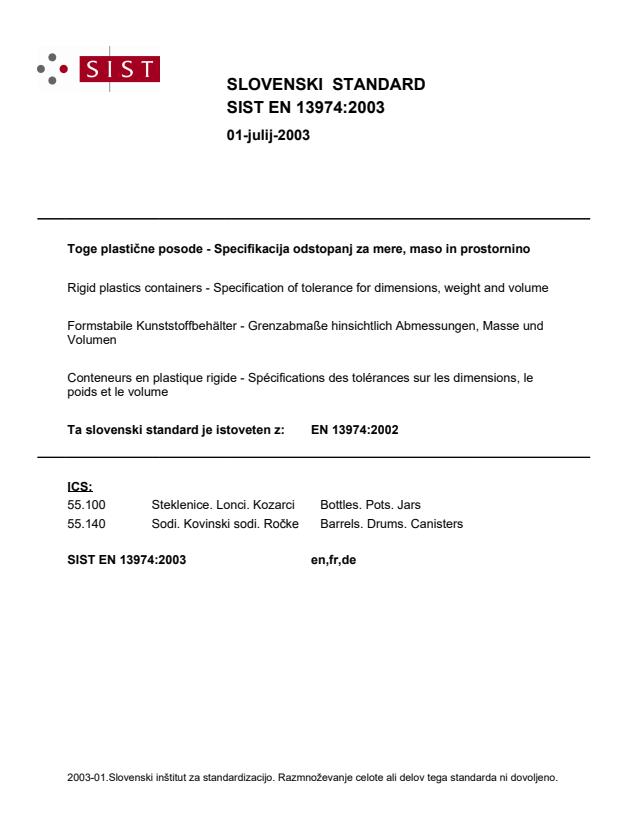

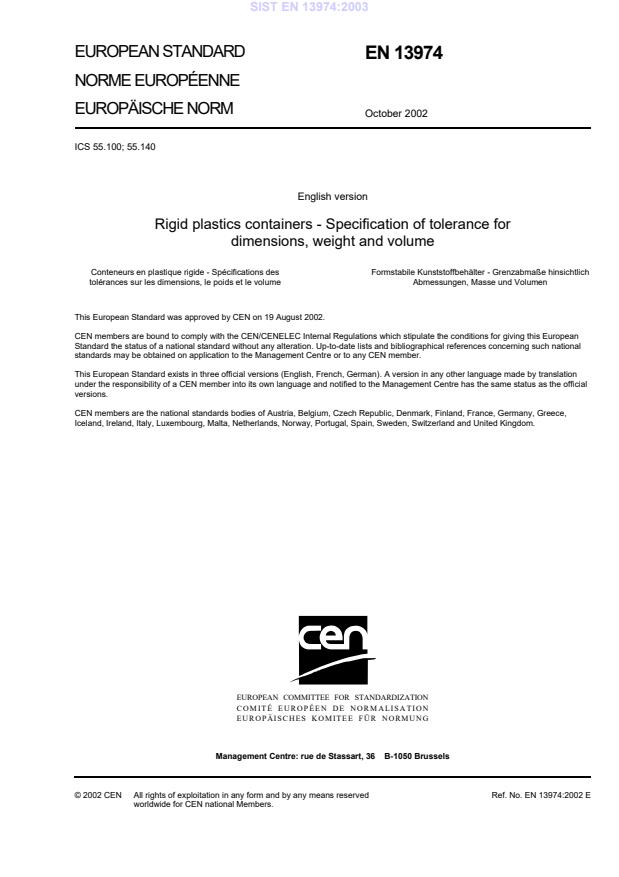
SIST EN 13974:2003 is the Slovenian standard for rigid plastics containers, published by SIST as an adoption of EN 13974:2002. It specifies tolerances for the dimensions, mass and volume of plastic bottles, jars, canisters/jerricans and pails, so users can check whether empty containers meet agreed size and capacity limits.
What does SIST EN 13974:2003 specify?
SIST EN 13974:2003 covers tolerances for empty rigid plastics containers used as bottles, jars, canisters/jerricans and pails. It applies to bottles and jars with nominal capacity up to 5 l, canisters/jerricans up to 20 l, and pails up to 60 l.
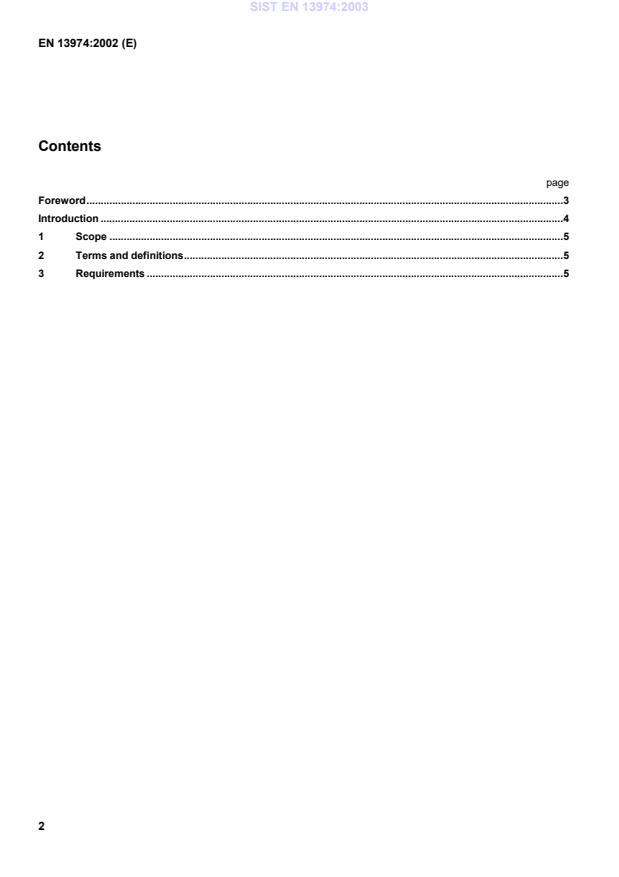
The standard uses the single term containers for all of these package types. Its structure is simple: clause 1 gives the scope, clause 2 defines the key terms, and clause 3 sets the requirements, supported by five tables.
| Part of the document | What it covers |
|---|---|
| Clause 1 | Scope |
| Clause 2 | Terms and definitions |
| Clause 3 | Requirements |
| Table 1 | Bottles and jars up to 5 l |
| Table 2 | Canisters/jerricans up to 20 l |
| Table 3 | Pails up to 60 l |
| Table 4 | Length tolerance |
| Table 5 | Mass tolerance |
What are the key requirements of SIST EN 13974:2003?
SIST EN 13974:2003 sets tolerances for empty containers and ties them to the way the container is measured. In practice, this means the design, production checks and acceptance criteria all need to match the same measurement basis.
- Measurements are taken on empty containers. This matters because the standard is about the container itself, not the filled pack.
- Measurements are not made within 48 h after manufacture and are carried out at ambient conditions unless otherwise stated. This helps avoid results being affected by early material changes or unusual test conditions.
- Tables 1 to 3 set capacity tolerances for bottles/jars, canisters/jerricans and pails by nominal size band. For a buyer or quality manager, this is the core rule for judging whether the container holds the intended amount.
- Table 1 covers brimful capacity for bottles and jars up to 5 l. It also notes that local government regulations may affect the minimum brimful capacity.
- Table 2 covers canisters/jerricans up to 20 l and sets limits for minimum brimful capacity and maximum total capacity. This is useful when the usable volume and the closed-container volume both matter.
- Table 3 covers pails up to 60 l with brimful and total-capacity limits by size band. This helps users control larger containers where a small dimensional shift can affect volume noticeably.
- Table 4 gives length tolerances for principal overall dimensions only. That means the key external size needs to stay within the stated band, which is important for filling lines, stacking and packaging fit.
- Table 5 gives mass tolerances for the empty container after the mass has been agreed. In practice, this is a production-control tool for checking moulding consistency and material use.
What terms does SIST EN 13974:2003 define?
- Plastics bottle - a rigid plastics container with shoulders and a small aperture, generally blow moulded.
- Plastics jar - a rigid plastics container of any base shape with an aperture about the same area as the base.
- Plastics canister/jerrican - a rigid plastics container with mostly rectangular or circular section, usually with a top or side opening and a carrying device.
- Pail - a rigid plastics container of any shape where the top area is greater than or equal to the bottom area, usually with a lid and often nestable.
- Nominal capacity - the capacity for which the container is designed.
- Total capacity - the total internal volume of the closed container.
- Brimful capacity - the volume of water the container holds when filled to overflowing through the filling orifice.
Who uses SIST EN 13974:2003?
SIST EN 13974:2003 is used by packaging designers, container manufacturers, quality managers, test laboratories and buyers of rigid plastics packaging. They use it to specify target dimensions and capacities, set incoming or outgoing inspection rules, and decide whether a container design is acceptable for production.
It is also relevant in procurement and supplier qualification, because it gives a common way to talk about size, weight and capacity for bottles, jars, canisters/jerricans and pails.
What does the SIST EN 13974:2003 document contain?
SIST EN 13974:2003 contains a brief introduction, one scope clause, a definitions clause and a requirements clause supported by five tables. The introduction explains that the standard was developed to test container design and to provide requirements and test procedures linked to capacity recommendations.
The tables are the practical heart of the document. Tables 1 to 3 set capacity tolerances for the three container groups, Table 4 sets length tolerance bands, and Table 5 sets mass tolerance bands.
The document is aimed at dimensional and capacity control rather than detailed product design. In practice, it supports specification writing, production checks, and acceptance testing for rigid plastics containers.
Relations
- Referred By
SIST EN 474-1:2007+A5:2018 - Earth-moving machinery - Safety - Part 1: General requirements - Effective Date
- 28-Jan-2026
- Referred By
SIST EN 474-1:2007+A6:2019 - Earth-moving machinery - Safety - Part 1: General requirements - Effective Date
- 28-Jan-2026
- Referred By
SIST EN 474-1:2007+A1:2009 - Earth-moving machinery - Safety - Part 1: General requirements - Effective Date
- 28-Jan-2026
- Referred By
SIST EN 14401:2004 - Rigid plastics containers - Methods to test the effectiveness of closures - Effective Date
- 28-Jan-2026
- Referred By
SIST EN 13973:2003 - Rigid plastics containers - Method for determination of drainability - Effective Date
- 28-Jan-2026
- Referred By
SIST EN 474-1:2007+A3:2014 - Earth-moving machinery - Safety - Part 1: General requirements - Effective Date
- 28-Jan-2026
- Referred By
SIST EN 474-1:2007+A4:2014 - Earth-moving machinery - Safety - Part 1: General requirements - Effective Date
- 28-Jan-2026
- Effective Date
- 28-Jan-2026
Get Certified
Connect with accredited certification bodies for this standard

BRCGS (Brand Reputation Compliance Global Standards)
Global food safety and quality standards owner.
Sponsored listings
Frequently Asked Questions
SIST EN 13974:2003 is a standard published by the Slovenian Institute for Standardization (SIST). Its full title is "Rigid plastics containers - Specification of tolerance for dimensions, weight and volume". This standard covers: This European Standard specifies tolerances for dimensions, mass and volume of plastic bottles and jars with a nominal capacity up to 5 l, of plastics canisters/jerricans with a nominal volume up to 20 l and for plastic pails up to 60 l. NOTE Plastics bottles, jars, canisters and jerricans and pails are referred to as "containers" in this standard.
This European Standard specifies tolerances for dimensions, mass and volume of plastic bottles and jars with a nominal capacity up to 5 l, of plastics canisters/jerricans with a nominal volume up to 20 l and for plastic pails up to 60 l. NOTE Plastics bottles, jars, canisters and jerricans and pails are referred to as "containers" in this standard.
SIST EN 13974:2003 is classified under the following ICS (International Classification for Standards) categories: 55.100 - Bottles. Pots. Jars; 55.140 - Barrels. Drums. Canisters. The ICS classification helps identify the subject area and facilitates finding related standards.
SIST EN 13974:2003 has the following relationships with other standards: It is inter standard links to SIST EN 474-1:2007+A5:2018, SIST EN 474-1:2007+A6:2019, SIST EN 474-1:2007+A1:2009, SIST EN 14401:2004, SIST EN 13973:2003, SIST EN 474-1:2007+A3:2014, SIST EN 474-1:2007+A4:2014, SIST EN 13972:2003. Understanding these relationships helps ensure you are using the most current and applicable version of the standard.
SIST EN 13974:2003 is available in PDF format for immediate download after purchase. The document can be added to your cart and obtained through the secure checkout process. Digital delivery ensures instant access to the complete standard document.
Standards Content (Sample)
2003-01.Slovenski inštitut za standardizacijo. Razmnoževanje celote ali delov tega standarda ni dovoljeno.SURVWRUQLQRFormstabile Kunststoffbehälter - Grenzabmaße hinsichtlich Abmessungen, Masse und VolumenConteneurs en plastique rigide - Spécifications des tolérances sur les dimensions, le poids et le volumeRigid plastics containers - Specification of tolerance for dimensions, weight and volume55.140Barrels. Drums. Canisters55.100Steklenice. Lonci. KozarciBottles. Pots. JarsICS:Ta slovenski standard je istoveten z:EN 13974:2002SIST EN 13974:2003en,fr,de01-julij-2003SIST EN 13974:2003SLOVENSKI
STANDARD
EUROPEAN STANDARDNORME EUROPÉENNEEUROPÄISCHE NORMEN 13974October 2002ICS 55.100; 55.140English versionRigid plastics containers - Specification of tolerance fordimensions, weight and volumeConteneurs en plastique rigide - Spécifications destolérances sur les dimensions, le poids et le volumeFormstabile Kunststoffbehälter - Grenzabmaße hinsichtlichAbmessungen, Masse und VolumenThis European Standard was approved by CEN on 19 August 2002.CEN members are bound to comply with the CEN/CENELEC Internal Regulations which stipulate the conditions for giving this EuropeanStandard the status of a national standard without any alteration. Up-to-date lists and bibliographical references concerning such nationalstandards may be obtained on application to the Management Centre or to any CEN member.This European Standard exists in three official versions (English, French, German). A version in any other language made by translationunder the responsibility of a CEN member into its own language and notified to the Management Centre has the same status as the officialversions.CEN members are the national standards bodies of Austria, Belgium, Czech Republic, Denmark, Finland, France, Germany, Greece,Iceland, Ireland, Italy, Luxembourg, Malta, Netherlands, Norway, Portugal, Spain, Sweden, Switzerland and United Kingdom.EUROPEAN COMMITTEE FOR STANDARDIZATIONCOMITÉ EUROPÉEN DE NORMALISATIONEUROPÄISCHES KOMITEE FÜR NORMUNGManagement Centre: rue de Stassart, 36
B-1050 Brussels© 2002 CENAll rights of exploitation in any form and by any means reservedworldwide for CEN national Members.Ref. No. EN 13974:2002 ESIST EN 13974:2003
...