

SIST EN 13411-7:2021
(Main)Terminations for steel wire ropes - Safety - Part 7: Symmetric wedge socket
General Information
- Abstract
This document specifies the minimum requirements for symmetrical wedge socket terminations for stranded steel wire ropes conforming to EN 12385-5 for lifts.
This document covers those symmetric wedge sockets intended for use at temperatures between −20 °C and 100 °C.
This document only covers those symmetric wedge sockets that have welded socket bodies. An example of the construction and sizes of a symmetric wedge socket is given in informative Annex A.
The informative Annex B gives the recommendations for the safe use and inspection of symmetric wedge socket according to Annex A.
This document deals with all significant hazards, hazardous situations and events relevant to symmetric wedge sockets for terminations for steel wire ropes, when used as intended and under conditions of misuse which are reasonably foreseeable by the manufacturer.
The hazards covered by this document are identified in Clause 4.
This document applies to symmetric wedge sockets, which are manufactured after the date of its publication.
- Status
- Published
- Public Enquiry End Date
- 30-Dec-2018
- Publication Date
- 17-Aug-2021
- Technical Committee
- DTN - Lift and transport appliances
- Current Stage
- 6060 - National Implementation/Publication (Adopted Project)
- Start Date
- 14-Jul-2021
- Due Date
- 18-Sep-2021
- Completion Date
- 18-Aug-2021



Overview
EN 13411-7:2021 - Terminations for steel wire ropes - Safety - Part 7: Symmetric wedge socket - is a CEN safety standard that specifies minimum requirements for symmetric wedge socket terminations used with stranded steel wire ropes for lifts (see EN 12385-5). It applies only to symmetric wedge sockets with welded socket bodies, intended for service temperatures between −20 °C and 100 °C, and covers design, testing, manufacture, marking and information for safe use.
Key topics and requirements
- Scope and applicability: Covers welded-body symmetric wedge sockets manufactured after the standard’s publication; informative examples in Annex A and safe-use guidance in Annex B.
- Geometry and fit: Dimensional and geometric criteria to prevent fitting errors - e.g., clamping length ≥ 7.3 × nominal rope diameter (d) and wedge groove radius at the large end ≥ 1 × d.
- Security of components: The pin must have secure retaining means when in service.
- Weld quality: Welding processes per EN ISO 4063; welds assessed to EN ISO 5817 assessment group B; no melted-on weld chips; qualified welding supervision required.
- Mechanical properties & safety factors: Requirements for termination efficiency, fatigue behaviour, and low-temperature performance. Notable update: coefficient of utilisation for lifting persons updated to 12:1 (previously 10:1).
- Verification & testing: Type testing regime includes tensile efficiency tests, fatigue testing, Charpy impact tests for low-temperature properties, and manufacturing examinations (visual, magnetic particle or penetrant NDT per EN ISO 17638 / EN ISO 23277).
- Information for use: Mandatory marking, fitting instructions, and manufacturer’s certificate to ensure correct assembly and traceability.
Applications and users
EN 13411-7:2021 is essential for:
- Manufacturers of wedge sockets and lifting accessories ensuring compliant welded socket designs
- Lift designers and installers specifying rope terminations for elevator systems
- Inspection & maintenance personnel performing in-service checks and NDT
- Procurement and quality managers who require documented conformity for accessories used in lifts and lifting equipment
- Notified bodies and certification authorities assessing conformity with lift and machinery directives
Typical applications include elevator rope terminations, anchorage points in lifting assemblies, and situations where reliable, inspected wedge socket terminations are required.
Related standards
- EN 12385-5 (Stranded ropes for lifts)
- EN ISO 4063, EN ISO 5817 (welding)
- EN ISO 148-1 (Charpy impact)
- EN ISO 17638 / EN ISO 23277 (weld NDT)
- EN 13411 (other parts covering alternative rope terminations)
Keywords: EN 13411-7:2021, symmetric wedge socket, welded socket body, steel wire rope termination, lifts, safety standard, rope termination testing, inspection.
Relations
- Effective Date
- 05-Jul-2017
- Effective Date
- 28-Jan-2026
- Effective Date
- 28-Jan-2026
- Effective Date
- 28-Jan-2026
- Effective Date
- 28-Jan-2026
- Effective Date
- 28-Jan-2026
- Effective Date
- 28-Jan-2026
- Effective Date
- 28-Jan-2026
- Effective Date
- 28-Jan-2026
- Effective Date
- 28-Jan-2026
- Effective Date
- 01-Jul-2026
- Effective Date
- 28-Jan-2026
- Effective Date
- 28-Jan-2026
- Effective Date
- 28-Jan-2026
- Effective Date
- 28-Jan-2026
Get Certified
Connect with accredited certification bodies for this standard

Element Materials Technology
Materials testing and product certification.

Inštitut za kovinske materiale in tehnologije
Institute of Metals and Technology. Materials testing, metallurgical analysis, NDT.
Sponsored listings
Frequently Asked Questions
SIST EN 13411-7:2021 is a standard published by the Slovenian Institute for Standardization (SIST). Its full title is "Terminations for steel wire ropes - Safety - Part 7: Symmetric wedge socket". This standard covers: This document specifies the minimum requirements for symmetrical wedge socket terminations for stranded steel wire ropes conforming to EN 12385-5 for lifts. This document covers those symmetric wedge sockets intended for use at temperatures between −20 °C and 100 °C. This document only covers those symmetric wedge sockets that have welded socket bodies. An example of the construction and sizes of a symmetric wedge socket is given in informative Annex A. The informative Annex B gives the recommendations for the safe use and inspection of symmetric wedge socket according to Annex A. This document deals with all significant hazards, hazardous situations and events relevant to symmetric wedge sockets for terminations for steel wire ropes, when used as intended and under conditions of misuse which are reasonably foreseeable by the manufacturer. The hazards covered by this document are identified in Clause 4. This document applies to symmetric wedge sockets, which are manufactured after the date of its publication.
This document specifies the minimum requirements for symmetrical wedge socket terminations for stranded steel wire ropes conforming to EN 12385-5 for lifts. This document covers those symmetric wedge sockets intended for use at temperatures between −20 °C and 100 °C. This document only covers those symmetric wedge sockets that have welded socket bodies. An example of the construction and sizes of a symmetric wedge socket is given in informative Annex A. The informative Annex B gives the recommendations for the safe use and inspection of symmetric wedge socket according to Annex A. This document deals with all significant hazards, hazardous situations and events relevant to symmetric wedge sockets for terminations for steel wire ropes, when used as intended and under conditions of misuse which are reasonably foreseeable by the manufacturer. The hazards covered by this document are identified in Clause 4. This document applies to symmetric wedge sockets, which are manufactured after the date of its publication.
SIST EN 13411-7:2021 is classified under the following ICS (International Classification for Standards) categories: 21.060.70 - Clamps and staples; 53.020.30 - Accessories for lifting equipment; 77.140.99 - Other iron and steel products. The ICS classification helps identify the subject area and facilitates finding related standards.
SIST EN 13411-7:2021 has the following relationships with other standards: It is inter standard links to SIST EN 13411-7:2006+A1:2008, SIST EN ISO 12100:2011, SIST EN ISO 5817:2014, SIST EN 12385-5:2021, SIST EN ISO 148-1:2017, SIST EN ISO 17638:2017, SIST EN ISO 7500-1:2018, SIST EN ISO 4063:2011, SIST EN ISO 23277:2015, SIST EN 12385-2:2003+A1:2008, SIST EN ISO 8100-1:2026, SIST EN 15567-1:2015, SIST EN 13852-2:2005, SIST EN 12927-4:2005, SIST EN 81-42:2026. Understanding these relationships helps ensure you are using the most current and applicable version of the standard.
SIST EN 13411-7:2021 is associated with the following European legislation: EU Directives/Regulations: 2006/42/EC, 2014/33/EU; Standardization Mandates: M/396, M/549. When a standard is cited in the Official Journal of the European Union, products manufactured in conformity with it benefit from a presumption of conformity with the essential requirements of the corresponding EU directive or regulation.
SIST EN 13411-7:2021 is available in PDF format for immediate download after purchase. The document can be added to your cart and obtained through the secure checkout process. Digital delivery ensures instant access to the complete standard document.
Standards Content (Sample)
SLOVENSKI STANDARD
01-september-2021
Nadomešča:
SIST EN 13411-7:2006+A1:2008
Zaključki jeklenih žičnih vrvi - Varnost - 7. del: Simetrični zagozdni spoji
Terminations for steel wire ropes - Safety - Part 7: Symmetric wedge socket
Endverbindungen für Drahtseile aus Stahldraht - Sicherheit - Teil 7: Symmetrische
Seilschlösser
Terminaisons pour câbles en acier - Sécurité - Partie 7: Boîte à coin symétrique
Ta slovenski standard je istoveten z: EN 13411-7:2021
ICS:
53.020.30 Pribor za dvigalno opremo Accessories for lifting
equipment
77.140.99 Drugi železni in jekleni izdelki Other iron and steel products
2003-01.Slovenski inštitut za standardizacijo. Razmnoževanje celote ali delov tega standarda ni dovoljeno.
EN 13411-7
EUROPEAN STANDARD
NORME EUROPÉENNE
July 2021
EUROPÄISCHE NORM
ICS 21.060.70; 53.020.30; C Supersedes EN 13411-7:2006+A1:2008
English Version
Terminations for steel wire ropes - Safety - Part 7:
Symmetric wedge socket
Terminaisons pour câbles en acier - Sécurité - Partie 7 : Endverbindungen für Drahtseile aus Stahldraht -
Boîte à coin symétrique Sicherheit - Teil 7: Symmetrische Seilschlösser
This European Standard was approved by CEN on 28 April 2021.
CEN members are bound to comply with the CEN/CENELEC Internal Regulations which stipulate the conditions for giving this
European Standard the status of a national standard without any alteration. Up-to-date lists and bibliographical references
concerning such national standards may be obtained on application to the CEN-CENELEC Management Centre or to any CEN
member.
This European Standard exists in three official versions (English, French, German). A version in any other language made by
translation under the responsibility of a CEN member into its own language and notified to the CEN-CENELEC Management
Centre has the same status as the official versions.
CEN members are the national standards bodies of Austria, Belgium, Bulgaria, Croatia, Cyprus, Czech Republic, Denmark, Estonia,
Finland, France, Germany, Greece, Hungary, Iceland, Ireland, Italy, Latvia, Lithuania, Luxembourg, Malta, Netherlands, Norway,
Poland, Portugal, Republic of North Macedonia, Romania, Serbia, Slovakia, Slovenia, Spain, Sweden, Switzerland, Turkey and
United Kingdom.
EUROPEAN COMMITTEE FOR STANDARDIZATION
COMITÉ EUROPÉEN DE NORMALISATION
EUROPÄISCHES KOMITEE FÜR NORMUNG
CEN-CENELEC Management Centre: Rue de la Science 23, B-1040 Brussels
© 2021 CEN All rights of exploitation in any form and by any means reserved Ref. No. EN 13411-7:2021 E
worldwide for CEN national Members.
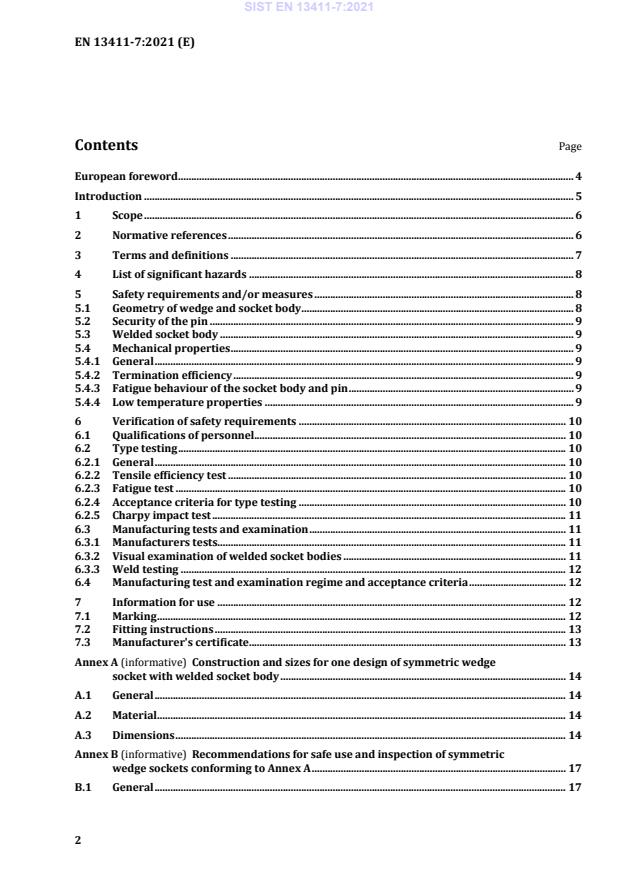
Contents Page
European foreword . 4
Introduction . 5
1 Scope . 6
2 Normative references . 6
3 Terms and definitions . 7
4 List of significant hazards . 8
5 Safety requirements and/or measures . 8
5.1 Geometry of wedge and socket body . 8
5.2 Security of the pin . 9
5.3 Welded socket body . 9
5.4 Mechanical properties . 9
5.4.1 General . 9
5.4.2 Termination efficiency . 9
5.4.3 Fatigue behaviour of the socket body and pin . 9
5.4.4 Low temperature properties . 9
6 Verification of safety requirements . 10
6.1 Qualifications of personnel. 10
6.2 Type testing . 10
6.2.1 General . 10
6.2.2 Tensile efficiency test . 10
6.2.3 Fatigue test . 10
6.2.4 Acceptance criteria for type testing . 10
6.2.5 Charpy impact test . 11
6.3 Manufacturing tests and examination . 11
6.3.1 Manufacturers tests . 11
6.3.2 Visual examination of welded socket bodies . 11
6.3.3 Weld testing . 12
6.4 Manufacturing test and examination regime and acceptance criteria . 12
7 Information for use . 12
7.1 Marking . 12
7.2 Fitting instructions . 13
7.3 Manufacturer's certificate . 13
Annex A (informative) Construction and sizes for one design of symmetric wedge
socket with welded socket body . 14
A.1 General . 14
A.2 Material . 14
A.3 Dimensions . 14
Annex B (informative) Recommendations for safe use and inspection of symmetric
wedge sockets conforming to Annex A . 17
B.1 General . 17
B.2 Method of assembly . 17
B.3 Inspection in use . 18
Bibliography . 19
European foreword
This document (EN 13411-7:2021) has been prepared by Technical Committee CEN/TC 168
“Chains, ropes, webbing, slings and accessories - Safety”, the secretariat of which is held by BSI.
This European Standard shall be given the status of a national standard, either by publication of
an identical text or by endorsement, at the latest by January 2022, and conflicting national
standards shall be withdrawn at the latest by January 2022.
Attention is drawn to the possibility that some of the elements of this document may be the
subject of patent rights. CEN shall not be held responsible for identifying any or all such patent
rights.
This document supersedes EN 13411-7:2006+A1:2008.
The main changes compared to the previous edition are listed below:
— a major change to 6.4;
— updates to standard references;
— coefficient of utilisation changed from 10:1 to 12:1 for lifting persons – 5.4.1.
EN 13411 consists of the following parts:
— Part 1: Thimbles for steel wire rope slings;
— Part 2: Splicing of eyes for steel wire rope slings;
— Part 3: Ferrules and ferrule-securing;
— Part 4: Metal and resin socketing;
— Part 5: U-bolt wire rope grips;
— Part 6: Asymmetric wedge socket;
— Part 7: Symmetric wedge socket;
— Part 8: Swage terminals and swaging;
— Part 9: Solid thimbles.
According to the CEN-CENELEC Internal Regulations, the national standards organisations of
the following countries are bound to implement this European Standard: Austria, Belgium,
Bulgaria, Croatia, Cyprus, Czech Republic, Denmark, Estonia, Finland, France, Germany, Greece,
Hungary, Iceland, Ireland, Italy, Latvia, Lithuania, Luxembourg, Malta, Netherlands, Norway,
Poland, Portugal, Republic of North Macedonia, Romania, Serbia, Slovakia, Slovenia, Spain,
Sweden, Switzerland, Turkey and the United Kingdom.
Introduction
This European standard is a type C standard as stated in EN ISO 12100.
This part of this European standard has been prepared to provide a means of conforming with
the essential safety requirements of the Machinery Directive and the Lift Directive and
associated EFTA regulations.
The wedge socket concerned and the extent to which hazards, hazardous situations and events
are covered are indicated in the scope of this standard part of the standard.
When provisions of this type C standard are different from those which are stated in type A or B
standards, the provisions of this type C standard take precedence over the provisions of the
other standards for symmetric wedge sockets that have been designed and produced according
to the provisions of this type C standard.
Purchasers ordering to this standard are advised to specify in their purchasing contract that the
supplier operates a quality assurance system applicable to the relevant part of this standard
(e.g. EN ISO 9001) to ensure themselves that products claiming to comply consistently achieve
the required level of quality.
1 Scope
This document specifies the minimum requirements for symmetrical wedge socket
terminations for stranded steel wire ropes conforming to EN 12385-5 for lifts.
This document covers those symmetric wedge sockets intended for use at temperatures
between −20 °C and 100 °C.
This document only covers those symmetric wedge sockets that have welded socket bodies. An
example of the construction and sizes of a symmetric wedge socket is given in informative
Annex A.
The informative Annex B gives the recommendations for the safe use and inspection of
symmetric wedge socket according to Annex A.
This document deals with all significant hazards, hazardous situations and events relevant to
symmetric wedge sockets for terminations for steel wire ropes, when used as intended and
under conditions of misuse which are reasonably foreseeable by the manufacturer.
The hazards covered by this document are identified in Clause 4.
This document applies to symmetric wedge sockets, which are manufactured after the date of
its publication.
2 Normative references
The following documents are referred to in the text in such a way that some or all of their
content constitutes requirements of this document. For dated references, only the edition cited
applies. For undated references, the latest edition of the referenced document (including any
amendments) applies.
EN 12385-2:2002+A1:2008, Steel wire ropes — Safety — Part 2: Definitions, designation and
classification
EN 12385-5:2021, Steel wire ropes — Safety — Part 5: Stranded ropes for lifts
EN ISO 148-1:2016, Metallic materials — Charpy pendulum impact test — Part 1: Test method
(ISO 148-1:2016)
EN ISO 4063:2010, Welding and allied processes — Nomenclature of processes and reference
numbers (ISO 4063:2009, Corrected version 2010-03-01)
EN ISO 5817:2014, Welding — Fusion-welded joints in steel, nickel, titanium and their alloys
(beam welding excluded) — Quality levels for imperfections (ISO 5817:2014)
EN ISO 7500-1:2018, Metallic materials — Calibration and verification of static uniaxial testing
machines — Part 1: Tension/compression testing machines — Calibration and verification of the
force-measuring system (ISO 7500-1:2018)
EN ISO 12100:2010, Safety of machinery — General principles for design — Risk assessment and
risk reduction (ISO 12100:2010)
EN ISO 17638:2016, Non-destructive testing of welds — Magnetic particle testing
(ISO 17638:2016)
EN ISO 23277:2015, Non-destructive testing of welds — Penetrant testing — Acceptance levels
(ISO 23277:2015)
3 Terms and definitions
For the purposes of this document, the following terms and definitions given in
EN ISO 12100:2010, EN 12385-2 and the following apply.
ISO and IEC maintain terminological databases for use in standardization at the following
addresses:
— IEC Electropedia: available at https://www.electropedia.org/
— ISO Online browsing platform: available at https://www.iso.org/obp
3.1
symmetric wedge socket
assembly consisting of a socket body, wedge, and a pin marginally offset to the longitudinal axis
of the live portion of the rope, and securing means for the pin
Note 1 to entry: See Figure B.1.
3.2
socket body
principal component of a wedge socket termination having an internal tapered form suitable for
receiving a wedge (see 3.3) and the rope with which the wedge is associated
Note 1 to entry: See Figure A.1.
3.3
wedge
flat tapered component with peripheral groove, suitable for fitting into a tapered socket body to
accommodate a rope of matching nominal diameter
Note 1 to entry: See Figure A.1.
3.4
pin
removable component intended to facilitate connection of the socket body to its anchorage
point
3.5
lot
number of symmetric wedge sockets from which samples are selected for testing purposes
which are of the same type and dimension, each of their constituent components manufactured
during the same production run from material of the same cast and subjected to the same heat
treatment process
4 List of significant hazards
This European standard contains all the significant hazards, hazardous situations and events, as
far as they are dealt with in this European standard, identified by risk assessment as significant
for this type of steel wire rope termination that require action to eliminate or reduce the risk.
In particular, the hazard caused by accidental release of a load, or release of a load due to failure
of a symmetric wedge socket, puts at risk, either directly or indirectly, the safety or health of
those persons within the hazard zone.
Errors in the fitting of accessories can also lead to premature failure and this European
standard contains dimensional and geometrical requirements to allow correct fit.
Table 1 contains those hazards that require action to reduce risk identified by risk assessment
as being specific and significant for symmetric wedge sockets.
Table 1 — Hazards and associated requirements
Hazards relevant to this standard identified by Relevant clause of this standard
reference to EN ISO 12100:2010
Inadequate mechanical strength 5.1
5.3
Clause 6
Errors of fitting 5.1
7.2
Insecurity of components 5.2
Failure arising from fatigue 5.4.3
6.2.3
Inadequate low temperature properties 5.4.4
6.2.5
Incorrect identification of components 7.1
7.2
Inadequate information about the item 7.3
5 Safety requirements and/or measures
5.1 Geometry of wedge and socket body
Symmetric wedge socket terminations for ropes shall conform to the following geometrical
criteria:
— the wedge shall be symmetric;
— the internal side surfaces of the socket body and the wedge in contact with the rope shall be
straight;
— the grooves of the body and the wedge shall have no surface irregularities, such as,
protrusions or joints which could influence the intimate contact with the rope;
— the clamping length between the socket body and the wedge shall be at least 7,3 times the
nominal rope diameter d;
— the radius of the wedge at the bottom of the groove at the large end of the wedge shall be at
least 1 times the nominal diameter d of the rope.
5.2 Security of the pin
The pin shall be provided with a means for securing it in position when in operation.
5.3 Welded socket body
The welding and allied process shall conform to one of those specified in EN ISO 4063. The
pe
...