


SIST EN 14059:2026
(Main)Decorative oil lamps - Safety requirements and test methods
General Information
- Abstract
This document specifies safety requirements and test methods for oil lamps used for decorative purposes in households, in restaurants, in recreational facilities and in similar areas. This document specifies the requirements and test methods for cartridges that are intended for forming oil lamps for decorative purposes in conjunction with further accessories. This document covers re-fillable and non-re-fillable decorative oil lamp.
This document does not apply to oil lamps intended to be a primary source of light or for functional purposes (e.g. lighting for boats, mountain huts and securing of road building sites).
The purpose of this document is to minimize the risk of accidental poisoning of small children up to three years of age by limiting the accessibility of the lamp oil.
- Status
- Published
- Public Enquiry End Date
- 31-Oct-2025
- Publication Date
- 23-Sep-2026
- Technical Committee
- OGS - Heating for buildings
- Current Stage
- 6060 - National Implementation/Publication (Adopted Project)
- Start Date
- 22-Sep-2026
- Due Date
- 27-Nov-2026
- Completion Date
- 24-Sep-2026
- Directive
- Harmonized Standard2001/95/EC - General product safety

Overview
SIST EN 14059:2026 – Decorative Oil Lamps: Safety Requirements and Test Methods is an international standard published by the Slovenian Institute for Standardization (SIST). This document addresses the safety requirements and testing protocols for decorative oil lamps used in various environments, including households, restaurants, and recreational facilities. The standard applies to both refillable and non-refillable oil lamps and their associated cartridges intended for decorative purposes.
Importantly, this standard does not cover oil lamps designed as primary lighting sources or for functional tasks such as roadwork or marine applications. Its principal aim is to minimize the risk of accidental poisoning in small children (up to three years old) by restricting easy access to potentially hazardous lamp oil.
Key Topics
SIST EN 14059:2026 specifies essential safety provisions and performance tests for decorative oil lamps, focusing on the following aspects:
- Design and Material Safety: Lamps must be constructed from suitable materials capable of withstanding expected thermal, chemical, and mechanical stresses.
- Sharp Edges and Stability: Requirements to ensure edges and corners are smooth and lamps remain stable in typical usage conditions.
- Impact and Leakage Resistance: Lamps are subjected to tests ensuring containers will not break or leak oil under normal impact scenarios.
- Wick Guard Protection: A mechanical or alternative wick guard must prevent children from accessing lamp oil or the wick directly.
- Child-Resistant Closures: Refillable oil lamps require filler caps that cannot be easily opened by young children, typically involving two independent and simultaneous motions.
- Marking, Labelling, and Packaging: Lamps and packaging must display clear safety warnings, manufacturer information, and standard reference.
- Child Appeal: Decorative oil lamps must not resemble objects that are appealing to children under the age of three, such as toys, cartoon characters, or food-related items.
- Comprehensive Product Information: Instructions for safe use, maintenance, correct disposal, and language requirements are mandatory to inform and protect users.
- Testing Protocols: Detailed test methods assess lamp performance under various conditions, such as mechanical impact, leak testing, and marking durability.
Applications
The SIST EN 14059:2026 standard is crucial for:
- Manufacturers of decorative oil lamps and accessories seeking to demonstrate compliance with EU safety directives and consumer protection regulations.
- Importers and Distributors responsible for ensuring products entering the market meet high safety standards, especially regarding child protection.
- Retailers, including e-commerce platforms, who must provide clear warnings and sales information at points of sale.
- Compliance and Regulatory Bodies overseeing consumer product safety and market surveillance.
- Hospitality and Event Organizations utilizing decorative oil lamps to create ambience while prioritizing guest safety.
By adhering to this standard, stakeholders can minimize the risk of accidental poisoning, reduce liability, and contribute to a safer living environment, especially for families with young children.
Related Standards
For comprehensive compliance and industry best practice, consider these related standards:
- EN 71-1: Safety of toys – Mechanical and physical properties (applies to sharp edges and durability testing methods)
- EN ISO 6508-1:2023: Metallic materials – Rockwell hardness test – Part 1: Test method
- CEN/TR 13387-1:2018: Safety guidelines for articles for infants and young children
- General Product Safety Regulation (2023/988/EC): EU legislation on consumer goods safety, referenced within this standard
Adhering to SIST EN 14059:2026 ensures decorative oil lamps are designed, manufactured, and supplied with safety as the top priority, protecting both consumers and businesses across the European and international markets.
Relations
- Effective Date
- 01-Nov-2026
Frequently Asked Questions
SIST EN 14059:2026 is a standard published by the Slovenian Institute for Standardization (SIST). Its full title is "Decorative oil lamps - Safety requirements and test methods". This standard covers: This document specifies safety requirements and test methods for oil lamps used for decorative purposes in households, in restaurants, in recreational facilities and in similar areas. This document specifies the requirements and test methods for cartridges that are intended for forming oil lamps for decorative purposes in conjunction with further accessories. This document covers re-fillable and non-re-fillable decorative oil lamp. This document does not apply to oil lamps intended to be a primary source of light or for functional purposes (e.g. lighting for boats, mountain huts and securing of road building sites). The purpose of this document is to minimize the risk of accidental poisoning of small children up to three years of age by limiting the accessibility of the lamp oil.
This document specifies safety requirements and test methods for oil lamps used for decorative purposes in households, in restaurants, in recreational facilities and in similar areas. This document specifies the requirements and test methods for cartridges that are intended for forming oil lamps for decorative purposes in conjunction with further accessories. This document covers re-fillable and non-re-fillable decorative oil lamp. This document does not apply to oil lamps intended to be a primary source of light or for functional purposes (e.g. lighting for boats, mountain huts and securing of road building sites). The purpose of this document is to minimize the risk of accidental poisoning of small children up to three years of age by limiting the accessibility of the lamp oil.
SIST EN 14059:2026 is classified under the following ICS (International Classification for Standards) categories: 97.195 - Items of art and handicrafts. Cultural property and heritage. The ICS classification helps identify the subject area and facilitates finding related standards.
SIST EN 14059:2026 has the following relationships with other standards: It is inter standard links to SIST EN 14059:2004. Understanding these relationships helps ensure you are using the most current and applicable version of the standard.
SIST EN 14059:2026 is associated with the following European legislation: EU Directives/Regulations: 2001/95/EC, 2023/988/EU; Standardization Mandates: M/259. When a standard is cited in the Official Journal of the European Union, products manufactured in conformity with it benefit from a presumption of conformity with the essential requirements of the corresponding EU directive or regulation.
SIST EN 14059:2026 is available in PDF format for immediate download after purchase. The document can be added to your cart and obtained through the secure checkout process. Digital delivery ensures instant access to the complete standard document.
Standards Content (Sample)
SLOVENSKI STANDARD
01-november-2026
Nadomešča:
SIST EN 14059:2004
Dekorativne oljne svetilke - Varnostne zahteve in preskusne metode
Decorative oil lamps - Safety requirements and test methods
Dekorative Öllampen - Sicherheitsanforderungen und Prüfverfahren
Lampes à huile décoratives - Exigences de sécurité et méthodes d'essai
Ta slovenski standard je istoveten z: EN 14059:2026
ICS:
97.195 Umetniški in obrtniški izdelki. Items of art and handicrafts.
Kulturne dobrine in kulturna Cultural property and
dediščina heritage
2003-01.Slovenski inštitut za standardizacijo. Razmnoževanje celote ali delov tega standarda ni dovoljeno.
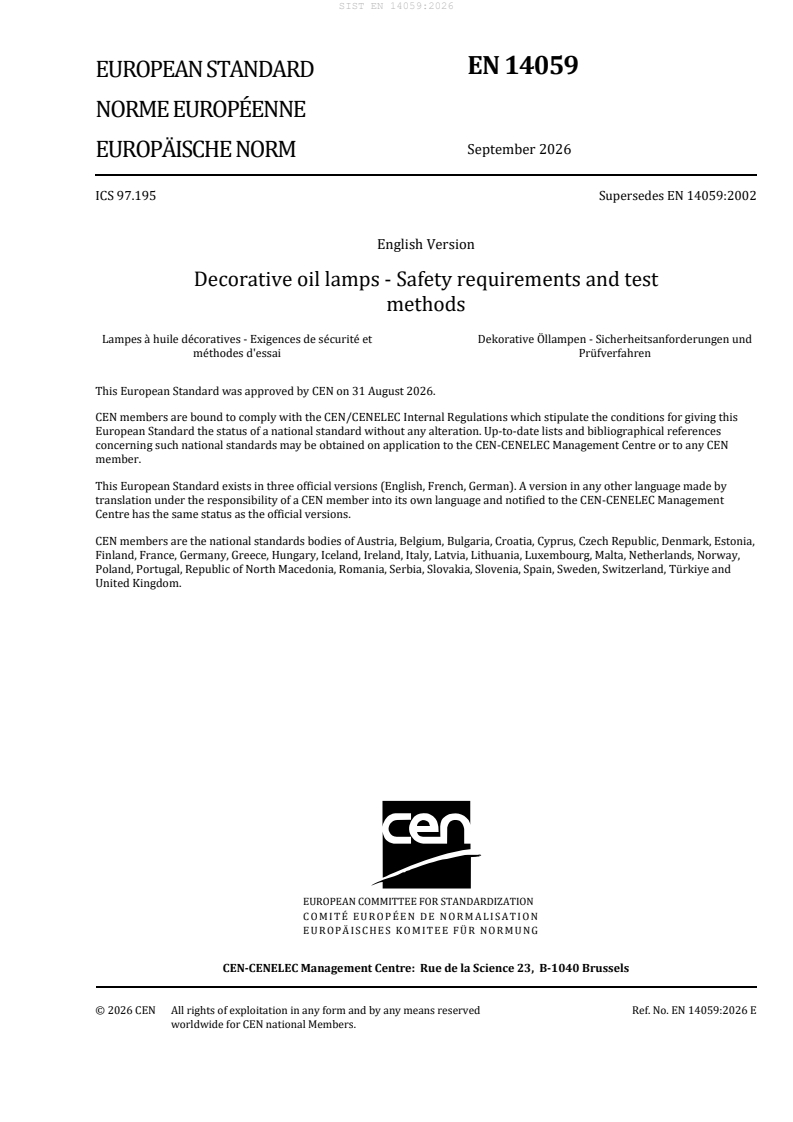
EN 14059
EUROPEAN STANDARD
NORME EUROPÉENNE
September 2026
EUROPÄISCHE NORM
ICS 97.195 Supersedes EN 14059:2002
English Version
Decorative oil lamps - Safety requirements and test
methods
Lampes à huile décoratives - Exigences de sécurité et Dekorative Öllampen - Sicherheitsanforderungen und
méthodes d'essai Prüfverfahren
This European Standard was approved by CEN on 31 August 2026.
CEN members are bound to comply with the CEN/CENELEC Internal Regulations which stipulate the conditions for giving this
European Standard the status of a national standard without any alteration. Up-to-date lists and bibliographical references
concerning such national standards may be obtained on application to the CEN-CENELEC Management Centre or to any CEN
member.
This European Standard exists in three official versions (English, French, German). A version in any other language made by
translation under the responsibility of a CEN member into its own language and notified to the CEN-CENELEC Management
Centre has the same status as the official versions.
CEN members are the national standards bodies of Austria, Belgium, Bulgaria, Croatia, Cyprus, Czech Republic, Denmark, Estonia,
Finland, France, Germany, Greece, Hungary, Iceland, Ireland, Italy, Latvia, Lithuania, Luxembourg, Malta, Netherlands, Norway,
Poland, Portugal, Republic of North Macedonia, Romania, Serbia, Slovakia, Slovenia, Spain, Sweden, Switzerland, Türkiye and
United Kingdom.
EUROPEAN COMMITTEE FOR STANDARDIZATION
COMITÉ EUROPÉEN DE NORMALISATION
EUROPÄISCHES KOMITEE FÜR NORMUNG
CEN-CENELEC Management Centre: Rue de la Science 23, B-1040 Brussels
© 2026 CEN All rights of exploitation in any form and by any means reserved Ref. No. EN 14059:2026 E
worldwide for CEN national Members.
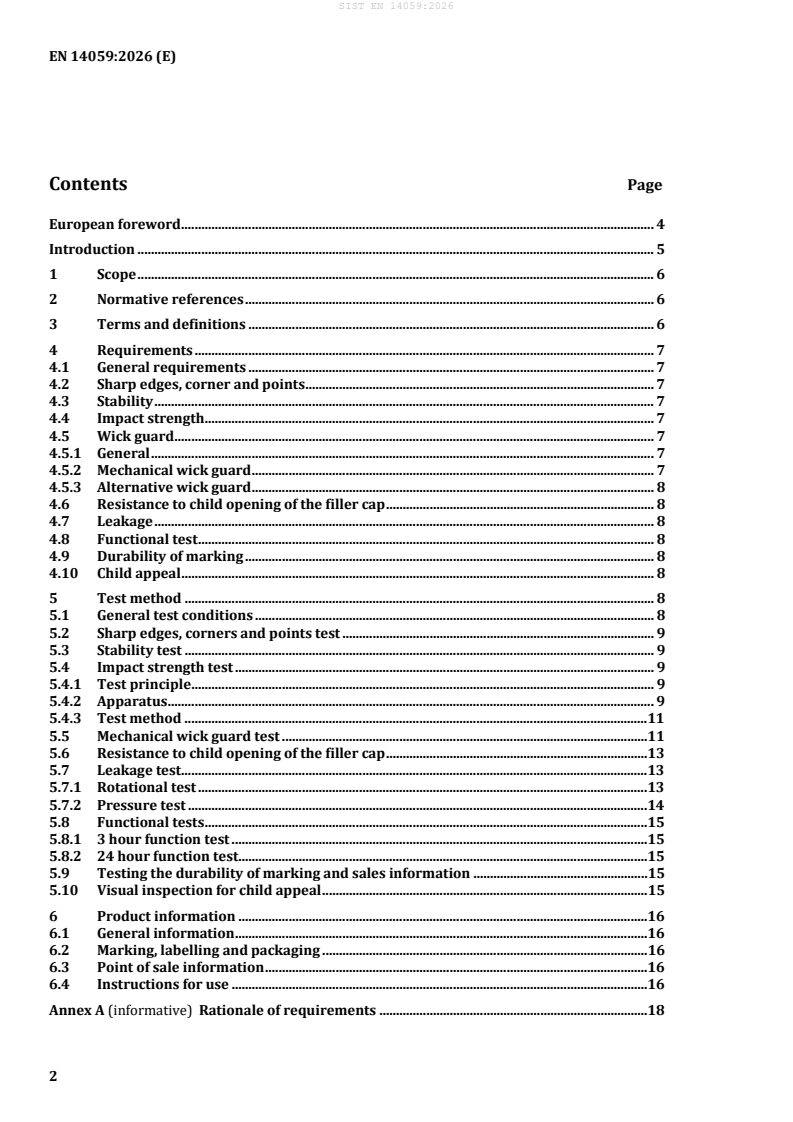
Contents Page
European foreword . 4
Introduction . 5
1 Scope . 6
2 Normative references . 6
3 Terms and definitions . 6
4 Requirements . 7
4.1 General requirements . 7
4.2 Sharp edges, corner and points . 7
4.3 Stability . 7
4.4 Impact strength . 7
4.5 Wick guard . 7
4.5.1 General . 7
4.5.2 Mechanical wick guard . 7
4.5.3 Alternative wick guard . 8
4.6 Resistance to child opening of the filler cap . 8
4.7 Leakage . 8
4.8 Functional test . 8
4.9 Durability of marking . 8
4.10 Child appeal . 8
5 Test method . 8
5.1 General test conditions . 8
5.2 Sharp edges, corners and points test . 9
5.3 Stability test . 9
5.4 Impact strength test . 9
5.4.1 Test principle . 9
5.4.2 Apparatus . 9
5.4.3 Test method .11
5.5 Mechanical wick guard test .11
5.6 Resistance to child opening of the filler cap .13
5.7 Leakage test .13
5.7.1 Rotational test .13
5.7.2 Pressure test .14
5.8 Functional tests .15
5.8.1 3 hour function test .15
5.8.2 24 hour function test.15
5.9 Testing the durability of marking and sales information .15
5.10 Visual inspection for child appeal .15
6 Product information .16
6.1 General information .16
6.2 Marking, labelling and packaging .16
6.3 Point of sale information .16
6.4 Instructions for use .16
Annex A (informative) Rationale of requirements .18
A.1 Rationale of 5.5 . 18
A.2 Rationale of 5.7.2 . 18
A.3 Rationale of 5.8 . 19
Bibliography . 21
European foreword
This document (EN 14059:2026) has been prepared by Technical Committee CEN/TC 46 “Fireplaces for
liquid fuels”, the secretariat of which is held by DIN.
This European Standard shall be given the status of a national standard, either by publication of an
identical text or by endorsement, at the latest by March 2027, and conflicting national standards shall be
withdrawn at the latest by March 2027.
Attention is drawn to the possibility that some of the elements of this document may be the subject of
patent rights. CEN shall not be held responsible for identifying any or all such patent rights.
This document supersedes EN 14059:2002.
— addition of non-re-fillable oil lamps to the Scope;
— technical improve throughout the entire document;
— addition of requirements and tests for non-re-fillable oil lamps.
Any feedback and questions on this document should be directed to the users’ national standards body.
A complete listing of these bodies can be found on the CEN website.
According to the CEN-CENELEC Internal Regulations, the national standards organisations of the
following countries are bound to implement this European Standard: Austria, Belgium, Bulgaria, Croatia,
Cyprus, Czech Republic, Denmark, Estonia, Finland, France, Germany, Greece, Hungary, Iceland, Ireland,
Italy, Latvia, Lithuania, Luxembourg, Malta, Netherlands, Norway, Poland, Portugal, Republic of North
Macedonia, Romania, Serbia, Slovakia, Slovenia, Spain, Sweden, Switzerland, Türkiye and the United
Kingdom.
Introduction
The ingestion and resultant aspiration of lamp oils can lead to severe lung damage and even death.
Small children aged up to three years are particularly at risk of drinking the oil directly from the lamps.
Very small amounts of lamp oil, labelled with R 65 or H 304 (even 80 mg/kg to 150 mg/kg body weight
have resulted in verifiable cases of death), are sufficient to cause severe lung complications with deadly
effect.
This safety standard for oil lamps aims primarily to restrict the access of small children to the lamp oil
contained in decorative oil lamps. However, it also covers some other safety aspects.
Products complying with this document should not be considered as being totally safe. It is realistic to
expect that children will sometimes be able to gain access to the oil in the lamp. Products corresponding
to this document significantly reduce the risk of serious or fatal incidents due to decorative oil lamps.
Attention is drawn to the fact that European regulations for lamp oil are in force (e.g. CLP and REACH).
1 Scope
This document specifies safety requirements and test methods for oil lamps used for decorative purposes
in households, in restaurants, in recreational facilities and in similar areas. This document specifies the
requirements and test methods for cartridges that are intended for forming oil lamps for decorative
purposes in conjunction with further accessories. This document covers re-fillable and non-re-fillable
decorative oil lamp.
This document does not apply to oil lamps intended to be a primary source of light or for functional
purposes (e.g. lighting for boats, mountain huts and securing of road building sites).
The purpose of this document is to minimize the risk of accidental poisoning of small children up to three
years of age by limiting the accessibility of the lamp oil.
2 Normative references
The following documents are referred to in the text in such a way that some or all of their content
constitutes requirements of this document. For dated references, only the edition cited applies. For
undated references, the latest edition of the referenced document (including any amendments) applies.
EN ISO 6508-1:2023, Metallic materials — Rockwell hardness test — Part 1: Test method (ISO 6508-
1:2023)
EN 71-1:2026, Safety of toys — Part 1: Mechanical and physical properties
3 Terms and definitions
For the purposes of this document, the following terms and definitions.
ISO and IEC maintain terminology databases for use in standardization at the following addresses:
— ISO Online browsing platform: available at https://www.iso.org/obp/
— IEC Electropedia: available at https://www.electropedia.org/
3.1
wick holder
part of an oil lamp including one end of the wick at which the combustion takes place
3.2
container
part of an oil lamp which holds the lamp oil
3.3
filler opening
part of a refillable oil lamp designed to enable the container to be refilled with lamp oil
3.4
lamp oil
inflammable liquid such as paraffin
EXAMPLE hydrocarbons C10-C13, N-alkanes, < 2 % aromatics, EC No.: 929-018-5
3.5
oil lamp
unit consisting of container and wick holder in which lamp oil is burnt at a wick to provide illumination
3.6
decorative oil lamp
oil lamp for interior or exterior use appealing by its design and the light atmosphere it creates
3.7
cartridge
non-refillable oil lamp which is intended for forming a decorative oil lamp in conjunction with further
accessories
3.8
wick
strip or thread which supplies lamp oil by its capillary action
3.9
wick guard
mechanical, chemical or other form of access protection or access barrier (skirt), which prevents children
up to the age of three years from ingesting lamp oil
4 Requirements
4.1 General requirements
The decorative oil lamp shall be constructed of materials suitable for the purpose, able to withstand the
thermal, chemical and mechanical stresses which can be reasonably foreseen that the product will
encounter in storage and use.
4.2 Sharp edges, corner and points
When ready for use, all accessible edges, corners and points shall be designed so as to reduce the risk of
causing injury. Edges and corners shall be free from burr and shall be chamfered or rounded. When tested
in accordance with 5.2, no sharp edges, corners or points shall be detected.
4.3 Stability
When tested in accordance with 5.3, the ready-to-use decorative oil lamp shall not overturn when
released.
4.4 Impact strength
When tested in accordance with 5.4, the decorative oil lamp container shall not break, crack or leak oil.
4.5 Wick guard
4.5.1 General
The decorative oil lamp shall be provided with a suitable mechanical or alternative wick guard. Cartridges
shall also be provided with a suitable mechanical or alternative wick guard insofar as they are used
without further accessories.
4.5.2 Mechanical wick guard
When tested in accordance with 5.5:
a) the wick guard shall not become detached from the oil lamp;
b) the wick guard shall not break or crack;
c) the probe shall not be able to touch the wick.
4.5.3 Alternative wick guard
The distributor shall be able to verify through suitable methods that the skirt it provides leads effectively
and permanently to an immediate discharge from the container and an immediate stop of the attempted
ingestion, thus preventing aspiration of the lamp oil. It shall not be possible for the user to remove the
alternative wick guard.
Suitable measures shall be provided to fulfil the protective goal.
4.6 Resistance to child opening of the filler cap
Two independent, simultaneous movements shall be required to open the closures of filler openings
including the wick holder: a vertical push downwards and a twist in the clockwise or anticlockwise
direction. The filler openings shall be closed with a simple movement. The user shall be able to clearly
recognize the attainment of the safely closed state (for example via visual, acoustic or haptic feedback).
Each renewed opening shall then require two independent, simultaneous movements.
When tested in accordance with 5.6, the closure shall not open.
4.7 Leakage
When tested in accordance with 5.7, no lamp oil shall leak out from the decorative oil lamp.
4.8 Functional test
When tested in accordance with 5.8, a maximum of 0,5 ml of lamp oil leakage from the decorative oil lamp
is permitted.
NOTE See Clause A.3 for rationale for maximum leakage.
4.9 Durability of marking
At the end of the test according to 5.9, the marking (see 6.2) and warning note on the product (see 6.2)
shall be clearly legible.
4.10 Child appeal
The decorative oil lamp shall not in any way resemble or incorporate any object commonly recognized as
appealing to or intended for use by children younger than three years of age. This includes, but is not
limited to, toys, cartoon characters, animals, plant materials, food, or food and beverage containers.
5 Test method
5.1 General test conditions
The refillable decorative oil lamp shall have been assembled according to the instructions for use and
filled with lamp oil and put into a state ready for use (any closures removed). Unless othe
...