

SIST EN 16163:2025
(Main)Conservation of Cultural Heritage - Guidelines and procedures for choosing appropriate lighting for indoor exhibitions
General Information
- Abstract
This document defines the procedures as well as the means to implement adequate lighting, with regard to the exhibition lighting and the conservation policy. This also includes security and cleaning lighting. It takes visual, exhibition and conservation aspects into account and it also discusses the implications of the lighting design on the safeguarding of cultural heritage. This document gives recommendations on luminous exposure values. It aims to provide a tool for setting up a common European policy and a guide to help curators, conservators and project managers to assess the correct lighting that can ensure the safeguarding of the objects. This document covers indoor lighting for heritage objects on exhibition in both public and private sites and does not consider lighting in other cultural heritage contexts such as open-air collections, etc.
This document does not cover non-public activities such as conservation-restoration, storage, emergency lighting and research.
- Status
- Published
- Public Enquiry End Date
- 11-Apr-2023
- Publication Date
- 12-Jan-2025
- Technical Committee
- I13 - Imaginarni 13
- Current Stage
- 6060 - National Implementation/Publication (Adopted Project)
- Start Date
- 06-Jan-2025
- Due Date
- 13-Mar-2025
- Completion Date
- 13-Jan-2025

Overview
EN 16163:2024 - "Conservation of cultural heritage - Guidelines and procedures for choosing appropriate lighting for indoor exhibitions" (CEN) provides a practical European framework for exhibition lighting that balances visitor experience, conservation, and operational concerns. It applies to indoor exhibition lighting in public and private heritage sites and updates the earlier CEN/TS 16163:2014 to reflect recent advances in lighting technology and practice.
Key topics and technical requirements
- Scope & exclusions: Focused on indoor exhibition lighting (including security and cleaning lighting); excludes storage, conservation‑restoration activities, emergency lighting, research and open‑air collections.
- Effects of light on perception: Guidance on visibility, contrast, colour discrimination, glare and reflections to optimise visitor visual experience.
- Sensitivity and damage mechanisms: Classification of cultural property sensitivity and descriptions of photochemical damage, radiant heating and biological effects-essential for risk assessment.
- Luminous exposure: Recommendations on managing annual luminous exposure (H, lx·h/year) and use of tools such as the Blue Wool Standard for light‑fastness evaluation.
- Measurements: Procedures for measuring illuminance, UV radiation and related metrics to monitor and document lighting conditions.
- Lighting typology: Definitions and guidance for general lighting, exhibition lighting, accent lighting, security and cleaning illumination; considerations for spectral composition and colour rendering.
- Design & simulation: Use of mock‑ups and simulations to validate visual outcomes and conservation limits before final installation.
- Control, maintenance & monitoring: Protocols for lighting control systems, energy efficiency, long‑term maintenance, and monitoring to ensure sustained compliance with conservation policies.
- Practical resources: Informative annexes on light source characteristics, protective glasses/films, filters, photochemical evaluation methods, colour rendering indices, facility reporting, good practices and management protocols.
Applications and intended users
EN 16163:2024 is aimed at professionals responsible for exhibition delivery and object care:
- Curators and exhibition designers - to balance presentation goals with conservation limits.
- Conservators - for risk assessment and setting exposure constraints.
- Lighting designers and electrical engineers - for selecting sources, control systems and measuring performance.
- Project managers and facilities/museum managers - for procurement, commissioning and maintenance plans.
- Security and collections care staff - for integrating cleaning and security lighting without compromising preservation.
Related standards and references
- Supersedes CEN/TS 16163:2014 (updated technical content)
- References CIE lighting vocabulary and methods (e.g., CIE S 017/E) and test methods such as ISO 105‑B08 for Blue Wool tests.
- Useful alongside standards for interior lighting, museum environmental control and colour rendering metrics.
EN 16163:2024 is a practical tool for creating exhibition lighting strategies that protect cultural heritage while delivering compelling visitor experiences - integrating measurement, design, control and maintenance best practices.
Relations
- Effective Date
- 18-Jan-2023
- Effective Date
- 28-Jan-2026
- Effective Date
- 28-Jan-2026
Get Certified
Connect with accredited certification bodies for this standard

DIBt (Deutsches Institut für Bautechnik)
German Institute for Building Technology.
DIN CERTCO
DIN Group product certification.

Aboma Certification B.V.
Specialized in construction, metal, and transport sectors.
Sponsored listings
Frequently Asked Questions
SIST EN 16163:2025 is a standard published by the Slovenian Institute for Standardization (SIST). Its full title is "Conservation of Cultural Heritage - Guidelines and procedures for choosing appropriate lighting for indoor exhibitions". This standard covers: This document defines the procedures as well as the means to implement adequate lighting, with regard to the exhibition lighting and the conservation policy. This also includes security and cleaning lighting. It takes visual, exhibition and conservation aspects into account and it also discusses the implications of the lighting design on the safeguarding of cultural heritage. This document gives recommendations on luminous exposure values. It aims to provide a tool for setting up a common European policy and a guide to help curators, conservators and project managers to assess the correct lighting that can ensure the safeguarding of the objects. This document covers indoor lighting for heritage objects on exhibition in both public and private sites and does not consider lighting in other cultural heritage contexts such as open-air collections, etc. This document does not cover non-public activities such as conservation-restoration, storage, emergency lighting and research.
This document defines the procedures as well as the means to implement adequate lighting, with regard to the exhibition lighting and the conservation policy. This also includes security and cleaning lighting. It takes visual, exhibition and conservation aspects into account and it also discusses the implications of the lighting design on the safeguarding of cultural heritage. This document gives recommendations on luminous exposure values. It aims to provide a tool for setting up a common European policy and a guide to help curators, conservators and project managers to assess the correct lighting that can ensure the safeguarding of the objects. This document covers indoor lighting for heritage objects on exhibition in both public and private sites and does not consider lighting in other cultural heritage contexts such as open-air collections, etc. This document does not cover non-public activities such as conservation-restoration, storage, emergency lighting and research.
SIST EN 16163:2025 is classified under the following ICS (International Classification for Standards) categories: 91.160.10 - Interior lighting; 97.195 - Items of art and handicrafts. Cultural property and heritage. The ICS classification helps identify the subject area and facilitates finding related standards.
SIST EN 16163:2025 has the following relationships with other standards: It is inter standard links to SIST-TS CEN/TS 16163:2014, SIST EN 16893:2018, SIST EN 15999-1:2025. Understanding these relationships helps ensure you are using the most current and applicable version of the standard.
SIST EN 16163:2025 is available in PDF format for immediate download after purchase. The document can be added to your cart and obtained through the secure checkout process. Digital delivery ensures instant access to the complete standard document.
Standards Content (Sample)
SLOVENSKI STANDARD
01-marec-2025
Nadomešča:
SIST-TS CEN/TS 16163:2014
Ohranjanje kulturne dediščine - Smernice in postopki za izbiro ustrezne
razsvetljave za razstave v zaprtih prostorih
Conservation of Cultural Heritage - Guidelines and procedures for choosing appropriate
lighting for indoor exhibitions
Erhaltung des kulturellen Erbes - Leitlinien und Verfahren für die Auswahl geeigneter
Beleuchtung für Innenausstellungen
Conservation du patrimoine culturel - Lignes directrices et procédures concernant le
choix d'un éclairage adapté pour les expositions en intérieur
Ta slovenski standard je istoveten z: EN 16163:2024
ICS:
91.160.10 Notranja razsvetljava Interior lighting
97.195 Umetniški in obrtniški izdelki. Items of art and handicrafts.
Kulturne dobrine in kulturna Cultural property and
dediščina heritage
2003-01.Slovenski inštitut za standardizacijo. Razmnoževanje celote ali delov tega standarda ni dovoljeno.
EN 16163
EUROPEAN STANDARD
NORME EUROPÉENNE
December 2024
EUROPÄISCHE NORM
ICS 97.195 Supersedes CEN/TS 16163:2014
English Version
Conservation of cultural heritage - Guidelines and
procedures for choosing appropriate lighting for indoor
exhibitions
Conservation du patrimoine culturel - Lignes Erhaltung des kulturellen Erbes - Leitlinien und
directrices et procédures concernant le choix d'un Verfahren für die Auswahl geeigneter Beleuchtung für
éclairage adapté pour les expositions en intérieur Innenausstellungen
This European Standard was approved by CEN on 18 November 2024.
CEN members are bound to comply with the CEN/CENELEC Internal Regulations which stipulate the conditions for giving this
European Standard the status of a national standard without any alteration. Up-to-date lists and bibliographical references
concerning such national standards may be obtained on application to the CEN-CENELEC Management Centre or to any CEN
member.
This European Standard exists in three official versions (English, French, German). A version in any other language made by
translation under the responsibility of a CEN member into its own language and notified to the CEN-CENELEC Management
Centre has the same status as the official versions.
CEN members are the national standards bodies of Austria, Belgium, Bulgaria, Croatia, Cyprus, Czech Republic, Denmark, Estonia,
Finland, France, Germany, Greece, Hungary, Iceland, Ireland, Italy, Latvia, Lithuania, Luxembourg, Malta, Netherlands, Norway,
Poland, Portugal, Republic of North Macedonia, Romania, Serbia, Slovakia, Slovenia, Spain, Sweden, Switzerland, Türkiye and
United Kingdom.
EUROPEAN COMMITTEE FOR STANDARDIZATION
COMITÉ EUROPÉEN DE NORMALISATION
EUROPÄISCHES KOMITEE FÜR NORMUNG
CEN-CENELEC Management Centre: Rue de la Science 23, B-1040 Brussels
© 2024 CEN All rights of exploitation in any form and by any means reserved Ref. No. EN 16163:2024 E
worldwide for CEN national Members.
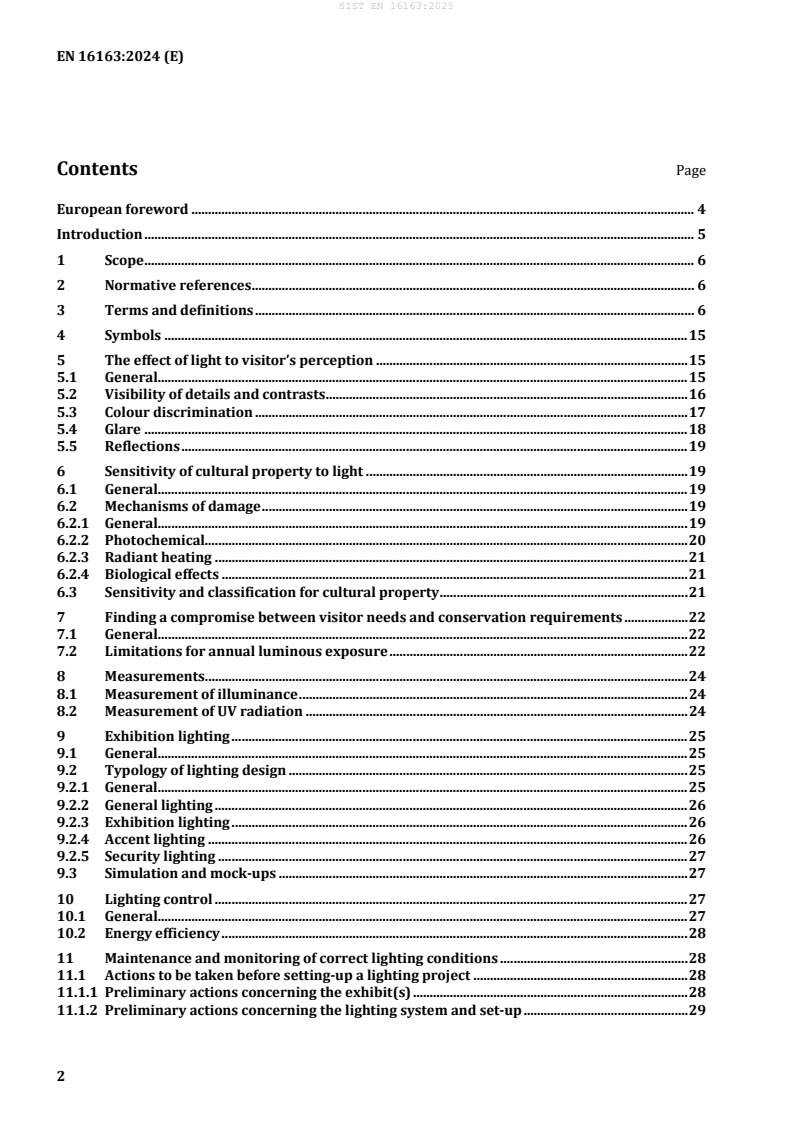
Contents Page
European foreword . 4
Introduction . 5
1 Scope . 6
2 Normative references . 6
3 Terms and definitions . 6
4 Symbols . 15
5 The effect of light to visitor’s perception . 15
5.1 General. 15
5.2 Visibility of details and contrasts . 16
5.3 Colour discrimination . 17
5.4 Glare . 18
5.5 Reflections . 19
6 Sensitivity of cultural property to light . 19
6.1 General. 19
6.2 Mechanisms of damage . 19
6.2.1 General. 19
6.2.2 Photochemical. 20
6.2.3 Radiant heating . 21
6.2.4 Biological effects . 21
6.3 Sensitivity and classification for cultural property . 21
7 Finding a compromise between visitor needs and conservation requirements . 22
7.1 General. 22
7.2 Limitations for annual luminous exposure . 22
8 Measurements . 24
8.1 Measurement of illuminance . 24
8.2 Measurement of UV radiation . 24
9 Exhibition lighting . 25
9.1 General. 25
9.2 Typology of lighting design . 25
9.2.1 General. 25
9.2.2 General lighting . 26
9.2.3 Exhibition lighting . 26
9.2.4 Accent lighting . 26
9.2.5 Security lighting . 27
9.3 Simulation and mock-ups . 27
10 Lighting control . 27
10.1 General. 27
10.2 Energy efficiency . 28
11 Maintenance and monitoring of correct lighting conditions . 28
11.1 Actions to be taken before setting-up a lighting project . 28
11.1.1 Preliminary actions concerning the exhibit(s) . 28
11.1.2 Preliminary actions concerning the lighting system and set-up . 29
11.2 Maintenance and control actions to undertake over the long term . 30
11.2.1 Maintenance actions concerning the exhibit(s) . 30
11.2.2 Maintenance actions concerning the lighting system . 30
12 Security and cleaning . 30
Annex A (informative) Characteristics of light sources . 31
Annex B (informative) Glasses and films characteristics . 38
Annex C (informative) Filters . 39
Annex D (informative) Additional methods for the evaluation and limitation of
photochemical damage for different light sources . 40
Annex E (informative) Light sources and lighting systems . 44
Annex F (informative) Colour rendering index, fidelity index and gamut index . 45
Annex G (informative) Facility report . 48
Annex H (informative) Good practices for exhibition lighting . 49
Annex I (informative) Lighting management protocols . 53
Bibliography . 54
European foreword
This document (EN 16163:2024) has been prepared by Technical Committee CEN/TC 346
“Conservation of Cultural Heritage”, the secretariat of which is held by UNI.
This European Standard shall be given the status of a national standard, either by publication of an
identical text or by endorsement, at the latest by June 2025, and conflicting national standards shall be
withdrawn at the latest by June 2025.
Attention is drawn to the possibility that some of the elements of this document may be the subject of
patent rights. CEN shall not be held responsible for identifying any or all such patent rights.
This document supersedes CEN/TS 16163:2014.
CEN/TS 16163:2014:
Since the publication of the CEN/TS 16163 in 2014, the technology of lighting has evolved considerably
and an update of the content has proven to be necessary. In addition to taking into account
technological advances and new calculation methods in the field of lighting in recent years, the present
version of the standard contains the elements of good practices for the exhibition lighting design, in its
subjective form, as an element of museography, which had not found its place in the previous version.
Any feedback and questions on this document should be directed to the users’ national standards body.
A complete listing of these bodies can be found on the CEN website.
According to the CEN-CENELEC Internal Regulations, the national standards organisations of the
following countries are bound to implement this European Standard: Austria, Belgium, Bulgaria,
Croatia, Cyprus, Czech Republic, Denmark, Estonia, Finland, France, Germany, Greece, Hungary, Iceland,
Ireland, Italy, Latvia, Lithuania, Luxembourg, Malta, Netherlands, Norway, Poland, Portugal, Republic of
North Macedonia, Romania, Serbia, Slovakia, Slovenia, Spain, Sweden, Switzerland, Türkiye and the
United Kingdom.
Introduction
Lighting is needed for many specific functions in museums and other cultural heritage buildings, such as
research, conservation and permanent or temporary exhibitions. Lighting is one of the most important
factors enabling visitors to fully enjoy works of art and other cultural property. In fact, lighting is a key
medium in which visitors interpret and appreciate cultural heritage. Light is needed to see well but this
can present a challenge when what is being viewed will deteriorate in the presence of light. When
displaying exhibits as a part of Cultural Heritage, it is essential to consider a controlled use of light, to
preserve them for the future generations. Indeed, light is an environmental factor, which is a threat to
many objects. Alone or in combination with other environmental factors (temperature, humidity,
pollution, etc.) light causes fading, discoloration and embrittlement of a wide range of materials. This
damage is cumulative and irreversible: no conservation treatment can restore original appearance of
colours and the material characteristics. Therefore, the challenge of museum exhibition lighting is to
find an appropriate compromise between the long-term preservation of the object and the needs of
visitors to view them within a suitable exhibition design. As an integral part of exhibition lighting, the
following aspects should be considered, mentioned below without priority:
— the conservation aspect, related to the sensitivity of the exhibit at different wavelengths of the
incident radiant energy, the spectral composition of the light source and the total luminous
exposure;
— the visual aspect, related to the impact of lighting on the visitor experience: lighting should allow
visitors to see exhibits on display, with the correct colour perceptions without glare, reflections or
insufficient illumination;
— the design aspect related to the concept and position of the exhibition architecture, the point of
view of the curator and all others involved in the purpose and/or didactic objectives of the
exhibition.
This document uses terms defined in European and International (CIE International lighting
vocabulary) terminology standards, but their definitions have been adapted to the intended users of
this document.
1 Scope
This document defines the procedures as well as the means to implement adequate lighting, with
regard to the exhibition lighting and the conservation policy. This also includes security and cleaning
lighting. It takes visual, exhibition and conservation aspects into account and it also discusses the
implications of the lighting design on the safeguarding of cultural heritage. This document gives
recommendations on luminous exposure values. It aims to provide a tool for setting up a common
European policy and a guide to help curators, conservators and project managers to assess the correct
lighting that can ensure the safeguarding of the objects. This document covers indoor lighting for
heritage objects on exhibition in both public and private sites and does not consider lighting in other
cultural heritage contexts such as open-air collections, etc.
This document does not cover non-public activities such as conservation-restoration, storage,
emergency lighting and research.
2 Normative references
There are no normative references in this document.
3 Terms and definitions
For the purposes of this document, the following terms and definitions apply.
ISO and IEC maintain terminology databases for use in standardization at the following addresses:
— ISO Online browsing platform: available at https://www.iso.org/obp/
— IEC Electropedia: available at https://www.electropedia.org/
3.1
accent lighting
directional lighting to emphasize a particular exhibit (3.19) or to draw attention to a spot in the field of
vision
[SOURCE: CIE S 017/E:2020, 17-29-023, modified.]
3.2
annual luminous exposure
H
m
total luminous exposure (3.49) per year
Note 1 to entry: One year of museum display is approximately 3 000 h. See also 3.34.
Note 2 to entry: The unit is expressed in lux hours per years, lx·h per year.
3.3
blue wool test
test for light fastness
certified set of eight pieces of wool each dyed with a different specific blue dye graded to fade after a
specific exposure test to light (3.25)
Note 1 to entry: This system is usually referred to as the Blue Wool Standard (BWS) and it is used in museums
to assess the radiation exposure of materials. The eight wool pieces are numbered #1 to #8, with sensitivity
doubling at every step. High sensitivity is defined as materials rated #1, #2, or #3; medium as #4, #5, or #6; and
low as #7, #8. A panel of selected blue wool samples is left at the measurement point and after a period of time it
can be seen which samples have faded and the dose of light (3.24) received approximated.
Note 2 to entry: See ISO 105-B08:1995.
3.4
brightness
attribute of a visual perception according to which an area appears to emit, transmit or reflect more or
less light (3.25)
[SOURCE: CIE S17/E:2022, 17-22-059, modified: Notes 1 to 3 to entry omitted.]
3.5
colour rendering
effect of an illuminant on the perceived colour of exhibits (3.19) by conscious or
subconscious comparison with their perceived colour under a reference illuminant
[SOURCE: CIE S 017/E:2020, 17-22-107, modified: Notes 1 and 2 to entry omitted, “object” is replaced
by “exhibits”.]
3.6
colour rendering index
R
a
index derived from the colour rendering (3.5) indices for a specified set of 8 test colour samples
Note 1 to entry: See Annex F.
3.7
colour fidelity index
Rf
derived from the colour fidelity indices for a specified set of 99 test colour samples
Note 1 to entry: See Annex F.
Note 2 to entry: See CIE 224:2017 for further information.
3.8
gamut index
Rg
index that provides information about the relative range of colours that can be produced by a white
light source
Note 1 to entry: A score close to 100 indicates that, on average, the light source (3.26) reproduces colours with
similar levels of saturation as a reference source of the same correlated colour temperature (3.10).
Note 2 to entry: See Annex F.
3.9
colour temperature
T
c
temperature of a Planckian radiator whose radiation has the same chromaticity as that of a given
stimulus
Note 1 to entry: The unit is expressed in K.
[SOURCE: CIE S 017/E:2020, 17-23-067, modified – Notes 2 and 3 to entry omitted.]
3.10
correlated colour temperature
CCT
temperature of the Planckian radiator whose perceived colour most closely resembles that of a given
stimulus at the same brightness and under specified viewing conditions
Note 1 to entry: The unit is expressed in K.
Note 2 to entry: Based on EN 12665 and modified for specific use.
3.11
cultural heritage
tangible and intangible entities of significance to present and future generations
Note 1 to entry: The term “object” (3.36) is used in this document for cultural heritage. In specific professional
contexts, other terms are used: e.g. “artefact”, “cultural property”, “item”.
[SOURCE: EN 15898:2019, modified: Note 1 to entry added.]
3.12
damage potential
P
dm
ratio of effective damaging irradiance E (3.18) and the illuminance E (3.22) at a point on the surface
dm
for a specific light source (3.26)
Note 1 to entry: The unit is expressed in W/lm.
3.13
daylight
part of global solar radiation capable of causing a visual sensation
Note 1 to entry: When dealing with actinic effects of optical radiation, this term is commonly used for radiations
extending beyond the visible region of the spectrum.
[SOURCE: CIE ILV:2020, 17-29-105, modified: Note 1 to entry added.]
3.14
daylighting
lighting for which daylight (3.13) is the light source (3.26)
Note 1 to entry: It means that window or other devices are taken into consideration.
[SOURCE: CIE S 017/E:2020, 17-29-031, modified: original Note 1 to entry deleted.]
3.15
daylight factor
D
quotient of the illuminance (3.22) at a point on a given plane due to the light (3.25) received directly
and indirectly from a sky of assumed or known luminance (3.33) distribution and the illuminance (3.22)
on a horizontal plane due to an unobstructed hemisphere of this sky, where the contribution of direct
sunlight to both illuminances (3.22) is excluded
Note 1 to entry: This is the ratio of the illuminance (3.22) at a given point in the interior space with respect to
horizontal exterior illuminance (3.22), at a clear point, measured at the same time, excluding direct sunlight.
[SOURCE: CIE S 017/E:2020, 17-29-121, modified: Notes 1 to 5 to entry deleted, new Note 1 to entry
added.]
3.16
diversity
extreme uniformity
U
d
quotient (or ratio) of minimum illuminance (3.22) (luminance (3.33)) to maximum illuminance (3.22)
(luminance (3.33)) on (of) a surface
Note 1 to entry: Diversity is dimensionless.
[SOURCE: CIE S 017/E:2020, 17-31-143, modified “(or ratio)” added, Note 1 to entry changed, Note 2 to
entry deleted.]
3.17
dosimeter
indicator revealing the effects of total irradiant exposure during a given time
Note 1 to entry: The above definition is valid in the context of this document and concerns lighting field only.
3.18
effective damaging irradiance
E
dm
part of the irradiance (3.24) causing damaging photochemical reaction
Note 1 to entry: It takes account of the spectrum of the incident radiation and the spectral response of the
receiving material
−2
Note 2 to entry: The unit is expressed in watt per square metre, W m .
Note 3 to entry: See the following formula:
E = ∫ E S (λ) dλ (1)
dm e,λ dem,rel
where
E is the total irradiance (3.24) at a specified wavelength;
e,λ
Sdem,rel(λ) is the spectral responsivity value of a material at a specified wavelength;
dm stands for damaging.
3.19
exhibit
item shown in the exhibition (3.20)
3.20
exhibition
designed display of exhibit(s) (3.19) and information
3.21
filter
any device that modifies or reduces a portion of the electromagnetic spectrum
Note 1 to entry: More information is included in Annexes B and C.
3.22
illuminance
E
quotient of the luminous flux (3.34) dΦ incident on an element of the surface
containing the point, to the area dΑ of that element
Note 1 to entry: It represents the quantity of light (3.25) impinging on a surface.
−2
Note 2 to entry: The unit is expressed in lux, lx = lm⋅m .
[SOURCE: CIE S017:2020, 17-21-060, modified: Notes 1 and 2 to entry added.]
3.23
infrared radiation
IR
optical radiation for which the wavelengths are longer than those for visible radiation
Note 1 to entry: For infrared radiation, the range between 780 nm and 1 mm is commonly subdivided into:
— IR-A: 780 nm to 1 400 nm, or 0,78 µm to 1,4 µm;
— IR-B: 1,4 µm to 3,0 µm;
— IR-C: 3 µm to 1 mm.
Note 2 to entry: A precise border between “visible” and “infrared” cannot be defined, because visual sensation at
wavelengths greater than 780 nm is noted for very bright sources (3.47) at longer wavelengths.
Note 3 to entry: In some applications the infrared spectrum has also been divided into “near”, “middle” and “far”
infrared; however, the borders necessarily vary with the application.
[SOURCE: CIE S 017/2020, 17-21-004, modified – Notes 4 and 5 to entry have been omitted.]
3.24
irradiance
Ee
radiometric quantity (3.40); the radiant flux (3.39) per unit area at a point on the surface
3.25
visible radiation
light
electromagnetic radiation of wavelengths causing visual sensations for humans
Note 1 to entry: Visible radiation is generally accepted to be within the wavelength band of 380 nm to 780 nm.
Note 2 to entry: The term “light” is sometimes used for optical radiation extending outside the visible range, but
this usage is not recommended in scientific context.
[SOURCE: ISO 9488:2022, 3.2.9]
3.26
light source
surface or device emitting light (3.25)
Note 1 to entry: A light source can be self-emitting (primary light source) or non-self-emitting (secondary light
source).
[SOURCE: CIE S 017/E:2020, 17-27-001, modified, “object” is replaced by “device”.]
3.27
lighting
deliberate use of natural or artificial light (3.25) to obtain aesthetic and/or functional visual stimulation
3.28
lighting design
result of the lighting designer (3.29) proposal
3.29
lighting designer
professional with suitable education and relevant experience in lighting design (3.28), able to manage
the aesthetic, behavioural and technical issues of the project
3.30
lighting management
all actions that contribute to the control and organisation of lighting (3.27)
3.31
lighting management protocol
language that allows different lighting devices to communicate
3.32
luminaire
apparatus which distributes, filters (3.21) or transforms the light (3.25) emitted from one or more light
sources (3.26) and which includes, all the parts necessary for fixing and protecting the light
sources (3.26) and, where necessary, circuit auxiliaries together with the means for connecting them to
the electric supply
3.33
luminance
L
light (3.25) reflected or emitted by a surface in the direction of the observer’s eyes
2 2
Note 1 to entry: The unit is expressed in candela/m (cd/m ).
Note 2 to entry: Based on EN 12665 and modified for specific use.
3.34
luminous flux
Φ
quantity derived from the radiant flux, by evaluating the radiation in accordance with its action upon
the CIE standard photometric observer
[SOURCE: ISO 4007:2018, 3.4.4]
3.35
luminous intensity
I
density of luminous flux (3.34) with respect to solid angle in a specified direction
−1
Note 1 to entry: The unit is expressed in candela, cd = lm sr ; sr = steradian.
Note 2 to entry: It is the luminous flux (3.34) on a small surface, divided by the solid angle that the surface
subtends at the source (3.47) (CIE S 017/E:2011 or IEC-IEV, 1987, 845-01-31).
Note 3 to entry: The candela is the base SI photometric unit. For its definition, see CIE S 17/E:2011 or IEC-IEV,
1987, 845-01-050 or the BIPM SI Brochure.
Note 4 to entry: Based on EN 12665 and modified for specific use.
3.36
object
single manifestation of tangible cultural heritage (3.11)
Note 1 to entry: The term “object” is used in this document for cultural heritage (3.11), both immovable and
movable. In specific professional contexts, other terms are used: e.g. “artefact”, “cultural property”, “item”, “site”,
“building”, “monument”, “specimen”, “structure”, “cultural landscape”, “document”, “exhibit”.
[SOURCE: EN 15898:2019, 3.13 – modified, “exhibit” added to the Note 1 to entry.]
3.37
optical radiation
electromagnetic radiation at wavelengths between the region of transition to X-rays (λ ≈ 1 nm) and the
region of transition to radio waves (λ ≈ 1 mm)
Note 1 to entry: For the purposes of this document, only optical radiation from the vacuum ultraviolet (100 nm)
to the mid-infrared (50 µm) is considered.
Note 2 to entry: “Light” is sometimes used as a synonym to “optical radiation”, but it not recommended in
scientific context.
[SOURCE: CIE S 017:2020, 17-21-002/IEV 845-21-002, modified — Notes 1 and 2 to entry omitted.]
3.38
photometric quantity
quantity that is based on the perception of radiation by the human eye and is valid only for visible
radiation
3.39
radiant flux
Φ
e
all radiation emitted in all directions from a light source (3.26)
Note 1 to entry: The unit is expressed in watt, W.
3.40
radiometric quantity
quantity that is physically related to the electromagnetic radiation
3.41
reflectance
ρ
ratio of the (luminous or radiant) flux reflected from a surface to the flux incident on it
Note 1 to entry: Based on EN 12665 and modified for specific use.
3.42
reflection
process by which radiation is returned by a surface or a medium, without change in the frequency of its
monochromatic components
Note 1 to entry: Part of the radiation falling on a medium is reflected at the surface of the medium (“surface
reflection”); another part can be scattered back from the interior of the medium (“volume reflection”).
[SOURCE: CIE S 017/E:2020, 17-24-047 – modified, Notes 2 to 4 to entry deleted.]
3.43
relative damage potential
RDP
ratio of the damage potential (3.12) of a specific light source (3.26) and the damage potential (3.12) of
the CIE standard illuminant A (2 856 K) (equivalent to the incandescent lamp)
Note 1 to entry: Relative damage potential is dimensionless.
3.44
relative spectral responsivity
relative damage action spectrum
s(λ)
dm,rel
wavelength dependence of the photochemical damage properties of a material, such as fading
Note 1 entry: See the following formula:
sfλ αλ⋅⋅ λ
( ) ( ) ( )
dm,rel
λ
(2)
where
is the spectral absorbance;
αλ
( )
is a function of wavelength determined by the receiving material;
f λ
( )
stands for damaging;
dm
rel stands for relative.
Note 2 to entry: Relative spectral responsivity is dimensionless.
[SOURCE: based upon CIE 157:2004]
3.45
relative UV content
ratio of the amount of UV radiation that a surface receives to the amount of visible radiation (lumen)
from the same light source (3.26)
=
Note 1 to entry: There is no standardized method on how to measure and/or calculate it.
Note 2 to entry: The unit is expressed in µW/lm.
3.46
sensitive object
exhibit (3.19) which can be more or less affected by electromagnetic radiations and/or other
environmental factors
3.47
source
surface or object (3.36) that produces light (3.25) and/or other radiant flux (3.39)
3.48
special colour rendering index
R
i
measure of the degree to which the psychophysical colour of a CIE test sample illuminated by the test
illuminant conforms to that of the same sample illuminated by the reference illuminant, suitable
allowance having been made for the state of chromatic adaptation
Note 1 to entry: See also CIE 13.
[SOURCE: CIE S 017/E:2020, 17-22-110, modified: Note 1 to entry shortened and Notes 2 and 3 to entry
deleted.]
3.49
total luminous exposure
H
photometric quantity (3.38) or product of the illuminance (3.22) by the time of the exhibit (3.19)
exposure
Note 1 to entry: The unit is expressed in lux·hours [lx·h].
3.50
ultraviolet radiation
UV
optical radiation for which the wavelengths are shorter than those for visible radiation
Note 1 to entry: The range between 100 nm and 400 nm is commonly subdivided into: UV-A: 315 nm to 400 nm;
UV-B: 280 nm to 315 nm; UV-C: 100 nm to 280 nm.
Note 2 to entry: A precise border between “ultraviolet radiation” and “visible radiation” cannot be defined,
because visual sensation at wavelengths shorter than 400 nm is noted for very bright sources (3.47).
Note 3 to entry: In some applications the ultraviolet spectrum has also been divided into “far,” “vacuum,” and
“near” ultraviolet; however, the borders necessarily vary with the application (e.g. in meteorology, optical design,
photochemistry, thermal physics).
[SOURCE: CIE S 017/E:2020, 17-21-008, modified: Notes 4 and 5 to entry were omitted.]
3.51
visual acuity
capacity for seeing distinctly fine details that have very small angular separation
[SOURCE: CIE S 017/E:2020, 17-22-077 – modified: synonym deleted.]
4 Symbols
The notations adopted in this document are summarized in the Table 1 below.
Table 1 — Symbols
Symbol Unit Quantity
H lux-hours per year, lx⋅h per year Annual luminous exposure
m
R - Colour Rendering Index
a
T Kelvin, K Colour temperature
c
CCT Kelvin, K Correlated Colour Temperature
−1
P Watt per lumen, W⋅lm Damage potential
dm
D - Daylight factor
−2
E Watt per square metre, W⋅m Effective damaging irradiance
dm
−2
E Watt per square metre, W⋅m Effective irradiance
eff
−2
E lux, lx = lm⋅m Illuminance
−2
E Watt per square metre, W⋅m Irradiance
e
−2 −2 −1
L candela per square metre, cd⋅m = lm⋅m ⋅sr Luminance
Φ lumen, lm Luminous flux
−1
I candela, cd = lm⋅sr Luminous intensity
Φ Watt, W Radiant flux
e
RDP - Relative Damage Potential
ρ - Reflectance
s(λ) - Relative damage action spectrum
dm,rel
s(λ) - Spectral sensitivity
H lux⋅hours, lx⋅h Total luminous exposure
R - Colour fidelity index
f
R - Colour gamut index
g
5 The effect of light to visitor’s perception
5.1 General
Lighting plays a key role in visitors’ perception of a heritage object (see Annex H for more details).
Appropriate lighting helps the visitor to understand its shape, texture, details and colour, and also
ensure visual comfort.
Exhibition needs in lighting, should enable the proper viewing of an object without compromising the
conservation requirements for its long-term preservation.
There are differences between the needs of the visitor for viewing an object, and the conservation
requirements to protect the object. This is discussed in Clause 7 (Finding a compromise between visitor
needs and conservation requirements).
5.2 Visibility of details and contrasts
The ability to see the smallest details and differences in brightness (contrasts) is described by visual
acuity or contrast sensitivity. Both improve with increasing light levels.
The degree of visual acuity and contrast sensitivity varies from person to person. Both decline with age,
but for different reasons and with different nonlinear time profiles (for acuity, see Figure 1). By
increasing the illuminance on the exhibit, a noticeable overall improvement in visual conditions can be
achieved. However, this improvement soon reaches the limits of the specified range of exhibition
lighting.
For older and visually impaired observers, the demanding viewing of exhibits at a comparable visual
performance level of a 25-year-old is only possible to a limited extent, as much higher illuminance
levels would be necessary for this. Figure 3 shows the relationship between visual acuity, illuminance
level and age, as well as the consequences of a reduction in illuminance below 100 lx for the ability to
see easily and in detail for older visitors. However, viewing with a lower level of visual acuity and
contrast sensitivity is possible and usually sufficient. Taking into consideration the different light
sensitivities of cultural heritage, illuminance values suitable for the exhibits shall be calculated using
the upper limit values for annual exposition in Table 3.
Key
Y acuity
X age in years
1 near vision (< 3 m) without old-age glasses
2 near vision (< 3 m) with old-age glasses
Figure 1 — Dependence of mean visual acuity of the population on age
(SOURCE: [30])
Acuity is 1/α with α in angle minutes. For example, an acuity of 0,75 corresponds to a visible detail a
th th
of 0,2 mm at 1 m viewing distance d. See Figure 2.
Key
a dimension of the smallest visible detail at the viewing distance d
d viewing distance
α dimension of the smallest visible angle in minutes
th
Figure 2 — Acuity
Key
X acuity
Y illuminance E in lx
1 20 to 40 years old 3 56 to 70 years old
2 41 to 55 years old 4 older than 70 years old
Figure 3 — Illuminance required to achieve different visual acuities depending on the age of the
observer (Calculated for bright surfaces according to [40])
5.3 Colour discrimination
The discrimination of a wide variety of colours can only be realized under white light. An excellent
white light source is defined by it containing all the wavelengths of the visible spectrum, as for example,
daylight. The spectral content of the light source should be balanced, that is not containing any
significant bias towards a specific colour region within the visual spectrum, to prevent it from
appearing off-white or to have a coloured tint.
The manufacturers should give an indication of the ability of a light source to show colours correctly
(see Annex E). The standard metric for this is the Colour Rendering Index (R ) of a light source, which is
a
measured on a scale up to 100. Light sources with R greater than 95 are considered to be very good,
a
while those with R below 90 are not suitable for the illumination of exhibits in museums and galleries.
a
A new metric has been developed as an alternative to the Colour Rendering Index, the Colour Fidelity
Index (R ). For LED light sources the R index should be used where data are available, with the same
f f
limiting values as specified for R above.
a
For quality lighting, such as that requested in galleries and museums, the SDCM (standard deviation
colour matching) index shall be equal or less than three units (SDCM ≤ 3). During the manufacture of
light sources, in particular LEDs, differences in chromaticity can appear. These differences can be very
important in the same manufacturing batch. This requires the manufacturers to sort them, one by one,
and to indicate for each the value of this deviation. It is measured in the SDCM index by numbers from 1
to 8.
NOTE If several light sources are placed side by side within the same area, it is useful for the user to take into
account their colour consistency due to unavoidable variability in the colour produced by LED white light sources.
See Annexes A and F for more details.
5.4 Glare
In galleries and museums, glare can cause severe problems, especially when using relatively high
output accent lighting with low levels of general lighting.
Glare occurs when luminaires, windows or other sources of light, seen either directly or reflected, are
too bright compared with the general brightness within the field of view. Glare can impair vision
(disability glare) or cause visual discomfort (discomfort glare).
However, by adjusting factors such as the relative location of exhibits, light sources, and observers, the
designer can usually overcome these problems. For example, direct glare from projectors is often due to
poor positioning or inadequate space planning (see Figure 4). Often the installation of accessories on
the projectors such as snoot, honeycomb grid, baffles or barn door, makes it possible to avoid annoying
luminance.
Good positioning of the projector to avoid dazzling and reflections but the low partition wall allows
glare from the light sources to be seen for the visitor who is behind the partition. The solution consists
in raising the partition or equipping the projector with an accessory that limits this glare (see Figure 4).
Key
1 reflection
2 glare
Figure 4 — Glare and reflection
When looking at exhibits housed in a display case that is not internally illuminated, visibility is often
impaired by the presence of reflections of outside light sources, illuminated displays or other exhibits.
This reflected glare may be minimized by using anti-reflection glass, careful arrangement of the angle of
the glass, or by internal lighting.
Glare should not be confused with glitter and sparkle, which are characterized by points or patterns of
high brightness caused by light reflecting from jewellery or polished metal exhibits. Usually the effects
of glitter and sparkle are too small to affect adaptation and vision, but will often improve the display.
However, this generally relates to small surfaces areas. As the lit surface increases in size it tends to
become a source of glare.
In addition to glare directly from light sources, fittings that allow light leaks or back scatter from
exposed reflector light sources could cause distraction and unwelcome reflection patterns in glazed
displays. Lights with full enclosure of the light source with no light emitted except in the intended
direction should generally be selected.
5.5 Reflections
This document considers two kinds of reflections: the image of light sources and the image of the
environment including visitors. Both of these types of reflections shall be avoided. Reflections will
depend upon the materials constituting the exhibition fixtures and furniture (metal, glass, high gloss
varnish, etc.).
NOTE This is possible in various ways: the best is to ensure correct geometry between the object, light
source, including reflected light within the space, and viewing position. Moving the object to an alternative
position is one solution, alternatively moving the position of the light source is also a good answer.
To have a good viewing of the showcase, the light level of surfaces outside should be significantly lower
than inside of the showcase.
It will also be taken into consideration that the glazed surface (protective glass of a painting or the
glazing of a showcase) is not opposite to a brightly lit surface. Another method is to tilt the glazed or
reflective surface.
The use of anti-reflective glass is a suitable solution where direct lighting is not present.
6 Sensitivity of cultural property to light
6.1 General
Light is one of several environmental factors to be considered in establishing a conservation policy.
Knowledge of the most vulnerable materials constituting heritage objects is crucial to design an
illumination project that should be compliant with the basic criteria of preventive conservation of
objects on exhibit.
6.2 Mechanisms of damage
6.2.1 General
Light can damage vulnerable objects by three mechanisms:
— photochemical;
— radiant heating effect;
— growth of biological organisms.
...