

SIST EN 15999-2:2025
(Main)Conservation of cultural heritage - Guidelines for design of showcases for exhibition and preservation of objects - Part 2: Technical aspects
General Information
- Abstract
This document classifies properties of passive showcases of cultural heritage objects for better preservation. It applies to most uses of the showcase: showcases for so called permanent or temporary exhibitions, historical or modular showcases, showcases in uncontrolled ambient environment, etc. It specifies how the performance of the showcase for the safe and secure display - as derived from needs identified during the risk assessment approach described in EN 15999-1:2025 - can be technically assessed by using classified properties.
Aspects of active showcases (those using electricity to directly condition their microclimates) and anoxic showcases (those containing inert atmospheres instead of air) are mentioned in this document, but their properties are not defined, nor classified.
- Status
- Published
- Public Enquiry End Date
- 02-May-2023
- Publication Date
- 20-Jul-2025
- Technical Committee
- I13 - Imaginarni 13
- Current Stage
- 6060 - National Implementation/Publication (Adopted Project)
- Start Date
- 18-Jul-2025
- Due Date
- 22-Sep-2025
- Completion Date
- 21-Jul-2025

Overview
EN 15999-2:2025 - "Conservation of cultural heritage - Guidelines for design of showcases for exhibition and preservation of objects - Part 2: Technical aspects" (CEN) specifies how to classify and assess the technical performance of passive showcases used to display and preserve cultural heritage. It complements the risk assessment approach in EN 15999-1:2025 and applies to permanent and temporary exhibitions, historical or modular showcases, and showcases in uncontrolled ambient environments. Active (electrically conditioned) and anoxic (inert atmosphere) showcases are mentioned but not classified.
Key topics
- Airtightness & Air Exchange Rate (AER): Defines AER categories (from low airtightness AER ≥ 5 day−1 to high airtightness AER < 0.4 day−1) and explains how airtightness affects moisture exchange, pollutant ingress, and the effectiveness of humidity buffering.
- Environmental protection: Guidance on reducing risks from humidity, temperature, pollutants (VOCs), particulates, UV/IR radiation and pests.
- Humidity buffering vs. humidity control: Distinguishes passive buffering strategies from active humidity control and discusses implications for preservation.
- Pollution management: Use of sorbents, strategies when pollution originates inside the showcase, and material emission testing (see Annex H).
- Security & safety: Physical resistance against theft, electronic security interfaces, structural stability, fire resistance and resistance to splashing water.
- Relocation and maintenance: Requirements for disassembly, transport and marking to maintain performance over time.
- Measurement & testing methods: Practical procedures and informative annexes covering tracer gas decay and constant-pressure AER measurements, leak detection, hygrometric half-time calculations, and certified safety showcase testing.
Applications and users
This standard is intended for:
- Museum and heritage professionals (end-users) specifying showcase performance for object display or loan agreements.
- Designers and manufacturers of showcases who need to classify and verify technical performance.
- Contracting authorities and conservators writing procurement documents or technical briefs.
- Independent experts and testing laboratories performing AER measurements, emission testing, or certification (referenced: EN ISO/IEC 17025). Practical uses include defining procurement requirements, setting acceptance criteria after installation, selecting appropriate buffering/sorbent strategies, and preparing risk-based conservation plans.
Related standards
- EN 15999-1:2025 - General requirements and risk assessment approach
- EN 15898:2019 - Terms for conservation of cultural heritage
- Test and safety references listed in the normative annexes (e.g., EN 410, EN 50131, EN IEC 60332 series)
Keywords: EN 15999-2:2025, conservation of cultural heritage, showcases, airtightness, air exchange rate, humidity buffering, VOCs, museum display, showcase design, risk assessment.
Relations
- Effective Date
- 03-Mar-2026
- Effective Date
- 09-Feb-2026
- Effective Date
- 09-Feb-2026
- Effective Date
- 09-Feb-2026
- Effective Date
- 09-Feb-2026
- Effective Date
- 09-Feb-2026
- Effective Date
- 09-Feb-2026
- Effective Date
- 09-Feb-2026
- Effective Date
- 09-Feb-2026
- Effective Date
- 09-Feb-2026
- Effective Date
- 09-Feb-2026
- Effective Date
- 09-Feb-2026
- Effective Date
- 09-Feb-2026
- Effective Date
- 09-Feb-2026
- Effective Date
- 09-Feb-2026
Frequently Asked Questions
SIST EN 15999-2:2025 is a standard published by the Slovenian Institute for Standardization (SIST). Its full title is "Conservation of cultural heritage - Guidelines for design of showcases for exhibition and preservation of objects - Part 2: Technical aspects". This standard covers: This document classifies properties of passive showcases of cultural heritage objects for better preservation. It applies to most uses of the showcase: showcases for so called permanent or temporary exhibitions, historical or modular showcases, showcases in uncontrolled ambient environment, etc. It specifies how the performance of the showcase for the safe and secure display - as derived from needs identified during the risk assessment approach described in EN 15999-1:2025 - can be technically assessed by using classified properties. Aspects of active showcases (those using electricity to directly condition their microclimates) and anoxic showcases (those containing inert atmospheres instead of air) are mentioned in this document, but their properties are not defined, nor classified.
This document classifies properties of passive showcases of cultural heritage objects for better preservation. It applies to most uses of the showcase: showcases for so called permanent or temporary exhibitions, historical or modular showcases, showcases in uncontrolled ambient environment, etc. It specifies how the performance of the showcase for the safe and secure display - as derived from needs identified during the risk assessment approach described in EN 15999-1:2025 - can be technically assessed by using classified properties. Aspects of active showcases (those using electricity to directly condition their microclimates) and anoxic showcases (those containing inert atmospheres instead of air) are mentioned in this document, but their properties are not defined, nor classified.
SIST EN 15999-2:2025 is classified under the following ICS (International Classification for Standards) categories: 97.195 - Items of art and handicrafts. Cultural property and heritage. The ICS classification helps identify the subject area and facilitates finding related standards.
SIST EN 15999-2:2025 has the following relationships with other standards: It is inter standard links to SIST EN 50131-3:2026, SIST EN 50131-2-7-2:2012/A2:2016, SIST EN 50131-2-6:2009, SIST EN 50131-2-3:2022, SIST EN 50131-2-7-3:2012/IS1:2014, SIST EN 50131-5-3:2017, SIST EN 50131-2-5:2009/IS1:2014, SIST EN 50131-1:2007/A1:2009, SIST EN 50131-3:2009, SIST EN 50131-2-7-3:2012, SIST EN 50131-6:2018/A1:2021, SIST EN 50131-2-2:2022, SIST EN 50131-2-5:2009, SIST EN 50131-1:2007/A3:2020, SIST EN 50131-10:2014. Understanding these relationships helps ensure you are using the most current and applicable version of the standard.
SIST EN 15999-2:2025 is available in PDF format for immediate download after purchase. The document can be added to your cart and obtained through the secure checkout process. Digital delivery ensures instant access to the complete standard document.
Standards Content (Sample)
SLOVENSKI STANDARD
01-september-2025
Ohranjanje kulturne dediščine - Smernice za načrtovanje vitrin za razstavljanje in
hrambo predmetov - 2. del: Tehnični vidiki
Conservation of cultural heritage - Guidelines for design of showcases for exhibition and
preservation of objects - Part 2: Technical aspects
Erhaltung des kulturellen Erbes - Leitfaden für die Konstruktion von Schauvitrinen zur
Ausstellung und Erhaltung von Objekten - Teil 2: Technische Aspekte
Conservation du patrimoine culturel - Lignes directrices pour la conception de vitrines
destinées à exposer et préserver des biens culturels - Partie 2 : Aspects techniques
Ta slovenski standard je istoveten z: EN 15999-2:2025
ICS:
97.195 Umetniški in obrtniški izdelki. Items of art and handicrafts.
Kulturne dobrine in kulturna Cultural property and
dediščina heritage
2003-01.Slovenski inštitut za standardizacijo. Razmnoževanje celote ali delov tega standarda ni dovoljeno.
EN 15999-2
EUROPEAN STANDARD
NORME EUROPÉENNE
June 2025
EUROPÄISCHE NORM
ICS 97.195
English Version
Conservation of cultural heritage - Guidelines for design of
showcases for exhibition and preservation of objects - Part
2: Technical aspects
Conservation du patrimoine culturel - Lignes Erhaltung des kulturellen Erbes - Leitfaden für die
directrices pour la conception de vitrines destinées à Konstruktion von Schauvitrinen zur Ausstellung und
exposer et préserver des biens culturels - Partie 2 : Erhaltung von Objekten - Teil 2: Technische Aspekte
Aspects techniques
This European Standard was approved by CEN on 21 April 2025.
CEN members are bound to comply with the CEN/CENELEC Internal Regulations which stipulate the conditions for giving this
European Standard the status of a national standard without any alteration. Up-to-date lists and bibliographical references
concerning such national standards may be obtained on application to the CEN-CENELEC Management Centre or to any CEN
member.
This European Standard exists in three official versions (English, French, German). A version in any other language made by
translation under the responsibility of a CEN member into its own language and notified to the CEN-CENELEC Management
Centre has the same status as the official versions.
CEN members are the national standards bodies of Austria, Belgium, Bulgaria, Croatia, Cyprus, Czech Republic, Denmark, Estonia,
Finland, France, Germany, Greece, Hungary, Iceland, Ireland, Italy, Latvia, Lithuania, Luxembourg, Malta, Netherlands, Norway,
Poland, Portugal, Republic of North Macedonia, Romania, Serbia, Slovakia, Slovenia, Spain, Sweden, Switzerland, Türkiye and
United Kingdom.
EUROPEAN COMMITTEE FOR STANDARDIZATION
COMITÉ EUROPÉEN DE NORMALISATION
EUROPÄISCHES KOMITEE FÜR NORMUNG
CEN-CENELEC Management Centre: Rue de la Science 23, B-1040 Brussels
© 2025 CEN All rights of exploitation in any form and by any means reserved Ref. No. EN 15999-2:2025 E
worldwide for CEN national Members.
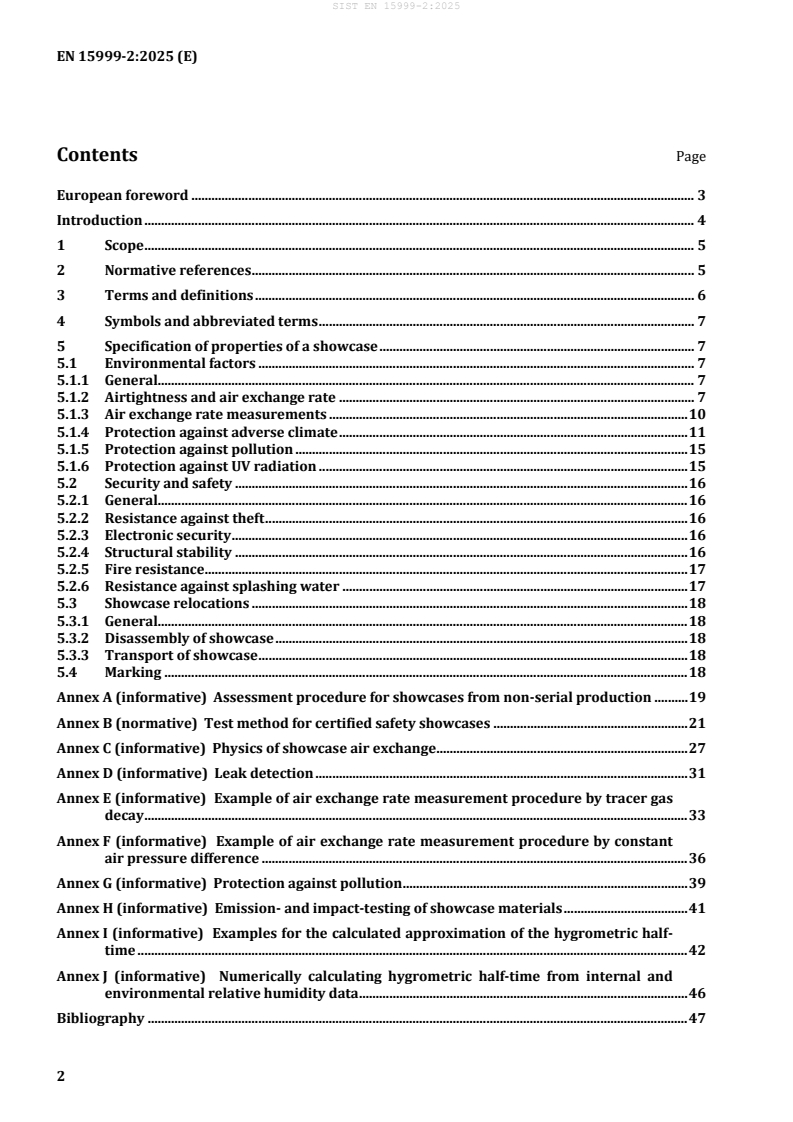
Contents Page
European foreword . 3
Introduction . 4
1 Scope . 5
2 Normative references . 5
3 Terms and definitions . 6
4 Symbols and abbreviated terms . 7
5 Specification of properties of a showcase . 7
5.1 Environmental factors . 7
5.1.1 General. 7
5.1.2 Airtightness and air exchange rate . 7
5.1.3 Air exchange rate measurements . 10
5.1.4 Protection against adverse climate . 11
5.1.5 Protection against pollution . 15
5.1.6 Protection against UV radiation . 15
5.2 Security and safety . 16
5.2.1 General. 16
5.2.2 Resistance against theft . 16
5.2.3 Electronic security . 16
5.2.4 Structural stability . 16
5.2.5 Fire resistance . 17
5.2.6 Resistance against splashing water . 17
5.3 Showcase relocations . 18
5.3.1 General. 18
5.3.2 Disassembly of showcase . 18
5.3.3 Transport of showcase . 18
5.4 Marking . 18
Annex A (informative) Assessment procedure for showcases from non-serial production . 19
Annex B (normative) Test method for certified safety showcases . 21
Annex C (informative) Physics of showcase air exchange . 27
Annex D (informative) Leak detection . 31
Annex E (informative) Example of air exchange rate measurement procedure by tracer gas
decay . 33
Annex F (informative) Example of air exchange rate measurement procedure by constant
air pressure difference . 36
Annex G (informative) Protection against pollution . 39
Annex H (informative) Emission- and impact-testing of showcase materials . 41
Annex I (informative) Examples for the calculated approximation of the hygrometric half-
time . 42
Annex J (informative) Numerically calculating hygrometric half-time from internal and
environmental relative humidity data . 46
Bibliography . 47
European foreword
This document (EN 15999-2:2025) has been prepared by Technical Committee CEN/TC 346
“Conservation of cultural heritage”, the secretariat of which is held by UNI.
This European Standard shall be given the status of a national standard, either by publication of an
identical text or by endorsement, at the latest by December 2025, and conflicting national standards
shall be withdrawn at the latest by December 2025.
Attention is drawn to the possibility that some of the elements of this document may be the subject of
patent rights. CEN shall not be held responsible for identifying any or all such patent rights.
EN 15999 consists of the following parts, under the general title “Conservation of cultural heritage —
Guidelines for design of showcases for exhibition and preservation of objects”:
— Part 1: General requirements
— Part 2: Technical aspects
Any feedback and questions on this document should be directed to the users’ national standards body.
A complete listing of these bodies can be found on the CEN website.
According to the CEN-CENELEC Internal Regulations, the national standards organisations of the
following countries are bound to implement this European Standard: Austria, Belgium, Bulgaria,
Croatia, Cyprus, Czech Republic, Denmark, Estonia, Finland, France, Germany, Greece, Hungary, Iceland,
Ireland, Italy, Latvia, Lithuania, Luxembourg, Malta, Netherlands, Norway, Poland, Portugal, Republic of
North Macedonia, Romania, Serbia, Slovakia, Slovenia, Spain, Sweden, Switzerland, Türkiye and the
United Kingdom.
Introduction
A key objective of a showcase is to display objects of cultural heritage while acceptably reducing their
conservation risks. Conservation risks include total loss, physical damage, chemical and biological
deterioration (e.g. by accidents, theft, vandalism, natural disasters, humidity, temperature, dust,
pollutants, light, pests).
This document addresses stakeholders who are engaged in projects that involve showcases and who
are expected to understand the properties of a showcase, such as end-users, designers, manufacturers,
and contracting authorities who are in charge of the cultural institutions.
The proposed categories and classifying of technical aspects of the showcases for conservation, safety
and security, use and management of the showcase should facilitate the dialogue between the
stakeholder and can be used in the procurement phase or in the operating phase; e.g. to define
showcase properties for objects on loan.
While recognizing that aesthetics of showcases are very important, the present document emphasizes
functional design of the showcase, the practical needs of the user and the requirements of the objects
for better preservation.
1 Scope
This document classifies properties of passive showcases of cultural heritage objects for better
preservation. It applies to most uses of the showcase: showcases for so called permanent or temporary
exhibitions, historical or modular showcases, showcases in uncontrolled ambient environment, etc. It
specifies how the performance of the showcase for the safe and secure display - as derived from needs
identified during the risk assessment approach described in EN 15999-1:2025 - can be technically
assessed by using classified properties.
Aspects of active showcases (those using electricity to directly condition their microclimates) and
anoxic showcases (those containing inert atmospheres instead of air) are mentioned in this document,
but their properties are not defined, nor classified.
2 Normative references
The following documents are referred to in the text in such a way that some or all of their content
constitutes requirements of this document. For dated references, only the edition cited applies. For
undated references, the latest edition of the referenced document (including any amendments) applies.
EN 410, Glass in building — Determination of luminous and solar characteristics of glazing
EN 1023-3, Office furniture — Screens — Part 3: Test methods
EN 1630:2021, Pedestrian doorsets, windows, curtain walling, grilles and shutters — Burglar
resistance — Test method for the determination of resistance to manual burglary attempts
EN 15898:2019, Conservation of cultural heritage — Main general terms and definitions
EN 50131 (all parts), Alarm systems — Intrusion and hold-up systems
EN 60529, Degrees of protection provided by enclosures (IP Code)
EN ISO/IEC 17025:2017, General requirements for the competence of testing and calibration laboratories
(ISO/IEC 17025:2017)
EN IEC 60332-1-2, Tests on electric and optical fibre cables under fire conditions — Part 1-2: Test for
vertical flame propagation for a single insulated wire or cable — Procedure for 1 kW pre-mixed flame
(IEC 60332-1-2)
EN IEC 60332-3-24, Tests on electric and optical fibre cables under fire conditions — Part 3-24: Test for
vertical flame spread of vertically-mounted bunched wires or cables — Category C (IEC 60332-3-24)
ISO 20653:2023, Road vehicles — Degrees of protection (IP code) — Protection of electrical equipment
against foreign objects, water and access
ISO 21348:2007, Space environment (natural and artificial) — Process for determining solar irradiances
EN 15999-1:2025, Conservation of cultural heritage — Guidelines for design of showcases for exhibition
and preservation of objects — Part 1: General requirements
3 Terms and definitions
For the purposes of this document, the terms and definitions given in EN 15898:2019 and in
EN 15999-1:2025 and the following apply.
ISO and IEC maintain terminology databases for use in standardization at the following addresses:
— ISO Online browsing platform: available at https://www.iso.org/obp/
— IEC Electropedia: available at https://www.electropedia.org/
3.1
airtightness
capacity of an envelope to limit the entrance or escape of air or other gas
3.2
end-user
person with assigned responsibility for cultural heritage on display in showcases or for the showcases
themselves
3.3
environment
physical, chemical and biological conditions surrounding the showcase
3.4
humidity buffering
smoothing of the peaks and troughs in relative humidity, whilst not changing the average relative
humidity
3.5
humidity control
maintaining a relative humidity value different from the average relative humidity value of the
environment (3.3)
3.6
independent expert
competent person who has the necessary training, knowledge, experience, expertise and skills,
sufficient to complete their allotted task
3.7
pollution sorbent
material that captures some specific gaseous pollutants to reduce their concentration
3.8
relative humidity
ratio of the actual vapour pressure to the saturation vapour pressure
[SOURCE: EN 15757:2010, 3.9]
3.9
volatile organic compound
VOC
organic molecule with a high vapour pressure at room temperature, including VVOC (very volatile
organic compound) and SVOC (semi volatile organic compound)
Note 1 to entry: VOCs can be found in construction materials and might be responsible for odour or considered
as air pollutants.
3.10
security personnel
those people in the organisation that have been assigned security related duties
Note 1 to entry: These people may or may not be employees of the organization.
[SOURCE: ISO 28001:2007, 3.22, modified, “in the supply chain” deleted]
4 Symbols and abbreviated terms
AER air exchange rate
RH relative humidity
T temperature
VOC volatile organic
compound
UV ultraviolet
IR infrared
−1 divided by
5 Specification of properties of a showcase
5.1 Environmental factors
5.1.1 General
Showcases can enhance the physical protection of objects from environmental risks arising from
incorrect humidity and temperature, pollutants, pests, from UV to IR radiation.
5.1.2 Airtightness and air exchange rate
The protective capacity of the showcase against the environmental factors listed below is mainly
determined by its airtightness. This allows it to:
— limit entry of gaseous pollutants present in the showcase's environment, e.g. external use of
corrosive cleaning products, outdoor gaseous pollutants;
— reduce water vapour exchanges and improve microclimate control. Moisture exchange due to low
airtightness limits the effectiveness and useful lifetimes of added moisture sorbent. It also
decreases hygrometric control of buffering showcases, which rely on high loading of moisture
sorbent in conjunction with higher airtightness;
— limit entry of particulate matter present in the room coming from indoor and outdoor sources
(e.g. smoke, dust, sporae, pest eggs) that deposit on objects or infest them, and to decrease cleaning
frequency of showcase interior.
When pollution comes from a source inside the showcase (e.g. an object releasing VOCs), and objects
made of vulnerable materials are present, higher airtightness is unfavourable for object preservation.
Intentional leaks (vents) should be created using natural or forced ventilation, or a material able to
absorb and retain the pollution should be added.
Airtightness of showcases generally decreases with time due to ageing and wear of sealing materials
(e.g. joints, adhesives, door-gasketas) and misalignment of the showcase with its closures (e.g. for
display space, technical compartments) and its joints due to deformation of glass and metal sheets.
Showcase airtightness is quantifiable by the air exchange rate (AER). Categories of AER and showcase
performance affected by the air exchange rate are indicated in Table 1. Different classes of AER are
−1
characterized by different levels of airtightness from low airtightness (AER ≥ 5 day ) to high
−1
airtightness (AER < 0,4 day ).
Table 1 — Class labels according to AER with indicative capacity to maintain a suitable
environment
Class AER Capacity to buffer Capacity to maintain internal Capacity to Pollutant
−1
Label against external hygrometric conditions (RH) provide protection accumulation
[day ]
(RH) fluctuation against the ingress from off-gassing
b
showcase
of pollutants
materials and/or
objects
Passive control Active control
AE 0 ≥ 5,0 Can significantly no Yes with high
Slight. Some Least build-up
reduce daily, but capacity protection offered
not weekly, systems against external
fluctuations with pollution, but not
very large amounts recommended
of moisture
a
sorbent
AE 1 < 5,0 to Can significantly will struggle to Yes Some. Between most Very low risk of
3,0 reduce weekly, but control RH stringent build-up
not monthly, depending on recommended levels
fluctuations with room (in rooms with low
large amounts of environment pollution
a
background values)
moisture sorbent
up to ~25 %
protection
compared to the
environment
AE 2 < 3,0 to Can significantly can struggle for Yes Good. Between most Low risk of buid-
1,0 reduce monthly, part of the year, stringent up
but not seasonal depending on recommended levels
up to ~50 %
variations with environment
medium amounts protection
of moisture compared to the
a
environment
sorbent
Class AER Capacity to buffer Capacity to maintain internal Capacity to Pollutant
−1
Label against external hygrometric conditions (RH) provide protection accumulation
[day ]
(RH) fluctuation against the ingress from off-gassing
b
showcase
of pollutants
materials and/or
objects
Passive control Active control
AE 3 < 1,0 to Can significantly can work for Suitable with Very good. Large Moderate risk of
0,4 reduce monthly, most most control showcases, and/or build-up
and most seasonal environments systems for with hard and
variations with most situations smooth materials
medium amounts (e.g. glass and
of moisture aluminium), cannot
a
satisfy most
sorbent
stringent
recommended levels
AE 4 < 0,4 to can significantly Yes Yes Very good. Nearly High risk of build-
reduce monthly, always satisfy most
0,1 up
and seasonal stringent
variations with recommended
medium amount of levels. Large
a
showcases in
moisture sorbent
naturally ventilated
buildings or in
conditioned
buildings with
insufficient chemical
filtering in urban
environments,
cannot satisfy most
stringent levels
AE 5 < 0,1 unlikely to be Yes Yes Excellent. Very few Highest risk of
required for RH showcases need this build-up
buffering or low AER
control, except in
most extreme
situations with low
amount of
a
moisture sorbent
a 3 3
Very high loading of moisture sorbent: e.g. 10 kg/m ; high loading of moisture sorbent: e.g. 6 kg/ m ; medium loading of
3 3
moisture sorbent: e.g. 3 kg/ m ; low loading of moisture sorbent: e.g. 1 to 2 kg/ m .
b
Protection levels are based on showcases placed in indoor environment.
Active climate conditioning systems can offer an alternative. However, the risk of technical failure
should be considered. The performance of many active systems is very temperature dependent.
Experience has shown that the showcase air exchange rate influences active conditioning (see Table 1).
Many manufacturers give indicative showcase volumes and air exchange rates that a certain active
climate conditioning unit will work with and requirements for space around the unit, which should be
adhered to. Humidifiers and dehumidifiers have large capacities and can successfully condition large
showcases with high air exchange rates. If both humidifiers and dehumidifiers are used together,
correct settings on the control sensor are essential. Mixing chambers can be used for smoothening RH
fluctuations induced by humidifiers and dehumidifiers units that run alternately. It comprises a space
between the display volume and humidifier or dehumidifier units. For greater effect, a mixing chamber
is possibly equipped with moisture sorbent. Several units based on Peltier coolers and water reservoirs
are available. Many have limited dehumidification capacity and can struggle at high room RH or high
temperatures.
5.1.3 Air exchange rate measurements
Two methods adapted from building measurement standards are suitable for measuring showcase air
exchange rates. They measure:
— tracer gas concentrations;
— air pressure differences.
Measuring showcase airtightness to estimate protection against the environmental factors outlined in
the previous section (see 5.1.2) is typically achievable with the tracer gas decay method. This is because
it measures air exchanges resulting from the complex interplay between the construction of the
showcase, and a variety of environmental contributions that often vary over time (see Annex C). As a
consequence, air exchange rates measured by tracer gas decay vary according to the changing ambient
environmental conditions. For this reason, tests running over periods longer than one day are
recommended to obtain an average air exchange rate; arriving at results representative of the
exhibition conditions. See Annex E for an example of air exchange rate measurement procedure by
tracer gas decay.
Measuring the extent of showcase air exchange via gaps is typically achievable with air pressure
difference methods, e.g. air pressure difference decay, constant air pressure difference. With these
methods air exchange is measured under a consistently controlled test environment which dominates
over ambient environmental conditions. As a result, air exchange rates measured by air pressure
methods are less subject to changing ambient environmental conditions; according to the unchanging
construction/geometries of the showcase and its gaps. This high test repeatability stems from its
mechanically-induced air exchange, which also enable tests to be completed in minutes. See Annex F.
Before taking air exchange rate measurements, the objective/s shall be clearly defined. This can help to
choose the suitable measurement method/s; especially in terms of the test duration, equipment and
environmental conditions. Unless preliminary tests are being undertaken, showcases shall be tested as
part of their final assessment, with all features installed, e.g. security/lighting devices and wiring.
Sealing surfaces and seals on all openings should be cleaned, and openings properly shut with all locks
engaged.
The objectives can be to determine the:
— construction quality of showcases versus targets from specifications in procurement contracts with
showcase suppliers, or from ad hoc exhibition needs;
— lifetime/amount of sorbent needed for buffering RH (see also Annex G, G.2);
— lifetime/amount of sorbent needed for controlling RH to a limit/threshold (see also G.3);
— protection of objects from externally generated pollutants (see also G.2);
— accumulation of internally generated pollutants (see also G.4);
— venting of internally generated pollutants (see also G.4);
— remedial alterations to airtightness made during maintenance or retrofitting of door-gaskets,
hinges, joints, gas struts, vertical lift systems and joints resealing around lighting/cableruns, etc. on
existing showcases;
— alterations to airtightness made after relocating existing showcases;
— influences of ageing and wear on alterations to airtightness of existing showcases.
Active microclimate conditioning systems will interfere with accuracy of airtightness measurements, so
should be turned off and have any plumbing connections closed when performing the measurements.
Before or after taking air exchange rate measurements, searching for leaks may be appropriate
(see Annex D).
Further information can be found in the Annexes:
— the physics of showcase air exchange (Annex C);
— the influence of showcase design on air exchange (see EN 15999-1:2025, Annex B);
— Example of air exchange rate measurement procedure by tracer gas decay (Annex E);
— Example of air exchange rate measurement procedure by constant air pressure difference
(Annex F).
5.1.4 Protection against adverse climate
5.1.4.1 General
Showcases can be designed to provide appropriate climate conditions for the long term preservation of
objects. Relative humidity and temperature are the principal climate parameters, but air pollution shall
be considered for many objects as well. Relative humidity of air is linked to the air temperature. A
temperature increase of 1°C can make the relative humidity decrease about 2 % to 3 %.
NOTE An enthalpy-entropy chart, a so-called Mollier-diagram, can be consulted to determine such changes.
For example: the relative humidity in air with a temperature of 25 °C and a constant humidity mixing ratio
of 9,9 g/kg, will drop from 50 % to 47 % when the temperature rises to 26 °C.
Four different qualities of showcases are described below to control its microclimate performances:
— Hygrometric half-time (5.1.4.2);
— Buffering against external relative humidity fluctuations (5.1.4.3);
— Capacity to maintain internal hygrometric conditions (RH) (5.1.4.4); and
— Thermal performance (5.1.4.5).
Whilst humidity buffering (5.1.4.3), is suitable if the room average relative humidity is acceptable, there
are often occasions when it is desired to keep the showcase average relative humidity significantly
different to the room (5.1.4.4).
The targeted relative humidity conditions for an object are obtained by selecting a showcase with a
suitable hygrometric half-time (5.1.4.2) and corresponding replacement cycle of the moisture sorbent.
5.1.4.2 Hygrometric half-time
The capacity of a showcase to buffer against fluctuations in room relative humidity, or to maintain a
specific microclimate relative humidity, is most easily expressed as the hygrometric half-time. The
hygrometric half-time depends on two chief factors: (1) airtightness of the showcase envelope, and (2)
the type, amount (loading for the moisture sorbent) of buffering material in the display space and
technical compartment (see Annex I, Formula (I.1)).
NOTE Showcase construction, dressings, exhibit can also be hygroscopic.
A long hygrometric half-time signifies a large buffering capacity for RH fluctuations. The objectives for
installing a certain amount and type of suitably conditioned moisture sorbent are to:
— adjust the microclimate RH to the target interval;
— increase the duration that the target microclimate RH can be maintained.
Examples for the calculated approximation of the hygrometric half-time are given in Annex I.
The hygrometric half-time of an existing showcase can be calculated from internal and external relative
humidity data, see Annex J. When specifying existing showcases, the hygrometric half-time shall be
quoted. When specifying new showcases, the anticipated showcase air exchange rate, and the volume of
the technical compartment for moisture sorbent, shall both be quoted. These allow estimation of the
hygrometric half-time. Hygrometric half-times are expressed in the following categories given
in Table 2.
Table 2 — Categories of hygrometric half-time with some indicative uses
Class Label Hygrometric Example of use
half-time (the actual suitability is subject to environmental
climate parameters)
(days)
HH 6 ≥ 800 extreme climates: RH over 80 % for considerable
amount of time (any kind of castle or underground
building, as tunnels, mines, bunker, marine
environment)
HH 5 < 800 to 400 Seasonal variations of 50 % RH in the environment
HH 4 < 400 to 200 Seasonal variations of 40 % RH in the environment
HH 3 < 200 to 100 Seasonal variations of 30 % RH in the environment
HH 2 < 100 to 50 Seasonal variations of 20 % RH in the environment
HH 1 < 50 to 10 two-week maintenance or repair period for air
conditioning in many environments
HH 0 < 10 most favourable climates and air conditioned spaces
5.1.4.3 Buffering against external (RH) fluctuations
A high hygrometric half-time of a showcase indicates a high capacity to maintain a narrow relative
humidity range over a long time.
If a technical compartment is used for moisture sorbents, sufficient air exchange with the display
volume is essential and its installation adjacent to the display volume works best. Sufficient gaps for
moisture exchange between the technical compartment and the display volume are essential to support
the function of the moisture sorbent.
NOTE Experience has shown that 8 mm holes covering 25 % of the surface area of a fabric covered 2 mm
thick metal board work well [1]. For slots, a 20 mm gap width has been proposed [2].
If air exchange between the display volume and sorbent compartment is too slow, electric fans can be
used. However, their powering, maintenance and malfunction risks should be considered.
To achieve the required hygrometric half-time, the:
— volume of the technical compartment shall be large enough to accommodate the calculated amount
of moisture sorbent material (see 5.1.4.1);
— surface area of contact in the technical compartment shall be large enough to condition air being
exchanged with the display volume.
Table 3 gives the expected RH microclimate inside showcases for selected hygrometric half-times
related to annual RH intervals of the indoor environment.
Table 3 — Expected RH microclimate inside showcases for selected hygrometric half-times
related to annual RH intervals of the indoor environment
Hygrometric half- Environment seasonal interval
time of the showcase (minimum to maximum annual RH (%))
(in days) between 30 to 70 between 20 to 80 between 10 to 90
Expected showcase microclimate
(minimum to maximum RH (%))
800 50 50 50
400 50 50 to 51 50 to 52
200 50 to 52 49 to 52 49 to 53
100 49 to 53 48 to 54 48 to 55
50 47 to 55 46 to 57 45 to 59
10 35 to 63 29 to 68 23 to 72
The higher category is mainly useful for long-term relative humidity control when the room average is
far from the desired average relative humidity, see 5.1.4.4.
5.1.4.4 Capacity to maintain microclimate hygrometric conditions (RH)
A high hygrometric half-time of a showcase indicates a high capacity to maintain a relative humidity
microclimate over a long time. At the same time, the maintenance cycle for reconditioning the moisture
sorbent material will be long. If large numbers of showcases are in use the resources (human, technical
and financial) required for reconditioning the moisture sorbents shall be considered.
A relative humidity microclimate different from the room can be achieved by adding moisture sorbent
(previously conditioned to the desired level). With time, the showcase average will move toward the
room average relative humidity. This means the buffer material shall be replaced with new conditioned
buffer. Calculations are available to predict moisture sorbent material lifetime (see [3]). Essentially, the
lower the showcase air exchange rate is and the higher the amount of moisture sorbent material
present, the longer the replacement interval will be.
The duration required to recondition the moisture sorbent of a showcase depends on the hygrometric
half-time of the showcase, the room conditions and the target relative humidity.
Table 4 was generated with calculations extensively tested on 200 real monitored showcases in historic
buildings in the United Kingdom. The time values have been found to have errors of less than 5 %. The
hygrometric half-time is the indicator for the capacity of the showcase to maintain the RH microclimate.
The moisture sorbent will need replacing after the time-periods indicated in Table 4. The seasonal
relative humidity values can differ and influence the time-periods.
Table 4 — Illustration of how the hygrometric half-time influence the time period for replacing
of a moisture sorbent
Hygrometric half- Days to maintain the microclimate in Days to maintain the
time (days) a 40 % –60 % RH interval microclimate
(with moisture sorbent material conditioned below 30 % RH
to 50 % RH) (with moisture sorbent
material conditioned
a
to 5 % RH)
RH room interval RH room interval room at 80 % RH
between 20 % to 60 % between 60 % to 100 %
800 ~ 11 000 (30 years) 2 916 467
400 ~ 6 600 (18 years) 1 500 233
200 ~ 3 300 (9 years) 768 116
100 1 400 387 58
50 653 117 19
10 238 31 5
a
Source: [4]
5.1.4.5 Thermal performance
The performance of a showcase to control its microclimate can be very negatively impacted by heating;
either from internal heat sources or external irradiation producing a greenhouse effect. Possible
internal heat sources include waste heat from active climate control devices, light sources (including
LEDs) and other electronic devices. If they are present, the temperature should be measured at the
warmest point of the deck or backboard, with the heat source running for at least 30 min prior to the
measurement, or in the centre of the display volume. Results should be expressed as the maximum
temperature difference measured through a full day. The thermal performance of display space of a
showcase should be placed in the following bands (see Table 5).
Thermal performance of display space of a showcase already installed on site can also be classified
according to Table 5 by long-term temperature monitoring. The installation site of the showcase can
affect the temperature inside the showcase due to a possible green-house effect. Green-house effects
from natural light (even through blinds) will have a strong seasonal effect and results should be
expressed as the maximum temperature measured throughout a full year.
Table 5 — Classification by maximum daily temperature difference ΔT in the showcase
max
compared to the environment
Class label ΔT (°C) Expected adverse effect
max
TP 0 > 4,0 dramatic impact on performance, showcase
protection is very likely to be compromised
TP 1 from > 2,0 to ≤ 4,0 impact on performance, AER will increase,
medium amounts of buffer can struggle
TP 2 from > 1,0 to ≤ 2,0 some impact on performance, AER will
increase, small amounts of buffer can struggle
TP 3 from > 0,5 to ≤ 1,0 little impact on performance
TP 4 ≤ 0,5 negligible impact on performance
5.1.5 Protection against pollution
5.1.5.1 General
Pollution in a showcase can originate from air exchanged with the environment or can be emitted from
internal sources. The balance between ingress of pollutants and their release by air exchange
determines the pollution level. Examples of typical situations are given in Annex G.
5.1.5.2 Protection against the ingress of pollutants
The protection against external air pollutants (gases, droplets, particles) is determined by the air
exchange rate of the showcase. The degree of protection can be categorized according to the six classes
indicated in Table 1.
5.1.5.3 Material emissions
An undesirable side effect of several materials and products used for constructing and decorating
showcases is that they emit pollutants. Showcases construction and decoration materials should be
selected with great care with regard to the emission behaviour. Preselected materials should be tested
for emissions and impacts to avoid damage of the objects on display (Annex H).
NOTE 1 High emitting materials are for example, wood-based materials, acetic acid containing sealants etc. For
more information about undesirable effects of several materials and products, see [5], [6], [7], [8], [9], [10].
NOTE 2 With increasing showcase tightness the risk of pollutant accumulation also rises (see Table 1).
5.1.5.4 Maintenance cycle for pollution sorbent
The maintenance procedures and lifetimes, as obtained e.g. by industrial capacity tests, as
described/recommended by manufacturers should be adhered to.
Critical impact levels of relevant air pollutants in the showcase as measured by relevant methods
(concentration in air or impact on dosimeters) can be determined.
Impact levels should be measured in regular intervals and the absorber then changed when the
measured level increases above the critical level.
For similar showcases, the amount of pollution sorbent needed to reach the same interval between its
changing will be proportional to the pollution sorbent exposed surface area and inversely proportional
to the showcase volume.
5.1.6 Protection against UV radiation
Ultraviolet (UV) radiation transmittance of glass shall be calculated according to EN 410 with the UVA
(from 315 nm to 400 nm) and UVB (from 280 nm to 315 nm) ranges defined in ISO 21348:2007.
NOTE In the museum context UV radiation is usually considered to include wavelengths up to 400 nm.
For the use in the showcase, the UV radiation protection properties can be categorized as follows:
— Class UV 0 – UV radiation absorbing properties are not specified;
— Class UV 1 – UV radiation transmittance of glass is lower than 1,0 %.
5.2 Security and safety
5.2.1 General
Showcases shall provide protection of objects from theft, burglary, vandalism, visitor damage, fire, etc.
Different levels of security and safety protection can be achieved through case design (water resistance,
physical stability) and building materials (fire resistance) or with added equipment (electronic
devices).
The security of a showcase is determined by a combination of the physical resistance and any
technological system such as an alarm. A good physical resistance prolongs the time that a perpetrator
needs to access the objects while electronic alarm systems built into the showcase can shorten the time
to trigger the intervention of security personnel.
5.2.2 Resistance against theft
Showcases from serial production can be qualified according to their resistance to burglary attacks by
practical attempts to overcome them in an attack test. Tool attack tests cannot be used for both non-
serial customized or existing showcases. In this case, an independent expert can evaluate the showcase
for its burglary resistance based on comparable showcases of the manufacturer and on the
requirements listed in Annex A.
Destructive laboratory tests can be used with known attack methods and tools. The resistance class for
the test showcase is determined from the type and duration of use of the tools used in a break-in
attempt (Annex B).
The fixing elements of the showcase shall not be accessible nor visible for visitors.
5.2.3 Electronic security
If the risk assessment for theft indicates a high risk, the provision or addition of an alarm system or
defence system shall be considered. The operation modes of the alarm and defence systems shall be
adjustable to suit the public opening/closure hours of the premises and shall be integrated into the
security concept of the entire premises.
Electronic alarm systems build into the showcase can shorten the time to trigger the intervention of
security personnel. Defence systems (such as fogging) can be used in confined rooms during closing
hours and serve to slow down the attack or escape of the perpetrator and by this prolonging the time
which is available to the security services to respond. All alarm systems shall comply with EN 50131 (all
parts). Hard wired monitored systems with a power back up are more reliable than any stand-alone
system.
5.2.4 Structural stability
Structural stability of a showcase is defined as the capability not to deform, collapse, dislodge or fall
over because of its intrinsic weight or applied loads over its lifetime. Structural stability shall be verified
by structural engineering calculations, experimentation or extensive experience given by the
manufacturer.
The structural stability of a showcase is determined by the following factors: its materials, assembly,
dimensions and weight distribution, and its surroundings.
Any showcase at risk of falling over should be fixed mechanically to the building. If mechanical fixings of
a free-standing showcase are not possible or inadequate, increasing the weight of the showcase base
can help. In doing so, the maximum distributed load on load-bearing structures of the gallery should be
taken into consideration. Such an evaluation shall also account for point loads of the showcase
...