


oSIST prEN IEC 60034-14:2026
(Main)Rotating electrical machines - Part 14: Mechanical vibration of certain machines with shaft heights 56 mm and higher - Measurement, evaluation and limits of vibration severity
Rotating electrical machines - Part 14: Mechanical vibration of certain machines with shaft heights 56 mm and higher - Measurement, evaluation and limits of vibration severity
Drehende elektrische Maschinen - Teil 14: Mechanische Schwingungen von bestimmten Maschinen mit einer Achshöhe von 56 mm und höher - Messung, Bewertung und Grenzwerte der Schwingstärke
Machines électriques tournantes - Partie 14: Vibrations mécaniques de certaines machines de hauteur d'axe supérieure ou égale à 56 mm - Mesurage, évaluation et limites de l'intensité vibratoire
Električni rotacijski stroji - 14. del: Mehanske vibracije nekaterih strojev za višino gredi 56 mm in več - Merjenje, vrednotenje in meje intenzivnosti vibracij
General Information
- Status
- Not Published
- Public Enquiry End Date
- 19-Apr-2026
- Technical Committee
- ERS - Rotating machinery
- Current Stage
- 4020 - Public enquire (PE) (Adopted Project)
- Start Date
- 10-Feb-2026
- Due Date
- 30-Jun-2026
Relations
- Effective Date
- 03-Jun-2025
Overview
oSIST prEN IEC 60034-14:2026 is an international standard developed by CENELEC (CLC) and the International Electrotechnical Commission (IEC) Technical Committee 2, focusing on rotating electrical machines. This document specifies the procedures for measuring, evaluating, and limiting the vibration severity of certain electrical machines with shaft heights of 56 mm and above. It applies to DC and three-phase AC machines with rated outputs up to 50 MW and speeds up to 15,000 min⁻¹. The standard addresses factory acceptance vibration tests, establishes defined mounting and measurement conditions, and prescribes permissible vibration limits for both displacement and velocity.
Key Topics
- Scope and Applicability
- Covers DC and three-phase AC rotating electrical machines with shaft heights ≥ 56 mm.
- Applicable to machines with up to 50 MW output; excludes certain types such as single-phase machines, three-phase commutator motors, vertical waterpower generators, and machines with magnetic bearings.
- Vibration Measurement
- Specifies methods for measuring vibration displacement and velocity at the machine bearings.
- Includes requirements for measurement equipment, mounting conditions, and test setups to ensure accurate and reproducible vibration data.
- Acceptance Criteria
- Defines vibration magnitude limits for bearing housings based on machine size and mounting configuration (free suspension or rigid mounting).
- Introduces two vibration grades (A and B), supporting both standard and special vibration performance requirements.
- Test Procedures
- Includes protocols for both direct-on-line and variable speed testing, with guidelines for measurement positions and directions.
- Provides details for testing both horizontal and vertical machines under specific mounting conditions.
- Limits for Relative Shaft Vibration
- Recommends procedures and thresholds for measuring relative shaft vibration, especially important for large machines with sleeve bearings.
Applications
oSIST prEN IEC 60034-14:2026 is crucial across various industries utilizing large or sensitive rotating electrical machines, such as:
- Industrial Manufacturing
Ensures electrical machinery meets vibration performance requirements to maintain production quality and equipment lifespan. - Power Generation
Applied in testing generators and motors in power plants to prevent excessive vibration, which can lead to unplanned downtime or failures. - Oil, Gas, and Chemical Sectors
Used for compliance in severe-duty motors and large synchronous machines that power critical processes, as per industry-specific requirements. - Railway Applications
Important for onboard electrical machinery where vibration impacts both performance and passenger comfort. - Equipment Certification and Procurement
Provides a standardized reference for OEMs, suppliers, and end-users to evaluate and compare machine vibration characteristics during acceptance and commissioning.
The standard supports predictive maintenance, enhances machine reliability, and fosters international uniformity in vibration assessment practices.
Related Standards
For comprehensive vibration assessment and alignment with oSIST prEN IEC 60034-14:2026, users may also consult:
- IEC 60034-1: Rotating electrical machines – Part 1: Rating and performance
- IEC 60034-7: Classification of types of construction and mounting arrangements
- ISO 2954: Mechanical vibration of rotating and reciprocating machinery – Requirements for instruments for measuring vibration severity
- ISO 10817-1: Rotating shaft vibration measuring systems – Part 1: Relative and absolute sensing of radial vibration from rotating shafts
- ISO 20816-1: Mechanical vibration – Measurement and evaluation of machine vibration – General guidelines
- ISO 20816-3: Mechanical vibration – Measurement and evaluation of machine vibration – Industrial machinery above 15 kW
- API Standards 541/546/547: For form-wound and brushless machines in critical industries
Following oSIST prEN IEC 60034-14:2026 ensures reliable vibration measurement and control for rotating electrical machines, supporting safety, operational performance, and regulatory compliance.

Get Certified
Connect with accredited certification bodies for this standard

Intertek Testing Services NA Inc.
Intertek certification services in North America.

UL Solutions
Global safety science company with testing, inspection and certification.

ANCE
Mexican certification and testing association.
Sponsored listings
Frequently Asked Questions
oSIST prEN IEC 60034-14:2026 is a draft published by the Slovenian Institute for Standardization (SIST). Its full title is "Rotating electrical machines - Part 14: Mechanical vibration of certain machines with shaft heights 56 mm and higher - Measurement, evaluation and limits of vibration severity". This standard covers: Rotating electrical machines - Part 14: Mechanical vibration of certain machines with shaft heights 56 mm and higher - Measurement, evaluation and limits of vibration severity
Rotating electrical machines - Part 14: Mechanical vibration of certain machines with shaft heights 56 mm and higher - Measurement, evaluation and limits of vibration severity
oSIST prEN IEC 60034-14:2026 is classified under the following ICS (International Classification for Standards) categories: 17.160 - Vibrations, shock and vibration measurements; 29.160.01 - Rotating machinery in general. The ICS classification helps identify the subject area and facilitates finding related standards.
oSIST prEN IEC 60034-14:2026 has the following relationships with other standards: It is inter standard links to SIST EN IEC 60034-14:2019. Understanding these relationships helps ensure you are using the most current and applicable version of the standard.
oSIST prEN IEC 60034-14:2026 is available in PDF format for immediate download after purchase. The document can be added to your cart and obtained through the secure checkout process. Digital delivery ensures instant access to the complete standard document.
Standards Content (Sample)
SLOVENSKI STANDARD
01-april-2026
Električni rotacijski stroji - 14. del: Mehanske vibracije nekaterih strojev za višino
gredi 56 mm in več - Meritve, vrednotenje in mejne vrednosti stopenj jakosti
Rotating electrical machines - Part 14: Mechanical vibration of certain machines with
shaft heights 56 mm and higher - Measurement, evaluation and limits of vibration
severity
Drehende elektrische Maschinen - Teil 14: Mechanische Schwingungen von bestimmten
Maschinen mit einer Achshöhe von 56 mm und höher - Messung, Bewertung und
Grenzwerte der Schwingstärke
Machines électriques tournantes - Partie 14: Vibrations mécaniques de certaines
machines de hauteur d'axe supérieure ou égale à 56 mm - Mesurage, évaluation et
limites de l'intensité vibratoire
Ta slovenski standard je istoveten z: prEN IEC 60034-14:2026
ICS:
17.160 Vibracije, meritve udarcev in Vibrations, shock and
vibracij vibration measurements
29.160.01 Rotacijski stroji na splošno Rotating machinery in
general
2003-01.Slovenski inštitut za standardizacijo. Razmnoževanje celote ali delov tega standarda ni dovoljeno.
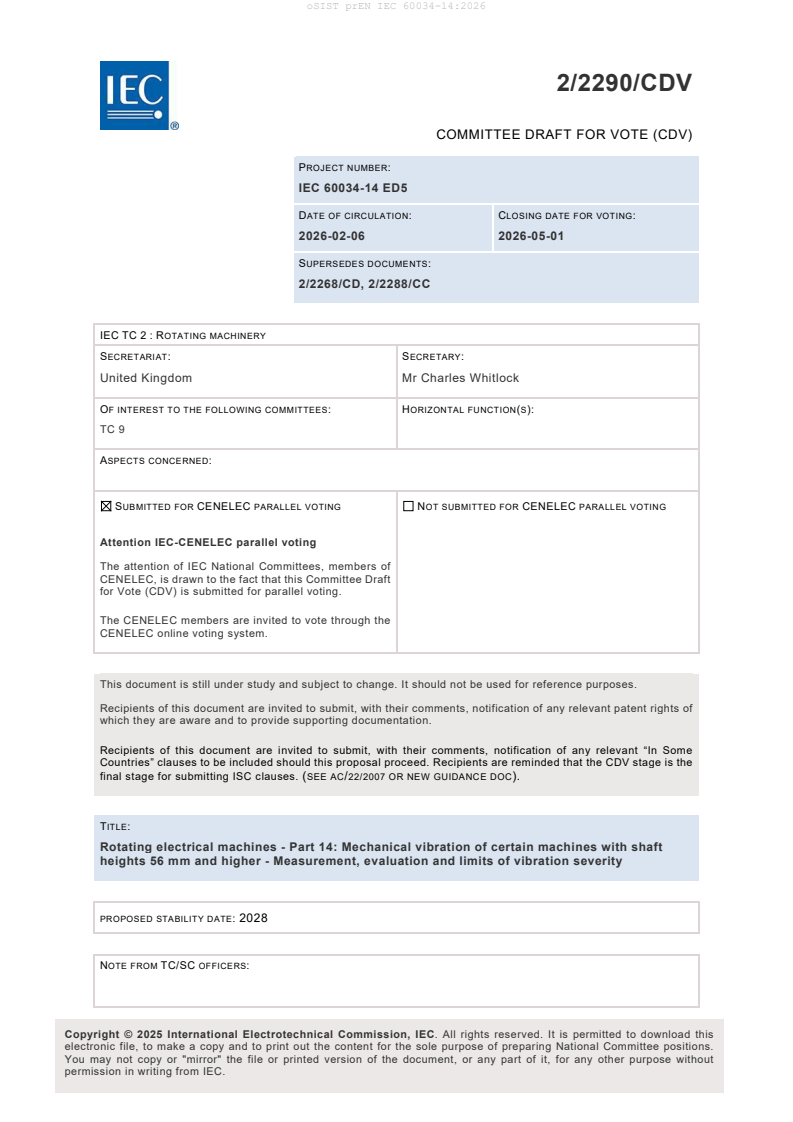
2/2290/CDV
COMMITTEE DRAFT FOR VOTE (CDV)
PROJECT NUMBER:
IEC 60034-14 ED5
DATE OF CIRCULATION: CLOSING DATE FOR VOTING:
2026-02-06 2026-05-01
SUPERSEDES DOCUMENTS:
2/2268/CD, 2/2288/CC
IEC TC 2 : ROTATING MACHINERY
SECRETARIAT: SECRETARY:
United Kingdom Mr Charles Whitlock
OF INTEREST TO THE FOLLOWING COMMITTEES: HORIZONTAL FUNCTION(S):
TC 9
ASPECTS CONCERNED:
SUBMITTED FOR CENELEC PARALLEL VOTING NOT SUBMITTED FOR CENELEC PARALLEL VOTING
Attention IEC-CENELEC parallel voting
The attention of IEC National Committees, members of
CENELEC, is drawn to the fact that this Committee Draft
for Vote (CDV) is submitted for parallel voting.
The CENELEC members are invited to vote through the
CENELEC online voting system.
This document is still under study and subject to change. It should not be used for reference purposes.
Recipients of this document are invited to submit, with their comments, notification of any relevant patent rights of
which they are aware and to provide supporting documentation.
Recipients of this document are invited to submit, with their comments, notification of any relevant “In Some
Countries” clauses to be included should this proposal proceed. Recipients are reminded that the CDV stage is the
final stage for submitting ISC clauses. (SEE AC/22/2007 OR NEW GUIDANCE DOC).
TITLE:
Rotating electrical machines - Part 14: Mechanical vibration of certain machines with shaft
heights 56 mm and higher - Measurement, evaluation and limits of vibration severity
PROPOSED STABILITY DATE: 2028
NOTE FROM TC/SC OFFICERS:
electronic file, to make a copy and to print out the content for the sole purpose of preparing National Committee positions.
You may not copy or "mirror" the file or printed version of the document, or any part of it, for any other purpose without
permission in writing from IEC.
IEC CDV 60034-14 © IEC 2026
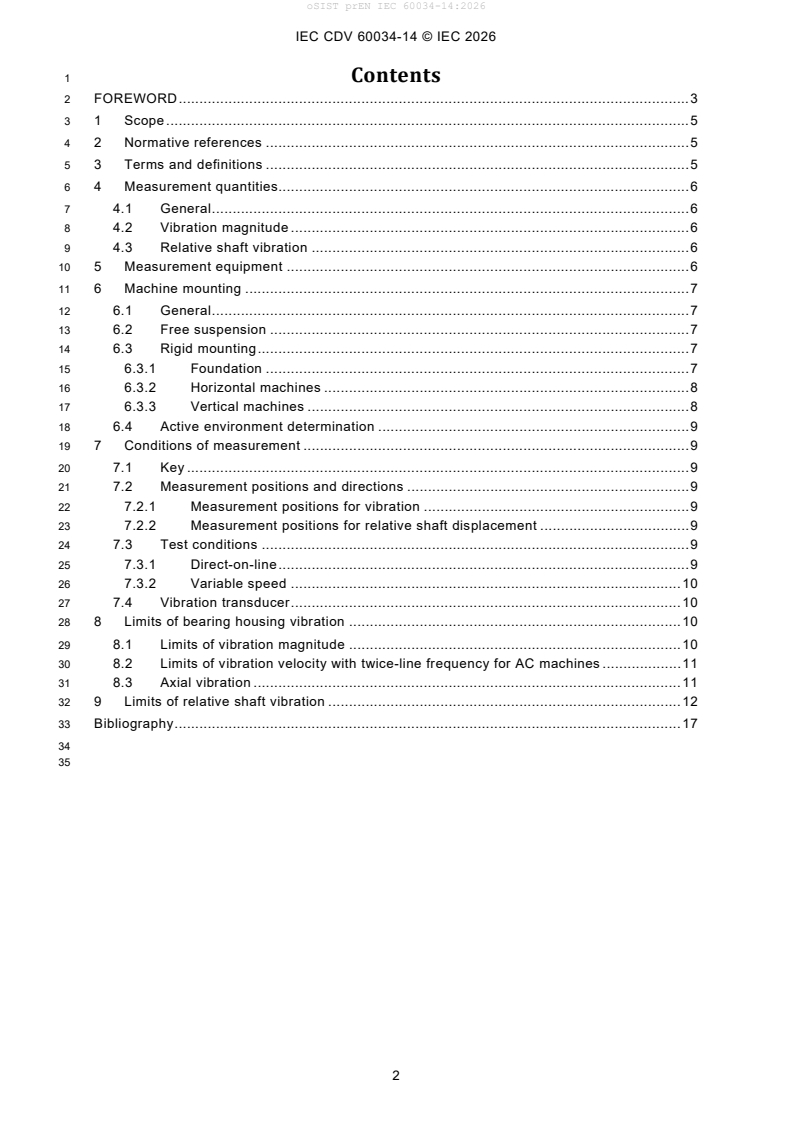
1 Contents
2 FOREWORD . 3
3 1 Scope . 5
4 2 Normative references . 5
5 3 Terms and definitions . 5
6 4 Measurement quantities. 6
7 4.1 General . 6
8 4.2 Vibration magnitude . 6
9 4.3 Relative shaft vibration . 6
10 5 Measurement equipment . 6
11 6 Machine mounting . 7
12 6.1 General . 7
13 6.2 Free suspension . 7
14 6.3 Rigid mounting . 7
15 6.3.1 Foundation . 7
16 6.3.2 Horizontal machines . 8
17 6.3.3 Vertical machines . 8
18 6.4 Active environment determination . 9
19 7 Conditions of measurement . 9
20 7.1 Key . 9
21 7.2 Measurement positions and directions . 9
22 7.2.1 Measurement positions for vibration . 9
23 7.2.2 Measurement positions for relative shaft displacement . 9
24 7.3 Test conditions . 9
25 7.3.1 Direct-on-line . 9
26 7.3.2 Variable speed . 10
27 7.4 Vibration transducer . 10
28 8 Limits of bearing housing vibration . 10
29 8.1 Limits of vibration magnitude . 10
30 8.2 Limits of vibration velocity with twice-line frequency for AC machines . 11
31 8.3 Axial vibration . 11
32 9 Limits of relative shaft vibration . 12
33 Bibliography . 17
IEC CDV 60034-14 © IEC 2026
36 INTERNATIONAL ELECTROTECHNICAL COMMISSION
37 ____________
39 ROTATING ELECTRICAL MACHINES –
41 Part 14: Mechanical vibration of certain machines
42 with shaft heights 56 mm and higher – Measurement,
43 evaluation and limits of vibration severity
45 FOREWORD
46 1) The International Electrotechnical Commission (IEC) is a worldwide organization for standardization comprising
47 all national electrotechnical committees (IEC National Committees). The object of IEC is to promote international
48 co-operation on all questions concerning standardization in the electrical and electronic fields. To this end and
49 in addition to other activities, IEC publishes International Standards, Technical Specifications, Technical Reports,
50 Publicly Available Specifications (PAS) and Guides (hereafter referred to as “IEC Publication(s)”). Their
51 preparation is entrusted to technical committees; any IEC National Committee interested in the subject dealt with
52 may participate in this preparatory work. International, governmental and non-governmental organizations liaising
53 with the IEC also participate in this preparation. IEC collaborates closely with the International Organization for
54 Standardization (ISO) in accordance with conditions determined by agreement between the two organizations.
55 2) The formal decisions or agreements of IEC on technical matters express, as nearly as possible, an international
56 consensus of opinion on the relevant subjects since each technical committee has representation from all
57 interested IEC National Committees.
58 3) IEC Publications have the form of recommendations for international use and are accepted by IEC National
59 Committees in that sense. While all reasonable efforts are made to ensure that the technical content of IEC
60 Publications is accurate, IEC cannot be held responsible for the way in which they are used or for any
61 misinterpretation by any end user.
62 4) In order to promote international uniformity, IEC National Committees undertake to apply IEC Publications
63 transparently to the maximum extent possible in their national and regional publications. Any divergence between
64 any IEC Publication and the corresponding national or regional publication shall be clearly indicated in the latter.
65 5) IEC itself does not provide any attestation of conformity. Independent certification bodies provide conformity
66 assessment services and, in some areas, access to IEC marks of conformity. IEC is not responsible for any
67 services carried out by independent certification bodies.
68 6) All users should ensure that they have the latest edition of this publication.
69 7) No liability shall attach to IEC or its directors, employees, servants or agents including individual experts and
70 members of its technical committees and IEC National Committees for any personal injury, property damage or
71 other damage of any nature whatsoever, whether direct or indirect, or for costs (including legal fees) and
72 expenses arising out of the publication, use of, or reliance upon, this IEC Publication or any other IEC
73 Publications.
74 8) Attention is drawn to the Normative references cited in this publication. Use of the referenced publications is
75 indispensable for the correct application of this publication.
76 9) Attention is drawn to the possibility that some of the elements of this IEC Publication may be the subject of patent
77 rights. IEC shall not be held responsible for identifying any or all such patent rights.
78 International Standard IEC 60034-14 has been prepared by IEC technical committee 2: Rotating
79 machinery.
80 This fifth edition cancels and replaces the fourth edition, published in 2018. It constitutes a
81 technical revision.
82 The significant technical changes with respect to the previous edition are:
83 a) Subclause 6.3.3 Vertical machines: added two new subclauses: Type and Routine tests
84 b) Subclause 7.3 Test conditions: added two new subclauses: Direct-on-line and Variable
85 speed
86 c) Table 1: decreased limits for Grade A in free suspension for 56 ≤ H ≤ 132
87 d) Clause 9 Limits of relative shaft vibration: added information how to mitigate effects of
88 run-out on shaft vibration measurements.
IEC CDV 60034-14 © IEC 2026
90 The text of this International Standard is based on the following documents:
FDIS Report on voting
2//FDIS 2//RVD
92 Full information on the voting for the approval of this International Standard can be found in the
93 report on voting indicated in the above table.
94 This document has been drafted in accordance with the ISO/IEC Directives, Part 2.
95 A list of all parts in the IEC 60034 series, published under the general title Rotating electrical
96 machines, can be found on the IEC website.
97 NOTE For A table of cross-references of all IEC TC 2 publications can be found in the IEC TC 2 dashboard on the
98 IEC website.
99 The committee has decided that the contents of this document will remain unchanged until the
100 stability date indicated on the IEC website under "http://webstore.iec.ch" in the data related to
101 the specific document. At this date, the document will be
102 • reconfirmed,
103 • withdrawn,
104 • replaced by a revised edition, or
105 • amended.
IEC CDV 60034-14 © IEC 2026
108 ROTATING ELECTRICAL MACHINES –
110 Part 14: Mechanical vibration of certain machines
111 with shaft heights 56 mm and higher – Measurement,
112 evaluation and limits of vibration severity
116 1 Scope
117 This part of IEC 60034 specifies the factory acceptance vibration test procedures and vibration
118 limits for certain electrical machines under specified conditions, when uncoupled from any load
119 or prime mover.
120 It is applicable to DC and three-phase AC machines, with shaft heights 56 mm and higher and
–1
121 a rated output up to 50 MW, at operational speeds from 120 min up to and including
–1
122 15 000 min .
123 This document is not applicable to machines mounted in situ (on site), three-phase commutator
124 motors, single-phase machines, three-phase machines operated on single-phase systems,
125 vertical waterpower generators, turbine generators greater than 20 MW and machines with
126 magnetic bearings or series-wound machines.
127 NOTE 1 For machines measured in situ, refer to applicable parts of ISO 20816-1 and ISO 20816-3.
128 NOTE 2 For output power above 50 MW reference shall be made to ISO 20816 standards.
129 NOTE 3 Vibration routine tests are not mandatory according to IEC 60034-1. If performed the method for testing is
130 included in this standard.
131 2 Normative references
132 The following documents are referred to in the text in such a way that some or all their content
133 constitutes requirements of this document. For dated references, only the edition cited applies.
134 For undated references, the latest edition of the referenced document (including any
135 amendments) applies.
136 IEC 60034-1, Rotating electrical machines – Part 1: Rating and performance
137 IEC 60034-7, Rotating electrical machines – Part 7: Classification of types of constructions and
138 mounting arrangements (IM Code)
139 ISO 2954, Mechanical vibration of rotating and reciprocating machinery – Requirements for
140 instruments for measuring vibration severity
141 ISO 10817-1, Rotating shaft vibration measuring systems – Part 1: Relative and absolute
142 sensing of radial vibration from rotating shafts
143 ISO 20816-1, Mechanical vibration – Measurement and evaluation of machine vibration –
144 Part 1: General guidelines
145 ISO 21940-32, Mechanical vibration – Rotor balancing – Part 32: Shaft and fitment key
146 convention
147 3 Terms and definitions
148 For the purposes of this document, the terms and definitions given in IEC 60034-1 apply.
IEC CDV 60034-14 © IEC 2026
149 ISO and IEC maintain terminological databases for use in standardization at the following
150 addresses:
151 • IEC Electropedia: available at http://www.electropedia.org/
152 • ISO Online browsing platform: available at http://www.iso.org/obp
153 4 Measurement quantities
154 4.1 General
155 Measurement quantities are the vibration displacement and vibration velocity at the machine
156 bearings and the relative shaft vibration displacement within or near to the machine bearings.
157 4.2 Vibration magnitude
158 The criterion for the vibration magnitude at the machine bearings shall be the broadband RMS
159 value of the vibration displacement in micrometres or the vibration velocity in millimeters per
160 second in the frequency range specified in Clause 5. The maximum value, determined at the
161 prescribed measurement positions and prescribed measuring variable, according to this
162 standard, characterizes the vibration magnitude of the machine.
163 Induction motors (especially of two pole type) frequently show vibration beating at twice slip
164 frequency. In these cases, the decisive vibration magnitude shall be determined from the
165 relationship:
2 2
𝑥𝑥 +𝑥𝑥
max min
�
166 𝑥𝑥 =
RMS
167 where
168 x is the maximum RMS value of vibration displacement or vibration velocity.
max
169 x is the minimum RMS value of vibration displacement or vibration velocity.
min
170 The sample rate shall be chosen large enough to reliably capture the maximum and minimum
171 values of the vibration.
172 NOTE Large AC induction machines running at very low slip values at no load may require several minutes to more
173 than ten minutes for such measurements to be completed at each vibration measuring position.
174 4.3 Relative shaft vibration
175 The criterion adopted for the relative shaft vibration shall be the vibratory peak-to-peak
176 displacement (S ) in the direction of measurement from ISO 20816-1.
p-p
177 5 Measurement equipment
178 The measurement equipment shall be capable of measuring broadband RMS vibration with flat
179 response over a frequency range of 10 Hz to 1 000 Hz, in accordance with the requirements of
–1
180 ISO 2954. However, for machines with speeds approaching or below 600 min , the lower limit
181 of the flat response frequency range shall not be greater than 2 Hz.
182 Measurement equipment for relative shaft vibration measurements shall comply with the
183 requirements in ISO 10817-1.
184 Multi-directional vibration sensors shall not be used.
185 NOTE Multi-directional sensors do not provide proper vibration measurement in all directions when mounted in only
186 one location.
IEC CDV 60034-14 © IEC 2026
187 6 Machine mounting
188 6.1 General
189 The vibration of an electrical machine is closely linked with the mounting of the machine. To
190 permit evaluation as far as balance and vibration of rotating electrical machines are
191 concerned, it is necessary to measure the vibration on the machine alone, under properly
192 determined test conditions, to enable reproducible tests to be carried out and to provide
193 comparable measurements.
194 6.2 Free suspension
195 This condition is achieved by suspending the machine on a spring or by mounting on an elastic
196 support (springs, rubber, etc.).
197 The hi ghes t natural oscillation frequency (f ) of the suspension system and machine, shall
no
198 be less than 1/3 of the frequency f corresponding to the speed of the machine under test, as
199 defined in 7.3. Based on the mass of the machine being tested, the necessary elasticity of the
–1 –1
200 suspension system as a function of rated speed from 600 min to 3 600 min can be
–1
201 determined from Figure 1. For speeds lower than 600 min measurements in free suspension
–1
202 are not practical. For speeds greater than 3 600 min , the static displacement Z should be not
–1
203 less than the value for 3 600 min .
204 The curve in Figure 1 presents the minimum elastic displacement to attain the necessary vertical
205 rigid body natural oscillation, which is usually the highest rigid body natura
...
Questions, Comments and Discussion
Ask us and Technical Secretary will try to provide an answer. You can facilitate discussion about the standard in here.
Loading comments...