

SIST EN 474-3:2022
(Main)Earth-moving machinery - Safety - Part 3: Requirements for loaders
General Information
- Abstract
This document together with EN 474 1:2022 deals with all significant hazards, hazardous situations and events relevant to loaders when used as intended and under the conditions of misuse which are reasonably foreseeable by the manufacturer (see Annex A) associated with the whole lifetime of the machine as described in EN ISO 12100:2010, 5.4.
The requirements of this document are complementary to the common requirements formulated in EN 474 1:2022. This document does not repeat the requirements of EN 474 1:2022 but supplements or modifies the requirements for loaders.
This document does not provide requirements for main electrical circuits and drives of machinery when the primary source of energy is an external electrical supply.
This document does not provide performance requirements for safety related functions of control system(s).
The following significant and relevant hazards are not covered in this document:
— Laser;
— Lightning.
This document does not deal with towing of trailers.
This document does not deal with demolition machinery.
This part also deals with fork application, log handling application, single heavy object handling application and lifting operation application.
This document is not applicable to loaders which are manufactured before the date of publication of this document by CEN.
NOTE For travelling on public roads, national traffic regulations apply (e.g. braking, steering, lighting, towing, etc.) until harmonized requirements are available.
- Status
- Published
- Public Enquiry End Date
- 21-Jun-2017
- Publication Date
- 11-Apr-2022
- Technical Committee
- I13 - Imaginarni 13
- Current Stage
- 6060 - National Implementation/Publication (Adopted Project)
- Start Date
- 06-Apr-2022
- Due Date
- 11-Jun-2022
- Completion Date
- 12-Apr-2022
- Directive
- 2006/42/EC - Directive 2006/42/EC of the European Parliament and of the Council of 17 May 2006 on machinery, and amending Directive 95/16/EC (recast)OJ Ref: OJ L 194, TIP C, L 7.9.2026 UMIK 20.1.2027 OJ Date: 02-Aug-2023 Conflicting Date: 20-Jan-2027



Overview
EN 474-3:2022 - published by CEN - is the European type‑C standard that specifies safety requirements for loaders (earth‑moving machinery) used as intended or under reasonably foreseeable misuse throughout the machine’s lifetime (per EN ISO 12100:2010). It is intended to be used in combination with EN 474-1:2022 (general requirements) and supplements or modifies those requirements specifically for loaders, including swing loaders, skid‑steer and compact loaders, and telescopic loaders (treated in Annex B). Certain hazards and systems are excluded (see Key Topics).
Key Topics and Requirements
- Scope and applicability: Applies to loaders manufactured from the date of publication forward; does not apply to machines made earlier. Covers fork, log‑handling, single heavy object handling and lifting applications.
- Relationship to EN 474-1:2022 and EN ISO 12100:2010: Works alongside the general part (EN 474-1) and follows EN ISO 12100 principles for risk assessment and reduction.
- Operator’s station and controls: Requirements for cab design, doors/windows and operator controls; e.g., loaders with cab width ≤ 750 mm at the SIP height are not required to have motorized wipers/washers (per clause 4.2.2).
- Falling‑object protective structures (FOPS) and ROPS: Protection measures and laboratory/performance references (EN ISO 3449).
- Stability and lifting: Stability rules for loader operation, with specific guidance for telescopic loaders including Longitudinal Load Moment concepts, and devices such as LLMI (Longitudinal Load Moment Indicator) and LLMC (Longitudinal Load Moment Control).
- Excluded areas: No requirements for main electrical circuits when primary energy is external electrical supply; no performance requirements for safety‑related control system functions. Significant hazards not covered include laser and lightning. Towing of trailers and demolition machinery are excluded.
- Verification & information for use: Clause 5 defines verification methods; Clause 6 covers safety labels and the operator’s manual requirements. Annex A lists significant hazards; Annex ZA maps to EU Machinery Directive requirements.
Applications and Who Uses It
- Machine manufacturers: Design and conformity of new loaders to meet EU/national regulations and market access.
- Health & safety regulators and market surveillance bodies: Assessing compliance and enforcement.
- Fleet owners, employers and operators: Guidance for safe operation, maintenance and retrofitting.
- Service and repair providers: Reference for safe procedures, replacement parts and documentation.
Keywords: EN 474-3:2022, loaders safety, earth‑moving machinery, CEN standard, telescopic loaders, LLMI, LLMC, operator’s station, EN 474-1:2022.
Related Standards
- EN 474-1:2022 (General requirements)
- EN ISO 12100:2010 (Risk assessment and reduction)
- EN ISO 3449 (FOPS)
- EN ISO 7096 (Seat vibration)
- EN 1459-1, EN ISO 13851
- ISO 7131, EN 15000 (load moment terminology)
Relations
- Replaces
SIST EN 474-3:2007+A1:2009 - Earth-moving machinery - Safety - Part 3: Requirements for loaders - Effective Date
- 06-Apr-2022
- Effective Date
- 18-Mar-2026
- Effective Date
- 28-Jan-2026
- Effective Date
- 28-Jan-2026
- Effective Date
- 28-Jan-2026
- Effective Date
- 28-Jan-2026
- Effective Date
- 28-Jan-2026
- Effective Date
- 28-Jan-2026
- Effective Date
- 28-Jan-2026
- Effective Date
- 28-Jan-2026
- Effective Date
- 28-Jan-2026
- Effective Date
- 28-Jan-2026
- Referred By
SIST EN 15573:2008 - Earth-moving machinery - Design requirements for circulation on the road - Effective Date
- 28-Jan-2026
- Corrected By
SIST EN 474-3:2022/AC:2022 - Earth-moving machinery - Safety - Part 3: Requirements for loaders - Effective Date
- 20-Apr-2022
Frequently Asked Questions
SIST EN 474-3:2022 is a standard published by the Slovenian Institute for Standardization (SIST). Its full title is "Earth-moving machinery - Safety - Part 3: Requirements for loaders". This standard covers: This document together with EN 474 1:2022 deals with all significant hazards, hazardous situations and events relevant to loaders when used as intended and under the conditions of misuse which are reasonably foreseeable by the manufacturer (see Annex A) associated with the whole lifetime of the machine as described in EN ISO 12100:2010, 5.4. The requirements of this document are complementary to the common requirements formulated in EN 474 1:2022. This document does not repeat the requirements of EN 474 1:2022 but supplements or modifies the requirements for loaders. This document does not provide requirements for main electrical circuits and drives of machinery when the primary source of energy is an external electrical supply. This document does not provide performance requirements for safety related functions of control system(s). The following significant and relevant hazards are not covered in this document: — Laser; — Lightning. This document does not deal with towing of trailers. This document does not deal with demolition machinery. This part also deals with fork application, log handling application, single heavy object handling application and lifting operation application. This document is not applicable to loaders which are manufactured before the date of publication of this document by CEN. NOTE For travelling on public roads, national traffic regulations apply (e.g. braking, steering, lighting, towing, etc.) until harmonized requirements are available.
This document together with EN 474 1:2022 deals with all significant hazards, hazardous situations and events relevant to loaders when used as intended and under the conditions of misuse which are reasonably foreseeable by the manufacturer (see Annex A) associated with the whole lifetime of the machine as described in EN ISO 12100:2010, 5.4. The requirements of this document are complementary to the common requirements formulated in EN 474 1:2022. This document does not repeat the requirements of EN 474 1:2022 but supplements or modifies the requirements for loaders. This document does not provide requirements for main electrical circuits and drives of machinery when the primary source of energy is an external electrical supply. This document does not provide performance requirements for safety related functions of control system(s). The following significant and relevant hazards are not covered in this document: — Laser; — Lightning. This document does not deal with towing of trailers. This document does not deal with demolition machinery. This part also deals with fork application, log handling application, single heavy object handling application and lifting operation application. This document is not applicable to loaders which are manufactured before the date of publication of this document by CEN. NOTE For travelling on public roads, national traffic regulations apply (e.g. braking, steering, lighting, towing, etc.) until harmonized requirements are available.
SIST EN 474-3:2022 is classified under the following ICS (International Classification for Standards) categories: 53.100 - Earth-moving machinery. The ICS classification helps identify the subject area and facilitates finding related standards.
SIST EN 474-3:2022 has the following relationships with other standards: It is inter standard links to SIST EN 474-3:2007+A1:2009, SIST ISO 2330:2012, SIST EN ISO 3449:2008, SIST EN 13383-2:2019, SIST EN ISO 3457:2008, SIST EN 474-1:2022, SIST EN 1459-1:2018+A1:2020, SIST EN ISO 7096:2020, SIST EN 4266:2014, SIST EN ISO 15701:2000, SIST EN ISO 13851:2019, SIST EN ISO 12100:2011, SIST EN 15573:2008, SIST EN 474-3:2022/AC:2022. Understanding these relationships helps ensure you are using the most current and applicable version of the standard.
SIST EN 474-3:2022 is associated with the following European legislation: EU Directives/Regulations: 2006/42/EC; Standardization Mandates: M/396. When a standard is cited in the Official Journal of the European Union, products manufactured in conformity with it benefit from a presumption of conformity with the essential requirements of the corresponding EU directive or regulation.
SIST EN 474-3:2022 is available in PDF format for immediate download after purchase. The document can be added to your cart and obtained through the secure checkout process. Digital delivery ensures instant access to the complete standard document.
Standards Content (Sample)
SLOVENSKI STANDARD
01-maj-2022
Nadomešča:
SIST EN 474-3:2007+A1:2009
Stroji za zemeljska dela - Varnost - 3. del: Zahteve za nakladalnike
Earth-moving machinery - Safety - Part 3: Requirements for loaders
Erdbaumaschinen - Sicherheit - Teil 3: Anforderungen für Lader
Engins de terrassement - Sécurité - Partie 3 : Prescriptions applicables aux chargeuses
Ta slovenski standard je istoveten z: EN 474-3:2022
ICS:
53.100 Stroji za zemeljska dela Earth-moving machinery
2003-01.Slovenski inštitut za standardizacijo. Razmnoževanje celote ali delov tega standarda ni dovoljeno.
EN 474-3
EUROPEAN STANDARD
NORME EUROPÉENNE
March 2022
EUROPÄISCHE NORM
ICS 53.100 Supersedes EN 474-3:2006+A1:2009
English Version
Earth-moving machinery - Safety - Part 3: Requirements
for loaders
Engins de terrassement - Sécurité - Partie 3 : Erdbaumaschinen - Sicherheit - Teil 3: Anforderungen
Prescriptions applicables aux chargeuses für Lader
This European Standard was approved by CEN on 14 February 2022.
CEN members are bound to comply with the CEN/CENELEC Internal Regulations which stipulate the conditions for giving this
European Standard the status of a national standard without any alteration. Up-to-date lists and bibliographical references
concerning such national standards may be obtained on application to the CEN-CENELEC Management Centre or to any CEN
member.
This European Standard exists in three official versions (English, French, German). A version in any other language made by
translation under the responsibility of a CEN member into its own language and notified to the CEN-CENELEC Management
Centre has the same status as the official versions.
CEN members are the national standards bodies of Austria, Belgium, Bulgaria, Croatia, Cyprus, Czech Republic, Denmark, Estonia,
Finland, France, Germany, Greece, Hungary, Iceland, Ireland, Italy, Latvia, Lithuania, Luxembourg, Malta, Netherlands, Norway,
Poland, Portugal, Republic of North Macedonia, Romania, Serbia, Slovakia, Slovenia, Spain, Sweden, Switzerland, Turkey and
United Kingdom.
EUROPEAN COMMITTEE FOR STANDARDIZATION
COMITÉ EUROPÉEN DE NORMALISATION
EUROPÄISCHES KOMITEE FÜR NORMUNG
CEN-CENELEC Management Centre: Rue de la Science 23, B-1040 Brussels
© 2022 CEN All rights of exploitation in any form and by any means reserved Ref. No. EN 474-3:2022 E
worldwide for CEN national Members.
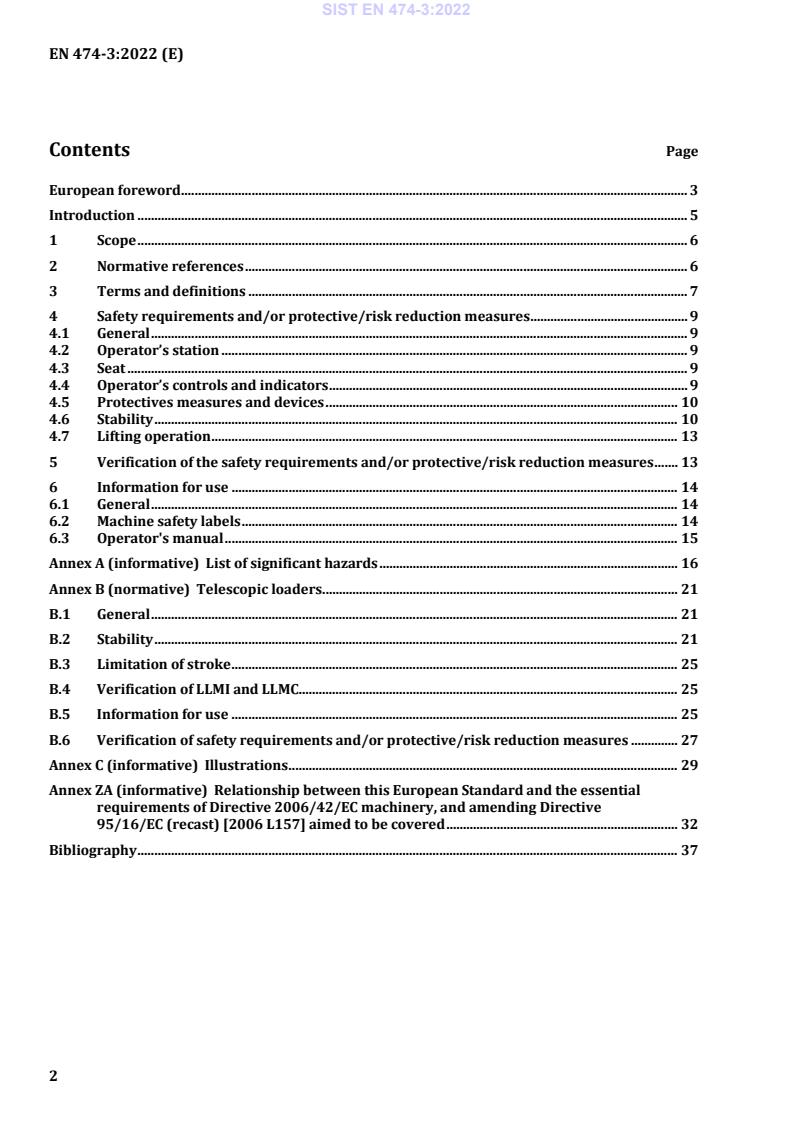
Contents Page
European foreword . 3
Introduction . 5
1 Scope . 6
2 Normative references . 6
3 Terms and definitions . 7
4 Safety requirements and/or protective/risk reduction measures . 9
4.1 General . 9
4.2 Operator’s station . 9
4.3 Seat . 9
4.4 Operator’s controls and indicators . 9
4.5 Protectives measures and devices . 10
4.6 Stability . 10
4.7 Lifting operation . 13
5 Verification of the safety requirements and/or protective/risk reduction measures . 13
6 Information for use . 14
6.1 General . 14
6.2 Machine safety labels . 14
6.3 Operator's manual . 15
Annex A (informative) List of significant hazards . 16
Annex B (normative) Telescopic loaders . 21
B.1 General . 21
B.2 Stability . 21
B.3 Limitation of stroke . 25
B.4 Verification of LLMI and LLMC. 25
B.5 Information for use . 25
B.6 Verification of safety requirements and/or protective/risk reduction measures . 27
Annex C (informative) Illustrations . 29
Annex ZA (informative) Relationship between this European Standard and the essential
requirements of Directive 2006/42/EC machinery, and amending Directive
95/16/EC (recast) [2006 L157] aimed to be covered . 32
Bibliography . 37
European foreword
This document (EN 474-3:2022) has been prepared by Technical Committee CEN/TC 151 “Construction
equipment and building material machines - Safety”, the secretariat of which is held by DIN.
This European Standard shall be given the status of a national standard, either by publication of an
identical text or by endorsement, at the latest by September 2022, and conflicting national standards shall
be withdrawn at the latest by March 2024.
Attention is drawn to the possibility that some of the elements of this document may be the subject of
patent rights. CEN shall not be held responsible for identifying any or all such patent rights.
This document supersedes EN 474-3:2006+A1:2009.
This document has been prepared under a standardization request given to CEN by the European
Commission and the European Free Trade Association and supports essential requirements of
EU Directive(s).
For relationship with EU Directive(s), see informative Annex ZA, which is an integral part of this
document.
For bibliographic references, see EN 474-1:2022.
EN 474 “Earth-moving machinery — Safety” comprises the following parts:
— Part 1: General requirements
— Part 2: Requirements for tractor-dozers
— Part 3: Requirements for loaders
— Part 4: Requirements for backhoe-loaders
— Part 5: Requirements for hydraulic excavators
— Part 6: Requirements for dumpers
— Part 7: Requirements for scrapers
— Part 8: Requirements for graders
— Part 9: Requirements for pipelayers
— Part 10: Requirements for trenchers
— Part 11: Requirements for earth and landfill compactors
— Part 12: Requirements for cable excavators
— Part 13: Requirements for rollers
This document is intended for use in combination with part 1 of the series.
The main differences between this document and EN 474-3:2006+A1:2009 are as follows:
a) safety-related functions of control systems (excluded);
b) normative references (updated);
c) safety requirements and information for use for telescopic loaders (Annex B) (added);
d) verification methods table (Clause 5) (added);
e) list of significant hazards (Annex A) (updated);
f) Annex ZA (updated).
Any feedback and questions on this document should be directed to the users’ national standards body.
A complete listing of these bodies can be found on the CEN website.
According to the CEN-CENELEC Internal Regulations, the national standards organisations of the
following countries are bound to implement this European Standard: Austria, Belgium, Bulgaria, Croatia,
Cyprus, Czech Republic, Denmark, Estonia, Finland, France, Germany, Greece, Hungary, Iceland, Ireland,
Italy, Latvia, Lithuania, Luxembourg, Malta, Netherlands, Norway, Poland, Portugal, Republic of North
Macedonia, Romania, Serbia, Slovakia, Slovenia, Spain, Sweden, Switzerland, Turkey and the United
Kingdom.
Introduction
This document is a type-C standard as stated in EN ISO 12100.
This document is of relevance, in particular, for the following stakeholder groups representing the market
players with regard to machinery safety:
— machine manufacturers (small, medium and large enterprises);
— health and safety bodies (regulators, accident prevention organizations, market surveillance, etc.).
Others can be affected by the level of machinery safety achieved with the means of the document by the
above-mentioned stakeholder groups:
— machine users/employers (small, medium and large enterprises);
— machine users/employees (e.g. trade unions, organizations for people with special needs);
— service providers, e.g. for maintenance (small, medium and large enterprises);
— consumers (in case of machinery intended for use by consumers).
The above-mentioned stakeholder groups have been given the possibility to participate at the drafting
process of this document.
The machinery concerned and the extent to which hazards, hazardous situations or hazardous events are
covered are indicated in the Scope of this document.
When requirements of this type-C standard are different from those which are stated in type-A or type-B
standards, the requirements of this type-C standard take precedence over the requirements of the other
standards for machines that have been designed and built according to the requirements of this type-C
standard.
1 Scope
This document together with EN 474-1:2022 deals with all significant hazards, hazardous situations and
events relevant to loaders when used as intended and under the conditions of misuse which are
reasonably foreseeable by the manufacturer (see Annex A) associated with the whole lifetime of the
machine as described in EN ISO 12100:2010, 5.4.
The requirements of this document are complementary to the common requirements formulated in
EN 474-1:2022. This document does not repeat the requirements of EN 474-1:2022 but supplements or
modifies the requirements for loaders.
This document does not provide requirements for main electrical circuits and drives of machinery when
the primary source of energy is an external electrical supply.
This document does not provide performance requirements for safety related functions of control
system(s).
The following significant and relevant hazards are not covered in this document:
— Laser;
— Lightning.
This document does not deal with towing of trailers.
This document does not deal with demolition machinery.
This part also deals with fork application, log handling application, single heavy object handling
application and lifting operation application.
This document is not applicable to loaders which are manufactured before the date of publication of this
document by CEN.
NOTE For travelling on public roads, national traffic regulations apply (e.g. braking, steering, lighting, towing,
etc.) until harmonized requirements are available.
2 Normative references
The following documents are referred to in the text in such a way that some or all of their content
constitutes requirements of this document. For dated references, only the edition cited applies. For
undated references, the latest edition of the referenced document (including any amendments) applies.
EN 474-1:2022, Earth-moving machinery — Safety — Part 1: General requirements
EN 1459-1:2017+A1:2020, Rough-terrain trucks — Safety requirements and verification — Part 1:
Variable reach trucks
EN ISO 3449:2008, Earth-moving machinery — Falling-object protective structures — Laboratory tests
and performance requirements (ISO 3449:2005)
EN ISO 3457:2008, Earth-moving machinery — Guards — Definitions and requirements (ISO 3457:2003)
EN ISO 7096:2020, Earth-moving machinery — Laboratory evaluation of operator seat vibration
(ISO 7096:2020)
EN ISO 12100:2010, Safety of machinery — General principles for design — Risk assessment and risk
reduction (ISO 12100:2010)
EN ISO 13851:2019, Safety of machinery — Two-hand control devices — Principles for design and
selection (ISO 13851:2019)
ISO 2330:2002, Fork-lift trucks — Fork arms — Technical characteristics and testing
ISO 7546:1983, Earth-moving machinery — Loader and front loading excavator buckets — Volumetric
ratings
ISO 14397-1:2007, Earth-moving machinery — Loaders and backhoe loaders — Part 1: Calculation of
rated operating capacity and test method for verifying calculated tipping load
3 Terms and definitions
For the purposes of this document, the terms and definitions given in EN 474-1:2022, EN ISO 12100:2010
and the definitions below apply.
ISO and IEC maintain terminological databases for use in standardization at the following addresses:
— IEC Electropedia: available at https://www.electropedia.org/
— ISO Online browsing platform: available at https://www.iso.org/obp
NOTE Terminology for loaders is specified in ISO 7131:2009 and the most common loaders are illustrated in
Annex C of this document.
3.1
loader
self-propelled crawler or wheeled machine having a front-mounted equipment, primarily designed for
loading operation (bucket use), which loads or excavates through forward motion of the machine
Note 1 to entry: A loader work cycle normally comprises filling and elevating, and the transporting and
discharging of material.
3.2
swing loader
loader (3.1) having a swing-type lift arm which can rotate to the left and the right of the straight position
Note 1 to entry: A swing-loader work cycle is similar to a loader cycle, but additional work can be done with the
equipment offset from the longitudinal axis of the machine.
3.3
skid steer loader
loader (3.1) normally having an operator station between or to the side of the attachment-supporting
structure(s) and steered by using variation of speed, and/or direction of rotation between traction drives
on the opposite sides of a machine having fixed axles on wheels or tracks
3.4
compact loader
loader (3.1) having an operating mass (see ISO 6016:2008, 3.2.1) of 4 500 kg or less for wheeled loaders
and 6 000 kg or less for crawler loaders, designed to work in areas with limited space, with the associated
need for greater manoeuvrability
3.5
telescopic loader
loader (3.1) having a centre mounted telescopic boom with the pivot point in front of the operator’s
station
3.6
Longitudinal Load Moment
moment produced by the load, the attachment and the lifting means of the telescopic loader which acts
at the load centre of gravity from the tipping line in the forward direction
[SOURCE: EN 15000:2008, 3.1; modified]
3.7
Longitudinal Load Moment Indicator
LLMI
device that warns the operator of a change to the load handling geometry which would increase the
longitudinal load moment, beyond pre-determined limit(s)
[SOURCE: EN 15000:2008, 3.2]
3.8
Longitudinal Load Moment Control
LLMC
device that prevents the operator changing the load handling geometry in direction(s) which would
increase the longitudinal load moment, beyond the allowable limit(s)
[SOURCE: EN 15000:2008, 3.3]
3.9
load handling geometry
relationship of points, lines and angles, described by the position of the load centre of gravity (the position
of the boom, carriage and attachment) and tipping line
[SOURCE: EN 15000:2008, 3.4; modified]
3.10
boom float
operating mode that uses gravity to allow an attachment at the end of the boom to follow a contour (e.g.
the ground)
[SOURCE: EN 1459-1:2017+A1:2020, 3.17]
3.11
rated operating capacity of telescopic loader
load in kg, permitted by the manufacturer, that the telescopic loader is capable of transporting or lifting
under normal operations
Note 1 to entry: The permitted load changes depended on the angle und extension of the boom as defined in the
load chart
4 Safety requirements and/or protective/risk reduction measures
4.1 General
4.1.1 Context
Loaders shall comply with the safety requirements and/or protective/risk reduction measures of this
clause. In addition, the machines shall be designed according to the principles of EN ISO 12100:2010 for
relevant but not significant hazards which are not dealt with by this document.
4.1.2 Specific relation to EN 474-1
Loaders shall comply with the requirements of EN 474-1:2022, as far as not modified or replaced by the
requirements of this part.
There are general requirements specified in EN 474-1:2022 that are not applicable because the risk
assessment has shown that for loaders the corresponding hazard does not exist. For loaders 4.22.5 in
EN 474-1:2022, is not applicable.
4.2 Operator’s station
4.2.1 General
EN 474-1:2022, 4.3 applies as modified in 4.2.2 and 4.2.3.
4.2.2 Doors and windows
EN 474-1:2022, 4.3.2.5 applies with the following addition:
No motorized wiper(s) and washers are required for loaders with a cab width less than or equal to
750 mm measured outside of the cab in the height of SIP.
4.2.3 Falling object protective structures (FOPS)
EN 474-1:2022, 4.3.4 applies with the following modifications:
— loaders, except compact loaders, shall be fitted with FOPS, meeting the requirements of
EN ISO 3449:2008 Level II;
— compact loaders shall be fitted with FOPS, meeting the requirements of EN ISO 3449:2008 Level I.
4.3 Seat
EN 474-1:2022, 4.4 applies with the following addition:
The seat shall meet the input spectral according to EN ISO 7096:2020:
— EM3 for wheel loaders greater than 4 500 kg;
— EM6 for crawler loaders;
— EM8 for compact wheel loaders less or equal than 4 500 kg;
— EM9 for skid steer loaders.
4.4 Operator’s controls and indicators
EN 474-1:2022, 4.5.3 applies with the following exception for compact loaders with front access:
Controls for lifting and lowering the loader linkage, machine movement and hydraulically controlled
attachments (e.g. multi-purpose bucket) shall be either automatically mechanically secured or
automatically deactivated when the operator leaves/enters the operator's compartment.
4.5 Protectives measures and devices
4.5.1 General
EN 474-1:2022, 4.14 applies as modified in 4.5.2 and 4.5.3.
4.5.2 Fenders
EN 474-1:2022, 4.14.4 does not apply to compact loaders with front access.
4.5.3 Guarding for front access loaders
Loaders shall be fitted with side and front guarding in accorcance with EN ISO 3457:2008 that prevents
the operator from reaching the trapping parts between the side lift arms and fixed parts of the machine
when the operator is seated in the operator's position.
Opening in the side guards shall comply with EN ISO 3457:2008, Table 4.
Front guarding shall be provided for the operator’s lower limbs if the lift arm componentry passes within
1,5 m in front and horizontal line to the SIP. This front guarding shall have a minimum height of 200 mm
from the floor plate.
4.6 Stability
4.6.1 General
EN 474-1:2022, 4.11 applies with the additions given in 4.6.2 to 4.6.5 below.
All rated operating capacities as defined hereafter are based on tests, calculations, or both, of machines
on a level and firm supporting surface.
The mass of the load, its density and the location of its centre of gravity as well as the mass of the
attachment and the quick coupler, if fitted, shall be included in the determination of the rated operating
capacity and the size/capacity of the attachment.
To provide a sufficient stability the rated operating capacity in intended operations shall be determined
as specified in 4.6.2 to 4.6.5.
4.6.2 Bucket application
The rated operating capacity shall be determined according to ISO 14397-1:2007.
The volumetric rating of bucket shall be determined according to ISO 7546:1983.
The mass, volumetric rating of bucket and density of the material have to be taken into account when the
bucket capacity is selected for a specific application.
4.6.3 Fork application
4.6.3.1 General
The rated operating capacity is based on the use of forks and shall be determined according to
ISO 14397-1:2007 (except for the stability factor (k) stated in ISO 14397-1:2007, 5.1, Table 1) and with
the fork in a horizontal position. Stability factors (k) specified in Table 1 shall apply.
Table 1 — Stability factors in fork application
Crawler loader
Ground condition Wheel loader Wheel skid steer loader
crawler skid steer loader
Rough terrain 0,60 - -
Firm and level ground 0,80 - -
All - 0,35 0,50
4.6.3.2 Fork load centre of gravity
The load centre of gravity distance, D, is determined as a point on the longitudinal centreline of the
machine at half the distance from the most rearward point of the load opening to the tip of the fork, as
shown in Figure 1.
Key
D distance in millimetres (see Tables 2 and 4)
F load in Newton
G load centre of gravity
Figure 1 — Load centre of gravity distance with fork arms
4.6.3.3 Fork size
Fork arms shall meet the performance requirements stated in ISO 2330:2002.
To select the fork arm size and to determine the load centre of gravity distance (D) as shown in Figure 1,
the specifications in Table 2 shall be followed.
Table 2 — Typical load centre of gravity distance
Load F in N Load centre of gravity distance D in mm
400 500 600 900 1 200
F < 10 000 X
10 000 ≤ F < 50 000 X
50 000 ≤ F < 100 000 X
100 000 ≤ F < 200 000 X X X
200 000 ≤ F < 250 000 X X
F ≥ 250 000 X
4.6.4 Log handling application
The rated operating capacity is based on a log grapple application and shall be determined according to
ISO 14397-1:2007 (except for stability factor (k) stated in ISO 14397-1:2007, 5.1, Table 1) with the log
grapple fitted. Stability factors (k) specified in Table 3 shall apply.
Table 3 — Stability factors in log handling
Ground condition Wheel loaders Crawler loaders
Rough terrain 0,75 0,50
Firm and level ground 0,85 0,60
4.6.5 Single heavy object (non-palletised single heavy object) application
4.6.5.1 General
The rated operating capacity is based on the use of a single heavy object handling device (for a non-
palletized load), and shall be determined according to ISO 14397-1:2007, Annex A.
4.6.5.2 Handling attachment
The load centre of gravity distance, D, of the attachment is as shown in Figure 1.
For indicating the rated operating capacity for a single heavy object handling attachment, a transversal
square cross-section of the load shall be considered.
The specifications in Table 4 shall be selected.
Table 4 — Load centre of gravity distance
Load centre of gravity distance
Load F in N
D in mm
F ≤ 100 000 600
100 000 < F ≤ 200 000 900
F > 200 000 1 200
Tipping load shall be determined according to ISO 14397-1:2007 (except for stability factor stated in
ISO 14397-1:2007, 5.1, Table 1), with the block handling attachment (e.g. stone fork) in a fully roll back
and carry position.
The stability factors in Table 5 are only valid for speeds less than or equal to 10 km/h.
The rated operating capacity according to this mode, as percentage of tipping load, shall not exceed the
applicable value specified in Table 5 when operating on a flat, hard surface.
Table 5 —Stability factors in single heavy object handling in transport mode
Ground condition Wheel Crawler
loaders loaders
Firm and level ground 0,80 0,60
4.7 Lifting operation
EN 474-1:2022, 4.12 shall apply, with the exception of 4.12.2, 4.12.3, 4.12.4, 4.12.5 and 4.12.6.
The rated operating capacity is based on use of a lifting accessory or accessories and the attachment and
shall be determined according to ISO 14397-1:2007.
Telescopic loaders shall meet the requirements of Annex B.
5 Verification of the safety requirements and/or protective/risk reduction
measures
Safety requirements and/or protective/risk reduction measures of Clause 4 of this document shall be
verified according to Table 6.
Table 6 sets out verification methods which shall be applied for each safety requirement in this document.
Where X(s) is indicated in the table, the corresponding verification method(s) shall be applied.
Table 6 shall be read in conjunction with the corresponding clauses.
Table 6 includes the following verification methods:
a) calculation: to establish that the requirements of this document have been met;
b) visual verification: to establish that something is present (e.g. a guard, a marking, a document);
c) measurement: to show that the required numerical values have been met (e.g. geometric dimensions,
safety distances, resistance of insulation of the electric circuits, results of physical tests);
d) functional tests: to show that the adequate signals intended to be forwarded to the main control
system of the complete machine are available and comply with the requirements and with the
technical documentation;
e) special verification: by reference to a standard which is mentioned in the
...