

oSIST prEN 12875-2:2026
(Main)Mechanical dishwashing resistance of utensils - Part 2: Inspection and evaluation
- Abstract
This document specifies the conditions for the visual inspection of domestic articles made from ceramic, glass, glass ceramic, decorated glass, plastics, rubber, silicones, metal, mineral based and plant-based products, as well as coated or enamelled articles, and others after testing its dishwashing resistance according to the procedures described in the relevant parts of the EN 12875 series.
- Status
- Not Published
- Public Enquiry End Date
- 01-Jun-2026
- Technical Committee
- EPO - Packaging - sales and grouped
- Current Stage
- 4020 - Public enquire (PE) (Adopted Project)
- Start Date
- 08-Apr-2026
- Due Date
- 26-Aug-2026
- Completion Date
- 06-Aug-2026

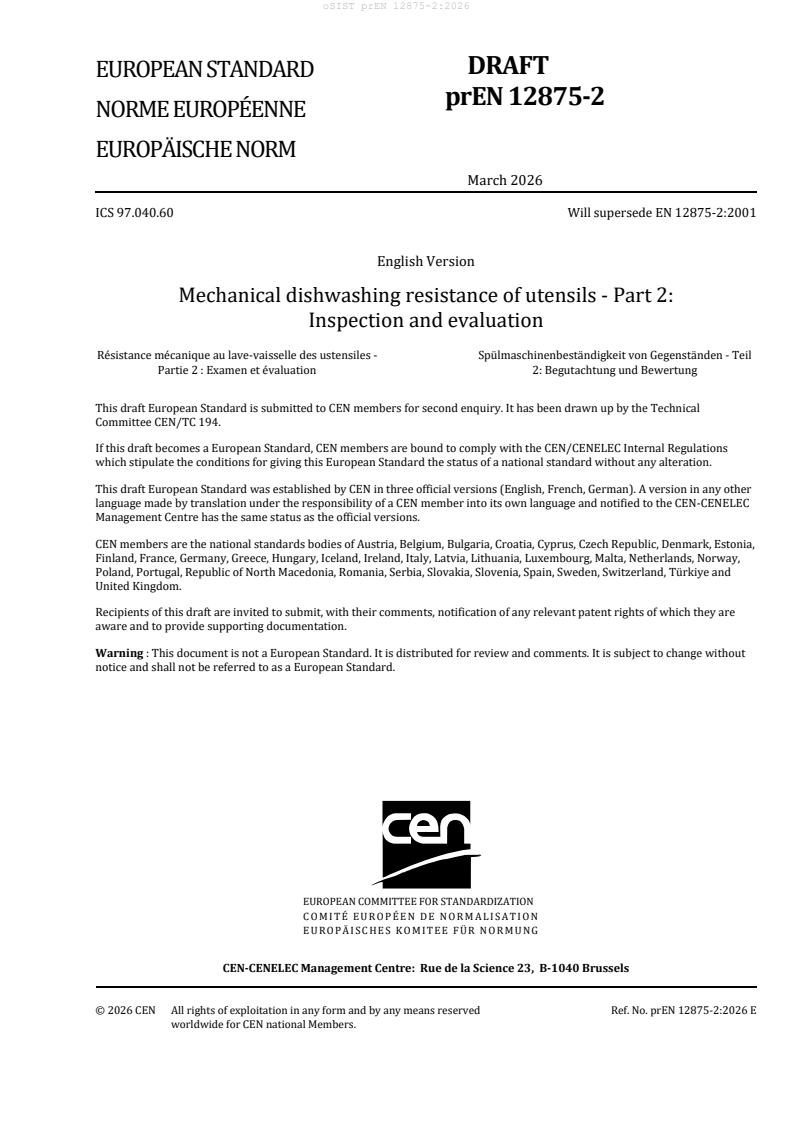
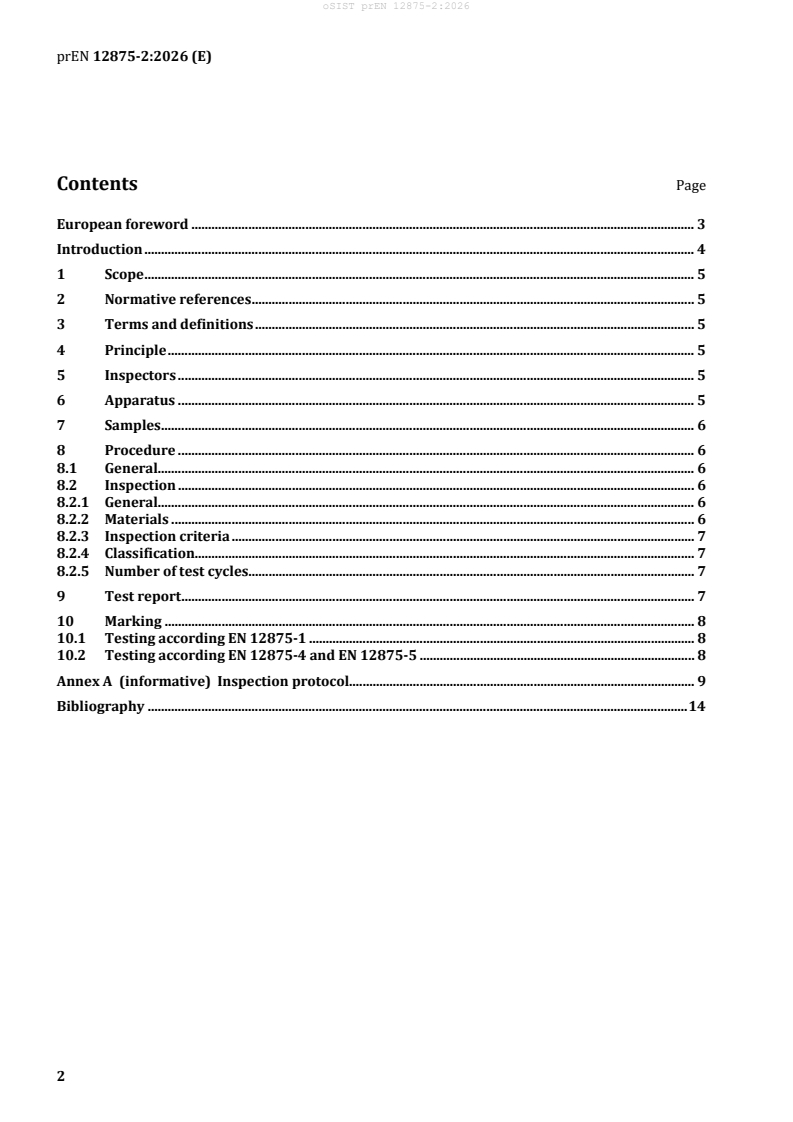
oSIST prEN 12875-2:2026 is the Slovenian version of the CEN draft European Standard prEN 12875-2:2026, published by SIST. It specifies how to visually inspect and evaluate utensils after mechanical dishwashing resistance testing, so laboratories, manufacturers, and buyers can judge surface changes in a consistent way. The standard applies to domestic articles made from ceramic, glass, glass ceramic, decorated glass, plastics, rubber, silicones, metal, mineral-based and plant-based products, as well as coated or enamelled articles.
What does oSIST prEN 12875-2:2026 specify?
oSIST prEN 12875-2:2026 specifies the conditions for visual inspection of articles after they have been tested for dishwashing resistance according to the relevant parts of the EN 12875 series. In practice, it tells users how to look for and record surface changes after washing tests, rather than how to run the washing test itself.
The document is organized into clauses 1 to 10 and one informative annex.
| Annex | What it covers |
|---|---|
| Annex A | Inspection protocol, with example evaluation tables and test report templates |
The scope covers the inspection and evaluation step for a wide range of domestic articles. That matters because the same evaluation method can be applied across different materials and products, including multi-material items such as pans with plastic handles or glass lids with plastic knobs.
What are the key requirements of oSIST prEN 12875-2:2026?
Inspection set-up and samples
oSIST prEN 12875-2:2026 requires at least two inspectors, at least three test specimens, and one unused reference specimen for comparison. The samples should be identical in shape, size, and surface finish, preferably from different lots. In practice, this helps separate a real material change from variation between individual samples.
Before inspection, easily removable deposits are cleaned off by wiping, or by hand washing with a mild liquid detergent at about 45 °C followed by rinsing and drying. The inspection then takes place at a distance of (30 ± 10) cm, with the viewing angle changed during the assessment.
The inspection site must be protected from external light and lit vertically with diffuse daylight at 6 000 to 6 500 K and about 1 000 lx near the specimens. The room background is required to be grey with a dull finish. These conditions matter because the standard is checking visual change, so the viewing environment must not hide or exaggerate defects.
What is judged during inspection
oSIST prEN 12875-2:2026 requires each inspector to compare the tested samples with the unused sample and record visible changes where applicable. The criteria include colour, gloss, clouding/hazing, resistant deposits, iridescent layers, corrosion products, deformation, cracking, delamination/loss of adhesion, and other aspects.
Each criterion is classified in three levels: no visible change, first discernible change, or clear visible change. The inspectors’ figures are averaged for each criterion and rounded to one decimal. If any criterion has an average above 1.0, the article is considered to show clearly visible changes.
How the result and claim are determined
oSIST prEN 12875-2:2026 links the inspection result to a number of test cycles. The test items shall show no clearly visible changes after a minimum of 100 cycles, and higher cycle counts may be claimed in multiples of 50. If an article is made of different materials, the claimed dishwasher resistance is based on the material with the lowest result.
That is important in practice for products with mixed materials, because the claim cannot exceed the weakest part of the item.
What must be reported and marked
The test report has to identify the standard used, the article tested, the sampling details, the test method, the inspectors, the maximum cycle count achieved without exceeding the average value of 1.0, and the article category with the average inspection figures. Clause 10 allows marking with a graphical symbol or description for articles tested according to prEN 12875-1 and evaluated under Clause 8, and it also allows a description for ceramic articles tested according to EN 12875-4 or EN 12875-5.
What terms does oSIST prEN 12875-2:2026 use?
- Inspection protocol - The structured record used to classify and document the visual evaluation of the tested articles.
- Reference sample - The unused sample used as the side-by-side comparison for the tested specimens.
- Test specimen - The article sample that has undergone the dishwashing resistance test and is then inspected.
- Inspection criteria - The surface features checked during evaluation, such as colour, gloss, cracking, or delamination.
- Classification numbers - The 0, 1, and 2 ratings used to show no change, first discernible change, or clear visible change.
- Test cycles - The number of dishwashing cycles used to express the resistance claim.
- Marking - The symbol or description placed on the article or its packaging to show the claimed resistance result.
Who uses oSIST prEN 12875-2:2026?
oSIST prEN 12875-2:2026 is used by testing laboratories, manufacturers, and quality teams that need to judge the appearance of articles after dishwashing tests. It is also relevant to suppliers and buyers of domestic utensils when they need a common basis for product claims.
The standard is particularly relevant for ceramic, glass, plastics, rubber, silicones, metal, mineral-based and plant-based kitchenware, as well as coated or enamelled articles. That makes it useful in food-contact utensil supply chains where visual durability matters to product acceptance and consumer information.
What changed in oSIST prEN 12875-2:2026 from the previous edition?
oSIST prEN 12875-2:2026 supersedes EN 12875-2:2001. The European foreword states these significant changes:
- scope extended to include non-metallic articles
- minor adjustments to the evaluation procedure
- clarification of the evaluation criteria
- insertion of the section on the number of test cycles
- insertion of an alternative marking
- insertion of informative Annex A, Inspection protocol
- editorial changes
Which standards are used with oSIST prEN 12875-2:2026?
| Standard | Contribution |
|---|---|
| prEN 12875-1 | Reference test method for domestic articles; Clause 8 uses its cycle result for evaluation |
| EN 12875-4 | Rapid test for domestic ceramic articles; Clause 10.2 refers to it for marking after evaluation |
| EN 12875-5 | Rapid test for ceramic catering articles; Clause 10.2 refers to it for marking after evaluation |
What does the oSIST prEN 12875-2:2026 document contain?
The document contains the inspection principle, inspector requirements, apparatus conditions, sample requirements, inspection procedure, reporting items, and marking rules. Clause 8 provides the evaluation logic, including the classification scale and the minimum cycle claim.
It also includes Table 1 for the inspection ratings and Annex A as an informative inspection protocol. Annex A gives example classification tables, example failure-detection entries, and print templates for the test report.
For practical use, the document is meant to support consistent visual judgement, cycle-based reporting, and clear marking of dishwasher-resistance claims.
Relations
- Effective Date
- 01-May-2026
Get Certified
Connect with accredited certification bodies for this standard

BSI Group
BSI (British Standards Institution) is the business standards company that helps organizations make excellence a habit.

Bureau Veritas
Bureau Veritas is a world leader in laboratory testing, inspection and certification services.

DNV
DNV is an independent assurance and risk management provider.
Sponsored listings
Frequently Asked Questions
oSIST prEN 12875-2:2026 is a draft published by the Slovenian Institute for Standardization (SIST). Its full title is "Mechanical dishwashing resistance of utensils - Part 2: Inspection and evaluation". This standard covers: This document specifies the conditions for the visual inspection of domestic articles made from ceramic, glass, glass ceramic, decorated glass, plastics, rubber, silicones, metal, mineral based and plant-based products, as well as coated or enamelled articles, and others after testing its dishwashing resistance according to the procedures described in the relevant parts of the EN 12875 series.
This document specifies the conditions for the visual inspection of domestic articles made from ceramic, glass, glass ceramic, decorated glass, plastics, rubber, silicones, metal, mineral based and plant-based products, as well as coated or enamelled articles, and others after testing its dishwashing resistance according to the procedures described in the relevant parts of the EN 12875 series.
oSIST prEN 12875-2:2026 is classified under the following ICS (International Classification for Standards) categories: 67.250 - Materials and articles in contact with foodstuffs; 97.040.40 - Dishwashers; 97.040.60 - Cookware, cutlery and flatware. The ICS classification helps identify the subject area and facilitates finding related standards.
oSIST prEN 12875-2:2026 has the following relationships with other standards: It is inter standard links to SIST EN 12875-2:2002. Understanding these relationships helps ensure you are using the most current and applicable version of the standard.
oSIST prEN 12875-2:2026 is available in PDF format for immediate download after purchase. The document can be added to your cart and obtained through the secure checkout process. Digital delivery ensures instant access to the complete standard document.
Standards Content (Sample)
SLOVENSKI STANDARD
01-maj-2026
Odpornost posode in pribora za domačo uporabo proti mehanskemu pranju - 2.
del: Pregled in vrednotenje
Mechanical dishwashing resistance of utensils - Part 2: Inspection and evaluation
Spülmaschinenfestigkeit von Gegenständen - Teil 2: Begutachtung von
nichtmetallischen Gegenstäden
Résistance mécanique au lave-vaisselle des ustensiles - Partie 2: Inspection des articles
non-métalliques
Ta slovenski standard je istoveten z: prEN 12875-2
ICS:
97.040.40 Pomivalni stroji Dishwashers
97.040.60 Kuhinjska posoda, jedilni Cookware, cutlery and
servisi in jedilni pribor flatware
2003-01.Slovenski inštitut za standardizacijo. Razmnoževanje celote ali delov tega standarda ni dovoljeno.
DRAFT
EUROPEAN STANDARD
prEN 12875-2
NORME EUROPÉENNE
EUROPÄISCHE NORM
March 2026
ICS 97.040.60 Will supersede EN 12875-2:2001
English Version
Mechanical dishwashing resistance of utensils - Part 2:
Inspection and evaluation
Résistance mécanique au lave-vaisselle des ustensiles - Spülmaschinenbeständigkeit von Gegenständen - Teil
Partie 2 : Examen et évaluation 2: Begutachtung und Bewertung
This draft European Standard is submitted to CEN members for second enquiry. It has been drawn up by the Technical
Committee CEN/TC 194.
If this draft becomes a European Standard, CEN members are bound to comply with the CEN/CENELEC Internal Regulations
which stipulate the conditions for giving this European Standard the status of a national standard without any alteration.
This draft European Standard was established by CEN in three official versions (English, French, German). A version in any other
language made by translation under the responsibility of a CEN member into its own language and notified to the CEN-CENELEC
Management Centre has the same status as the official versions.
CEN members are the national standards bodies of Austria, Belgium, Bulgaria, Croatia, Cyprus, Czech Republic, Denmark, Estonia,
Finland, France, Germany, Greece, Hungary, Iceland, Ireland, Italy, Latvia, Lithuania, Luxembourg, Malta, Netherlands, Norway,
Poland, Portugal, Republic of North Macedonia, Romania, Serbia, Slovakia, Slovenia, Spain, Sweden, Switzerland, Türkiye and
United Kingdom.
Recipients of this draft are invited to submit, with their comments, notification of any relevant patent rights of which they are
aware and to provide supporting documentation.
Warning : This document is not a European Standard. It is distributed for review and comments. It is subject to change without
notice and shall not be referred to as a European Standard.
EUROPEAN COMMITTEE FOR STANDARDIZATION
COMITÉ EUROPÉEN DE NORMALISATION
EUROPÄISCHES KOMITEE FÜR NORMUNG
CEN-CENELEC Management Centre: Rue de la Science 23, B-1040 Brussels
© 2026 CEN All rights of exploitation in any form and by any means reserved Ref. No. prEN 12875-2:2026 E
worldwide for CEN national Members.
prEN 12875-2:2026 (E)
Contents Page
European foreword . 3
Introduction . 4
1 Scope . 5
2 Normative references . 5
3 Terms and definitions . 5
4 Principle . 5
5 Inspectors . 5
6 Apparatus . 5
7 Samples . 6
8 Procedure . 6
8.1 General. 6
8.2 Inspection . 6
8.2.1 General. 6
8.2.2 Materials . 6
8.2.3 Inspection criteria . 7
8.2.4 Classification. 7
8.2.5 Number of test cycles . 7
9 Test report . 7
10 Marking . 8
10.1 Testing according EN 12875-1 . 8
10.2 Testing according EN 12875-4 and EN 12875-5 . 8
Annex A (informative) Inspection protocol . 9
Bibliography . 14
prEN 12875-2:2026 (E)
European foreword
This document (prEN 12875-2:2026) has been prepared by Technical Committee CEN/TC 194 “Utensils
in contact with food”, the secretariat of which is held by AFNOR.
This document is currently submitted to the 2nd CEN Enquiry.
This document will supersede EN 12875-2:2001.
This document includes the following significant technical changes with respect to EN 12875-2:2001:
— extension of the scope of application to include non-metallic articles;
— minor adjustments to the evaluation procedure;
— Clarification of the evaluation criteria;
— insertion of the section “Number of test cycles”;
— insertion of an alternative marking;
— insertion of the informative Annex A “Inspection protocol”;
— editorial changes.
prEN 12875-2:2026 (E)
Introduction
This document specifies the conditions for visual inspection and evaluation of metallic and non-metallic
utensils in connection with the standardized dishwashing resistance tests including the expression of
results.
Further parts of EN 12875, under the general title Mechanical dishwashing resistance of utensils are as
follows:
— Part 1: Reference test method for domestic articles
— Part 4: Rapid test for domestic ceramic articles
— Part 5: Rapid test for ceramic catering articles
NOTE The marking based on these test results is primarily intended as consumer information. In the opinion
of consumers other features of equivalent importance exist which are not always compatible with high dishwashing
resistance requirement.
prEN 12875-2:2026 (E)
1 Scope
This document specifies the conditions for the visual inspection of domestic articles made from ceramic,
glass, glass ceramic, decorated glass, plastics, rubber, silicones, metal, mineral based and plant-based
products, as well as coated or enamelled articles, and others after testing its dishwashing resistance
according to the procedures described in the relevant parts of the EN 12875 series.
2 Normative references
The following documents are referred to in the text in such a way that some or all of their content
constitutes requirements of this document. For dated references, only the edition cited applies. For
undated references, the latest edition of the referenced document (including any amendments) applies.
prEN 12875-1, Mechanical dishwashing resistance of utensils — Part 1: Reference test method for domestic
articles
3 Terms and definitions
No terms and definitions are listed in this document.
4 Principle
The surface of at least three samples preferably from different lots, which have been tested are visually
inspected under defined conditions in comparison to an unused sample by at least two inspectors.
Depending on the type of article, the differences in the surfaces of the tested samples from the surface of
the unused sample are recorded.
5 Inspectors
At least two inspectors are required who are familiar with the inspection procedure described in this
document. Each inspector shall be able to see the surface of the specimens clearly with the naked eye (or
with a habitual vision aid) and shall have normal colour vision. The clothing of the inspectors should not
impact the visual evaluation (e.g. the reflectance of the colour).
NOTE Suitable methods for assessing colour vision are the H-R-R-Pseudoisochromatic Plates or the Ishihara
Test for Colour Blindness [1].
6 Apparatus
6.1 Linen cloth for wiping off surface residues and wiping decorated surfaces.
6.2 Inspection site
An inspection site, which:
— is protected from external light, and illuminated vertically by a diffuse daylight (6 000 to 6 500) K
lamp yielding 1 000 lx near the specimens;
— shows grey colour (RGB 146/142/133) and a dull surface finish on all surfaces exposed to the
artificial light;
— has sufficient table area to accommodate all of the specimens of one type simultaneously.
...