

SIST EN 1983:2014
(Main)Industrial valves - Steel ball valves
- Abstract
This European Standard specifies requirements for industrial steel ball valves having flanged, threaded, socket welding or butt welding ends.
The DN range is:
- DN 4 ; DN 6 ; DN 8 ; DN 10 ; DN 15 ; DN 20 ; DN 25 ; DN 32 ; DN 40 ; DN 50 ; DN 65 ; DN 80 ; DN 100 ; DN 125 ; DN 150 ; DN 200 ; DN 250 ; DN 300 ; DN 350 ; DN 400 ; DN 450 ; DN 500 ; DN 550 ; DN 600 ; DN 650 ; DN 700 ; DN 750 ; DN 800 ; DN 850 ; DN 900.
The PN and Class ranges are:
- PN 6 ; PN 10 ; PN 16 ; PN 25 ; PN 40 ; PN 63 ; PN 100 ;
- Class 150 ; Class 300 ; Class 600 ; Class 900 ; Class 1 500 ; Class 2 500 ; Class 4 500.
This European Standard applies to steel ball valves mainly used for industrial and general purpose applications. However, they can be used for other applications provided the requirements of the relevant performance standard are met.
- Status
- Published
- Publication Date
- 05-Dec-2013
- Technical Committee
- TLP - Pressure vessels
- Current Stage
- 6060 - National Implementation/Publication (Adopted Project)
- Start Date
- 22-Nov-2013
- Due Date
- 27-Jan-2014
- Completion Date
- 06-Dec-2013
- Directive
- 2014/68/EU - Directive 2014/68/EU of the European Parliament and of the Council of 15 May 2014 on the harmonisation of the laws of the Member States relating to the making available on the market of pressure equipmentOJ Ref: C 293/01 OJ Date: 12-Aug-2016
97/23/EC - Pressure equipmentOJ Ref: C 22 OJ Date: 24-Jan-2014 Conflicting Date: 28-Feb-2014



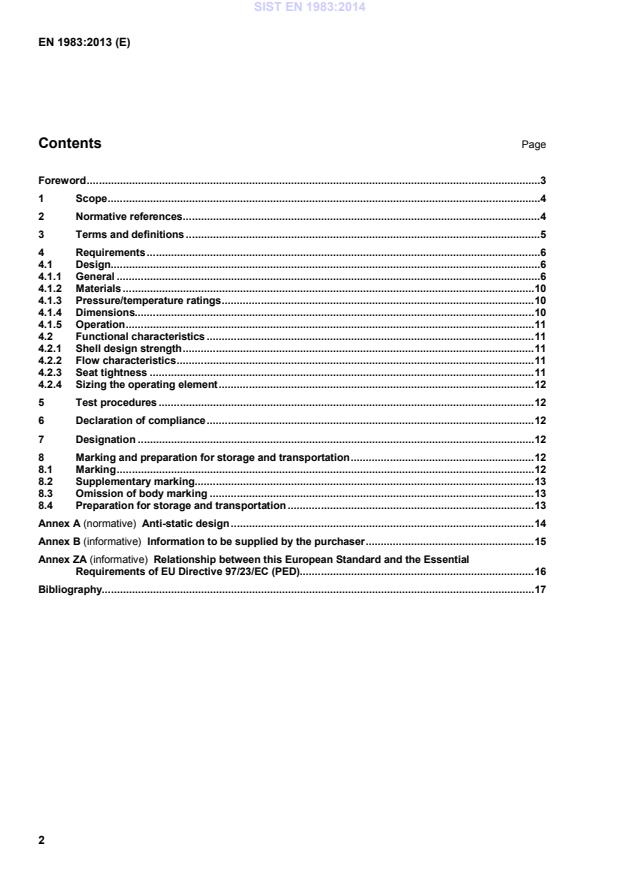
SIST EN 1983:2014 is the Slovenian standard identical to EN 1983:2013, published by SIST. It specifies requirements for industrial steel ball valves with flanged, threaded, socket welding or butt welding ends. It is written for valves mainly used in industrial and general-purpose applications, where the purchaser and manufacturer need a clear basis for design, testing, marking and designation.
What does SIST EN 1983:2014 specify?
SIST EN 1983:2014 specifies the construction, performance, testing and marking requirements for steel ball valves. The document covers the valve sizes and pressure designations that fall within its scope, and it organizes the subject into clauses on scope, references, terms, requirements, test procedures, compliance, designation, and marking and storage.
| Annex | What it covers |
|---|---|
| Annex A | Anti-static design |
| Annex B | Information to be supplied by the purchaser |
| Annex ZA | Relationship with EU Directive 97/23/EC (PED) |
The standard applies to valves with DN 4 to DN 900 and PN 6 to PN 100, plus Class 150 to Class 4 500, depending on the end connection. In practice, that means a purchaser must match the valve body end type and pressure designation to the intended pipework and service conditions.
What are the key requirements of SIST EN 1983:2014?
Design and construction
SIST EN 1983:2014 requires valves to be either full bore or reduced bore, and the body design must suit the declared end connection and pressure designation. Body design is tied to EN 12516-1, EN 12516-2, EN 12516-3 or EN 13445-3, which matters because the valve shell has to be strong enough for the intended pressure service.
The ball port has to be circular, with minimum effective diameters given in a table by size and bore type. The practical point is that the manufacturer must control the flow passage size, and the purchaser should specify a particular ball construction if that matters to the application.
The shaft has to be anti-blow out, and valves shall have an anti-static feature according to Annex A. Fire safe design is required only when specified, and then the valve is type tested to EN ISO 10497.
For DN 50 and larger, the body design may allow a drain tapping when specified. This is useful where the valve needs draining or maintenance access, but the tapping thread type and size must follow the document.
Materials, ratings and dimensions
Materials have to suit the operating conditions, especially the maximum allowable temperature shown on the identification plate. Shell materials come from EN 1503-1 and EN 1503-2 or EN 12516-1, and bolting comes from EN 1515-1 and EN 1515-2.
Pressure/temperature ratings for flanged valves follow EN 1092-1 or EN 1759-1, while welding-end and threaded-end valves use EN 12516-1. The manufacturer must state any extra pressure or temperature limits caused by closure materials, so the user can see the real service limit.
Dimensions are linked to the end type. Face-to-face dimensions for Class valves follow EN 558, butt-welding end dimensions follow EN 12982, and body-end dimensions follow EN 1092-1, EN 1759-1, EN 12627, EN 12760 or the thread standards named in the document.
Operation, testing and delivery
Ball valves are closed by turning the handwheel or lever clockwise when facing the operating device, and the valve must stop in both fully open and fully closed positions. If an actuator attachment is required, the valve must accept a part-turn actuator with EN ISO 5211 interface dimensions.
Each valve has to be pressure tested by the manufacturer before despatch to EN 12266-1, and additional finished-valve tests may follow EN 12266-2. Seat tightness uses Rate A for elastomeric or polymeric seating and Rate B for other seating.
The document also covers declaration of compliance, designation wording, marking to EN 19, supplementary marking for pressure and temperature limits, and preparation for storage and transport.
What terms does SIST EN 1983:2014 define?
- DN - The nominal size designation used throughout the tables to state valve size and applicability.
- PN - The pressure designation series used for metric-designated valves.
- Class - The pressure designation series used for class-designated valves.
- Full bore - A valve pattern in which the flow passage is not reduced in the open position.
- Reduced bore - A valve pattern in which the flow passage is smaller than the pipe size.
- Effective diameter - The manufactured minimum diameter through the flow passage in the fully open position.
- Anti-blow out - A shaft feature intended to prevent the shaft from being forced out of the valve.
Who uses SIST EN 1983:2014?
SIST EN 1983:2014 is used by valve manufacturers, design engineers, purchasers, quality managers and test laboratories. They use it to select end connections, define size and pressure designation, choose materials, verify shell strength, run pressure tests, decide marking, and prepare the valve for delivery and installation.
It is also useful in procurement and technical review for industrial and general-purpose valve applications, because Annex B lists the information the purchaser should supply with the enquiry and order.
What changed in SIST EN 1983:2014 from the previous edition?
SIST EN 1983:2014 supersedes EN 1983:2006. The foreword states three main changes: the normative references were updated, EN 13445-3 was added as a reference for body design and shell design strength, and the compulsory marking in Clause 8.1 was updated.
Which standards are used with SIST EN 1983:2014?
- EN 19 - Defines the marking of metallic valves.
- EN 736-1, EN 736-2, EN 736-3 - Provide valve terminology and component definitions.
- EN 12266-1 and EN 12266-2 - Set pressure test methods, acceptance criteria and supplementary valve tests.
- EN 12516-1, EN 12516-2, EN 12516-3, EN 13445-3 - Support shell and body design strength.
- EN 558 and EN 12982 - Cover face-to-face and end-to-end dimensions.
- EN 1092-1 and EN 1759-1 - Cover flanges and flange dimensions.
- EN 12627 and EN 12760 - Cover butt welding ends and socket welding ends.
- EN 1503-1, EN 1503-2, EN 1515-1, EN 1515-2 - Cover body/bonnet materials and bolting.
- EN ISO 5211 and EN ISO 10497 - Cover actuator mounting and fire type testing.
- EN ISO 228-1, ISO 7-1, ASME B1.20.1 and ASME B16.34 - Support threaded ends and related end-connection details.
What does the SIST EN 1983:2014 document contain?
The document contains design requirements, size and pressure tables, dimensional rules, testing rules, marking rules and shipment-preparation rules. It also includes figures for full-bore and reduced-bore patterns, typical ball valve construction and ball construction examples.
The tables give the allowed DN and pressure designation ranges for each end connection, minimum effective diameters for the ball port, drain tapping sizes, and the order of omitted body marking items for smaller valves. In practice, these tables are the parts designers and buyers use to specify the exact valve variant.
The annexes add anti-static design rules, a purchaser-information checklist and the link to the PED. That makes the standard useful both for technical specification and for compliance review.
Relations
- Effective Date
- 01-Jan-2014
- Effective Date
- 25-Aug-2026
- Effective Date
- 22-Apr-2026
- Effective Date
- 04-Mar-2026
- Effective Date
- 28-Jan-2026
- Effective Date
- 28-Jan-2026
- Effective Date
- 28-Jan-2026
- Effective Date
- 28-Jan-2026
- Effective Date
- 28-Jan-2026
- Effective Date
- 28-Jan-2026
- Effective Date
- 28-Jan-2026
- Effective Date
- 28-Jan-2026
- Effective Date
- 28-Jan-2026
- Effective Date
- 28-Jan-2026
- Effective Date
- 28-Jan-2026
Get Certified
Connect with accredited certification bodies for this standard

Institut za varilstvo d.o.o. (Welding Institute)
Slovenia's leading welding institute since 1952. ISO 3834, EN 1090, pressure equipment certification, NDT personnel, welder qualification. Only IIW Au
Sponsored listings
Frequently Asked Questions
SIST EN 1983:2014 is a standard published by the Slovenian Institute for Standardization (SIST). Its full title is "Industrial valves - Steel ball valves". This standard covers: This European Standard specifies requirements for industrial steel ball valves having flanged, threaded, socket welding or butt welding ends. The DN range is: - DN 4 ; DN 6 ; DN 8 ; DN 10 ; DN 15 ; DN 20 ; DN 25 ; DN 32 ; DN 40 ; DN 50 ; DN 65 ; DN 80 ; DN 100 ; DN 125 ; DN 150 ; DN 200 ; DN 250 ; DN 300 ; DN 350 ; DN 400 ; DN 450 ; DN 500 ; DN 550 ; DN 600 ; DN 650 ; DN 700 ; DN 750 ; DN 800 ; DN 850 ; DN 900. The PN and Class ranges are: - PN 6 ; PN 10 ; PN 16 ; PN 25 ; PN 40 ; PN 63 ; PN 100 ; - Class 150 ; Class 300 ; Class 600 ; Class 900 ; Class 1 500 ; Class 2 500 ; Class 4 500. This European Standard applies to steel ball valves mainly used for industrial and general purpose applications. However, they can be used for other applications provided the requirements of the relevant performance standard are met.
This European Standard specifies requirements for industrial steel ball valves having flanged, threaded, socket welding or butt welding ends. The DN range is: - DN 4 ; DN 6 ; DN 8 ; DN 10 ; DN 15 ; DN 20 ; DN 25 ; DN 32 ; DN 40 ; DN 50 ; DN 65 ; DN 80 ; DN 100 ; DN 125 ; DN 150 ; DN 200 ; DN 250 ; DN 300 ; DN 350 ; DN 400 ; DN 450 ; DN 500 ; DN 550 ; DN 600 ; DN 650 ; DN 700 ; DN 750 ; DN 800 ; DN 850 ; DN 900. The PN and Class ranges are: - PN 6 ; PN 10 ; PN 16 ; PN 25 ; PN 40 ; PN 63 ; PN 100 ; - Class 150 ; Class 300 ; Class 600 ; Class 900 ; Class 1 500 ; Class 2 500 ; Class 4 500. This European Standard applies to steel ball valves mainly used for industrial and general purpose applications. However, they can be used for other applications provided the requirements of the relevant performance standard are met.
SIST EN 1983:2014 is classified under the following ICS (International Classification for Standards) categories: 23.060.20 - Ball and plug valves. The ICS classification helps identify the subject area and facilitates finding related standards.
SIST EN 1983:2014 has the following relationships with other standards: It is inter standard links to SIST EN 1983:2006, SIST ISO 7-1:1995, SIST EN 12570:2001, SIST EN ISO 5211:2026, SIST EN 1092-1:2018, oSIST prEN 15116:2005, SIST EN 736-1:2000, SIST EN 12516-3:2003, SIST EN 1515-2:2002, SIST EN ISO 228-1:2003, SIST EN 736-2:2000, SIST EN 1503-1:2001, SIST EN 12760:2016, SIST EN 12516-2:2004, SIST EN 1759-1:2005. Understanding these relationships helps ensure you are using the most current and applicable version of the standard.
SIST EN 1983:2014 is associated with the following European legislation: EU Directives/Regulations: 2014/68/EU, 97/23/EC, EUR-PUB; Standardization Mandates: M/071. When a standard is cited in the Official Journal of the European Union, products manufactured in conformity with it benefit from a presumption of conformity with the essential requirements of the corresponding EU directive or regulation.
SIST EN 1983:2014 is available in PDF format for immediate download after purchase. The document can be added to your cart and obtained through the secure checkout process. Digital delivery ensures instant access to the complete standard document.
Standards Content (Sample)
2003-01.Slovenski inštitut za standardizacijo. Razmnoževanje celote ali delov tega standarda ni dovoljeno.Industrijski ventili - Jekleni krogelni ventiliIndustriearmaturen - Kugelhähne aus StahlRobinetterie industrielle - Robinets à tournant sphérique en acierIndustrial valves - Steel ball valves23.060.20Zapirni ventili (kroglasti in pipe)Ball and plug valvesICS:Ta slovenski standard je istoveten z:EN 1983:2013SIST EN 1983:2014en,fr,de01-januar-2014SIST EN 1983:2014SLOVENSKI
STANDARDSIST EN 1983:20061DGRPHãþD
EUROPEAN STANDARD NORME EUROPÉENNE EUROPÄISCHE NORM
EN 1983
August 2013 ICS 23.060.20 Supersedes EN 1983:2006English Version
Industrial valves - Steel ball valves
Robinetterie industrielle - Robinets à tournant sphérique en acier
Industriearmaturen - Kugelhähne aus Stahl This European Standard was approved by CEN on 25 July 2013.
CEN members are bound to comply with the CEN/CENELEC Internal Regulations which stipulate the conditions for giving this European Standard the status of a national standard without any alteration. Up-to-date lists and bibliographical references concerning such national standards may be obtained on application to the CEN-CENELEC Management Centre or to any CEN member.
This European Standard exists in three official versions (English, French, German). A version in any other language made by translation under the responsibility of a CEN member into its own language and notified to the CEN-CENELEC Management Centre has the same status as the official versions.
CEN members are the national standards bodies of Austria, Belgium, Bulgaria, Croatia, Cyprus, Czech Republic, Denmark, Estonia, Finland, Former Yugoslav Republic of Macedonia, France, Germany, Greece, Hungary, Iceland, Ireland, Italy, Latvia, Lithuania, Luxembourg, Malta, Netherlands, Norway, Poland, Portugal, Romania, Slovakia, Slovenia, Spain, Sweden, Switzerland, Turkey and United Kingdom.
EUROPEAN COMMITTEE FOR STANDARDIZATION
COMITÉ EUROPÉEN DE NORMALISATION EUROPÄISCHES KOMITEE FÜR NORMUNG
Management Centre:
Avenue Marnix 17,
B-1000 Brussels © 2013 CEN All rights of exploitation in any form and by any means reserved worldwide for CEN national Members. Ref. No. EN 1983:2013: ESIST EN 1983:2014
Anti-static design . 14 Annex B (informative)
Information to be supplied by the purchaser . 15 Annex ZA (informative)
Relationship between this European Standard and the Essential Requirements of EU Directive 97/23/EC (PED). 16 Bibliography. 17
1) EN 12516-1:2005 is impacted by the corrigendum EN 12516-1:2005/AC:2007. 2) EN 13445-3:2009 is impacted by the stand-alone amendment EN 13445-3:2009/A1:2012. SIST EN 1983:2014
a) Full bore pattern b) Reduced bore pattern Figure 1 — Valve patterns 4.1.1.2 Size and pressure designation The range of nominal sizes and pressure designations covered by each type of body end connection shall be as specified in Tables 1 to 3. Table 1 — Ball valves with flanged and butt welding ends Size PN Class DN 8 to DN 900 PN 10 to PN 100 Class 150 Class 300 Class 600 DN 8 to DN 600 - Class 900 DN 8 to DN 400 - Class 1 500 DN 8 to DN 50
Class 2 500 NOTE Sizes DN 8, DN 550, DN 650, DN 750 and DN 850 are not applicable to flanged valves.
Table 2 — Ball valves with socket weld ends Size PN Class DN 8 to DN 100 PN 10 - DN 8 to DN 50 PN 16 to PN 100 -
Typical ball valve construction features are illustrated in Figure 2.
a) Type of ball
b) Type of body Key 1 seat support 2 trunnion support 3 sealed 4 one piece body - axial entry (insert) 5 to
...