

SIST EN 15714-5:2022
(Main)Industrial valves - Actuators - Part 5: Pneumatic linear actuators for industrial valves - Basic requirements
General Information
- Abstract
This document provides basic requirements for piston type pneumatic linear actuators for industrial valve, both double acting and single acting, used for on-off and modulating control duties.
It includes criteria, method and guidelines for design, qualification, corrosion protection, control and testing.
It does not apply to diaphragm actuators and to pneumatic actuators which are integral parts of control valves.
Other requirements, or conditions of use, different from those indicated in this document, are subject to agreement, between the purchaser and the manufacturer/supplier, prior to order.
- Status
- Published
- Public Enquiry End Date
- 19-Jul-2019
- Publication Date
- 08-Jun-2022
- Technical Committee
- TLP - Pressure vessels
- Current Stage
- 6060 - National Implementation/Publication (Adopted Project)
- Start Date
- 01-Jun-2022
- Due Date
- 06-Aug-2022
- Completion Date
- 09-Jun-2022

Overview
EN 15714-5:2022 - "Industrial valves - Actuators - Part 5: Pneumatic linear actuators for industrial valves - Basic requirements" is a CEN standard that specifies basic requirements, criteria and test methods for piston-type pneumatic linear actuators used with industrial valves. It covers both double acting (DA) and single acting (SA) actuators for on‑off and modulating duties. The document defines performance data, design and qualification guidelines, corrosion protection, control and testing requirements, and requirements for conformity assessment, marking and documentation.
Note: EN 15714-5:2022 does not apply to diaphragm actuators or pneumatic actuators that are integral parts of control valves. Other conditions of use must be mutually agreed between purchaser and manufacturer.
Key Topics and Requirements
- Scope & Definitions - Terminology and duty classification (on‑off vs. modulating; DA vs. SA).
- Motive energy - Compressed air is the standard operating medium; alternative gases require agreement.
- Performance data - Parameters such as stroke, minimum moving pressure, operating time, displacement volume and thrust (rated, nominal, start and maximum operating thrust). Example: nominal thrust references pneumatic nominal supply of 0.55 MPa (5.5 bar).
- Design requirements - Safety features, actuator attachment, nominal stroke, endurance, leakage limits, environmental protection (IP rating), and corrosion protection.
- Pressure connections - Requirements for direct and remotely mounted pilot valves and pneumatic interfaces.
- Structural safety factors - Design margins to ensure reliable operation under load.
- Optional equipment - Position indicators, manual override devices, mechanical end‑stop adjustment, anti‑rotation devices, brackets and ancillaries.
- Conformity assessment & testing - Type tests, production control procedures, and an annexed endurance test procedure.
- Marking & documentation - Mandatory and optional marking details and minimum documentation for selection and installation.
Applications and Who Uses This Standard
EN 15714-5:2022 is intended for professionals involved in valve actuation and plant engineering who need clear, harmonized requirements for pneumatic linear actuators:
- Valve and actuator manufacturers - to design and certify actuators to European requirements.
- Plant engineers and maintenance teams - to select actuators for process valves (on‑off or modulating).
- Procurement and specification writers - to define contractual requirements and acceptance criteria.
- Testing laboratories and certification bodies - to perform type tests, endurance tests and conformity assessment.
- OEMs and integrators - for specifying actuator interfaces, mounting and control systems in industrial applications.
Related Standards
Relevant cross-references include EN 15714-1 (terminology), EN ISO 5210 (actuator attachments), EN 12570 (valve sizing), EN 60529 (IP code) and ISO 8573-1 (compressed air quality). Use EN 15714-5 in conjunction with these standards for complete actuator and valve system specification.
Relations
- Effective Date
- 25-Aug-2026
- Effective Date
- 22-Apr-2026
- Effective Date
- 09-Feb-2026
- Effective Date
- 09-Feb-2026
- Effective Date
- 28-Jan-2026
- Effective Date
- 28-Jan-2026
- Refers
SIST EN ISO 5210:2017 - Industrial valves - Multi-turn valve actuator attachments (ISO 5210:2017) - Effective Date
- 28-Jan-2026
- Effective Date
- 28-Jan-2026
Get Certified
Connect with accredited certification bodies for this standard

Institut za varilstvo d.o.o. (Welding Institute)
Slovenia's leading welding institute since 1952. ISO 3834, EN 1090, pressure equipment certification, NDT personnel, welder qualification. Only IIW Au
Sponsored listings
Frequently Asked Questions
SIST EN 15714-5:2022 is a standard published by the Slovenian Institute for Standardization (SIST). Its full title is "Industrial valves - Actuators - Part 5: Pneumatic linear actuators for industrial valves - Basic requirements". This standard covers: This document provides basic requirements for piston type pneumatic linear actuators for industrial valve, both double acting and single acting, used for on-off and modulating control duties. It includes criteria, method and guidelines for design, qualification, corrosion protection, control and testing. It does not apply to diaphragm actuators and to pneumatic actuators which are integral parts of control valves. Other requirements, or conditions of use, different from those indicated in this document, are subject to agreement, between the purchaser and the manufacturer/supplier, prior to order.
This document provides basic requirements for piston type pneumatic linear actuators for industrial valve, both double acting and single acting, used for on-off and modulating control duties. It includes criteria, method and guidelines for design, qualification, corrosion protection, control and testing. It does not apply to diaphragm actuators and to pneumatic actuators which are integral parts of control valves. Other requirements, or conditions of use, different from those indicated in this document, are subject to agreement, between the purchaser and the manufacturer/supplier, prior to order.
SIST EN 15714-5:2022 is classified under the following ICS (International Classification for Standards) categories: 23.060.20 - Ball and plug valves. The ICS classification helps identify the subject area and facilitates finding related standards.
SIST EN 15714-5:2022 has the following relationships with other standards: It is inter standard links to SIST ISO 5599-2:2002, SIST EN 12570:2001, SIST ISO 8573-1:2023, SIST EN 60529:1997, SIST EN 12680-3:2012, SIST EN ISO 286-2:2010, SIST EN ISO 5210:2017, SIST EN 15714-1:2011. Understanding these relationships helps ensure you are using the most current and applicable version of the standard.
SIST EN 15714-5:2022 is available in PDF format for immediate download after purchase. The document can be added to your cart and obtained through the secure checkout process. Digital delivery ensures instant access to the complete standard document.
Standards Content (Sample)
SLOVENSKI STANDARD
01-julij-2022
Industrijski ventili - Pogoni - 5. del: Pnevmatični linearni pogoni za industrijske
ventile - Osnovne zahteve
Industrial valves - Actuators - Part 5: Pneumatic linear actuators for industrial valves -
Basic requirements
Industriearmaturen - Antriebe - Teil 5: Pneumatische Antriebe – Grundanforderungen
Robinetterie industrielle - Actionneurs - Partie 5 : Actionneurs linéaires pneumatiques -
Prescriptions de base
Ta slovenski standard je istoveten z: EN 15714-5:2022
ICS:
23.060.20 Zapirni ventili (kroglasti in Ball and plug valves
pipe)
2003-01.Slovenski inštitut za standardizacijo. Razmnoževanje celote ali delov tega standarda ni dovoljeno.
EN 15714-5
EUROPEAN STANDARD
NORME EUROPÉENNE
May 2022
EUROPÄISCHE NORM
ICS 23.060.20
English Version
Industrial valves - Actuators - Part 5: Pneumatic linear
actuators for industrial valves - Basic requirements
Robinetterie industrielle - Actionneurs - Partie 5 : Industriearmaturen - Antriebe - Teil 5: Pneumatische
Actionneurs linéaires pneumatiques - Prescriptions de Antriebe - Grundanforderungen
base
This European Standard was approved by CEN on 20 April 2022.
CEN members are bound to comply with the CEN/CENELEC Internal Regulations which stipulate the conditions for giving this
European Standard the status of a national standard without any alteration. Up-to-date lists and bibliographical references
concerning such national standards may be obtained on application to the CEN-CENELEC Management Centre or to any CEN
member.
This European Standard exists in three official versions (English, French, German). A version in any other language made by
translation under the responsibility of a CEN member into its own language and notified to the CEN-CENELEC Management
Centre has the same status as the official versions.
CEN members are the national standards bodies of Austria, Belgium, Bulgaria, Croatia, Cyprus, Czech Republic, Denmark, Estonia,
Finland, France, Germany, Greece, Hungary, Iceland, Ireland, Italy, Latvia, Lithuania, Luxembourg, Malta, Netherlands, Norway,
Poland, Portugal, Republic of North Macedonia, Romania, Serbia, Slovakia, Slovenia, Spain, Sweden, Switzerland, Turkey and
United Kingdom.
EUROPEAN COMMITTEE FOR STANDARDIZATION
COMITÉ EUROPÉEN DE NORMALISATION
EUROPÄISCHES KOMITEE FÜR NORMUNG
CEN-CENELEC Management Centre: Rue de la Science 23, B-1040 Brussels
© 2022 CEN All rights of exploitation in any form and by any means reserved Ref. No. EN 15714-5:2022 E
worldwide for CEN national Members.
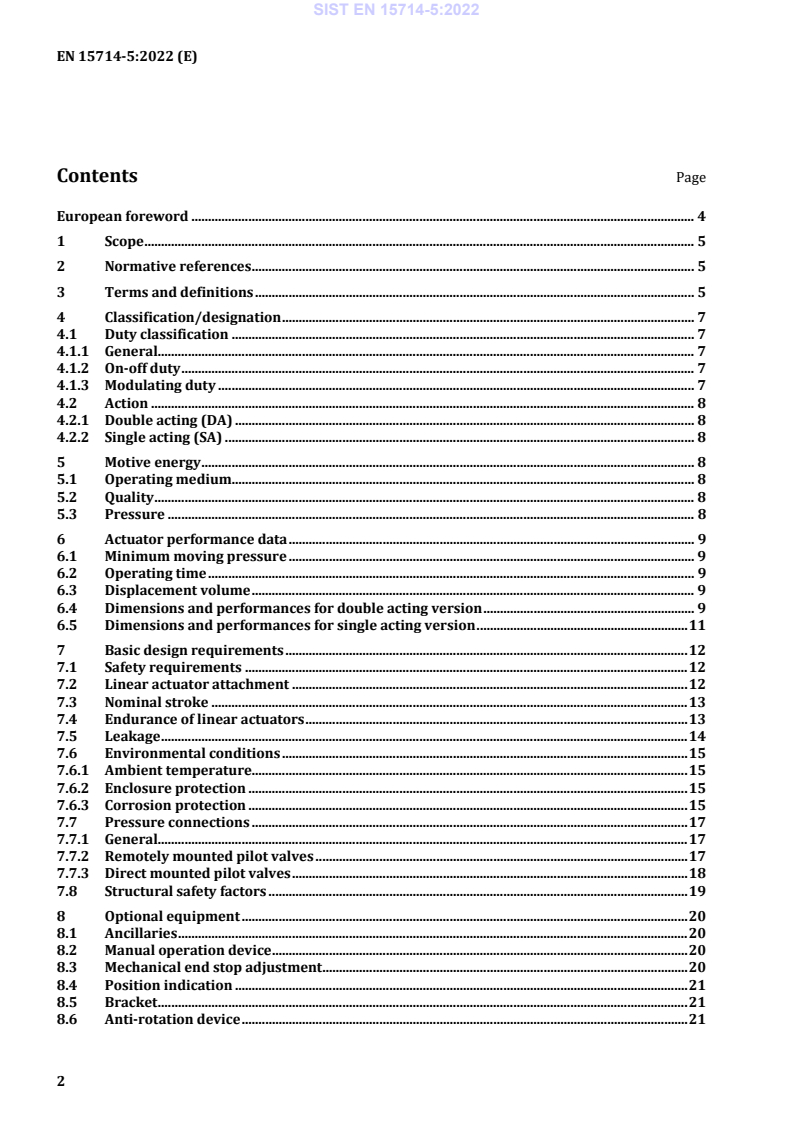
Contents Page
European foreword . 4
1 Scope . 5
2 Normative references . 5
3 Terms and definitions . 5
4 Classification/designation . 7
4.1 Duty classification . 7
4.1.1 General. 7
4.1.2 On-off duty . 7
4.1.3 Modulating duty . 7
4.2 Action . 8
4.2.1 Double acting (DA) . 8
4.2.2 Single acting (SA) . 8
5 Motive energy . 8
5.1 Operating medium. 8
5.2 Quality . 8
5.3 Pressure . 8
6 Actuator performance data . 9
6.1 Minimum moving pressure . 9
6.2 Operating time . 9
6.3 Displacement volume . 9
6.4 Dimensions and performances for double acting version . 9
6.5 Dimensions and performances for single acting version . 11
7 Basic design requirements . 12
7.1 Safety requirements . 12
7.2 Linear actuator attachment . 12
7.3 Nominal stroke . 13
7.4 Endurance of linear actuators . 13
7.5 Leakage . 14
7.6 Environmental conditions . 15
7.6.1 Ambient temperature. 15
7.6.2 Enclosure protection . 15
7.6.3 Corrosion protection . 15
7.7 Pressure connections . 17
7.7.1 General. 17
7.7.2 Remotely mounted pilot valves . 17
7.7.3 Direct mounted pilot valves . 18
7.8 Structural safety factors . 19
8 Optional equipment . 20
8.1 Ancillaries . 20
8.2 Manual operation device . 20
8.3 Mechanical end stop adjustment . 20
8.4 Position indication . 21
8.5 Bracket . 21
8.6 Anti-rotation device . 21
9 Conformity assessment . 21
9.1 General . 21
9.2 Type tests . 21
9.3 Control of production process . 22
10 Marking . 24
10.1 Mandatory marking . 24
10.2 Optional marking . 24
11 Documentation . 25
12 Linear actuator selection guidelines . 25
Annex A (normative) Endurance test procedure . 26
Annex B (informative) Actuator selection guidelines . 28
Bibliography . 31
European foreword
This document (EN 15714-5:2022) has been prepared by Technical Committee CEN/TC 69 “Industrial
valves”, the secretariat of which is held by AFNOR.
This European Standard shall be given the status of a national standard, either by publication of an
identical text or by endorsement, at the latest by November 2022, and conflicting national standards shall
be withdrawn at the latest by November 2022.
Attention is drawn to the possibility that some of the elements of this document may be the subject of
patent rights. CEN shall not be held responsible for identifying any or all such patent rights.
Any feedback and questions on this document should be directed to the users’ national standards body.
A complete listing of these bodies can be found on the CEN website.
According to the CEN-CENELEC Internal Regulations, the national standards organisations of the
following countries are bound to implement this European Standard: Austria, Belgium, Bulgaria, Croatia,
Cyprus, Czech Republic, Denmark, Estonia, Finland, France, Germany, Greece, Hungary, Iceland, Ireland,
Italy, Latvia, Lithuania, Luxembourg, Malta, Netherlands, Norway, Poland, Portugal, Republic of North
Macedonia, Romania, Serbia, Slovakia, Slovenia, Spain, Sweden, Switzerland, Turkey and the United
Kingdom.
1 Scope
This document provides basic requirements for piston type pneumatic linear actuators for industrial
valve, both double acting and single acting, used for on-off and modulating control duties.
It includes criteria, method and guidelines for design, qualification, corrosion protection, control and
testing.
It does not apply to diaphragm actuators and to pneumatic actuators which are integral parts of control
valves.
Other requirements, or conditions of use, different from those indicated in this document, are subject to
agreement, between the purchaser and the manufacturer/supplier, prior to order.
2 Normative references
The following documents are referred to in the text in such a way that some or all of their content
constitutes requirements of this document. For dated references, only the edition cited applies. For
undated references, the latest edition of the referenced document (including any amendments) applies.
EN ISO 286-2, Geometrical product specifications (GPS) - ISO code system for tolerances on linear sizes -
Part 2: Tables of standard tolerance classes and limit deviations for holes and shafts (ISO 286-2)
EN ISO 5210:2017, Industrial valves - Multi-turn valve actuator attachments (ISO 5210:2017)
EN 12570, Industrial valves - Method for sizing the operating element
EN 15714-1, Industrial valves - Actuators - Part 1: Terminology and definitions
EN 60529, Degrees of protection provided by enclosures (IP Code)
ISO 5599-2, Pneumatic fluid power — Five-port directional control valves — Part 2: Mounting interface
surfaces with optional electrical connector
ISO 8573-1:2010, Compressed air — Part 1: Contaminants and purity classes
3 Terms and definitions
For the purposes of this document, the terms and definitions given in EN 15714-1 and the following apply.
ISO and IEC maintain terminological databases for use in standardization at the following addresses:
— ISO Online browsing platform: available at https://www.iso.org/obp
— IEC Electropedia: available at https://www.electropedia.org/
3.1
stroke
single and complete movement from one end of travel to the other
3.2
end stop
mechanical part, designed to stop the actuator drive train at an end position
Note 1 to entry: End stop can be fixed or adjustable.
3.3
output thrust
minimum guaranteed output thrust capability of the actuator, in both directions, at specified supply
pressures conditions as provided by the manufacturer/supplier
Note 1 to entry: Where the output thrust varies with the stroke, in a linear or nonlinear relationship with pressure,
tabulated data and/or thrust versus stroke diagram shall be provided at significant pressure values for each
direction of movement.
3.3.1
rated thrust
characterizing figure, indicated by the actuator manufacturer/supplier, used to define the maximum
actuator operating thrust
Note 1 to entry: The rated thrust corresponds to the maximum thrust value developed by the actuator when
powered with maximum allowable pressure.
3.3.2
nominal thrust
3.3.2.1
double acting version (4.2.1)
minimum guaranteed output thrust of the actuator, at any point of the stroke, with nominal supply
pressure 0,55 MPa (5,5 bar)
3.3.2.2
single acting version (4.2.2)
guaranteed output thrust of the actuator with pneumatic nominal supply 0,55 MPa (5,5 bar) at the
beginning of the stroke in the direction to compress the spring
3.3.3
start thrust
actuator output thrust at the beginning of the stroke in the direction of movement
3.3.4
maximum operating thrust
MOT
for double acting version, output thrust of the actuator when the pressure of the power supply
corresponds to the maximum allowable pressure; for single acting version the maximum output thrust
between the thrust at the beginning of the stroke when the pressure of the power supply corresponds to
the maximum allowable pressure and the thrust generated by the spring at the end of specified
compression stroke
Note 1 to entry: The maximum thrust value shall be indicated by the manufacturer/supplier; the value shall be not
lower than 1,45 times the nominal thrust.
3.4
single acting version
3.4.1
air starting thrust
AST
output thrust, at defined pressure value, at the beginning of the stroke in opposition to the spring
3.4.2
air ending thrust
AET
output thrust, at defined pressure value, at the end of the stroke when spring is at its maximum
compression
3.4.3
air running thrust
ART
any output thrust value between AST and AET at defined pressure value
3.4.4
spring ending thrust
SET
output thrust generated by the spring at the end of its stroke with no air in the cylinder
3.4.5
spring starting thrust
SST
output thrust generated by the spring at its maximum compression with no air in the cylinder
3.4.6
spring running thrust
SRT
any output thrust value between SST and SET
4 Classification/designation
4.1 Duty classification
4.1.1 General
According to their intended function, two versions of linear valve actuators are defined by this document:
on-off duty and modulating duty.
4.1.2 On-off duty
The actuator shall drive the valve through its entire travel from the fully open position to the fully closed
position or vice-versa.
4.1.3 Modulating duty
The actuator shall continuously drive the valve to any position between fully open and fully closed or
vice-versa.
4.2 Action
4.2.1 Double acting (DA)
A double acting actuator requires the supply of motive energy to operate in both travel directions.
4.2.2 Single acting (SA)
A single acting actuator requires external power to operate the valve in one direction only, the return
stroke being powered by an alternative form of stored energy (fail-safe actuators).
For the purpose of this document, the stored energy shall be supplied by a mechanical spring.
5 Motive energy
5.1 Operating medium
The operating medium shall be compressed air, unless otherwise specified.
Other compressed gases may be used, on agreement between the manufacturer/supplier and purchaser,
ensuring they are compatible with all the parts which they are in contact with, including the lubricants.
5.2 Quality
Humidity of the operating medium shall be Class 2 according to ISO 8573-1:2010, Table 2.
For ambient temperature conditions different from the standard stated at 7.6.1, the dew point shall be at
least 10 °C below the minimum operating ambient temperature.
It is recommended that the content of particles per cubic meter in the operating medium shall not exceed
Class 5 according to ISO 8573-1:2010, Table 1; particles up to a maximum 40 µm size are acceptable in
the operating medium provided that a right analysis of the behaviour of the ancillaries (8.1), when
mounted on the actuator, is done.
5.3 Pressure
The manufacturer/supplier shall indicate the actuator’s pressure limits.
Unless otherwise specified the following values shall be considered within the scope of this document:
a) nominal supply pressure: 0,55 MPa (5,5 bar);
b) maximum allowable pressure shall be at least 0,8 MPa (8 bar);
c) design pressure for pressurized parts at least 1,1 times the maximum allowable pressure;
d) the minimum test pressure for pressurized parts shall be 1,50 times the design pressure.
For sizing of the double acting actuator at different pressures with different loads, Figure B.1 can be used
as a guidance.
6 Actuator performance data
6.1 Minimum moving pressure
For double acting actuators, the minimum moving pressure, at no load condition and ambient
temperature, shall be made available by the manufacturer/supplier upon request.
For single acting actuators, the minimum starting and release pressure in contrast to the spring at the
beginning and ending of the nominal stroke, at no load condition and ambient temperature, shall be made
available by manufacturer/supplier upon request.
6.2 Operating time
The actuator manufacturer/supplier shall state the minimum operating time in both directions, without
external load, at nominal pressure and without any significant external restriction on supply flow rate
and exhaust.
6.3 Displacement volume
Internal actuator displaced volumes for each direction, including the dead volumes, for the maximum
stroke without any external limitation.
Displacement volume should be expressed in litres.
6.4 Dimensions and performances for double acting version
Dimension of cylinders and performances data of double acting actuator shall be in accordance with
Table 1.
Table 1 — Dimensions and data of double acting actuator
c
Standard Minimum Rated thrust Flange type Nominal Minimum
d
nominal nominal EN ISO 5210 thrust based stroke
“X”
b
diameter of thrust on
a
cylinder EN ISO 5210
mm kN kN kN mm
80 2,6 4,0 F05 ≤ 10 20
100 4,1 6,0 F05 ≤ 10 20
125 6,3 10,0 F05 ≤ 10 20
160 10,4 16,0 F07 ≤ 20 40
200 16,2 24,0 F10 ≤ 40 60
250 25,4 37,0 F10 ≤ 40 60
300 37,3 55,0 F12 ≤ 70 60
400 66,4 97,0 F14 ≤ 100 80
500 103,7 150,0 F16 ≤ 150 100
600 149,3 218,0 F30 ≤ 325 140
700 203,2 296,0 F30 ≤ 350 140
900 335,9 489,0 F35 ≤ 700 160
1 100 501,8 730,0 F35 ≤ 700 160
a
Intermediate diameters are permissible and may be used upon agreement between purchaser and
manufacturer/supplier.
b
Minimum nominal thrust is based on nominal pressure 0,55 MPa (5,5 bar) and includes friction factor.
Different operating pressure sizing can be referred to as in Clause B.3 (Figure B.1).
c
Maximum operating thrust (MOT) at maximum allowable pressure 0,80 MPa (8,0 bar); different rated thrust
can be defined at higher maximum allowable pressure upon agreement between purchaser and
manufacturer/supplier.
d
Different flange type may be used upon agreement between purchaser and manufacturer/supplier.
6.5 Dimensions and performances for single acting version
Dimension of cylinders and performances data of single acting actuator shall be in accordance with
Table 2 based on nominal pressure of 0,55 MPa (5,5 bar). Other pressure values and spring thrusts are
subject to agreement between purchaser and manufacturer/supplier.
Table 2 — Dimensions and data of single acting actuator
Standard Minimum Spring Rated Flange type Nominal Minimum
c d
nominal nominal ending thrust EN ISO 5210 thrust based stroke
b
internal thrust thrust (SET) on
“X”
diameter of EN ISO 5210
a
cylinder
mm kN kN kN kN mm
125 4,1 2,2 7,0 F05 ≤ 10 20
160 6,7 3,7 11,5 F05 ≤ 20 40
180 8,5 4,7 14,5 F07 ≤ 20 40
200 10,4 5,8 18,0 F07 ≤ 20 40
250 16,4 9,0 28,0 F10 ≤ 40 60
300 23,0 13,5 40,0 F10 ≤ 40 60
400 42,8 23,5 73,0 F12 ≤ 70 60
500 66,7 37,0 114,0 F14 ≤ 100 80
600 96,3 53,0 164,0 F16 ≤ 150 100
700 131,2 72,0 224,0 F25 ≤ 200 120
800 171,4 94,0 292,0 F30 ≤ 350 140
900 215,9 120,0 370,0 F30 ≤ 350 140
1 200 370,0 230,0 640,0 F35 ≤ 700 160
a
Intermediate diameters are permissible and may be used upon agreement between purchaser and
manufacturer/supplier.
b
Minimum nominal thrust is based on nominal pressure 0,55 MPa (5,5 bar) and includes friction factor. Different
operating pressure sizing can be referred to as in Clause B.3 (Figure B.1).
c
Air starting thrust (AST) at maximum allowable pressure 0,80 MPa (8,0 bar); different rated thrust can be defined at
higher maximum allowable pressure upon agreement between purchaser and manufacturer/supplier.
d
Different flange type may be used upon agreement between purchaser and manufacturer/supplier.
NOTE For air and spring thrust specific definitions refer to 3.4.
7 Basic design requirements
7.1 Safety requirements
Actuators shall be designed to take into account the technical principles and specifications for safety.
The design of spring return actuators shall permit the safe assembly/disassembly, when complying with
the manufacturer/supplier’s instructions.
Provisions shall be taken to avoid that the pressure within the spring enclosure exceeds 0,05 MPa
(0,50 bar) during the actuator operation if the spring is not located in a pressurized enclosure.
7.2 Linear actuator attachment
Dimensions of attachment flange shall be according to EN ISO 5210:2017, Clause 5, Figure 2 and Table 2,
7.6 and Table 8.
Dimensions of output shaft shall be based on EN ISO 5210:2017, 7.6 with specific additional dimensions
according to Figure 1 and Table 3.
A flat attach for fork wrench SW shall be provided as optional.
Figure 1 — Dimensions of output drive
Table 3 — Data and dimensions of output drive
Flange type EN ISO 5210 rated thrust sw
a
EN ISO 5210
kN mm
F05 10 13
F07 20 17
F10 40 21
F12 70 27
F14 100 36
F16 150 46
F25 200 50
F30 325 55
F35 700 80
a
Different flange and/or coupling type may be used upon agreement between
purchaser and manufacturer/supplier.
The material of the output drive (Table 3) component shall be clearly indicated in the
manufacturer’s/supplier’s documentation.
7.3 Nominal stroke
Length of the stroke (3.1) of linear actuator shall be defined by the manufacturer/supplier or based on
agreement between the manufacturer/supplier and purchaser or valve manufacturer.
For linear actuators, without adjustable end stops (3.2), the standard tolerance on defined length of
stroke shall be H15 according to EN ISO 286-2.
For linear actuators, with adjustable mechanical end stops (8.3) in one or both directions, the adjustment
range referred to the defined length of stroke shall be stated by the manufacturer/supplier but at least
not less than ± 3 % of adjustment for each end where adjustable stroke is provided.
Different values of tolerances or percentages on end-stops adjustment shall be agreed between the
purchaser and the manufacturer/supplier.
7.4 Endurance of linear actuators
The actuator shall be designed to have an endurance, without maintenance, in accordance with values
given in Table 4; minimum endurance shall be demonstrated by a suitable endurance test performed in
accordance with the procedure detailed in Annex A.
For double acting actuators the endurance test shall be performed at a load, along the complete stroke,
at least equal to the nominal thrust at supply pressure 0,55 MPa (5,5 bar) as shown in Table 1.
For single acting actuators the endurance test shall be performed at a nominal thrust, at starting condition
(AST), generated by the supply pressure 0,55 MPa (5,5 bar) as shown in Table 2.
Stroke length, stroking time and number of cycles for the endurance test shall be selected from Table 4
considering the EN ISO 5210 range where the rated thrust (3.3.1) of the actuator under test falls.
a
Table 4 — Endurance testing parameters
Rated thrust Minimum test Maximum stroking time Minimum number
b a c
for tabulated stroke length
reference range stroke length of cycles
kN mm s
≤ 10
...