


kSIST FprEN IEC 63616:2025
(Main)Measurement of the conductivity for metal thin films at microwave and millimeter-wave frequencies balanced-type circular disk resonator method
Measurement of the conductivity for metal thin films at microwave and millimeter-wave frequencies balanced-type circular disk resonator method
IEC 63616:2025 relates to a conductivity measurement method of thin metal films at microwave and millimeter-wave frequencies. This method has been developed to evaluate the conductivity of a metal foil used for adhering to a substrate or the interfacial conductivity of a metal layer formed on a dielectric substrate. It uses higher-order modes of a balanced-type circular disk resonator and provides broadband conductivity measurements by using a single resonator.
Messung der Leitfähigkeit von Metalldünnschichten bei Mikrowellen- und Millimeterwellenfrequenzen nach dem symmetrischen Kreisscheibenresonatorverfahren
Mesurage de la conductivité des films minces métalliques aux hyperfréquences et aux fréquences à ondes millimétriques par la méthode du résonateur à disque circulaire de type symétrique
L'IEC 63616:2025 traite d’une méthode de mesurage de la conductivité de films métalliques minces aux hyperfréquences et aux fréquences à ondes millimétriques. Cette méthode a été élaborée pour évaluer la conductivité d’une feuille métallique utilisée pour adhérer à un substrat ou la conductivité interfaciale d’une couche métallique formée sur un substrat diélectrique. Elle utilise des modes d’ordre supérieur d’un résonateur à disque circulaire de type symétrique et permet d’effectuer, à l’aide d’un seul résonateur, des mesurages de conductivité à large bande.
Merjenje prevodnosti kovinskih tankih plasti pri mikrovalovnih in milimetrskih frekvencah z metodo uravnoteženega krožnega diska z resonatorjem
General Information
- Status
- Not Published
- Public Enquiry End Date
- 22-Jun-2025
- Technical Committee
- MOC - Mobile Communications
- Current Stage
- 5020 - Formal vote (FV) (Adopted Project)
- Start Date
- 26-Aug-2025
- Due Date
- 14-Oct-2025
- Completion Date
- 27-Aug-2025
Overview
EN IEC 63616:2026 (CLC adoption of IEC 63616) defines a standardized, non‑destructive method for measuring the electrical conductivity of metal thin films at microwave and millimeter‑wave frequencies using a balanced‑type circular disk resonator (BCDR). The method targets both free metal foils (used for bonding to substrates) and interfacial conductivity of metal layers formed on dielectric substrates. It enables broadband conductivity measurements with a single resonator by exploiting higher‑order TM0m modes.
Key topics and technical requirements
- Measurement principle: Relative resonator method - compare unloaded Q‑factors of a reference BCDR and the BCDR containing the test sample to extract conductivity. Conductivity is related to surface resistance and resonant Q.
- Resonator design: Balanced‑type circular disk resonator (thin circular conductor disk sandwiched between paired low‑loss dielectric sheets and parallel conductor plates). Selective excitation of TM modes via coaxial or waveguide interfaces.
- Frequency coverage: Applicable in the microwave to millimeter‑wave band (document specifies 10 GHz ≤ f ≤ 170 GHz).
- Sample configurations:
- Conductor disk (metal foil) placed in the resonator
- Pair of metal‑clad substrate samples for interfacial conductivity of deposited layers
- Measurement system: Vector network analyzer (VNA) recommended for precision S21 measurements and complex‑plane circle fitting to obtain resonant frequencies and unloaded Q.
- Calibration and reference: Requires a reference metal foil with known conductivity (reference foil can be characterized using dielectric resonator methods such as IEC 61788‑7).
- Limitations and checks: Cutoff frequencies (coaxial lines, excitation holes, radial radiation through dielectric sheets) set the upper usable frequency. Periodic resonator checkups and VNA calibration are required.
Applications and users
- Who uses it: RF/microwave materials labs, metrology institutes, thin‑film and foil manufacturers, connector and RF passive component designers, quality control and R&D teams in electronics and semiconductor industries, and academic researchers in microwave materials characterization.
- Practical uses:
- Non‑destructive QC of metal foils for bonding and shielding
- Characterization of conductive coatings and metallization on dielectric substrates at operating RF/MMW frequencies
- Broadband conductivity profiling using a single test fixture (useful for process control and material comparison)
Related standards
- Normative reference: IEC 61788‑7:2020 (dielectric resonator methods for surface resistance measurements) - used for reference foil characterization.
- Historical note: document replaces/renumbers prior work in the TC/SC (previously referenced documents such as 61169‑73 in committee discussions).
Keywords: EN IEC 63616:2026, conductivity measurement, metal thin films, microwave, millimeter‑wave, balanced‑type circular disk resonator, BCDR, interfacial conductivity, vector network analyzer, non‑destructive testing, broadband conductivity measurements.

Frequently Asked Questions
kSIST FprEN IEC 63616:2025 is a draft published by the Slovenian Institute for Standardization (SIST). Its full title is "Measurement of the conductivity for metal thin films at microwave and millimeter-wave frequencies balanced-type circular disk resonator method". This standard covers: IEC 63616:2025 relates to a conductivity measurement method of thin metal films at microwave and millimeter-wave frequencies. This method has been developed to evaluate the conductivity of a metal foil used for adhering to a substrate or the interfacial conductivity of a metal layer formed on a dielectric substrate. It uses higher-order modes of a balanced-type circular disk resonator and provides broadband conductivity measurements by using a single resonator.
IEC 63616:2025 relates to a conductivity measurement method of thin metal films at microwave and millimeter-wave frequencies. This method has been developed to evaluate the conductivity of a metal foil used for adhering to a substrate or the interfacial conductivity of a metal layer formed on a dielectric substrate. It uses higher-order modes of a balanced-type circular disk resonator and provides broadband conductivity measurements by using a single resonator.
kSIST FprEN IEC 63616:2025 is classified under the following ICS (International Classification for Standards) categories: 17.220.20 - Measurement of electrical and magnetic quantities; 29.050 - Superconductivity and conducting materials; 33.120.30 - RF connectors. The ICS classification helps identify the subject area and facilitates finding related standards.
You can purchase kSIST FprEN IEC 63616:2025 directly from iTeh Standards. The document is available in PDF format and is delivered instantly after payment. Add the standard to your cart and complete the secure checkout process. iTeh Standards is an authorized distributor of SIST standards.
Standards Content (Sample)
SLOVENSKI STANDARD
oSIST prEN IEC 63616:2025
01-junij-2025
Merjenje prevodnosti kovinskih tankih plasti pri mikrovalovnih in milimetrskih
frekvencah z metodo uravnoteženega krožnega diska z resonatorjem
Measurement of the conductivity for metal thin films at microwave and millimeter-wave
frequencies balanced-type circular disk resonator method
Ta slovenski standard je istoveten z: prEN IEC 63616:2025
ICS:
33.120.30 Radiofrekvenčni konektorji RF connectors
(RF)
oSIST prEN IEC 63616:2025 en
2003-01.Slovenski inštitut za standardizacijo. Razmnoževanje celote ali delov tega standarda ni dovoljeno.
oSIST prEN IEC 63616:2025
oSIST prEN IEC 63616:2025
46F/697/CDV
COMMITTEE DRAFT FOR VOTE (CDV)
PROJECT NUMBER:
IEC 63616 ED1
DATE OF CIRCULATION: CLOSING DATE FOR VOTING:
2025-02-28 2025-05-23
SUPERSEDES DOCUMENTS:
46F/670/CD, 46F/676/CC
IEC SC 46F : RF AND MICROWAVE PASSIVE COMPONENTS
SECRETARIAT: SECRETARY:
United States of America Mr John Morelli
OF INTEREST TO THE FOLLOWING COMMITTEES: HORIZONTAL FUNCTION(S):
ASPECTS CONCERNED:
SUBMITTED FOR CENELEC PARALLEL VOTING NOT SUBMITTED FOR CENELEC PARALLEL VOTING
Attention IEC-CENELEC parallel voting
The attention of IEC National Committees, members of CENELEC,
is drawn to the fact that this Committee Draft for Vote (CDV) is
submitted for parallel voting.
The CENELEC members are invited to vote through the CENELEC
online voting system.
This document is still under study and subject to change. It should not be used for reference purposes.
Recipients of this document are invited to submit, with their comments, notification of any relevant patent rights of which they are aware
and to provide supporting documentation.
Recipients of this document are invited to submit, with their comments, notification of any relevant “In Some Countries” clau ses to be
included should this proposal proceed. Recipients are reminded that the CDV stage is the final stage for submitting ISC c lauses. (SEE
AC/22/2007 OR NEW GUIDANCE DOC).
TITLE:
Measurement of the conductivity for metal thin films at microwave and millimeter-wave frequencies balanced-
type circular disk resonator method
PROPOSED STABILITY DATE: 2028
NOTE FROM TC/SC OFFICERS:
This is the replacement for 61169-73 which was decided to renumber as 63616 at the SC46F meeting in November 2024
electronic file, to make a copy and to print out the content for the sole purpose of preparing National Committee positions.
You may not copy or "mirror" the file or printed version of the document, or any part of it, for any other purpose without
permission in writing from IEC.
oSIST prEN IEC 63616:2025
46F/697/CDV – 2 – IEC CDV 63616 © IEC 2025
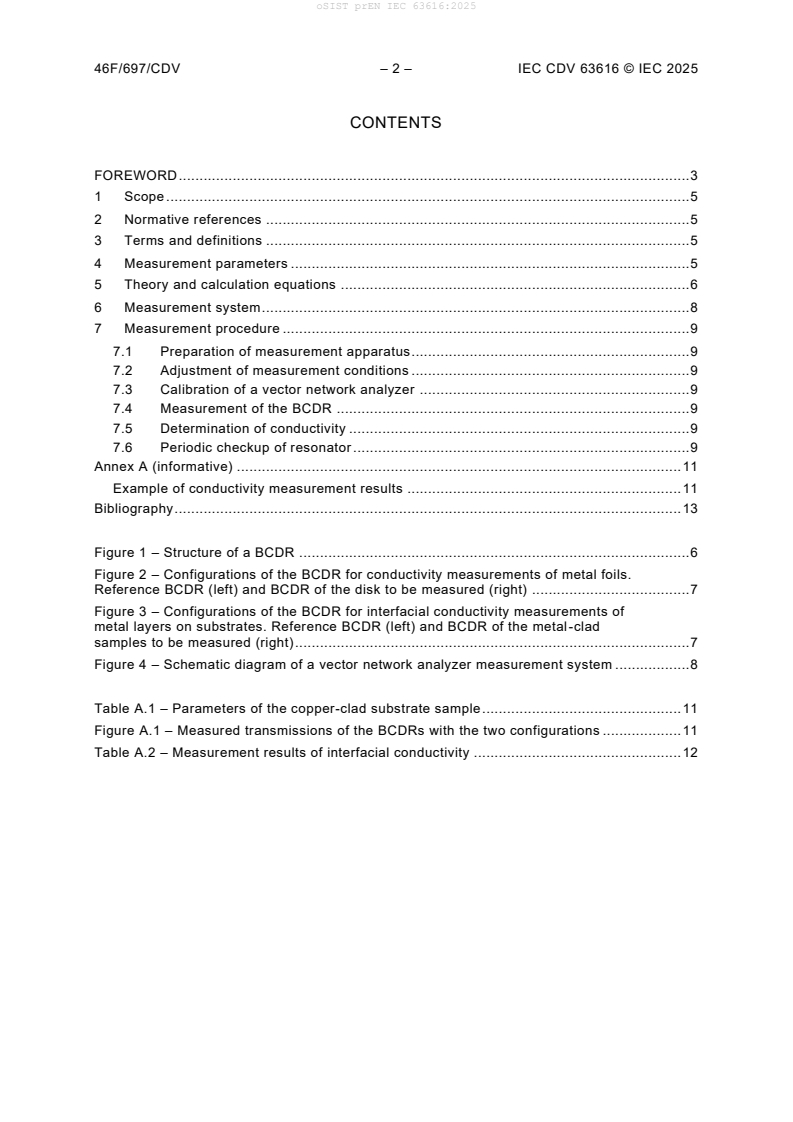
CONTENTS
FOREWORD . 3
1 Scope . 5
2 Normative references . 5
3 Terms and definitions . 5
4 Measurement parameters . 5
5 Theory and calculation equations . 6
6 Measurement system . 8
7 Measurement procedure . 9
7.1 Preparation of measurement apparatus. 9
7.2 Adjustment of measurement conditions . 9
7.3 Calibration of a vector network analyzer . 9
7.4 Measurement of the BCDR . 9
7.5 Determination of conductivity . 9
7.6 Periodic checkup of resonator . 9
Annex A (informative) . 11
Example of conductivity measurement results . 11
Bibliography . 13
Figure 1 – Structure of a BCDR . 6
Figure 2 – Configurations of the BCDR for conductivity measurements of metal foils.
Reference BCDR (left) and BCDR of the disk to be measured (right) . 7
Figure 3 – Configurations of the BCDR for interfacial conductivity measurements of
metal layers on substrates. Reference BCDR (left) and BCDR of the metal-clad
samples to be measured (right) . 7
Figure 4 – Schematic diagram of a vector network analyzer measurement system . 8
Table A.1 – Parameters of the copper-clad substrate sample . 11
Figure A.1 – Measured transmissions of the BCDRs with the two configurations . 11
Table A.2 – Measurement results of interfacial conductivity . 12
oSIST prEN IEC 63616:2025
IEC CDV 63616 © IEC 2025 – 3 – 46F/697/CDV
INTERNATIONAL ELECTROTECHNICAL COMMISSION
____________
MEASUREMENT OF THE CONDUCTIVITY FOR METAL THIN FILMS
AT MICROWAVE AND MILLIMETER-WAVE FREQUENCIES
BALANCED-TYPE CIRCULAR DISK RESONATOR METHOD
FOREWORD
1) The International Electrotechnical Commission (IEC) is a worldwide organization for standardization comprising
all national electrotechnical committees (IEC National Committees). The object of IEC is to promote international
co-operation on all questions concerning standardization in the electrical and electronic fields. To this end and
in addition to other activities, IEC publishes International Standards, Technical Specifications, Technical Reports,
Publicly Available Specifications (PAS) and Guides (hereafter referred to as “IEC Publication(s)”). Their
preparation is entrusted to technical committees; any IEC National Committee interested in the subject dealt with
may participate in this preparatory work. International, governmental and non-governmental organizations liaising
with the IEC also participate in this preparation. IEC collaborates closely with the International Organization for
Standardization (ISO) in accordance with conditions determined by agreement between the two organizations.
2) The formal decisions or agreements of IEC on technical matters express, as nearly as possible, an international
consensus of opinion on the relevant subjects since each technical committee has representation from all
interested IEC National Committees.
3) IEC Publications have the form of recommendations for international use and are accepted by IEC National
Committees in that sense. While all reasonable efforts are made to ensure that the technical content of IEC
Publications is accurate, IEC cannot be held responsible for the way in which they are used or for any
misinterpretation by any end user.
4) In order to promote international uniformity, IEC National Committees undertake to apply IEC Publications
transparently to the maximum extent possible in their national and regional publications. Any divergence between
any IEC Publication and the corresponding national or regional publication shall be clearly indicated in the latter.
5) IEC itself does not provide any attestation of conformity. Independent certification bodies provide conformity
assessment services and, in some areas, access to IEC marks of conformity. IEC is not responsible for any
services carried out by independent certification bodies.
6) All users should ensure that they have the latest edition of this publication.
7) No liability shall attach to IEC or its directors, employees, servants or agents including individual experts and
members of its technical committees and IEC National Committees for any personal injury, property damage or
other damage of any nature whatsoever, whether direct or indirect, or for costs (including legal fees) and
expenses arising out of the publication, use of, or reliance upon, this IEC Publication or any other IEC Publications.
8) Attention is drawn to the Normative references cited in this publication. Use of the referenced publications is
indispensable for the correct application of this publication.
9) Attention is drawn to the possibility that some of the elements of this IEC Publication may be the subject of patent
rights. IEC shall not be held responsible for identifying any or all such patent rights.
International Standard IEC 63185 has been prepared by subcommittee 46F: RF and microwave
passive components, of IEC technical committee 46: Cables, wires, waveguides, RF connectors,
RF and microwave passive components and accessories.
The text of this standard is based on the following documents:
FDIS Report on voting
46F/XX/FDIS 46F/XX/RVD
Full information on the voting for the approval of this standard can be found in the report on
voting indicated in the above table.
This publication has been drafted in accordance with the ISO/IEC Directives, Part 2.
The committee has decided that the contents of this publication will remain unchanged until the
stability date indicated on the IEC web site under "http://webstore.iec.ch" in the data related to
the specific publication. At this date, the publication will be
oSIST prEN IEC 63616:2025
46F/697/CDV – 4 – IEC CDV 63616 © IEC 2025
• reconfirmed,
• withdrawn,
• replaced by a revised edition, or
• amended.
IMPORTANT – The 'colour inside' logo on the cover page of this publication indicates
that it contains colours which are considered to be useful for the correct understanding
of its contents. Users should therefore print this document using a colour printer.
oSIST prEN IEC 63616:2025
IEC CDV 63616 © IEC 2025 – 5 – 46F/697/CDV
1 MEASUREMENT OF THE CONDUCTIVITY FOR METAL THIN FILMS
2 AT MICROWAVE AND MILLIMETER-WAVE FREQUENCIES
3 BALANCED-TYPE CIRCULAR DISK RESONATOR METHOD
7 1 Scope
8 This document relates to a conductivity measurement method of thin metal films at microwave
9 and millimeter-wave frequencies. This method has been developed to evaluate the conductivity
10 of a metal foil used for adhering to a substrate or the interfacial conductivity of a metal layer
11 formed on a dielectric substrate. It uses higher-order modes of a balanced-type circular disk
12 resonator and provides broadband conductivity measurements by using a single resonator.
13 In comparison with the conventional method described in IEC 61788-7, this method has the
14 following characteristics:
15 • the value of the conductivity 𝜎 of a metal foil can be measured accurately and non-
16 destructively;
17 • the value of the interfacial conductivity 𝜎 of a metal layer on a dielectric substrate can be
18 measured accurately and non-destructively;
19 • this method presents broadband measurements by using higher-order modes by one
20 resonator;
21 • this method is applicable for the measurements on the following condition:
22 – frequency: 10 GHz ≤ 𝑓 ≤ 170 GHz;
5 8
23 – conductivity: 10 S/m ≤ 𝜎 ≤ 10 S/m.
24 2 Normative references
25 The following document is referred to in the text in such a way that some or all of the content
26 constitutes requirements of this document. For dated references, only the edition cited applies.
27 For undated references, the latest edition of the referenced document (including any
28 amendments) applies.
29 IEC 61788-7:2020, Electronic characteristic measurements - Surface resistance of high-
30 temperature superconductors at microwave frequencies
31 3 Terms and definitions
32 No terms and definitions are listed in this document.
33 ISO and IEC maintain terminological databases for use in standardization at the following
34 addresses:
35 • IEC Electropedia: available at http://www.electropedia.org/
36 • ISO Online browsing platform: available at http://www.iso.org/obp
38 4 Measurement parameters
39 The measurement parameter is the conductivity of a metal thin film, which is related to the
40 surface resistance 𝑅 as follows
...
Questions, Comments and Discussion
Ask us and Technical Secretary will try to provide an answer. You can facilitate discussion about the standard in here.
Loading comments...