

ISO/TS 14812:2025
(Main)Intelligent transport systems — Vocabulary
General Information
- Abstract
This document defines terms relating to intelligent transport systems (ITS).
- Status
- Published
- Publication Date
- 09-Jun-2025
- Technical Committee
- ISO/TC 204 - Intelligent transport systems
- Drafting Committee
- ISO/TC 204 - Intelligent transport systems
- Current Stage
- 9092 - International Standard to be revised
- Start Date
- 10-Oct-2025
- Completion Date
- 29-Aug-2026
Overview
ISO/TS 14812:2025 - Intelligent transport systems - Vocabulary is a Technical Specification published by ISO that standardizes terminology used across intelligent transport systems (ITS). As a second edition (2025), it replaces the 2022 edition and provides a consolidated, concept-model–based glossary to support consistent communication, system design and interoperability across ITS projects, products and policies.
Key topics
This vocabulary covers a wide range of ITS domains and architectural views. Major topic groups include:
- Core terms: entity, system, architecture, views (communication, enterprise, functional, physical), system engineering and information security terminology.
- Technology terms: ITS station, device components, centre/field/personal/vehicle physical objects, ITS applications and processes.
- Infrastructure terms: road reservation components, carriageways, physical traffic separators, kerbs, footpaths, junctions, road equipment and facility terms.
- Location and referencing: coordinate tuples, point/area/network locations, geographic and infrastructure descriptors, jurisdictional terms.
- Service and user terms: generic and transport service vocabulary, shared transport and vehicle-sharing concepts, traveller and occupant categories.
- Vehicle and automation: vehicle components and attributes, automation levels, connectivity terms, speed and environment classifications.
- Financial and operational models: payment and contractual model vocabulary supporting transport service economics.
The 2025 edition documents specific updates (for example, revisions to information security terms, connected-vehicle roadside equipment, carriageway types, kerbside usage and payment terms), ensuring contemporary alignment with ITS technology and deployment practice.
Practical applications
Although ISO/TS 14812:2025 is a vocabulary rather than a prescriptive technical standard, it delivers essential practical value:
- Improves interoperability by providing unambiguous definitions used in interface specifications, data models and communications standards.
- Supports procurement and contracts by reducing ambiguity in requirements and deliverables.
- Aids system architects and developers in aligning designs to common ITS concepts and architecture views.
- Assists regulators and policymakers to draft consistent rules and guidance for ITS deployment and safety/security assessments.
- Facilitates research and documentation, ensuring that academic and industry reports use standardized terms.
Who uses this standard
- ITS system architects and integrators
- Vehicle and roadside equipment manufacturers
- Transport agencies and infrastructure operators
- Software developers working on ITS applications and data models
- Policy makers, procurement teams and standards bodies
- Researchers and consultants in mobility, connected vehicles and automated driving
ISO/TS 14812:2025 is a foundational reference for anyone needing a consistent ITS glossary to support design, specification, deployment and governance of intelligent transport systems.
Relations
- Effective Date
- 09-Feb-2026
- Effective Date
- 06-Jun-2022
Get Certified
Connect with accredited certification bodies for this standard

BSI Group
BSI (British Standards Institution) is the business standards company that helps organizations make excellence a habit.

Great Wall Tianjin Quality Assurance Center
Established 1993, first batch to receive national accreditation with IAF recognition.
Hong Kong Quality Assurance Agency (HKQAA)
Hong Kong's leading certification body.
Sponsored listings
Frequently Asked Questions
ISO/TS 14812:2025 is a technical specification published by the International Organization for Standardization (ISO). Its full title is "Intelligent transport systems — Vocabulary". This standard covers: This document defines terms relating to intelligent transport systems (ITS).
This document defines terms relating to intelligent transport systems (ITS).
ISO/TS 14812:2025 is classified under the following ICS (International Classification for Standards) categories: 01.040.03 - Services. Company organization, management and quality. Administration. Transport. Sociology. (Vocabularies); 01.040.35 - Information technology (Vocabularies); 03.220.01 - Transport in general; 35.240.60 - IT applications in transport. The ICS classification helps identify the subject area and facilitates finding related standards.
ISO/TS 14812:2025 has the following relationships with other standards: It is inter standard links to CEN ISO/TR 24315-2:2025, ISO/TS 14812:2022. Understanding these relationships helps ensure you are using the most current and applicable version of the standard.
ISO/TS 14812:2025 is available in PDF format for immediate download after purchase. The document can be added to your cart and obtained through the secure checkout process. Digital delivery ensures instant access to the complete standard document.
Standards Content (Sample)
Technical
Specification
ISO/TS 14812
Second edition
Intelligent transport systems —
2025-06
Vocabulary
Systèmes de transport intelligents — Vocabulaire
Reference number
© ISO 2025
All rights reserved. Unless otherwise specified, or required in the context of its implementation, no part of this publication may
be reproduced or utilized otherwise in any form or by any means, electronic or mechanical, including photocopying, or posting on
the internet or an intranet, without prior written permission. Permission can be requested from either ISO at the address below
or ISO’s member body in the country of the requester.
ISO copyright office
CP 401 • Ch. de Blandonnet 8
CH-1214 Vernier, Geneva
Phone: +41 22 749 01 11
Email: copyright@iso.org
Website: www.iso.org
Published in Switzerland
ii
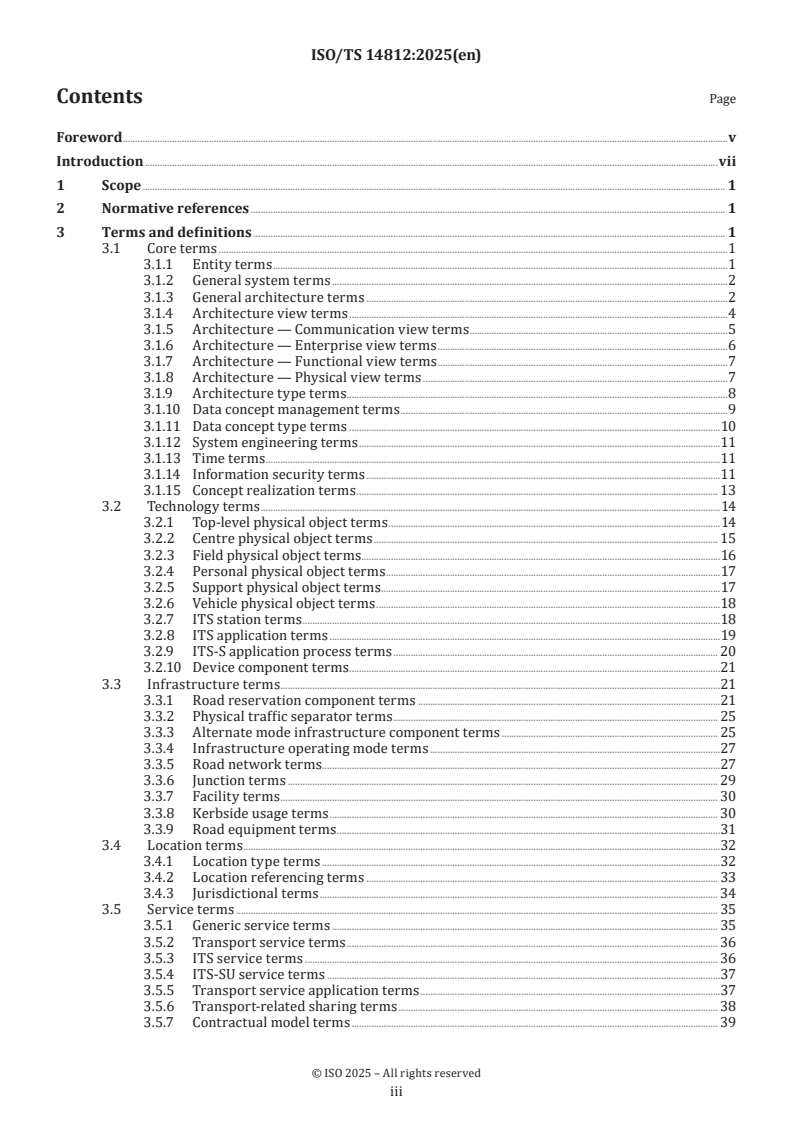
Contents Page
Foreword .v
Introduction .vii
1 Scope . 1
2 Normative references . 1
3 Terms and definitions . 1
3.1 Core terms .1
3.1.1 Entity terms .1
3.1.2 General system terms .2
3.1.3 General architecture terms .2
3.1.4 Architecture view terms .4
3.1.5 Architecture — Communication view terms .5
3.1.6 Architecture — Enterprise view terms .6
3.1.7 Architecture — Functional view terms .7
3.1.8 Architecture — Physical view terms .7
3.1.9 Architecture type terms . .8
3.1.10 Data concept management terms .9
3.1.11 Data concept type terms .10
3.1.12 System engineering terms .11
3.1.13 Time terms .11
3.1.14 Information security terms .11
3.1.15 Concept realization terms . 13
3.2 Technology terms .14
3.2.1 Top-level physical object terms .14
3.2.2 Centre physical object terms . 15
3.2.3 Field physical object terms . .16
3.2.4 Personal physical object terms .17
3.2.5 Support physical object terms .17
3.2.6 Vehicle physical object terms .18
3.2.7 ITS station terms .18
3.2.8 ITS application terms .19
3.2.9 ITS-S application process terms . 20
3.2.10 Device component terms.21
3.3 Infrastructure terms . .21
3.3.1 Road reservation component terms .21
3.3.2 Physical traffic separator terms . 25
3.3.3 Alternate mode infrastructure component terms . 25
3.3.4 Infrastructure operating mode terms .27
3.3.5 Road network terms.27
3.3.6 Junction terms . 29
3.3.7 Facility terms . 30
3.3.8 Kerbside usage terms . 30
3.3.9 Road equipment terms .31
3.4 Location terms .32
3.4.1 Location type terms .32
3.4.2 Location referencing terms . 33
3.4.3 Jurisdictional terms . 34
3.5 Service terms . 35
3.5.1 Generic service terms . 35
3.5.2 Transport service terms . 36
3.5.3 ITS service terms . 36
3.5.4 ITS-SU service terms .37
3.5.5 Transport service application terms .37
3.5.6 Transport-related sharing terms . 38
3.5.7 Contractual model terms . 39
iii
3.5.8 Financial model terms . 39
3.5.9 Operational model terms . 40
3.5.10 Network model terms .41
3.5.11 Shared transport service terms .42
3.5.12 Shared vehicle terms .42
3.6 User terms .43
3.6.1 Traveller terms . .43
3.6.2 Vehicle occupant terms .43
3.7 Vehicle terms . 44
3.7.1 Vehicle component terms. 44
3.7.2 Vehicle attribute terms .45
3.7.3 Vehicle automation terms . . 46
3.7.4 Vehicle connectivity terms . 49
3.7.5 Vehicle speed terms . 49
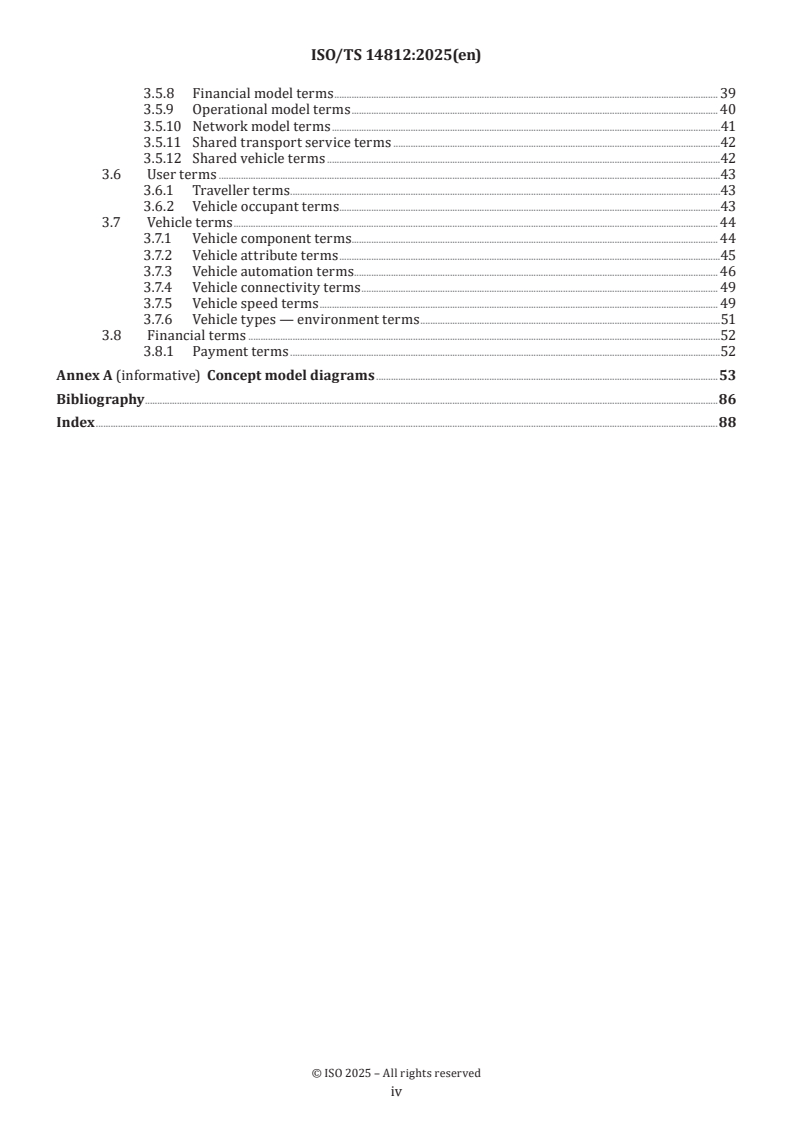
3.7.6 Vehicle types — environment terms .51
3.8 Financial terms .52
3.8.1 Payment terms .52
Annex A (informative) Concept model diagrams .53
Bibliography .86
Index .88
iv
Foreword
ISO (the International Organization for Standardization) is a worldwide federation of national standards
bodies (ISO member bodies). The work of preparing International Standards is normally carried out through
ISO technical committees. Each member body interested in a subject for which a technical committee
has been established has the right to be represented on that committee. International organizations,
governmental and non-governmental, in liaison with ISO, also take part in the work. ISO collaborates closely
with the International Electrotechnical Commission (IEC) on all matters of electrotechnical standardization.
The procedures used to develop this document and those intended for its further maintenance are described
in the ISO/IEC Directives, Part 1. In particular, the different approval criteria needed for the different types
of ISO document should be noted. This document was drafted in accordance with the editorial rules of the
ISO/IEC Directives, Part 2 (see www.iso.org/directives).
ISO draws attention to the possibility that the implementation of this document may involve the use of (a)
patent(s). ISO takes no position concerning the evidence, validity or applicability of any claimed patent
rights in respect thereof. As of the date of publication of this document, ISO had not received notice of (a)
patent(s) which may be required to implement this document. However, implementers are cautioned that
this may not represent the latest information, which may be obtained from the patent database available at
www.iso.org/patents. ISO shall not be held responsible for identifying any or all such patent rights.
Any trade name used in this document is information given for the convenience of users and does not
constitute an endorsement.
For an explanation of the voluntary nature of standards, the meaning of ISO specific terms and expressions
related to conformity assessment, as well as information about ISO's adherence to the World Trade
Organization (WTO) principles in the Technical Barriers to Trade (TBT), see www.iso.org/iso/foreword.html.
This document was prepared by Technical Committee ISO/TC 204, Intelligent transport systems.
This second edition cancels and replaces the first edition (ISO/TS 14812:2022), which has been technically
revised. The main changes are as follows:
— the following terms and groups of terms have been modified:
— information security terms (3.1.14);
— connected vehicle roadside equipment (3.2.3.3);
— connected vehicle (3.2.3.7);
— device component terms (3.2.10);
— carriageway (3.3.1.5);
— single carriageway (3.3.1.7);
— dual carriageway (3.3.1.8);
— multiple carriageway (3.3.1.9);
— motorway (3.3.1.21);
— physical traffic separator (3.3.2.1);
— kerb (3.3.2.4);
— footpath (3.3.3.3);
— sidewalk (3.3.3.4);
— escalator (3.3.3.5);
v
— moving walkway (3.3.3.6);
— pedestrian crossing (3.3.3.7);
— shared space (3.3.3.8);
— block-face (3.3.3.9);
— alley (3.3.5.11);
— road identifier (3.3.5.12);
— service road (3.3.5.13);
— service alley (3.3.5.14);
— facility terms (3.3.7);
— kerbside usage terms (3.3.8);
— road equipment terms (3.3.9);
— geographic feature (3.4.1.7);
— point destination (3.4.1.8);
— area destination (3.4.1.9);
— coordinate tuple (3.4.1.10);
— point coordinates (3.4.1.11);
— network location (3.4.2.8);
— geographic descriptor (3.4.2.9);
— infrastructure descriptor (3.4.2.10);
— jurisdictional terms (3.4.3);
— vulnerable road user (3.6.1.5);
— protected road user (3.6.1.6);
— anonymized vehicle reference (3.7.2.3);
— vehicle equipment (3.7.2.4);
— vehicle fuel type (3.7.2.5);
— vehicle identifier (3.7.2.6);
— vehicle load type (3.7.2.7);
— vehicle registration plate identifier (3.7.2.8);
— gross vehicle mass (3.7.2.9);
— gross vehicle mass rating (3.7.2.10);
— payment terms (3.8.1).
Any feedback or questions on this document should be directed to the user’s national standards body. A
complete listing of these bodies can be found at www.iso.org/members.html.
vi
Introduction
The definitions found in this document have been formulated in accordance with ISO International
Standards such as ISO 704 and are based on a consistent concept model. It is recognized that the contents of
this document are not exhaustive and that terminology evolves over time.
In most cases, the definitions provided within this document are suitable for general application throughout
intelligent transport systems (ITS). In those circumstances where a term is intended for a specific domain
of discourse or where the term can be used in multiple domains, the intended context is indicated at the
beginning of the definition as bracketed text (e.g. "").
In addition to a Bibliography, this document provides an index that provides an alphabetical listing of all
preferred, admitted and deprecated terms contained in this document.
Other standardization groups and organizations are encouraged to adopt the terminology in this document
to promote better understanding of terms among ITS professionals worldwide. The terms and definitions
contained within this document can be searched online at ISO’s Online Browsing Platform available at
https://www.iso.org/obp.
Additional related terms can be found in ISO/IEC/IEEE 24765.
vii
Technical Specification ISO/TS 14812:2025(en)
Intelligent transport systems — Vocabulary
1 Scope
This document defines terms relating to intelligent transport systems (ITS).
2 Normative references
There are no normative references in this document.
3 Terms and definitions
ISO and IEC maintain terminology databases for use in standardization at the following addresses:
— ISO Online browsing platform: available at https:// www .iso .org/ obp
— IEC Electropedia: available at https:// www .electropedia .org/
3.1 Core terms
3.1.1 Entity terms
NOTE Figure A.1 depicts the concept model for the terms defined in this subclause.
3.1.1.1
entity
concrete or abstract thing that exists, did exist, or can possibly exist, including associations among these things
EXAMPLE Person (3.1.1.6), object, event, idea, process, etc.
3.1.1.2
immaterial entity
entity (3.1.1.1) that does not occupy three-dimensional space
EXAMPLE Idea, process, organization, etc.
3.1.1.3
material entity
entity (3.1.1.1) that occupies three-dimensional space
Note 1 to entry: All material entities have certain characteristics that can be described and therefore this concept is
important for ontology purposes.
3.1.1.4
non-biological entity
material entity (3.1.1.3) that is not and has never been a living organism
3.1.1.5
biological entity
material entity (3.1.1.3) that was or is a living organism
3.1.1.6
person
biological entity (3.1.1.5) that is a human being
3.1.2 General system terms
NOTE Figure A.2 depicts the concept model for the terms defined in this subclause.
3.1.2.1
system
combination of interacting elements (3.1.3.10) organized to achieve one or more stated purposes
3.1.2.2
transport system
system (3.1.2.1) of infrastructure elements (3.1.3.10) and optionally vehicles (3.7.1.1) that are jointly designed
to move material entities (3.1.1.3) from an origin to a destination
Note 1 to entry: Transport systems can also include any supporting system, such as information and control systems.
3.1.2.3
surface transport system
transport system
transport system (3.1.2.2) designed to move material entities (3.1.1.3) across the surface or near-surface of
the Earth
Note 1 to entry: A surface transport system can include tunnels, bridges (3.3.7.3) and similar elements (3.1.3.10).
Note 2 to entry: There is not complete agreement on the precise limitations of a "surface transport system" within
the ITS community. Currently, the term is almost exclusively applied to ground-based travel of goods and people
over significant distances. The term is viewed as including ferry systems, which often form an integral part of a local
surface transport system; it is less clear if it includes long-distance sea-fairing ships. The term "surface transport
systems" is also generally limited to transport systems that cover a considerable distance (e.g. factory conveyance
technologies are not often referred to as "surface transport systems"). It has been suggested that air travel, which
is arguably a transport system designed to move physical entities between points on the surface of the Earth, ought
to be included in the scope of the term, but this perspective is not universally accepted. It is expected that the exact
limitations of the term will be further refined as ITS matures.
Note 3 to entry: Due to the defined scope of ITS, the term "transport system" is intended to be interpreted as being
synonymous with the term "surface transport system" unless explicitly specified otherwise.
3.1.2.4
intelligent transport system
ITS
intelligent transportation system
system (3.1.2.1) comprised of information, communication, sensor and control technologies and that is
designed to benefit a surface transport system (3.1.2.3)
Note 1 to entry: "Intelligent transportation system" is the American English equivalent.
Note 2 to entry: Benefits potentially include, but are not limited to, increased safety, sustainability, efficiency and
comfort.
Note 3 to entry: The full term (i.e. "intelligent transport system") is often used when the noun is used as a subject,
whereas the abbreviated term (i.e. "ITS") is often used to modify another noun (e.g. "Intelligent transport systems
provide ITS services.").
3.1.2.5
cooperative ITS
C-ITS
subset of intelligent transport systems (3.1.2.4) where information is shared among ITS stations (3.2.7.3) in a
manner that enables its use by multiple ITS services (3.5.3.1)
3.1.3 General architecture terms
NOTE Figure A.3 depicts the concept model for the terms defined in this subclause.
3.1.3.1
architecture
system architecture
fundamental concepts or properties of a system (3.1.2.1) in its environment (3.1.3.11) embodied in
its elements (3.1.3.10), relationships (3.1.6.8) and in the principles of its design and evolution
3.1.3.2
architecture description
work product used to express an architecture (3.1.3.1)
[SOURCE: ISO/IEC/IEEE 42010:2022, 3.3]
3.1.3.3
architecture framework
conventions, principles and practices for the description of architectures (3.1.3.1) established within a
specific domain of application or community of stakeholders (3.1.3.4)
EXAMPLE 1 Generalised Enterprise Reference Architecture and Methodologies (GERAM) [ISO 15704] is an
architecture framework.
EXAMPLE 2 Reference Model of Open Distributed Processing (RM-ODP) [ISO/IEC 10746 series] is an architecture
framework.
[SOURCE: ISO/IEC/IEEE 42010:2022, 3.4, modified — the preferred term from ISO/IEC/IEEE 42010,
"architecture description framework", has been shortened to "architecture framework" in this document.
Notes 1 and 2 to entry have been removed and replaced with new Notes to entry.]
3.1.3.4
stakeholder
system stakeholder
individual, team, organization or classes (3.1.12.2) thereof, having an interest in a system (3.1.2.1)
3.1.3.5
concern
system concern
interest in a system (3.1.2.1) relevant to one or more of its stakeholders (3.1.3.4)
Note 1 to entry: A concern pertains to any influence on a system in its environment (3.1.3.11), including developmental,
technological, business, operational, organizational, political, economic, legal, regulatory, ecological and social
influences.
3.1.3.6
architecture viewpoint
work product establishing the conventions for the construction, interpretation and use of architecture views
(3.1.3.7) to frame specific system concerns (3.1.3.5)
3.1.3.7
architecture view
work product expressing the architecture (3.1.3.1) of a system (3.1.2.1) from the perspective of specific
system concerns (3.1.3.5)
3.1.3.8
model kind
conventions for a type of modelling
Note 1 to entry: Examples of model kinds include data flow (3.1.7.1) diagrams, class (3.1.11.2) diagrams, Petri nets,
balance sheets, organization charts and state transition models.
3.1.3.9
architecture model
work product representing one or more architecture views (3.1.3.7) and expressed in a format governed by a
model kind (3.1.3.8)
3.1.3.10
element
architecture element
component member of an architecture model (3.1.3.9) included in an architecture view
(3.1.3.7)
3.1.3.11
environment
system environment
context determining the setting and circumstances of all influences upon a system (3.1.2.1)
Note 1 to entry: The environment of a system includes developmental, technological, business, operational,
organizational, political, economic, legal, regulatory, ecological and social influences.
3.1.4 Architecture view terms
NOTE Figure A.4 depicts the concept model for the terms defined in this subclause.
3.1.4.1
communications view
architecture view (3.1.3.7) from the communications viewpoint (3.1.4.2)
Note 1 to entry: Within ITS, the preferred model for describing the communications view is based on the ITS-S reference
architecture (3.1.9.4).
3.1.4.2
communications viewpoint
architecture viewpoint (3.1.3.6) used to frame concerns (3.1.3.5) related to all layers of the Open Systems
Interconnection (OSI) stack and related management and security issues
3.1.4.3
enterprise view
architecture view (3.1.3.7) from the enterprise viewpoint (3.1.4.4)
3.1.4.4
enterprise viewpoint
architecture viewpoint (3.1.3.6) used to frame the policies, funding incentives, working arrangements and
jurisdictional structure that support the technical layers of the architecture (3.1.3.1)
3.1.4.5
functional view
architecture view (3.1.3.7) from the functional viewpoint (3.1.4.6)
3.1.4.6
functional viewpoint
architecture viewpoint (3.1.3.6) used to frame concerns (3.1.3.5) related to the definition of processes (3.1.7.2)
that perform surface transport functions and data flows (3.1.7.1) shared between these processes
3.1.4.7
physical view
architecture view (3.1.3.7) from the physical viewpoint (3.1.4.8)
Note 1 to entry: The term "deployment view" is sometimes used within the broader ICT community, but the term
"physical view" is preferred to prevent confusion between the physical view of a reference architecture and any part
of a deployment architecture (3.1.9.3).
3.1.4.8
physical viewpoint
architecture viewpoint (3.1.3.6) used to frame concerns (3.1.3.5) related to the assignment of functionality to
physical objects (3.1.8.1) and the interfaces among these physical objects
3.1.5 Architecture — Communication view terms
NOTE Figure A.5 depicts the concept model for the terms defined in this subclause.
3.1.5.1
application entity
ITS-S application entity
DEPRECATED: information layer
part of the ITS station reference architecture (3.1.9.4) that is responsible for providing ITS-related
functionality
Note 1 to entry: Within the US, the National Transportation Communications for ITS Protocol (NTCIP) standards
identify an "information layer" on top of the traditional OSI stack. However, the purpose of this layer includes both
information configuration and functionality. The ITS-S reference architecture separates these two roles between the
managemententity (3.1.5.6) and the application entity.
3.1.5.2
access layer
link layer
subnet layer
communications layer that corresponds to the physical and data link layers of the OSI model
Note 1 to entry: Within the Internet Engineering Task Force (IETF), the term "link layer" is used to describe the same
functionality as the access layer.
Note 2 to entry: Within the US, the National Transportation Communications for ITS Protocol (NTCIP) standards use
the term "subnet layer" to describe the same functionality as the access layer.
3.1.5.3
ITS-S access layer
communications layer in the ITS station reference architecture (3.1.9.4) corresponding to the physical and
data link layers of the OSI model for ITS communications
3.1.5.4
transnet layer
ITS-S networking and transport layer
networking and transport layer
communications layer in the ITS station reference architecture (3.1.9.4) corresponding to the network and
transport layers of the OSI model
Note 1 to entry: The full name of this layer is the networking and transport layer, but the term "transnet layer"
provides a more concise name.
3.1.5.5
facilities layer
ITS-S facilities layer
DEPRECATED: application layer
communications layer in the ITS station reference architecture (3.1.9.4) corresponding to the session,
presentation and application layers of the OSI model
Note 1 to entry: Within the US, the National Transportation Communications for ITS Protocol (NTCIP) standards call the
facilities layer the "application layer". However, as this term is easily confused with both the OSI application layer and
the application entity (3.1.5.1), it is preferable to avoid the term and to qualify it when used (e.g. OSI application layer).
3.1.5.6
management entity
ITS-S management entity
part of the ITS station reference architecture (3.1.9.4) that is responsible for management and configuration
of all layers and entities within the ITS-S
3.1.5.7
security entity
ITS-S security entity
part of the ITS station reference architecture (3.1.9.4) that is responsible for providing communication
security and system (3.1.2.1) security
3.1.6 Architecture — Enterprise view terms
NOTE Figure A.6 depicts the concept model for the terms defined in this subclause.
3.1.6.1
enterprise object
element (3.1.3.10) within an enterprise view (3.1.4.3) that represents an organization or individual
3.1.6.2
resource
enterprise view resource
element (3.1.3.10) that represents an entity (3.1.1.1) that is managed, operated, referenced
and/or used to develop and provide ITS (3.1.2.4)
3.1.6.3
document
uniquely identified unit of information for human use
EXAMPLE A report, specification, manual or book, in printed or electronic form.
Note 1 to entry: A document can be a single information item, or part of a larger information item.
[SOURCE: ISO/IEC/IEEE 15289:2019, 3.1.10]
3.1.6.4
interaction
enterprise view interaction
element (3.1.3.10) that represents coordination between two enterprise objects (3.1.6.1)
3.1.6.5
formal coordination
enterprise view formal coordination
interaction (3.1.6.4) between two enterprise objects (3.1.6.1) governed by a documented
agreement
EXAMPLE A road operator can enter into formal agreement(s) with the owner of a road (3.3.5.1) and the owner(s)
of the associated roadside (3.3.1.10) equipment.
3.1.6.6
informal coordination
enterprise view informal coordination
interaction (3.1.6.4) between two enterprise objects (3.1.6.1) governed by an understanding
that is not documented in a formal agreement between the two parties
3.1.6.7
role
enterprise view role
element (3.1.3.10) that represents the specified responsibilities between an enterprise
object (3.1.6.1) and another enterprise view (3.1.4.3) element
3.1.6.8
relationship
enterprise view relationship
element (3.1.3.10) that represents an association between two resources (3.1.6.2)
3.1.6.9
include
enterprise view include
relationship (3.1.6.8) where one resource (3.1.6.2) contains another resource
EXAMPLE Every ITS component includes one or more modules (3.1.8.7).
3.1.6.10
extend
enterprise view extend
relationship (3.1.6.8) where one resource (3.1.6.2) supplements another resource
EXAMPLE A module (3.1.8.7) can extend the functionality of another module.
3.1.7 Architecture — Functional view terms
NOTE Figure A.7 depicts the concept model for the terms defined in this subclause.
3.1.7.1
data flow
representation of data flowing between two processes (3.1.7.2) or between a process and a terminator
(3.1.8.3)
3.1.7.2
process
functional view process
series of one or more functions (3.1.7.3) in support of an ITS service (3.5.3.1)
3.1.7.3
function
functional view function
series of actions or activities performed by a given object to achieve a goal
Note 1 to entry: A function transforms inputs into outputs that can include the creation, modification, monitoring or
destruction of elements (3.1.3.10).
3.1.7.4
process specification
document (3.1.6.3) that defines a lowest-level process (3.1.7.2)
3.1.8 Architecture — Physical view terms
NOTE Figure A.8 depicts the concept model for the terms defined in this subclause.
3.1.8.1
physical object
ITS physical object
abstraction of a material entity (3.1.1.3) that interacts with other abstract material entities
in the provision of ITS services (3.5.3.1)
Note 1 to entry: Physical objects are represented as elements (3.1.3.10) within the physical view (3.1.4.7) and perform a
role. Physical objects can be implemented as cloud-based systems (3.1.2.1).
Note 2 to entry: Within many ITS reference architectures (3.1.9.5), physical objects are placed into one of five categories:
centre, support, field, vehicle or traveller (3.6.1.1).
3.1.8.2
ITS component
physical object (3.1.8.1) that has been assigned one or more functional objects (3.1.8.6) in the provision of one
or more ITS services (3.5.3.1)
Note 1 to entry: Physical objects are ITS components if they are an integral part of the system (3.1.2.1); otherwise they
are terminators (3.1.8.3).
3.1.8.3
terminator
ITS terminator
entity (3.1.1.1) that is external to the ITS service (3.5.3.1) implementation but either with which the
implementation communicates to obtain inputs or to which it can send outputs
Note 1 to entry: A terminator can exist within functional (3.1.4.5) and physical views (3.1.4.7).
3.1.8.4
information flow
information that is exchanged between physical objects (3.1.8.1)
3.1.8.5
information transfer
information flow triple
information flow (3.1.8.4) from a physical object (3.1.8.1) acting as an information provider and sent to
another physical object acting as an information consumer
Note 1 to entry: The term "information flow triple" is used extensively in the Architecture Reference for Cooperative
and Intelligent Transportation (ARC-IT; see Reference [42]).
3.1.8.6
functional object
ITS functional object
set of related processes (3.1.7.2) that are performed by a physical object (3.1.8.1) to fulfil aspects of an ITS
service (3.5.3.1)
EXAMPLE A vehicle OBE can include a "vehicle basic safety" functional object.
Note 1 to entry: The term "module" is used by the European FRAME architecture while the Architecture Reference for
Cooperative and Intelligent Transportation (ARC-IT) uses the term "functional object".
3.1.8.7
module
ITS module
functional object (3.1.8.6) that can be replaced and has defined interfaces
3.1.9 Architecture type terms
NOTE Figure A.9 depicts the concept model for the terms defined in this subclause.
3.1.9.1
reference architecture
architecture (3.1.3.1) that provides a template solution for planning (3.1.9.2) and deployment architectures
(3.1.9.3)
Note 1 to entry: Interface standards are based on a reference architecture, which should be explicitly described in the
standards.
3.1.9.2
planning architecture
regional architecture
architecture (3.1.3.1) that provides a long-term vision of system elements (3.1.3.10) that can be deployed and
managed by different projects or entities (3.1.1.1), or both, within a geographic area
Note 1 to entry: Some countries use the term "regional architecture", but in International Standards, the term
"regional" is avoided due to its multiple meanings.
3.1.9.3
deployment architecture
architecture (3.1.3.1) that provides a vision of a specific deployment of a system (3.1.2.1) within a geographic area
3.1.9.4
ITS-S reference architecture
reference architecture (3.1.9.1) for handling communications within a physical object (3.1.8.1) as defined in
ISO 21217
Note 1 to entry: The ITS-S reference architecture provides a model for describing communication.
3.1.9.5
ITS reference architecture
reference architecture (3.1.9.1) for one or more ITS services (3.5.3.1)
Note 1 to entry: An ITS architecture can be a reference, planning or deployment architecture (3.1.9.3).
Note 2 to entry: The Architecture Reference for Cooperative and Intelligent Transportation (ARC-IT; see Reference [42])
is an example of an ITS reference architecture.
3.1.9.6
ITS planning architecture
planning architecture (3.1.9.2) for one or more ITS services (3.5.3.1)
3.1.9.7
ITS deployment architecture
deployment architecture (3.1.9.3) for one or more ITS services (3.5.3.1)
3.1.10 Data concept management terms
NOTE Figure A.10 depicts the concept model for the terms defined in this subclause.
3.1.10.1
data concept
data element (3.1.11.1), class (3.1.11.2), value domain (3.1.11.3), data frame (3.1.11.4), message (3.1.11.5) or
interface dialogue (3.1.11.6) defined, at a minimum, with an unambiguous identifier and a definition
Note 1 to entry: In order to exchange a value corresponding to a data concept, more information than an identifier, a
name and a definition can be needed. For a property, a data type is needed. Depending on the kind of property, other
data elements such as unit of measure and language can be needed as well. The additional information can be given
in the data dictionary (3.1.10.3), in a data specification that references the data concept, or associated with the data
themselves.
3.1.10.2
meta-attribute
documenting characteristic of a data concept (3.1.10.1) that is stored in a data dictionary (3.1.10.3)
3.1.10.3
data dictionary
collection of data concepts (3.1.10.1) that allows lookup by entity (3.1.1.1) identifier
[SOURCE: ISO 22745-2:2010, B.2.16, modified — "collection of data dictionary entries" has been replaced
with "collection of data concepts".]
3.1.10.4
data concept registry
electronic data dictionary (3.1.10.3) that follows precise documented rules for the registration and
management of stored data concepts (3.1.10.1)
Note 1 to entry: The data concept registry contains meta-attributes (3.1.10.2) about data concepts in terms of their
names and representational forms as well as the semantics associated with the data concepts. A data concept registry
can contain metadata that assists information interchange and re-use, both from the perspective of human users and
for machine-interpretation of data concepts.
Note 2 to entry: A data concept registry typically includes advanced features for adding, retrieving and working with
its contents.
3.1.11 Data concept type terms
NOTE Figure A.11 depicts the concept model for the terms defined in this subclause.
3.1.11.1
data element
unit of data that is considered in a given context to be indivisible and which includes an unambiguous
representational form
Note 1 to entry: This definition states that a data element is “indivisible” in a given context. This means it is possible
for a data element considered indivisible in one context [e.g. location (3.4.1.1)] to be divisible in another context (e.g.
latitude, longitude and elevation).
3.1.11.2
class
object class
set of ideas, abstractions or things in the real world that are identified with explicit boundaries and meaning
and whose properties and behaviour follow the same rules
Note 1 to entry: Some ISO/TC 204 documents use the term "object class" for consistency with ISO/IEC 11179-1, but
within ITS, the term "class" is more generally understood.
Note 2 to entry: This is semantically equivalent to a "class" as used within UML (ISO/IEC 19505-2:2012).
[SOURCE: ISO/IEC 11179-1:2023, 3.3.1, modified — the preferred term has been changed from "object class"
to "class" and "object class" has been included as an admitted term. Notes 1 and 2 to entry have been added.]
3.1.11.3
value domain
set of permissible values
3.1.11.4
data frame
specific grouping of data elements (3.1.11.1) that describes information of interest through a useful grouping
of more atomic properties about one or more classes (3.1.11.2)
Note 1 to entry: The grouping can be a set, sequence or a choice.
Note 2 to entry: A data frame can contain other data frames.
3.1.11.5
message
grouping of data elements (3.1.11.1), dat
...