

ISO 3767-5:2016
(Main)Tractors, machinery for agriculture and forestry, powered lawn and garden equipment — Symbols for operator controls and other displays — Part 5: Symbols for manual portable forestry machines
General Information
- Abstract
ISO 3767-5:2016 standardizes symbols for use specifically on operator controls and other displays on manual portable forestry machines such as chain saws and brush saws.
- Status
- Published
- Publication Date
- 30-Aug-2016
- Current Stage
- 9093 - International Standard confirmed
- Start Date
- 22-Mar-2023
- Completion Date
- 29-Aug-2026
Buy Documents


ISO 3767-5:2016 - Tractors, machinery for agriculture and forestry, powered lawn and garden equipment — Symbols for operator controls and other displays — Part 5: Symbols for manual portable forestry machines Released:8/31/2016
ISO 3767-5:2016 - Tracteurs, matériels agricoles et forestiers, matériel a moteur pour jardins et pelouses — Symboles pour les commandes de l'opérateur et autres indications — Partie 5: Symboles pour le matériel forestier portatif a main Released:8/31/2016
Overview
ISO 3767-5:2016 specifies graphical symbols for operator controls and other displays used on manual portable forestry machines - notably chain saws and brush saws. The standard ensures consistent, language‑independent visual communication on controls, labels and electronic displays to improve usability and safety for operators of portable forestry equipment.
Key topics and technical requirements
- Scope and purpose: Standardizes symbol graphics specifically for manual portable forestry machines and references the common symbols in ISO 3767‑1.
- Symbol design rules: Symbols shall be used and reproduced as shown, with permitted minor modifications (line width, corner rounding) so long as the symbol remains conceptually unchanged and easily discernible.
- Sizing and placement: Symbols must be large enough for easy perception and located on or adjacent to the control they identify; grouped symbols should maintain visual relationships.
- Orientation and representation: Conventions for side and overhead views (directional assumptions) and allowed rotations/mirror imaging only where specified.
- Colour meanings for illuminated displays:
- Red - failure or immediate attention required
- Yellow/amber - condition outside normal limits
- Green - normal operating condition
- Digital display icons: Guidance for adapting symbols to pixelated icons (GUIs, reconfigurable displays) per ISO 80416‑4 while preserving the original visual impression.
- Development of new symbols: Requires a search of ISO 7000 / IEC 60417 and adherence to ISO/IEC 80416 principles; proposed symbols must include a clear functional description.
- Example symbols included: fuel/oil mixture, chain oil/chain oil pump, choke (open/closed), heated handle, decompression valve, output shaft speed, manual (pull) start, and carburettor adjustments.
Applications and users
ISO 3767‑5 is intended for:
- Manufacturers and designers of chain saws, brush saws and other hand‑held forestry tools (control panels, labels).
- UI/UX designers and software engineers adapting symbols to electronic displays and mobile GUIs.
- Technical writers producing operator manuals, safety labeling and training materials.
- Regulatory authorities and safety engineers specifying consistent operator controls, ergonomics and visual warnings.
- Standards developers and testing bodies referencing symbol conformity.
Using ISO 3767‑5 helps reduce language barriers, improve operator recognition, and support compliance with international symbol conventions.
Related standards
- ISO 3767 series (Parts 1–4) - common and equipment‑specific symbols
- ISO 7000 / IEC 60417 - international graphical symbol databases
- IEC 80416 / ISO 80416 series - principles for creating, sizing and adapting symbols and arrows
Keywords: ISO 3767-5:2016, symbols for operator controls, manual portable forestry machines, chainsaw symbols, brush saw symbols, graphical symbols, digital display icons, ISO 7000, IEC 60417.
Relations
- Effective Date
- 25-Aug-2026
- Effective Date
- 25-Aug-2026
- Effective Date
- 20-May-2026
- Effective Date
- 04-Mar-2026
- Effective Date
- 06-Jun-2022
- Effective Date
- 23-Jul-2011
- Effective Date
- 23-Jul-2011
Buy Documents
ISO 3767-5:2016 - Tractors, machinery for agriculture and forestry, powered lawn and garden equipment — Symbols for operator controls and other displays — Part 5: Symbols for manual portable forestry machines Released:8/31/2016
ISO 3767-5:2016 - Tracteurs, matériels agricoles et forestiers, matériel a moteur pour jardins et pelouses — Symboles pour les commandes de l'opérateur et autres indications — Partie 5: Symboles pour le matériel forestier portatif a main Released:8/31/2016
Get Certified
Connect with accredited certification bodies for this standard

Control Union Certifications
Global certification for agriculture and sustainability.

ECOCERT
Organic and sustainability certification.

FSC International
Forest Stewardship Council certification.
Sponsored listings
Frequently Asked Questions
ISO 3767-5:2016 is a standard published by the International Organization for Standardization (ISO). Its full title is "Tractors, machinery for agriculture and forestry, powered lawn and garden equipment — Symbols for operator controls and other displays — Part 5: Symbols for manual portable forestry machines". This standard covers: ISO 3767-5:2016 standardizes symbols for use specifically on operator controls and other displays on manual portable forestry machines such as chain saws and brush saws.
ISO 3767-5:2016 standardizes symbols for use specifically on operator controls and other displays on manual portable forestry machines such as chain saws and brush saws.
ISO 3767-5:2016 is classified under the following ICS (International Classification for Standards) categories: 01.080.20 - Graphical symbols for use on specific equipment; 65.060.80 - Forestry equipment. The ICS classification helps identify the subject area and facilitates finding related standards.
ISO 3767-5:2016 has the following relationships with other standards: It is inter standard links to EN ISO 11806-1:2022, EN 17106-1:2021, EN ISO 28139:2021, EN ISO 19932-1:2025, ISO 5395-2:2013/Amd 2:2017, ISO 3767-5:1992, ISO 3767-5:1992/Amd 1:2001. Understanding these relationships helps ensure you are using the most current and applicable version of the standard.
ISO 3767-5:2016 is available in PDF format for immediate download after purchase. The document can be added to your cart and obtained through the secure checkout process. Digital delivery ensures instant access to the complete standard document.
Standards Content (Sample)
INTERNATIONAL ISO
STANDARD 3767-5
Second edition
2016-09-01
Tractors, machinery for agriculture
and forestry, powered lawn and
garden equipment — Symbols
for operator controls and other
displays —
Part 5:
Symbols for manual portable forestry
machines
Tracteurs, matériels agricoles et forestiers, matériel à moteur pour
jardins et pelouses — Symboles pour les commandes de l’opérateur et
autres indications —
Partie 5: Symboles pour le matériel forestier portatif à main
Reference number
©
ISO 2016
© ISO 2016, Published in Switzerland
All rights reserved. Unless otherwise specified, no part of this publication may be reproduced or utilized otherwise in any form
or by any means, electronic or mechanical, including photocopying, or posting on the internet or an intranet, without prior
written permission. Permission can be requested from either ISO at the address below or ISO’s member body in the country of
the requester.
ISO copyright office
Ch. de Blandonnet 8 • CP 401
CH-1214 Vernier, Geneva, Switzerland
Tel. +41 22 749 01 11
Fax +41 22 749 09 47
copyright@iso.org
www.iso.org
ii © ISO 2016 – All rights reserved
Contents Page
Foreword .iv
1 Scope . 1
2 Normative references . 1
3 Terms and definitions . 1
4 General . 2
5 Colour . 3
6 Development of new symbols . 3
7 Adaptation of symbols as digital display icons . 4
8 Chain saw and brush saw symbols . 4
Bibliography . 6
Foreword
ISO (the International Organization for Standardization) is a worldwide federation of national standards
bodies (ISO member bodies). The work of preparing International Standards is normally carried out
through ISO technical committees. Each member body interested in a subject for which a technical
committee has been established has the right to be represented on that committee. International
organizations, governmental and non-governmental, in liaison with ISO, also take part in the work.
ISO collaborates closely with the International Electrotechnical Commission (IEC) on all matters of
electrotechnical standardization.
The procedures used to develop this document and those intended for its further maintenance are
described in the ISO/IEC Directives, Part 1. In particular the different approval criteria needed for the
different types of ISO documents should be noted. This document was drafted in accordance with the
editorial rules of the ISO/IEC Directives, Part 2 (see www.iso.org/directives).
Attention is drawn to the possibility that some of the elements of this document may be the subject of
patent rights. ISO shall not be held responsible for identifying any or all such patent rights. Details of
any patent rights identified during the development of the document will be in the Introduction and/or
on the ISO list of patent declarations received (see www.iso.org/patents).
Any trade name used in this document is information given for the convenience of users and does not
constitute an endorsement.
For an explanation on the meaning of ISO specific terms and expressions related to conformity
assessment, as well as information about ISO’s adherence to the WTO principles in the Technical
Barriers to Trade (TBT) see the following URL: Foreword - Supplementary information
The committee responsible for this document is ISO/TC 23, Tractors and machinery for agriculture and
forestry, SC 14, Operator controls, operator symbols and other displays, operator manuals.
This second edition cancels and replaces the first edition (ISO 3767-5:1992), which has been technically
revised. It also incorporates the amendment ISO 3767-5:1992/Amd 1:2001. Many new symbols have
been added.
A list of all the parts in the ISO 3767 series can be found on the ISO website.
iv © ISO 2016 – All rights reserved
INTERNATIONAL STANDARD ISO 3767-5:2016(E)
Tractors, machinery for agriculture and forestry, powered
lawn and garden equipment — Symbols for operator
controls and other displays —
Part 5:
Symbols for manual portable forestry machines
1 Scope
This document standardizes symbols for use specifically on operator controls and other displays on
manual portable forestry machines such as chain saws and brush saws.
NOTE 1 ISO 3767-1 covers common symbols that apply to multiple types of agricultural tractors and machinery,
forestry machinery, and powered lawn and garden equipment. ISO 3767-2 covers symbols for agricultural
tractors and machinery. ISO 3767-3 covers symbols for powered lawn and garden equipment. ISO 3767-4 covers
symbols for forestry machinery.
NOTE 2 ISO 7000 and IEC 60417 can be consulted for additional internationally standardized symbols of
potential relevance to manual portable forestry machines.
2 Normative references
The following documents are referred to in the text in such a way that some or all of their content
constitutes requirements of this document. For dated references, only the edition cited applies. For
undated references, the latest edition of the referenced document (including any amendments) applies.
ISO 3767-1:2016, Tractors, machinery for agriculture and forestry, powered lawn and garden equipment —
Symbols for operator controls and other displays—Part 1: Common symbols
IEC 80416-1, Basic principles for graphical symbols for use on equipment — Part 1: Creation of graphical
symbols for registration
ISO 80416-2, Basic principles for graphical symbols for use on equipment — Part 2: Form and use of arrows
IEC 80416-3, Basic principles for graphical symbols for use on equipment — Part 3: Guidelines for the
application of graphical symbols
3 Terms and definitions
For the purposes of this document, the following terms and definitions apply.
ISO and IEC maintain terminological databases for use in standardization at the following addresses:
— IEC Electropedia: available at http://www.electropedia.org/
— ISO Online browsing platform: available at http://www.iso.org/obp
3.1
symbol
graphical symbol
visually perceptible figure used to transmit information independent of language
Note 1 to entry: It may be produced by drawing, printing or other means. Letters, numerals and mathematical
symbols may be used as symbols or symbol elements. For some specific applications, groups of letters (for
example, AUTO, STOP) are used as symbols or symbol elements.
Note 2 to entry: Letters and numerals are not registered by ISO/TC 145/SC 3 or published in ISO 7000 unless they
are symbol elements embedded in graphical symbols.
3.2
icon
digital display icon
digitized (pixelated) representation of a graphical symbol, usually used on a reconfigurable electronic
display screen or graphical user interface (GUI)
Note 1 to entry: A single symbol can be represented by multiple icons, each of a different size, pixel count or
colourization.
4 General
4.1 Except where indicated in subsequent clauses, symbols shall be used as shown in this document.
4.2 Selected symbols, which are shown in outline form in this document, may be filled in actual use for
enhanced clarity of reproduction and improved visual perception by the operator, except as otherwise
specified for individual symbols, and in accordance with IEC 80416-3.
4.3 Limitations inherent in some reproduction and display technologies can require increased line
width or other minor modifications of symbols. Such modifications are allowed, provided that the symbol
remains conceptually unchanged in its basic graphical elements and is easily discernible by the operator.
4.4 To improve the appearance and perceptibility of a graphical symbol, or to coordinate with the
design of the equipment to which it is applied, it can be necessary to modify the symbol as indicated
in IEC 80416-3 (for example, to change the line width or to round the corners of the symbol). Such
modifications are allowed, provided that the essential perceptible characteristics of the symbol are
maintained.
4.5 For actual use, all symbols shall be reproduced large enough to be easily discernible by the operator.
Follow IEC 80416-1 for the proper sizing of symbols. Symbols grouped together in a display or on a set
of controls should be scaled to the same degree relative to the corner m
...
NORME ISO
INTERNATIONALE 3767-5
Deuxième édition
2016-09-01
Tracteurs, matériels agricoles et
forestiers, matériel à moteur pour
jardins et pelouses — Symboles pour
les commandes de l’opérateur et
autres indications —
Partie 5:
Symboles pour le matériel forestier
portatif à main
Tractors, machinery for agriculture and forestry, powered lawn
and garden equipment — Symbols for operator controls and other
displays —
Part 5: Symbols for manual portable forestry machines
Numéro de référence
©
ISO 2016
DOCUMENT PROTÉGÉ PAR COPYRIGHT
© ISO 2016, Publié en Suisse
Droits de reproduction réservés. Sauf indication contraire, aucune partie de cette publication ne peut être reproduite ni utilisée
sous quelque forme que ce soit et par aucun procédé, électronique ou mécanique, y compris la photocopie, l’affichage sur
l’internet ou sur un Intranet, sans autorisation écrite préalable. Les demandes d’autorisation peuvent être adressées à l’ISO à
l’adresse ci-après ou au comité membre de l’ISO dans le pays du demandeur.
ISO copyright office
Ch. de Blandonnet 8 • CP 401
CH-1214 Vernier, Geneva, Switzerland
Tel. +41 22 749 01 11
Fax +41 22 749 09 47
copyright@iso.org
www.iso.org
ii © ISO 2016 – Tous droits réservés
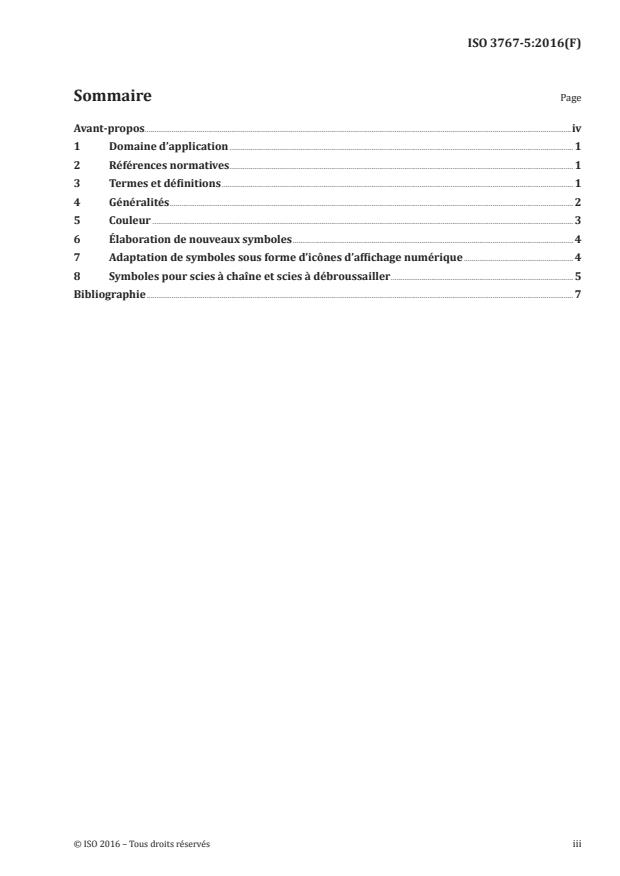
Sommaire Page
Avant-propos .iv
1 Domaine d’application . 1
2 Références normatives . 1
3 Termes et définitions . 1
4 Généralités . 2
5 Couleur . 3
6 Élaboration de nouveaux symboles . 4
7 Adaptation de symboles sous forme d’icônes d’affichage numérique .4
8 Symboles pour scies à chaîne et scies à débroussailler . 5
Bibliographie . 7
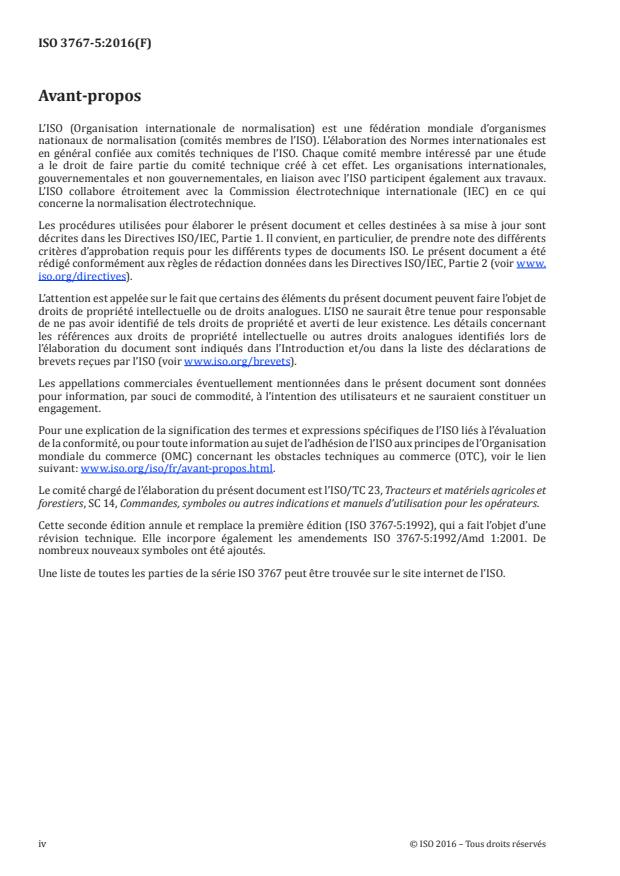
Avant-propos
L’ISO (Organisation internationale de normalisation) est une fédération mondiale d’organismes
nationaux de normalisation (comités membres de l’ISO). L’élaboration des Normes internationales est
en général confiée aux comités techniques de l’ISO. Chaque comité membre intéressé par une étude
a le droit de faire partie du comité technique créé à cet effet. Les organisations internationales,
gouvernementales et non gouvernementales, en liaison avec l’ISO participent également aux travaux.
L’ISO collabore étroitement avec la Commission électrotechnique internationale (IEC) en ce qui
concerne la normalisation électrotechnique.
Les procédures utilisées pour élaborer le présent document et celles destinées à sa mise à jour sont
décrites dans les Directives ISO/IEC, Partie 1. Il convient, en particulier, de prendre note des différents
critères d’approbation requis pour les différents types de documents ISO. Le présent document a été
rédigé conformément aux règles de rédaction données dans les Directives ISO/IEC, Partie 2 (voir www.
iso.org/directives).
L’attention est appelée sur le fait que certains des éléments du présent document peuvent faire l’objet de
droits de propriété intellectuelle ou de droits analogues. L’ISO ne saurait être tenue pour responsable
de ne pas avoir identifié de tels droits de propriété et averti de leur existence. Les détails concernant
les références aux droits de propriété intellectuelle ou autres droits analogues identifiés lors de
l’élaboration du document sont indiqués dans l’Introduction et/ou dans la liste des déclarations de
brevets reçues par l’ISO (voir www.iso.org/brevets).
Les appellations commerciales éventuellement mentionnées dans le présent document sont données
pour information, par souci de commodité, à l’intention des utilisateurs et ne sauraient constituer un
engagement.
Pour une explication de la signification des termes et expressions spécifiques de l’ISO liés à l’évaluation
de la conformité, ou pour toute information au sujet de l’adhésion de l’ISO aux principes de l’Organisation
mondiale du commerce (OMC) concernant les obstacles techniques au commerce (OTC), voir le lien
suivant: www.iso.org/iso/fr/avant-propos.html.
Le comité chargé de l’élaboration du présent document est l’ISO/TC 23, Tracteurs et matériels agricoles et
forestiers, SC 14, Commandes, symboles ou autres indications et manuels d’utilisation pour les opérateurs.
Cette seconde édition annule et remplace la première édition (ISO 3767-5:1992), qui a fait l’objet d’une
révision technique. Elle incorpore également les amendements ISO 3767-5:1992/Amd 1:2001. De
nombreux nouveaux symboles ont été ajoutés.
Une liste de toutes les parties de la série ISO 3767 peut être trouvée sur le site internet de l’ISO.
iv © ISO 2016 – Tous droits réservés
NORME INTERNATIONALE ISO 3767-5:2016(F)
Tracteurs, matériels agricoles et forestiers, matériel à
moteur pour jardins et pelouses — Symboles pour les
commandes de l’opérateur et autres indications —
Partie 5:
Symboles pour le matériel forestier portatif à main
1 Domaine d’application
Le présent document normalise les symboles pour une utilisation sur les commandes de l’opérateur et
autres affichage des machines forestières.
NOTE 1 L’ISO 3767-1 couvre les symboles communs qui s’appliquent aux divers types de tracteurs et de
matériel agricole, de matériel forestier, et de matériel à moteur pour jardins et pelouses. L’ISO 3767-2 couvre
les symboles pour tracteurs et machines agricoles. L’ISO 3767-4 couvre les symboles pour matériel forestier.
L’ISO 3767-5 couvre les symboles pour le matériel forestier portatif à main.
NOTE 2 L’ISO 7000 et l’IEC 60417 peuvent être consultées pour les besoins d’obtenir des symboles normalisés
supplémentaires reconnus à l’échelle internationale et potentiellement intéressants du point de vue du matériel
forestier.
2 Références normatives
Les documents suivants cités dans le texte constituent, pour tout ou partie de leur contenu, des
exigences du présent document. Pour les références datées, seule l’édition citée s’applique. Pour les
références non datées, la dernière édition du document de référence s’applique (y compris les éventuels
amendements).
ISO 3767-1:2016, Tracteurs, matériels agricoles et forestiers, matériel à moteur pour jardins et pelouses —
Symboles pour les commandes de l’opérateur et autres indications — Partie 1: Symboles communs
IEC 80416-1, Principes de base pour les symboles graphiques utilisables sur le matériel — Partie 1: Création
des symboles graphiques pour enregistrement
ISO 80416-2, Principes de base pour les symboles graphiques utilisables sur le matériel — Partie 2: Forme
et utilisation des flèches
IEC 80416-3, Principes élémentaires pour les symboles graphiques utilisables sur le matériel — Partie 3:
Guide pour l’application des symboles graphiques
3 Termes et définitions
Pour les besoins du présent document, les termes et définitions suivants s’appliquent.
L’ISO et l’IEC tiennent à jour des bases de données terminologiques destinées à être utilisées en
normalisation, consultables aux adresses suivantes:
— IEC Electropedia: disponible à l’adresse http://www.electropedia.org/
— ISO Online browsing platform: disponible à l’adresse http://www.iso.org/obp
3.1
symbole
symbole graphique
figure visuellement perceptible utilisée pour transmettre des informations indépendamment de la langue
Note 1 à l’article: Un symbole peut être reproduit par un dessin, une impression ou tout autre moyen. Les lettres,
les caractères numériques et les symboles mathématiques peuvent être employés comme symboles ou éléments
de symbole. Pour certaines applications particulières, des groupes de lettres, (par exemple AUTO, STOP) sont
utilisés comme symboles ou éléments de symbole.
Note 2 à l’article: Les lettres et les caractères numériques ne sont ni couverts par l’ISO/TC 145/SC 3 ni publiés
dans l’ISO 7000 à moins d’être intégrés dans des symboles graphiques.
3.2
icône
icône d’affichage numérique
représentation numérisée (pixélisée) d’un symbole graphique, habituellement utilisée sur un écran
électronique reconfigurable ou sur une interface utilisateur graphique
Note 1 à l’article: Un même symbole peut être représenté par plusieurs icônes, chacune ayant une taille, un
nombre de pixels ou une colorisation différents.
4 Généralités
4.1 Sauf indication contraire dans les articles suivants, les symboles doivent être utilisés conformément
au présent document.
4.2 Les symboles sélectionnés, qui sont présentés sous forme de contour dans le présent document,
peuvent utiliser un remplissage dans l’utilisation réelle afin de renforcer la clarté de la reproduction et
d’améliorer la perception visuelle de l’opérateur, sauf indication contraire notifiée pour les symboles
individuels et en conformité avec les préconisations de l’IEC 80416-3.
4.3 Les restrictions propres à certaines technologies de reproduction et de représentation peuvent
nécessiter un épaississement du trait ou d’autres modifications mineures des symboles. De telles
modifications sont autorisées si le symbole reste conceptuellement inchangé dans ses éléments
graphiques de base et s’il demeure facilement perceptible par l’opérateur.
4.4 Pour améliorer l’apparence et la perceptibilité d’un symbole graphique ou pour le coordonner avec
la conception du matériel où il sera incorporé, il peut être nécessaire de modifier le symbole tel que
décrit dans l’IEC 80416-3 (par exemple, changer l’épaisseur du trait ou arrondir les angles du symbole).
Ces modifications sont autorisées sous réserve que les caractéristiques perceptibles essentielles du
symbole soient conservées.
4.5 Pour l’utilisation réelle, tout symbole doit être reproduit aussi grand que possible afin d’être
facilement perceptible par l’opérateur. Suivre l’IEC 80416-1 pour la taille appropriée des symboles. Il
convient que les symboles regroupés dans un indicateur ou sur un ensemble de commandes soient à la
même échelle que les repères en coin du symbole d’origine, comme illustré dans le présent document,
afin de préserver une bonne relation visuelle entre les symboles. Les symboles doivent être utilisés dans
l’orientation représentée dans le présent document, à moins qu’une rotation ou un effet d’image inverse
ne soient précisément autorisés pour les symboles ind
...