

ISO/TR 19948:2016
(Main)Earth-moving machinery — Conformity assessment and certification process
General Information
- Abstract
ISO/TR 19948:2016 presents a process for conformity assessment and certification for earth-moving machinery as defined in ISO 6165. This includes a presentation of the characteristics of standards to be used for conformity assessment of the machines, a process for testing to demonstrate compliance with those standards, and a process for third party certification where such certification is required. The global objective for the earth-moving machinery industry is acceptance and use of supplier's declarations of conformity (SDoC) according to ISO/IEC 17050. This document includes provisions for third party certification in countries or regions where SDoC is not accepted.
- Status
- Published
- Publication Date
- 20-Jul-2016
- Technical Committee
- ISO/TC 127 - Earth-moving machinery
- Drafting Committee
- ISO/TC 127 - Earth-moving machinery
- Current Stage
- 6060 - International Standard published
- Start Date
- 21-Jul-2016
- Due Date
- 21-Aug-2017
- Completion Date
- 21-Aug-2017
Buy Documents


ISO/TR 19948:2016 - Earth-moving machinery -- Conformity assessment and certification process
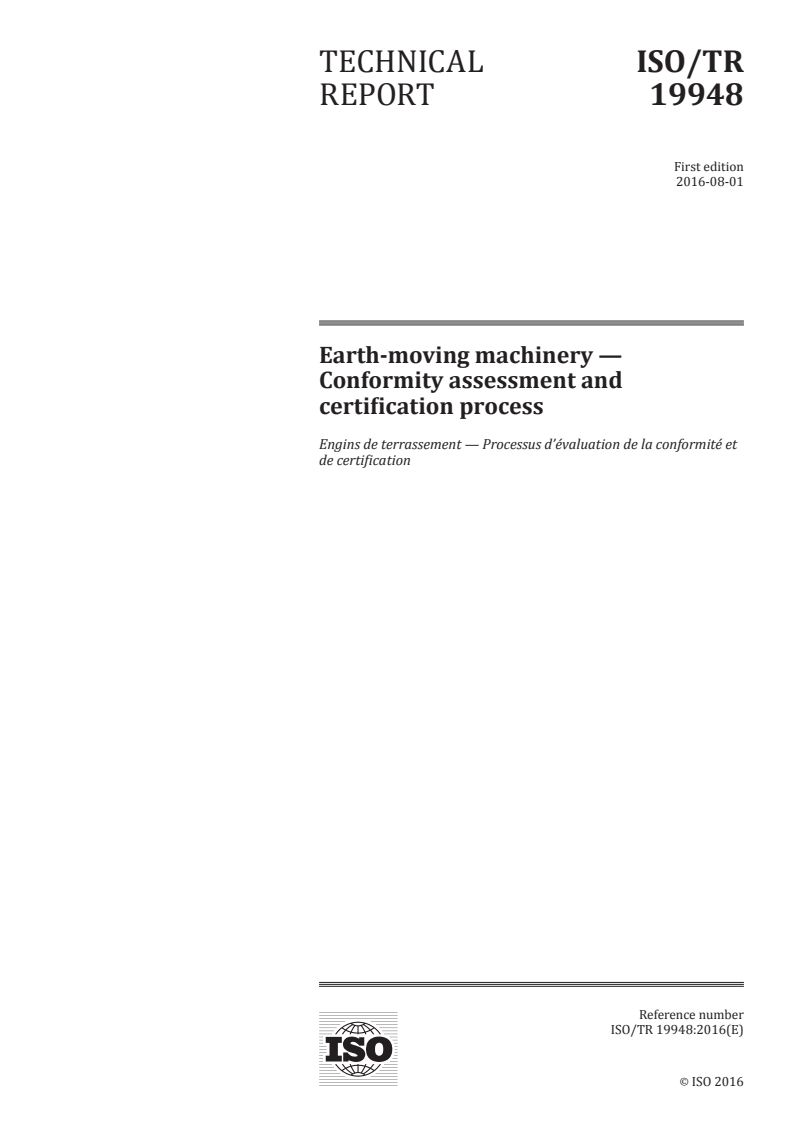
ISO/TR 19948:2016 - Earth-moving machinery — Conformity assessment and certification process/21/2016
Overview
ISO/TR 19948:2016 provides a comprehensive framework for the conformity assessment and certification process of earth-moving machinery (EMM) as defined by ISO 6165. This Technical Report focuses on establishing a standardized process to demonstrate compliance with international safety and performance standards, primarily supporting Supplier’s Declarations of Conformity (SDoC) aligned with ISO/IEC 17050. It also addresses provisions for third-party certification where SDoC is not accepted, enabling global harmonization in regulatory acceptance and reducing redundant testing. This standard is pivotal for manufacturers, certification bodies, and regulatory authorities involved in ensuring the safety, reliability, and regulatory compliance of earth-moving machinery worldwide.
Key Topics
1. Conformity Assessment Process
- Defines a step-by-step approach for testing and assessing earth-moving machinery to ensure compliance with ISO 20474 series safety standards
- Emphasizes the importance of repeatable, accurate test results and verified compliance backed by documentation
- Details the responsibilities of manufacturers and third-party bodies in conducting assessments and certification
2. Standards Characteristics
- Specifies requirements that standards must meet for conformity assessment, including clear scope, risk coverage, detailed performance criteria, test methods, and verifiable procedures
- ISO 20474 series is highlighted as the core international standard addressing all safety risks for various types of earth-moving machines
3. Supplier’s Declaration of Conformity (SDoC)
- Promotes global acceptance of manufacturers’ SDoC as a primary means of conformity declaration, allowing for streamlined market entry and regulatory compliance
- Addresses the framework under ISO/IEC 17050 for supplier declarations, fostering trust and reliability in the conformity process
4. Third-Party Certification Provisions
- Provides alternative conformity certification for regions where SDoC is not recognized
- Encourages acceptance of third-party certification based on manufacturer’s original testing to avoid redundant assessments and minimize costs
5. Documentation and Certification
- Specifies the need for a technical construction file compiling all relevant test reports and data demonstrating compliance
- Details the content and format of a conformity assessment certificate, designed for use in regulatory submissions and cross-border recognition
Applications
Manufacturers of Earth-Moving Machinery
Use ISO/TR 19948:2016 to develop and implement quality and testing processes that demonstrate compliance with international safety requirements, enabling easier market access and reduced certification costs.Certification Bodies and Testing Laboratories
Follow the conformity assessment and certification process outlined to provide reliable third-party evaluation or validation of manufacturer claims, especially in countries requiring third-party oversight.Regulatory Authorities and Governments
Adopt this standard's model to harmonize safety regulations, accept manufacturer SDoC where applicable, and efficiently incorporate third-party certifications reducing duplicative testing burdens.Industry Stakeholders and Trade Organizations
Promote global acceptance of harmonized conformity assessment approaches, enhancing safety, reducing trade barriers, and supporting the UNECE model regulations for earth-moving machinery.
Related Standards
ISO 6165 - Earth-moving machinery: Basic types, identification, and definitions
Establishes essential terminology and classification referenced in conformity assessment.ISO 20474 Series - Safety of Earth-moving Machinery
A multi-part standard setting detailed safety requirements and test methods utilized as the benchmark for assessing machine conformity.ISO/IEC 17050 - Supplier’s Declaration of Conformity
Defines general requirements and supporting documentation frameworks for supplier declarations, supporting manufacturer-led conformity assessments.ISO/IEC 17025 - General requirements for the competence of testing and calibration laboratories
Provides guidelines for testing facilities to ensure quality and reliability essential for conformity assessment testing.
ISO/TR 19948:2016 supports the global earth-moving machinery industry's commitment to safety harmonization, regulatory efficiency, and practical certification processes. Through adoption of this standard, stakeholders benefit from consistent safety evaluation methods, streamlined conformity declarations, and reduced costs arising from duplicated testing, fostering safer machine operation and smoother international trade.
Buy Documents
ISO/TR 19948:2016 - Earth-moving machinery -- Conformity assessment and certification process
ISO/TR 19948:2016 - Earth-moving machinery — Conformity assessment and certification process/21/2016
Get Certified
Connect with accredited certification bodies for this standard

BSI Group
BSI (British Standards Institution) is the business standards company that helps organizations make excellence a habit.

Bureau Veritas
Bureau Veritas is a world leader in laboratory testing, inspection and certification services.

DNV
DNV is an independent assurance and risk management provider.
Sponsored listings
Frequently Asked Questions
ISO/TR 19948:2016 is a technical report published by the International Organization for Standardization (ISO). Its full title is "Earth-moving machinery — Conformity assessment and certification process". This standard covers: ISO/TR 19948:2016 presents a process for conformity assessment and certification for earth-moving machinery as defined in ISO 6165. This includes a presentation of the characteristics of standards to be used for conformity assessment of the machines, a process for testing to demonstrate compliance with those standards, and a process for third party certification where such certification is required. The global objective for the earth-moving machinery industry is acceptance and use of supplier's declarations of conformity (SDoC) according to ISO/IEC 17050. This document includes provisions for third party certification in countries or regions where SDoC is not accepted.
ISO/TR 19948:2016 presents a process for conformity assessment and certification for earth-moving machinery as defined in ISO 6165. This includes a presentation of the characteristics of standards to be used for conformity assessment of the machines, a process for testing to demonstrate compliance with those standards, and a process for third party certification where such certification is required. The global objective for the earth-moving machinery industry is acceptance and use of supplier's declarations of conformity (SDoC) according to ISO/IEC 17050. This document includes provisions for third party certification in countries or regions where SDoC is not accepted.
ISO/TR 19948:2016 is classified under the following ICS (International Classification for Standards) categories: 03.120.20 - Product and company certification. Conformity assessment; 53.100 - Earth-moving machinery. The ICS classification helps identify the subject area and facilitates finding related standards.
ISO/TR 19948:2016 is available in PDF format for immediate download after purchase. The document can be added to your cart and obtained through the secure checkout process. Digital delivery ensures instant access to the complete standard document.
Standards Content (Sample)
TECHNICAL ISO/TR
REPORT 19948
First edition
2016-08-01
Earth-moving machinery —
Conformity assessment and
certification process
Engins de terrassement — Processus d’évaluation de la conformité et
de certification
Reference number
©
ISO 2016
© ISO 2016, Published in Switzerland
All rights reserved. Unless otherwise specified, no part of this publication may be reproduced or utilized otherwise in any form
or by any means, electronic or mechanical, including photocopying, or posting on the internet or an intranet, without prior
written permission. Permission can be requested from either ISO at the address below or ISO’s member body in the country of
the requester.
ISO copyright office
Ch. de Blandonnet 8 • CP 401
CH-1214 Vernier, Geneva, Switzerland
Tel. +41 22 749 01 11
Fax +41 22 749 09 47
copyright@iso.org
www.iso.org
ii © ISO 2016 – All rights reserved
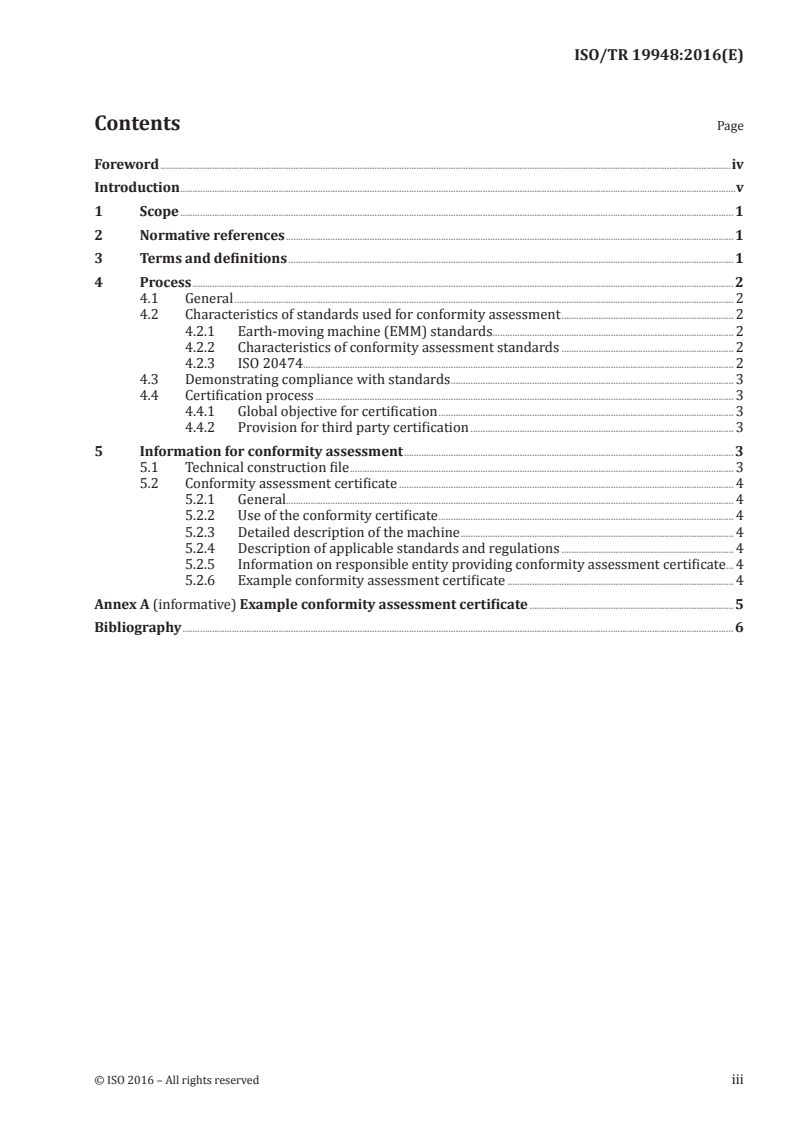
Contents Page
Foreword .iv
Introduction .v
1 Scope . 1
2 Normative references . 1
3 Terms and definitions . 1
4 Process . 2
4.1 General . 2
4.2 Characteristics of standards used for conformity assessment . 2
4.2.1 Earth-moving machine (EMM) standards . . 2
4.2.2 Characteristics of conformity assessment standards . 2
4.2.3 ISO 20474 . 2
4.3 Demonstrating compliance with standards . 3
4.4 Certification pr ocess . 3
4.4.1 Global objective for certification . 3
4.4.2 Provision for third party certification . 3
5 Information for conformity assessment . 3
5.1 Technical construction file . 3
5.2 Conf ormity assessment certificate . 4
5.2.1 General. 4
5.2.2 Use of the conformity certificate . 4
5.2.3 Detailed description of the machine . 4
5.2.4 Description of applicable standards and regulations . 4
5.2.5 Information on responsible entity providing conformity assessment certificate . 4
5.2.6 Example conformity assessment certificate . 4
Annex A (informative) Example conformity assessment certificate . 5
Bibliography . 6
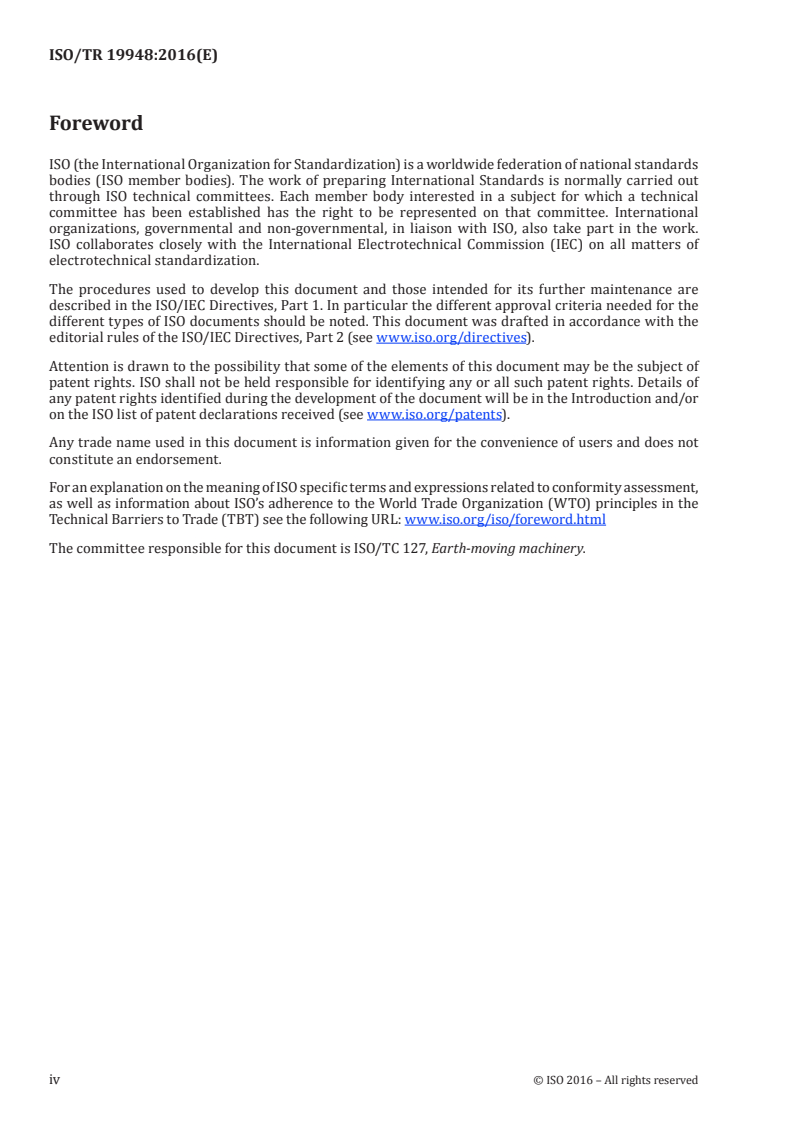
Foreword
ISO (the International Organization for Standardization) is a worldwide federation of national standards
bodies (ISO member bodies). The work of preparing International Standards is normally carried out
through ISO technical committees. Each member body interested in a subject for which a technical
committee has been established has the right to be represented on that committee. International
organizations, governmental and non-governmental, in liaison with ISO, also take part in the work.
ISO collaborates closely with the International Electrotechnical Commission (IEC) on all matters of
electrotechnical standardization.
The procedures used to develop this document and those intended for its further maintenance are
described in the ISO/IEC Directives, Part 1. In particular the different approval criteria needed for the
different types of ISO documents should be noted. This document was drafted in accordance with the
editorial rules of the ISO/IEC Directives, Part 2 (see www.iso.org/directives).
Attention is drawn to the possibility that some of the elements of this document may be the subject of
patent rights. ISO shall not be held responsible for identifying any or all such patent rights. Details of
any patent rights identified during the development of the document will be in the Introduction and/or
on the ISO list of patent declarations received (see www.iso.org/patents).
Any trade name used in this document is information given for the convenience of users and does not
constitute an endorsement.
For an explanation on the meaning of ISO specific terms and expressions related to conformity assessment,
as well as information about ISO’s adherence to the World Trade Organization (WTO) principles in the
Technical Barriers to Trade (TBT) see the following URL: www.iso.org/iso/foreword.html
The committee responsible for this document is ISO/TC 127, Earth-moving machinery.
iv © ISO 2016 – All rights reserved
Introduction
Background
ISO Technical committee, ISO/TC 127, Earth-moving machinery, was formed in 1968 to promote
harmonization of global safety requirements for the already global earth-moving machine (EMM)
industry. The goal of the committee is to pro-actively develop International Standards to address all
safety risks for its machines.
EMM manufacturers use the standards to achieve a high level of safety for machines to meet the
safety expectations of customers and health and safety groups. The EMM industry strives to develop
machines that are recognized as safe machines, and allow its manufacturers to use ISO/IEC 17050,
and for supplier’s declarations of conformity (SDoC). Third party certification might be required by
countries where manufacturers may lack the necessary expertise or testing facilities to do their own
conformity assessment testing for SDoC.
Challenge
Earth-moving machines are low-production volume compared to automobiles or home appliances. The
yearly sales for many models is less than 10 machines per country. Repeated conformity assessment
testing causes significant time delays and added cost for customers, if third party testing and
certification are required in each country.
United Nations Economic Commission for Europe (UNECE) project
To address this challenge, the EMM industry started a “model regulation project” in the UNECE’s
Working Party (WP) 6. The purposed of WP 6 is to facilitate global harmonization of standards,
regulations and conformity assessment processes. The UNECE EMM model regulation project includes
— developing and complying with International Standards developed by ISO/TC 127,
— using the requirements of the standards as the technical requirements for national safety
regulations,
— accepting conformity assessment testing completed by manufacturers for compliance to
standards, and
— accepting SDoC for compliance with regulations.
With the requirement for third party certification in some countries, the EMM model regulation project
allows third party certification in the short-term, with provisions to accept testing by manufacturers
for the third party certification without repeating the testing. If third party certification is required, the
project promotes the acceptance of a single third party certification by all countries, thereby avoiding
unnecessary costs and time delays.
Current status
The application of International Standards and the conformity assessment process by machine
manufacturers is a major element for achieving the goal of “zero injury and zero harm” on user
worksites around the world.
The SDoC assessment process completed by manufacturers demonstrates compliance for the entire
machine, including all of its systems, components and parts. Additional conformity assessment is not
necessary for replacement parts that were already covered in the manufacturer’s machine c
...
TECHNICAL ISO/TR
REPORT 19948
First edition
2016-08-01
Earth-moving machinery —
Conformity assessment and
certification process
Engins de terrassement — Processus d’évaluation de la conformité et
de certification
Reference number
©
ISO 2016
© ISO 2016, Published in Switzerland
All rights reserved. Unless otherwise specified, no part of this publication may be reproduced or utilized otherwise in any form
or by any means, electronic or mechanical, including photocopying, or posting on the internet or an intranet, without prior
written permission. Permission can be requested from either ISO at the address below or ISO’s member body in the country of
the requester.
ISO copyright office
Ch. de Blandonnet 8 • CP 401
CH-1214 Vernier, Geneva, Switzerland
Tel. +41 22 749 01 11
Fax +41 22 749 09 47
copyright@iso.org
www.iso.org
ii © ISO 2016 – All rights reserved
Contents Page
Foreword .iv
Introduction .v
1 Scope . 1
2 Normative references . 1
3 Terms and definitions . 1
4 Process . 2
4.1 General . 2
4.2 Characteristics of standards used for conformity assessment . 2
4.2.1 Earth-moving machine (EMM) standards . . 2
4.2.2 Characteristics of conformity assessment standards . 2
4.2.3 ISO 20474 . 2
4.3 Demonstrating compliance with standards . 3
4.4 Certification pr ocess . 3
4.4.1 Global objective for certification . 3
4.4.2 Provision for third party certification . 3
5 Information for conformity assessment . 3
5.1 Technical construction file . 3
5.2 Conf ormity assessment certificate . 4
5.2.1 General. 4
5.2.2 Use of the conformity certificate . 4
5.2.3 Detailed description of the machine . 4
5.2.4 Description of applicable standards and regulations . 4
5.2.5 Information on responsible entity providing conformity assessment certificate . 4
5.2.6 Example conformity assessment certificate . 4
Annex A (informative) Example conformity assessment certificate . 5
Bibliography . 6
Foreword
ISO (the International Organization for Standardization) is a worldwide federation of national standards
bodies (ISO member bodies). The work of preparing International Standards is normally carried out
through ISO technical committees. Each member body interested in a subject for which a technical
committee has been established has the right to be represented on that committee. International
organizations, governmental and non-governmental, in liaison with ISO, also take part in the work.
ISO collaborates closely with the International Electrotechnical Commission (IEC) on all matters of
electrotechnical standardization.
The procedures used to develop this document and those intended for its further maintenance are
described in the ISO/IEC Directives, Part 1. In particular the different approval criteria needed for the
different types of ISO documents should be noted. This document was drafted in accordance with the
editorial rules of the ISO/IEC Directives, Part 2 (see www.iso.org/directives).
Attention is drawn to the possibility that some of the elements of this document may be the subject of
patent rights. ISO shall not be held responsible for identifying any or all such patent rights. Details of
any patent rights identified during the development of the document will be in the Introduction and/or
on the ISO list of patent declarations received (see www.iso.org/patents).
Any trade name used in this document is information given for the convenience of users and does not
constitute an endorsement.
For an explanation on the meaning of ISO specific terms and expressions related to conformity assessment,
as well as information about ISO’s adherence to the World Trade Organization (WTO) principles in the
Technical Barriers to Trade (TBT) see the following URL: www.iso.org/iso/foreword.html
The committee responsible for this document is ISO/TC 127, Earth-moving machinery.
iv © ISO 2016 – All rights reserved
Introduction
Background
ISO Technical committee, ISO/TC 127, Earth-moving machinery, was formed in 1968 to promote
harmonization of global safety requirements for the already global earth-moving machine (EMM)
industry. The goal of the committee is to pro-actively develop International Standards to address all
safety risks for its machines.
EMM manufacturers use the standards to achieve a high level of safety for machines to meet the
safety expectations of customers and health and safety groups. The EMM industry strives to develop
machines that are recognized as safe machines, and allow its manufacturers to use ISO/IEC 17050,
and for supplier’s declarations of conformity (SDoC). Third party certification might be required by
countries where manufacturers may lack the necessary expertise or testing facilities to do their own
conformity assessment testing for SDoC.
Challenge
Earth-moving machines are low-production volume compared to automobiles or home appliances. The
yearly sales for many models is less than 10 machines per country. Repeated conformity assessment
testing causes significant time delays and added cost for customers, if third party testing and
certification are required in each country.
United Nations Economic Commission for Europe (UNECE) project
To address this challenge, the EMM industry started a “model regulation project” in the UNECE’s
Working Party (WP) 6. The purposed of WP 6 is to facilitate global harmonization of standards,
regulations and conformity assessment processes. The UNECE EMM model regulation project includes
— developing and complying with International Standards developed by ISO/TC 127,
— using the requirements of the standards as the technical requirements for national safety
regulations,
— accepting conformity assessment testing completed by manufacturers for compliance to
standards, and
— accepting SDoC for compliance with regulations.
With the requirement for third party certification in some countries, the EMM model regulation project
allows third party certification in the short-term, with provisions to accept testing by manufacturers
for the third party certification without repeating the testing. If third party certification is required, the
project promotes the acceptance of a single third party certification by all countries, thereby avoiding
unnecessary costs and time delays.
Current status
The application of International Standards and the conformity assessment process by machine
manufacturers is a major element for achieving the goal of “zero injury and zero harm” on user
worksites around the world.
The SDoC assessment process completed by manufacturers demonstrates compliance for the entire
machine, including all of its systems, components and parts. Additional conformity assessment is not
necessary for replacement parts that were already covered in the manufacturer’s machine c
...