

ISO 24667:2022
(Main)Sports and recreational facilities — Impact surfacing testing device
General Information
- Abstract
This document gives the specifications for impact attenuation testing equipment used to evaluate the impact performance characteristics of playground surfacing. The specifications are aimed at ensuring that developers and manufacturers of such instruments meet minimum performance characteristics to allow repeatable, reproducible and accurate results. This document does not specify a test method. NOTE Such test methods are covered in other standards, e.g. EN 1177, ASTM F1292, ASTM F3313, AS 4422, CSA Z614.
- Status
- Published
- Publication Date
- 24-Jan-2022
- Technical Committee
- ISO/TC 83 - Sports and other recreational facilities and equipment
- Drafting Committee
- ISO/TC 83/WG 8 - Playground equipment
- Current Stage
- 6060 - International Standard published
- Start Date
- 25-Jan-2022
- Due Date
- 15-Apr-2023
- Completion Date
- 25-Jan-2022
Buy Documents

ISO 24667:2022 - Sports and recreational facilities — Impact surfacing testing device Released:1/25/2022

ISO 24667:2022 - Sports and recreational facilities — Impact surfacing testing device Released:2/23/2022
Overview
ISO 24667:2022 is an international standard that specifies the requirements for impact attenuation testing devices used in sports and recreational facilities, particularly playground surfacing. This standard ensures that the devices used to assess playground surfacing impact performance meet minimum performance characteristics, enabling repeatable, reproducible, and accurate testing results. While ISO 24667:2022 focuses on device specifications, it does not prescribe testing methods - these are covered by other standards such as EN 1177 and ASTM F1292.
The importance of impact surfacing testing devices lies in their role in preventing injuries in playgrounds by evaluating the shock-absorbing quality of surface materials. With diverse surfacing materials used worldwide - ranging from local sand or wood chips to manufactured rubber tiles and synthetic turf - standardized device specifications are essential for consistent safety assessments across locations.
Key Topics
Projectile Specifications
The device includes a projectile ("false head") made from aluminum 6061-T6 or equivalent, with a spherical or hemispherical impact surface diameter of 160 ± 1 mm. The assembly mass must be 4.6 ± 0.02 kg. Acceleration sensors (accelerometers) must be precisely mounted at the projectile’s mass center, with no voids between sensors and impact surfaces.Accelerometer Requirements
Accelerometers used may be piezoelectric, piezoresistive, or capacitive but must meet strict performance criteria: frequency response from 1 Hz to 1000 Hz, transverse sensitivity below 5%, minimum measurement range of ±500 g, and a discharge time constant greater than 1 second (except MEMS types). Calibration must be performed periodically, at intervals no longer than two years.Data Acquisition System (DAQ)
The DAQ must have at least 12-bit resolution, sample at a minimum of 20,000 Hz per channel, apply anti-aliasing filters, and record data 10 ms before and 50 ms after impact detection above 5 g acceleration. The system should export recorded data in formats suitable for post-processing.Calculation and Processing
The standard defines how the data acquired are processed to determine critical safety parameters such as the Head Injury Criterion (HIC) and peak acceleration (g-force). The HIC calculation requires analyzing acceleration over specific impact intervals, ensuring reliable injury risk estimation.Calibration and Reference Surface
Calibration is a crucial aspect ensuring long-term accuracy. Each testing device undergoes periodic calibration of accelerometers, DAQ systems, and must be tested on a provided reference surface with known impact attenuation characteristics. Calibration waveforms simulate real impact profiles and establish traceability.
Applications
ISO 24667:2022 plays a vital role in numerous applications involving playground and sports facility safety assessments:
Playground Safety Testing
Provides a standardized basis for manufacturers, testing labs, and facility managers to evaluate and certify playground surfacing materials against impact safety criteria.Equipment Development and Manufacturing
Guides device manufacturers in producing instruments that comply with recognized performance standards to ensure global compatibility and data comparability.Research and Development
Supports academic institutions and research bodies in developing new impact attenuation materials and surfacing solutions, underpinned by reliable measurement tools.Regulatory Compliance
Assists regulatory agencies and authorities in enforcing safety standards aligned with internationally recognized testing devices, complementing test method standards.
Related Standards
ISO 24667:2022 is designed to work in conjunction with several key related standards that establish testing methods, safety criteria, and related protocols:
EN 1177 - Impact Attenuation of Surfacing Materials
Specifies test methods for playground safety surfaces concerning impact attenuation performance.ASTM F1292 - Standard Specification for Impact Attenuation of Surfacing Materials
Provides procedures for measuring shock-absorbing properties of playground surfaces.ASTM F3313 - Test Method for Impact Attenuation of Turf Surfaces
Focuses on testing artificial turf systems and surfaces used in recreational areas.AS 4422 - Playground Surfacing
Covers surfacing requirements and test methods for Australian playground environments.CSA Z614 - Children's Playspaces and Equipment
Defines safety performance in Canadian playground equipment and surfacing.
Implementing ISO 24667:2022 in conjunction with these testing methods ensures reliable, standardized evaluations of playground surfacing impact attenuation – critical for injury prevention in sports and recreational facilities worldwide.
Keywords: ISO 24667:2022, impact attenuation testing, playground surfacing, sports facilities safety, impact surfacing testing device, accelerometer calibration, data acquisition system, Head Injury Criterion, impact testing standard, playground safety assessment, surfacing materials testing, international safety standard.
Relations
- Effective Date
- 05-Jun-2021
Buy Documents
ISO 24667:2022 - Sports and recreational facilities — Impact surfacing testing device Released:1/25/2022
ISO 24667:2022 - Sports and recreational facilities — Impact surfacing testing device Released:2/23/2022
Frequently Asked Questions
ISO 24667:2022 is a standard published by the International Organization for Standardization (ISO). Its full title is "Sports and recreational facilities — Impact surfacing testing device". This standard covers: This document gives the specifications for impact attenuation testing equipment used to evaluate the impact performance characteristics of playground surfacing. The specifications are aimed at ensuring that developers and manufacturers of such instruments meet minimum performance characteristics to allow repeatable, reproducible and accurate results. This document does not specify a test method. NOTE Such test methods are covered in other standards, e.g. EN 1177, ASTM F1292, ASTM F3313, AS 4422, CSA Z614.
This document gives the specifications for impact attenuation testing equipment used to evaluate the impact performance characteristics of playground surfacing. The specifications are aimed at ensuring that developers and manufacturers of such instruments meet minimum performance characteristics to allow repeatable, reproducible and accurate results. This document does not specify a test method. NOTE Such test methods are covered in other standards, e.g. EN 1177, ASTM F1292, ASTM F3313, AS 4422, CSA Z614.
ISO 24667:2022 is classified under the following ICS (International Classification for Standards) categories: 97.200.40 - Playgrounds; 97.220.01 - Sports equipment and facilities in general. The ICS classification helps identify the subject area and facilitates finding related standards.
ISO 24667:2022 has the following relationships with other standards: It is inter standard links to ISO/TS 24667:2020. Understanding these relationships helps ensure you are using the most current and applicable version of the standard.
ISO 24667:2022 is available in PDF format for immediate download after purchase. The document can be added to your cart and obtained through the secure checkout process. Digital delivery ensures instant access to the complete standard document.
Standards Content (Sample)
INTERNATIONAL ISO
STANDARD 24667
First edition
2022-01
Sports and recreational facilities —
Impact surfacing testing device
Installations sportives et récréatives — Dispositif d'essai de
revêtement d'impact
Reference number
© ISO 2022
All rights reserved. Unless otherwise specified, or required in the context of its implementation, no part of this publication may
be reproduced or utilized otherwise in any form or by any means, electronic or mechanical, including photocopying, or posting on
the internet or an intranet, without prior written permission. Permission can be requested from either ISO at the address below
or ISO’s member body in the country of the requester.
ISO copyright office
CP 401 • Ch. de Blandonnet 8
CH-1214 Vernier, Geneva
Phone: +41 22 749 01 11
Email: copyright@iso.org
Website: www.iso.org
Published in Switzerland
ii
Contents Page
Foreword .iv
Introduction .v
1 Scope . 1
2 Normative references . 1
3 Terms and definitions . 1
4 Apparatus . 1
4.1 Missile (headform) . 1
4.2 Accelerometer . 2
4.3 Data acquisition system . 2
4.3.1 General . 2
4.3.2 Channels . 2
5 Calculation and processing .3
6 Periodic calibration .3
6.1 General . 3
6.2 Accelerometer . 3
6.3 Data acquisition system . 4
6.4 Reference pad . 4
6.5 Missile profile . 5
6.6 Calibration report . 5
Bibliography . 6
iii
Foreword
ISO (the International Organization for Standardization) is a worldwide federation of national standards
bodies (ISO member bodies). The work of preparing International Standards is normally carried out
through ISO technical committees. Each member body interested in a subject for which a technical
committee has been established has the right to be represented on that committee. International
organizations, governmental and non-governmental, in liaison with ISO, also take part in the work.
ISO collaborates closely with the International Electrotechnical Commission (IEC) on all matters of
electrotechnical standardization.
The procedures used to develop this document and those intended for its further maintenance are
described in the ISO/IEC Directives, Part 1. In particular, the different approval criteria needed for the
different types of ISO documents should be noted. This document was drafted in accordance with the
editorial rules of the ISO/IEC Directives, Part 2 (see www.iso.org/directives).
Attention is drawn to the possibility that some of the elements of this document may be the subject of
patent rights. ISO shall not be held responsible for identifying any or all such patent rights. Details of
any patent rights identified during the development of the document will be in the Introduction and/or
on the ISO list of patent declarations received (see www.iso.org/patents).
Any trade name used in this document is information given for the convenience of users and does not
constitute an endorsement.
For an explanation of the voluntary nature of standards, the meaning of ISO specific terms and
expressions related to conformity assessment, as well as information about ISO's adherence to
the World Trade Organization (WTO) principles in the Technical Barriers to Trade (TBT), see
www.iso.org/iso/foreword.html.
This document was prepared by Technical Committee ISO/TC 83, Sports and other recreational facilities
and equipment.
This first edition cancels and replaces ISO/TS 24667:2020, which has been technically revised.
The main changes are as follows:
— Addition of a new Formula (1) and renumbering of the subsequent formulae.
Any feedback or questions on this document should be directed to the user’s national standards body. A
complete listing of these bodies can be found at www.iso.org/members.html.
iv
Introduction
Impact attenuating surfacing has been shown to be fundamental to the prevention of 60 % to 75 %
of the injuries in playgrounds from impacts with the surface after a fall. The surface materials can be
sourced and installed locally, such as sand, wood chips or rounded gravel, while others can be sourced
from materials around the world and assembled on site such as poured in place rubber, tiles, mats or
synthetic turfs and installed at local playgrounds. The performance of installed surfacing materials
should be comparable from playground to playground no matter where the playground is situated. The
equipment used to measure the performance of playground surfacing is internationally consistent,
repeatable and reproducible.
The field of impact attenuation measurement as it applies to playground safety surfaces is very small,
resulting in a limited market for potential manufacturers of such equipment. While a small number of
reputable manufacturers exist, organizations needing playground impact test equipment, such as test
laboratories and university researchers, often rely on their own technical abilities or those of related
engineering departments to create the needed equipment from scratch.
v
INTERNATIONAL STANDARD ISO 24667:2022(E)
Sports and recreational facilities — Impact surfacing
testing device
1 Scope
This document gives the specifications for impact attenuation testing equipment used to evaluate the
impact performance characteristics of playground surfacing. The specifications are aimed at ensuring
that developers and manufacturers of such instruments meet minimum performance characteristics to
allow repeatable, reproducible and accurate results.
This document does not specify a test method.
NOTE Such test methods are covered in other standards, e.g. EN 1177, ASTM F1292, ASTM F3313, AS 4422,
CSA
...
NORME ISO
INTERNATIONALE 24667
Première édition
2022-01
Installations sportives et
récréatives — Dispositif d'essai de
revêtement d'impact
Sports and recreational facilities — Impact surfacing testing device
Numéro de référence
DOCUMENT PROTÉGÉ PAR COPYRIGHT
© ISO 2022
Tous droits réservés. Sauf prescription différente ou nécessité dans le contexte de sa mise en œuvre, aucune partie de cette
publication ne peut être reproduite ni utilisée sous quelque forme que ce soit et par aucun procédé, électronique ou mécanique,
y compris la photocopie, ou la diffusion sur l’internet ou sur un intranet, sans autorisation écrite préalable. Une autorisation peut
être demandée à l’ISO à l’adresse ci-après ou au comité membre de l’ISO dans le pays du demandeur.
ISO copyright office
Case postale 401 • Ch. de Blandonnet 8
CH-1214 Vernier, Genève
Tél.: +41 22 749 01 11
E-mail: copyright@iso.org
Web: www.iso.org
Publié en Suisse
ii
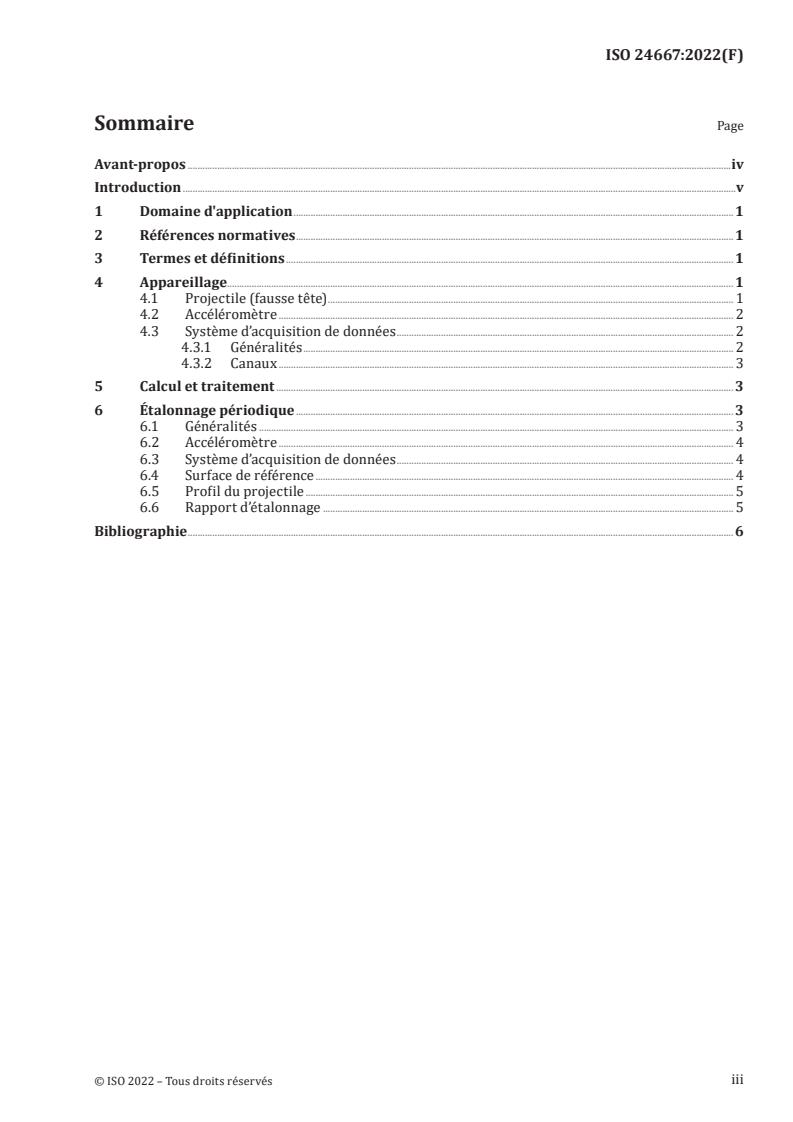
Sommaire Page
Avant-propos .iv
Introduction .v
1 Domaine d'application .1
2 Références normatives .1
3 Termes et définitions . 1
4 Appareillage . 1
4.1 Projectile (fausse tête) . 1
4.2 Accéléromètre . 2
4.3 Système d’acquisition de données . 2
4.3.1 Généralités . 2
4.3.2 Canaux . 3
5 Calcul et traitement . 3
6 Étalonnage périodique . 3
6.1 Généralités . 3
6.2 Accéléromètre . 4
6.3 Système d’acquisition de données . 4
6.4 Surface de référence . 4
6.5 Profil du projectile . 5
6.6 Rapport d’étalonnage . 5
Bibliographie . 6
iii
Avant-propos
L'ISO (Organisation internationale de normalisation) est une fédération mondiale d'organismes
nationaux de normalisation (comités membres de l'ISO). L'élaboration des Normes internationales est
en général confiée aux comités techniques de l'ISO. Chaque comité membre intéressé par une étude
a le droit de faire partie du comité technique créé à cet effet. Les organisations internationales,
gouvernementales et non gouvernementales, en liaison avec l'ISO participent également aux travaux.
L'ISO collabore étroitement avec la Commission électrotechnique internationale (IEC) en ce qui
concerne la normalisation électrotechnique.
Les procédures utilisées pour élaborer le présent document et celles destinées à sa mise à jour sont
décrites dans les Directives ISO/IEC, Partie 1. Il convient, en particulier de prendre note des différents
critères d'approbation requis pour les différents types de documents ISO. Le présent document
a été rédigé conformément aux règles de rédaction données dans les Directives ISO/IEC, Partie 2
(voir www.iso.org/directives).
L'attention est attirée sur le fait que certains des éléments du présent document peuvent faire l'objet de
droits de propriété intellectuelle ou de droits analogues. L'ISO ne saurait être tenue pour responsable
de ne pas avoir identifié de tels droits de propriété et averti de leur existence. Les détails concernant
les références aux droits de propriété intellectuelle ou autres droits analogues identifiés lors de
l'élaboration du document sont indiqués dans l'Introduction et/ou dans la liste des déclarations de
brevets reçues par l'ISO (voir www.iso.org/brevets).
Les appellations commerciales éventuellement mentionnées dans le présent document sont données
pour information, par souci de commodité, à l’intention des utilisateurs et ne sauraient constituer un
engagement.
Pour une explication de la nature volontaire des normes, la signification des termes et expressions
spécifiques de l'ISO liés à l'évaluation de la conformité, ou pour toute information au sujet de l'adhésion
de l'ISO aux principes de l’Organisation mondiale du commerce (OMC) concernant les obstacles
techniques au commerce (OTC), voir www.iso.org/avant-propos.
Le présent document a été élaboré par le comité technique ISO/TC 83, Matériel et équipements de sports
et autres activités de loisirs.
Cette première édition annule et remplace l'ISO/TS 24667:2020 qui a fait l’objet d’une révision technique.
Les principales modifications sont les suivantes:
— Ajout d'une nouvelle Formule (1) et renumérotation des formules qui suivent.
Il convient que l’utilisateur adresse tout retour d’information ou toute question concernant le présent
document à l’organisme national de normalisation de son pays. Une liste exhaustive desdits organismes
se trouve à l’adresse www.iso.org/fr/members.html.
iv
Introduction
Il a été démontré que les revêtements atténuant les impacts sont d’une importance capitale, permettant
d’éviter 60 % à 75 % des blessures liées aux impacts avec le revêtement suite à une chute dans les aires
de jeux. Les matériaux constitutifs du revêtement peuvent être commandés et installés localement (par
exemple, du sable, des copeaux de bois ou du gravier rond) tandis que d’autres peuvent être issus de
matériaux provenant du monde entier, assemblés sur site (par exemple, du caoutchouc coulé sur place,
des dalles, des nattes ou du gazon synthétique) et installés au sein d’aires de jeux locales. Il convient que
les performances des matériaux de revêtement installés soient comparables d’une aire de jeux à une
autre, quel que soit l’emplacement de l’aire de jeux. Le dispositif utilisé à l’échelle internationale pour
mesurer les performances des revêtements des aires de jeux dans des conditions de répétabilité et de
reproductibilité est uniforme.
L’activité de mesure de l’atténuation des impacts concernant les revêtements de sécurité pour aires de
jeux est très réduite. Le marché est donc limité pour les fabricants potentiels de tels dispositifs. Certes,
il existe un petit nombre de fabricants fiables mais les organismes ayant besoin de dispositifs d’essai
d’impact (comme les laboratoires d’essai et les services de recherche universitaire) s'appuient souvent
sur leurs propres compétences techniques, ou sur celles de leurs services d’ingénierie, pour créer de
toutes pièces les dispositifs nécessaires.
v
NORME INTERNATIONALE ISO 24667:2022(F)
Installations sportives et récréatives — Dispositif d'essai
de revêtement d'impact
1 Domaine d'application
Le présent document indique les spécifications du dispositif d’essai de mesure de l’atténuation des
impacts utilisé pour évaluer les caractéristiques de performance à l’impact des revêtements d’aires
de jeux. Ces spécifications sont conçues pour assurer que les développeurs et les fabricants de tels
instruments respectent les caractéristiques de performance minimales permettant d’obtenir des
résultats répétables, reproductibles et exacts.
Le présent document ne spécifie pas de méthode d’essai.
NOTE De telles méthodes d’essai sont couvertes par d’autres normes, par exemple, l’EN 1177, l’ASTM F1292,
l’ASTM F3313, l’AS 4422 et la CSA Z614.
2 Références normatives
Les documents suivants sont cités dans le texte de sorte qu’ils constituent, pour tout ou partie de leur
contenu, des exigences du présent document. Pour les références datées, seule l'édition citée s'applique.
Pour les références non da
...