

ISO 21307:2017
(Main)Plastics pipes and fittings — Butt fusion jointing procedures for polyethylene (PE) piping systems
General Information
- Abstract
ISO 21307:2017 establishes general principles regarding the procedure used in the construction and quality assessment of butt fusion jointing of polyethylene (PE) piping system components specified in accordance with relevant ISO standards. These components are installed in accordance with the relevant codes of practice, national regulations or industry guidance. Specifically, this document specifies three butt fusion jointing procedures for PE pipes and fittings. These are: - single low-pressure fusion jointing procedure; - dual low-pressure fusion jointing procedure; - single high-pressure fusion jointing procedure. ISO 21307:2017 takes into consideration the materials and components used, the fusion jointing procedure and equipment and the quality assessment of the completed joint. It can be applied in conjunction with appropriate national regulations and standards.
- Status
- Published
- Publication Date
- 29-Nov-2017
- Current Stage
- 9093 - International Standard confirmed
- Start Date
- 06-Mar-2023
- Completion Date
- 29-Aug-2026
Buy Documents


ISO 21307:2017 - Plastics pipes and fittings -- Butt fusion jointing procedures for polyethylene (PE) piping systems
ISO 21307:2017 - Plastics pipes and fittings — Butt fusion jointing procedures for polyethylene (PE) piping systems/30/2017
Overview
ISO 21307:2017 - Plastics pipes and fittings: Butt fusion jointing procedures for polyethylene (PE) piping systems establishes general principles and standardized procedures for butt fusion of PE pipes and fittings. The standard specifies three recognized butt fusion procedures - single low-pressure, dual low-pressure, and single high-pressure - and covers the materials, equipment, process steps and quality assessment needed to produce reliable fusion joints. ISO 21307:2017 is intended to be applied together with relevant national regulations, codes of practice and other ISO piping standards.
Key Topics
- Butt fusion procedures: detailed descriptions of the three procedures (single low-pressure, dual low-pressure, single high-pressure) and when each is typically used.
- Butt fusion process steps: cleaning, clamping, planing/face preparation, alignment, heating (bead-up and heat soak), heater plate removal, fusion jointing and cooling.
- Process parameters and calculations: guidance for calculating gauge pressure, accounting for drag pressure, and defining heater plate temperatures and timing. (Annexes A–C give example parameter values.)
- Terminology and definitions: standardized terms such as bead-up, heat soak, fusion jointing pressure, cooling times and operator qualifications to ensure consistent practice.
- Equipment and safety: references to butt fusion equipment requirements (see normative reference ISO 12176-1).
- Quality control and testing: requirements for destructive and non‑destructive joint integrity testing (including visual examination with requirements) and guidance on documenting weld records.
- Operator competence: roles and responsibilities of the operator and pipeline operator, and the importance of qualified personnel using written procedures (see ISO/TR 19480).
Applications
ISO 21307:2017 is used by organizations and professionals involved in the design, construction, installation and inspection of polyethylene piping systems, including:
- Pipeline and utility contractors and site welders
- Pipeline operators and asset owners
- Fabricators and PE fittings manufacturers
- Quality assurance personnel and third‑party inspectors
- Technical committees and regulatory authorities developing national welding practices
Typical practical uses include developing welding procedures, qualifying butt fusion equipment and operators, preparing installation and inspection protocols, and ensuring consistent, high‑quality fusion joints in PE piping used for transport of fluids (including gaseous fuels) and other utility applications.
Related standards
- ISO 12176-1 - Equipment for fusion jointing polyethylene systems - Butt fusion (normative reference)
- ISO/TR 19480 (operator qualification guidance) and other ISO piping standards that specify PE component dimensions and materials
Keywords: ISO 21307:2017, butt fusion, polyethylene (PE) piping systems, fusion jointing procedures, PE pipes and fittings, weld quality control, gauge pressure, heat soak.
Relations
- Effective Date
- 01-Jan-2022
- Effective Date
- 30-Mar-2013
Buy Documents
ISO 21307:2017 - Plastics pipes and fittings -- Butt fusion jointing procedures for polyethylene (PE) piping systems
ISO 21307:2017 - Plastics pipes and fittings — Butt fusion jointing procedures for polyethylene (PE) piping systems/30/2017
Get Certified
Connect with accredited certification bodies for this standard

Element Materials Technology
Materials testing and product certification.

ABS Group Brazil
ABS Group certification services in Brazil.

ABS Quality Evaluations Inc.
American Bureau of Shipping quality certification.
Sponsored listings
Frequently Asked Questions
ISO 21307:2017 is a standard published by the International Organization for Standardization (ISO). Its full title is "Plastics pipes and fittings — Butt fusion jointing procedures for polyethylene (PE) piping systems". This standard covers: ISO 21307:2017 establishes general principles regarding the procedure used in the construction and quality assessment of butt fusion jointing of polyethylene (PE) piping system components specified in accordance with relevant ISO standards. These components are installed in accordance with the relevant codes of practice, national regulations or industry guidance. Specifically, this document specifies three butt fusion jointing procedures for PE pipes and fittings. These are: - single low-pressure fusion jointing procedure; - dual low-pressure fusion jointing procedure; - single high-pressure fusion jointing procedure. ISO 21307:2017 takes into consideration the materials and components used, the fusion jointing procedure and equipment and the quality assessment of the completed joint. It can be applied in conjunction with appropriate national regulations and standards.
ISO 21307:2017 establishes general principles regarding the procedure used in the construction and quality assessment of butt fusion jointing of polyethylene (PE) piping system components specified in accordance with relevant ISO standards. These components are installed in accordance with the relevant codes of practice, national regulations or industry guidance. Specifically, this document specifies three butt fusion jointing procedures for PE pipes and fittings. These are: - single low-pressure fusion jointing procedure; - dual low-pressure fusion jointing procedure; - single high-pressure fusion jointing procedure. ISO 21307:2017 takes into consideration the materials and components used, the fusion jointing procedure and equipment and the quality assessment of the completed joint. It can be applied in conjunction with appropriate national regulations and standards.
ISO 21307:2017 is classified under the following ICS (International Classification for Standards) categories: 23.040.20 - Plastics pipes; 23.040.45 - Plastics fittings; 75.200 - Petroleum products and natural gas handling equipment; 93.025 - External water conveyance systems. The ICS classification helps identify the subject area and facilitates finding related standards.
ISO 21307:2017 has the following relationships with other standards: It is inter standard links to ISO 21307:2017/Amd 1:2020, ISO 21307:2011. Understanding these relationships helps ensure you are using the most current and applicable version of the standard.
ISO 21307:2017 is available in PDF format for immediate download after purchase. The document can be added to your cart and obtained through the secure checkout process. Digital delivery ensures instant access to the complete standard document.
Standards Content (Sample)
INTERNATIONAL ISO
STANDARD 21307
Third edition
2017-12
Plastics pipes and fittings — Butt
fusion jointing procedures for
polyethylene (PE) piping systems
Tubes et raccords en matières plastiques — Modes opératoires
d'assemblage par soudage bout à bout de tubes et raccords en
polyéthylène (PE)
Reference number
©
ISO 2017
© ISO 2017, Published in Switzerland
All rights reserved. Unless otherwise specified, no part of this publication may be reproduced or utilized otherwise in any form
or by any means, electronic or mechanical, including photocopying, or posting on the internet or an intranet, without prior
written permission. Permission can be requested from either ISO at the address below or ISO’s member body in the country of
the requester.
ISO copyright office
Ch. de Blandonnet 8 • CP 401
CH-1214 Vernier, Geneva, Switzerland
Tel. +41 22 749 01 11
Fax +41 22 749 09 47
copyright@iso.org
www.iso.org
ii © ISO 2017 – All rights reserved
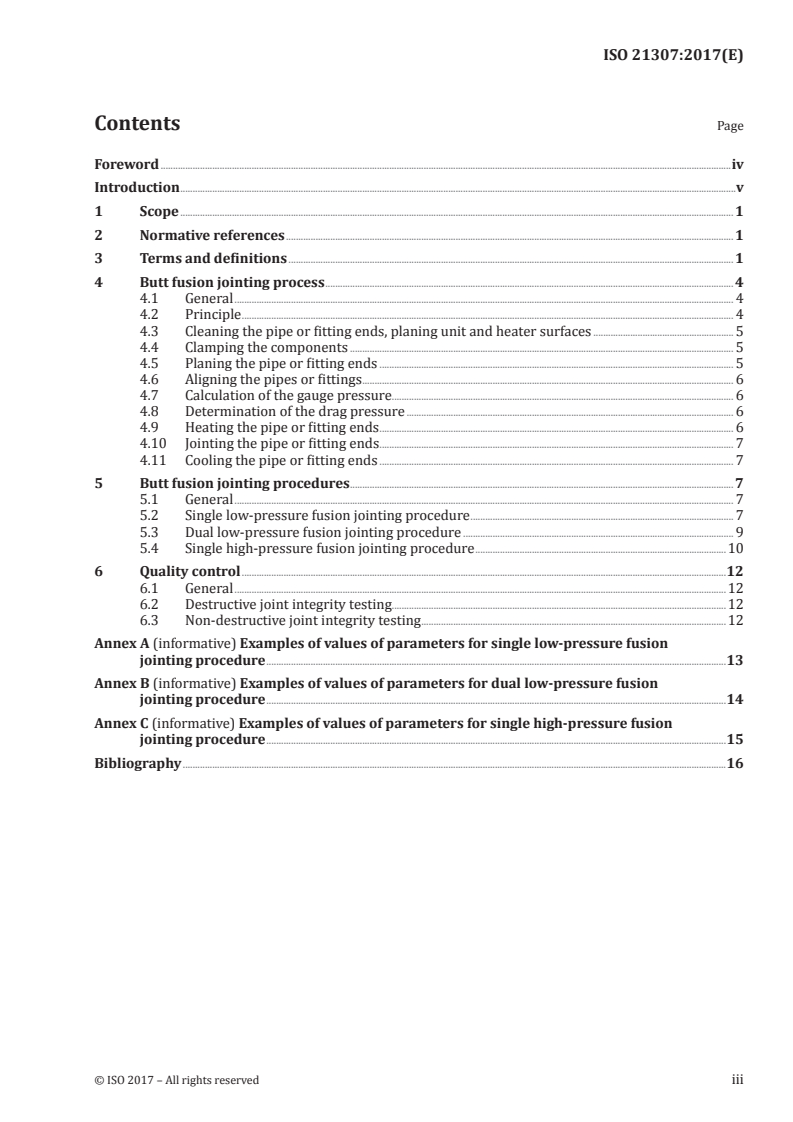
Contents Page
Foreword .iv
Introduction .v
1 Scope . 1
2 Normative references . 1
3 Terms and definitions . 1
4 Butt fusion jointing process . 4
4.1 General . 4
4.2 Principle . 4
4.3 Cleaning the pipe or fitting ends, planing unit and heater surfaces . 5
4.4 Clamping the components . 5
4.5 Planing the pipe or fitting ends . 5
4.6 Aligning the pipes or fittings . 6
4.7 Calculation of the gauge pressure. 6
4.8 Determination of the drag pressure . 6
4.9 Heating the pipe or fitting ends . 6
4.10 Jointing the pipe or fitting ends . 7
4.11 Cooling the pipe or fitting ends . 7
5 Butt fusion jointing procedures . 7
5.1 General . 7
5.2 Single low-pressure fusion jointing procedure . 7
5.3 Dual low-pressure fusion jointing procedure . 9
5.4 Single high-pressure fusion jointing procedure .10
6 Quality control .12
6.1 General .12
6.2 Destructive joint integrity testing.12
6.3 Non-destructive joint integrity testing .12
Annex A (informative) Examples of values of parameters for single low-pressure fusion
jointing procedure .13
Annex B (informative) Examples of values of parameters for dual low-pressure fusion
jointing procedure .14
Annex C (informative) Examples of values of parameters for single high-pressure fusion
jointing procedure .15
Bibliography .16
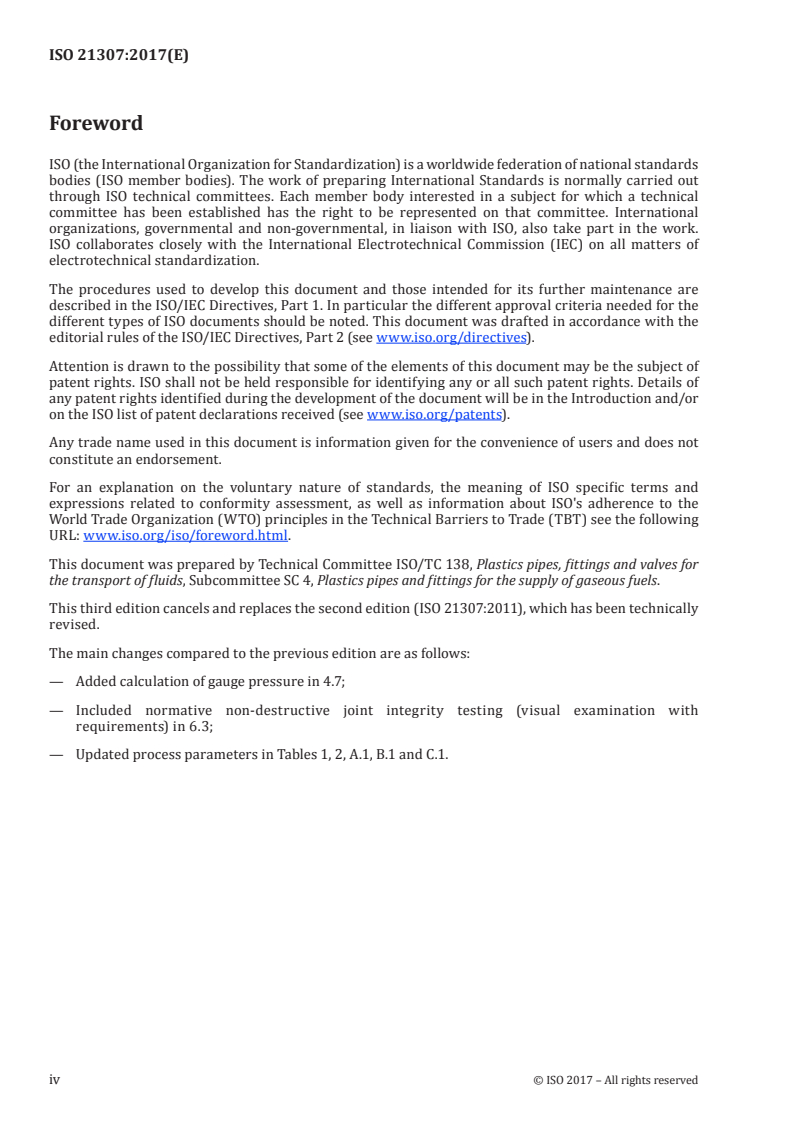
Foreword
ISO (the International Organization for Standardization) is a worldwide federation of national standards
bodies (ISO member bodies). The work of preparing International Standards is normally carried out
through ISO technical committees. Each member body interested in a subject for which a technical
committee has been established has the right to be represented on that committee. International
organizations, governmental and non-governmental, in liaison with ISO, also take part in the work.
ISO collaborates closely with the International Electrotechnical Commission (IEC) on all matters of
electrotechnical standardization.
The procedures used to develop this document and those intended for its further maintenance are
described in the ISO/IEC Directives, Part 1. In particular the different approval criteria needed for the
different types of ISO documents should be noted. This document was drafted in accordance with the
editorial rules of the ISO/IEC Directives, Part 2 (see www.iso.org/directives).
Attention is drawn to the possibility that some of the elements of this document may be the subject of
patent rights. ISO shall not be held responsible for identifying any or all such patent rights. Details of
any patent rights identified during the development of the document will be in the Introduction and/or
on the ISO list of patent declarations received (see www.iso.org/patents).
Any trade name used in this document is information given for the convenience of users and does not
constitute an endorsement.
For an explanation on the voluntary nature of standards, the meaning of ISO specific terms and
expressions related to conformity assessment, as well as information about ISO's adherence to the
World Trade Organization (WTO) principles in the Technical Barriers to Trade (TBT) see the following
URL: www.iso.org/iso/foreword.html.
This document was prepared by Technical Committee ISO/TC 138, Plastics pipes, fittings and valves for
the transport of fluids, Subcommittee SC 4, Plastics pipes and fittings for the supply of gaseous fuels.
This third edition cancels and replaces the second edition (ISO 21307:2011), which has been technically
revised.
The main changes compared to the previous edition are as follows:
— Added calculation of gauge pressure in 4.7;
— Included normative non-destructive joint integrity testing (visual examination with
requirements) in 6.3;
— Updated process parameters in Tables 1, 2, A.1, B.1 and C.1.
iv © ISO 2017 – All rights reserved
Introduction
With the increasing use of polyethylene (PE) pipes of larger diameters and wall thicknesses there is
a need for this document which provides details on three butt fusion procedures. This document is
developed for the benefit of countries without a national standard or technical specification for butt
fusion procedures of PE pipes. High quality butt fusion welds can be obtained with all three butt fusion
procedures mentioned in this document. The choice for one of these three procedures can depend on
experience, on the practical trials of the three butt fusion procedures and on availability of equipment.
INTERNATIONAL STANDARD ISO 21307:2017(E)
Plastics pipes and fittings — Butt fusion jointing
procedures for polyethylene (PE) piping systems
1 Scope
This document establishes general principles regarding the procedure used in the construction and
quality assessment of butt fusion jointing of polyethylene (PE) piping system components specified
in accordance with relevant ISO standards. These components are installed in accordance with the
relevant codes of practice, national regulations or industry guidance. Specifically, this document
specifies three butt fusion jointing procedures for PE pipes and fittings. These are:
— single low-pressure fusion jointing procedure;
— dual low-pressure fusion jointing procedure;
— single high-pressure fusion jointing procedure.
This document takes into consideration the materials and components used, the fusion jointing
procedure and equipment and the quality assessment of the completed joint. It can be applied in
conjunction with appropriate national regulations and standards.
[1][2][3][4][5][6]
NOTE 1 The references for these procedures are given in the Bibliography. Single low-
pressure fusion jointing procedure is derived from multiple procedures and agreed by experts, given in the
[1][2]
Bibliography .
NOTE 2 The three procedures detailed in this document are based on those most commonly used. It is not the
intention that one or more of these procedures be used to replace well established and verified industry based
procedures.
2 Normative references
The following documents are referred to in the text in such a way that some or all of their content
constitutes requirements of this document. For dated references, only the edition cited applies. For
undated references, the latest edition of the referenced document (including any amendments) applies.
ISO 12176-1, Plastics pipes and fittings — Equipment for fusion jointing polyethylene systems — Part 1:
Butt fusion
3 Terms and definitions
For the purposes of this document, the following terms and definitions apply.
ISO and IEC maintain terminological databases for use in standardization at the following addresses:
— IEC Electropedia: available at http://www.electropedia.org/
— ISO Online browsing platform: available at http://www.iso.org/obp
3.1
heater plate temperature
measured temperature on the surface of the heater plate where the pipe or fitting wall cross-section
makes contact
3.2
nominal wall thickness
e
n
1)
wall thickness tabulated in ISO 4065 , corresponding to the minimum wall thickness e at any
y,min
point e
y
3.3
nominal outside diameter
d
n
numerical designation of size which is common to all components in a thermoplastics piping system
other than flanges and components designated by thread size
3.4
standard dimension ratio
SDR
numerical designation of a pipe series, which is a convenient round number, approximately equal to the
dimension ratio of the nominal outside diameter, d , and the nominal wall thickness, e
n n
3.5
drag pressure
gauge pressure required to overcome, on a given machine, the sliding frictional drag force of the
machine and pipe
Note 1 to entry: Drag pressure, if present, can be a positive or negative value.
3.6
bead-up
initial melt under pressure around the circumference of the ends of the pipes or fittings which ensures
that complete pipe or fitting to heater plate contact is achieved
3.7
bead-up pressure
pressure exerted on the heater plate by the pipe or fitting ends during the bead-up phase of the
jointing cycle
Note 1 to entry: The value of the corresponding gauge pressure is calculated with Formulae (1) and (2).
3.8
bead-up size
bead size formed on the pipe or fitting ends during the bead-up phase
3.9
heat soak
portion of the heating cycle done at 0 to drag pressure so that the heat can melt the pipe or fitting to a
depth sufficient for proper mixing and fusion
3.10
heat soak pressure
pressure required to maintain the pipe or fitting in contact with the heater plate taking into account
the drag pressure
3.11
0 to drag pressure
lowest possible pressure during the heat soak that will allow the pipe or fitting to remain in contact
with the heater plate, up to a maximum of the current drag pressure
Note 1 to entry: The drag pressure required to move the pipe or fitting may be much higher than the pressure
required to maintain pipe or fitting/heater contact during heat soak.
1) To be published.
2 © ISO 2017 – All rights reserved
3.12
heating cycle
part of the welding process in which pipe or fitting ends are in contact with the heater plate composed
by bead up pressure and followed by heat soak pressure
3.13
heat soak time
time during which the heater plate is in contact with the pipe or fitting ends at the heat soak pressure
3.14
minimum bead size after heating
minimum value of bead size to be attained after completing the heat soak time
Note 1 to entry: Single high-pressure butt fusion procedure only.
3.15
heater plate removal time
time taken to separate the pipe or fitting ends from the heater plate, remove the heater plate and close
the carriage in order to bring the molten pipe or fitting ends together
3.16
fusion jointing pressure
interfacial pressure
actual pressure exerted on the pipe or fitting ends during jointing
Note 1 to entry: The value of the corresponding gauge pressure is calculated with Formulae (1) and (2).
3.17
gauge pressure
actual pressure (bead-up pressure or fusion jointing pressure with drag pressure) in the cylinders of
the butt fusion jointing machine read by the gauge
3.18
fusion jointing time
time period allotted for bead roll-over before cooling-cycle reduced pressure
Note 1 to entry: Dual low-pressure butt fusion procedure only.
3.19
cooling-cycle reduced pressure
pressure, exerted on the pipe or fitting ends during the cooling cycle of the dual low-pressure procedure
after fusion jointing time
Note 1 to entry: The value of the corresponding gauge pressure is calculated with Formulae (1) and (2).
3.20
cooling time in machine under pressure
time period during which the butt fusion joint remains under pressure when still clamped in the machine
3.21
cooling time in machine without pressure or out of machine
additional cooling period that may be required after the cooling time under pressure to ensure optimum
joint strength, particularly when working at high ambient temperatures and prior to rough handling or
pipe installation
3.22
operator
qualified person authorized to construct polyethylene (PE) systems from pipes and/or fittings, based
on a written procedure agreed by the pipeline operator according to ISO/TR 19480
3.23
pipeline operator
private or public organization authorized to design, construct and/or operate and maintain a pipeline
supply system
3.24
dummy joint
unfinished joint made prior to production welding to ensure cleanliness of the heater plate in which the
welding procedure is stopped after the heat soak time
3.25
jointing session
uninterrupted series of welds made with the same parameters and same equipment
3.26
rough handling
any action whereby stresses are applied to the fused joint, such as tensile and bending forces
Note 1 to entry: Some examples of rough handling are immediately after the cooling time in the machine under
pressure:
— the joint is removed from the machine by single point lifting at the joint;
— several lengths of joined pipe are pulled with the freshly made fusion joint;
— the joint is immediately subjected to a severe bending stress.
4 Butt fusion jointing process
4.1 General
Polyethylene (PE) pipes and fittings for the production of butt fusion joints in accordance with this
document should conform with the relevant ISO, local or national piping system standards.
PE components with fusion ends of different SDR/DR values shall not be jointed by butt fusion.
Ambient temperatures mentioned in this document shall be measured with a thermometer with an
accuracy of ± 1,0 °C.
To prevent potential contamination of welds it is recommended that welding is carried out in a shelter,
and the welding equipment is sited on a baseboard or ground sheet.
It is recommended to block off the PE pipe ends to prevent contamination and reduction of the
temperature of the heater plate.
It is recommended, before starting the welding procedure, to check the functioning of the fusion
equipment, particularly the temperature of the heating plate on both sides.
It is recommended to record the welding data in welding protocols or on data carriers.
4.2 Principle
The principle of butt fusion jointing is to heat two pipe or fitting ends for a specified time by means
of a heater plate maintained at a specified temperature. Following heater plate removal the pipe
ends are brought together by applying a specified pressure, and then cooled for a specified time. Butt
fusion joints shall be made by qualified operators using butt fusion jointing machines that conform to
ISO 12176-1. The training and level of skill of the operator shall be in accordance with the requirements
of the jointing procedure. A written jointing procedure, authorized by the pipeline operator, shall be
available prior to the construction of a pipeline. Any one of the three jointing procedures mentioned
in this document can be used as the basis. The jointing procedure shall include specification of the
4 © ISO 2017 – All rights reserved
jointing method, the fusion parameters, the fusion equipment, the jointing conditions, the level of skill
of the operator, and the quality control methods to be used. Guidelines for quality control are given in
Clause 6.
Key elements of the jointing process shall include:
a) cleaning the pipe or fitting ends, planing unit and heater surfaces;
b) clamping the components to be joined (pipe support with drag reducing rollers may be required to
ensure proper alignment);
c) planing the pipe or fitting ends;
d) aligning the pipes or fittings;
e) measuring the drag and compensating pressure accordingly;
f) melting the pipe or fitting ends;
g) jointing the pipe or fitting ends;
h) holding the pipe or fitting ends under pressure for the duration of the cooling time in the machine;
i) completing the cooling time in machine without pressure or out of machine if required.
These key elements are explained in more detail in 4.3 to 4.11.
4.3 Cleaning the pipe or fitting ends, planing unit and heater surfaces
Before placing them in the machine, clean the inside and outside of the pipe or fittings to be joined by
wiping the joint area with a clean lint-free cloth, using a suitable solvent (e.g. ethanol, isopropanol)
only if necessary or if specified in codes of practice or national regulations. All foreign matter shall be
removed from the jointing area.
If the pipe has a protective outer layer, it shall be peeled back far enough so that the pipe can be properly
clamped in the fusion machine, unless otherwise specified by the pipe manufacturer.
Cleaning the planing unit and the heater plate surfaces shall be done using a clean lint-free cloth, a
clean lint-free cloth with a suitable solvent or by making dummy joints at the start of each jointing
session whenever the heater plate has been allowed to cool below 180 °C and for a change of pipe size
or SDR/DR prior to commencement of production welding. The number of dummy joints to be made
shall be included in the written jointing procedure and/or as specified
...
INTERNATIONAL ISO
STANDARD 21307
Third edition
2017-12
Plastics pipes and fittings — Butt
fusion jointing procedures for
polyethylene (PE) piping systems
Tubes et raccords en matières plastiques — Modes opératoires
d'assemblage par soudage bout à bout de tubes et raccords en
polyéthylène (PE)
Reference number
©
ISO 2017
© ISO 2017, Published in Switzerland
All rights reserved. Unless otherwise specified, no part of this publication may be reproduced or utilized otherwise in any form
or by any means, electronic or mechanical, including photocopying, or posting on the internet or an intranet, without prior
written permission. Permission can be requested from either ISO at the address below or ISO’s member body in the country of
the requester.
ISO copyright office
Ch. de Blandonnet 8 • CP 401
CH-1214 Vernier, Geneva, Switzerland
Tel. +41 22 749 01 11
Fax +41 22 749 09 47
copyright@iso.org
www.iso.org
ii © ISO 2017 – All rights reserved
Contents Page
Foreword .iv
Introduction .v
1 Scope . 1
2 Normative references . 1
3 Terms and definitions . 1
4 Butt fusion jointing process . 4
4.1 General . 4
4.2 Principle . 4
4.3 Cleaning the pipe or fitting ends, planing unit and heater surfaces . 5
4.4 Clamping the components . 5
4.5 Planing the pipe or fitting ends . 5
4.6 Aligning the pipes or fittings . 6
4.7 Calculation of the gauge pressure. 6
4.8 Determination of the drag pressure . 6
4.9 Heating the pipe or fitting ends . 6
4.10 Jointing the pipe or fitting ends . 7
4.11 Cooling the pipe or fitting ends . 7
5 Butt fusion jointing procedures . 7
5.1 General . 7
5.2 Single low-pressure fusion jointing procedure . 7
5.3 Dual low-pressure fusion jointing procedure . 9
5.4 Single high-pressure fusion jointing procedure .10
6 Quality control .12
6.1 General .12
6.2 Destructive joint integrity testing.12
6.3 Non-destructive joint integrity testing .12
Annex A (informative) Examples of values of parameters for single low-pressure fusion
jointing procedure .13
Annex B (informative) Examples of values of parameters for dual low-pressure fusion
jointing procedure .14
Annex C (informative) Examples of values of parameters for single high-pressure fusion
jointing procedure .15
Bibliography .16
Foreword
ISO (the International Organization for Standardization) is a worldwide federation of national standards
bodies (ISO member bodies). The work of preparing International Standards is normally carried out
through ISO technical committees. Each member body interested in a subject for which a technical
committee has been established has the right to be represented on that committee. International
organizations, governmental and non-governmental, in liaison with ISO, also take part in the work.
ISO collaborates closely with the International Electrotechnical Commission (IEC) on all matters of
electrotechnical standardization.
The procedures used to develop this document and those intended for its further maintenance are
described in the ISO/IEC Directives, Part 1. In particular the different approval criteria needed for the
different types of ISO documents should be noted. This document was drafted in accordance with the
editorial rules of the ISO/IEC Directives, Part 2 (see www.iso.org/directives).
Attention is drawn to the possibility that some of the elements of this document may be the subject of
patent rights. ISO shall not be held responsible for identifying any or all such patent rights. Details of
any patent rights identified during the development of the document will be in the Introduction and/or
on the ISO list of patent declarations received (see www.iso.org/patents).
Any trade name used in this document is information given for the convenience of users and does not
constitute an endorsement.
For an explanation on the voluntary nature of standards, the meaning of ISO specific terms and
expressions related to conformity assessment, as well as information about ISO's adherence to the
World Trade Organization (WTO) principles in the Technical Barriers to Trade (TBT) see the following
URL: www.iso.org/iso/foreword.html.
This document was prepared by Technical Committee ISO/TC 138, Plastics pipes, fittings and valves for
the transport of fluids, Subcommittee SC 4, Plastics pipes and fittings for the supply of gaseous fuels.
This third edition cancels and replaces the second edition (ISO 21307:2011), which has been technically
revised.
The main changes compared to the previous edition are as follows:
— Added calculation of gauge pressure in 4.7;
— Included normative non-destructive joint integrity testing (visual examination with
requirements) in 6.3;
— Updated process parameters in Tables 1, 2, A.1, B.1 and C.1.
iv © ISO 2017 – All rights reserved
Introduction
With the increasing use of polyethylene (PE) pipes of larger diameters and wall thicknesses there is
a need for this document which provides details on three butt fusion procedures. This document is
developed for the benefit of countries without a national standard or technical specification for butt
fusion procedures of PE pipes. High quality butt fusion welds can be obtained with all three butt fusion
procedures mentioned in this document. The choice for one of these three procedures can depend on
experience, on the practical trials of the three butt fusion procedures and on availability of equipment.
INTERNATIONAL STANDARD ISO 21307:2017(E)
Plastics pipes and fittings — Butt fusion jointing
procedures for polyethylene (PE) piping systems
1 Scope
This document establishes general principles regarding the procedure used in the construction and
quality assessment of butt fusion jointing of polyethylene (PE) piping system components specified
in accordance with relevant ISO standards. These components are installed in accordance with the
relevant codes of practice, national regulations or industry guidance. Specifically, this document
specifies three butt fusion jointing procedures for PE pipes and fittings. These are:
— single low-pressure fusion jointing procedure;
— dual low-pressure fusion jointing procedure;
— single high-pressure fusion jointing procedure.
This document takes into consideration the materials and components used, the fusion jointing
procedure and equipment and the quality assessment of the completed joint. It can be applied in
conjunction with appropriate national regulations and standards.
[1][2][3][4][5][6]
NOTE 1 The references for these procedures are given in the Bibliography. Single low-
pressure fusion jointing procedure is derived from multiple procedures and agreed by experts, given in the
[1][2]
Bibliography .
NOTE 2 The three procedures detailed in this document are based on those most commonly used. It is not the
intention that one or more of these procedures be used to replace well established and verified industry based
procedures.
2 Normative references
The following documents are referred to in the text in such a way that some or all of their content
constitutes requirements of this document. For dated references, only the edition cited applies. For
undated references, the latest edition of the referenced document (including any amendments) applies.
ISO 12176-1, Plastics pipes and fittings — Equipment for fusion jointing polyethylene systems — Part 1:
Butt fusion
3 Terms and definitions
For the purposes of this document, the following terms and definitions apply.
ISO and IEC maintain terminological databases for use in standardization at the following addresses:
— IEC Electropedia: available at http://www.electropedia.org/
— ISO Online browsing platform: available at http://www.iso.org/obp
3.1
heater plate temperature
measured temperature on the surface of the heater plate where the pipe or fitting wall cross-section
makes contact
3.2
nominal wall thickness
e
n
1)
wall thickness tabulated in ISO 4065 , corresponding to the minimum wall thickness e at any
y,min
point e
y
3.3
nominal outside diameter
d
n
numerical designation of size which is common to all components in a thermoplastics piping system
other than flanges and components designated by thread size
3.4
standard dimension ratio
SDR
numerical designation of a pipe series, which is a convenient round number, approximately equal to the
dimension ratio of the nominal outside diameter, d , and the nominal wall thickness, e
n n
3.5
drag pressure
gauge pressure required to overcome, on a given machine, the sliding frictional drag force of the
machine and pipe
Note 1 to entry: Drag pressure, if present, can be a positive or negative value.
3.6
bead-up
initial melt under pressure around the circumference of the ends of the pipes or fittings which ensures
that complete pipe or fitting to heater plate contact is achieved
3.7
bead-up pressure
pressure exerted on the heater plate by the pipe or fitting ends during the bead-up phase of the
jointing cycle
Note 1 to entry: The value of the corresponding gauge pressure is calculated with Formulae (1) and (2).
3.8
bead-up size
bead size formed on the pipe or fitting ends during the bead-up phase
3.9
heat soak
portion of the heating cycle done at 0 to drag pressure so that the heat can melt the pipe or fitting to a
depth sufficient for proper mixing and fusion
3.10
heat soak pressure
pressure required to maintain the pipe or fitting in contact with the heater plate taking into account
the drag pressure
3.11
0 to drag pressure
lowest possible pressure during the heat soak that will allow the pipe or fitting to remain in contact
with the heater plate, up to a maximum of the current drag pressure
Note 1 to entry: The drag pressure required to move the pipe or fitting may be much higher than the pressure
required to maintain pipe or fitting/heater contact during heat soak.
1) To be published.
2 © ISO 2017 – All rights reserved
3.12
heating cycle
part of the welding process in which pipe or fitting ends are in contact with the heater plate composed
by bead up pressure and followed by heat soak pressure
3.13
heat soak time
time during which the heater plate is in contact with the pipe or fitting ends at the heat soak pressure
3.14
minimum bead size after heating
minimum value of bead size to be attained after completing the heat soak time
Note 1 to entry: Single high-pressure butt fusion procedure only.
3.15
heater plate removal time
time taken to separate the pipe or fitting ends from the heater plate, remove the heater plate and close
the carriage in order to bring the molten pipe or fitting ends together
3.16
fusion jointing pressure
interfacial pressure
actual pressure exerted on the pipe or fitting ends during jointing
Note 1 to entry: The value of the corresponding gauge pressure is calculated with Formulae (1) and (2).
3.17
gauge pressure
actual pressure (bead-up pressure or fusion jointing pressure with drag pressure) in the cylinders of
the butt fusion jointing machine read by the gauge
3.18
fusion jointing time
time period allotted for bead roll-over before cooling-cycle reduced pressure
Note 1 to entry: Dual low-pressure butt fusion procedure only.
3.19
cooling-cycle reduced pressure
pressure, exerted on the pipe or fitting ends during the cooling cycle of the dual low-pressure procedure
after fusion jointing time
Note 1 to entry: The value of the corresponding gauge pressure is calculated with Formulae (1) and (2).
3.20
cooling time in machine under pressure
time period during which the butt fusion joint remains under pressure when still clamped in the machine
3.21
cooling time in machine without pressure or out of machine
additional cooling period that may be required after the cooling time under pressure to ensure optimum
joint strength, particularly when working at high ambient temperatures and prior to rough handling or
pipe installation
3.22
operator
qualified person authorized to construct polyethylene (PE) systems from pipes and/or fittings, based
on a written procedure agreed by the pipeline operator according to ISO/TR 19480
3.23
pipeline operator
private or public organization authorized to design, construct and/or operate and maintain a pipeline
supply system
3.24
dummy joint
unfinished joint made prior to production welding to ensure cleanliness of the heater plate in which the
welding procedure is stopped after the heat soak time
3.25
jointing session
uninterrupted series of welds made with the same parameters and same equipment
3.26
rough handling
any action whereby stresses are applied to the fused joint, such as tensile and bending forces
Note 1 to entry: Some examples of rough handling are immediately after the cooling time in the machine under
pressure:
— the joint is removed from the machine by single point lifting at the joint;
— several lengths of joined pipe are pulled with the freshly made fusion joint;
— the joint is immediately subjected to a severe bending stress.
4 Butt fusion jointing process
4.1 General
Polyethylene (PE) pipes and fittings for the production of butt fusion joints in accordance with this
document should conform with the relevant ISO, local or national piping system standards.
PE components with fusion ends of different SDR/DR values shall not be jointed by butt fusion.
Ambient temperatures mentioned in this document shall be measured with a thermometer with an
accuracy of ± 1,0 °C.
To prevent potential contamination of welds it is recommended that welding is carried out in a shelter,
and the welding equipment is sited on a baseboard or ground sheet.
It is recommended to block off the PE pipe ends to prevent contamination and reduction of the
temperature of the heater plate.
It is recommended, before starting the welding procedure, to check the functioning of the fusion
equipment, particularly the temperature of the heating plate on both sides.
It is recommended to record the welding data in welding protocols or on data carriers.
4.2 Principle
The principle of butt fusion jointing is to heat two pipe or fitting ends for a specified time by means
of a heater plate maintained at a specified temperature. Following heater plate removal the pipe
ends are brought together by applying a specified pressure, and then cooled for a specified time. Butt
fusion joints shall be made by qualified operators using butt fusion jointing machines that conform to
ISO 12176-1. The training and level of skill of the operator shall be in accordance with the requirements
of the jointing procedure. A written jointing procedure, authorized by the pipeline operator, shall be
available prior to the construction of a pipeline. Any one of the three jointing procedures mentioned
in this document can be used as the basis. The jointing procedure shall include specification of the
4 © ISO 2017 – All rights reserved
jointing method, the fusion parameters, the fusion equipment, the jointing conditions, the level of skill
of the operator, and the quality control methods to be used. Guidelines for quality control are given in
Clause 6.
Key elements of the jointing process shall include:
a) cleaning the pipe or fitting ends, planing unit and heater surfaces;
b) clamping the components to be joined (pipe support with drag reducing rollers may be required to
ensure proper alignment);
c) planing the pipe or fitting ends;
d) aligning the pipes or fittings;
e) measuring the drag and compensating pressure accordingly;
f) melting the pipe or fitting ends;
g) jointing the pipe or fitting ends;
h) holding the pipe or fitting ends under pressure for the duration of the cooling time in the machine;
i) completing the cooling time in machine without pressure or out of machine if required.
These key elements are explained in more detail in 4.3 to 4.11.
4.3 Cleaning the pipe or fitting ends, planing unit and heater surfaces
Before placing them in the machine, clean the inside and outside of the pipe or fittings to be joined by
wiping the joint area with a clean lint-free cloth, using a suitable solvent (e.g. ethanol, isopropanol)
only if necessary or if specified in codes of practice or national regulations. All foreign matter shall be
removed from the jointing area.
If the pipe has a protective outer layer, it shall be peeled back far enough so that the pipe can be properly
clamped in the fusion machine, unless otherwise specified by the pipe manufacturer.
Cleaning the planing unit and the heater plate surfaces shall be done using a clean lint-free cloth, a
clean lint-free cloth with a suitable solvent or by making dummy joints at the start of each jointing
session whenever the heater plate has been allowed to cool below 180 °C and for a change of pipe size
or SDR/DR prior to commencement of production welding. The number of dummy joints to be made
shall be included in the written jointing procedure and/or as specified
...