

ISO 23555-2:2022
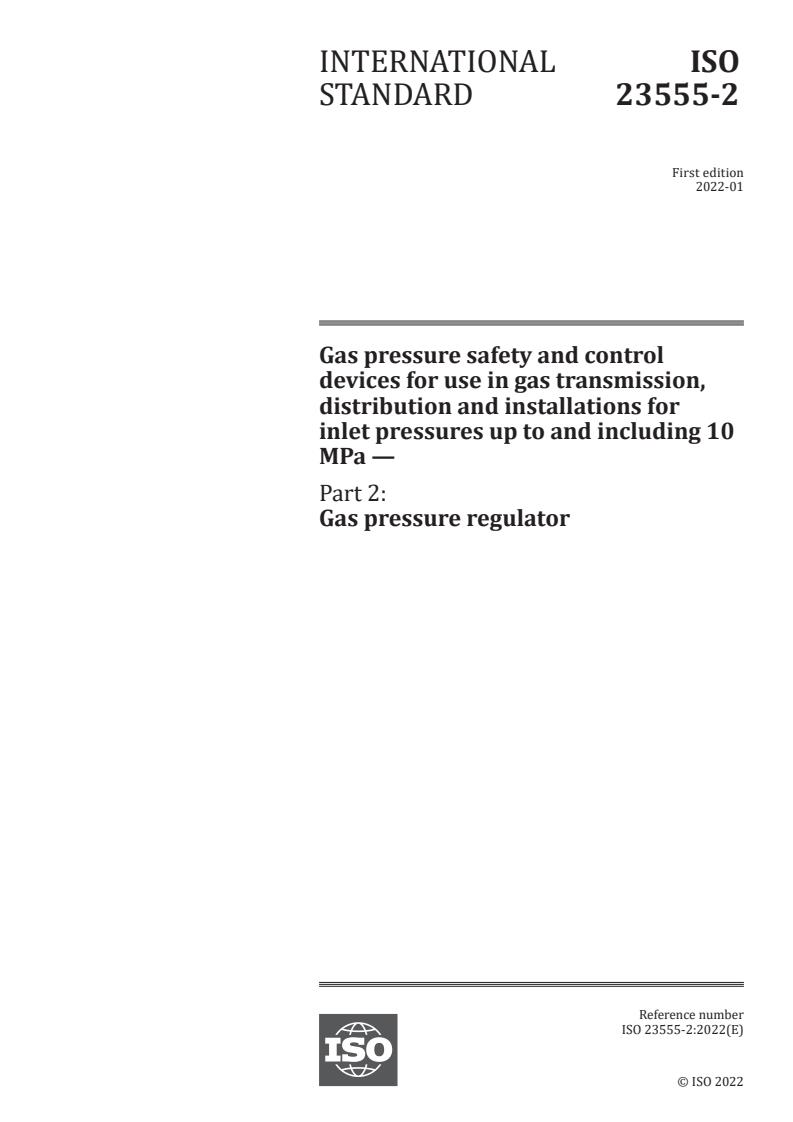
(Main)Gas pressure safety and control devices for use in gas transmission, distribution and installations for inlet pressures up to and including 10 MPa — Part 2: Gas pressure regulator
General Information
- Abstract
This document specifies safety, constructional, performance, testing and documentation requirements for gas pressure regulators for use in gas transmission and distribution installations (hereafter referred to as regulators). This document is applicable to regulators with operating pressures greater than 500 kPa and up to and including 10 MPa (100 bar) and nominal diameters up to DN 400 for use with fuel gases as natural gas, manufactured gas, biomethane or liquefied petroleum gas (LPG). This document is applicable to: — test methods which are intended for product type test, routine tests and product surveillance tests; — regulators which use the pipeline gas as a source of control energy unassisted by any external power source; — regulators integrating on the same body a second regulator, used as monitor, complying with the requirements in this document; — regulators integrating a safety shut off device (SSD) according to ISO 23555-3; — regulators incorporating a creep (venting) relief device and/or a vent limiter complying with the requirements in this document. This document does not apply to: — regulators upstream from/on/in domestic gas‑consuming appliances which are installed downstream of domestic gas meters; — regulators designed to be incorporated into pressure control systems used in service lines (pipework from the main pipework in a gas infrastructure to the point of delivery of the gas) with declared volumetric flow rate ≤ 200 m3/h at normal conditions and declared inlet pressure ≤ 500 kPa (5 bar); — industrial process control valves, such as IEC 60534 (all parts); — regulators used in aggressive/sour gas environments (gas environments containing water and H2S are considered sour) or severely corrosive conditions; — regulators in service conditions with renewables (e.g. H2NG with hydrogen more than 10 %) and/or waste gases (e.g. biogas etc.), if additional information is not provided (e. g. contaminant, liquid, etc.).
- Status
- Published
- Publication Date
- 10-Jan-2022
- Technical Committee
- ISO/TC 161 - Controls and protective devices for gas and/or oil
- Drafting Committee
- ISO/TC 161/WG 5 - High pressure controls
- Current Stage
- 9092 - International Standard to be revised
- Start Date
- 17-Apr-2026
- Completion Date
- 29-Aug-2026
Buy Documents
ISO 23555-2:2022 - Gas pressure safety and control devices for use in gas transmission, distribution and installations for inlet pressures up to and including 10 MPa — Part 2: Gas pressure regulator Released:1/11/2022
Overview - ISO 23555-2:2022 (Gas pressure regulator)
ISO 23555-2:2022 defines safety, constructional, performance, testing and documentation requirements for gas pressure regulators used in gas transmission and distribution systems. It applies to regulators with inlet pressures > 500 kPa and up to 10 MPa (100 bar) and nominal diameters up to DN 400, intended for fuel gases such as natural gas, manufactured gas, biomethane and LPG. The standard covers product type tests, routine and surveillance tests, and regulators that use pipeline gas as control energy (no external power). It also applies to devices integrating a monitor regulator, a safety shut‑off device (SSD) per ISO 23555‑3, and creep (venting) relief devices and vent limiters.
Key topics and technical requirements
- Scope & limits: Operating pressure and size limits, permitted gas types, and explicit exclusions (see below).
- Design and materials: Requirements for metallic and elastomeric parts, diaphragms, welding and strength of pressure-containing parts.
- Performance & testing: Test rig requirements, type/routine/surveillance tests, shell strength, internal/external tightness, antistatic characteristics, sound emission, control classification, fail‑safe behaviour (fail‑open / fail‑close).
- Functional features: Requirements for monitor regulators, integrated SSDs, creep (token) relief devices and high‑pressure vent limiters.
- Documentation & marking: Type test and batch documentation, routine test records, marking and packaging requirements.
- Annexes: Normative and informative annexes provide materials lists, elastomer guidance, vent limiter and creep device definitions, compliance evaluation, inspection certificate and test templates, dynamic force calculations and order specification guidance.
Important exclusions noted by the standard:
- Regulators for domestic appliances downstream of domestic meters.
- Service‑line regulators with declared flow ≤ 200 m3/h and inlet ≤ 500 kPa.
- Industrial process control valves (referenced IEC 60534).
- Use in aggressive/sour gas or severely corrosive environments, and in renewable/waste gas mixes with H2 >10% unless additional data is provided.
Applications - who uses ISO 23555-2
- Manufacturers of gas pressure regulators for high‑pressure transmission and distribution networks.
- Gas network operators / utilities specifying compliant equipment for mains and transmission.
- Testing and certification bodies carrying out type, routine and surveillance tests.
- System designers, procurement and maintenance teams ensuring safe selection, installation and documentation of regulators.
- Supports compliance, safety assurance, product specification and interoperability for high‑pressure gas infrastructure.
Related standards
- ISO 23555 series (other parts, e.g., ISO 23555‑3 for SSD integration).
- IEC 60534 (industrial process control valves) - explicitly excluded from ISO 23555‑2 scope.
Keywords: ISO 23555-2:2022, gas pressure regulator, gas transmission and distribution, 10 MPa, safety testing, vent limiter, creep relief, monitor regulator.
Relations
- Effective Date
- 09-Feb-2026
Buy Documents
ISO 23555-2:2022 - Gas pressure safety and control devices for use in gas transmission, distribution and installations for inlet pressures up to and including 10 MPa — Part 2: Gas pressure regulator Released:1/11/2022
Get Certified
Connect with accredited certification bodies for this standard

DNV
DNV is an independent assurance and risk management provider.

Lloyd's Register
Lloyd's Register is a global professional services organisation specialising in engineering and technology.

DIBt (Deutsches Institut für Bautechnik)
German Institute for Building Technology.
Sponsored listings
Frequently Asked Questions
ISO 23555-2:2022 is a standard published by the International Organization for Standardization (ISO). Its full title is "Gas pressure safety and control devices for use in gas transmission, distribution and installations for inlet pressures up to and including 10 MPa — Part 2: Gas pressure regulator". This standard covers: This document specifies safety, constructional, performance, testing and documentation requirements for gas pressure regulators for use in gas transmission and distribution installations (hereafter referred to as regulators). This document is applicable to regulators with operating pressures greater than 500 kPa and up to and including 10 MPa (100 bar) and nominal diameters up to DN 400 for use with fuel gases as natural gas, manufactured gas, biomethane or liquefied petroleum gas (LPG). This document is applicable to: — test methods which are intended for product type test, routine tests and product surveillance tests; — regulators which use the pipeline gas as a source of control energy unassisted by any external power source; — regulators integrating on the same body a second regulator, used as monitor, complying with the requirements in this document; — regulators integrating a safety shut off device (SSD) according to ISO 23555-3; — regulators incorporating a creep (venting) relief device and/or a vent limiter complying with the requirements in this document. This document does not apply to: — regulators upstream from/on/in domestic gas‑consuming appliances which are installed downstream of domestic gas meters; — regulators designed to be incorporated into pressure control systems used in service lines (pipework from the main pipework in a gas infrastructure to the point of delivery of the gas) with declared volumetric flow rate ≤ 200 m3/h at normal conditions and declared inlet pressure ≤ 500 kPa (5 bar); — industrial process control valves, such as IEC 60534 (all parts); — regulators used in aggressive/sour gas environments (gas environments containing water and H2S are considered sour) or severely corrosive conditions; — regulators in service conditions with renewables (e.g. H2NG with hydrogen more than 10 %) and/or waste gases (e.g. biogas etc.), if additional information is not provided (e. g. contaminant, liquid, etc.).
This document specifies safety, constructional, performance, testing and documentation requirements for gas pressure regulators for use in gas transmission and distribution installations (hereafter referred to as regulators). This document is applicable to regulators with operating pressures greater than 500 kPa and up to and including 10 MPa (100 bar) and nominal diameters up to DN 400 for use with fuel gases as natural gas, manufactured gas, biomethane or liquefied petroleum gas (LPG). This document is applicable to: — test methods which are intended for product type test, routine tests and product surveillance tests; — regulators which use the pipeline gas as a source of control energy unassisted by any external power source; — regulators integrating on the same body a second regulator, used as monitor, complying with the requirements in this document; — regulators integrating a safety shut off device (SSD) according to ISO 23555-3; — regulators incorporating a creep (venting) relief device and/or a vent limiter complying with the requirements in this document. This document does not apply to: — regulators upstream from/on/in domestic gas‑consuming appliances which are installed downstream of domestic gas meters; — regulators designed to be incorporated into pressure control systems used in service lines (pipework from the main pipework in a gas infrastructure to the point of delivery of the gas) with declared volumetric flow rate ≤ 200 m3/h at normal conditions and declared inlet pressure ≤ 500 kPa (5 bar); — industrial process control valves, such as IEC 60534 (all parts); — regulators used in aggressive/sour gas environments (gas environments containing water and H2S are considered sour) or severely corrosive conditions; — regulators in service conditions with renewables (e.g. H2NG with hydrogen more than 10 %) and/or waste gases (e.g. biogas etc.), if additional information is not provided (e. g. contaminant, liquid, etc.).
ISO 23555-2:2022 is classified under the following ICS (International Classification for Standards) categories: 23.060.40 - Pressure regulators; 27.060.20 - Gas fuel burners; 91.140.40 - Gas supply systems. The ICS classification helps identify the subject area and facilitates finding related standards.
ISO 23555-2:2022 has the following relationships with other standards: It is inter standard links to EN ISO 13577-2:2023. Understanding these relationships helps ensure you are using the most current and applicable version of the standard.
ISO 23555-2:2022 is available in PDF format for immediate download after purchase. The document can be added to your cart and obtained through the secure checkout process. Digital delivery ensures instant access to the complete standard document.
Standards Content (Sample)
INTERNATIONAL ISO
STANDARD 23555-2
First edition
2022-01
Gas pressure safety and control
devices for use in gas transmission,
distribution and installations for
inlet pressures up to and including 10
MPa —
Part 2:
Gas pressure regulator
Reference number
© ISO 2022
All rights reserved. Unless otherwise specified, or required in the context of its implementation, no part of this publication may
be reproduced or utilized otherwise in any form or by any means, electronic or mechanical, including photocopying, or posting on
the internet or an intranet, without prior written permission. Permission can be requested from either ISO at the address below
or ISO’s member body in the country of the requester.
ISO copyright office
CP 401 • Ch. de Blandonnet 8
CH-1214 Vernier, Geneva
Phone: +41 22 749 01 11
Email: copyright@iso.org
Website: www.iso.org
Published in Switzerland
ii
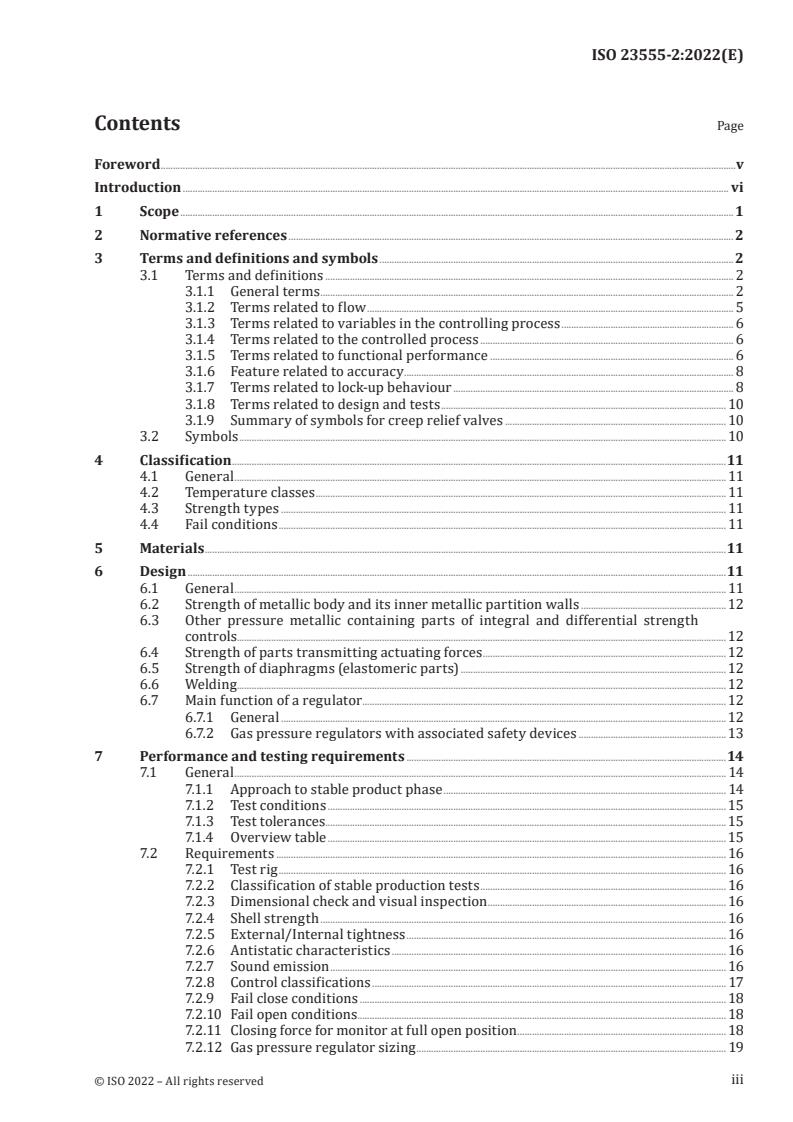
Contents Page
Foreword .v
Introduction . vi
1 Scope . 1
2 Normative references . 2
3 Terms and definitions and symbols .2
3.1 Terms and definitions . 2
3.1.1 General terms . 2
3.1.2 Terms related to flow . 5
3.1.3 Terms related to variables in the controlling process . 6
3.1.4 Terms related to the controlled process . 6
3.1.5 Terms related to functional performance . 6
3.1.6 Feature related to accuracy . 8
3.1.7 Terms related to lock-up behaviour . 8
3.1.8 Terms related to design and tests . 10
3.1.9 Summary of symbols for creep relief valves . 10
3.2 Symbols . 10
4 Classification .11
4.1 General . 11
4.2 Temperature classes . 11
4.3 Strength types . 11
4.4 Fail conditions . 11
5 Materials .11
6 Design .11
6.1 General . 11
6.2 Strength of metallic body and its inner metallic partition walls .12
6.3 Other pressure metallic containing parts of integral and differential strength
controls.12
6.4 Strength of parts transmitting actuating forces .12
6.5 Strength of diaphragms (elastomeric parts) .12
6.6 Welding . .12
6.7 Main function of a regulator . 12
6.7.1 General .12
6.7.2 Gas pressure regulators with associated safety devices .13
7 Performance and testing requirements .14
7.1 General . 14
7.1.1 Approach to stable product phase . 14
7.1.2 Test conditions . 15
7.1.3 Test tolerances . . .15
7.1.4 Overview table . 15
7.2 Requirements . 16
7.2.1 Test rig . 16
7.2.2 Classification of stable production tests . 16
7.2.3 Dimensional check and visual inspection . 16
7.2.4 Shell strength . 16
7.2.5 External/Internal tightness . 16
7.2.6 Antistatic characteristics . 16
7.2.7 Sound emission . 16
7.2.8 Control classifications . 17
7.2.9 Fail close conditions . 18
7.2.10 Fail open conditions. 18
7.2.11 Closing force for monitor at full open position . 18
7.2.12 Gas pressure regulator sizing . 19
iii
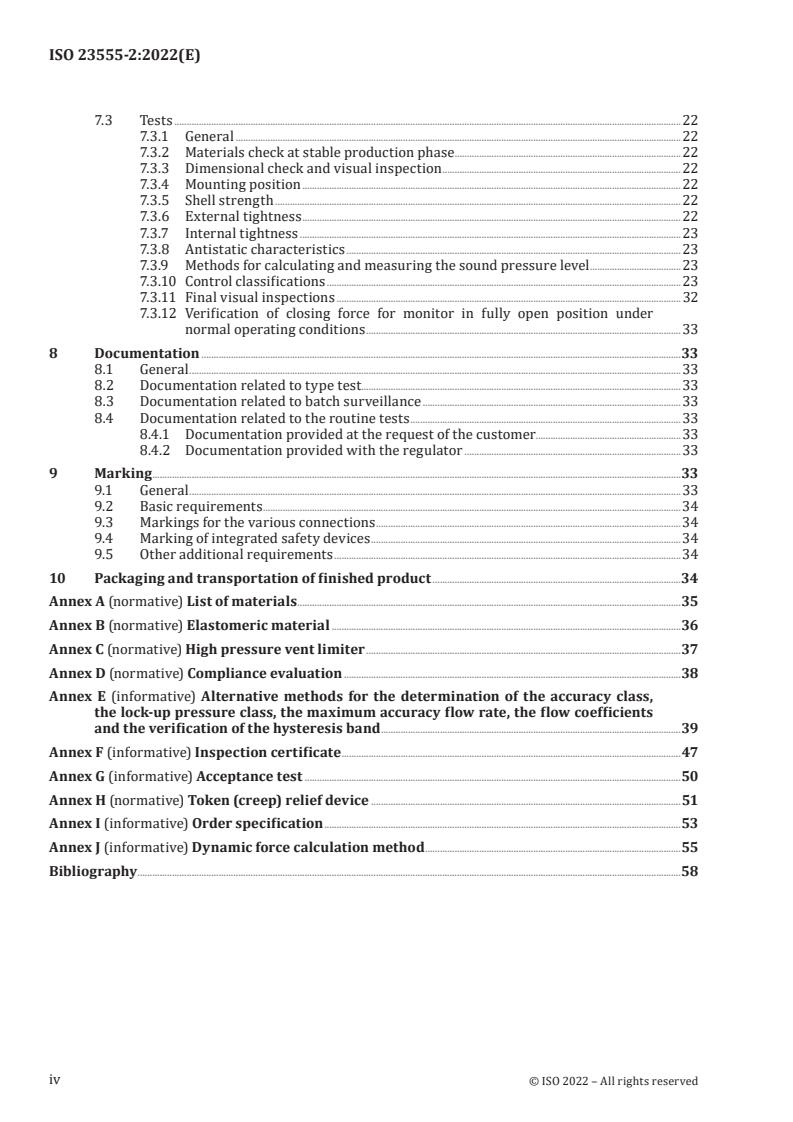
7.3 Tests .22
7.3.1 General .22
7.3.2 Materials check at stable production phase. 22
7.3.3 Dimensional check and visual inspection . 22
7.3.4 Mounting position . 22
7.3.5 Shell strength . 22
7.3.6 External tightness . 22
7.3.7 Internal tightness .23
7.3.8 Antistatic characteristics . 23
7.3.9 Methods for calculating and measuring the sound pressure level .23
7.3.10 Control classifications .23
7.3.11 Final visual inspections . 32
7.3.12 Verification of closing force for monitor in fully open position under
normal operating conditions . 33
8 Documentation .33
8.1 General . 33
8.2 Documentation related to type test. 33
8.3 Documentation related to batch surveillance . 33
8.4 Documentation related to the routine tests . 33
8.4.1 Documentation provided at the request of the customer . 33
8.4.2 Documentation provided with the regulator . 33
9 Marking . .33
9.1 General . 33
9.2 Basic requirements .34
9.3 Markings for the various connections .34
9.4 Marking of integrated safety devices .34
9.5 Other additional requirements .34
10 Packaging and transportation of finished product .34
Annex A (normative) List of materials .35
Annex B (normative) Elastomeric material .36
Annex C (normative) High pressure vent limiter .37
Annex D (normative) Compliance evaluation .38
Annex E (informative) Alternative methods for the determination of the accuracy class,
the lock-up pressure class, the maximum accuracy flow rate, the flow coefficients
and the verification of the hysteresis band .39
Annex F (informative) Inspection certificate .47
Annex G (informative) Acceptance test .50
Annex H (normative) Token (creep) relief device .51
Annex I (informative) Order specification .53
Annex J (informative) Dynamic force calculation method .55
Bibliography .58
iv
Foreword
ISO (the International Organization for Standardization) is a worldwide federation of national standards
bodies (ISO member bodies). The work of preparing International Standards is normally carried out
through ISO technical committees. Each member body interested in a subject for which a technical
committee has been established has the right to be represented on that committee. International
organizations, governmental and non-governmental, in liaison with ISO, also take part in the work.
ISO collaborates closely with the International Electrotechnical Commission (IEC) on all matters of
electrotechnical standardization.
The procedures used to develop this document and those intended for its further maintenance are
described in the ISO/IEC Directives, Part 1. In particular, the different approval criteria needed for the
different types of ISO documents should be noted. This document was drafted in accordance with the
editorial rules of the ISO/IEC Directives, Part 2 (see www.iso.org/directives).
Attention is drawn to the possibility that some of the elements of this document may be the subject of
patent rights. ISO shall not be held responsible for identifying any or all such patent rights. Details of
any patent rights identified during the development of the document will be in the Introduction and/or
on the ISO list of patent declarations received (see www.iso.org/patents).
Any trade name used in this document is information given for the convenience of users and does not
constitute an endorsement.
For an explanation of the voluntary nature of standards, the meaning of ISO specific terms and
expressions related to conformity assessment, as well as information about ISO's adherence to
the World Trade Organization (WTO) principles in the Technical Barriers to Trade (TBT), see
www.iso.org/iso/foreword.html.
This document was prepared by Technical Committee ISO/TC 161, Controls and protective devices for
gas and/or oil.
A list of all parts in the ISO 23555 series can be found on the ISO website.
Any feedback or questions on this document should be directed to the user’s national standards body. A
complete listing of these bodies can be found at www.iso.org/members.html.
v
Introduction
This document is designed to be used in combination with ISO 23555-1. This document together with
ISO 23555-1 establishes the complete standard as it applies to the specific control covered by the
ISO 23555 series.
Where needed, this document adapts ISO 23555-1 by stating in the corresponding clause:
— “with the following modification”;
— “with the following addition”;
— “is replaced by the following”; or
— “is not applicable”.
In order to identify specific requirements that are particular to this document but not already covered
by ISO 23555-1, this document can contain clauses or subclauses that are additional to the structure
of ISO 23555-1. These subclauses are indicated by the introductory sentence: “Subclause (or Annex)
specific to this document.”.
vi
INTERNATIONAL STANDARD ISO 23555-2:2022(E)
Gas pressure safety and control devices for use in gas
transmission, distribution and installations for inlet
pressures up to and including 10 MPa —
Part 2:
Gas pressure regulator
1 Scope
This document specifies safety, constructional, performance, testing and documentation requirements
for gas pressure regulators for use in gas transmission and distribution installations (hereafter
referred to as regulators).
This document is applicable to regulators with operating pressures greater than 500 kPa and up to and
including 10 MPa (100 bar) and nominal diameters up to DN 400 for use with fuel gases as natural gas,
manufactured gas, biomethane or liquefied petroleum gas (LPG).
This document is applicable to:
— test methods which are intended for product type test, routine tests and product surveillance tests;
— regulators which use the pipeline gas as a source of control energy unassisted by any external
power source;
— regulators integrating on the same body a second regulator, used as monitor, complying with the
requirements in this document;
— regulators integrating a safety shut off device (SSD) according to ISO 23555-3;
— regulators incorporating a creep (venting) relief device and/or a vent limiter complying with the
requirements in this document.
This document does not apply to:
— regulators upstream from/on/in domestic gas-consuming appliances which are installed
downstream of domestic gas meters;
— regulators designed to be incorporated into pressure control systems used in service lines (pipework
from the main pipework in a gas infrastructure to the point of delivery of the gas) with declared
volumetric flow rate ≤ 200 m /h at normal conditions and declared inlet pressure ≤ 500 kPa (5 bar);
— industrial process control valves, such as IEC 60534 (all parts);
— regulators used in aggressive/sour gas environments (gas environments containing water and H2S
are considered sour) or severely corrosive conditions;
— regulators in service conditions with renewables (e.g. H2NG with hydrogen more than 10 %) and/
or waste gases (e.g. biogas etc.), if additional information is not provided (e. g. contaminant, liquid,
etc.).
2 Normative references
The following documents are referred to in the text in such a way that some or all of their content
constitutes requirements of this document. For dated references, only the edition cited applies. For
undated references, the latest edition of the referenced document (including any amendments) applies.
ISO 23555-1:2022, Gas pressure safety and control devices for use in gas transmission, distribution and
installations for inlet pressures up to and including 10 MPa — Part 1: General requirements
IEC 60534-1:2005, Industrial-process control valves — Part 1: Control valve terminology and general
considerations
IEC 60534-2-3, Industrial-process control valves — Part 2-3: Flow capacity — Test procedures
IEC 60534-4, Industrial-process control valves — Part 4: Inspection and routine testing
3 Terms and definitions and symbols
3.1 Terms and definitions
For the purposes of this document, the terms and definitions given in ISO 23555-1 and the following
apply.
ISO and IEC maintain terminology databases for use in standardization at the following addresses:
— ISO Online browsing platform: available at https:// www .iso .org/ obp
— IEC Electropedia: available at https:// www .electropedia .org/
3.1.1 General terms
3.1.1.1
gas pressure regulator
device whose function is to maintain the value of the controlled variable (3.1.3.1) within its tolerance
field irrespective of disturbance variables
3.1.1.2
direct acting gas pressure regulator
regulator in which the net force required to move the control member is supplied directly by the
controlled variable
Note 1 to entry: See example in Figure 1.
a) Direct acting regulator - type integral b) Direct acting regulator - type differential
strength strength
Key
1 + 2 = Controller
1 setting element 6 sensing line
2 pressure detecting element 7 regulator body
3 breather/exhaust line 8 valve seats
4 actuator 9 seat ring
5 casing of actuator 10 control member
Figure 1 — Examples of a direct acting regulator
3.1.1.3
pilot-controlled gas pressure regulator
regulator in which the net force required to move the control member is supplied by a pilot
Note 1 to entry: See example in Figures 2 and 3.
Key
1 auxiliary device 6 regulator body
2 pilot 7 valve seats
3 actuator 8 seat ring
4 casing of actuator 9 control member
5 sensing/process line 10 motorization chamber
Figure 2 — Example of a pilot-controlled regulator
Key
1 auxiliary device 6 sensing/process lines
2 pilot 7 regulator body
3 throttle 8 valve seat
4 control member 9 motorization chamber
5 casing of control member
Figure 3 — Example of a pilot-controlled regulator with a diaphragm as control member
3.1.1.4
monitor
second regulator installed in series with an active regulator, normally upstream, which has the task
of maintaining the controlled variable within allowable limits in the event of its value exceeds pre-
established values (e.g. in the event of opening of the active regulator due to a failure, etc.)
3.1.1.5
fail close regulator
regulator whose control member automatically tends to close or close when failures occur
Note 1 to entry: This definition is based on typical control failure modes.
3.1.1.6
fail open regulator
regulator whose control member automatically tends to open or open when failures occur
Note 1 to entry: This definition is based on typical control failure modes.
3.1.1.7
regulator size
nominal size DN of the inlet connection
Note 1 to entry: The preferred DN values are specified in ISO 6708.
3.1.1.8
series of regulators
regulators with the same design concept but differing only in size
3.1.2 Terms related to flow
3.1.2.1
flow coefficient in critical conditions
Cg
characteristic value for the flow capacity of regulator in critical conditions
Note 1 to entry: Flow coefficient Cg is a non-SI regulator coefficient.
Note 2 to entry: Numerically, Cg is represented as the number of normal cubic feet per hour of air flowing through
a regulator in critical conditions with inlet absolute pressure 1 psia and with a reference inlet temperature t
ur
1) 3
= 15 °C . The numerical value in SI units is equal to the number of m /h of air flowing through a regulator in
critical conditions with inlet absolute pressure 243 kPa (2,43 bar) and inlet temperature of 15 °C.
Note 3 to entry: IEC 60534-2-1:2011, Clause 7 and Appendix B deals with this flow coefficient.
3.1.2.2
flow coefficient in normal conditions
KG
characteristic value for the flow capacity of a regulator in normal conditions
Note 1 to entry: The flow coefficient is equal to the volumetric flow rate at normal conditions through the
regulator under the following reference conditions:
— reference natural gas at normal conditions with the relative density d = 0,64 (density ρ = 0,827 5 kg/m );
r r
— fully opened control member (mechanical stop);
— reference inlet temperature of t = 15 °C;
ur
— reference absolute gas inlet pressure p = 200 kPa (2 bar);
ur
— reference absolute gas outlet pressure p = 100 kPa (1 bar).
dr
Note 2 to entry: The KG value is specified in (m /h)/bar.
1) The definition of this flow coefficient is based on IEC 60534-1.
3.1.3 Terms related to variables in the controlling process
3.1.3.1
controlled variable
variable which is monitored by the controlling process
Note 1 to entry: In this document, only the outlet pressure, p , is considered as the controlled variable.
d
3.1.3.2
disturbance variable
variable acting from outside on the controlling process
Note 1 to entry: In the case of regulators with outlet pressure as the controlled variable, the disturbance variables
are essentially:
— changes in the inlet pressure;
— changes in the volumetric flow rate.
3.1.3.3
reference inlet temperature
t
ur
temperature at the inlet of control in the assessment of its functional performance
Note 1 to entry: This document considers as reference temperature 15 °C.
Note 2 to entry: The use of reference inlet temperature is necessary to obtain homogeneous set of test results
when comparing the functional performances of different type of control.
3.1.4 Terms related to the controlled process
3.1.4.1
set point
p
ds
nominal value of the controlled variable under specified conditions
Note 1 to entry: The set point is not directly measurable but determined as shown in Figure 6.
3.1.4.2
set range
W
d
whole range of set points which can be obtained from a regulator by adjustment and/or the replacement
of some components (i.e. replacement of the valve seat or setting element, e.g. spring)
3.1.4.3
specific set range
W
ds
whole range of set points which can be obtained from a regulator by adjustment and with no replacement
of its components
3.1.4.4
regulation change
difference between the actual value of the controlled variable and the set point expressed as a
percentage of the set point
3.1.5 Terms related to functional performance
3.1.5.1
stable
condition where the controlled variable settles to a stable value after a disturbance has occurred
3.1.5.2
performance curve
graphic representation of the controlled variable as a function of the volumetric flow rate
Note 1 to entry: This curve is determined by increasing and then decreasing the volumetric flow rate with
constant inlet pressure and set point (see Figure 4).
3.1.5.3
hysteresis band
difference between the two values of outlet pressure for a given volumetric flow rate
Note 1 to entry: See Figure 4.
Key
⊗ start setting 1 max hysteresis band
⨉ measured values 2 hysteresis band
Figure 4 — Performance curve (p constant, p constant)
ds u
3.1.5.4
family
set of the performance curves for each value of inlet pressure determined for
a given set point
Note 1 to entry: See Figure 5.
Figure 5 — Family of performance curves (p constant)
ds
3.1.6 Feature related to accuracy
3.1.6.1
accuracy
maximum absolute value of regulation change under specified operating range
3.1.6.2
accuracy class
AC
maximum permissible value of the accuracy under specified operating range
3.1.6.3
inlet pressure range
b
pu
range of the inlet pressure for which the regulator ensures a given accuracy class
Note 1 to entry: The inlet pressure range is characterized by its limit values p and p .
umax umin
3.1.6.4
maximum accuracy flow rate
lowest value of the maximum volumetric flow rate up to which, for a given set point and within the
ambient temperature range specified, a given accuracy class is ensured:
— at the lowest inlet pressure (see Figure 6) Q ;
n,max,pumin
— at the highest inlet pressure (see Figure 6) Q ;
n,max,pumax
— at an intermediate inlet pressure between p and p (see Figure 6) Q
umax umin n,max,pu
Figure 6 — Family of performance curves indicating maximum accuracy flow rates and
minimum flow rates (p constant, stable conditions)
ds
3.1.7 Terms related to lock-up behaviour
3.1.7.1
lock-up time
t
f
time taken for the control member to move from an open position to the closed position
3.1.7.2
lock-up pressure
p
f
pressure that occurs at the measuring point of the controlled variable when the control member is in
the closed position
Note 1 to entry: The lock-up pressure corresponds to the outlet pressure at the volumetric flow rate Q = 0 in the
performance curve (see Figure 4). It results when the time taken for a change in volumetric flow rate from Q to
zero is greater than the lock- up time of the regulator.
3.1.7.3
lock-up pressure class
SG
maximum permissible positive difference between the actual lock-up pressure and the set point
expressed as a percentage of the set point [see Formula (1)]:
pp−
fds
SG = •100 (1)
p
ds
Note 1 to entry: For better understanding of ()pp− , see Figure 6.
fds
max
3.1.7.4
minimum flow rate
largest value of the minimum volumetric flow rate down to which, for a given set point and within the
ambient temperature range specified, stable conditions are obtained:
— at the lowest inlet pressure (see Figure 6) Q ;
nmin,pumin
— at the highest inlet pressure (see Figure 6) Q ;
nmin,pumax
— at an intermediate inlet pressure between p and p (see Figure 6) Q .
umax umin nmin,pu
Note 1 to entry: Stable conditions are given in 7.2.8.3.
3.1.7.5
lock-up pressure zone
zone between the volumetric flow rate Q = 0 and the minimum flow rate Q for each corresponding
n nmin,pu
inlet pressure and set point (see Figure 7)
3.1.7.6
class of lock-up pressure zone
SZ
maximum permissible lock-up pressure zone for specified:
— inlet pressure p ;
u
— set point p ;
ds
which is expressed as the percentage of Q to Q [see Formula (2)]:
nmin,pu nmax,pu
Q
nminpu
SZ = •100 (2)
Q
nmaxpu
3.1.7.7
computational fluid dynamics
CFD
set of numerical methods and algorithms to solve and analyse problems that involve fluid flows
Key
1 lock-up pressure zone SZ
Figure 7 — Performance curve indicating lock-up pressure zone (stable condition)
3.1.8 Terms related to design and tests
3.1.8.1
closing force
F
S
force acting on control member of the monitor in full open position in normal operating conditions to
bring it to its control position after activation of the monitor itself
3.1.9 Summary of symbols for creep relief valves
3.1.9.1
opening pressure
p
do
pressure at which the first internal leak occurs
3.1.9.2
closing pressure
p
df
falling pressure at which the relief valve is pressure tight after re-seating
3.2 Symbols
Shall be according to ISO 23555-1:2022, 3.2 with the following addition:
The following prospect summarizes the symbols and relevant descriptions and unit considered in this
chapter and/or used in this document. The symbols are listed in alphabetic order.
Symbol Term Subclause Unit
AC Accuracy class 3.1.6.2 %
b Inlet pressure range 3.1.6.3 kPA
pu
Cg Flow coefficient in critical conditions 3.1.2.1 See definition
F Closing force 3.1.8.1 N
S
KG Flow coefficient in normal conditions 3.1.2.2 See definition
p Closing pressure 3.1.9.2 kPA
df
p Opening pressure 3.1.9.1 kPA
do
Symbol Term Subclause Unit
p Reference absolute outlet pressure 3.1.2.2 kPA abs
dr
p Set point 3.1.4.1 kPA
ds
p Lock-up pressure 3.1.7.2 kPA
f
p Reference absolute inlet pressure 3.1.2.2 kPA abs
ur
Q Minimum flow rate at inlet pressure p m /h at normal conditions
nmin,pu u
Q Minimum flow rate at inlet pressure p 3.1.7.4 m /h at normal conditions
nmin,pumax umax
Q Minimum flow rate at inlet pressure p m /h at normal conditions
nmin,pumin umin
SG Lock-up pressure class 3.1.7.3 %
SZ Class of lock-up pressure zone 3.1.7.6 %
t Lock-up time 3.1.7.1 s
f
t Reference inlet temperature for KG 3.1.2.1 °C
ur
W Set range 3.1.4.2 kPA
d
W Specific set range 3.1.4.3 kPA
ds
4 Classification
4.1 General
Shall be according to ISO 23555-1:2022, 4.1 with the following addition.
— Fail condition.
4.2 Temperature classes
Shall be according to ISO 23555-1:2022, 4.2.
4.3 Strength types
Shall be according to ISO 23555-1:2022, 4.2.
4.4 Fail conditions
Subclause specific to this document.
This document considers the following fail conditions.
— Fail close condition: the control member shall tend to close or close.
— Fail open conditions: the control member shall tend to open or open.
5 Materials
Shall be according to ISO 23555-1:2022, Clause 5.
6 Design
6.1 General
Shall be according to ISO 23555-1:2022, 6.1.
6.2 Strength of metallic body and its inner metallic partition walls
Shall be according to ISO 23555-1:2022, 6.2.
6.3 Other pressure metallic containing parts of integral and differential strength
controls
Shall be according to ISO 23555-1:2022, 6.3.
6.4 Strength of parts transmitting actuating forces
Shall be according to ISO 23555-1:2022, 6.4.
6.5 Strength of diaphragms (elastomeric parts)
Shall be according to ISO 23555-1:2022, 6.5.
6.6 Welding
Shall be according to ISO 23555-1:2022, 6.6.
6.7 Main function of a regulator
6.7.1 General
Subclause specific to this document.
The main function of a regulator is to maintain the value of the controlled variable within its tolerance
field irrespective of the disturbance variables.
Regulators shall not have any continuous discharge of gas into the atmosphere. However, temporary
discharges from auxiliary devices can occur.
Regulators shall be so designed that the external tightness and internal sealing meet the requirements
of 7.2.4 and 7.2.5. If in the event of failure of the regulator (e.g. failure of a diaphragm) leakage to
atmosphere is possible, the breather shall be provided with a threaded connection of at least DN 10
to enable an exhaust line to be connected. This connection may be used for a specific device (e.g. a
dumping device). For proper operation of the regulator, any exhaust line shall be designed in such a way
to prevent the ingress of foreign materials.
Pressure bearing parts including measuring and test points, which may be dismantled for servicing,
adjustment or conversion shall be made pressure tight by mechanical means (e.g. metal to metal joints,
o-rings, gaskets, etc.). Jointing compounds, such as liquids and pastes, shall not be used.
Jointing compounds, however, may be used for permanent assemblies and shall remain effective under
normal operating conditions.
Pressure bearing parts not intended to be dismantled during servicing, adjustment or conversion shall
be sealed by means which show evidence of interference or tampering (e.g. lacquer).
When external protrusions or other external parts need special care to cover the hazards during
transport and handling, the manual shall include the provisions to cover these risks.
The motorization energy in a pilot-controlled regulator shall be provided by the gas upstream of the
regulator.
For regulators used as stand-by monitor, it shall be possible to check whether the control member is in
fully open or in controlling position by a visual inspection.
6.7.2 Gas pressure regulators with associated safety devices
6.7.2.1 Gas pressure regulators with integrated safety devices
Additional integrated (same body) safety devices, i.e. gas safety shut-off devices (SSD) and/or a monitor
shall be functionally independent from the regulator.
This requirement is met if:
a) the function of the regulator is not affected in the event of the failure and/or loss of functionality of
one or more of the following safety shut-off device/monitor components:
— closure / control member;
— seat ring;
— actuator;
— casing of actuator;
— controller;
— pilot (in case of pilot-controlled monitor type);
— sensing and process lines;
b) the function of the safety shut-off device/monitor is not affected in the event of the failure and/or
loss of functionality of one or more of the following regulator components:
— control member;
— seat ring;
— actuator;
— casing of actuator;
— controller;
— pilot (in case of pilot-controlled regulator type);
— sensing and process lines.
When the regulator incorporates more than one safety devices (e.g. a monitor and an SSD or two SSDs),
the functional independence shall be met by each device from the other ones in similar way as detailed
in this subclause.
When the integrated safety device is a slam-shut device or a cut-off device or a monitor, the motorization
energy for the regulator, when it is a pilot-controlled type, shall be provided by the gas downstream of
the safety device.
6.7.2.2 Gas pressure regulators with in-line monitor
The system includes a regulator with the function of active regulator and a second (in series) regulator
with the function of monitor. The monitor shall be installed normally upstream of the active regulator
and both equipment shall control the pressure at the same location.
The associated in-line monitor shall be functionally independent from the active regulator.
This requirement is met if:
a) the function of the active regulator is not affected in the event of the failure and/or loss of
functionality of one or more of the following monitor components:
— pilot (in case of pilot-controlled monitor type);
— sensing and process lines; and
b) the function of the monitor is not affected in the event of the failure and/or loss of functionality of
one or more of the following active regulator components:
— pilot (in case of pilot-controlled regulator type);
— sensing and process lines.
The motorization energy for active regulator in case of pilot-controlled type shall be taken downstream
of the monitor.
For monitor in fully open position in normal operating conditions, it is necessary to adopt appropriate
design measures to avoid the possible effect of static friction (break away friction) at the first movement
between movable and fixed parts.
6.7.2.3 Gas pressure regulator with in-line safety shut off device
The system includes a regulator with the function of active regulator and an in-line SSD (in series).
The SSD shall be installed directly upstream of active regulator and both devices shall control the
pressure at the same location.
The associated in-line SSD shall be functionally independent from the active regulator.
The requirement is met if:
a) the function of active regulator is not affected in the event of the failure and/or loss of functionality
of one or more of the following SSD components:
— controller;
— sensing and process lines; and
b) the function of SSD is not affected in the event of the failure and/or loss of functionality of one or
more of the following active regulator components:
— pilot (in case of pilot-controlled regulator type);
— sensing and process lines.
The motorization energy for active regulator, in case of pilot-controlled type, shall be taken downstream
of the SSD.
7 Performance and testing requirements
7.1 General
7.1.1 Approach to stable product phase
Shall be according to ISO 23555-1:2022, 7.1.1.
7.1.2 Test conditions
Shall be according to ISO 23555-1:2022, 7.1.2.
7.1.3 Test tolerances
Shall be according to ISO 23555-1:2022, 7.1.3.
7.1.4 Overview table
Shall be according to ISO 23555-1:2022, 7.1.4 with the replacement of Table 11 by Table 1:
Table 1 — Summary of test methods and requirements
Test schedule Requirement Test method
T M S Clause Title Clause
Constructional tests
A A A 6.1 Dim
...