

ISO 20466:2024
(Main)Guidance for performance grading of recovered reverse osmosis (RO) membranes for water reuse
General Information
- Abstract
This document provides guidance and requirements for grade classification of performance of recovered reverse osmosis (RO) membranes for water reuse systems. This standard is applicable to the spiral-wound type of recovered membranes from seawater reverse osmosis (SWRO) and brackish water reverse osmosis (BWRO) systems. This standard is to ensure consistency in the performance of recovered RO membranes. It does not specify any method or process for the recovery of RO membranes.
- Status
- Published
- Publication Date
- 08-Dec-2024
- Technical Committee
- ISO/TC 282/SC 3 - Risk and performance evaluation of water reuse systems
- Drafting Committee
- ISO/TC 282/SC 3 - Risk and performance evaluation of water reuse systems
- Current Stage
- 6060 - International Standard published
- Start Date
- 09-Dec-2024
- Due Date
- 23-May-2025
- Completion Date
- 09-Dec-2024
Overview
ISO 20466:2024 - Guidance for performance grading of recovered reverse osmosis (RO) membranes for water reuse - establishes a consistent framework for classifying the performance of recovered spiral-wound RO membranes from seawater (SWRO) and brackish water (BWRO) systems. The standard defines what information must accompany a recovered RO membrane, how performance grades are presented, and the minimum data required to support safe and predictable reuse in water reuse applications. ISO 20466:2024 does not prescribe recovery or cleaning methods.
Key topics and requirements
- Scope and applicability: Applies to spiral-wound recovered RO membranes from SWRO and BWRO systems intended for non-potable water reuse.
- Performance grading: Membranes are graded by key performance metrics-salt rejection and flow rate-with classification prefixes to indicate source type (e.g., “S-” for SWRO, “B-” for BWRO). Example grades in the standard include labels such as S-A1 or C1 (introductory examples).
- Required information: Each recovered membrane must include, at minimum:
- Unique serial number
- Grade
- Differential pressure
- Usage history (raw water type, application, years of operation, membrane area)
- Recovered membrane supplier details
- Performance test information (test method, conditions and results)
- Marking and traceability: Permanent human-readable marking on the element plus optional machine-readable identifiers (2D barcode, RFID). Documents should be attached electronically or in print and protected against counterfeiting (PKI/encoded verification suggested).
- Testing and documentation: Performance test methods and conditions are referenced (see Annex A) - suppliers must report test parameters (e.g., feed conditions, temperature, test salt) and measured flow/rejection results.
- Limitations: Recovered membranes graded under ISO 20466 are intended for water reuse but not for potable reuse per ISO 20469.
Practical applications
- Enables reuse pathways such as cascade reuse (e.g., SWRO membrane repurposed for tertiary wastewater treatment), irrigation, industrial boiler feed water, and other non-potable water reuse uses.
- Supports system designers and engineers by providing consistent performance data needed for pump sizing, piping, and process design.
- Promotes circular economy goals by extending membrane life, reducing disposal and manufacturing impacts, and supporting SDGs related to responsible consumption and clean water.
Who should use this standard
- Recovered membrane suppliers and manufacturers
- Water reuse system designers and process engineers
- Wastewater treatment operators and utilities
- Procurement teams, regulators, and certification bodies assessing reclaimed membrane products
Related standards
- ISO 20670 (vocabulary for water reuse)
- ISO 20468-5 (membrane system design guidance)
- ISO 20469 (potable reuse considerations)
- ISO/IEC standards referenced for marking and PKI (e.g., ISO/IEC 18004, ISO/IEC 18000-63)
Keywords: ISO 20466:2024, recovered RO membranes, performance grading, water reuse, spiral-wound, SWRO, BWRO, membrane rejection, flow rate, membrane traceability.
Get Certified
Connect with accredited certification bodies for this standard

CIS Institut d.o.o.
Personal Protective Equipment (PPE) certification body. Notified Body NB-2890 for EU Regulation 2016/425 PPE.

Kiwa BDA Testing
Building and construction product certification.
Kmetijski inštitut Slovenije
Agricultural Institute of Slovenia. Soil testing, plant health, agricultural product analysis.
Sponsored listings
Frequently Asked Questions
ISO 20466:2024 is a standard published by the International Organization for Standardization (ISO). Its full title is "Guidance for performance grading of recovered reverse osmosis (RO) membranes for water reuse". This standard covers: This document provides guidance and requirements for grade classification of performance of recovered reverse osmosis (RO) membranes for water reuse systems. This standard is applicable to the spiral-wound type of recovered membranes from seawater reverse osmosis (SWRO) and brackish water reverse osmosis (BWRO) systems. This standard is to ensure consistency in the performance of recovered RO membranes. It does not specify any method or process for the recovery of RO membranes.
This document provides guidance and requirements for grade classification of performance of recovered reverse osmosis (RO) membranes for water reuse systems. This standard is applicable to the spiral-wound type of recovered membranes from seawater reverse osmosis (SWRO) and brackish water reverse osmosis (BWRO) systems. This standard is to ensure consistency in the performance of recovered RO membranes. It does not specify any method or process for the recovery of RO membranes.
ISO 20466:2024 is classified under the following ICS (International Classification for Standards) categories: 13.060.99 - Other standards related to water quality. The ICS classification helps identify the subject area and facilitates finding related standards.
ISO 20466:2024 is available in PDF format for immediate download after purchase. The document can be added to your cart and obtained through the secure checkout process. Digital delivery ensures instant access to the complete standard document.
Standards Content (Sample)
International
Standard
ISO 20466
First edition
Guidance for performance grading
2024-12
of recovered reverse osmosis (RO)
membranes for water reuse
Reference number
© ISO 2024
All rights reserved. Unless otherwise specified, or required in the context of its implementation, no part of this publication may
be reproduced or utilized otherwise in any form or by any means, electronic or mechanical, including photocopying, or posting on
the internet or an intranet, without prior written permission. Permission can be requested from either ISO at the address below
or ISO’s member body in the country of the requester.
ISO copyright office
CP 401 • Ch. de Blandonnet 8
CH-1214 Vernier, Geneva
Phone: +41 22 749 01 11
Email: copyright@iso.org
Website: www.iso.org
Published in Switzerland
ii
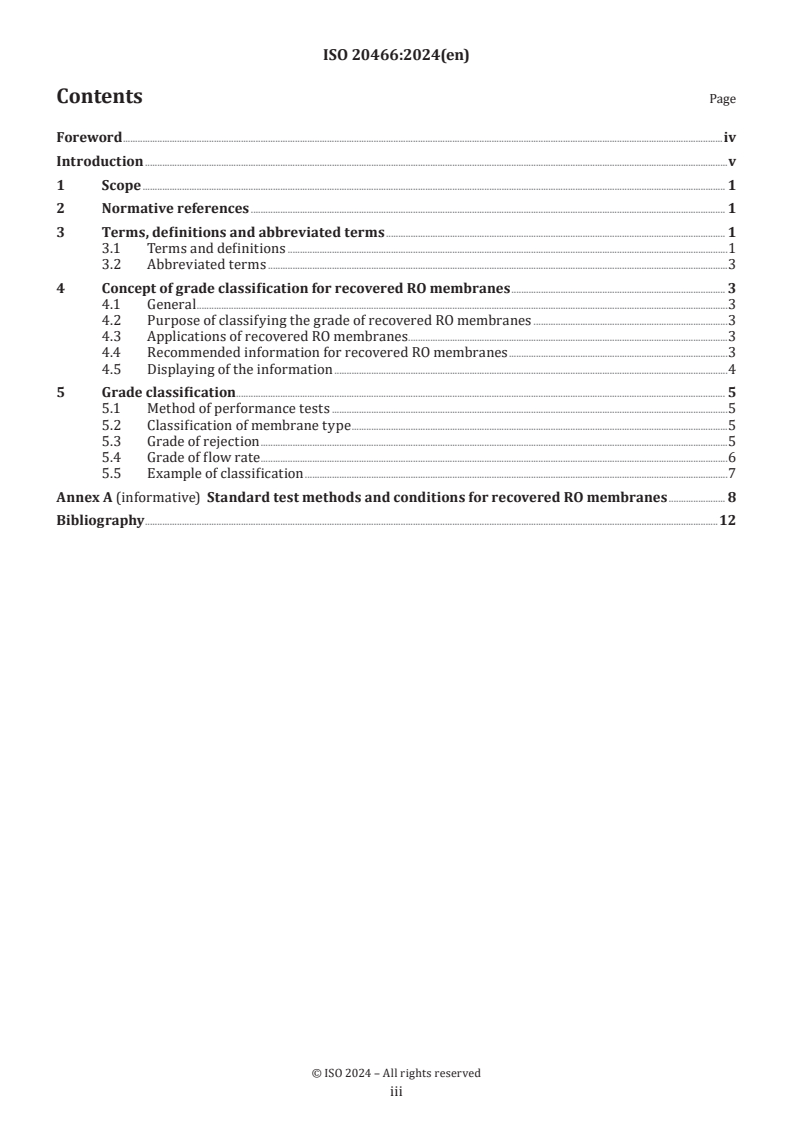
Contents Page
Foreword .iv
Introduction .v
1 Scope . 1
2 Normative references . 1
3 Terms, definitions and abbreviated terms . 1
3.1 Terms and definitions .1
3.2 Abbreviated terms .3
4 Concept of grade classification for recovered RO membranes . 3
4.1 General .3
4.2 Purpose of classifying the grade of recovered RO membranes .3
4.3 Applications of recovered RO membranes .3
4.4 Recommended information for recovered RO membranes .3
4.5 Displaying of the information .4
5 Grade classification. 5
5.1 Method of performance tests .5
5.2 Classification of membrane type .5
5.3 Grade of rejection .5
5.4 Grade of flow rate .6
5.5 Example of classification .7
Annex A (informative) Standard test methods and conditions for recovered RO membranes . 8
Bibliography .12
iii
Foreword
ISO (the International Organization for Standardization) is a worldwide federation of national standards
bodies (ISO member bodies). The work of preparing International Standards is normally carried out through
ISO technical committees. Each member body interested in a subject for which a technical committee
has been established has the right to be represented on that committee. International organizations,
governmental and non-governmental, in liaison with ISO, also take part in the work. ISO collaborates closely
with the International Electrotechnical Commission (IEC) on all matters of electrotechnical standardization.
The procedures used to develop this document and those intended for its further maintenance are described
in the ISO/IEC Directives, Part 1. In particular, the different approval criteria needed for the different types
of ISO document should be noted. This document was drafted in accordance with the editorial rules of the
ISO/IEC Directives, Part 2 (see www.iso.org/directives).
ISO draws attention to the possibility that the implementation of this document may involve the use of (a)
patent(s). ISO takes no position concerning the evidence, validity or applicability of any claimed patent
rights in respect thereof. As of the date of publication of this document, ISO had not received notice of (a)
patent(s) which may be required to implement this document. However, implementers are cautioned that
this may not represent the latest information, which may be obtained from the patent database available at
www.iso.org/patents. ISO shall not be held responsible for identifying any or all such patent rights.
Any trade name used in this document is information given for the convenience of users and does not
constitute an endorsement.
For an explanation of the voluntary nature of standards, the meaning of ISO specific terms and expressions
related to conformity assessment, as well as information about ISO's adherence to the World Trade
Organization (WTO) principles in the Technical Barriers to Trade (TBT), see www.iso.org/iso/foreword.html.
This document was prepared by Technical Committee ISO/TC 282, Water reuse, Subcommittee SC 3, Risk and
performance evaluation of water reuse systems.
Any feedback or questions on this document should be directed to the user’s national standards body. A
complete listing of these bodies can be found at www.iso.org/members.html.
iv
Introduction
Reverse osmosis (RO) membranes are used in various applications such as seawater desalination, ultrapure
water production, wastewater treatment, advanced treatment of secondary treated wastewater for reuse,
etc. However, the performance of RO membranes gradually declines due to aging and membrane fouling
caused by long-term use. At present, used RO membranes are disposed of as consumable materials after
[1]
several years of use.
However, used RO membranes, if recovered by an appropriate process such as chemical cleaning, can
be reused for various water reclamation and reuse applications, with lower costs than those involved in
[2][3]
new membrane production. For example, in Japan, disposed RO membranes from Fukuoka seawater
desalination plant have been reused for boiler feed water production in the waste water processing centre
(sewage plant).
If a used membrane is graded based on its performance, then an appropriate membrane can be selected for
each purpose for water reuse. For example, a Grade C1 membrane (lower salt rejection rate and higher flow
rate) is suitable for reuse in treating sewage for irrigation usage, while a Grade A1 membrane (higher salt
rejection and higher flow rate) is preferable for processing treated sewage for boiler feed water usage.
By reducing membrane disposal, the use of recovered RO membranes can contribute to sustainable
development goals (SDGs). Membrane life extension will promote the reduction of old membrane disposal
(GOAL12), and less production of new membranes will reduce the carbon footprint (GOAL13). Furthermore,
reusing and repurposing RO membranes will also result in an inexpensive and safe water supply to more
people (GOAL6).
In order to promote the use of recovered RO membranes, users need information on the membranes,
including their performance. This will enable new users to apply the membranes to their intended purpose.
v
International Standard ISO 20466:2024(en)
Guidance for performance grading of recovered reverse
osmosis (RO) membranes for water reuse
1 Scope
This document provides guidance and requirements for grade classification of performance of recovered
reverse osmosis (RO) membranes for water reuse systems.
This standard is applicable to the spiral-wound type of recovered membranes from seawater reverse
osmosis (SWRO) and brackish water reverse osmosis (BWRO) systems.
This standard is to ensure consistency in the performance of recovered RO membranes. It does not specify
any method or process for the recovery of RO membranes.
2 Normative references
The following documents are referred to in the text in such a way that some or all of their content constitutes
requirements of this document. For dated references, only the edition cited applies. For undated references,
the latest edition of the referenced document (including any amendments) applies.
ISO 20670:2023, Water reuse — Vocabulary
3 Terms, definitions and abbreviated terms
For the purposes of this document, the terms and definitions given in ISO 20670 and the following apply.
ISO and IEC maintain terminology databases for use in standardization at the following addresses:
— ISO Online browsing platform: available at https:// www .iso .org/ obp
— IEC Electropedia: available at https:// www .electropedia .org/
3.1 Terms and definitions
3.1.1
differential pressure
delta-P
hydraulic pressure drop across the element feed channel that is a differential pressure from the feed water
inlet to the concentrate outlet
[SOURCE: AWWA M53]
3.1.2
element
component containing the membrane, generally replaceable, such as a spiral wound cartridge
[SOURCE: ASTM D6161]
3.1.3
flux
membrane throughput
Note 1 to entry: Flux is usually expressed in volume of permeate (3.1.6) per unit membrane surface area, for example
litre per square metre per hour (l/m ·h) at a given temperature or normalized temperature (more than 20 °C).
Note 2 to entry: Flux can also be expressed in number of moles, or volume or mass of specified component per unit
time per unit membrane surface area.
[SOURCE: ISO 20468-5:2021, 3.1.8, modified — part of the original definition was moved to Note 1 to entry.]
3.1.4
flow rate
mass or volume of fluid passing through the primary device per unit time
[SOURCE: ISO 5167-1:2022, 3.3.1, modified — the admitted term “rate of flow” was removed.]
3.1.5
new membrane manufacturer
company organizations or firms that produce new reverse osmosis (RO) (3.1.10) membranes
3.1.6
permeate
portion of the feed stream that passes through a membrane
[SOURCE: ISO 20468-5:2021, 3.1.16]
3.1.7
recovered membrane supplier
company or organization that supplies or sells recovered reverse osmosis (RO) (3.1.10) membranes and takes
responsibility for quality and performance characteristics of the recovered membranes
3.1.8
recovered RO membrane
used reverse osmosis (RO) (3.1.10) membrane that can be reused after recovery (3.1.9) process
3.1.9
recovery process
recovery
process to restore performance of a used reverse osmosis (RO) (3.1.10) membrane to a certain applicable
level by washing, chemical cleaning, reforming, surface coating, etc.
3.1.10
reverse osmosis
RO
separation process in which one component of a solution is removed from another component by flowing the
feed stream under pressure across a semipermeable membrane that causes selective movement of solvent
against its osmotic pressure difference
Note 1 to entry: Reverse osmosis (RO) removes ions based on electrochemical forces, colloids, and organics down to a
molecular weight of 150, practically reported in units of Daltons. It can also be called hyperfiltration.
[SOURCE: ISO 20468-5:2021, 3.1.19]
3.1.11
used RO membrane
reverse osmosis (RO) (3.1.10) membrane that has been used for a certain period of time and is in need of
replacement
3.1.12
water reuse
use of treated wastewater for beneficial use
Note 1 to entry: Synonymous with water reclamation.
[SOURCE: ISO 20670:2023, 3.109, modified — Note 1 to entry was added.]
3.2 Abbreviated terms
SWRO seawater reverse osmosis
BWRO brackish water reverse osmosis
RO reverse osmosis
4 Concept of grade classification for recovered RO membranes
4.1 General
During a long-term operation period, RO membranes are regularly and repeatedly cleaned with chemicals.
When the membranes reach their end-of-life due to deterioration of performance, they are typically disposed
as waste.
A used RO membrane that is treated by an appropriate recovery process is regarded as a recovered RO
membrane. A recovered RO membrane that conforms to the requirements of this document is a marketable
product.
Even if the membrane is reused several times, it may be referred to as a recovered RO membrane as long as it
is subjected to an appropriate recovery step.
This document does not require any guarantee or warranty of performance of the recovered RO membrane.
Depending on the requirements of users, a guarantee or warranty, or both, can be specified as the
responsibility of the supplier.
4.2 Purpose of classifying the grade of recovered RO membranes
Classifying the grade of a recovered RO membrane based on its performance characteristics, as well as
verifying that a comprehensive performance test has been performed, can help users choose an appropriate
membrane for their applications.
Successful system design and construction or installation of a recovered RO membrane process for water
reuse can be achieved by the appropriate grading of the membrane.
Engineers should design the recovered RO membrane process after verifying membrane specifications such
as rejection and flow rate.
Clarifying these performance parameters and their expected ranges is a mandatory requirement for the
appropriate design of a system, including the feed pump head, piping size and system capacity.
In addition, the design philosophy which is specified in ISO 20468-5 can also be applied to systems with
recovered RO membranes.
4.3 Applications of recovered RO membranes
A recovered RO membrane may be applied for water reuse applications, but should not be applied for potable
use as per ISO 20469.
There are various possible applications; these include cascade implementations in which RO membranes
that are initially used for seawater desalination are subsequently reused for tertiary treatment of sewage or
reused in the same process, or both.
4.4 Recommended information for
...