

ISO 25947-1:2017
(Main)Fireworks — Categories 1, 2 and 3 — Part 1: Terminology
General Information
- Abstract
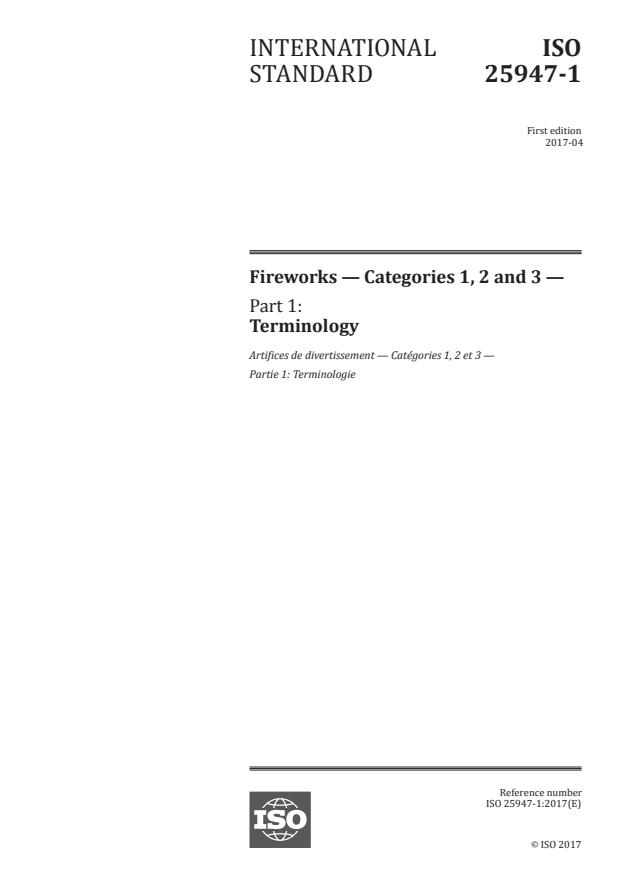
ISO 25947-1:2017 defines various terms relating to the design, construction, primary packaging and testing of fireworks of categories 1, 2 and 3.
- Status
- Published
- Publication Date
- 22-Mar-2017
- Technical Committee
- ISO/TC 264 - Fireworks
- Drafting Committee
- ISO/TC 264 - Fireworks
- Current Stage
- 9092 - International Standard to be revised
- Start Date
- 19-Sep-2024
- Completion Date
- 29-Aug-2026
Buy Documents
ISO 25947-1:2017 - Fireworks -- Categories 1, 2 and 3
ISO 25947-1:2017 - Fireworks — Categories 1, 2 and 3 — Part 1: Terminology/23/2017
ISO 25947-1:2017 - Artifices de divertissement -- Catégories 1, 2 et 3
ISO 25947-1:2017 - Artifices de divertissement — Catégories 1, 2 et 3 — Partie 1: Terminologie/4/2017
Overview
ISO 25947-1:2017 is an international standard developed by the International Organization for Standardization (ISO) that focuses on terminology related to fireworks in Categories 1, 2, and 3. This standard provides clear and consistent definitions for terms used in the design, construction, primary packaging, and testing of these fireworks. By standardizing the language and concepts, ISO 25947-1:2017 supports manufacturers, testers, regulators, and users in ensuring safety, compliance, and uniform understanding within the fireworks industry.
The document is part one of a series and aimed specifically at improving communication and quality assurance when handling fireworks of these three categories. It covers essential terminology such as pyrotechnic compositions, effects, components, and nonconformities, providing a foundation for product development, testing, and regulatory adherence.
Key Topics
- Firework Categories: Specifically addresses Categories 1 (indoor fireworks), 2 (garden fireworks), and 3 (display fireworks).
- Terminology Definitions: Defines critical terms such as:
- Firework Case: The container designed to retain pyrotechnic compositions and influence firework behavior.
- Pyrotechnic Composition: Substance or mixture producing visual, aural, or gas-evolving effects upon ignition.
- Initial Fuse and Ignition Head: Components responsible for initiating firework function.
- Bursting Charge and Propellant Charge: Specific pyrotechnic components causing explosions or propulsion without bursting the case.
- Nonconformities: Classifications of defects (critical, major, minor) affecting safety or usability.
- Net Explosive Content (NEC): The mass of explosive composition excluding ignition elements.
- Testing Terms: Including batch tests, type tests, and acceptance quality limit (AQL).
- Packaging Concepts: Explains primary pack and selection pack terminology relevant to retail and consumer handling.
- Safety-Related Definitions: Critical for identifying hazardous conditions, such as critical nonconformities and projected debris.
Applications
ISO 25947-1:2017 is designed primarily for professionals involved in the production, quality control, testing, and regulatory oversight of fireworks in categories 1, 2, and 3. Its key applications include:
- Product Design and Manufacturing: Ensures using standardized terminology during design, construction, and quality inspections.
- Quality Assurance and Testing: Assists in defining criteria for batch testing, type testing, and interpreting nonconformities to maintain safety and performance.
- Regulatory Compliance: Provides authorities with uniform terminology for safety inspections, certifications, and enforcement of regulations.
- Consumer Safety Information: Clarifies packaging terms and product definitions that contribute to improved consumer understanding and safe handling.
- Industry Training and Documentation: Acts as a reference guide for staff training and technical documentation within the fireworks industry.
Related Standards
ISO 25947-1:2017 interacts closely with other standards to form a comprehensive framework for fireworks:
- ISO 25947-2: Defines categories and types of fireworks for Categories 1, 2, and 3.
- ISO 26261 series: Pertains to Category 4 fireworks, including higher hazard products.
- ISO 2859-1:1999: Provides sampling procedures for inspection by attributes, referenced for acceptance quality limits (AQL) and nonconformity classes.
- ISO/IEC Directives: Guide the development, maintenance, and approval of ISO standards, ensuring international collaboration and consistency.
Keywords: ISO 25947-1, fireworks terminology, fireworks safety standards, pyrotechnic definitions, fireworks categories 1 2 3, fireworks packaging, firework testing, fireworks design, nonconformity classification, net explosive content, pyro compositions, fireworks industry standards, ISO fireworks terminology
Buy Documents
ISO 25947-1:2017 - Fireworks -- Categories 1, 2 and 3
ISO 25947-1:2017 - Fireworks — Categories 1, 2 and 3 — Part 1: Terminology/23/2017
ISO 25947-1:2017 - Artifices de divertissement -- Catégories 1, 2 et 3
ISO 25947-1:2017 - Artifices de divertissement — Catégories 1, 2 et 3 — Partie 1: Terminologie/4/2017
Related Packages
Get Certified
Connect with accredited certification bodies for this standard

ECOCERT
Organic and sustainability certification.

Eurofins Food Testing Global
Global leader in food, environment, and pharmaceutical product testing.

Intertek Bangladesh
Intertek certification and testing services in Bangladesh.
Sponsored listings
Frequently Asked Questions
ISO 25947-1:2017 is a standard published by the International Organization for Standardization (ISO). Its full title is "Fireworks — Categories 1, 2 and 3 — Part 1: Terminology". This standard covers: ISO 25947-1:2017 defines various terms relating to the design, construction, primary packaging and testing of fireworks of categories 1, 2 and 3.
ISO 25947-1:2017 defines various terms relating to the design, construction, primary packaging and testing of fireworks of categories 1, 2 and 3.
ISO 25947-1:2017 is classified under the following ICS (International Classification for Standards) categories: 01.040.71 - Chemical technology (Vocabularies); 71.100.30 - Explosives. Pyrotechnics and fireworks. The ICS classification helps identify the subject area and facilitates finding related standards.
ISO 25947-1:2017 is available in PDF format for immediate download after purchase. The document can be added to your cart and obtained through the secure checkout process. Digital delivery ensures instant access to the complete standard document.
Standards Content (Sample)
INTERNATIONAL ISO
STANDARD 25947-1
First edition
2017-04
Fireworks — Categories 1, 2 and 3 —
Part 1:
Terminology
Artifices de divertissement — Catégories 1, 2 et 3 —
Partie 1: Terminologie
Reference number
©
ISO 2017
© ISO 2017, Published in Switzerland
All rights reserved. Unless otherwise specified, no part of this publication may be reproduced or utilized otherwise in any form
or by any means, electronic or mechanical, including photocopying, or posting on the internet or an intranet, without prior
written permission. Permission can be requested from either ISO at the address below or ISO’s member body in the country of
the requester.
ISO copyright office
Ch. de Blandonnet 8 • CP 401
CH-1214 Vernier, Geneva, Switzerland
Tel. +41 22 749 01 11
Fax +41 22 749 09 47
copyright@iso.org
www.iso.org
ii © ISO 2017 – All rights reserved
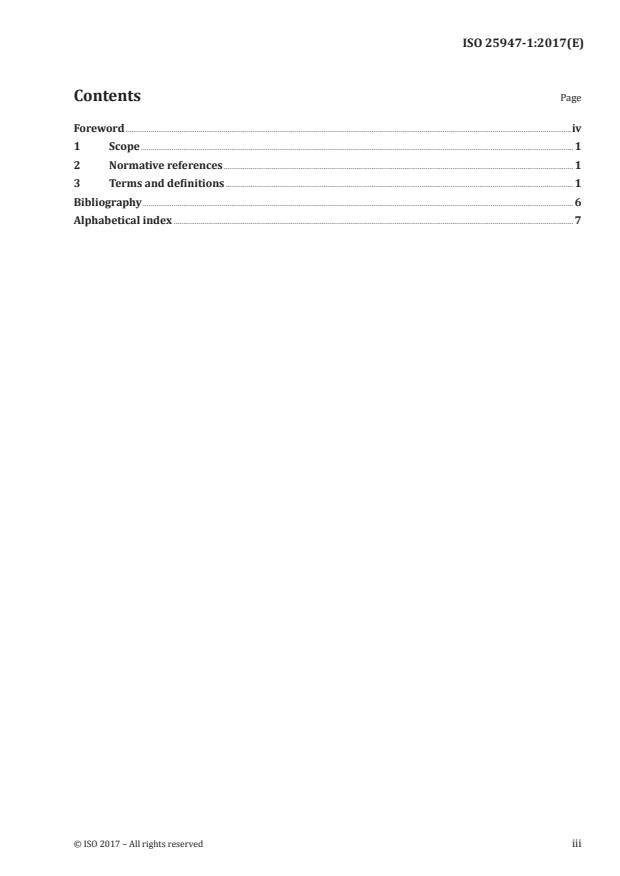
Contents Page
Foreword .iv
1 Scope . 1
2 Normative references . 1
3 Terms and definitions . 1
Bibliography . 6
Alphabetical index . 7
Foreword
ISO (the International Organization for Standardization) is a worldwide federation of national standards
bodies (ISO member bodies). The work of preparing International Standards is normally carried out
through ISO technical committees. Each member body interested in a subject for which a technical
committee has been established has the right to be represented on that committee. International
organizations, governmental and non-governmental, in liaison with ISO, also take part in the work.
ISO collaborates closely with the International Electrotechnical Commission (IEC) on all matters of
electrotechnical standardization.
The procedures used to develop this document and those intended for its further maintenance are
described in the ISO/IEC Directives, Part 1. In particular the different approval criteria needed for the
different types of ISO documents should be noted. This document was drafted in accordance with the
editorial rules of the ISO/IEC Directives, Part 2 (see www .iso .org/ directives).
Attention is drawn to the possibility that some of the elements of this document may be the subject of
patent rights. ISO shall not be held responsible for identifying any or all such patent rights. Details of
any patent rights identified during the development of the document will be in the Introduction and/or
on the ISO list of patent declarations received (see www .iso .org/ patents).
Any trade name used in this document is information given for the convenience of users and does not
constitute an endorsement.
For an explanation on the voluntary nature of standards, the meaning of ISO specific terms and expressions related to
conformity assessment, as well as information about ISO’s adherence to the World Trade Organization
(WTO) principles in the Technical Barriers to Trade (TBT) see the following URL: www .iso. org/ iso/
foreword. html.
This document was prepared by Technical Committee ISO/TC 264, Fireworks.
A list of all the parts in the ISO 25947 series can be found on the ISO website.
iv © ISO 2017 – All rights reserved
INTERNATIONAL STANDARD ISO 25947-1:2017(E)
Fireworks — Categories 1, 2 and 3 —
Part 1:
Terminology
1 Scope
This document defines various terms relating to the design, construction, primary packaging and
testing of fireworks of categories 1, 2 and 3.
2 Normative references
The following documents are referred to in the text in such a way that some or all of their content
constitutes requirements of this document. For dated references, only the edition cited applies. For
undated references, the latest edition of the referenced document (including any amendments) applies.
ISO 25947-2, Fireworks — Categories 1, 2 and 3 — Part 2: Categories and types of firework
3 Terms and definitions
For the purposes of this document, the following terms and definitions apply.
ISO and IEC maintain terminological databases for use in standardization at the following addresses:
— IEC Electropedia: available at http:// www .electropedia .org/
— ISO Online browsing platform: available at http:// www .iso .org/ obp
3.1
acceptance quality limit
AQL
quality level that is the worst tolerable process average when a continuing series of lots is submitted for
acceptance sampling
[SOURCE: ISO 2859‑1:1999, 3.1.26]
3.2
batch test
test performed on a sample of products taken at random from a production batch to check compliance
with a given standard
Note 1 to entry: Batch testing needs all products in the production batch to comply with the characteristics the
standard requires to ensure homogeneity of the whole batch. It aims to prove that all products which are placed
on the market are in conformity with the type which is described in the type‑examination certificate and have
been successfully submitted to type tests as determined by the standard.
3.3
black powder
intimate mixture of charcoal and sodium nitrate or potassium nitrate with or without sulfur
3.4
burning rate of composition
net explosive content (3.27) in grams divided by the effect time in seconds
3.5
bursting charge
pyrotechnic composition (3.36) which is intended to burst open the firework case (3.14), in order to expel
one or more pyrotechnic units (3.37), which can also transmit ignition
3.6
critical nonconforming unit
nonconforming unit (3.28) with one or more critical nonconformities (3.7), with or without major (3.24)
or minor nonconformities (3.26)
3.7
critical nonconformity
nonconformity (3.29) that judgement and experience indicate is likely to result in hazardous or unsafe
conditions
Note 1 to entry: This type of nonconformity is referred to as a “class A nonconformity” in ISO 2859‑1:1999.
3.8
debris
any part of the firework (3.15) which remains after the firework has ceased to function
3.9
droop
angle by which the tip of a composition‑coated wire has been deflected from the horizontal, after the
firework (3.15) has ceased to burn
3.10
effect charge
pyrotechnic composition (3.36), other than propellant charge (3.34) or bursting charge (3.5), which, upon
functioni
...
INTERNATIONAL ISO
STANDARD 25947-1
First edition
2017-04
Fireworks — Categories 1, 2 and 3 —
Part 1:
Terminology
Artifices de divertissement — Catégories 1, 2 et 3 —
Partie 1: Terminologie
Reference number
©
ISO 2017
© ISO 2017, Published in Switzerland
All rights reserved. Unless otherwise specified, no part of this publication may be reproduced or utilized otherwise in any form
or by any means, electronic or mechanical, including photocopying, or posting on the internet or an intranet, without prior
written permission. Permission can be requested from either ISO at the address below or ISO’s member body in the country of
the requester.
ISO copyright office
Ch. de Blandonnet 8 • CP 401
CH-1214 Vernier, Geneva, Switzerland
Tel. +41 22 749 01 11
Fax +41 22 749 09 47
copyright@iso.org
www.iso.org
ii © ISO 2017 – All rights reserved
Contents Page
Foreword .iv
1 Scope . 1
2 Normative references . 1
3 Terms and definitions . 1
Bibliography . 6
Alphabetical index . 7
Foreword
ISO (the International Organization for Standardization) is a worldwide federation of national standards
bodies (ISO member bodies). The work of preparing International Standards is normally carried out
through ISO technical committees. Each member body interested in a subject for which a technical
committee has been established has the right to be represented on that committee. International
organizations, governmental and non-governmental, in liaison with ISO, also take part in the work.
ISO collaborates closely with the International Electrotechnical Commission (IEC) on all matters of
electrotechnical standardization.
The procedures used to develop this document and those intended for its further maintenance are
described in the ISO/IEC Directives, Part 1. In particular the different approval criteria needed for the
different types of ISO documents should be noted. This document was drafted in accordance with the
editorial rules of the ISO/IEC Directives, Part 2 (see www .iso .org/ directives).
Attention is drawn to the possibility that some of the elements of this document may be the subject of
patent rights. ISO shall not be held responsible for identifying any or all such patent rights. Details of
any patent rights identified during the development of the document will be in the Introduction and/or
on the ISO list of patent declarations received (see www .iso .org/ patents).
Any trade name used in this document is information given for the convenience of users and does not
constitute an endorsement.
For an explanation on the voluntary nature of standards, the meaning of ISO specific terms and expressions related to
conformity assessment, as well as information about ISO’s adherence to the World Trade Organization
(WTO) principles in the Technical Barriers to Trade (TBT) see the following URL: www .iso. org/ iso/
foreword. html.
This document was prepared by Technical Committee ISO/TC 264, Fireworks.
A list of all the parts in the ISO 25947 series can be found on the ISO website.
iv © ISO 2017 – All rights reserved
INTERNATIONAL STANDARD ISO 25947-1:2017(E)
Fireworks — Categories 1, 2 and 3 —
Part 1:
Terminology
1 Scope
This document defines various terms relating to the design, construction, primary packaging and
testing of fireworks of categories 1, 2 and 3.
2 Normative references
The following documents are referred to in the text in such a way that some or all of their content
constitutes requirements of this document. For dated references, only the edition cited applies. For
undated references, the latest edition of the referenced document (including any amendments) applies.
ISO 25947-2, Fireworks — Categories 1, 2 and 3 — Part 2: Categories and types of firework
3 Terms and definitions
For the purposes of this document, the following terms and definitions apply.
ISO and IEC maintain terminological databases for use in standardization at the following addresses:
— IEC Electropedia: available at http:// www .electropedia .org/
— ISO Online browsing platform: available at http:// www .iso .org/ obp
3.1
acceptance quality limit
AQL
quality level that is the worst tolerable process average when a continuing series of lots is submitted for
acceptance sampling
[SOURCE: ISO 2859‑1:1999, 3.1.26]
3.2
batch test
test performed on a sample of products taken at random from a production batch to check compliance
with a given standard
Note 1 to entry: Batch testing needs all products in the production batch to comply with the characteristics the
standard requires to ensure homogeneity of the whole batch. It aims to prove that all products which are placed
on the market are in conformity with the type which is described in the type‑examination certificate and have
been successfully submitted to type tests as determined by the standard.
3.3
black powder
intimate mixture of charcoal and sodium nitrate or potassium nitrate with or without sulfur
3.4
burning rate of composition
net explosive content (3.27) in grams divided by the effect time in seconds
3.5
bursting charge
pyrotechnic composition (3.36) which is intended to burst open the firework case (3.14), in order to expel
one or more pyrotechnic units (3.37), which can also transmit ignition
3.6
critical nonconforming unit
nonconforming unit (3.28) with one or more critical nonconformities (3.7), with or without major (3.24)
or minor nonconformities (3.26)
3.7
critical nonconformity
nonconformity (3.29) that judgement and experience indicate is likely to result in hazardous or unsafe
conditions
Note 1 to entry: This type of nonconformity is referred to as a “class A nonconformity” in ISO 2859‑1:1999.
3.8
debris
any part of the firework (3.15) which remains after the firework has ceased to function
3.9
droop
angle by which the tip of a composition‑coated wire has been deflected from the horizontal, after the
firework (3.15) has ceased to burn
3.10
effect charge
pyrotechnic composition (3.36), other than propellant charge (3.34) or bursting charge (3.5), which, upon
functioni
...
NORME ISO
INTERNATIONALE 25947-1
Première édition
2017-04
Artifices de divertissement —
Catégories 1, 2 et 3 —
Partie 1:
Terminologie
Fireworks — Categories 1, 2 and 3 —
Part 1: Terminology
Numéro de référence
©
ISO 2017
DOCUMENT PROTÉGÉ PAR COPYRIGHT
© ISO 2017, Publié en Suisse
Droits de reproduction réservés. Sauf indication contraire, aucune partie de cette publication ne peut être reproduite ni utilisée
sous quelque forme que ce soit et par aucun procédé, électronique ou mécanique, y compris la photocopie, l’affichage sur
l’internet ou sur un Intranet, sans autorisation écrite préalable. Les demandes d’autorisation peuvent être adressées à l’ISO à
l’adresse ci-après ou au comité membre de l’ISO dans le pays du demandeur.
ISO copyright office
Ch. de Blandonnet 8 • CP 401
CH-1214 Vernier, Geneva, Switzerland
Tel. +41 22 749 01 11
Fax +41 22 749 09 47
copyright@iso.org
www.iso.org
ii © ISO 2017 – Tous droits réservés
Sommaire Page
Avant-propos .iv
1 Domaine d’application . 1
2 Références normatives . 1
3 Termes et définitions . 1
Bibliographie .6
Index alphabétique. 7
Avant-propos
L’ISO (Organisation internationale de normalisation) est une fédération mondiale d’organismes
nationaux de normalisation (comités membres de l’ISO). L’élaboration des Normes internationales est
en général confiée aux comités techniques de l’ISO. Chaque comité membre intéressé par une étude
a le droit de faire partie du comité technique créé à cet effet. Les organisations internationales,
gouvernementales et non gouvernementales, en liaison avec l’ISO participent également aux travaux.
L’ISO collabore étroitement avec la Commission électrotechnique internationale (IEC) en ce qui
concerne la normalisation électrotechnique.
Les procédures utilisées pour élaborer le présent document et celles destinées à sa mise à jour sont
décrites dans les Directives ISO/IEC, Partie 1. Il convient, en particulier de prendre note des différents
critères d’approbation requis pour les différents types de documents ISO. Le présent document a été
rédigé conformément aux règles de rédaction données dans les Directives ISO/IEC, Partie 2 (voir www
.iso .org/ directives).
L’attention est appelée sur le fait que certains des éléments du présent document peuvent faire l’objet de
droits de propriété intellectuelle ou de droits analogues. L’ISO ne saurait être tenue pour responsable
de ne pas avoir identifié de tels droits de propriété et averti de leur existence. Les détails concernant
les références aux droits de propriété intellectuelle ou autres droits analogues identifiés lors de
l’élaboration du document sont indiqués dans l’Introduction et/ou dans la liste des déclarations de
brevets reçues par l’ISO (voir www .iso .org/ brevets).
Les appellations commerciales éventuellement mentionnées dans le présent document sont données
pour information, par souci de commodité, à l’intention des utilisateurs et ne sauraient constituer un
engagement.
Pour une explication de la nature volontaire des normes, la signification des termes et expressions
spécifiques de l’ISO liés à l’évaluation de la conformité, ou pour toute information au sujet de l’adhésion
de l’ISO aux principes de l’OMC concernant les obstacles techniques au commerce (OTC), voir le lien
suivant: w w w . i s o .org/ iso/ fr/ foreword .html.
Le présent document a été élaboré par le comité technique ISO/TC 264, Artifices de divertissement.
Une liste de toutes les parties de la série ISO 25947 est disponible sur le site Internet de l’ISO.
iv © ISO 2017 – Tous droits réservés
NORME INTERNATIONALE ISO 25947-1:2017(F)
Artifices de divertissement — Catégories 1, 2 et 3 —
Partie 1:
Terminologie
1 Domaine d’application
Le présent document définit divers termes concernant la conception, la construction, l’emballage
primaire et les essais des artifices de divertissement de catégories 1, 2 et 3.
2 Références normatives
Les documents suivants cités dans le texte constituent, pour tout ou partie de leur contenu, des
exigences du présent document. Pour les références datées, seule l’édition citée s’applique. Pour les
références non datées, la dernière édition du document de référence s’applique (y compris les éventuels
amendements).
ISO 25947-2, Artifices de divertissement — Catégories 1, 2 et 3 — Partie 2: Catégories et types
3 Termes et définitions
Pour les besoins du présent document, les termes et définitions suivants s’appliquent.
L’ISO et l’IEC tiennent à jour des bases de données terminologiques destinées à être utilisées en
normalisation, consultables aux adresses suivantes:
— IEC Electropedia: disponible à l’adresse http:// www .electropedia .org/ .
— ISO Online browsing platform: disponible à l’adresse http:// www .iso .org/ obp.
3.1
niveau de qualité acceptable
NQA
sur une série continue de lots, niveau de qualité qui, pour le contrôle par échantillonnage, constitue la
limite pour une moyenne de processus satisfaisante
[SOURCE: ISO 2859‑1:1999, 3.1.26]
3.2
essai de lot
essai effectué sur un échantillon de produits pris au hasard dans un lot de production pour vérifier la
conformité à une norme donnée
Note 1 à l’article: L’essai de lot nécessite que tous les produits du lot de production soient conformes aux
caractéristiques exigées par la norme pour assurer l’homogénéité de l’ensemble du lot. Il vise à prouver que tous
les produits qui sont mis sur le marché sont conformes au type décrit dans le certificat d’examen de type et ont
passé avec succès les essais de type définis par la norme.
3.3
poudre noire
mélange intime de charbon et de nitrate de sodium ou de potassium, avec ou sans soufre
3.4
vitesse de combustion de la composition
masse active (3.27) en grammes divisée par la durée de l’effet en secondes
3.5
charge d’éclatement
composition pyrotechnique (3.36) destinée à éclater pour ouvrir le corps de l’artifice (3.14) avant
d’expulser un ou plusieurs composants pyrotechniques élémentaires (3.37), qui peut également
transmettre l’allumage
3.6
produit avec non-conformité critique
produit non conforme (3.28) qui présente une ou plusieurs non-conformités critiques (3.7), pouvant
également comporter ou non des non-conformités majeures (3.24) ou mineures (3.26)
3.7
non-conformité critique
non-conformité (3.29) qui, d’après le jugement ou l’expérience, est susceptible de conduire à des
situations dangereuses ou à un manque de sécurité
Note 1 à l’article: Ce type de non-conformité est appelée «classe A de non-conformité» dans l’ISO 2859-1:1999.
3.8
débris
toute partie de l’artifice de divertissement (3.15) restant après qu’il a fonctionné
3.9
fléchissement
angle de déviation de l’extrémité d’un fil enrobé d’une composition par rapport à l’horizontale après
que l’artifice de divertissement (3.15) a cessé de se consumer
3.10
charge d’effet
composition pyrotechnique (3.36) autre qu’une charge propulsive (3.34) ou charge d’éclatement (3.5), qui,
en fonctionnement, est destinée à brûler ou à exploser pour produire un effet visuel et/ou sonore
3.11
bouchon de fermeture
partie ou sertissage destiné à fermer une extrémité du corps de l’artifice (3.14)
3.12
explosion
libération d’énergie en un temps très court accompagnée d’un effet sonore déflagrant, avec ou sans
flash lumineux
3.13
support externe
support qui ne fait pas partie intég
...
NORME ISO
INTERNATIONALE 25947-1
Première édition
2017-04
Artifices de divertissement —
Catégories 1, 2 et 3 —
Partie 1:
Terminologie
Fireworks — Categories 1, 2 and 3 —
Part 1: Terminology
Numéro de référence
©
ISO 2017
DOCUMENT PROTÉGÉ PAR COPYRIGHT
© ISO 2017, Publié en Suisse
Droits de reproduction réservés. Sauf indication contraire, aucune partie de cette publication ne peut être reproduite ni utilisée
sous quelque forme que ce soit et par aucun procédé, électronique ou mécanique, y compris la photocopie, l’affichage sur
l’internet ou sur un Intranet, sans autorisation écrite préalable. Les demandes d’autorisation peuvent être adressées à l’ISO à
l’adresse ci-après ou au comité membre de l’ISO dans le pays du demandeur.
ISO copyright office
Ch. de Blandonnet 8 • CP 401
CH-1214 Vernier, Geneva, Switzerland
Tel. +41 22 749 01 11
Fax +41 22 749 09 47
copyright@iso.org
www.iso.org
ii © ISO 2017 – Tous droits réservés
Sommaire Page
Avant-propos .iv
1 Domaine d’application . 1
2 Références normatives . 1
3 Termes et définitions . 1
Bibliographie .6
Index alphabétique. 7
Avant-propos
L’ISO (Organisation internationale de normalisation) est une fédération mondiale d’organismes
nationaux de normalisation (comités membres de l’ISO). L’élaboration des Normes internationales est
en général confiée aux comités techniques de l’ISO. Chaque comité membre intéressé par une étude
a le droit de faire partie du comité technique créé à cet effet. Les organisations internationales,
gouvernementales et non gouvernementales, en liaison avec l’ISO participent également aux travaux.
L’ISO collabore étroitement avec la Commission électrotechnique internationale (IEC) en ce qui
concerne la normalisation électrotechnique.
Les procédures utilisées pour élaborer le présent document et celles destinées à sa mise à jour sont
décrites dans les Directives ISO/IEC, Partie 1. Il convient, en particulier de prendre note des différents
critères d’approbation requis pour les différents types de documents ISO. Le présent document a été
rédigé conformément aux règles de rédaction données dans les Directives ISO/IEC, Partie 2 (voir www
.iso .org/ directives).
L’attention est appelée sur le fait que certains des éléments du présent document peuvent faire l’objet de
droits de propriété intellectuelle ou de droits analogues. L’ISO ne saurait être tenue pour responsable
de ne pas avoir identifié de tels droits de propriété et averti de leur existence. Les détails concernant
les références aux droits de propriété intellectuelle ou autres droits analogues identifiés lors de
l’élaboration du document sont indiqués dans l’Introduction et/ou dans la liste des déclarations de
brevets reçues par l’ISO (voir www .iso .org/ brevets).
Les appellations commerciales éventuellement mentionnées dans le présent document sont données
pour information, par souci de commodité, à l’intention des utilisateurs et ne sauraient constituer un
engagement.
Pour une explication de la nature volontaire des normes, la signification des termes et expressions
spécifiques de l’ISO liés à l’évaluation de la conformité, ou pour toute information au sujet de l’adhésion
de l’ISO aux principes de l’OMC concernant les obstacles techniques au commerce (OTC), voir le lien
suivant: w w w . i s o .org/ iso/ fr/ foreword .html.
Le présent document a été élaboré par le comité technique ISO/TC 264, Artifices de divertissement.
Une liste de toutes les parties de la série ISO 25947 est disponible sur le site Internet de l’ISO.
iv © ISO 2017 – Tous droits réservés
NORME INTERNATIONALE ISO 25947-1:2017(F)
Artifices de divertissement — Catégories 1, 2 et 3 —
Partie 1:
Terminologie
1 Domaine d’application
Le présent document définit divers termes concernant la conception, la construction, l’emballage
primaire et les essais des artifices de divertissement de catégories 1, 2 et 3.
2 Références normatives
Les documents suivants cités dans le texte constituent, pour tout ou partie de leur contenu, des
exigences du présent document. Pour les références datées, seule l’édition citée s’applique. Pour les
références non datées, la dernière édition du document de référence s’applique (y compris les éventuels
amendements).
ISO 25947-2, Artifices de divertissement — Catégories 1, 2 et 3 — Partie 2: Catégories et types
3 Termes et définitions
Pour les besoins du présent document, les termes et définitions suivants s’appliquent.
L’ISO et l’IEC tiennent à jour des bases de données terminologiques destinées à être utilisées en
normalisation, consultables aux adresses suivantes:
— IEC Electropedia: disponible à l’adresse http:// www .electropedia .org/ .
— ISO Online browsing platform: disponible à l’adresse http:// www .iso .org/ obp.
3.1
niveau de qualité acceptable
NQA
sur une série continue de lots, niveau de qualité qui, pour le contrôle par échantillonnage, constitue la
limite pour une moyenne de processus satisfaisante
[SOURCE: ISO 2859‑1:1999, 3.1.26]
3.2
essai de lot
essai effectué sur un échantillon de produits pris au hasard dans un lot de production pour vérifier la
conformité à une norme donnée
Note 1 à l’article: L’essai de lot nécessite que tous les produits du lot de production soient conformes aux
caractéristiques exigées par la norme pour assurer l’homogénéité de l’ensemble du lot. Il vise à prouver que tous
les produits qui sont mis sur le marché sont conformes au type décrit dans le certificat d’examen de type et ont
passé avec succès les essais de type définis par la norme.
3.3
poudre noire
mélange intime de charbon et de nitrate de sodium ou de potassium, avec ou sans soufre
3.4
vitesse de combustion de la composition
masse active (3.27) en grammes divisée par la durée de l’effet en secondes
3.5
charge d’éclatement
composition pyrotechnique (3.36) destinée à éclater pour ouvrir le corps de l’artifice (3.14) avant
d’expulser un ou plusieurs composants pyrotechniques élémentaires (3.37), qui peut également
transmettre l’allumage
3.6
produit avec non-conformité critique
produit non conforme (3.28) qui présente une ou plusieurs non-conformités critiques (3.7), pouvant
également comporter ou non des non-conformités majeures (3.24) ou mineures (3.26)
3.7
non-conformité critique
non-conformité (3.29) qui, d’après le jugement ou l’expérience, est susceptible de conduire à des
situations dangereuses ou à un manque de sécurité
Note 1 à l’article: Ce type de non-conformité est appelée «classe A de non-conformité» dans l’ISO 2859-1:1999.
3.8
débris
toute partie de l’artifice de divertissement (3.15) restant après qu’il a fonctionné
3.9
fléchissement
angle de déviation de l’extrémité d’un fil enrobé d’une composition par rapport à l’horizontale après
que l’artifice de divertissement (3.15) a cessé de se consumer
3.10
charge d’effet
composition pyrotechnique (3.36) autre qu’une charge propulsive (3.34) ou charge d’éclatement (3.5), qui,
en fonctionnement, est destinée à brûler ou à exploser pour produire un effet visuel et/ou sonore
3.11
bouchon de fermeture
partie ou sertissage destiné à fermer une extrémité du corps de l’artifice (3.14)
3.12
explosion
libération d’énergie en un temps très court accompagnée d’un effet sonore déflagrant, avec ou sans
flash lumineux
3.13
support externe
support qui ne fait pas partie intég
...