

ISO 14625:2023
(Main)Space systems — Ground support equipment for use at launch, landing or retrieval sites — General requirements
General Information
- Abstract
This document specifies the general characteristics, performance, design, test, checkout, maintenance, safety, reliability, maintainability and quality requirements for ground support equipment (GSE) and systems intended for use at launch, landing or retrieval-site installations, or other locations that are the responsibility of the launch, landing and retrieval site. This document does not specify how to design, checkout and maintain GSE, but establishes the minimum requirements to provide simple, robust, safe, reliable, maintainable and cost-effective GSE. This document is applicable to the design, checkout and maintenance of non-flight hardware and software used to support the operations of transporting, receiving, handling, assembly, inspection, test, checkout, service, launch and recovery of space vehicles and payloads at the launch, landing or retrieval sites. As such, the requirements of this document are optional for hardware used only at the manufacturing, development or test sites prior to arrival at the launch, landing or retrieval sites. However, if such GSE is dual use equipment to be also at a launch, landing or retrieval site, for whatever reason, all the safety-related requirements of this document apply to the GSE.
- Status
- Published
- Publication Date
- 23-Jan-2023
- Technical Committee
- ISO/TC 20/SC 14 - Space systems and operations
- Drafting Committee
- ISO/TC 20/SC 14/WG 3 - Operations and support systems
- Current Stage
- 6060 - International Standard published
- Start Date
- 24-Jan-2023
- Due Date
- 08-Jul-2022
- Completion Date
- 24-Jan-2023


Overview
ISO 14625:2023 - Space systems - Ground support equipment for use at launch, landing or retrieval sites - General requirements defines minimum requirements for ground support equipment (GSE) and systems used at launch, landing or retrieval-site installations. The standard sets out general characteristics, performance, design, test, checkout, maintenance, safety, reliability, maintainability and quality requirements for non‑flight hardware and software that support transporting, handling, assembly, inspection, test, checkout, service, launch and recovery of space vehicles and payloads.
Key topics and technical requirements
ISO 14625:2023 addresses the full lifecycle of GSE with emphasis on robust, safe and cost‑effective equipment. Major technical topics include:
- Functional designations (servicing, checkout/test, handling/transportation, auxiliary and umbilical GSE)
- Performance and physical characteristics (operability, interfaces, producibility, life limits, coatings, colours, metric system, redundancy)
- Reliability and maintainability requirements to support predictable operations and upkeep
- Environmental conditions (natural, launch‑induced, controlled/uncontrolled interiors, fire/explosion, seismic and environmental test methods)
- Documentation (drawings, technical documentation, operations & maintenance documentation)
- Supply support, personnel & training, qualification and quality assurance (testing, load tests, NDT, calibration, conformance verification)
- Packaging and transportability (preservation, shipping containers, marking, precision clean parts)
- Design and construction requirements across structural, mechanical (pneumatics, cryogenics, hydraulics, lifting devices, tethers, jacks), electrical/electronic systems and hazard-proofing
Practical applications and who uses it
ISO 14625:2023 is used to:
- Develop procurement specifications and acceptance criteria for GSE at launch, landing or retrieval sites
- Guide GSE design reviews to ensure safety, maintainability and environmental robustness
- Define test and checkout procedures, qualification plans and quality control for suppliers and integrators
- Structure maintenance programs, training curricula and documentation packages for site operators
Typical users:
- GSE designers and manufacturers
- Launch site operators and integrators
- Program managers, safety and reliability engineers
- Logistics, maintenance teams and procurement specialists
Note: the standard applies primarily to GSE at launch/landing/retrieval sites; equipment used only in manufacturing or test sites is optional unless the GSE is dual‑use, in which case safety requirements apply.
Related standards
For full compliance, organizations typically apply ISO 14625 alongside other space systems standards and relevant national/international standards for testing, seismic qualification, NDT, electrical safety and clean‑room/environmental control. Obtain ISO 14625:2023 from ISO for authoritative requirements.
Relations
- Effective Date
- 23-Apr-2020
Get Certified
Connect with accredited certification bodies for this standard

BUREAU VERITAS Certification Germany
Bureau Veritas certification in Germany.

Element Materials Technology
Materials testing and product certification.

AQMS Ltd.
AQMS provides ISO certification to SMEs across the UK.
Sponsored listings
Frequently Asked Questions
ISO 14625:2023 is a standard published by the International Organization for Standardization (ISO). Its full title is "Space systems — Ground support equipment for use at launch, landing or retrieval sites — General requirements". This standard covers: This document specifies the general characteristics, performance, design, test, checkout, maintenance, safety, reliability, maintainability and quality requirements for ground support equipment (GSE) and systems intended for use at launch, landing or retrieval-site installations, or other locations that are the responsibility of the launch, landing and retrieval site. This document does not specify how to design, checkout and maintain GSE, but establishes the minimum requirements to provide simple, robust, safe, reliable, maintainable and cost-effective GSE. This document is applicable to the design, checkout and maintenance of non-flight hardware and software used to support the operations of transporting, receiving, handling, assembly, inspection, test, checkout, service, launch and recovery of space vehicles and payloads at the launch, landing or retrieval sites. As such, the requirements of this document are optional for hardware used only at the manufacturing, development or test sites prior to arrival at the launch, landing or retrieval sites. However, if such GSE is dual use equipment to be also at a launch, landing or retrieval site, for whatever reason, all the safety-related requirements of this document apply to the GSE.
This document specifies the general characteristics, performance, design, test, checkout, maintenance, safety, reliability, maintainability and quality requirements for ground support equipment (GSE) and systems intended for use at launch, landing or retrieval-site installations, or other locations that are the responsibility of the launch, landing and retrieval site. This document does not specify how to design, checkout and maintain GSE, but establishes the minimum requirements to provide simple, robust, safe, reliable, maintainable and cost-effective GSE. This document is applicable to the design, checkout and maintenance of non-flight hardware and software used to support the operations of transporting, receiving, handling, assembly, inspection, test, checkout, service, launch and recovery of space vehicles and payloads at the launch, landing or retrieval sites. As such, the requirements of this document are optional for hardware used only at the manufacturing, development or test sites prior to arrival at the launch, landing or retrieval sites. However, if such GSE is dual use equipment to be also at a launch, landing or retrieval site, for whatever reason, all the safety-related requirements of this document apply to the GSE.
ISO 14625:2023 is classified under the following ICS (International Classification for Standards) categories: 49.100 - Ground service and maintenance equipment; 49.140 - Space systems and operations. The ICS classification helps identify the subject area and facilitates finding related standards.
ISO 14625:2023 has the following relationships with other standards: It is inter standard links to ISO 14625:2007. Understanding these relationships helps ensure you are using the most current and applicable version of the standard.
ISO 14625:2023 is available in PDF format for immediate download after purchase. The document can be added to your cart and obtained through the secure checkout process. Digital delivery ensures instant access to the complete standard document.
Standards Content (Sample)
INTERNATIONAL ISO
STANDARD 14625
Third edition
2023-01
Space systems — Ground support
equipment for use at launch,
landing or retrieval sites — General
requirements
Systèmes spatiaux — Équipements de soutien au sol utilisés sur les
sites de lancement, d'atterrissage ou de récupération — Exigences
générales
Reference number
© ISO 2023
All rights reserved. Unless otherwise specified, or required in the context of its implementation, no part of this publication may
be reproduced or utilized otherwise in any form or by any means, electronic or mechanical, including photocopying, or posting on
the internet or an intranet, without prior written permission. Permission can be requested from either ISO at the address below
or ISO’s member body in the country of the requester.
ISO copyright office
CP 401 • Ch. de Blandonnet 8
CH-1214 Vernier, Geneva
Phone: +41 22 749 01 11
Email: copyright@iso.org
Website: www.iso.org
Published in Switzerland
ii
Contents Page
Foreword . vi
Introduction .vii
1 Scope . 1
2 Normative references . 1
3 Terms and definitions, symbols and abbreviated terms . 2
3.1 Terms and definitions . 2
3.2 Symbols and abbreviated terms . 4
4 General . 4
5 Functional designations . 4
5.1 General . 4
5.2 Servicing GSE . 5
5.3 Checkout and test GSE . 5
5.4 Handling and transportation GSE . 5
5.5 Auxiliary GSE . 5
5.6 Umbilical GSE . 5
6 Characteristics . 5
6.1 Performance characteristics . 5
6.1.1 Operability . 5
6.1.2 Interfaces . 5
6.1.3 Producibility . . 5
6.2 Physical characteristics . 6
6.2.1 Limited life . 6
6.2.2 Useful life . 6
6.2.3 Protective coating . 6
6.2.4 Colours . . . 6
6.2.5 Metric system . 6
6.2.6 Redundancy . 6
6.3 Reliability . 6
6.4 Maintainability . 7
6.5 Environmental conditions . 7
6.5.1 General . 7
6.5.2 Natural environment . 7
6.5.3 Launch-induced environment . 7
6.5.4 Controlled interior environment . 7
6.5.5 Controlled clean environment . 7
6.5.6 Uncontrolled interior environment . 7
6.5.7 Fire/explosion hazard environment . 7
6.5.8 Environmental test methods . 8
6.5.9 Seismic environment . 8
6.6 Transportability . 8
7 Documentation . 8
7.1 Drawings and specifications . 8
7.2 Technical documentation . 8
7.3 Operations and maintenance documentation (OMD) . 8
8 Supply support .8
9 Personnel and training .8
10 Qualification . 9
11 Quality assurance . 9
11.1 General . 9
11.2 Responsibility for verification . 9
iii
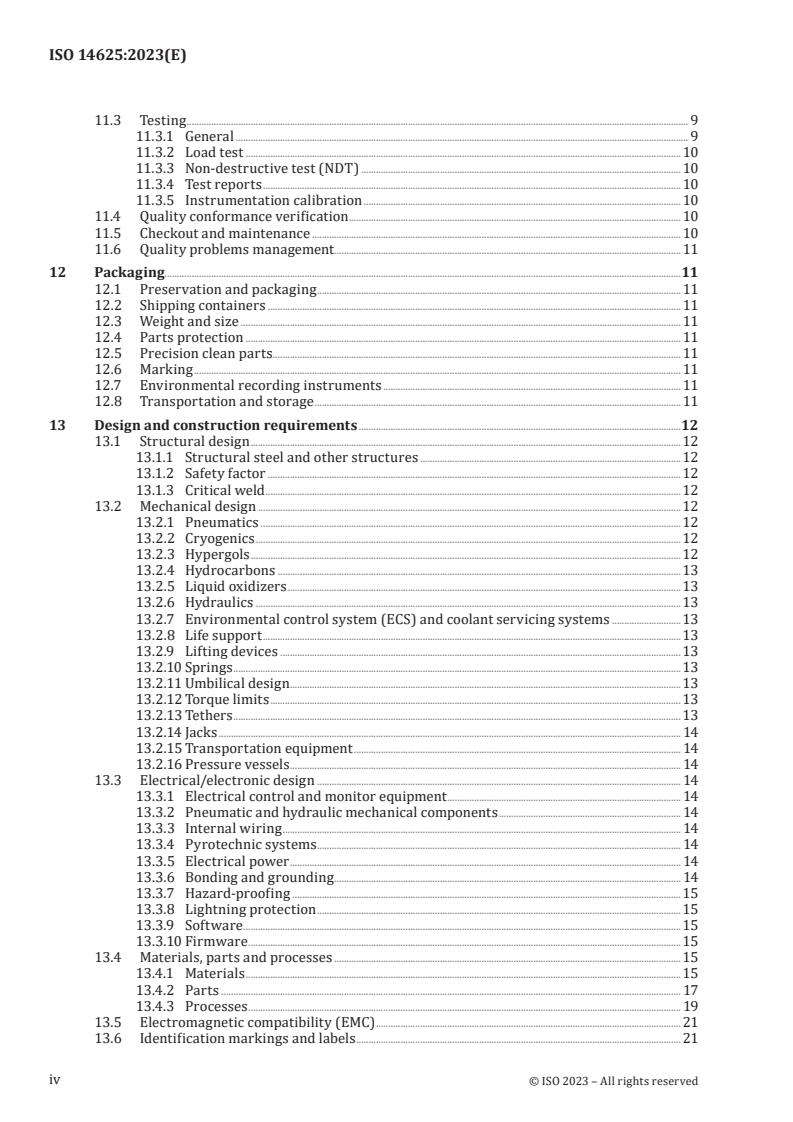
11.3 Testing . 9
11.3.1 General . 9
11.3.2 Load test . 10
11.3.3 Non-destructive test (NDT) . 10
11.3.4 Test reports . 10
11.3.5 Instrumentation calibration . 10
11.4 Quality conformance verification . 10
11.5 Checkout and maintenance . 10
11.6 Quality problems management . . 11
12 Packaging.11
12.1 Preservation and packaging . 11
12.2 Shipping containers . 11
12.3 Weight and size . 11
12.4 Parts protection . 11
12.5 Precision clean parts. 11
12.6 Marking . 11
12.7 Environmental recording instruments . 11
12.8 Transportation and storage . 11
13 Design and construction requirements .12
13.1 Structural design .12
13.1.1 Structural steel and other structures .12
13.1.2 Safety factor . 12
13.1.3 Critical weld . 12
13.2 Mechanical design .12
13.2.1 Pneumatics . 12
13.2.2 Cryogenics . 12
13.2.3 Hypergols . 12
13.2.4 Hydrocarbons . 13
13.2.5 Liquid oxidizers .13
13.2.6 Hydraulics .13
13.2.7 Environmental control system (ECS) and coolant servicing systems .13
13.2.8 Life support .13
13.2.9 Lifting devices . 13
13.2.10 Springs .13
13.2.11 Umbilical design . .13
13.2.12 Torque limits . 13
13.2.13 Tethers . 13
13.2.14 Jacks . 14
13.2.15 Transportation equipment . 14
13.2.16 Pressure vessels . 14
13.3 Electrical/electronic design . 14
13.3.1 Electrical control and monitor equipment . 14
13.3.2 Pneumatic and hydraulic mechanical components . 14
13.3.3 Internal wiring . 14
13.3.4 Pyrotechnic systems . 14
13.3.5 Electrical power . 14
13.3.6 Bonding and grounding . 14
13.3.7 Hazard-proofing . 15
13.3.8 Lightning protection . 15
13.3.9 Software . .15
13.3.10 Firmware . .15
13.4 Materials, parts and processes . 15
13.4.1 Materials .15
13.4.2 Parts . 17
13.4.3 Processes . 19
13.5 Electromagnetic compatibility (EMC) . 21
13.6 Identification markings and labels . 21
iv
13.6.1 Systems and equipment . 21
13.6.2 Load test . 21
13.6.3 Piping systems. 21
13.6.4 Compressed gas cylinders. 21
13.6.5 Load capacity . 21
13.6.6 Test weights . 21
13.6.7 Electrical cable assemblies . 22
13.6.8 Serial numbers . 22
13.7 Workmanship . 22
13.8 Interchangeability . 22
13.9 Safety. 22
13.10 Human performance . 23
13.10.1 General .23
13.10.2 Operating characteristics . 23
13.10.3 Personnel force limits . 23
13.10.4 Propellant handlers ensemble (PHE) operators .23
13.11 Security . 23
13.12 Redundancy . . 23
14 Checkout and maintenance requirements .23
14.1 General requirements .23
14.2 Checkout and maintenance items . 24
Bibliography .26
v
Foreword
ISO (the International Organization for Standardization) is a worldwide federation of national standards
bodies (ISO member bodies). The work of preparing International Standards is normally carried out
through ISO technical committees. Each member body interested in a subject for which a technical
committee has been established has the right to be represented on that committee. International
organizations, governmental and non-governmental, in liaison with ISO, also take part in the work.
ISO collaborates closely with the International Electrotechnical Commission (IEC) on all matters of
electrotechnical standardization.
The procedures used to develop this document and those intended for its further maintenance are
described in the ISO/IEC Directives, Part 1. In particular, the different approval criteria needed for the
different types of ISO documents should be noted. This document was drafted in accordance with the
editorial rules of the ISO/IEC Directives, Part 2 (see www.iso.org/directives).
Attention is drawn to the possibility that some of the elements of this document may be the subject of
patent rights. ISO shall not be held responsible for identifying any or all such patent rights. Details of
any patent rights identified during the development of the document will be in the Introduction and/or
on the ISO list of patent declarations received (see www.iso.org/patents).
Any trade name used in this document is information given for the convenience of users and does not
constitute an endorsement.
For an explanation of the voluntary nature of standards, the meaning of ISO specific terms and
expressions related to conformity assessment, as well as information about ISO's adherence to
the World Trade Organization (WTO) principles in the Technical Barriers to Trade (TBT), see
www.iso.org/iso/foreword.html.
This document was prepared by Technical Committee ISO/TC 20, Aircraft and space vehicles,
Subcommittee SC 14, Space systems and operations.
This third edition cancels and replaces the second edition (ISO 14625:2007), which has been technically
revised.
The main changes are as follows:
— requirements related to GSE checkout and maintenance have been added.
Any feedback or questions on this document should be directed to the user’s national standards body. A
complete listing of these bodies can be found at www.iso.org/members.html.
vi
Introduction
This document is intended to be used when designing new ground support equipment (GSE) that
support space system (launch vehicle or payload) programmes or projects. Existing programmes
and projects can use this document as far as is practical in accordance with sound management and
engineering practices.
This document is applicable at the time the decision is taken to design, construct, manufacture or
procure a given GSE that remains applicable for the useful life of the hardware. However, if modifications
are made to existing hardware, the edition of this document available at the time the modification is
applicable.
When this document is used in procurement, it is advisable that it be reviewed by the programme/
project office for applicability, and that only the clauses that apply to the project or programme be
included in the procurement documentation.
This document can also be used as a template for the development of specific programme or project
GSE specifications or standards.
vii
INTERNATIONAL STANDARD ISO 14625:2023(E)
Space systems — Ground support equipment for use at
launch, landing or retrieval sites — General requirements
1 Scope
This document specifies the general characteristics, performance, design, test, checkout, maintenance,
safety, reliability, maintainability and quality requirements for ground support equipment (GSE) and
systems intended for use at launch, landing or retrieval-site installations, or other locations that are the
responsibility of the launch, landing and retrieval site. This document does not specify how to design,
checkout and maintain GSE, but establishes the minimum requirements to provide simple, robust, safe,
reliable, maintainable and cost-effective GSE.
This document is applicable to the design, checkout and maintenance of non-flight hardware and
software used to support the operations of transporting, receiving, handling, assembly, inspection,
test, checkout, service, launch and recovery of space vehicles and payloads at the launch, landing or
retrieval sites. As such, the requirements of this document are optional for hardware used only at
the manufacturing, development or test sites prior to arrival at the launch, landing or retrieval sites.
However, if such GSE is dual use equipment to be also at a launch, landing or retrieval site, for whatever
reason, all the safety-related requirements of this document apply to the GSE.
2 Normative references
The following documents are referred to in the text in such a way that some or all of their content
constitutes requirements of this document. For dated references, only the edition cited applies. For
undated references, the latest edition of the referenced document (including any amendments) applies.
ISO 898-7, Mechanical properties of fasteners — Part 7: Torsional test and minimum torques for bolts and
screws with nominal diameters 1 mm to 10 mm
ISO 1949, Aircraft — Electrical connectors — Design requirements
ISO 1966, Crimped joints for aircraft electrical cables
ISO 2635, Aircraft — Conductors for general purpose aircraft electrical cables and aerospace applications
— Dimensions and characteristics
ISO 2964, Aerospace — Tubing — Outside diameters and thicknesses — Metric dimensions
ISO 4301 (all parts), Cranes — Classification
ISO 6346, Freight containers — Coding, identification and marking
ISO 14620-1, Space systems — Safety requirements — Part 1: System safety
ISO 14621 (all parts), Space systems — Electrical, electronic and electromechanical (EEE) parts
ISO 14623, Space systems - Pressure vessels and pressurized structures — Design and operation
ISO 14624 (all parts), Space systems — Safety and compatibility of materials
ISO 14952 (all parts), Space systems — Surface cleanliness of fluid systems
ISO 15389, Space systems — Flight-to-ground umbilicals
ISO 15859 (all parts), Space systems — Fluid characteristics, sampling and test methods
ISO 22538 (all parts), Space systems — Oxygen safety
ISO 80000-1, Quantities and units — Part 1: General
IEC 60034 (all parts), Rotating electrical machines
IEC 60038, IEC standard voltages
IEC 60079 (all parts), Electrical apparatus for explosive gas atmospheres
IEC 60096 (all parts), Radio-frequency cables
IEC 60169 (all parts), Radio-frequency connectors
IEC 60189 (all parts), Low-frequency cables and wires with PVC insulation and PVC sheath
IEC 60227 (all parts), Polyvinyl chloride insulated cables of rated voltages up to and including 450/750 V
IEC 60245 (all parts), Rubber insulated cables — Rated voltages up to and including 450/750 V
IEC 60297 (all parts), Dimensions of mechanical structures of the 482,6 mm (19 in) series
IEC 60309 (all parts), Plugs, socket-outlets and couplers for industrial purposes
IEC 60364 (all parts), Electrical installations of buildings
IEC 60794 (all parts), Optical fibre cables
IEC 60874 (all parts), Connectors for optical fibres and cables
IEC 60884 (all parts), Plugs and socket-outlets for household and similar purposes
IEC 60947 (all parts), Low-voltage switchgear and controlgear
IEC 61000 (all parts), Electromagnetic compatibility (EMC)
IEC 61086 (all parts), Coatings for loaded printed wire boards (conformal coatings)
IEC 62305 (all parts), Protection against lightning
IEC 62326 (all parts), Printed boards
3 Terms and definitions, symbols and abbreviated terms
3.1 Terms and definitions
For the purposes of this document, the following terms and definitions apply.
ISO and IEC maintain terminology databases for use in standardization at the following addresses:
— ISO Online browsing platform: available at https:// www .iso .org/ obp
— IEC Electropedia: available at https:// www .electropedia .org/
3.1.1
cognizant authority
organization that is recognized as having expertise in one or more technical disciplines
EXAMPLE ISO, IEC.
3.1.2
commercial off-the-shelf
COTS
equipment, including hardware and associated software/procedures, that is commercially available
from current industry inventory
3.1.3
critical weld
weld whose single failure during any operating condition can result in injury to personnel or damage to
property or flight hardware
3.1.4
flight hardware lifting device
structural or mechanical items between the crane hook and the flight vehicle interface that are used to
lift the flight hardware
EXAMPLE Sling, cable, shackle, beam.
3.1.5
ground support equipment
GSE
non-flight systems, equipment or devices necessary to support the operations of transporting,
receiving, handling, assembly, inspection, test, checkout, servicing, launch and recovery of a space
system at launch, landing or retrieval sites
3.1.6
safety critical
any condition, event, operation, process, equipment or system with a potential for personnel injury,
fatality or damage to, or loss of, equipment or property
3.1.7
safety factor
multiplying factor to be applied to limit loads (3.1.11) and/or maximum expected operating pressure
(MEOP) or maximum design pressure (MDP)
3.1.8
safe working load
assigned load, as shown on the identification tag, which is the maximum load the device or equipment is
permitted to handle and maintain in operation
3.1.9
sneak circuit
unexpected path or logic flow within a system that, under certain conditions, can initiate an undesired
function or inhibit a desired function
Note 1 to entry: The path may consist of hardware, software, operator actions, or combinations of these elements.
Sneak circuits are not the result of hardware failure but are latent conditions, inadvertently designed into the
system, coded into the software program, or triggered by human error.
Note 2 to entry: ISO 26871 defines "sneak circuit" as an undesired function or a function that inhibits a desired
function.
3.1.10
space flight vehicle
combination of the launch system elements which leave the ground i.e. the launch vehicle and the space
vehicle(s) placed in orbit by the launch vehicle
[SOURCE: ISO 14622:2000 ,2.1]
3.1.11
limit load
maximum expected load, or combination of loads, which a structure or a component in a structural
assembly is expected to experience during its service life, in association with the applicable operating
environments
Note 1 to entry: Load is a generic term for thermal load, pressure, external mechanical load (force, moment, or
enforced displacement) or internal mechanical load (residual stress, pretension, or inertial load).
3.2 Symbols and abbreviated terms
COTS commercial off-the-shelf
ECS environmental control system
EEE electrical, electronic and electromechanical
EMC electromagnetic compatibility
GSE ground support equipment
MMH monomethylhydrazine
NDT non-destructive test
N H hydrazine
2 4
N O nitrogen tetroxide
2 4
OMD operations and maintenance documentation
PHE propellant handlers ensemble
PVC polyvinyl chloride
RF radio frequency
UDMH unsymmetrical dimethylhydrazine
4 General
The general design requirements and criteria described in this document are the minimum
requirements necessary to meet the needs and expectations of internal customers (e.g. safety,
reliability, maintainability, quality, ergonomics, supportability) in a cost-effective manner. In order to
meet customer expectations, GSE shall need requirements that are more stringent than those specified
herein. In such cases, requirements that exceed the provisions described in this document shall be
determined by the responsible design organization in consultation with its customers (e.g. users,
operators).
5 Functional designations
5.1 General
GSE covered by this document shall be classified according to one of the functional designations given
in 5.2 to 5.6. Under each functional designation, GSE can be classified by criticality, whereby the GSE
a) physically or functionally interfaces with flight hardware/software,
b) is classified as safety critical, and/or
c) generates data used in determining flight worthiness/certification.
The GSE is assessed as safety critical if loss of the GSE or improper performance can result in loss
of life or personal injury, loss of flight hardware and ground equipment and facilities or damage to
flight hardware and ground equipment and facilities. The GSE defined herein shall be subject to the
configuration control requirements specified in the approved programme configuration management
plan.
5.2 Servicing GSE
Servicing GSE is equipment used to supply electrical power, compressed gases or fluids to the flight
hardware and/or associated GSE. Typical functions of servicing GSE are storage, fuelling, transfer,
flushing, purging, pressurizing, conditioning, vapour disposal and decontamination of propellants and
other fluids required by the flight hardware up to and including the launch terminal count and/or lift-
off.
5.3 Checkout and test GSE
Checkout and test GSE is equipment used in the preparation, test and checkout of flight hardware and/
or associated GSE. Typical functions of checkout and test GSE are stimuli monitoring and evaluation,
flight hardware preparation and testing.
5.4 Handling and transportation GSE
Handling and transportation GSE is equipment used for the movement and support of flight hardware
and/or associated GSE. Typical types of equipment used in the handling and transportation category
are slings, dollies, trailers, shipping containers, support stands, jacks, hoists, strongbacks and special
handling mechanisms.
5.5 Auxiliary GSE
Auxiliary GSE is equipment used to align, access, protect and calibrate flight hardware. Auxiliary
GSE includes, but is not limited to, protective devices, access stands and platforms, and alignment or
calibration hardware.
5.6 Umbilical GSE
Umbilical GSE is equipment used to interface directly with flight hardware for transfer of fluids(gases),
electrical power or electronic signals to and from the flight vehicle element intended for use up to and
including launch terminal count and/or lift-off.
6 Characteristics
6.1 Performance characteristics
6.1.1 Operability
GSE shall support the flight hardware operational requirements and shall be designed to ensure
that it does not degrade or contaminate associated flight or ground systems (areas), subsystems or
experiments during use, checkout, servicing or handling. While being operated, GSE shall ensure that
the minimal amount of preparation processes and work operations are performed.
6.1.2 Interfaces
GSE shall meet the requirements of all interfaces with new or existing flight and facility hardware or
software. Future system compatibility shall be in accordance with identified interfaces. GSE hardware
shall meet the requirements of the applicable interface control document (ICD).
6.1.3 Producibility
GSE hardware shall provide for ease of production, manufacture, construction and inspection. Special
care shall be taken to avoid imposing close manufacturing tolerances, unless required by design and
performance.
6.2 Physical characteristics
6.2.1 Limited life
Use of items with a life of less than the useful life of the system, or equipment for which the items are
intended, shall be avoided whenever possible. Items with limited life shall be identified. Identified
limited-life items shall be controlled from the date of manufacture through operational use, including
storage. Provisions should be made for replacement or refurbishment of these items after a specified
age or operating time/cycle. Status of limited-life cycle items and waivers on limited-life items shall
be maintained. Elapsed time or cycle indicators shall be employed to accumulate operational time or
cycles if critical.
6.2.2 Useful life
GSE shall be designed for a useful life appropriate to its mission. When a useful life is not identified
by programme or mission requirements, a goal of at least 10 years may be used. During this period,
normal preventive maintenance, repair, modification or calibration should be accomplished to maintain
specified performance.
6.2.3 Protective coating
Protective coating of hardware shall be appropriate to the condition, use and environment to which the
GSE should be exposed during its life cycle. The coating shall minimize corrosion and should indicate its
use (see 6.2.4).
6.2.4 Colours
The colours given in Table 1 should be used for the type of GSE indicated.
Table 1 — Colours for GSE
Colour GSE type
Grey or blue Consoles and panels
Grey or orange Structural steel
Red Remove before flight, safety and protective equipment
White Transportation containers
Black Panel lettering
Yellow or white Handling and transportation equipment
6.2.5 Metric system
New GSE shall use the metric system in accordance with ISO 80000-1.
6.2.6 Redundancy
Redundant systems, subsystems or components shall be physically separated or otherwise protected
to ensure that failure of one should not prevent the other from performing the function.
6.3 Reliability
GSE shall be designed to meet system availability and/or dependability requirements. GSE shall be
designed to minimize the probability of system failure and reduce the severity of the failure effect
of the system. As a minimum, GSE shall be designed to be fail-safe, except for structure and pressure
vessels in the rupture mode. The quality management system of the supplier shall provide appropriate
procedures and instructions to perform and document analyses like the failure mode, effects and
criticality analysis (FMECA)/critical items list (CIL), reliability diagrams and, in particular cases, sneak
circuit analysis, or equivalent.
6.4 Mainta
...