

ISO 23431:2021
(Main)Measurement of road tunnel air quality
General Information
- Abstract
This document describes methods for determining air speed and flow direction, CO, NO and NO2 concentrations and visibility in road tunnels using direct-reading instruments. This document specifically excludes requirements relating to instrument conformance testing.
- Status
- Published
- Publication Date
- 18-Mar-2021
- Technical Committee
- ISO/TC 146/SC 3 - Ambient atmospheres
- Current Stage
- 9060 - Close of review
- Completion Date
- 02-Sep-2031
Buy Documents





ISO 23431:2021 - Measurement of road tunnel air quality
ISO 23431:2021 - Measurement of road tunnel air quality/19/2021

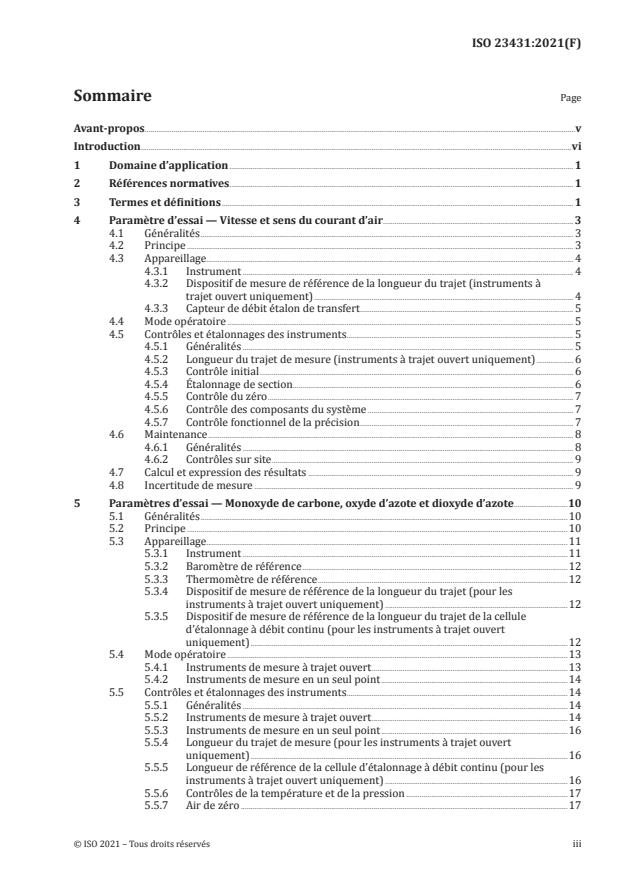
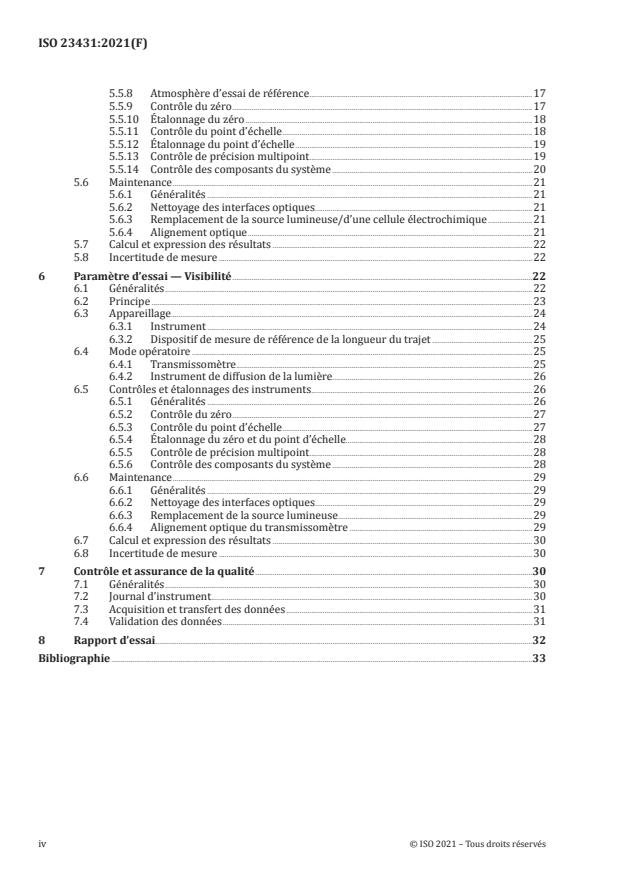
ISO 23431:2021 - Mesurage de la qualité de l'air d'un tunnel routier
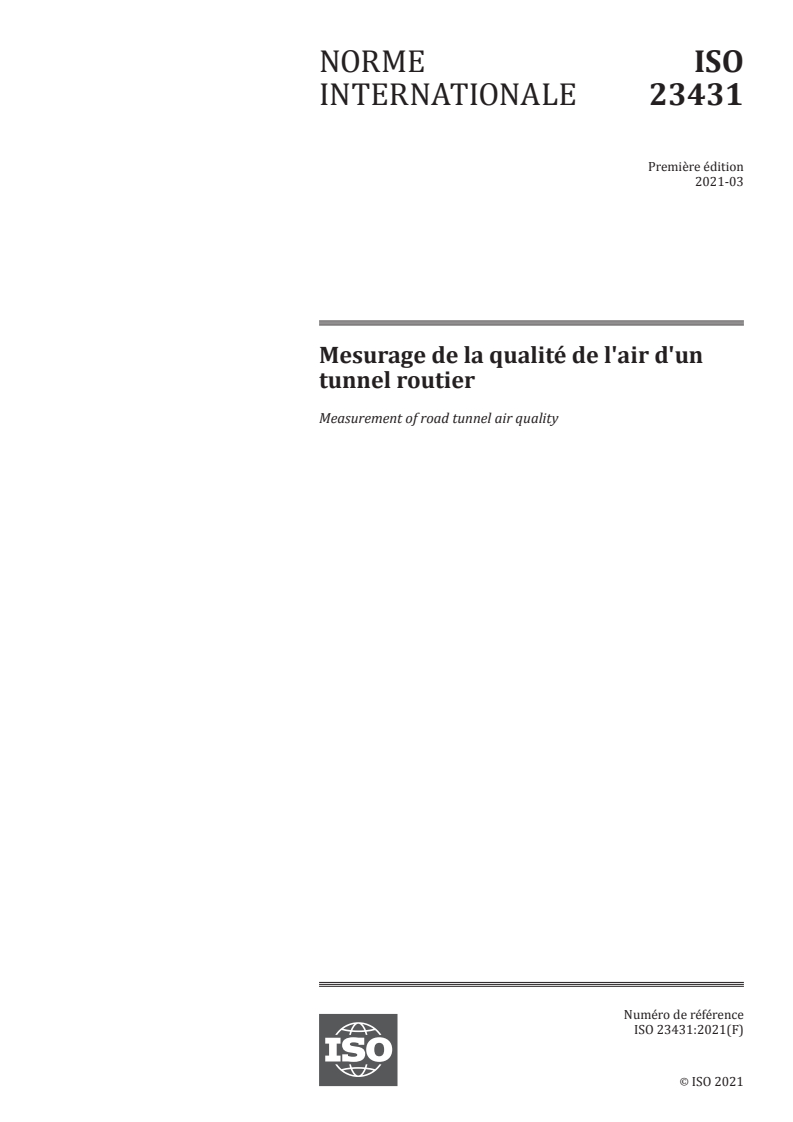
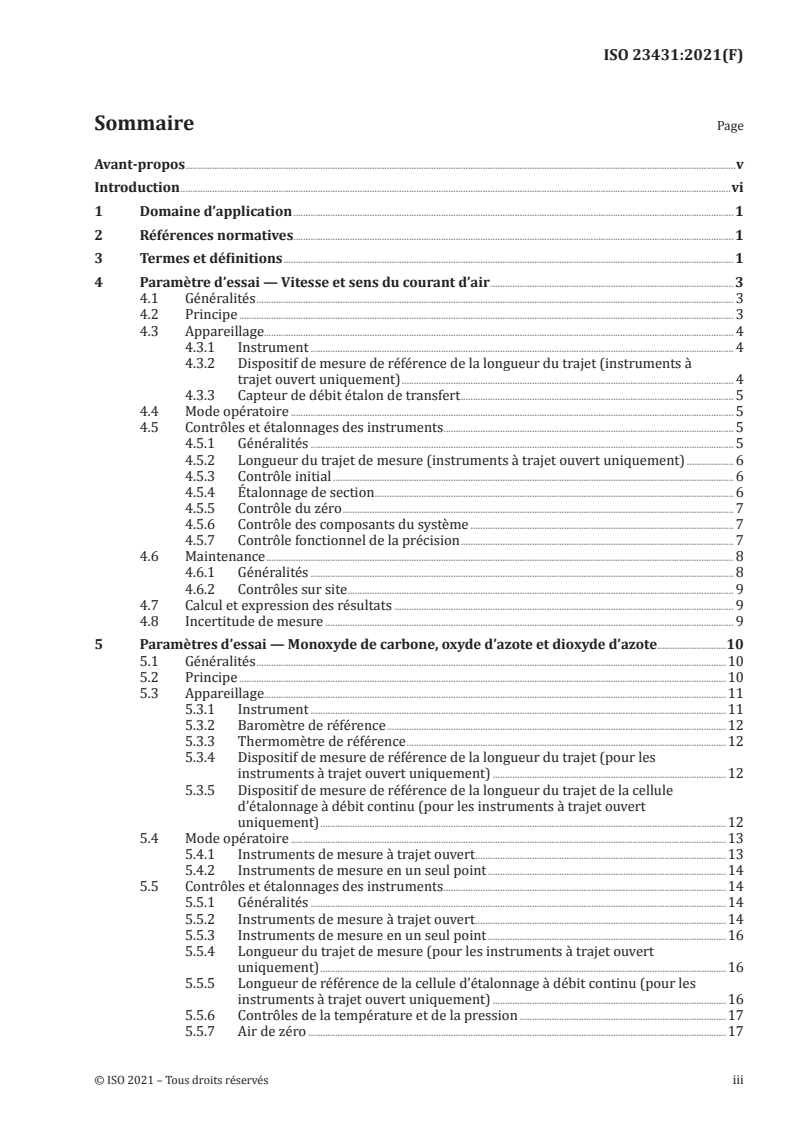
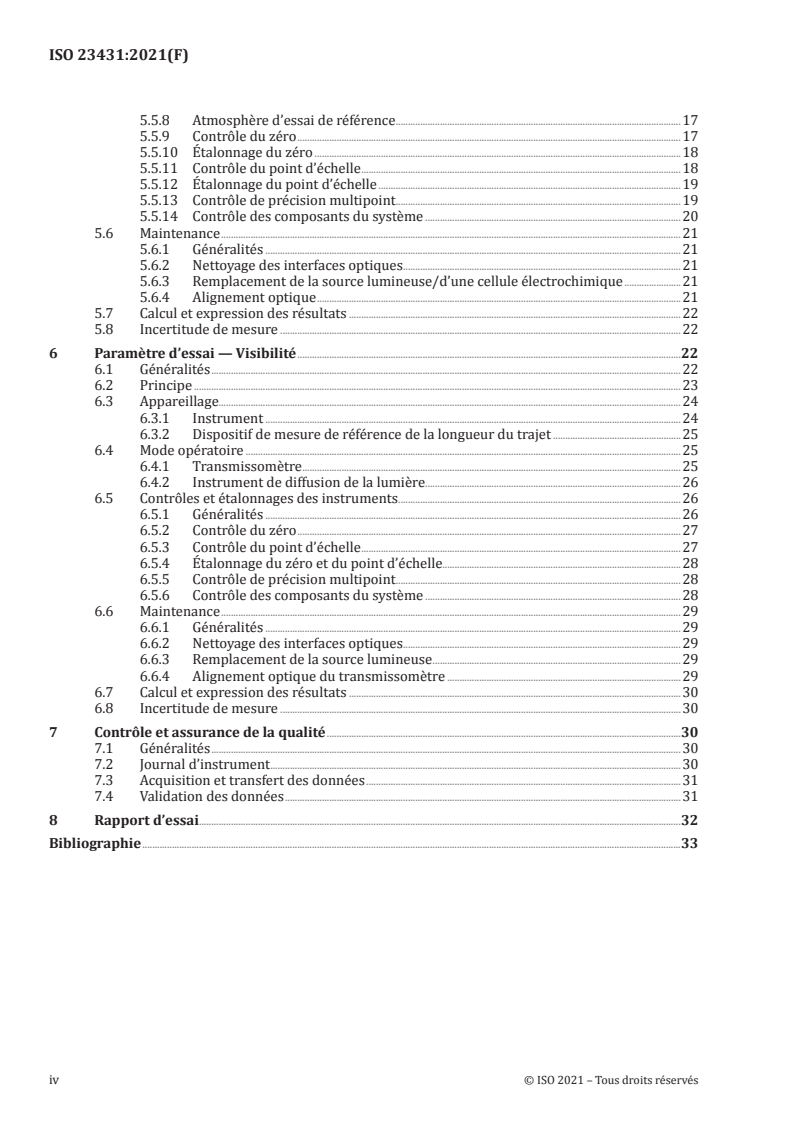
ISO 23431:2021 - Mesurage de la qualité de l'air d'un tunnel routier/19/2021
Overview
ISO 23431:2021 - Measurement of road tunnel air quality - specifies methods for measuring air speed and flow direction, carbon monoxide (CO), nitric oxide (NO) and nitrogen dioxide (NO2) concentrations, and visibility in road tunnels using direct‑reading instruments. The standard focuses on measurement procedures, instrument checks, calibration routines, maintenance, data expression and uncertainty estimation. It explicitly excludes requirements for instrument conformance testing.
Key topics and technical requirements
- Measured parameters: air speed, flow direction, CO, NO, NO2, and visibility (transmissometry and scattered‑light techniques).
- Instrument types covered: open‑path and single‑point gas monitors, transmissometers, scattered‑light visibility instruments and related flow sensors.
- Procedures and checks: initial checks, zero and span checks/calibrations, multipoint precision checks, cross‑section calibration (for flow), and system component checks.
- Reference devices: use of reference path length devices, reference barometer and thermometer for accurate concentration correction.
- Maintenance and care: optical interface cleaning, light source/cell replacement, optical alignment and on‑site maintenance checks.
- Data handling: calculation and expression of results, measurement uncertainty estimation, instrument logs, data acquisition, validation and test reporting.
- Quality assurance: requirements for ongoing QA/QC to ensure reliable tunnel air quality monitoring.
Practical applications and users
ISO 23431:2021 is designed for organizations and professionals involved in tunnel air quality management and monitoring, including:
- Tunnel operators and road authorities - to guide operational monitoring and ventilation control.
- Environmental and public‑health agencies - for exposure assessment and regulatory reporting.
- Consultants and testing laboratories - conducting field measurements and performance checks.
- Instrument manufacturers and integrators - to understand field use expectations (note: the standard does not set conformance specifications).
- Researchers and designers - for ventilation system commissioning and modeling validation.
Typical applications:
- Real‑time ventilation control and optimization in road tunnels.
- Incident response (e.g., fire, heavy traffic) where pollutant levels and visibility must be rapidly assessed.
- Long‑term exposure assessment and compliance monitoring for tunnel environments.
- Commissioning and acceptance testing of tunnel monitoring systems.
Related standards
ISO 23431:2021 was prepared by ISO/TC 146 (Air quality). For instrument performance criteria, calibration standards and conformity assessment, consult other ISO and national standards on air quality instrumentation and calibration produced by ISO/TC 146 and relevant national bodies. Note that ISO 23431 does not include instrument conformance testing requirements.
Relations
- Effective Date
- 06-Jun-2022
Buy Documents
ISO 23431:2021 - Measurement of road tunnel air quality
ISO 23431:2021 - Measurement of road tunnel air quality/19/2021
ISO 23431:2021 - Mesurage de la qualité de l'air d'un tunnel routier
ISO 23431:2021 - Mesurage de la qualité de l'air d'un tunnel routier/19/2021
Get Certified
Connect with accredited certification bodies for this standard

CIS Institut d.o.o.
Personal Protective Equipment (PPE) certification body. Notified Body NB-2890 for EU Regulation 2016/425 PPE.

Kiwa BDA Testing
Building and construction product certification.
Kmetijski inštitut Slovenije
Agricultural Institute of Slovenia. Soil testing, plant health, agricultural product analysis.
Sponsored listings
Frequently Asked Questions
ISO 23431:2021 is a standard published by the International Organization for Standardization (ISO). Its full title is "Measurement of road tunnel air quality". This standard covers: This document describes methods for determining air speed and flow direction, CO, NO and NO2 concentrations and visibility in road tunnels using direct-reading instruments. This document specifically excludes requirements relating to instrument conformance testing.
This document describes methods for determining air speed and flow direction, CO, NO and NO2 concentrations and visibility in road tunnels using direct-reading instruments. This document specifically excludes requirements relating to instrument conformance testing.
ISO 23431:2021 is classified under the following ICS (International Classification for Standards) categories: 13.040.20 - Ambient atmospheres; 93.060 - Tunnel construction. The ICS classification helps identify the subject area and facilitates finding related standards.
ISO 23431:2021 has the following relationships with other standards: It is inter standard links to ISO 22042:2021/Amd 1:2024. Understanding these relationships helps ensure you are using the most current and applicable version of the standard.
ISO 23431:2021 is available in PDF format for immediate download after purchase. The document can be added to your cart and obtained through the secure checkout process. Digital delivery ensures instant access to the complete standard document.
Standards Content (Sample)
SLOVENSKI STANDARD
01-maj-2021
Zunanji zrak - Merjenje kakovosti zraka v cestnih tunelih
Measurement of road tunnel air quality
Mesurage de la qualité de l'air du tunnel routier
Ta slovenski standard je istoveten z: ISO 23431:2021
ICS:
13.040.20 Kakovost okoljskega zraka Ambient atmospheres
93.060 Gradnja predorov Tunnel construction
2003-01.Slovenski inštitut za standardizacijo. Razmnoževanje celote ali delov tega standarda ni dovoljeno.
INTERNATIONAL ISO
STANDARD 23431
First edition
2021-03
Measurement of road tunnel air quality
Mesurage de la qualité de l'air d'un tunnel routier
Reference number
©
ISO 2021
© ISO 2021
All rights reserved. Unless otherwise specified, or required in the context of its implementation, no part of this publication may
be reproduced or utilized otherwise in any form or by any means, electronic or mechanical, including photocopying, or posting
on the internet or an intranet, without prior written permission. Permission can be requested from either ISO at the address
below or ISO’s member body in the country of the requester.
ISO copyright office
CP 401 • Ch. de Blandonnet 8
CH-1214 Vernier, Geneva
Phone: +41 22 749 01 11
Email: copyright@iso.org
Website: www.iso.org
Published in Switzerland
ii © ISO 2021 – All rights reserved
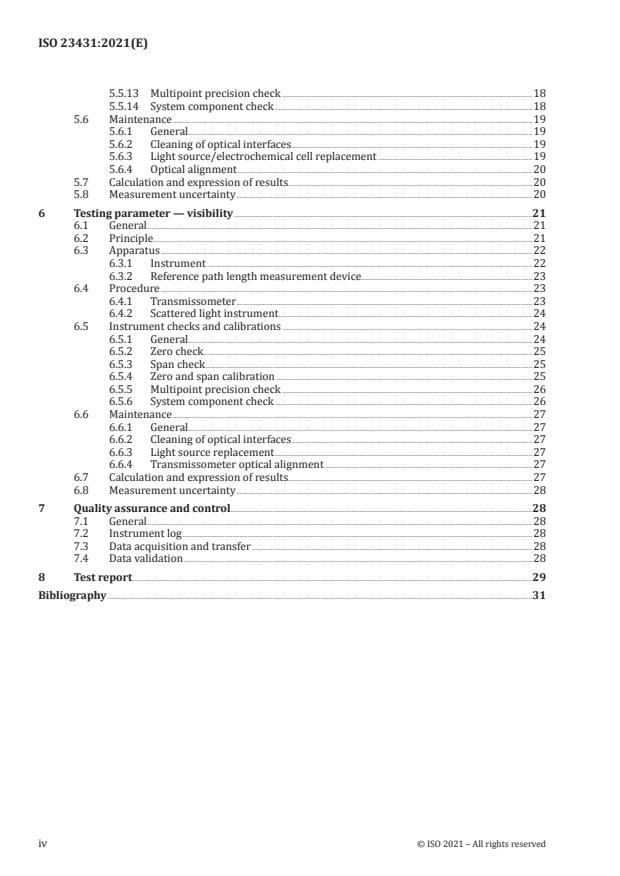
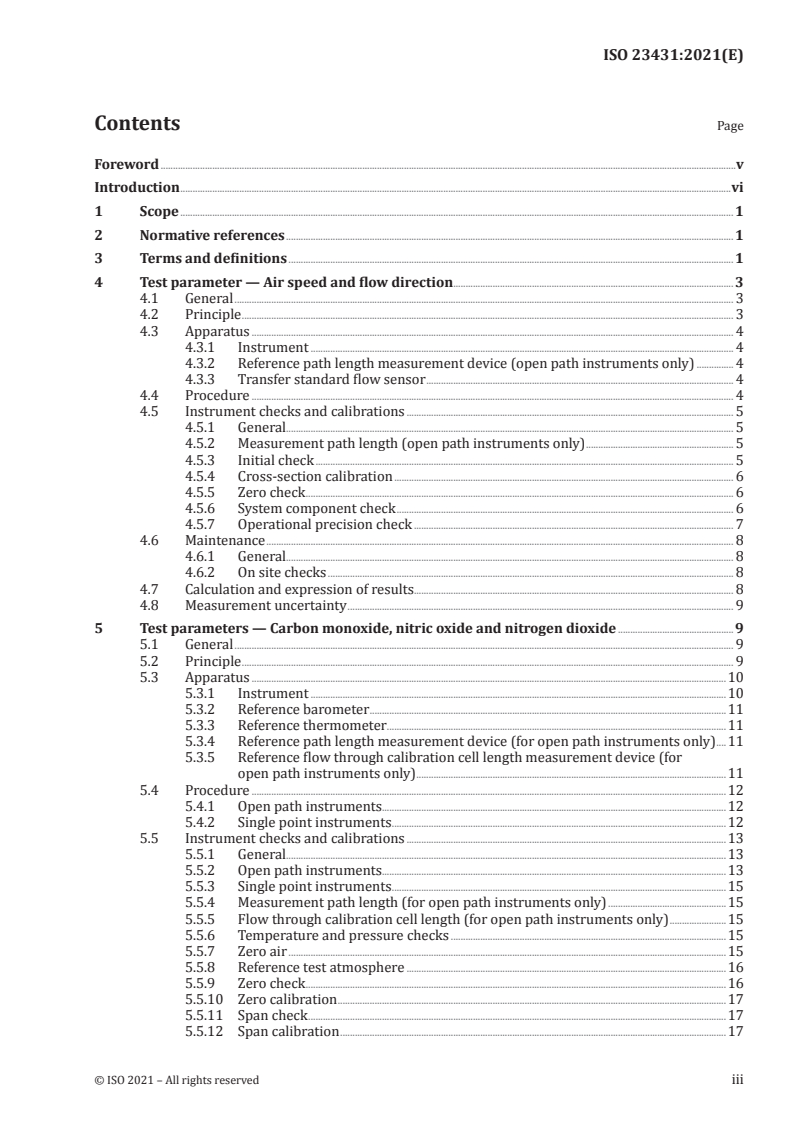
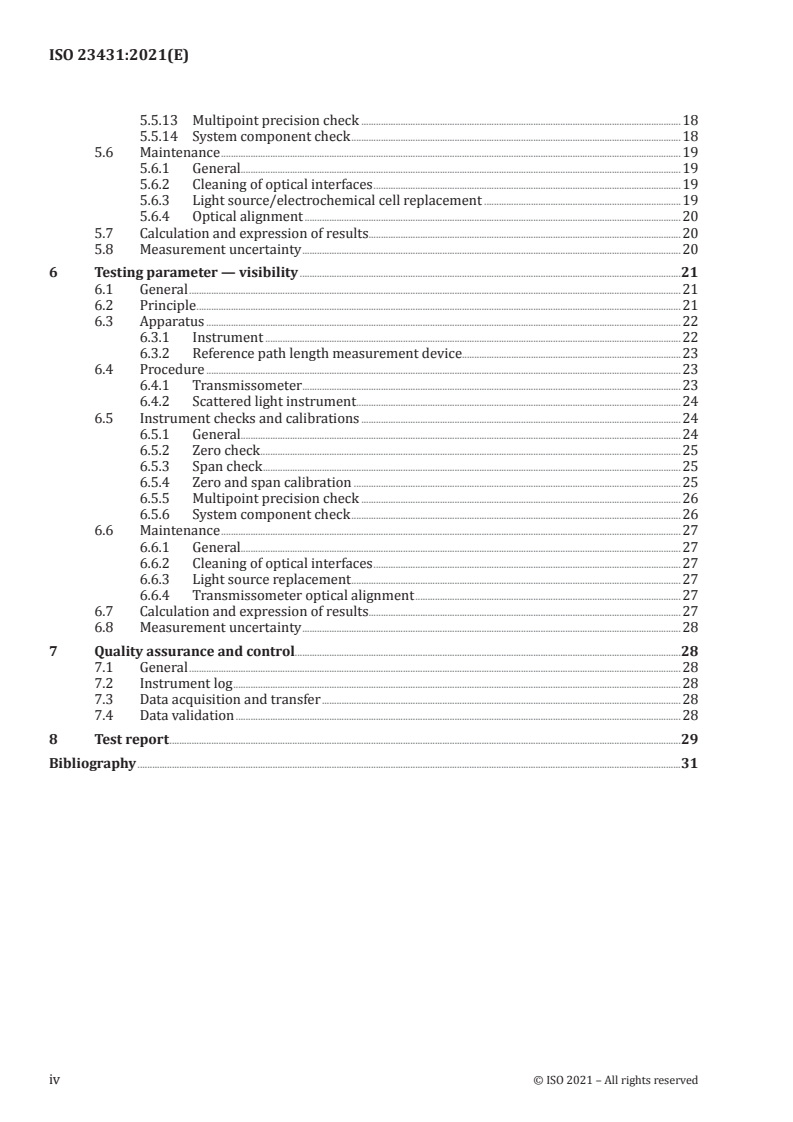
Contents Page
Foreword .v
Introduction .vi
1 Scope . 1
2 Normative references . 1
3 Terms and definitions . 1
4 Test parameter — Air speed and flow direction . 3
4.1 General . 3
4.2 Principle . 3
4.3 Apparatus . 4
4.3.1 Instrument . 4
4.3.2 Reference path length measurement device (open path instruments only) . 4
4.3.3 Transfer standard flow sensor . 4
4.4 Procedure . 4
4.5 Instrument checks and calibrations . 5
4.5.1 General. 5
4.5.2 Measurement path length (open path instruments only) . 5
4.5.3 Initial check . 5
4.5.4 Cross-section calibration . 6
4.5.5 Zero check . 6
4.5.6 System component check . 6
4.5.7 Operational precision check . 7
4.6 Maintenance . 8
4.6.1 General. 8
4.6.2 On site checks . 8
4.7 Calculation and expression of results. 8
4.8 Measurement uncertainty . 9
5 Test parameters — Carbon monoxide, nitric oxide and nitrogen dioxide .9
5.1 General . 9
5.2 Principle . 9
5.3 Apparatus .10
5.3.1 Instrument .10
5.3.2 Reference barometer .11
5.3.3 Reference thermometer .11
5.3.4 Reference path length measurement device (for open path instruments only) .11
5.3.5 Reference flow through calibration cell length measurement device (for
open path instruments only) .11
5.4 Procedure .12
5.4.1 Open path instruments.12
5.4.2 Single point instruments .12
5.5 Instrument checks and calibrations .13
5.5.1 General.13
5.5.2 Open path instruments.13
5.5.3 Single point instruments .15
5.5.4 Measurement path length (for open path instruments only) .15
5.5.5 Flow through calibration cell length (for open path instruments only) .15
5.5.6 Temperature and pressure checks .15
5.5.7 Zero air .15
5.5.8 Reference test atmosphere .16
5.5.9 Zero check .16
5.5.10 Zero calibration .17
5.5.11 Span check .17
5.5.12 Span calibration .17
5.5.13 Multipoint precision check .18
5.5.14 System component check .18
5.6 Maintenance .19
5.6.1 General.19
5.6.2 Cleaning of optical interfaces .19
5.6.3 Light source/electrochemical cell replacement .19
5.6.4 Optical alignment .20
5.7 Calculation and expression of results.20
5.8 Measurement uncertainty .20
6 Testing parameter — visibility .21
6.1 General .21
6.2 Principle .21
6.3 Apparatus .22
6.3.1 Instrument .22
6.3.2 Reference path length measurement device . .23
6.4 Procedure .23
6.4.1 Transmissometer .23
6.4.2 Scattered light instrument .24
6.5 Instrument checks and calibrations .24
6.5.1 General.24
6.5.2 Zero check .25
6.5.3 Span check .25
6.5.4 Zero and span calibration .25
6.5.5 Multipoint precision check .26
6.5.6 System component check .26
6.6 Maintenance .27
6.6.1 General.27
6.6.2 Cleaning of optical interfaces .27
6.6.3 Light source replacement .27
6.6.4 Transmissometer optical alignment .27
6.7 Calculation and expression of results.27
6.8 Measurement uncertainty .28
7 Quality assurance and control.28
7.1 General .28
7.2 Instrument log .28
7.3 Data acquisition and transfer .28
7.4 Data validation .28
8 Test report .29
Bibliography .31
iv © ISO 2021 – All rights reserved
Foreword
ISO (the International Organization for Standardization) is a worldwide federation of national standards
bodies (ISO member bodies). The work of preparing International Standards is normally carried out
through ISO technical committees. Each member body interested in a subject for which a technical
committee has been established has the right to be represented on that committee. International
organizations, governmental and non-governmental, in liaison with ISO, also take part in the work.
ISO collaborates closely with the International Electrotechnical Commission (IEC) on all matters of
electrotechnical standardization.
The procedures used to develop this document and those intended for its further maintenance are
described in the ISO/IEC Directives, Part 1. In particular, the different approval criteria needed for the
different types of ISO documents should be noted. This document was drafted in accordance with the
editorial rules of the ISO/IEC Directives, Part 2 (see www .iso .org/ directives).
Attention is drawn to the possibility that some of the elements of this document may be the subject of
patent rights. ISO shall not be held responsible for identifying any or all such patent rights. Details of
any patent rights identified during the development of the document will be in the Introduction and/or
on the ISO list of patent declarations received (see www .iso .org/ patents).
Any trade name used in this document is information given for the convenience of users and does not
constitute an endorsement.
For an explanation of the voluntary nature of standards, the meaning of ISO specific terms and
expressions related to conformity assessment, as well as information about ISO's adherence to the
World Trade Organization (WTO) principles in the Technical Barriers to Trade (TBT), see www .iso .org/
iso/ foreword .html.
This document was prepared by Technical Committee ISO/TC 146, Air quality, Subcommittee SC 3,
Ambient atmospheres.
Any feedback or questions on this document should be directed to the user’s national standards body. A
complete listing of these bodies can be found at www .iso .org/ members .html.
Introduction
The objective of this document is to provide road tunnel owners and operators with standard methods
for checking and calibrating instruments used in road tunnels to continuously monitor air speed,
carbon monoxide (CO), nitric oxide (NO) and nitrogen dioxide (NO ) concentrations and visibility.
Data from these instruments enables tunnel operators to manage the ventilation system in real time or
to take emergency measures (e.g. closure to traffic).
This document has been developed as a performance-based standard that allows for use of a number
of direct-reading instruments. Statements expressed in mandatory terms in notes to tables and figures
are deemed to be requirements of this document.
In order to improve traffic flow in central business districts and through sensitive environments, road
tunnels are increasingly used throughout the world to achieve the desired outcomes. There are a large
number of tunnels in operation, with a number of others in the planning stages.
Road tunnel projects are subject to environmental and/or planning approval conditions by regulatory
authorities that specify the parameters to be monitored in-tunnel, typically including air speed, CO, NO,
NO and visibility, with NO measured as a surrogate for NO , with, historically, 10 % of total nitrogen
2 2
oxides assumed to be NO . However, this assumption is no longer considered appropriate, given the
increased proportion of diesel fuelled vehicles in vehicle fleets. It can also be a requirement that the
tunnel ventilation system is controlled to:
a) reduce CO and NO concentrations within the tunnel environment to enable conformance with in-
tunnel air quality criteria for various averaging periods;
b) prevent or reduce portal emissions and resultant environmental impacts;
c) ensure appropriate visibility for different tunnel operating conditions; and
d) control smoke and improve the self-rescue time and security of tunnel users in emergency
situations such as fires.
Conformance with in-tunnel air quality criteria is typically determined by averaging measured CO and
measured or estimated NO concentrations from a number of instruments located on possible travel
paths throughout the tunnel system.
The number of instruments required to adequately characterise the tunnel environment is dependent
on a number of factors, including:
a) tunnel length and number of gradient changes and entry and exit ramps;
b) volume of traffic and types of vehicles;
c) exhaust ventilation system flowrate and control regime; and
d) regulatory requirements.
Consequently, this aspect is not addressed in this document. It is noted, however, that computational
fluid dynamics modelling can be used as a design tool to assist in the placement of instruments,
ensuring that indicative maximum and average concentrations are measured.
vi © ISO 2021 – All rights reserved
INTERNATIONAL STANDARD ISO 23431:2021(E)
Measurement of road tunnel air quality
1 Scope
This document describes methods for determining air speed and flow direction, CO, NO and NO
concentrations and visibility in road tunnels using direct-reading instruments. This document
specifically excludes requirements relating to instrument conformance testing.
2 Normative references
The following documents are referred to in the text in such a way that some or all of their content
constitutes requirements of this document. For dated references, only the edition cited applies. For
undated references, the latest edition of the referenced document (including any amendments) applies.
ISO 5802, Industrial fans — Performance testing in situ
ISO 6145, Gas analysis — Preparation of calibration gas mixtures using dynamic methods
ISO 10780, Stationary source emissions — Measurement of velocity and volume flowrate of gas streams
in ducts
ISO/IEC Guide 98-3, Uncertainty of measurement — Part 3: Guide to the expression of uncertainty in
me a s ur ement (GUM: 1995)
ISO/IEC 17025, General requirements for the competence of testing and calibration laboratories
3 Terms and definitions
For the purposes of this document, the following terms and definitions apply.
ISO and IEC maintain terminological databases for use in standardization at the following addresses:
— ISO Online browsing platform: available at https:// www .iso .org/ obp
— IEC Electropedia: available at http:// www .electropedia .org/
3.1
calibration
set of operations that establish, under specified conditions, the relationship between the value indicated
by a measuring instrument and the corresponding known value of a reference standard
3.2
certified reference material
reference material, characterized by a metrologically valid procedure for one or more specified
properties, accompanied by a reference material certificate that provides the value of the specified
property, its associated uncertainty, and a statement of metrological traceability
3.3
check
confirmation of acceptable instrument response, without adjustment
3.4
fall time
time interval, after a step decrease in input concentration, between initial instrument response and
10 % of initial instrument response
3.5
full scale
FS
nominated maximum concentration for which an instrument has been calibrated
Note 1 to entry: The full scale (FS) is selected to cover the normal range of values expected in the sampling
environment.
3.6
interference equivalent
positive or negative instrument response caused by a substance other than the one being measured
3.7
linearity
deviation of an instrument’s output from a linear best fit line when subjected to varying reference test
atmospheres
3.8
lower detectable limit
minimum pollutant concentration that produces a signal of exactly three times the repeatability
standard deviation
Note 1 to entry: See ISO 5725-1.
3.9
parameter
one of the characteristics related to an air sample
EXAMPLE Concentration of pollutant or other quantifiable property (e.g. air speed).
3.10
ppm
parts per million
ratio expressing the volume of gaseous pollutant contained in 1 000 000 volumes of atmosphere
Note 1 to entry: It may be expressed in terms of millilitres per cubic metre as the values are identical. Alternatively,
it is one million times the ratio of the partial pressure of gaseous pollutant to the pressure of the atmosphere in
which it is contained.
3.11
precision
variation about the mean of repeated measurements of the same pollutant concentration on the same
instrument, expressed as one standard deviation about the mean
3.12
range
nominal minimum and maximum concentrations that a method is capable of measuring
Note 1 to entry: The nominal range is specified by the lower and upper range limits in concentration units, e.g. 0
to 250 ppm.
3.13
reference test atmosphere
test atmosphere containing a known concentration of pollutant, typically generated by diluting the
contents of a cylinder containing a gaseous certified reference material (3.2)
3.14
rise time
time interval, after a step increase in input concentration, between the instrument initial response and
90 % of the final instrument response
2 © ISO 2021 – All rights reserved
3.15
road tunnel
any fully enclosed length of roadway with a minimum length ranging between 90 m and 150 m
EXAMPLE National Fire Protection Association and UK Design Manual for Roads and Bridges.
3.16
span drift
percentage change in the instrument response to an on-scale pollutant concentration over a period of
continuous unadjusted operation
3.17
U
measurement of expanded uncertainty at a confidence interval of 95 % according to ISO/IEC Guide 98-3
3.18
zero air
air free from contaminants likely to cause a detectable response on the test instrument
3.19
zero drift
change in the instrument response to a zero-pollutant concentration over a period of continuous
unadjusted operation
4 Test parameter — Air speed and flow direction
4.1 General
Clause 4 describes continuous, direct-reading instruments for determining air speed and flow direction
in road tunnels. Providing the instrument performance is within the specifications given in Table 1,
alternate methods may be used within the context of this document.
4.2 Principle
Air speed and flow direction in modern road tunnels are typically measured using ultrasonic flow
sensors.
Ultrasonic sensor systems are based on the principle that the speed of air movement changes the transit
time of a sound pulse across a fixed distance, allowing calculation of the air speed and determination of
flow direction.
Instrument outputs may be used to control mechanical ventilation in a tunnel during both routine and
emergency operation.
The measurement of flow in road tunnels is important for emergency operation (e.g. vehicle fire),
enabling the control of air flow such that fumes are not dispersed in the tunnel tube. The choice of cross
section or single point air flow measurements for this purpose is dependent on local technical practices.
Air flow measurement can also be important for the management of mechanical ventilation, either to
dilute pollutants, or to control the atmospheric discharges at the portals.
Ultrasonic sensors are either open path or single point instruments, installed at various locations along
the tunnel length, including portals and exit ramps.
Open path ultrasonic flow sensors measure the average value over the tunnel width, with transceiver
pairs installed on opposing walls at an angle of 45° to 60° to the tunnel axis. In order to eliminate
potential measurement errors caused by variations in ultrasonic sound speed due to temperature and
pressure, the transceiver units shall be installed on each side of the tunnel wall, with the transit time
measured in both directions.
Single point ultrasonic flow sensors use the same measurement principle as open path sensors,
measuring changes in the transit time of a sound pulse across a fixed distance, but in this case the
distance evaluated is within the instrument casing.
NOTE Open path ultrasonic flow sensors are typically located high on tunnel walls; consequently, it is
possible that the measured air speed is not representative of the average speed for the overall tunnel cross-
section. Similarly, single point ultrasonic flow sensors measure air speed close to the tunnel wall (or ceiling) and
nearer the pavement, consequently it is possible that the measured air speed is not representative of the average
speed for the tunnel cross-section, with the added potential, under normal operating conditions, for increased
error due to turbulence created by vehicular traffic.
4.3 Apparatus
4.3.1 Instrument
A continuous direct-reading instrument that meets or exceeds the specifications given in Table 1.
The manufacturer’s published performance specifications shall be deemed as acceptable evidence of
conformance to the given requirements, if accompanied by a statement of measurement uncertainty
issued by an organization that meets the requirements of ISO/IEC 17025.
Table 1 — Instrument performance specifications for tunnel air speed systems
Parameter Minimum requirements
Range (−20 to 20) m/s
a
Expanded measurement uncertainty 2 % of reading or 0,2 m/s
Resolution ≤ 0,1 m/s
a
Whichever is the greater.
4.3.2 Reference path length measurement device (open path instruments only)
A metrologically traceable reference path length measurement device with an uncertainty of 0,5 % U is
required to make an accurate determination of the path length. The reference path length measurement
device shall be checked over a path length of at least the instrument measurement path length.
Organizations performing the tests outlined in this clause shall meet the requirements of ISO/IEC 17025.
4.3.3 Transfer standard flow sensor
A metrologically traceable hand-held vane or hot-wire anemometer, or equivalent, of similar or higher
specification to the air speed sensor, with an uncertainty of 2 % U is required to check the operation
of air speed sensors. The transfer standard flow sensor shall be calibrated over a range exceeding the
maximum air flow experienced in the tunnel.
Organizations performing the tests outlined in this clause shall meet the requirements of ISO/IEC 17025.
4.4 Procedure
The procedure shall be as follows:
a) For open path ultrasonic flow sensors, ensure that the transceivers are installed such that the path
for the sonic pulse is unimpeded by tunnel equipment or other obstructions, including vehicular
traffic, whilst allowing ease of access for instrument maintenance and calibration.
b) For open path ultrasonic flow sensors check instrument horizontal and vertical alignment and
beam angle, in accordance with the manufacturer’s instructions.
c) For open path ultrasonic flow sensors, accurately measure and record the distance between the
transceivers using a reference path length measurement device (4.3.2).
4 © ISO 2021 – All rights reserved
d) Set up the instrument and carry out initial checks in accordance with the manufacturer’s
instructions (e.g. setting the path length, configuring and scaling of analogue outputs, setting of
alarm values and level of damping) and the requirements of 4.5.
e) Take measurements in accordance with the manufacturer’s instructions and ensure that the values
obtained relate to the correct date and time.
4.5 Instrument checks and calibrations
4.5.1 General
Calibration of an instrument establishes the quantitative relationship between the air speed and the
instrument’s response.
Instrument checks and calibrations shall be carried out in accordance with the frequencies specified by
the equipment manufacturer and in accordance with Table 2.
In addition, operational precision checks shall be carried out as follows:
a) Prior to decommissioning or physical relocation of the instrument, if operational.
b) Following physical relocation of the instrument.
c) After any repairs that might affect the instrument’s response.
d) Upon any indication of an instrument malfunction or change in response that may cause the
instrument to drift by more than the values given in Table 2.
NOTE 1 The air flow and direction monitor can incorporate an automatic daily zero and span check function
for daily quality control and assurance purposes.
NOTE 2 Checks and calibrations specified in this section can be omitted if the air flow measuring instrument
provides proven equivalent self-test functions (e.g. read back of analogue or digital outputs).
4.5.2 Measurement path length (open path instruments only)
The measurement path length for open path ultrasonic flow sensors is normally defined as the
distance between the faces of opposing transceiver units, however, this should be confirmed with the
manufacturer. The measurement path length shall be determined upon installation (see Table 2) using
a reference distance measurement device as described in 4.3.2.
A check of the measurement path length shall also be conducted whenever an open path instrument
is reinstalled following maintenance or repair, if the maintenance or repair could result in a change of
measurement path length.
4.5.3 Initial check
Conduct an initial check on the ultrasonic flow sensor prior to road tunnel opening using a collocated
transfer standard (CTS) method at a minimum of three air velocities (if technically feasible) evenly
spread over the tunnel design operational range.
For open path ultrasonic flow sensors, measurements shall be taken at a minimum of two points per
trafficable lane over the measurement path. For a single point ultrasonic flow sensor, the CTS needs to
be within 1 m of the subject sensor in the horizontal and 0,5 m in the vertical, but the same distance
from the tunnel wall.
The CTS method requires a calibrated hand-held vane or hot-wire anemometer, or equivalent, of similar
or higher specification to the ultrasonic flow sensor, located in the vicinity of the measurement path for
the sensor being assessed.
For both single point and open path ultrasonic flow sensors it is important to site the CTS to be
representative of the air flow at the subject sensor, without interfering with either instrument’s
response.
The procedure shall be as follows:
a) Ensure that the CTS is oriented such that the reading is obtained in the direction of air flow.
b) Connect the CTS to an independent data logger. Once the air speed has stabilised, record check data
for a period of not less than 5 min. Simultaneously record the response from the in-situ sensor over
the same period.
c) Average the recorded data over the selected period, and, if applicable, across all CTS measurement
points. Calculate the difference between the in-situ sensor and CTS average readings.
d) Check that the difference conforms to the tolerance given in Table 2. If the result is not within the
prescribed tolerance, review siting and site-specific issues, conduct repairs and/or instrument
calibrations as required and repeat the above procedure until compliance with the specified
tolerance is indicated.
4.5.4 Cross-section calibration
A correlation may also be required between the ultrasonic flow sensor output and the total ventilation
system flowrate, in order to obtain a factor or algorithm for use in the tunnel ventilation control system.
If required, the cross-section calibration shall be performed following instrument commissioning and
after the initial check (4.5.3) has been conducted.
The total ventilation system flowrate may be determined by measuring air speeds across the tunnel
cross-section, at approximately the same tunnel longitudinal position as the ultrasonic flow sensor,
using a calibrated hand-held vane or hot-wire anemometer, or equivalent, of similar or higher
specification to the ultrasonic flow sensor.
In this instance, the number and location of measurement points across the tunnel cross-section will be
dependent on the hydraulic diameter and shape of the tunnel cross-section. Methods typically used are
the tracer gas method, the equal area method described in ISO 10780 and the Log-Tchebycheff method
described in ANSI/ASHRAE Standard 41.2 and ISO 5802. The average measured speed is multiplied by
the cross-sectional area in order to calculate the total ventilation system flowrate.
Measurement of the total ventilation system flowrate does not preclude the need to check the actual
instrument response in accordance with the procedure described above. It should also be recognised
that the correlation determined between total ventilation system flowrate and ultrasonic flow sensor
output in an empty tunnel may not reflect what occurs in an operational tunnel.
4.5.5 Zero check
If a zero-air flow environment can be attained, the zero response of the ultrasonic flow sensor shall be
checked on a yearly basis, in accordance with the manufacturer’s instructions.
For single point sensors this can be readily achieved by enclosing the sensor in a box which isolates it
from any draughts.
Check that the zero response is within the tolerance given in Table 2. If the result is not within the
tolerance, conduct repairs and/or instrument calibrations as required and repeat the procedure until
the zero response is within the tolerance.
4.5.6 System component check
Cables, recorders, signal conditioning and data processing devices can corrupt the sensor’s output.
6 © ISO 2021 – All rights reserved
A system component check shall be conducted on a yearly basis to ensure the transmitted sensor output
matches that received at the data recording device. For example, if the ultrasonic flow sensor gives
a 20 mA output with an air speed of 20 m/s, then apply a 20 mA signal to the system to confirm that
20 m/s is indicated at the data recording device.
Check that the response is within the tolerance given in Table 2. If the response is not within the
tolerance, conduct repairs and/or instrument calibrations as required and repeat the procedure until
the response is within the tolerance.
4.5.7 Operational precision check
An operational precision check shall be conducted on the ultrasonic flow sensor on a yearly basis using
the CTS method at a minimum of one air speed, and, for open path ultrasonic flow sensors, a minimum
of three equally spaced points over the measurement path. For a single point ultrasonic flow sensor, the
CTS shall be within 1 m of the subject sensor in the horizontal and 0,5 m in the vertical, but the same
distance from the tunnel wall.
The CTS method requires a calibrated hand-held vane or hot-wire anemometer, or equivalent, of
similar or higher specification to the ultrasonic flow sensor, located in the same horizontal plane as the
measurement path for the sensor being assessed.
The transfer standard sensor shall be routinely calibrated by a recognized external authority such that
the CTS is traceable to required reference standards. This calibration shall be evidenced by a calibration
certificate which states the sensitivity of the device by a procedure which establishes traceability to a
recognized standard and for which a measurement uncertainty is given at a stated level of confidence,
and the period during which the calibration is valid.
For both single point and open path ultrasonic flow sensors it is important to site the CTS to be
representative of the air flow at the subject sensor, without interfering with either instrument’s
response.
The procedure shall be as follows:
a) Ensure that the CTS is oriented such that the reading is obtained in the direction of air flow.
b) Connect the CTS to an independent data logger. Record check data for a sufficient period that
demonstrates a stable response. Simultaneously record the response from the in-situ sensor over
the same period.
c) Average the recorded data over the selected period, and, if applicable, across the three CTS
measurement points. Calculate the difference between the in-situ sensor and CTS average readings.
d) Check that the difference conforms to the tolerance given in Table 2. If the result is not within the
prescribed tolerance, conduct repairs and/or instrument calibrations as required and repeat the
above procedure until compliance with the specified tolerance is indicated.
Table 2 — Instrument check and calibration requirements for tunnel air speed systems
Parameter Criterion Frequency
b
Measurement path length ± 0,5 % Initial
a
Initial check 2 % of reading or ± 0,2 m/s Initial
Zero check ± 0,2 m/s ≤ 12 months
System component check ± 0,2 % FS ≤ 12 months
a
Operational precision check 6 % of reading or ± 0,3 m/s ≤ 12 months
a
Whichever is the greater.
b
And after maintenance or repair (if this could result in a change to measurement path length)
A detailed log of all performance checks and calibration undertaken shall be maintained.
4.6 Maintenance
4.6.1 General
Maintenance should be carried out in accordance with the frequencies specified in Table 3.
Manufacturers may require additional procedures.
A detailed log of all performance checks and maintenance undertaken shall be maintained and retained
with the initial check air speed and flow direction data.
The maintenance regime recommended in this clause is for preventive maintenance, with the
maint
...
INTERNATIONAL ISO
STANDARD 23431
First edition
2021-03
Measurement of road tunnel air quality
Mesurage de la qualité de l'air d'un tunnel routier
Reference number
©
ISO 2021
© ISO 2021
All rights reserved. Unless otherwise specified, or required in the context of its implementation, no part of this publication may
be reproduced or utilized otherwise in any form or by any means, electronic or mechanical, including photocopying, or posting
on the internet or an intranet, without prior written permission. Permission can be requested from either ISO at the address
below or ISO’s member body in the country of the requester.
ISO copyright office
CP 401 • Ch. de Blandonnet 8
CH-1214 Vernier, Geneva
Phone: +41 22 749 01 11
Email: copyright@iso.org
Website: www.iso.org
Published in Switzerland
ii © ISO 2021 – All rights reserved
Contents Page
Foreword .v
Introduction .vi
1 Scope . 1
2 Normative references . 1
3 Terms and definitions . 1
4 Test parameter — Air speed and flow direction . 3
4.1 General . 3
4.2 Principle . 3
4.3 Apparatus . 4
4.3.1 Instrument . 4
4.3.2 Reference path length measurement device (open path instruments only) . 4
4.3.3 Transfer standard flow sensor . 4
4.4 Procedure . 4
4.5 Instrument checks and calibrations . 5
4.5.1 General. 5
4.5.2 Measurement path length (open path instruments only) . 5
4.5.3 Initial check . 5
4.5.4 Cross-section calibration . 6
4.5.5 Zero check . 6
4.5.6 System component check . 6
4.5.7 Operational precision check . 7
4.6 Maintenance . 8
4.6.1 General. 8
4.6.2 On site checks . 8
4.7 Calculation and expression of results. 8
4.8 Measurement uncertainty . 9
5 Test parameters — Carbon monoxide, nitric oxide and nitrogen dioxide .9
5.1 General . 9
5.2 Principle . 9
5.3 Apparatus .10
5.3.1 Instrument .10
5.3.2 Reference barometer .11
5.3.3 Reference thermometer .11
5.3.4 Reference path length measurement device (for open path instruments only) .11
5.3.5 Reference flow through calibration cell length measurement device (for
open path instruments only) .11
5.4 Procedure .12
5.4.1 Open path instruments.12
5.4.2 Single point instruments .12
5.5 Instrument checks and calibrations .13
5.5.1 General.13
5.5.2 Open path instruments.13
5.5.3 Single point instruments .15
5.5.4 Measurement path length (for open path instruments only) .15
5.5.5 Flow through calibration cell length (for open path instruments only) .15
5.5.6 Temperature and pressure checks .15
5.5.7 Zero air .15
5.5.8 Reference test atmosphere .16
5.5.9 Zero check .16
5.5.10 Zero calibration .17
5.5.11 Span check .17
5.5.12 Span calibration .17
5.5.13 Multipoint precision check .18
5.5.14 System component check .18
5.6 Maintenance .19
5.6.1 General.19
5.6.2 Cleaning of optical interfaces .19
5.6.3 Light source/electrochemical cell replacement .19
5.6.4 Optical alignment .20
5.7 Calculation and expression of results.20
5.8 Measurement uncertainty .20
6 Testing parameter — visibility .21
6.1 General .21
6.2 Principle .21
6.3 Apparatus .22
6.3.1 Instrument .22
6.3.2 Reference path length measurement device . .23
6.4 Procedure .23
6.4.1 Transmissometer .23
6.4.2 Scattered light instrument .24
6.5 Instrument checks and calibrations .24
6.5.1 General.24
6.5.2 Zero check .25
6.5.3 Span check .25
6.5.4 Zero and span calibration .25
6.5.5 Multipoint precision check .26
6.5.6 System component check .26
6.6 Maintenance .27
6.6.1 General.27
6.6.2 Cleaning of optical interfaces .27
6.6.3 Light source replacement .27
6.6.4 Transmissometer optical alignment .27
6.7 Calculation and expression of results.27
6.8 Measurement uncertainty .28
7 Quality assurance and control.28
7.1 General .28
7.2 Instrument log .28
7.3 Data acquisition and transfer .28
7.4 Data validation .28
8 Test report .29
Bibliography .31
iv © ISO 2021 – All rights reserved
Foreword
ISO (the International Organization for Standardization) is a worldwide federation of national standards
bodies (ISO member bodies). The work of preparing International Standards is normally carried out
through ISO technical committees. Each member body interested in a subject for which a technical
committee has been established has the right to be represented on that committee. International
organizations, governmental and non-governmental, in liaison with ISO, also take part in the work.
ISO collaborates closely with the International Electrotechnical Commission (IEC) on all matters of
electrotechnical standardization.
The procedures used to develop this document and those intended for its further maintenance are
described in the ISO/IEC Directives, Part 1. In particular, the different approval criteria needed for the
different types of ISO documents should be noted. This document was drafted in accordance with the
editorial rules of the ISO/IEC Directives, Part 2 (see www .iso .org/ directives).
Attention is drawn to the possibility that some of the elements of this document may be the subject of
patent rights. ISO shall not be held responsible for identifying any or all such patent rights. Details of
any patent rights identified during the development of the document will be in the Introduction and/or
on the ISO list of patent declarations received (see www .iso .org/ patents).
Any trade name used in this document is information given for the convenience of users and does not
constitute an endorsement.
For an explanation of the voluntary nature of standards, the meaning of ISO specific terms and
expressions related to conformity assessment, as well as information about ISO's adherence to the
World Trade Organization (WTO) principles in the Technical Barriers to Trade (TBT), see www .iso .org/
iso/ foreword .html.
This document was prepared by Technical Committee ISO/TC 146, Air quality, Subcommittee SC 3,
Ambient atmospheres.
Any feedback or questions on this document should be directed to the user’s national standards body. A
complete listing of these bodies can be found at www .iso .org/ members .html.
Introduction
The objective of this document is to provide road tunnel owners and operators with standard methods
for checking and calibrating instruments used in road tunnels to continuously monitor air speed,
carbon monoxide (CO), nitric oxide (NO) and nitrogen dioxide (NO ) concentrations and visibility.
Data from these instruments enables tunnel operators to manage the ventilation system in real time or
to take emergency measures (e.g. closure to traffic).
This document has been developed as a performance-based standard that allows for use of a number
of direct-reading instruments. Statements expressed in mandatory terms in notes to tables and figures
are deemed to be requirements of this document.
In order to improve traffic flow in central business districts and through sensitive environments, road
tunnels are increasingly used throughout the world to achieve the desired outcomes. There are a large
number of tunnels in operation, with a number of others in the planning stages.
Road tunnel projects are subject to environmental and/or planning approval conditions by regulatory
authorities that specify the parameters to be monitored in-tunnel, typically including air speed, CO, NO,
NO and visibility, with NO measured as a surrogate for NO , with, historically, 10 % of total nitrogen
2 2
oxides assumed to be NO . However, this assumption is no longer considered appropriate, given the
increased proportion of diesel fuelled vehicles in vehicle fleets. It can also be a requirement that the
tunnel ventilation system is controlled to:
a) reduce CO and NO concentrations within the tunnel environment to enable conformance with in-
tunnel air quality criteria for various averaging periods;
b) prevent or reduce portal emissions and resultant environmental impacts;
c) ensure appropriate visibility for different tunnel operating conditions; and
d) control smoke and improve the self-rescue time and security of tunnel users in emergency
situations such as fires.
Conformance with in-tunnel air quality criteria is typically determined by averaging measured CO and
measured or estimated NO concentrations from a number of instruments located on possible travel
paths throughout the tunnel system.
The number of instruments required to adequately characterise the tunnel environment is dependent
on a number of factors, including:
a) tunnel length and number of gradient changes and entry and exit ramps;
b) volume of traffic and types of vehicles;
c) exhaust ventilation system flowrate and control regime; and
d) regulatory requirements.
Consequently, this aspect is not addressed in this document. It is noted, however, that computational
fluid dynamics modelling can be used as a design tool to assist in the placement of instruments,
ensuring that indicative maximum and average concentrations are measured.
vi © ISO 2021 – All rights reserved
INTERNATIONAL STANDARD ISO 23431:2021(E)
Measurement of road tunnel air quality
1 Scope
This document describes methods for determining air speed and flow direction, CO, NO and NO
concentrations and visibility in road tunnels using direct-reading instruments. This document
specifically excludes requirements relating to instrument conformance testing.
2 Normative references
The following documents are referred to in the text in such a way that some or all of their content
constitutes requirements of this document. For dated references, only the edition cited applies. For
undated references, the latest edition of the referenced document (including any amendments) applies.
ISO 5802, Industrial fans — Performance testing in situ
ISO 6145, Gas analysis — Preparation of calibration gas mixtures using dynamic methods
ISO 10780, Stationary source emissions — Measurement of velocity and volume flowrate of gas streams
in ducts
ISO/IEC Guide 98-3, Uncertainty of measurement — Part 3: Guide to the expression of uncertainty in
me a s ur ement (GUM: 1995)
ISO/IEC 17025, General requirements for the competence of testing and calibration laboratories
3 Terms and definitions
For the purposes of this document, the following terms and definitions apply.
ISO and IEC maintain terminological databases for use in standardization at the following addresses:
— ISO Online browsing platform: available at https:// www .iso .org/ obp
— IEC Electropedia: available at http:// www .electropedia .org/
3.1
calibration
set of operations that establish, under specified conditions, the relationship between the value indicated
by a measuring instrument and the corresponding known value of a reference standard
3.2
certified reference material
reference material, characterized by a metrologically valid procedure for one or more specified
properties, accompanied by a reference material certificate that provides the value of the specified
property, its associated uncertainty, and a statement of metrological traceability
3.3
check
confirmation of acceptable instrument response, without adjustment
3.4
fall time
time interval, after a step decrease in input concentration, between initial instrument response and
10 % of initial instrument response
3.5
full scale
FS
nominated maximum concentration for which an instrument has been calibrated
Note 1 to entry: The full scale (FS) is selected to cover the normal range of values expected in the sampling
environment.
3.6
interference equivalent
positive or negative instrument response caused by a substance other than the one being measured
3.7
linearity
deviation of an instrument’s output from a linear best fit line when subjected to varying reference test
atmospheres
3.8
lower detectable limit
minimum pollutant concentration that produces a signal of exactly three times the repeatability
standard deviation
Note 1 to entry: See ISO 5725-1.
3.9
parameter
one of the characteristics related to an air sample
EXAMPLE Concentration of pollutant or other quantifiable property (e.g. air speed).
3.10
ppm
parts per million
ratio expressing the volume of gaseous pollutant contained in 1 000 000 volumes of atmosphere
Note 1 to entry: It may be expressed in terms of millilitres per cubic metre as the values are identical. Alternatively,
it is one million times the ratio of the partial pressure of gaseous pollutant to the pressure of the atmosphere in
which it is contained.
3.11
precision
variation about the mean of repeated measurements of the same pollutant concentration on the same
instrument, expressed as one standard deviation about the mean
3.12
range
nominal minimum and maximum concentrations that a method is capable of measuring
Note 1 to entry: The nominal range is specified by the lower and upper range limits in concentration units, e.g. 0
to 250 ppm.
3.13
reference test atmosphere
test atmosphere containing a known concentration of pollutant, typically generated by diluting the
contents of a cylinder containing a gaseous certified reference material (3.2)
3.14
rise time
time interval, after a step increase in input concentration, between the instrument initial response and
90 % of the final instrument response
2 © ISO 2021 – All rights reserved
3.15
road tunnel
any fully enclosed length of roadway with a minimum length ranging between 90 m and 150 m
EXAMPLE National Fire Protection Association and UK Design Manual for Roads and Bridges.
3.16
span drift
percentage change in the instrument response to an on-scale pollutant concentration over a period of
continuous unadjusted operation
3.17
U
measurement of expanded uncertainty at a confidence interval of 95 % according to ISO/IEC Guide 98-3
3.18
zero air
air free from contaminants likely to cause a detectable response on the test instrument
3.19
zero drift
change in the instrument response to a zero-pollutant concentration over a period of continuous
unadjusted operation
4 Test parameter — Air speed and flow direction
4.1 General
Clause 4 describes continuous, direct-reading instruments for determining air speed and flow direction
in road tunnels. Providing the instrument performance is within the specifications given in Table 1,
alternate methods may be used within the context of this document.
4.2 Principle
Air speed and flow direction in modern road tunnels are typically measured using ultrasonic flow
sensors.
Ultrasonic sensor systems are based on the principle that the speed of air movement changes the transit
time of a sound pulse across a fixed distance, allowing calculation of the air speed and determination of
flow direction.
Instrument outputs may be used to control mechanical ventilation in a tunnel during both routine and
emergency operation.
The measurement of flow in road tunnels is important for emergency operation (e.g. vehicle fire),
enabling the control of air flow such that fumes are not dispersed in the tunnel tube. The choice of cross
section or single point air flow measurements for this purpose is dependent on local technical practices.
Air flow measurement can also be important for the management of mechanical ventilation, either to
dilute pollutants, or to control the atmospheric discharges at the portals.
Ultrasonic sensors are either open path or single point instruments, installed at various locations along
the tunnel length, including portals and exit ramps.
Open path ultrasonic flow sensors measure the average value over the tunnel width, with transceiver
pairs installed on opposing walls at an angle of 45° to 60° to the tunnel axis. In order to eliminate
potential measurement errors caused by variations in ultrasonic sound speed due to temperature and
pressure, the transceiver units shall be installed on each side of the tunnel wall, with the transit time
measured in both directions.
Single point ultrasonic flow sensors use the same measurement principle as open path sensors,
measuring changes in the transit time of a sound pulse across a fixed distance, but in this case the
distance evaluated is within the instrument casing.
NOTE Open path ultrasonic flow sensors are typically located high on tunnel walls; consequently, it is
possible that the measured air speed is not representative of the average speed for the overall tunnel cross-
section. Similarly, single point ultrasonic flow sensors measure air speed close to the tunnel wall (or ceiling) and
nearer the pavement, consequently it is possible that the measured air speed is not representative of the average
speed for the tunnel cross-section, with the added potential, under normal operating conditions, for increased
error due to turbulence created by vehicular traffic.
4.3 Apparatus
4.3.1 Instrument
A continuous direct-reading instrument that meets or exceeds the specifications given in Table 1.
The manufacturer’s published performance specifications shall be deemed as acceptable evidence of
conformance to the given requirements, if accompanied by a statement of measurement uncertainty
issued by an organization that meets the requirements of ISO/IEC 17025.
Table 1 — Instrument performance specifications for tunnel air speed systems
Parameter Minimum requirements
Range (−20 to 20) m/s
a
Expanded measurement uncertainty 2 % of reading or 0,2 m/s
Resolution ≤ 0,1 m/s
a
Whichever is the greater.
4.3.2 Reference path length measurement device (open path instruments only)
A metrologically traceable reference path length measurement device with an uncertainty of 0,5 % U is
required to make an accurate determination of the path length. The reference path length measurement
device shall be checked over a path length of at least the instrument measurement path length.
Organizations performing the tests outlined in this clause shall meet the requirements of ISO/IEC 17025.
4.3.3 Transfer standard flow sensor
A metrologically traceable hand-held vane or hot-wire anemometer, or equivalent, of similar or higher
specification to the air speed sensor, with an uncertainty of 2 % U is required to check the operation
of air speed sensors. The transfer standard flow sensor shall be calibrated over a range exceeding the
maximum air flow experienced in the tunnel.
Organizations performing the tests outlined in this clause shall meet the requirements of ISO/IEC 17025.
4.4 Procedure
The procedure shall be as follows:
a) For open path ultrasonic flow sensors, ensure that the transceivers are installed such that the path
for the sonic pulse is unimpeded by tunnel equipment or other obstructions, including vehicular
traffic, whilst allowing ease of access for instrument maintenance and calibration.
b) For open path ultrasonic flow sensors check instrument horizontal and vertical alignment and
beam angle, in accordance with the manufacturer’s instructions.
c) For open path ultrasonic flow sensors, accurately measure and record the distance between the
transceivers using a reference path length measurement device (4.3.2).
4 © ISO 2021 – All rights reserved
d) Set up the instrument and carry out initial checks in accordance with the manufacturer’s
instructions (e.g. setting the path length, configuring and scaling of analogue outputs, setting of
alarm values and level of damping) and the requirements of 4.5.
e) Take measurements in accordance with the manufacturer’s instructions and ensure that the values
obtained relate to the correct date and time.
4.5 Instrument checks and calibrations
4.5.1 General
Calibration of an instrument establishes the quantitative relationship between the air speed and the
instrument’s response.
Instrument checks and calibrations shall be carried out in accordance with the frequencies specified by
the equipment manufacturer and in accordance with Table 2.
In addition, operational precision checks shall be carried out as follows:
a) Prior to decommissioning or physical relocation of the instrument, if operational.
b) Following physical relocation of the instrument.
c) After any repairs that might affect the instrument’s response.
d) Upon any indication of an instrument malfunction or change in response that may cause the
instrument to drift by more than the values given in Table 2.
NOTE 1 The air flow and direction monitor can incorporate an automatic daily zero and span check function
for daily quality control and assurance purposes.
NOTE 2 Checks and calibrations specified in this section can be omitted if the air flow measuring instrument
provides proven equivalent self-test functions (e.g. read back of analogue or digital outputs).
4.5.2 Measurement path length (open path instruments only)
The measurement path length for open path ultrasonic flow sensors is normally defined as the
distance between the faces of opposing transceiver units, however, this should be confirmed with the
manufacturer. The measurement path length shall be determined upon installation (see Table 2) using
a reference distance measurement device as described in 4.3.2.
A check of the measurement path length shall also be conducted whenever an open path instrument
is reinstalled following maintenance or repair, if the maintenance or repair could result in a change of
measurement path length.
4.5.3 Initial check
Conduct an initial check on the ultrasonic flow sensor prior to road tunnel opening using a collocated
transfer standard (CTS) method at a minimum of three air velocities (if technically feasible) evenly
spread over the tunnel design operational range.
For open path ultrasonic flow sensors, measurements shall be taken at a minimum of two points per
trafficable lane over the measurement path. For a single point ultrasonic flow sensor, the CTS needs to
be within 1 m of the subject sensor in the horizontal and 0,5 m in the vertical, but the same distance
from the tunnel wall.
The CTS method requires a calibrated hand-held vane or hot-wire anemometer, or equivalent, of similar
or higher specification to the ultrasonic flow sensor, located in the vicinity of the measurement path for
the sensor being assessed.
For both single point and open path ultrasonic flow sensors it is important to site the CTS to be
representative of the air flow at the subject sensor, without interfering with either instrument’s
response.
The procedure shall be as follows:
a) Ensure that the CTS is oriented such that the reading is obtained in the direction of air flow.
b) Connect the CTS to an independent data logger. Once the air speed has stabilised, record check data
for a period of not less than 5 min. Simultaneously record the response from the in-situ sensor over
the same period.
c) Average the recorded data over the selected period, and, if applicable, across all CTS measurement
points. Calculate the difference between the in-situ sensor and CTS average readings.
d) Check that the difference conforms to the tolerance given in Table 2. If the result is not within the
prescribed tolerance, review siting and site-specific issues, conduct repairs and/or instrument
calibrations as required and repeat the above procedure until compliance with the specified
tolerance is indicated.
4.5.4 Cross-section calibration
A correlation may also be required between the ultrasonic flow sensor output and the total ventilation
system flowrate, in order to obtain a factor or algorithm for use in the tunnel ventilation control system.
If required, the cross-section calibration shall be performed following instrument commissioning and
after the initial check (4.5.3) has been conducted.
The total ventilation system flowrate may be determined by measuring air speeds across the tunnel
cross-section, at approximately the same tunnel longitudinal position as the ultrasonic flow sensor,
using a calibrated hand-held vane or hot-wire anemometer, or equivalent, of similar or higher
specification to the ultrasonic flow sensor.
In this instance, the number and location of measurement points across the tunnel cross-section will be
dependent on the hydraulic diameter and shape of the tunnel cross-section. Methods typically used are
the tracer gas method, the equal area method described in ISO 10780 and the Log-Tchebycheff method
described in ANSI/ASHRAE Standard 41.2 and ISO 5802. The average measured speed is multiplied by
the cross-sectional area in order to calculate the total ventilation system flowrate.
Measurement of the total ventilation system flowrate does not preclude the need to check the actual
instrument response in accordance with the procedure described above. It should also be recognised
that the correlation determined between total ventilation system flowrate and ultrasonic flow sensor
output in an empty tunnel may not reflect what occurs in an operational tunnel.
4.5.5 Zero check
If a zero-air flow environment can be attained, the zero response of the ultrasonic flow sensor shall be
checked on a yearly basis, in accordance with the manufacturer’s instructions.
For single point sensors this can be readily achieved by enclosing the sensor in a box which isolates it
from any draughts.
Check that the zero response is within the tolerance given in Table 2. If the result is not within the
tolerance, conduct repairs and/or instrument calibrations as required and repeat the procedure until
the zero response is within the tolerance.
4.5.6 System component check
Cables, recorders, signal conditioning and data processing devices can corrupt the sensor’s output.
6 © ISO 2021 – All rights reserved
A system component check shall be conducted on a yearly basis to ensure the transmitted sensor output
matches that received at the data recording device. For example, if the ultrasonic flow sensor gives
a 20 mA output with an air speed of 20 m/s, then apply a 20 mA signal to the system to confirm that
20 m/s is indicated at the data recording device.
Check that the response is within the tolerance given in Table 2. If the response is not within the
tolerance, conduct repairs and/or instrument calibrations as required and repeat the procedure until
the response is within the tolerance.
4.5.7 Operational precision check
An operational precision check shall be conducted on the ultrasonic flow sensor on a yearly basis using
the CTS method at a minimum of one air speed, and, for open path ultrasonic flow sensors, a minimum
of three equally spaced points over the measurement path. For a single point ultrasonic flow sensor, the
CTS shall be within 1 m of the subject sensor in the horizontal and 0,5 m in the vertical, but the same
distance from the tunnel wall.
The CTS method requires a calibrated hand-held vane or hot-wire anemometer, or equivalent, of
similar or higher specification to the ultrasonic flow sensor, located in the same horizontal plane as the
measurement path for the sensor being assessed.
The transfer standard sensor shall be routinely calibrated by a recognized external authority such that
the CTS is traceable to required reference standards. This calibration shall be evidenced by a calibration
certificate which states the sensitivity of the device by a procedure which establishes traceability to a
recognized standard and for which a measurement uncertainty is given at a stated level of confidence,
and the period during which the calibration is valid.
For both single point and open path ultrasonic flow sensors it is important to site the CTS to be
representative of the air flow at the subject sensor, without interfering with either instrument’s
response.
The procedure shall be as follows:
a) Ensure that the CTS is oriented such that the reading is obtained in the direction of air flow.
b) Connect the CTS to an independent data logger. Record check data for a sufficient period that
demonstrates a stable response. Simultaneously record the response from the in-situ sensor over
the same period.
c) Average the recorded data over the selected period, and, if applicable, across the three CTS
measurement points. Calculate the difference between the in-situ sensor and CTS average readings.
d) Check that the difference conforms to the tolerance given in Table 2. If the result is not within the
prescribed tolerance, conduct repairs and/or instrument calibrations as required and repeat the
above procedure until compliance with the specified tolerance is indicated.
Table 2 — Instrument check and calibration requirements for tunnel air speed systems
Parameter Criterion Frequency
b
Measurement path length ± 0,5 % Initial
a
Initial check 2 % of reading or ± 0,2 m/s Initial
Zero check ± 0,2 m/s ≤ 12 months
System component check ± 0,2 % FS ≤ 12 months
a
Operational precision check 6 % of reading or ± 0,3 m/s ≤ 12 months
a
Whichever is the greater.
b
And after maintenance or repair (if this could result in a change to measurement path length)
A detailed log of all performance checks and calibration undertaken shall be maintained.
4.6 Maintenance
4.6.1 General
Maintenance should be carried out in accordance with the frequencies specified in Table 3.
Manufacturers may require additional procedures.
A detailed log of all performance checks and maintenance undertaken shall be maintained and retained
with the initial check air speed and flow direction data.
The maintenance regime recommended in this clause is for preventive maintenance, with the
maintenance components and frequencies recommended minimums. When the manufacturer makes
claims regarding maintenance intervals that exceed these minimum requirements, they shall be
deemed as acceptable if accompanied by a certificate issued from an organization other than the
equipment manufacturer that meets the requirements of ISO/IEC 17025.
NOTE Condition based maintenance or predictive maintenance can be used as alternative regimes, given
that these systems determine differing maintenance components and frequencies.
4.6.2 On site checks
Maintenance should be carried out in accordance with the frequencies specified in Table 3. Visual
examination of the ultrasonic flow sensors should be conducted on a six-monthly basis. A log of the
results of such checks shall be maintained, with routine entries providing the evidence of attendance
needed to support data validity claims.
Table 3 — Routin
...
INTERNATIONAL ISO
STANDARD 23431
First edition
2021-03
Measurement of road tunnel air quality
Mesurage de la qualité de l'air d'un tunnel routier
Reference number
©
ISO 2021
© ISO 2021
All rights reserved. Unless otherwise specified, or required in the context of its implementation, no part of this publication may
be reproduced or utilized otherwise in any form or by any means, electronic or mechanical, including photocopying, or posting
on the internet or an intranet, without prior written permission. Permission can be requested from either ISO at the address
below or ISO’s member body in the country of the requester.
ISO copyright office
CP 401 • Ch. de Blandonnet 8
CH-1214 Vernier, Geneva
Phone: +41 22 749 01 11
Email: copyright@iso.org
Website: www.iso.org
Published in Switzerland
ii © ISO 2021 – All rights reserved
Contents Page
Foreword .v
Introduction .vi
1 Scope . 1
2 Normative references . 1
3 Terms and definitions . 1
4 Test parameter — Air speed and flow direction . 3
4.1 General . 3
4.2 Principle . 3
4.3 Apparatus . 4
4.3.1 Instrument . 4
4.3.2 Reference path length measurement device (open path instruments only) . 4
4.3.3 Transfer standard flow sensor . 4
4.4 Procedure . 4
4.5 Instrument checks and calibrations . 5
4.5.1 General. 5
4.5.2 Measurement path length (open path instruments only) . 5
4.5.3 Initial check . 5
4.5.4 Cross-section calibration . 6
4.5.5 Zero check . 6
4.5.6 System component check . 6
4.5.7 Operational precision check . 7
4.6 Maintenance . 8
4.6.1 General. 8
4.6.2 On site checks . 8
4.7 Calculation and expression of results. 8
4.8 Measurement uncertainty . 9
5 Test parameters — Carbon monoxide, nitric oxide and nitrogen dioxide .9
5.1 General . 9
5.2 Principle . 9
5.3 Apparatus .10
5.3.1 Instrument .10
5.3.2 Reference barometer .11
5.3.3 Reference thermometer .11
5.3.4 Reference path length measurement device (for open path instruments only) .11
5.3.5 Reference flow through calibration cell length measurement device (for
open path instruments only) .11
5.4 Procedure .12
5.4.1 Open path instruments.12
5.4.2 Single point instruments .12
5.5 Instrument checks and calibrations .13
5.5.1 General.13
5.5.2 Open path instruments.13
5.5.3 Single point instruments .15
5.5.4 Measurement path length (for open path instruments only) .15
5.5.5 Flow through calibration cell length (for open path instruments only) .15
5.5.6 Temperature and pressure checks .15
5.5.7 Zero air .15
5.5.8 Reference test atmosphere .16
5.5.9 Zero check .16
5.5.10 Zero calibration .17
5.5.11 Span check .17
5.5.12 Span calibration .17
5.5.13 Multipoint precision check .18
5.5.14 System component check .18
5.6 Maintenance .19
5.6.1 General.19
5.6.2 Cleaning of optical interfaces .19
5.6.3 Light source/electrochemical cell replacement .19
5.6.4 Optical alignment .20
5.7 Calculation and expression of results.20
5.8 Measurement uncertainty .20
6 Testing parameter — visibility .21
6.1 General .21
6.2 Principle .21
6.3 Apparatus .22
6.3.1 Instrument .22
6.3.2 Reference path length measurement device . .23
6.4 Procedure .23
6.4.1 Transmissometer .23
6.4.2 Scattered light instrument .24
6.5 Instrument checks and calibrations .24
6.5.1 General.24
6.5.2 Zero check .25
6.5.3 Span check .25
6.5.4 Zero and span calibration .25
6.5.5 Multipoint precision check .26
6.5.6 System component check .26
6.6 Maintenance .27
6.6.1 General.27
6.6.2 Cleaning of optical interfaces .27
6.6.3 Light source replacement .27
6.6.4 Transmissometer optical alignment .27
6.7 Calculation and expression of results.27
6.8 Measurement uncertainty .28
7 Quality assurance and control.28
7.1 General .28
7.2 Instrument log .28
7.3 Data acquisition and transfer .28
7.4 Data validation .28
8 Test report .29
Bibliography .31
iv © ISO 2021 – All rights reserved
Foreword
ISO (the International Organization for Standardization) is a worldwide federation of national standards
bodies (ISO member bodies). The work of preparing International Standards is normally carried out
through ISO technical committees. Each member body interested in a subject for which a technical
committee has been established has the right to be represented on that committee. International
organizations, governmental and non-governmental, in liaison with ISO, also take part in the work.
ISO collaborates closely with the International Electrotechnical Commission (IEC) on all matters of
electrotechnical standardization.
The procedures used to develop this document and those intended for its further maintenance are
described in the ISO/IEC Directives, Part 1. In particular, the different approval criteria needed for the
different types of ISO documents should be noted. This document was drafted in accordance with the
editorial rules of the ISO/IEC Directives, Part 2 (see www .iso .org/ directives).
Attention is drawn to the possibility that some of the elements of this document may be the subject of
patent rights. ISO shall not be held responsible for identifying any or all such patent rights. Details of
any patent rights identified during the development of the document will be in the Introduction and/or
on the ISO list of patent declarations received (see www .iso .org/ patents).
Any trade name used in this document is information given for the convenience of users and does not
constitute an endorsement.
For an explanation of the voluntary nature of standards, the meaning of ISO specific terms and
expressions related to conformity assessment, as well as information about ISO's adherence to the
World Trade Organization (WTO) principles in the Technical Barriers to Trade (TBT), see www .iso .org/
iso/ foreword .html.
This document was prepared by Technical Committee ISO/TC 146, Air quality, Subcommittee SC 3,
Ambient atmospheres.
Any feedback or questions on this document should be directed to the user’s national standards body. A
complete listing of these bodies can be found at www .iso .org/ members .html.
Introduction
The objective of this document is to provide road tunnel owners and operators with standard methods
for checking and calibrating instruments used in road tunnels to continuously monitor air speed,
carbon monoxide (CO), nitric oxide (NO) and nitrogen dioxide (NO ) concentrations and visibility.
Data from these instruments enables tunnel operators to manage the ventilation system in real time or
to take emergency measures (e.g. closure to traffic).
This document has been developed as a performance-based standard that allows for use of a number
of direct-reading instruments. Statements expressed in mandatory terms in notes to tables and figures
are deemed to be requirements of this document.
In order to improve traffic flow in central business districts and through sensitive environments, road
tunnels are increasingly used throughout the world to achieve the desired outcomes. There are a large
number of tunnels in operation, with a number of others in the planning stages.
Road tunnel projects are subject to environmental and/or planning approval conditions by regulatory
authorities that specify the parameters to be monitored in-tunnel, typically including air speed, CO, NO,
NO and visibility, with NO measured as a surrogate for NO , with, historically, 10 % of total nitrogen
2 2
oxides assumed to be NO . However, this assumption is no longer considered appropriate, given the
increased proportion of diesel fuelled vehicles in vehicle fleets. It can also be a requirement that the
tunnel ventilation system is controlled to:
a) reduce CO and NO concentrations within the tunnel environment to enable conformance with in-
tunnel air quality criteria for various averaging periods;
b) prevent or reduce portal emissions and resultant environmental impacts;
c) ensure appropriate visibility for different tunnel operating conditions; and
d) control smoke and improve the self-rescue time and security of tunnel users in emergency
situations such as fires.
Conformance with in-tunnel air quality criteria is typically determined by averaging measured CO and
measured or estimated NO concentrations from a number of instruments located on possible travel
paths throughout the tunnel system.
The number of instruments required to adequately characterise the tunnel environment is dependent
on a number of factors, including:
a) tunnel length and number of gradient changes and entry and exit ramps;
b) volume of traffic and types of vehicles;
c) exhaust ventilation system flowrate and control regime; and
d) regulatory requirements.
Consequently, this aspect is not addressed in this document. It is noted, however, that computational
fluid dynamics modelling can be used as a design tool to assist in the placement of instruments,
ensuring that indicative maximum and average concentrations are measured.
vi © ISO 2021 – All rights reserved
INTERNATIONAL STANDARD ISO 23431:2021(E)
Measurement of road tunnel air quality
1 Scope
This document describes methods for determining air speed and flow direction, CO, NO and NO
concentrations and visibility in road tunnels using direct-reading instruments. This document
specifically excludes requirements relating to instrument conformance testing.
2 Normative references
The following documents are referred to in the text in such a way that some or all of their content
constitutes requirements of this document. For dated references, only the edition cited applies. For
undated references, the latest edition of the referenced document (including any amendments) applies.
ISO 5802, Industrial fans — Performance testing in situ
ISO 6145, Gas analysis — Preparation of calibration gas mixtures using dynamic methods
ISO 10780, Stationary source emissions — Measurement of velocity and volume flowrate of gas streams
in ducts
ISO/IEC Guide 98-3, Uncertainty of measurement — Part 3: Guide to the expression of uncertainty in
me a s ur ement (GUM: 1995)
ISO/IEC 17025, General requirements for the competence of testing and calibration laboratories
3 Terms and definitions
For the purposes of this document, the following terms and definitions apply.
ISO and IEC maintain terminological databases for use in standardization at the following addresses:
— ISO Online browsing platform: available at https:// www .iso .org/ obp
— IEC Electropedia: available at http:// www .electropedia .org/
3.1
calibration
set of operations that establish, under specified conditions, the relationship between the value indicated
by a measuring instrument and the corresponding known value of a reference standard
3.2
certified reference material
reference material, characterized by a metrologically valid procedure for one or more specified
properties, accompanied by a reference material certificate that provides the value of the specified
property, its associated uncertainty, and a statement of metrological traceability
3.3
check
confirmation of acceptable instrument response, without adjustment
3.4
fall time
time interval, after a step decrease in input concentration, between initial instrument response and
10 % of initial instrument response
3.5
full scale
FS
nominated maximum concentration for which an instrument has been calibrated
Note 1 to entry: The full scale (FS) is selected to cover the normal range of values expected in the sampling
environment.
3.6
interference equivalent
positive or negative instrument response caused by a substance other than the one being measured
3.7
linearity
deviation of an instrument’s output from a linear best fit line when subjected to varying reference test
atmospheres
3.8
lower detectable limit
minimum pollutant concentration that produces a signal of exactly three times the repeatability
standard deviation
Note 1 to entry: See ISO 5725-1.
3.9
parameter
one of the characteristics related to an air sample
EXAMPLE Concentration of pollutant or other quantifiable property (e.g. air speed).
3.10
ppm
parts per million
ratio expressing the volume of gaseous pollutant contained in 1 000 000 volumes of atmosphere
Note 1 to entry: It may be expressed in terms of millilitres per cubic metre as the values are identical. Alternatively,
it is one million times the ratio of the partial pressure of gaseous pollutant to the pressure of the atmosphere in
which it is contained.
3.11
precision
variation about the mean of repeated measurements of the same pollutant concentration on the same
instrument, expressed as one standard deviation about the mean
3.12
range
nominal minimum and maximum concentrations that a method is capable of measuring
Note 1 to entry: The nominal range is specified by the lower and upper range limits in concentration units, e.g. 0
to 250 ppm.
3.13
reference test atmosphere
test atmosphere containing a known concentration of pollutant, typically generated by diluting the
contents of a cylinder containing a gaseous certified reference material (3.2)
3.14
rise time
time interval, after a step increase in input concentration, between the instrument initial response and
90 % of the final instrument response
2 © ISO 2021 – All rights reserved
3.15
road tunnel
any fully enclosed length of roadway with a minimum length ranging between 90 m and 150 m
EXAMPLE National Fire Protection Association and UK Design Manual for Roads and Bridges.
3.16
span drift
percentage change in the instrument response to an on-scale pollutant concentration over a period of
continuous unadjusted operation
3.17
U
measurement of expanded uncertainty at a confidence interval of 95 % according to ISO/IEC Guide 98-3
3.18
zero air
air free from contaminants likely to cause a detectable response on the test instrument
3.19
zero drift
change in the instrument response to a zero-pollutant concentration over a period of continuous
unadjusted operation
4 Test parameter — Air speed and flow direction
4.1 General
Clause 4 describes continuous, direct-reading instruments for determining air speed and flow direction
in road tunnels. Providing the instrument performance is within the specifications given in Table 1,
alternate methods may be used within the context of this document.
4.2 Principle
Air speed and flow direction in modern road tunnels are typically measured using ultrasonic flow
sensors.
Ultrasonic sensor systems are based on the principle that the speed of air movement changes the transit
time of a sound pulse across a fixed distance, allowing calculation of the air speed and determination of
flow direction.
Instrument outputs may be used to control mechanical ventilation in a tunnel during both routine and
emergency operation.
The measurement of flow in road tunnels is important for emergency operation (e.g. vehicle fire),
enabling the control of air flow such that fumes are not dispersed in the tunnel tube. The choice of cross
section or single point air flow measurements for this purpose is dependent on local technical practices.
Air flow measurement can also be important for the management of mechanical ventilation, either to
dilute pollutants, or to control the atmospheric discharges at the portals.
Ultrasonic sensors are either open path or single point instruments, installed at various locations along
the tunnel length, including portals and exit ramps.
Open path ultrasonic flow sensors measure the average value over the tunnel width, with transceiver
pairs installed on opposing walls at an angle of 45° to 60° to the tunnel axis. In order to eliminate
potential measurement errors caused by variations in ultrasonic sound speed due to temperature and
pressure, the transceiver units shall be installed on each side of the tunnel wall, with the transit time
measured in both directions.
Single point ultrasonic flow sensors use the same measurement principle as open path sensors,
measuring changes in the transit time of a sound pulse across a fixed distance, but in this case the
distance evaluated is within the instrument casing.
NOTE Open path ultrasonic flow sensors are typically located high on tunnel walls; consequently, it is
possible that the measured air speed is not representative of the average speed for the overall tunnel cross-
section. Similarly, single point ultrasonic flow sensors measure air speed close to the tunnel wall (or ceiling) and
nearer the pavement, consequently it is possible that the measured air speed is not representative of the average
speed for the tunnel cross-section, with the added potential, under normal operating conditions, for increased
error due to turbulence created by vehicular traffic.
4.3 Apparatus
4.3.1 Instrument
A continuous direct-reading instrument that meets or exceeds the specifications given in Table 1.
The manufacturer’s published performance specifications shall be deemed as acceptable evidence of
conformance to the given requirements, if accompanied by a statement of measurement uncertainty
issued by an organization that meets the requirements of ISO/IEC 17025.
Table 1 — Instrument performance specifications for tunnel air speed systems
Parameter Minimum requirements
Range (−20 to 20) m/s
a
Expanded measurement uncertainty 2 % of reading or 0,2 m/s
Resolution ≤ 0,1 m/s
a
Whichever is the greater.
4.3.2 Reference path length measurement device (open path instruments only)
A metrologically traceable reference path length measurement device with an uncertainty of 0,5 % U is
required to make an accurate determination of the path length. The reference path length measurement
device shall be checked over a path length of at least the instrument measurement path length.
Organizations performing the tests outlined in this clause shall meet the requirements of ISO/IEC 17025.
4.3.3 Transfer standard flow sensor
A metrologically traceable hand-held vane or hot-wire anemometer, or equivalent, of similar or higher
specification to the air speed sensor, with an uncertainty of 2 % U is required to check the operation
of air speed sensors. The transfer standard flow sensor shall be calibrated over a range exceeding the
maximum air flow experienced in the tunnel.
Organizations performing the tests outlined in this clause shall meet the requirements of ISO/IEC 17025.
4.4 Procedure
The procedure shall be as follows:
a) For open path ultrasonic flow sensors, ensure that the transceivers are installed such that the path
for the sonic pulse is unimpeded by tunnel equipment or other obstructions, including vehicular
traffic, whilst allowing ease of access for instrument maintenance and calibration.
b) For open path ultrasonic flow sensors check instrument horizontal and vertical alignment and
beam angle, in accordance with the manufacturer’s instructions.
c) For open path ultrasonic flow sensors, accurately measure and record the distance between the
transceivers using a reference path length measurement device (4.3.2).
4 © ISO 2021 – All rights reserved
d) Set up the instrument and carry out initial checks in accordance with the manufacturer’s
instructions (e.g. setting the path length, configuring and scaling of analogue outputs, setting of
alarm values and level of damping) and the requirements of 4.5.
e) Take measurements in accordance with the manufacturer’s instructions and ensure that the values
obtained relate to the correct date and time.
4.5 Instrument checks and calibrations
4.5.1 General
Calibration of an instrument establishes the quantitative relationship between the air speed and the
instrument’s response.
Instrument checks and calibrations shall be carried out in accordance with the frequencies specified by
the equipment manufacturer and in accordance with Table 2.
In addition, operational precision checks shall be carried out as follows:
a) Prior to decommissioning or physical relocation of the instrument, if operational.
b) Following physical relocation of the instrument.
c) After any repairs that might affect the instrument’s response.
d) Upon any indication of an instrument malfunction or change in response that may cause the
instrument to drift by more than the values given in Table 2.
NOTE 1 The air flow and direction monitor can incorporate an automatic daily zero and span check function
for daily quality control and assurance purposes.
NOTE 2 Checks and calibrations specified in this section can be omitted if the air flow measuring instrument
provides proven equivalent self-test functions (e.g. read back of analogue or digital outputs).
4.5.2 Measurement path length (open path instruments only)
The measurement path length for open path ultrasonic flow sensors is normally defined as the
distance between the faces of opposing transceiver units, however, this should be confirmed with the
manufacturer. The measurement path length shall be determined upon installation (see Table 2) using
a reference distance measurement device as described in 4.3.2.
A check of the measurement path length shall also be conducted whenever an open path instrument
is reinstalled following maintenance or repair, if the maintenance or repair could result in a change of
measurement path length.
4.5.3 Initial check
Conduct an initial check on the ultrasonic flow sensor prior to road tunnel opening using a collocated
transfer standard (CTS) method at a minimum of three air velocities (if technically feasible) evenly
spread over the tunnel design operational range.
For open path ultrasonic flow sensors, measurements shall be taken at a minimum of two points per
trafficable lane over the measurement path. For a single point ultrasonic flow sensor, the CTS needs to
be within 1 m of the subject sensor in the horizontal and 0,5 m in the vertical, but the same distance
from the tunnel wall.
The CTS method requires a calibrated hand-held vane or hot-wire anemometer, or equivalent, of similar
or higher specification to the ultrasonic flow sensor, located in the vicinity of the measurement path for
the sensor being assessed.
For both single point and open path ultrasonic flow sensors it is important to site the CTS to be
representative of the air flow at the subject sensor, without interfering with either instrument’s
response.
The procedure shall be as follows:
a) Ensure that the CTS is oriented such that the reading is obtained in the direction of air flow.
b) Connect the CTS to an independent data logger. Once the air speed has stabilised, record check data
for a period of not less than 5 min. Simultaneously record the response from the in-situ sensor over
the same period.
c) Average the recorded data over the selected period, and, if applicable, across all CTS measurement
points. Calculate the difference between the in-situ sensor and CTS average readings.
d) Check that the difference conforms to the tolerance given in Table 2. If the result is not within the
prescribed tolerance, review siting and site-specific issues, conduct repairs and/or instrument
calibrations as required and repeat the above procedure until compliance with the specified
tolerance is indicated.
4.5.4 Cross-section calibration
A correlation may also be required between the ultrasonic flow sensor output and the total ventilation
system flowrate, in order to obtain a factor or algorithm for use in the tunnel ventilation control system.
If required, the cross-section calibration shall be performed following instrument commissioning and
after the initial check (4.5.3) has been conducted.
The total ventilation system flowrate may be determined by measuring air speeds across the tunnel
cross-section, at approximately the same tunnel longitudinal position as the ultrasonic flow sensor,
using a calibrated hand-held vane or hot-wire anemometer, or equivalent, of similar or higher
specification to the ultrasonic flow sensor.
In this instance, the number and location of measurement points across the tunnel cross-section will be
dependent on the hydraulic diameter and shape of the tunnel cross-section. Methods typically used are
the tracer gas method, the equal area method described in ISO 10780 and the Log-Tchebycheff method
described in ANSI/ASHRAE Standard 41.2 and ISO 5802. The average measured speed is multiplied by
the cross-sectional area in order to calculate the total ventilation system flowrate.
Measurement of the total ventilation system flowrate does not preclude the need to check the actual
instrument response in accordance with the procedure described above. It should also be recognised
that the correlation determined between total ventilation system flowrate and ultrasonic flow sensor
output in an empty tunnel may not reflect what occurs in an operational tunnel.
4.5.5 Zero check
If a zero-air flow environment can be attained, the zero response of the ultrasonic flow sensor shall be
checked on a yearly basis, in accordance with the manufacturer’s instructions.
For single point sensors this can be readily achieved by enclosing the sensor in a box which isolates it
from any draughts.
Check that the zero response is within the tolerance given in Table 2. If the result is not within the
tolerance, conduct repairs and/or instrument calibrations as required and repeat the procedure until
the zero response is within the tolerance.
4.5.6 System component check
Cables, recorders, signal conditioning and data processing devices can corrupt the sensor’s output.
6 © ISO 2021 – All rights reserved
A system component check shall be conducted on a yearly basis to ensure the transmitted sensor output
matches that received at the data recording device. For example, if the ultrasonic flow sensor gives
a 20 mA output with an air speed of 20 m/s, then apply a 20 mA signal to the system to confirm that
20 m/s is indicated at the data recording device.
Check that the response is within the tolerance given in Table 2. If the response is not within the
tolerance, conduct repairs and/or instrument calibrations as required and repeat the procedure until
the response is within the tolerance.
4.5.7 Operational precision check
An operational precision check shall be conducted on the ultrasonic flow sensor on a yearly basis using
the CTS method at a minimum of one air speed, and, for open path ultrasonic flow sensors, a minimum
of three equally spaced points over the measurement path. For a single point ultrasonic flow sensor, the
CTS shall be within 1 m of the subject sensor in the horizontal and 0,5 m in the vertical, but the same
distance from the tunnel wall.
The CTS method requires a calibrated hand-held vane or hot-wire anemometer, or equivalent, of
similar or higher specification to the ultrasonic flow sensor, located in the same horizontal plane as the
measurement path for the sensor being assessed.
The transfer standard sensor shall be routinely calibrated by a recognized external authority such that
the CTS is traceable to required reference standards. This calibration shall be evidenced by a calibration
certificate which states the sensitivity of the device by a procedure which establishes traceability to a
recognized standard and for which a measurement uncertainty is given at a stated level of confidence,
and the period during which the calibration is valid.
For both single point and open path ultrasonic flow sensors it is important to site the CTS to be
representative of the air flow at the subject sensor, without interfering with either instrument’s
response.
The procedure shall be as follows:
a) Ensure that the CTS is oriented such that the reading is obtained in the direction of air flow.
b) Connect the CTS to an independent data logger. Record check data for a sufficient period that
demonstrates a stable response. Simultaneously record the response from the in-situ sensor over
the same period.
c) Average the recorded data over the selected period, and, if applicable, across the three CTS
measurement points. Calculate the difference between the in-situ sensor and CTS average readings.
d) Check that the difference conforms to the tolerance given in Table 2. If the result is not within the
prescribed tolerance, conduct repairs and/or instrument calibrations as required and repeat the
above procedure until compliance with the specified tolerance is indicated.
Table 2 — Instrument check and calibration requirements for tunnel air speed systems
Parameter Criterion Frequency
b
Measurement path length ± 0,5 % Initial
a
Initial check 2 % of reading or ± 0,2 m/s Initial
Zero check ± 0,2 m/s ≤ 12 months
System component check ± 0,2 % FS ≤ 12 months
a
Operational precision check 6 % of reading or ± 0,3 m/s ≤ 12 months
a
Whichever is the greater.
b
And after maintenance or repair (if this could result in a change to measurement path length)
A detailed log of all performance checks and calibration undertaken shall be maintained.
4.6 Maintenance
4.6.1 General
Maintenance should be carried out in accordance with the frequencies specified in Table 3.
Manufacturers may require additional procedures.
A detailed log of all performance checks and maintenance undertaken shall be maintained and retained
with the initial check air speed and flow direction data.
The maintenance regime recommended in this clause is for preventive maintenance, with the
maintenance components and frequencies recommended minimums. When the manufacturer makes
claims regarding maintenance intervals that exceed these minimum requirements, they shall be
deemed as acceptable if accompanied by a certificate issued from an organization other than the
equipment manufacturer that meets the requirements of ISO/IEC 17025.
NOTE Condition based maintenance or predictive maintenance can be used as alternative regimes, given
that these systems determine differing maintenance components and frequencies.
4.6.2 On site checks
Maintenance should be carried out in accordance with the frequencies specified in Table 3. Visual
examination of the ultrasonic flow sensors should be conducted on a six-monthly basis. A log of the
results of such checks shall be maintained, with routine entries providing the evidence of attendance
needed to support data validity claims.
Table 3 — Routin
...
NORME ISO
INTERNATIONALE 23431
Première édition
2021-03
Mesurage de la qualité de l'air d'un
tunnel routier
Measurement of road tunnel air quality
Numéro de référence
©
ISO 2021
DOCUMENT PROTÉGÉ PAR COPYRIGHT
© ISO 2021
Tous droits réservés. Sauf prescription différente ou nécessité dans le contexte de sa mise en œuvre, aucune partie de cette
publication ne peut être reproduite ni utilisée sous quelque forme que ce soit et par aucun procédé, électronique ou mécanique,
y compris la photocopie, ou la diffusion sur l’internet ou sur un intranet, sans autorisation écrite préalable. Une autorisation peut
être demandée à l’ISO à l’adresse ci-après ou au comité membre de l’ISO dans le pays du demandeur.
ISO copyright office
Case postale 401 • Ch. de Blandonnet 8
CH-1214 Vernier, Genève
Tél.: +41 22 749 01 11
E-mail: copyright@iso.org
Web: www.iso.org
Publié en Suisse
ii © ISO 2021 – Tous droits réservés
Sommaire Page
Avant-propos .v
Introduction .vi
1 Domaine d’application . 1
2 Références normatives . 1
3 Termes et définitions . 1
4 Paramètre d’essai — Vitesse et sens du courant d’air . 3
4.1 Généralités . 3
4.2 Principe . 3
4.3 Appareillage. 4
4.3.1 Instrument . 4
4.3.2 Dispositif de mesure de référence de la longueur du trajet (instruments à
trajet ouvert uniquement) . 4
4.3.3 Capteur de débit étalon de transfert . 5
4.4 Mode opératoire . 5
4.5 Contrôles et étalonnages des instruments . 5
4.5.1 Généralités . 5
4.5.2 Longueur du trajet de mesure (instruments à trajet ouvert uniquement) . 6
4.5.3 Contrôle initial . 6
4.5.4 Étalonnage de section . . 6
4.5.5 Contrôle du zéro . 7
4.5.6 Contrôle des composants du système . 7
4.5.7 Contrôle fonctionnel de la précision . 7
4.6 Maintenance . 8
4.6.1 Généralités . 8
4.6.2 Contrôles sur site . 9
4.7 Calcul et expression des résultats . 9
4.8 Incertitude de mesure . 9
5 Paramètres d’essai — Monoxyde de carbone, oxyde d’azote et dioxyde d’azote .10
5.1 Généralités .10
5.2 Principe .10
5.3 Appareillage.11
5.3.1 Instrument .11
5.3.2 Baromètre de référence .12
5.3.3 Thermomètre de référence .12
5.3.4 Dispositif de mesure de référence de la longueur du trajet (pour les
instruments à trajet ouvert uniquement) .12
5.3.5 Dispositif de mesure de référence de la longueur du trajet de la cellule
d’étalonnage à débit continu (pour les instruments à trajet ouvert
uniquement) .12
5.4 Mode opératoire .13
5.4.1 Instruments de mesure à trajet ouvert .13
5.4.2 Instruments de mesure en un seul point .14
5.5 Contrôles et étalonnages des instruments .14
5.5.1 Généralités .14
5.5.2 Instruments de mesure à trajet ouvert .14
5.5.3 Instruments de mesure en un seul point .16
5.5.4 Longueur du trajet de mesure (pour les instruments à trajet ouvert
uniquement) .16
5.5.5 Longueur de référence de la cellule d’étalonnage à débit continu (pour les
instruments à trajet ouvert uniquement) .16
5.5.6 Contrôles de la température et de la pression .17
5.5.7 Air de zéro .17
5.5.8 Atmosphère d’essai de référence .17
5.5.9 Contrôle du zéro .17
5.5.10 Étalonnage du zéro .18
5.5.11 Contrôle du point d’échelle .18
5.5.12 Étalonnage du point d’échelle .19
5.5.13 Contrôle de précision multipoint.19
5.5.14 Contrôle des composants du système .20
5.6 Maintenance .21
5.6.1 Généralités .21
5.6.2 Nettoyage des interfaces optiques .21
5.6.3 Remplacement de la source lumineuse/d’une cellule électrochimique .21
5.6.4 Alignement optique .21
5.7 Calcul et expression des résultats .22
5.8 Incertitude de mesure .22
6 Paramètre d’essai — Visibilité .22
6.1 Généralités .22
6.2 Principe .23
6.3 Appareillage.24
6.3.1 Instrument .24
6.3.2 Dispositif de mesure de référence de la longueur du trajet .25
6.4 Mode opératoire .25
6.4.1 Transmissomètre .25
6.4.2 Instrument de diffusion de la lumière .26
6.5 Contrôles et étalonnages des instruments .26
6.5.1 Généralités .26
6.5.2 Contrôle du zéro .27
6.5.3 Contrôle du point d’échelle .27
6.5.4 Étalonnage du zéro et du point d’échelle.28
6.5.5 Contrôle de précision multipoint.28
6.5.6 Contrôle des composants du système .28
6.6 Maintenance .29
6.6.1 Généralités .29
6.6.2 Nettoyage des interfaces optiques .29
6.6.3 Remplacement de la source lumineuse .29
6.6.4 Alignement optique du transmissomètre .29
6.7 Calcul et expression des résultats .30
6.8 Incertitude de mesure .30
7 Contrôle et assurance de la qualité .30
7.1 Généralités .30
7.2 Journal d’instrument .30
7.3 Acquisition et transfert des données .31
7.4 Validation des données .31
8 Rapport d’essai .32
Bibliographie .33
iv © ISO 2021 – Tous droits réservés
Avant-propos
L'ISO (Organisation internationale de normalisation) est une fédération mondiale d'organismes
nationaux de normalisation (comités membres de l'ISO). L'élaboration des Normes internationales est
en général confiée aux comités techniques de l'ISO. Chaque comité membre intéressé par une étude
a le droit de faire partie du comité technique créé à cet effet. Les organisations internationales,
gouvernementales et non gouvernementales, en liaison avec l'ISO participent également aux travaux.
L'ISO collabore étroitement avec la Commission électrotechnique internationale (IEC) en ce qui
concerne la normalisation électrotechnique.
Les procédures utilisées pour élaborer le présent document et celles destinées à sa mise à jour sont
décrites dans les Directives ISO/IEC, Partie 1. Il convient, en particulier, de prendre note des différents
critères d'approbation requis pour les différents types de documents ISO. Le présent document a été
rédigé conformément aux règles de rédaction données dans les Directives ISO/IEC, Partie 2 (voir www
.iso .org/ directives).
L'attention est attirée sur le fait que certains des éléments du présent document peuvent faire l'objet de
droits de propriété intellectuelle ou de droits analogues. L'ISO ne saurait être tenue pour responsable
de ne pas avoir identifié de tels droits de propriété et averti de leur existence. Les détails concernant
les références aux droits de propriété intellectuelle ou autres droits analogues identifiés lors de
l'élaboration du document sont indiqués dans l'Introduction et/ou dans la liste des déclarations de
brevets reçues par l'ISO (voir www .iso .org/ brevets).
Les appellations commerciales éventuellement mentionnées dans le présent document sont données
pour information, par souci de commodité, à l’intention des utilisateurs et ne sauraient constituer un
engagement.
Pour une explication de la nature volontaire des normes, la signification des termes et expressions
spécifiques de l'ISO liés à l'évaluation de la conformité, ou pour toute information au sujet de l'adhésion
de l'ISO aux principes de l’Organisation mondiale du commerce (OMC) concernant les obstacles
techniques au commerce (OTC), voir www .iso .org/ avant -propos.
Le présent document a été élaboré par le Comité technique ISO/TC 146, Qualité de l’air, sous-comité
SC 3, Atmosphères ambiantes.
Il convient que l’utilisateur adresse tout retour d’information ou toute question concernant le présent
document à l’organisme national de normalisation de son pays. Une liste exhaustive desdits organismes
se trouve à l’adresse www .iso .org/ fr/ members .html.
Introduction
L’objectif du présent document est de fournir aux maîtres d’ouvrage et exploitants de tunnels routiers
des méthodes normalisées pour la vérification et l’étalonnage des instruments utilisés dans les tunnels
routiers afin de surveiller en continu la vitesse de l’air, les concentrations en monoxyde de carbone (CO),
en oxyde d’azote (NO) et en dioxyde d’azote (NO ) ainsi que la visibilité.
Les données de ces instruments permettent aux exploitants de tunnels de piloter le système de
ventilation en temps réel ou de prendre des mesures d’urgence (par exemple, fermeture à la circulation).
Le présent document a été élaboré comme une norme fondée sur les performances permettant
l’utilisation d’un certain nombre d’instruments à lecture directe. Les énoncés exprimés en termes
obligatoires dans les notes aux tableaux et aux figures sont réputés être des exigences du présent
document.
Afin d’améliorer le débit de circulation dans les grands centres d’affaires et dans les environnements
sensibles, les tunnels routiers sont de plus en plus utilisés dans le monde entier pour atteindre les
résultats escomptés. Il existe un grand nombre de tunnels en service et plusieurs autres sont à l’étude.
Les projets de tunnels routiers sont soumis à validation sur des critères environnementaux et/ou
d’aménagement par les autorités réglementaires qui spécifient les paramètres à surveiller dans le
tunnel, lesquels incluent généralement la vitesse de l’air, le CO, le NO, le NO et la visibilité, le NO étant
mesuré comme valeur de substitution au NO , en se basant sur le ratio historique de 10 % des oxydes
d’azote totaux qui sont du NO . Toutefois, cette hypothèse n’est plus considérée comme appropriée
compte tenu de la proportion accrue de véhicules à moteur diesel dans les parcs automobiles. Il peut
également être exigé que le système de ventilation du tunnel soit contrôlé de sorte à:
a) réduire les concentrations en CO et en NO à l’intérieur du tunnel afin de respecter les critères de
qualité de l’air à l’intérieur du tunnel pour diverses périodes de calcul de moyennes;
b) prévenir ou réduire les émissions au niveau des têtes de tunnel et les impacts environnementaux
qui en résultent;
c) assurer une visibilité adéquate pour les différentes conditions d’exploitation du tunnel;
d) contrôler les fumées et améliorer le temps d’auto-évacuation et la sécurité des usagers du tunnel
dans les situations d’urgence telles que les incendies.
La conformité avec les critères de qualité de l’air à l’intérieur du tunnel est généralement déterminée
en calculant la moyenne des concentrations en CO et en NO mesurées ou estimées à l’aide d’un certain
nombre d’instruments placés le long de chaque tube de l’ouvrage.
Le nombre d’instruments requis pour surveiller correctement la qualité de l’air du tunnel dépend d’un
certain nombre de facteurs, incluant:
a) la longueur du tunnel ainsi que le nombre de changements de déclivité et de bretelles d’entrée et
de sortie;
b) la densité du trafic et les types de véhicules;
c) le débit et le régime de contrôle du système de ventilation pour gérer les fumées ou l’air vicié;
d) les exigences réglementaires.
Par conséquent, cet aspect n’est pas abordé dans le présent document. Il convient toutefois de noter que
la modélisation numérique de la mécanique des fluides peut être utilisée comme outil de conception
pour aider à la mise en place des instruments, en garantissant que les concentrations maximales et
moyennes indicatives sont mesurées.
vi © ISO 2021 – Tous droits réservés
NORME INTERNATIONALE ISO 23431:2021(F)
Mesurage de la qualité de l'air d'un tunnel routier
1 Domaine d’application
Le présent document décrit des méthodes permettant de déterminer la vitesse et le sens d’écoulement
de l’air, les concentrations en monoxyde de carbone (CO), en oxyde d’azote (NO) et en dioxyde d’azote
(NO ), et la visibilité dans les tunnels routiers à l’aide d’instruments à lecture directe. Il exclut
spécifiquement les exigences relatives aux essais de conformité des instruments.
2 Références normatives
Les documents suivants sont cités dans le texte de sorte qu’ils constituent, pour tout ou partie de leur
contenu, des exigences du présent document. Pour les références datées, seule l’édition citée s’applique.
Pour les références non datées, la dernière édition du document de référence s'applique (y compris les
éventuels amendements).
ISO 5802, Ventilateurs industriels — Essai de performance in situ
ISO 6145, Analyse des gaz — Préparation des mélanges de gaz pour étalonnage à l'aide de méthodes
dynamiques
ISO 10780, Émissions de sources fixes — Mesurage de la vitesse et du débit-volume des courants gazeux
dans des conduites
Guide ISO/IEC 98-3, Incertitude de mesure — Partie 3: Guide pour l’expression de l’incertitude de mesure
(GUM: 1995)
ISO/IEC 17025, Exigences générales concernant la compétence des laboratoires d'étalonnages et d'essais
3 Termes et définitions
Pour les besoins du présent document, les termes et définitions suivants s’appliquent.
L’ISO et l’IEC tiennent à jour des bases de données terminologiques destinées à être utilisées en
normalisation, consultables aux adresses suivantes:
— ISO Online browsing platform: disponible à l’adresse https:// www .iso .org/ obp
— IEC Electropedia: disponible à l’adresse http:// www .electropedia .org/
3.1
étalonnage
ensemble des opérations permettant d’établir, dans des conditions spécifiées, les rapports existant
entre la valeur indiquée par un instrument de mesure et la valeur connue correspondante d’un étalon
de référence
3.2
matériau de référence certifié
matériau de référence caractérisé par un mode opératoire métrologiquement valide applicable
à une ou plusieurs propriétés spécifiées et accompagné d’un certificat de matériau de référence qui
indique la valeur de la propriété spécifiée, son incertitude associée, et une expression de la traçabilité
métrologique
3.3
contrôle
confirmation de la réponse acceptable d’un instrument, sans réglage
3.4
temps de descente
intervalle de temps entre la réponse initiale de l’instrument et 10 % de la réponse initiale de
l’instrument, après une diminution progressive de la concentration d’entrée
3.5
pleine échelle
PE
concentration maximale désignée pour laquelle un instrument a été étalonné
Note 1 à l'article: La pleine échelle (PE) est sélectionnée de sorte à couvrir la plage normale des valeurs attendues
dans l’environnement de prélèvement.
3.6
équivalent d’interférence
réponse positive ou négative de l’instrument induite par une substance autre que celle mesurée
3.7
linéarité
divergence du relevé d’un instrument par rapport à une ligne d’ajustement linéaire optimal lorsque
celui-ci est soumis à des atmosphères d’essai de référence variables
3.8
limite inférieure de détection
concentration minimale en polluant qui produit un signal d’exactement trois fois l’écart-type de
répétabilité
Note 1 à l'article: Voir l’ISO 5725-1.
3.9
paramètre
une des caractéristiques liées à un échantillon d’air
EXEMPLE Concentration en polluant ou autres valeurs quantifiables (par exemple, la vitesse de l’air).
3.10
ppm
parties par million
rapport exprimant le volume de polluant gazeux contenu dans 1 000 000 volumes d’atmosphère
Note 1 à l'article: et pouvant être exprimé en millilitres par mètre cube, les valeurs étant identiques. En variante,
ce rapport est égal à un million de fois le rapport entre la pression partielle du polluant gazeux et la pression de
l’atmosphère dans laquelle il est contenu.
3.11
fidélité
variation autour de la moyenne des mesures obtenues par mesurages répétés de la même concentration
en polluant avec le même instrument, exprimée sous la forme d’un écart-type autour de la moyenne
3.12
plage
concentrations minimale et maximale nominales qu’une méthode est capable de mesurer
Note 1 à l'article: La plage nominale est spécifiée par les limites inférieure et supérieure de la plage en unités de
concentration, par exemple 0 ppm à 250 ppm.
2 © ISO 2021 – Tous droits réservés
3.13
atmosphère d’essai de référence
atmosphère d’essai contenant une concentration connue en polluant, généralement créée par la dilution
du contenu d’une bouteille contenant un matériau de référence certifié (3.2) gazeux
3.14
temps de montée
intervalle de temps entre la réponse initiale de l’instrument et 90 % de la réponse finale de l’instrument,
après une augmentation progressive de la concentration d’entrée
3.15
tunnel routier
toute longueur de route entièrement confinée d’une longueur minimale comprise entre 90 m et 150 m
EXEMPLE National Fire protection Association et UK Design Manual for Roads and Bridges.
3.16
dérive au point d’échelle
variation, en pourcentage, de la réponse d’un instrument à une concentration en polluant à l’échelle sur
une période d’exploitation en continu non ajustée
3.17
U
mesurage de l’incertitude élargie à un intervalle de confiance de 95 % conformément au
Guide ISO/IEC 98-3
3.18
air de zéro
air exempt de contaminants susceptibles d’induire une réponse détectable sur l’instrument d’essai
3.19
dérive au zéro
variation de la réponse d’un instrument à une concentration en polluant zéro sur une période
d’exploitation en continu non ajustée
4 Paramètre d’essai — Vitesse et sens du courant d’air
4.1 Généralités
L’Article 4 décrit des instruments à lecture directe et en continu permettant de déterminer la
vitesse et le sens d’écoulement de l’air dans les tunnels routiers. Sous réserve que les performances
des instruments soient conformes aux spécifications indiquées dans le Tableau 1, d’autres méthodes
peuvent être utilisées dans le cadre du présent document.
4.2 Principe
La vitesse de l’air et le sens d’écoulement dans les tunnels routiers modernes sont généralement mesurés
à l’aide de capteurs de débit à ultrasons.
Les systèmes de capteurs à ultrasons reposent sur le principe selon lequel la vitesse du mouvement de
l’air modifie le temps de transit d’une impulsion sonore sur une distance fixe, ce qui permet de calculer
la vitesse de l’air et de déterminer le sens d’écoulement.
Les relevés des instruments peuvent être utilisés pour contrôler la ventilation mécanique dans un
tunnel en situation normale d’exploitation et d’urgence.
Le mesurage de l’écoulement d’air dans les tunnels routiers est important pour les opérations d’urgence
(par exemple, un incendie de véhicule), car il permet de contrôler le courant d’air de sorte que les fumées
ne se dispersent pas à l’intérieur du tunnel. Le choix de mesurage de l’écoulement d’air entre une mesure
traversante en section transversale ou une mesure ponctuelle dépend des pratiques techniques locales.
Le mesurage du débit d’air peut également être important pour la gestion de la ventilation mécanique,
soit pour diluer les polluants, soit pour contrôler les rejets atmosphériques au niveau des têtes.
Les capteurs à ultrasons sont des instruments à trajet ouvert ou ponctuel, installés à différents points
tout au long du tunnel, y compris au niveau des têtes et des bretelles de sortie.
Les capteurs de débit à ultrasons à trajet ouvert mesurent la valeur moyenne sur la largeur du tunnel,
les paires d’émetteurs-récepteurs étant installées sur les piédroits opposés à un angle compris entre
45° et 60° par rapport à l’axe du tunnel. Afin d’éliminer les erreurs de mesure potentielles causées par
des variations de la vitesse des ondes ultrasonores dues à la température et à la pression, les unités
émettrices-réceptrices doivent être installées en piédroit de part et d’autre de la section du tunnel, en
mesurant le temps de transit dans les deux sens.
Les capteurs de débit à ultrasons ponctuels utilisent le même principe de mesurage que les capteurs
à trajet ouvert, c’est-à-dire en mesurant les variations du temps de transit d’une impulsion sonore sur
une distance fixe, mais, dans ce cas, la distance évaluée se trouve sur le boîtier de l’instrument.
NOTE Les capteurs de débit à ultrasons à trajet ouvert sont généralement situés en hauteur sur les piédroits
du tunnel; par conséquent, la vitesse de l’air mesurée peut ne pas être représentative de la vitesse moyenne de
l’ensemble de la section du tunnel. De même, les capteurs de débit à ultrasons ponctuels mesurent la vitesse de
l’air à proximité du piédroit (ou du plafond) du tunnel et plus près de la chaussée. Par conséquent, il est possible
que la vitesse de l’air mesurée ne soit pas représentative de la vitesse moyenne de la section du tunnel, avec un
potentiel accru d’erreurs, dans les conditions normales d’exploitation, due à la turbulence créée par la circulation
automobile.
4.3 Appareillage
4.3.1 Instrument
Un instrument à lecture directe et en continu qui satisfait ou va au-delà des spécifications indiquées
dans le Tableau 1. Les spécifications de performances publiées par le fabricant doivent être considérées
comme une preuve acceptable de la conformité aux exigences données si elles sont accompagnées
d’une déclaration d’incertitude de mesure émise par une organisation qui satisfait aux exigences de
l’ISO/IEC 17025.
Tableau 1 — Spécifications de performances des instruments pour les systèmes de mesure de
la vitesse de l’air dans les tunnels
Paramètre Exigences minimales
Plage de –20 m/s à 20 m/s
a
Incertitude de mesure élargie 2 % des lectures ou 0,2 m/s
Résolution ≤ 0,1 m/s
a
La plus grande des deux valeurs étant retenue.
4.3.2 Dispositif de mesure de référence de la longueur du trajet (instruments à trajet ouvert
uniquement)
Un dispositif de mesure de référence de la longueur du trajet, traçable métrologiquement avec une
incertitude de 0,5 %, U , est nécessaire pour déterminer avec exactitude la longueur du trajet. Le
dispositif de mesure de référence de la longueur du trajet doit être contrôlé sur une longueur de trajet
correspondant au moins à la longueur du trajet de mesure de l’instrument.
Les organisations qui réalisent les essais exposés dans le présent article doivent satisfaire aux exigences
de l’ISO/IEC 17025.
4 © ISO 2021 – Tous droits réservés
4.3.3 Capteur de débit étalon de transfert
Pour contrôler le fonctionnement des capteurs de vitesse de l’air, il est requis de disposer d’un
anémomètre portatif à hélice ou à fil chaud, ou dispositif équivalent, de spécification similaire ou
supérieure au capteur de vitesse de l’air traçable métrologiquement avec une incertitude de 2 % U . Le
capteur de débit étalon de transfert doit être étalonné sur une plage dépassant le débit d’air maximum
rencontré dans le tunnel.
Les organisations qui réalisent les essais exposés dans le présent article doivent satisfaire aux exigences
de l’ISO/IEC 17025.
4.4 Mode opératoire
Le mode opératoire doit être le suivant:
a) en ce qui concerne les capteurs de débit à ultrasons à trajet ouvert, s’assurer que les émetteurs-
récepteurs sont installés de sorte que le trajet de l’impulsion sonore ne soit pas entravé par des
équipements du tunnel ou autres obstacles, y compris la circulation automobile, tout en garantissant
un accès facile pour la maintenance et l’étalonnage des instruments;
b) pour les capteurs de débit à ultrasons à trajet ouvert, vérifier l’alignement horizontal et vertical de
l’instrument et l’angle du faisceau, conformément aux instructions du fabricant;
c) en ce qui concerne les capteurs de débit à ultrasons à trajet ouvert, mesurer avec exactitude et
enregistrer la distance entre les émetteurs-récepteurs à l’aide d’un dispositif de mesure de
référence de la longueur du trajet (4.3.2);
d) régler l’instrument et effectuer les premiers contrôles conformément aux instructions du fabricant
(par exemple, réglage de la longueur du trajet, configuration et mise à l’échelle des sorties
analogiques, réglage des valeurs d’alarme et du niveau d’atténuation) et aux exigences en 4.5;
e) procéder aux mesurages conformément aux instructions du fabricant et s’assurer que les valeurs
obtenues se rapportent à la date et à l’heure correctes.
4.5 Contrôles et étalonnages des instruments
4.5.1 Généralités
L’étalonnage d’un instrument établit la relation quantitative entre la vitesse de l’air et la réponse de
l’instrument.
Les contrôles et les étalonnages des instruments doivent être réalisés conformément aux fréquences
spécifiées par le fabricant et conformément au Tableau 2.
En outre, des contrôles fonctionnels de la précision doivent être effectués dans les cas suivants:
a) avant la mise hors service ou le déplacement physique de l’instrument, s’il est opérationnel;
b) après le déplacement physique de l’instrument;
c) après toute réparation susceptible d’affecter la réponse de l’instrument;
d) En cas d’indication d’un dysfonctionnement de l’instrument ou d’une modification de la réponse
pouvant entraîner une dérive de l’instrument supérieure aux valeurs indiquées dans le Tableau 2.
NOTE 1 Le dispositif de surveillance du débit et du sens d’écoulement de l’air peut comporter une fonction
automatique quotidienne de contrôle du zéro et du point d’échelle à des fins de contrôle et d’assurance qualité
quotidiens.
NOTE 2 Les vérifications et étalonnages spécifiés dans la présente section peuvent être omis si l’instrument
de mesure de l’écoulement de l’air fournit des fonctions d’autodiagnostic équivalentes éprouvées (par exemple,
lecture des sorties analogiques ou numériques).
4.5.2 Longueur du trajet de mesure (instruments à trajet ouvert uniquement)
La longueur du trajet de mesure pour les capteurs de débit à ultrasons à trajet ouvert est généralement
définie comme la distance entre les faces d’unités émettrices-réceptrices opposées; il convient toutefois
que cette définition soit confirmée par le fabricant. La longueur du trajet de mesure doit être déterminée
lors de l’installation (voir Tableau 2) à l’aide d’un dispositif de mesure de référence de la longueur du
trajet, comme décrit en 4.3.2.
Un contrôle de la longueur du trajet de mesure doit également être réalisé chaque fois qu’un instrument
à trajet ouvert est réinstallé après maintenance ou réparation, si la maintenance ou la réparation est
susceptible d’entraîner une modification de la longueur du trajet de mesure.
4.5.3 Contrôle initial
Procéder à un premier contrôle du capteur de débit à ultrasons avant l’ouverture du tunnel routier
en appliquant une méthode d’étalon de transfert colocalisé (CTS, de l’anglais « collocated transfer
standard ») à au moins trois vitesses d’air (si techniquement possible) réparties uniformément sur la
plage opérationnelle de conception du tunnel.
Pour les capteurs de débit à ultrasons à trajet ouvert, les mesurages doivent être effectués en au moins
deux points par voie de circulation sur le trajet de mesure. Pour les capteurs de débit à ultrasons
ponctuels, il est nécessaire que le CTS se trouve à moins de 1 m du capteur d’intérêt à l’horizontale et de
0,5 m à la verticale, mais à la même distance du piédroit du tunnel.
La méthode CTS requiert un anémomètre portatif étalonné à hélice ou à fil chaud, ou dispositif
équivalent, de spécification similaire ou supérieure au capteur de débit à ultrasons, situé à proximité du
trajet de mesure du capteur soumis à évaluation.
Pour les capteurs de débit à ultrasons aussi bien ponctuels qu’à trajet ouvert, il est important de
positionner le CTS de sorte que ce dernier soit représentatif du débit d’air au niveau du capteur d’intérêt,
sans interférer avec la réponse de l’un ou l’autre instrument.
Le mode opératoire doit être le suivant:
a) s’assurer que le CTS est orienté de sorte que la lecture soit obtenue dans le sens de l’écoulement d’air;
b) connecter le CTS à un enregistreur de données indépendant. une fois la vitesse de l’air stabilisée,
enregistrer les données de contrôle pendant au moins 5 min. Enregistrer simultanément la réponse
du capteur in situ au cours de la même période;
c) établir la moyenne des données enregistrées sur la période sélectionnée et, le cas échéant, sur
l’ensemble des points de mesure du CTS. calculer la différence entre les lectures moyennes du
capteur in situ et celles du CTS;
d) contrôler que la différence est conforme à la tolérance indiquée dans le Tableau 2. Si le résultat n’est
pas conforme à la tolérance spécifiée, vérifier le positionnement du CTS et que des particularités
du site de mesure ne peuvent pas induire de problèmes spécifiques, procéder aux réparations et/ou
étalonnages nécessaires des instruments et répéter le mode opératoire ci-dessus jusqu’à ce que la
conformité à la tolérance spécifiée soit confirmée.
4.5.4 Étalonnage de section
Une corrélation peut également être exigée entre la sortie du capteur de débit à ultrasons et le débit
total de ventilation dans le tube, afin d’obtenir un facteur ou un algorithme à utiliser dans le système de
commande de ventilation du tunnel.
6 © ISO 2021 – Tous droits réservés
Si demandé, l’étalonnage de section doit être effectué après la mise en service de l’instrument et après
la vérification initiale (4.5.3).
Le débit total de ventilation dans le tube peut être déterminé en mesurant la vitesse de l’air dans la
section transversale du tube, approximativement au droit du capteur de débit à ultrasons, à l’aide d’un
anémomètre portatif étalonné à hélice ou à fil chaud, ou équivalent, de spécifications similaires ou
supérieures à celles du capteur de débit à ultrasons.
Dans ce cas, le nombre et l’emplacement des points de mesurage dans la section du tunnel dépendent
du diamètre hydraulique et de la forme de ladite section. Les méthodes généralement utilisées sont la
méthode du gaz traceur, la méthode de surface égale décrite dans l’ISO 10780 et la méthode selon la loi
log-Tchebycheff décrite dans la norme ANSI/ASHRAE 41.2 et l’ISO 5802. La vitesse moyenne mesurée
est multipliée par la surface de la section afin de calculer le débit total de ventilation dans le tube.
Le mesurage du débit total de ventilation dans le tube n’exclut pas la nécessité de vérifier la réponse
réelle de l’instrument conformément au mode opératoire décrit ci-dessus. Il convient également de
reconnaître que la corrélation déterminée entre le débit total de ventilation dans le tube et la sortie du
capteur de débit à ultrasons dans un tunnel vide peut ne pas refléter ce qui se produit dans un tunnel en
exploitation.
4.5.5 Contrôle du zéro
Si un environnement à débit d’air de zéro peut être atteint, la réponse zéro du capteur de débit à
ultrasons doit être contrôlée tous les ans conformément aux instructions du fabricant.
Pour les capteurs ponctuels, il est facile d’y parvenir en enfermant le capteur dans un boîtier qui l’isole
des courants d’air.
Contrôler que la réponse zéro est conforme à la tolérance indiquée dans le Tableau 2. Si le résultat n’est
pas conforme à la tolérance, procéder aux réparations et/ou étalonnages nécessaires de l’instrument et
répéter le mode opératoire jusqu’à ce que la réponse zéro soit conforme à la tolérance.
4.5.6 Contrôle des composants du système
Les câbles, les enregistreurs et les dispositifs de conditionnement des signaux et de traitement des
données peuvent déformer le signal de sortie des capteurs.
Un contrôle des composants du système doit être réalisé tous les ans afin de s’assurer que le signal de
sortie transmis par un capteur correspond à celui reçu par le dispositif d’enregistrement des données.
Par exemple, si le capteur de débit à ultrasons émet un signal de sortie de 20 mA avec une vitesse
de l’air de 20 m/s, appliquer alors un signal de 20 mA au système pour confirmer que le dispositif
d’enregistrement des données indique bien 20 m/s.
Contrôler que la réponse est conforme à la tolérance indiquée dans le Tableau 2. Si la réponse n’est
pas conforme à la tolérance,
...
NORME ISO
INTERNATIONALE 23431
Première édition
2021-03
Mesurage de la qualité de l'air d'un
tunnel routier
Measurement of road tunnel air quality
Numéro de référence
©
ISO 2021
DOCUMENT PROTÉGÉ PAR COPYRIGHT
© ISO 2021
Tous droits réservés. Sauf prescription différente ou nécessité dans le contexte de sa mise en œuvre, aucune partie de cette
publication ne peut être reproduite ni utilisée sous quelque forme que ce soit et par aucun procédé, électronique ou mécanique,
y compris la photocopie, ou la diffusion sur l’internet ou sur un intranet, sans autorisation écrite préalable. Une autorisation peut
être demandée à l’ISO à l’adresse ci-après ou au comité membre de l’ISO dans le pays du demandeur.
ISO copyright office
Case postale 401 • Ch. de Blandonnet 8
CH-1214 Vernier, Genève
Tél.: +41 22 749 01 11
E-mail: copyright@iso.org
Web: www.iso.org
Publié en Suisse
ii © ISO 2021 – Tous droits réservés
Sommaire Page
Avant-propos .v
Introduction .vi
1 Domaine d’application . 1
2 Références normatives . 1
3 Termes et définitions . 1
4 Paramètre d’essai — Vitesse et sens du courant d’air . 3
4.1 Généralités . 3
4.2 Principe . 3
4.3 Appareillage. 4
4.3.1 Instrument . 4
4.3.2 Dispositif de mesure de référence de la longueur du trajet (instruments à
trajet ouvert uniquement) . 4
4.3.3 Capteur de débit étalon de transfert . 5
4.4 Mode opératoire . 5
4.5 Contrôles et étalonnages des instruments . 5
4.5.1 Généralités . 5
4.5.2 Longueur du trajet de mesure (instruments à trajet ouvert uniquement) . 6
4.5.3 Contrôle initial . 6
4.5.4 Étalonnage de section . . 6
4.5.5 Contrôle du zéro . 7
4.5.6 Contrôle des composants du système . 7
4.5.7 Contrôle fonctionnel de la précision . 7
4.6 Maintenance . 8
4.6.1 Généralités . 8
4.6.2 Contrôles sur site . 9
4.7 Calcul et expression des résultats . 9
4.8 Incertitude de mesure . 9
5 Paramètres d’essai — Monoxyde de carbone, oxyde d’azote et dioxyde d’azote .10
5.1 Généralités .10
5.2 Principe .10
5.3 Appareillage.11
5.3.1 Instrument .11
5.3.2 Baromètre de référence .12
5.3.3 Thermomètre de référence .12
5.3.4 Dispositif de mesure de référence de la longueur du trajet (pour les
instruments à trajet ouvert uniquement) .12
5.3.5 Dispositif de mesure de référence de la longueur du trajet de la cellule
d’étalonnage à débit continu (pour les instruments à trajet ouvert
uniquement) .12
5.4 Mode opératoire .13
5.4.1 Instruments de mesure à trajet ouvert .13
5.4.2 Instruments de mesure en un seul point .14
5.5 Contrôles et étalonnages des instruments .14
5.5.1 Généralités .14
5.5.2 Instruments de mesure à trajet ouvert .14
5.5.3 Instruments de mesure en un seul point .16
5.5.4 Longueur du trajet de mesure (pour les instruments à trajet ouvert
uniquement) .16
5.5.5 Longueur de référence de la cellule d’étalonnage à débit continu (pour les
instruments à trajet ouvert uniquement) .16
5.5.6 Contrôles de la température et de la pression .17
5.5.7 Air de zéro .17
5.5.8 Atmosphère d’essai de référence .17
5.5.9 Contrôle du zéro .17
5.5.10 Étalonnage du zéro .18
5.5.11 Contrôle du point d’échelle .18
5.5.12 Étalonnage du point d’échelle .19
5.5.13 Contrôle de précision multipoint.19
5.5.14 Contrôle des composants du système .20
5.6 Maintenance .21
5.6.1 Généralités .21
5.6.2 Nettoyage des interfaces optiques .21
5.6.3 Remplacement de la source lumineuse/d’une cellule électrochimique .21
5.6.4 Alignement optique .21
5.7 Calcul et expression des résultats .22
5.8 Incertitude de mesure .22
6 Paramètre d’essai — Visibilité .22
6.1 Généralités .22
6.2 Principe .23
6.3 Appareillage.24
6.3.1 Instrument .24
6.3.2 Dispositif de mesure de référence de la longueur du trajet .25
6.4 Mode opératoire .25
6.4.1 Transmissomètre .25
6.4.2 Instrument de diffusion de la lumière .26
6.5 Contrôles et étalonnages des instruments .26
6.5.1 Généralités .26
6.5.2 Contrôle du zéro .27
6.5.3 Contrôle du point d’échelle .27
6.5.4 Étalonnage du zéro et du point d’échelle.28
6.5.5 Contrôle de précision multipoint.28
6.5.6 Contrôle des composants du système .28
6.6 Maintenance .29
6.6.1 Généralités .29
6.6.2 Nettoyage des interfaces optiques .29
6.6.3 Remplacement de la source lumineuse .29
6.6.4 Alignement optique du transmissomètre .29
6.7 Calcul et expression des résultats .30
6.8 Incertitude de mesure .30
7 Contrôle et assurance de la qualité .30
7.1 Généralités .30
7.2 Journal d’instrument .30
7.3 Acquisition et transfert des données .31
7.4 Validation des données .31
8 Rapport d’essai .32
Bibliographie .33
iv © ISO 2021 – Tous droits réservés
Avant-propos
L'ISO (Organisation internationale de normalisation) est une fédération mondiale d'organismes
nationaux de normalisation (comités membres de l'ISO). L'élaboration des Normes internationales est
en général confiée aux comités techniques de l'ISO. Chaque comité membre intéressé par une étude
a le droit de faire partie du comité technique créé à cet effet. Les organisations internationales,
gouvernementales et non gouvernementales, en liaison avec l'ISO participent également aux travaux.
L'ISO collabore étroitement avec la Commission électrotechnique internationale (IEC) en ce qui
concerne la normalisation électrotechnique.
Les procédures utilisées pour élaborer le présent document et celles destinées à sa mise à jour sont
décrites dans les Directives ISO/IEC, Partie 1. Il convient, en particulier, de prendre note des différents
critères d'approbation requis pour les différents types de documents ISO. Le présent document a été
rédigé conformément aux règles de rédaction données dans les Directives ISO/IEC, Partie 2 (voir www
.iso .org/ directives).
L'attention est attirée sur le fait que certains des éléments du présent document peuvent faire l'objet de
droits de propriété intellectuelle ou de droits analogues. L'ISO ne saurait être tenue pour responsable
de ne pas avoir identifié de tels droits de propriété et averti de leur existence. Les détails concernant
les références aux droits de propriété intellectuelle ou autres droits analogues identifiés lors de
l'élaboration du document sont indiqués dans l'Introduction et/ou dans la liste des déclarations de
brevets reçues par l'ISO (voir www .iso .org/ brevets).
Les appellations commerciales éventuellement mentionnées dans le présent document sont données
pour information, par souci de commodité, à l’intention des utilisateurs et ne sauraient constituer un
engagement.
Pour une explication de la nature volontaire des normes, la signification des termes et expressions
spécifiques de l'ISO liés à l'évaluation de la conformité, ou pour toute information au sujet de l'adhésion
de l'ISO aux principes de l’Organisation mondiale du commerce (OMC) concernant les obstacles
techniques au commerce (OTC), voir www .iso .org/ avant -propos.
Le présent document a été élaboré par le Comité technique ISO/TC 146, Qualité de l’air, sous-comité
SC 3, Atmosphères ambiantes.
Il convient que l’utilisateur adresse tout retour d’information ou toute question concernant le présent
document à l’organisme national de normalisation de son pays. Une liste exhaustive desdits organismes
se trouve à l’adresse www .iso .org/ fr/ members .html.
Introduction
L’objectif du présent document est de fournir aux maîtres d’ouvrage et exploitants de tunnels routiers
des méthodes normalisées pour la vérification et l’étalonnage des instruments utilisés dans les tunnels
routiers afin de surveiller en continu la vitesse de l’air, les concentrations en monoxyde de carbone (CO),
en oxyde d’azote (NO) et en dioxyde d’azote (NO ) ainsi que la visibilité.
Les données de ces instruments permettent aux exploitants de tunnels de piloter le système de
ventilation en temps réel ou de prendre des mesures d’urgence (par exemple, fermeture à la circulation).
Le présent document a été élaboré comme une norme fondée sur les performances permettant
l’utilisation d’un certain nombre d’instruments à lecture directe. Les énoncés exprimés en termes
obligatoires dans les notes aux tableaux et aux figures sont réputés être des exigences du présent
document.
Afin d’améliorer le débit de circulation dans les grands centres d’affaires et dans les environnements
sensibles, les tunnels routiers sont de plus en plus utilisés dans le monde entier pour atteindre les
résultats escomptés. Il existe un grand nombre de tunnels en service et plusieurs autres sont à l’étude.
Les projets de tunnels routiers sont soumis à validation sur des critères environnementaux et/ou
d’aménagement par les autorités réglementaires qui spécifient les paramètres à surveiller dans le
tunnel, lesquels incluent généralement la vitesse de l’air, le CO, le NO, le NO et la visibilité, le NO étant
mesuré comme valeur de substitution au NO , en se basant sur le ratio historique de 10 % des oxydes
d’azote totaux qui sont du NO . Toutefois, cette hypothèse n’est plus considérée comme appropriée
compte tenu de la proportion accrue de véhicules à moteur diesel dans les parcs automobiles. Il peut
également être exigé que le système de ventilation du tunnel soit contrôlé de sorte à:
a) réduire les concentrations en CO et en NO à l’intérieur du tunnel afin de respecter les critères de
qualité de l’air à l’intérieur du tunnel pour diverses périodes de calcul de moyennes;
b) prévenir ou réduire les émissions au niveau des têtes de tunnel et les impacts environnementaux
qui en résultent;
c) assurer une visibilité adéquate pour les différentes conditions d’exploitation du tunnel;
d) contrôler les fumées et améliorer le temps d’auto-évacuation et la sécurité des usagers du tunnel
dans les situations d’urgence telles que les incendies.
La conformité avec les critères de qualité de l’air à l’intérieur du tunnel est généralement déterminée
en calculant la moyenne des concentrations en CO et en NO mesurées ou estimées à l’aide d’un certain
nombre d’instruments placés le long de chaque tube de l’ouvrage.
Le nombre d’instruments requis pour surveiller correctement la qualité de l’air du tunnel dépend d’un
certain nombre de facteurs, incluant:
a) la longueur du tunnel ainsi que le nombre de changements de déclivité et de bretelles d’entrée et
de sortie;
b) la densité du trafic et les types de véhicules;
c) le débit et le régime de contrôle du système de ventilation pour gérer les fumées ou l’air vicié;
d) les exigences réglementaires.
Par conséquent, cet aspect n’est pas abordé dans le présent document. Il convient toutefois de noter que
la modélisation numérique de la mécanique des fluides peut être utilisée comme outil de conception
pour aider à la mise en place des instruments, en garantissant que les concentrations maximales et
moyennes indicatives sont mesurées.
vi © ISO 2021 – Tous droits réservés
NORME INTERNATIONALE ISO 23431:2021(F)
Mesurage de la qualité de l'air d'un tunnel routier
1 Domaine d’application
Le présent document décrit des méthodes permettant de déterminer la vitesse et le sens d’écoulement
de l’air, les concentrations en monoxyde de carbone (CO), en oxyde d’azote (NO) et en dioxyde d’azote
(NO ), et la visibilité dans les tunnels routiers à l’aide d’instruments à lecture directe. Il exclut
spécifiquement les exigences relatives aux essais de conformité des instruments.
2 Références normatives
Les documents suivants sont cités dans le texte de sorte qu’ils constituent, pour tout ou partie de leur
contenu, des exigences du présent document. Pour les références datées, seule l’édition citée s’applique.
Pour les références non datées, la dernière édition du document de référence s'applique (y compris les
éventuels amendements).
ISO 5802, Ventilateurs industriels — Essai de performance in situ
ISO 6145, Analyse des gaz — Préparation des mélanges de gaz pour étalonnage à l'aide de méthodes
dynamiques
ISO 10780, Émissions de sources fixes — Mesurage de la vitesse et du débit-volume des courants gazeux
dans des conduites
Guide ISO/IEC 98-3, Incertitude de mesure — Partie 3: Guide pour l’expression de l’incertitude de mesure
(GUM: 1995)
ISO/IEC 17025, Exigences générales concernant la compétence des laboratoires d'étalonnages et d'essais
3 Termes et définitions
Pour les besoins du présent document, les termes et définitions suivants s’appliquent.
L’ISO et l’IEC tiennent à jour des bases de données terminologiques destinées à être utilisées en
normalisation, consultables aux adresses suivantes:
— ISO Online browsing platform: disponible à l’adresse https:// www .iso .org/ obp
— IEC Electropedia: disponible à l’adresse http:// www .electropedia .org/
3.1
étalonnage
ensemble des opérations permettant d’établir, dans des conditions spécifiées, les rapports existant
entre la valeur indiquée par un instrument de mesure et la valeur connue correspondante d’un étalon
de référence
3.2
matériau de référence certifié
matériau de référence caractérisé par un mode opératoire métrologiquement valide applicable
à une ou plusieurs propriétés spécifiées et accompagné d’un certificat de matériau de référence qui
indique la valeur de la propriété spécifiée, son incertitude associée, et une expression de la traçabilité
métrologique
3.3
contrôle
confirmation de la réponse acceptable d’un instrument, sans réglage
3.4
temps de descente
intervalle de temps entre la réponse initiale de l’instrument et 10 % de la réponse initiale de
l’instrument, après une diminution progressive de la concentration d’entrée
3.5
pleine échelle
PE
concentration maximale désignée pour laquelle un instrument a été étalonné
Note 1 à l'article: La pleine échelle (PE) est sélectionnée de sorte à couvrir la plage normale des valeurs attendues
dans l’environnement de prélèvement.
3.6
équivalent d’interférence
réponse positive ou négative de l’instrument induite par une substance autre que celle mesurée
3.7
linéarité
divergence du relevé d’un instrument par rapport à une ligne d’ajustement linéaire optimal lorsque
celui-ci est soumis à des atmosphères d’essai de référence variables
3.8
limite inférieure de détection
concentration minimale en polluant qui produit un signal d’exactement trois fois l’écart-type de
répétabilité
Note 1 à l'article: Voir l’ISO 5725-1.
3.9
paramètre
une des caractéristiques liées à un échantillon d’air
EXEMPLE Concentration en polluant ou autres valeurs quantifiables (par exemple, la vitesse de l’air).
3.10
ppm
parties par million
rapport exprimant le volume de polluant gazeux contenu dans 1 000 000 volumes d’atmosphère
Note 1 à l'article: et pouvant être exprimé en millilitres par mètre cube, les valeurs étant identiques. En variante,
ce rapport est égal à un million de fois le rapport entre la pression partielle du polluant gazeux et la pression de
l’atmosphère dans laquelle il est contenu.
3.11
fidélité
variation autour de la moyenne des mesures obtenues par mesurages répétés de la même concentration
en polluant avec le même instrument, exprimée sous la forme d’un écart-type autour de la moyenne
3.12
plage
concentrations minimale et maximale nominales qu’une méthode est capable de mesurer
Note 1 à l'article: La plage nominale est spécifiée par les limites inférieure et supérieure de la plage en unités de
concentration, par exemple 0 ppm à 250 ppm.
2 © ISO 2021 – Tous droits réservés
3.13
atmosphère d’essai de référence
atmosphère d’essai contenant une concentration connue en polluant, généralement créée par la dilution
du contenu d’une bouteille contenant un matériau de référence certifié (3.2) gazeux
3.14
temps de montée
intervalle de temps entre la réponse initiale de l’instrument et 90 % de la réponse finale de l’instrument,
après une augmentation progressive de la concentration d’entrée
3.15
tunnel routier
toute longueur de route entièrement confinée d’une longueur minimale comprise entre 90 m et 150 m
EXEMPLE National Fire protection Association et UK Design Manual for Roads and Bridges.
3.16
dérive au point d’échelle
variation, en pourcentage, de la réponse d’un instrument à une concentration en polluant à l’échelle sur
une période d’exploitation en continu non ajustée
3.17
U
mesurage de l’incertitude élargie à un intervalle de confiance de 95 % conformément au
Guide ISO/IEC 98-3
3.18
air de zéro
air exempt de contaminants susceptibles d’induire une réponse détectable sur l’instrument d’essai
3.19
dérive au zéro
variation de la réponse d’un instrument à une concentration en polluant zéro sur une période
d’exploitation en continu non ajustée
4 Paramètre d’essai — Vitesse et sens du courant d’air
4.1 Généralités
L’Article 4 décrit des instruments à lecture directe et en continu permettant de déterminer la
vitesse et le sens d’écoulement de l’air dans les tunnels routiers. Sous réserve que les performances
des instruments soient conformes aux spécifications indiquées dans le Tableau 1, d’autres méthodes
peuvent être utilisées dans le cadre du présent document.
4.2 Principe
La vitesse de l’air et le sens d’écoulement dans les tunnels routiers modernes sont généralement mesurés
à l’aide de capteurs de débit à ultrasons.
Les systèmes de capteurs à ultrasons reposent sur le principe selon lequel la vitesse du mouvement de
l’air modifie le temps de transit d’une impulsion sonore sur une distance fixe, ce qui permet de calculer
la vitesse de l’air et de déterminer le sens d’écoulement.
Les relevés des instruments peuvent être utilisés pour contrôler la ventilation mécanique dans un
tunnel en situation normale d’exploitation et d’urgence.
Le mesurage de l’écoulement d’air dans les tunnels routiers est important pour les opérations d’urgence
(par exemple, un incendie de véhicule), car il permet de contrôler le courant d’air de sorte que les fumées
ne se dispersent pas à l’intérieur du tunnel. Le choix de mesurage de l’écoulement d’air entre une mesure
traversante en section transversale ou une mesure ponctuelle dépend des pratiques techniques locales.
Le mesurage du débit d’air peut également être important pour la gestion de la ventilation mécanique,
soit pour diluer les polluants, soit pour contrôler les rejets atmosphériques au niveau des têtes.
Les capteurs à ultrasons sont des instruments à trajet ouvert ou ponctuel, installés à différents points
tout au long du tunnel, y compris au niveau des têtes et des bretelles de sortie.
Les capteurs de débit à ultrasons à trajet ouvert mesurent la valeur moyenne sur la largeur du tunnel,
les paires d’émetteurs-récepteurs étant installées sur les piédroits opposés à un angle compris entre
45° et 60° par rapport à l’axe du tunnel. Afin d’éliminer les erreurs de mesure potentielles causées par
des variations de la vitesse des ondes ultrasonores dues à la température et à la pression, les unités
émettrices-réceptrices doivent être installées en piédroit de part et d’autre de la section du tunnel, en
mesurant le temps de transit dans les deux sens.
Les capteurs de débit à ultrasons ponctuels utilisent le même principe de mesurage que les capteurs
à trajet ouvert, c’est-à-dire en mesurant les variations du temps de transit d’une impulsion sonore sur
une distance fixe, mais, dans ce cas, la distance évaluée se trouve sur le boîtier de l’instrument.
NOTE Les capteurs de débit à ultrasons à trajet ouvert sont généralement situés en hauteur sur les piédroits
du tunnel; par conséquent, la vitesse de l’air mesurée peut ne pas être représentative de la vitesse moyenne de
l’ensemble de la section du tunnel. De même, les capteurs de débit à ultrasons ponctuels mesurent la vitesse de
l’air à proximité du piédroit (ou du plafond) du tunnel et plus près de la chaussée. Par conséquent, il est possible
que la vitesse de l’air mesurée ne soit pas représentative de la vitesse moyenne de la section du tunnel, avec un
potentiel accru d’erreurs, dans les conditions normales d’exploitation, due à la turbulence créée par la circulation
automobile.
4.3 Appareillage
4.3.1 Instrument
Un instrument à lecture directe et en continu qui satisfait ou va au-delà des spécifications indiquées
dans le Tableau 1. Les spécifications de performances publiées par le fabricant doivent être considérées
comme une preuve acceptable de la conformité aux exigences données si elles sont accompagnées
d’une déclaration d’incertitude de mesure émise par une organisation qui satisfait aux exigences de
l’ISO/IEC 17025.
Tableau 1 — Spécifications de performances des instruments pour les systèmes de mesure de
la vitesse de l’air dans les tunnels
Paramètre Exigences minimales
Plage de –20 m/s à 20 m/s
a
Incertitude de mesure élargie 2 % des lectures ou 0,2 m/s
Résolution ≤ 0,1 m/s
a
La plus grande des deux valeurs étant retenue.
4.3.2 Dispositif de mesure de référence de la longueur du trajet (instruments à trajet ouvert
uniquement)
Un dispositif de mesure de référence de la longueur du trajet, traçable métrologiquement avec une
incertitude de 0,5 %, U , est nécessaire pour déterminer avec exactitude la longueur du trajet. Le
dispositif de mesure de référence de la longueur du trajet doit être contrôlé sur une longueur de trajet
correspondant au moins à la longueur du trajet de mesure de l’instrument.
Les organisations qui réalisent les essais exposés dans le présent article doivent satisfaire aux exigences
de l’ISO/IEC 17025.
4 © ISO 2021 – Tous droits réservés
4.3.3 Capteur de débit étalon de transfert
Pour contrôler le fonctionnement des capteurs de vitesse de l’air, il est requis de disposer d’un
anémomètre portatif à hélice ou à fil chaud, ou dispositif équivalent, de spécification similaire ou
supérieure au capteur de vitesse de l’air traçable métrologiquement avec une incertitude de 2 % U . Le
capteur de débit étalon de transfert doit être étalonné sur une plage dépassant le débit d’air maximum
rencontré dans le tunnel.
Les organisations qui réalisent les essais exposés dans le présent article doivent satisfaire aux exigences
de l’ISO/IEC 17025.
4.4 Mode opératoire
Le mode opératoire doit être le suivant:
a) en ce qui concerne les capteurs de débit à ultrasons à trajet ouvert, s’assurer que les émetteurs-
récepteurs sont installés de sorte que le trajet de l’impulsion sonore ne soit pas entravé par des
équipements du tunnel ou autres obstacles, y compris la circulation automobile, tout en garantissant
un accès facile pour la maintenance et l’étalonnage des instruments;
b) pour les capteurs de débit à ultrasons à trajet ouvert, vérifier l’alignement horizontal et vertical de
l’instrument et l’angle du faisceau, conformément aux instructions du fabricant;
c) en ce qui concerne les capteurs de débit à ultrasons à trajet ouvert, mesurer avec exactitude et
enregistrer la distance entre les émetteurs-récepteurs à l’aide d’un dispositif de mesure de
référence de la longueur du trajet (4.3.2);
d) régler l’instrument et effectuer les premiers contrôles conformément aux instructions du fabricant
(par exemple, réglage de la longueur du trajet, configuration et mise à l’échelle des sorties
analogiques, réglage des valeurs d’alarme et du niveau d’atténuation) et aux exigences en 4.5;
e) procéder aux mesurages conformément aux instructions du fabricant et s’assurer que les valeurs
obtenues se rapportent à la date et à l’heure correctes.
4.5 Contrôles et étalonnages des instruments
4.5.1 Généralités
L’étalonnage d’un instrument établit la relation quantitative entre la vitesse de l’air et la réponse de
l’instrument.
Les contrôles et les étalonnages des instruments doivent être réalisés conformément aux fréquences
spécifiées par le fabricant et conformément au Tableau 2.
En outre, des contrôles fonctionnels de la précision doivent être effectués dans les cas suivants:
a) avant la mise hors service ou le déplacement physique de l’instrument, s’il est opérationnel;
b) après le déplacement physique de l’instrument;
c) après toute réparation susceptible d’affecter la réponse de l’instrument;
d) En cas d’indication d’un dysfonctionnement de l’instrument ou d’une modification de la réponse
pouvant entraîner une dérive de l’instrument supérieure aux valeurs indiquées dans le Tableau 2.
NOTE 1 Le dispositif de surveillance du débit et du sens d’écoulement de l’air peut comporter une fonction
automatique quotidienne de contrôle du zéro et du point d’échelle à des fins de contrôle et d’assurance qualité
quotidiens.
NOTE 2 Les vérifications et étalonnages spécifiés dans la présente section peuvent être omis si l’instrument
de mesure de l’écoulement de l’air fournit des fonctions d’autodiagnostic équivalentes éprouvées (par exemple,
lecture des sorties analogiques ou numériques).
4.5.2 Longueur du trajet de mesure (instruments à trajet ouvert uniquement)
La longueur du trajet de mesure pour les capteurs de débit à ultrasons à trajet ouvert est généralement
définie comme la distance entre les faces d’unités émettrices-réceptrices opposées; il convient toutefois
que cette définition soit confirmée par le fabricant. La longueur du trajet de mesure doit être déterminée
lors de l’installation (voir Tableau 2) à l’aide d’un dispositif de mesure de référence de la longueur du
trajet, comme décrit en 4.3.2.
Un contrôle de la longueur du trajet de mesure doit également être réalisé chaque fois qu’un instrument
à trajet ouvert est réinstallé après maintenance ou réparation, si la maintenance ou la réparation est
susceptible d’entraîner une modification de la longueur du trajet de mesure.
4.5.3 Contrôle initial
Procéder à un premier contrôle du capteur de débit à ultrasons avant l’ouverture du tunnel routier
en appliquant une méthode d’étalon de transfert colocalisé (CTS, de l’anglais « collocated transfer
standard ») à au moins trois vitesses d’air (si techniquement possible) réparties uniformément sur la
plage opérationnelle de conception du tunnel.
Pour les capteurs de débit à ultrasons à trajet ouvert, les mesurages doivent être effectués en au moins
deux points par voie de circulation sur le trajet de mesure. Pour les capteurs de débit à ultrasons
ponctuels, il est nécessaire que le CTS se trouve à moins de 1 m du capteur d’intérêt à l’horizontale et de
0,5 m à la verticale, mais à la même distance du piédroit du tunnel.
La méthode CTS requiert un anémomètre portatif étalonné à hélice ou à fil chaud, ou dispositif
équivalent, de spécification similaire ou supérieure au capteur de débit à ultrasons, situé à proximité du
trajet de mesure du capteur soumis à évaluation.
Pour les capteurs de débit à ultrasons aussi bien ponctuels qu’à trajet ouvert, il est important de
positionner le CTS de sorte que ce dernier soit représentatif du débit d’air au niveau du capteur d’intérêt,
sans interférer avec la réponse de l’un ou l’autre instrument.
Le mode opératoire doit être le suivant:
a) s’assurer que le CTS est orienté de sorte que la lecture soit obtenue dans le sens de l’écoulement d’air;
b) connecter le CTS à un enregistreur de données indépendant. une fois la vitesse de l’air stabilisée,
enregistrer les données de contrôle pendant au moins 5 min. Enregistrer simultanément la réponse
du capteur in situ au cours de la même période;
c) établir la moyenne des données enregistrées sur la période sélectionnée et, le cas échéant, sur
l’ensemble des points de mesure du CTS. calculer la différence entre les lectures moyennes du
capteur in situ et celles du CTS;
d) contrôler que la différence est conforme à la tolérance indiquée dans le Tableau 2. Si le résultat n’est
pas conforme à la tolérance spécifiée, vérifier le positionnement du CTS et que des particularités
du site de mesure ne peuvent pas induire de problèmes spécifiques, procéder aux réparations et/ou
étalonnages nécessaires des instruments et répéter le mode opératoire ci-dessus jusqu’à ce que la
conformité à la tolérance spécifiée soit confirmée.
4.5.4 Étalonnage de section
Une corrélation peut également être exigée entre la sortie du capteur de débit à ultrasons et le débit
total de ventilation dans le tube, afin d’obtenir un facteur ou un algorithme à utiliser dans le système de
commande de ventilation du tunnel.
6 © ISO 2021 – Tous droits réservés
Si demandé, l’étalonnage de section doit être effectué après la mise en service de l’instrument et après
la vérification initiale (4.5.3).
Le débit total de ventilation dans le tube peut être déterminé en mesurant la vitesse de l’air dans la
section transversale du tube, approximativement au droit du capteur de débit à ultrasons, à l’aide d’un
anémomètre portatif étalonné à hélice ou à fil chaud, ou équivalent, de spécifications similaires ou
supérieures à celles du capteur de débit à ultrasons.
Dans ce cas, le nombre et l’emplacement des points de mesurage dans la section du tunnel dépendent
du diamètre hydraulique et de la forme de ladite section. Les méthodes généralement utilisées sont la
méthode du gaz traceur, la méthode de surface égale décrite dans l’ISO 10780 et la méthode selon la loi
log-Tchebycheff décrite dans la norme ANSI/ASHRAE 41.2 et l’ISO 5802. La vitesse moyenne mesurée
est multipliée par la surface de la section afin de calculer le débit total de ventilation dans le tube.
Le mesurage du débit total de ventilation dans le tube n’exclut pas la nécessité de vérifier la réponse
réelle de l’instrument conformément au mode opératoire décrit ci-dessus. Il convient également de
reconnaître que la corrélation déterminée entre le débit total de ventilation dans le tube et la sortie du
capteur de débit à ultrasons dans un tunnel vide peut ne pas refléter ce qui se produit dans un tunnel en
exploitation.
4.5.5 Contrôle du zéro
Si un environnement à débit d’air de zéro peut être atteint, la réponse zéro du capteur de débit à
ultrasons doit être contrôlée tous les ans conformément aux instructions du fabricant.
Pour les capteurs ponctuels, il est facile d’y parvenir en enfermant le capteur dans un boîtier qui l’isole
des courants d’air.
Contrôler que la réponse zéro est conforme à la tolérance indiquée dans le Tableau 2. Si le résultat n’est
pas conforme à la tolérance, procéder aux réparations et/ou étalonnages nécessaires de l’instrument et
répéter le mode opératoire jusqu’à ce que la réponse zéro soit conforme à la tolérance.
4.5.6 Contrôle des composants du système
Les câbles, les enregistreurs et les dispositifs de conditionnement des signaux et de traitement des
données peuvent déformer le signal de sortie des capteurs.
Un contrôle des composants du système doit être réalisé tous les ans afin de s’assurer que le signal de
sortie transmis par un capteur correspond à celui reçu par le dispositif d’enregistrement des données.
Par exemple, si le capteur de débit à ultrasons émet un signal de sortie de 20 mA avec une vitesse
de l’air de 20 m/s, appliquer alors un signal de 20 mA au système pour confirmer que le dispositif
d’enregistrement des données indique bien 20 m/s.
Contrôler que la réponse est conforme à la tolérance indiquée dans le Tableau 2. Si la réponse n’est
pas conforme à la tolérance,
...