


ISO Guide 34:2000
(Main)General requirements for the competence of reference material producers
General requirements for the competence of reference material producers
Exigences générales pour la compétence des producteurs de matériaux de référence
General Information
- Status
- Withdrawn
- Publication Date
- 16-Feb-2000
- Withdrawal Date
- 16-Feb-2000
- Technical Committee
- ISO/REMCO - Committee on reference materials
- Drafting Committee
- ISO/REMCO - Committee on reference materials
- Current Stage
- 9599 - Withdrawal of International Standard
- Start Date
- 20-Nov-2009
- Completion Date
- 14-Feb-2026
Relations
- Effective Date
- 06-Jun-2022
- Effective Date
- 15-Apr-2008
Get Certified
Connect with accredited certification bodies for this standard

BSI Group
BSI (British Standards Institution) is the business standards company that helps organizations make excellence a habit.

Bureau Veritas
Bureau Veritas is a world leader in laboratory testing, inspection and certification services.

DNV
DNV is an independent assurance and risk management provider.
Sponsored listings
Frequently Asked Questions
ISO Guide 34:2000 is a guide published by the International Organization for Standardization (ISO). Its full title is "General requirements for the competence of reference material producers". This standard covers: General requirements for the competence of reference material producers
General requirements for the competence of reference material producers
ISO Guide 34:2000 is classified under the following ICS (International Classification for Standards) categories: 03.120.10 - Quality management and quality assurance; 71.040.30 - Chemical reagents. The ICS classification helps identify the subject area and facilitates finding related standards.
ISO Guide 34:2000 has the following relationships with other standards: It is inter standard links to ISO 14720-1:2013, ISO Guide 34:2009. Understanding these relationships helps ensure you are using the most current and applicable version of the standard.
ISO Guide 34:2000 is available in PDF format for immediate download after purchase. The document can be added to your cart and obtained through the secure checkout process. Digital delivery ensures instant access to the complete standard document.
Standards Content (Sample)
GUIDE 34
General requirements for the
competence of reference
material producers
Second edition 2000
©
ISO 2000
PDF disclaimer
This PDF file may contain embedded typefaces. In accordance with Adobe's licensing policy, this file may be printed or viewed but shall not
be edited unless the typefaces which are embedded are licensed to and installed on the computer performing the editing. In downloading this
file, parties accept therein the responsibility of not infringing Adobe's licensing policy. The ISO Central Secretariat accepts no liability in this
area.
Adobe is a trademark of Adobe Systems Incorporated.
Details of the software products used to create this PDF file can be found in the General Info relative to the file; the PDF-creation parameters
were optimized for printing. Every care has been taken to ensure that the file is suitable for use by ISO member bodies. In the unlikely event
that a problem relating to it is found, please inform the Central Secretariat at the address given below.
All rights reserved. Unless otherwise specified, no part of this publication may be reproduced or utilized in any form or by any means, electronic
or mechanical, including photocopying and microfilm, without permission in writing from either ISO at the address below or ISO's member body
in the country of the requester.
ISO copyright office
Case postale 56 � CH-1211 Geneva 20
Tel. + 41 22 749 01 11
Fax + 41 22 734 10 79
E-mail copyright@iso.ch
Web www.iso.ch
Printed in Switzerland
ii © ISO 2000 – All rights reserved
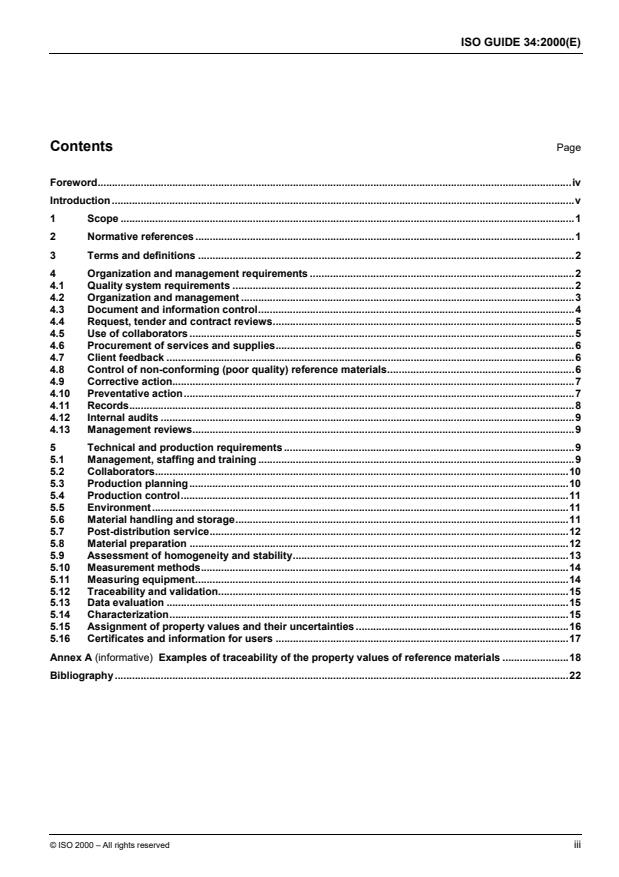
Contents Page
Foreword.iv
Introduction.v
1 Scope .1
2 Normative references .1
3 Terms and definitions .2
4 Organization and management requirements .2
4.1 Quality system requirements .2
4.2 Organization and management .3
4.3 Document and information control.4
4.4 Request, tender and contract reviews.5
4.5 Use of collaborators .5
4.6 Procurement of services and supplies.6
4.7 Client feedback .6
4.8 Control of non-conforming (poor quality) reference materials.6
4.9 Corrective action.7
4.10 Preventative action.7
4.11 Records.8
4.12 Internal audits .9
4.13 Management reviews.9
5 Technical and production requirements .9
5.1 Management, staffing and training .9
5.2 Collaborators.10
5.3 Production planning.10
5.4 Production control.11
5.5 Environment.11
5.6 Material handling and storage.11
5.7 Post-distribution service.12
5.8 Material preparation .12
5.9 Assessment of homogeneity and stability.13
5.10 Measurement methods.14
5.11 Measuring equipment.14
5.12 Traceability and validation.15
5.13 Data evaluation .15
5.14 Characterization.15
5.15 Assignment of property values and their uncertainties .16
5.16 Certificates and information for users .17
Annex A (informative) Examples of traceability of the property values of reference materials .18
Bibliography.22
Foreword
ISO (the International Organization for Standardization) and IEC (the International Electrotechnical Commission)
form the specialized system for worldwide standardization. National bodies that are members of ISO or IEC
participate in the development of International Standards through technical committees established by the
respective organization to deal with particular fields of technical activity. ISO and IEC technical committees
collaborate in fields of mutual interest. Other international organizations, governmental and non-governmental, in
liaison with ISO and IEC, also take part in the work.
Guides are drafted in accordance with the rules given in the ISO/IEC Directives, Part 3.
Draft Guides adopted by the responsible Committee or Group are circulated to national bodies for voting.
Publication as a Guide requires approval by at least 75 % of the national bodies casting a vote.
Attention is drawn to the possibility that some of the elements of this Guide may be the subject of patent rights. ISO
and IEC shall not be held responsible for identifying any or all such patent rights.
ISO Guide 34 was prepared by the ISO Committee on Reference Materials (REMCO).
This second edition cancels and replaces the first edition (ISO Guide 34:1996), which has been technically revised.
Annex A of this Guide is for information only.
iv © ISO 2000 – All rights reserved
Introduction
The use of reference materials makes possible the transfer of the values of measured or assigned quantities
between testing, analytical and measurement laboratories. Such materials are widely used for the calibration of
measuring equipment and for the evaluation or validation of measurement procedures. In certain cases, they
enable properties to be expressed conveniently in arbitrary units.
There is an increasing number of reference material producers, and a demonstration of their scientific and technical
competence is now a basic requirement for ensuring the quality of reference materials. The demand for new
reference materials of higher quality is increasing as a consequence of both the increased precision of measuring
equipment and the requirement for more accurate and reliable data in the scientific and technological disciplines.
Some previously acceptable reference materials may not meet these more stringent requirements. It is, therefore,
not only necessary for reference material producers to supply information about their materials in the form of
reports, certificates and statements, but also to demonstrate their competence in producing reference materials of
appropriate quality.
The first edition of ISO Guide 34 set out specific guidelines on the interpretation of ISO/IEC Guide 25 and the
ISO 9000 family of standards in the context of reference materials production. The more general requirements of
these standards were omitted. Since the first edition of ISO Guide 34 was published in 1996, the assessment of the
competence of reference material producers has gained considerable impetus. The present revision of Guide 34
now sets out all the general requirements in accordance with which a reference material producer has to
demonstrate that it operates.
Pharmacopoeial standards and substances are established and distributed by pharmacopoeial authorities following
the general principles of this Guide. It should be noted, however, that a different approach is used by the
pharmacopoeial authorities to give the user the information provided by certificates of analysis and expiration
dates. Also, the uncertainty of their assigned values is not stated since it is negligible in relation to the defined limits
of the method-specific assays of the pharmacopoeias for which they are used.
General requirements for the competence of reference
material producers
1 Scope
1.1 This Guide sets out the general requirements in accordance with which a reference material producer has to
demonstrate that it operates, if it is to be recognized as competent to carry out the production of reference
materials.
1.2 This Guide is intended for the use of reference material producers in the development and implementation of
their quality system, and by accreditation bodies, certification bodies and others concerned with assessing the
competence of reference material producers.
1.3 This Guide sets out the quality system requirements in accordance with which reference materials shall be
produced. It is intended to be used as part of a reference material producer’s general quality assurance (QA)
procedures.
2 Normative references
The following normative documents contain provisions which, through reference in this text, constitute provisions of
this Guide. For dated references, subsequent amendments to, or revisions of, any of these publications do not
apply. However, parties to agreements based on this Guide are encouraged to investigate the possibility of
applying the most recent editions of the normative documents indicated below. For undated references, the latest
edition of the normative document referred to applies. Members of ISO and IEC maintain registers of currently valid
International Standards.
ISO/IEC Guide 2:1996, Standardization and related activities — General vocabulary.
ISO/IEC Guide 25:1990, General requirements for the competence of calibration and testing laboratories.
ISO Guide 30:1992, Terms and definitions used in connection with reference materials.
ISO Guide 31:1981, Contents of certificates of reference materials.
ISO Guide 35:1989, Certification of reference materials — General and statistical principles.
ISO 8402:1994, Quality management and quality assurance — Vocabulary.
ISO 10012-1:1992, Quality assurance requirements for measuring equipment — Part 1: Metrological confirmation
system requirements for measuring equipment.
VIM:1993, International vocabulary of basic and general terms in metrology (issued by ISO, IEC, BIPM, IFCC,
IUPAC, IUPAP and OIML).
3 Terms and definitions
For the purposes of this Guide, the terms and definitions given in ISO/IEC Guide 2, ISO/IEC Guide 25,
ISO Guide 30, ISO 8402, VIM and the following apply.
3.1
reference material producer
technically competent body (organization or firm, public or private) that is fully responsible for assigning the certified
or other property values of the reference materials it produces and supplies which have been produced in
accordance with ISO Guides 31 and 35
3.2
collaborator
technically competent body (organization or firm, public or private) that undertakes aspects of the manufacture or
characterization of the (certified) reference material on behalf of the reference material producer, either on a
contractual (as a subcontractor) or voluntary basis
4 Organization and management requirements
4.1 Quality system requirements
4.1.1 General
The reference material producer shall establish, implement and maintain a quality system appropriate to the scope
of its activities, including the type, range and magnitude of the reference material production it undertakes.
It should be recognized that a reference material needs to be characterized mainly to the level of accuracy required
for its intended purpose (i.e. appropriate measurement uncertainty). The reference material producer shall describe
the procedure for establishing the quality of materials as a component of the quality system.
Reference material producers shall define their scope in terms of the application, the measurement methods used
in the homogeneity, stability and characterization studies, and any limitations due to the material matrix.
4.1.2 Quality policy
The reference material producer shall define and document its policy, objectives and commitment to ensuring and
maintaining the quality of all aspects of reference material production, including material quality (e.g. homogeneity
and stability), characterization (e.g. equipment calibration and measurement method validation), assignment of
property values (e.g. use of appropriate statistical procedures) and material handling, storage and transport
procedures.
The quality policy shall, when appropriate, include use of interlaboratory characterization studies employing
laboratories which are active and competent in the respective field of measurement. In this context, the policy shall
include a commitment to interact with the appropriate sectors of the measurement community, in order to prevent
working in isolation. The policy shall also include a commitment to produce reference materials which conform to
the definitions given in ISO Guide 30, characterized according to the requirements of ISO Guide 35 and whose
property values are assessed using accepted statistical techniques. The policy shall, where appropriate, include a
commitment to comply with ISO Guide 31 for the contents of reference material certificates and supply of
associated information for users. It is important that the policy also specify the intended use of the reference
materials, in order to ensure that the reference material producer fully advises the user for which types of
application the materials may be used.
4.1.3 Quality system
The reference material producer shall establish, implement and maintain a documented quality system appropriate
to the type, range and volume of reference material production it undertakes. The reference material producer shall
document all of its policies, systems, programmes, procedures, instructions, findings, etc., to the extent necessary
2 © ISO 2000 – All rights reserved
to enable the producer to assure the quality of the reference materials produced. Documentation used in this
quality system shall be communicated to, understood by, available to and implemented by all personnel concerned.
In particular, the producer shall have a quality system that covers the following:
a) arrangements for ensuring the suitable choice (e.g. particle size range, concentration range, etc.) of the
candidate reference materials;
b) preparation procedures;
c) achievement of the required degree of homogeneity of the reference material;
d) assessment of the stability of the reference material; including on-going assessment of stability where
necessary;
e) procedures for undertaking characterization;
f) practical realization of traceability to national or international standards of measurement;
g) assignment of property values, including preparation of certificates or statements in accordance with
ISO Guide 31 when appropriate;
h) arrangements for ensuring adequate storage facilities;
i) arrangements for suitable identification, labelling and packaging facilities, packing and delivery procedures and
customer service;
j) compliance with ISO Guides 30, 31, 34 and 35.
The documented quality system should specify which activities are undertaken by the reference material producer
and, where relevant, which activities are undertaken by collaborators. It shall include policies and procedures used
by the producer to ensure that all activities conducted by collaborators comply with the relevant clauses of this
Guide.
The documented quality system shall define the roles and responsibilities of the technical manager (however
named) and quality manager, including their responsibilities for ensuring compliance with this Guide.
4.2 Organization and management
4.2.1 The reference material producer, or the organization of which it is part, shall be legally identifiable.
4.2.2 The reference material producer shall be organized and shall operate in such a way that it meets all the
applicable requirements of this Guide, whether carrying out work in its permanent facilities or at sites (including
associated temporary or mobile facilities) away from its permanent facilities (including work undertaken by
collaborators).
4.2.3 The reference material producer shall:
a) have managerial personnel supported by technical personnel with the authority and resources needed to
discharge their duties and to identify the occurrence of departures from the quality system or the procedures
for the production of reference materials and to initiate actions to prevent or minimize such departures;
b) have arrangements to ensure that its management and personnel are free from any commercial, financial and
other internal and external pressures that may adversely affect the quality of their work;
c) have policies and procedures to ensure the protection of its client’s confidential information and proprietary
rights;
d) have policies and procedures to avoid involvement in any activities that might diminish confidence in its
competence, impartiality, judgement or operational integrity;
e) define, with the aid of organizational charts, the organization and management structure of the reference
material producer, its place in any parent organization, and the relations between management, technical
operations, support services, collaborators and the quality management system;
f) specify the responsibility, authority and interrelationships of all personnel who manage, perform or verify work
affecting the quality of production of reference materials;
g) have technical management, which has overall responsibility for the technical operations and the provision of
the resources needed to ensure the required quality of each operation which forms part of the reference
material production;
h) appoint a member of staff as quality manager (however named) who, irrespective of other duties and
responsibilities, shall have defined responsibility and authority for ensuring that the requirements of this Guide
are implemented and followed at all times. The quality manager shall have direct access to the highest level of
management at which decisions are taken on production policy or resources;
i) where appropriate, appoint deputies for key managerial personnel such as the technical and quality managers.
4.3 Document and information control
4.3.1 General
The reference material producer shall establish and maintain procedures to control all documents (both internally
generated and from external sources) and other information that form part of its quality documentation. These may
include documents of external origin, such as standards, guides, test and/or calibration methods, as well as
specifications, instructions and manuals related to the reference material under production.
NOTE In this context “document” means any information or instruction including policy statements, text books, procedures,
specifications, calibration tables, charts, software, etc. These may be on various media, whether hard or electronic, and they
may be digital, analog, photographic or written.
4.3.2 Document approval and issue
4.3.2.1 All documents (including documented procedures) issued to personnel as part of the quality system
shall be suitably controlled. This shall include review and approval for use by authorized personnel prior to issue. A
master list or equivalent, identifying the current revision status of documents in the quality system, shall be
established and be readily available to preclude the use of invalid and/or obsolete documents.
4.3.2.2 The procedures adopted shall also ensure that:
a) authorized editions of appropriate documents are available at all locations where operations essential to the
effective production of reference materials are performed;
b) documents are periodically reviewed and, where necessary, revised to ensure continuing suitability and
compliance with applicable requirements;
c) invalid or obsolete documents are promptly removed from all points of issue or use, or otherwise assured
against unintended use;
d) obsolete documents retained for either legal or information preservation purposes are suitably marked.
4.3.3 Document changes
4.3.3.1 Changes to documents (including documented procedures) shall be reviewed and approved by
designated personnel performing the same function as that conducted for the original review and approval unless
specifically decided otherwise. The designated personnel shall have access to pertinent background information
upon which to base their review and approval.
4 © ISO 2000 – All rights reserved
4.3.3.2 Where practicable, the nature of the change shall be identified in the document with appropriate
attachments.
4.3.3.3 If the reference material producer’s documentation control system allows for the amendment of
documents by hand, pending the re-issue of the documents, the procedures and authorities for such amendments
shall be defined and shall ensure that amendments are initialled and dated. Documents amended by hand shall be
marked, signed and dated and shall be formally re-issued as soon as practicable.
4.3.3.4 Procedures shall be established to describe how changes in documents maintained in computerized
systems are made.
4.4 Request, tender and contract reviews
4.4.1 When relevant, each request, tender or contract concerning the production of a reference material shall be
reviewed by the reference material producer to ensure that:
a) the requirements are adequately defined, documented and understood;
b) the reference material producer has the capability and resources to meet the requirements;
c) in the case of external contracts, any differences between the contract or order requirements and those in a
tender are resolved to the satisfaction of the reference material producer and the customer or client.
The request, tender or contract review should be conducted in a practical and efficient manner and the financial,
legal and time schedule aspects should be taken into account.
NOTE 1 Capability means that the reference material producer possesses the necessary equipment, intellectual and
information resources and that its personnel have the skills and expertise necessary for the production of those reference
materials in question. The review of the capability may include an assessment of previous reference material production and/or
the organization of interlaboratory characterization programmes using samples of similar composition to the reference materials
to be produced.
NOTE 2 A contract may be any written or verbal agreement to provide a customer or client with reference materials from
stock or custom-produced respectively.
4.4.2 Records of such reviews, including any changes, shall be maintained. Records shall also be maintained of
pertinent discussions with a customer relating to the customer’s requirements or the results of the work during the
period of execution of the contract or request.
4.4.3 The review shall include any work that has to be subcontracted by the reference material producer.
4.5 Use of collaborators
4.5.1 The reference material producer shall establish and maintain procedures to ensure that all tasks performed
by collaborators comply with specifications set by the reference material producer for such tasks. The reference
material producer shall also ensure that collaborators comply with any clauses of this Guide relevant to the tasks
performed by them for the reference material producer.
4.5.2 The reference material producer shall select collaborators on the basis of their ability to meet
subcontracted requirements in terms of both their technical competence and any specific quality assurance
requirements relevant to their tasks. The technical requirements to be satisfied by collaborators shall be equivalent
to the technical requirements specified in clause 5 of this Guide.
4.5.3 The reference material producer shall maintain a register of all collaborators used in the production
process, and include a record of any assessments made of their abilities to carry out subcontracted tasks according
to the requirements of this Guide.
The reference material producer is always responsible for ensuring that a collaborator is competent. The
collaborator should be able to demonstrate compliance with the requirements of this Guide for all subcontracted
work.
4.6 Procurement of services and supplies
4.6.1 The reference material producer shall have policies and procedures for the selection of services and
supplies that affect the quality of its reference materials.
4.6.2 The reference material producer shall use only those services and supplies that are of adequate
specification to ensure the quality of its reference materials.
4.6.3 When no formal approval of the quality of services and supplies is available, the reference material
producer shall have procedures to ensure that purchased materials and services comply with specified
requirements and records of actions taken shall be maintained.
4.6.4 The reference material producer shall ensure that purchased equipment and consumable materials are not
used until they have been inspected, calibrated or otherwise verified as complying with standard specifications or
requirements defined in specifications for production, characterization and certification of its reference materials.
4.6.5 The reference material producer shall maintain records of the main suppliers and collaborators from whom
it obtains supplies required for the production of reference materials. These records should include any quality
assurance approval the suppliers and/or collaborators hold.
4.7 Client feedback
The reference material producer shall have a policy and procedures for the resolution of complaints or other
feedback received from its customers or other parties. Records shall be maintained of all complaints and of the
investigations and corrective actions taken by the reference material producer.
4.8 Control of non-conforming (poor quality) reference materials
4.8.1 The reference material producer shall have a policy and procedures that shall be implemented when it
establishes that any aspect of its production activities do not conform with its own specified production procedures.
The policy and procedures shall ensure that:
a) responsibilities and authorities for the management of non-conforming work are designated;
b) the actions, which must be taken when any non-conforming reference materials are identified, are defined,
together with a system which ensures they are implemented;
c) an evaluation of the significance of the non-conforming work is made;
d) work is halted and, if appropriate, certificates withheld as necessary;
e) remedial actions are taken within a defined timeframe;
f) where necessary, the results of non-conforming reference materials already distributed to customers are
recalled;
g) the responsibility for authorization of the resumption of work is defined.
NOTE The identification of non-conforming reference materials or problems with the quality system or with certification
activities can occur at various places within the quality system such as: customer complaints, quality control, checking of
consumable materials, staff observations or supervision, certificate checking, management reviews and internal or external
audits.
6 © ISO 2000 – All rights reserved
4.8.2 Where the evaluation indicates that the supply of non-conforming reference materials could recur or that
there is doubt about the reference material producer’s compliance with its own policies and procedures, the
corrective action procedures in 4.9 shall be promptly followed to identify the causes of the problem and to eliminate
them.
4.9 Corrective action
4.9.1 General
The reference material producer shall establish a policy and procedures and shall designate appropriate authorities
for implementing corrective action when non-conforming reference materials or departures from the policies and
procedures in the quality system have been identified.
Any corrective action taken to eliminate the causes of non-conformances or other departures shall be to a degree
appropriate to the magnitude of the problems and commensurate with the risks encountered.
The reference material producer shall document and implement any required changes to the operational
procedures resulting from corrective action investigations.
NOTE A problem with the quality system or with technical operations may be identified through a variety of activities within
the quality system, such as control of non-conforming reference materials, internal or external audits, management reviews,
feedback from clients or staff observations.
4.9.2 Cause analysis
Corrective action procedures shall include an investigation process to determine the causes of the problem. This is
sometimes the most difficult, but the key part in the corrective action procedure.
Often the root cause is not obvious and thus a careful analysis of all potential causes of the problem is required.
Potential causes could include, inter alia, the nature of the reference material and its specification, methods and
procedures used for characterization, staff skills and training, and the materials and equipment (and/or its
calibration) used in the production processes.
4.9.3 Corrective actions
The reference material producer shall identify possible causes and potential corrective actions. It shall select the
actions most likely to eliminate the problem and to prevent it recurring.
4.9.4 Monitoring of corrective actions
After having implemented the action plans, the reference material producer shall monitor the results to ensure that
the actions taken have been effective in overcoming the problems originally identified.
4.9.5 Results
The results of corrective action shall be submitted for management review.
4.10 Preventative action
4.10.1 All operational procedures shall be systematically reviewed at regular intervals to identify any potential
sources of non-conformance and any opportunities for improvement, either technical or with the quality system.
Action plans shall be developed, implemented and monitored, to reduce the likelihood of occurrence of such non-
conformances and to take advantage of the improvement opportunities.
NOTE 1 Preventative action is a pro-active process to identify improvement opportunities, rather than a reaction to the
identification of problems or complaints.
NOTE 2 TQM tools such as brainstorming, flowcharting, mind-mapping and parieto charts can assist this process.
4.10.2 After the implementation of the preventative actions, the reference material producer shall monitor the
results to establish any reduction in deficiencies or other improvements in this operational area, thereby
establishing the effectiveness of the preventative action.
4.10.3 The results of preventative actions shall be submitted for management review.
4.11 Records
4.11.1 General
4.11.1.1 The reference material producer shall establish and maintain procedures for identification, collection,
indexing, access, storage, maintenance and disposal of quality and technical records.
a) Quality records
Quality records are records providing objective evidence of the extent of the fulfilment of the requirements for
quality or the effectiveness of the operation of the quality system. For example, they include reports from internal
audits and management reviews, and corrective and preventative action records.
b) Technical records
Technical records are accumulations of data and information which result from carrying out testing and calibration
procedures and which indicate whether specified quality or process parameters are achieved. They include forms,
contracts, work sheets, work books, check sheets, control charts/graphs, calibration reports/certificates and papers,
reports and certificates to customers and clients.
The reference material producer should ensure that it has recorded such information that might be needed in a
future dispute situation.
4.11.1.2 All records shall be legible and shall be stored and retained in such a way that they are readily
retrievable, and in facilities that provide a suitable environment to prevent damage, deterioration or loss. Retention
times of records shall be established and recorded.
NOTE Records may be in the form of any type of media, such as hard copy or electronic media.
4.11.1.3 All records shall be held secure and, where appropriate, in confidence to the client.
4.11.1.4 The reference material producer shall have procedures to protect electronically-held data at all times
and to prevent unauthorized access to, or amendment of, such data.
4.11.2 Records and reports
The reference material producer shall establish and maintain a record system to suit its particular circumstances
and to comply with any applicable regulations. The reference material producer shall arrange for all individual
measurement observations, appropriate calculations and derived data (e.g. statistical treatments and uncertainty
budgets), calibration records and preparation reports to be retained for a defined period beyond which it is no
longer probable that they will be referred to, taking into account the period for which the reference material remains
valid.
The results of each calibration or measurement (or series of either) carried out by the reference material producer
and, where appropriate, its collaborators, shall be reported unambiguously and objectively, in accordance with any
instructions in the calibration or measurement methods. The results shall normally be reported in a calibration or
measurement report and shall include all information necessary for interpretation of the calibration or measurement
results and a summary of the method employed.
This procedure applies to internal reports of the reference material producer and should not be confused with a
certificate of analysis or certification report which is supplied with a reference material to the customer or client.
8 © ISO 2000 – All rights reserved
4.12 Internal audits
4.12.1 The reference material producer shall, periodically and in accordance with a predetermined schedule and
procedure, conduct internal audits of its activities to verify that its operations continue to comply with the
requirements of the quality system and the requirements of this Guide. The internal audit programme shall address
all elements of the quality system, including the technical and production activities leading to the finished product
(reference material). It is the responsibility of the quality manager to plan and organize audits as required by the
schedule and requested by management. Such audits shall be carried out by trained and qualified personnel who
are, wherever resources permit, independent of the activity to be audited. Personnel shall not audit their own
activities except where it is necessary and it can be demonstrated that an effective audit has been carried out.
The schedule for internal auditing should normally be completed in one year.
4.12.2 When audit findings cast doubt on the effectiveness of the operations or on the correctness or validity of its
reference materials, the reference material producer shall take timely corrective action and shall notify, in writing, its
customers whose activities may have been adversely affected.
4.12.3 All audit findings and corrective actions that arise from them shall be recorded. The reference material
producer’s management shall ensure that these actions are discharged within an appropriate and agreed
timescale.
4.13 Management reviews
4.13.1 The reference material producer’s senior management shall periodically conduct a review of its quality
system and production processes to ensure their continuing suitability and effectiveness and to introduce any
necessary changes or improvements. The review shall take account of reports from managerial and supervisory
personnel, the outcome of recent internal audits, assessments by external bodies, feedback from customers,
including complaints and other relevant factors.
A typical period for conducting a management review is once every year. Results should feed into the corporate
planning programme and should include the goals, objectives and action plans for the coming year.
4.13.2 Findings from management reviews and the actions that arise from them shall be recorded. The
management shall ensure that these actions are discharged within an appropriate and agreed timescale.
5 Technical and production requirements
5.1 Management, staffing and training
5.1.1 The production of reference materials should, where possible, only be undertaken by organizations having
experience in the production of the particular type of reference material (or related material), as well as having
experience in the measurement of the properties being determined.
The reference material producer and any associated collaborators shall have managerial staff with the necessary
authority, resources and technical competence required to discharge their duties. Measurement of the property of
interest shall be completed by, or under the supervision of a technically competent manager qualified either in
terms of suitable academic qualifications or relevant work experience. The reference material producer’s
management shall define the minimum levels of qualification and experience necessary for the key posts within its
body.
5.1.2 The reference material producer shall have sufficient personnel having the necessary education, training,
technical knowledge and experience for their assigned functions.
EXAMPLE A staff member undertaking thermal expansion measurements should have a degree or appropriate level
qualification, together with adequate experience in the field working with a more senior scientist making measurements at an
equivalent level of accuracy.
5.1.3 The reference material producer shall also ensure that staff receive additional training, when necessary, to
ensure competent performance of measurements, operation of equipment and any other activities which affect
quality. Where possible, objective measures should be used to assess the attainment of competence during
training.
The need to retrain staff periodically should be considered (e.g. the reference material producer should have in
place a policy for retraining staff when a method or measurement technique is not in regular use). Staff training and
retraining policies should take account of technological change and aim at continuous skill upgrading.
5.1.4 The reference material producer shall maintain an up-to-date record of the training that each staff member
has received. These records shall provide evidence that individual staff members have been adequately trained
and that their competence to complete particular types of material preparation and measurement has been
assessed.
5.2 Collaborators
5.2.1 Where a reference material producer undertakes any part of the procedure for the production or
characterization of a reference material on an interlaboratory basis, the producer shall be able to demonstrate that
the experience of any collaborator is sufficient, and that the results produced are of the required quality. In
assessing the competence of a collaborator, the reference material producer shall require information on the
collaborator’s knowledge of the subject and details of past experience in the field (e.g. valid results for comparable
measurements). In the latter context, the producer may consider distributing materials of a comparable matrix
whose property values are well established and at appropriate concentration levels, ranges, etc., prior to
distributing any candidate reference material samples. Evidence of collaborators being accredited to
ISO/IEC Guide 25 when testing is carried out, or registered to the ISO 9000 series for other activities, is generally
appropriate. Evidence of collaborators participating in a relevant proficiency testing scheme and producing
acceptable results on well-characterized materials of similar or equivalent nature to that of the reference material
may also be considered appropriate. At the limit, the reference material producer may have no laboratory facilities,
but shall ensure that all scientific work carried out by collaborators which may contribute to the assignment of the
property values of interest is fit for that purpose and in compliance with the above requirements.
5.2.2 The reference material producer shall ensure that all details of the methodology, results and all the
performance procedures of any collaborators are available, if required, and that a register/database of all
collaborators and their a
...
Questions, Comments and Discussion
Ask us and Technical Secretary will try to provide an answer. You can facilitate discussion about the standard in here.
Loading comments...