


ISO 37120:2014
(Main)Sustainable development of communities — Indicators for city services and quality of life
Sustainable development of communities — Indicators for city services and quality of life
ISO 37120:2014 defines and establishes methodologies for a set of indicators to steer and measure the performance of city services and quality of life. It follows the principles set out and can be used in conjunction with ISO 37101:?, Sustainable development in communities ? Management systems ? General principles and requirements, when published, and other strategic frameworks. ISO 37120:2014 is applicable to any city, municipality or local government that undertakes to measure its performance in a comparable and verifiable manner, irrespective of size and location.
Développement durable des collectivités — Indicateurs pour les services urbains et la qualité de vie
General Information
- Status
- Withdrawn
- Publication Date
- 14-May-2014
- Withdrawal Date
- 14-May-2014
- Technical Committee
- ISO/TC 268 - Sustainable cities and communities
- Drafting Committee
- ISO/TC 268 - Sustainable cities and communities
- Current Stage
- 9599 - Withdrawal of International Standard
- Start Date
- 05-Jul-2018
- Completion Date
- 14-Feb-2026
Relations
- Effective Date
- 05-Nov-2015
Buy Documents

ISO 37120:2014 - Sustainable development of communities -- Indicators for city services and quality of life

ISO 37120:2014 - Sustainable development of communities -- Indicators for city services and quality of life
Get Certified
Connect with accredited certification bodies for this standard

BSI Group
BSI (British Standards Institution) is the business standards company that helps organizations make excellence a habit.

Bureau Veritas
Bureau Veritas is a world leader in laboratory testing, inspection and certification services.

DNV
DNV is an independent assurance and risk management provider.
Sponsored listings
Frequently Asked Questions
ISO 37120:2014 is a standard published by the International Organization for Standardization (ISO). Its full title is "Sustainable development of communities — Indicators for city services and quality of life". This standard covers: ISO 37120:2014 defines and establishes methodologies for a set of indicators to steer and measure the performance of city services and quality of life. It follows the principles set out and can be used in conjunction with ISO 37101:?, Sustainable development in communities ? Management systems ? General principles and requirements, when published, and other strategic frameworks. ISO 37120:2014 is applicable to any city, municipality or local government that undertakes to measure its performance in a comparable and verifiable manner, irrespective of size and location.
ISO 37120:2014 defines and establishes methodologies for a set of indicators to steer and measure the performance of city services and quality of life. It follows the principles set out and can be used in conjunction with ISO 37101:?, Sustainable development in communities ? Management systems ? General principles and requirements, when published, and other strategic frameworks. ISO 37120:2014 is applicable to any city, municipality or local government that undertakes to measure its performance in a comparable and verifiable manner, irrespective of size and location.
ISO 37120:2014 is classified under the following ICS (International Classification for Standards) categories: 13.020.10 - Environmental management; 13.020.20 - Environmental economics. Sustainability. The ICS classification helps identify the subject area and facilitates finding related standards.
ISO 37120:2014 has the following relationships with other standards: It is inter standard links to ISO 37120:2018. Understanding these relationships helps ensure you are using the most current and applicable version of the standard.
ISO 37120:2014 is available in PDF format for immediate download after purchase. The document can be added to your cart and obtained through the secure checkout process. Digital delivery ensures instant access to the complete standard document.
Standards Content (Sample)
ISO 37120
Sustainable
development
of communities
Indicators for city services
and quality of life
First edition
2014-05-15
Our vision Our process
To be the world’s leading provider of high Our standards are developed by experts
quality, globally relevant International all over the world who work on a volunteer
Standards through its members and or part-time basis. We sell International
stakeholders. Standards to recover the costs of organ-
izing this process and making standards
widely available.
Our mission
Please respect our licensing terms and
ISO develops high quality voluntary
copyright to ensure this system remains
International Standards that facilitate
independent.
international exchange of goods and ser-
If you would like to contribute to the devel-
vices, support sustainable and equitable
opment of ISO standards, please contact
economic growth, promote innovation and
the ISO Member Body in your country:
protect health, safety and the environment.
www.iso.org/iso/home/about/iso_mem-
bers.htm
This document has been prepared by:
ISO/TC 268, Sustainable development of
All rights reserved. Unless otherwise
communities.
specified, no part of this publication may
Committee members:
be reproduced or utilized otherwise in
ASI; BNSI; BSI; SCC; SAC; UNMZ; DS; EOS;
any form or by any means, electronic
AFNOR; DIN; SII; JISC; NEN; SN; GOST R;
or mechanical, including photocopy, or
ASN; SABS; AENOR; SLSI; SIS; FIDIC; GCIF;
posting on the internet or intranet, with-
ICLEI; UNEP.
out prior permission. Permission can be
requested from either ISO at the address
This list reflects contributing members at the
below or ISO’s member body in the country
time of publication.
of the requester:
Cover photo credit: ISO/CS, 2014
ISO copyright office
Case postale 56 • CH-1211 Geneva 20
Tel. +41 22 749 01 11
Fax. +41 22 749 09 47
E-mail copyright@iso.org
Web www.iso.org
Executive summary
— ISO 37120 establishes definitions that undertakes to measure its perfor-
and methodologies for a set of city indica- mance in a comparable and verifiable man-
tors to steer and measure delivery of city ner, irrespective of size and location.
services and quality of life. As part of a
new series of International Standards be- — The indicators can be used to track
ing developed for a holistic and integrated and monitor a city’s progress on city ser-
approach to sustainable development and vice performance and quality of life and as-
resilience, this set of standardized indica- sist cities in setting targets and monitoring
tors provides a uniform approach to what achievements. In order to achieve sustain-
is measured, and how that measurement is able development, the whole city system
to be undertaken. needs to be taken into consideration.
Planning for future needs must take into
— The requirements contained in this consideration current use and efficiency of
International Standard are applicable to resources in order to better plan for tomor-
any city, municipality or local government row.
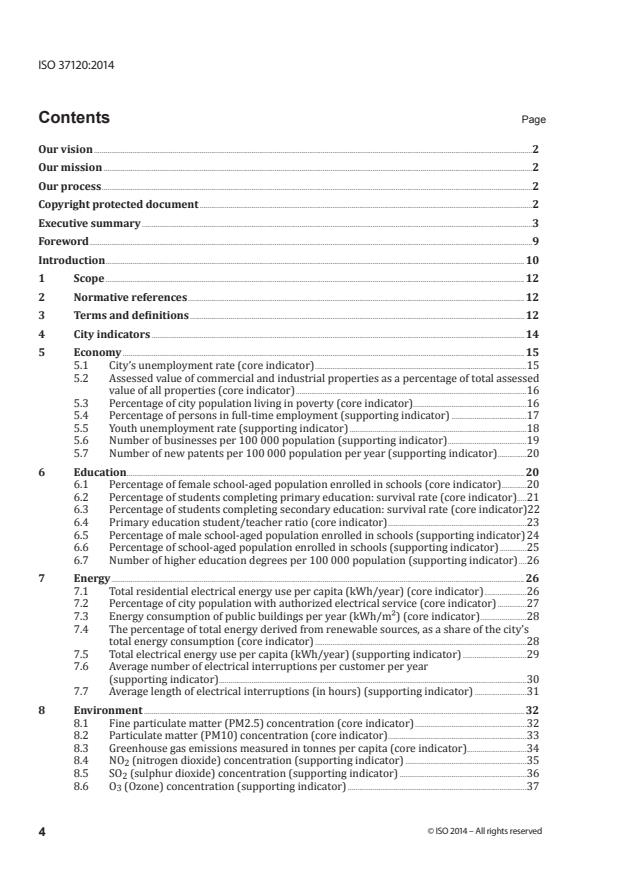
Contents Page
Our vision .2
Our mission .2
Our process .2
Executive summary .3
Foreword .9
Introduction .10
1 Scope .12
2 Normative references .12
3 Terms and definitions .12
4 City indicators .14
5 Economy .15
5.1 City’s unemployment rate (core indicator) .15
5.2 Assessed value of commercial and industrial properties as a percentage of total assessed
value of all properties (core indicator) .16
5.3 Percentage of city population living in poverty (core indicator).16
5.4 Percentage of persons in full-time employment (supporting indicator) .17
5.5 Youth unemployment rate (supporting indicator) .18
5.6 Number of businesses per 100 000 population (supporting indicator) .19
5.7 Number of new patents per 100 000 population per year (supporting indicator) .20
6 Education .20
6.1 Percentage of female school-aged population enrolled in schools (core indicator) . .20
6.2 Percentage of students completing primary education: survival rate (core indicator).21
6.3 Percentage of students completing secondary education: survival rate (core indicator) 22
6.4 Primary education student/teacher ratio (core indicator) .23
6.5 Percentage of male school-aged population enrolled in schools (supporting indicator) 24
6.6 Percentage of school-aged population enrolled in schools (supporting indicator) .25
6.7 Number of higher education degrees per 100 000 population (supporting indicator) .26
7 Energy .26
7.1 Total residential electrical energy use per capita (kWh/year) (core indicator) .26
7.2 Percentage of city population with authorized electrical service (core indicator) .27
7.3 Energy consumption of public buildings per year (kWh/m²) (core indicator) .28
7.4 The percentage of total energy derived from renewable sources, as a share of the city’s
total energy consumption (core indicator) .28
7.5 Total electrical energy use per capita (kWh/year) (supporting indicator) .29
7.6 Average number of electrical interruptions per customer per year
(supporting indicator) .30
7.7 Average length of electrical interruptions (in hours) (supporting indicator) .31
8 Environment .32
8.1 Fine particulate matter (PM2.5) concentration (core indicator) .32
8.2 Particulate matter (PM10) concentration (core indicator) .33
8.3 Greenhouse gas emissions measured in tonnes per capita (core indicator).34
8.4 NO (nitrogen dioxide) concentration (supporting indicator) .35
8.5 SO (sulphur dioxide) concentration (supporting indicator) .36
8.6 O (Ozone) concentration (supporting indicator) .37
8.7 Noise pollution (supporting indicator) .37
8.8 Percentage change in number of native species (supporting indicator) .38
9 Finance .39
9.1 Debt service ratio (debt service expenditure as a percentage of a municipality’s own-
source revenue) (core indicator) .39
9.2 Capital spending as a percentage of total expenditures (supporting indicator) .40
9.3 Own-source revenue as a percentage of total revenues (supporting indicator).40
9.4 Tax collected as a percentage of tax billed (supporting indicator) .41
10 Fire and emergency response .42
10.1 Number of firefighters per 100 000 population (core indicator) .42
10.2 Number of fire related deaths per 100 000 population (core indicator) .42
10.3 Number of natural disaster related deaths per 100 000 population (core indicator) .43
10.4 Number of volunteer and part-time firefighters per 100 000 population
(supporting indicator) .44
10.5 Response time for emergency response services from initial call (supporting indicator) 44
10.6 Response time for fire department from initial call (supporting indicator) .45
11 Governance .46
11.1 Voter participation in last municipal election (as a percentage of eligible voters)
(core indicator) .46
11.2 Women as a percentage of total elected to city-level office (core indicator) .47
11.3 Percentage of women employed in the city government workforce
(supporting indicator) .47
11.4 Number of convictions for corruption and/or bribery by city officials per 100 000
population (supporting indicator) .48
11.5 Citizens’ representation: number of local officials elected to office per 100 000 population
(supporting indicator) .48
11.6 Number of registered voters as a percentage of the voting age population
(supporting indicator) .49
12 Health .50
12.1 Average life expectancy (core indicator) .50
12.2 Number of in-patient hospital beds per 100 000 population (core indicator) .50
12.3 Number of physicians per 100 000 population (core indicator) .51
12.4 Under age five mortality per 1 000 live births (core indicator) .52
12.5 Number of nursing and midwifery personnel per 100 000 population
(supporting indicator) .53
12.6 Number of mental health practitioners per 100 000 population (supporting indicator) 54
12.7 Suicide rate per 100 000 population (supporting indicator) .54
13 Recreation .55
13.1 Square meters of public indoor recreation space per capita (supporting indicator) .55
13.2 Square meters of public outdoor recreation space per capita (supporting indicator) .56
14 Safety .57
14.1 Number of police officers per 100 000 population (core indicator) .57
14.2 Number of homicides per 100 000 population (core indicator) .58
14.3 Crimes against property per 100 000 (supporting indicator) .59
14.4 Response time for police department from initial call (supporting indicator) .59
14.5 Violent crime rate per 100 000 population (supporting indicator) .60
15 Shelter.61
15.1 Percentage of city population living in slums (core indicator) .61
15.2 Number of homeless per 100 000 population (supporting indicator) .62
15.3 Percentage of households that exist without registered legal titles
(supporting indicator) .63
16 Solid waste .63
16.1 Percentage of city population with regular solid waste collection (residential)
(core indicator) .63
16.2 Total collected municipal solid waste per capita (core indicator) .65
16.3 Percentage of the city’s solid waste that is recycled (core indicator) .66
16.4 Percentage of the city’s solid waste that is disposed of in a sanitary landfill
(supporting indicator) .67
16.5 Percentage of the city’s solid waste that is disposed of in an incinerator
(supporting indicator) .68
16.6 Percentage of the city’s solid waste that is burned openly (supporting indicator) .69
16.7 Percentage of the city’s solid waste that is disposed of in an open dump
(supporting indicator) .70
16.8 Percentage of the city’s solid waste that is disposed of by other means
(supporting indicator) .70
16.9 Hazardous Waste Generation per capita (tonnes) (supporting indicator) .71
16.10 Percentage of the city’s hazardous waste that is recycled (supporting indicator) .73
17 Telecommunication and innovation .73
17.1 Number of internet connections per 100 000 population (core indicator) .73
17.2 Number of cell phone connections per 100 000 population (core indicator) .74
17.3 Number of landline phone connections per 100 000 population (supporting indicator) 75
18 Transportation .75
18.1 Kilometres of high capacity public transport system per 100 000 population
(core indicator) .75
18.2 Kilometres of light passenger public transport system per 100 000 population
(core indicator) .76
18.3 Annual number of public transport trips per capita (core indicator) .77
18.4 Number of personal automobiles per capita (core indicator) .78
18.5 Percentage of commuters using a travel mode to work other than a personal vehicle
(supporting indicator) .78
18.6 Number of two-wheel motorized vehicles per capita (supporting indicator) .80
18.7 Kilometres of bicycle paths and lanes per 100 000 population (supporting indicator) .80
18.8 Transportation fatalities per 100 000 population (supporting indicator) .81
18.9 Commercial air connectivity (number of non-stop commercial air destinations)
(supporting indicator) .82
19 Urban planning .83
19.1 Green area (hectares) per 100 000 population (core indicator) .83
19.2 Annual number of trees planted per 100 000 population (supporting indicator) .83
19.3 Areal size of informal settlements as a percentage of city area (supporting indicator) .84
19.4 Jobs/housing ratio (supporting indicator) .85
20 Wastewater .86
20.1 Percentage of city population served by wastewater collection (core indicator) .86
20.2 Percentage of the city’s wastewater that has received no treatment (core indicator) .87
20.3 Percentage of the city’s wastewater receiving primary treatment (core indicator) .87
20.4 Percentage of the city’s wastewater receiving secondary treatment (core indicator) .88
20.5 Percentage of the city’s wastewater receiving tertiary treatment (core indicator) .89
21 Water and sanitation .90
21.1 Percentage of city population with potable water supply service (core indicator) .90
21.2 Percentage of city population with sustainable access to an improved water source
(core indicator) .91
21.3 Percentage of population with access to improved sanitation (core indicator) .92
21.4 Total domestic water consumption per capita (litres/day) (core indicator).93
21.5 Total water consumption per capita (litres/day) (supporting indicator) .94
21.6 Average annual hours of water service interruption per household
(supporting indicator) .95
21.7 Percentage of water loss (unaccounted for water) (supporting indicator) .96
22 Reporting and record maintenance .96
Annex A (informative) City indicators .97
Annex B (informative) Profile indicators .103
Bibliography .105
Foreword
ISO (the International Organization for Standardization) is a worldwide fed-
eration of national standards bodies (ISO member bodies). The work of pre-
paring International Standards is normally carried out through ISO technical
committees. Each member body interested in a subject for which a technical
committee has been established has the right to be represented on that com-
mittee. International organizations, governmental and non-governmental, in
liaison with ISO, also take part in the work. ISO collaborates closely with the
International Electrotechnical Commission (IEC) on all matters of electrotechni-
cal standardization.
The procedures used to develop this document and those intended for its fur-
ther maintenance are described in the ISO/IEC Directives, Part 1. In particular
the different approval criteria needed for the different types of ISO documents
should be noted. This document was drafted in accordance with the editorial
rules of the ISO/IEC Directives, Part 2 (see www.iso.org/directives).
Attention is drawn to the possibility that some of the elements of this document
may be the subject of patent rights. ISO shall not be held responsible for identi-
fying any or all such patent rights. Details of any patent rights identified during
the development of the document will be in the Introduction and/or on the ISO
list of patent declarations received (see www.iso.org/patents).
Any trade name used in this document is information given for the convenience
of users and does not constitute an endorsement.
For an explanation on the meaning of ISO specific terms and expressions related
to conformity assessment, as well as information about ISO’s adherence to the
WTO principles in the Technical Barriers to Trade (TBT) see the following URL:
Foreword - Supplementary information
The committee responsible for this document is ISO/TC 268, Sustainable devel-
opment in communities.
Introduction
Cities need indicators to measure their performance. Existing indicators are
often not standardized, consistent, or comparable over time or across cities.
As part of a new series of International Standards being developed for a holistic
and integrated approach to sustainable development and resilience, this set of
standardized indicators provides a uniform approach to what is measured, and
how that measurement is to be undertaken. As a list, it does not provide a value
judgement, or threshold or a target numerical value for the indicators.
Conformance with this standard does not confer a status in this regard. A city
which conforms to this standard in regards to measurement of indicators for
city services and quality of life may only claim compliance to that effect.
These indicators can be used to track and monitor progress on city perfor-
mance. In order to achieve sustainable development, the whole city system
needs to be taken into consideration. Planning for future needs must take into
consideration current use and efficiency of resources in order to better plan for
tomorrow.
The indicators and associated test methods in this International Standard have
been developed in order to help cities:
a) measure performance management of city services and quality of life over
time;
b) learn from one another by allowing comparison across a wide range of per-
formance measures; and,
c) share best practices.
NOTE It is acknowledged that cities may not have direct influence or control over
factors governing some of these indicators, but the reporting is important for meaning-
ful comparison and provides a general indication of service delivery and quality of life
within a city.
The indicators in this International Standard have been selected to make
reporting as simple and inexpensive as possible, and therefore reflect an initial
platform for reporting. Further development of indicators to support sustain-
able development and resilience in cities is on-going in TC268.
The indicators are structured around themes. Recognizing the differences in
resources and capabilities of cities worldwide, the overall set of indicators for
city performance has been divided into “core” indicators (those implementing
this International Standard shall follow) and “supporting” indicators, (those
implementing this International Standard should follow). Both core and sup-
porting indicators are listed in Annex A, Table A.1. In addition, profile indicators,
which provide basic statistics and background information to help cities deter-
mine which cities are of interest for comparisons, are included in Annex B, Table
B.1, as a reference.
In this International Standard, the following verbal forms are used:
— “shall” indicates a requirement;
— “should” indicates a recommendation;
— “may” indicates a permission;
— “can” indicates a possibility or a capability.
1 Scope
This International Standard defines and establishes methodologies for a set
of indicators to steer and measure the performance of city services and qual-
ity of life. It follows the principles set out and can be used in conjunction with
ISO 37101:—, Sustainable development in communities — Management systems
— General principles and requirements, when published, and other strategic
frameworks.
This International Standard is applicable to any city, municipality or local gov-
ernment that undertakes to measure its performance in a comparable and veri-
fiable manner, irrespective of size and location.
2 Normative references
The following documents, in whole or in part, are normatively referenced in this
document and are indispensable for its application. For dated references, only
the edition cited applies. For undated references, the latest edition of the refer-
enced document (including any amendments) applies.
ISO 37101:—, Sustainable development and resilience of communities —
Management systems — General principles and requirements
ISO 1996-2:—, Acoustics Description, measurement and assessment of environ-
mental noise — Part 2: Determination of environmental noise levels
3 Terms and definitions
For the purposes of this document, the terms and definitions given in ISO 37101,
and the following apply.
3.1
city
urban community falling under a specific administrative boundary, commonly
referred to as a city, municipality or local government
3.2
indicator
a quantitative, qualitative or descriptive measure
[SOURCE: ISO 15392:2008, 3.14]
Note 1 to entry: Indicators in this standard are divided into:
a) core indicators: indicators that are required to demonstrate performance in the
delivery of city services and quality of life.
b) supporting indicators: indicators that are recommended to demonstrate perfor-
mance in the delivery of city services and quality of life.
c) profile indicators: indicators that provide basic statistics and background informa-
tion to help cities determine which cities are of interest for peer comparisons. Profile
indicators are used as an informative reference.
3.3
full-time enrolment
enrolment in school for every full school day in a week over the entire school
year
3.4
natural disaster
a natural event such as a flood, earthquake, or hurricane that causes great dam-
age or loss of life
3.5
part-time enrolment
enrolment in school for at least every half-day in a week over the entire school
year or equivalent on a weekly basis
EXAMPLE A student is counted as enrolled part-time if he/she is enrolled in school
for every half-day in a week, but is not counted as enrolled if he/she is only enrolled for
0,25 of a day.
3.6
primary education
elementary school
education that is considered to be the first stage of ‘basic education’
Note 1 to entry: Primary education typically covers six years of full-time schooling
with the legal age of entrance normally being not younger than 5 years or older than 7
years. Primary education typically lasts until age 10 to 12. Primary education refers
to children ages 5-12 years or 1st grade through 5th or 6th grade as defined by local
education systems.
[SOURCE: UNESCO Institute for Statistics, UOE data collection on education sys-
tems, 10.1]
3.7
secondary education
education that is considered to be the second stage of basic education and
marks the end of compulsory education where it exists
Note 1 to entry: Students usually enter between age 10 and 13 (age 12 being the most
common). Secondary education usually ends 12 or 13 years after the beginning of
primary education (or around age 18); however, systems can range between ending 11
to 14 years after beginning school (or around age 17 to 20). Secondary education also
th th th
refers to 6 grade (or 7 grade) to 12 grade as defined by local education systems.
3.8
tertiary education
education provided by universities and other higher education institutions fol-
lowing secondary education
3.9
hazardous waste
waste that is potentially harmful to human beings, property or the environment
[SOURCE: ISO 18113-1:2009, 3.22]
3.10
solid waste
non-soluble, discarded solid materials, including sewage sludge, municipal
garbage, industrial wastes, agricultural refuse, demolition wastes and mining
residues
3.11
vascular plants (tracheophytes)
plants that can internally transport water and food
4 City indicators
This International Standard is designed to assist cities in steering and assessing
the performance management of city services and all service provisions as well
as quality of life. It considers sustainability as its general principle and resil-
ience as a guiding concept in the development of cities. All indicators shall be
compiled on an annual basis.
Those implementing this International Standard shall report on all core indica-
tors listed in Clauses 5 to 21 of this International Standard.
The core indicators described in this International Standard are considered
essential for steering and assessing the performance management of city ser-
vices and quality of life.
In order to promote best practice, cities should also report on the supporting
indicators given in Clauses 5 to 21 of this International Standard.
The core and supporting indicators are classified into themes according to the
different sectors and services provided by a city. The classification structure is
used solely to denote the services and area of application of each type of indica-
tor when reported on by a city. This classification has no hierarchical signifi-
cance and is organized alphabetically according to themes.
Indicators under each theme, where possible, were selected and paired on the
basis of input and outcome indicators for further contextual analysis.
When interpreting the results of a particular service area, it is important to
review the results of multiple types of indicators across themes; to focus on a
single indicator can lead to a distorted or incomplete conclusion. Elements of
aspiration must also be taken into consideration in the analysis.
Users may also consider the following aspects which shall be clearly stated in
the report and justified: indicators can be aggregated to larger administrative
areas (ex. region, metropolitan areas etc.); since some indicators are indirectly
linked to sustainability, there is a need to consider the resource efficiency of a
city; indicators can be grouped together for analysis when taking into consid-
eration holistic characteristics of a city; and, this set of indicators may be com-
plemented by other indicator sets in order to have a more comprehensive holis-
tic approach to analysis on sustainability.
Furthermore, it is also important to acknowledge potential antagonistic effects
of the outcome of particular indicators, either positive or negative, when ana-
lysing results. For example, an increase in air connectivity and the number of
automobiles per capita will potentially result in increased levels of PM10 and
greenhouse gas emissions.
For data interpretation purposes cities shall take into consideration contextual
analysis when interpreting results. The local institutional environment may
affect the capacity to apply indicators. In some cases, services may be delivered
by the private sector or the community itself.
Table B.1 lists a series of profile indicators for reference purposes.
5 Economy
5.1 City’s unemployment rate (core indicator)
5.1.1 General
Those implementing this International Standard shall report on this indicator in
accordance with the following requirements.
NOTE The unemployment rate is considered one of the single, most informative
labour market indicators reflecting the general performance of the labour market and
the health of the economy as a whole. It is used to measure a city’s unutilized labour
supply and track business cycles. When economic growth is strong, unemployment
rates tend to be low and when the economy is stagnating or in recession, unemploy-
ment rates tend to be higher.
5.1.2 Core indicator requirements
A city’s unemployment rate shall be calculated as the number of working-age
city residents who during the survey reference period were not in paid employ-
ment or self-employment, but available for work, and seeking work (numerator)
divided by the total labour force (denominator). The result shall be multiplied
by 100 and expressed as a percentage.
Unemployment shall refer to individuals without work, actively seeking work
in a recent past period (past four weeks), and currently available for work.
Persons who did not look for work but have a future labour market stake
(arrangements for a future job start) are counted as unemployed (International
Labour Organization). Discouraged workers or hidden unemployed shall refer to
persons who are not actively seeking work because they believe the prospects
of finding it are extremely poor or they have restricted labour mobility, face dis-
crimination, and/or structural, social, and cultural barriers – are not counted as
unemployed or as part of the labour force. Not actively seeking work shall refer
to people who have not taken active steps to seek work (i.e. job searches, inter-
views, informational meetings etc.) during a specified recent period (usually the
past four weeks).
Labour Force shall refer to the sum of the total persons employed and unem-
ployed who are legally eligible to work.
5.2 Assessed value of commercial and industrial prop-
erties as a percentage of total assessed value of all prop-
erties (core indicator)
5.2.1 General
Those implementing this International Standard shall report on this indicator in
accordance with the following requirements.
NOTE Assessed value of commercial and industrial properties as a percentage of
total assessed value of all properties provides an understanding of the mix of assessed
values of properties as well as the stability of the assessed base. A downward trend in
the proportion of commercial and industrial assessed values could indicate an eroding
economic base. Over reliance on residential assessed values can impact affordability.
5.2.2 Core indicator requirements
The assessed value of commercial and industrial properties as a percentage of
total assessed value of all properties shall be expressed as the total assessed
value of commercial and industrial properties (numerator) divided by the total
assessed value of all properties (denominator). The result shall then be multi-
plied by 100 and expressed as a percentage.
Commercial and industrial properties shall refer to those which have been des-
ignated by the city for commercial and industrial use.
NOTE Property assessment methods may vary from one jurisdiction or country
to another, including the market-oriented method, the profit-oriented method and the
cost-oriented method.
5.3 Percentage of city population living in poverty (core
indicator)
5.3.1 General
Those implementing this International Standard shall report on this indicator in
accordance with the following requirements.
NOTE The percentage of the city’s population living in poverty is an indicator of
social equity and reflects levels of economic and social marginality and/or inclusive-
ness in a city. Eradication of poverty is an essential component of the Millennium
[22]
Development Goals.
5.3.2 Core indicator requirements
The percentage of city population living in poverty shall be calculated as the
number of people living below the poverty threshold (numerator) divided by
the total current population of the city (denominator). The result shall then be
multiplied by 100 and expressed as a percentage.
The total number of persons in the city living below the poverty threshold shall
first be determined by multiplying the number of city households living at or
below the poverty threshold by the current average number of persons per
household for that city.
NOTE The poverty threshold for each country is recorded by the World Bank,
which can be viewed through its website at: www.worldbank.org (search for
[34]
PovertyNet) or directly on the PovertyNet website at: www.povertynet.org where,
the poverty threshold for households is specified as persons unable to adequately
provide themselves over a 12 month period with water, food, shelter, and other basic
needs for a healthy life.
5.3.3 Data interpretation
Applying current average persons per household figure to all households
can lower distinctions between household size in poor and more affluent
households.
5.4 Percentage of persons in full-time employment (sup-
porting indicator)
5.4.1 General
Those implementing this International Standard should report on this indicator
in accordance with the following requirements.
NOTE The percentage of the city population in full-time employment is an indicator
of the economic health of the city and the success of city economic policy.
5.4.2 Supporting indicator requirements
The percentage of persons in full-time employment shall be calculated as the
number of persons in full- time employment (numerator) divided by the total
city population (denominator). The result shall then be multiplied by 100 and
expressed as a percentage.
The number of persons residing in the city in full-time employment shall include
those that are self- employed and shall only include the residents that work a
minimum of 35
...
INTERNATIONAL ISO
STANDARD 37120
First edition
2014-05-15
Sustainable development of
communities — Indicators for city
services and quality of life
Développement durable des collectivités — Indicateurs pour les
services urbains et la qualité de vie
Reference number
©
ISO 2014
© ISO 2014
All rights reserved. Unless otherwise specified, no part of this publication may be reproduced or utilized otherwise in any form
or by any means, electronic or mechanical, including photocopying, or posting on the internet or an intranet, without prior
written permission. Permission can be requested from either ISO at the address below or ISO’s member body in the country of
the requester.
ISO copyright office
Case postale 56 • CH-1211 Geneva 20
Tel. + 41 22 749 01 11
Fax + 41 22 749 09 47
E-mail copyright@iso.org
Web www.iso.org
Published in Switzerland
ii © ISO 2014 – All rights reserved
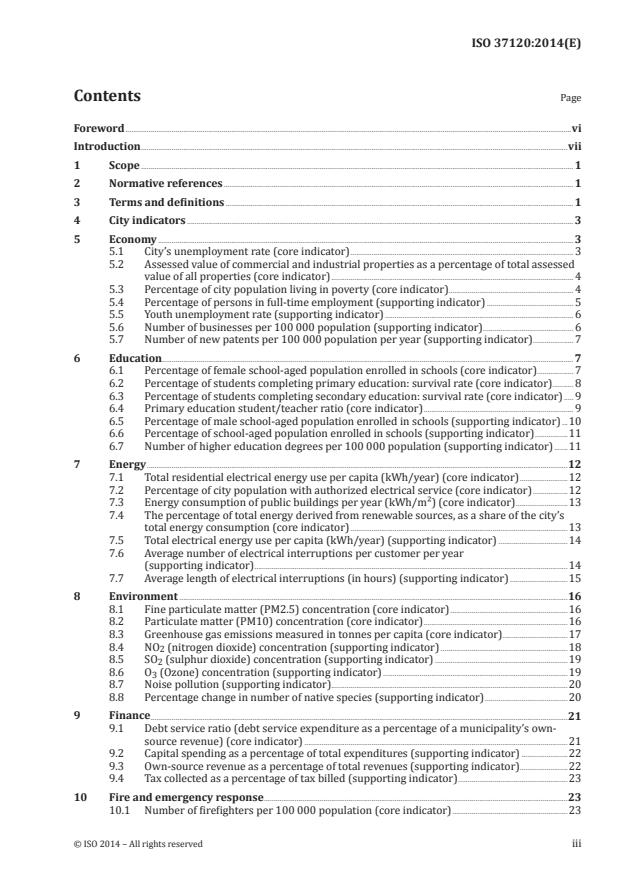
Contents Page
Foreword .vi
Introduction .vii
1 Scope . 1
2 Normative references . 1
3 Terms and definitions . 1
4 City indicators . 3
5 Economy . 3
5.1 City’s unemployment rate (core indicator) . 3
5.2 Assessed value of commercial and industrial properties as a percentage of total assessed
value of all properties (core indicator) . 4
5.3 Percentage of city population living in poverty (core indicator). 4
5.4 Percentage of persons in full-time employment (supporting indicator) . 5
5.5 Youth unemployment rate (supporting indicator) . 6
5.6 Number of businesses per 100 000 population (supporting indicator) . 6
5.7 Number of new patents per 100 000 population per year (supporting indicator) . 7
6 Education . 7
6.1 Percentage of female school-aged population enrolled in schools (core indicator) . . 7
6.2 Percentage of students completing primary education: survival rate (core indicator). 8
6.3 Percentage of students completing secondary education: survival rate (core indicator) . 9
6.4 Primary education student/teacher ratio (core indicator) . 9
6.5 Percentage of male school-aged population enrolled in schools (supporting indicator) .10
6.6 Percentage of school-aged population enrolled in schools (supporting indicator) .11
6.7 Number of higher education degrees per 100 000 population (supporting indicator) .11
7 Energy .12
7.1 Total residential electrical energy use per capita (kWh/year) (core indicator) .12
7.2 Percentage of city population with authorized electrical service (core indicator) .12
7.3 Energy consumption of public buildings per year (kWh/m²) (core indicator) .13
7.4 The percentage of total energy derived from renewable sources, as a share of the city’s
total energy consumption (core indicator) .13
7.5 Total electrical energy use per capita (kWh/year) (supporting indicator) .14
7.6 Average number of electrical interruptions per customer per year
(supporting indicator) .14
7.7 Average length of electrical interruptions (in hours) (supporting indicator) .15
8 Environment .16
8.1 Fine particulate matter (PM2.5) concentration (core indicator) .16
8.2 Particulate matter (PM10) concentration (core indicator) .16
8.3 Greenhouse gas emissions measured in tonnes per capita (core indicator).17
8.4 NO (nitrogen dioxide) concentration (supporting indicator) .18
8.5 SO (sulphur dioxide) concentration (supporting indicator) .19
8.6 O (Ozone) concentration (supporting indicator) .19
8.7 Noise pollution (supporting indicator) .20
8.8 Percentage change in number of native species (supporting indicator) .20
9 Finance .21
9.1 Debt service ratio (debt service expenditure as a percentage of a municipality’s own-
source revenue) (core indicator) .21
9.2 Capital spending as a percentage of total expenditures (supporting indicator) .22
9.3 Own-source revenue as a percentage of total revenues (supporting indicator).22
9.4 Tax collected as a percentage of tax billed (supporting indicator) .23
10 Fire and emergency response .23
10.1 Number of firefighters per 100 000 population (core indicator) .23
10.2 Number of fire related deaths per 100 000 population (core indicator) .24
10.3 Number of natural disaster related deaths per 100 000 population (core indicator) .24
10.4 Number of volunteer and part-time firefighters per 100 000 population
(supporting indicator) .25
10.5 Response time for emergency response services from initial call (supporting indicator) 25
10.6 Response time for fire department from initial call (supporting indicator) .26
11 Governance .26
11.1 Voter participation in last municipal election (as a percentage of eligible voters)
(core indicator) .26
11.2 Women as a percentage of total elected to city-level office (core indicator) .27
11.3 Percentage of women employed in the city government workforce
(supporting indicator) .27
11.4 Number of convictions for corruption and/or bribery by city officials per 100 000
population (supporting indicator) .27
11.5 Citizens’ representation: number of local officials elected to office per 100 000 population
(supporting indicator) .28
11.6 Number of registered voters as a percentage of the voting age population
(supporting indicator) .29
12 Health .29
12.1 Average life expectancy (core indicator) .29
12.2 Number of in-patient hospital beds per 100 000 population (core indicator) .30
12.3 Number of physicians per 100 000 population (core indicator) .30
12.4 Under age five mortality per 1 000 live births (core indicator) .31
12.5 Number of nursing and midwifery personnel per 100 000 population
(supporting indicator) .32
12.6 Number of mental health practitioners per 100 000 population (supporting indicator) .32
12.7 Suicide rate per 100 000 population (supporting indicator) .33
13 Recreation .33
13.1 Square meters of public indoor recreation space per capita (supporting indicator) .33
13.2 Square meters of public outdoor recreation space per capita (supporting indicator) .34
14 Safety .35
14.1 Number of police officers per 100 000 population (core indicator) .35
14.2 Number of homicides per 100 000 population (core indicator) .36
14.3 Crimes against property per 100 000 (supporting indicator) .36
14.4 Response time for police department from initial call (supporting indicator) .37
14.5 Violent crime rate per 100 000 population (supporting indicator) .37
15 Shelter.38
15.1 Percentage of city population living in slums (core indicator) .38
15.2 Number of homeless per 100 000 population (supporting indicator) .39
15.3 Percentage of households that exist without registered legal titles
(supporting indicator) .39
16 Solid waste .39
16.1 Percentage of city population with regular solid waste collection (residential)
(core indicator) .39
16.2 Total collected municipal solid waste per capita (core indicator) .40
16.3 Percentage of the city’s solid waste that is recycled (core indicator) .41
16.4 Percentage of the city’s solid waste that is disposed of in a sanitary landfill
(supporting indicator) .42
16.5 Percentage of the city’s solid waste that is disposed of in an incinerator
(supporting indicator) .43
16.6 Percentage of the city’s solid waste that is burned openly (supporting indicator) .43
16.7 Percentage of the city’s solid waste that is disposed of in an open dump
(supporting indicator) .44
16.8 Percentage of the city’s solid waste that is disposed of by other means
(supporting indicator) .44
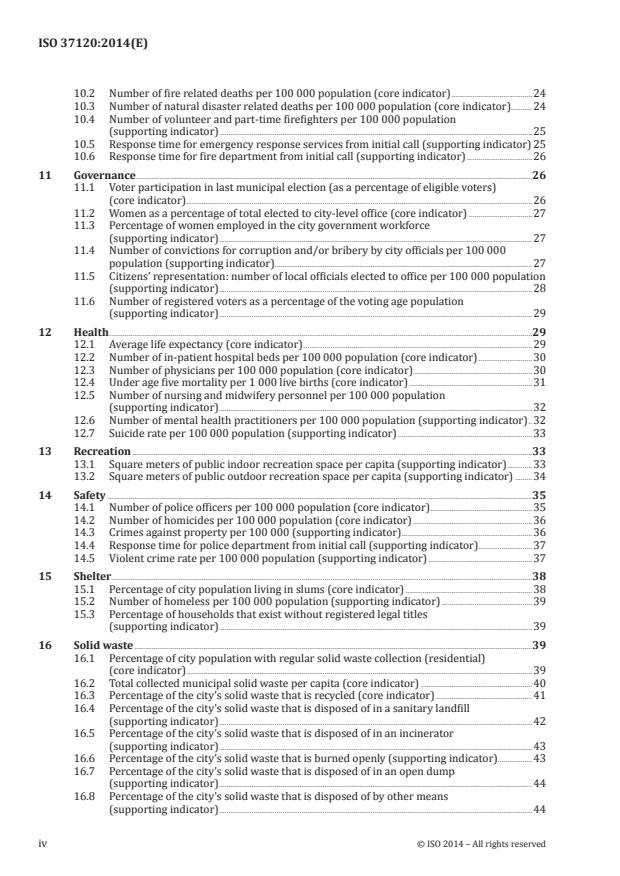
iv © ISO 2014 – All rights reserved
16.9 Hazardous Waste Generation per capita (tonnes) (supporting indicator) .45
16.10 Percentage of the city’s hazardous waste that is recycled (supporting indicator) .46
17 Telecommunication and innovation .47
17.1 Number of internet connections per 100 000 population (core indicator) .47
17.2 Number of cell phone connections per 100 000 population (core indicator) .47
17.3 Number of landline phone connections per 100 000 population (supporting indicator) .48
18 Transportation .48
18.1 Kilometres of high capacity public transport system per 100 000 population
(core indicator) .48
18.2 Kilometres of light passenger public transport system per 100 000 population
(core indicator) .49
18.3 Annual number of public transport trips per capita (core indicator) .49
18.4 Number of personal automobiles per capita (core indicator) .50
18.5 Percentage of commuters using a travel mode to work other than a personal vehicle
(supporting indicator) .50
18.6 Number of two-wheel motorized vehicles per capita (supporting indicator) .51
18.7 Kilometres of bicycle paths and lanes per 100 000 population (supporting indicator) .52
18.8 Transportation fatalities per 100 000 population (supporting indicator) .52
18.9 Commercial air connectivity (number of non-stop commercial air destinations)
(supporting indicator) .53
19 Urban planning .53
19.1 Green area (hectares) per 100 000 population (core indicator) .53
19.2 Annual number of trees planted per 100 000 population (supporting indicator) .54
19.3 Areal size of informal settlements as a percentage of city area (supporting indicator) .54
19.4 Jobs/housing ratio (supporting indicator) .55
20 Wastewater .56
20.1 Percentage of city population served by wastewater collection (core indicator) .56
20.2 Percentage of the city’s wastewater that has received no treatment (core indicator) .56
20.3 Percentage of the city’s wastewater receiving primary treatment (core indicator) .57
20.4 Percentage of the city’s wastewater receiving secondary treatment (core indicator) .57
20.5 Percentage of the city’s wastewater receiving tertiary treatment (core indicator) .58
21 Water and sanitation .59
21.1 Percentage of city population with potable water supply service (core indicator) .59
21.2 Percentage of city population with sustainable access to an improved water source
(core indicator) .59
21.3 Percentage of population with access to improved sanitation (core indicator) .60
21.4 Total domestic water consumption per capita (litres/day) (core indicator).60
21.5 Total water consumption per capita (litres/day) (supporting indicator) .61
21.6 Average annual hours of water service interruption per household
(supporting indicator) .62
21.7 Percentage of water loss (unaccounted for water) (supporting indicator) .63
22 Reporting and record maintenance .63
Annex A (informative) City indicators .64
Annex B (informative) Profile indicators .69
Bibliography .71
Foreword
ISO (the International Organization for Standardization) is a worldwide federation of national standards
bodies (ISO member bodies). The work of preparing International Standards is normally carried out
through ISO technical committees. Each member body interested in a subject for which a technical
committee has been established has the right to be represented on that committee. International
organizations, governmental and non-governmental, in liaison with ISO, also take part in the work.
ISO collaborates closely with the International Electrotechnical Commission (IEC) on all matters of
electrotechnical standardization.
The procedures used to develop this document and those intended for its further maintenance are
described in the ISO/IEC Directives, Part 1. In particular the different approval criteria needed for the
different types of ISO documents should be noted. This document was drafted in accordance with the
editorial rules of the ISO/IEC Directives, Part 2 (see www.iso.org/directives).
Attention is drawn to the possibility that some of the elements of this document may be the subject of
patent rights. ISO shall not be held responsible for identifying any or all such patent rights. Details of
any patent rights identified during the development of the document will be in the Introduction and/or
on the ISO list of patent declarations received (see www.iso.org/patents).
Any trade name used in this document is information given for the convenience of users and does not
constitute an endorsement.
For an explanation on the meaning of ISO specific terms and expressions related to conformity
assessment, as well as information about ISO’s adherence to the WTO principles in the Technical Barriers
to Trade (TBT) see the following URL: Foreword - Supplementary information
The committee responsible for this document is ISO/TC 268, Sustainable development in communities.
vi © ISO 2014 – All rights reserved
Introduction
Cities need indicators to measure their performance. Existing indicators are often not standardized,
consistent, or comparable over time or across cities.
As part of a new series of International Standards being developed for a holistic and integrated approach
to sustainable development and resilience, this set of standardized indicators provides a uniform
approach to what is measured, and how that measurement is to be undertaken. As a list, it does not
provide a value judgement, or threshold or a target numerical value for the indicators.
Conformance with this standard does not confer a status in this regard. A city which conforms to this
standard in regards to measurement of indicators for city services and quality of life may only claim
compliance to that effect.
These indicators can be used to track and monitor progress on city performance. In order to achieve
sustainable development, the whole city system needs to be taken into consideration. Planning for
future needs must take into consideration current use and efficiency of resources in order to better plan
for tomorrow.
The indicators and associated test methods in this International Standard have been developed in order
to help cities:
a) measure performance management of city services and quality of life over time;
b) learn from one another by allowing comparison across a wide range of performance measures; and,
c) share best practices.
NOTE It is acknowledged that cities may not have direct influence or control over factors governing some of
these indicators, but the reporting is important for meaningful comparison and provides a general indication of
service delivery and quality of life within a city.
The indicators in this International Standard have been selected to make reporting as simple and
inexpensive as possible, and therefore reflect an initial platform for reporting. Further development of
indicators to support sustainable development and resilience in cities is on-going in TC268.
The indicators are structured around themes. Recognizing the differences in resources and capabilities
of cities worldwide, the overall set of indicators for city performance has been divided into “core”
indicators (those implementing this International Standard shall follow) and “supporting” indicators,
(those implementing this International Standard should follow). Both core and supporting indicators
are listed in Annex A, Table A.1. In addition, profile indicators, which provide basic statistics and
background information to help cities determine which cities are of interest for comparisons, are
included in Annex B, Table B.1, as a reference.
In this International Standard, the following verbal forms are used:
— “shall” indicates a requirement;
— “should” indicates a recommendation;
— “may” indicates a permission;
— “can” indicates a possibility or a capability.
INTERNATIONAL STANDARD ISO 37120:2014(E)
Sustainable development of communities — Indicators for
city services and quality of life
1 Scope
This International Standard defines and establishes methodologies for a set of indicators to steer and
measure the performance of city services and quality of life. It follows the principles set out and can be
used in conjunction with ISO 37101:—, Sustainable development in communities — Management systems
— General principles and requirements, when published, and other strategic frameworks.
This International Standard is applicable to any city, municipality or local government that undertakes
to measure its performance in a comparable and verifiable manner, irrespective of size and location.
2 Normative references
The following documents, in whole or in part, are normatively referenced in this document and are
indispensable for its application. For dated references, only the edition cited applies. For undated
references, the latest edition of the referenced document (including any amendments) applies.
ISO 37101:—, Sustainable development and resilience of communities — Management systems — General
principles and requirements
ISO 1996-2:—, Acoustics Description, measurement and assessment of environmental noise — Part 2:
Determination of environmental noise levels
3 Terms and definitions
For the purposes of this document, the terms and definitions given in ISO 37101, and the following apply.
3.1
city
urban community falling under a specific administrative boundary, commonly referred to as a city,
municipality or local government
3.2
indicator
a quantitative, qualitative or descriptive measure
[SOURCE: ISO 15392:2008, 3.14]
Note 1 to entry: Indicators in this standard are divided into:
a) core indicators: indicators that are required to demonstrate performance in the delivery of city services and
quality of life.
b) supporting indicators: indicators that are recommended to demonstrate performance in the delivery of city
services and quality of life.
c) profile indicators: indicators that provide basic statistics and background information to help cities determine
which cities are of interest for peer comparisons. Profile indicators are used as an informative reference.
3.3
full-time enrolment
enrolment in school for every full school day in a week over the entire school year
3.4
natural disaster
a natural event such as a flood, earthquake, or hurricane that causes great damage or loss of life
3.5
part-time enrolment
enrolment in school for at least every half-day in a week over the entire school year or equivalent on a
weekly basis
EXAMPLE A student is counted as enrolled part-time if he/she is enrolled in school for every half-day in a
week, but is not counted as enrolled if he/she is only enrolled for 0,25 of a day.
3.6
primary education
elementary school
education that is considered to be the first stage of ‘basic education’
Note 1 to entry: Primary education typically covers six years of full-time schooling with the legal age of entrance
normally being not younger than 5 years or older than 7 years. Primary education typically lasts until age 10 to
12. Primary education refers to children ages 5-12 years or 1st grade through 5th or 6th grade as defined by local
education systems.
[SOURCE: UNESCO Institute for Statistics, UOE data collection on education systems, 10.1]
3.7
secondary education
education that is considered to be the second stage of basic education and marks the end of compulsory
education where it exists
Note 1 to entry: Students usually enter between age 10 and 13 (age 12 being the most common). Secondary
education usually ends 12 or 13 years after the beginning of primary education (or around age 18); however,
systems can range between ending 11 to 14 years after beginning school (or around age 17 to 20). Secondary
th th th
education also refers to 6 grade (or 7 grade) to 12 grade as defined by local education systems.
3.8
tertiary education
education provided by universities and other higher education institutions following secondary
education
3.9
hazardous waste
waste that is potentially harmful to human beings, property or the environment
[SOURCE: ISO 18113-1:2009, 3.22]
3.10
solid waste
non-soluble, discarded solid materials, including sewage sludge, municipal garbage, industrial wastes,
agricultural refuse, demolition wastes and mining residues
3.11
vascular plants (tracheophytes)
plants that can internally transport water and food
2 © ISO 2014 – All rights reserved
4 City indicators
This International Standard is designed to assist cities in steering and assessing the performance
management of city services and all service provisions as well as quality of life. It considers sustainability
as its general principle and resilience as a guiding concept in the development of cities. All indicators
shall be compiled on an annual basis.
Those implementing this International Standard shall report on all core indicators listed in Clauses 5 to
21 of this International Standard.
The core indicators described in this International Standard are considered essential for steering and
assessing the performance management of city services and quality of life.
In order to promote best practice, cities should also report on the supporting indicators given in Clauses
5 to 21 of this International Standard.
The core and supporting indicators are classified into themes according to the different sectors and
services provided by a city. The classification structure is used solely to denote the services and area of
application of each type of indicator when reported on by a city. This classification has no hierarchical
significance and is organized alphabetically according to themes.
Indicators under each theme, where possible, were selected and paired on the basis of input and outcome
indicators for further contextual analysis.
When interpreting the results of a particular service area, it is important to review the results of multiple
types of indicators across themes; to focus on a single indicator can lead to a distorted or incomplete
conclusion. Elements of aspiration must also be taken into consideration in the analysis.
Users may also consider the following aspects which shall be clearly stated in the report and justified:
indicators can be aggregated to larger administrative areas (ex. region, metropolitan areas etc.); since
some indicators are indirectly linked to sustainability, there is a need to consider the resource efficiency
of a city; indicators can be grouped together for analysis when taking into consideration holistic
characteristics of a city; and, this set of indicators may be complemented by other indicator sets in order
to have a more comprehensive holistic approach to analysis on sustainability.
Furthermore, it is also important to acknowledge potential antagonistic effects of the outcome of
particular indicators, either positive or negative, when analysing results. For example, an increase in air
connectivity and the number of automobiles per capita will potentially result in increased levels of PM10
and greenhouse gas emissions.
For data interpretation purposes cities shall take into consideration contextual analysis when
interpreting results. The local institutional environment may affect the capacity to apply indicators. In
some cases, services may be delivered by the private sector or the community itself.
Table B.1 lists a series of profile indicators for reference purposes.
5 Economy
5.1 City’s unemployment rate (core indicator)
5.1.1 General
Those implementing this International Standard shall report on this indicator in accordance with the
following requirements.
NOTE The unemployment rate is considered one of the single, most informative labour market indicators
reflecting the general performance of the labour market and the health of the economy as a whole. It is used
to measure a city’s unutilized labour supply and track business cycles. When economic growth is strong,
unemployment rates tend to be low and when the economy is stagnating or in recession, unemployment rates
tend to be higher.
5.1.2 Core indicator requirements
A city’s unemployment rate shall be calculated as the number of working-age city residents who during
the survey reference period were not in paid employment or self-employment, but available for work,
and seeking work (numerator) divided by the total labour force (denominator). The result shall be
multiplied by 100 and expressed as a percentage.
Unemployment shall refer to individuals without work, actively seeking work in a recent past period
(past four weeks), and currently available for work. Persons who did not look for work but have a future
labour market stake (arrangements for a future job start) are counted as unemployed (International
Labour Organization). Discouraged workers or hidden unemployed shall refer to persons who are not
actively seeking work because they believe the prospects of finding it are extremely poor or they have
restricted labour mobility, face discrimination, and/or structural, social, and cultural barriers – are not
counted as unemployed or as part of the labour force. Not actively seeking work shall refer to people
who have not taken active steps to seek work (i.e. job searches, interviews, informational meetings etc.)
during a specified recent period (usually the past four weeks).
Labour Force shall refer to the sum of the total persons employed and unemployed who are legally
eligible to work.
5.2 Assessed value of commercial and industrial properties as a percentage of total as-
sessed value of all properties (core indicator)
5.2.1 General
Those implementing this International Standard shall report on this indicator in accordance with the
following requirements.
NOTE Assessed value of commercial and industrial properties as a percentage of total assessed value of all
properties provides an understanding of the mix of assessed values of properties as well as the stability of the
assessed base. A downward trend in the proportion of commercial and industrial assessed values could indicate
an eroding economic base. Over reliance on residential assessed values can impact affordability.
5.2.2 Core indicator requirements
The assessed value of commercial and industrial properties as a percentage of total assessed value of
all properties shall be expressed as the total assessed value of commercial and industrial properties
(numerator) divided by the total assessed value of all properties (denominator). The result shall then be
multiplied by 100 and expressed as a percentage.
Commercial and industrial properties shall refer to those which have been designated by the city for
commercial and industrial use.
NOTE Property assessment methods may vary from one jurisdiction or country to another, including the
market-oriented method, the profit-oriented method and the cost-oriented method.
5.3 Percentage of city population living in poverty (core indicator)
5.3.1 General
Those implementing this International Standard shall report on this indicator in accordance with the
following requirements.
NOTE The percentage of the city’s population living in poverty is an indicator of social equity and reflects
levels of economic and social marginality and/or inclusiveness in a city. Eradication of poverty is an essential
[22]
component of the Millennium Development Goals.
4 © ISO 2014 – All rights reserved
5.3.2 Core indicator requirements
The percentage of city population living in poverty shall be calculated as the number of people living below
the poverty threshold (numerator) divided by the total current population of the city (denominator).
The result shall then be multiplied by 100 and expressed as a percentage.
The total number of persons in the city living below the poverty threshold shall first be determined
by multiplying the number of city households living at or below the poverty threshold by the current
average number of persons per household for that city.
NOTE The poverty threshold for each country is recorded by the World Bank, which can be viewed through
its website at: www.worldbank.org (search for PovertyNet) or directly on the PovertyNet website at: www.
[34]
povertynet.org where, the poverty threshold for households is specified as persons unable to adequately
provide themselves over a 12 month period with water, food, shelter, and other basic needs for a healthy life.
5.3.3 Data interpretation
Applying current average persons per household figure to all households can lower distinctions between
household size in poor and more affluent households.
5.4 Percentage of persons in full-time employment (supporting indicator)
5.4.1 General
Those implementing this International Standard should report on this indicator in accordance with the
following requirements.
NOTE The percentage of the city population in full-time employment is an indicator of the economic health of
the city and the success of city economic policy.
5.4.2 Supporting indicator requirements
The percentage of persons in full-time employment shall be calculated as the number of persons in full-
time employment (numerator) divided by the total city population (denominator). The result shall then
be multiplied by 100 and expressed as a percentage.
The number of persons residing in the city in full-time employment shall include those that are self-
employed and shall only include the residents that work a minimum of 35 hours a week in one job and
who are of legal working age.
NOTE 1 City population has been used as the denominator for this indicator instead of workforce given that
population will be known for most cities. This indicator is dependent on the government agency charged with the
responsibility of collecting relevant employment and population data and the precise nature of the available data.
NOTE 2 Employment is a formal labour market concept which is often complicated in developing countries
with a large informal sector of the city economy.
NOTE 3 The Social Responsibility core subjects on Human Rights and Labour Practices from ISO 26000 can be
considered, and are particularly useful in regards to child labour.
NOTE 4 The International Labour Organization (ILO) Fundamental Principles and Rights at Work (FPRW)
include the elimination of child labour alongside the right to freedom of association and collective bargaining,
elimination of forced labour, and the elimination of discrimination in employment or occupation. These
fundamental principles and rights at work are mutually interdependent. Violation of one category of rights at
work often has an adverse impact on the respect and realization of the others. Vice versa, recognition, promotion
and implementation of one category of rights can have a beneficial impact on the respect and realization of the
others.
Over the years the international community has developed a framework of international standards
which seek to protect children from child labour, in particular the two important ILO Conventions on
[45]
the subject and more generally the UN Convention on the Rights of the Child. Whilst some progress
is being made in reducing child labour, in too many cases the rights contained in these international
standards are still not fully applied in practice and enforced. Users of this standard are encouraged to
keep these principles in mind.
5.5 Youth unemployment rate (supporting indicator)
5.5.1 General
Those implementing this International Standard should report on this indicator in accordance with the
following requirements.
NOTE The unemployment rate is probably the best-known and most used labour market performance
indicator. Youth Unemployment Rate is key indicator for quantifying and analyzing the current labour market
trends and challenges of young people. Young men and women today face increasing uncertainty in their hopes
of undergoing a satisfactory transition in the labour market, and this uncertainty and disillusionment can, in
turn, have damaging effects on individuals, communities, economies and society at large. Unemployed or
underemployed youth are less able to contribute effectively to community and national development and have
fewer opportunities to exercise their rights as citizens. They have less to spend as consumers, less to invest
as savers and often have no “voice” to bring about change in their lives and communities. Widespread youth
unemployment and underemployment also prevents companies and countries from innovating and developing
competitive advantages based on huma
...
Questions, Comments and Discussion
Ask us and Technical Secretary will try to provide an answer. You can facilitate discussion about the standard in here.
Loading comments...