

ISO 37101:2016
(Main)Sustainable development in communities — Management system for sustainable development — Requirements with guidance for use
General Information
- Abstract
ISO 37101:2016 establishes requirements for a management system for sustainable development in communities, including cities, using a holistic approach, with a view to ensuring consistency with the sustainable development policy of communities. The intended outcomes of a management system for sustainable development in communities include: · managing sustainability and fostering smartness and resilience in communities, while taking into account the territorial boundaries to which it applies; · improving the contribution of communities to sustainable development outcomes; · assessing the performance of communities in progressing towards sustainable development outcomes and the level of smartness and of resilience that they have achieved; · fulfilling compliance obligations. ISO 37101:2016 is intended to help communities become more resilient, smart and sustainable, through the implementation of strategies, programmes, projects, plans and services, and demonstrate and communicate their achievements. ISO 37101:2016 is intended to be implemented by an organization designated by a community to establish the organizational framework and to provide the resources necessary to support the management of environmental, economic and social performance outcomes. A community that chooses to establish the organizational framework by itself is considered to constitute an organization as defined in ISO 37101:2016. ISO 37101:2016 is applicable to communities of all sizes, structures and types, in developed or developing countries, at local, regional or national levels, and in defined urban or rural areas, at their respective level of responsibility. ISO 37101:2016 can be used in whole or in part to improve the management of sustainable development in communities. Claims of conformity to ISO 37101:2016, however, are not acceptable unless all its requirements are incorporated into an organization's management system for sustainable development in communities and fulfilled without exclusion.
- Status
- Published
- Publication Date
- 10-Jul-2016
- Technical Committee
- ISO/TC 268 - Sustainable cities and communities
- Drafting Committee
- ISO/TC 268/WG 1 - Management System Standards
- Current Stage
- 9092 - International Standard to be revised
- Start Date
- 04-Jun-2026
- Completion Date
- 29-Aug-2026
Buy Documents



ISO 37101:2016 - Sustainable development in communities -- Management system for sustainable development -- Requirements with guidance for use

ISO 37101:2016 - Sustainable development in communities — Management system for sustainable development — Requirements with guidance for use/11/2016


ISO 37101:2016 - Développement durable au sein des communautés territoriales -- Systeme de management pour le développement durable -- Exigences et lignes directrices pour son utilisation

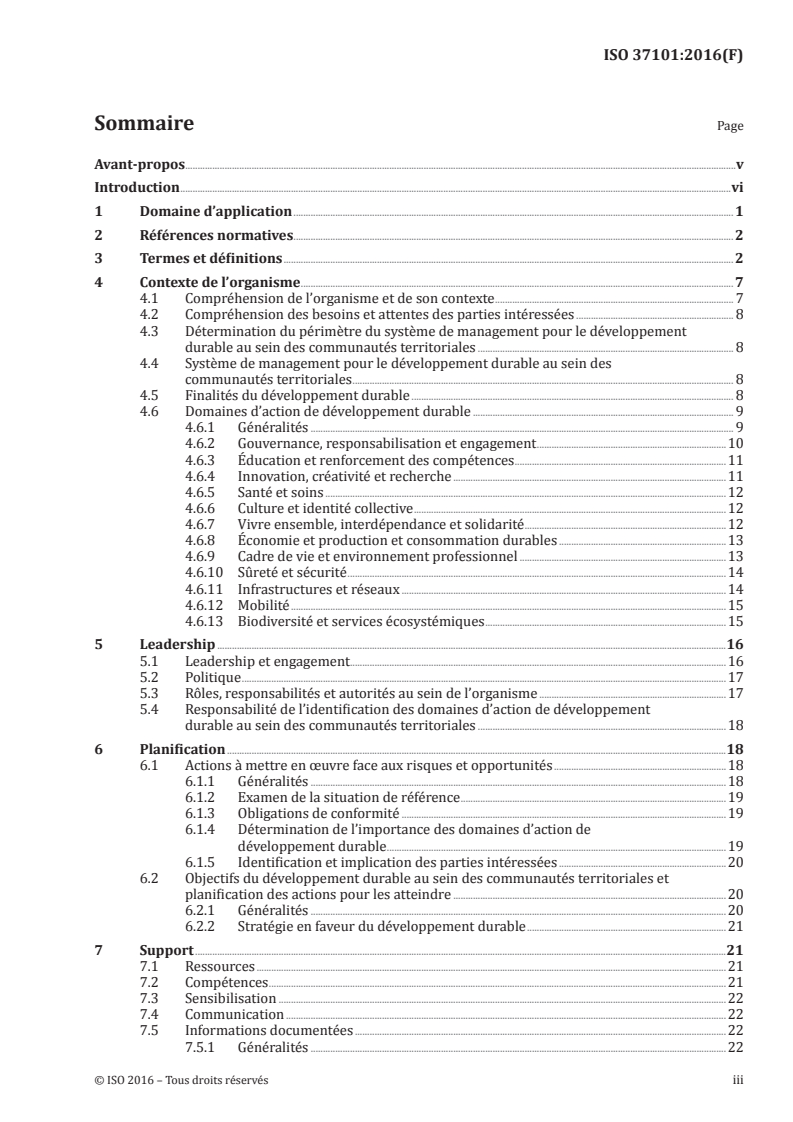
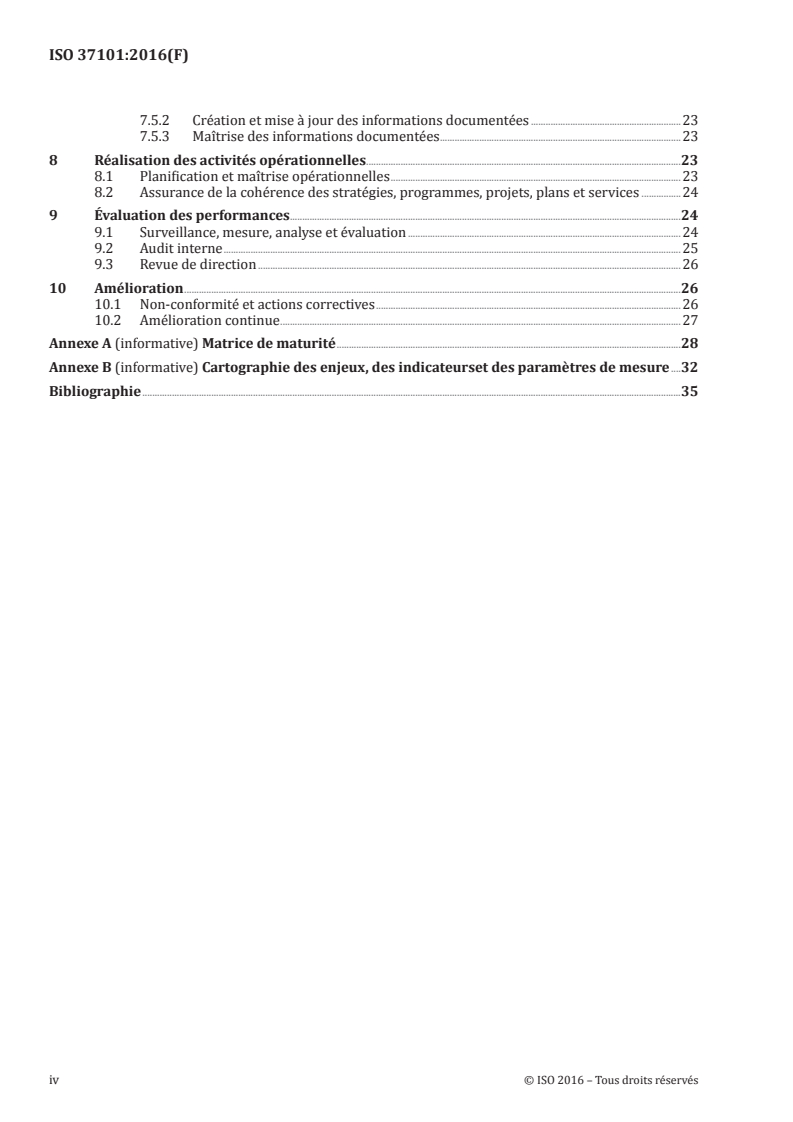
ISO 37101:2016 - Développement durable au sein des communautés territoriales — Système de management pour le développement durable — Exigences et lignes directrices pour son utilisation/10/2016
ISO 37101:2016 - Sustainable development in communities — Management system for sustainable development — Requirements with guidance for use Released:23. 11. 2023
Overview
ISO 37101:2016 - "Sustainable development in communities - Management system for sustainable development - Requirements with guidance for use" - specifies requirements and guidance for establishing a management system to advance sustainable development in communities (including cities). The standard adopts a holistic, multi‑actor approach to help communities become more resilient, smart and sustainable, and to assess and communicate progress. It is applicable to communities of all sizes, types and levels (local, regional, national; urban or rural). Claims of conformity are permitted only when an organization’s management system fully incorporates all ISO 37101 requirements.
Key topics and requirements
ISO 37101 structures a management system around familiar system elements while focusing on community sustainability outcomes:
- Context of the organization: understand the community, territorial boundaries and interested parties.
- Leadership & policy: establish sustainable development purposes, governance, roles and responsibilities.
- Planning: identify sustainability issues, risks and opportunities; conduct baseline reviews and set strategy, objectives and programmes.
- Support: allocate resources, build competence, ensure stakeholder communication and manage documented information.
- Operation: plan and control strategies, programmes, projects, plans and services to ensure coherence and delivery.
- Performance evaluation: monitoring, measurement, internal audit and management review to track progress on sustainability, smartness and resilience.
- Improvement: manage nonconformities, corrective action and continual improvement.
The standard also highlights specific sustainability issue areas, including governance and engagement, education and capacity building, innovation, health and care, culture and identity, social cohesion, economy and sustainable consumption, living and working environments, safety, infrastructure, mobility and biodiversity. Annexes provide a maturity matrix and mapping of issues, indicators and metrics to support implementation.
Practical applications
ISO 37101 is used to:
- Develop integrated community sustainability strategies and action plans.
- Systematically measure and report on community sustainability, resilience and smart city initiatives.
- Coordinate cross‑sector programmes (infrastructure, mobility, health, biodiversity, economy).
- Improve stakeholder engagement through multi‑actor processes and participatory partnerships.
- Demonstrate a credible management system for funding, procurement or reporting purposes.
Who should use it
- Municipalities, city councils and regional governments
- Designated organizations (public authorities or entities appointed by a community)
- Urban planners, community development agencies, NGOs and multi‑stakeholder partnerships
- Consultants and auditors supporting community sustainability management systems
Related standards
ISO 37101 is compatible with and can be used alongside other management standards such as ISO 14001, ISO 45001, ISO 50001, ISO 20121, ISO 14046 and ISO 26000, enabling integrated sustainability management across environmental, social and economic domains.
Relations
- Effective Date
- 06-Jun-2022
- Effective Date
- 18-Nov-2023
Buy Documents
ISO 37101:2016 - Sustainable development in communities -- Management system for sustainable development -- Requirements with guidance for use
ISO 37101:2016 - Sustainable development in communities — Management system for sustainable development — Requirements with guidance for use/11/2016
ISO 37101:2016 - Développement durable au sein des communautés territoriales -- Systeme de management pour le développement durable -- Exigences et lignes directrices pour son utilisation
ISO 37101:2016 - Développement durable au sein des communautés territoriales — Système de management pour le développement durable — Exigences et lignes directrices pour son utilisation/10/2016
ISO 37101:2016 - Sustainable development in communities — Management system for sustainable development — Requirements with guidance for use Released:23. 11. 2023
Get Certified
Connect with accredited certification bodies for this standard

BSI Group
BSI (British Standards Institution) is the business standards company that helps organizations make excellence a habit.

Bureau Veritas
Bureau Veritas is a world leader in laboratory testing, inspection and certification services.

DNV
DNV is an independent assurance and risk management provider.
Sponsored listings
Frequently Asked Questions
ISO 37101:2016 is a standard published by the International Organization for Standardization (ISO). Its full title is "Sustainable development in communities — Management system for sustainable development — Requirements with guidance for use". This standard covers: ISO 37101:2016 establishes requirements for a management system for sustainable development in communities, including cities, using a holistic approach, with a view to ensuring consistency with the sustainable development policy of communities. The intended outcomes of a management system for sustainable development in communities include: · managing sustainability and fostering smartness and resilience in communities, while taking into account the territorial boundaries to which it applies; · improving the contribution of communities to sustainable development outcomes; · assessing the performance of communities in progressing towards sustainable development outcomes and the level of smartness and of resilience that they have achieved; · fulfilling compliance obligations. ISO 37101:2016 is intended to help communities become more resilient, smart and sustainable, through the implementation of strategies, programmes, projects, plans and services, and demonstrate and communicate their achievements. ISO 37101:2016 is intended to be implemented by an organization designated by a community to establish the organizational framework and to provide the resources necessary to support the management of environmental, economic and social performance outcomes. A community that chooses to establish the organizational framework by itself is considered to constitute an organization as defined in ISO 37101:2016. ISO 37101:2016 is applicable to communities of all sizes, structures and types, in developed or developing countries, at local, regional or national levels, and in defined urban or rural areas, at their respective level of responsibility. ISO 37101:2016 can be used in whole or in part to improve the management of sustainable development in communities. Claims of conformity to ISO 37101:2016, however, are not acceptable unless all its requirements are incorporated into an organization's management system for sustainable development in communities and fulfilled without exclusion.
ISO 37101:2016 establishes requirements for a management system for sustainable development in communities, including cities, using a holistic approach, with a view to ensuring consistency with the sustainable development policy of communities. The intended outcomes of a management system for sustainable development in communities include: · managing sustainability and fostering smartness and resilience in communities, while taking into account the territorial boundaries to which it applies; · improving the contribution of communities to sustainable development outcomes; · assessing the performance of communities in progressing towards sustainable development outcomes and the level of smartness and of resilience that they have achieved; · fulfilling compliance obligations. ISO 37101:2016 is intended to help communities become more resilient, smart and sustainable, through the implementation of strategies, programmes, projects, plans and services, and demonstrate and communicate their achievements. ISO 37101:2016 is intended to be implemented by an organization designated by a community to establish the organizational framework and to provide the resources necessary to support the management of environmental, economic and social performance outcomes. A community that chooses to establish the organizational framework by itself is considered to constitute an organization as defined in ISO 37101:2016. ISO 37101:2016 is applicable to communities of all sizes, structures and types, in developed or developing countries, at local, regional or national levels, and in defined urban or rural areas, at their respective level of responsibility. ISO 37101:2016 can be used in whole or in part to improve the management of sustainable development in communities. Claims of conformity to ISO 37101:2016, however, are not acceptable unless all its requirements are incorporated into an organization's management system for sustainable development in communities and fulfilled without exclusion.
ISO 37101:2016 is classified under the following ICS (International Classification for Standards) categories: 03.100.70 - Management systems; 13.020.10 - Environmental management; 13.020.20 - Environmental economics. Sustainability. The ICS classification helps identify the subject area and facilitates finding related standards.
ISO 37101:2016 has the following relationships with other standards: It is inter standard links to ISO 21302-1:2019, ISO 37101:2016/Amd 1:2024. Understanding these relationships helps ensure you are using the most current and applicable version of the standard.
ISO 37101:2016 is available in PDF format for immediate download after purchase. The document can be added to your cart and obtained through the secure checkout process. Digital delivery ensures instant access to the complete standard document.
Standards Content (Sample)
INTERNATIONAL ISO
STANDARD 37101
First edition
2016-07-15
Sustainable development in
communities — Management system
for sustainable development —
Requirements with guidance for use
Développement durable des communautés — Système de
management pour le développement durable — Exigences et lignes
directrices pour son utilisation
Reference number
©
ISO 2016
© ISO 2016, Published in Switzerland
All rights reserved. Unless otherwise specified, no part of this publication may be reproduced or utilized otherwise in any form
or by any means, electronic or mechanical, including photocopying, or posting on the internet or an intranet, without prior
written permission. Permission can be requested from either ISO at the address below or ISO’s member body in the country of
the requester.
ISO copyright office
Ch. de Blandonnet 8 • CP 401
CH-1214 Vernier, Geneva, Switzerland
Tel. +41 22 749 01 11
Fax +41 22 749 09 47
copyright@iso.org
www.iso.org
ii © ISO 2016 – All rights reserved
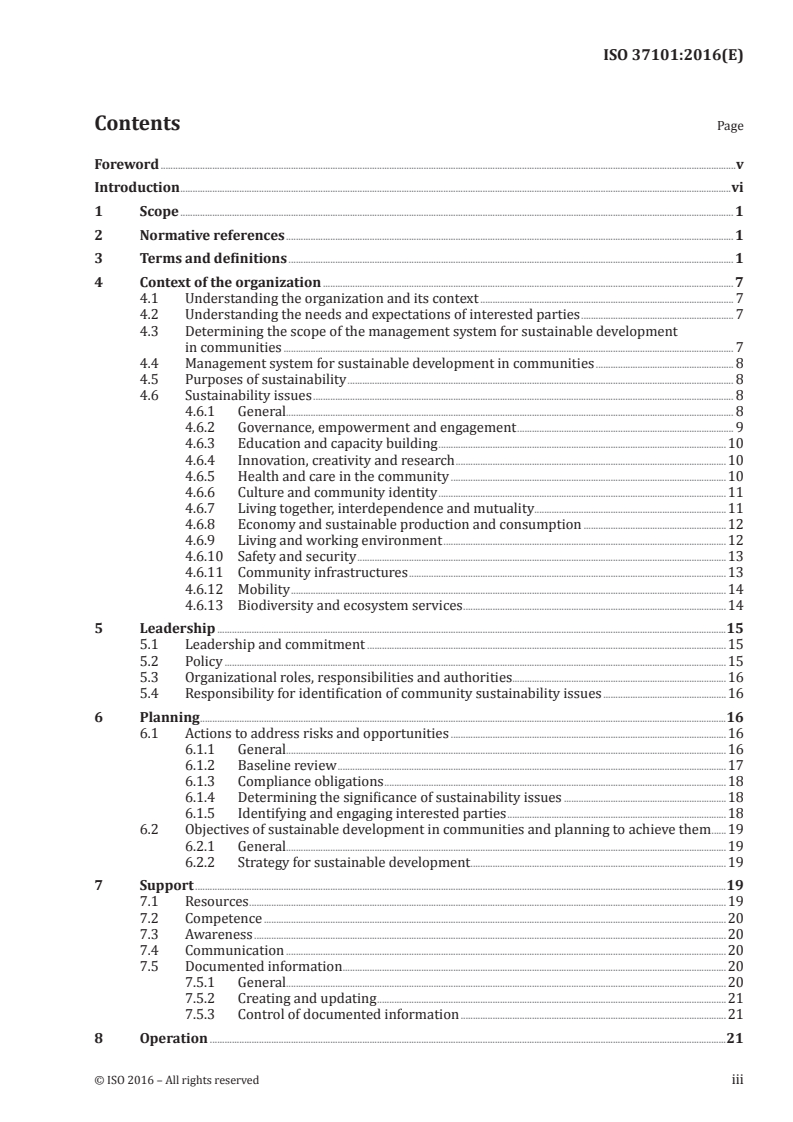
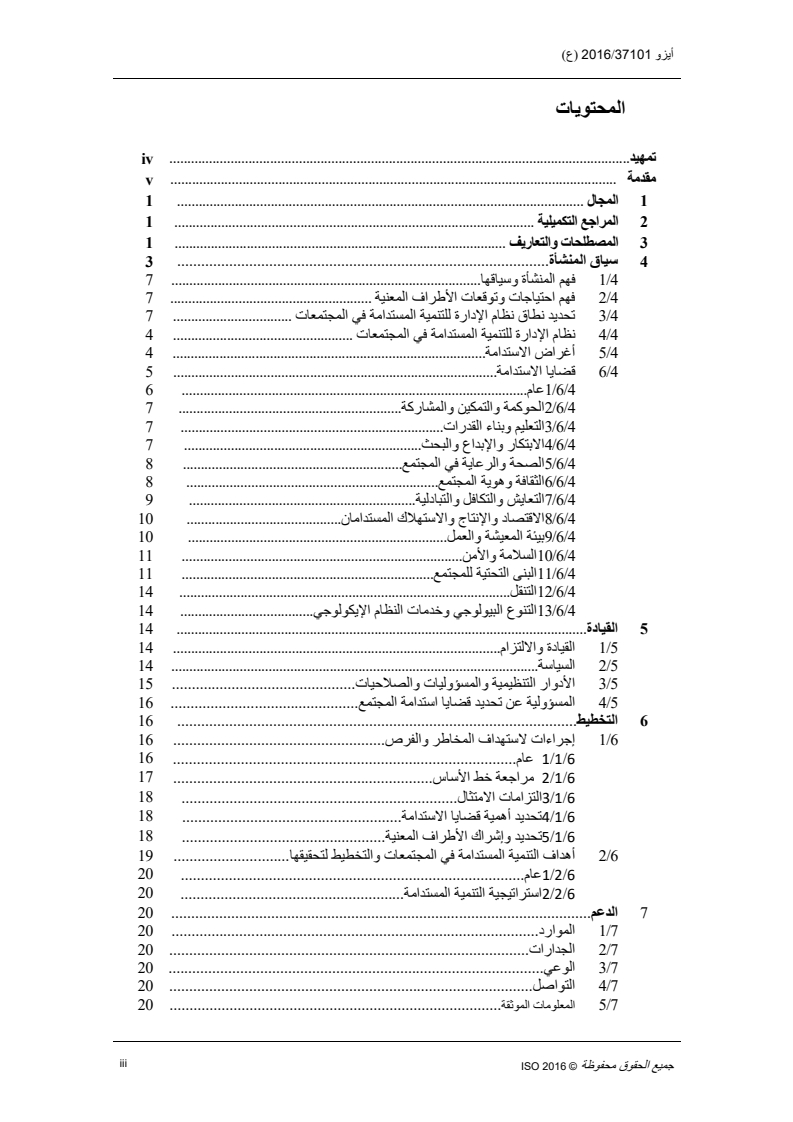
Contents Page
Foreword .v
Introduction .vi
1 Scope . 1
2 Normative references . 1
3 Terms and definitions . 1
4 Context of the organization . 7
4.1 Understanding the organization and its context . 7
4.2 Understanding the needs and expectations of interested parties . 7
4.3 Determining the scope of the management system for sustainable development
in communities . 7
4.4 Management system for sustainable development in communities . 8
4.5 Purposes of sustainability . 8
4.6 Sustainability issues . 8
4.6.1 General. 8
4.6.2 Governance, empowerment and engagement . 9
4.6.3 Education and capacity building .10
4.6.4 Innovation, creativity and research .10
4.6.5 Health and care in the community .10
4.6.6 Culture and community identity .11
4.6.7 Living together, interdependence and mutuality .11
4.6.8 Economy and sustainable production and consumption .12
4.6.9 Living and working environment .12
4.6.10 Safety and security .13
4.6.11 Community infrastructures .13
4.6.12 Mobility .14
4.6.13 Biodiversity and ecosystem services .14
5 Leadership .15
5.1 Leadership and commitment .15
5.2 Policy .15
5.3 Organizational roles, responsibilities and authorities.16
5.4 Responsibility for identification of community sustainability issues .16
6 Planning .16
6.1 Actions to address risks and opportunities .16
6.1.1 General.16
6.1.2 Baseline review .17
6.1.3 Compliance obligations .18
6.1.4 Determining the significance of sustainability issues .18
6.1.5 Identifying and engaging interested parties .18
6.2 Objectives of sustainable development in communities and planning to achieve them .19
6.2.1 General.19
6.2.2 Strategy for sustainable development . .19
7 Support .19
7.1 Resources .19
7.2 Competence .20
7.3 Awareness .20
7.4 Communication .20
7.5 Documented information .20
7.5.1 General.20
7.5.2 Creating and updating .21
7.5.3 Control of documented information .21
8 Operation .21
8.1 Operational planning and control .21
8.2 Ensuring coherence of strategies, programmes, projects, plans and services .22
9 Performance evaluation .22
9.1 Monitoring, measurement, analysis and evaluation .22
9.2 Internal audit .23
9.3 Management review .24
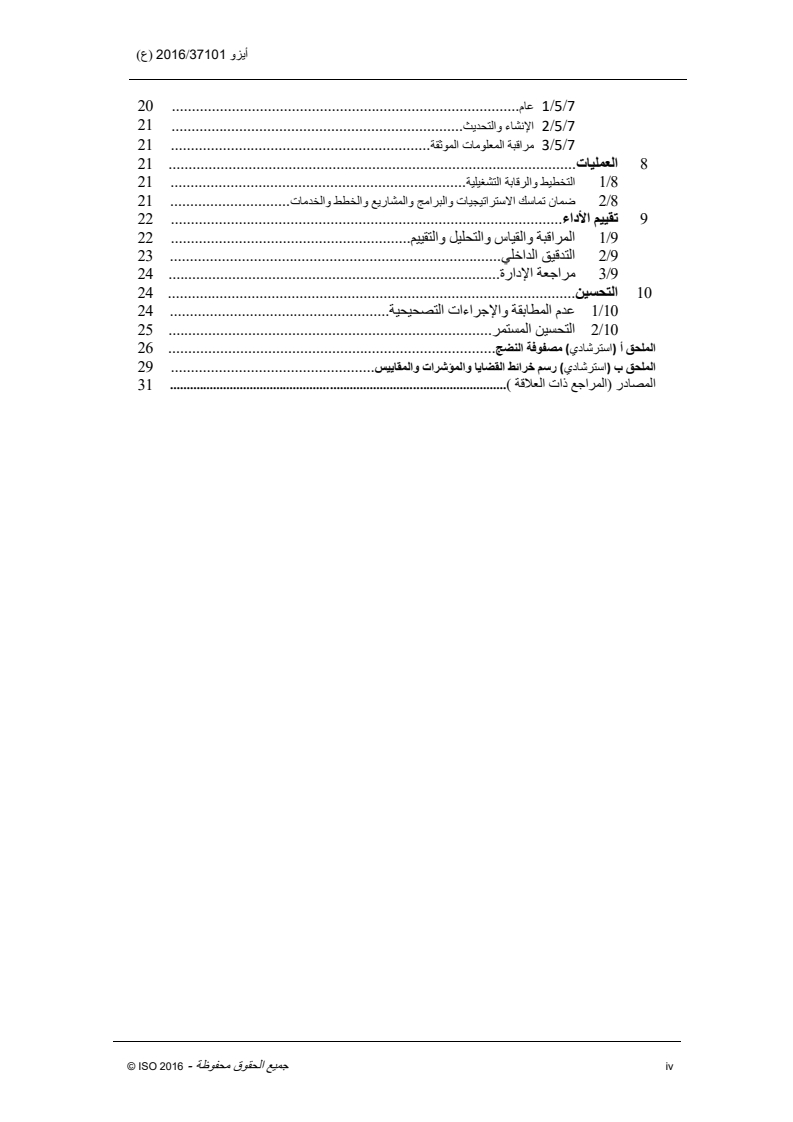
10 Improvement .24
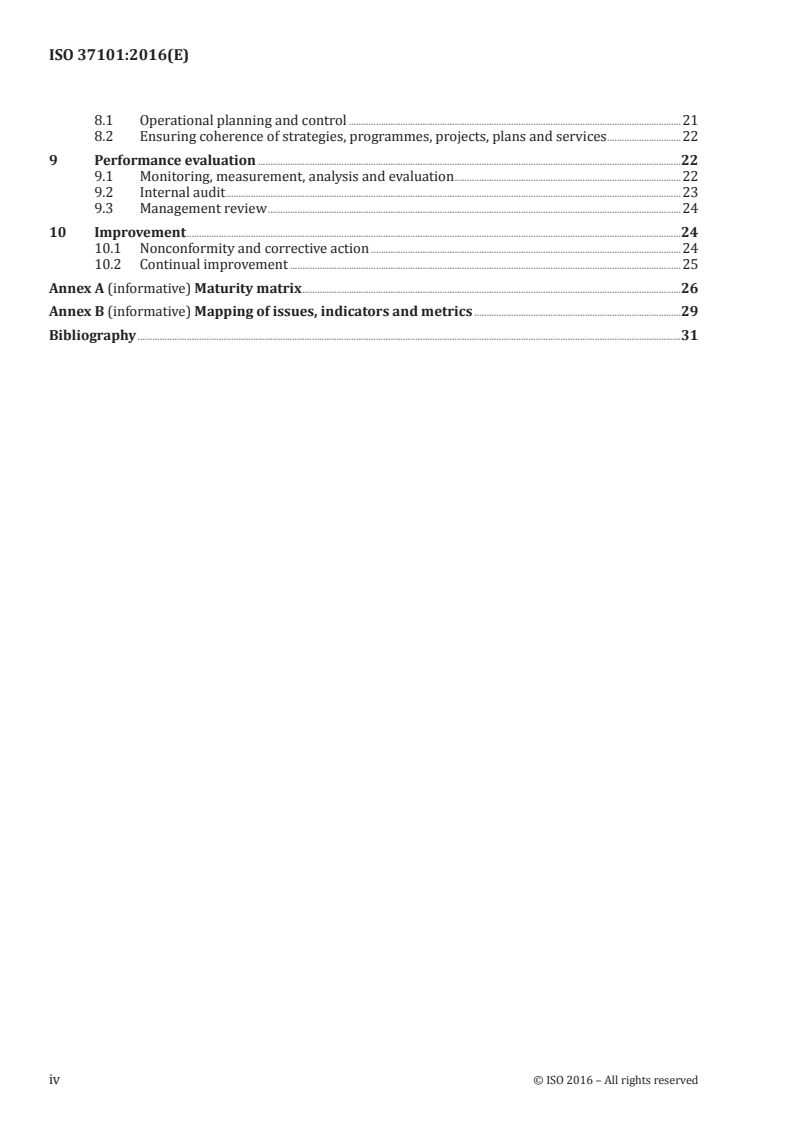
10.1 Nonconformity and corrective action .24
10.2 Continual improvement .25
Annex A (informative) Maturity matrix .26
Annex B (informative) Mapping of issues, indicators and metrics .29
Bibliography .31
iv © ISO 2016 – All rights reserved
Foreword
ISO (the International Organization for Standardization) is a worldwide federation of national standards
bodies (ISO member bodies). The work of preparing International Standards is normally carried out
through ISO technical committees. Each member body interested in a subject for which a technical
committee has been established has the right to be represented on that committee. International
organizations, governmental and non-governmental, in liaison with ISO, also take part in the work.
ISO collaborates closely with the International Electrotechnical Commission (IEC) on all matters of
electrotechnical standardization.
The procedures used to develop this document and those intended for its further maintenance are
described in the ISO/IEC Directives, Part 1. In particular the different approval criteria needed for the
different types of ISO documents should be noted. This document was drafted in accordance with the
editorial rules of the ISO/IEC Directives, Part 2 (see www.iso.org/directives).
Attention is drawn to the possibility that some of the elements of this document may be the subject of
patent rights. ISO shall not be held responsible for identifying any or all such patent rights. Details of
any patent rights identified during the development of the document will be in the Introduction and/or
on the ISO list of patent declarations received (see www.iso.org/patents).
Any trade name used in this document is information given for the convenience of users and does not
constitute an endorsement.
For an explanation on the meaning of ISO specific terms and expressions related to conformity assessment,
as well as information about ISO’s adherence to the World Trade Organization (WTO) principles in the
Technical Barriers to Trade (TBT) see the following URL: www.iso.org/iso/foreword.html.
The committee responsible for this document is Technical Committee ISO/TC 268, Sustainable
development in communities.
Introduction
This International Standard adopts a holistic approach to the establishment of the requirements of
a management system for sustainable development in communities, including cities, and provides
guidance aimed at:
— improving the contribution of communities to sustainable development;
— fostering smartness and resilience in communities, while taking into account the territorial
boundaries to which it applies;
— assessing the performance of communities in progressing towards sustainable development.
It sets out to establish a coherent framework to enable the community to develop its purposes and vision.
This International Standard sets out requirements and guidance to help communities achieve a
framework that will allow them to become more sustainable. It does not set benchmarks or expected
levels of performance.
While the challenge of sustainable development is global, the strategies for achieving it at community
level are local, to a large extent, and can therefore differ in context and content from country to country
and region to region. Community strategies need to reflect the context, preconditions, priorities
and needs, particularly in the social environment, e.g. social equity, cultural identity and traditions,
heritage, human health, safety and comfort, and social infrastructure.
In order to become more sustainable, communities also face the challenge of respecting planetary
boundaries and taking into account the limitations these boundaries impose.
NOTE 1 The concept of “planetary boundaries” describes a framework within which humanity needs to live
in order to continue to develop and thrive for generations to come. Climate change, freshwater consumption,
land-use change and loss of biodiversity are examples of planetary boundaries. Crossing these boundaries could
generate abrupt or irreversible environmental changes, while respecting them significantly reduces risks.
Planetary boundaries can be broken down in order to select measures that can be addressed at community level,
while taking into account the specific situation.
The management of sustainable development in communities encompasses a wide range of issues, e.g.
issues related to the economic, social and natural environment of communities and their interactions.
Those issues can have strategic, operational and competitive implications.
NOTE 2 The capacity to foster cross-discipline harmony and common purpose is fundamental to achieving a
community’s objectives effectively and efficiently.
This International Standard is designed to empower communities and to build on local initiatives. It
targets environmental, social and economic issues, including improved community services and socio-
economic benefits, as well as supporting clear purposes for sustainable development in communities
and encouraging sound planning systems to achieve them.
This International Standard focuses on communities as stepping stones towards sustainability of
society as a whole. Although each community has values and interests of its own, all communities
can derive mutual benefits from agreeing upon ownership of shared values and objectives without
exonerating individual actors from their respective responsibilities. This can be achieved only if the
community applies a long-term view on planning, while respecting the Earth’s overall capacity and the
needs of current and future generations, including the capability and resources to provide resilience.
This International Standard fosters the establishment of a multi-actor process in communities, through
a holistic approach that facilitates the cooperation of all interested parties and avoids a silo approach.
It is intended to provide guidance for organizations that implement other management systems that
are compatible with this International Standard, such as ISO 14001, ISO 45001, ISO 50001, ISO 20121,
ISO 14046 and ISO 26000, whether involved directly or indirectly in sustainable development in
communities at different stages in their life cycles.
vi © ISO 2016 – All rights reserved
Involvement of interested parties through a multi-actor process can take different forms, such as:
— participatory partnerships;
— public participation;
— community based collaboration.
They all aim at involving interested parties in a cooperative dialogue for more sustainable solutions.
The successful implementation of this International Standard can help communities elaborate holistic
and integrated strategies for sustainable development that depart from usual business approaches. It
can also help communities show interested parties that an appropriate management system is in place
and encourage them to become proactive.
Successful implementation of this International Standard can:
— help to build consensus on sustainable development within communities;
— improve the sustainability, smartness and resilience of strategies, programmes, projects, plans and
services conducted under the direct responsibility of communities, or on the territory they relate to;
— evolve cross-sector, multidisciplinary, life cycle value and total costing approaches;
— foster synergies between several actors through a holistic approach;
— increase the efficiency and attractiveness of communities.
The successful implementation of this International Standard is intended to establish a coherent
framework to enable communities to develop their purpose and vision. Using relevant indicators
and metrics, the outcome of strategies, programmes, projects, plans and services can be measured
throughout communities. Metrics and indicators are connected, but often developed for different
reasons. Metrics have a more technical focus, e.g. a parameter of the performance of a product, a
process or an infrastructure element.
The International Standards developed by ISO/TC 268 aim to make use of indicators and metrics for
structured and consistent support of sustainable, smart and resilient management of communities.
Indicators such as those used in ISO 37120 are quantitative, qualitative or descriptive measures defined
for actual use in monitoring and evaluating the overall performance of a community. In contrast, metrics
such as those used in ISO/TS 37151 are the measurement method and measurement scale defined for
use in evaluating the technical performance of infrastructure elements (hardware and software), e.g.
in energy, transport or waste management services.
Annex B provides a mapping of issues, indicators and metrics between this International Standard,
ISO 37120:2014 and ISO/TS 37151:2015
This International Standard is based on the Plan-Do-Check-Act (PDCA) model, which can be briefly
described as follows:
— Plan: establish objectives and processes necessary to deliver results in accordance with community
purposes;
— Do: implement processes and achieve objectives;
— Check: monitor and measure processes against community policy, objectives and commitments,
and report the results;
— Act: take necessary actions to improve performance.
Figure 1 illustrates how this International Standard follows a PDCA approach to the management of
sustainable development in communities.
NOTE Strategic steps are iterative, while operational steps are sequential. It is their combined
implementation that helps communities become more sustainable, resilient and smart.
Figure 1 — Relationship between PDCA model and this International Standard
In this International Standard, the following verbal forms are used:
— “shall” indicates a requirement;
— “should” indicates a recommendation;
— “may” indicates a permission;
— “can” indicates a possibility or a capability.
Information marked as “NOTE” is intended to assist the understanding or use of the document. “Notes
to entry” used in Clause 3 provide additional information that supplements the terminological data and
can contain provisions relating to the use of a term.
viii © ISO 2016 – All rights reserved
INTERNATIONAL STANDARD ISO 37101:2016(E)
Sustainable development in communities — Management
system for sustainable development — Requirements with
guidance for use
1 Scope
This International Standard establishes requirements for a management system for sustainable
development in communities, including cities, using a holistic approach, with a view to ensuring
consistency with the sustainable development policy of communities.
NOTE 1 Cities have become essential actors for sustainable development at local, national and international
levels over the last century, due to the pressure of unprecedented urbanization.
The intended outcomes of a management system for sustainable development in communities include:
— managing sustainability and fostering smartness and resilience in communities, while taking into
account the territorial boundaries to which it applies;
— improving the contribution of communities to sustainable development outcomes;
— assessing the performance of communities in progressing towards sustainable development
outcomes and the level of smartness and of resilience that they have achieved;
— fulfilling compliance obligations.
NOTE 2 Smartness and resilience are embedded in the process of sustainable development: sustainable
development is the overarching process, while smartness and resilience are characteristics.
This International Standard is intended to help communities become more resilient, smart and
sustainable, through the implementation of strategies, programmes, projects, plans and services, and
demonstrate and communicate their achievements.
This International Standard is intended to be implemented by an organization designated by a
community to establish the organizational framework and to provide the resources necessary to
support the management of environmental, economic and social performance outcomes. A community
that chooses to establish the organizational framework by itself is considered to constitute an
organization as defined in this International Standard.
This International Standard is applicable to communities of all sizes, structures and types, in developed
or developing countries, at local, regional or national levels, and in defined urban or rural areas, at their
respective level of responsibility.
This International Standard can be used in whole or in part to improve the management of sustainable
development in communities. Claims of conformity to this International Standard, however, are not
acceptable unless all its requirements are incorporated into an organization’s management system for
sustainable development in communities and fulfilled without exclusion.
2 Normative references
There are no normative references.
3 Terms and definitions
For the purposes of this document, the following terms and definitions apply.
3.1
accountability
state of being answerable for decisions and activities to the interested parties (3.19) of an
organization (3.27)
3.2
audit
systematic, independent and documented process (3.31) for obtaining audit evidence and evaluating it
objectively to determine the extent to which the audit criteria are fulfilled
Note 1 to entry: An audit can be an internal audit (first party) or an external audit (second party or third party),
and it can be a combined audit (combining two or more disciplines).
Note 2 to entry: An internal audit is conducted by the organization (3.27) itself, or by an external party on its behalf.
Note 3 to entry: “Audit evidence” and “audit criteria” are defined in ISO 19011.
3.3
city
urban community (3.4) falling under a specific administrative boundary
Note 1 to entry: A city is sometimes referred to as a municipality or a local government.
Note 2 to entry: Cities can help to alleviate increasing pressure on the environment and natural resources caused
by global urbanization through the development of holistic and integrated policies (3.30).
[SOURCE: ISO 37120:2014, 3.1, modified — Definition has been modified and Notes 1 and 2 to entry
have been added.]
3.4
community
group of people with an arrangement of responsibilities, activities and relationships
Note 1 to entry: In many, but not all, contexts, a community has a defined geographical boundary.
Note 2 to entry: A city (3.3) is a type of community.
[SOURCE: ISO/TS 37151:2015, 3.1, modified — Note 1 to entry has been modified and Note 2 to entry
has been added.]
3.5
competence
ability to apply knowledge and skills to achieve intended results
3.6
compliance obligations (preferred term)
legal requirements and other requirements (admitted term)
legal requirements (3.32) that an organization (3.27) has to comply with and other requirements that an
organization has to or chooses to comply with
Note 1 to entry: Compliance obligations are related to the management system (3.21) for sustainable development
(3.36) in communities (3.4).
Note 2 to entry: Compliance obligations can arise from mandatory requirements, such as applicable laws and
regulations, or voluntary commitments, such as organizational and industry standards, contractual relationships,
principles of good governance and community and ethical standards.
3.7
conformity
fulfilment of a requirement (3.32)
2 © ISO 2016 – All rights reserved
3.8
continual improvement
recurring activity to enhance performance (3.29)
3.9
corrective action
action to eliminate the cause of a nonconformity (3.25) and to prevent recurrence
3.10
documented information
information required to be controlled and maintained by an organization (3.27) and the medium on
which it is contained
Note 1 to entry: Documented information can be in any format and media, and from any source.
Note 2 to entry: Documented information can refer to:
— the management system (3.21), including related processes (3.31);
— information created in order for the organization to operate (documentation);
— evidence of results achieved (records).
3.11
ecosystem
system of complex interactions between plants, animals, microorganisms and their environment (3.14),
which functions as a unit
[SOURCE: ISO 13065:2015, 3.14, modified]
3.12
ecosystem services
benefits provided by ecosystems (3.11) that contribute to the viability and quality of human life
[SOURCE: ISO 13065:2015, 3.15, modified]
3.13
effectiveness
extent to which planned activities are realized and planned results achieved
3.14
environment
surroundings in which an organization (3.27) operates, including air, water, land, natural resources,
flora, fauna, humans and their interrelations
[SOURCE: ISO 13065:2015, 3.16]
3.15
evaluation
systematic process (3.31) of determining how well individuals, procedures, systems or programmes
have met formally agreed objectives (3.26) and requirements (3.32)
[SOURCE: ISO 10795, 2011, 1.90]
3.16
greenhouse gas emission
total mass of a greenhouse gas released to the atmosphere over a specified period of time
[SOURCE: ISO 14064-1, 2006, 2.5]
3.17
impact
positive or negative change to society, economy or the environment (3.14), wholly or partially resulting
from an organization’s (3.27) past and present decisions and activities
[SOURCE: ISO 26000:2010, 2.9]
3.18
indicator
quantitative, qualitative or descriptive measure
[SOURCE: ISO 15392:2008, 3.14]
3.19
interested party (preferred term)
stakeholder (admitted term)
person or organization (3.27) that can affect, be affected by, or perceive itself to be affected by a decision
or activity
3.20
life cycle
consecutive and interlinked stages of a product (or service) system, from raw material acquisition or
generation from natural resources to final disposal
Note 1 to entry: The life cycle stages include acquisition of raw materials, design, production,
transportation/delivery, use, end-of-life treatment and final disposal.
[SOURCE: ISO 14001:2015, 3.3.3]
3.21
management system
set of interrelated or interacting elements of an organization (3.27) to establish policies (3.30) and
objectives (3.26) and processes (3.31) to achieve those objectives
Note 1 to entry: A management system can address a single discipline or several disciplines.
Note 2 to entry: The system elements include the organization’s structure, roles and responsibilities, planning
and operation.
Note 3 to entry: The scope of a management system may include the whole organization, specific and identified
functions of the organization, specific and identified sections of the organization, or one or more functions across
a group of organizations.
3.22
measurement
process (3.31) to determine a value
3.23
metric
defined measurement (3.22) method and measurement scale
[SOURCE: ISO/TR 37150:2014, 3.5, modified]
3.24
monitoring
determining the status of a system, a process (3.31) or an activity
Note 1 to entry: To determine the status, there may be a need to check, supervise or critically observe.
3.25
nonconformity
non-fulfilment of a requirement (3.32)
4 © ISO 2016 – All rights reserved
3.26
objective
result to be achieved
Note 1 to entry: An objective can be strategic, tactical, or operational.
Note 2 to entry: Objectives can relate to different disciplines (such as financial, health and safety, and
environmental goals) and can apply at different levels [such as strategic, organization-wide, project, product and
process (3.31)].
Note 3 to entry: An objective can be expressed in other ways, e.g. as an intended outcome, a purpose, an
operational criterion, as an objective of sustainable development (3.36) in communities (3.4), or by the use of other
words with similar meaning (e.g. aim, goal, or target)
Note 4 to entry: In the context of management systems (3.21) for sustainable development in communities,
objectives for sustainable development in communities are set by the organization (3.27), consistent with the
policy (3.30) for sustainable development in communities, to achieve specific results.
3.27
organization
person or group of people that has its own functions with responsibilities, authorities and relationships
to achieve its objectives (3.26)
Note 1 to entry: The concept of organization includes, but is not limited to sole-trader, company, corporation, firm,
enterprise, authority, partnership, charity or institution, or part or combination thereof, whether incorporated
or not, public or private.
Note 2 to entry: In this International Standard, the concept of organization refers to an entity/institution inside
the community (3.4) that is tasked with implementing the management system (3.21), e.g. the local government.
The community identifies an organization that it entrusts with the implementation of this International Standard.
3.28
outsource (verb)
make an arrangement where an external organization (3.27) performs part of an organization’s
function or process (3.31)
Note 1 to entry: An external organization is outside the scope of the management system (3.21), although the
outsourced function or process is within the scope.
3.29
performance
measurable result
Note 1 to entry: Performance can relate either to quantitative or qualitative findings.
Note 2 to entry: Performance can relate to the management of activities, processes (3.31), products (including
strategies, programmes, projects, plans and services), systems or organizations (3.27).
3.30
policy
intentions and direction of an organization (3.27), as formally expressed by its top management (3.37)
3.31
process
set of interrelated or interacting activities which transforms inputs into outputs
3.32
requirement
need or expectation that is stated, generally implied or obligatory
Note 1 to entry: “Generally implied” means that it is custom or common practice for the organization (3.27) and
interested parties (3.19) that the need or expectation under consideration is implied.
Note 2 to entry: A specified requirement is one that is stated, for example in documented information (3.10).
3.33
resilience
adaptive capacity of an organization (3.27) in a complex and changing environment (3.14)
[21]
Note 1 to entry: The Intergovernmental Panel on Climate Change (IPCC) defines resilience as “the ability of a
system and its component parts to anticipate, absorb, accommodate, or recover from the effects of a hazardous
event in a timely and efficient manner, including through ensuring the preservation, restoration, or improvement
of its essential basic structures and functions”.
Note 2 to entry: Resilience is the ability of an organization to resist being affected by an event or the ability to
return to an acceptable level of performance (3.29) in an acceptable period of time after being affected by an event.
Note 3 to entry: Resilience is the capability of a system to maintain its functions and structure in the face of
internal and external change and to degrade gracefully when this is necessary.
[SOURCE: ISO Guide 73:2009, 3.8.1.7, modified — Notes 1, 2 and 3 to entry have been added.]
3.34
risk
effect of uncertainty on objectives (3.26)
Note 1 to entry: An effect is a deviation from the expected — positive or negative.
Note 2 to entry: Uncertainty is the state, even partial, of deficiency of information related to, understanding or
knowledge of, an event, its consequence, or likelihood.
Note 3 to entry: Risk is often characterized by reference to potential “events” (as defined in ISO Guide 73:2009,
3.5.1.3) and “consequence” (as defined in ISO Guide 73:2009, 3.6.1.3), or a combination of these.
Note 4 to entry: Risk is often expressed in terms of a combination of the consequences of an event (including
changes in circumstances) and the associated “likelihood” (as defined in ISO Guide 73:2009, 3.6.1.1) of occurrence.
3.35
smartness
quality of contributing to sustainable development (3.36) and resilience (3.33), through soundly based
decision making and the adoption of a long- and short-term perspective
Note 1 to entry: Smartness is embedded in the process (3.31) of sustainable development, i.e. sustainable
development is the overarching process, while smartness is a characteristic. It implies a holistic approach,
including good governance and adequate organization, processes and behaviour, and appropriate innovative use
of techniques, technologies and natural resources.
Note 2 to entry: Smartness is addressed in terms of performance (3.29), relevant to technologically implementable
solutions.
3.36
sustainable development
development that meets the environmental, social and economic needs of the present without
compromising the ability of future generations to meet their own needs
[22]
Note 1 to entry: Derived from the Brundtland Report .
[23]
Note 2 to entry: The Aalborg Charter provides further information on sustainable development (3.36) in
communities (3.4).
[SOURCE: ISO Guide 82:2014, modified — Note 2 to entry has been added.]
6 © ISO 2016 – All rights reserved
3.37
top management
person or group of people who directs and controls an organization (3.27) at the highest level
Note 1 to entry: Top management has the power to delegate authority and to provide resources within the
organization.
Note 2 to entry: Top management is understood to be the decision-making body of the organization formally or
informally entrusted by the relevant community to implement the management system (3.21).
Note 3 to entry: If the scope of the management system covers only part of an organization, then top management
refers to those who direct and control that part of the organization.
4 Context of the organization
4.1 Understanding the organization and its context
When implementing this International Standard, the organization shall determine external and
internal sustainability issues (see 4.6) that are relevant to its purpose (see 4.5) and that affect its
ability to achieve the intended outcome(s) of its management system for sustainable development in
communities, and shall involve interested parties at an early stage.
The organization shall ensure that the management system for sustainable development in communities:
— is designed to empower communities and build on local initiatives;
— targets social, environmental and economic issues;
— improves community services and socio-economic benefits;
— supports clear sustainable purposes and promotes sound planning systems to achieve them.
4.2 Understanding the needs and expectations of interested parties
The organization shall determine:
— the interested parties that are relevant to the management system for sustainable development in
communities;
— the relevant requirements of these interested parties;
— which of these needs and expectations become its compliance obligations.
Appropriate involvement of interested parties is a key principle of sustainable development. There is no
effective implementation without acceptance, understanding, will, interest, awareness and recognition
of benefits and accountability, especially because limited organization responsibilities and financial
resources create a need for appropriate partnerships.
4.3 Determining the scope of the management system for sustainable development in
communities
The organization shall determine the boundaries and applicability of the management system for
sustainable development in communities to establish its scope.
When determining this scope, the organization shall consider:
— the external and internal issues referred to in 4.1 and 4.6;
— the requirements referred to in 4.2.
The scope shall be available as documented information.
4.4 Management system for sustainable development in communities
The organization shall establish, implement, maintain and continually improve a management system
for sustainable development in communities, including the processes needed and their interactions,
in accordance with the requirements of this International Standard. The organization shall secure
sufficient resources to implement the management system at the appropriate level of authority.
The requirements of this International Standard are presented in sequential form. However,
organizations may implement the clauses in this International Standard concurrently or consecutively
to meet their specific needs.
Taking relevant purposes and issues into account, the management system shall encourage the
implementation of harmonized, holistic and integrated approaches to sustainable development.
4.5 Purposes of sustainability
The organization shall identify, review and document all the purposes and issues that contribute to
implementing this International Standard.
The organization shall consider the purposes of sustainability outlined in Table 1.
Table 1 — Purposes of sustainability
Purpose of sustainability Examples
Attractiveness Appeal to citizens and other interested parties, e.g. investors; belonging; culture;
place; sense of identity.
Preservation and improvement Improved environmental performance, including reducing greenhouse gas
of environment emissions; protection, restoration and enhancement of biological diversity
and ecosystem services, including protection of ecosystems, plant and animal
diversity and migration as well as genetic diversity; reduced health hazard.
Resilience Anticipation; climate change mitigation and/or adaptation; economic shocks
and stresses preparedness, social evolution.
Responsible resource use Consumption; distribution; improved land management; reducing, reusing and
recycling of materials; respect for scarcity of all types of resources (natural,
human, financial); sustainable production, storage and transport.
Social cohesion Accessibility; culture; dialogue with external parties not limited by bounda-
ries, diversity; equity; heritage; inclusiveness; inequalities reduction; rooted-
ness; sense of belonging and social mobility.
Well-being Access to opportunities; creativity, education; happiness; healthy environment;
human capital improvement; liveable city; prosperity; quality of life; security;
self-confidence; welfare.
The organization shall focus on the sustainability issues described in 4.6. It may, however, consider
additional issues if relevant and suitable, bearing in mind that issues are likely to change or evolve
over time.
4.6 Sustainability issues
4.6.1 General
When reviewing all strategies, programmes, projects, plans and services for inclusion in the
organization strategic plan, the organization shall evaluate their contribution to achieve the six
purposes of sustainability and how they take the sustainability issues into account. In order to do so,
the organization shall undertake an iterative cross-analysis of purposes and issues.
When evaluating the contribution to achieve the six purposes of sustainability outlined in 4.5, taking
into account the twelve sustainability issues described in 4.6.2 to 4.6.13, the organization shall consider
[24]
the United Nations Sustainable Development Goals (in particular Goal 11: “Make cities and human
8 © ISO 2016 – All rights reserved
settlements inclusive, safe, resilient and sustainable”), as well as their potential implementation in
communities.
Tables 2 to 13 provide guidance on the types of questions that the organization or interested parties
may raise in the course of this cross-analysis.
NOTE The questions proposed in Tables 2 to 13 might not be applicable in all cases and are provided
...
INTERNATIONAL ISO
STANDARD 37101
First edition
2016-07-15
Sustainable development in
communities — Management system
for sustainable development —
Requirements with guidance for use
Développement durable des communautés — Système de
management pour le développement durable — Exigences et lignes
directrices pour son utilisation
Reference number
©
ISO 2016
© ISO 2016, Published in Switzerland
All rights reserved. Unless otherwise specified, no part of this publication may be reproduced or utilized otherwise in any form
or by any means, electronic or mechanical, including photocopying, or posting on the internet or an intranet, without prior
written permission. Permission can be requested from either ISO at the address below or ISO’s member body in the country of
the requester.
ISO copyright office
Ch. de Blandonnet 8 • CP 401
CH-1214 Vernier, Geneva, Switzerland
Tel. +41 22 749 01 11
Fax +41 22 749 09 47
copyright@iso.org
www.iso.org
ii © ISO 2016 – All rights reserved
Contents Page
Foreword .v
Introduction .vi
1 Scope . 1
2 Normative references . 1
3 Terms and definitions . 1
4 Context of the organization . 7
4.1 Understanding the organization and its context . 7
4.2 Understanding the needs and expectations of interested parties . 7
4.3 Determining the scope of the management system for sustainable development
in communities . 7
4.4 Management system for sustainable development in communities . 8
4.5 Purposes of sustainability . 8
4.6 Sustainability issues . 8
4.6.1 General. 8
4.6.2 Governance, empowerment and engagement . 9
4.6.3 Education and capacity building .10
4.6.4 Innovation, creativity and research .10
4.6.5 Health and care in the community .10
4.6.6 Culture and community identity .11
4.6.7 Living together, interdependence and mutuality .11
4.6.8 Economy and sustainable production and consumption .12
4.6.9 Living and working environment .12
4.6.10 Safety and security .13
4.6.11 Community infrastructures .13
4.6.12 Mobility .14
4.6.13 Biodiversity and ecosystem services .14
5 Leadership .15
5.1 Leadership and commitment .15
5.2 Policy .15
5.3 Organizational roles, responsibilities and authorities.16
5.4 Responsibility for identification of community sustainability issues .16
6 Planning .16
6.1 Actions to address risks and opportunities .16
6.1.1 General.16
6.1.2 Baseline review .17
6.1.3 Compliance obligations .18
6.1.4 Determining the significance of sustainability issues .18
6.1.5 Identifying and engaging interested parties .18
6.2 Objectives of sustainable development in communities and planning to achieve them .19
6.2.1 General.19
6.2.2 Strategy for sustainable development . .19
7 Support .19
7.1 Resources .19
7.2 Competence .20
7.3 Awareness .20
7.4 Communication .20
7.5 Documented information .20
7.5.1 General.20
7.5.2 Creating and updating .21
7.5.3 Control of documented information .21
8 Operation .21
8.1 Operational planning and control .21
8.2 Ensuring coherence of strategies, programmes, projects, plans and services .22
9 Performance evaluation .22
9.1 Monitoring, measurement, analysis and evaluation .22
9.2 Internal audit .23
9.3 Management review .24
10 Improvement .24
10.1 Nonconformity and corrective action .24
10.2 Continual improvement .25
Annex A (informative) Maturity matrix .26
Annex B (informative) Mapping of issues, indicators and metrics .29
Bibliography .31
iv © ISO 2016 – All rights reserved
Foreword
ISO (the International Organization for Standardization) is a worldwide federation of national standards
bodies (ISO member bodies). The work of preparing International Standards is normally carried out
through ISO technical committees. Each member body interested in a subject for which a technical
committee has been established has the right to be represented on that committee. International
organizations, governmental and non-governmental, in liaison with ISO, also take part in the work.
ISO collaborates closely with the International Electrotechnical Commission (IEC) on all matters of
electrotechnical standardization.
The procedures used to develop this document and those intended for its further maintenance are
described in the ISO/IEC Directives, Part 1. In particular the different approval criteria needed for the
different types of ISO documents should be noted. This document was drafted in accordance with the
editorial rules of the ISO/IEC Directives, Part 2 (see www.iso.org/directives).
Attention is drawn to the possibility that some of the elements of this document may be the subject of
patent rights. ISO shall not be held responsible for identifying any or all such patent rights. Details of
any patent rights identified during the development of the document will be in the Introduction and/or
on the ISO list of patent declarations received (see www.iso.org/patents).
Any trade name used in this document is information given for the convenience of users and does not
constitute an endorsement.
For an explanation on the meaning of ISO specific terms and expressions related to conformity assessment,
as well as information about ISO’s adherence to the World Trade Organization (WTO) principles in the
Technical Barriers to Trade (TBT) see the following URL: www.iso.org/iso/foreword.html.
The committee responsible for this document is Technical Committee ISO/TC 268, Sustainable
development in communities.
Introduction
This International Standard adopts a holistic approach to the establishment of the requirements of
a management system for sustainable development in communities, including cities, and provides
guidance aimed at:
— improving the contribution of communities to sustainable development;
— fostering smartness and resilience in communities, while taking into account the territorial
boundaries to which it applies;
— assessing the performance of communities in progressing towards sustainable development.
It sets out to establish a coherent framework to enable the community to develop its purposes and vision.
This International Standard sets out requirements and guidance to help communities achieve a
framework that will allow them to become more sustainable. It does not set benchmarks or expected
levels of performance.
While the challenge of sustainable development is global, the strategies for achieving it at community
level are local, to a large extent, and can therefore differ in context and content from country to country
and region to region. Community strategies need to reflect the context, preconditions, priorities
and needs, particularly in the social environment, e.g. social equity, cultural identity and traditions,
heritage, human health, safety and comfort, and social infrastructure.
In order to become more sustainable, communities also face the challenge of respecting planetary
boundaries and taking into account the limitations these boundaries impose.
NOTE 1 The concept of “planetary boundaries” describes a framework within which humanity needs to live
in order to continue to develop and thrive for generations to come. Climate change, freshwater consumption,
land-use change and loss of biodiversity are examples of planetary boundaries. Crossing these boundaries could
generate abrupt or irreversible environmental changes, while respecting them significantly reduces risks.
Planetary boundaries can be broken down in order to select measures that can be addressed at community level,
while taking into account the specific situation.
The management of sustainable development in communities encompasses a wide range of issues, e.g.
issues related to the economic, social and natural environment of communities and their interactions.
Those issues can have strategic, operational and competitive implications.
NOTE 2 The capacity to foster cross-discipline harmony and common purpose is fundamental to achieving a
community’s objectives effectively and efficiently.
This International Standard is designed to empower communities and to build on local initiatives. It
targets environmental, social and economic issues, including improved community services and socio-
economic benefits, as well as supporting clear purposes for sustainable development in communities
and encouraging sound planning systems to achieve them.
This International Standard focuses on communities as stepping stones towards sustainability of
society as a whole. Although each community has values and interests of its own, all communities
can derive mutual benefits from agreeing upon ownership of shared values and objectives without
exonerating individual actors from their respective responsibilities. This can be achieved only if the
community applies a long-term view on planning, while respecting the Earth’s overall capacity and the
needs of current and future generations, including the capability and resources to provide resilience.
This International Standard fosters the establishment of a multi-actor process in communities, through
a holistic approach that facilitates the cooperation of all interested parties and avoids a silo approach.
It is intended to provide guidance for organizations that implement other management systems that
are compatible with this International Standard, such as ISO 14001, ISO 45001, ISO 50001, ISO 20121,
ISO 14046 and ISO 26000, whether involved directly or indirectly in sustainable development in
communities at different stages in their life cycles.
vi © ISO 2016 – All rights reserved
Involvement of interested parties through a multi-actor process can take different forms, such as:
— participatory partnerships;
— public participation;
— community based collaboration.
They all aim at involving interested parties in a cooperative dialogue for more sustainable solutions.
The successful implementation of this International Standard can help communities elaborate holistic
and integrated strategies for sustainable development that depart from usual business approaches. It
can also help communities show interested parties that an appropriate management system is in place
and encourage them to become proactive.
Successful implementation of this International Standard can:
— help to build consensus on sustainable development within communities;
— improve the sustainability, smartness and resilience of strategies, programmes, projects, plans and
services conducted under the direct responsibility of communities, or on the territory they relate to;
— evolve cross-sector, multidisciplinary, life cycle value and total costing approaches;
— foster synergies between several actors through a holistic approach;
— increase the efficiency and attractiveness of communities.
The successful implementation of this International Standard is intended to establish a coherent
framework to enable communities to develop their purpose and vision. Using relevant indicators
and metrics, the outcome of strategies, programmes, projects, plans and services can be measured
throughout communities. Metrics and indicators are connected, but often developed for different
reasons. Metrics have a more technical focus, e.g. a parameter of the performance of a product, a
process or an infrastructure element.
The International Standards developed by ISO/TC 268 aim to make use of indicators and metrics for
structured and consistent support of sustainable, smart and resilient management of communities.
Indicators such as those used in ISO 37120 are quantitative, qualitative or descriptive measures defined
for actual use in monitoring and evaluating the overall performance of a community. In contrast, metrics
such as those used in ISO/TS 37151 are the measurement method and measurement scale defined for
use in evaluating the technical performance of infrastructure elements (hardware and software), e.g.
in energy, transport or waste management services.
Annex B provides a mapping of issues, indicators and metrics between this International Standard,
ISO 37120:2014 and ISO/TS 37151:2015
This International Standard is based on the Plan-Do-Check-Act (PDCA) model, which can be briefly
described as follows:
— Plan: establish objectives and processes necessary to deliver results in accordance with community
purposes;
— Do: implement processes and achieve objectives;
— Check: monitor and measure processes against community policy, objectives and commitments,
and report the results;
— Act: take necessary actions to improve performance.
Figure 1 illustrates how this International Standard follows a PDCA approach to the management of
sustainable development in communities.
NOTE Strategic steps are iterative, while operational steps are sequential. It is their combined
implementation that helps communities become more sustainable, resilient and smart.
Figure 1 — Relationship between PDCA model and this International Standard
In this International Standard, the following verbal forms are used:
— “shall” indicates a requirement;
— “should” indicates a recommendation;
— “may” indicates a permission;
— “can” indicates a possibility or a capability.
Information marked as “NOTE” is intended to assist the understanding or use of the document. “Notes
to entry” used in Clause 3 provide additional information that supplements the terminological data and
can contain provisions relating to the use of a term.
viii © ISO 2016 – All rights reserved
INTERNATIONAL STANDARD ISO 37101:2016(E)
Sustainable development in communities — Management
system for sustainable development — Requirements with
guidance for use
1 Scope
This International Standard establishes requirements for a management system for sustainable
development in communities, including cities, using a holistic approach, with a view to ensuring
consistency with the sustainable development policy of communities.
NOTE 1 Cities have become essential actors for sustainable development at local, national and international
levels over the last century, due to the pressure of unprecedented urbanization.
The intended outcomes of a management system for sustainable development in communities include:
— managing sustainability and fostering smartness and resilience in communities, while taking into
account the territorial boundaries to which it applies;
— improving the contribution of communities to sustainable development outcomes;
— assessing the performance of communities in progressing towards sustainable development
outcomes and the level of smartness and of resilience that they have achieved;
— fulfilling compliance obligations.
NOTE 2 Smartness and resilience are embedded in the process of sustainable development: sustainable
development is the overarching process, while smartness and resilience are characteristics.
This International Standard is intended to help communities become more resilient, smart and
sustainable, through the implementation of strategies, programmes, projects, plans and services, and
demonstrate and communicate their achievements.
This International Standard is intended to be implemented by an organization designated by a
community to establish the organizational framework and to provide the resources necessary to
support the management of environmental, economic and social performance outcomes. A community
that chooses to establish the organizational framework by itself is considered to constitute an
organization as defined in this International Standard.
This International Standard is applicable to communities of all sizes, structures and types, in developed
or developing countries, at local, regional or national levels, and in defined urban or rural areas, at their
respective level of responsibility.
This International Standard can be used in whole or in part to improve the management of sustainable
development in communities. Claims of conformity to this International Standard, however, are not
acceptable unless all its requirements are incorporated into an organization’s management system for
sustainable development in communities and fulfilled without exclusion.
2 Normative references
There are no normative references.
3 Terms and definitions
For the purposes of this document, the following terms and definitions apply.
3.1
accountability
state of being answerable for decisions and activities to the interested parties (3.19) of an
organization (3.27)
3.2
audit
systematic, independent and documented process (3.31) for obtaining audit evidence and evaluating it
objectively to determine the extent to which the audit criteria are fulfilled
Note 1 to entry: An audit can be an internal audit (first party) or an external audit (second party or third party),
and it can be a combined audit (combining two or more disciplines).
Note 2 to entry: An internal audit is conducted by the organization (3.27) itself, or by an external party on its behalf.
Note 3 to entry: “Audit evidence” and “audit criteria” are defined in ISO 19011.
3.3
city
urban community (3.4) falling under a specific administrative boundary
Note 1 to entry: A city is sometimes referred to as a municipality or a local government.
Note 2 to entry: Cities can help to alleviate increasing pressure on the environment and natural resources caused
by global urbanization through the development of holistic and integrated policies (3.30).
[SOURCE: ISO 37120:2014, 3.1, modified — Definition has been modified and Notes 1 and 2 to entry
have been added.]
3.4
community
group of people with an arrangement of responsibilities, activities and relationships
Note 1 to entry: In many, but not all, contexts, a community has a defined geographical boundary.
Note 2 to entry: A city (3.3) is a type of community.
[SOURCE: ISO/TS 37151:2015, 3.1, modified — Note 1 to entry has been modified and Note 2 to entry
has been added.]
3.5
competence
ability to apply knowledge and skills to achieve intended results
3.6
compliance obligations (preferred term)
legal requirements and other requirements (admitted term)
legal requirements (3.32) that an organization (3.27) has to comply with and other requirements that an
organization has to or chooses to comply with
Note 1 to entry: Compliance obligations are related to the management system (3.21) for sustainable development
(3.36) in communities (3.4).
Note 2 to entry: Compliance obligations can arise from mandatory requirements, such as applicable laws and
regulations, or voluntary commitments, such as organizational and industry standards, contractual relationships,
principles of good governance and community and ethical standards.
3.7
conformity
fulfilment of a requirement (3.32)
2 © ISO 2016 – All rights reserved
3.8
continual improvement
recurring activity to enhance performance (3.29)
3.9
corrective action
action to eliminate the cause of a nonconformity (3.25) and to prevent recurrence
3.10
documented information
information required to be controlled and maintained by an organization (3.27) and the medium on
which it is contained
Note 1 to entry: Documented information can be in any format and media, and from any source.
Note 2 to entry: Documented information can refer to:
— the management system (3.21), including related processes (3.31);
— information created in order for the organization to operate (documentation);
— evidence of results achieved (records).
3.11
ecosystem
system of complex interactions between plants, animals, microorganisms and their environment (3.14),
which functions as a unit
[SOURCE: ISO 13065:2015, 3.14, modified]
3.12
ecosystem services
benefits provided by ecosystems (3.11) that contribute to the viability and quality of human life
[SOURCE: ISO 13065:2015, 3.15, modified]
3.13
effectiveness
extent to which planned activities are realized and planned results achieved
3.14
environment
surroundings in which an organization (3.27) operates, including air, water, land, natural resources,
flora, fauna, humans and their interrelations
[SOURCE: ISO 13065:2015, 3.16]
3.15
evaluation
systematic process (3.31) of determining how well individuals, procedures, systems or programmes
have met formally agreed objectives (3.26) and requirements (3.32)
[SOURCE: ISO 10795, 2011, 1.90]
3.16
greenhouse gas emission
total mass of a greenhouse gas released to the atmosphere over a specified period of time
[SOURCE: ISO 14064-1, 2006, 2.5]
3.17
impact
positive or negative change to society, economy or the environment (3.14), wholly or partially resulting
from an organization’s (3.27) past and present decisions and activities
[SOURCE: ISO 26000:2010, 2.9]
3.18
indicator
quantitative, qualitative or descriptive measure
[SOURCE: ISO 15392:2008, 3.14]
3.19
interested party (preferred term)
stakeholder (admitted term)
person or organization (3.27) that can affect, be affected by, or perceive itself to be affected by a decision
or activity
3.20
life cycle
consecutive and interlinked stages of a product (or service) system, from raw material acquisition or
generation from natural resources to final disposal
Note 1 to entry: The life cycle stages include acquisition of raw materials, design, production,
transportation/delivery, use, end-of-life treatment and final disposal.
[SOURCE: ISO 14001:2015, 3.3.3]
3.21
management system
set of interrelated or interacting elements of an organization (3.27) to establish policies (3.30) and
objectives (3.26) and processes (3.31) to achieve those objectives
Note 1 to entry: A management system can address a single discipline or several disciplines.
Note 2 to entry: The system elements include the organization’s structure, roles and responsibilities, planning
and operation.
Note 3 to entry: The scope of a management system may include the whole organization, specific and identified
functions of the organization, specific and identified sections of the organization, or one or more functions across
a group of organizations.
3.22
measurement
process (3.31) to determine a value
3.23
metric
defined measurement (3.22) method and measurement scale
[SOURCE: ISO/TR 37150:2014, 3.5, modified]
3.24
monitoring
determining the status of a system, a process (3.31) or an activity
Note 1 to entry: To determine the status, there may be a need to check, supervise or critically observe.
3.25
nonconformity
non-fulfilment of a requirement (3.32)
4 © ISO 2016 – All rights reserved
3.26
objective
result to be achieved
Note 1 to entry: An objective can be strategic, tactical, or operational.
Note 2 to entry: Objectives can relate to different disciplines (such as financial, health and safety, and
environmental goals) and can apply at different levels [such as strategic, organization-wide, project, product and
process (3.31)].
Note 3 to entry: An objective can be expressed in other ways, e.g. as an intended outcome, a purpose, an
operational criterion, as an objective of sustainable development (3.36) in communities (3.4), or by the use of other
words with similar meaning (e.g. aim, goal, or target)
Note 4 to entry: In the context of management systems (3.21) for sustainable development in communities,
objectives for sustainable development in communities are set by the organization (3.27), consistent with the
policy (3.30) for sustainable development in communities, to achieve specific results.
3.27
organization
person or group of people that has its own functions with responsibilities, authorities and relationships
to achieve its objectives (3.26)
Note 1 to entry: The concept of organization includes, but is not limited to sole-trader, company, corporation, firm,
enterprise, authority, partnership, charity or institution, or part or combination thereof, whether incorporated
or not, public or private.
Note 2 to entry: In this International Standard, the concept of organization refers to an entity/institution inside
the community (3.4) that is tasked with implementing the management system (3.21), e.g. the local government.
The community identifies an organization that it entrusts with the implementation of this International Standard.
3.28
outsource (verb)
make an arrangement where an external organization (3.27) performs part of an organization’s
function or process (3.31)
Note 1 to entry: An external organization is outside the scope of the management system (3.21), although the
outsourced function or process is within the scope.
3.29
performance
measurable result
Note 1 to entry: Performance can relate either to quantitative or qualitative findings.
Note 2 to entry: Performance can relate to the management of activities, processes (3.31), products (including
strategies, programmes, projects, plans and services), systems or organizations (3.27).
3.30
policy
intentions and direction of an organization (3.27), as formally expressed by its top management (3.37)
3.31
process
set of interrelated or interacting activities which transforms inputs into outputs
3.32
requirement
need or expectation that is stated, generally implied or obligatory
Note 1 to entry: “Generally implied” means that it is custom or common practice for the organization (3.27) and
interested parties (3.19) that the need or expectation under consideration is implied.
Note 2 to entry: A specified requirement is one that is stated, for example in documented information (3.10).
3.33
resilience
adaptive capacity of an organization (3.27) in a complex and changing environment (3.14)
[21]
Note 1 to entry: The Intergovernmental Panel on Climate Change (IPCC) defines resilience as “the ability of a
system and its component parts to anticipate, absorb, accommodate, or recover from the effects of a hazardous
event in a timely and efficient manner, including through ensuring the preservation, restoration, or improvement
of its essential basic structures and functions”.
Note 2 to entry: Resilience is the ability of an organization to resist being affected by an event or the ability to
return to an acceptable level of performance (3.29) in an acceptable period of time after being affected by an event.
Note 3 to entry: Resilience is the capability of a system to maintain its functions and structure in the face of
internal and external change and to degrade gracefully when this is necessary.
[SOURCE: ISO Guide 73:2009, 3.8.1.7, modified — Notes 1, 2 and 3 to entry have been added.]
3.34
risk
effect of uncertainty on objectives (3.26)
Note 1 to entry: An effect is a deviation from the expected — positive or negative.
Note 2 to entry: Uncertainty is the state, even partial, of deficiency of information related to, understanding or
knowledge of, an event, its consequence, or likelihood.
Note 3 to entry: Risk is often characterized by reference to potential “events” (as defined in ISO Guide 73:2009,
3.5.1.3) and “consequence” (as defined in ISO Guide 73:2009, 3.6.1.3), or a combination of these.
Note 4 to entry: Risk is often expressed in terms of a combination of the consequences of an event (including
changes in circumstances) and the associated “likelihood” (as defined in ISO Guide 73:2009, 3.6.1.1) of occurrence.
3.35
smartness
quality of contributing to sustainable development (3.36) and resilience (3.33), through soundly based
decision making and the adoption of a long- and short-term perspective
Note 1 to entry: Smartness is embedded in the process (3.31) of sustainable development, i.e. sustainable
development is the overarching process, while smartness is a characteristic. It implies a holistic approach,
including good governance and adequate organization, processes and behaviour, and appropriate innovative use
of techniques, technologies and natural resources.
Note 2 to entry: Smartness is addressed in terms of performance (3.29), relevant to technologically implementable
solutions.
3.36
sustainable development
development that meets the environmental, social and economic needs of the present without
compromising the ability of future generations to meet their own needs
[22]
Note 1 to entry: Derived from the Brundtland Report .
[23]
Note 2 to entry: The Aalborg Charter provides further information on sustainable development (3.36) in
communities (3.4).
[SOURCE: ISO Guide 82:2014, modified — Note 2 to entry has been added.]
6 © ISO 2016 – All rights reserved
3.37
top management
person or group of people who directs and controls an organization (3.27) at the highest level
Note 1 to entry: Top management has the power to delegate authority and to provide resources within the
organization.
Note 2 to entry: Top management is understood to be the decision-making body of the organization formally or
informally entrusted by the relevant community to implement the management system (3.21).
Note 3 to entry: If the scope of the management system covers only part of an organization, then top management
refers to those who direct and control that part of the organization.
4 Context of the organization
4.1 Understanding the organization and its context
When implementing this International Standard, the organization shall determine external and
internal sustainability issues (see 4.6) that are relevant to its purpose (see 4.5) and that affect its
ability to achieve the intended outcome(s) of its management system for sustainable development in
communities, and shall involve interested parties at an early stage.
The organization shall ensure that the management system for sustainable development in communities:
— is designed to empower communities and build on local initiatives;
— targets social, environmental and economic issues;
— improves community services and socio-economic benefits;
— supports clear sustainable purposes and promotes sound planning systems to achieve them.
4.2 Understanding the needs and expectations of interested parties
The organization shall determine:
— the interested parties that are relevant to the management system for sustainable development in
communities;
— the relevant requirements of these interested parties;
— which of these needs and expectations become its compliance obligations.
Appropriate involvement of interested parties is a key principle of sustainable development. There is no
effective implementation without acceptance, understanding, will, interest, awareness and recognition
of benefits and accountability, especially because limited organization responsibilities and financial
resources create a need for appropriate partnerships.
4.3 Determining the scope of the management system for sustainable development in
communities
The organization shall determine the boundaries and applicability of the management system for
sustainable development in communities to establish its scope.
When determining this scope, the organization shall consider:
— the external and internal issues referred to in 4.1 and 4.6;
— the requirements referred to in 4.2.
The scope shall be available as documented information.
4.4 Management system for sustainable development in communities
The organization shall establish, implement, maintain and continually improve a management system
for sustainable development in communities, including the processes needed and their interactions,
in accordance with the requirements of this International Standard. The organization shall secure
sufficient resources to implement the management system at the appropriate level of authority.
The requirements of this International Standard are presented in sequential form. However,
organizations may implement the clauses in this International Standard concurrently or consecutively
to meet their specific needs.
Taking relevant purposes and issues into account, the management system shall encourage the
implementation of harmonized, holistic and integrated approaches to sustainable development.
4.5 Purposes of sustainability
The organization shall identify, review and document all the purposes and issues that contribute to
implementing this International Standard.
The organization shall consider the purposes of sustainability outlined in Table 1.
Table 1 — Purposes of sustainability
Purpose of sustainability Examples
Attractiveness Appeal to citizens and other interested parties, e.g. investors; belonging; culture;
place; sense of identity.
Preservation and improvement Improved environmental performance, including reducing greenhouse gas
of environment emissions; protection, restoration and enhancement of biological diversity
and ecosystem services, including protection of ecosystems, plant and animal
diversity and migration as well as genetic diversity; reduced health hazard.
Resilience Anticipation; climate change mitigation and/or adaptation; economic shocks
and stresses preparedness, social evolution.
Responsible resource use Consumption; distribution; improved land management; reducing, reusing and
recycling of materials; respect for scarcity of all types of resources (natural,
human, financial); sustainable production, storage and transport.
Social cohesion Accessibility; culture; dialogue with external parties not limited by bounda-
ries, diversity; equity; heritage; inclusiveness; inequalities reduction; rooted-
ness; sense of belonging and social mobility.
Well-being Access to opportunities; creativity, education; happiness; healthy environment;
human capital improvement; liveable city; prosperity; quality of life; security;
self-confidence; welfare.
The organization shall focus on the sustainability issues described in 4.6. It may, however, consider
additional issues if relevant and suitable, bearing in mind that issues are likely to change or evolve
over time.
4.6 Sustainability issues
4.6.1 General
When reviewing all strategies, programmes, projects, plans and services for inclusion in the
organization strategic plan, the organization shall evaluate their contribution to achieve the six
purposes of sustainability and how they take the sustainability issues into account. In order to do so,
the organization shall undertake an iterative cross-analysis of purposes and issues.
When evaluating the contribution to achieve the six purposes of sustainability outlined in 4.5, taking
into account the twelve sustainability issues described in 4.6.2 to 4.6.13, the organization shall consider
[24]
the United Nations Sustainable Development Goals (in particular Goal 11: “Make cities and human
8 © ISO 2016 – All rights reserved
settlements inclusive, safe, resilient and sustainable”), as well as their potential implementation in
communities.
Tables 2 to 13 provide guidance on the types of questions that the organization or interested parties
may raise in the course of this cross-analysis.
NOTE The questions proposed in Tables 2 to 13 might not be applicable in all cases and are provided
...
NORME ISO
INTERNATIONALE 37101
Première édition
2016-07-15
Développement durable au sein
des communautés territoriales —
Système de management pour le
développement durable — Exigences
et lignes directrices pour son
utilisation
Sustainable development in communities — Management system for
sustainable development — Requirements with guidance for use
Numéro de référence
©
ISO 2016
DOCUMENT PROTÉGÉ PAR COPYRIGHT
© ISO 2016, Publié en Suisse
Droits de reproduction réservés. Sauf indication contraire, aucune partie de cette publication ne peut être reproduite ni utilisée
sous quelque forme que ce soit et par aucun procédé, électronique ou mécanique, y compris la photocopie, l’affichage sur
l’internet ou sur un Intranet, sans autorisation écrite préalable. Les demandes d’autorisation peuvent être adressées à l’ISO à
l’adresse ci-après ou au comité membre de l’ISO dans le pays du demandeur.
ISO copyright office
Ch. de Blandonnet 8 • CP 401
CH-1214 Vernier, Geneva, Switzerland
Tel. +41 22 749 01 11
Fax +41 22 749 09 47
copyright@iso.org
www.iso.org
ii © ISO 2016 – Tous droits réservés
Sommaire Page
Avant-propos .v
Introduction .vi
1 Domaine d’application . 1
2 Références normatives . 2
3 Termes et définitions . 2
4 Contexte de l’organisme . 7
4.1 Compréhension de l’organisme et de son contexte . 7
4.2 Compréhension des besoins et attentes des parties intéressées . 8
4.3 Détermination du périmètre du système de management pour le développement
durable au sein des communautés territoriales . 8
4.4 Système de management pour le développement durable au sein des
communautés territoriales . 8
4.5 Finalités du développement durable . 8
4.6 Domaines d’action de développement durable . 9
4.6.1 Généralités . 9
4.6.2 Gouvernance, responsabilisation et engagement .10
4.6.3 Éducation et renforcement des compétences .11
4.6.4 Innovation, créativité et recherche .11
4.6.5 Santé et soins .12
4.6.6 Culture et identité collective .12
4.6.7 Vivre ensemble, interdépendance et solidarité .12
4.6.8 Économie et production et consommation durables .13
4.6.9 Cadre de vie et environnement professionnel .13
4.6.10 Sûreté et sécurité .14
4.6.11 Infrastructures et réseaux .14
4.6.12 Mobilité .15
4.6.13 Biodiversité et services écosystémiques .15
5 Leadership .16
5.1 Leadership et engagement.16
5.2 Politique .17
5.3 Rôles, responsabilités et autorités au sein de l’organisme .17
5.4 Responsabilité de l’identification des domaines d’action de développement
durable au sein des communautés territoriales .18
6 Planification .18
6.1 Actions à mettre en œuvre face aux risques et opportunités .18
6.1.1 Généralités .18
6.1.2 Examen de la situation de référence .19
6.1.3 Obligations de conformité .19
6.1.4 Détermination de l’importance des domaines d’action de
développement durable .19
6.1.5 Identification et implication des parties intéressées .20
6.2 Objectifs du développement durable au sein des communautés territoriales et
planification des actions pour les atteindre .20
6.2.1 Généralités .20
6.2.2 Stratégie en faveur du développement durable .21
7 Support .21
7.1 Ressources .21
7.2 Compétences .21
7.3 Sensibilisation .22
7.4 Communication .22
7.5 Informations documentées .22
7.5.1 Généralités .22
7.5.2 Création et mise à jour des informations documentées .23
7.5.3 Maîtrise des informations documentées .23
8 Réalisation des activités opérationnelles .23
8.1 Planification et maîtrise opérationnelles .23
8.2 Assurance de la cohérence des stratégies, programmes, projets, plans et services .24
9 Évaluation des performances .24
9.1 Surveillance, mesure, analyse et évaluation .24
9.2 Audit interne .25
9.3 Revue de direction .26
10 Amélioration .26
10.1 Non-conformité et actions correctives .26
10.2 Amélioration continue .27
Annexe A (informative) Matrice de maturité .28
Annexe B (informative) Cartographie des enjeux, des indicateurset des paramètres de mesure .32
Bibliographie .35
iv © ISO 2016 – Tous droits réservés
Avant-propos
L’ISO (Organisation internationale de normalisation) est une fédération mondiale d’organismes
nationaux de normalisation (comités membres de l’ISO). L’élaboration des Normes internationales est
en général confiée aux comités techniques de l’ISO. Chaque comité membre intéressé par une étude
a le droit de faire partie du comité technique créé à cet effet. Les organisations internationales,
gouvernementales et non gouvernementales, en liaison avec l’ISO participent également aux travaux.
L’ISO collabore étroitement avec la Commission électrotechnique internationale (IEC) en ce qui
concerne la normalisation électrotechnique.
Les procédures utilisées pour élaborer le présent document et celles destinées à sa mise à jour sont
décrites dans les Directives ISO/IEC, Partie 1. Il convient, en particulier de prendre note des différents
critères d’approbation requis pour les différents types de documents ISO. Le présent document a été
rédigé conformément aux règles de rédaction données dans les Directives ISO/IEC, Partie 2 (voir www.
iso.org/directives).
L’attention est appelée sur le fait que certains des éléments du présent document peuvent faire l’objet de
droits de propriété intellectuelle ou de droits analogues. L’ISO ne saurait être tenue pour responsable
de ne pas avoir identifié de tels droits de propriété et averti de leur existence. Les détails concernant
les références aux droits de propriété intellectuelle ou autres droits analogues identifiés lors de
l’élaboration du document sont indiqués dans l’Introduction et/ou dans la liste des déclarations de
brevets reçues par l’ISO (voir www.iso.org/brevets).
Les appellations commerciales éventuellement mentionnées dans le présent document sont données
pour information, par souci de commodité, à l’intention des utilisateurs et ne sauraient constituer un
engagement.
Pour une explication de la signification des termes et expressions spécifiques de l’ISO liés à l’évaluation
de la conformité, ou pour toute information au sujet de l’adhésion de l’ISO aux principes de l’Organisation
mondiale du commerce (OMC) concernant les obstacles techniques au commerce (OTC), voir le lien
suivant: www.iso.org/iso/fr/avant-propos.html
Le comité chargé de l’élaboration du présent document est l’ISO/TC 268, Aménagement durable.
Introduction
La présente Norme internationale adopte une approche holistique pour l’établissement des exigences
d’un système de management pour le développement durable au sein des communautés territoriales, y
compris les villes, et fournit des préconisations visant à:
— améliorer la contribution des communautés territoriales au développement durable;
— favoriser l’intelligence et la résilience des communautés territoriales, en tenant compte des
frontières territoriales auxquelles elles s’appliquent;
— évaluer la performance des communautés territoriales dans leurs progrès sur la voie du
développement durable.
Elle décrit l’établissement d’un cadre cohérent pour permettre à la communauté territoriale de définir
ses objectifs et sa vision.
La présente Norme internationale établit des exigences et des lignes directrices pour aider les
communautés territoriales à mettre en place un cadre leur permettant de devenir plus durables. Elle ne
fixe pas de niveaux de référence ni de niveaux attendus de performance.
Alors que le défi du développement durable est mondial, les stratégies pour y parvenir au niveau d’une
communauté territoriale sont d’ordre local, dans une large mesure, et peuvent donc différer selon le
contexte d’un pays à l’autre et d’un territoire à l’autre. Les stratégies des communautés territoriales
doivent refléter le contexte, les conditions préalables, les priorités et les besoins, notamment dans le
domaine social, par exemple, justice sociale, identité culturelle et traditions, patrimoine, santé humaine,
sécurité et confort, et infrastructure sociale.
Les communautés territoriales qui souhaitent devenir plus durables sont également confrontées au défi
qui consiste à respecter les limites des ressources de la planète et prendre en compte les limites que ces
dernières impliquent.
NOTE 1 Le concept de «limites des ressources de la planète» décrit un cadre de vie dont l’humanité a
besoin pour continuer à se développer et à prospérer pour des générations à venir. Le changement climatique,
la consommation d’eau douce, l’évolution de l’utilisation des terres et la diminution de la biodiversité sont des
exemples de limites des ressources de la planète. Franchir ces limites pourrait entraîner des changements
environnementaux soudains ou irréversibles, tandis que leur respect réduit les risques de façon significative. Il
est possible de dépasser les limites des ressources de la planète afin de sélectionner les mesures qui peuvent être
abordées au niveau des communautés territoriales en tenant compte de la situation spécifique.
Le management du développement durable au sein des communautés territoriales comprend une
grande variété d’enjeux, par exemple concernant l’environnement économique, social et naturel des
communautés territoriales et leurs interactions. Ces enjeux sont susceptibles d’avoir des implications
stratégiques, opérationnelles et concurrentielles.
NOTE 2 La capacité de promouvoir une harmonie transdisciplinaire et une finalité commune est fondamentale
pour l’atteinte effective et efficace des objectifs de la communauté territoriale.
La présente Norme internationale est destinée à renforcer les capacités des communautés territoriales
et à s’appuyer sur les initiatives locales. Elle concerne les enjeux environnementaux, sociaux et
économiques, incluant l’amélioration des services de la communauté territoriale et des bienfaits
socio-économiques, ainsi que le soutien d’objectifs clairs pour le développement durable au sein des
communautés territoriales et l’encouragement de systèmes de planification rationnels pour les
atteindre.
La présente Norme internationale met l’accent sur les communautés territoriales en tant que jalons
essentiels du développement durable de la société dans son ensemble. Même si chaque communauté
territoriale a ses propres valeurs et ses propres intérêts, toutes les communautés territoriales peuvent
retirer des bénéfices mutuels en partageant des valeurs et des objectifs communs, sans pour autant
exonérer les acteurs individuels de leurs responsabilités respectives. Cela n’est possible que si la
communauté territoriale adopte une vision à long terme de la planification, en respectant la capacité
vi © ISO 2016 – Tous droits réservés
globale de la Terre et les besoins des générations actuelles et futures, y compris les capacités et les
ressources pour assurer la résilience.
La présente Norme internationale encourage l’établissement d’un processus multi-acteurs au sein
des communautés territoriales, à travers la mise en œuvre d’une approche holistique qui facilite la
coopération de toutes les parties intéressées et évite le cloisonnement des actions. Elle est destinée à
fournir des préconisations pour les organismes qui mettent en œuvre d’autres systèmes de management
compatibles avec la présente Norme internationale, tels que les systèmes décrits dans l’ISO 14001,
l’ISO 45001, l’ISO 50001, l’ISO 20121, l’ISO 14046 et l’ISO 26000, qu’ils concernent directement ou
indirectement le développement durable au sein des communautés territoriales à différents stades de
leur cycle de vie.
L’implication des parties intéressées dans le cadre d’un processus multi-acteurs peut prendre
différentes formes, telles que:
— les partenariats participatifs;
— la participation publique;
— la collaboration au niveau de la communauté territoriale.
Dans tous les cas, l’objectif est d’engager un dialogue coopératif avec les parties intéressées afin de
trouver des solutions plus durables.
La mise en œuvre réussie de la présente Norme internationale peut aider les communautés territoriales
à élaborer des stratégies holistiques et intégrées en faveur du développement durable qui se distinguent
du «business as usual». Cela peut également aider les communautés territoriales à montrer aux parties
intéressées qu’un système de management approprié est en place, tout en les incitant à devenir
proactives.
La mise en œuvre réussie de la présente Norme internationale peut:
— aider à créer un consensus sur le développement durable au sein des communautés territoriales;
— améliorer le caractère durable, l’intelligence et la résilience des stratégies, programmes, projets,
plans et services conduits sous la responsabilité directe des communautés territoriales ou sur le
territoire qui les concerne;
— développer des approches intersectorielles, multidisciplinaires, relatives à la valeur sur le cycle de
vie et au coût global;
— favoriser les synergies entre plusieurs acteurs grâce à une approche holistique;
— améliorer l’efficacité et l’attractivité des communautés territoriales.
La mise en œuvre réussie de la présente Norme internationale est destinée à établir un cadre cohérent
pour permettre à la communauté territoriale de définir ses objectifs et sa vision. À l’aide d’indicateurs et
de paramètres de mesure pertinents à cet égard, il est possible de mesurer le résultat des stratégies, des
programmes, des projets, des plans et des services au sein des communautés territoriales. Il existe un
lien entre les paramètres de mesure et les indicateurs, mais ils sont souvent élaborés pour des raisons
différentes. Les paramètres de mesure ont un caractère plus technique, par exemple les paramètres de
la performance d’un produit ou d’un processus ou d’un élément d’infrastructure.
Les normes internationales élaborées par l’ISO/TC 268 visent à utiliser les indicateurs et les paramètres
de mesure pour soutenir de façon structurée et cohérente le management durable, intelligent et
résilient des communautés territoriales. Les indicateurs, tels que ceux décrits dans l’ISO 37120, sont
des mesures quantitatives, qualitatives ou descriptives définies pour une utilisation effective dans le
cadre du suivi et de l’évaluation de la performance globale d’une communauté territoriale. Au contraire,
les paramètres de mesure, tels que ceux utilisés dans l’ISO/TS 37151, correspondent à la méthode
de mesure et à l’échelle de mesure définies pour une utilisation dans le cadre de l’évaluation des
performances techniques des éléments d’infrastructure (matériels et logiciels), par exemple dans les
services de management de l’énergie, des transports ou des déchets.
L’Annexe B fournit une cartographie des enjeux, des indicateurs et des paramètres de mesure de la
présente Norme internationale, de l’ISO 37120:2014 et de l’ISO/TS 37151:2015.
La présente Norme internationale se base sur le modèle «Planifier-Mettre en œuvre-Contrôler-Agir»
(Plan-Do-Check-Act, PDCA), qui peut être décrit brièvement comme suit:
— Planifier (Plan): établir les objectifs et les processus nécessaires à l’obtention de résultats conformes
aux finalités de la communauté territoriale.
— Mettre en œuvre (Do): mettre en œuvre les processus et atteindre les objectifs.
— Contrôler (Check): suivre et mesurer les processus par rapport à la politique, aux objectifs et aux
engagements de la communauté territoriale, et rendre compte des résultats.
— Agir (Act): entreprendre les actions nécessaires pour améliorer les performances.
La Figure 1 illustre la façon dont la présente Norme internationale suit une approche PDCA pour le
management du développement durable au sein des communautés territoriales.
NOTE Les étapes stratégiques sont itératives, tandis que les étapes opérationnelles sont séquentielles.
C’est leur mise en œuvre combinée qui aide les communautés territoriales à devenir plus durables, résilientes et
intelligentes.
Figure 1 — Relation entre le modèle PDCA et la présente Norme internationale
Dans la présente Norme internationale, les formes verbales suivantes sont utilisées:
— «doit» indique une exigence;
— «il convient» indique une recommandation;
— «peut» indique une permission, une possibilité ou une capacité.
viii © ISO 2016 – Tous droits réservés
Les informations mentionnées en «NOTE» sont destinées à faciliter la compréhension ou l’utilisation du
document. Les «Notes à l’article» employées à l’Article 3 fournissent des informations supplémentaires
qui viennent compléter les données terminologiques et peuvent contenir des dispositions concernant
l’usage d’un terme.
NORME INTERNATIONALE ISO 37101:2016(F)
Développement durable au sein des communautés
territoriales — Système de management pour le
développement durable — Exigences et lignes directrices
pour son utilisation
1 Domaine d’application
La présente Norme internationale établit les exigences d’un système de management pour le
développement durable au sein des communautés territoriales, y compris les villes, basées sur une
approche holistique, en cohérence avec la politique de développement durable des communautés
territoriales.
NOTE 1 Au cours du dernier siècle, les villes sont devenues des acteurs essentiels du développement durable
au niveau local, national et international en raison des pressions d’une urbanisation sans précédent.
Les résultats escomptés d’un système de management pour le développement durable au sein des
communautés territoriales comprennent:
— le management du développement durable et l’encouragement de l’intelligence et de la résilience
des communautés territoriales, en tenant compte des frontières territoriales auxquelles elles
s’appliquent;
— l’amélioration de la contribution des communautés territoriales aux résultats du développement
durable;
— l’évaluation de la performance des communautés territoriales dans leurs progrès en matière de
développement durable ainsi que le niveau d’intelligence et de résilience qu’elles ont atteint;
— la détermination des obligations de conformité.
NOTE 2 L’intelligence et la résilience sont intégrées dans le processus de développement durable:
le développement durable est le processus global, tandis que l’intelligence et la résilience en sont des
caractéristiques.
La présente Norme internationale est destinée à aider les communautés territoriales à devenir plus
résilientes, intelligentes et durables, par la mise en œuvre de stratégies, de programmes, de projets, de
plans et de services, et à démontrer et communiquer leurs réalisations.
La présente Norme internationale est destinée à être mise en œuvre par un organisme désigné par une
communauté territoriale pour établir le cadre organisationnel et fournir les ressources nécessaires au
soutien du management des résultats de performance environnementale, économique et sociale. Une
communauté territoriale qui choisit d’établir ce cadre organisationnel par ses propres moyens est dès
lors considérée comme l’organisme tel que défini dans la présente Norme internationale.
La présente Norme internationale s’applique à des communautés territoriales de toutes tailles, de toutes
structures et de tous types, dans les pays développés ou en développement, au niveau local, régional ou
national, et dans des zones urbaines ou rurales définies, à leur niveau de responsabilité respectif.
La présente Norme internationale peut être utilisée dans son intégralité ou en partie pour améliorer
le management du développement durable au sein des communautés territoriales. Les déclarations de
conformité à la présente Norme internationale ne sont cependant pas acceptables à moins que toutes
ses exigences soient intégrées dans le système de management pour le développement durable au sein
des communautés territoriales d’un organisme et soient satisfaites, sans exclusion.
2 Références normatives
Il n’y a pas de références normatives.
3 Termes et définitions
Pour les besoins du présent document, les termes et définitions suivants s’appliquent.
3.1
responsabilité
état de devoir répondre de décisions et d’activités auprès des parties intéressées (3.19) d’un
organisme (3.27)
3.2
audit
processus (3.31) méthodique, indépendant et documenté, permettant d’obtenir des preuves d’audit et de
les évaluer de manière objective pour déterminer dans quelle mesure les critères d’audit sont satisfaits
Note 1 à l’article: Un audit peut être interne (de première partie) ou externe (de seconde ou tierce partie), et il
peut être combiné (s’il associe deux domaines ou plus).
Note 2 à l’article: Un audit interne est réalisé par l’organisme (3.27) lui-même ou par une partie externe travaillant
pour le compte de celui-ci.
Note 3 à l’article: Les termes «preuves d’audit» et «critères d’audit» sont définis dans l’ISO 19011.
3.3
ville
communauté territoriale (3.4) urbaine s’inscrivant dans une frontière administrative spécifique
Note 1 à l’article: Une ville est parfois appelée municipalité ou administration locale.
Note 2 à l’article: Les villes peuvent contribuer à réduire la pression croissante qui s’exerce sur l’environnement et
les ressources naturelles causées par l’urbanisation mondiale grâce à l’élaboration de politiques (3.30) holistiques
et intégrées.
[SOURCE: ISO 37120:2014, 3.1, modifiée — La définition a été modifiée et les Notes 1 et 2 à l’article ont
été ajoutées.]
3.4
communauté territoriale
ensemble de personnes avec des responsabilités, activités et relations
Note 1 à l’article: Dans de nombreux contextes, sans que cela soit universel, une communauté territoriale possède
une frontière géographique définie.
Note 2 à l’article: Une ville (3.3) est un type de communauté territoriale.
[SOURCE: ISO/TS 37151:2015, 3.1, modifiée — La Note 1 à l’article a été modifiée et la Note 2 à l’article
a été ajoutée.]
3.5
compétence
aptitude à mettre en pratique des connaissances et des savoir-faire pour obtenir les résultats escomptés
2 © ISO 2016 – Tous droits réservés
3.6
obligations de conformité (terme recommandé)
exigences légales et autres exigences (terme admis)
exigences (3.32) légales auxquelles un organisme (3.27) doit se conformer et autres exigences auxquelles
un organisme doit ou choisit de se conformer
Note 1 à l’article: Les obligations de conformité sont liées au système de management (3.21) pour le développement
durable (3.36) au sein des communautés territoriales (3.4).
Note 2 à l’article: Les obligations peuvent provenir d’exigences obligatoires, telles que la législation et la
réglementation applicables, ou d’engagements volontaires, tels que des normes organisationnelles et industrielles,
des relations contractuelles, des principes de bonne gouvernance ainsi que des normes communautaires ou
d’éthique.
3.7
conformité
satisfaction d’une exigence (3.32)
3.8
amélioration continue
activité récurrente menée pour améliorer les performances (3.29)
3.9
action corrective
action visant à éliminer la cause d’une non-conformité (3.25) et à éviter qu’elle ne réapparaisse
3.10
information documentée
information devant être maîtrisée et tenue à jour par un organisme (3.27) ainsi que le support sur lequel
elle figure
Note 1 à l’article: Les informations documentées peuvent se présenter sous n’importe quel format et sur tous
supports, et peuvent provenir de toute source.
Note 2 à l’article: Les informations documentées peuvent se rapporter:
— au système de management (3.21), y compris les processus (3.31) connexes;
— aux informations créées en vue du fonctionnement de l’organisme (documentation);
— aux preuves des résultats obtenus (enregistrements).
3.11
écosystème
système d’interactions complexes entre les plantes, les animaux, les micro-organismes et leur
environnement (3.14), qui fonctionne comme un tout
[SOURCE: ISO 13065:2015, 3.14, modifiée]
3.12
services écosystémiques
bienfaits apportés par les écosystèmes (3.11) qui contribuent à la viabilité et à la qualité de la vie humaine
[SOURCE: ISO 13065:2015, 3.15, modifiée]
3.13
efficacité
niveau de réalisation des activités planifiées et d’obtention des résultats escomptés
3.14
environnement
milieu dans lequel un organisme (3.27) fonctionne, incluant l’air, l’eau, le sol, les ressources naturelles, la
flore, la faune, les êtres humains et leurs interrelations
[SOURCE: ISO 13065:2015, 3.16]
3.15
évaluation
processus (3.31) méthodique visant à déterminer dans quelle mesure des individus, procédures,
systèmes ou programmes ont rempli les objectifs (3.26) et exigences formellement établis (3.32)
[SOURCE: ISO 10795, 2011, 1.90]
3.16
émission de gaz à effet de serre
masse totale de gaz à effet de serre libérée dans l’atmosphère lors d’une période donnée
[SOURCE: ISO 14064-1, 2006, 2.5]
3.17
impact
changement positif ou négatif subi par la société, l’économie ou l’environnement (3.14), résultant
entièrement ou en partie des décisions et activités passées et présentes d’un organisme (3.27)
[SOURCE: ISO 26000:2010, 2.9]
3.18
indicateur
mesure quantitative, qualitative ou descriptive
[SOURCE: ISO 15392:2008, 3.14]
3.19
partie intéressée (terme recommandé)
partie prenante (terme admis)
personne ou organisme (3.27) qui peut soit influer sur une décision ou une activité, soit être influencé
ou s’estimer influencé par une décision ou une activité
3.20
cycle de vie
phases consécutives et liées d’un système de produits (ou de services), de l’acquisition des matières
premières ou de la génération des ressources naturelles à l’élimination finale
Note 1 à l’article: Les phases du cycle de vie incluent l’acquisition des matières premières, la conception, la
production, le transport/la livraison, l’utilisation, le traitement en fin de vie et l’élimination finale.
[SOURCE: ISO 14001:2015, 3.3.3]
3.21
système de management
ensemble d’éléments corrélés ou en interaction d’un organisme (3.27) utilisés pour établir des politiques
(3.30), des objectifs (3.26) et des processus (3.31) de façon à atteindre lesdits objectifs
Note 1 à l’article: Un système de management peut traiter d’un seul ou de plusieurs domaines.
Note 2 à l’article: Les éléments du système comprennent la structure, les rôles et responsabilités, la planification
et le fonctionnement de l’organisme.
Note 3 à l’article: Le périmètre d’un système de management peut comprendre l’ensemble de l’organisme, des
fonctions ou des sections spécifiques et identifiées de l’organisme, ou une ou plusieurs fonctions dans un groupe
d’organismes.
4 © ISO 2016 – Tous droits réservés
3.22
mesure
processus (3.31) visant à déterminer une valeur
3.23
paramètre de mesure
méthode de mesure (3.22) et échelle de mesure définies
[SOURCE: ISO/TR 37150:2014, 3.5, modifiée]
3.24
surveillance
détermination de l’état d’un système, d’un processus (3.31) ou d’une activité
Note 1 à l’article: Pour déterminer cet état, il peut être nécessaire de vérifier, de superviser ou d’observer d’un
point de vue critique.
3.25
non-conformité
non-satisfaction d’une exigence (3.32)
3.26
objectif
résultat à atteindre
Note 1 à l’article: Un objectif peut être stratégique, tactique ou opérationnel.
Note 2 à l’article: Les objectifs peuvent se rapporter à différents domaines (tels que finance, santé, sécurité
et environnement) et peuvent s’appliquer à divers niveaux [au niveau stratégique, à un niveau concernant
l’organisme dans son ensemble ou afférant à un projet, un produit ou un processus (3.31), par exemple].
Note 3 à l’article: Un objectif peut être exprimé de différentes manières, par exemple par un résultat escompté,
un besoin, un critère opérationnel, en tant qu’objectif de développement durable (3.36) au sein des communautés
territoriales (3.4), ou par l’utilisation d’autres termes ayant la même signification (par exemple finalité, but ou cible).
Note 4 à l’article: Dans le contexte des systèmes de management (3.21) pour le développement durable au sein
des communautés territoriales, les objectifs du développement durable au sein des communautés territoriales
sont établis par l’organisme (3.27), conformément à la politique (3.30) pour le développement durable au sein des
communautés territoriales, dans le but d’atteindre des résultats spécifiques.
3.27
organisme
personne ou groupe de personnes ayant un rôle avec les responsabilités, l’autorité et les relations lui
permettant d’atteindre ses objectifs (3.26)
Note 1 à l’article: Le concept d’organisme englobe sans s’y limiter, les travailleurs indépendants, les compagnies,
les sociétés, les firmes, les entreprises, les administrations, les partenariats, les organisations caritatives ou les
institutions, ou bien une partie ou une combinaison des entités précédentes, à responsabilité limitée ou ayant un
autre statut, de droit public ou privé.
Note 2 à l’article: Dans la présente Norme internationale, le concept d’organisme fait référence à une
entité/institution au sein de la communauté territoriale (3.4) qui a pour tâche la mise en œuvre du système de
management (3.21), par exemple l’administration locale. La communauté territoriale identifie un organisme dans
lequel elle a confiance pour la mise en œuvre de la présente Norme internationale.
3.28
externaliser (verbe)
passer un accord selon lequel un organisme (3.27) externe assure une partie de la fonction ou met en
œuvre une partie du processus (3.31) d’un organisme
Note 1 à l’article: L’organisme externe n’est pas inclus dans le périmètre du système de management (3.21),
contrairement à la fonction ou au processus externalisé qui en font partie intégrante.
3.29
performance
résultat mesurable
Note 1 à l’article: Les performances peuvent être liées à des résultats quantitatifs ou qualitatifs.
Note 2 à l’article: Les performances peuvent concerner le management d’activités, de processus (3.31), de produits
(y compris de stratégies, programmes, projets, plans et services), de systèmes ou d’organismes (3.27).
3.30
politique
intentions et orientations d’un organisme (3.27), telles qu’elles sont officiellement formulées par sa
direction (3.37)
3.31
processus
ensemble d’activités corrélées ou en interaction qui transforme des éléments d’entrée en éléments
de sortie
3.32
exigence
besoin ou attente formulé, généralement implicite ou obligatoire
Note 1 à l’article: «Généralement implicite» signifie qu’il est habituel ou de pratique commune pour l’organisme
(3.27) et les parties intéressées (3.19) que le besoin ou l’attente à prendre en considération soit implicite.
Note 2 à l’article: Une exigence spécifiée est une exigence formulée, par exemple une information documentée (3.10).
3.33
résilience
capacité d’adaptation d’un organisme (3.27) dans un environnement (3.14) complexe et changeant
[21]
Note 1 à l’article: Le Groupe d’experts intergouvernemental sur l’évolution du climat (GIEC) considère la
résilience comme «la capacité que présentent un système et ses éléments constitutifs d’anticiper, d’absorber, ou
de supporter les effets d’un phénomène dangereux, ou de s’en relever, avec rapidité et efficacité, y compris par la
protection, la remise en état et l’amélioration de ses structures et fonctions de base».
Note 2 à l’article: La résilience est la capacité d’un organisme de résister aux effets d’un phénomène ou la capacité
de retrouver un niveau acceptable de performance (3.29) dans un délai acceptable après avoir été affecté par un
phénomène.
Note 3 à l’article: La résilience est la capacité d’un système de maintenir ses fonctions et sa structure face aux
changements internes et externes, et de procéder à une dégradation contrôlée quand cela est nécessaire.
[SOURCE: Guide ISO 73:2009, 3.8.1.7, modifié — Les Notes 1, 2 et 3 à l’article ont été ajoutées.]
3.34
risque
effet de l’incertitude sur l’atteinte des objectifs (3.26)
Note 1 à l’article: Un effet est un écart, positif ou négatif, par rapport à une attente.
Note 2 à l’article: L’incertitude est l’état, même partiel, de manque d’information qui entrave la compréhension ou
la connaissance d’un événement, de ses conséquences ou de sa vraisemblance.
Note 3 à l’article: Un risque est souvent caractérisé par référence à des «événements» potentiels (tels que définis
dans le Guide ISO 73:2009, 3.5.1.3) et à des «conséquences» également potentielles (telles que définies dans le
Guide ISO 73:2009, 3.6.1.3), ou par référence à une combinaison des deux.
Note 4 à l’article: Un risque est souvent exprimé en termes de combinaison des conséquences d’un événement (y
compris des changements de circonstances) et de la «vraisemblance» de son occurrence (telle que définie dans le
Guide ISO 73:2009, 3.6.1.1).
6 © ISO 2016 – Tous droits réservés
3.35
intelligence
qualité permettant de contribuer au développement durable (3.36) et à la résilience (3.33), se traduisant
par des prises de décision éclairées et l’adoption d’une perspective à long terme et à court terme
Note 1 à l’article: L’intelligence est intégrée dans le processus (3.31) de développement durable, c’est-à-dire que
le développement durable est le processus global, tandis que l’intelligence est une caractéristique. Cela implique
une approche holistique, incluant une bonne gouvernance et une organisation, des processus et un comportement
adaptés, ainsi qu’une utilisation innovante appropriée des techniques, des technologies et des ressources
naturelles.
Note 2 à l’article: L’intelligence est abordée en termes de performance (3.29), par rapport à des solutions
technologiquement applicables.
3.36
développement durable
développement qui répond aux besoins environnementaux, sociaux et économiques du présent sans
compromettre la capacité des générations futures à répondre aux leurs
[22]
Note 1 à l’article: Cette définition est extraite du Rapport Brundtland .
[23]
Note 2 à l’article: La Charte d’Aalborg fournit des informations complémentaires sur le développement durable
(3.36) au sein des communautés territoriales (3.4).
[SOURCE: Guide ISO 82:2014, modifié — La Note 2 à l’article a été ajoutée.]
3.37
direction
personne ou groupe de personnes qui oriente et dirige un organisme (3.27) au plus haut niveau
Note 1 à l’article: La direction a le pouvoir de déléguer son autorité et de fournir des ressources au sein de
l’organisme.
Note 2 à l’article: Il faut entendre par direction l’organe de prise de décision de l’organisme chargé, de
manière formelle ou informelle, par la communauté territoriale concernée de mettre en œuvre le système de
management (3.21).
Note 3 à l’article: Si le périmètre du système de management traite uniquement une partie de l’organisme, alors la
direction se réfère à ceux qui dirigent et contrôlent cette partie de l’organisme.
4 Contexte de l’organisme
4.1 Compréhension de l’organisme et de son contexte
Lors de la mise en œuvre de la présente Norme internationale, l’organisme doit déterminer les domaines
d’action internes et externes de développement durable (voir 4.6) qui sont pertinents par rapport à sa
finalité (voir 4.5) et qui influent sur sa capacité à atteindre le ou les résultats escomptés de son système
de management pour le développement durable au sein des communautés territoriales, et doit impliquer
les parties intéressées à un stade précoce.
L’organisme doit s’assurer que le système de management pour le développement durable au sein des
communautés territoriales:
— est destiné à renfor
...
NORME ISO
INTERNATIONALE 37101
Première édition
2016-07-15
Développement durable au sein
des communautés territoriales —
Système de management pour le
développement durable — Exigences
et lignes directrices pour son
utilisation
Sustainable development in communities — Management system for
sustainable development — Requirements with guidance for use
Numéro de référence
©
ISO 2016
DOCUMENT PROTÉGÉ PAR COPYRIGHT
© ISO 2016, Publié en Suisse
Droits de reproduction réservés. Sauf indication contraire, aucune partie de cette publication ne peut être reproduite ni utilisée
sous quelque forme que ce soit et par aucun procédé, électronique ou mécanique, y compris la photocopie, l’affichage sur
l’internet ou sur un Intranet, sans autorisation écrite préalable. Les demandes d’autorisation peuvent être adressées à l’ISO à
l’adresse ci-après ou au comité membre de l’ISO dans le pays du demandeur.
ISO copyright office
Ch. de Blandonnet 8 • CP 401
CH-1214 Vernier, Geneva, Switzerland
Tel. +41 22 749 01 11
Fax +41 22 749 09 47
copyright@iso.org
www.iso.org
ii © ISO 2016 – Tous droits réservés
Sommaire Page
Avant-propos .v
Introduction .vi
1 Domaine d’application . 1
2 Références normatives . 2
3 Termes et définitions . 2
4 Contexte de l’organisme . 7
4.1 Compréhension de l’organisme et de son contexte . 7
4.2 Compréhension des besoins et attentes des parties intéressées . 8
4.3 Détermination du périmètre du système de management pour le développement
durable au sein des communautés territoriales . 8
4.4 Système de management pour le développement durable au sein des
communautés territoriales . 8
4.5 Finalités du développement durable . 8
4.6 Domaines d’action de développement durable . 9
4.6.1 Généralités . 9
4.6.2 Gouvernance, responsabilisation et engagement .10
4.6.3 Éducation et renforcement des compétences .11
4.6.4 Innovation, créativité et recherche .11
4.6.5 Santé et soins .12
4.6.6 Culture et identité collective .12
4.6.7 Vivre ensemble, interdépendance et solidarité .12
4.6.8 Économie et production et consommation durables .13
4.6.9 Cadre de vie et environnement professionnel .13
4.6.10 Sûreté et sécurité .14
4.6.11 Infrastructures et réseaux .14
4.6.12 Mobilité .15
4.6.13 Biodiversité et services écosystémiques .15
5 Leadership .16
5.1 Leadership et engagement.16
5.2 Politique .17
5.3 Rôles, responsabilités et autorités au sein de l’organisme .17
5.4 Responsabilité de l’identification des domaines d’action de développement
durable au sein des communautés territoriales .18
6 Planification .18
6.1 Actions à mettre en œuvre face aux risques et opportunités .18
6.1.1 Généralités .18
6.1.2 Examen de la situation de référence .19
6.1.3 Obligations de conformité .19
6.1.4 Détermination de l’importance des domaines d’action de
développement durable .19
6.1.5 Identification et implication des parties intéressées .20
6.2 Objectifs du développement durable au sein des communautés territoriales et
planification des actions pour les atteindre .20
6.2.1 Généralités .20
6.2.2 Stratégie en faveur du développement durable .21
7 Support .21
7.1 Ressources .21
7.2 Compétences .21
7.3 Sensibilisation .22
7.4 Communication .22
7.5 Informations documentées .22
7.5.1 Généralités .22
7.5.2 Création et mise à jour des informations documentées .23
7.5.3 Maîtrise des informations documentées .23
8 Réalisation des activités opérationnelles .23
8.1 Planification et maîtrise opérationnelles .23
8.2 Assurance de la cohérence des stratégies, programmes, projets, plans et services .24
9 Évaluation des performances .24
9.1 Surveillance, mesure, analyse et évaluation .24
9.2 Audit interne .25
9.3 Revue de direction .26
10 Amélioration .26
10.1 Non-conformité et actions correctives .26
10.2 Amélioration continue .27
Annexe A (informative) Matrice de maturité .28
Annexe B (informative) Cartographie des enjeux, des indicateurset des paramètres de mesure .32
Bibliographie .35
iv © ISO 2016 – Tous droits réservés
Avant-propos
L’ISO (Organisation internationale de normalisation) est une fédération mondiale d’organismes
nationaux de normalisation (comités membres de l’ISO). L’élaboration des Normes internationales est
en général confiée aux comités techniques de l’ISO. Chaque comité membre intéressé par une étude
a le droit de faire partie du comité technique créé à cet effet. Les organisations internationales,
gouvernementales et non gouvernementales, en liaison avec l’ISO participent également aux travaux.
L’ISO collabore étroitement avec la Commission électrotechnique internationale (IEC) en ce qui
concerne la normalisation électrotechnique.
Les procédures utilisées pour élaborer le présent document et celles destinées à sa mise à jour sont
décrites dans les Directives ISO/IEC, Partie 1. Il convient, en particulier de prendre note des différents
critères d’approbation requis pour les différents types de documents ISO. Le présent document a été
rédigé conformément aux règles de rédaction données dans les Directives ISO/IEC, Partie 2 (voir www.
iso.org/directives).
L’attention est appelée sur le fait que certains des éléments du présent document peuvent faire l’objet de
droits de propriété intellectuelle ou de droits analogues. L’ISO ne saurait être tenue pour responsable
de ne pas avoir identifié de tels droits de propriété et averti de leur existence. Les détails concernant
les références aux droits de propriété intellectuelle ou autres droits analogues identifiés lors de
l’élaboration du document sont indiqués dans l’Introduction et/ou dans la liste des déclarations de
brevets reçues par l’ISO (voir www.iso.org/brevets).
Les appellations commerciales éventuellement mentionnées dans le présent document sont données
pour information, par souci de commodité, à l’intention des utilisateurs et ne sauraient constituer un
engagement.
Pour une explication de la signification des termes et expressions spécifiques de l’ISO liés à l’évaluation
de la conformité, ou pour toute information au sujet de l’adhésion de l’ISO aux principes de l’Organisation
mondiale du commerce (OMC) concernant les obstacles techniques au commerce (OTC), voir le lien
suivant: www.iso.org/iso/fr/avant-propos.html
Le comité chargé de l’élaboration du présent document est l’ISO/TC 268, Aménagement durable.
Introduction
La présente Norme internationale adopte une approche holistique pour l’établissement des exigences
d’un système de management pour le développement durable au sein des communautés territoriales, y
compris les villes, et fournit des préconisations visant à:
— améliorer la contribution des communautés territoriales au développement durable;
— favoriser l’intelligence et la résilience des communautés territoriales, en tenant compte des
frontières territoriales auxquelles elles s’appliquent;
— évaluer la performance des communautés territoriales dans leurs progrès sur la voie du
développement durable.
Elle décrit l’établissement d’un cadre cohérent pour permettre à la communauté territoriale de définir
ses objectifs et sa vision.
La présente Norme internationale établit des exigences et des lignes directrices pour aider les
communautés territoriales à mettre en place un cadre leur permettant de devenir plus durables. Elle ne
fixe pas de niveaux de référence ni de niveaux attendus de performance.
Alors que le défi du développement durable est mondial, les stratégies pour y parvenir au niveau d’une
communauté territoriale sont d’ordre local, dans une large mesure, et peuvent donc différer selon le
contexte d’un pays à l’autre et d’un territoire à l’autre. Les stratégies des communautés territoriales
doivent refléter le contexte, les conditions préalables, les priorités et les besoins, notamment dans le
domaine social, par exemple, justice sociale, identité culturelle et traditions, patrimoine, santé humaine,
sécurité et confort, et infrastructure sociale.
Les communautés territoriales qui souhaitent devenir plus durables sont également confrontées au défi
qui consiste à respecter les limites des ressources de la planète et prendre en compte les limites que ces
dernières impliquent.
NOTE 1 Le concept de «limites des ressources de la planète» décrit un cadre de vie dont l’humanité a
besoin pour continuer à se développer et à prospérer pour des générations à venir. Le changement climatique,
la consommation d’eau douce, l’évolution de l’utilisation des terres et la diminution de la biodiversité sont des
exemples de limites des ressources de la planète. Franchir ces limites pourrait entraîner des changements
environnementaux soudains ou irréversibles, tandis que leur respect réduit les risques de façon significative. Il
est possible de dépasser les limites des ressources de la planète afin de sélectionner les mesures qui peuvent être
abordées au niveau des communautés territoriales en tenant compte de la situation spécifique.
Le management du développement durable au sein des communautés territoriales comprend une
grande variété d’enjeux, par exemple concernant l’environnement économique, social et naturel des
communautés territoriales et leurs interactions. Ces enjeux sont susceptibles d’avoir des implications
stratégiques, opérationnelles et concurrentielles.
NOTE 2 La capacité de promouvoir une harmonie transdisciplinaire et une finalité commune est fondamentale
pour l’atteinte effective et efficace des objectifs de la communauté territoriale.
La présente Norme internationale est destinée à renforcer les capacités des communautés territoriales
et à s’appuyer sur les initiatives locales. Elle concerne les enjeux environnementaux, sociaux et
économiques, incluant l’amélioration des services de la communauté territoriale et des bienfaits
socio-économiques, ainsi que le soutien d’objectifs clairs pour le développement durable au sein des
communautés territoriales et l’encouragement de systèmes de planification rationnels pour les
atteindre.
La présente Norme internationale met l’accent sur les communautés territoriales en tant que jalons
essentiels du développement durable de la société dans son ensemble. Même si chaque communauté
territoriale a ses propres valeurs et ses propres intérêts, toutes les communautés territoriales peuvent
retirer des bénéfices mutuels en partageant des valeurs et des objectifs communs, sans pour autant
exonérer les acteurs individuels de leurs responsabilités respectives. Cela n’est possible que si la
communauté territoriale adopte une vision à long terme de la planification, en respectant la capacité
vi © ISO 2016 – Tous droits réservés
globale de la Terre et les besoins des générations actuelles et futures, y compris les capacités et les
ressources pour assurer la résilience.
La présente Norme internationale encourage l’établissement d’un processus multi-acteurs au sein
des communautés territoriales, à travers la mise en œuvre d’une approche holistique qui facilite la
coopération de toutes les parties intéressées et évite le cloisonnement des actions. Elle est destinée à
fournir des préconisations pour les organismes qui mettent en œuvre d’autres systèmes de management
compatibles avec la présente Norme internationale, tels que les systèmes décrits dans l’ISO 14001,
l’ISO 45001, l’ISO 50001, l’ISO 20121, l’ISO 14046 et l’ISO 26000, qu’ils concernent directement ou
indirectement le développement durable au sein des communautés territoriales à différents stades de
leur cycle de vie.
L’implication des parties intéressées dans le cadre d’un processus multi-acteurs peut prendre
différentes formes, telles que:
— les partenariats participatifs;
— la participation publique;
— la collaboration au niveau de la communauté territoriale.
Dans tous les cas, l’objectif est d’engager un dialogue coopératif avec les parties intéressées afin de
trouver des solutions plus durables.
La mise en œuvre réussie de la présente Norme internationale peut aider les communautés territoriales
à élaborer des stratégies holistiques et intégrées en faveur du développement durable qui se distinguent
du «business as usual». Cela peut également aider les communautés territoriales à montrer aux parties
intéressées qu’un système de management approprié est en place, tout en les incitant à devenir
proactives.
La mise en œuvre réussie de la présente Norme internationale peut:
— aider à créer un consensus sur le développement durable au sein des communautés territoriales;
— améliorer le caractère durable, l’intelligence et la résilience des stratégies, programmes, projets,
plans et services conduits sous la responsabilité directe des communautés territoriales ou sur le
territoire qui les concerne;
— développer des approches intersectorielles, multidisciplinaires, relatives à la valeur sur le cycle de
vie et au coût global;
— favoriser les synergies entre plusieurs acteurs grâce à une approche holistique;
— améliorer l’efficacité et l’attractivité des communautés territoriales.
La mise en œuvre réussie de la présente Norme internationale est destinée à établir un cadre cohérent
pour permettre à la communauté territoriale de définir ses objectifs et sa vision. À l’aide d’indicateurs et
de paramètres de mesure pertinents à cet égard, il est possible de mesurer le résultat des stratégies, des
programmes, des projets, des plans et des services au sein des communautés territoriales. Il existe un
lien entre les paramètres de mesure et les indicateurs, mais ils sont souvent élaborés pour des raisons
différentes. Les paramètres de mesure ont un caractère plus technique, par exemple les paramètres de
la performance d’un produit ou d’un processus ou d’un élément d’infrastructure.
Les normes internationales élaborées par l’ISO/TC 268 visent à utiliser les indicateurs et les paramètres
de mesure pour soutenir de façon structurée et cohérente le management durable, intelligent et
résilient des communautés territoriales. Les indicateurs, tels que ceux décrits dans l’ISO 37120, sont
des mesures quantitatives, qualitatives ou descriptives définies pour une utilisation effective dans le
cadre du suivi et de l’évaluation de la performance globale d’une communauté territoriale. Au contraire,
les paramètres de mesure, tels que ceux utilisés dans l’ISO/TS 37151, correspondent à la méthode
de mesure et à l’échelle de mesure définies pour une utilisation dans le cadre de l’évaluation des
performances techniques des éléments d’infrastructure (matériels et logiciels), par exemple dans les
services de management de l’énergie, des transports ou des déchets.
L’Annexe B fournit une cartographie des enjeux, des indicateurs et des paramètres de mesure de la
présente Norme internationale, de l’ISO 37120:2014 et de l’ISO/TS 37151:2015.
La présente Norme internationale se base sur le modèle «Planifier-Mettre en œuvre-Contrôler-Agir»
(Plan-Do-Check-Act, PDCA), qui peut être décrit brièvement comme suit:
— Planifier (Plan): établir les objectifs et les processus nécessaires à l’obtention de résultats conformes
aux finalités de la communauté territoriale.
— Mettre en œuvre (Do): mettre en œuvre les processus et atteindre les objectifs.
— Contrôler (Check): suivre et mesurer les processus par rapport à la politique, aux objectifs et aux
engagements de la communauté territoriale, et rendre compte des résultats.
— Agir (Act): entreprendre les actions nécessaires pour améliorer les performances.
La Figure 1 illustre la façon dont la présente Norme internationale suit une approche PDCA pour le
management du développement durable au sein des communautés territoriales.
NOTE Les étapes stratégiques sont itératives, tandis que les étapes opérationnelles sont séquentielles.
C’est leur mise en œuvre combinée qui aide les communautés territoriales à devenir plus durables, résilientes et
intelligentes.
Figure 1 — Relation entre le modèle PDCA et la présente Norme internationale
Dans la présente Norme internationale, les formes verbales suivantes sont utilisées:
— «doit» indique une exigence;
— «il convient» indique une recommandation;
— «peut» indique une permission, une possibilité ou une capacité.
viii © ISO 2016 – Tous droits réservés
Les informations mentionnées en «NOTE» sont destinées à faciliter la compréhension ou l’utilisation du
document. Les «Notes à l’article» employées à l’Article 3 fournissent des informations supplémentaires
qui viennent compléter les données terminologiques et peuvent contenir des dispositions concernant
l’usage d’un terme.
NORME INTERNATIONALE ISO 37101:2016(F)
Développement durable au sein des communautés
territoriales — Système de management pour le
développement durable — Exigences et lignes directrices
pour son utilisation
1 Domaine d’application
La présente Norme internationale établit les exigences d’un système de management pour le
développement durable au sein des communautés territoriales, y compris les villes, basées sur une
approche holistique, en cohérence avec la politique de développement durable des communautés
territoriales.
NOTE 1 Au cours du dernier siècle, les villes sont devenues des acteurs essentiels du développement durable
au niveau local, national et international en raison des pressions d’une urbanisation sans précédent.
Les résultats escomptés d’un système de management pour le développement durable au sein des
communautés territoriales comprennent:
— le management du développement durable et l’encouragement de l’intelligence et de la résilience
des communautés territoriales, en tenant compte des frontières territoriales auxquelles elles
s’appliquent;
— l’amélioration de la contribution des communautés territoriales aux résultats du développement
durable;
— l’évaluation de la performance des communautés territoriales dans leurs progrès en matière de
développement durable ainsi que le niveau d’intelligence et de résilience qu’elles ont atteint;
— la détermination des obligations de conformité.
NOTE 2 L’intelligence et la résilience sont intégrées dans le processus de développement durable:
le développement durable est le processus global, tandis que l’intelligence et la résilience en sont des
caractéristiques.
La présente Norme internationale est destinée à aider les communautés territoriales à devenir plus
résilientes, intelligentes et durables, par la mise en œuvre de stratégies, de programmes, de projets, de
plans et de services, et à démontrer et communiquer leurs réalisations.
La présente Norme internationale est destinée à être mise en œuvre par un organisme désigné par une
communauté territoriale pour établir le cadre organisationnel et fournir les ressources nécessaires au
soutien du management des résultats de performance environnementale, économique et sociale. Une
communauté territoriale qui choisit d’établir ce cadre organisationnel par ses propres moyens est dès
lors considérée comme l’organisme tel que défini dans la présente Norme internationale.
La présente Norme internationale s’applique à des communautés territoriales de toutes tailles, de toutes
structures et de tous types, dans les pays développés ou en développement, au niveau local, régional ou
national, et dans des zones urbaines ou rurales définies, à leur niveau de responsabilité respectif.
La présente Norme internationale peut être utilisée dans son intégralité ou en partie pour améliorer
le management du développement durable au sein des communautés territoriales. Les déclarations de
conformité à la présente Norme internationale ne sont cependant pas acceptables à moins que toutes
ses exigences soient intégrées dans le système de management pour le développement durable au sein
des communautés territoriales d’un organisme et soient satisfaites, sans exclusion.
2 Références normatives
Il n’y a pas de références normatives.
3 Termes et définitions
Pour les besoins du présent document, les termes et définitions suivants s’appliquent.
3.1
responsabilité
état de devoir répondre de décisions et d’activités auprès des parties intéressées (3.19) d’un
organisme (3.27)
3.2
audit
processus (3.31) méthodique, indépendant et documenté, permettant d’obtenir des preuves d’audit et de
les évaluer de manière objective pour déterminer dans quelle mesure les critères d’audit sont satisfaits
Note 1 à l’article: Un audit peut être interne (de première partie) ou externe (de seconde ou tierce partie), et il
peut être combiné (s’il associe deux domaines ou plus).
Note 2 à l’article: Un audit interne est réalisé par l’organisme (3.27) lui-même ou par une partie externe travaillant
pour le compte de celui-ci.
Note 3 à l’article: Les termes «preuves d’audit» et «critères d’audit» sont définis dans l’ISO 19011.
3.3
ville
communauté territoriale (3.4) urbaine s’inscrivant dans une frontière administrative spécifique
Note 1 à l’article: Une ville est parfois appelée municipalité ou administration locale.
Note 2 à l’article: Les villes peuvent contribuer à réduire la pression croissante qui s’exerce sur l’environnement et
les ressources naturelles causées par l’urbanisation mondiale grâce à l’élaboration de politiques (3.30) holistiques
et intégrées.
[SOURCE: ISO 37120:2014, 3.1, modifiée — La définition a été modifiée et les Notes 1 et 2 à l’article ont
été ajoutées.]
3.4
communauté territoriale
ensemble de personnes avec des responsabilités, activités et relations
Note 1 à l’article: Dans de nombreux contextes, sans que cela soit universel, une communauté territoriale possède
une frontière géographique définie.
Note 2 à l’article: Une ville (3.3) est un type de communauté territoriale.
[SOURCE: ISO/TS 37151:2015, 3.1, modifiée — La Note 1 à l’article a été modifiée et la Note 2 à l’article
a été ajoutée.]
3.5
compétence
aptitude à mettre en pratique des connaissances et des savoir-faire pour obtenir les résultats escomptés
2 © ISO 2016 – Tous droits réservés
3.6
obligations de conformité (terme recommandé)
exigences légales et autres exigences (terme admis)
exigences (3.32) légales auxquelles un organisme (3.27) doit se conformer et autres exigences auxquelles
un organisme doit ou choisit de se conformer
Note 1 à l’article: Les obligations de conformité sont liées au système de management (3.21) pour le développement
durable (3.36) au sein des communautés territoriales (3.4).
Note 2 à l’article: Les obligations peuvent provenir d’exigences obligatoires, telles que la législation et la
réglementation applicables, ou d’engagements volontaires, tels que des normes organisationnelles et industrielles,
des relations contractuelles, des principes de bonne gouvernance ainsi que des normes communautaires ou
d’éthique.
3.7
conformité
satisfaction d’une exigence (3.32)
3.8
amélioration continue
activité récurrente menée pour améliorer les performances (3.29)
3.9
action corrective
action visant à éliminer la cause d’une non-conformité (3.25) et à éviter qu’elle ne réapparaisse
3.10
information documentée
information devant être maîtrisée et tenue à jour par un organisme (3.27) ainsi que le support sur lequel
elle figure
Note 1 à l’article: Les informations documentées peuvent se présenter sous n’importe quel format et sur tous
supports, et peuvent provenir de toute source.
Note 2 à l’article: Les informations documentées peuvent se rapporter:
— au système de management (3.21), y compris les processus (3.31) connexes;
— aux informations créées en vue du fonctionnement de l’organisme (documentation);
— aux preuves des résultats obtenus (enregistrements).
3.11
écosystème
système d’interactions complexes entre les plantes, les animaux, les micro-organismes et leur
environnement (3.14), qui fonctionne comme un tout
[SOURCE: ISO 13065:2015, 3.14, modifiée]
3.12
services écosystémiques
bienfaits apportés par les écosystèmes (3.11) qui contribuent à la viabilité et à la qualité de la vie humaine
[SOURCE: ISO 13065:2015, 3.15, modifiée]
3.13
efficacité
niveau de réalisation des activités planifiées et d’obtention des résultats escomptés
3.14
environnement
milieu dans lequel un organisme (3.27) fonctionne, incluant l’air, l’eau, le sol, les ressources naturelles, la
flore, la faune, les êtres humains et leurs interrelations
[SOURCE: ISO 13065:2015, 3.16]
3.15
évaluation
processus (3.31) méthodique visant à déterminer dans quelle mesure des individus, procédures,
systèmes ou programmes ont rempli les objectifs (3.26) et exigences formellement établis (3.32)
[SOURCE: ISO 10795, 2011, 1.90]
3.16
émission de gaz à effet de serre
masse totale de gaz à effet de serre libérée dans l’atmosphère lors d’une période donnée
[SOURCE: ISO 14064-1, 2006, 2.5]
3.17
impact
changement positif ou négatif subi par la société, l’économie ou l’environnement (3.14), résultant
entièrement ou en partie des décisions et activités passées et présentes d’un organisme (3.27)
[SOURCE: ISO 26000:2010, 2.9]
3.18
indicateur
mesure quantitative, qualitative ou descriptive
[SOURCE: ISO 15392:2008, 3.14]
3.19
partie intéressée (terme recommandé)
partie prenante (terme admis)
personne ou organisme (3.27) qui peut soit influer sur une décision ou une activité, soit être influencé
ou s’estimer influencé par une décision ou une activité
3.20
cycle de vie
phases consécutives et liées d’un système de produits (ou de services), de l’acquisition des matières
premières ou de la génération des ressources naturelles à l’élimination finale
Note 1 à l’article: Les phases du cycle de vie incluent l’acquisition des matières premières, la conception, la
production, le transport/la livraison, l’utilisation, le traitement en fin de vie et l’élimination finale.
[SOURCE: ISO 14001:2015, 3.3.3]
3.21
système de management
ensemble d’éléments corrélés ou en interaction d’un organisme (3.27) utilisés pour établir des politiques
(3.30), des objectifs (3.26) et des processus (3.31) de façon à atteindre lesdits objectifs
Note 1 à l’article: Un système de management peut traiter d’un seul ou de plusieurs domaines.
Note 2 à l’article: Les éléments du système comprennent la structure, les rôles et responsabilités, la planification
et le fonctionnement de l’organisme.
Note 3 à l’article: Le périmètre d’un système de management peut comprendre l’ensemble de l’organisme, des
fonctions ou des sections spécifiques et identifiées de l’organisme, ou une ou plusieurs fonctions dans un groupe
d’organismes.
4 © ISO 2016 – Tous droits réservés
3.22
mesure
processus (3.31) visant à déterminer une valeur
3.23
paramètre de mesure
méthode de mesure (3.22) et échelle de mesure définies
[SOURCE: ISO/TR 37150:2014, 3.5, modifiée]
3.24
surveillance
détermination de l’état d’un système, d’un processus (3.31) ou d’une activité
Note 1 à l’article: Pour déterminer cet état, il peut être nécessaire de vérifier, de superviser ou d’observer d’un
point de vue critique.
3.25
non-conformité
non-satisfaction d’une exigence (3.32)
3.26
objectif
résultat à atteindre
Note 1 à l’article: Un objectif peut être stratégique, tactique ou opérationnel.
Note 2 à l’article: Les objectifs peuvent se rapporter à différents domaines (tels que finance, santé, sécurité
et environnement) et peuvent s’appliquer à divers niveaux [au niveau stratégique, à un niveau concernant
l’organisme dans son ensemble ou afférant à un projet, un produit ou un processus (3.31), par exemple].
Note 3 à l’article: Un objectif peut être exprimé de différentes manières, par exemple par un résultat escompté,
un besoin, un critère opérationnel, en tant qu’objectif de développement durable (3.36) au sein des communautés
territoriales (3.4), ou par l’utilisation d’autres termes ayant la même signification (par exemple finalité, but ou cible).
Note 4 à l’article: Dans le contexte des systèmes de management (3.21) pour le développement durable au sein
des communautés territoriales, les objectifs du développement durable au sein des communautés territoriales
sont établis par l’organisme (3.27), conformément à la politique (3.30) pour le développement durable au sein des
communautés territoriales, dans le but d’atteindre des résultats spécifiques.
3.27
organisme
personne ou groupe de personnes ayant un rôle avec les responsabilités, l’autorité et les relations lui
permettant d’atteindre ses objectifs (3.26)
Note 1 à l’article: Le concept d’organisme englobe sans s’y limiter, les travailleurs indépendants, les compagnies,
les sociétés, les firmes, les entreprises, les administrations, les partenariats, les organisations caritatives ou les
institutions, ou bien une partie ou une combinaison des entités précédentes, à responsabilité limitée ou ayant un
autre statut, de droit public ou privé.
Note 2 à l’article: Dans la présente Norme internationale, le concept d’organisme fait référence à une
entité/institution au sein de la communauté territoriale (3.4) qui a pour tâche la mise en œuvre du système de
management (3.21), par exemple l’administration locale. La communauté territoriale identifie un organisme dans
lequel elle a confiance pour la mise en œuvre de la présente Norme internationale.
3.28
externaliser (verbe)
passer un accord selon lequel un organisme (3.27) externe assure une partie de la fonction ou met en
œuvre une partie du processus (3.31) d’un organisme
Note 1 à l’article: L’organisme externe n’est pas inclus dans le périmètre du système de management (3.21),
contrairement à la fonction ou au processus externalisé qui en font partie intégrante.
3.29
performance
résultat mesurable
Note 1 à l’article: Les performances peuvent être liées à des résultats quantitatifs ou qualitatifs.
Note 2 à l’article: Les performances peuvent concerner le management d’activités, de processus (3.31), de produits
(y compris de stratégies, programmes, projets, plans et services), de systèmes ou d’organismes (3.27).
3.30
politique
intentions et orientations d’un organisme (3.27), telles qu’elles sont officiellement formulées par sa
direction (3.37)
3.31
processus
ensemble d’activités corrélées ou en interaction qui transforme des éléments d’entrée en éléments
de sortie
3.32
exigence
besoin ou attente formulé, généralement implicite ou obligatoire
Note 1 à l’article: «Généralement implicite» signifie qu’il est habituel ou de pratique commune pour l’organisme
(3.27) et les parties intéressées (3.19) que le besoin ou l’attente à prendre en considération soit implicite.
Note 2 à l’article: Une exigence spécifiée est une exigence formulée, par exemple une information documentée (3.10).
3.33
résilience
capacité d’adaptation d’un organisme (3.27) dans un environnement (3.14) complexe et changeant
[21]
Note 1 à l’article: Le Groupe d’experts intergouvernemental sur l’évolution du climat (GIEC) considère la
résilience comme «la capacité que présentent un système et ses éléments constitutifs d’anticiper, d’absorber, ou
de supporter les effets d’un phénomène dangereux, ou de s’en relever, avec rapidité et efficacité, y compris par la
protection, la remise en état et l’amélioration de ses structures et fonctions de base».
Note 2 à l’article: La résilience est la capacité d’un organisme de résister aux effets d’un phénomène ou la capacité
de retrouver un niveau acceptable de performance (3.29) dans un délai acceptable après avoir été affecté par un
phénomène.
Note 3 à l’article: La résilience est la capacité d’un système de maintenir ses fonctions et sa structure face aux
changements internes et externes, et de procéder à une dégradation contrôlée quand cela est nécessaire.
[SOURCE: Guide ISO 73:2009, 3.8.1.7, modifié — Les Notes 1, 2 et 3 à l’article ont été ajoutées.]
3.34
risque
effet de l’incertitude sur l’atteinte des objectifs (3.26)
Note 1 à l’article: Un effet est un écart, positif ou négatif, par rapport à une attente.
Note 2 à l’article: L’incertitude est l’état, même partiel, de manque d’information qui entrave la compréhension ou
la connaissance d’un événement, de ses conséquences ou de sa vraisemblance.
Note 3 à l’article: Un risque est souvent caractérisé par référence à des «événements» potentiels (tels que définis
dans le Guide ISO 73:2009, 3.5.1.3) et à des «conséquences» également potentielles (telles que définies dans le
Guide ISO 73:2009, 3.6.1.3), ou par référence à une combinaison des deux.
Note 4 à l’article: Un risque est souvent exprimé en termes de combinaison des conséquences d’un événement (y
compris des changements de circonstances) et de la «vraisemblance» de son occurrence (telle que définie dans le
Guide ISO 73:2009, 3.6.1.1).
6 © ISO 2016 – Tous droits réservés
3.35
intelligence
qualité permettant de contribuer au développement durable (3.36) et à la résilience (3.33), se traduisant
par des prises de décision éclairées et l’adoption d’une perspective à long terme et à court terme
Note 1 à l’article: L’intelligence est intégrée dans le processus (3.31) de développement durable, c’est-à-dire que
le développement durable est le processus global, tandis que l’intelligence est une caractéristique. Cela implique
une approche holistique, incluant une bonne gouvernance et une organisation, des processus et un comportement
adaptés, ainsi qu’une utilisation innovante appropriée des techniques, des technologies et des ressources
naturelles.
Note 2 à l’article: L’intelligence est abordée en termes de performance (3.29), par rapport à des solutions
technologiquement applicables.
3.36
développement durable
développement qui répond aux besoins environnementaux, sociaux et économiques du présent sans
compromettre la capacité des générations futures à répondre aux leurs
[22]
Note 1 à l’article: Cette définition est extraite du Rapport Brundtland .
[23]
Note 2 à l’article: La Charte d’Aalborg fournit des informations complémentaires sur le développement durable
(3.36) au sein des communautés territoriales (3.4).
[SOURCE: Guide ISO 82:2014, modifié — La Note 2 à l’article a été ajoutée.]
3.37
direction
personne ou groupe de personnes qui oriente et dirige un organisme (3.27) au plus haut niveau
Note 1 à l’article: La direction a le pouvoir de déléguer son autorité et de fournir des ressources au sein de
l’organisme.
Note 2 à l’article: Il faut entendre par direction l’organe de prise de décision de l’organisme chargé, de
manière formelle ou informelle, par la communauté territoriale concernée de mettre en œuvre le système de
management (3.21).
Note 3 à l’article: Si le périmètre du système de management traite uniquement une partie de l’organisme, alors la
direction se réfère à ceux qui dirigent et contrôlent cette partie de l’organisme.
4 Contexte de l’organisme
4.1 Compréhension de l’organisme et de son contexte
Lors de la mise en œuvre de la présente Norme internationale, l’organisme doit déterminer les domaines
d’action internes et externes de développement durable (voir 4.6) qui sont pertinents par rapport à sa
finalité (voir 4.5) et qui influent sur sa capacité à atteindre le ou les résultats escomptés de son système
de management pour le développement durable au sein des communautés territoriales, et doit impliquer
les parties intéressées à un stade précoce.
L’organisme doit s’assurer que le système de management pour le développement durable au sein des
communautés territoriales:
— est destiné à renfor
...
37101وزـــيأ ةيلودلا ةيسايقلا ةفصاوملا
ةيمسرلا ةمجرتلا
Official translation
Traductionofficielle
لولأا رادصلإا
2016-07-15
ةزهجملا تابلطتملا -- ةمادتسملا ةيمنتلا ةرادإ ماظن -- تاعمتجملا يف ةمادتسملا ةيمنتلا
مادختسلاا تاداشرإب
Sustainable development in communities — Management system for sustainable
development — Requirements with guidance for use(E)
Développement durable des communautés—Système de management pour le
développement durable — Exigences et lignes directrices pour son utilization ( F )
ةمجرتلا ةقد تدمتعا يتلاISO يف ءاضعأ تائيه10نع ةبانلإاب ةيمسر ةيبرع ةمجرتك ارسيوس ،فينج يف ISO ةيزكرملا ةناملأا يف تعبط
.) ii ةحفص يف ةمئاقلا رظنا (
ىعجرملا مقرلا
ISO37101/2016 (A)
ةيمسرلا ةمجرتلا
©ISO 2016
)ع( 2016/37101 وزيأ
)هيونت( ةيلوئسم ءلاخإ
اذذه ةعابط نكمي هنإف Adobe ـل صيخرتلا ةسايس بجومبو ، ةجمدُم طوطخ ىلع )PDF( فلملا اذه يوتحي دق
يذلا بوساحلا يف ةل َّمح ُم و ةصخرُمهيف ةجمدُملا طوطخلا نكت مل ام هليدعت متي َّلاأ ىلع ، هيلع علاطلإا وأ فلملا
ـذذل صيخرذذتلا ةذذسايسب للاذذخلإا ادذذع ةيلوئذذسم - فذذلملا اذذذه ذذيزنت دذذنع - ارذذطلأا ذذمحتت و . يدذذعتلا هذذيف متذذي
. لاجملا اذه لايح ةينوناق ةيلوئسم يأ محتت لاوزيلآلةماعلا ةيراتركسلانأنيح يف،Adobe
.Adobeـلا مظنل ةدحتملا ةكرشلل ةلجسم ةيراجت ةملاع Adobe ـلا دعت
ةذماعلا تاذمولعملا نذم فذلملا اذذه ءاذشنن يذف ةمدختذسملا مماربلاذب ةذصاخلا يذصافتلا ذيمج يذلع لوصحلا نكمي
وذكي أ يذعوُر ذيح ،)PDF( ءاذشنن يف ةلخادلا تاريغتملا تن سُح دقف ةعابطلا جلأو ، )PDF(فلمب ةقلعتملا
، فذلملا اذذهب لذلعتت ةلكذشم يأ شودذح ةذلاح يذفو ، يذيقتلل ةذيلودلا ةذمظنملا ءاضعلأ امئلام فلملا اذه اادختسا
.هاندأ جسملا اونعلا ىلع ةماعلا ةيراتركسلا غلابن ىجرُي
ةفصاوملا تدمتعأ يتلا ةيبرعلا سييقتلا تاهج
ندرلأا
ةيندرلأا سيياقملاو تافصاوملا ةسسؤم
تاراملإا
سيياقملاو تافصاوملل تاراملإا ةئيه
برغملا
سييقتلل ىبرغملا دهعملا
ةيدوعسلا
سيياقملاو تافصاوملل ةيدوعسلا ةئيهلا
قارعلا
ةيعونلا ةرطيسلاو سييقتلل يزكرملا زاهجلا
تيوكلا
ةعانصلل ةماعلا ةئيهلا
نادوسلا
سيياقملاو تافصاوملل ةينادوسلا ةئيهلا
نميلا
ةدوجلا طبضو سيياقملاو تافصاوملل ةينميلا ةئيهلا
سنوت
ةيعانصلا ةيكلملاو تافصاوملل ىنطولا دهعملا
ايروس
ةيروسلا ةيبرعلا سيياقملاو تافصاوملا ةئيه
ايبيل
ةيسايقلا ريياعملاو تافصاوملل ىنطولا زكرملا
رصم
ةدوجلاو تافصاوملل ةماعلا ةيرصملا ةئيهلا
رشنلاو عبطلا قوقح ةيامح ةقيثو
©2016 وزيأ
ةليسو يأب وأ كش يأب همادختسا وأ رادصلإا اذه نم ءزج يأ جاتنن ةداعن زوجي لا ،كلذ لاخ دري كل امو .ةظوفحم قوقحلا يمج
ىلع ييقتلل ةيلودلا ةمظنملا نم امن يطخ ذن ودتنارتنلإا وأ تنرتنلإا ىلع رشنلا وأ خسنلا كلذ يف امب ةيكيناكيم وأ ةينورتكلا
.ةبلاطلا ةهجلا ةلود يف ييقتلل ةيلودلا ةمظنملا يف ءاضعلأا تائيهلا دحا وأ هاندأ اونعلا
ييقتلل ةيلودلا ةمظنملا ةيكلم قوقح بتكم
20 فينج -Ch-1211- 56 :يديربلا زمرلا
0041227490111 :فتاه
0041227490947 : كاف
copyright@iso.org :ينورتكلا ديرب
www.iso.org :ينورتكللاا قوملا
2023 يف ةيبرعلا ةخسنلارشن مت
ارسيوس يف رشنلا مت
)ع( 2016/37101 وزيأ
تايوتحملا
iv .ديهمت
v . ةمدقم
1 . لاجملا 1
1 . ةيليمكتلا عجارملا 2
1 . فيراعتلاو تاحلطصملا 3
.............................................................................................ةأشنملا قايس
3 4
7 .اهقايسو ةأشنملا مهف 1/4
7 . ةينعملا ارطلأا تاعقوتو تاجايتحا مهف 2/4
7 . تاعمتجملا يف ةمادتسملا ةيمنتلل ةرادلإا ااظن قاطن ديدحت 3/4
4 . تاعمتجملا يف ةمادتسملا ةيمنتلل ةرادلإا ااظن 4/4
4 .ةمادتسلاا ضارغأ 5/4
5 .ةمادتسلاا اياضق 6/4
6 .ااع1/6/4
7 .ةكراشملاو نيكمتلاو ةمكوحلا2/6/4
7 .تاردقلا ءانبو ميلعتلا3/6/4
7 . حبلاو عادبلإاو راكتبلاا4/6/4
8 . متجملا يف ةياعرلاو ةحصلا5/6/4
8 . متجملا ةيوهو ةفاقثلا6/6/4
9 .ةيلدابتلاو فاكتلاو شياعتلا7/6/4
10 . امادتسملا كلاهتسلااو جاتنلإاو داصتقلاا8/6/4
10 . معلاو ةشيعملا ةئيب9/6/4
11 .نملأاو ةملاسلا10/6/4
11 . متجملل ةيتحتلا ىنبلا11/6/4
14 . قنتلا12/6/4
14 .يجولوكيلإا ااظنلا تامدخو يجولويبلا عونتلا13/6/4
14 .ةدايقلا
14 .اازتللااو ةدايقلا 1/5
14 .ةسايسلا 2/5
15 .تايحلاصلاو تايلوؤسملاو ةيميظنتلا راودلأا 3/5
16 . متجملا ةمادتسا اياضق ديدحت نع ةيلوؤسملا 4/5
16 .طيطختلا
16 .صرفلاو رطاخملا ادهتسلا تاءارجن 1/6
......................................................................................ااع 1/1/6
17 .ساسلأا طخ ةعجارم 2/1/6
.....................................................................لاثتملاا تامازتلا3/1/6
18 .ةمادتسلاا اياضق ةيمهأ ديدحت4/1/6
18 .ةينعملا ارطلأا كارشنو ديدحت5/1/6
19 .اهقيقحتل طيطختلاو تاعمتجملا يف ةمادتسملا ةيمنتلا ادهأ 2/6
......................................................................................ااع1/2/6
20 .ةمادتسملا ةيمنتلا ةيجيتارتسا2/2/6
20 .معدلا 7
20 .دراوملا 1/7
20 .تارادجلا 2/7
20 .يعولا 3/7
20 . صاوتلا 4/7
20 .ةقثوملا تامولعملا 5/7
iii
ISO 2016 © ةظوفحم قوقحلا عيمج
)ع( 2016/37101 وزيأ
.......................................................................................ااع 1/5/7
......................................................................... يدحتلاو ءاشنلإا 2/5/7
21 .ةقثوملا تامولعملا ةبقارم 3/5/7
21 .تايلمعلا 8
21 .ةيليغشتلا ةباقرلاو طيطختلا 1/8
21 .تامدخلاو ططخلاو يراشملاو مماربلاو تايجيتارتسلاا كسامت امض 2/8
22 .ءادلأا مييقت 9
22 .مييقتلاو يلحتلاو سايقلاو ةبقارملا 1/9
23 .يلخادلا ليقدتلا 2/9
24 .ةرادلإا ةعجارم 3/9
24 .نيسحتلا 10
24 .ةيحيحصتلا تاءارجلإاو ةقباطملا ادع 1/10
25 .رمتسملا نيسحتلا 2/10
..................................................................................جضنلا ةفوفصم )يداشرتسا( أ قحلملا
...................................................سيياقملاو تارشؤملاو اياضقلا طئارخ مسر )يداشرتسا( ب قحلملا
.....................................................................................................) ةقلاعلا تاذ جارملا( رداصملا
)ع( 2016/37101 وزيأ
ديهمت
ةداع.)ISOيف ءاضعلأا تائيهلا( ةينطولا تافصاوملا تائيهل يملاع داحتا يه ) ييقتلل ةيلودلا ةمظنملا( وزيلآا
عوضومب ةمتهم وضع ةئيه كو .ةينفلا ISO اجل للاخ نم ةيلودلا تافصاوملا دادعن ىلع معلا متي ام
ةيلودلا تامظنملا ًاضيأ معلا يف كراشت .ةنجللا هذه يف ةلثمم وكت ا يف لحلا اهيدل ،ةينف ةنجل هل تلكُش
ةيلودلا ةنجللا م ليثو كشب ISO واعتت ISO. م ةلصلا تاذ ةيموكحلا ريغو ةيموكحلا
ةفصاوملا هذه ريوطت ىف ةمدختسملا تاءارجلإاو)ينقتورهكلا ييقتلا ئاسم يمج أشب(IECةينقتورهكلا
دري )كلذ ىلن امو ذجلا وأ يدعتلاب( دعب اميف اهتنايص ىف ادختست أ اهب دصقي ىتلا كلتو ةيلودلا ةيسايقلا
دامتعلاا ريياعم ةاعارم بجي صوصخلا يبس ىلعو .لولأا اهئزج ىفISO/IECتاهيجوتو ةلدأ ىف اهفصو
ةيسايقلا ةفصاوملا هذه ةدوسم تبتك دقو ISO. هيلودلاهيسايقلا تافصاوملا نم ةفلتخملا عاونلأل ةبولطملا ةفلتخملا
ISO/IEC تاهيجوت نم ىناثلا ءزجلا ىف ةدراولا ةيريرحتلا دعاوقلل اقبط ةيلودلا
)www.iso.org/directivesرظنا(
ةءارب قوقحل ةعضاخةيلودلا ةيسايقلا ةفصاوملا هذه رصانع ضعب وكت أ ةيلامتحا ىلن هابتنلاا تفل دون و
. اهعيمج وأ قوقحلا هذه نم يأ ديدحت ةيلوؤسم(ISO) ييقتلل ةيلودلا ةمظنملا محتت نل و .عارتخلاا
وأ/و ةيسايقلا ةفصاوملا هذه رادصا ءانثأ اهديدحت مت عارتخلاا ةءارب قوقح يأ يصافت ةمدقملا يف وكتس
iso ييقتلل ةيلودلا ةمظنملاب ةصاخلا ةملتسملا عارتخلاا تاءارب تانلاعن ةمئاق ىلع
.)www.iso.org/patents رظنا(
ةقيثولا يمدختسم ةعفنمل اهميدقت مت تامولعم وهةيلودلا ةيسايقلا ةفصاوملا هذه يف ادختسم يراجت مسا يأ
.ةقداصم كشتلاو
تامولعملا كلذكو ةقباطملا ميوقتب ةقلاع تاذ ريباعت ةيأ وأISO ب ةصاخ تاحلطصم ىناعمل تاريسفت ىلأو
، (TBT)ةراجتلل ةينفلا لئاوعلاب صتخي اميف ةيملاعلا ةراجتلا ةمظنم ئدابمبISO اازتلا لوح
.www.iso.org/iso/foreword.htmlىلاتلاURL رظنا
.تاعمتجملا يف ةمادتسملا ةيمنتلا ،ISO/TC 268 ةينفلا ةنجللا يه هفصاوملاهذه نع ةلوؤسملا ةنجللا
v
ISO 2016 © ةظوفحم قوقحلا عيمج
)ع( 2016/37101 وزيأ
همدقم
،تاعمتجملا يف ةمادتسملا ةيمنتلا ةرادن ااظن تابلطتم ديدحتل ًلاماش اًجهنم ةيلودلا ةيسايقلا ةفصاوملا هذه ىنبتت
:ىلن دهت تاداشرن ادقتو ، دملا كلذ يف امب
،ةمادتسملا ةيمنتلا يف تاعمتجملا ةمهاسم نيسحت -
،اهيلع لبطنت يتلا ةيميلقلإا دودحلا ةاعارم م ،تاعمتجملا يف ةنورملاو هراهملا زيزعت -
.ةمادتسملا ةيمنتلا وحن ادقتلا يف تاعمتجملا ءادأ مييقت -
.هتيؤرو هفادهأ ريوطت نم متجملا نيكمتل كسامتم راطن ءاشنن ىلن دهتو
أب اهل حمسي راطن ليقحت ىلع تاعمتجملا ةدعاسمل تاداشرلإاو تابلطتملا ةيلودلا ةيسايقلا ةفصاوملا هذه ددحت
.ةعقوتملا ءادلأا تايوتسم وأ ريياعم ددحت لاو .ةمادتسا رثكأ حبصت
متجملا ىوتسم ىلع كلذ ليقحت تايجيتارتسا إف ،يملاعيدحتوه ةمادتسملا ةيمنتلا يف ثمتملا يدحتلا أ مغرو
ةقطنم نمو رخآ ىلن دلب نم ىوتحملاو قايسلا يف فلتخت أ نكمي يلاتلابو ،ريبك دح ىلن ةيلحم تايجيتارتسا يه
ةصاخ ،تاجايتحلااو تايولولأاو ةقبسملا طورشلاو قايسلا ةيعمتجملا تايجيتارتسلاا كعت أ بجي.ىرخأ ىلن
، اسنلإا ةحصو ،شارتلاو ،ديلاقتلاو ةيفاقثلا ةيوهلاو ،ةيعامتجلاا ةلادعلا .لاثملا يبس ىلع ،ةيعامتجلاا ةئيبلا يف
.ةيعامتجلاا ةيتحتلا ةينبلاو ،ةحارلاو ةملاسلاو
دويقلا ةاعارمو هيبكوكلا دودحلا اارتحا يف ثمتملا يدحتلا اًضيأ هجاوت ،ةمادتسا رثكأ تاعمتجملا حبصت يكلو
.دودحلا هذه اهضرفت يتلا
ةلصاوم جأ نم هيف شيعلا ىلن ةيرشبلا جاتحت يذلا راطلإا "هيبكوكلا دودحلا" اوهفم فصي :1 ةظحلاملا
ادقفو يضارلأا اادختسا ريغتو ةبذعلا هايملا كلاهتساو خانملا ريغت دعي .ةمداقلا لايجلأل راهدزلااو روطتلا
لا وأ ةئجافم ةيئيب تاريغت ىلن يدؤي أ نكمي دودحلا هذه روبع ن .هيبكوكلا دودحلا ىلع ةلثمأ يجولويبلا عونتلا
ديدحت جأ نم هيبكوكلا دودحلا ميسقت نكمي .ريبك كشب رطاخملا نم لقي اهمارتحا أ نيح يف ،اهيف ةعجر
.ددحملا ضولا رابتعلاا يف ذخلأا م ، متجملا ىوتسم ىلع اهتجلاعم نكمي يتلا ريبادتلا
ةقلعتملا اياضقلا ،لاثملا يبس ىلع ،اياضقلا نم ةعساو ةعومجم تاعمتجملا يف ةمادتسملا ةيمنتلا ةرادن مشت
ةيجيتارتسا راثآ اياضقلا هذهل وكت أ نكميو .اهتلاعافتو تاعمتجملل ةيعيبطلاو ةيعامتجلااو ةيداصتقلاا ةئيبلاب
.ةيسفانتو هيذيفنتو
ادهأ ليقحتل اًيساسأ اًرمأ كرتشملا ضرغلاو تاصصختلا نيب ااجسنلاا زيزعت ىلع ةردقلا دعت :2 ةظحلاملا
.ةءافكو ةيلاعفب متجملا
هذه دهتستو .اهنم هدافتسلااو ةيلحملا تاردابملا نم تاعمتجملا نيكمتل ةيلودلا ةيسايقلا ةفصاوملا هذه دادعن مت
ةيعامتجلاا دئاوفلاو ةيعمتجملا تامدخلا نيسحت كلذ يف امب ،ةيداصتقلااو ةيعامتجلااو ةيئيبلا اياضقلا هفصاوملا
ميلسلا طيطختلا ةمظنأ يجشتو تاعمتجملا يف ةمادتسملا ةيمنتلل ةحضاولا ادهلأا معد نع ًلاضف ،ةيداصتقلااو
.اهقيقحتل
ىلعو. كك متجملا ةمادتسا وحن قلاطنن طاقن اهرابتعاب تاعمتجملا ىلع ءوضلا هيلودلاهفصاوملا هذه طلست
ىلع قافتلاا نم عافتنلاا اهنكمي تاعمتجملا ةفاك أ لان ،هب ةصاخ حلاصمو ميق هيدل متجم ك أ نم مغرلا
لان كلذ ليقحت نكمي لا.اهنم ك تايلوؤسم نم ةيدرفلا ةلعافلا تاهجلا ءافعن ود ةكرتشملا ادهلأاو ميقلا عويش
تاجايتحاو ضرلأل ةيلامجلإا ةردقلا اارتحا م ،طيطختلا أشب ىدملا ةليوط رظن ةهجو ليبطتب متجملا ااق اذن
.فيكتلا هلوهسل ةمزلالا دراوملاو ةردقلا كلذ يف امب ،ةيلبقتسملاو ةيلاحلا لايجلأا
اوقي ماش مهن للاخ نم ،تاعمتجملا يف ارطلأا ةددعتم ةيلمع ءاشنن ةيلودلا ةيسايقلا ةفصاوملا هذه ززعت
تاداشرن ميدقت وه هفصاوملانم ضرغلا .لزعنملا مهنلا بنجتيو ةينعملا ارطلأا يمج نيب واعتلا يهستب
ISO و ISO 14001 ثم ،ةيلودلا ةيسايقلا ةفصاوملا هذه م ةقفاوتم ىرخأ ةرادن ةمظنأ لبطت يتلا تاسسؤملل
وأ رشابم كشب ةكراشم تناك ءاوس ،ISO 26000و ISO 14046و ISO 20121و ISO 50001و 45001
مهتايح تارود نم ةفلتخم حارم يف تاعمتجملا يف ةمادتسملا ةيمنتلا يف رشابم ريغ
)ع( 2016/37101 وزيأ
: ثم ،ةفلتخم ًلااكشأذخأي أ ، ارطلأا ةددعتم ةيلمع للاخ نم ةينعملا ارطلأا هكراشمل نكمي
،ةيكراشتلا تاكارشلا -
،ةماعلا ةكراشملا -
.يعمتجملا واعتلا -
.ةمادتسا رثكأ لولح داجين جأ نم ينواعت راوح يف هينعملا ارطلأا كارشن ىلن اهعيمج دهتو
ةلماكتمو ةلماش تايجيتارتسا ضتنأ تاعمتجمللنكمٌي ،ةيلودلا ةيسايقلا ةفصاوملا هذهل حجانلا ليبطتللالاخ نم
ااظن دوجو راهظن ىلع تاعمتجملا ةدعاسم اًضيأ اهنكميو .ةداتعملا معلا بيلاسأ نع دعتبت يتلا ةمادتسملا ةيمنتلل
.يقابتسا كولس ذاختا ىلع مهعيجشتو هينعملا ارطلأل بسانم ةرادن
: أ ةيلودلا ةيسايقلا ةفصاوملا هذهل حجانلا ليبطتلل نكمي
،ةيلحملا تاعمتجملا خاد ةمادتسملا ةيمنتلا أشب ءارلآا يف لفاوت ءانب ىلع دعاسي -
متي يتلا تامدخلاو ططخلاو يراشملاو مماربلاو تايجيتارتسلاا م فيكتلا هلوهسو هراهملاو ةمادتسا نيسحت -
،اهب طبترت يتلا يضارلأا ىلع وأ ،تاعمتجملل ةرشابملا ةيلوؤسملا تحت اهؤارجن
،ةيلامجلإا ةفلكتلا بيلاسأو ةايحلا ةرود ةميقو تاصصختلا ةددعتمو تاعاطقلا ةددعتم مهانم ريوطت
، ماش مهن للاخ نم ةلعافلا تاهجلا نم ديدعلا نيب رزآتلا زيزعت -
.تاعمتجملا ةيبذاجو ةءافك ةدايز -
اهفده ريوطت نم تاعمتجملا نيكمتل كسامتم راطن ءاشنن يلا هيلودلاهيسايقلاهفصاوملا هذهل حاجنلا ليبطتلا دهي
يراشملاو مماربلاو تايجيتارتسلاا مئاتن سايق نكمي ،ةلصلا تاذ يياقملاو تارشؤملا اادختساب.اهتيؤرو
متي ام ا ًبلاغ اهنكلو ،ضعبلا اهضعبب تارشؤملاو يياقملا طبترت.تاعمتجملا ءاحنأ يمج يف تامدخلاو ططخلاو
وأ ةيلمعلاو متنملا ءادأ ماعم .لاثملا يبس ىلع ،يلاع ينقت زيكرت اهيدل يياقملا .ةفلتخم بابسلأ اهريوطت
.ةيتحتلا ةينبلا رصنع
مظنم معد ميدقتل يياقملاو تارشؤملا نم ةدافتسلاا ىلن ISO/TC 268اهتردصأ يتلا ةيلودلا هفصاوملا دهت
يف ةمدختسملا كلت ثم تارشؤملا .فيكتلا ىلع هردق اهلو هعرابو ةمادتسم هقيرطب تاعمتجملا هرادلا لستمو
ااعلا ءادلأا مييقتو ةبقارم يف يلعفلا اادختسلال ةددحم ةيفصو وأ ةيعون وأ ةيمك يياقم يه ISO 37120
سايقلا سايقمو سايقلا ةقيرط يه ISO/TS 37151 يف ةمدختسملا كلت ثم تاسايقلا إف ، باقملا يف . متجملل
لاجم يف .لاثملا يبس ىلع ،)مماربلاو ةزهجلأا( ةيتحتلا ةينبلا رصانعل ينفلا ءادلأا مييقت يف اادختسلال ددحملا
.تايافنلا ةرادن تامدخ وأ قنلا وأ ةقاطلا
ISO 37120:2014 ةيلودلا ةيسايقلا ةفصاوملا هذه نيب يياقملاو تارشؤملاو اياضقلل ةطيرخ ب لحلملا ادقي
ISO/TS 37151:2015و
جذومنهبسانملا ةوطخلا ذاختاو لقحتلاو ذيفنتلاو طيطختلا جذومن ىلع ةيلودلا ةيسايقلا ةفصاوملا هذه دمتعت
:يلاتلا وحنلا ىلع زاجيإب هفصو نكمي يذلاو ،)PDCA(
، متجملا ضارغأ م لفاوتي امب مئاتنلا ليقحتل ةمزلالا تايلمعلاو ادهلأا ديدحت :طيطختلا -
، ادهلأا ليقحتو تايلمعلا ذيفنت : عفا -
،مئاتنلا نع غلابلإاو ،هتامازتلاو هفادهأو متجملا ةسايس باقم تايلمعلا سايقو ةبقارم :لقحتلا -
.ءادلأا نيسحتل ةمزلالا تاءارجلإا ذاختا :هبسانملا ةوطخلا ذاختا -
. متجملا يف ةمادتسملا ةيمنتلا ةرادلإ )PDCA) مهن ةيلودلا ةيسايقلا ةفصاوملا هذه بتت فيك 1 كشلا حضوي
vii
ISO 2016 © ةظوفحم قوقحلا عيمج
)ع( 2016/37101 وزيأ
هيلودلا هفصاوملا هذهو )PDCA(جذومن نيب ةقلاعلا - 1 لكشلا
:ةيلاتلا ةيظفللا غيصلا مادختسا متي ،ةيلودلا ةيسايقلا ةفصاوملا هذه يف
،بلطتم ىلإ "بجي" ةملك ريشت -
،ةيصوتلا ىلإ ريشت "يغبني" ةملك -
،نذلإا ىلإ ريشت "زوجي" -
.ةردق وأ ةيناكمإ ىلإ ريشت "نكمي" -
"لاخدلإا تاظحلام" حلطصم مدقي .همادختسا وأ دنتسملا مهف يف ةدعاسملا ىلإ "ةظحلام" ةملاع لمحت يتلا تامولعملا فدهت
مادختساب قلعتت طورش ىلع يوتحت نأ نكميو ةيحلاطصإ تانايب في ض ت اهرودب يتلاو ةيفاضإ تامولعم ، 3 دنبلا يف مدختس ملا
.حلطصملا
)ع( 2016/37101 وزيأ
ةمادتسملا ةيمنتلا ةرادإ ماظن - تاعمتجملا يف ةمادتسملا ةيمنتلا
مادختسلاا تاداشرإب ةزهجملا تابلطتملا -
لاجملا -1
ةبراقم اادختساب ، دملا نمضتت يتلا ،تاعمتجملا يف ةمادتسملا ةيمنتلا ةرادن ااظن تابلطتم ةيلودلا ةيسايقلا ةفصاوملا هذه ددحت
.تاعمتجملل ةمادتسملا ةيمنتلا ةسايس م لفاوتلا نمضت ةيؤرب ،ةيلومش
رقلا ىدم ىلع ةيلودلاو ةينطولاو ةيلحملا تايوتسملا ىلع ةمادتسملا ةيمنتلل ةيساسأ ةلعاف تاهج دملا تحبصأ :1 ةظوحلم
.قوبسملا ريغ رضحتلا طغض ببسب كلذو ،يضاملا
:يلي ام تاعمتجملا يف ةمادتسملا ةيمنتلا ةرادن ااظن نم ةوجرملا تاجرخملا مشت
اهيلع لبطنت يتلا ةيميلقلإا دودحلا ةاعارم م ،تاعمتجملا يف ةنورملاو ءاكذلا زيزعتو ةمادتسلاا ةرادن -
ةمادتسملا ةيمنتلا مئاتن يف ةيلحملا تاعمتجملا ةمهاسم نيسحت -
هتققح يذلا دومصلاو ءاكذلا ىوتسمو ةمادتسملا ةيمنتلا مئاتن وحن ادقتلا يف تاعمتجملا ءادأ مييقت -
.ةقباطملا تامازتلا ءافيتسا -
نيح يف ،ةلماشلا ةيلمعلا يه ةمادتسملا ةيمنتلا يح :ةمادتسملا ةيمنتلا ةيلمع يفاهصئاصخ نم امه ةنورملاو ءاكذلا :2 ةظوحلم
.اهصئاصا نم امه ةنورملاو ءاكذلا أ
للاخ نم ،ةمادتساو ًءاكذو ةنورم رثكأ حبصت أ ىلع تاعمتجملا ةدعاسم ىلن ةيلودلا ةيسايقلا ةفصاوملا هذه دهت
.
اهلاصينو مهتازاجنن راهظنو ،تامدخلاو ططخلاو يراشملاو مماربلاو تايجيتارتسلاا ذيفنت
يميظنتلا معلا راطن ضول متجم بق نم ةنيعم ةأشنم ةطساوب ذفنت أ ىلن ةيلودلا ةيسايقلا ةفصاوملا هذه دهت
يذلا متجملا .يعامتجلااو يداصتقلااو يئيبلا ءادلأا مئاتن ةرادن معدل ةمزلالا دراوملا ريفوتلو )ةأشنملا مع راطن(
هذه يف رعملا وحنلا ىلع ةأشنمل انوكم ربتعي ،هسفنب )ةأشنملا مع راطن( يميظنتلا معلا راطن ءاشنن راتخي
.ةيلودلا ةيسايقلا ةفصاوملا
ادلبلا يف ،عاونلأاو )تانيوكتلا( كايهلاو ااجحلأا يمج نم تاعمتجملا ىلع ليبطتلل ةلباق ةيسايقلا ةفصاوملا هذه
ىلع ،ةددحم ةيفير وأ ةيرضح لطانم يفو ،ةينطولا وأ ةيميلقلإا وأ ةيلحملا تايوتسملا ىلع ،ةيمانلا وأ ةمدقتملا
.
اهنم ك ةيلوؤسم ىوتسم
،كلذ مو .تاعمتجملا يف ةمادتسملا ةيمنتلا ةرادن نيسحتل اًيئزج وأ اًيلك ةيلودلا ةيسايقلا ةفصاوملا هذه اادختسا نكمي
ةرادن ااظن يف اهتابلطتم يمج ممد متي مل ام ةلوبقم ريغ ةيلودلا ةيسايقلا ةفصاوملا هذه م ةقباطملا تاءاعدا إف
.ءانثتسا ود اهب ءافولاو تاعمتجملا يف ةمادتسملا ةيمنتلل ةأشنملا
ةيليمكتلا عجارملا -2
ةفصاوملا هذهل ةلمكم جارم دجوت لا
فيراعتلاو تاحلطصملا -3
ةيلاتلا فيراعتلاو تاحلطصملا لبطنت ،ةفصاوملا هذه ضارغلأ
1/3
ISO 2016 © ةظوفحم قوقحلا عيمج
)ع( 2016/37101 وزيأ
ةلءاسم
صتخي اميف - )3-27(ةأشنملاب )3-19(اامتهلاا تاذ ارطلأا ةلئسأ نع تاباجلإا ميدقت كنم ابولطم كنوك ةلاح
-اهتسرامم تمت يتلا ةطشنلأاو اهتذختا يتلا تارارقلاب
2 /3
قيقدت
ءافيتذذسا ىدذذم دذذيدحتل ةيعوذذضومب اذذهمييقتو )3-8( ليقدذذتلا ةذذلدأدلع لوذذصحلل)3-31(ةذذقثومو ةلقتذذسمو ةذذيجهنم ةذذيلمع
ليقدتلا ريياعم
،)اذًثلاث اذًفرط وأ اذًيناث اذًفرط( اذًيجراخ اًقيقدذت وأ )لوأ اذًفرط( اذًيلخاد اًقيقدذت ليقدذتلا وذكي أ نذكمي :دراو وذه ام ىلع 1 ةظوحلم
.)رثكأ وأ نيصصخت نيب مجي( اًكرتشم اًقيقدت وكي أ نكميو
.اهنع ةباين يجراخ رط بق نم وأ ،اهسفن)3-27( ةاشنملا بق نم يلخادلا ليقدتلا ءارجن متي : خدملا ىلع 2 ةظوحلم
.ISO 19011 يف "ةعجارملا ريياعم" و "ةعجارملا ةلدأ" فيرعت مت : خدملل 3 ةظوحلم
3/3
ةنيدم
ةنيعم ةيرادن دودح تحت قي يذلا )3-4( يرضحلا متجملا
.ةيلحم ةموكح وأ ةيدلب اهنأ ىلع اًنايحأ ةنيدملا ىلن راشي :دراو وه ام ىلع– 1 ةظوحلم
نع مجانلا ةيعيبطلا دراوملاو ةئيبلا ىلع ديازتملا طغضلا فيفخت يف دعاست أ دملل نكمي :دراو وه ام ىلع - 2 ةظوحلم
)3-30( ةلماكتمو ةلماش تاسايس ريوطت للاخ نم يملاعلا رضحتلا
]لاخدلإا ىلن 2 و 1 نيتظحلاملا ةفاضنو فيرعتلا يدعت مت - هليدعت مت ،1-3 ،: ISO 37120: 2014ردصملا[
4/3
عمتجم
تاقلاعلاو ةطشنلأاو تايلوؤسملا بيترت م صاخشلأا نم ةعومجم
.ةددحم ةيفارغج دودح متجملل وكي ،اهلك يل نكلو ،تاقايسلا نم ديدعلا يفدراو وه ام ىلع 1 ةظوحلم
متجملا نم عون يه )3-3(ةنيدملا :دراو وه ام ىلع 2 ةظوحلم
2 ةذظوحلملا تفيذضأو خدملا ىلع 1 ةظوحلملا يدعت مت – رصتب،1-3 ،ISO / TS 37151: 2015 :ردصملا[
] خدملا ىلع
5/3
هءافك
ةوجرملا مئاتنلا ليقحتل تاراهملاو ةفرعملا ليبطت ىلع ةردقلا
6/3
]لضفم حلطصم[ةقباطملا تامازتلا
)لوبقم حلطصم( ىرخلأا تابلطتملاو ةينوناقلا تابلطتملا
ىذذلع بذذجي يذذتلا ىرذذخلأا تاذذبلطتملاواهعم ةذذقباطملا)27-3( ةأذذشنملا ىذذلع نيذذعتي يذذتلا ةذذينوناقلا )32-3( تاذذبلطتملا
.اهل لاثتملاا ةأشنملا راتخت يتلا وأ اهل لاثتملاا ةأشنملا
)3-4( تاعمتجملا يف )3-36( ةمادتسملا ةيمنتلل )3-21( ةرادلإا ااظنب لاثتملاا تامازتلا للعتت : خدملا ىلع 1 ةظوحلم
)تاميظنتلا( حئاوللاو نيناوقلا ثم ،)ةمزلم( ةيمازلن تابلطتم نع لاثتملاا تامازتلا أشنت أ نكمي : خدملا ىلع 2 ةظوحلم
ئدابم نع وأ ةيدقاعتلا تاقلاعلا نع وأ ةعانصلا تافصاوم وأ ةأشنملا تافصاوم ثمةيرايتخا تامازتلا نع وأ ةيراسلا
ةيقلاخلأاو ةيعمتجملا ريياعملا نعو ةديجلا ةمكوحلا
7/3
ةقباطملا
)3-32(بلطتم ءافيتسا
8/3
)ع( 2016/37101 وزيأ
رمتسم نيسحت
)3-29( ءادلأا نيسحتل يراركت طاشن
9/3
يحيحصت ءارجإ
هثودح راركت نمو )3-25(ةقباطملا ادع ببس داعبتسلا ءارجن
10/3
ةقثوم تامولعم
اهيوتحي يذلا طيسولاو )3-27( ةأشنم بق نم اهتنايص /اهبلع ظافحلاو اهتبقارم/اهطبض بولطملا تامولعملا
.ردصم يأ نمو طئاسو وأ ليسنت يأب ةقثوملا تامولعملا وكت أ نكمي : خدملا ىلع 1 ةظوحلم
:ىلن ةقثوملا تامولعملا ريشت أ نكمي : خدملا ىلع 2 ةظوحلم
.)3-31( ةلصلا تاذ تايلمعلا كلذ يف امب ،)3-21( ةرادلإا ااظن -
.) قئاثولا-قيثوتلا( ةأشنملا معت يكل اهؤاشنن مت يتلا تامولعملا -
11/3.)تلاجسلا( ةققحملا مئاتنلا ىلع يلدلا -
11/3
يئيب ماظن
ةدحاو ةدحوك معت يتلا )3-14( اهتئيبو ةقيقدلا ءايحلأاو اويحلاو تابنلا نيب ةدقعملا تلاعافتلا نم ااظن
]لدعم: ISO 13065:2015, 3.14 :ردصملا[
12/3
يئيبلا ماظنلا تامدخ
اهتدوجوةيناسنلإا ةايحلاةيرارمتسا يف مهست يتلاو )3-11( ةيئيبلا ااظنلا بق نم ةمدقملا فانملا
:
]لدعم: ISO 13065:2015, 3.15 ردصملا[
13/3
ةيلاعف
اهل ططخملا مئاتنلا زاجننو اهل ططخملا ةطشنلأا ليقحت ىدم
14/3
ةئيب
ةيعيبطلا دراوملاو ضرلأاو ءاملاو ءاوهلا كلذ يف امب ،)3-27( ةأشنملا اهيف معت يتلا ةطيحملا ةئيبلا رصانع
ةلدابتملا مهتاقلاعو رشبلاو تاناويحلاو تاتابنلاو
:
]ISO 13065:2015, 3.16 ردصملا[
15/3
مييقت
)26-3(فادهلأا عم جماربلا وأ ةمظنلأا وأ تاءارجلإا وأ دارفلأا ءافيتسا ةدوج ىدم ديدحتل )3-31( ةيجهنم ةيلمع
اًيمسر اهيلع لفتملا)32-3( تابلطتملاو
]90-1 ،2011 : ISO 10795ردصملا[
16/3
)ةبوصلا(ىرارحلا سابتحلاا تازاغ تاثاعبنا
ةددحم ةينمز ةرتف للاخ يوجلا لاغلا يف ةثعبنملادرارحلا سابتحلاا زاغل ةيلامجلإا ةلتكلا
]5-2 ،2006 ،: ISO 14064 1ردصملا[
17/3
ISO 2016 © ةظوفحم قوقحلا عيمج
)ع( 2016/37101 وزيأ
ريثأت
ةيلاحو ةقباس ةطشنأو تارارق نع متان اًيئزج وأ اًيلك ،)3-14( ةئيبلا وأ داصتقلاا وأ متجملل يبلس وأ يباجين رييغت
)3-27( ةأشنمل
]9-2 ،ISO 26000: 2010 :ردصملا[
18/3
رشؤم
يفصو وأ يعون وأ يمك سايقم
]14-3 ،ISO 15392: 2008 :ردصملا[
19/3
)لضفم حلطصم( متهم فرط
)لوبقم حلطصم( ةحلصملا باحصأ
طاشن وأ رارقب رثأتت اهنأ كردت وأ رثأتت وأ رثؤت أ نكمي )3-27( ةأشنم وأ صخش
20/3
ةايح ةرود
ىلإ ةيعيبطلا دراوملا نم اهديلوت وأ ماخلا داوملا ىلع لوصحلا نم ،)ةمدخلا وأ( جتنملا ماظن نم ةطبارتمو ةيلاتتم لحارم
.يئاهنلا صلختلا
،ميلستلا/لقنلاو ،جاتنلإاو ،ميمصتلاو ،ماخلا داوملا ىلع لوصحلا ةايحلا ةرود لحارم لمشتا:دراو وه ام ىلع1ةظوحلم
.يئاهنلا صلختلاو ،رمعلا ةياهن يف ةجلاعملاو ،مادختسلااو
3.3. ،ISO 14001:2015 :ردصملا[
21/3
ةرادإ ماظن
)3-26( ادهلأاو )3-30( تاسايسلا ضول ام )3-27( ةأشنم يف ةلعافتملا وأ ةطبارتملا رصانعلا ةعومجم
ادهلأا كلت ليقحتل )3-31( تايلمعلاو
.تاصصخت ةدع وأ اًدحاو اًصصخت دهتسي أ ةرادلإا ااظنل نكمي :دراو وه ام ىلع 1 ةظوحلم
ليغشتلاو ،طيطختلاو ،تايلوؤسملاو راودلأاو ،ةأشنملا لكيه ماظنلا رصانع نمضتت : دراو وه ام ىلع 2 ةظوحلم
اماسقأ وأ ،ةأشنملا يف ةزيممو ةددحم فئاظو وأ ،ةأشنملا ماك ةرادلإا ااظن قاطن مشي أ نكمي :دراو وه ام ىلع 3 ةظوحلم
.تآشنملا نم ةعومجم ربع رثكأ وأ ةدحاو ةفيظو وأ ،ةأشنملا نم ةزيممو ةددحم
22/3
سايقلا
هددحم )3-22( سايق ةقيرط
23/3
سايقم
سايقلا ميردتو ةميقلا ديدحتل ةفرعم )3-22( سايق ةقيرط
]لدعم 5-3 ، ISO/TR 37150:2014ردصملا[
24/3
ةبقارم /دصر
/
طاشن وأ )3-31( ةيلمع وأ ااظن ةلاح فقوم ديدحت
.ةدقانلا ةبقارملا وأ ارشلإا وأ لقحتلل ةجاح كانه وكت دق ،ةلاحلا/ فقوملا ديدحتل : خدملا ىلع 1 ةظوحلم
25/3
ةقباطملا مدع
)3-32(طارتشا وأ بلطتم ءافيتسا ادع
)ع( 2016/37101 وزيأ
26/3
فده
اهقيقحت داري ةجيتن
.اًيليغشت وأ اًيكيتكت وأ اًيجيتارتسا دهلا وكي أ نكمي : خدملا ىلع 1 ةظوحلم
ادهلأاو ،ةملاسلاو ةحصلا ادهأو ،ةيلاملا ادهلأا ثم(ةفلتخم تلااجمب ادهلأا للعتت أ نكمي : خدملا ىلع 2 ةظوحلم
-3( ةيلمعلاو متنملاو ،عورشملاو ،ةأشنملا ىوتسم ىلعو ،ةيجيتارتسلاا ثم( ةفلتخم تايوتسم ىلع اهقيبطت نكميو )ةيئيبلا
.))31
،يليغشت رايعم ،ضرغ ،ةدوصقم ةجيتنك لاثملا يبس ىلع ،ىرخأ قرطب دهلا نع ريبعتلا نكمي : خدملا ىلع 3 ةظوحلم
دصقملا ثم هباشم ىنعم تاذ ىرخأ تاملك اادختسا ليرط نع وأ ،)3-4( تاعمتجملا يف )3-36( ةمادتسملا ةيمنتلل ده
) دهتسملا وأ ضرغلاوأ
ةمادتسملا ةيمنتلا ادهأ ديدحت متي ،تاعمتجملا يف ةمادتسملا ةيمنتلل )3-21( ةرادلإا ةمظنأ قايس يف : خدملا ىلع 4 ةظوحلم
.ةددحم مئاتن ليقحتل ،تاعمتجملا يف ةمادتسملا ةيمنتلا )3-30( ةسايس م لفتي امب ،)3-27( ةأشنملا بق نم تاعمتجملا يف
27/3
ةأشنم
قيقحتل ةمزلالا تاقلاعلاو تايحلاصلاو( تايلوؤسملا عم مهب ةصاخلا مهفئاظو مهيدل نيذلا صاخشلأا نم ةعومجم وأ صخش
.مهفادهأ
وأ ةأذشنملا وأ ةكرذشلا وأ درذفنملا رجاذتلا ،-كذلذ ىذلع راصتقلاا ود -يلي ام ةأشنملا اوهفم مشي :دراو وه ام ىلع 1 ةظوحلم
ذم اذهنم ميزذملا وأ اذهنم ءزذجلا وأ ،ةذسسؤملا وأ ةذيريخلا ةأذشنملا وأ ةكارشلا وأ ةئيهلا /ةطلسلا وأ ةصصختملا تامدخلا ةكرش
.ةصاخ وأ ةماع تناك ءاوسو ،لا اأ ةجمدم تناك ءاوس ،اهريغ
ةذفلكم )3-4( ذمتجملا ذخاد ةذسسؤم / اذيك ىذلن ةأذشنملا اوهفم ريشي ،ةيلودلا ةفصاوملا هذه يف :دراو وه ام ىلع 2 ةظوحلم
.ةيلودلا ةيسايقلا ةفصاوملا هذه ذيفنتب اهيلن دهعي يتلا ةأشنملا متجملا ددحي .ةيلحملا ةموكحلا يف امك،)3-21( ةرادلإا ااظن ذيفنتب
28/3
)لعف( ةيجراخ رداصمب نيعتسي
)3-31( ةأشنملا ةيلمع وأ ةفيظو نم اًءزج )3-27( ةيجراخ ةأشنم يدؤت هبجومب بيترت مع
ةذيلمعلا وأ ةذفيظولا أ نذم مغرذلا ىذلع ،)3-21( ةرادلإا ااذظن قاذطن جراذخ ةذيجراخلا ةأذشنملا وذكت : خدذملا ىلع 1 ةظوحلم
.قاطنلا اذه نمض قت يجراخلا ردصملل ةلوكوملا
29/3
ءادلأا
ةسيقم ةجيتن –سايقلل ةلباق ةجيتن
.ةيعونلا وأ ةيمكلا مئاتنلاب امن ءادلأا طبتري أ نكمي : خدملا ىلع 1 ةظوحلم
تايجيتارتسلاا نمضتت يتلا( تاجتنملا وأ )3-31( تايلمعلا وأ ةطشنلأا ةرادإب ءادلأا للعتي أ نكمي : خدملا ىلع 2 ةظوحلم
)3-27( تآشنملا وأ مظنلا وأ )تامدخلاو ططخلاو تاعورشملاو مماربلاو
30/3
ةسايس
)3-37(ايلعلا اهترادن بق نم اًيمسر اهنع ريبعتلا مت امك ،)3-27( اهتاهاجتاو ةأشنملا دصاقم
31/3
ةيلمعلا
تاجرخم ىلن تلاخدملا لوحت يتلا ةلعافتملا وأ ةطبارتملا ةطشنلأا نم ةعومجم
32/3
بلطتم
اًيمازلن وأ ااع كشب اًينمض ،هيلع صوصنملا قوتلا وأ ةجاحلا
-3( ةمتهملا ارطلأاو )3-27( ةأشنملل ةعئاشلا ةسرامملا وأ رعلا نم هنأ ينعي "ااع كشب اينمض": خدملا ىلع 1 ةظوحلم
.اًينمض رابتعلاا ديق قوتلا وأ ةجاحلا وكت أ )19
ISO 2016 © ةظوفحم قوقحلا عيمج
)ع( 2016/37101 وزيأ
)3-10( ةقثوملا تامولعملا يف لاثملا يبس ىلع ،هركذ مت يذلا كلذ وهددحملا بلطتملا :دراو وه ام ىلع 2 ةظوحلم
33/3
ةنورملا
)3-14( ةريغتمو ةدقعم ةئيب يف )3-27(ةيفيكتلا ةأشنملا ةردق
ااذظنلا ةردذق" اذهنأب ةذنورملا [21] (IPCC) خاذنملا رذيغتب ةذينعملا ةذيلودلا ةذيموكحلا ةذئيهلا رذعت : خدذملا ىذلع 1 ةذظوحلم
يف امب ،ةلاعف ةقيرطبو بسانملا تقولا يف رطخ شدح راثآ نم يفاعتلا وأ ءاوتحا وأ باعيتسا وأ قوت ىلع هل ةنوكملا ءازجلأاو
اهنيسحت وأ )اهتداعتسا( اهميمرت وأ ةيرورضلا ةيساسلأا فئاظولاو كايهلا ىلع ظافحلا امض للاخ نم كلذ
نم لوبقم ىوتسم ىلن ةدوعلا ىلع ةردقلا وأ ام شدحب رثأتلا ةمواقم ىلع ةأشنملا ةردق يه ةنورملا : خدملا ىلع 2 ةظوحلم
.شدحلاب رثأتلا دعب ةلوبقم ةينمز ةرتف يف )3-29( ءادلأا
يجراخلاو يلخادلا رييغتلا ةهجاوم يف هلكيهو هفئاظو ىلع ظافحلا ىلع ااظنلا ةردق يه ةنورملا : خدملا ىلع 3 ةظوحلم
.اًيرورض كلذ وكي امدنع امأب جارتلاو
]دراووه ام ىلع 3 و 2 و 1 تاظحلاملا ةفاضن تمت - لدعم ،7-1-8-3 ،ISO 73: 2009 يلد :ردصملا[
34/3
ةرطاخم
ادهلأا ىلع نيقيلالا ريثأت
.بلسلاب وأ باجيلإاب . قوتملا نع ارحنا وه ريثأتلا :دراو وه ام ىلع 1 ةظوحلم
.هثودح ةيلامتحا وأ هبقاوعب وأ شدحب ةقلعتملا تامولعملا صقنل ،ةيئزجلا ىتح ،ةلاحلا :دراو وه ام ىلع 2 ةظوحلم
وه نيقيلالا
ISO 73: يلد يف رعم وه امك(ةلمتحملا "شادحلأا" ىلن ةراشلإاب رطاخملا زييمت متي ام اًبلاغ :دراو وه ام ىلع 3 ةظوحلم
.ءلاؤه نم ميزم وأ ،)3-1-6-3 ، ISO 73: 2009 يلد يف رعم وه امك(" بقاوعلا" و )3-1-5-3 ،2009
) ورذظلا يف تارييغتلا كلذ يف امب( شدح بقاوعنم جيزملا ةللادب رطاخملا نع ريبعتلا متي ام اًبلاغ : خدملا ىلع 4 ةظوحلم
شودحلل)1-1-6-3 ، ISO 73: 2009 يلد يف رعم وه امك( هب ةطبترملا "ةيلامتحلاا" و
35/3
ءاكذ
ذسأ ىذلن دنتذست تارارذق ذاذختا للاذخ نذم ،)3-33(ةنورملا/دومصلاو )3-36( ةمادتسملا ةيمنتلا يف ةمهاسملا ةدوج
ىدملا ريصقو يوط روظنم دامتعاو ةميلس
ةذيلمعلا يذه ةمادتسملا ةيمنتلا يأ ،اهيف ممدم )3-31(ةمادتسملا ةيمنتلا ةيلمع نم أزجتي لا ءزج ءاكذلا : خدملا ىلع 1 ةظوحلم
تايكولذسلاو تاذيلمعلاو ميذظنتلاو ةديذشرلا ةذمكوحلا نمذضتي ،اذيلك اجهن ءاكذلا يضتقي .ةيصاخ/ةمس ءاكذلا أ نيح يف ،ةلماشلا
.ةيعيبطلا دراوملاو تاينقتلاو لئارطلل بسانملا ركتبملا اادختسلااو ،ةمئلاملا
.اًينقت ذيفنتلل ةلباقلا لولحلاب ةلصلا يذ ،ءادلأا ةللادب ءاكذلا رعي : خدملا ىلع 2 ةظوحلم
36/3
ةمادتسم ةيمنت
ىلع ةمداقلا لايجلأا ةردقب ساسملا ود رضاحلل ةيداصتقلااو ةيعامتجلااو ةيئيبلا تاجايتحلاا م لفاوتت يتلا ةيمنتلا
ةصاخلا مهتاجايتحا م لفاوتلا
. [22]دنلاتدنورب ريرقت نم ةقتشم :دراو وه ام ىلع 1 ةظوحلم
تاعمتجملا يف )3-36( ةمادتسملا ةيمنتلا لوح تامولعملا نم اًديزم ]23[ جروبلا قاثيم رفوي :دراو وه ام ىلع 2 ةظوحلم
.)4-3(
].دراو وه ام ىلع 2 ةظوحلملا تفيضأ - لدعم ،2-3 ، ISO 82: 2014 يلد :ردصملا[
)ع( 2016/37101 وزيأ
37/3
ايلعلا ةرادلإا
تايوتسملا ىلعأ يف )3-27( ةأشنم ىلع ورطيسيو وهجوي صاخشلأا نم ةعومجم وأ صخش
.ةأشنملا خاد دراوملا ريفوتو ةطلسلا ضيوفت ةيحلاصب ايلعلا ةرادلإا تمتت : خدملا ىلع 1 ةظوحلم
رذيغ كذشب وأ اًيمذسر اذهيلن دذهعي يتلاوةأذشنملا يذف رارذقلا نذص ةئيه اهنأ ىلع ايلعلا ةرادلإا مهف بجي : خدملا ىلع 2 ةظوحلم
.)3-21( ةرادلإا ااظن ذيفنتب ينعملا متجملا بق نم يمسر
نيذلا كئلوأ ىلن ريشت ايلعلا ةرادلإا إف ،ةأشنملا نم ءزج ىوس يطغي لا ةرادلإا ااظن قاطن اك اذن :لاخدلإل 3 ةظوحلم
.ةأشنملا نم ءزجلا اذه يف ومكحتيو وهجوي
ةأشنملا ةئيب/قايس -4
اهتئيب/اهقايسو ةأشنملا مهف 1/4
)4.6 رذظنا( ةذيلخادلاو ةذيجراخلا ةمادتذسلاا اياضق ديدحت ةأشنملا ىلع بجي ،ةيلودلا ةيسايقلا ةفصاوملا هذه ذيفنت دنع
)مئاذتنلا( ةذجيتنلا ليقحت ىلع اهتردق ىلع رثؤت يتلاو )5-4 رظنا( اهفدهب ةلصلا تاذ )6-4 رظنا( اهفدهب ةلصلا تاذ
.ةركبم ةلحرم يف ةينعملا ارطلأا كارشن بجيو ،تاعمتجملا يف ةمادتسملا ةيمنتلل يرادلإا اهماظن نم ةدوصقملا
:تاعمتجملا يف ةمادتسملا ةيمنتلا ةرادن ااظن أ ةأشنملا نمضت أ بجي
ةيلحملا تاردابملا ىلع ءانبلاو تاعمتجملا نيكمتل ممصم —
ةيداصتقلااو ةيئيبلاو ةيعامتجلاا اياضقلا دهتسي —
ةيداصتقلاا ةيعامتجلاا فانملاو ةيعمتجملا تامدخلا نسحي —
.اهقيقحتل ةميلسلا طيطختلا ةمظنأ ززعيو ةحضاو ةمادتسم اًضارغأ معدي —
ةينعملا فارطلأا تاعقوتو تاجايتحا مهف 2/4
:يلي ام ةأشنملا ددحت
تاعمتجملا يف ةمادتسملا ةيمنتلا ةرادن ااظنب ةلصلا تاذ ةمتهملا ارطلأا —
ةمتهملا ارطلأا هذهل ةلصلا تاذ تابلطتملا —
.ةقباطملل اهتامازتلا حبصت تاعقوتلاو تاجايتحلاا هذه نم يأ —
ةدارلإاو مهفلاو لوبقلا ود لاعف ذيفنت دجوي لا .ةمادتسملا ةيمنتلل اًيسيئر أدبم ةينعملا ارطلأل ةبسانملا ةكراشملا دعت
ةيلاملا دراوملاو ةدودحملا ةأشنملا تايلوؤسم لأ اميس لا ،ةلءاسملاو ايازملاب ) افرع( كاردنو يعولاو اامتهلااو
.ةبسانم تاكارش ىلن ةجاحلا للخت
تاعمتجملا يف ةمادتسملا ةيمنتلل ةرادلإا ماظن لاجم ديدحت3/4
.اهقاطن ديدحتل تاعمتجملا يف ةمادتسملا ةيمنتلل ةرادلإا ااظن ةيقابطناو دودح ديدحت ةأشنملا ىلع بجي
:يلي ام ةاعارم ةأشنملا ىلع بجي ،قاطنلا اذه ديدحت دنع
6-4و 1-4 يف اهيلن راشملا ةيلخادلاو ةيجراخلا اياضقلا -
.2-4 يف اهيلن راشملا تابلطتملا -
.ةقثوم تامولعمك اًحاتم قاطنلا وكي أ بجي
ISO 2016 © ةظوفحم قوقحلا عيمج
)ع( 2016/37101 وزيأ
تاعمتجملا يف ةمادتسملا ةيمنتلل ةرادلإا ماظن4/4
كلذ يف امب ،تاعمتجملا يف ةمادتسملا ةيمنتلل رارمتساب هنيسحتو هتنايصو هذيفنتو ةرادن ااظن ءاشنن ةأشنملا ىلع بجي
ةذيفاكلا دراوملا نيمأت ةأشنملا ىلع بجي .ةيلودلا ةيسايقلا ةفصاوملا هذه تابلطتمل اًقفو ،اهتلاعافتو ةبولطملا تايلمعلا
.بسانملا ةيحلاصلا ىوتسم ىلع ةرادلإا ااظن ذيفنتل
يذف ةدراوذلا دونبلا ذيفنت تآشنملل زوجي ،كلذ مو . سلستم كش يف ةيلودلا ةيسايقلا ةفصاوملا هذه تابلطتم ميدقت متي
.ةصاخلا اهتجايتحاب يفي يذلا وحنلا ىلع ةعباتتم وأ ةنمازتم ةيلودلا ةيسايقلا ةفصاوملا هذه
ةلماشو ةقسنم مهانم/بيلاسأ ذيفنت ةرادلإا ااظن جشي أ بجي ، ابسحلا يف ةلصلا تاذ اياضقلاو ضارغلأا ذخأ م
.ةمادتسملا ةيمنتلل ةلماكتمو
ةمادتسلاا ضارغأ 5/4
ةيسايقلا ةفصاوملا هذه ذيفنت يف مهاست يتلا اياضقلاو ضارغلأا يمج ليثوتو ةعجارمو ديدحت ةأشنملا ىلع بجي
.ةيلودلا
.1 لودجلا يف ةنيبملا ةمادتسلاا ضارغأ رابتعلاا يف ضت أ ةأشنملا ىلع بجي
ةمادتسلاا ضارغأ - 1 لودج
ةلثمأ ةمادتسلاا ضرغ
، اكملا ،ةفاقثلا،ءامتنلاا،نيرمثتسملا ثم ،ىرخلأا ةينعملا ارطلأاو نينطاوملا باذتجا
ةيبذاجلا
.ةيوهلاب ساسحلإا
ةيامح; يرارحلا سابتحلاا تازاغ تاثاعبنا نم دحلا كلذ يف امب ،يئيبلا ءادلأا نيسحت
ةئيبلا ىلع ظافحلا
مظنلا ةيامح كلذ يف امب ،يجولوكيلإا ااظنلا تامدخو يجولويبلا عونتلا زيزعتو ةداعتساو
اهنيسحتو
رطاخملا يلقت; ينيجلا عونتلا كلذكو ةرجهلاو يناويحلاو يتابنلا عونتلاو ةيجولوكيلإا
.ةيحصلا
ةيزهاجلاو ةيداصتقلاا تامدصلا; هعم فيكتلا وأ / و خانملا ريغت راثآ نم فيفختلا ;تاعقوتلا
ةنورملا
.يعامتجلاا روطتلاو ;طوغضلل
داوملا ريودت ةداعنو اادختسا ةداعنو يلقت ;يضارلأا ةرادن نيسحت ; يزوتلا; كلاهتسلاا
لوؤسملا مادختسلاا
دراوملل
.اادتسملا قنلاو نيزختلاو جاتنلإا ; )ةيلام ،ةيرشب،ةيعيبط( دراوملا عاونأ يمج ةردن اارتحا;
عونتلاو دودحلاب ديقملا ريغ ةيجراخلا ارطلأا م راوحلا;ةفاقثلا; لوصولا/لانملا ةلوهس
يعامتجلاا كسامتلا
كارحلاو ءامتنلااب روعشل;ةيروذجلا;ةاواسملا ادع نم دحلا;ءاوتحلاا;شارتلا;ةاواسملا;
.يعامتجلاا
;يرشبلا لاملا سأر نيسحت ;ةيحصلا ةئيبلا ; ةداعسلا;.ميلعتلاو عادبلإا;صرفلا ىلن لوصولا
ةيهافرلا
.ةيهافرلا; فنلاب ةقثل; املأا;ةايحلا ةدوج;راهدزلاا;ةايحلل ةحلاص ةنيدم
تاذ تناك اذن ةيفاضن اياضق يف رظنت دق ،كلذ مو .6-4 يف ةحضوملا ةمادتسلاا اياضق ىلع ةأشنملا زكرت أ بجي
.تقولا رورمب روطتت وأ اياضقلا ريغتت أ حجرملا نم هنأ رابتعلاا يف ذخلأا م ،ةبسانموةلص
ةمادتسلاا اياضق 6/4
ماع 1/6/4
ةطخلا يف اهجاردلإ تامدخلاو ططخلاو يراشملاو مماربلاو تايجيتارتسلاا يمج اهتعجارم دنع ،ةأشنملا ىلع بجي
يف ةمادتسلاا اياضق ذخأ ةيفيكو ةمادتسلال ةتسلا ادهلأا ليقحت يف اهتمهاسم مييقتب اوقت أ ،ةأشنملل ةيجيتارتسلاا
.اياضقلاو ضارغلأليراركت يعاطق يلحت ءارجن ةأشنملا ىلع بجي ،كلذب اايقلا جأ نم .رابتعلاا
)ع( 2016/37101 وزيأ
ةرشع يتنثلاا ةمادتسلاا اياضق ةاعارم م ،5-4 يف ةحضوملا ةمادتسلال ةتسلا ادهلأا ليقحت يف ةمهاسملا مييقت دنع
ىلع( ]24[ ةمادتسملا ةيمنتلل ةدحتملا مملأا ادهأ يف رظنلا ةأشنملا ىلع بجي ،13-6-4 ىلن 2-6-4 يف ةحضوملا
ىلن ةفاضلإاب ،)"ةمادتسمو ةنرمو ةنمآو ةلماش ةيرشبلا تانطوتسملاو دملا عج" :11 دهلا صوصخلا هجو
تاعمتجملا يف متحملا اهذيفنت
اذه قايس يف ةمتهملا ارطلأا وأ ةأشنملا اهريثت دق يتلا ةلئسلأا عاونأ لوح تاداشرن 13 ىلن 2 نم لوادجلا رفوت
.يعاطقلا يلحتلا
.طقف ةلثمأك اهميدقت متيو تلااحلا يمج يف ليبطتلل ةلباق 13 ىلن 2 نم لوادجلا يف ةحرتقملا ةلئسلأا وكت لا دق :ةظوحلم
ادهلأا ليقحت يف ةأشنملا اهذفنت يتلا تامدخلاو ططخلاو يراشملاو مماربلاو تايجيتارتسلاا يمج مهاست أ بجي
.اياضقلا ةاعارمو ةتسلا
كلت ديدحت جأ نم ،ةيلاتلا ةلئسلأا ىلع ةباجلإا اهيلع بجيف ،ةليدب وأ ةيفاضن ئاسم يف رظنلا ىلن ةأشنملا تجاتحا اذن
.ةمئلاملاو ةبسانملا
/
؟ةمتهملا ارطلأل ةيمهأ امه عوضوملا ثمي ه
؟ متجملا ةمادتسا يف ةريبك ةمهاسم عوضوملا ادقي أ متحملا نم ه
؟ متجملا ذوفن ةرئاد يف اأ متجملا ةطلس صاصتخا نم عوضوملا ه
اهعيراشمو اهجماربو اهتايجيتارتسا للاخ نم لاثملا يبس ىلع ،عوضوملا ةجلاعمل ئاسو متجملا ىدل ه
؟اهتامدخو اهططخو
؟اينف ةنكمم عوضوملا ةجلاعم ه
؟ايلامو ايعامتجاو ايئيب ةيدجم ةيضقلا ةجلاعم ه
ةلكشملا ةجلاعمل حاتم يعيبطلاو يلاملاو يرشبلا لاملا سأر ه
؟سايقلل ةلباق ةيضقلا ةجلاعم ه
هذهب للعتي اميف متجملا ريثأت ىوتسم بيترتو ةيضقلا ةيمهأ مييقت نكمي ،هلاعأ ةلئسلأا ىلع تاباجلإا ساسأ ىلع
. قلأا ىلن ربكلأا نم ةلأسملا
ةكراشملاو نيكمتلاو ةمكوحلا 2/6/4
ارطلأا يمج كارشلإ ةيجهنملا بيلاسلأا معد ىلن ةمكوحلا جذامن جاتحت ،ةمادتسا رثكأ ةيمنت ليقحت جأ نم
.ةمتهملا
.ةمكوحلا لوح تامولعملا نم اًديزم ISO 26000 ةيلودلا ةيسايقلا ةفصاوملا ادقت ةظوحلم
.ةكراشملاو نيكمتلاو ةمكوحلاب للعتت ةلثمأ 2 لودجلا ادقي
ةكراشملاو نيكمتلاو ةمكوحلاب قلعتت ةلثمأ - 2 لودج
اياضقلاب ةقلعتملا ةلئسلأا ىلع ةلثمأ ضرغلا
؟ ابسحلا يف مهتامهاسم ذخؤت فيكو ورمثتسملاو ةينعملا ارطلأا كراشت ىدم يأ ىلن
ةيبذاجلا
يفو اهرهظمو ةئيبلا ةدوج ىلع ظافحلا يف ةكراشملا ىلع ةمتهملا ارطلأا يجشت متي فيك
اهنيسحتو ةئيبلا ىلع ةظفاحملا
؟امهنيسحت
؟اهفادهتساو اهنع غلابلإاو ةنورملا دصرب تاعمتجملا يف ةمكوحلا كيه اوقي فيك فيكتلا / ةنورملا
دودحلا اوهفم كعتو ةيعيبطلا دراوملل لوؤسملا اادختسلاا تاعمتجملا يف ةمكوحلا معدت فيك
دراوملل لوؤسملا مادختسلاا
؟)ضرلأا بكوكب ةقلاعلا تاذ( ةيبكوكلا
اصنلإاو يعامتجلاا ءاوتحلاا /لومشلاب ةقلعتملا اياضقلا رابتعلاا يف ةمكوحلا ااظن ذخأي فيك
يعامتجلاا كسامتلا
؟تاعمتجملا يف تاسايسلا ذيفنتو ريوطت يف قنتلاو
اهنع غلابلإاو متجملا دارفأ اضر وأ ةداعسو ةايحلا ةدوج ةبقارمب ةمكوحلا ااظن اوقي فيك
ةيهافرلا
؟اهيلع ًءانب رصتلاو
ISO 2016 © ةظوفحم قوقحلا عيمج
)ع( 2016/37101 وزيأ
تاردقلا ءانبو ميلعتلا 3/6/4
ةيمنتلا يف مهاست يتلا تاراهملاو ةفرعملاو يعولا ةدايز ىلن تايوتسملا يمج ىلع تاردقلا ءانبو ميلعتلا يدؤي
.ةنورملاو ءاكذلاو ةمادتسملا
.تاردقلا ءانبو ميلعتلاب للعتت ةلثمأ 3 لودجلا ادقي
تاردقلا ءانبو ميلعتلاب قلعتت ةلثمأ - 3لودج
اياضقلاب ةقلعتملا ةلئسلأا ىلع ةلثمأ ضرغلا
؟ متجملا ةيبذاج يف رامعلأا يمجل ميلعتلا ةدوجو ةحاتن مهاست فيك
ةيبذاجلا
ةئيبلا ىلع ظافحلا يف ةطشنلا ةكراشملاو اامتهلاا ميلعتلا ززعي فيك
اهنيسحتو ةئيبلا ىلع ةظفاحملا
؟اهتداعتساو
ءاضعلأا دادعلإ متجملا يف اهذيفنت متي يتلا ةيميلعتلا تايجيتارتسلاا يه ام
فيكتلا / ةنورملا
؟ةوق رثكأ حبصيل كك متجملا ةدعاسمو ةلمتحملا رطاخملا ةهجاومل
؟ةفدهتسملا ةمادتسلاا مهن نيمضتل ةمدختسملا تايجيتارتسلاا يه ام
دراوملل لوؤسملا مادختسلاا
يتلا دئاوفلا ام ؟تاردقلاو تاراهملاو ةفرعملا يح نم متجملا عونت ىدم ام
يعامتجلاا كسامتلا
؟ كك متجملل عونتلا اذه اهبلجي
لوح يعولا ىوتسم فرل متجملا يف ادختست يتلا تايجيتارتسلاا يه ام
ادخت يتلا ةطشنلأا يف طارخنلااو ةكرتشملا دراوملا ىلع ظافحلا دئاوف
ةيهافرلا
؟ةماعلا ةحلصملا
ثحبلاو عادبلإاو راكتبلاا 4/6/4
روفنلا يف ةمهاسملا م ،ةروطتم ميماصت ضوو واعتلا نم ةديدج لاكشلأ ريوطتلا حبلاو عادبلإاو راكتبلاا ززعي
.ةيقلاخلأا مئاتنلاو راثلآل بجاولا رابتعلاا ريدقتو ةرطاخملا نم طرفملا
.
حبلاو عادبلإاو راكتبلااب للعتت ةلثمأ 4 لودجلا ادقي
ثحبلاو عادبلإاو راكتبلااب قلعتت ةلثمأ - 4 لودجلا
اياضقلاب ةقلعتملا ةلئسلأا ىلع ةلثمأ ضرغلا
يف متجملا يف راكتبلااو حبلاو عادبلإل يلمعلا معدلاو يجشتلا مهاسي فيك
ةيبذاجلا
؟هتيبذاج
؟ةيئيبلا ةرادلإل يعمتجملا راكتبلاا اهبلجي يتلا دئاوفلا يه ام
اهنيسحتو ةئيبلا ىلع ةظفاحملا
زيزعتل ةركتبملا ةطشنلأاو يراشملاو مماربلا نيب رزآتلا متجملا ززعي فيك
فيكتلا / ةنورملا
؟دومصلا ىلع متجملا ةردق يف اهتمهاسم
يجشتل ةيلاحلا ةيثحبلا ةردقلاو عادبلإاو راكتبلاا متجملا ادختسي فيك
دراوملل لوؤسملا مادختسلاا
؟ةيعيبطلا دراوملل لوؤسملا اادختسلاا
،ةيعادبلإا ةطشنلأا ىلن حوتفملاو ئفاكتملا لوصولا متجملا هسي فيك
يعامتجلاا كسامتلا
؟يعمتجملا يومتلاو يعادبلإاو ينفلا ريبعتلا صرفو
ظافحلاو ةيعامجلا ةشيعملا تاحاسم ةدوج نيسحت دئاوف متجملا ميقي فيك
ةيهافرلا
؟اهلاخدن وأ ةمهلملا ةماعلا نكاملأا ىلع
عمتجملا يف ةياعرلاو ةحصلا5/6/4
يف ةمهاسملاو متجملا خاد اهنيسحتو ةيلقعلاو ةيندبلا ةحصلا ىلع ظافحلا يف اًمساح اًرود ةيحصلا ةياعرلا بعلت
.هتنورمو هتيهافر
متجملا يف ةياعرلاو ةحصلاب للعتت ةلثمأ 5 لودجلا ادقي
عمتجملا يف ةياعرلاو ةحصلاب قلعتت ةلثمأ - 5 لودج
)ع( 2016/37101 وزيأ
اياضقلاب ةقلعتملا ةلئسلأا ىلع ةلثمأ ضرغلا
؟ متجملا ةيبذاج ىلع رامعلأاو تائفلا يمجل ةيحصلا ةمدخلا ةدوج رثؤت فيك
ةيبذاجلا
؟ةحصلا ىلع ،ةبرتلاو ءاوهلاو ءاملا ةدوج ةصاخو ،ةئيبلا ريثأت يقن فيك اهنيسحتو ةئيبلا ىلع ةظفاحملا
؟ متجملا يف ئراوطلل دادعتسلااو ةيحصلا تاهيبنتلا نيرامت ميظنت متي فيك فيكتلا / ةنورملا
؟ةماعلا ةحصلل ةميلسلا ةيئاقولا تاسرامملا اادختسا متجملا جشي فيك
دراوملل لوؤسملا مادختسلاا
ودمتسي نيأ نم ؟ متجملا يف ةيحصلا ةياعرلل ةيريخلا تايعمجلا جشن فيك
يعامتجلاا كسامتلا
؟مهمعدو مهدراوم
؟ متجملا يف ةيحصلا ةياعرلا ااظن ةمئلامو اصننو لوصولا ةلوهس ىدم ام ةيهافرلا
عمتجملا ةيوهو ةفاقثلا 6/6/4
تاسرامملا ثم ةسوململا ريغ بناوجلا كلذ يف امب ،ةايحلا طامنأ ىلع ظافحلل اتيرورض ةيعمتجملا ةيوهلاو ةفاقثلا
.ديلاقتلاو شارتلا روطت يجشت ىتح وأ حامسلا م ،تاداعلاو ةيناحورلاو تاغللاو ةياردلاو
. متجملا ةيوهو ةفاقثلاب للعتت ةلثمأ 6 لودجلا ادقي
عمتجملا ةيوهو ةفاقثلاب قلعتت ةلثمأ - 6 لودج
اياضقلاب ةقلعتملا ةلئسلأا ىلع ةلثمأ ضرغلا
ظافحلا وأ يسوت يف تاعمتجملا يف تايجيتارتسلااو تاسايسلا مهاست ىدم يأ ىلن
يف ةيفاقثلا تاسايسلا مهاست فيك ؟ساسحلإا اذهلكآت يفوأ ةيوهلاب مهساسحن ىلع ةيبذاجلا
؟اهتيبذاج يف تاعمتجملا
؟تاعمتجملا يف ميقلاو ةيوهلل ااهلن ردصم ةيعيبطلا ةئيبلا ربتعت ىدم يأ ىلن اهنيسحتو ةئيبلا ىلع ةظفاحملا
اذاملف ،كلذك رملأا اك اذن ؟تاعمتجملا يف ةعقوتم ةيوهلاو ةفاقثلا يف تارييغتلا ه
فيكتلا / ةنورملا
؟ىتمو
؟دراوملل لوؤسملا اادختسلاا لوح يعولا ىوتسم فرل ةفاقثلا اادختسا متي فيك دراوملل لوؤسملا مادختسلاا
ةيلحملا تاعمتجملا يف ةيفاقثلا شادحلأا ىلن ربكأ لوصو ةيناكمن امض كنكمي فيك
يعامتجلاا كسامتلا
؟اهتفلكت محت ىلع ةردقلاو
،ةيوهلاب زيمم روعش ريوطتل تاعمتجملا يف سانلا اهب تمتي يتلا صرفلا يه ام
ةيهافرلا
اًيعامج وأ اًيدرف
ةيلدابتلاو لفاكتلاو شياعتلا 7/6/4
نم ةلدابتم ةيعامتجاو ةيداصتقا فانم متنت ةينواعتو ةيعامج ةايح طامنأ ريوطت ةيلدابتلاو فاكتلاو شياعتلا ازلتسي
.يعامتجلاا كارحلاو لايجلأا نمض ةاواسملاو لايجلأا نيب ةاواسملا يح
.ةيلدابتلاو فاكتلاو شياعتلاب للعتت ةلثمأ 7 لودجلا ادقي
...