

ISO 19885-1:2024
(Main)Gaseous hydrogen — Fuelling protocols for hydrogen-fuelled vehicles — Part 1: Design and development process for fuelling protocols
General Information
- Abstract
This document addresses the design and development of fuelling protocols for compressed hydrogen gas dispensing to vehicles with compressed hydrogen storage of fuel. The document does not address dispensing of compressed hydrogen gas to vehicles with hydride-based hydrogen storage systems as well as the dispensing of liquefied or cryo-compressed hydrogen. This document is intended to be used for a wide range of applications including, but not limited to, the following: — light, medium, and heavy-duty road vehicles, — motor bicycles and tricycles, carts, and trailers, — off-road vehicles, — fork-lift and other industrial trucks, — rail locomotives and powered cars, — airplanes and drones, and — maritime ships, boats, and barges. This document applies to a wide spectrum of development situations ranging from companies developing a fuelling protocol for their specific products or applications to standards development organizations (SDOs) developing a consensus-based fuelling protocol for a broad segment of the industrial or commercial market. Additionally, combinations between the two extremes are possible, where, for example, companies start design and development as a way of defining a proposal for new work by an SDO to complete development and publish the document as a consensus-based standard (including technical justification for compliance to this document). This document defines requirements for the design and development of the fuelling protocols. These requirements can be integrated into the existing design and development processes to ensure that the fuelling protocol is fully verified and that the generated documentation is sufficient for the proper implementation and safe use of the fuelling protocols in dispensing systems for the targeted application. In addition to addressing the design and development of fuelling protocols for general applications, Annex A provides specific requirements and information relative to fuelling protocols for road vehicles at public fuelling stations based on ISO 19880-1.
- Status
- Published
- Publication Date
- 12-May-2024
- Technical Committee
- ISO/TC 197 - Hydrogen technologies
- Drafting Committee
- ISO/TC 197 - Hydrogen technologies
- Current Stage
- 6060 - International Standard published
- Start Date
- 13-May-2024
- Due Date
- 08-Feb-2024
- Completion Date
- 13-May-2024


Overview - ISO 19885-1:2024 (Gaseous hydrogen - Fuelling protocols)
ISO 19885-1:2024 defines the design and development process for fuelling protocols used when dispensing compressed gaseous hydrogen to vehicles that store hydrogen in compressed form. It establishes requirements to ensure fuelling protocols are fully specified, verified, documented and safely implemented in dispenser control systems. The standard covers a wide range of vehicle types (road vehicles, industrial trucks, rail, aviation drones, maritime vessels, off‑road equipment) but excludes hydride-based storage and liquefied/cryo‑compressed hydrogen dispensing.
Key topics and technical requirements
- Fuelling protocol design process: structured steps to define protocol scope, performance limits and control strategies that can be integrated into existing product development workflows.
- Fuelling envelope definition: formal capture of the range of vehicle storage systems, ambient/operating conditions and dispenser capabilities that the protocol must accommodate.
- Protocol requirements for dispensing: identification of static and dynamic data (pressures, temperatures, design limits), dispenser application considerations, and maximum fuelling pressures.
- Vehicle–dispenser communications: requirements and considerations for data exchange and interoperability between vehicle systems and hydrogen dispensers.
- Risk assessment and fault management: methods to identify hazards, define fault responses and ensure safe behavior during abnormal conditions (including verification of maximum developed pressure scenarios).
- Verification, validation and documentation: procedures to verify protocol performance, validate implementation in dispenser control systems, and produce sufficient documentation for safe deployment and standardization.
- Annex A (normative): specific development requirements for fuelling protocols used at public road vehicle fuelling stations (aligned with ISO 19880‑1).
- Guidance Annex B: informative guidance for Clauses 6–9 to aid practical application.
Practical applications and users
ISO 19885-1 is intended for:
- Hydrogen dispenser and HRS (hydrogen refuelling station) manufacturers implementing control systems.
- Vehicle OEMs and subsystem suppliers defining vehicle-side fuelling behaviors and communication.
- Standards development organizations (SDOs) and industry consortia developing consensus fuelling protocols.
- HRS operators, safety engineers and certification bodies assessing protocol compliance, risk management and documentation.
- Control system integrators validating BPCS and safety-related functions in dispensers.
Benefits include improved interoperability, safer dispensing of compressed hydrogen, and clearer pathways for protocol standardization and certification.
Related standards
Relevant references include ISO 19880 (fuelling stations), ISO 19881 (vehicle fuel containers), ISO 17268 (refuelling connection devices), functional safety and cybersecurity standards (ISO 26262, ISO/SAE 21434, IEC/ISO safety standards) which inform control system and safety validation requirements.
Get Certified
Connect with accredited certification bodies for this standard

DNV
DNV is an independent assurance and risk management provider.

TÜV Rheinland
TÜV Rheinland is a leading international provider of technical services.

TÜV SÜD
TÜV SÜD is a trusted partner of choice for safety, security and sustainability solutions.
Sponsored listings
Frequently Asked Questions
ISO 19885-1:2024 is a standard published by the International Organization for Standardization (ISO). Its full title is "Gaseous hydrogen — Fuelling protocols for hydrogen-fuelled vehicles — Part 1: Design and development process for fuelling protocols". This standard covers: This document addresses the design and development of fuelling protocols for compressed hydrogen gas dispensing to vehicles with compressed hydrogen storage of fuel. The document does not address dispensing of compressed hydrogen gas to vehicles with hydride-based hydrogen storage systems as well as the dispensing of liquefied or cryo-compressed hydrogen. This document is intended to be used for a wide range of applications including, but not limited to, the following: — light, medium, and heavy-duty road vehicles, — motor bicycles and tricycles, carts, and trailers, — off-road vehicles, — fork-lift and other industrial trucks, — rail locomotives and powered cars, — airplanes and drones, and — maritime ships, boats, and barges. This document applies to a wide spectrum of development situations ranging from companies developing a fuelling protocol for their specific products or applications to standards development organizations (SDOs) developing a consensus-based fuelling protocol for a broad segment of the industrial or commercial market. Additionally, combinations between the two extremes are possible, where, for example, companies start design and development as a way of defining a proposal for new work by an SDO to complete development and publish the document as a consensus-based standard (including technical justification for compliance to this document). This document defines requirements for the design and development of the fuelling protocols. These requirements can be integrated into the existing design and development processes to ensure that the fuelling protocol is fully verified and that the generated documentation is sufficient for the proper implementation and safe use of the fuelling protocols in dispensing systems for the targeted application. In addition to addressing the design and development of fuelling protocols for general applications, Annex A provides specific requirements and information relative to fuelling protocols for road vehicles at public fuelling stations based on ISO 19880-1.
This document addresses the design and development of fuelling protocols for compressed hydrogen gas dispensing to vehicles with compressed hydrogen storage of fuel. The document does not address dispensing of compressed hydrogen gas to vehicles with hydride-based hydrogen storage systems as well as the dispensing of liquefied or cryo-compressed hydrogen. This document is intended to be used for a wide range of applications including, but not limited to, the following: — light, medium, and heavy-duty road vehicles, — motor bicycles and tricycles, carts, and trailers, — off-road vehicles, — fork-lift and other industrial trucks, — rail locomotives and powered cars, — airplanes and drones, and — maritime ships, boats, and barges. This document applies to a wide spectrum of development situations ranging from companies developing a fuelling protocol for their specific products or applications to standards development organizations (SDOs) developing a consensus-based fuelling protocol for a broad segment of the industrial or commercial market. Additionally, combinations between the two extremes are possible, where, for example, companies start design and development as a way of defining a proposal for new work by an SDO to complete development and publish the document as a consensus-based standard (including technical justification for compliance to this document). This document defines requirements for the design and development of the fuelling protocols. These requirements can be integrated into the existing design and development processes to ensure that the fuelling protocol is fully verified and that the generated documentation is sufficient for the proper implementation and safe use of the fuelling protocols in dispensing systems for the targeted application. In addition to addressing the design and development of fuelling protocols for general applications, Annex A provides specific requirements and information relative to fuelling protocols for road vehicles at public fuelling stations based on ISO 19880-1.
ISO 19885-1:2024 is classified under the following ICS (International Classification for Standards) categories: 27.075 - Hydrogen technologies; 43.060.40 - Fuel systems. The ICS classification helps identify the subject area and facilitates finding related standards.
ISO 19885-1:2024 is available in PDF format for immediate download after purchase. The document can be added to your cart and obtained through the secure checkout process. Digital delivery ensures instant access to the complete standard document.
Standards Content (Sample)
International
Standard
ISO 19885-1
First edition
Gaseous hydrogen — Fuelling
2024-05
protocols for hydrogen-fuelled
vehicles —
Part 1:
Design and development process for
fuelling protocols
Reference number
© ISO 2024
All rights reserved. Unless otherwise specified, or required in the context of its implementation, no part of this publication may
be reproduced or utilized otherwise in any form or by any means, electronic or mechanical, including photocopying, or posting on
the internet or an intranet, without prior written permission. Permission can be requested from either ISO at the address below
or ISO’s member body in the country of the requester.
ISO copyright office
CP 401 • Ch. de Blandonnet 8
CH-1214 Vernier, Geneva
Phone: +41 22 749 01 11
Email: copyright@iso.org
Website: www.iso.org
Published in Switzerland
ii
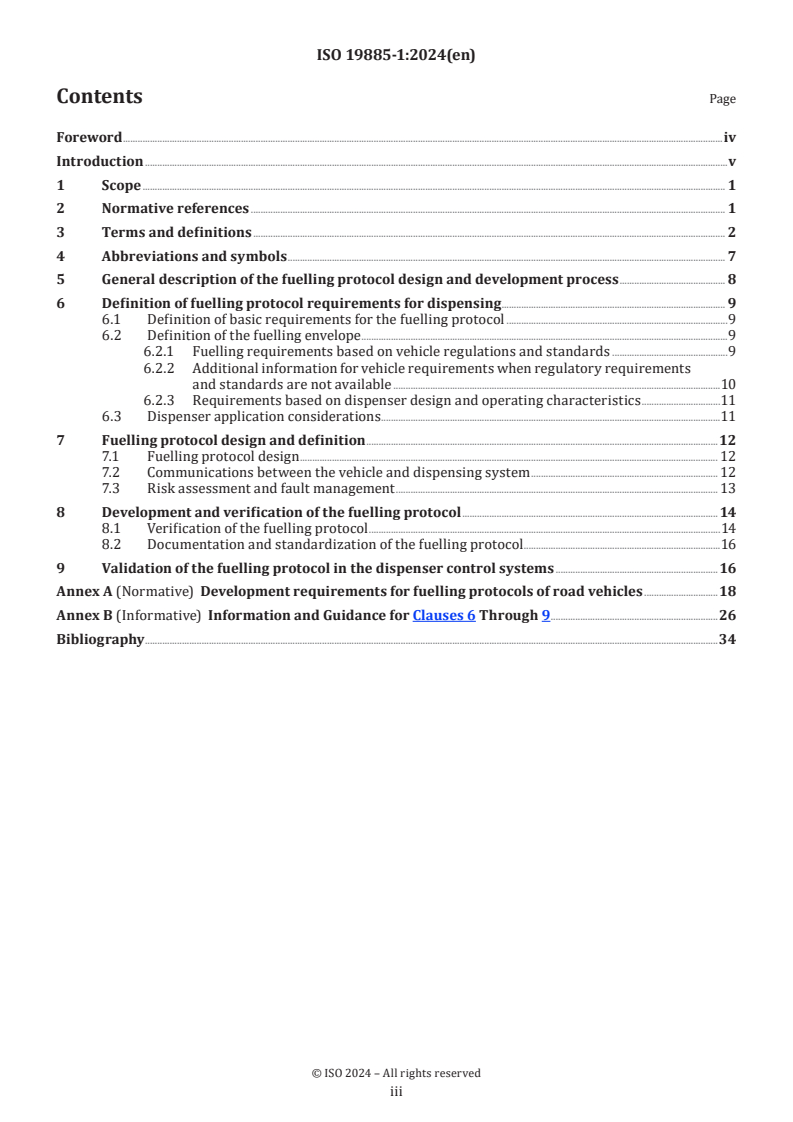
Contents Page
Foreword .iv
Introduction .v
1 Scope . 1
2 Normative references . 1
3 Terms and definitions . 2
4 Abbreviations and symbols . 7
5 General description of the fuelling protocol design and development process . 8
6 Definition of fuelling protocol requirements for dispensing . 9
6.1 Definition of basic requirements for the fuelling protocol .9
6.2 Definition of the fuelling envelope .9
6.2.1 Fuelling requirements based on vehicle regulations and standards .9
6.2.2 Additional information for vehicle requirements when regulatory requirements
and standards are not available .10
6.2.3 Requirements based on dispenser design and operating characteristics .11
6.3 Dispenser application considerations .11
7 Fuelling protocol design and definition .12
7.1 Fuelling protocol design . 12
7.2 Communications between the vehicle and dispensing system . 12
7.3 Risk assessment and fault management . 13
8 Development and verification of the fuelling protocol . 14
8.1 Verification of the fuelling protocol .14
8.2 Documentation and standardization of the fuelling protocol .16
9 Validation of the fuelling protocol in the dispenser control systems .16
Annex A (Normative) Development requirements for fuelling protocols of road vehicles .18
Annex B (Informative) Information and Guidance for Clauses 6 Through 9 .26
Bibliography .34
iii
Foreword
ISO (the International Organization for Standardization) is a worldwide federation of national standards
bodies (ISO member bodies). The work of preparing International Standards is normally carried out through
ISO technical committees. Each member body interested in a subject for which a technical committee
has been established has the right to be represented on that committee. International organizations,
governmental and non-governmental, in liaison with ISO, also take part in the work. ISO collaborates closely
with the International Electrotechnical Commission (IEC) on all matters of electrotechnical standardization.
The procedures used to develop this document and those intended for its further maintenance are described
in the ISO/IEC Directives, Part 1. In particular, the different approval criteria needed for the different types
of ISO document should be noted. This document was drafted in accordance with the editorial rules of the
ISO/IEC Directives, Part 2 (see www.iso.org/directives).
ISO draws attention to the possibility that the implementation of this document may involve the use of (a)
patent(s). ISO takes no position concerning the evidence, validity or applicability of any claimed patent
rights in respect thereof. As of the date of publication of this document, ISO had not received notice of (a)
patent(s) which may be required to implement this document. However, implementers are cautioned that
this may not represent the latest information, which may be obtained from the patent database available at
www.iso.org/patents. ISO shall not be held responsible for identifying any or all such patent rights.
Any trade name used in this document is information given for the convenience of users and does not
constitute an endorsement.
For an explanation of the voluntary nature of standards, the meaning of ISO specific terms and expressions
related to conformity assessment, as well as information about ISO's adherence to the World Trade
Organization (WTO) principles in the Technical Barriers to Trade (TBT), see www.iso.org/iso/foreword.html.
This document was prepared by Technical Committee ISO/TC 197, Hydrogen technologies.
A list of all parts in the ISO 19885 series can be found on the ISO website.
Any feedback or questions on this document should be directed to the user’s national standards body. A
complete listing of these bodies can be found at www.iso.org/members.html.
iv
Introduction
This document is intended to identify and describe requirements for the design and development of hydrogen
dispenser fuelling protocols and address issues with current protocols with regard to their acceptance and
thoroughness of verification as well as the safe implementation in dispenser systems.
This document is intended to coordinate with the ISO 19880 series with regard to road vehicles and, at the
same time, address a more general need with the regard to fuelling a far broader range of vehicles. This
document can help to address technical details of the fuelling process and will allow ISO 19880-1 to be
streamlined and focus on basic requirements of the fuelling station.
This document is expected to be the first part in a series dealing with fuelling protocols for a broad range of
vehicle applications.
Additionally, the requirements for the development process in this document are robust and can be
considered for extension to other container-fuelling applications in the future.
v
International Standard ISO 19885-1:2024(en)
Gaseous hydrogen — Fuelling protocols for hydrogen-fuelled
vehicles —
Part 1:
Design and development process for fuelling protocols
1 Scope
This document addresses the design and development of fuelling protocols for compressed hydrogen gas
dispensing to vehicles with compressed hydrogen storage of fuel.
The document does not address dispensing of compressed hydrogen gas to vehicles with hydride-based
hydrogen storage systems as well as the dispensing of liquefied or cryo-compressed hydrogen.
This document is intended to be used for a wide range of applications including, but not limited to, the
following:
— light, medium, and heavy-duty road vehicles,
— motor bicycles and tricycles, carts, and trailers,
— off-road vehicles,
— fork-lift and other industrial trucks,
— rail locomotives and powered cars,
— airplanes and drones, and
— maritime ships, boats, and barges.
This document applies to a wide spectrum of development situations ranging from companies developing a
fuelling protocol for their specific products or applications to standards development organizations (SDOs)
developing a consensus-based fuelling protocol for a broad segment of the industrial or commercial market.
Additionally, combinations between the two extremes are possible, where, for example, companies start
design and development as a way of defining a proposal for new work by an SDO to complete development
and publish the document as a consensus-based standard (including technical justification for compliance to
this document).
This document defines requirements for the design and development of the fuelling protocols. These
requirements can be integrated into the existing design and development processes to ensure that
the fuelling protocol is fully verified and that the generated documentation is sufficient for the proper
implementation and safe use of the fuelling protocols in dispensing systems for the targeted application.
In addition to addressing the design and development of fuelling protocols for general applications, Annex A
provides specific requirements and information relative to fuelling protocols for road vehicles at public
fuelling stations based on ISO 19880-1.
2 Normative references
The following documents are referred to in the text in such a way that some or all their content constitutes
requirements of this document. For dated references, only the edition cited applies. For undated references,
the latest edition of the referenced document (including any amendments) applies.
ISO 13849-1, Safety of machinery — Safety-related parts of control systems — Part 1: General principles for design
ISO 13849-2, Safety of machinery — Safety-related parts of control systems — Part 2: Validation
ISO 17268, Gaseous hydrogen land vehicle refuelling connection devices, 2020
ISO 19880 (all parts), Gaseous hydrogen — Fuelling stations
ISO 19881, Gaseous hydrogen — Land vehicle fuel containers
ISO/SAE 21434, Road vehicles — Cybersecurity engineering
ISO 26262, Road vehicles — Functional safety
IEC 60204-1, Safety of machinery - Electrical equipment of machines - Part 1: General requirements
IEC 61508, Functional safety of electrical/electronic/programmable electronic safety-related systems
IEC 61511, Functional safety – Safety instrumented systems for the process industry sector
IEC 62061, Safety of machinery – Functional safety of safety-related electrical, electronic, and programmable
electronic control systems
3 Terms and definitions
For the purposes of this document, the terms and definitions given in ISO 19880-1 and the following apply.
ISO and IEC maintain terminology databases for use in standardization at the following addresses:
— ISO Online browsing platform: available at https:// www .iso .org/ obp
— IEC Electropedia: available at https:// www .electropedia .org/
3.1
basic process control system
BPCS
system which responds to input signals from the process, its associated equipment, other programmable
systems and/or an operator and generates output signals causing the process and its associated equipment
to operate in the desired manner
Note 1 to entry: a BPCS does not perform any safety-instrumented functions with a claimed SIL ≥ 1.
[SOURCE: IEC 61511:2004, 3.2.3]
3.2
compressed hydrogen storage system
CHSS
system designed to store compressed hydrogen fuel for a hydrogen-fuelled road vehicle, composed of a
container, container attachments (if any), and all primary closure devices required to isolate the stored
hydrogen from the remainder of the fuel system and the environment
Note 1 to entry: The above definition is specific to hydrogen road vehicles where the CHSS has one (and only one)
container with dedicated primary closures devices. See A.3.
Note 2 to entry: Hydrogen road vehicles typically have more than one CHSS. See vehicle fuel system (3.27).
Note 3 to entry: The CHSS can also include actuators, sensors, and electronics as deemed necessary by the vehicle
manufacturer.
[SOURCE: ECE/TRANS/180/Add.13/Amend.1 UN GTR No. 13, UN Global Technical Regulation on Hydrogen
and Fuel Cell Vehicles: 2023, 3.6]
3.3
container
pressure-bearing component on the road vehicle within the hydrogen storage system that stores the
primary volume of hydrogen fuel in a single chamber or in multiple permanently interconnected chambers
Note 1 to entry: Cylinders and conformable containers are types of containers for road vehicles. See A.3.
[SOURCE: ECE/TRANS/180/Add.13/Amend.1 UN GTR No. 13, UN Global Technical Regulation on Hydrogen
and Fuel Cell Vehicles: 2023, 3.8]
3.4
control system
system which responds to input signals from the process and/or from an operator and generates output
signals causing the process to operate in the desired manner
3.5
data
design characteristics and limits, process measurements (such as temperature, pressure, and flow), and
associated calculated parameters of the interconnected dispensing system and vehicle fuel system during
the fuelling process
Note 1 to entry: Calculated parameters can be based on, for example, interpolations of data tables such as fuelling
tables for containers as well as formulas or equations involving other data.
3.5.1
dynamic data
data (3.5) such as temperature and pressure measurements, and associated calculated parameters that are
expected to change value with time during the fuelling process
3.5.2
static data
data (3.5) such as design characteristics and limits and associated calculated parameters that are expected
to remain constant with time during the fuelling process
3.6
dispenser
equipment in the dispensing system, including the dispenser cabinet(s) and support structure, that is
physically located in the fuelling area
Note 1 to entry: The hydrogen dispenser typically includes the fuelling assembly, required temperature and pressure
instrumentation, filters, and the user interface to conduct vehicle fuelling.
Note 2 to entry: The manufacturer of the hydrogen dispenser can include additional equipment in the dispenser,
including all equipment in the dispensing system.
3.7
dispensing system
system downstream of the hydrogen supply system comprising all equipment necessary to carry out the
vehicle fuelling operation, through which the compressed hydrogen is supplied to the vehicle
3.8
fuelling envelope
required design space for the fuelling protocol that captures extreme combinations of hydrogen fuelling and
storage systems on vehicles to be fuelled, the ambient and operating conditions of the vehicle during operation
and dispensing, and the capabilities and limitations of the vehicle fuel system and dispensing systems
3.9
fuelling protocol
technical descriptions, instructions, or constructs that define how the dispensing of compressed gaseous
hydrogen to storage systems on vehicles is to be conducted
Note 1 to entry: The fuelling protocol serves as the basis for defining control strategies and algorithms for
implementation in the BPCS (3.1) hardware and software of the dispensing control system
Note 2 to entry: Fuelling protocols can range from simple descriptions that can be performed in hardware to complex
programmable control functions using prescribed values, tables, and/or reduced-order models as well as conventional
process controls such as feedforward-feedback and predictor-corrector control functions.
3.10
fuelling station
hydrogen fuelling station
hydrogen refuelling station
HRS
facility for the dispensing of compressed hydrogen vehicle fuel, including the supply of hydrogen, and
hydrogen compression, storage, and dispensing systems
3.11
hydrogen service level
HSL
pressure level in MPa used to characterize the hydrogen service of the dispensing system based on the NWP
of the vehicle
Note 1 to entry: See ISO 19880-1:2020, Annex E for application of pressure terminology to hydrogen dispensing
systems and vehicles.
3.12
maximum allowable working pressure
MAWP
maximum pressure permissible in a system at the temperature specified
Note 1 to entry: The maximum allowable working pressure can also be defined as the design pressure, the maximum
allowable operating pressure, the maximum permissible working pressure, or the maximum allowable pressure for
the rating of pressure vessels and equipment manufactured in accordance with national pressure vessel codes.
Note 2 to entry: See ISO 19880-1:2020, Annex E for discussion of pressure terminology and its application to dispensing
systems and fuelling stations in general. Pressures are understood to be gauge unless otherwise specifically indicated
in this document.
3.13
maximum developed pressure
MDP
highest pressure achieved during infrequent, short-term excursions above MAWP during fault management
Note 1 to entry: See ISO 19880-1:2020, Annex E for a discussion of pressure terminology and its application to
dispensing systems and fuelling stations in general. Pressures are understood to be gauge unless otherwise
specifically indicated in this document.
3.14
maximum fuelling pressure
MFP
maximum pressure expected during a normal (fault-free) vehicle fuelling
Note 1 to entry: Per GTR#13, the maximum fuelling pressure is 125 % NWP for road vehicles.
Note 2 to entry: See ISO 19880-1:2020, Annex E for a discussion of pressure terminology and its application to
dispensing systems and fuelling stations in general. Pressures are understood to be gauge unless otherwise
specifically indicated in this document.
3.15
maximum operating pressure
MOP
highest pressure that is expected for a component or system during normal operation including anticipated
transients
Note 1 to entry: In the case of the dispensing system (3.7), the MOP is equivalent to the maximum fuelling pressure (3.14)
of the vehicle.
Note 2 to entry: See ISO 19880-1:2020, Annex E for discussion of pressure terminology and its application to dispensing
systems and fuelling stations in general. Pressures are understood to be gauge unless otherwise specifically indicated
in this document.
3.16
nominal working pressure
NWP
pressure within a hydrogen storage container(s) in the vehicle fuel system at 100 % SOC at a gas temperature
of 15 °C
Note 1 to entry: For road vehicles, this is typically 35 MPa or 70 MPa.
Note 2 to entry: See ISO 19880-1:2020, Annex E for discussion of pressure terminology and the correspondence
between vehicle terminology and dispensing systems. Pressures are understood to be gauge unless otherwise
specifically indicated in this document.
Note 3 to entry: Also known as “settled pressure” in ISO 10286.
[SOURCE: ISO 19880-1:2020, 3.51, modified to replace “CHSS” for road vehicles with the more general term
“hydrogen storage container(s) in the vehicle fuel system”. ]
3.17
non-comm fuelling
fuelling that is conducted without communications between the vehicle and the dispensing control system
Note 1 to entry: Non-comm fuelling is equivalent to a UCDC (3.25) of 0.
3.18
non-public fuelling station
fuelling station that does not sell or dispense gaseous hydrogen to the general public
EXAMPLE Private or municipal vehicle fleet operation
[SOURCE: ISO 19880-1:2020, 3.52]
3.19
physics-based model
representation of the governing laws of nature such as the equation of state for compressed hydrogen gas
and the conservation of mass, momentum and energy as applied in thermodynamics, fluid mechanics and
heat and mass transfer equations
Note 1 to entry: Physics-based models can be empirically adjusted to improve accuracy within the range of interest.
3.20
public fuelling station
fuelling station that sells gaseous hydrogen to the public
[SOURCE: ISO 19880-1:2020, 3.62, modified - the text “general public” has been changed to "public"]
3.21
risk assessment
determination of quantitative or qualitative value of risk related to a specific situation and a recognised threat
Note 1 to entry: See ISO 19880-1 for a discussion of the risk assessment process as well as examples of threats and
hazards.
Note 2 to entry: A recognized threat is also referred to as a hazard.
[SOURCE: ISO 19880-1:2020, 3.66, modified - text from the definition moved to Note 2 to entry.]
3.22
safety function
function to be implemented by a safety-instrumented system that is intended to achieve or maintain a safe
state for the process with respect to a specific hazardous situation
Note 1 to entry: See ISO 19880-1 for a discussion of safety-instrumented systems and their application to dispensing
systems and fuelling stations in general.
[SOURCE: ISO 19880-1:2020, 3.71, modified - Note 1 to entry has been replaced.]
3.23
standards development organization
SDO
industry- or sector-based standards organization that develops and publishes industry specific standards
Note 1 to entry: In some cases, international industry-based SDOs can have direct liaisons with international standards
organizations. SDOs are differentiated from standards setting organizations (SSOs) in that SDOs may be accredited to
develop standards using open and transparent processes.
Note 2 to entry: In the European Union, only standards created by CEN, CENELEC, and ETSI are recognized as
European standards, and member states are required to notify the European Commission and each other about all
the draft technical regulations. These rules were laid down in Directive 2015/1535/EU with the goal of providing
transparency and control with regard to technical regulations.
[SOURCE: ISO 19880-1:2020, 3.77]
3.24
state of charge
SOC
density (or mass) ratio of compressed hydrogen in the vehicle fuel system between the actual condition and
the capacity at NWP when the system is equilibrated at 15 °C
Note 1 to entry: SOC is typically expressed as a percentage. See ISO 19880-1:2020, 3.78 for details related to the
calculation process.
[SOURCE: ISO 19880-1:2020, 3.78, modified - replaced CHSS (3.2) for road vehicles with the more general
term “vehicle fuel system” (3.27) and Notes 1 to 4 to entry have been removed.]
3.25
use classification of data communicated
UCDC
numerical ranking of data communicated between the vehicle and the dispensing systems based on its use
within the fuelling protocol as supported by risk assessment for the following four levels of UCDC:
0) No data (3.5) is communicated (e.g., non-comm fuelling (3.17));
1) The data communicated is not used for safety functions but is available for data collection and,
if countermeasures are provided to mitigate risks (if any) resulting from faults, can also be used to
improve the performance of the basic process control for fuelling protocol;
2) Communicated static data (3.5.2) is used for safety functions (in addition to the allowed usages for static
and dynamic data (3.5.1) defined for UCDC of 1);
3) Static and dynamic data is used for dynamic control within the protocol or safety functions.
3.26
validation
assurance that a product, service, or system meets the needs of the customer and other identified
stakeholders
Note 1 to entry: See the definition of verification (3.28).
3.27
vehicle fuel system
assembly of components used to store or supply hydrogen fuel to a fuel cell (FC) or internal combustion
engine (ICE).
Note 1 to entry: For road vehicles, the vehicle fuel system includes all CHSSs (3.2) on the vehicle where the CHSSs are
interconnected in parallel.
[SOURCE: ECE/TRANS/180/Add.13/Amend.1 UN GTR No. 13, UN Global Technical Regulation on Hydrogen
and Fuel Cell Vehicles: 2023, 3.54]
3.28
verification
evaluation using subscale and full-scale tests, analyses, or a combination of tests and analyses that
demonstrate a product, service, or system complies with regulations, requirements, specifications, or
imposed conditions.
Note 1 to entry: Verification is typically conducted as part of the development process whereas validation (3.26) is
typically conducted after the completion of development to confirm acceptability to customers and stakeholders.
4 Abbreviations and symbols
BPCS Basic process control system
CHSS Compressed hydrogen storage system
FCEV Fuel cell electric vehicle
GTR Global technical regulation
HSL Hydrogen service level
H35 Indication for 35 MPa NWP hydrogen fuelling
H70 Indication for 70 MPa NWP hydrogen fuelling
L/D Length-to-Diameter ratio of a container
MAWP Maximum allowable working pressure
MDP Maximum developed pressure
MFP Maximum fuelling pressure
MOP Maximum operating pressure
NWP Nominal working pressure
SDO Standards development organization
SAE Society of Automotive Engineers International
SOC State of charge
T/F True or False as possible values for logical variables
TPRD Temperature-activated pressure relief device
UCDC Use Classification of Communicated Data
5 General description of the fuelling protocol design and development process
This document is intended to coordinate with the ISO 19880 series with regard to road vehicles and, at the
same time, address a more general need with the regard to fuelling a far broader range of vehicles as defined
in Clause 1.
Requirements for the design and development of fuelling protocols are organized into four process areas
defined in Clauses 6 through 9 (see Figure 1). The requirements are based on learnings from previous
fuelling protocol development activities and are intended to provide an efficient and orderly methodology
for verification of fuelling protocols and validation of implementation and function in dispensing control
systems for fuelling hydrogen vehicles.
Figure 1 — Process areas with fuelling protocol-specific requirements
The intent is to integrate the specific requirements of each of the four process areas into the appropriate
steps of the designer’s and developer’s existing processes. The specific requirements for the four process
areas are defined in Clauses 6 through 9. See also Annex B for additional information and guidance relative
to addressing Clauses 6 through 9, respectively.
The requirements defined in each of the key process areas must be documented (and updated if changes
occur). This documentation is essential to understand the requirements and limits for proper use of the
fuelling protocol and to provide the technical information necessary for implementing the fuelling protocol
into the dispensing control system including countermeasures for potential process deviations and faults.
This document is intended to apply to modifications to existing fuelling protocols (which have already been
evaluated) as well as new fuelling protocols for compressed hydrogen dispensing systems.
In addition to the requirements for fuelling protocol definition and development in the main body of this
document, Annex A provides requirements and information specific to fuelling protocols for road vehicles at
public fuelling stations based on ISO 19880-1. Fuelling protocols for road vehicles at public fuelling stations
shall be in accordance with A.6 through A.9.
While Annex A addresses a specific segment of the industry, designers/developers of fuelling protocols for
other hydrogen vehicles can find that Annex A provides useful examples of how to apply the general process
to other hydrogen vehicle applications.
6 Definition of fuelling protocol requirements for dispensing
6.1 Definition of basic requirements for the fuelling protocol
A clear understanding of the capabilities and limitations of the fuel systems in the vehicle and the dispensing
system is necessary before the fuelling protocol can be defined and developed. To ensure that hydrogen
dispensing is conducted safely, the basic requirements for the fuelling protocol defined below in this
subclause and the information defining the fuelling envelope in 6.2 shall be consistent with the capabilities
of the vehicle fuel system.
Since, as described in B.2, the objective of the fuelling protocol is to fill the vehicle fuel system to the maximum
state-of-charge (SOC) without exceeding temperature and pressure limits of the vehicle fuel system during
normal (i.e., fault-free) fuelling, the basic requirements for the fuelling protocol are as follows:
— maximum state-of-charge (SOC),
— maximum allowable container temperature, and
NOTE See 6.2.2 relative internal temperature monitoring of containers. See also B.3 and B.4 for general
guidance and A.5.1 for information related to gas temperature sensors in containers for road service.
— maximum pressure.
Applicable vehicle regulatory requirements and standards can define parameters for the basic requirements
listed above. If applicable regulations and standards are not available or any of the parameters listed above
are not defined in the regulations or standards, then these parameters shall be determined as part of 6.2.2.
6.2 Definition of the fuelling envelope
6.2.1 Fuelling requirements based on vehicle regulations and standards
Regulatory requirements and standards can provide information related to expected values and ranges of
vehicle operating characteristics as well as minimum capabilities for vehicle fuel systems. The following
information shall be defined when applicable to the targeted fuelling application (i.e. parameters can be
found in applicable regulations and standards):
— ambient temperature limits of the hydrogen vehicle and corresponding temperature limits surrounding
the container(s) in the vehicle to be fuelled,
— allowable minimum and maximum temperatures of fuel being dispensed,
— minimum allowable temperature of container materials,
NOTE See 6.2.2 relative internal temperature monitoring of containers. See also B.3 and B.4 for guidance,
and A.5.1 for information related to gas temperature sensors in containers for road service.
— minimum and maximum allowable temperature of piping systems including devices (e.g., control valves,
check valves, and TPRDs) that close to isolate the vehicle fuel system and prevent leakage,
— the minimum and maximum allowable fuelling rate of the vehicle expressed, for example, as either mass
flow rate of fuel being dispensed or pressurization rate (or both),
— minimum allowable pressure for fuelling to be initiated,
— additional vehicle requirements, if any, for actions taken during the vehicle fuelling that need to be
addressed in the design of the protocol or as protective measures by the dispensing system,
NOTE For example, the maximum allowable number of flow pauses (for integrity checks, for example) based
on cycle life fatigue of check valves.
— maximum allowable working pressure (of hydrogen storage systems) or maximum developed pressure
expected during fault management.
Additional items shall be added when necessary.
The vehicle design and operating characteristics defined above shall be used to define requirements for the
fuelling protocol that, when combined with requirements in 6.2.2 and 6.2.3, will form the fuelling envelope
based on representative ranges of design and operating characteristics of vehicles to be fuelled at the
targeted dispensing systems. See B.2 for guidance.
If applicable regulations and standards are not available or if any of the requirements are not defined in the
regulations or standards, then these parameters shall be determined as part of 6.2.2.
6.2.2 Additional information for vehicle requirements when regulatory requirements and
standards are not available
As discussed in B.2, the information defined from vehicle regulations and standards in 6.2.1 is not normally
sufficient to define all the necessary requirements related to the vehicle, and market surveys of the industry
segment to be served including discussions with manufacturers and stakeholders are often necessary to
compile information about hydrogen vehicles to be fuelled.
The following information shall be defined at worst-case conditions, when applicable to the targeted fuelling
application, based on market surveys:
— number, capacity, type(s), dimensions, and other parameters describing containers in the vehicle fuel system,
— heat transfer, thermal characteristics, and other parameters affecting thermal response of the containers
during the fuelling process (such as inlet flow dynamics that can affect gas mixing and possibly cause
thermal stratification),
— location, response time, and measurement tolerance of temperature sensor(s) for monitoring the internal
temperature of containers and the associated temperature levels and allowable durations as specified by
the manufacturer for protection of the container against damage,
NOTE See B.2, B.3, and B.4 for guidance, and A.5.1 for information related to gas temperature sensors in
containers for road service.
— pressure drop characteristics between the fuelling interface on the vehicle and the storage containers
during the dispensing of hydrogen,
— location of pressure sensors and measurement tolerances,
— heat transfer and thermal characteristics of vehicle fuelling line(s) and all associated components from
the fuelling interface (receptacle) that affect the temperature level and thermal response of the hydrogen
delivered to containers during dispensing,
— additional vehicle requirements, if any, for actions taken during the vehicle fuelling that need to be
addressed in the design of the protocol or as protective measures by the dispensing system,
— initial temperature range of the container(s) and contents as a function of ambient temperature and
prior vehicle operation including, if credible, the possibility that the initial temperature of contents in
container(s) is higher than expected due to the vehicle undergoing a prior partial fill without opportunity
for the contents to cool down to the expected operating range, and
— hot and cold soak initial conditions of container(s) based on stabilization at the minimum and maximum
ambient temperatures (identified above) and definition of a possible intermediate soak condition
based on stabilization of the container at a temperature between the minimum and maximum ambient
temperatures when, for example, the vehicle is parked or stored in an environmentally-controlled space
or enclosure such as a heated or cooled garage or enclosure.
Additional information shall be added when necessary.
The vehicle design and operating characteristics defined above shall be used to define requirements for the
fuelling protocol that, when combined with requirements in 6.2.1 and 6.2.3, will form the fuelling envelope
based on representative ranges of design and operating characteristics of vehicles to be fuelled at the
targeted dispensing systems. See B.2 for guidance.
6.2.3 Requirements based on dispenser design and operating characteristics
As discussed in B.2, the capabilities and limitations of the dispensing systems that will employ the fuelling
protocol also need to be considered.
The following information shall be defined at worst-case conditions, when applicable to the targeted fuelling
application, based on the design and operating conditions of the dispensing systems:
— ambient temperature range for dispensing,
— fuel supply capability (i.e., pressure and flow) and capacity (total mass that can be delivered during
fuelling) based on fuelling station compression and storage,
— temperature of dispensed fuel based on precooling temperatures and capability (if precooling used) or
ambient conditions,
— initial conditions (i.e., temperature, pressure, flow) when the dispensing of fuel is commenced,
— heat transfer and thermal characteristics of station fuel dispensing components (i.e., fuelling lines,
breakaway fittings, hose and nozzle) that affect the temperature level and thermal response of the
hydrogen delivered during dispensing to the vehicle,
— location and measurement tolerances of pressure and temperature sensors,
— pressure drop of equipment and piping within the dispensing systems, and
— number and pressure level of dispenser integrity checks during the dispensing process based on vehicle
cycle life capability (defined in 6.2.1) and regulatory requirements, if any.
Additional parameters shall be added when deemed necessary by risk assessment.
The dispensing system design and operating characteristics defined above shall be used to define
requirements for the fuelling protocol that, when combined with requirements in 6.2.1 and 6.2.2, will form
the fuelling envelope based on representative ranges of design and operating characteristics of vehicles to
be fuelled at the targeted dispensing system(s). See B.2 for guidance.
6.3 Dispenser application considerations
Knowledge of the proposed application for the dispenser can establish performance goals for the systems
(required to meet customer or stakeholder expectations) as well as an understanding of the physical and
management protections available at the targeted site(s).
The following information shall be defined when applicable to the targeted fuelling application:
— definition of vehicles to be fuelled and fuelling time goals,
— performance during high load (i.e., usage) conditions of the fuelling stations such as, for example, the
minimum time between refuelling of two consecutive vehicles, the amount of hydrogen available for
dispensing, or the rate of hydrogen dispensing as a function of pressure level of hydrogen storage at the
fuelling station and compression capability,
— allowable change in performance of the dispensing system as a function of changes in ambient conditions,
— ability to reach but not exceed 100 % SOC (or at least a satisfactory level),
— administrative actions and restrictions of use including, for example, possible supervision of fuelling,
limitations of hours of operation, lock-outs, fencing, and security codes, and
— public or non-public fuelling station(s).
Additional parameters shall be added when necessary to define and verify the fuelling protocol.
Also, any requirements in 6.2 that are affected by the information listed above shall be updated to be
consistent with the targeted application. See B.2 for guidance.
7 Fuelling protocol design and definition
7.1 Fuelling protocol design
A fuelling protocol shall be designed that satisfactorily meets the requirements for dispensing based on
basic requirements in 6.1 and the fuelling envelope formed by combining 6.2.1, 6.2.2, and 6.2.3.
The fuelling protocol can be original or a modification to an existing fuelling protocol as determined by
the designer. In either case, the defined protocol shall be subject to risk assessment in 7.3 and subsequent
verification and validation as defined in Clauses 8 and 9, respectively.
The designer shall determine whether the fuelling protocol will include communications between the vehicle
and dispensing control system. See B.3 for guidance. If communications are used, the communications shall
meet requirements in 7.2. The assigned UCDC level in 7.2 shall be subjected to a risk assessment as described
in 7.3, and the designer shall verify that countermeasures are provided when necessary to mitigate increased
risks when using UCDC 0 or 1.
The designer shall also determine (as supported by risk assessment in 7.3) to either terminate the fuelling
process if the communication fails or continue the fuelling without further communications (e.g., in UCDC of
0) using a backup protocol. The choice of backup protocol can be different depending on which phase of the
fuelling process the communication is interrupted. Furthermore, if the communication is re-established, the
designer can elect to return from the backup protocol to the original fuelling protocol when supported by risk
assessment. The backup non-comm fuelling protocol can be based on a published non-comm fuelling protocol
and can limit the amount of fuel dispensed to lower risk and thereby simplify verification as defined in 8.1.
The fuelling protocol design and the backup(s) as defined above shall be documented. The designer has
flexibility as to the form of the fuelling protocol documentation as long as the definition of the protocol is
clear and ultimately can be translated to hardware and software of the dispensing (and possibly vehicle)
control system(s).
7.2 Communications between the vehicle and dispensing system
If communications are used, the required UCDC level shall be determined based on the use of the
communicated data by the fuelling protocol as defined in 7.1. Only data communicated between the vehicle
and dispensing systems are subject to limitations on use of data as defined by UCDC. See 3.25 for definition
of UCDC levels and B.3 for guidance.
Data required to execute the fuelling protocol shall be defined along with UCDC level. The selected UCDC
level and communications system shall be supported by the risk assessment in 7.3.
Designers and developers of the fuelling protocol shall adopt designs consistent with requirements of the
selected communication system for pre-fuelling communications between the vehicle-to-dispenser control
systems, conducting the fuelling process, and post-fuelling before closing the communications as supported
by risk assessment for the targeted application.
NOTE ISO 19885-2 is under development to address communication requirements.
The following items s
...