

ISO 19882:2025
(Main)Gaseous hydrogen — Thermally activated pressure relief devices for compressed hydrogen vehicle fuel containers
General Information
- Abstract
This document specifies minimum requirements for pressure relief devices intended for use on hydrogen fuelled vehicle fuel containers that comply with ISO 19881, IEC 62282-4-101, CSA/ANSI HGV 2, EC79/EU406, SAE J2579, UN ECE R134, or the UN GTR No. 13. The applicability of this document is limited to thermally activated pressure relief devices installed on fuel containers containing gaseous hydrogen according to ISO 14687 for fuel cell and internal combustion land vehicles. This document specifies requirements for thermally activated pressure relief devices acceptable for use on-board the following types of land vehicles: — light-duty vehicles; — heavy-duty vehicles; — industrial powered trucks, such as forklifts and other material handling vehicles. Requirements for other types of land vehicles such as rail, off-road, etc., can be derived with due consideration of appropriate service conditions. This document does not apply to reseating, resealing, or pressure-activated devices. Pressure relief devices can be of any design or manufacturing method that meets the requirements of this document.
- Status
- Published
- Publication Date
- 11-Feb-2025
- Technical Committee
- ISO/TC 197 - Hydrogen technologies
- Drafting Committee
- ISO/TC 197 - Hydrogen technologies
- Current Stage
- 6060 - International Standard published
- Start Date
- 12-Feb-2025
- Due Date
- 12-Nov-2024
- Completion Date
- 12-Feb-2025

Overview
ISO 19882:2025 - "Gaseous hydrogen - Thermally activated pressure relief devices for compressed hydrogen vehicle fuel containers" - is the second edition (2025) international standard that defines minimum requirements for thermally activated pressure relief devices (TPRDs) used on compressed hydrogen vehicle fuel containers. It is focused on TPRDs installed on containers holding gaseous hydrogen (fuel quality per ISO 14687) and intended for onboard use in light‑duty vehicles, heavy‑duty vehicles, and industrial powered trucks (e.g., forklifts). The standard excludes reseating/resealing or pressure‑activated devices and applies only to thermally activated designs of any manufacturing method that meet the specified requirements.
Key topics and technical requirements
ISO 19882:2025 organizes requirements across design, materials, testing and production control. Major technical topics include:
- Service conditions: design service life, nominal working pressure, durability cycles and operating temperature range.
- Materials & design: material requirements for metallic and non‑metallic parts, general design requirements, and flow capacity expectations.
- Safety analysis: requirement for Failure Modes and Effects Analysis (FMEA) to identify hazards and mitigation.
- Design qualification testing: comprehensive test regimes such as pressure cycling, accelerated life and thermal cycling, corrosion and environmental exposure, stress corrosion cracking resistance, impact (drop) and vibration, leakage, bench‑top activation (direct‑acting and pilot‑activated PRDs), high‑pressure activation/flow, hydrostatic strength, excess torque resistance, and water‑jet protection.
- Quality assurance & production: inspection and acceptance testing plans, inspector responsibilities, system component inspection, leak testing, and production batch testing and sampling requirements.
These topics ensure TPRDs reliably activate under thermal exposure (e.g., fire) and provide predictable venting characteristics for compressed hydrogen vehicle containers.
Applications and users
Who uses ISO 19882:2025:
- Pressure relief device manufacturers designing thermally activated PRDs for hydrogen vehicles.
- Hydrogen fuel container and vehicle OEMs integrating TPRDs into compressed hydrogen storage systems for fuel cell and internal combustion vehicles.
- Test labs and certification bodies conducting design qualification and production testing to demonstrate compliance.
- Regulatory and safety engineers assessing component safety and system-level risk for hydrogen vehicle applications.
Practical applications include component design validation, supplier quality control, type approval testing, and conformity assessment for hydrogen passenger cars, buses, trucks, and material‑handling equipment.
Related standards
- ISO 14687 (hydrogen fuel quality)
- ISO 19881; IEC 62282-4-101; CSA/ANSI HGV 2; EC79/EU406; SAE J2579; UN ECE R134; UN GTR No. 13 - listed in the scope as related hydrogen vehicle and container standards referenced for applicability and system compliance.
Keywords: ISO 19882:2025, thermally activated pressure relief devices, TPRD, gaseous hydrogen, compressed hydrogen vehicle fuel containers, hydrogen vehicle safety, pressure relief device testing.
Relations
- Effective Date
- 06-Jun-2022
Get Certified
Connect with accredited certification bodies for this standard

DNV
DNV is an independent assurance and risk management provider.

TÜV Rheinland
TÜV Rheinland is a leading international provider of technical services.

TÜV SÜD
TÜV SÜD is a trusted partner of choice for safety, security and sustainability solutions.
Sponsored listings
Frequently Asked Questions
ISO 19882:2025 is a standard published by the International Organization for Standardization (ISO). Its full title is "Gaseous hydrogen — Thermally activated pressure relief devices for compressed hydrogen vehicle fuel containers". This standard covers: This document specifies minimum requirements for pressure relief devices intended for use on hydrogen fuelled vehicle fuel containers that comply with ISO 19881, IEC 62282-4-101, CSA/ANSI HGV 2, EC79/EU406, SAE J2579, UN ECE R134, or the UN GTR No. 13. The applicability of this document is limited to thermally activated pressure relief devices installed on fuel containers containing gaseous hydrogen according to ISO 14687 for fuel cell and internal combustion land vehicles. This document specifies requirements for thermally activated pressure relief devices acceptable for use on-board the following types of land vehicles: — light-duty vehicles; — heavy-duty vehicles; — industrial powered trucks, such as forklifts and other material handling vehicles. Requirements for other types of land vehicles such as rail, off-road, etc., can be derived with due consideration of appropriate service conditions. This document does not apply to reseating, resealing, or pressure-activated devices. Pressure relief devices can be of any design or manufacturing method that meets the requirements of this document.
This document specifies minimum requirements for pressure relief devices intended for use on hydrogen fuelled vehicle fuel containers that comply with ISO 19881, IEC 62282-4-101, CSA/ANSI HGV 2, EC79/EU406, SAE J2579, UN ECE R134, or the UN GTR No. 13. The applicability of this document is limited to thermally activated pressure relief devices installed on fuel containers containing gaseous hydrogen according to ISO 14687 for fuel cell and internal combustion land vehicles. This document specifies requirements for thermally activated pressure relief devices acceptable for use on-board the following types of land vehicles: — light-duty vehicles; — heavy-duty vehicles; — industrial powered trucks, such as forklifts and other material handling vehicles. Requirements for other types of land vehicles such as rail, off-road, etc., can be derived with due consideration of appropriate service conditions. This document does not apply to reseating, resealing, or pressure-activated devices. Pressure relief devices can be of any design or manufacturing method that meets the requirements of this document.
ISO 19882:2025 is classified under the following ICS (International Classification for Standards) categories: 27.075 - Hydrogen technologies; 43.060.40 - Fuel systems. The ICS classification helps identify the subject area and facilitates finding related standards.
ISO 19882:2025 has the following relationships with other standards: It is inter standard links to ISO 19882:2018. Understanding these relationships helps ensure you are using the most current and applicable version of the standard.
ISO 19882:2025 is available in PDF format for immediate download after purchase. The document can be added to your cart and obtained through the secure checkout process. Digital delivery ensures instant access to the complete standard document.
Standards Content (Sample)
International
Standard
ISO 19882
Second edition
Gaseous hydrogen — Thermally
2025-02
activated pressure relief devices for
compressed hydrogen vehicle fuel
containers
Hydrogène gazeux — Dispositifs limiteurs de pression
thermiquement activés pour les conteneurs de carburant de
véhicules à hydrogène comprimé
Reference number
© ISO 2025
All rights reserved. Unless otherwise specified, or required in the context of its implementation, no part of this publication may
be reproduced or utilized otherwise in any form or by any means, electronic or mechanical, including photocopying, or posting on
the internet or an intranet, without prior written permission. Permission can be requested from either ISO at the address below
or ISO’s member body in the country of the requester.
ISO copyright office
CP 401 • Ch. de Blandonnet 8
CH-1214 Vernier, Geneva
Phone: +41 22 749 01 11
Email: copyright@iso.org
Website: www.iso.org
Published in Switzerland
ii
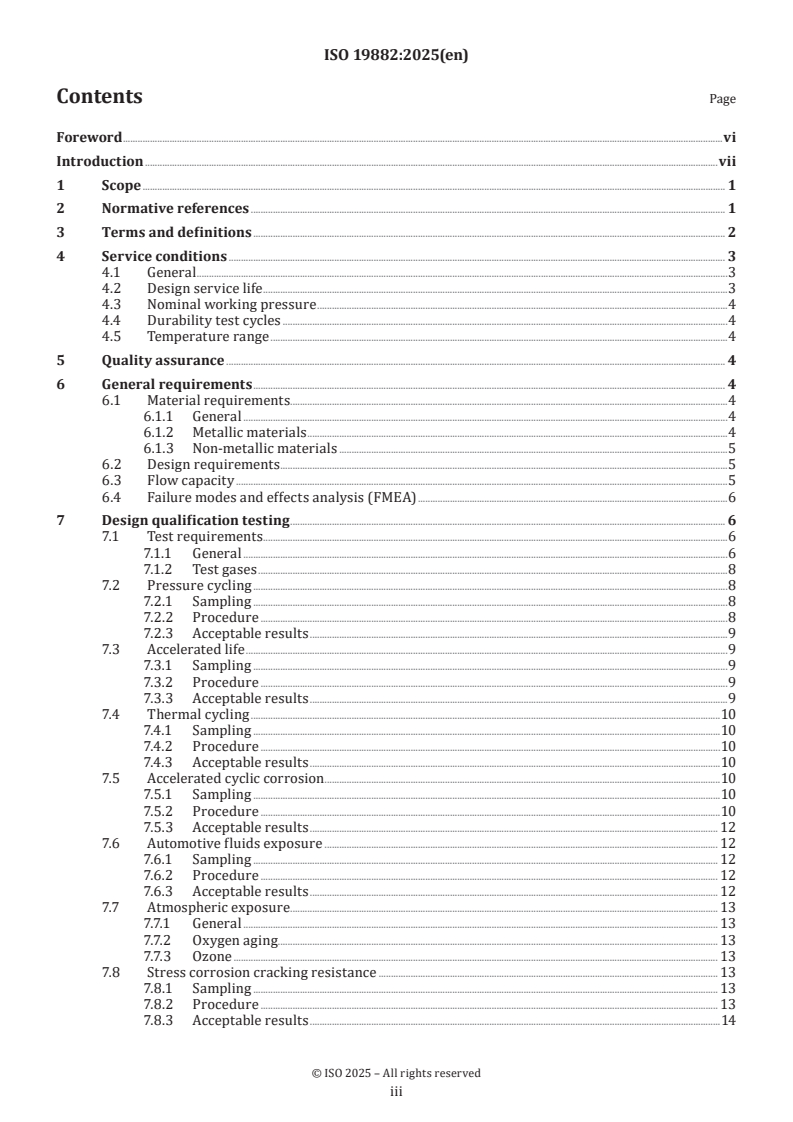
Contents Page
Foreword .vi
Introduction .vii
1 Scope . 1
2 Normative references . 1
3 Terms and definitions . 2
4 Service conditions . 3
4.1 General .3
4.2 Design service life .3
4.3 Nominal working pressure .4
4.4 Durability test cycles .4
4.5 Temperature range .4
5 Quality assurance . 4
6 General requirements . 4
6.1 Material requirements.4
6.1.1 General .4
6.1.2 Metallic materials .4
6.1.3 Non-metallic materials .5
6.2 Design requirements .5
6.3 Flow capacity .5
6.4 Failure modes and effects analysis (FMEA) .6
7 Design qualification testing . 6
7.1 Test requirements.6
7.1.1 General .6
7.1.2 Test gases .8
7.2 Pressure cycling .8
7.2.1 Sampling .8
7.2.2 Procedure .8
7.2.3 Acceptable results .9
7.3 Accelerated life .9
7.3.1 Sampling .9
7.3.2 Procedure .9
7.3.3 Acceptable results .9
7.4 Thermal cycling .10
7.4.1 Sampling .10
7.4.2 Procedure .10
7.4.3 Acceptable results .10
7.5 Accelerated cyclic corrosion .10
7.5.1 Sampling .10
7.5.2 Procedure .10
7.5.3 Acceptable results . 12
7.6 Automotive fluids exposure . 12
7.6.1 Sampling . 12
7.6.2 Procedure . 12
7.6.3 Acceptable results . 12
7.7 Atmospheric exposure . . 13
7.7.1 General . 13
7.7.2 Oxygen aging. 13
7.7.3 Ozone . 13
7.8 Stress corrosion cracking resistance . 13
7.8.1 Sampling . 13
7.8.2 Procedure . 13
7.8.3 Acceptable results .14
iii
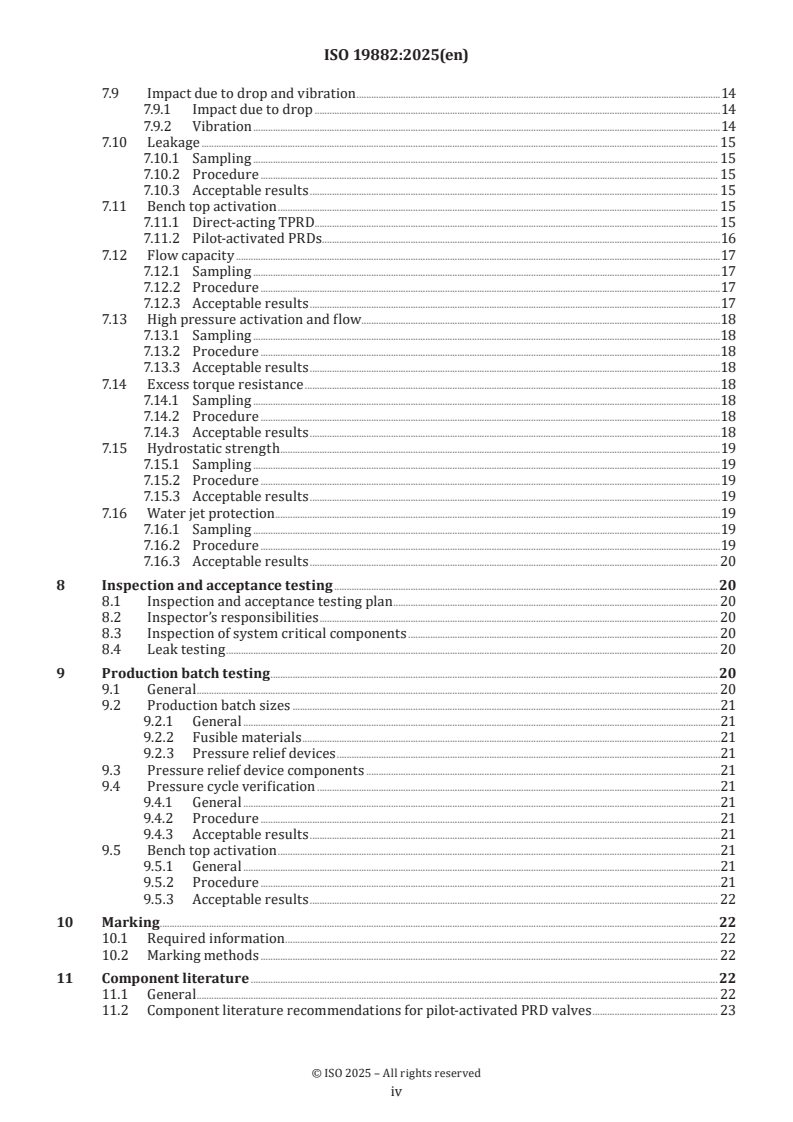
7.9 Impact due to drop and vibration .14
7.9.1 Impact due to drop .14
7.9.2 Vibration .14
7.10 Leakage . 15
7.10.1 Sampling . 15
7.10.2 Procedure . 15
7.10.3 Acceptable results . 15
7.11 Bench top activation . 15
7.11.1 Direct-acting TPRD. 15
7.11.2 Pilot-activated PRDs . .16
7.12 Flow capacity .17
7.12.1 Sampling .17
7.12.2 Procedure .17
7.12.3 Acceptable results .17
7.13 High pressure activation and flow . .18
7.13.1 Sampling .18
7.13.2 Procedure .18
7.13.3 Acceptable results .18
7.14 Excess torque resistance .18
7.14.1 Sampling .18
7.14.2 Procedure .18
7.14.3 Acceptable results .18
7.15 Hydrostatic strength .19
7.15.1 Sampling .19
7.15.2 Procedure .19
7.15.3 Acceptable results .19
7.16 Water jet protection .19
7.16.1 Sampling .19
7.16.2 Procedure .19
7.16.3 Acceptable results . 20
8 Inspection and acceptance testing .20
8.1 Inspection and acceptance testing plan . 20
8.2 Inspector’s responsibilities . 20
8.3 Inspection of system critical components . 20
8.4 Leak testing . 20
9 Production batch testing .20
9.1 General . 20
9.2 Production batch sizes .21
9.2.1 General .21
9.2.2 Fusible materials .21
9.2.3 Pressure relief devices .21
9.3 Pressure relief device components .21
9.4 Pressure cycle verification .21
9.4.1 General .21
9.4.2 Procedure .21
9.4.3 Acceptable results .21
9.5 Bench top activation .21
9.5.1 General .21
9.5.2 Procedure .21
9.5.3 Acceptable results . 22
10 Marking . .22
10.1 Required information . 22
10.2 Marking methods . 22
11 Component literature .22
11.1 General . 22
11.2 Component literature recommendations for pilot-activated PRD valves . 23
iv
Annex A (informative) Subsystem and vehicle level considerations .24
Annex B (informative) Design qualification test rationale .28
Bibliography .31
v
Foreword
ISO (the International Organization for Standardization) is a worldwide federation of national standards
bodies (ISO member bodies). The work of preparing International Standards is normally carried out through
ISO technical committees. Each member body interested in a subject for which a technical committee
has been established has the right to be represented on that committee. International organizations,
governmental and non-governmental, in liaison with ISO, also take part in the work. ISO collaborates closely
with the International Electrotechnical Commission (IEC) on all matters of electrotechnical standardization.
The procedures used to develop this document and those intended for its further maintenance are described
in the ISO/IEC Directives, Part 1. In particular, the different approval criteria needed for the different types
of ISO document should be noted. This document was drafted in accordance with the editorial rules of the
ISO/IEC Directives, Part 2 (see www.iso.org/directives).
ISO draws attention to the possibility that the implementation of this document may involve the use of (a)
patent(s). ISO takes no position concerning the evidence, validity or applicability of any claimed patent
rights in respect thereof. As of the date of publication of this document, ISO had not received notice of (a)
patent(s) which may be required to implement this document. However, implementers are cautioned that
this may not represent the latest information, which may be obtained from the patent database available at
www.iso.org/patents. ISO shall not be held responsible for identifying any or all such patent rights.
Any trade name used in this document is information given for the convenience of users and does not
constitute an endorsement.
For an explanation of the voluntary nature of standards, the meaning of ISO specific terms and expressions
related to conformity assessment, as well as information about ISO's adherence to the World Trade
Organization (WTO) principles in the Technical Barriers to Trade (TBT), see www.iso.org/iso/foreword.html.
This document was prepared by Technical Committee ISO/TC 197, Hydrogen technologies.
This second edition cancels and replaces the first edition (ISO 19882:2018), which has been technically
revised.
The main changes are as follows:
— addition of pilot TPRDs and PRD valve coverage;
— updates to design qualification test procedures;
— additional test requirements for excess torque resistance, hydrostatic strength and waterjet protection.
Any feedback or questions on this document should be directed to the user’s national standards body. A
complete listing of these bodies can be found at www.iso.org/members.html.
vi
Introduction
The purpose of this document is to promote the implementation of hydrogen powered land vehicles through
the creation of performance-based testing requirements for thermally activated pressure relief devices
for compressed hydrogen fuel containers. The successful commercialization of hydrogen land vehicle
technologies requires standards pertaining vehicle fuel system components and the global homologation of
standards requirements for technologies with the same end use. This will allow manufacturers to achieve
economies of scale in production through the ability to manufacture one product for global use.
Documents which apply to hydrogen fuel vehicles and hydrogen fuel subsystems include IEC 62282- 4-101,
SAE J2578, SAE J2579, UN ECE R134, or UN GTR No. 13.
Annex A presents an informative record of recommended fuel container, fuel storage subsystem and vehicle
level requirements. The statements in Annex A are intended as recommendations for consideration of
inclusion by the organizations and committees developing standards on these sub-system and vehicle level
standards.
Annex B presents a rationale for the design qualification tests in this document.
This document is based on the CSA Standard CSA/ANSI HPRD 1:21.
vii
International Standard ISO 19882:2025(en)
Gaseous hydrogen — Thermally activated pressure relief
devices for compressed hydrogen vehicle fuel containers
1 Scope
This document specifies minimum requirements for pressure relief devices intended for use on hydrogen
fuelled vehicle fuel containers that comply with ISO 19881, IEC 62282-4-101, CSA/ANSI HGV 2, EC79/EU406,
SAE J2579, UN ECE R134, or the UN GTR No. 13.
The applicability of this document is limited to thermally activated pressure relief devices installed on fuel
containers containing gaseous hydrogen according to ISO 14687 for fuel cell and internal combustion land
vehicles. This document specifies requirements for thermally activated pressure relief devices acceptable
for use on-board the following types of land vehicles:
— light-duty vehicles;
— heavy-duty vehicles;
— industrial powered trucks, such as forklifts and other material handling vehicles.
Requirements for other types of land vehicles such as rail, off-road, etc., can be derived with due consideration
of appropriate service conditions.
This document does not apply to reseating, resealing, or pressure-activated devices.
Pressure relief devices can be of any design or manufacturing method that meets the requirements of this
document.
2 Normative references
The following documents are referred to in the text in such a way that some or all of their content constitutes
requirements of this document. For dated references, only the edition cited applies. For undated references,
the latest edition of the referenced document (including any amendments) applies.
ISO 1431-1, Rubber, vulcanized or thermoplastic — Resistance to ozone cracking — Part 1: Static and dynamic
strain testing
ISO 188, Rubber, vulcanized or thermoplastic — Accelerated ageing and heat resistance tests
ISO 6270-2, Paints and varnishes — Determination of resistance to humidity — Part 2: Condensation (in-cabinet
exposure with heated water reservoir)
ISO 14687, Hydrogen fuel quality — Product specification
ISO 19881, Gaseous hydrogen — Land vehicle fuel containers
ASTM D572, Standard Test Method for Rubber — Deterioration by Heat and Oxygen
ASTM D1149, Standard Test Methods for Rubber Deterioration — Cracking in an Ozone Controlled Environment
ASTM D1193, Standard Specification for Reagent Water
CSA/ANSI HGV 2, Compressed hydrogen gas vehicle fuel containers
UN GTR No. 13, UN Global Technical Regulation on Hydrogen and Fuel Cell Vehicles
SAE J2579, Standard for Fuel Systems in Fuel Cell and Other Hydrogen Vehicles
SAE J2719, Hydrogen Fuel Quality for Fuel Cell Vehicles
3 Terms and definitions
For the purposes of this document, the following terms and definitions apply.
ISO and IEC maintain terminology databases for use in standardization at the following addresses:
— ISO Online browsing platform: available at https:// www .iso .org/ obp
— IEC Electropedia: available at https:// www .electropedia .org/
3.1
flow capacity
capacity in volume per unit time at specified conditions
3.2
fusible material
metal, alloy, or other material capable of being melted by heat where the melting is integral to the function
of the pressure relief device (3.7)
3.3
manufacturer's specified activation temperature
temperature, as specified by the pressure relief device manufacturer, at which the pressure relief device (3.7)
is designed to release pressure
3.4
manufacturer's specified nominal working pressure
highest settled pressure at a uniform gas temperature of 15 °C of the container or container assembly with
which the pressure relief device (3.7) may be used, as specified by the pressure relief device manufacturer
3.5
normal cubic centimetre
Ncm
dry gas that occupies a volume of 1 cm at a temperature of 293,15 K (20 °C) and an absolute pressure of
101,325 kPa
3.6
pilot-activating device
valve or device designed to be used as a trigger for pilot-activated pressure relief device (3.7) valves, other
than pilot TPRDs
3.7
pressure relief device
PRD
device that, when activated under specified performance conditions, is used to vent the container contents
Note 1 to entry: Reseating and resealing devices are not addressed by this document.
3.8
thermally activated pressure relief device
TPRD
pressure relief device (3.7) activated by temperature
3.8.1
direct-acting TPRD
TPRD (3.8) having a heat-reactive element that acts directly with the gas control portion of the PRD (3.7)
3.8.2
long-trigger TPRD
TPRD (3.8) having a heat-reactive element that is more than 10 times longer than the longest dimension of
the PRD (3.7) body
3.8.3
pilot TPRD
TPRD (3.8) designed to be used as the trigger for the pilot-activated PRD valve (3.9.2)
3.8.4
remote-sensing TPRD
TPRD (3.8) having one or more remote heat-reactive element(s) such that it can be heated separately from,
and acts indirectly with, the gas control portion of the PRD
3.9
pressure relief device valve
PRD valve
single-use valve that is intended to be opened to empty a hydrogen container
3.9.1
negative-acting pilot-activated PRD valve
PRD (3.7) that is designed to be triggered by a remote heat-sensing element or device and that will react to a
decrease in pressure being applied to the pilot-activated PRD valve (3.9.2) activation port
3.9.2
pilot-activated PRD valve
single-use valve that is intended to be opened to empty a hydrogen container by the action of an attached
PRD (3.7)
3.9.3
positive-acting pilot-activated PRD valve
PRD (3.7) that is designed to be triggered by a remote heat-sensing element or device and that will react to a
positive pressure applied to the pilot-activated PRD valve (3.9.2) activation port
4 Service conditions
4.1 General
Fuel containers can accidentally be exposed to fire or elevated temperature. These conditions can act to
increase the contained-pressure or to degrade the structural materials, depending on the container type
and materials of construction. A pressure relief device provides a means to vent the fuel container under
these conditions.
A pressure relief device may not be suitable for all container types, sizes or installations. Fuel container
or installation standards may require that a pressure relief device be tested in conjunction with other
components.
The service conditions in 4.2 through 4.5 are representative of what can be seen in an automotive service.
These service conditions are provided as a basis for the design, manufacture, inspection and testing of
pressure relief devices used in compressed hydrogen vehicle fuel containers.
4.2 Design service life
The design service life of the pressure relief device shall be specified by the manufacturer.
NOTE The testing described in this document is based on an expected service life of 20 years. Service life values
can be extended by adjusting the filling or duty cycles, as applicable, by the appropriate factor (ratio). For example, a
service life of 25 years will require cycling to be multiplied by 1,25.
4.3 Nominal working pressure
This document applies to pressure relief devices that have a nominal working pressure, as specified by the
manufacturer, of 35 MPa or 70 MPa at 15 °C, hereinafter referred to in this document as the following:
a) “H35” — 35 MPa;
b) “H70” — 70 MPa.
Other nominal working pressures for hydrogen gas besides those defined are allowed if the required
qualification test requirements of this document are met.
4.4 Durability test cycles
Pressure relief devices shall be designed to withstand 15 000 pressure cycles per the cycling requirements
in 7.2. Pressure cycling includes 10 cycles between ≤ 2 MPa and ≥ 150 % of the manufacturer’s specified
nominal working pressure.
NOTE The maximum pressure under the condition of fuelling station dispenser fault management is 150 % of
the vehicle nominal working pressure, as defined in ISO 19880-1, SAE J2760, SAE J2579-2023, Appendix A and CSA/
ANSI HGV 4.1.
4.5 Temperature range
The pressure relief device shall be designed to maintain pressure integrity from −40 °C to 85 °C.
It is possible that operational gas temperatures are outside of this range. The manufacturer may choose to
test beyond these temperatures.
5 Quality assurance
Quality system programs shall be established and operated to demonstrate that pressure relief devices are
produced in accordance with the qualified design.
6 General requirements
6.1 Material requirements
6.1.1 General
Pressure-containing materials in contact with hydrogen shall be determined to be acceptable in hydrogen
service, with particular attention to hydrogen embrittlement and hydrogen-accelerated fatigue. Materials
and design shall be such that there will be no significant change in the functioning of the device, deformation
or mechanical change in the device, and no harmful corrosion, deformation, or deterioration of the materials.
6.1.2 Metallic materials
Material acceptability for metallic materials shall be demonstrated by testing or by referencing published
data for the same material, representative form (e.g. bar or plate, forging or casting), similar strength and
equivalent service conditions.
NOTE 1 Information regarding material performance in hydrogen environments can be found in ISO/TR 15916,
ANSI/CSA CHMC 1, ASME B31.12 and SAE J2579:2023 Appendix B. Hydrogen compatibility can also be demonstrated
by testing in hydrogen environments as anticipated in service, such as the pressure cycling test specified in 7.2.
NOTE 2 Some fusible alloys can contain heavy metals that can be considered environmentally unacceptable by
some customers and can be prohibited by some jurisdictions.
Resistance to chloride stress corrosion cracking shall be taken under consideration if selecting stainless
steel materials. Resistance to corrosion cracking shall be taken under consideration if selecting carbon steel
materials (e.g. by choosing appropriate coating, manufacturing processes).
Resistance to stress corrosion cracking and sustained load cracking shall be taken under consideration if
selecting aluminium materials.
Resistance to galvanic corrosion shall be taken under consideration when joining components containing
dissimilar materials.
6.1.3 Non-metallic materials
The suitability of non-metallic organic materials (e.g. rubbers, plastics) for hydrogen service shall be
verified, taking into consideration the fact that hydrogen diffuses through these materials more easily than
through metals.
Non-metallic materials shall retain their mechanical stability with respect to strength (e.g. fatigue
properties, endurance limit, creep strength, elasticity) when exposed to the full range of service conditions
and lifetime as specified by the manufacturer.
Materials shall be sufficiently resistant to the chemical and physical action of the fluids that they contain and
to environmental degradation. The chemical and physical properties necessary for operational safety should
not be significantly affected within the scheduled lifetime of the component. Specifically, when selecting
materials and manufacturing methods, due account should be taken of the material’s wear resistance,
impact strength, aging resistance, the effects of temperature variations, effects that arise when materials
are put together, the effects of ultraviolet radiation, rapid gas decompression and the degradation effects of
hydrogen on the mechanical performance of a material.
The manufacturer shall verify the material’s suitability, including consideration for such characteristics as
permeability, creep, long-term aging, stress cracking, and retention of mechanical properties, as appropriate.
Safety margin shall be demonstrated by the hydrostatic strength test, allowable leakage, and the use of
materials below their creep threshold for their qualification temperature.
NOTE Guidance to account for the degradation effects of hydrogen on the mechanical performance of a material
can be found in ISO/TR 15916 and ANSI/AIAA G-095. Hydrogen compatibility for non-metallic materials can also be
demonstrated by testing in hydrogen environments as anticipated in service by one or more of the following:
a) documented field experience with successful performance of the material in hydrogen environments with similar
service conditions;
b) performance of industry approved standards for hydrogen compatibility, such as CSA/ANSI CHMC 2;
c) use of hydrogen as the test gas for the pressure cycling test specified in 7.2.
6.2 Design requirements
The design shall be such that, once activated, the pressure relief device fully vents the contents of the fuel
container. The design should minimize the possibility of external hazards (e.g. projectiles) resulting from
the activation of the device. Any material released shall not interfere with the proper venting of the PRD.
The PRD shall be designed to address degradation from creep or plastic deformation. The design or
manufacturing process should account for the effects of material defects, particularly casting and shrinkage
voids, that adversely impact the robustness of the design.
6.3 Flow capacity
The flow capacity shall be determined by the flow capacity test in 7.12.
The adequacy of the flow capacity of pressure relief devices for a given application shall be demonstrated by
bonfire testing in accordance with ISO 19881, CSA/ANSI HGV 2, SAE J2579, or the UN GTR No. 13 for fuel cell
vehicles and by the minimization of the hazardous effects of the pressure peaking phenomenon which can
take place during high flow rate releases from small diameter vents in enclosed spaces.
6.4 Failure modes and effects analysis (FMEA)
Design FMEA and process FMEA, or equivalent shall be performed for pressure relief devices.
NOTE FMEA is a methodology used in the automotive industry to identify potentially hazardous failure modes of
safety devices and recommend changes in design, manufacturing, inspection or testing which eliminate such failure
modes or minimize their effects. FMEA is applied to both device design and to the manufacturing and assembly process
to identify corrective actions that improve device reliability and safety. Available references include SAE J1739.
7 Design qualification testing
7.1 Test requirements
7.1.1 General
Design qualification testing shall be conducted on finished pressure relief devices that are representative of
the normal production. Test reports shall be kept on file by the manufacturer and should be made available
for review by fuel container manufacturers and end users upon request.
The design qualification testing required by this document shall, as appropriate and necessary, be
supplemented by additional tests defined in “design controls” or “recommended action” in the design FMEA.
PRDs representative of each design and design change shall be subjected to tests as prescribed in Table 1.
Designs sufficiently similar to an existing fully qualified design shall be permitted to be qualified through a
reduced test program as defined in Table 1. Design changes not falling within the guidelines in Table 1 shall
be qualified as original designs.
Any additional tests or requirements shall be performed in accordance with appropriate published
standards or procedures, as available.
Unless stated otherwise, the tests specified herein shall be conducted at an ambient temperature of
20 °C ± 5 °C.
Caution shall be taken to confirm that the specified test temperature and test pressure are maintained.
Unless stated otherwise, the tests specified herein shall be conducted with the following tolerances on
specified temperatures and pressures:
a) −40 °C (+0, −5) °C;
b) +85 °C (+5, −0) °C;
c) P (+2, -0) MPa;
max
d) P (+0, -1) MPa.
min
Pilot-activated PRD valves shall be tested as TPRDs, except as noted in individual tests.
...