

ISO 24521:2016
(Main)Activities relating to drinking water and wastewater services — Guidelines for the management of basic on-site domestic wastewater services
General Information
- Abstract
ISO 24521:2016 provides guidance for the management of basic on-site domestic wastewater services, using appropriate technologies in their entirety at any level of development. ISO 24521:2016 supplements and is intended to be used in conjunction with ISO 24511. It includes the following: · guidelines for the management of basic on-site domestic wastewater services from the operator's perspective, including maintenance techniques, training of personnel and risk considerations; · guidelines for the management of basic on-site domestic wastewater services from the perspective of users; · guidance on the design and construction of basic on-site domestic wastewater systems; · guidance on planning, operation and maintenance, and health and safety issues. The following are outside the scope of ISO 24521:2016: · limits of acceptability for wastewater discharged into a receiving body; · analytical methods; · the management structure of sanitary waste/wastewater service activities of operation and management; · the content of contracts or subcontracts. ISO 24521:2016 is applicable to both publicly and privately operated basic on-site domestic wastewater (black and grey water) services, for one or more dwellings.
- Status
- Withdrawn
- Publication Date
- 25-Aug-2016
- Technical Committee
- ISO/TC 224 - Drinking water, wastewater and stormwater systems and services
- Current Stage
- 9599 - Withdrawal of International Standard
- Start Date
- 28-May-2025
- Completion Date
- 29-Aug-2026
Buy Documents

ISO 24521:2016 - Activities relating to drinking water and wastewater services — Guidelines for the management of basic on-site domestic wastewater services/26/2016

ISO 24521:2016 - Activities relating to drinking water and wastewater services -- Guidelines for the management of basic on-site domestic wastewater services
ISO 24521:2016 - Activités relatives aux services de l'eau potable et des eaux usées — Lignes directrices pour la gestion sur site des services d'eaux usées domestiques de base/6/2019
ISO 24521:2016 - Activités relatives aux services de l'eau potable et des eaux usées -- Lignes directrices pour la gestion sur site des services d'eaux usées domestiques de base
Overview
ISO 24521:2016 - Activities relating to drinking water and wastewater services - provides guidance for the management of basic on-site domestic wastewater services (black and grey water) for one or more dwellings. It is intended to be used alongside ISO 24511 and applies to publicly and privately operated systems at any level of development. The standard covers management from both the operator’s and user’s perspectives and addresses planning, design, construction, operation, maintenance, health and safety, and risk considerations for on-site systems.
Key Topics
- Scope and exclusions
- Applies to on-site domestic wastewater services (black and grey water).
- Outside scope: discharge limits to receiving waters, analytical methods, organizational management structures, and contract contents.
- System components
- User interface, collection, transportation, treatment, disposal/reuse.
- Management guidance
- Developing objectives, action plans, financial sustainability, asset sustainability, customer relations and stakeholder engagement.
- Independent management of system function and stakeholder communication.
- Technical selection
- Criteria for selecting appropriate on-site wastewater technologies depending on context and development level.
- Planning, construction, operation & maintenance
- Guidance on design and construction of systems, operational plans and instructions, and maintenance schedules for collection, transportation and treatment.
- Risk, environmental and health/safety
- Risk management, environmental protection considerations, health and safety measures, staff training, and public health programmes.
- Stakeholder support
- Education, training and communication plans for users and operators.
Applications and Who Uses It
ISO 24521:2016 is practical for organizations and professionals involved in decentralized sanitation and on-site wastewater management:
- Local authorities and regulators developing policy or guidance for basic on-site systems.
- Operators and service providers (public or private) responsible for maintenance, operation and small-scale wastewater services.
- Designers and installers selecting appropriate technologies for household-level treatment, collection and disposal/reuse.
- NGOs and development agencies implementing sanitation projects in low- and middle-income settings.
- Community water and sanitation committees seeking frameworks for stakeholder engagement, training and sustainable service delivery.
Use cases include planning small-scale sanitation programs, creating O&M manuals, developing training and health-and-safety procedures, and selecting fit-for-purpose on-site treatment technologies.
Related Standards
- ISO 24511 - complements ISO 24521 by addressing management of wastewater services more broadly.
- Other ISO standards in the 24500 series cover drinking water and wastewater service quality, performance indicators and management approaches.
Keywords: ISO 24521:2016, on-site domestic wastewater, wastewater management, basic on-site treatment, sanitation, operation and maintenance, health and safety, risk management, decentralized sanitation.
Relations
- Effective Date
- 06-Aug-2022
Buy Documents
ISO 24521:2016 - Activities relating to drinking water and wastewater services — Guidelines for the management of basic on-site domestic wastewater services/26/2016
ISO 24521:2016 - Activities relating to drinking water and wastewater services -- Guidelines for the management of basic on-site domestic wastewater services
ISO 24521:2016 - Activités relatives aux services de l'eau potable et des eaux usées — Lignes directrices pour la gestion sur site des services d'eaux usées domestiques de base/6/2019
ISO 24521:2016 - Activités relatives aux services de l'eau potable et des eaux usées -- Lignes directrices pour la gestion sur site des services d'eaux usées domestiques de base
Get Certified
Connect with accredited certification bodies for this standard

CIS Institut d.o.o.
Personal Protective Equipment (PPE) certification body. Notified Body NB-2890 for EU Regulation 2016/425 PPE.
Great Wall Tianjin Quality Assurance Center
Established 1993, first batch to receive national accreditation with IAF recognition.
Hong Kong Quality Assurance Agency (HKQAA)
Hong Kong's leading certification body.
Sponsored listings
Frequently Asked Questions
ISO 24521:2016 is a standard published by the International Organization for Standardization (ISO). Its full title is "Activities relating to drinking water and wastewater services — Guidelines for the management of basic on-site domestic wastewater services". This standard covers: ISO 24521:2016 provides guidance for the management of basic on-site domestic wastewater services, using appropriate technologies in their entirety at any level of development. ISO 24521:2016 supplements and is intended to be used in conjunction with ISO 24511. It includes the following: · guidelines for the management of basic on-site domestic wastewater services from the operator's perspective, including maintenance techniques, training of personnel and risk considerations; · guidelines for the management of basic on-site domestic wastewater services from the perspective of users; · guidance on the design and construction of basic on-site domestic wastewater systems; · guidance on planning, operation and maintenance, and health and safety issues. The following are outside the scope of ISO 24521:2016: · limits of acceptability for wastewater discharged into a receiving body; · analytical methods; · the management structure of sanitary waste/wastewater service activities of operation and management; · the content of contracts or subcontracts. ISO 24521:2016 is applicable to both publicly and privately operated basic on-site domestic wastewater (black and grey water) services, for one or more dwellings.
ISO 24521:2016 provides guidance for the management of basic on-site domestic wastewater services, using appropriate technologies in their entirety at any level of development. ISO 24521:2016 supplements and is intended to be used in conjunction with ISO 24511. It includes the following: · guidelines for the management of basic on-site domestic wastewater services from the operator's perspective, including maintenance techniques, training of personnel and risk considerations; · guidelines for the management of basic on-site domestic wastewater services from the perspective of users; · guidance on the design and construction of basic on-site domestic wastewater systems; · guidance on planning, operation and maintenance, and health and safety issues. The following are outside the scope of ISO 24521:2016: · limits of acceptability for wastewater discharged into a receiving body; · analytical methods; · the management structure of sanitary waste/wastewater service activities of operation and management; · the content of contracts or subcontracts. ISO 24521:2016 is applicable to both publicly and privately operated basic on-site domestic wastewater (black and grey water) services, for one or more dwellings.
ISO 24521:2016 is classified under the following ICS (International Classification for Standards) categories: 03.080.30 - Services for consumers; 13.060.30 - Sewage water. The ICS classification helps identify the subject area and facilitates finding related standards.
ISO 24521:2016 has the following relationships with other standards: It is inter standard links to ISO 24521:2025. Understanding these relationships helps ensure you are using the most current and applicable version of the standard.
ISO 24521:2016 is available in PDF format for immediate download after purchase. The document can be added to your cart and obtained through the secure checkout process. Digital delivery ensures instant access to the complete standard document.
Standards Content (Sample)
INTERNATIONAL ISO
STANDARD 24521
First edition
2016-09-01
Activities relating to drinking water
and wastewater services — Guidelines
for the management of basic on-site
domestic wastewater services
Activités relatives aux services de l’eau potable et des eaux usées —
Lignes directrices pour la gestion sur site des services d’eaux usées
domestiques de base
Reference number
©
ISO 2016
© ISO 2016, Published in Switzerland
All rights reserved. Unless otherwise specified, no part of this publication may be reproduced or utilized otherwise in any form
or by any means, electronic or mechanical, including photocopying, or posting on the internet or an intranet, without prior
written permission. Permission can be requested from either ISO at the address below or ISO’s member body in the country of
the requester.
ISO copyright office
Ch. de Blandonnet 8 • CP 401
CH-1214 Vernier, Geneva, Switzerland
Tel. +41 22 749 01 11
Fax +41 22 749 09 47
copyright@iso.org
www.iso.org
ii © ISO 2016 – All rights reserved
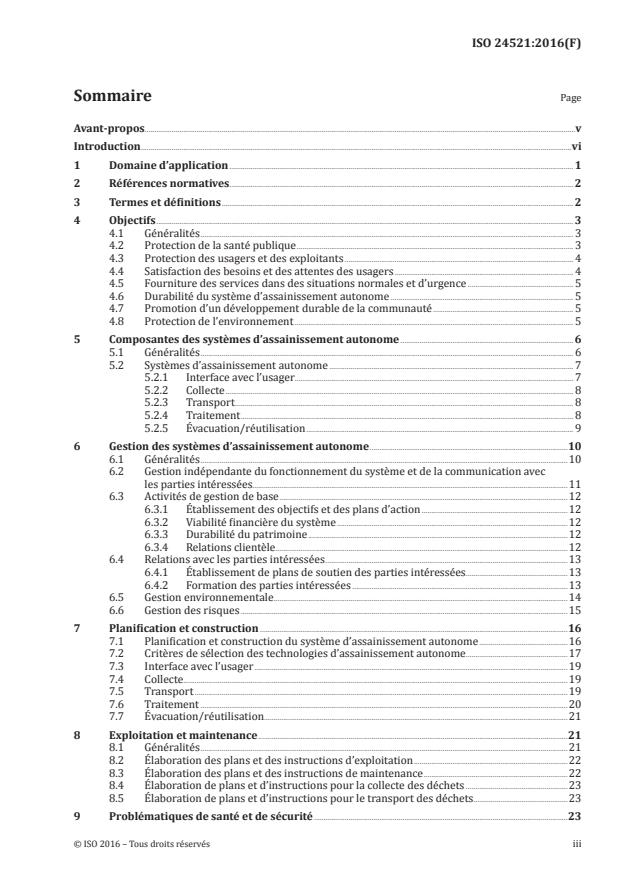
Contents Page
Foreword .v
Introduction .vi
1 Scope . 1
2 Normative references . 1
3 Terms and definitions . 2
4 Objectives . 2
4.1 General . 2
4.2 Protection of public health . 3
4.3 Protection of users and operators . 4
4.4 Meeting the needs and expectations of users . 4
4.5 Provisions of services under normal and emergency situations . 4
4.6 Sustainability of basic on-site domestic wastewater systems . 4
4.7 Promotion of sustainable development of the community . 5
4.8 Protection of the environment . 5
5 Components of basic on-site domestic wastewater systems . 6
5.1 General . 6
5.2 Basic on-site domestic wastewater systems . 6
5.2.1 User interface . . 6
5.2.2 Collection . 7
5.2.3 Transportation . 7
5.2.4 Treatment . 7
5.2.5 Disposal/reuse. 8
6 Management of basic on-site domestic wastewater systems . 9
6.1 General . 9
6.2 Independent management of system function and stakeholder communication .10
6.3 Basic management activities .11
6.3.1 Developing objectives and establishing action plans .11
6.3.2 Financial sustainability of the system .11
6.3.3 Sustainability of the assets .11
6.3.4 Customer relations .12
6.4 Stakeholder relations .12
6.4.1 Developing plans for support of stakeholders .12
6.4.2 Education and/or training of stakeholders .13
6.5 Environmental management .13
6.6 Risk management .14
7 Planning and construction .15
7.1 Planning and construction of basic on-site domestic wastewater systems .15
7.2 Criteria for selecting appropriate basic on-site domestic wastewater technologies .16
7.3 User interface .17
7.4 Collection .18
7.5 Transportation .18
7.6 Treatment .19
7.7 Disposal/reuse .19
8 Operation and maintenance .20
8.1 General .20
8.2 Developing operational plans and instructions.20
8.3 Developing maintenance plans and instructions .21
8.4 Developing plans and instructions for collection of waste .21
8.5 Developing plans and instructions for transportation of waste .21
9 Health and safety issues .21
9.1 Health and safety measures and training .21
9.2 Public health programmes .22
Annex A (informative) Corresponding terms in English, French and Spanish .23
Annex B (informative) Schematics of basic on-site domestic wastewater systems .24
Bibliography .55
iv © ISO 2016 – All rights reserved
Foreword
ISO (the International Organization for Standardization) is a worldwide federation of national standards
bodies (ISO member bodies). The work of preparing International Standards is normally carried out
through ISO technical committees. Each member body interested in a subject for which a technical
committee has been established has the right to be represented on that committee. International
organizations, governmental and non-governmental, in liaison with ISO, also take part in the work.
ISO collaborates closely with the International Electrotechnical Commission (IEC) on all matters of
electrotechnical standardization.
The procedures used to develop this document and those intended for its further maintenance are
described in the ISO/IEC Directives, Part 1. In particular the different approval criteria needed for the
different types of ISO documents should be noted. This document was drafted in accordance with the
editorial rules of the ISO/IEC Directives, Part 2 (see www.iso.org/directives).
Attention is drawn to the possibility that some of the elements of this document may be the subject of
patent rights. ISO shall not be held responsible for identifying any or all such patent rights. Details of
any patent rights identified during the development of the document will be in the Introduction and/or
on the ISO list of patent declarations received (see www.iso.org/patents).
Any trade name used in this document is information given for the convenience of users and does not
constitute an endorsement.
For an explanation on the meaning of ISO specific terms and expressions related to conformity assessment,
as well as information about ISO’s adherence to the World Trade Organization (WTO) principles in the
Technical Barriers to Trade (TBT) see the following URL: www.iso.org/iso/foreword.html.
The committee responsible for this document is Technical Committee ISO/TC 224, Service activities
relating to drinking water supply systems and wastewater systems — quality criteria of the service and
performance indicator.
Introduction
0.1 Water issues: global context and policies framework
st
Water constitutes a worldwide challenge for the 21 century, both in terms of the management of
available water resources and the provision of access to drinking water and sanitation for the world’s
population. In 2000, the United Nations recognized that access to water is an essential human right
and, in conjunction with national governments, it set ambitious goals (the “Millennium Development
Goals”) to increase access to drinking water and wastewater services, including safe disposal or
reuse of residues (jointly referred to as “water services” in this International Standard), particularly
in developing countries. International conferences on sustainable development and water (e.g. the
World Summit on Sustainable Development in Johannesburg in September 2002, the third World Water
Forum in Kyoto in March 2003 and the fourth World Water Forum in Mexico City in March 2006) have
highlighted this issue, and UN agencies (including WHO and UNESCO) have developed recommendations
and programmes to establish a framework in which to advance.
The United Nations Commission on Sustainable Development has emphasised that governments have
a primary role in promoting improved access to safe drinking water and basic sanitation through
improved governance at all levels and appropriate enabling environments and regulatory frameworks,
with the active involvement of all stakeholders.
NOTE Governments are referred to as “relevant authorities” in ISO 24510, ISO 24511 and ISO 24512).
If institutional solutions are incorporated into this process, the water sector becomes more productive
and the management of water resources becomes more sustainable. Declarations from the World Water
Forum have recommended that governments endeavour to reinforce the role of parliaments and local
public authorities, particularly with regard to the provision of adequate water services, and have
recognized that an effective collaboration with and between these actors is a key factor for meeting
water-related challenges and goals.
Examples of key issues for efficient drinking water and sanitation services policy frameworks are:
— clearly defining the roles of the different stakeholders;
— establishing how sanitary rules and organization are defined and assessed;
— establishing processes to ensure consistency between the policies regarding urban development
and water utility infrastructure;
— regulating water withdrawal and wastewater discharge;
— providing information to users and communities.
0.2 Water utilities: general objectives
In addition to public health protection, sound management of the drinking water and wastewater
utilities (jointly referred to as “water utilities” in this International Standard) is an essential element
of integrated water resources management. When applied to these utilities, sound management
practices will contribute, both quantitatively and qualitatively, to sustainable development. Sound
utility management also contributes to social cohesion and economic development of the communities
served, because the quality and efficiency of water services have implications for virtually all activities
of society.
As water is considered to be a social good and activities related to water services support the three
aspects (economic, social and environmental) of sustainable development, it is logical that the
management of water utilities be transparent to, and inclusive of, all stakeholders identified in
accordance with the local context.
vi © ISO 2016 – All rights reserved
There is a broad array of stakeholders that can play a role in activities related to water services.
Examples of such stakeholders include:
— governments or public agencies (international, national, regional or local);
— associations of the utilities themselves (e.g. international, regional/multinational and national
drinking water or wastewater associations);
— autonomous bodies seeking to play an overview role (e.g. organizations concerned, such as non-
governmental organizations);
— users and associations of water users.
The relationships between stakeholders and water utilities vary around the world. In many countries,
there are bodies that have responsibility (in whole or in part) for overseeing the activities related to
water services, whether the utilities are publicly or privately owned or operated, and whether they are
regulated by relevant authorities or acting in a system of technical self-regulation. Standardization and
technical self-regulation are possible ways of ensuring involvement of all stakeholders and meeting the
subsidiarity principle.
The aim of water utilities is to offer services to everybody in the area of responsibility of the utility,
to provide users with a continuous supply of drinking water and to collect and treat wastewater
under economic and social conditions that are acceptable to the users and to the utility. Water utilities
are expected to meet the requirements of relevant authorities and the expectations specified by
the responsible bodies in conjunction with the other stakeholders, while ensuring the long-term
sustainability of the service. In a context of scarcity of resources, including financial resources, it is
advisable that the investments made in installations be appropriate and that necessary attention be paid
to proper maintenance and effective use of the installations. It is advisable that water tariffs generally
aim at meeting cost-recovery principles and at promoting efficiency in the use of the resources, while
striving to maintain affordable basic access to water services.
It is advisable that the stakeholders be involved in both setting service objectives and assessing the
adequacy and efficiency of service.
0.3 Objectives, content and implementation of ISO standards addressing water services
The ISO standards addressing water services are ISO 24510 (service-oriented), ISO 24511 and
ISO 24512 (both management-oriented). The objective of these ISO standards is to provide the relevant
stakeholders with guidelines for assessing and improving the service to users and guidance for
managing water utilities, consistent with the overarching goals set by the relevant authorities.
ISO 24510 contains the following:
— a brief description of the components of the service relating to the users;
— core objectives for the service, with respect to the needs and expectations of users;
— guidelines for satisfying the needs and expectations of users;
— assessment criteria for service to users in accordance with the provided guidelines;
— examples of performance indicators linked to the assessment criteria that can be used for assessing
the performance of the service.
ISO 24511 and ISO 24512 contain the following:
— a brief description of the physical/infrastructural and managerial/institutional components of
water utilities;
— core objectives for water utilities, considered to be globally relevant at the broadest level;
— guidelines for the management of the water utilities;
— guidelines for the assessment of the water services with service assessment criteria related to the
objectives, and performance indicators linked to these criteria.
The performance indicators presented in ISO 24510, ISO 24511 and ISO 24512 are for illustrative
purposes only, because assessing the service to users cannot be reduced to a single or universal set of
performance indicators.
The quality of the supplied water (or discharged wastewater) can be adversely impacted between the
point-of-delivery (or, in the case of wastewater, the point-of-collection) and the point-of-use (or, in the
case of wastewater, the point-of-discharge) by the installations inside the premises. Some stakeholders
(e.g. relevant authorities, owners, contractors and users) can have a role to play regarding this issue.
Recognizing that the organization of water utilities differs from country to country, the guidelines
given in ISO 24510, ISO 24511 and ISO 24512 focus on the needs and expectations of users and on the
water services themselves, without imposing a means of meeting those needs and expectations, in
order to permit the broadest possible use of ISO 24510, ISO 24511 and ISO 24512 while respecting the
cultural, socio-economic, climatic, health and legislative characteristics of the different countries and
regions of the world. In the short term, it might not always be possible to meet the expectations of
local users, due to factors such as climate conditions, resource availability and difficulties relating to
the economic sustainability of the water services, particularly regarding financing and the capacity
of users to pay for improvements. These conditions can limit the achievement of some objectives or
restrict the implementation of some recommendations in developing countries. However, ISO 24510,
ISO 24511 and ISO 24512 are drafted with such constraints in mind and, for example, allow for differing
levels of fixed networks and the need for on-site alternatives. Notwithstanding the need for flexibility
in terms of engineering and hardware, many recommendations in ISO 24510, ISO 24511 and ISO 24512,
such as consultation mechanisms, are intended to apply universally.
In order to assess and improve the service to users and to ensure proper monitoring of the improvements,
an appropriate number of performance indicators (PIs) or other methods can be established for checking
conformity with requirements. Stakeholders can select PIs from the examples given in ISO 24510,
ISO 24511 and ISO 24512, or develop other relevant PIs taking into account the principles described.
The PIs logically relate to the objectives for which they are defined through the assessment criteria, and
are used to measure performance. They can also be used to set required or targeted values. ISO 24510,
ISO 24511 and ISO 24512 do not impose any specific indicator or any minimum value or performance
range; they respect the principle of adaptability to local contexts, facilitating local implementation.
ISO 24510, ISO 24511 and ISO 24512 can serve to assess progress towards water policy goals and the
objectives of financing programmes, by providing guidelines for the continual improvement and for the
assessment of the service.
ISO 24510, ISO 24511 and ISO 24512 are consistent with the principle of the “Plan-Do-Check-Act” (PDCA)
approach: they propose a step-by-step process, from identifying the components and defining the
objectives of the utility to establishing performance indicators, with a loop back to the objectives and
to the management, after having assessed the performances. ISO 24510, ISO 24511 and ISO 24512 are
consistent with management systems standards such as ISO 9001 and ISO 14001. Implementation of an
overall ISO 9001 and/or ISO 14001 management system can facilitate the implementation of the guidelines
contained within ISO 24510, ISO 24511 and ISO 24512; conversely, these guidelines can help to achieve the
technical provisions of ISO 9001 and ISO 14001 for organizations choosing to implement them.
0.4 Basic on-site domestic wastewater services
The absence of basic on-site sanitation services globally is a major inhibitor of achieving global societal
goals of improving public health and economic development. This situation prevails in both developed
and developing countries. Although often thought of as a rural problem, it is also a fact for many peri-
urban and urbanized areas. According to the United Nations (see Reference [5]), 2,1 billion people
gained access to improved sanitation facilities between 1990 and 2015. However, by 2015, 2,4 billion
people still lacked improved sanitation and 946 million people, accounting for 13 % of the world’s
population, practiced open defecation.
Poor sanitation facilities are often linked to contaminated water sources, which in turn are linked to
transmission of diseases such as cholera, diarrhoea, dysentery, hepatitis A and typhoid. In addition,
viii © ISO 2016 – All rights reserved
such conditions are often exacerbated by inadequate or absent health care facilities, which exposes
already vulnerable patients to additional risk of infection and disease. UNICEF estimates that diarrhoea
is the second largest killer of children under the age of five in the developing world and this is caused
largely by poor sanitation and inadequate hygiene.
The environmental and public health impacts of the lack of sanitation facilities depend on the density of
the population. In sparsely populated rural and remote areas, the lack of sanitation facilities might not
result in significant risk as urine and faecal deposits (also referred to as “open defecation”) might be
handled ecologically to a satisfactory level. However, as population density increases, a point is reached
where the failure of natural absorption or decomposition processes become both a public health and an
environmental risk. In such circumstances, basic on-site wastewater services can be installed. These
can be either on the scale of a single family unit or on a community scale, although the latter requires
collection systems of some type and can include transportation and disposal. Regardless of the type of
on-site domestic wastewater services in place, its scale or the level of technology installed, the services
and processes need to be managed to ensure effective operation within the socio-economic and cultural
conditions.
Management of on-site domestic wastewater services of all types and at all levels of technology requires
an understanding of the biological processes at work, the factors that can inhibit those processes and the
means of ensuring those processes are functioning. It also involves a general understanding by the wider
community served of the benefits of sanitation system use and management. In this way, the sanitation
facilities work efficiently and help sustain the community in which they are located. Management of
the services is often considered to be the responsibility of the relevant authority, whether it is local
or supported by larger scale water utilities. However, in many instances, the management of the basic
on-site domestic wastewater services is the responsibility of the user in collaboration with the local
authorities.
Many of these basic on-site sanitation systems are located near or adjacent to sanitation services,
under professional supervision and operation. In many cases, the basic on-site systems can be
supported by the nearby larger scale wastewater services, e.g. through the collection of wastewater or
partially treated sanitary effluents for further treatment/disposal in the larger facility. This symbiotic
relationship provides an opportunity for small scale sanitation facilities without needing to host all
the technology or experienced wastewater treatment systems and staff on-site. In other cases, the
management of the large scale facility can provide supervisory technical services to the neighbouring
basic system operators, to help train and ensure effective treatment levels.
This International Standard provides guidelines on the management of such basic on-site domestic
wastewater services with a focus on improving hygiene, taking into account social norms through
stakeholder communication, management of assets and better management of human waste and
wastewater.
INTERNATIONAL STANDARD ISO 24521:2016(E)
Activities relating to drinking water and wastewater
services — Guidelines for the management of basic on-site
domestic wastewater services
1 Scope
This International Standard provides guidance for the management of basic on-site domestic
wastewater services, using appropriate technologies in their entirety at any level of development.
This International Standard supplements and is intended to be used in conjunction with ISO 24511. It
includes the following:
— guidelines for the management of basic on-site domestic wastewater services from the operator’s
perspective, including maintenance techniques, training of personnel and risk considerations;
— guidelines for the management of basic on-site domestic wastewater services from the perspective
of users;
— guidance on the design and construction of basic on-site domestic wastewater systems;
— guidance on planning, operation and maintenance, and health and safety issues.
The following are outside the scope of this International Standard:
— limits of acceptability for wastewater discharged into a receiving body;
— analytical methods;
— the management structure of sanitary waste/wastewater service activities of operation and
management;
— the content of contracts or subcontracts.
This International Standard is applicable to both publicly and privately operated basic on-site domestic
wastewater (black and grey water) services, for one or more dwellings.
NOTE 1 Management of on-site domestic wastewater, especially in rural areas and areas under development,
is sometimes provided by the owners of the premises where wastewater is generated. In such cases, the owners
of the premises carry out the management of domestic wastewater by themselves. In this International Standard,
the term “services” includes “self-services” provided by the owners of the premises.
NOTE 2 Especially in undeveloped areas, domestic wastewater is collected in an undiluted form (i.e. sanitary
waste). Sources of sanitary waste/wastewater in this International Standard are residential, excluding storm
water runoff.
NOTE 3 Annex A contains a table of correspondence between equivalent terms in English, French and Spanish.
NOTE 4 Annex B gives some examples of schematics of basic on-site domestic wastewater systems and
components.
2 Normative references
The following documents, in whole or in part, are normatively referenced in this document and are
indispensable for its application. For dated references, only the edition cited applies. For undated
references, the latest edition of the referenced document (including any amendments) applies.
ISO 24510, Activities relating to drinking water and wastewater services — Guidelines for the assessment
and for the improvement of the service to users
ISO 24511, Activities relating to drinking water and wastewater services — Guidelines for the management
of wastewater utilities and for the assessment of wastewater services
3 Terms and definitions
For the purposes of this document, the terms and definitions given in ISO 24510 and ISO 24511 and the
following apply.
NOTE All terms and definitions from ISO publications are publicly available on the ISO Online Browsing
Platform (www.iso.org/obp).
3.1
basic
minimum equipment or process required to treat wastewater and meet discharge objectives
3.2
basic on-site domestic wastewater
water containing only human body waste and human liquid waste, which can contain grey water from
washing but does not contain commercial or industrial discharges
3.3
excreta
waste products of human metabolism, in solid or liquid form, generally urine and/or faeces
3.4
land treatment
treatment that can include simply spraying homogenized waste onto a land surface for bacterial
breakdown through the effects of sun and climate or subsurface discharge of partially treated
wastewater (after removal of suspended solids) and decomposition of dissolved organics in the soil
anaerobic environment
3.5
technology
specific infrastructure or method that is designed to collect, store, treat, use and/or transport
wastewater and/or residues
3.6
wetland
natural or constructed lined media filled bed, into which effluent is discharged and which contains
suitable flora and fauna that grow and feed on the nutrients in the effluent
Note 1 to entry: These are “natural” alternatives to a biological treatment process involving buildings, aeration
systems and sedimentation systems. However, these “natural” systems also require maintenance, i.e. periodic
removal of overgrown flora and fauna as well as collected sediment.
4 Objectives
4.1 General
Basic on-site domestic wastewater services are in many cases not provided by others; instead,
wastewater collection, transport and disposal is carried out by the owner of the premises where
wastewater is generated.
The four main objectives of basic on-site domestic wastewater services are:
— public health and safety;
2 © ISO 2016 – All rights reserved
— occupational health and safety;
— environmental protection;
— sustainable development.
Basic on-site domestic wastewater system solutions should adapt to local conditions, respond to actual
needs and be adaptable to a changing environment.
Besides constituting these main objectives, basic on-site sanitation solutions should consider the
following:
— effective disease barrier;
— prevention of environmental pollution;
— environmental requirements;
— optimization of the use of resources in terms of nutrients, water and energy;
— simplicity of construction, use, operation, maintenance and repair;
— adherence to hygienic safety standards;
— affordability and willingness to pay;
— existing institutional support;
— existing best practice, experience and infrastructure;
— development of ownership, involving landlords, users of all kinds, public water utilities and the
private sector in design and planning;
— cultural sensitivity, taking into account values, attitudes and the behaviour of the user.
4.2 Protection of public health
The requirements of ISO 24511 apply.
Safe and sanitary disposal of wastewater should be a public health priority. Wastewater should be
disposed of in a manner that ensures that:
— drinking water supplies are not threatened;
— direct human exposure is not possible;
— waste is inaccessible to vectors, insects, rodents or other possible carriers;
— odour or aesthetic nuisances are not created.
The following should be considered.
— Discharges of untreated or partially treated wastewater from basic on-site domestic wastewater
systems cause public health risks and negative environmental health effects.
— The presence of nitrates or bacteria in the drinking water well indicates that liquid from the system
may be flowing into the well through the ground or over the surface (water analyses available from
the local health department will indicate whether this is a problem).
— The reuse of reclaimed water (treated effluent) is encouraged; however, the relevant authority
should establish that the extent of treatment, the method of application and the reuse purpose for
reclaimed water does not create public health risks and adverse environmental impacts before
approval is granted. Reuse is only permitted for non-potable (not for human consumption) purposes.
For further guidance on possible actions, see ISO 24511:2007, Annexes C and D.
4.3 Protection of users and operators
All users and operators need protective equipment when handling wastewater. Appropriate training
should be available for users and operators.
Health protection of the owners of the premises or workers providing emptying services should also be
accounted for.
The health and safety precautions for users and operators should be documented and reviewed
periodically. The actual health and safety situation should be reviewed at prescribed intervals.
4.4 Meeting the needs and expectations of users
The requirements of ISO 24510 and ISO 24511 apply.
NOTE In many cases, a favoured technology is chosen and little attempt is made to include the views of users.
Users are most interested in seeing improvements to their living conditions, e.g. due to health issues, matters of
privacy and safety for family members.
The requirements of the users should be identified for the site (number of users, economic costs and
cultural acceptance) so that the implemented technologies meet the users’ needs and expectations.
Basic on-site domestic wastewater systems should be secure, comfortable, convenient and safe for all
kinds of users (children, adults, elderly and disabled persons).
Users’ expectations typically relate to:
— response to complaints;
— reporting of financial results;
— consultation on plans for changes;
— involvement in electing or appointing management positions;
— expectations that public health and the environment will be protected.
If there is potential for wastewater reuse, the needs and expectations of the potential end-users of the
treated wastewater and/or residues should be considered.
4.5 Provisions of services under normal and emergency situations
The requirements of ISO 24511 apply.
User interfaces intended for emergency situations should be portable/easy to assemble, as applicable.
The system (assets) should have written and visual instructions for operating and maintenance plans
for normal and emergency situations. Such plans should include advice for situations that could occur
because of the technology used or the site location.
See ISO 24511:2007, Annexes C and D, for additional guidance.
4.6 Sustainability of basic on-site domestic wastewater systems
The requirements of ISO 24511 apply.
Whenever possible, effluents should be used beneficially or disposed of in a safe and appropriate way.
The focus should be on the outputs of systems and their (potential) value.
4 © ISO 2016 – All rights reserved
It should be determined if there is a real or potential demand for reuse of sanitation system products;
such reuse systems need to be designed considering health and safety requirements.
When possible, nutrients recovered from faeces and urine should be recycled and used at household
level as fertilizer or soil improver. Safety and hygiene issues should be taken into consideration.
The system (assets) should be maintained and should provide the capacity to meet current and future
needs. Preventative maintenance of the facility and desludging should be identified and performed
periodically so that the assets meet the criterion for functional lifespan.
Revenue sources should be developed in order to ensure cost recovery of services and financial
sustainability.
See ISO 24511:2007, Annexes C and D, for additional guidance.
4.7 Promotion of sustainable development of the community
The requirements of ISO 24511 apply.
Specifically integrated water resources management and renewable energy and utilization of treated
wastewater residues should be taken into consideration.
Another advantage from basic on-site domestic wastewater systems is the reuse of treated wastewater
residues in agriculture for the provision of food, when applicable.
Possible actions are shown in ISO 24511:2007, Annexes C and D, for further guidance.
See ISO 16075-1, for further guidance.
4.8 Protection of the environment
The requirements of ISO 24511 apply.
Improper discharge of wastewater from the system into the natural environment can lead to high
levels of pollution. Aquatic organisms living in surface waters may be endangered when untreated
wastewater is discharged.
Many of the environmental impacts, e.g. salinization of soil and contamination of water resources, can
be minimized through systems that are environmentally friendly.
Only basic on-site domestic wastewater systems that do not have a negative effect on the environment
should be set up.
Competent authorities should ascertain the compatibility of the system for the environment. Where
necessary, pre-approval for basic on-site domestic wastewater disposal may be required before home
construction. The process may require site-evaluation by environmental health experts or other
competent authorities.
Management should ensure that failing basic on-site domestic wastewater systems do not have negative
environmental effects as a result of discharge of partially treated or untreated wastewater.
Designs should include safeguards to ensure that failing on-site domestic wastewater systems do not
cause accumulation of wastewater on the ground, its percolation into ground water or its flow into
waterways that are close to the failing system.
From the perspective of water environment conservation, existing basic on-site domestic wastewater
systems that are found to have negative effect on the environment should be replaced by systems that
meet local environmental requirements and are affordable.
For further guidance, see possible actions as shown in ISO 24511:2007, Annexes C and D.
5 Components of basic on-site domestic wastewater systems
5.1 General
Basic on-site domestic wastewater systems generally comprise:
— user interface;
— collection and transport of sanitary waste/wastewater and residues removed from wastewater;
— treatment of sanitary waste/wastewater and residues removed from wastewater;
— disposal/reuse of treated effluent;
— disposal/reuse of treated residues.
Table 1 outlines the chains of successive components of basic on-site domestic wastewater technologies.
[6]
NOTE Table 1 is adapted from pS-Eau , in which the component “user interface” is called “access”.
Table 1 — Chains of successive components of basic on-site domestic wastewater technologies
Component Definition Objective
User interface Technologies with which the user comes into To improve the sanitary conditions in peo-
contact and access the sanitation system. ple’s homes.
Collection Technologies which enable wastewater to be To improve the sanitary conditions in peo-
collected, temporarily stored and, if appro- ple’s homes.
priate, to be partially treated.
Transportation Technologies that transport wastewater away To ensure the health and hygiene of the
from the user’s home to temporary disposal, neighbourhood.
treatment or discharge sites.
Treatment Technologies used to treat wastewater and To reduce pollution and ensure the health
residues in order to reduce the pollution of the community.
load by means of physico-chemical and/or
biological processes.
Disposal/reuse Technologies or methods by which residues To allow a safe and adequate disposal of
are ultimately disposed of in the environment treated residues (disposal) or the utilization
or reused as useful resources. of treated residues (reuse).
In some simple systems (e.g. pit latrines), the treatment component is not present or, if present, can
include only a screening component, depending on the quantity and quality of the wastewater and the
disposal method.
Depending on the extent of the development of wastewater management in a particular country or area,
only one or a few of the components mentioned in Annex B may be used (e.g. only collection, disposal).
5.2 Basic on-site domestic wastewater systems
5.2.1 User in
...
INTERNATIONAL ISO
STANDARD 24521
First edition
2016-09-01
Activities relating to drinking water
and wastewater services — Guidelines
for the management of basic on-site
domestic wastewater services
Activités relatives aux services de l’eau potable et des eaux usées —
Lignes directrices pour la gestion sur site des services d’eaux usées
domestiques de base
Reference number
©
ISO 2016
© ISO 2016, Published in Switzerland
All rights reserved. Unless otherwise specified, no part of this publication may be reproduced or utilized otherwise in any form
or by any means, electronic or mechanical, including photocopying, or posting on the internet or an intranet, without prior
written permission. Permission can be requested from either ISO at the address below or ISO’s member body in the country of
the requester.
ISO copyright office
Ch. de Blandonnet 8 • CP 401
CH-1214 Vernier, Geneva, Switzerland
Tel. +41 22 749 01 11
Fax +41 22 749 09 47
copyright@iso.org
www.iso.org
ii © ISO 2016 – All rights reserved
Contents Page
Foreword .v
Introduction .vi
1 Scope . 1
2 Normative references . 1
3 Terms and definitions . 2
4 Objectives . 2
4.1 General . 2
4.2 Protection of public health . 3
4.3 Protection of users and operators . 4
4.4 Meeting the needs and expectations of users . 4
4.5 Provisions of services under normal and emergency situations . 4
4.6 Sustainability of basic on-site domestic wastewater systems . 4
4.7 Promotion of sustainable development of the community . 5
4.8 Protection of the environment . 5
5 Components of basic on-site domestic wastewater systems . 6
5.1 General . 6
5.2 Basic on-site domestic wastewater systems . 6
5.2.1 User interface . . 6
5.2.2 Collection . 7
5.2.3 Transportation . 7
5.2.4 Treatment . 7
5.2.5 Disposal/reuse. 8
6 Management of basic on-site domestic wastewater systems . 9
6.1 General . 9
6.2 Independent management of system function and stakeholder communication .10
6.3 Basic management activities .11
6.3.1 Developing objectives and establishing action plans .11
6.3.2 Financial sustainability of the system .11
6.3.3 Sustainability of the assets .11
6.3.4 Customer relations .12
6.4 Stakeholder relations .12
6.4.1 Developing plans for support of stakeholders .12
6.4.2 Education and/or training of stakeholders .13
6.5 Environmental management .13
6.6 Risk management .14
7 Planning and construction .15
7.1 Planning and construction of basic on-site domestic wastewater systems .15
7.2 Criteria for selecting appropriate basic on-site domestic wastewater technologies .16
7.3 User interface .17
7.4 Collection .18
7.5 Transportation .18
7.6 Treatment .19
7.7 Disposal/reuse .19
8 Operation and maintenance .20
8.1 General .20
8.2 Developing operational plans and instructions.20
8.3 Developing maintenance plans and instructions .21
8.4 Developing plans and instructions for collection of waste .21
8.5 Developing plans and instructions for transportation of waste .21
9 Health and safety issues .21
9.1 Health and safety measures and training .21
9.2 Public health programmes .22
Annex A (informative) Corresponding terms in English, French and Spanish .23
Annex B (informative) Schematics of basic on-site domestic wastewater systems .24
Bibliography .55
iv © ISO 2016 – All rights reserved
Foreword
ISO (the International Organization for Standardization) is a worldwide federation of national standards
bodies (ISO member bodies). The work of preparing International Standards is normally carried out
through ISO technical committees. Each member body interested in a subject for which a technical
committee has been established has the right to be represented on that committee. International
organizations, governmental and non-governmental, in liaison with ISO, also take part in the work.
ISO collaborates closely with the International Electrotechnical Commission (IEC) on all matters of
electrotechnical standardization.
The procedures used to develop this document and those intended for its further maintenance are
described in the ISO/IEC Directives, Part 1. In particular the different approval criteria needed for the
different types of ISO documents should be noted. This document was drafted in accordance with the
editorial rules of the ISO/IEC Directives, Part 2 (see www.iso.org/directives).
Attention is drawn to the possibility that some of the elements of this document may be the subject of
patent rights. ISO shall not be held responsible for identifying any or all such patent rights. Details of
any patent rights identified during the development of the document will be in the Introduction and/or
on the ISO list of patent declarations received (see www.iso.org/patents).
Any trade name used in this document is information given for the convenience of users and does not
constitute an endorsement.
For an explanation on the meaning of ISO specific terms and expressions related to conformity assessment,
as well as information about ISO’s adherence to the World Trade Organization (WTO) principles in the
Technical Barriers to Trade (TBT) see the following URL: www.iso.org/iso/foreword.html.
The committee responsible for this document is Technical Committee ISO/TC 224, Service activities
relating to drinking water supply systems and wastewater systems — quality criteria of the service and
performance indicator.
Introduction
0.1 Water issues: global context and policies framework
st
Water constitutes a worldwide challenge for the 21 century, both in terms of the management of
available water resources and the provision of access to drinking water and sanitation for the world’s
population. In 2000, the United Nations recognized that access to water is an essential human right
and, in conjunction with national governments, it set ambitious goals (the “Millennium Development
Goals”) to increase access to drinking water and wastewater services, including safe disposal or
reuse of residues (jointly referred to as “water services” in this International Standard), particularly
in developing countries. International conferences on sustainable development and water (e.g. the
World Summit on Sustainable Development in Johannesburg in September 2002, the third World Water
Forum in Kyoto in March 2003 and the fourth World Water Forum in Mexico City in March 2006) have
highlighted this issue, and UN agencies (including WHO and UNESCO) have developed recommendations
and programmes to establish a framework in which to advance.
The United Nations Commission on Sustainable Development has emphasised that governments have
a primary role in promoting improved access to safe drinking water and basic sanitation through
improved governance at all levels and appropriate enabling environments and regulatory frameworks,
with the active involvement of all stakeholders.
NOTE Governments are referred to as “relevant authorities” in ISO 24510, ISO 24511 and ISO 24512).
If institutional solutions are incorporated into this process, the water sector becomes more productive
and the management of water resources becomes more sustainable. Declarations from the World Water
Forum have recommended that governments endeavour to reinforce the role of parliaments and local
public authorities, particularly with regard to the provision of adequate water services, and have
recognized that an effective collaboration with and between these actors is a key factor for meeting
water-related challenges and goals.
Examples of key issues for efficient drinking water and sanitation services policy frameworks are:
— clearly defining the roles of the different stakeholders;
— establishing how sanitary rules and organization are defined and assessed;
— establishing processes to ensure consistency between the policies regarding urban development
and water utility infrastructure;
— regulating water withdrawal and wastewater discharge;
— providing information to users and communities.
0.2 Water utilities: general objectives
In addition to public health protection, sound management of the drinking water and wastewater
utilities (jointly referred to as “water utilities” in this International Standard) is an essential element
of integrated water resources management. When applied to these utilities, sound management
practices will contribute, both quantitatively and qualitatively, to sustainable development. Sound
utility management also contributes to social cohesion and economic development of the communities
served, because the quality and efficiency of water services have implications for virtually all activities
of society.
As water is considered to be a social good and activities related to water services support the three
aspects (economic, social and environmental) of sustainable development, it is logical that the
management of water utilities be transparent to, and inclusive of, all stakeholders identified in
accordance with the local context.
vi © ISO 2016 – All rights reserved
There is a broad array of stakeholders that can play a role in activities related to water services.
Examples of such stakeholders include:
— governments or public agencies (international, national, regional or local);
— associations of the utilities themselves (e.g. international, regional/multinational and national
drinking water or wastewater associations);
— autonomous bodies seeking to play an overview role (e.g. organizations concerned, such as non-
governmental organizations);
— users and associations of water users.
The relationships between stakeholders and water utilities vary around the world. In many countries,
there are bodies that have responsibility (in whole or in part) for overseeing the activities related to
water services, whether the utilities are publicly or privately owned or operated, and whether they are
regulated by relevant authorities or acting in a system of technical self-regulation. Standardization and
technical self-regulation are possible ways of ensuring involvement of all stakeholders and meeting the
subsidiarity principle.
The aim of water utilities is to offer services to everybody in the area of responsibility of the utility,
to provide users with a continuous supply of drinking water and to collect and treat wastewater
under economic and social conditions that are acceptable to the users and to the utility. Water utilities
are expected to meet the requirements of relevant authorities and the expectations specified by
the responsible bodies in conjunction with the other stakeholders, while ensuring the long-term
sustainability of the service. In a context of scarcity of resources, including financial resources, it is
advisable that the investments made in installations be appropriate and that necessary attention be paid
to proper maintenance and effective use of the installations. It is advisable that water tariffs generally
aim at meeting cost-recovery principles and at promoting efficiency in the use of the resources, while
striving to maintain affordable basic access to water services.
It is advisable that the stakeholders be involved in both setting service objectives and assessing the
adequacy and efficiency of service.
0.3 Objectives, content and implementation of ISO standards addressing water services
The ISO standards addressing water services are ISO 24510 (service-oriented), ISO 24511 and
ISO 24512 (both management-oriented). The objective of these ISO standards is to provide the relevant
stakeholders with guidelines for assessing and improving the service to users and guidance for
managing water utilities, consistent with the overarching goals set by the relevant authorities.
ISO 24510 contains the following:
— a brief description of the components of the service relating to the users;
— core objectives for the service, with respect to the needs and expectations of users;
— guidelines for satisfying the needs and expectations of users;
— assessment criteria for service to users in accordance with the provided guidelines;
— examples of performance indicators linked to the assessment criteria that can be used for assessing
the performance of the service.
ISO 24511 and ISO 24512 contain the following:
— a brief description of the physical/infrastructural and managerial/institutional components of
water utilities;
— core objectives for water utilities, considered to be globally relevant at the broadest level;
— guidelines for the management of the water utilities;
— guidelines for the assessment of the water services with service assessment criteria related to the
objectives, and performance indicators linked to these criteria.
The performance indicators presented in ISO 24510, ISO 24511 and ISO 24512 are for illustrative
purposes only, because assessing the service to users cannot be reduced to a single or universal set of
performance indicators.
The quality of the supplied water (or discharged wastewater) can be adversely impacted between the
point-of-delivery (or, in the case of wastewater, the point-of-collection) and the point-of-use (or, in the
case of wastewater, the point-of-discharge) by the installations inside the premises. Some stakeholders
(e.g. relevant authorities, owners, contractors and users) can have a role to play regarding this issue.
Recognizing that the organization of water utilities differs from country to country, the guidelines
given in ISO 24510, ISO 24511 and ISO 24512 focus on the needs and expectations of users and on the
water services themselves, without imposing a means of meeting those needs and expectations, in
order to permit the broadest possible use of ISO 24510, ISO 24511 and ISO 24512 while respecting the
cultural, socio-economic, climatic, health and legislative characteristics of the different countries and
regions of the world. In the short term, it might not always be possible to meet the expectations of
local users, due to factors such as climate conditions, resource availability and difficulties relating to
the economic sustainability of the water services, particularly regarding financing and the capacity
of users to pay for improvements. These conditions can limit the achievement of some objectives or
restrict the implementation of some recommendations in developing countries. However, ISO 24510,
ISO 24511 and ISO 24512 are drafted with such constraints in mind and, for example, allow for differing
levels of fixed networks and the need for on-site alternatives. Notwithstanding the need for flexibility
in terms of engineering and hardware, many recommendations in ISO 24510, ISO 24511 and ISO 24512,
such as consultation mechanisms, are intended to apply universally.
In order to assess and improve the service to users and to ensure proper monitoring of the improvements,
an appropriate number of performance indicators (PIs) or other methods can be established for checking
conformity with requirements. Stakeholders can select PIs from the examples given in ISO 24510,
ISO 24511 and ISO 24512, or develop other relevant PIs taking into account the principles described.
The PIs logically relate to the objectives for which they are defined through the assessment criteria, and
are used to measure performance. They can also be used to set required or targeted values. ISO 24510,
ISO 24511 and ISO 24512 do not impose any specific indicator or any minimum value or performance
range; they respect the principle of adaptability to local contexts, facilitating local implementation.
ISO 24510, ISO 24511 and ISO 24512 can serve to assess progress towards water policy goals and the
objectives of financing programmes, by providing guidelines for the continual improvement and for the
assessment of the service.
ISO 24510, ISO 24511 and ISO 24512 are consistent with the principle of the “Plan-Do-Check-Act” (PDCA)
approach: they propose a step-by-step process, from identifying the components and defining the
objectives of the utility to establishing performance indicators, with a loop back to the objectives and
to the management, after having assessed the performances. ISO 24510, ISO 24511 and ISO 24512 are
consistent with management systems standards such as ISO 9001 and ISO 14001. Implementation of an
overall ISO 9001 and/or ISO 14001 management system can facilitate the implementation of the guidelines
contained within ISO 24510, ISO 24511 and ISO 24512; conversely, these guidelines can help to achieve the
technical provisions of ISO 9001 and ISO 14001 for organizations choosing to implement them.
0.4 Basic on-site domestic wastewater services
The absence of basic on-site sanitation services globally is a major inhibitor of achieving global societal
goals of improving public health and economic development. This situation prevails in both developed
and developing countries. Although often thought of as a rural problem, it is also a fact for many peri-
urban and urbanized areas. According to the United Nations (see Reference [5]), 2,1 billion people
gained access to improved sanitation facilities between 1990 and 2015. However, by 2015, 2,4 billion
people still lacked improved sanitation and 946 million people, accounting for 13 % of the world’s
population, practiced open defecation.
Poor sanitation facilities are often linked to contaminated water sources, which in turn are linked to
transmission of diseases such as cholera, diarrhoea, dysentery, hepatitis A and typhoid. In addition,
viii © ISO 2016 – All rights reserved
such conditions are often exacerbated by inadequate or absent health care facilities, which exposes
already vulnerable patients to additional risk of infection and disease. UNICEF estimates that diarrhoea
is the second largest killer of children under the age of five in the developing world and this is caused
largely by poor sanitation and inadequate hygiene.
The environmental and public health impacts of the lack of sanitation facilities depend on the density of
the population. In sparsely populated rural and remote areas, the lack of sanitation facilities might not
result in significant risk as urine and faecal deposits (also referred to as “open defecation”) might be
handled ecologically to a satisfactory level. However, as population density increases, a point is reached
where the failure of natural absorption or decomposition processes become both a public health and an
environmental risk. In such circumstances, basic on-site wastewater services can be installed. These
can be either on the scale of a single family unit or on a community scale, although the latter requires
collection systems of some type and can include transportation and disposal. Regardless of the type of
on-site domestic wastewater services in place, its scale or the level of technology installed, the services
and processes need to be managed to ensure effective operation within the socio-economic and cultural
conditions.
Management of on-site domestic wastewater services of all types and at all levels of technology requires
an understanding of the biological processes at work, the factors that can inhibit those processes and the
means of ensuring those processes are functioning. It also involves a general understanding by the wider
community served of the benefits of sanitation system use and management. In this way, the sanitation
facilities work efficiently and help sustain the community in which they are located. Management of
the services is often considered to be the responsibility of the relevant authority, whether it is local
or supported by larger scale water utilities. However, in many instances, the management of the basic
on-site domestic wastewater services is the responsibility of the user in collaboration with the local
authorities.
Many of these basic on-site sanitation systems are located near or adjacent to sanitation services,
under professional supervision and operation. In many cases, the basic on-site systems can be
supported by the nearby larger scale wastewater services, e.g. through the collection of wastewater or
partially treated sanitary effluents for further treatment/disposal in the larger facility. This symbiotic
relationship provides an opportunity for small scale sanitation facilities without needing to host all
the technology or experienced wastewater treatment systems and staff on-site. In other cases, the
management of the large scale facility can provide supervisory technical services to the neighbouring
basic system operators, to help train and ensure effective treatment levels.
This International Standard provides guidelines on the management of such basic on-site domestic
wastewater services with a focus on improving hygiene, taking into account social norms through
stakeholder communication, management of assets and better management of human waste and
wastewater.
INTERNATIONAL STANDARD ISO 24521:2016(E)
Activities relating to drinking water and wastewater
services — Guidelines for the management of basic on-site
domestic wastewater services
1 Scope
This International Standard provides guidance for the management of basic on-site domestic
wastewater services, using appropriate technologies in their entirety at any level of development.
This International Standard supplements and is intended to be used in conjunction with ISO 24511. It
includes the following:
— guidelines for the management of basic on-site domestic wastewater services from the operator’s
perspective, including maintenance techniques, training of personnel and risk considerations;
— guidelines for the management of basic on-site domestic wastewater services from the perspective
of users;
— guidance on the design and construction of basic on-site domestic wastewater systems;
— guidance on planning, operation and maintenance, and health and safety issues.
The following are outside the scope of this International Standard:
— limits of acceptability for wastewater discharged into a receiving body;
— analytical methods;
— the management structure of sanitary waste/wastewater service activities of operation and
management;
— the content of contracts or subcontracts.
This International Standard is applicable to both publicly and privately operated basic on-site domestic
wastewater (black and grey water) services, for one or more dwellings.
NOTE 1 Management of on-site domestic wastewater, especially in rural areas and areas under development,
is sometimes provided by the owners of the premises where wastewater is generated. In such cases, the owners
of the premises carry out the management of domestic wastewater by themselves. In this International Standard,
the term “services” includes “self-services” provided by the owners of the premises.
NOTE 2 Especially in undeveloped areas, domestic wastewater is collected in an undiluted form (i.e. sanitary
waste). Sources of sanitary waste/wastewater in this International Standard are residential, excluding storm
water runoff.
NOTE 3 Annex A contains a table of correspondence between equivalent terms in English, French and Spanish.
NOTE 4 Annex B gives some examples of schematics of basic on-site domestic wastewater systems and
components.
2 Normative references
The following documents, in whole or in part, are normatively referenced in this document and are
indispensable for its application. For dated references, only the edition cited applies. For undated
references, the latest edition of the referenced document (including any amendments) applies.
ISO 24510, Activities relating to drinking water and wastewater services — Guidelines for the assessment
and for the improvement of the service to users
ISO 24511, Activities relating to drinking water and wastewater services — Guidelines for the management
of wastewater utilities and for the assessment of wastewater services
3 Terms and definitions
For the purposes of this document, the terms and definitions given in ISO 24510 and ISO 24511 and the
following apply.
NOTE All terms and definitions from ISO publications are publicly available on the ISO Online Browsing
Platform (www.iso.org/obp).
3.1
basic
minimum equipment or process required to treat wastewater and meet discharge objectives
3.2
basic on-site domestic wastewater
water containing only human body waste and human liquid waste, which can contain grey water from
washing but does not contain commercial or industrial discharges
3.3
excreta
waste products of human metabolism, in solid or liquid form, generally urine and/or faeces
3.4
land treatment
treatment that can include simply spraying homogenized waste onto a land surface for bacterial
breakdown through the effects of sun and climate or subsurface discharge of partially treated
wastewater (after removal of suspended solids) and decomposition of dissolved organics in the soil
anaerobic environment
3.5
technology
specific infrastructure or method that is designed to collect, store, treat, use and/or transport
wastewater and/or residues
3.6
wetland
natural or constructed lined media filled bed, into which effluent is discharged and which contains
suitable flora and fauna that grow and feed on the nutrients in the effluent
Note 1 to entry: These are “natural” alternatives to a biological treatment process involving buildings, aeration
systems and sedimentation systems. However, these “natural” systems also require maintenance, i.e. periodic
removal of overgrown flora and fauna as well as collected sediment.
4 Objectives
4.1 General
Basic on-site domestic wastewater services are in many cases not provided by others; instead,
wastewater collection, transport and disposal is carried out by the owner of the premises where
wastewater is generated.
The four main objectives of basic on-site domestic wastewater services are:
— public health and safety;
2 © ISO 2016 – All rights reserved
— occupational health and safety;
— environmental protection;
— sustainable development.
Basic on-site domestic wastewater system solutions should adapt to local conditions, respond to actual
needs and be adaptable to a changing environment.
Besides constituting these main objectives, basic on-site sanitation solutions should consider the
following:
— effective disease barrier;
— prevention of environmental pollution;
— environmental requirements;
— optimization of the use of resources in terms of nutrients, water and energy;
— simplicity of construction, use, operation, maintenance and repair;
— adherence to hygienic safety standards;
— affordability and willingness to pay;
— existing institutional support;
— existing best practice, experience and infrastructure;
— development of ownership, involving landlords, users of all kinds, public water utilities and the
private sector in design and planning;
— cultural sensitivity, taking into account values, attitudes and the behaviour of the user.
4.2 Protection of public health
The requirements of ISO 24511 apply.
Safe and sanitary disposal of wastewater should be a public health priority. Wastewater should be
disposed of in a manner that ensures that:
— drinking water supplies are not threatened;
— direct human exposure is not possible;
— waste is inaccessible to vectors, insects, rodents or other possible carriers;
— odour or aesthetic nuisances are not created.
The following should be considered.
— Discharges of untreated or partially treated wastewater from basic on-site domestic wastewater
systems cause public health risks and negative environmental health effects.
— The presence of nitrates or bacteria in the drinking water well indicates that liquid from the system
may be flowing into the well through the ground or over the surface (water analyses available from
the local health department will indicate whether this is a problem).
— The reuse of reclaimed water (treated effluent) is encouraged; however, the relevant authority
should establish that the extent of treatment, the method of application and the reuse purpose for
reclaimed water does not create public health risks and adverse environmental impacts before
approval is granted. Reuse is only permitted for non-potable (not for human consumption) purposes.
For further guidance on possible actions, see ISO 24511:2007, Annexes C and D.
4.3 Protection of users and operators
All users and operators need protective equipment when handling wastewater. Appropriate training
should be available for users and operators.
Health protection of the owners of the premises or workers providing emptying services should also be
accounted for.
The health and safety precautions for users and operators should be documented and reviewed
periodically. The actual health and safety situation should be reviewed at prescribed intervals.
4.4 Meeting the needs and expectations of users
The requirements of ISO 24510 and ISO 24511 apply.
NOTE In many cases, a favoured technology is chosen and little attempt is made to include the views of users.
Users are most interested in seeing improvements to their living conditions, e.g. due to health issues, matters of
privacy and safety for family members.
The requirements of the users should be identified for the site (number of users, economic costs and
cultural acceptance) so that the implemented technologies meet the users’ needs and expectations.
Basic on-site domestic wastewater systems should be secure, comfortable, convenient and safe for all
kinds of users (children, adults, elderly and disabled persons).
Users’ expectations typically relate to:
— response to complaints;
— reporting of financial results;
— consultation on plans for changes;
— involvement in electing or appointing management positions;
— expectations that public health and the environment will be protected.
If there is potential for wastewater reuse, the needs and expectations of the potential end-users of the
treated wastewater and/or residues should be considered.
4.5 Provisions of services under normal and emergency situations
The requirements of ISO 24511 apply.
User interfaces intended for emergency situations should be portable/easy to assemble, as applicable.
The system (assets) should have written and visual instructions for operating and maintenance plans
for normal and emergency situations. Such plans should include advice for situations that could occur
because of the technology used or the site location.
See ISO 24511:2007, Annexes C and D, for additional guidance.
4.6 Sustainability of basic on-site domestic wastewater systems
The requirements of ISO 24511 apply.
Whenever possible, effluents should be used beneficially or disposed of in a safe and appropriate way.
The focus should be on the outputs of systems and their (potential) value.
4 © ISO 2016 – All rights reserved
It should be determined if there is a real or potential demand for reuse of sanitation system products;
such reuse systems need to be designed considering health and safety requirements.
When possible, nutrients recovered from faeces and urine should be recycled and used at household
level as fertilizer or soil improver. Safety and hygiene issues should be taken into consideration.
The system (assets) should be maintained and should provide the capacity to meet current and future
needs. Preventative maintenance of the facility and desludging should be identified and performed
periodically so that the assets meet the criterion for functional lifespan.
Revenue sources should be developed in order to ensure cost recovery of services and financial
sustainability.
See ISO 24511:2007, Annexes C and D, for additional guidance.
4.7 Promotion of sustainable development of the community
The requirements of ISO 24511 apply.
Specifically integrated water resources management and renewable energy and utilization of treated
wastewater residues should be taken into consideration.
Another advantage from basic on-site domestic wastewater systems is the reuse of treated wastewater
residues in agriculture for the provision of food, when applicable.
Possible actions are shown in ISO 24511:2007, Annexes C and D, for further guidance.
See ISO 16075-1, for further guidance.
4.8 Protection of the environment
The requirements of ISO 24511 apply.
Improper discharge of wastewater from the system into the natural environment can lead to high
levels of pollution. Aquatic organisms living in surface waters may be endangered when untreated
wastewater is discharged.
Many of the environmental impacts, e.g. salinization of soil and contamination of water resources, can
be minimized through systems that are environmentally friendly.
Only basic on-site domestic wastewater systems that do not have a negative effect on the environment
should be set up.
Competent authorities should ascertain the compatibility of the system for the environment. Where
necessary, pre-approval for basic on-site domestic wastewater disposal may be required before home
construction. The process may require site-evaluation by environmental health experts or other
competent authorities.
Management should ensure that failing basic on-site domestic wastewater systems do not have negative
environmental effects as a result of discharge of partially treated or untreated wastewater.
Designs should include safeguards to ensure that failing on-site domestic wastewater systems do not
cause accumulation of wastewater on the ground, its percolation into ground water or its flow into
waterways that are close to the failing system.
From the perspective of water environment conservation, existing basic on-site domestic wastewater
systems that are found to have negative effect on the environment should be replaced by systems that
meet local environmental requirements and are affordable.
For further guidance, see possible actions as shown in ISO 24511:2007, Annexes C and D.
5 Components of basic on-site domestic wastewater systems
5.1 General
Basic on-site domestic wastewater systems generally comprise:
— user interface;
— collection and transport of sanitary waste/wastewater and residues removed from wastewater;
— treatment of sanitary waste/wastewater and residues removed from wastewater;
— disposal/reuse of treated effluent;
— disposal/reuse of treated residues.
Table 1 outlines the chains of successive components of basic on-site domestic wastewater technologies.
[6]
NOTE Table 1 is adapted from pS-Eau , in which the component “user interface” is called “access”.
Table 1 — Chains of successive components of basic on-site domestic wastewater technologies
Component Definition Objective
User interface Technologies with which the user comes into To improve the sanitary conditions in peo-
contact and access the sanitation system. ple’s homes.
Collection Technologies which enable wastewater to be To improve the sanitary conditions in peo-
collected, temporarily stored and, if appro- ple’s homes.
priate, to be partially treated.
Transportation Technologies that transport wastewater away To ensure the health and hygiene of the
from the user’s home to temporary disposal, neighbourhood.
treatment or discharge sites.
Treatment Technologies used to treat wastewater and To reduce pollution and ensure the health
residues in order to reduce the pollution of the community.
load by means of physico-chemical and/or
biological processes.
Disposal/reuse Technologies or methods by which residues To allow a safe and adequate disposal of
are ultimately disposed of in the environment treated residues (disposal) or the utilization
or reused as useful resources. of treated residues (reuse).
In some simple systems (e.g. pit latrines), the treatment component is not present or, if present, can
include only a screening component, depending on the quantity and quality of the wastewater and the
disposal method.
Depending on the extent of the development of wastewater management in a particular country or area,
only one or a few of the components mentioned in Annex B may be used (e.g. only collection, disposal).
5.2 Basic on-site domestic wastewater systems
5.2.1 User in
...
NORME ISO
INTERNATIONALE 24521
Première édition
2016-09-01
Activités relatives aux services de
l'eau potable et des eaux usées —
Lignes directrices pour la gestion
sur site des services d'eaux usées
domestiques de base
Activities relating to drinking water and wastewater services —
Guidelines for the management of basic on-site domestic wastewater
services
Numéro de référence
©
ISO 2016
DOCUMENT PROTÉGÉ PAR COPYRIGHT
© ISO 2016
Tous droits réservés. Sauf prescription différente ou nécessité dans le contexte de sa mise en œuvre, aucune partie de cette
publication ne peut être reproduite ni utilisée sous quelque forme que ce soit et par aucun procédé, électronique ou mécanique,
y compris la photocopie, ou la diffusion sur l’internet ou sur un intranet, sans autorisation écrite préalable. Une autorisation peut
être demandée à l’ISO à l’adresse ci-après ou au comité membre de l’ISO dans le pays du demandeur.
ISO copyright office
Case postale 401 • Ch. de Blandonnet 8
CH-1214 Vernier, Genève
Tél.: +41 22 749 01 11
Fax: +41 22 749 09 47
E-mail: copyright@iso.org
Web: www.iso.org
Publié en Suisse
ii © ISO 2016 – Tous droits réservés
Sommaire Page
Avant-propos .v
Introduction .vi
1 Domaine d’application . 1
2 Références normatives . 2
3 Termes et définitions . 2
4 Objectifs . 3
4.1 Généralités . 3
4.2 Protection de la santé publique . 3
4.3 Protection des usagers et des exploitants . 4
4.4 Satisfaction des besoins et des attentes des usagers . 4
4.5 Fourniture des services dans des situations normales et d’urgence . 5
4.6 Durabilité du système d’assainissement autonome . 5
4.7 Promotion d’un développement durable de la communauté . 5
4.8 Protection de l’environnement . 5
5 Composantes des systèmes d’assainissement autonome . 6
5.1 Généralités . 6
5.2 Systèmes d’assainissement autonome . 7
5.2.1 Interface avec l’usager . . . 7
5.2.2 Collecte . 8
5.2.3 Transport . 8
5.2.4 Traitement . 8
5.2.5 Évacuation/réutilisation . 9
6 Gestion des systèmes d’assainissement autonome .10
6.1 Généralités .10
6.2 Gestion indépendante du fonctionnement du système et de la communication avec
les parties intéressées.11
6.3 Activités de gestion de base .12
6.3.1 Établissement des objectifs et des plans d’action .12
6.3.2 Viabilité financière du système .12
6.3.3 Durabilité du patrimoine .12
6.3.4 Relations clientèle .12
6.4 Relations avec les parties intéressées .13
6.4.1 Établissement de plans de soutien des parties intéressées .13
6.4.2 Formation des parties intéressées .13
6.5 Gestion environnementale .14
6.6 Gestion des risques .15
7 Planification et construction .16
7.1 Planification et construction du système d’assainissement autonome .16
7.2 Critères de sélection des technologies d’assainissement autonome .17
7.3 Interface avec l’usager .19
7.4 Collecte.19
7.5 Transport .19
7.6 Traitement .20
7.7 Évacuation/réutilisation.21
8 Exploitation et maintenance .21
8.1 Généralités .21
8.2 Élaboration des plans et des instructions d’exploitation .22
8.3 Élaboration des plans et des instructions de maintenance .22
8.4 Élaboration de plans et d’instructions pour la collecte des déchets .23
8.5 Élaboration de plans et d’instructions pour le transport des déchets .23
9 Problématiques de santé et de sécurité .23
9.1 Mesures et formation relatives à la santé et à la sécurité .23
9.2 Programmes de santé publique .24
Annexe A (informative) Termes correspondants en anglais, français et espagnol .25
Annexe B (informative) Représentations schématiques des systèmes d’assainissement
autonome .26
Bibliographie .57
iv © ISO 2016 – Tous droits réservés
Avant-propos
L'ISO (Organisation internationale de normalisation) est une fédération mondiale d'organismes
nationaux de normalisation (comités membres de l'ISO). L'élaboration des Normes internationales est
en général confiée aux comités techniques de l'ISO. Chaque comité membre intéressé par une étude
a le droit de faire partie du comité technique créé à cet effet. Les organisations internationales,
gouvernementales et non gouvernementales, en liaison avec l'ISO participent également aux travaux.
L'ISO collabore étroitement avec la Commission électrotechnique internationale (IEC) en ce qui
concerne la normalisation électrotechnique.
Les procédures utilisées pour élaborer le présent document et celles destinées à sa mise à jour sont
décrites dans les Directives ISO/IEC, Partie 1. Il convient, en particulier de prendre note des différents
critères d’approbation requis pour les différents types de documents ISO. Le présent document a été
rédigé conformément aux règles de rédaction données dans les Directives ISO/IEC, Partie 2 (voir www
.iso .org/directives).
L’attention est appelée sur le fait que certains des éléments du présent document peuvent faire l’objet
de droits de propriété intellectuelle ou de droits analogues. L’ISO et l’IEC ne sauraient être tenues pour
responsables de ne pas avoir identifié de tels droits de propriété et averti de leur existence. Les détails
concernant les références aux droits de propriété intellectuelle ou autres droits analogues identifiés
lors de l’élaboration du document sont indiqués dans l’Introduction et/ou dans la liste des déclarations
de brevets reçues par l’ISO (voir www .iso .org/brevets).
Les appellations commerciales éventuellement mentionnées dans le présent document sont données
pour information, par souci de commodité, à l’intention des utilisateurs et ne sauraient constituer un
engagement.
Pour une explication de la signification des termes et expressions spécifiques de l’ISO liés à l’évaluation
de la conformité, ou pour toute information au sujet de l’adhésion de l’ISO aux principes de l’Organisation
mondiale du commerce (OMC) concernant les obstacles techniques au commerce (OTC), voir le lien
suivant : http: //www .iso .org/iso/fr/foreword .html.
Le comité chargé de l’élaboration du présent document est l’ISO/TC 224, Activités de service relatives aux
systèmes d’alimentation en eau potable et aux systèmes d’assainissement — Critères de qualité du service et
indicateurs de performance.
Introduction
0.1 Problématique de l’eau: contexte international et cadre des politiques
e
L’eau constitue un enjeu mondial pour le XXI siècle, à la fois pour la gestion des ressources en eau
disponibles et pour la fourniture d’un accès à l’eau potable et à l’assainissement à la population du globe.
En 2000, les Nations Unies ont reconnu l’accès à l’eau comme un droit de l’Homme essentiel et, en liaison
avec les gouvernements nationaux, ont fixé des objectifs ambitieux (« les objectifs du millénaire pour le
développement ») pour augmenter l’accès aux services de l’eau potable et de l’assainissement, incluant
l’évacuation ou la réutilisation en toute sécurité des résidus (conjointement désignés par « services
de l’eau » dans la présente Norme internationale), en particulier dans les pays en développement. Des
conférences internationales sur le développement durable et sur l’eau (par exemple le Sommet mondial
e
sur le développement durable à Johannesburg en septembre 2002, le 3 Forum mondial de l’eau à Kyoto
e
en mars 2003 et le 4 Forum mondial de l’eau à Mexico en mars 2006) ont mis l’accent sur ce sujet et les
agences des Nations Unies (par exemple, l’OMS et l’UNESCO) ont élaboré des recommandations et des
programmes pour préciser ce cadre général.
La Commission du développement durable des Nations Unies a insisté sur le rôle prépondérant que
jouent les gouvernements en promouvant l’amélioration de l’accès à une eau potable sans risque
sanitaire et à son assainissement autonome grâce à une meilleure gouvernance à tous les niveaux et à la
mise en place d’un cadre environnemental et réglementaire propice garantissant l’implication active de
toutes les parties intéressées.
NOTE Les gouvernements sont dénommés « autorités compétentes » dans l’ISO 24510, l’ISO 24511 et
l’ISO 24512).
Si des solutions institutionnelles sont intégrées dans ce processus, le secteur de l’eau devient alors plus
productif et la gestion des ressources en eau plus durable. Les déclarations du Forum mondial de l’eau
ont recommandé que les gouvernements s’attachent à renforcer le rôle des parlements et des autorités
publiques locales, particulièrement en ce qui concerne la fourniture de services de l’eau adéquats et
ont reconnu qu’une collaboration effective avec et entre ces acteurs est un facteur déterminant pour
relever les défis et réaliser les objectifs liés à l’eau.
Des exemples de points clés permettant de se doter d’un cadre d’action efficace en matière de services
de l’eau potable et de l’assainissement sont:
— la définition claire des responsabilités des différentes parties intéressées;
— l’établissement de la manière dont les règles sanitaires et l’organisation sont définies et évaluées;
— l’établissement des processus destinés à garantir la cohérence entre les politiques de développement
urbain et les infrastructures des services publics de l’eau;
— la réglementation des prélèvements de l’eau et de l’évacuation des eaux usées;
— la mise à disposition d’informations à l’intention des usagers et de la collectivité.
vi © ISO 2016 – Tous droits réservés
0.2 Services publics de l’eau: objectifs généraux
Outre qu’il garantit la protection de la santé publique, une bonne gestion des services publics de l’eau
potable et de l’assainissement (conjointement désignés par « services publics de l’eau » dans la présente
Norme internationale) est une composante essentielle de la gestion intégrée des ressources en eau.
Appliquées à ces services publics, des pratiques de gestion bien conçues contribuent, tant sur le plan de
la quantité que sur celui de la qualité, au développement durable. Une bonne gestion des services publics
contribue également à la cohésion sociale et au développement économique de la collectivité desservie,
dans la mesure où la qualité et l’efficience des services de l’eau ont des implications sur pratiquement
toutes les activités de la société.
L’eau étant considérée comme un « bien social » et les activités liées aux services de l’eau intégrant les
trois piliers du développement durable (l’économie, le social et l’environnement), il est normal que la
gestion des services publics de l’eau soit transparente et qu’elle associe toutes les parties intéressées
concernées, identifiées en fonction du contexte local.
Les catégories de parties intéressées pouvant jouer un rôle dans les activités liées aux services de l’eau
sont nombreuses. Les exemples de parties intéressées incluent:
— des gouvernements ou des agences publiques (internationales, nationales, régionales ou locales);
— des associations des services publics de l’eau eux-mêmes (par exemple, associations internationales,
régionales/multinationales et nationales de l’eau potable ou de l’assainissement);
— des organismes autonomes cherchant à jouer un rôle de surveillance (par exemple, organisations de
défense d’intérêts, telles que les organisations non gouvernementales);
— des usagers et des associations d’usagers de l’eau.
Les relations entre les parties intéressées et les services publics de l’eau varient selon les pays. Dans
de nombreux pays, des organismes sont responsables (totalement ou en partie) de la supervision des
activités des services de l’eau, que leur propriété et leur gestion soient publics ou privés et qu’ils fassent
l’objet d’une réglementation exercée par une autorité compétente ou fonctionnent dans le cadre d’un
système de règles techniques internes. La normalisation et les règles techniques internes constituent
des moyens possibles d’assurer l’implication de toutes les parties intéressées et de satisfaire au principe
de subsidiarité.
L’objectif général des services publics de l’eau est de fournir des services à tous les habitants de leur
zone de compétence et de garantir aux usagers une alimentation continue en eau potable ainsi que la
collecte et le traitement de leurs eaux usées dans des conditions économiques et sociales acceptables
tant pour les usagers que pour le service public lui-même. Les services publics de l’eau sont censés
répondre aux exigences des autorités compétentes et aux attentes spécifiées par les organismes
responsables en liaison avec les autres parties intéressées, tout en assurant la durabilité à long terme
du service. Dans un contexte de raréfaction des ressources, y compris des ressources financières, il y a
lieu que les investissements faits dans les installations soient appropriés et qu’une attention nécessaire
soit portée à la maintenance adéquate et à l’utilisation efficace des installations. D’une façon générale,
il est préférable que les tarifs de l’eau soient calculés selon les principes de recouvrement des coûts et
de promotion d’une utilisation efficace des ressources, tout en assurant un accès de base abordable aux
services de l’eau.
Il est préférable que les parties intéressées soient impliquées tant dans l’établissement des objectifs du
service que dans l’évaluation de son adéquation et de son efficience.
0.3 Objectif, contenu et mise en œuvre des normes ISO relatives aux services de l’eau
Les normes ISO relatives aux services de l’eau sont l’ISO 24510 (axée sur les services), l’ISO 24511 et
l’ISO 24512 (toutes deux axées sur la gestion). L’objectif visé dans ces normes ISO est de fournir aux
parties intéressées concernées des lignes directrices pour l’évaluation et l’amélioration des services
fournis aux usagers ainsi que des recommandations relatives à la gestion des services publics de l’eau,
en conformité avec les objectifs globaux fixés par les autorités compétentes.
L’ISO 24510 contient les éléments suivants:
— une brève description des composantes du service fourni aux usagers;
— les objectifs fondamentaux du service, compte tenu des besoins et des attentes des usagers;
— les lignes directrices pour satisfaire aux besoins et aux attentes des usagers;
— les critères d’évaluation du service aux usagers selon les lignes directrices fournies;
— des exemples d’indicateurs de performance liés aux critères d’évaluation susceptibles d’être utilisés
pour évaluer la performance du service.
L’ISO 24511 et l’ISO 24512 contiennent les éléments suivants:
— une brève description des composantes physiques/infrastructurelles et managériales/
institutionnelles des services publics de l’eau;
— les objectifs fondamentaux des services publics de l’eau, considérés comme globalement applicables
au niveau le plus large;
— les lignes directrices de la gestion des services publics de l’eau;
— les lignes directrices de l’évaluation des services de l’eau avec des critères d’évaluation du service
liés aux objectifs et des indicateurs de performance liés à ces critères.
Les indicateurs de performance présentés dans l’ISO 24510, l’ISO 24511 et l’ISO 24512 sont fournis
uniquement à titre d’exemple, du fait que l’évaluation du service aux usagers ne peut pas être réduite à
un indicateur unique ou à un ensemble universel d’indicateurs de performance.
Les installations situées à l’intérieur des bâtiments peuvent influer négativement sur la qualité de l’eau
fournie (ou des eaux usées évacuées) entre le point de livraison (point de collecte pour les eaux usées)
et le point de consommation (point de rejet pour les eaux usées). Certaines parties intéressées (telles
que les autorités compétentes, les propriétaires, les entrepreneurs et même les usagers) peuvent avoir
un rôle à jouer à cet égard.
Reconnaissant que l’organisation des services publics de l’eau diffère d’un pays à l’autre, les lignes
directrices données dans l’ISO 24510, l’ISO 24511 et l’ISO 24512 sont axées sur les besoins et les attentes
des usagers ainsi que sur les services de l’eau eux-mêmes, sans imposer de moyen de satisfaire ces besoins
et attentes afin de permettre l’utilisation la plus large possible de l’ISO 24510, l’ISO 24511 et l’ISO 24512
tout en respectant les caractéristiques culturelles, socio-économiques, climatiques, sanitaires et légales
des différents pays et régions du globe. À court terme, il peut ne pas toujours être possible de satisfaire
les attentes des usagers locaux en raison de facteurs tels que les conditions climatiques, la disponibilité
des ressources et les difficultés relatives à la viabilité économique des services de l’eau, notamment
en termes de financement et d’aptitude de l’usager à payer ces améliorations. Ces conditions peuvent
limiter l’atteinte de certains objectifs ou la mise en œuvre de certaines recommandations dans les pays
en développement. Cependant, l’ISO 24510, l’ISO 24511 et l’ISO 24512 sont élaborées en tenant compte
de ces contraintes et permettent ainsi de prévoir différents niveaux de réseaux fixes et la nécessité
d’alternatives autonomes. En dépit de la nécessité de flexibilité en termes d’ingénierie et de matériel, de
nombreuses recommandations dans l’ISO 24510, l’ISO 24511 et l’ISO 24512, telles que les mécanismes
de consultation, sont censées s’appliquer de façon universelle.
viii © ISO 2016 – Tous droits réservés
En vue d’évaluer et d’améliorer les services aux usagers ainsi que d’assurer un pilotage adéquat de
leur mise en œuvre, il est possible d’établir un nombre approprié d’indicateurs de performance (IP) ou
d’utiliser d’autres méthodes pour vérifier la conformité aux exigences. Les parties intéressées peuvent
sélectionner les IP parmi les exemples donnés dans l’ISO 24510, l’ISO 24511 et l’ISO 24512, ou élaborer
d’autres IP pertinents en prenant en compte les principes décrits. Les IP correspondent aux objectifs
pour lesquels ils sont définis en utilisant les critères d’évaluation et sont utilisés pour mesurer les
performances. Ils peuvent également être utilisés pour fixer des valeurs cibles ou exigées. L’ISO 24510,
l’ISO 24511 et l’ISO 24512 n’imposent aucun indicateur spécifique ni aucune valeur minimale ou plage
de performance; elles respectent le principe d’adaptabilité aux contextes locaux, permettant une mise
en œuvre locale. L’ISO 24510, l’ISO 24511 et l’ISO 24512 peuvent être utilisées pour évaluer les progrès
réalisés en vue d’atteindre les buts stratégiques et les objectifs des programmes de financement en
fournissant des lignes directrices pour l’amélioration continue et l’évaluation du service.
L’ISO 24510, l’ISO 24511 et l’ISO 24512 sont cohérentes avec le concept de « Plan (Planifier) – Do
(Mettre en œuvre) – Check (Contrôler) – Act (Agir) » (PDCA): elles proposent une procédure étape par
étape, depuis l’identification des composantes et la définition des objectifs du service public jusqu’à
l’établissement d’indicateurs de performance, avec une boucle réactive sur les objectifs et la gestion
après une évaluation des performances. L’ISO 24510, l’ISO 24511 et l’ISO 24512 sont cohérentes avec les
normes de systèmes de gestion, telles que l’ISO 9001 et l’ISO 14001. La mise en œuvre d’un système de
gestion global ISO 9001 et/ou ISO 14001 peut faciliter la mise en œuvre des lignes directrices contenues
dans l’ISO 24510, l’ISO 24511 et l’ISO 24512; inversement, ces lignes directrices peuvent aider les
organismes choisissant de les mettre en œuvre à satisfaire aux dispositions techniques de l’ISO 9001 et
de l’ISO 14001.
0.4 Services d’assainissement autonome
L’absence globale de services d’assainissement autonome est un frein majeur à la réalisation des
objectifs sociétaux mondiaux d’amélioration de la santé publique et du développement économique.
Cette situation prédomine aussi bien dans les pays développés que dans les pays en développement.
Bien que souvent considérée comme un problème rural, cette réalité se retrouve également dans de
nombreuses zones péri-urbaines et urbaines. Selon les Nations Unies (voir Référence [5]), 2,1 milliards
de personnes ont obtenu l’accès à des installations d’assainissement améliorées entre 1990 et 2015.
Cependant, en 2015, 2,4 milliards de personnes n’avaient toujours pas accès à un assainissement
amélioré et 946 millions de personnes, soit 13 % de la population mondiale, avaient recours à la
défécation en plein air.
La vétusté des installations d’assainissement est souvent associée à une contamination des sources
d’eau, laquelle donne souvent lieu en retour à la transmission de maladies telles que le choléra, la
diarrhée, la dysenterie, l’hépatite A et la typhoïde. En outre, ces conditions sont souvent aggravées par
l’insuffisance, voire l’absence d’établissements de soins de santé appropriés, qui expose déjà les patients
vulnérables à des risques supplémentaires d’infection et de maladie. L’UNICEF estime que la diarrhée
est la deuxième cause de mortalité infantile chez les enfants de moins de cinq ans dans les pays en voie
de développement, en grande partie du fait d’un assainissement insuffisant et du manque d’hygiène.
Les conséquences du manque d’installations d’assainissement sur l’environnement et la santé publique
dépendent de la densité de la population. Dans les zones rurales et les régions isolées faiblement
peuplées, le manque d’installations d’assainissement peut ne pas présenter de risque conséquent, car
l’urine et les dépôts de matières fécales (également désignés par le terme « défécation en plein air »)
peuvent être traités de manière écologique à un niveau satisfaisant. Cependant, à mesure que la
densité de population augmente, on arrive à un seuil au-delà duquel les processus d’absorption ou de
décomposition naturelles ne fonctionnent plus, présentant à la fois un risque pour l’environnement et la
santé publique. Dans ces circonstances, des services d’assainissement autonome peuvent être installés.
Ceux-ci peuvent être soit à l’échelle d’une seule unité familiale, soit à l’échelle d’une communauté, bien
que cette dernière échelle exige certains types spécifiques de systèmes de collecte et puisse inclure le
transport et l’évacuation. Indépendamment du type de service d’assainissement autonome déployé, de
son échelle ou du niveau de technologie installé, il est nécessaire de gérer les services et les processus
afin d’assurer un fonctionnement efficace dans les conditions socio-économiques et culturelles.
La gestion des services d’assainissement autonome de tous types et à tous les niveaux de technologie
exige une compréhension des processus biologiques à l’œuvre, des facteurs susceptibles d’enrayer
ces processus et des moyens de garantir leur bon fonctionnement. Elle implique également une
compréhension générale par la communauté concernée au sens large des avantages de l’utilisation
et de la gestion d’un système d’assainissement. De cette manière, les installations d’assainissement
fonctionnent efficacement et contribuent à alimenter la communauté dans laquelle elles se situent.
La gestion des services est souvent considérée comme relevant de la responsabilité de l’autorité
compétente, qu’elle soit réalisée localement ou prise en charge par des services publics de l’eau à plus
grande échelle. Cependant, dans de nombreux cas, la gestion des services d’assainissement autonome
relève de la responsabilité de l’usager en collaboration avec les autorités locales.
Un grand nombre de ces systèmes d’assainissement autonome se situent à proximité ou à côté de
services d’assainissement, contrôlés et exploités par des professionnels. Dans de nombreux cas, les
systèmes autonomes peuvent être pris en charge par les services d’assainissement environnants à plus
grande échelle, par exemple par la collecte des eaux usées ou des effluents sanitaires partiellement
traités pour traitement ultérieur/évacuation dans l’installation plus grande. Cette relation symbiotique
offre une opportunité de mettre en place des installations d’assainissement à petite échelle sans avoir
besoin d’héberger toute la technologie ou les systèmes de traitement des eaux usées et le personnel
expérimenté sur le site. Dans d’autres cas, la gestion de l’installation à grande échelle peut fournir des
services techniques de surveillance aux exploitants des systèmes autonomes environnants, afin de les
aider à se former et à assurer des niveaux de traitement efficaces.
La présente Norme internationale fournit des lignes directrices concernant la gestion de ces services
d’assainissement autonome en se concentrant sur l’amélioration de l’hygiène tout en tenant compte
des normes sociales par la communication avec les parties intéressées, la gestion du patrimoine et une
meilleure gestion des déchets humains et des eaux usées.
x © ISO 2016 – Tous droits réservés
NORME INTERNATIONALE ISO 24521:2016(F)
Activités relatives aux services de l'eau potable et des eaux
usées — Lignes directrices pour la gestion sur site des
services d'eaux usées domestiques de base
1 Domaine d’application
La présente Norme internationale donne des recommandations relatives à la gestion des services
d’assainissement autonome, en utilisant les technologies appropriées dans leur intégralité à tous les
niveaux de développement.
La présente Norme internationale complète et est destinée à être utilisée conjointement avec
l’ISO 24511. Elle comprend les éléments suivants:
— des lignes directrices pour la gestion des services d’assainissement autonome du point de vue de
l’exploitant, incluant les techniques de maintenance, la formation du personnel et la prise en compte
des risques;
— des lignes directrices pour la gestion des services d’assainissement autonome du point de vue des
usagers;
— des recommandations relatives à la conception et à la construction des systèmes d’assainissement
autonome;
— des recommandations relatives à la planification, à l’exploitation et à la maintenance ainsi qu’aux
problématiques de santé et de sécurité.
Les sujets suivants ne relèvent pas du domaine d’application de la présente Norme internationale:
— les limites d’acceptabilité pour les eaux usées rejetées dans un milieu récepteur;
— les méthodes d’analyse;
— la structure de management des activités d’exploitation et de management des services de collecte
de matières fécales/d’assainissement;
— le contenu des contrats et contrats de sous-traitance.
La présente Norme internationale s’applique aux services d’assainissement autonome (eaux noires et
eaux grises) exploités aussi bien par le secteur public que privé pour une ou plusieurs habitations.
NOTE 1 La gestion des services d’assainissement autonome, notamment dans les zones rurales et les zones
en développement, est parfois assurée par les propriétaires des locaux où les eaux usées sont générées. Dans
pareils cas, les propriétaires des locaux se chargent eux-mêmes de la gestion des eaux usées domestiques. Dans
la présente Norme internationale, le terme « services » comprend les « services personnels » fournis par les
propriétaires des locaux.
NOTE 2 Notamment dans les zones sous-développées, les eaux usées domestiques sont collectées sous forme
non diluée (à savoir, sous forme de matières fécales). Les sources de matières fécales/eaux usées citées dans la
présente Norme internationale sont résidentielles, à l’exception des écoulements d’eaux pluviales.
NOTE 3 L’Annexe A contient un tableau de correspondance entre des équivalences de termes en anglais,
français et espagnol.
NOTE 4 L’Annexe B donne quelques exemples de schémas de systèmes d’assainissement autonome et de leurs
composantes.
2 Références normatives
Les documents ci-après, dans leur intégralité ou non, sont des références normatives indispensables à
l’application du présent document. Pour les références datées, seule l’édition citée s’applique. Pour les
références non datées, la dernière édition du document de référence s’applique (y compris les éventuels
amendements).
ISO 24510, Activités relatives aux services de l'eau potable et de l'assainissement — Lignes directrices pour
l'évaluation et l'amélioration du service aux usagers
ISO 24511, Activités relatives aux services de l'eau potable et de l'assainissement — Lignes directrices pour
le management des services publics de l'assainissement et pour l'évaluation des services fournis
3 Termes et définitions
Pour les besoins du présent document, les termes et définitions de l’ISO 24510 et l’ISO 24511 ainsi que
les suivants, s’appliquent.
NOTE Tous les termes et définitions issus des publications ISO sont accessibles au public sur la Plateforme de
consultation en ligne de l’ISO (www .iso .org/obp).
3.1
de base
équipement ou processus requis au minimum pour traiter les eaux usées et atteindre les objectifs de rejet
3.2
eaux usées domestiques traitées sur site
eaux contenant uniquement des déchets humains corporels ou liquides, pouvant contenir des eaux
grises provenant des eaux de rinçage, mais ne contenant pas de rejets commerciaux ou industriels
3.3
excréments
déchets produits par le métabolisme humain, sous forme solide ou liquide, généralement de l’urine et/
ou des fèces
3.4
traitement par épandage
traitement pouvant simplement comprendre la pulvérisation de déchets homogénéisés sur une surface
de terrain pour la décomposition bactérienne sous l’effet du soleil et du climat ou le rejet souterrain
d’eaux usées partiellement traitées (après élimination des matières en suspension) et la décomposition
des matières organiques dissoutes dans le milieu anaérobie du sol
3.5
technologie
infrastructure ou méthode spécifique conçue pour collecter, stocker, traiter, utiliser et/ou transporter
les eaux usées et/ou les résidus
3.6
zone humide
lit rempli d’un milieu naturel ou artificiel revêtu, dans lequel l’effluent est rejeté et qui contient une
flore et une faune appropriées qui se développent et s’alimentent des éléments nutritifs de l’effluent
Note 1 à l'article: Il s’agit d’alternatives « naturelles » à un processus de traitement biologique qui implique des
bâtiments, des systèmes d’aération et des systèmes de sédimentation. Cependant, ces systèmes « naturels »
exigent également un entretien régulier, à savoir l’élimination périodique de la flore et de la faune envahissantes
ainsi que des sédiments collectés.
2 © ISO 2016 – Tous droits réservés
4 Objectifs
4.1 Généralités
Dans de nombreux cas, les services d’assainissement autonome ne sont pas fournis par des tiers; en
lieu et place, la collecte, le transport et l’évacuation des eaux usées sont assurés par le propriétaire des
locaux où les eaux usées sont générées.
Les quatre principaux objectifs des services d’assainissement autonome sont:
— la santé et la sécurité du public;
— la santé et la sécurité au travail;
— la protection de l’environnement;
— le développement durable.
Il convient que les solutions de systèmes d’assainissement autonome s’adaptent aux conditions locales,
répondent aux besoins actuels et soient flexibles pour se conformer à un environnement en constante
évolution.
En plus de refléter ces objectifs principaux, il convient que les solutions d’assainissement autonome
tiennent compte des éléments suivants:
— barrière efficace contre la maladie;
— prévention de la pollution environnementale;
— exigences environnementales;
— optimisation de l’utilisation des ressources en termes d’éléments nutritifs, d’eau et d’énergie;
— simplicité de construction, d’utilisation, d’exploitation, de maintenance et de réparation;
— respect des normes de sécurité en matière d’hygiène;
— accessibilité économique et consentement à payer;
— aide institutionnelle existante;
— bonnes pratiques, expérience et infrastructures existantes;
— expansion de propriété, en impliquant les propriétaires, les usagers de tout type, les services publics
de l’eau et le secteur privé dans la conception et la planification;
— sensibilité culturelle, en tenant compte des valeurs, opinions et du comportement des usagers.
4.2 Protection de la santé publique
Les exigences de l’ISO 24511 s’appliquent.
Il convient que l’évacuation sûre et sanitaire des eaux usées constitue une priorité de santé publique. Il
convient que les eaux usées soient évacuées d’une manière garantissant que:
— l’alimentation en eau potable n’est pas menacée;
— aucune exposition humaine directe n’est possible;
— les déchets ne sont pas accessibles aux vecteurs, insectes, rongeurs ou autres porteurs potentiels;
— aucune odeur ou nuisance esthétique n’est générée.
Il convient de tenir compte des éléments suivants:
— les rejets d’eaux usées non traitées ou partiellement traitées provenant de systèmes d’assainissement
autonome de base des eaux usées domestiques présentent des risques pour la santé publique et ont
un impact sanitaire environnemental négatif;
— la présence de nitrates ou de bactéries dans les puits d’eau potable indique que des liquides du
système peuvent s’écouler dans le puits par le sol ou à la surface (les analyses d’eau disponibles
auprès du service de santé local indiqueront si cela constitue un problème);
— la réutilisation de l’eau recyclée (effluent traité) est encouragée; cependant, il convient que l’autorité
compétente établisse que l’étendue du traitement, la méthode d’épandage et la finalité de réutilisation
de l’eau recyclée ne constituent aucun risque pour la santé publique et n’entraînent aucun impact
environnemental négatif avant que l’autorisation soit accordée. La réutilisation est uniquement
autorisée pour des applications d’eau non potable (non pour la consommation humaine).
Pour d’autres recommandations relatives aux actions possibles, voir ISO 24511:2007, Annexes C et D.
4.3 Protection des usagers et des exploitants
Il est nécessaire que tous les usagers et exploitants disposent d’équipements de protection lorsqu’ils
manipulent des eaux usées. Il convient qu’une formation appropriée soit dispensée aux usagers et aux
exploitants.
Il convient également de considérer la protection de la santé des propriétaires de locaux ou des
travailleurs fournissant des services de vidange.
Il convient de documenter et de réviser régulièrement les précautions de santé et de sécurité pour les
usagers et exploitants. Il convient de réexaminer la situation actuelle en matière de santé et de sécurité
à des intervalles définis.
4.4 Satisfaction des besoins et des attentes des usagers
Les exigences de l’ISO 24510 et de l’ISO 24511 s’appliquent.
NOTE Dans de nombreux cas, une technologie privilégiée est sélectionnée et peu d’efforts sont déployés
pour tenir compte du point de vue des usagers. Les usagers sont surtout intéressés par des améliorations de
leurs conditions de vie, par exemple pour des raisons de santé, de respect de la vie privée et de sécurité pour les
membres de la famille.
Il convient d’identifier les exigences des usagers pour le site (nombre d’usagers, coûts économiques et
acceptation culturelle) pour que les technologies mises en place répondent à leurs besoins et à leurs
attentes.
Il convient que les systèmes d’assainissement autonome de base des eaux usées domestiques soient
fiables, fonctionnels, accessibles et sûrs pour tous les types d’usagers (enfants, adultes, personnes âgées
et personnes handicapées).
Les attentes des usagers sont généralement liées à:
— une réponse à des plaintes;
— la communication de résultats financiers;
— la consultation de plans de modifications;
— la participation à des postes d’encadrement d’élection ou de nomination;
— des attentes concernant la protection de la santé publique et de l’environnement.
S’il existe une possibilité de réutilisation des eaux usées, il convient de tenir compte des besoins et des
attentes des usagers finaux potentiels des eaux usées et/ou des résidus traités.
4 © ISO 2016 – Tous droits réservés
4.5 Fourniture des services dans des situations normales et d’urgence
Les exigences de l’ISO 24511 s’appliquent.
Il convient que les interfaces avec les usagers destinées aux situations d’urgence soient portatives/
faciles à assembler, selon le cas.
Il convient que le système (patrimoine) dispose d’instructions écrites et visuelles des plans opérationnels
et de maintenance pour les situations normales et d’urgence. Il convient que ces plans comprennent des
conseils concernant les situations susceptibles de se produire en
...
NORME ISO
INTERNATIONALE 24521
Première édition
2016-09-01
Activités relatives aux services de
l'eau potable et des eaux usées —
Lignes directrices pour la gestion
sur site des services d'eaux usées
domestiques de base
Activities relating to drinking water and wastewater services —
Guidelines for the management of basic on-site domestic wastewater
services
Numéro de référence
©
ISO 2016
DOCUMENT PROTÉGÉ PAR COPYRIGHT
© ISO 2016
Tous droits réservés. Sauf prescription différente ou nécessité dans le contexte de sa mise en œuvre, aucune partie de cette
publication ne peut être reproduite ni utilisée sous quelque forme que ce soit et par aucun procédé, électronique ou mécanique,
y compris la photocopie, ou la diffusion sur l’internet ou sur un intranet, sans autorisation écrite préalable. Une autorisation peut
être demandée à l’ISO à l’adresse ci-après ou au comité membre de l’ISO dans le pays du demandeur.
ISO copyright office
Case postale 401 • Ch. de Blandonnet 8
CH-1214 Vernier, Genève
Tél.: +41 22 749 01 11
Fax: +41 22 749 09 47
E-mail: copyright@iso.org
Web: www.iso.org
Publié en Suisse
ii © ISO 2016 – Tous droits réservés
Sommaire Page
Avant-propos .v
Introduction .vi
1 Domaine d’application . 1
2 Références normatives . 2
3 Termes et définitions . 2
4 Objectifs . 3
4.1 Généralités . 3
4.2 Protection de la santé publique . 3
4.3 Protection des usagers et des exploitants . 4
4.4 Satisfaction des besoins et des attentes des usagers . 4
4.5 Fourniture des services dans des situations normales et d’urgence . 5
4.6 Durabilité du système d’assainissement autonome . 5
4.7 Promotion d’un développement durable de la communauté . 5
4.8 Protection de l’environnement . 5
5 Composantes des systèmes d’assainissement autonome . 6
5.1 Généralités . 6
5.2 Systèmes d’assainissement autonome . 7
5.2.1 Interface avec l’usager . . . 7
5.2.2 Collecte . 8
5.2.3 Transport . 8
5.2.4 Traitement . 8
5.2.5 Évacuation/réutilisation . 9
6 Gestion des systèmes d’assainissement autonome .10
6.1 Généralités .10
6.2 Gestion indépendante du fonctionnement du système et de la communication avec
les parties intéressées.11
6.3 Activités de gestion de base .12
6.3.1 Établissement des objectifs et des plans d’action .12
6.3.2 Viabilité financière du système .12
6.3.3 Durabilité du patrimoine .12
6.3.4 Relations clientèle .12
6.4 Relations avec les parties intéressées .13
6.4.1 Établissement de plans de soutien des parties intéressées .13
6.4.2 Formation des parties intéressées .13
6.5 Gestion environnementale .14
6.6 Gestion des risques .15
7 Planification et construction .16
7.1 Planification et construction du système d’assainissement autonome .16
7.2 Critères de sélection des technologies d’assainissement autonome .17
7.3 Interface avec l’usager .19
7.4 Collecte.19
7.5 Transport .19
7.6 Traitement .20
7.7 Évacuation/réutilisation.21
8 Exploitation et maintenance .21
8.1 Généralités .21
8.2 Élaboration des plans et des instructions d’exploitation .22
8.3 Élaboration des plans et des instructions de maintenance .22
8.4 Élaboration de plans et d’instructions pour la collecte des déchets .23
8.5 Élaboration de plans et d’instructions pour le transport des déchets .23
9 Problématiques de santé et de sécurité .23
9.1 Mesures et formation relatives à la santé et à la sécurité .23
9.2 Programmes de santé publique .24
Annexe A (informative) Termes correspondants en anglais, français et espagnol .25
Annexe B (informative) Représentations schématiques des systèmes d’assainissement
autonome .26
Bibliographie .57
iv © ISO 2016 – Tous droits réservés
Avant-propos
L'ISO (Organisation internationale de normalisation) est une fédération mondiale d'organismes
nationaux de normalisation (comités membres de l'ISO). L'élaboration des Normes internationales est
en général confiée aux comités techniques de l'ISO. Chaque comité membre intéressé par une étude
a le droit de faire partie du comité technique créé à cet effet. Les organisations internationales,
gouvernementales et non gouvernementales, en liaison avec l'ISO participent également aux travaux.
L'ISO collabore étroitement avec la Commission électrotechnique internationale (IEC) en ce qui
concerne la normalisation électrotechnique.
Les procédures utilisées pour élaborer le présent document et celles destinées à sa mise à jour sont
décrites dans les Directives ISO/IEC, Partie 1. Il convient, en particulier de prendre note des différents
critères d’approbation requis pour les différents types de documents ISO. Le présent document a été
rédigé conformément aux règles de rédaction données dans les Directives ISO/IEC, Partie 2 (voir www
.iso .org/directives).
L’attention est appelée sur le fait que certains des éléments du présent document peuvent faire l’objet
de droits de propriété intellectuelle ou de droits analogues. L’ISO et l’IEC ne sauraient être tenues pour
responsables de ne pas avoir identifié de tels droits de propriété et averti de leur existence. Les détails
concernant les références aux droits de propriété intellectuelle ou autres droits analogues identifiés
lors de l’élaboration du document sont indiqués dans l’Introduction et/ou dans la liste des déclarations
de brevets reçues par l’ISO (voir www .iso .org/brevets).
Les appellations commerciales éventuellement mentionnées dans le présent document sont données
pour information, par souci de commodité, à l’intention des utilisateurs et ne sauraient constituer un
engagement.
Pour une explication de la signification des termes et expressions spécifiques de l’ISO liés à l’évaluation
de la conformité, ou pour toute information au sujet de l’adhésion de l’ISO aux principes de l’Organisation
mondiale du commerce (OMC) concernant les obstacles techniques au commerce (OTC), voir le lien
suivant : http: //www .iso .org/iso/fr/foreword .html.
Le comité chargé de l’élaboration du présent document est l’ISO/TC 224, Activités de service relatives aux
systèmes d’alimentation en eau potable et aux systèmes d’assainissement — Critères de qualité du service et
indicateurs de performance.
Introduction
0.1 Problématique de l’eau: contexte international et cadre des politiques
e
L’eau constitue un enjeu mondial pour le XXI siècle, à la fois pour la gestion des ressources en eau
disponibles et pour la fourniture d’un accès à l’eau potable et à l’assainissement à la population du globe.
En 2000, les Nations Unies ont reconnu l’accès à l’eau comme un droit de l’Homme essentiel et, en liaison
avec les gouvernements nationaux, ont fixé des objectifs ambitieux (« les objectifs du millénaire pour le
développement ») pour augmenter l’accès aux services de l’eau potable et de l’assainissement, incluant
l’évacuation ou la réutilisation en toute sécurité des résidus (conjointement désignés par « services
de l’eau » dans la présente Norme internationale), en particulier dans les pays en développement. Des
conférences internationales sur le développement durable et sur l’eau (par exemple le Sommet mondial
e
sur le développement durable à Johannesburg en septembre 2002, le 3 Forum mondial de l’eau à Kyoto
e
en mars 2003 et le 4 Forum mondial de l’eau à Mexico en mars 2006) ont mis l’accent sur ce sujet et les
agences des Nations Unies (par exemple, l’OMS et l’UNESCO) ont élaboré des recommandations et des
programmes pour préciser ce cadre général.
La Commission du développement durable des Nations Unies a insisté sur le rôle prépondérant que
jouent les gouvernements en promouvant l’amélioration de l’accès à une eau potable sans risque
sanitaire et à son assainissement autonome grâce à une meilleure gouvernance à tous les niveaux et à la
mise en place d’un cadre environnemental et réglementaire propice garantissant l’implication active de
toutes les parties intéressées.
NOTE Les gouvernements sont dénommés « autorités compétentes » dans l’ISO 24510, l’ISO 24511 et
l’ISO 24512).
Si des solutions institutionnelles sont intégrées dans ce processus, le secteur de l’eau devient alors plus
productif et la gestion des ressources en eau plus durable. Les déclarations du Forum mondial de l’eau
ont recommandé que les gouvernements s’attachent à renforcer le rôle des parlements et des autorités
publiques locales, particulièrement en ce qui concerne la fourniture de services de l’eau adéquats et
ont reconnu qu’une collaboration effective avec et entre ces acteurs est un facteur déterminant pour
relever les défis et réaliser les objectifs liés à l’eau.
Des exemples de points clés permettant de se doter d’un cadre d’action efficace en matière de services
de l’eau potable et de l’assainissement sont:
— la définition claire des responsabilités des différentes parties intéressées;
— l’établissement de la manière dont les règles sanitaires et l’organisation sont définies et évaluées;
— l’établissement des processus destinés à garantir la cohérence entre les politiques de développement
urbain et les infrastructures des services publics de l’eau;
— la réglementation des prélèvements de l’eau et de l’évacuation des eaux usées;
— la mise à disposition d’informations à l’intention des usagers et de la collectivité.
vi © ISO 2016 – Tous droits réservés
0.2 Services publics de l’eau: objectifs généraux
Outre qu’il garantit la protection de la santé publique, une bonne gestion des services publics de l’eau
potable et de l’assainissement (conjointement désignés par « services publics de l’eau » dans la présente
Norme internationale) est une composante essentielle de la gestion intégrée des ressources en eau.
Appliquées à ces services publics, des pratiques de gestion bien conçues contribuent, tant sur le plan de
la quantité que sur celui de la qualité, au développement durable. Une bonne gestion des services publics
contribue également à la cohésion sociale et au développement économique de la collectivité desservie,
dans la mesure où la qualité et l’efficience des services de l’eau ont des implications sur pratiquement
toutes les activités de la société.
L’eau étant considérée comme un « bien social » et les activités liées aux services de l’eau intégrant les
trois piliers du développement durable (l’économie, le social et l’environnement), il est normal que la
gestion des services publics de l’eau soit transparente et qu’elle associe toutes les parties intéressées
concernées, identifiées en fonction du contexte local.
Les catégories de parties intéressées pouvant jouer un rôle dans les activités liées aux services de l’eau
sont nombreuses. Les exemples de parties intéressées incluent:
— des gouvernements ou des agences publiques (internationales, nationales, régionales ou locales);
— des associations des services publics de l’eau eux-mêmes (par exemple, associations internationales,
régionales/multinationales et nationales de l’eau potable ou de l’assainissement);
— des organismes autonomes cherchant à jouer un rôle de surveillance (par exemple, organisations de
défense d’intérêts, telles que les organisations non gouvernementales);
— des usagers et des associations d’usagers de l’eau.
Les relations entre les parties intéressées et les services publics de l’eau varient selon les pays. Dans
de nombreux pays, des organismes sont responsables (totalement ou en partie) de la supervision des
activités des services de l’eau, que leur propriété et leur gestion soient publics ou privés et qu’ils fassent
l’objet d’une réglementation exercée par une autorité compétente ou fonctionnent dans le cadre d’un
système de règles techniques internes. La normalisation et les règles techniques internes constituent
des moyens possibles d’assurer l’implication de toutes les parties intéressées et de satisfaire au principe
de subsidiarité.
L’objectif général des services publics de l’eau est de fournir des services à tous les habitants de leur
zone de compétence et de garantir aux usagers une alimentation continue en eau potable ainsi que la
collecte et le traitement de leurs eaux usées dans des conditions économiques et sociales acceptables
tant pour les usagers que pour le service public lui-même. Les services publics de l’eau sont censés
répondre aux exigences des autorités compétentes et aux attentes spécifiées par les organismes
responsables en liaison avec les autres parties intéressées, tout en assurant la durabilité à long terme
du service. Dans un contexte de raréfaction des ressources, y compris des ressources financières, il y a
lieu que les investissements faits dans les installations soient appropriés et qu’une attention nécessaire
soit portée à la maintenance adéquate et à l’utilisation efficace des installations. D’une façon générale,
il est préférable que les tarifs de l’eau soient calculés selon les principes de recouvrement des coûts et
de promotion d’une utilisation efficace des ressources, tout en assurant un accès de base abordable aux
services de l’eau.
Il est préférable que les parties intéressées soient impliquées tant dans l’établissement des objectifs du
service que dans l’évaluation de son adéquation et de son efficience.
0.3 Objectif, contenu et mise en œuvre des normes ISO relatives aux services de l’eau
Les normes ISO relatives aux services de l’eau sont l’ISO 24510 (axée sur les services), l’ISO 24511 et
l’ISO 24512 (toutes deux axées sur la gestion). L’objectif visé dans ces normes ISO est de fournir aux
parties intéressées concernées des lignes directrices pour l’évaluation et l’amélioration des services
fournis aux usagers ainsi que des recommandations relatives à la gestion des services publics de l’eau,
en conformité avec les objectifs globaux fixés par les autorités compétentes.
L’ISO 24510 contient les éléments suivants:
— une brève description des composantes du service fourni aux usagers;
— les objectifs fondamentaux du service, compte tenu des besoins et des attentes des usagers;
— les lignes directrices pour satisfaire aux besoins et aux attentes des usagers;
— les critères d’évaluation du service aux usagers selon les lignes directrices fournies;
— des exemples d’indicateurs de performance liés aux critères d’évaluation susceptibles d’être utilisés
pour évaluer la performance du service.
L’ISO 24511 et l’ISO 24512 contiennent les éléments suivants:
— une brève description des composantes physiques/infrastructurelles et managériales/
institutionnelles des services publics de l’eau;
— les objectifs fondamentaux des services publics de l’eau, considérés comme globalement applicables
au niveau le plus large;
— les lignes directrices de la gestion des services publics de l’eau;
— les lignes directrices de l’évaluation des services de l’eau avec des critères d’évaluation du service
liés aux objectifs et des indicateurs de performance liés à ces critères.
Les indicateurs de performance présentés dans l’ISO 24510, l’ISO 24511 et l’ISO 24512 sont fournis
uniquement à titre d’exemple, du fait que l’évaluation du service aux usagers ne peut pas être réduite à
un indicateur unique ou à un ensemble universel d’indicateurs de performance.
Les installations situées à l’intérieur des bâtiments peuvent influer négativement sur la qualité de l’eau
fournie (ou des eaux usées évacuées) entre le point de livraison (point de collecte pour les eaux usées)
et le point de consommation (point de rejet pour les eaux usées). Certaines parties intéressées (telles
que les autorités compétentes, les propriétaires, les entrepreneurs et même les usagers) peuvent avoir
un rôle à jouer à cet égard.
Reconnaissant que l’organisation des services publics de l’eau diffère d’un pays à l’autre, les lignes
directrices données dans l’ISO 24510, l’ISO 24511 et l’ISO 24512 sont axées sur les besoins et les attentes
des usagers ainsi que sur les services de l’eau eux-mêmes, sans imposer de moyen de satisfaire ces besoins
et attentes afin de permettre l’utilisation la plus large possible de l’ISO 24510, l’ISO 24511 et l’ISO 24512
tout en respectant les caractéristiques culturelles, socio-économiques, climatiques, sanitaires et légales
des différents pays et régions du globe. À court terme, il peut ne pas toujours être possible de satisfaire
les attentes des usagers locaux en raison de facteurs tels que les conditions climatiques, la disponibilité
des ressources et les difficultés relatives à la viabilité économique des services de l’eau, notamment
en termes de financement et d’aptitude de l’usager à payer ces améliorations. Ces conditions peuvent
limiter l’atteinte de certains objectifs ou la mise en œuvre de certaines recommandations dans les pays
en développement. Cependant, l’ISO 24510, l’ISO 24511 et l’ISO 24512 sont élaborées en tenant compte
de ces contraintes et permettent ainsi de prévoir différents niveaux de réseaux fixes et la nécessité
d’alternatives autonomes. En dépit de la nécessité de flexibilité en termes d’ingénierie et de matériel, de
nombreuses recommandations dans l’ISO 24510, l’ISO 24511 et l’ISO 24512, telles que les mécanismes
de consultation, sont censées s’appliquer de façon universelle.
viii © ISO 2016 – Tous droits réservés
En vue d’évaluer et d’améliorer les services aux usagers ainsi que d’assurer un pilotage adéquat de
leur mise en œuvre, il est possible d’établir un nombre approprié d’indicateurs de performance (IP) ou
d’utiliser d’autres méthodes pour vérifier la conformité aux exigences. Les parties intéressées peuvent
sélectionner les IP parmi les exemples donnés dans l’ISO 24510, l’ISO 24511 et l’ISO 24512, ou élaborer
d’autres IP pertinents en prenant en compte les principes décrits. Les IP correspondent aux objectifs
pour lesquels ils sont définis en utilisant les critères d’évaluation et sont utilisés pour mesurer les
performances. Ils peuvent également être utilisés pour fixer des valeurs cibles ou exigées. L’ISO 24510,
l’ISO 24511 et l’ISO 24512 n’imposent aucun indicateur spécifique ni aucune valeur minimale ou plage
de performance; elles respectent le principe d’adaptabilité aux contextes locaux, permettant une mise
en œuvre locale. L’ISO 24510, l’ISO 24511 et l’ISO 24512 peuvent être utilisées pour évaluer les progrès
réalisés en vue d’atteindre les buts stratégiques et les objectifs des programmes de financement en
fournissant des lignes directrices pour l’amélioration continue et l’évaluation du service.
L’ISO 24510, l’ISO 24511 et l’ISO 24512 sont cohérentes avec le concept de « Plan (Planifier) – Do
(Mettre en œuvre) – Check (Contrôler) – Act (Agir) » (PDCA): elles proposent une procédure étape par
étape, depuis l’identification des composantes et la définition des objectifs du service public jusqu’à
l’établissement d’indicateurs de performance, avec une boucle réactive sur les objectifs et la gestion
après une évaluation des performances. L’ISO 24510, l’ISO 24511 et l’ISO 24512 sont cohérentes avec les
normes de systèmes de gestion, telles que l’ISO 9001 et l’ISO 14001. La mise en œuvre d’un système de
gestion global ISO 9001 et/ou ISO 14001 peut faciliter la mise en œuvre des lignes directrices contenues
dans l’ISO 24510, l’ISO 24511 et l’ISO 24512; inversement, ces lignes directrices peuvent aider les
organismes choisissant de les mettre en œuvre à satisfaire aux dispositions techniques de l’ISO 9001 et
de l’ISO 14001.
0.4 Services d’assainissement autonome
L’absence globale de services d’assainissement autonome est un frein majeur à la réalisation des
objectifs sociétaux mondiaux d’amélioration de la santé publique et du développement économique.
Cette situation prédomine aussi bien dans les pays développés que dans les pays en développement.
Bien que souvent considérée comme un problème rural, cette réalité se retrouve également dans de
nombreuses zones péri-urbaines et urbaines. Selon les Nations Unies (voir Référence [5]), 2,1 milliards
de personnes ont obtenu l’accès à des installations d’assainissement améliorées entre 1990 et 2015.
Cependant, en 2015, 2,4 milliards de personnes n’avaient toujours pas accès à un assainissement
amélioré et 946 millions de personnes, soit 13 % de la population mondiale, avaient recours à la
défécation en plein air.
La vétusté des installations d’assainissement est souvent associée à une contamination des sources
d’eau, laquelle donne souvent lieu en retour à la transmission de maladies telles que le choléra, la
diarrhée, la dysenterie, l’hépatite A et la typhoïde. En outre, ces conditions sont souvent aggravées par
l’insuffisance, voire l’absence d’établissements de soins de santé appropriés, qui expose déjà les patients
vulnérables à des risques supplémentaires d’infection et de maladie. L’UNICEF estime que la diarrhée
est la deuxième cause de mortalité infantile chez les enfants de moins de cinq ans dans les pays en voie
de développement, en grande partie du fait d’un assainissement insuffisant et du manque d’hygiène.
Les conséquences du manque d’installations d’assainissement sur l’environnement et la santé publique
dépendent de la densité de la population. Dans les zones rurales et les régions isolées faiblement
peuplées, le manque d’installations d’assainissement peut ne pas présenter de risque conséquent, car
l’urine et les dépôts de matières fécales (également désignés par le terme « défécation en plein air »)
peuvent être traités de manière écologique à un niveau satisfaisant. Cependant, à mesure que la
densité de population augmente, on arrive à un seuil au-delà duquel les processus d’absorption ou de
décomposition naturelles ne fonctionnent plus, présentant à la fois un risque pour l’environnement et la
santé publique. Dans ces circonstances, des services d’assainissement autonome peuvent être installés.
Ceux-ci peuvent être soit à l’échelle d’une seule unité familiale, soit à l’échelle d’une communauté, bien
que cette dernière échelle exige certains types spécifiques de systèmes de collecte et puisse inclure le
transport et l’évacuation. Indépendamment du type de service d’assainissement autonome déployé, de
son échelle ou du niveau de technologie installé, il est nécessaire de gérer les services et les processus
afin d’assurer un fonctionnement efficace dans les conditions socio-économiques et culturelles.
La gestion des services d’assainissement autonome de tous types et à tous les niveaux de technologie
exige une compréhension des processus biologiques à l’œuvre, des facteurs susceptibles d’enrayer
ces processus et des moyens de garantir leur bon fonctionnement. Elle implique également une
compréhension générale par la communauté concernée au sens large des avantages de l’utilisation
et de la gestion d’un système d’assainissement. De cette manière, les installations d’assainissement
fonctionnent efficacement et contribuent à alimenter la communauté dans laquelle elles se situent.
La gestion des services est souvent considérée comme relevant de la responsabilité de l’autorité
compétente, qu’elle soit réalisée localement ou prise en charge par des services publics de l’eau à plus
grande échelle. Cependant, dans de nombreux cas, la gestion des services d’assainissement autonome
relève de la responsabilité de l’usager en collaboration avec les autorités locales.
Un grand nombre de ces systèmes d’assainissement autonome se situent à proximité ou à côté de
services d’assainissement, contrôlés et exploités par des professionnels. Dans de nombreux cas, les
systèmes autonomes peuvent être pris en charge par les services d’assainissement environnants à plus
grande échelle, par exemple par la collecte des eaux usées ou des effluents sanitaires partiellement
traités pour traitement ultérieur/évacuation dans l’installation plus grande. Cette relation symbiotique
offre une opportunité de mettre en place des installations d’assainissement à petite échelle sans avoir
besoin d’héberger toute la technologie ou les systèmes de traitement des eaux usées et le personnel
expérimenté sur le site. Dans d’autres cas, la gestion de l’installation à grande échelle peut fournir des
services techniques de surveillance aux exploitants des systèmes autonomes environnants, afin de les
aider à se former et à assurer des niveaux de traitement efficaces.
La présente Norme internationale fournit des lignes directrices concernant la gestion de ces services
d’assainissement autonome en se concentrant sur l’amélioration de l’hygiène tout en tenant compte
des normes sociales par la communication avec les parties intéressées, la gestion du patrimoine et une
meilleure gestion des déchets humains et des eaux usées.
x © ISO 2016 – Tous droits réservés
NORME INTERNATIONALE ISO 24521:2016(F)
Activités relatives aux services de l'eau potable et des eaux
usées — Lignes directrices pour la gestion sur site des
services d'eaux usées domestiques de base
1 Domaine d’application
La présente Norme internationale donne des recommandations relatives à la gestion des services
d’assainissement autonome, en utilisant les technologies appropriées dans leur intégralité à tous les
niveaux de développement.
La présente Norme internationale complète et est destinée à être utilisée conjointement avec
l’ISO 24511. Elle comprend les éléments suivants:
— des lignes directrices pour la gestion des services d’assainissement autonome du point de vue de
l’exploitant, incluant les techniques de maintenance, la formation du personnel et la prise en compte
des risques;
— des lignes directrices pour la gestion des services d’assainissement autonome du point de vue des
usagers;
— des recommandations relatives à la conception et à la construction des systèmes d’assainissement
autonome;
— des recommandations relatives à la planification, à l’exploitation et à la maintenance ainsi qu’aux
problématiques de santé et de sécurité.
Les sujets suivants ne relèvent pas du domaine d’application de la présente Norme internationale:
— les limites d’acceptabilité pour les eaux usées rejetées dans un milieu récepteur;
— les méthodes d’analyse;
— la structure de management des activités d’exploitation et de management des services de collecte
de matières fécales/d’assainissement;
— le contenu des contrats et contrats de sous-traitance.
La présente Norme internationale s’applique aux services d’assainissement autonome (eaux noires et
eaux grises) exploités aussi bien par le secteur public que privé pour une ou plusieurs habitations.
NOTE 1 La gestion des services d’assainissement autonome, notamment dans les zones rurales et les zones
en développement, est parfois assurée par les propriétaires des locaux où les eaux usées sont générées. Dans
pareils cas, les propriétaires des locaux se chargent eux-mêmes de la gestion des eaux usées domestiques. Dans
la présente Norme internationale, le terme « services » comprend les « services personnels » fournis par les
propriétaires des locaux.
NOTE 2 Notamment dans les zones sous-développées, les eaux usées domestiques sont collectées sous forme
non diluée (à savoir, sous forme de matières fécales). Les sources de matières fécales/eaux usées citées dans la
présente Norme internationale sont résidentielles, à l’exception des écoulements d’eaux pluviales.
NOTE 3 L’Annexe A contient un tableau de correspondance entre des équivalences de termes en anglais,
français et espagnol.
NOTE 4 L’Annexe B donne quelques exemples de schémas de systèmes d’assainissement autonome et de leurs
composantes.
2 Références normatives
Les documents ci-après, dans leur intégralité ou non, sont des références normatives indispensables à
l’application du présent document. Pour les références datées, seule l’édition citée s’applique. Pour les
références non datées, la dernière édition du document de référence s’applique (y compris les éventuels
amendements).
ISO 24510, Activités relatives aux services de l'eau potable et de l'assainissement — Lignes directrices pour
l'évaluation et l'amélioration du service aux usagers
ISO 24511, Activités relatives aux services de l'eau potable et de l'assainissement — Lignes directrices pour
le management des services publics de l'assainissement et pour l'évaluation des services fournis
3 Termes et définitions
Pour les besoins du présent document, les termes et définitions de l’ISO 24510 et l’ISO 24511 ainsi que
les suivants, s’appliquent.
NOTE Tous les termes et définitions issus des publications ISO sont accessibles au public sur la Plateforme de
consultation en ligne de l’ISO (www .iso .org/obp).
3.1
de base
équipement ou processus requis au minimum pour traiter les eaux usées et atteindre les objectifs de rejet
3.2
eaux usées domestiques traitées sur site
eaux contenant uniquement des déchets humains corporels ou liquides, pouvant contenir des eaux
grises provenant des eaux de rinçage, mais ne contenant pas de rejets commerciaux ou industriels
3.3
excréments
déchets produits par le métabolisme humain, sous forme solide ou liquide, généralement de l’urine et/
ou des fèces
3.4
traitement par épandage
traitement pouvant simplement comprendre la pulvérisation de déchets homogénéisés sur une surface
de terrain pour la décomposition bactérienne sous l’effet du soleil et du climat ou le rejet souterrain
d’eaux usées partiellement traitées (après élimination des matières en suspension) et la décomposition
des matières organiques dissoutes dans le milieu anaérobie du sol
3.5
technologie
infrastructure ou méthode spécifique conçue pour collecter, stocker, traiter, utiliser et/ou transporter
les eaux usées et/ou les résidus
3.6
zone humide
lit rempli d’un milieu naturel ou artificiel revêtu, dans lequel l’effluent est rejeté et qui contient une
flore et une faune appropriées qui se développent et s’alimentent des éléments nutritifs de l’effluent
Note 1 à l'article: Il s’agit d’alternatives « naturelles » à un processus de traitement biologique qui implique des
bâtiments, des systèmes d’aération et des systèmes de sédimentation. Cependant, ces systèmes « naturels »
exigent également un entretien régulier, à savoir l’élimination périodique de la flore et de la faune envahissantes
ainsi que des sédiments collectés.
2 © ISO 2016 – Tous droits réservés
4 Objectifs
4.1 Généralités
Dans de nombreux cas, les services d’assainissement autonome ne sont pas fournis par des tiers; en
lieu et place, la collecte, le transport et l’évacuation des eaux usées sont assurés par le propriétaire des
locaux où les eaux usées sont générées.
Les quatre principaux objectifs des services d’assainissement autonome sont:
— la santé et la sécurité du public;
— la santé et la sécurité au travail;
— la protection de l’environnement;
— le développement durable.
Il convient que les solutions de systèmes d’assainissement autonome s’adaptent aux conditions locales,
répondent aux besoins actuels et soient flexibles pour se conformer à un environnement en constante
évolution.
En plus de refléter ces objectifs principaux, il convient que les solutions d’assainissement autonome
tiennent compte des éléments suivants:
— barrière efficace contre la maladie;
— prévention de la pollution environnementale;
— exigences environnementales;
— optimisation de l’utilisation des ressources en termes d’éléments nutritifs, d’eau et d’énergie;
— simplicité de construction, d’utilisation, d’exploitation, de maintenance et de réparation;
— respect des normes de sécurité en matière d’hygiène;
— accessibilité économique et consentement à payer;
— aide institutionnelle existante;
— bonnes pratiques, expérience et infrastructures existantes;
— expansion de propriété, en impliquant les propriétaires, les usagers de tout type, les services publics
de l’eau et le secteur privé dans la conception et la planification;
— sensibilité culturelle, en tenant compte des valeurs, opinions et du comportement des usagers.
4.2 Protection de la santé publique
Les exigences de l’ISO 24511 s’appliquent.
Il convient que l’évacuation sûre et sanitaire des eaux usées constitue une priorité de santé publique. Il
convient que les eaux usées soient évacuées d’une manière garantissant que:
— l’alimentation en eau potable n’est pas menacée;
— aucune exposition humaine directe n’est possible;
— les déchets ne sont pas accessibles aux vecteurs, insectes, rongeurs ou autres porteurs potentiels;
— aucune odeur ou nuisance esthétique n’est générée.
Il convient de tenir compte des éléments suivants:
— les rejets d’eaux usées non traitées ou partiellement traitées provenant de systèmes d’assainissement
autonome de base des eaux usées domestiques présentent des risques pour la santé publique et ont
un impact sanitaire environnemental négatif;
— la présence de nitrates ou de bactéries dans les puits d’eau potable indique que des liquides du
système peuvent s’écouler dans le puits par le sol ou à la surface (les analyses d’eau disponibles
auprès du service de santé local indiqueront si cela constitue un problème);
— la réutilisation de l’eau recyclée (effluent traité) est encouragée; cependant, il convient que l’autorité
compétente établisse que l’étendue du traitement, la méthode d’épandage et la finalité de réutilisation
de l’eau recyclée ne constituent aucun risque pour la santé publique et n’entraînent aucun impact
environnemental négatif avant que l’autorisation soit accordée. La réutilisation est uniquement
autorisée pour des applications d’eau non potable (non pour la consommation humaine).
Pour d’autres recommandations relatives aux actions possibles, voir ISO 24511:2007, Annexes C et D.
4.3 Protection des usagers et des exploitants
Il est nécessaire que tous les usagers et exploitants disposent d’équipements de protection lorsqu’ils
manipulent des eaux usées. Il convient qu’une formation appropriée soit dispensée aux usagers et aux
exploitants.
Il convient également de considérer la protection de la santé des propriétaires de locaux ou des
travailleurs fournissant des services de vidange.
Il convient de documenter et de réviser régulièrement les précautions de santé et de sécurité pour les
usagers et exploitants. Il convient de réexaminer la situation actuelle en matière de santé et de sécurité
à des intervalles définis.
4.4 Satisfaction des besoins et des attentes des usagers
Les exigences de l’ISO 24510 et de l’ISO 24511 s’appliquent.
NOTE Dans de nombreux cas, une technologie privilégiée est sélectionnée et peu d’efforts sont déployés
pour tenir compte du point de vue des usagers. Les usagers sont surtout intéressés par des améliorations de
leurs conditions de vie, par exemple pour des raisons de santé, de respect de la vie privée et de sécurité pour les
membres de la famille.
Il convient d’identifier les exigences des usagers pour le site (nombre d’usagers, coûts économiques et
acceptation culturelle) pour que les technologies mises en place répondent à leurs besoins et à leurs
attentes.
Il convient que les systèmes d’assainissement autonome de base des eaux usées domestiques soient
fiables, fonctionnels, accessibles et sûrs pour tous les types d’usagers (enfants, adultes, personnes âgées
et personnes handicapées).
Les attentes des usagers sont généralement liées à:
— une réponse à des plaintes;
— la communication de résultats financiers;
— la consultation de plans de modifications;
— la participation à des postes d’encadrement d’élection ou de nomination;
— des attentes concernant la protection de la santé publique et de l’environnement.
S’il existe une possibilité de réutilisation des eaux usées, il convient de tenir compte des besoins et des
attentes des usagers finaux potentiels des eaux usées et/ou des résidus traités.
4 © ISO 2016 – Tous droits réservés
4.5 Fourniture des services dans des situations normales et d’urgence
Les exigences de l’ISO 24511 s’appliquent.
Il convient que les interfaces avec les usagers destinées aux situations d’urgence soient portatives/
faciles à assembler, selon le cas.
Il convient que le système (patrimoine) dispose d’instructions écrites et visuelles des plans opérationnels
et de maintenance pour les situations normales et d’urgence. Il convient que ces plans comprennent des
conseils concernant les situations susceptibles de se produire en
...