

ISO/IEC 27562:2024
(Main)Information technology — Security techniques — Privacy guidelines for fintech services
General Information
- Abstract
This document provides guidelines on privacy for fintech services. It identifies all relevant business models and roles in consumer-to-business relations and business-to-business relations, as well as privacy risks and privacy requirements, which are related to fintech services. It provides specific privacy controls for fintech services to address privacy risks. This document is based on the principles from ISO/IEC 29100, ISO/IEC 27701, and ISO/IEC 29184, the privacy impact assessment framework described in ISO/IEC 29134, and the risk management guideline described in ISO 31000. It also provides guidelines focusing on a set of privacy requirements for each stakeholder. This document can be applicable to all kinds of organizations such as regulators, institutions, service providers and product providers in the fintech service environment.
- Status
- Published
- Publication Date
- 10-Dec-2024
- Current Stage
- 6060 - International Standard published
- Start Date
- 11-Dec-2024
- Due Date
- 25-Dec-2024
- Completion Date
- 11-Dec-2024

Overview
ISO/IEC 27562:2024 - Information technology - Security techniques - Privacy guidelines for fintech services provides targeted privacy guidance for financial technology (fintech) ecosystems. The standard maps fintech business models and stakeholder roles (consumers, service providers, financial companies, regulators), identifies privacy risks and requirements, and prescribes specific privacy controls and guidelines to manage personally identifiable information (PII) across consumer-to-business and business-to-business relationships. It is applicable to regulators, financial institutions, fintech service and product providers, and other organizations operating in the fintech environment.
Key topics and technical requirements
ISO/IEC 27562:2024 organizes practical privacy measures around actors and risk treatment. Key technical topics include:
- Stakeholders & business models: classification of actors and roles relevant to fintech privacy (consumers, PII controllers, PII processors, regulators).
- Privacy principles & general considerations: foundational privacy concepts tailored to fintech services.
- Privacy risks: catalog of threats and risks to each actor (service providers as controllers/processors, customers, financial companies).
- Privacy controls: specific controls and requirements such as:
- Consent and purpose limitation (requests for permission, legitimate purpose)
- Authentication mechanisms and access controls
- Automated decision making and explainability (explainable/analysable automated decisions)
- De-identification, re-identification controls, anonymization
- Encryption, backup, recovery, logging and monitoring
- PII transfer management across jurisdictions
- Malware, breach management and notification procedures
- Contracts, non-disclosure and processor obligations
- Risk management and governance aligned with ISO 31000
- Privacy impact assessment (PIA) guidance (aligned with ISO/IEC 29134) and AI-related PII processing characteristics (Annex F).
- Supporting material: annexes with use cases, open platform examples, common vulnerabilities and lists of international/regional regulations.
Practical applications - who should use it
ISO/IEC 27562:2024 is intended for:
- Fintech startups and platform providers designing privacy-aware services
- Banks, insurers and financial companies integrating fintech partnerships
- Cloud and payments service providers acting as PII controllers or PII processors
- Regulators and compliance teams shaping fintech privacy policy
- Security, privacy and legal teams conducting Privacy Impact Assessments and vendor due diligence
Use the standard to build privacy-by-design fintech products, define contractual obligations for processors, perform PIAs, and align operational controls with regulatory requirements and enterprise risk management.
Related standards
ISO/IEC 27562:2024 is based on and complements:
- ISO/IEC 29100 (privacy framework)
- ISO/IEC 27701 (privacy information management / PIMS)
- ISO/IEC 29184 (online privacy notices and consent)
- ISO/IEC 29134 (Privacy Impact Assessment)
- ISO 31000 (risk management)
Keywords: ISO/IEC 27562:2024, privacy guidelines for fintech services, fintech privacy, privacy controls, PII controller, PII processor, privacy impact assessment, risk management.
Get Certified
Connect with accredited certification bodies for this standard

BSI Group
BSI (British Standards Institution) is the business standards company that helps organizations make excellence a habit.

Bureau Veritas
Bureau Veritas is a world leader in laboratory testing, inspection and certification services.

DNV
DNV is an independent assurance and risk management provider.
Sponsored listings
Frequently Asked Questions
ISO/IEC 27562:2024 is a standard published by the International Organization for Standardization (ISO). Its full title is "Information technology — Security techniques — Privacy guidelines for fintech services". This standard covers: This document provides guidelines on privacy for fintech services. It identifies all relevant business models and roles in consumer-to-business relations and business-to-business relations, as well as privacy risks and privacy requirements, which are related to fintech services. It provides specific privacy controls for fintech services to address privacy risks. This document is based on the principles from ISO/IEC 29100, ISO/IEC 27701, and ISO/IEC 29184, the privacy impact assessment framework described in ISO/IEC 29134, and the risk management guideline described in ISO 31000. It also provides guidelines focusing on a set of privacy requirements for each stakeholder. This document can be applicable to all kinds of organizations such as regulators, institutions, service providers and product providers in the fintech service environment.
This document provides guidelines on privacy for fintech services. It identifies all relevant business models and roles in consumer-to-business relations and business-to-business relations, as well as privacy risks and privacy requirements, which are related to fintech services. It provides specific privacy controls for fintech services to address privacy risks. This document is based on the principles from ISO/IEC 29100, ISO/IEC 27701, and ISO/IEC 29184, the privacy impact assessment framework described in ISO/IEC 29134, and the risk management guideline described in ISO 31000. It also provides guidelines focusing on a set of privacy requirements for each stakeholder. This document can be applicable to all kinds of organizations such as regulators, institutions, service providers and product providers in the fintech service environment.
ISO/IEC 27562:2024 is classified under the following ICS (International Classification for Standards) categories: 03.060 - Finances. Banking. Monetary systems. Insurance; 35.030 - IT Security; 35.240.40 - IT applications in banking. The ICS classification helps identify the subject area and facilitates finding related standards.
ISO/IEC 27562:2024 is available in PDF format for immediate download after purchase. The document can be added to your cart and obtained through the secure checkout process. Digital delivery ensures instant access to the complete standard document.
Standards Content (Sample)
International
Standard
ISO/IEC 27562
First edition
Information technology — Security
2024-12
techniques — Privacy guidelines for
fintech services
Technologies de l'information — Techniques de sécurité — Lignes
directrices relatives à la protection de la vie privée pour les
services fintech
Reference number
© ISO/IEC 2024
All rights reserved. Unless otherwise specified, or required in the context of its implementation, no part of this publication may
be reproduced or utilized otherwise in any form or by any means, electronic or mechanical, including photocopying, or posting on
the internet or an intranet, without prior written permission. Permission can be requested from either ISO at the address below
or ISO’s member body in the country of the requester.
ISO copyright office
CP 401 • Ch. de Blandonnet 8
CH-1214 Vernier, Geneva
Phone: +41 22 749 01 11
Email: copyright@iso.org
Website: www.iso.org
Published in Switzerland
© ISO/IEC 2024 – All rights reserved
ii
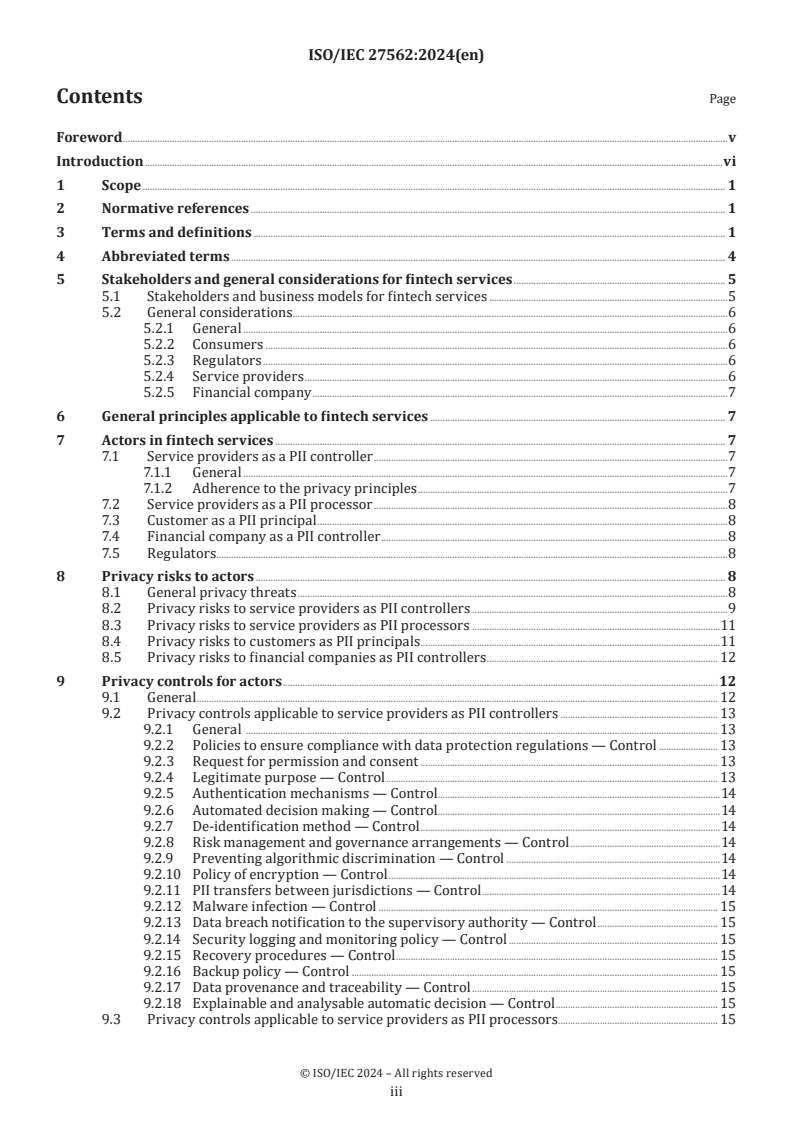
Contents Page
Foreword .v
Introduction .vi
1 Scope . 1
2 Normative references . 1
3 Terms and definitions . 1
4 Abbreviated terms . 4
5 Stakeholders and general considerations for fintech services . 5
5.1 Stakeholders and business models for fintech services .5
5.2 General considerations.6
5.2.1 General .6
5.2.2 Consumers .6
5.2.3 Regulators .6
5.2.4 Service providers .6
5.2.5 Financial company .7
6 General principles applicable to fintech services . 7
7 Actors in fintech services . 7
7.1 Service providers as a PII controller .7
7.1.1 General .7
7.1.2 Adherence to the privacy principles .7
7.2 Service providers as a PII processor .8
7.3 Customer as a PII principal .8
7.4 Financial company as a PII controller .8
7.5 Regulators .8
8 Privacy risks to actors . 8
8.1 General privacy threats .8
8.2 Privacy risks to service providers as PII controllers .9
8.3 Privacy risks to service providers as PII processors .11
8.4 Privacy risks to customers as PII principals.11
8.5 Privacy risks to financial companies as PII controllers . 12
9 Privacy controls for actors .12
9.1 General . 12
9.2 Privacy controls applicable to service providers as PII controllers . 13
9.2.1 General . 13
9.2.2 Policies to ensure compliance with data protection regulations — Control . 13
9.2.3 Request for permission and consent . 13
9.2.4 Legitimate purpose — Control . 13
9.2.5 Authentication mechanisms — Control.14
9.2.6 Automated decision making — Control.14
9.2.7 De-identification method — Control .14
9.2.8 Risk management and governance arrangements — Control .14
9.2.9 Preventing algorithmic discrimination — Control .14
9.2.10 Policy of encryption — Control .14
9.2.11 PII transfers between jurisdictions — Control .14
9.2.12 Malware infection — Control . 15
9.2.13 Data breach notification to the supervisory authority — Control . 15
9.2.14 Security logging and monitoring policy — Control . 15
9.2.15 Recovery procedures — Control . 15
9.2.16 Backup policy — Control . 15
9.2.17 Data provenance and traceability — Control . 15
9.2.18 Explainable and analysable automatic decision — Control . 15
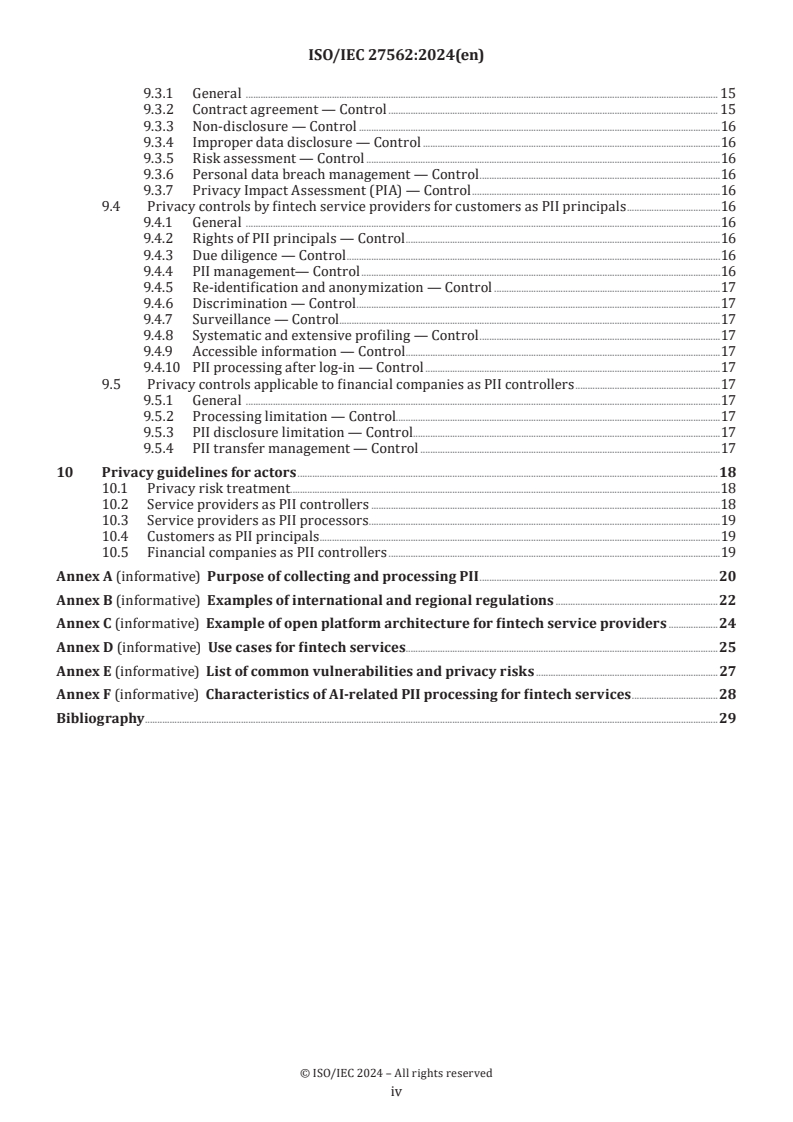
9.3 Privacy controls applicable to service providers as PII processors . 15
© ISO/IEC 2024 – All rights reserved
iii
9.3.1 General . 15
9.3.2 Contract agreement — Control . 15
9.3.3 Non-disclosure — Control .16
9.3.4 Improper data disclosure — Control .16
9.3.5 Risk assessment — Control .16
9.3.6 Personal data breach management — Control .16
9.3.7 Privacy Impact Assessment (PIA) — Control .16
9.4 Privacy controls by fintech service providers for customers as PII principals .16
9.4.1 General .16
9.4.2 Rights of PII principals — Control .16
9.4.3 Due diligence — Control .16
9.4.4 PII management— Control .16
9.4.5 Re-identification and anonymization — Control .17
9.4.6 Discrimination — Control .17
9.4.7 Surveillance — Control .17
9.4.8 Systematic and extensive profiling — Control .17
9.4.9 Accessible information — Control .17
9.4.10 PII processing after log-in — Control .17
9.5 Privacy controls applicable to financial companies as PII controllers .17
9.5.1 General .17
9.5.2 Processing limitation — Control.17
9.5.3 PII disclosure limitation — Control.17
9.5.4 PII transfer management — Control .17
10 Privacy guidelines for actors .18
10.1 Privacy risk treatment.18
10.2 Service providers as PII controllers .18
10.3 Service providers as PII processors .19
10.4 Customers as PII principals .19
10.5 Financial companies as PII controllers .19
Annex A (informative) Purpose of collecting and processing PII .20
Annex B (informative) Examples of international and regional regulations .22
Annex C (informative) Example of open platform architecture for fintech service providers .24
Annex D (informative) Use cases for fintech services.25
Annex E (informative) List of common vulnerabilities and privacy risks .27
Annex F (informative) Characteristics of AI-related PII processing for fintech services .28
Bibliography .29
© ISO/IEC 2024 – All rights reserved
iv
Foreword
ISO (the International Organization for Standardization) and IEC (the International Electrotechnical
Commission) form the specialized system for worldwide standardization. National bodies that are
members of ISO or IEC participate in the development of International Standards through technical
committees established by the respective organization to deal with particular fields of technical activity.
ISO and IEC technical committees collaborate in fields of mutual interest. Other international organizations,
governmental and non-governmental, in liaison with ISO and IEC, also take part in the work.
The procedures used to develop this document and those intended for its further maintenance are described
in the ISO/IEC Directives, Part 1. In particular, the different approval criteria needed for the different types
of document should be noted. This document was drafted in accordance with the editorial rules of the ISO/
IEC Directives, Part 2 (see www.iso.org/directives or www.iec.ch/members_experts/refdocs).
ISO and IEC draw attention to the possibility that the implementation of this document may involve the
use of (a) patent(s). ISO and IEC take no position concerning the evidence, validity or applicability of any
claimed patent rights in respect thereof. As of the date of publication of this document, ISO and IEC had not
received notice of (a) patent(s) which may be required to implement this document. However, implementers
are cautioned that this may not represent the latest information, which may be obtained from the patent
database available at www.iso.org/patents and https://patents.iec.ch. ISO and IEC shall not be held
responsible for identifying any or all such patent rights.
Any trade name used in this document is information given for the convenience of users and does not
constitute an endorsement.
For an explanation of the voluntary nature of standards, the meaning of ISO specific terms and expressions
related to conformity assessment, as well as information about ISO's adherence to the World Trade
Organization (WTO) principles in the Technical Barriers to Trade (TBT) see www.iso.org/iso/foreword.html.
In the IEC, see www.iec.ch/understanding-standards.
This document was prepared by Technical Committee ISO/IEC JTC 1, Information technology, Subcommittee
SC 27, Information security, cybersecurity and privacy protection.
Any feedback or questions on this document should be directed to the user’s national standards
body. A complete listing of these bodies can be found at www.iso.org/members.html and
www.iec.ch/national-committees.
© ISO/IEC 2024 – All rights reserved
v
Introduction
Fintech refers to the use of ICT technologies across all financial service functions, for example, banking,
payments and insurance.
Fintech represents the next wave of innovation for the financial service sector. Strong authentication
technologies, emerging decentralized technologies like blockchain, analytical technologies for fraud
detection and anti-money laundering compliance are changing digital financial services. Privacy aspects are
the top priority in order to build trust and confidence in fintech services and applications and to protect
financial infrastructure and customers.
AML (anti-money laundering) rules require the collection, processing and use of personal data as part of
customer due diligence (CDD). Fraud detections require transaction monitoring, behavioural monitoring,
internal data sharing (including within a group), external data sharing (including with regulators and other
financial institutions), data sharing for outsourced arrangements; and cross-border processing of data
(especially for international payments). Consumers want to be able to control access to, and usage of, their
information.
This document draws upon the privacy principles and framework described in ISO/IEC 29100:2024 and the
privacy impact assessment specified in ISO/IEC 29134:2023 to develop the guidelines for fintech services.
This document identifies regulations, such as anti-money laundering, fraud detection, and countering
terrorist financing. It identifies all relevant stakeholder and privacy risks which are related to fintech
services.
© ISO/IEC 2024 – All rights reserved
vi
International Standard ISO/IEC 27562:2024(en)
Information technology — Security techniques — Privacy
guidelines for fintech services
1 Scope
This document provides guidelines on privacy for fintech services.
It identifies all relevant business models and roles in consumer-to-business relations and business-to-
business relations, as well as privacy risks and privacy requirements, which are related to fintech services.
It provides specific privacy controls for fintech services to address privacy risks.
This document is based on the principles from ISO/IEC 29100, ISO/IEC 27701, and ISO/IEC 29184, the privacy
impact assessment framework described in ISO/IEC 29134, and the risk management guideline described in
ISO 31000. It also provides guidelines focusing on a set of privacy requirements for each stakeholder.
This document can be applicable to all kinds of organizations such as regulators, institutions, service
providers and product providers in the fintech service environment.
2 Normative references
There are no normative references in this document.
3 Terms and definitions
For the purposes of this document, the following terms and definitions apply.
ISO and IEC maintain terminology databases for use in standardization at the following addresses:
— ISO Online browsing platform: available at https:// www .iso .org/ obp
— IEC Electropedia: available at https:// www .electropedia .org/
3.1
actor
organization or individual that fulfils a role
[SOURCE: ISO 23234:2021, 3.4]
3.2
anonymization
process by which personally identifiable information (PII) (3.15) is irreversibly altered in such a way that a PII
principal (3.17) can no longer be identified directly or indirectly, either by the PII controller (3.16) alone or in
collaboration with any other party
[SOURCE: ISO/IEC 29100:2024, 3.2]
3.3
application programming interface
API
set of functions, protocols, parameters, and objects of different formats, used to create software that
interfaces with the features or data of an external system or service
[SOURCE: ISO/IEC/IEEE 26531:2023, 3.1.1]
© ISO/IEC 2024 – All rights reserved
3.4
artificial intelligence
AI
discipline concerned with the building of computer systems that perform tasks requiring intelligence when
performed by humans
[SOURCE: ISO/IEC 39794-16:2021, 3.6]
3.5
automated decision making
process of making a decision by automated means without any human involvement
3.6
control
measure that is modifying risk
Note 1 to entry: Controls include any process, policy, device, practice, or other actions which modify risk.
Note 2 to entry: It is possible that controls do not always exert the intended or assumed modifying effect.
[SOURCE: ISO/IEC 27000:2018, 3.14]
3.7
de-identified dataset
dataset resulting from the application of a de-identification process
[SOURCE: ISO/IEC 20889:2018, 3.8]
3.8
fintech
digital innovations and technology-enabled business model innovations in the financial sector
3.9
fraud detection system
software as an application that supports monitoring, detection, and management of fraud or other misuse
across users (e.g. customers), accounts, channels, products and other entities (e.g. kiosks)
Note 1 to entry: To deploy the fraud detection system, enterprise applications can integrate with a fraud detection
engine that assesses the fraud risk of a transaction, from user navigation and application access, to any type of activity,
such as a change of address, payment or retrieval of sensitive information.
[SOURCE: ITU-T X.1157:2015, 3.2.1]
3.10
governance
human-based system comprising directing, overseeing and accountability
[SOURCE: ISO/IEC 38500:2024, 3.3]
3.11
joint PII controller
personally identifiable information (PII) controller (3.16) that determines the purposes and means of the
processing of PII (3.15) jointly with one or more other PII controllers
[SOURCE: ISO/IEC 27701:2019, 3.1]
3.12
know your customer
KYC
process to verify the identity of a customer in order to prevent financial crime, money laundering and
terrorism financing
[SOURCE: ISO 12812-1:2017, 3.18]
© ISO/IEC 2024 – All rights reserved
3.13
machine learning
ML
process using computational techniques to enable systems to learn from data or experience
[SOURCE: ISO/IEC TR 29119-11:2020, 3.1.43]
3.14
malware
malicious software
software designed with malicious intent containing features or capabilities that can potentially cause harm
directly or indirectly to the user and/or the user’s computer system
EXAMPLE Viruses, worms, trojans.
[SOURCE: ISO/IEC 27032:2023, 3.15]
3.15
personally identifiable information
PII
information that (a) can be used to establish a link between the information and the natural person to whom
such information relates, or (b) is or might be directly or indirectly linked to a natural person
Note 1 to entry: The “natural person” in the definition is the PII principal (3.17). To determine whether a PII principal
is identifiable, account should be taken of all the means which can reasonably be used by the privacy stakeholder
holding the data, or by any other party, to establish the link between the set of PII and the natural person.
[SOURCE: ISO/IEC 29100:2024, 3.7]
3.16
PII controller
privacy stakeholder (or privacy stakeholders) that determines the purposes and means for processing
personally identifiable information (PII) (3.15) other than natural persons who use data for personal purposes
Note 1 to entry: A PII controller sometimes instructs others (e.g. PII processors (3.18)) to process PII on its behalf
while the responsibility for the processing remains with the PII controller.
[SOURCE: ISO/IEC 29100:2024, 3.8]
3.17
PII principal
data principal
natural person to whom the personally identifiable information (PII) (3.15) relates
Note 1 to entry: Depending on the jurisdiction and the particular data protection and privacy legislation, the synonym
“data subject” can also be used instead of the term “PII principal”.
[SOURCE: ISO/IEC 29100:2024, 3.27]
3.18
PII processor
privacy stakeholder that processes personally identifiable information (PII) (3.15) on behalf of and in
accordance with the instructions of a PII controller (3.16)
[SOURCE: ISO/IEC 29100:2024, 3.10]
3.19
privacy data sharing agreement
clauses for privacy protection in a data sharing agreement
Note 1 to entry: A privacy data sharing agreement can involve data transfer, data processing, and sharing of personally
identifiable information (PII) (3.15) between joint PII controllers (3.11).
© ISO/IEC 2024 – All rights reserved
[SOURCE: ISO/IEC TS 27570:2021, 3.22]
3.20
re-identification
process of associating data in a de-identified dataset (3.7) with the original data principal (3.17)
Note 1 to entry: A process that establishes the presence of a particular data principal in a dataset is included in this
definition.
[SOURCE: ISO/IEC 20889:2018, 3.32]
3.21
risk
effect of uncertainty on objectives
Note 1 to entry: An effect is a deviation from the expected — positive or negative.
Note 2 to entry: Uncertainty is the state, even partial, of deficiency of information related to, understanding or
knowledge of, an event, its consequence, or likelihood.
Note 3 to entry: Risk is often characterized by reference to potential “events” (as defined in ISO Guide 73:2009, 3.5.1.3)
and “consequences” (as defined in ISO Guide 73:2009, 3.6.1.3) , or a combination of these.
Note 4 to entry: Risk is often expressed in terms of a combination of the consequences of an event (including changes
in circumstances) and the associated “likelihood” (as defined in ISO Guide 73:2009, 3.6.1.1) of occurrence.
Note 5 to entry: In the context of information security management systems, information security risks can be
expressed as effect of uncertainty on information security objectives.
Note 6 to entry: Information security risk is associated with the potential that threats will exploit vulnerabilities of an
information asset or group of information assets and thereby cause harm to an organization.
[SOURCE: ISO/IEC 27000:2018, 3.61]
3.22
strong authentication
authentication procedure using a minimum of two independent (from the security point of view)
authentication mechanisms, with at least one of them being dynamic
[SOURCE: ISO 12812-1:2017, 3.57]
3.23
user profiling
activity to retrieve a set of attributes used by the system that are unique to a specific user/user group
4 Abbreviated terms
For the purposes of this document, the following abbreviated terms apply.
AI artificial intelligence
AML anti-money laundry
API application programming interface
ICT Information and Communication Technology
KYC know your customer
ML machine learning
PII personally identifiable information
© ISO/IEC 2024 – All rights reserved
5 Stakeholders and general considerations for fintech services
5.1 Stakeholders and business models for fintech services
Figure 1 illustrates the business model of fintech services. To provide fintech services, there are five entities
involved: customers, fintech service providers as PII controller/joint PII controller, fintech service providers
as PII processor, financial companies and regulators.
Figure 1 — Stakeholders for fintech services
Fintech service providers include all entities which provide fintech services to customers. It includes both
so-called traditional financial services providers (i.e. banks, savings institutions, credit unions and other
chartered financial institutions) and other entities, which can include eMoney operators, postal authorities
and a variety of different commercial providers. These other entities are collectively referred to here as
“non-bank providers”. Annex C provides an example of architecture with an open platform for fintech service
providers, as described in ITU-T X.1149.
Examples of business models in fintech services include:
— payment gateways;
— digital wallets;
— digital insurance;
— digital lending;
— peer-to-peer (P2P) lending;
— point of sale;
— payment banks;
— neo banking;
— alternative insurance underwriting;
— wealthtech;
— API-based bank-as-a-service platforms;
— personal finance;
— blockchain-based fintech services;
— equity crowdfunding;
© ISO/IEC 2024 – All rights reserved
— project financing;
— microfinancing;
— financial agents;
— property investment management;
— claim service handling;
— credit scoring;
— e-KYC;
— online distress solution;
— market comparison.
Annex D provides the use cases for fintech services. Annex F provides the characteristics of AI-related PII
processing for fintech services.
5.2 General considerations
5.2.1 General
Users of fintech services and applications should consider the points listed in 5.2.2 to 5.2.5.
5.2.2 Consumers
— Most consumers use at least one fintech application.
— Most consumers are concerned about data privacy and data sharing. Consumers’ concerns about privacy
extend to practically all types of financial and personally identifiable information (e.g. payment information,
financial history, bank account user name and password, social security numbers, facial photo, digital
copies of valid IDs). Annex A gives information on the purposes of collecting and processing PII.
— Consumers want to be able to control access to, and usage of, their information.
— Most fintech app users want to understand and be able to control how their data are accessed, collected,
used and shared by third parties, but consumers are often not aware of fintech data aggregation practices.
— AI/ML technologies can be used to profile customers.
5.2.3 Regulators
— A data protection authority or privacy regulator serves as the body that implements and monitors data
privacy regulation in a jurisdiction. Since fintech services process a vast amount of PII, the requirements
set by each data protection authority should be addressed by the service providers.
— AML (anti-money laundering) compliance by regulation requires the collection, processing, and use of
PII as part of customer due diligence (e.g. KYC); internal data sharing (including within a group); external
data sharing (including with regulators and other financial institutions); data sharing for outsourced
arrangements; and cross border processing of data (especially for international payments). See Annex B
for examples of international and regional regulations related to anti-money laundering and fraud
detection systems.
— Regulations on data privacy, data transfer, and data storage in processing PII can apply.
5.2.4 Service providers
— Various use cases are used to provide fintech services.
© ISO/IEC 2024 – All rights reserved
— Fraud detection by institutions also requires transaction and behavioural monitoring.
— Privacy issues are considered from both customer and back-office processing perspectives.
5.2.5 Financial company
— Financial companies, which include but are not limited to, banks, credit card issuers and payment
gateways, are viewed by some as a trusted provider of data security and as a holder of what is considered
sensitive data, so financial companies are expected to safeguard their customers’ personal data.
— Financial companies can act as a system function provider that provides a financial-grade API.
6 General principles applicable to fintech services
When providing fintech services to customers, organizations should follow the privacy principles derived
from ISO/IEC 29100:
— consent and choice;
— purpose legitimacy and specification;
— collection limitation;
— data minimization;
— use, retention and disclosure limitation;
— accuracy and quality;
— openness, transparency and access;
— individual participation and access;
— accountability;
— information security; and
— privacy compliance.
7 Actors in fintech services
7.1 Service providers as a PII controller
7.1.1 General
The role of the fintech service provider is categorized as either a PII controller or a PII processor. A service
provider is considered a PII controller/joint PII controller when it controls and determines the processing
of PII. It has the task of determining the purpose and the means of PII processing for its provided fintech
services and identifying the appropriate privacy and security controls based on different conditions such as
legal, business, contractual, and industry requirements.
7.1.2 Adherence to the privacy principles
As a PII controller, a service provider controls and decides on the PII processing and is responsible for the
protection of PII. Depending on legal, business, contractual, and industry requirements these can be the
common obligations of a PII controller.
PII controllers should ensure that the privacy principles described in ISO/IEC 29100 are adhered to during
the implementation of fintech services.
© ISO/IEC 2024 – All rights reserved
In particular, if processing personal data legally requires consent from the user, the PII controllers as service
providers implement the consent management function, which is a system or process for allowing customers
to determine what PII data they are willing to share with service providers.
7.2 Service providers as a PII processor
A PII processor processes PII on behalf of or upon the instruction of the PII controller. The role of a PII
processor can vary in every fintech service. For example, a PII controller that provides and maintains a
lending application can task an organization as its PII processor in terms of handling the digital identity
verification and credentials of the individuals who are applying for loans.
7.3 Customer as a PII principal
In most cases, every customer is considered a PII principal, since fintech services require their customer to
provide PII for identity verification to avail their user-centric financial services.
Customers refers to all users of fintech service, i.e. individuals, merchants, billers and other payments
acceptors; businesses; governments; and non-profit agencies. These groups can be collectively thought of as
a customer of fintech services.
7.4 Financial company as a PII controller
A financial company is an entity engaged in the business of dealing with financial and monetary transactions
such as deposits, loans, investments, and currency exchange. Financial companies encompass a broad range
of business operations within the financial services sector including banks, trust companies, insurance
companies, brokerage firms, and investment dealers.
7.5 Regulators
Where regulators develop and enforce a legal framework to monitor and oversee fintech activities, they
should comprehensively document the policy and ensure that financial, consumer, antitrust, regulatory,
cybersecurity, data protection and human rights bodies are notified thereof. This policy should be guided by
best practices and relevant international standards.
In addition, regulators should document the data protection policy with adequate and coordinated levels of
enforcement, addressing the financial sector and regulating cross-border data transfers to ensure equivalent
and adequate levels of protection.
8 Privacy risks to actors
8.1 General privacy threats
General privacy threats can be grouped into seven threat categories:
— Linkability: a bad actor can establish the link between two or more actions, identities, and pieces of
information, even if bad actors have no knowledge of the subject’s identity.
— Identifiability: a bad actor can establish the link between an identity and an action or a set of data.
— Non-repudiation: the PII principal cannot deny having performed an action that other parties can neither
confirm nor contradict.
— Detectability: a bad actor can detect a PII principal and distinguish whether an item of interest about
that subject exists.
— Disclosure of information: a bad actor can disclose the data content or controlled release of data content.
— Unawareness: PII principals are unaware of their PII being collected and processed.
© ISO/IEC 2024 – All rights reserved
— Non-compliance: the personal data processing does not comply with relevant laws and/or policies.
There is a risk to the providers of fintech services that more information is required to be collected and
stored than is necessary or safe. General privacy risks are as follows:
— Fintech services can leverage web-based service models and APIs. APIs can increase the exposure risks
and induce vulnerability leading to potential data breaches, fraud, or misuse. This vulnerability can
allow attackers to gain access to PII and sensitive data or execute other malicious actions such as data
exfiltration, account takeover (ATO) and service disruption. Annex E provides a non-exhaustive list of
common vulnerabilities and privacy risks related web-based applications.
— Cloud computing is widely accepted and implemented in the fintech services sectors, as the demand for
faster computing and higher cost-efficiency grows. Cloud services are available on-demand, scalable to
the customer needs, and delivered over the internet, thus availing local and global market outreach. While
the use of cloud services offer access to next-generation computing performance levels at reasonable cost
structures, this setup introduces new threats due to outsourcing workloads, cross-border processing and
data storage. This poses potential legal and geo-political risks. In addition, unanticipated communications
between Virtual Machines (VMs) can result in unpredictable and emerging vulnerabilities.
— Blockchain technologies can be leveraged for financial use cases, which have characteristics of
“immutability” of the decentralized ledger/data storage implementation and can eliminate a single point
of failure. Ensuring privacy while using blockchain technology is virtually impossible. Special attention
should be paid when implementing the right to be forgotten, i.e. right of PII principal.
Possible organizational impacts in case of a privacy breach include:
— loss of reputation/goodwill;
— loss of strategic advantage to a competitor;
— breach of contractual obligation;
— failure to comply with all applicable legislation or regulations;
— economic losses due to compensation claims from individuals;
— economic losses due to project/system redesign;
— economic losses due to project/system failure;
— economic losses due to security measures, retrofitted after project launch.
It is recommended to identify the possible privacy risks of fintech services and their potential impact on the
PII principals. In addition, it is also recommended to identify risk management and consequences of adverse
privacy impacts on individuals that greatly affect the organization.
NOTE 1 Further guidance on conducting a privacy impact assessment (PIA) can be found in ISO/IEC 29134.
NOTE 2 Further guidance on organizational privacy risk management can be found in ISO/IEC 27557.
8.2 Privacy risks to service providers as PII controllers
Privacy risk is defined as the potential loss of control over personal information by the service provider.
The following privacy risks for fintech services apply: unauthorized access, breaches, loss, manipulation,
falsification, destruction or unauthorized disclosure to all collected data.
In general, privacy risks are any accidental or unlawful destruction; loss, alteration; unauthorized disclosure
of, or access to, personal data as arising from data breach; data exposure on the operator side; lacking breach
response; inadequate personal data disposal; lack of transparency in privacy policies; terms and conditions;
collection of unnecessary data; personal data sharing; incorrect or outdated personal data and data transfer
over insecure channels.
© ISO/IEC 2024 – All rights reserved
Typical risks to PII of organizations can include:
— Illegitimate access to PII – For example, PII are seen by an unauthorized person, even though this
person does not use them. PII are copied and saved to another location without being used further.
PII are disseminated more than necessary and beyond the control of the PII principals (e.g. unwanted
dissemination of a photo over the internet, loss of control over information published in a social network).
PII are used for purposes other than those planned and/or in an unfair manner (e.g. commercial purposes,
identity theft, use against data principals) or correlated with other information relating to PII principals
(e.g. correlation of residence address and real-time geolocation data).
— Manipulation of PII – For example, PII can be modified into invalid data, which cannot be used correctly,
and the processing of modified PII can cause errors, malfunctions, or no longer provide the expected
service (e.g. impairing the proper progress of important steps).
— Loss of PII – For example, PII is missing from personal da
...