

ISO/TS 21030:2023
(Main)Educational organizations — Requirements for bodies providing audit and certification of educational organizations' management systems
General Information
- Abstract
This document defines the rules applicable to the audit and certification of educational organization management systems (EOMS) conforming to the requirements given in ISO 21001 (or other sets of specified EOMS requirements). It also provides the necessary information and confidence to customers about the way certification of their suppliers has been granted. Certification of EOMS is a third-party conformity assessment activity (as described in ISO/IEC 17000:2020, 4.5), and bodies performing this activity are third-party conformity assessment bodies. NOTE 1 This document can be used as a criteria document for the accreditation or peer assessment of certification bodies which seek to be recognized as being competent to certify that an EOMS conforms to ISO 21001. It is also intended to be used as a criteria document by regulatory authorities and industry consortia which engage in direct recognition of certification bodies to certify that an EOMS conforms to ISO 21001. Some of its requirements could also be useful to other parties involved in the conformity assessment of such certification bodies, and in the conformity assessment of bodies that undertake to certify the compliance of EOMS with criteria additional to, or other than, those in ISO 21001. NOTE 2 Certification of an EOMS according to ISO 21001 is a management system certification, not a product certification. NOTE 3 ISO 21001 is a standalone management system standard, not a sector application of ISO 9001.
- Status
- Published
- Publication Date
- 30-Oct-2023
- Technical Committee
- ISO/TC 232 - Education and learning services
- Drafting Committee
- ISO/TC 232 - Education and learning services
- Current Stage
- 6060 - International Standard published
- Start Date
- 31-Oct-2023
- Due Date
- 23-Nov-2023
- Completion Date
- 31-Oct-2023
Buy Documents




ISO/TS 21030:2023 - Educational organizations — Requirements for bodies providing audit and certification of educational organizations' management systems Released:31. 10. 2023
Overview
ISO/TS 21030:2023 - Educational organizations - Requirements for bodies providing audit and certification of educational organizations' management systems - is a technical specification that defines rules and expectations for third‑party audit and certification of Educational Organization Management Systems (EOMS). It supports consistent, impartial certification against ISO 21001 (or other specified EOMS requirements) and can be used as a criteria document for accreditation, peer assessment, regulatory recognition, or direct recognition of certification bodies.
Key topics and requirements
This TS addresses the full lifecycle and governance of EOMS certification. Major topics include:
- Principles and general requirements: legal/contractual matters, impartiality management, liability and financing.
- Structural requirements: organizational arrangements for certification bodies.
- Resource and competence: competence criteria, evaluation processes, records, use of external auditors and technical experts, outsourcing controls.
- Information requirements: public information, certification documents, use of marks, confidentiality and client information exchange.
- Process requirements: pre‑certification activities (application, review, audit programme), determination of audit time, multi‑site sampling and virtual site considerations, planning and conducting audits, initial certification, surveillance and maintenance, certification decision, appeals, complaints and recordkeeping.
- Management system requirements for certification bodies to ensure consistent delivery.
- Normative annexes cover audit time determination and specific knowledge/skills needed for EOMS certification functions.
Practical applications
ISO/TS 21030:2023 is intended to:
- Provide a clear framework for certification bodies to design and operate EOMS audit and certification schemes.
- Serve as a basis for accreditation bodies and industry consortia to assess competence and recognize certification providers.
- Help educational organizations and their customers understand how certification is granted and maintained, improving confidence in supplier selection.
- Guide auditors and consultants on required skills, audit planning (including virtual sites and multi‑site sampling) and evidence‑based certification decisions.
Who should use this standard
- Certification bodies auditing EOMS (including those seeking accreditation)
- Accreditation and regulatory authorities, and industry consortia performing assessments or recognition
- Education providers seeking ISO 21001 certification or preparing for audits
- Auditors, technical experts and conformity assessment personnel involved in educational management system certification
Related standards
- ISO 21001:2018 - EOMS requirements
- ISO/IEC 17021‑1 - Requirements for bodies providing audit and certification of management systems
- ISO/IEC 17000:2020 - Conformity assessment vocabulary and principles
- Other sector schemes (e.g., EQAVET, ENQA‑ESG) where EOMS certification practices are applied
Keywords: ISO/TS 21030:2023, ISO 21001, EOMS, audit and certification, certification bodies, accreditation, audit time, virtual site, impartiality.
Buy Documents
ISO/TS 21030:2023 - Educational organizations — Requirements for bodies providing audit and certification of educational organizations' management systems Released:31. 10. 2023
Get Certified
Connect with accredited certification bodies for this standard

BSI Group
BSI (British Standards Institution) is the business standards company that helps organizations make excellence a habit.

Bureau Veritas
Bureau Veritas is a world leader in laboratory testing, inspection and certification services.

DNV
DNV is an independent assurance and risk management provider.
Sponsored listings
Frequently Asked Questions
ISO/TS 21030:2023 is a technical specification published by the International Organization for Standardization (ISO). Its full title is "Educational organizations — Requirements for bodies providing audit and certification of educational organizations' management systems". This standard covers: This document defines the rules applicable to the audit and certification of educational organization management systems (EOMS) conforming to the requirements given in ISO 21001 (or other sets of specified EOMS requirements). It also provides the necessary information and confidence to customers about the way certification of their suppliers has been granted. Certification of EOMS is a third-party conformity assessment activity (as described in ISO/IEC 17000:2020, 4.5), and bodies performing this activity are third-party conformity assessment bodies. NOTE 1 This document can be used as a criteria document for the accreditation or peer assessment of certification bodies which seek to be recognized as being competent to certify that an EOMS conforms to ISO 21001. It is also intended to be used as a criteria document by regulatory authorities and industry consortia which engage in direct recognition of certification bodies to certify that an EOMS conforms to ISO 21001. Some of its requirements could also be useful to other parties involved in the conformity assessment of such certification bodies, and in the conformity assessment of bodies that undertake to certify the compliance of EOMS with criteria additional to, or other than, those in ISO 21001. NOTE 2 Certification of an EOMS according to ISO 21001 is a management system certification, not a product certification. NOTE 3 ISO 21001 is a standalone management system standard, not a sector application of ISO 9001.
This document defines the rules applicable to the audit and certification of educational organization management systems (EOMS) conforming to the requirements given in ISO 21001 (or other sets of specified EOMS requirements). It also provides the necessary information and confidence to customers about the way certification of their suppliers has been granted. Certification of EOMS is a third-party conformity assessment activity (as described in ISO/IEC 17000:2020, 4.5), and bodies performing this activity are third-party conformity assessment bodies. NOTE 1 This document can be used as a criteria document for the accreditation or peer assessment of certification bodies which seek to be recognized as being competent to certify that an EOMS conforms to ISO 21001. It is also intended to be used as a criteria document by regulatory authorities and industry consortia which engage in direct recognition of certification bodies to certify that an EOMS conforms to ISO 21001. Some of its requirements could also be useful to other parties involved in the conformity assessment of such certification bodies, and in the conformity assessment of bodies that undertake to certify the compliance of EOMS with criteria additional to, or other than, those in ISO 21001. NOTE 2 Certification of an EOMS according to ISO 21001 is a management system certification, not a product certification. NOTE 3 ISO 21001 is a standalone management system standard, not a sector application of ISO 9001.
ISO/TS 21030:2023 is classified under the following ICS (International Classification for Standards) categories: 03.120.20 - Product and company certification. Conformity assessment; 03.180 - Education. The ICS classification helps identify the subject area and facilitates finding related standards.
ISO/TS 21030:2023 is available in PDF format for immediate download after purchase. The document can be added to your cart and obtained through the secure checkout process. Digital delivery ensures instant access to the complete standard document.
Standards Content (Sample)
SLOVENSKI STANDARD
01-januar-2024
Izobraževalne organizacije - Zahteve za organe, ki izvajajo presojo in certificiranje
sistemov vodenja izobraževalnih organizacij
Educational organizations - Requirements for bodies providing audit and certification of
educational organizations management systems
Organismes d'éducation/formation — Exigences pour les organismes procédant à l'audit
et à la certification des systèmes de management des organismes d'éducation/formation
Ta slovenski standard je istoveten z: ISO/TS 21030:2023
ICS:
03.120.20 Certificiranje proizvodov in Product and company
podjetij. Ugotavljanje certification. Conformity
skladnosti assessment
03.180 Vzgoja in izobraževanje Education
2003-01.Slovenski inštitut za standardizacijo. Razmnoževanje celote ali delov tega standarda ni dovoljeno.
TECHNICAL ISO/TS
SPECIFICATION 21030
First edition
2023-10
Educational organizations —
Requirements for bodies providing
audit and certification of educational
organizations' management systems
Organismes d'éducation/formation — Exigences pour les organismes
procédant à l'audit et à la certification des systèmes de management
des organismes d'éducation/formation
Reference number
© ISO 2023
All rights reserved. Unless otherwise specified, or required in the context of its implementation, no part of this publication may
be reproduced or utilized otherwise in any form or by any means, electronic or mechanical, including photocopying, or posting on
the internet or an intranet, without prior written permission. Permission can be requested from either ISO at the address below
or ISO’s member body in the country of the requester.
ISO copyright office
CP 401 • Ch. de Blandonnet 8
CH-1214 Vernier, Geneva
Phone: +41 22 749 01 11
Email: copyright@iso.org
Website: www.iso.org
Published in Switzerland
ii
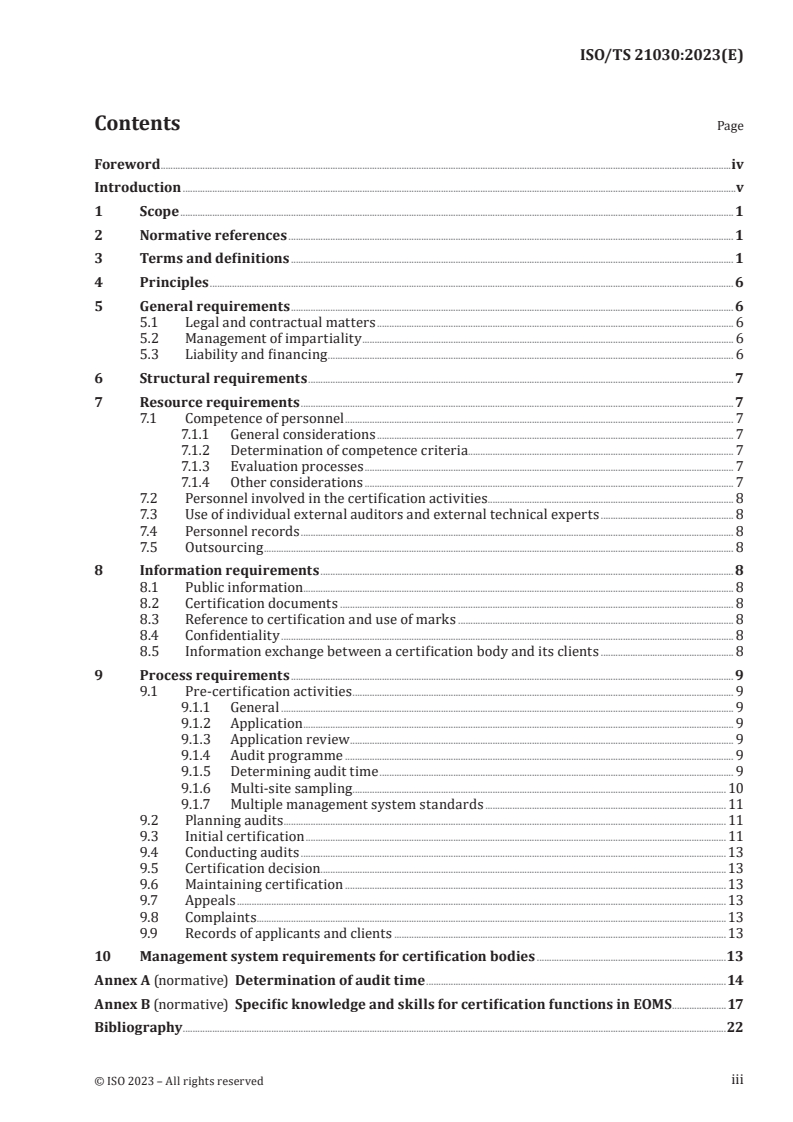
Contents Page
Foreword .iv
Introduction .v
1 Scope . 1
2 Normative references . 1
3 Terms and definitions . 1
4 Principles . 6
5 General requirements . 6
5.1 L egal and contractual matters . 6
5.2 Management of impartiality . 6
5.3 Liability and financing . 6
6 Structural requirements .7
7 Resource requirements .7
7.1 Competence of personnel . 7
7.1.1 General considerations . 7
7.1.2 Determination of competence criteria. 7
7.1.3 E valuation processes . 7
7.1.4 Other considerations . 7
7.2 Personnel involved in the certification activities . 8
7.3 Use of individual external auditors and external technical experts . 8
7.4 Personnel records . 8
7.5 Outsourcing . 8
8 Information requirements . 8
8.1 Public information . . 8
8.2 Certification documents . 8
8.3 Reference to certification and use of marks . 8
8.4 Confidentiality . 8
8.5 Information exchange between a certification body and its clients . 8
9 Process requirements . 9
9.1 Pre-certification activities . 9
9.1.1 General . 9
9.1.2 Application . 9
9.1.3 Application review . . 9
9.1.4 Audit programme . 9
9.1.5 Determining audit time . 9
9.1.6 Multi-site sampling . . 10
9.1.7 Multiple management system standards . 11
9.2 P lanning audits . 11
9.3 Initial certification . 11
9.4 Conducting audits . 13
9.5 Certification decision . . .13
9.6 Maintaining certification . 13
9.7 Appeals . 13
9.8 Complaints.13
9.9 Records of applicants and clients . 13
10 M anagement system requirements for certification bodies .13
Annex A (normative) Determination of audit time .14
Annex B (normative) Specific knowledge and skills for certification functions in EOMS .17
Bibliography .22
iii
Foreword
ISO (the International Organization for Standardization) is a worldwide federation of national standards
bodies (ISO member bodies). The work of preparing International Standards is normally carried out
through ISO technical committees. Each member body interested in a subject for which a technical
committee has been established has the right to be represented on that committee. International
organizations, governmental and non-governmental, in liaison with ISO, also take part in the work.
ISO collaborates closely with the International Electrotechnical Commission (IEC) on all matters of
electrotechnical standardization.
The procedures used to develop this document and those intended for its further maintenance are
described in the ISO/IEC Directives, Part 1. In particular, the different approval criteria needed for the
different types of ISO document should be noted. This document was drafted in accordance with the
editorial rules of the ISO/IEC Directives, Part 2 (see www.iso.org/directives).
ISO draws attention to the possibility that the implementation of this document may involve the use
of (a) patent(s). ISO takes no position concerning the evidence, validity or applicability of any claimed
patent rights in respect thereof. As of the date of publication of this document, ISO had not received
notice of (a) patent(s) which may be required to implement this document. However, implementers are
cautioned that this may not represent the latest information, which may be obtained from the patent
database available at www.iso.org/patents. ISO shall not be held responsible for identifying any or all
such patent rights.
Any trade name used in this document is information given for the convenience of users and does not
constitute an endorsement.
For an explanation of the voluntary nature of standards, the meaning of ISO specific terms and
expressions related to conformity assessment, as well as information about ISO's adherence to
the World Trade Organization (WTO) principles in the Technical Barriers to Trade (TBT), see
www.iso.org/iso/foreword.html.
This document was prepared by Technical Committee ISO/TC 232, Education and learning services, in
collaboration with the ISO Committee on Conformity Assessment (CASCO).
Any feedback or questions on this document should be directed to the user’s national standards body. A
complete listing of these bodies can be found at www.iso.org/members.html.
iv
Introduction
Certification of the educational organization management systems (EOMS) of an organization is one
means of providing assurance that the organization has implemented a system for the management of
its educational services in line with its policy.
Requirements for an EOMS can originate from a number of sources. This document has been developed
to assist in the certification of EOMS that fulfil the requirements of ISO 21001. The contents of this
document can also be used to support certification of EOMS that are based on other sets of specified
EOMS requirements.
This document is intended for use by bodies that carry out audit and certification of EOMS by providing
generic requirements for such bodies. Such bodies are referred to as certification bodies. This wording
is not intended to be an obstacle to the use of this document by bodies with other designations that
undertake activities covered by the scope of this document. This document is intended to be used
by anybody involved in the audit of EOMS. It can also be used to support other types of educational
organization certifications based on a combination of ISO/IEC 17021-1, ISO/IEC 17024 and
ISO/IEC 17065.
Certification activities involve the audit of an organization’s EOMS. The form of attestation of conformity
of an organization’s EOMS to a specific EOMS standard (e.g. ISO 21001) or other specified requirements
is normally a certification document or a certificate.
It is for the organization being certified to develop its own management systems (e.g. EOMS in
accordance with ISO 21001, other sets of specified EOMS requirements, quality management systems,
environmental management systems or occupational health and safety management systems) and,
other than where relevant legislative requirements specify to the contrary, it is for the organization to
decide how the various components of these will be arranged. The degree of integration between the
various management system components will vary from organization to organization. It is, therefore,
appropriate for certification bodies that operate in accordance with this document to consider the
culture and practices of their clients with respect to the integration of their EOMS in the organization.
v
TECHNICAL SPECIFICATION ISO/TS 21030:2023(E)
Educational organizations — Requirements for bodies
providing audit and certification of educational
organizations' management systems
1 Scope
This document defines the rules applicable to the audit and certification of educational organization
management systems (EOMS) conforming to the requirements given in ISO 21001 (or other sets of
specified EOMS requirements). It also provides the necessary information and confidence to customers
about the way certification of their suppliers has been granted.
Certification of EOMS is a third-party conformity assessment activity (as described in
ISO/IEC 17000:2020, 4.5), and bodies performing this activity are third-party conformity assessment
bodies.
NOTE 1 This document can be used as a criteria document for the accreditation or peer assessment of
certification bodies which seek to be recognized as being competent to certify that an EOMS conforms to
ISO 21001. It is also intended to be used as a criteria document by regulatory authorities and industry consortia
which engage in direct recognition of certification bodies to certify that an EOMS conforms to ISO 21001. Some of
its requirements could also be useful to other parties involved in the conformity assessment of such certification
bodies, and in the conformity assessment of bodies that undertake to certify the compliance of EOMS with
criteria additional to, or other than, those in ISO 21001.
NOTE 2 Certification of an EOMS according to ISO 21001 is a management system certification, not a product
certification.
NOTE 3 ISO 21001 is a standalone management system standard, not a sector application of ISO 9001.
The concepts and requirements of this document can be used to support certification schemes in other
standards for education, such as EQAVET (European Quality Assurance in Vocational Education and
Training) and ENQA-ESG (European Association for Quality Assurance in Higher Education, Standards
and guidelines for quality assurance in the European Higher Education Area).
2 Normative references
The following documents are referred to in the text in such a way that some or all of their content
constitutes requirements of this document. For dated references, only the edition cited applies. For
undated references, the latest edition of the referenced document (including any amendments) applies.
ISO/IEC 17000:2020, Conformity assessment — Vocabulary and general principles
ISO/IEC 17021-1:2015, Conformity assessment — Requirements for bodies providing audit and certification
of management systems — Part 1: Requirements
ISO 21001:2018, Educational organizations — Management systems for educational organizations —
Requirements with guidance for use
3 Terms and definitions
For the purposes of this document, the terms and definitions given in ISO/IEC 17000, ISO/IEC 17021-1
and ISO 21001 and the following apply.
ISO and IEC maintain terminology databases for use in standardization at the following addresses:
— ISO Online browsing platform: available at https:// www .iso .org/ obp
— IEC Electropedia: available at https:// www .electropedia .org/
3.1
virtual site
digital space where an educational organization performs work or provides educational products
and services using an online environment allowing persons, irrespective of their locations, to execute
processes
Note 1 to entry: Where the processes are executed in a physical environment, for example physical testing and
computing laboratories, libraries, sports facilities, dormitories or food service, the site cannot be considered as a
virtual site.
Note 2 to entry: An example of such a virtual site is a learning management platform with all employees
performing work located remotely, working in a cloud environment.
Note 3 to entry: A virtual site (e.g. learning management system, organization intranet) is considered a single
site for the calculation of audit time.
[SOURCE: Adapted from IAF MD5: 2019]
3.2
organization
person or group of people that has its own functions with responsibilities, authorities and relationships
to achieve its objectives
Note 1 to entry: The concept of organization includes, but is not limited to, sole-trader, company, corporation, firm,
enterprise, authority, partnership, charity or institution, or part or combination thereof, whether incorporated
or not, public or private.
[SOURCE: ISO 21001:2018, 3.1]
3.3
effectiveness
extent to which planned activities are realized and planned results are achieved
[SOURCE: ISO 21001:2018, 3.6]
3.4
objective
result to be achieved
Note 1 to entry: An objective can be strategic, tactical or operational.
Note 2 to entry: Objectives can relate to different disciplines (e.g. educational, financial, health and safety,
environmental goals) and can apply at different levels (e.g. strategic, organization-wide, project, product,
process).
Note 3 to entry: An objective can be expressed in other ways, for example as an intended outcome, a purpose,
an operational criterion, an EOMS objective or by the use of other words with similar meaning (e.g. aim, goal or
target).
Note 4 to entry: In the context of EOMS, EOMS objectives are set by the organization, consistent with the EOMS
policy, to achieve specific results.
[SOURCE: ISO 21001:2018, 3.8]
3.5
risk
effect of uncertainty
Note 1 to entry: An effect is a deviation from the expected – positive or negative.
Note 2 to entry: Uncertainty is the state, even partial, of deficiency of information related to, understanding of or
knowledge of an event, its consequence or likelihood.
Note 3 to entry: Risk is often characterized by reference to potential “events” (as defined in ISO Guide 73:2009,
3.5.1.3) and “consequences” (as defined in ISO Guide 73:2009, 3.6.1.3), or a combination of these.
Note 4 to entry: Risk is often expressed in terms of a combination of the consequences of an event (including
changes in circumstances) and the associated “likelihood” (as defined in ISO Guide 73:2009, 3.6.1.1) of occurrence
[SOURCE: ISO 21001:2018, 3.9]
3.6
competence
ability to apply knowledge and skills to achieve intended results
Note 1 to entry: The ability to apply knowledge and skills means that the learner demonstrates appropriate
attitudes and behaviour in different contexts or situations with responsibility and autonomy.
[SOURCE: ISO 21001:2018, 3.10]
3.7
documented information
information required to be controlled and maintained by an organization and the medium on which it
is contained
Note 1 to entry: Documented information can be in any format and media, and from any source.
Note 2 to entry: Documented information can refer to:
— the management system, including related processes;
— information created in order for the organization to operate (documentation);
— evidence of results achieved (records).
[SOURCE: ISO 21001:2018, 3.11]
3.8
performance
measurable result
Note 1 to entry: Performance can relate either to quantitative or qualitative findings.
Note 2 to entry: Performance can relate to the management of activities, processes, products (including services),
systems or organizations.
[SOURCE: ISO 21001:2018, 3.13]
3.9
educational organization
organization whose core business is the provision of educational products and educational services
Note 1 to entry: This can include an educational organization within a larger organization whose core business is
not education, such as a professional training department.
[SOURCE: ISO 21001:2018, 3.22]
3.10
educational service
process that supports acquisition and development of learners' competence through teaching, learning
or research
Note 1 to entry: The service provided in a school library is an educational service when utilized in an educational
context where learning how to obtain information and resources from a library is part of the curricula.
[SOURCE: ISO 21001:2018, 3.23, modified — Note to entry added.]
3.11
educational product
learning resource
tangible or intangible goods used in pedagogical support of an educational service
Note 1 to entry: Educational products can be either physical or digital and can include textbooks, workbooks,
worksheets, manipulatives (e.g. blocks, beads), flashcards, educator workshops, non-fiction, books, posters,
educational games, applications, websites, software, online courses, activity books, graphic novels, reference
books, DVDs, CDs, magazines and periodicals, study guides, educator guides, laboratories, models, movies,
televisions shows, webcasts, podcasts, maps and atlases, standards, technical specifications and case studies.
Note 2 to entry: Educational products can be produced by any parties, including learners.
[SOURCE: ISO 21001:2018, 3.24]
3.12
learner
beneficiary acquiring and developing competence using an educational service
[SOURCE: ISO 21001:2018, 3.25]
3.13
educator
person who performs teaching activities
Note 1 to entry: In different contexts, an educator is sometimes referred to as a teacher, a trainer, a coach, a
facilitator, a tutor, a consultant, an instructor, a lecturer or a mentor.
[SOURCE: ISO 21001:2018, 3.27]
3.14
staff
persons who work for and within an organization
Note 1 to entry: Staff can be referred by different terms, such as personnel, collaborator, intern, apprentice,
consultant or volunteer.
Note 2 to entry: In educational organizations, staff can be clustered according to the nature of their job roles, for
example teaching, researching and non-teaching staff; administrative and support staff.
Note 3 to entry: Staff can be permanent or non-permanent.
Note 4 to entry: Non-permanent staff can be:
a) seasonal (e.g. a part-time teacher who only teaches in the first semester, a janitor who works during the
academic months but not during holiday periods, a volunteer during the registration period, data entry
operators); or
b) temporary (e.g. an invited lecturer to a once-off masterclass, a consultant subcontracted to help the
organization implement a new management system, apprenticeships, traineeships, internships, fellowships).
Note 5 to entry: Staff can be full-time or part-time (e.g. a cook who only works mornings in the food service; a
teacher who only teaches half of a schedule).
Note 6 to entry: Staff can have different formal agreements with the educational organization (e.g. employment
contract of a teacher or a clerk, client-supplier contract of a trainer, consultant, housekeeper; memorandum of
understanding for an intern, apprentice, trainee, fellow or volunteer).
[SOURCE: ISO 21001:2018, 3.36, modified — Notes to entry added.]
3.15
vision
aspirations of an organization in relation to its desired future condition and duly aligned with its
mission
[SOURCE: ISO 21001:2018, 3.30]
3.16
mission
reason for being, mandate and scope of an organization, translated into the context in which it operates
[SOURCE: ISO 21001:2018, 3.31]
3.17
course
distinct set of teaching and learning activities, designed to meet defined learning objectives or learning
outcomes
[SOURCE: ISO 21001:2018, 3.33, modified — Note to entry removed.]
3.18
educational programme
course or consistent set of courses leading to recognition
Note 1 to entry: Recognition can take the form of a degree, a certificate of completion, participation or
achievement, a badge, diploma and other forms.
[SOURCE: ISO 21001:2018, 3.34, modified — Term and definition revised.]
3.19
skill
set of know-how that allows a person to master an activity and succeed in accomplishing a task
Note 1 to entry: Skill can be cognitive, emotional, social or psychomotor.
[SOURCE: ISO 21001:2018, 3.41]
3.20
knowledge
facts, information, principles or understanding acquired through experience, research or education
[SOURCE: ISO/IEC TS 17027:2014, 2.56, modified — Definition revised.]
3.21
verification
confirmation, through the provision of objective evidence, that specified requirements have been
fulfilled
[SOURCE: ISO 9000:2015, 3.8.12, modified — Notes to entry removed.]
3.22
validation
confirmation, through the provision of objective evidence, that the requirements for a specific intended
use or application have been fulfilled
[SOURCE: ISO 9000:2015, 3.8.13, modified — Notes to entry removed.]
3.23
multi-site educational organization
organization having an identified central function (also referred to as a central office – but not
necessarily the headquarters of the organization) at which certain EOMS activities are planned,
controlled or managed, and a network of sites at which such educational services, educational products
and support services are fully or partially carried out
Note 1 to entry: Examples of multi-site educational organizations are those operating:
— with franchises, for example mathematics schools, driving schools, language schools;
— in different places in the same country and/or different countries, for example with branches or campuses;
— with more than one site, which are partially or totally virtual.
3.24
non-educational service
process provided to learners, not as a part of the educational programme, that can have an impact on
the conformity of the educational products and services included in the scope of certification
EXAMPLE Catering, transportation, healthcare, psychological counselling, security, career guidance,
reprography, extracurricular activities (languages, sports, entertaining, community work).
Note 1 to entry: The service provided in a school library is a non-educational service in an educational context,
where learning how to use a library is not part of the curricula.
3.25
scientific discipline
broad domain, branch or area of content covered by an education programme or qualification
[SOURCE: Adapted from ISCED-F 2013]
4 Principles
The principles of ISO/IEC 17021-1:2015, Clause 4, are the basis for the subsequent specific performance
and descriptive requirements in this document.
5 General requirements
5.1 Leg al and contractual matters
ISO/IEC 17021-1:2015, 5.1, shall be followed.
5.2 Management of impartiality
ISO/IEC 17021-1:2015, 5.2, shall be followed.
Additionally:
a) educational services provided by the certification body shall not be offered to the educational
organization being certified for a minimum of two years before or after the certification period;
b) the staff, auditors and technical experts of certification bodies involved in the certification of an
organization shall not provide any educational services in the name of the organization being
certified or any part of the same legal entity.
5.3 Liability and financing
ISO/IEC 17021-1:2015, 5.3 shall be followed.
6 Structural requirements
ISO/IEC 17021-1:2015, Clause 6 shall be followed.
7 Resource requirements
7.1 Competence of personnel
7.1.1 General considerations
ISO/IEC 17021-1:2015, 7.1.1 shall be followed.
Additionally, the certification body shall also ensure that the audit team has specific and appropriate
knowledge and skills relevant to the levels of education and scientific disciplines, as applicable, of the
educational products and services– as well as to any other non-educational services – included in the
scope of certification. The certification body shall retain documented information as evidence of its
personnel competence.
NOTE 1 The levels of formal education are defined by the International Standard Classification of Education
(ISCED).
NOTE 2 The scientific disciplines for higher and/or vocational education and training are defined by the
International Standard Classification of Fields of Education and Training (ISCED-F).
NOTE 3 The technical areas of non-educational services are defined by the Nomenclature of Economic
[17]
Activities (NACE).
NOTE 4 NACE, ISCED and ISCED-F can be considered by certification bodies to define the technical areas.
7.1.2 Determination of competence criteria
ISO/IEC 17021-1:2015, 7.1.2 shall be followed.
Annex B shall be used as a basis to develop competence criteria for all certification functions for
each level and/or scientific discipline of the educational products and services and for the non-
educational services. Competence criteria can be generic or specific. The competence criteria in
ISO/IEC 17021-1:2015, Annex A shall be considered to be generic.
NOTE Qualification(s) and experience can be used as part of the criteria; however, competence is not
based on these alone, as it is important to ensure that a person can demonstrate the ability to apply the specific
knowledge and skills that they would be expected to have after completing a qualification or having a certain
amount of sector experience.
7.1.3 Evaluation processes
ISO/IEC 17021-1:2015, 7.1.3 shall be followed.
Evaluation processes shall include, in particular, the certification body personnel’s knowledge relating
to educational products and services, including knowledge of specific information about the educational
cycle (e.g. design, delivery, assessment of learning) applicable to the levels and/or scientific disciplines
of the educational products and services within which the certification body personnel operate. These
shall have been identified for these levels and/or scientific disciplines under the requirements of 7.1.2.
NOTE ISO/IEC 17021-1:2015, 7.1.3 requires the certification body to demonstrate the effectiveness of the
evaluation methods used to evaluate personnel against identified competence criteria. ISO/IEC 17021-1:2015,
Annex B contains five examples of methods of evaluation.
7.1.4 Other considerations
ISO/IEC 17021-1:2015, 7.1.4 shall be followed.
7.2 Personnel involved in the certification activities
7.2.1 ISO/IEC 17021-1:2015, 7.2 shall be followed.
7.2.2 On-site evaluation shall monitor the audit team performance at all education levels and scientific
disciplines, as applicable, and include information about specific competences, including those related
to applicable legal and regulatory requirements.
7.3 Use of individual external auditors and external technical experts
ISO/IEC 17021-1:2015, 7.3 shall be followed.
7.4 Personnel records
ISO/IEC 17021-1:2015, 7.4 shall be followed.
7.5 Outsourcing
ISO/IEC 17021-1:2015, 7.5 shall be followed.
8 Information requirements
8.1 Public information
8.1.1 ISO/IEC 17021-1:2015, 8.1 shall be followed.
8.1.2 The scope of certification described in ISO/IEC 17021-1:2015, 8.1.2 c) shall detail the educational
products and services and non-educational services covered by the EOMS certified, referring to its
levels and/or scientific disciplines.
8.2 C ertification documents
8.2.1 ISO/IEC 17021-1:2015, 8.2 shall be followed.
8.2.2 The scope of certification identified in the certification documents [ISO/IEC 17021-1:2015,
8.2.2 f)] shall detail the educational products and services and non-educational services covered by the
EOMS being certified, referring to its levels and/or scientific disciplines.
8.3 Reference to certification and use of marks
ISO/IEC 17021-1:2015, 8.3 shall be followed.
8.4 Confidentiality
ISO/IEC 17021-1:2015, 8.4 shall be followed.
8.5 Information exchange between a certification body and its clients
ISO/IEC 17021-1:2015, 8.5 shall be followed.
9 Process requirements
9.1 Pre-certification activities
9.1.1 General
ISO/IEC 17021-1:2015, 9.1 shall be followed.
9.1.2 Application
9.1.2.1 ISO/IEC 17021-1:2015, 9.1.1 shall be followed.
9.1.2.2 The certification body shall review and approve the scope of certification according to
the types of products and services identified by the educational organization in its application for
certification.
The certification body shall only accept certification requests from educational organizations. A partial
scope (e.g. not covering all their educational products and services) can be accepted. However, the
certification body shall not accept the following exclusions:
a) any activities, processes, products or services that can have an influence on the conformity of the
educational products and services included in the scope of certification proposed by the educational
organization;
b) any non-educational services which are provided to learners of the educational services
and educational products included in the scope of certification proposed by the educational
organization.
9.1.3 Application review
9.1.3.1 ISO/IEC 17021-1:2015, 9.1.2 shall be followed.
9.1.3.2 The certification body shall have a documented process for choosing the appropriate audit
date(s) to ensure that the audit team has the opportunity of auditing the organization operating on a
representative number of educational products and services and non-educational services covered by
the scope of certification.
9.1.4 Audit programme
ISO/IEC 17021-1:2015, 9.1.3 shall be followed.
9.1.5 Determining audit time
9.1.5.1 ISO/IEC 17021-1:2015, 9.1.4 shall be followed.
9.1.5.2 The certification body shall have documented procedures for determining audit time. For each
educational organization, the certification body shall determine the time needed to plan and accomplish
a complete and effective audit of the client’s EOMS. The audit time determined by the certification body,
and the justification for the determination, shall be recorded.
9.1.5.3 The certification body shall use Annex A to determine audit time.
9.1.6 Multi-site sampling
9.1.6.1 General
ISO/IEC 17021-1:2015, 9.1.5 shall be followed.
9.1.6.2 Management of multi-site educational organizations
9.1.6.2.1 General
Multi-site sampling shall be used on an exceptional basis, duly justified and documented by the
certification body.
When determining samples, certification bodies shall consider aspects such as risk or complexity
associated with the sites, their size and the educational products and services provided.
To ensure that multi-site sampling of an educational organization, when applied to any phase of the
certification cycle, is not a threat to confidence in the certification process, the criteria in the following
subclauses shall be met cumulatively.
9.1.6.2.2 Eligibility of sampling
For sites to be eligible for sampling, they shall:
a) offer the same services and products, including educational services and products, as well as non-
educational services;
NOTE 1 Examples of differences in educational services can include:
— different education types (e.g. formal or non-formal);
— different formal educational levels (e.g. primary, secondary, higher education);
— different scientific disciplines (e.g. law, medicine, languages);
— different modes of delivery (e.g. distance, in presence, work-based);
— different beneficiaries (e.g. learners with different needs).
NOTE 2 Examples of differences in non-educational services can include:
— different types (e.g. food services, counselling);
— different modes of delivery (e.g. online, in presence);
— different beneficiaries (e.g. learners with different needs).
b) operate under the same regulatory requirements;
c) be centrally controlled and administered under the same fully implemented EOMS;
d) be included in the internal audit programme and have been internally audited at least once before
the certification audit.
9.1.6.2.3 Minimums per sample
The size of each sample shall cover at minimum one third of the total number of sites eligible for
sampling.
In the case of repetitive educational services and products and/or non-educational services at the same
site, at least one of each kind shall be included in the sample.
9.1.6.2.4 Mitigation of negative impact of sampling on audit programmes
All sites where sampling is not applicable shall be audited in all phases of the certification cycle.
Additionally, a sample of the remaining sites shall be included. This sample shall be different at
each phase of the certification cycle. All sites shall be covered in a cycle unless there are justifiable
extraordinary circumstances.
9.1.6.2.5 Documented justification of samples
Documented information of the rationale used to reach each sample and of its distribution through the
certification cycle shall be retained. This rationale shall evidence the fulfilment of the requirements
stated in 9.1.6.2.1 to 9.1.6.2.4.
9.1.7 Multiple management system standards
ISO/IEC 17021-1:2015, 9.1.6 shall be followed
9.2 Planning audits
9.2.1 ISO/IEC 17021-1:2015, 9.2 shall be followed
9.2.2 The certification body shall require the applicant organization to provide detailed information
concerning operational and academic procedures, programmes of study and, when applicable,
educational products offered, as well as any other services and products offered to learners.
NOTE Other services offered to learners can be libraries, food services, dormitories, sports facilities,
counselling and other healthcare services, among others.
9.3 Initial certification
9.3.1 ISO/IEC 17021-1:2015, 9.3 shall be followed.
9.3.2 The objectives of the stage 1 audit are to provide a focus for planning the stage 2 audit by
gaining an understanding of the organization’s EOMS and the organization’s state of preparedness for
stage 2 by reviewing the extent to which:
a) the organization has adopted the principles for an EOMS that are appropriate to the type of
education services provided;
b) the EOMS includes adequate processes and methods for the identification and evaluation of the
organization’s educational products and services;
c) the EOMS is designed to achieve the education organization’s vision, mission and policy;
d) the EOMS implementation programme justifies proceeding to the stage 2 audit;
e) the EOMS includes verification and validation activities and improvement programmes conforming
to the requirements of the EOMS standard;
f) the EOMS documents and arrangements are in place to communicate internally and with learners
and other beneficiaries as well as relevant interested parties;
g) there is any additional documentation which needs to be reviewed and/or information which needs
to be obtained in advance of the stage 2 audit.
Where an organization has implemented an externally developed combination of control measures,
the stage 1 audit shall review the documentation included in the EOMS to determine whether the
combination of control measures:
— is suitable for the organization;
— was developed in accordance with the requirements of ISO 21001 or other sets of specified EOMS
requirements;
— is kept up to date.
9.3.3 The stage 1 audit, except for the document review, shall be carried out at the client’s premises
in order to achieve the objectives stated in 9.3.2. In exceptional circumstances, part of the stage 1
audit can take place off-site and shall be fully justified. The evidence demonstrating that stage 1 audit
objectives are fully achieved shall be documented.
NOTE Examples of
...
TECHNICAL ISO/TS
SPECIFICATION 21030
First edition
2023-10
Educational organizations —
Requirements for bodies providing
audit and certification of educational
organizations' management systems
Organismes d'éducation/formation — Exigences pour les organismes
procédant à l'audit et à la certification des systèmes de management
des organismes d'éducation/formation
Reference number
© ISO 2023
All rights reserved. Unless otherwise specified, or required in the context of its implementation, no part of this publication may
be reproduced or utilized otherwise in any form or by any means, electronic or mechanical, including photocopying, or posting on
the internet or an intranet, without prior written permission. Permission can be requested from either ISO at the address below
or ISO’s member body in the country of the requester.
ISO copyright office
CP 401 • Ch. de Blandonnet 8
CH-1214 Vernier, Geneva
Phone: +41 22 749 01 11
Email: copyright@iso.org
Website: www.iso.org
Published in Switzerland
ii
Contents Page
Foreword .iv
Introduction .v
1 Scope . 1
2 Normative references . 1
3 Terms and definitions . 1
4 Principles . 6
5 General requirements . 6
5.1 L egal and contractual matters . 6
5.2 Management of impartiality . 6
5.3 Liability and financing . 6
6 Structural requirements .7
7 Resource requirements .7
7.1 Competence of personnel . 7
7.1.1 General considerations . 7
7.1.2 Determination of competence criteria. 7
7.1.3 E valuation processes . 7
7.1.4 Other considerations . 7
7.2 Personnel involved in the certification activities . 8
7.3 Use of individual external auditors and external technical experts . 8
7.4 Personnel records . 8
7.5 Outsourcing . 8
8 Information requirements . 8
8.1 Public information . . 8
8.2 Certification documents . 8
8.3 Reference to certification and use of marks . 8
8.4 Confidentiality . 8
8.5 Information exchange between a certification body and its clients . 8
9 Process requirements . 9
9.1 Pre-certification activities . 9
9.1.1 General . 9
9.1.2 Application . 9
9.1.3 Application review . . 9
9.1.4 Audit programme . 9
9.1.5 Determining audit time . 9
9.1.6 Multi-site sampling . . 10
9.1.7 Multiple management system standards . 11
9.2 P lanning audits . 11
9.3 Initial certification . 11
9.4 Conducting audits . 13
9.5 Certification decision . . .13
9.6 Maintaining certification . 13
9.7 Appeals . 13
9.8 Complaints.13
9.9 Records of applicants and clients . 13
10 M anagement system requirements for certification bodies .13
Annex A (normative) Determination of audit time .14
Annex B (normative) Specific knowledge and skills for certification functions in EOMS .17
Bibliography .22
iii
Foreword
ISO (the International Organization for Standardization) is a worldwide federation of national standards
bodies (ISO member bodies). The work of preparing International Standards is normally carried out
through ISO technical committees. Each member body interested in a subject for which a technical
committee has been established has the right to be represented on that committee. International
organizations, governmental and non-governmental, in liaison with ISO, also take part in the work.
ISO collaborates closely with the International Electrotechnical Commission (IEC) on all matters of
electrotechnical standardization.
The procedures used to develop this document and those intended for its further maintenance are
described in the ISO/IEC Directives, Part 1. In particular, the different approval criteria needed for the
different types of ISO document should be noted. This document was drafted in accordance with the
editorial rules of the ISO/IEC Directives, Part 2 (see www.iso.org/directives).
ISO draws attention to the possibility that the implementation of this document may involve the use
of (a) patent(s). ISO takes no position concerning the evidence, validity or applicability of any claimed
patent rights in respect thereof. As of the date of publication of this document, ISO had not received
notice of (a) patent(s) which may be required to implement this document. However, implementers are
cautioned that this may not represent the latest information, which may be obtained from the patent
database available at www.iso.org/patents. ISO shall not be held responsible for identifying any or all
such patent rights.
Any trade name used in this document is information given for the convenience of users and does not
constitute an endorsement.
For an explanation of the voluntary nature of standards, the meaning of ISO specific terms and
expressions related to conformity assessment, as well as information about ISO's adherence to
the World Trade Organization (WTO) principles in the Technical Barriers to Trade (TBT), see
www.iso.org/iso/foreword.html.
This document was prepared by Technical Committee ISO/TC 232, Education and learning services, in
collaboration with the ISO Committee on Conformity Assessment (CASCO).
Any feedback or questions on this document should be directed to the user’s national standards body. A
complete listing of these bodies can be found at www.iso.org/members.html.
iv
Introduction
Certification of the educational organization management systems (EOMS) of an organization is one
means of providing assurance that the organization has implemented a system for the management of
its educational services in line with its policy.
Requirements for an EOMS can originate from a number of sources. This document has been developed
to assist in the certification of EOMS that fulfil the requirements of ISO 21001. The contents of this
document can also be used to support certification of EOMS that are based on other sets of specified
EOMS requirements.
This document is intended for use by bodies that carry out audit and certification of EOMS by providing
generic requirements for such bodies. Such bodies are referred to as certification bodies. This wording
is not intended to be an obstacle to the use of this document by bodies with other designations that
undertake activities covered by the scope of this document. This document is intended to be used
by anybody involved in the audit of EOMS. It can also be used to support other types of educational
organization certifications based on a combination of ISO/IEC 17021-1, ISO/IEC 17024 and
ISO/IEC 17065.
Certification activities involve the audit of an organization’s EOMS. The form of attestation of conformity
of an organization’s EOMS to a specific EOMS standard (e.g. ISO 21001) or other specified requirements
is normally a certification document or a certificate.
It is for the organization being certified to develop its own management systems (e.g. EOMS in
accordance with ISO 21001, other sets of specified EOMS requirements, quality management systems,
environmental management systems or occupational health and safety management systems) and,
other than where relevant legislative requirements specify to the contrary, it is for the organization to
decide how the various components of these will be arranged. The degree of integration between the
various management system components will vary from organization to organization. It is, therefore,
appropriate for certification bodies that operate in accordance with this document to consider the
culture and practices of their clients with respect to the integration of their EOMS in the organization.
v
TECHNICAL SPECIFICATION ISO/TS 21030:2023(E)
Educational organizations — Requirements for bodies
providing audit and certification of educational
organizations' management systems
1 Scope
This document defines the rules applicable to the audit and certification of educational organization
management systems (EOMS) conforming to the requirements given in ISO 21001 (or other sets of
specified EOMS requirements). It also provides the necessary information and confidence to customers
about the way certification of their suppliers has been granted.
Certification of EOMS is a third-party conformity assessment activity (as described in
ISO/IEC 17000:2020, 4.5), and bodies performing this activity are third-party conformity assessment
bodies.
NOTE 1 This document can be used as a criteria document for the accreditation or peer assessment of
certification bodies which seek to be recognized as being competent to certify that an EOMS conforms to
ISO 21001. It is also intended to be used as a criteria document by regulatory authorities and industry consortia
which engage in direct recognition of certification bodies to certify that an EOMS conforms to ISO 21001. Some of
its requirements could also be useful to other parties involved in the conformity assessment of such certification
bodies, and in the conformity assessment of bodies that undertake to certify the compliance of EOMS with
criteria additional to, or other than, those in ISO 21001.
NOTE 2 Certification of an EOMS according to ISO 21001 is a management system certification, not a product
certification.
NOTE 3 ISO 21001 is a standalone management system standard, not a sector application of ISO 9001.
The concepts and requirements of this document can be used to support certification schemes in other
standards for education, such as EQAVET (European Quality Assurance in Vocational Education and
Training) and ENQA-ESG (European Association for Quality Assurance in Higher Education, Standards
and guidelines for quality assurance in the European Higher Education Area).
2 Normative references
The following documents are referred to in the text in such a way that some or all of their content
constitutes requirements of this document. For dated references, only the edition cited applies. For
undated references, the latest edition of the referenced document (including any amendments) applies.
ISO/IEC 17000:2020, Conformity assessment — Vocabulary and general principles
ISO/IEC 17021-1:2015, Conformity assessment — Requirements for bodies providing audit and certification
of management systems — Part 1: Requirements
ISO 21001:2018, Educational organizations — Management systems for educational organizations —
Requirements with guidance for use
3 Terms and definitions
For the purposes of this document, the terms and definitions given in ISO/IEC 17000, ISO/IEC 17021-1
and ISO 21001 and the following apply.
ISO and IEC maintain terminology databases for use in standardization at the following addresses:
— ISO Online browsing platform: available at https:// www .iso .org/ obp
— IEC Electropedia: available at https:// www .electropedia .org/
3.1
virtual site
digital space where an educational organization performs work or provides educational products
and services using an online environment allowing persons, irrespective of their locations, to execute
processes
Note 1 to entry: Where the processes are executed in a physical environment, for example physical testing and
computing laboratories, libraries, sports facilities, dormitories or food service, the site cannot be considered as a
virtual site.
Note 2 to entry: An example of such a virtual site is a learning management platform with all employees
performing work located remotely, working in a cloud environment.
Note 3 to entry: A virtual site (e.g. learning management system, organization intranet) is considered a single
site for the calculation of audit time.
[SOURCE: Adapted from IAF MD5: 2019]
3.2
organization
person or group of people that has its own functions with responsibilities, authorities and relationships
to achieve its objectives
Note 1 to entry: The concept of organization includes, but is not limited to, sole-trader, company, corporation, firm,
enterprise, authority, partnership, charity or institution, or part or combination thereof, whether incorporated
or not, public or private.
[SOURCE: ISO 21001:2018, 3.1]
3.3
effectiveness
extent to which planned activities are realized and planned results are achieved
[SOURCE: ISO 21001:2018, 3.6]
3.4
objective
result to be achieved
Note 1 to entry: An objective can be strategic, tactical or operational.
Note 2 to entry: Objectives can relate to different disciplines (e.g. educational, financial, health and safety,
environmental goals) and can apply at different levels (e.g. strategic, organization-wide, project, product,
process).
Note 3 to entry: An objective can be expressed in other ways, for example as an intended outcome, a purpose,
an operational criterion, an EOMS objective or by the use of other words with similar meaning (e.g. aim, goal or
target).
Note 4 to entry: In the context of EOMS, EOMS objectives are set by the organization, consistent with the EOMS
policy, to achieve specific results.
[SOURCE: ISO 21001:2018, 3.8]
3.5
risk
effect of uncertainty
Note 1 to entry: An effect is a deviation from the expected – positive or negative.
Note 2 to entry: Uncertainty is the state, even partial, of deficiency of information related to, understanding of or
knowledge of an event, its consequence or likelihood.
Note 3 to entry: Risk is often characterized by reference to potential “events” (as defined in ISO Guide 73:2009,
3.5.1.3) and “consequences” (as defined in ISO Guide 73:2009, 3.6.1.3), or a combination of these.
Note 4 to entry: Risk is often expressed in terms of a combination of the consequences of an event (including
changes in circumstances) and the associated “likelihood” (as defined in ISO Guide 73:2009, 3.6.1.1) of occurrence
[SOURCE: ISO 21001:2018, 3.9]
3.6
competence
ability to apply knowledge and skills to achieve intended results
Note 1 to entry: The ability to apply knowledge and skills means that the learner demonstrates appropriate
attitudes and behaviour in different contexts or situations with responsibility and autonomy.
[SOURCE: ISO 21001:2018, 3.10]
3.7
documented information
information required to be controlled and maintained by an organization and the medium on which it
is contained
Note 1 to entry: Documented information can be in any format and media, and from any source.
Note 2 to entry: Documented information can refer to:
— the management system, including related processes;
— information created in order for the organization to operate (documentation);
— evidence of results achieved (records).
[SOURCE: ISO 21001:2018, 3.11]
3.8
performance
measurable result
Note 1 to entry: Performance can relate either to quantitative or qualitative findings.
Note 2 to entry: Performance can relate to the management of activities, processes, products (including services),
systems or organizations.
[SOURCE: ISO 21001:2018, 3.13]
3.9
educational organization
organization whose core business is the provision of educational products and educational services
Note 1 to entry: This can include an educational organization within a larger organization whose core business is
not education, such as a professional training department.
[SOURCE: ISO 21001:2018, 3.22]
3.10
educational service
process that supports acquisition and development of learners' competence through teaching, learning
or research
Note 1 to entry: The service provided in a school library is an educational service when utilized in an educational
context where learning how to obtain information and resources from a library is part of the curricula.
[SOURCE: ISO 21001:2018, 3.23, modified — Note to entry added.]
3.11
educational product
learning resource
tangible or intangible goods used in pedagogical support of an educational service
Note 1 to entry: Educational products can be either physical or digital and can include textbooks, workbooks,
worksheets, manipulatives (e.g. blocks, beads), flashcards, educator workshops, non-fiction, books, posters,
educational games, applications, websites, software, online courses, activity books, graphic novels, reference
books, DVDs, CDs, magazines and periodicals, study guides, educator guides, laboratories, models, movies,
televisions shows, webcasts, podcasts, maps and atlases, standards, technical specifications and case studies.
Note 2 to entry: Educational products can be produced by any parties, including learners.
[SOURCE: ISO 21001:2018, 3.24]
3.12
learner
beneficiary acquiring and developing competence using an educational service
[SOURCE: ISO 21001:2018, 3.25]
3.13
educator
person who performs teaching activities
Note 1 to entry: In different contexts, an educator is sometimes referred to as a teacher, a trainer, a coach, a
facilitator, a tutor, a consultant, an instructor, a lecturer or a mentor.
[SOURCE: ISO 21001:2018, 3.27]
3.14
staff
persons who work for and within an organization
Note 1 to entry: Staff can be referred by different terms, such as personnel, collaborator, intern, apprentice,
consultant or volunteer.
Note 2 to entry: In educational organizations, staff can be clustered according to the nature of their job roles, for
example teaching, researching and non-teaching staff; administrative and support staff.
Note 3 to entry: Staff can be permanent or non-permanent.
Note 4 to entry: Non-permanent staff can be:
a) seasonal (e.g. a part-time teacher who only teaches in the first semester, a janitor who works during the
academic months but not during holiday periods, a volunteer during the registration period, data entry
operators); or
b) temporary (e.g. an invited lecturer to a once-off masterclass, a consultant subcontracted to help the
organization implement a new management system, apprenticeships, traineeships, internships, fellowships).
Note 5 to entry: Staff can be full-time or part-time (e.g. a cook who only works mornings in the food service; a
teacher who only teaches half of a schedule).
Note 6 to entry: Staff can have different formal agreements with the educational organization (e.g. employment
contract of a teacher or a clerk, client-supplier contract of a trainer, consultant, housekeeper; memorandum of
understanding for an intern, apprentice, trainee, fellow or volunteer).
[SOURCE: ISO 21001:2018, 3.36, modified — Notes to entry added.]
3.15
vision
aspirations of an organization in relation to its desired future condition and duly aligned with its
mission
[SOURCE: ISO 21001:2018, 3.30]
3.16
mission
reason for being, mandate and scope of an organization, translated into the context in which it operates
[SOURCE: ISO 21001:2018, 3.31]
3.17
course
distinct set of teaching and learning activities, designed to meet defined learning objectives or learning
outcomes
[SOURCE: ISO 21001:2018, 3.33, modified — Note to entry removed.]
3.18
educational programme
course or consistent set of courses leading to recognition
Note 1 to entry: Recognition can take the form of a degree, a certificate of completion, participation or
achievement, a badge, diploma and other forms.
[SOURCE: ISO 21001:2018, 3.34, modified — Term and definition revised.]
3.19
skill
set of know-how that allows a person to master an activity and succeed in accomplishing a task
Note 1 to entry: Skill can be cognitive, emotional, social or psychomotor.
[SOURCE: ISO 21001:2018, 3.41]
3.20
knowledge
facts, information, principles or understanding acquired through experience, research or education
[SOURCE: ISO/IEC TS 17027:2014, 2.56, modified — Definition revised.]
3.21
verification
confirmation, through the provision of objective evidence, that specified requirements have been
fulfilled
[SOURCE: ISO 9000:2015, 3.8.12, modified — Notes to entry removed.]
3.22
validation
confirmation, through the provision of objective evidence, that the requirements for a specific intended
use or application have been fulfilled
[SOURCE: ISO 9000:2015, 3.8.13, modified — Notes to entry removed.]
3.23
multi-site educational organization
organization having an identified central function (also referred to as a central office – but not
necessarily the headquarters of the organization) at which certain EOMS activities are planned,
controlled or managed, and a network of sites at which such educational services, educational products
and support services are fully or partially carried out
Note 1 to entry: Examples of multi-site educational organizations are those operating:
— with franchises, for example mathematics schools, driving schools, language schools;
— in different places in the same country and/or different countries, for example with branches or campuses;
— with more than one site, which are partially or totally virtual.
3.24
non-educational service
process provided to learners, not as a part of the educational programme, that can have an impact on
the conformity of the educational products and services included in the scope of certification
EXAMPLE Catering, transportation, healthcare, psychological counselling, security, career guidance,
reprography, extracurricular activities (languages, sports, entertaining, community work).
Note 1 to entry: The service provided in a school library is a non-educational service in an educational context,
where learning how to use a library is not part of the curricula.
3.25
scientific discipline
broad domain, branch or area of content covered by an education programme or qualification
[SOURCE: Adapted from ISCED-F 2013]
4 Principles
The principles of ISO/IEC 17021-1:2015, Clause 4, are the basis for the subsequent specific performance
and descriptive requirements in this document.
5 General requirements
5.1 Leg al and contractual matters
ISO/IEC 17021-1:2015, 5.1, shall be followed.
5.2 Management of impartiality
ISO/IEC 17021-1:2015, 5.2, shall be followed.
Additionally:
a) educational services provided by the certification body shall not be offered to the educational
organization being certified for a minimum of two years before or after the certification period;
b) the staff, auditors and technical experts of certification bodies involved in the certification of an
organization shall not provide any educational services in the name of the organization being
certified or any part of the same legal entity.
5.3 Liability and financing
ISO/IEC 17021-1:2015, 5.3 shall be followed.
6 Structural requirements
ISO/IEC 17021-1:2015, Clause 6 shall be followed.
7 Resource requirements
7.1 Competence of personnel
7.1.1 General considerations
ISO/IEC 17021-1:2015, 7.1.1 shall be followed.
Additionally, the certification body shall also ensure that the audit team has specific and appropriate
knowledge and skills relevant to the levels of education and scientific disciplines, as applicable, of the
educational products and services– as well as to any other non-educational services – included in the
scope of certification. The certification body shall retain documented information as evidence of its
personnel competence.
NOTE 1 The levels of formal education are defined by the International Standard Classification of Education
(ISCED).
NOTE 2 The scientific disciplines for higher and/or vocational education and training are defined by the
International Standard Classification of Fields of Education and Training (ISCED-F).
NOTE 3 The technical areas of non-educational services are defined by the Nomenclature of Economic
[17]
Activities (NACE).
NOTE 4 NACE, ISCED and ISCED-F can be considered by certification bodies to define the technical areas.
7.1.2 Determination of competence criteria
ISO/IEC 17021-1:2015, 7.1.2 shall be followed.
Annex B shall be used as a basis to develop competence criteria for all certification functions for
each level and/or scientific discipline of the educational products and services and for the non-
educational services. Competence criteria can be generic or specific. The competence criteria in
ISO/IEC 17021-1:2015, Annex A shall be considered to be generic.
NOTE Qualification(s) and experience can be used as part of the criteria; however, competence is not
based on these alone, as it is important to ensure that a person can demonstrate the ability to apply the specific
knowledge and skills that they would be expected to have after completing a qualification or having a certain
amount of sector experience.
7.1.3 Evaluation processes
ISO/IEC 17021-1:2015, 7.1.3 shall be followed.
Evaluation processes shall include, in particular, the certification body personnel’s knowledge relating
to educational products and services, including knowledge of specific information about the educational
cyc
...