

ISO/TS 21609:2014
(Main)Road vehicles — (EMC) guidelines for installation of aftermarket radio frequency transmitting equipment
General Information
- Abstract
ISO/TS 21609:2014 gives requirements and recommendations for the installation in road vehicles of radio frequency (RF) transmitting and receiving equipment, "in-road-vehicle" mounting kits for transportable and hand-held RF equipment, and ancillary equipment associated with these. As well as methods for installation, it establishes methods for minimizing the possibility of electromagnetic interference (EMI) between the installed equipment and the vehicle electrical and electronic systems.
- Status
- Published
- Publication Date
- 16-Apr-2014
- Technical Committee
- ISO/TC 22/SC 32 - Electrical and electronic components and general system aspects
- Drafting Committee
- ISO/TC 22/SC 32/WG 3 - Electromagnetic compatibility
- Current Stage
- 9093 - International Standard confirmed
- Start Date
- 29-Jun-2026
- Completion Date
- 29-Aug-2026
Buy Documents


ISO/TS 21609:2014 - Road vehicles -- (EMC) guidelines for installation of aftermarket radio frequency transmitting equipment
ISO/TS 21609:2014 - Road vehicles — (EMC) guidelines for installation of aftermarket radio frequency transmitting equipment/17/2014
Overview
ISO/TS 21609:2014 - "Road vehicles - (EMC) guidelines for installation of aftermarket radio frequency transmitting equipment" provides requirements and practical recommendations for installing RF transmitting and receiving equipment in road vehicles. The Technical Specification covers installation of mobile equipment, in-vehicle mounting kits for transportable and hand-held devices, and associated ancillary equipment, and establishes methods to minimize electromagnetic interference (EMI) and ensure electromagnetic compatibility (EMC) with vehicle electrical and electronic systems.
Key topics and technical requirements
- Scope and applicability: Guidance for aftermarket installations of RF equipment powered by the vehicle battery, including antennas, feeder cables and mounting kits.
- Installer competence and documentation: Installations must be carried out by competent personnel following vehicle and equipment manufacturer instructions; vehicle manufacturer instructions take priority.
- Customer liaison: Advising customers on antenna selection, mounting locations and ignition-switched supplies.
- Antenna and cabling: Requirements and recommendations for antenna positioning, ground plane considerations, and cable routing to reduce RF coupling and RFI.
- Installation process: Practical steps and precautions to avoid creating safety hazards or invalidating vehicle warranties.
- Testing and final inspection: Antenna basic checks, test calls and disturbance checks to detect EMI/RFI affecting vehicle systems.
- Compliance with EMC and legal requirements: Coordination with RF product EMC standards and road vehicle EMC regulations to protect on-board and off-board receivers and vehicle functions.
Practical applications and who uses this standard
ISO/TS 21609:2014 is used by:
- Automotive radio installers and service centres performing aftermarket RF installations.
- Equipment suppliers and manufacturers of mobile radios, antennas and mounting kits to provide installation guidance.
- Vehicle manufacturers and fleet operators to assess compatibility and warranty implications.
- Regulatory and compliance teams verifying installations meet EMC and safety requirements.
Benefits include reduced risk of interference with safety-critical ECUs, improved RF performance, and consistent, legally-aware installation practices.
Related standards
Relevant companion standards cited in ISO/TS 21609:2014 include:
- ISO 7637, ISO 10605, ISO 11451, ISO 11452 (vehicle EMC test methods)
- CISPR 12, CISPR 25 (disturbance characteristics)
- EN 301 489 series (product EMC for radio equipment)
- ECE‑R10, 1999/5/EC, CFR Title 47 Part 15 (regulatory frameworks)
Keywords: ISO/TS 21609:2014, EMC, electromagnetic compatibility, EMI, RFI, RF transmitting equipment, aftermarket installation, road vehicles, antenna installation, vehicle electronic systems.
Relations
- Effective Date
- 22-Sep-2012
Buy Documents
ISO/TS 21609:2014 - Road vehicles -- (EMC) guidelines for installation of aftermarket radio frequency transmitting equipment
ISO/TS 21609:2014 - Road vehicles — (EMC) guidelines for installation of aftermarket radio frequency transmitting equipment/17/2014
Get Certified
Connect with accredited certification bodies for this standard

TÜV Rheinland
TÜV Rheinland is a leading international provider of technical services.

TÜV SÜD
TÜV SÜD is a trusted partner of choice for safety, security and sustainability solutions.

DEKRA Certification Inc.
DEKRA US certification services.
Sponsored listings
Frequently Asked Questions
ISO/TS 21609:2014 is a technical specification published by the International Organization for Standardization (ISO). Its full title is "Road vehicles — (EMC) guidelines for installation of aftermarket radio frequency transmitting equipment". This standard covers: ISO/TS 21609:2014 gives requirements and recommendations for the installation in road vehicles of radio frequency (RF) transmitting and receiving equipment, "in-road-vehicle" mounting kits for transportable and hand-held RF equipment, and ancillary equipment associated with these. As well as methods for installation, it establishes methods for minimizing the possibility of electromagnetic interference (EMI) between the installed equipment and the vehicle electrical and electronic systems.
ISO/TS 21609:2014 gives requirements and recommendations for the installation in road vehicles of radio frequency (RF) transmitting and receiving equipment, "in-road-vehicle" mounting kits for transportable and hand-held RF equipment, and ancillary equipment associated with these. As well as methods for installation, it establishes methods for minimizing the possibility of electromagnetic interference (EMI) between the installed equipment and the vehicle electrical and electronic systems.
ISO/TS 21609:2014 is classified under the following ICS (International Classification for Standards) categories: 33.100.01 - Electromagnetic compatibility in general; 43.040.10 - Electrical and electronic equipment. The ICS classification helps identify the subject area and facilitates finding related standards.
ISO/TS 21609:2014 has the following relationships with other standards: It is inter standard links to ISO/TS 21609:2003. Understanding these relationships helps ensure you are using the most current and applicable version of the standard.
ISO/TS 21609:2014 is available in PDF format for immediate download after purchase. The document can be added to your cart and obtained through the secure checkout process. Digital delivery ensures instant access to the complete standard document.
Standards Content (Sample)
TECHNICAL ISO/TS
SPECIFICATION 21609
Second edition
2014-04-15
Road vehicles — (EMC) guidelines
for installation of aftermarket radio
frequency transmitting equipment
Véhicules routiers — Guide sur la compatibilité électromagnétique
(CEM) pour l’installation en seconde monte d’équipements radio-
téléphone
Reference number
©
ISO 2014
© ISO 2014
All rights reserved. Unless otherwise specified, no part of this publication may be reproduced or utilized otherwise in any form
or by any means, electronic or mechanical, including photocopying, or posting on the internet or an intranet, without prior
written permission. Permission can be requested from either ISO at the address below or ISO’s member body in the country of
the requester.
ISO copyright office
Case postale 56 • CH-1211 Geneva 20
Tel. + 41 22 749 01 11
Fax + 41 22 749 09 47
E-mail copyright@iso.org
Web www.iso.org
Published in Switzerland
ii © ISO 2014 – All rights reserved
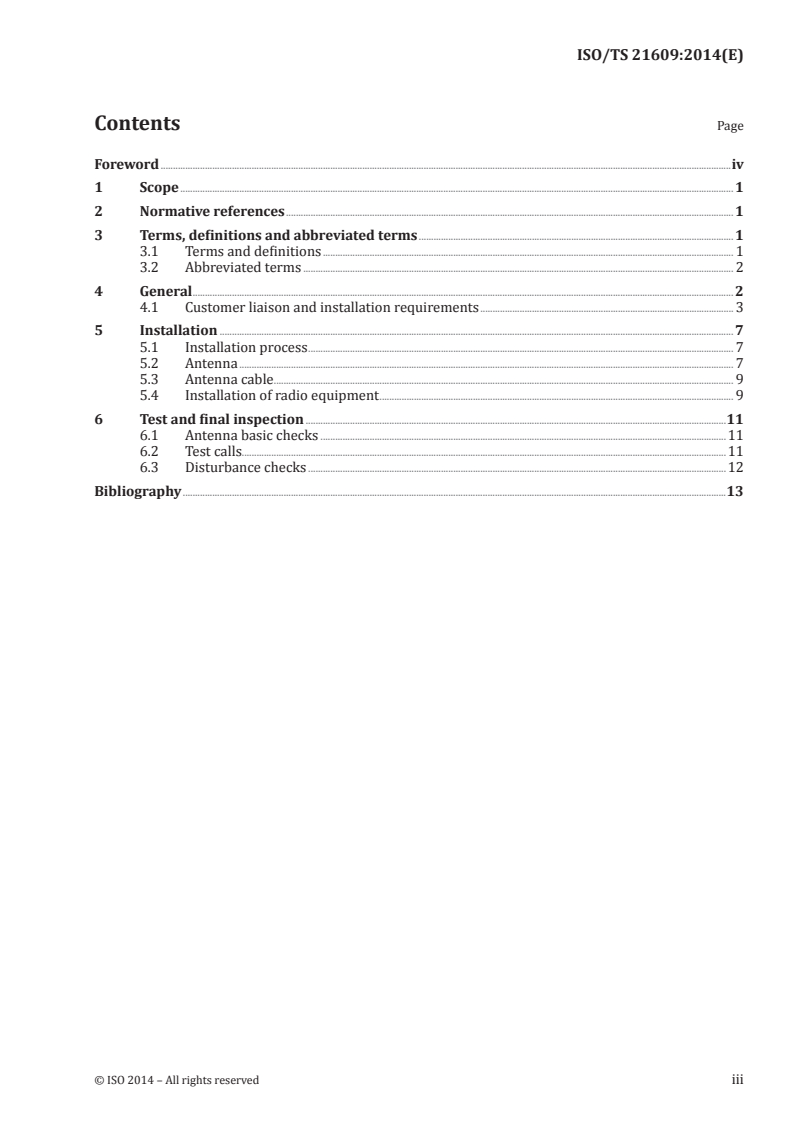
Contents Page
Foreword .iv
1 Scope . 1
2 Normative references . 1
3 Terms, definitions and abbreviated terms . 1
3.1 Terms and definitions . 1
3.2 Abbreviated terms . 2
4 General . 2
4.1 Customer liaison and installation requirements . 3
5 Installation . 7
5.1 Installation process . 7
5.2 Antenna . 7
5.3 Antenna cable . 9
5.4 Installation of radio equipment . 9
6 Test and final inspection .11
6.1 Antenna basic checks .11
6.2 Test calls.11
6.3 Disturbance checks .12
Bibliography .13
Foreword
ISO (the International Organization for Standardization) is a worldwide federation of national standards
bodies (ISO member bodies). The work of preparing International Standards is normally carried out
through ISO technical committees. Each member body interested in a subject for which a technical
committee has been established has the right to be represented on that committee. International
organizations, governmental and non-governmental, in liaison with ISO, also take part in the work.
ISO collaborates closely with the International Electrotechnical Commission (IEC) on all matters of
electrotechnical standardization.
The procedures used to develop this document and those intended for its further maintenance are
described in the ISO/IEC Directives, Part 1. In particular the different approval criteria needed for the
different types of ISO documents should be noted. This document was drafted in accordance with the
editorial rules of the ISO/IEC Directives, Part 2. www.iso.org/directives
Attention is drawn to the possibility that some of the elements of this document may be the subject of
patent rights. ISO shall not be held responsible for identifying any or all such patent rights. Details of
any patent rights identified during the development of the document will be in the Introduction and/or
on the ISO list of patent declarations received. www.iso.org/patents
Any trade name used in this document is information given for the convenience of users and does not
constitute an endorsement.
For an explanation on the meaning of ISO specific terms and expressions related to conformity
assessment, as well as information about ISO’s adherence to the WTO principles in the Technical Barriers
to Trade (TBT) see the following URL: Foreword - Supplementary information
The committee responsible for this document is ISO/TC 22, Road vehicles, Subcommittee SC 3, Electrical
and electronic equipment.
This second edition cancels and replaces the first edition (ISO/TS 21609:2003), which has been
technically revised.
iv © ISO 2014 – All rights reserved
TECHNICAL SPECIFICATION ISO/TS 21609:2014(E)
Road vehicles — (EMC) guidelines for installation of
aftermarket radio frequency transmitting equipment
1 Scope
This Technical Specification gives requirements and recommendations for the installation in road
vehicles of
— radio frequency (RF) transmitting and receiving equipment,
— “in-road-vehicle” mounting kits for transportable and hand-held RF equipment, and
— ancillary equipment associated with these.
As well as methods for installation, it establishes methods for minimizing the possibility of
electromagnetic interference (EMI) between the installed equipment and the vehicle electrical and
electronic systems.
2 Normative references
The following documents, in whole or in part, are normatively referenced in this document and are
indispensable to its application. For dated references, only the edition cited applies. For undated
references, the latest edition of the referenced document (including any amendments) applies.
IEC 60050 (all parts), International Electrotechnical Vocabulary (IEV)
3 Terms, definitions and abbreviated terms
3.1 Terms and definitions
For the purposes of this document, the terms and definitions given in IEC 60050 (all parts) and the
following terms, definitions and abbreviated terms apply.
3.1.1
mobile equipment
receiver, transmitter or transmitter/receiver (transceiver) that is intended for installation and use in a
vehicle, and powered by the main battery of the vehicle
3.1.2
ancillary equipment
any equipment required as part of the installation in addition to the radio
EXAMPLE Voltage converter
3.1.3
equipment supplier
supplier of the equipment to the installer
Note 1 to entry: The equipment supplier may be a dealer, distributor or manufacturer.
3.1.4
floating system
isolated ground return
3.1.5
ground plane
conducting plane of a minimum dimension proportional to the wavelength λ on which a panel mount
antenna is fitted
3.1.6
installer
radio equipment installation technician
3.1.7
radiating element
part of an antenna which radiates the signal
3.1.8
vehicle supplier
supplier of the vehicle, who may be a dealer or the manufacturer/importer of the vehicle
3.2 Abbreviated terms
ABS anti-blocking system
CB citizen band
ECU electronic control unit
EMC electromagnetic compatibility
EMI electromagnetic interference
HT high tension (i.e. the high voltage circuits of the ignition system)
ICE in-car entertainment
PMR private mobile radio
RF radio frequency
RFI radio frequency interference
VSWR voltage standing wave ratio
4 General
Installation of RF-transmitting equipment shall be performed by competent personnel. The vehicle and
RF transmitting equipment manufacturers’ instruction manuals and installation notes shall be followed.
NOTE Vehicle manufacturer’s instructions take priority in case of conflict.
It is the responsibility of the competent personnel to ensure the installation complies with national legal
requirements for the installation and use of RF equipment in vehicles.
Installation shall be checked for possible interference between the RF-transmitting equipment and the
vehicle electric systems in accordance with 6.3.
2 © ISO 2014 – All rights reserved
4.1 Customer liaison and installation requirements
4.1.1 General
The customer shall
— be advised to use a suitable antenna for the particular application and optimum position,
— be made aware of the various fixing locations and mounts available for the items to be fitted, and
— be asked whether or not an ignition switched supply to the equipment is required.
4.1.2 EMC requirements
After-market RF-transmitting equipment for installation in road vehicles shall fulfil the requirements of
RF-product relevant EMC standards and road vehicle standards. Contact the road vehicle manufacturer
and/or equipment supplier if necessary to ensure that the latest version is used.
The purpose of road vehicle EMC standards (see Table 1) and legal requirements (Table 2) is to ensure
— the protection of broadcast receivers in a residential environment from radio disturbances from
vehicles at distances greater than 10 m,
— that vehicle RF-receivers have sufficient protection from unwanted emissions of other electric
systems (RF-systems included) installed in the same vehicle, and
— that no vehicle functions are affected because of the susceptibility of RF-systems to radiated or
conducted disturbances.
Table 1 — ISO and IEC/CISPR EMC and RFI standards for road vehicles
Standard Title
ISO 7637 (all parts) Road vehicles — Electrical disturbances from conduction and coupling
ISO 10605 Road vehicles — Test methods for electrical disturbances from electrostatic discharge
ISO 11451 Road vehicles — Vehicle test methods for electrical disturbances from narrowband radiated
electromagnetic energy
ISO 11452 Road vehicles — Component test methods for electrical disturbances from narrowband radi-
ated electromagnetic energy
ISO 13766 Earth-moving machinery — Electromagnetic compatibility
ISO 14982 Agricultural and forestry machinery — Electromagnetic compatibility — Test methods and
acceptance criteria
CISPR 12 Vehicles, boats and internal combustion engines — Radio disturbance characteristics — Lim-
its and methods of measurement for the protection of off-board receivers
CISPR 25 Vehicles, boats and internal combustion engines — Radio disturbance characteristics — Lim-
its and methods of measurement for the protection of on-board receivers
Table 2 — Selection of EMC regulations for vehicles and equipment
Standard Title
ECE-R 10 Agreement concerning the adoption of uniform technical prescriptions for wheeled
vehicles, equipment and parts which can be fitted and/or be used on wheeled vehicles
and the conditions for reciprocal recognition of approvals granted on the basis of these
prescriptions
Uniform provisions concerning the approval of vehicles with regard to electromagnetic
compatibility
1999/5/EC Directive 1999/5/EC of the European Parliament and of the Council of 9 March 1999 on
radio equipment and telecommunications terminal equipment and the mutual recogni-
tion of their conformity
ECE-R 116 Agreement concerning the Adoption of Uniform Technical Prescriptions for Wheeled
Vehicles, Equipment and Parts which can be Fitted and/or be Used on Wheeled Vehicles
and the Conditions for Reciprocal Recognition of Approvals Granted on the Basis of these
Prescriptions
Uniform technical prescriptions concerning the protection of motor vehicles against
unauthorised use
CFR Title 47 Part 15 Telecommunication, Radio Frequency Devices
In addition to vehicle standards, RF-product specific EMC standards (see Table 3) are designed to ensure
that
— the RF-system operates in environments specified in the applicable radio EMC standard, and
— unwanted emissions are controlled to a specific level.
4.1.3 Vehicle supplier’s warranty
Installation of mobile radio equipment to any part of the vehicle, other than an authorized connection or
mounting location, might invalidate the vehicle warranty. If in doubt, the vehicle or equipment supplier
shall be consulted.
4.1.4 Electromagnetic and radio frequency interference
Full consideration shall be given to the positioning of mobile RF-transmitting equipment such that
electromagnetic interference (EMI) and radio frequency interference (RFI) is minimized between the
RF transmitting equipment being installed and the vehicle electrical and electronic systems.
Mobile equipment might include radio equipment, ancillary equipment, antenna and feeder cable.
4.1.5 Radio equipment and ancillary items
Prior to the installation of the radio equipment or any other ancillary items, it is essential that the
vehicle manufacturer’s and equipment supplier’s instructions be followed, in order to ensure that the
safe operation of the vehicle is not impaired.
Care shall be taken when planning the installation that any additional equipment used does not constitute
a safety hazard and does not contravene safety regulations.
Care shall be taken to ensure that any microphone/handset lead is not installed such that the lead can
interfere with the vehicle controls or driver.
Where a hand portable or transportable unit is installed in road vehicles, the correct car adapter kit
specified for the product shall be used.
4 © ISO 2014 – All rights reserved
Table 3 — Selection of EMC product standards for RF equipment
Standard Title
EN 301 489–1 Electromagnetic compatibility and Radio spectrum Matters (ERM); ElectroMagnetic
Compatibility (EMC) standard for radio equipment and services; Part 1: Common technical
requirements
EN 301 489–2 Electromagnetic compatibility and Radio spectrum Matters (ERM); ElectroMagnetic Com-
patibility (EMC) standard for radio equipment and services; Part 2: Specific conditions for
radio paging equipment
EN 301 489–3 Electromagnetic compatibility and Radio spectrum Matters (ERM); ElectroMagnetic Com-
patibility (EMC) standard for radio equipment and services; Part 3: Specific conditions for
Short-Range Devices (SRD) operating on frequencies between 9 kHz and 40 GHz
EN 301 489–4 Electromagnetic compatibility and Radio spectrum Matters (ERM); ElectroMagnetic Com-
patibility (EMC) standard for radio equipment and services; Part 4: Specific conditions for
fixed radio links, Broadband Data Transmission System Base stations, ancillary equipment
and services
EN 301 489–5 Electromagnetic compatibility and Radio spectrum Matters (ERM); ElectroMagnetic Com-
patibility (EMC) standard for radio equipment and services; Part 5: Specific conditions for
Private land Mobile Radio (PMR) and ancillary equipment (speech and non-speech)
EN 301 489–6 Electromagnetic compatibility and Radio spectrum Matters (ERM); ElectroMagnetic Com-
patibility (EMC) standard for radio equipment and services; Part 6: Specific conditions for
Digital Enhanced Cordless Telecommunications (DECT) equipment
EN 301 489–7 Electromagnetic compatibility and Radio spectrum Matters (ERM); ElectroMagnetic Com-
patibility (EMC) standard for radio equipment and services; Part 7: Specific conditions for
mobile and portable radio and ancillary equipment of digital cellular radio telecommunica-
tions systems (GSM and DCS)
EN 301 489–8 Electromagnetic compatibility and Radio spectrum Matters (ERM); ElectroMagnetic Com-
patibility (EMC) standard for radio equipment and services; Part 8: Specific conditions for
GSM base stations
EN 301 489–9 Electromagnetic compatibility and Radio spectrum Matters (ERM); ElectroMagnetic Com-
patibility (EMC) standard for radio equipment and services; Part 9: Specific conditions for
wireless microphones, similar Radio Frequency (RF) audio link equipment, cordless audio
and in-ear monitoring devices
EN 301 489–10 Electromagnetic compatibility and Radio spectrum Matters (ERM); ElectroMagnetic Com-
patibility (EMC) standard for radio equipment and services; Part 10: Specific conditions for
First (CT1 and CT1+) and Second Generation Cordless Telephone (CT2) equipment
EN 301 489–11 Electromagnetic compatibility and Radio spectrum Matters (ERM); ElectroMagnetic Com-
patibility (EMC) standard for radio equipment and services; Part 11: Specific conditions for
terrestrial sound broadcasting services transmiters
EN 301 489–12 Electromagnetic compatibility and Radio spectrum Matters (ERM); ElectroMagnetic
Compatibility (EMC) standard for radio equipment and services; Part 12: Specific condi-
tions for Very Small Aperture Terminal, Satellite Interactive Earth Stations operated in the
frequency ranges between 4 GHz and 30 GHz in the Fixed Satellite Service (FSS)
EN 301 489–13 Electromagnetic compatibility and Radio spectrum Matters (ERM); ElectroMagnetic Com-
patibility (EMC) standard for radio equipment and services; Part 13: Specific conditions for
Citizens’ Band (CB) radio and ancillary equipment (speech and non-speech)
EN 301 489–14 Electromagnetic compatibility and Radio spectrum Matters (ERM); ElectroMagnetic Com-
patibility (EMC) standard for radio equipment and services; Part 14: Specific conditions for
analogue and digital terrestrial TV broadcasting service transmitters
EN 301 489–15 Electromagnetic compatibility and Radio spectrum Matters (ERM); ElectroMagnetic Com-
patibility (EMC) standard for radio equipment and services; Part 15: Specific conditions for
commercially available amateur radio equipment
EN 301 489–16 Electromagnetic compatibility and Radio spectrum Matters (ERM); ElectroMagnetic Com-
patibility (EMC) standard for radio equipment and services; Part 16: Specific conditions for
analogue cellular radio communications equipment, mobile and portable
Table 3 (continued)
Standard Title
EN 301 489–17 Electromagnetic compatibility and Radio spectrum Matters (ERM); ElectroMagnetic Com-
patibility (EMC) standard for radio equipment and services; Part 17: Specific conditions for
broadband data transmission systems
EN 301 489–18 Electromagnetic compatibility and Radio spectrum Matters (ERM); ElectroMagnetic Com-
patibility (EMC) standard for radio equipment and services; Part 18: Specific conditions for
Terrestrial Trunked Radio (TETRA) equipment
EN 301 489–19 Electromagnetic compatibility and Radio spectrum Matters (ERM); ElectroMagnetic Com-
patibility (EMC) standard for radio equipment and services; Part 19: Specific conditions for
Received Only Mobile Earth Stations (ROMES) operating in the 1,5 GHz band providing data
communications
EN 301 489–20 Electromagnetic compatibility and Radio spectrum Matters (ERM); ElectroMagnetic Com-
patibility (EMC) standard for radio equipment and services; Part 20: Specific conditions for
Mobile Earth Stations (MES) used in the Mobile Satellite Services (MSS)
EN 301 489–22 Electromagnetic compatibility and Radio spectrum Matters (ERM); ElectroMagnetic Com-
patibility (EMC) standard for radio equipment and services; Part 22: Specific conditions for
ground based VHF aeronautical mobile and fixed radio equipment
EN 301 489–23 Electromagnetic compatibility and Radio spectrum Matters (ERM); ElectroMagnetic Com-
patibility (EMC) standard for radio equipment and services; Part 23: Specific conditions for
IMT–2000 CDMA Direct Spread (UTRA and E-UTRA) Base Station (BS) radio, repeater and
ancillary equipment
EN 301 489–24 Electromagnetic compatibility and Radio spectrum Matters (ERM); ElectroMagnetic Com-
patibility (EMC) standard for radio equipment and services; Part 24: Specific conditions for
IMT–2000 CDMA Direct Spread (UTRA and E-UTRA) for mobile and portable (UE) radio and
ancillary equipment
EN 301 489–25 Electromagnetic compatibility and Radio spectrum Matters (ERM); ElectroMagnetic Com-
patibility (EMC) standard for radio equipment and services; Part 25: Specific conditions for
CDMA 1x spread spectrum mobile stations and ancillary equipment
EN 301 489–26 Electromagnetic compatibility and Radio spectrum Matters (ERM); ElectroMagnetic Com-
patibility (EMC) standard for radio equipment and services; Part 26: Specific conditions for
CDMA 1x spread spectrum base stations, repeaters and ancillary equipment
EN 301 489–27 Electromagnetic compatibility and Radio spectrum Matters (ERM); ElectroMagnetic Com-
patibility (EMC) standard for radio equipment and services; Part 27: Specific conditions for
Ultra Low Power Active Medical Implants (ULP–AMI) and related peripheral devices (ULP–
AMI–P)
EN 301 489–28 Electromagnetic compatibility and Radio spectrum Matters (ERM); ElectroMagnetic Com-
patibility (EMC) standard for radio equipment and services; Part 28: Specific conditions for
wireless digital video links
EN 301 489–29 Electromagnetic compatibility and Radio spectrum Matters (ERM); ElectroMagnetic Com-
patibility (EMC) standard for radio equipment and services; Part 29: Specific conditions for
Medical Data Service Devices (MEDS) operating in the 401 MHz to 402 MHz and 405 MHz
to 406 MHz bands
EN 301 489–31 Electromagnetic compatibility and Radio spectrum Matters (ERM); ElectroMagnetic Com-
patibility (EMC) standard for radio equipment and services; Part 31: Specific conditions
for equipment in the 9 kHz to 315 kHz band for Ultra Low Power Active Medical Implants
(ULP–AMI) and related peripheral devices (ULP–AMI–P)
EN 301 489–32 Electromagnetic compatibility and Radio spectrum Matters (ERM); ElectroMagnetic Com-
patibility (EMC) standard for radio equipment and services; Part 32: Specific conditions for
ground and wall probing radar applications
EN 301 489–33 Electromagnetic compatibility and Radio spectrum Matters (ERM); ElectroMagnetic Com-
patibility (EMC) standard for radio equipment and services; Part 33: Specific conditions for
Ultra Wide Band (UWB) communications devices
6 © ISO 2014 – All rights reserved
Table 3 (continued)
Standard Title
EN 301 489–34 Electromagnetic compatibility and Radio spectrum Matters (ERM); ElectroMagnetic Com-
patibility (EMC) standard for radio equipment and services; Part 34: Specific conditions for
External Power Supply (EPS) for mobile phones
RSS-119 Radio-transmitters and receivers operating in the Land mobile and fixed services in the
frequency range 27,41 − 960 MHz
RSS-128 800 MHz Dual-mode TDMA cellular telephones
RSS-129 800 MHz Dual-mode CDMA cellular telephones
RSS-136 Land and mobile station radiotelephone transmitters and receivers operating in the 26,960
– 27,410 MHz general radio service band
5 Installation
5.1 Installation process
Care shall be taken in
— choosing the antenna,
— mounting it in a recommended location,
— installing it correctly,
— ensuring that all connections in the antenna feeder are sealed to prevent dirt and water from
entering the feeder and affecting its performance,
— ensuring that all connec
...
TECHNICAL ISO/TS
SPECIFICATION 21609
Second edition
2014-04-15
Road vehicles — (EMC) guidelines
for installation of aftermarket radio
frequency transmitting equipment
Véhicules routiers — Guide sur la compatibilité électromagnétique
(CEM) pour l’installation en seconde monte d’équipements radio-
téléphone
Reference number
©
ISO 2014
© ISO 2014
All rights reserved. Unless otherwise specified, no part of this publication may be reproduced or utilized otherwise in any form
or by any means, electronic or mechanical, including photocopying, or posting on the internet or an intranet, without prior
written permission. Permission can be requested from either ISO at the address below or ISO’s member body in the country of
the requester.
ISO copyright office
Case postale 56 • CH-1211 Geneva 20
Tel. + 41 22 749 01 11
Fax + 41 22 749 09 47
E-mail copyright@iso.org
Web www.iso.org
Published in Switzerland
ii © ISO 2014 – All rights reserved
Contents Page
Foreword .iv
1 Scope . 1
2 Normative references . 1
3 Terms, definitions and abbreviated terms . 1
3.1 Terms and definitions . 1
3.2 Abbreviated terms . 2
4 General . 2
4.1 Customer liaison and installation requirements . 3
5 Installation . 7
5.1 Installation process . 7
5.2 Antenna . 7
5.3 Antenna cable . 9
5.4 Installation of radio equipment . 9
6 Test and final inspection .11
6.1 Antenna basic checks .11
6.2 Test calls.11
6.3 Disturbance checks .12
Bibliography .13
Foreword
ISO (the International Organization for Standardization) is a worldwide federation of national standards
bodies (ISO member bodies). The work of preparing International Standards is normally carried out
through ISO technical committees. Each member body interested in a subject for which a technical
committee has been established has the right to be represented on that committee. International
organizations, governmental and non-governmental, in liaison with ISO, also take part in the work.
ISO collaborates closely with the International Electrotechnical Commission (IEC) on all matters of
electrotechnical standardization.
The procedures used to develop this document and those intended for its further maintenance are
described in the ISO/IEC Directives, Part 1. In particular the different approval criteria needed for the
different types of ISO documents should be noted. This document was drafted in accordance with the
editorial rules of the ISO/IEC Directives, Part 2. www.iso.org/directives
Attention is drawn to the possibility that some of the elements of this document may be the subject of
patent rights. ISO shall not be held responsible for identifying any or all such patent rights. Details of
any patent rights identified during the development of the document will be in the Introduction and/or
on the ISO list of patent declarations received. www.iso.org/patents
Any trade name used in this document is information given for the convenience of users and does not
constitute an endorsement.
For an explanation on the meaning of ISO specific terms and expressions related to conformity
assessment, as well as information about ISO’s adherence to the WTO principles in the Technical Barriers
to Trade (TBT) see the following URL: Foreword - Supplementary information
The committee responsible for this document is ISO/TC 22, Road vehicles, Subcommittee SC 3, Electrical
and electronic equipment.
This second edition cancels and replaces the first edition (ISO/TS 21609:2003), which has been
technically revised.
iv © ISO 2014 – All rights reserved
TECHNICAL SPECIFICATION ISO/TS 21609:2014(E)
Road vehicles — (EMC) guidelines for installation of
aftermarket radio frequency transmitting equipment
1 Scope
This Technical Specification gives requirements and recommendations for the installation in road
vehicles of
— radio frequency (RF) transmitting and receiving equipment,
— “in-road-vehicle” mounting kits for transportable and hand-held RF equipment, and
— ancillary equipment associated with these.
As well as methods for installation, it establishes methods for minimizing the possibility of
electromagnetic interference (EMI) between the installed equipment and the vehicle electrical and
electronic systems.
2 Normative references
The following documents, in whole or in part, are normatively referenced in this document and are
indispensable to its application. For dated references, only the edition cited applies. For undated
references, the latest edition of the referenced document (including any amendments) applies.
IEC 60050 (all parts), International Electrotechnical Vocabulary (IEV)
3 Terms, definitions and abbreviated terms
3.1 Terms and definitions
For the purposes of this document, the terms and definitions given in IEC 60050 (all parts) and the
following terms, definitions and abbreviated terms apply.
3.1.1
mobile equipment
receiver, transmitter or transmitter/receiver (transceiver) that is intended for installation and use in a
vehicle, and powered by the main battery of the vehicle
3.1.2
ancillary equipment
any equipment required as part of the installation in addition to the radio
EXAMPLE Voltage converter
3.1.3
equipment supplier
supplier of the equipment to the installer
Note 1 to entry: The equipment supplier may be a dealer, distributor or manufacturer.
3.1.4
floating system
isolated ground return
3.1.5
ground plane
conducting plane of a minimum dimension proportional to the wavelength λ on which a panel mount
antenna is fitted
3.1.6
installer
radio equipment installation technician
3.1.7
radiating element
part of an antenna which radiates the signal
3.1.8
vehicle supplier
supplier of the vehicle, who may be a dealer or the manufacturer/importer of the vehicle
3.2 Abbreviated terms
ABS anti-blocking system
CB citizen band
ECU electronic control unit
EMC electromagnetic compatibility
EMI electromagnetic interference
HT high tension (i.e. the high voltage circuits of the ignition system)
ICE in-car entertainment
PMR private mobile radio
RF radio frequency
RFI radio frequency interference
VSWR voltage standing wave ratio
4 General
Installation of RF-transmitting equipment shall be performed by competent personnel. The vehicle and
RF transmitting equipment manufacturers’ instruction manuals and installation notes shall be followed.
NOTE Vehicle manufacturer’s instructions take priority in case of conflict.
It is the responsibility of the competent personnel to ensure the installation complies with national legal
requirements for the installation and use of RF equipment in vehicles.
Installation shall be checked for possible interference between the RF-transmitting equipment and the
vehicle electric systems in accordance with 6.3.
2 © ISO 2014 – All rights reserved
4.1 Customer liaison and installation requirements
4.1.1 General
The customer shall
— be advised to use a suitable antenna for the particular application and optimum position,
— be made aware of the various fixing locations and mounts available for the items to be fitted, and
— be asked whether or not an ignition switched supply to the equipment is required.
4.1.2 EMC requirements
After-market RF-transmitting equipment for installation in road vehicles shall fulfil the requirements of
RF-product relevant EMC standards and road vehicle standards. Contact the road vehicle manufacturer
and/or equipment supplier if necessary to ensure that the latest version is used.
The purpose of road vehicle EMC standards (see Table 1) and legal requirements (Table 2) is to ensure
— the protection of broadcast receivers in a residential environment from radio disturbances from
vehicles at distances greater than 10 m,
— that vehicle RF-receivers have sufficient protection from unwanted emissions of other electric
systems (RF-systems included) installed in the same vehicle, and
— that no vehicle functions are affected because of the susceptibility of RF-systems to radiated or
conducted disturbances.
Table 1 — ISO and IEC/CISPR EMC and RFI standards for road vehicles
Standard Title
ISO 7637 (all parts) Road vehicles — Electrical disturbances from conduction and coupling
ISO 10605 Road vehicles — Test methods for electrical disturbances from electrostatic discharge
ISO 11451 Road vehicles — Vehicle test methods for electrical disturbances from narrowband radiated
electromagnetic energy
ISO 11452 Road vehicles — Component test methods for electrical disturbances from narrowband radi-
ated electromagnetic energy
ISO 13766 Earth-moving machinery — Electromagnetic compatibility
ISO 14982 Agricultural and forestry machinery — Electromagnetic compatibility — Test methods and
acceptance criteria
CISPR 12 Vehicles, boats and internal combustion engines — Radio disturbance characteristics — Lim-
its and methods of measurement for the protection of off-board receivers
CISPR 25 Vehicles, boats and internal combustion engines — Radio disturbance characteristics — Lim-
its and methods of measurement for the protection of on-board receivers
Table 2 — Selection of EMC regulations for vehicles and equipment
Standard Title
ECE-R 10 Agreement concerning the adoption of uniform technical prescriptions for wheeled
vehicles, equipment and parts which can be fitted and/or be used on wheeled vehicles
and the conditions for reciprocal recognition of approvals granted on the basis of these
prescriptions
Uniform provisions concerning the approval of vehicles with regard to electromagnetic
compatibility
1999/5/EC Directive 1999/5/EC of the European Parliament and of the Council of 9 March 1999 on
radio equipment and telecommunications terminal equipment and the mutual recogni-
tion of their conformity
ECE-R 116 Agreement concerning the Adoption of Uniform Technical Prescriptions for Wheeled
Vehicles, Equipment and Parts which can be Fitted and/or be Used on Wheeled Vehicles
and the Conditions for Reciprocal Recognition of Approvals Granted on the Basis of these
Prescriptions
Uniform technical prescriptions concerning the protection of motor vehicles against
unauthorised use
CFR Title 47 Part 15 Telecommunication, Radio Frequency Devices
In addition to vehicle standards, RF-product specific EMC standards (see Table 3) are designed to ensure
that
— the RF-system operates in environments specified in the applicable radio EMC standard, and
— unwanted emissions are controlled to a specific level.
4.1.3 Vehicle supplier’s warranty
Installation of mobile radio equipment to any part of the vehicle, other than an authorized connection or
mounting location, might invalidate the vehicle warranty. If in doubt, the vehicle or equipment supplier
shall be consulted.
4.1.4 Electromagnetic and radio frequency interference
Full consideration shall be given to the positioning of mobile RF-transmitting equipment such that
electromagnetic interference (EMI) and radio frequency interference (RFI) is minimized between the
RF transmitting equipment being installed and the vehicle electrical and electronic systems.
Mobile equipment might include radio equipment, ancillary equipment, antenna and feeder cable.
4.1.5 Radio equipment and ancillary items
Prior to the installation of the radio equipment or any other ancillary items, it is essential that the
vehicle manufacturer’s and equipment supplier’s instructions be followed, in order to ensure that the
safe operation of the vehicle is not impaired.
Care shall be taken when planning the installation that any additional equipment used does not constitute
a safety hazard and does not contravene safety regulations.
Care shall be taken to ensure that any microphone/handset lead is not installed such that the lead can
interfere with the vehicle controls or driver.
Where a hand portable or transportable unit is installed in road vehicles, the correct car adapter kit
specified for the product shall be used.
4 © ISO 2014 – All rights reserved
Table 3 — Selection of EMC product standards for RF equipment
Standard Title
EN 301 489–1 Electromagnetic compatibility and Radio spectrum Matters (ERM); ElectroMagnetic
Compatibility (EMC) standard for radio equipment and services; Part 1: Common technical
requirements
EN 301 489–2 Electromagnetic compatibility and Radio spectrum Matters (ERM); ElectroMagnetic Com-
patibility (EMC) standard for radio equipment and services; Part 2: Specific conditions for
radio paging equipment
EN 301 489–3 Electromagnetic compatibility and Radio spectrum Matters (ERM); ElectroMagnetic Com-
patibility (EMC) standard for radio equipment and services; Part 3: Specific conditions for
Short-Range Devices (SRD) operating on frequencies between 9 kHz and 40 GHz
EN 301 489–4 Electromagnetic compatibility and Radio spectrum Matters (ERM); ElectroMagnetic Com-
patibility (EMC) standard for radio equipment and services; Part 4: Specific conditions for
fixed radio links, Broadband Data Transmission System Base stations, ancillary equipment
and services
EN 301 489–5 Electromagnetic compatibility and Radio spectrum Matters (ERM); ElectroMagnetic Com-
patibility (EMC) standard for radio equipment and services; Part 5: Specific conditions for
Private land Mobile Radio (PMR) and ancillary equipment (speech and non-speech)
EN 301 489–6 Electromagnetic compatibility and Radio spectrum Matters (ERM); ElectroMagnetic Com-
patibility (EMC) standard for radio equipment and services; Part 6: Specific conditions for
Digital Enhanced Cordless Telecommunications (DECT) equipment
EN 301 489–7 Electromagnetic compatibility and Radio spectrum Matters (ERM); ElectroMagnetic Com-
patibility (EMC) standard for radio equipment and services; Part 7: Specific conditions for
mobile and portable radio and ancillary equipment of digital cellular radio telecommunica-
tions systems (GSM and DCS)
EN 301 489–8 Electromagnetic compatibility and Radio spectrum Matters (ERM); ElectroMagnetic Com-
patibility (EMC) standard for radio equipment and services; Part 8: Specific conditions for
GSM base stations
EN 301 489–9 Electromagnetic compatibility and Radio spectrum Matters (ERM); ElectroMagnetic Com-
patibility (EMC) standard for radio equipment and services; Part 9: Specific conditions for
wireless microphones, similar Radio Frequency (RF) audio link equipment, cordless audio
and in-ear monitoring devices
EN 301 489–10 Electromagnetic compatibility and Radio spectrum Matters (ERM); ElectroMagnetic Com-
patibility (EMC) standard for radio equipment and services; Part 10: Specific conditions for
First (CT1 and CT1+) and Second Generation Cordless Telephone (CT2) equipment
EN 301 489–11 Electromagnetic compatibility and Radio spectrum Matters (ERM); ElectroMagnetic Com-
patibility (EMC) standard for radio equipment and services; Part 11: Specific conditions for
terrestrial sound broadcasting services transmiters
EN 301 489–12 Electromagnetic compatibility and Radio spectrum Matters (ERM); ElectroMagnetic
Compatibility (EMC) standard for radio equipment and services; Part 12: Specific condi-
tions for Very Small Aperture Terminal, Satellite Interactive Earth Stations operated in the
frequency ranges between 4 GHz and 30 GHz in the Fixed Satellite Service (FSS)
EN 301 489–13 Electromagnetic compatibility and Radio spectrum Matters (ERM); ElectroMagnetic Com-
patibility (EMC) standard for radio equipment and services; Part 13: Specific conditions for
Citizens’ Band (CB) radio and ancillary equipment (speech and non-speech)
EN 301 489–14 Electromagnetic compatibility and Radio spectrum Matters (ERM); ElectroMagnetic Com-
patibility (EMC) standard for radio equipment and services; Part 14: Specific conditions for
analogue and digital terrestrial TV broadcasting service transmitters
EN 301 489–15 Electromagnetic compatibility and Radio spectrum Matters (ERM); ElectroMagnetic Com-
patibility (EMC) standard for radio equipment and services; Part 15: Specific conditions for
commercially available amateur radio equipment
EN 301 489–16 Electromagnetic compatibility and Radio spectrum Matters (ERM); ElectroMagnetic Com-
patibility (EMC) standard for radio equipment and services; Part 16: Specific conditions for
analogue cellular radio communications equipment, mobile and portable
Table 3 (continued)
Standard Title
EN 301 489–17 Electromagnetic compatibility and Radio spectrum Matters (ERM); ElectroMagnetic Com-
patibility (EMC) standard for radio equipment and services; Part 17: Specific conditions for
broadband data transmission systems
EN 301 489–18 Electromagnetic compatibility and Radio spectrum Matters (ERM); ElectroMagnetic Com-
patibility (EMC) standard for radio equipment and services; Part 18: Specific conditions for
Terrestrial Trunked Radio (TETRA) equipment
EN 301 489–19 Electromagnetic compatibility and Radio spectrum Matters (ERM); ElectroMagnetic Com-
patibility (EMC) standard for radio equipment and services; Part 19: Specific conditions for
Received Only Mobile Earth Stations (ROMES) operating in the 1,5 GHz band providing data
communications
EN 301 489–20 Electromagnetic compatibility and Radio spectrum Matters (ERM); ElectroMagnetic Com-
patibility (EMC) standard for radio equipment and services; Part 20: Specific conditions for
Mobile Earth Stations (MES) used in the Mobile Satellite Services (MSS)
EN 301 489–22 Electromagnetic compatibility and Radio spectrum Matters (ERM); ElectroMagnetic Com-
patibility (EMC) standard for radio equipment and services; Part 22: Specific conditions for
ground based VHF aeronautical mobile and fixed radio equipment
EN 301 489–23 Electromagnetic compatibility and Radio spectrum Matters (ERM); ElectroMagnetic Com-
patibility (EMC) standard for radio equipment and services; Part 23: Specific conditions for
IMT–2000 CDMA Direct Spread (UTRA and E-UTRA) Base Station (BS) radio, repeater and
ancillary equipment
EN 301 489–24 Electromagnetic compatibility and Radio spectrum Matters (ERM); ElectroMagnetic Com-
patibility (EMC) standard for radio equipment and services; Part 24: Specific conditions for
IMT–2000 CDMA Direct Spread (UTRA and E-UTRA) for mobile and portable (UE) radio and
ancillary equipment
EN 301 489–25 Electromagnetic compatibility and Radio spectrum Matters (ERM); ElectroMagnetic Com-
patibility (EMC) standard for radio equipment and services; Part 25: Specific conditions for
CDMA 1x spread spectrum mobile stations and ancillary equipment
EN 301 489–26 Electromagnetic compatibility and Radio spectrum Matters (ERM); ElectroMagnetic Com-
patibility (EMC) standard for radio equipment and services; Part 26: Specific conditions for
CDMA 1x spread spectrum base stations, repeaters and ancillary equipment
EN 301 489–27 Electromagnetic compatibility and Radio spectrum Matters (ERM); ElectroMagnetic Com-
patibility (EMC) standard for radio equipment and services; Part 27: Specific conditions for
Ultra Low Power Active Medical Implants (ULP–AMI) and related peripheral devices (ULP–
AMI–P)
EN 301 489–28 Electromagnetic compatibility and Radio spectrum Matters (ERM); ElectroMagnetic Com-
patibility (EMC) standard for radio equipment and services; Part 28: Specific conditions for
wireless digital video links
EN 301 489–29 Electromagnetic compatibility and Radio spectrum Matters (ERM); ElectroMagnetic Com-
patibility (EMC) standard for radio equipment and services; Part 29: Specific conditions for
Medical Data Service Devices (MEDS) operating in the 401 MHz to 402 MHz and 405 MHz
to 406 MHz bands
EN 301 489–31 Electromagnetic compatibility and Radio spectrum Matters (ERM); ElectroMagnetic Com-
patibility (EMC) standard for radio equipment and services; Part 31: Specific conditions
for equipment in the 9 kHz to 315 kHz band for Ultra Low Power Active Medical Implants
(ULP–AMI) and related peripheral devices (ULP–AMI–P)
EN 301 489–32 Electromagnetic compatibility and Radio spectrum Matters (ERM); ElectroMagnetic Com-
patibility (EMC) standard for radio equipment and services; Part 32: Specific conditions for
ground and wall probing radar applications
EN 301 489–33 Electromagnetic compatibility and Radio spectrum Matters (ERM); ElectroMagnetic Com-
patibility (EMC) standard for radio equipment and services; Part 33: Specific conditions for
Ultra Wide Band (UWB) communications devices
6 © ISO 2014 – All rights reserved
Table 3 (continued)
Standard Title
EN 301 489–34 Electromagnetic compatibility and Radio spectrum Matters (ERM); ElectroMagnetic Com-
patibility (EMC) standard for radio equipment and services; Part 34: Specific conditions for
External Power Supply (EPS) for mobile phones
RSS-119 Radio-transmitters and receivers operating in the Land mobile and fixed services in the
frequency range 27,41 − 960 MHz
RSS-128 800 MHz Dual-mode TDMA cellular telephones
RSS-129 800 MHz Dual-mode CDMA cellular telephones
RSS-136 Land and mobile station radiotelephone transmitters and receivers operating in the 26,960
– 27,410 MHz general radio service band
5 Installation
5.1 Installation process
Care shall be taken in
— choosing the antenna,
— mounting it in a recommended location,
— installing it correctly,
— ensuring that all connections in the antenna feeder are sealed to prevent dirt and water from
entering the feeder and affecting its performance,
— ensuring that all connec
...