

ISO 17717:2024
(Main)Meteorological balloons — Specification
General Information
- Abstract
This document specifies the minimum requirements and the test methods for meteorological balloons made from natural rubber latex or natural rubber latex compounded with synthetic rubber emulsion. This document applies to two types of balloons: — Type 1: meteorological balloon by dipping process; — Type 2: meteorological balloon by moulding process.
- Status
- Published
- Publication Date
- 07-Apr-2024
- Technical Committee
- ISO/TC 45/SC 4 - Products (other than hoses)
- Drafting Committee
- ISO/TC 45/SC 4 - Products (other than hoses)
- Current Stage
- 6060 - International Standard published
- Start Date
- 08-Apr-2024
- Due Date
- 01-Nov-2024
- Completion Date
- 08-Apr-2024
Overview
ISO 17717:2024 - Meteorological balloons - Specification defines minimum requirements and test methods for meteorological balloons manufactured from natural rubber latex or natural latex compounded with synthetic rubber emulsion. The standard covers two production types: Type 1 (dipping process) and Type 2 (moulding process), and replaces the 2017 edition with technical revisions including expanded size ranges and updated sampling/test requirements.
Key topics and technical requirements
- Scope and balloon types: Applies to dipping and moulded meteorological balloons made of natural rubber latex (with or without synthetic emulsion).
- Appearance and defects: Visual acceptance criteria (Annex A) and inflatable inspection (Annex B) specify allowed/forbidden defects (e.g., holes, cracking, grease marks, air bubbles, thin spots, permanent creases).
- Size, mass and dimensions: Detailed tables provide size classes (from small ~10 g to large ~3 000 g), mass tolerances, body length, body thickness, neck diameter/length/thickness for both Type 1 and Type 2 balloons.
- Tensile properties: Test method per ISO 37 using dumb-bell specimens. Required minimums:
- Tensile strength before ageing: ≥ 17.0 MPa
- Elongation at break before ageing: ≥ 600%
- After accelerated ageing (per ISO 188: 8 h @ 100 °C or 168 h @ 70 °C): tensile strength ≥ 16.0 MPa, elongation ≥ 600%
- Bursting diameters: Burst tests defined in Annex E; specified bursting diameters listed separately for Type 1 and Type 2.
- Ozone resistance and ageing: Ozone ageing test methods described (Annex F) and requirements for retained properties after exposure.
- Sampling, packing and marking: Sampling plans reference ISO 2859‑1; requirements for packing, marking, transport and storage are included.
- Normative test annexes: Annexes C–F give prescriptive test methods for mass, dimensions, burst testing and ozone ageing.
Practical applications
- Ensures consistent quality and interchangeability of meteorological sounding balloons used in radiosonde launches and atmospheric research.
- Provides manufacturers with clear production tolerances and lab test protocols for quality control.
- Enables procurement teams and national meteorological services to specify and accept balloon shipments based on reproducible criteria.
- Guides test laboratories on validated methods for tensile testing, burst testing and ageing assessments.
Who should use ISO 17717:2024
- Balloon manufacturers and compounders (quality/production engineers)
- Meteorological agencies and research institutions (procurement/specification writers)
- Test laboratories and conformity assessment bodies
- Suppliers of atmospheric sounding equipment
Related standards (normative references)
- ISO 37 - Rubber - Determination of tensile stress‑strain properties
- ISO 188 - Rubber - Accelerated ageing and heat resistance tests
- ISO 2859‑1 - Sampling procedures for inspection by attributes
For implementation or purchase, consult your national standards body or ISO (www.iso.org).
Relations
- Effective Date
- 06-Jun-2022
Get Certified
Connect with accredited certification bodies for this standard

DIN CERTCO
DIN Group product certification.

Smithers Quality Assessments
US management systems and product certification.
Sponsored listings
Frequently Asked Questions
ISO 17717:2024 is a standard published by the International Organization for Standardization (ISO). Its full title is "Meteorological balloons — Specification". This standard covers: This document specifies the minimum requirements and the test methods for meteorological balloons made from natural rubber latex or natural rubber latex compounded with synthetic rubber emulsion. This document applies to two types of balloons: — Type 1: meteorological balloon by dipping process; — Type 2: meteorological balloon by moulding process.
This document specifies the minimum requirements and the test methods for meteorological balloons made from natural rubber latex or natural rubber latex compounded with synthetic rubber emulsion. This document applies to two types of balloons: — Type 1: meteorological balloon by dipping process; — Type 2: meteorological balloon by moulding process.
ISO 17717:2024 is classified under the following ICS (International Classification for Standards) categories: 07.060 - Geology. Meteorology. Hydrology; 83.140.99 - Other rubber and plastics products. The ICS classification helps identify the subject area and facilitates finding related standards.
ISO 17717:2024 has the following relationships with other standards: It is inter standard links to ISO 17717:2017. Understanding these relationships helps ensure you are using the most current and applicable version of the standard.
ISO 17717:2024 is available in PDF format for immediate download after purchase. The document can be added to your cart and obtained through the secure checkout process. Digital delivery ensures instant access to the complete standard document.
Standards Content (Sample)
International
Standard
ISO 17717
Second edition
Meteorological balloons —
2024-04
Specification
Ballons météorologiques — Spécifications
Reference number
© ISO 2024
All rights reserved. Unless otherwise specified, or required in the context of its implementation, no part of this publication may
be reproduced or utilized otherwise in any form or by any means, electronic or mechanical, including photocopying, or posting on
the internet or an intranet, without prior written permission. Permission can be requested from either ISO at the address below
or ISO’s member body in the country of the requester.
ISO copyright office
CP 401 • Ch. de Blandonnet 8
CH-1214 Vernier, Geneva
Phone: +41 22 749 01 11
Email: copyright@iso.org
Website: www.iso.org
Published in Switzerland
ii
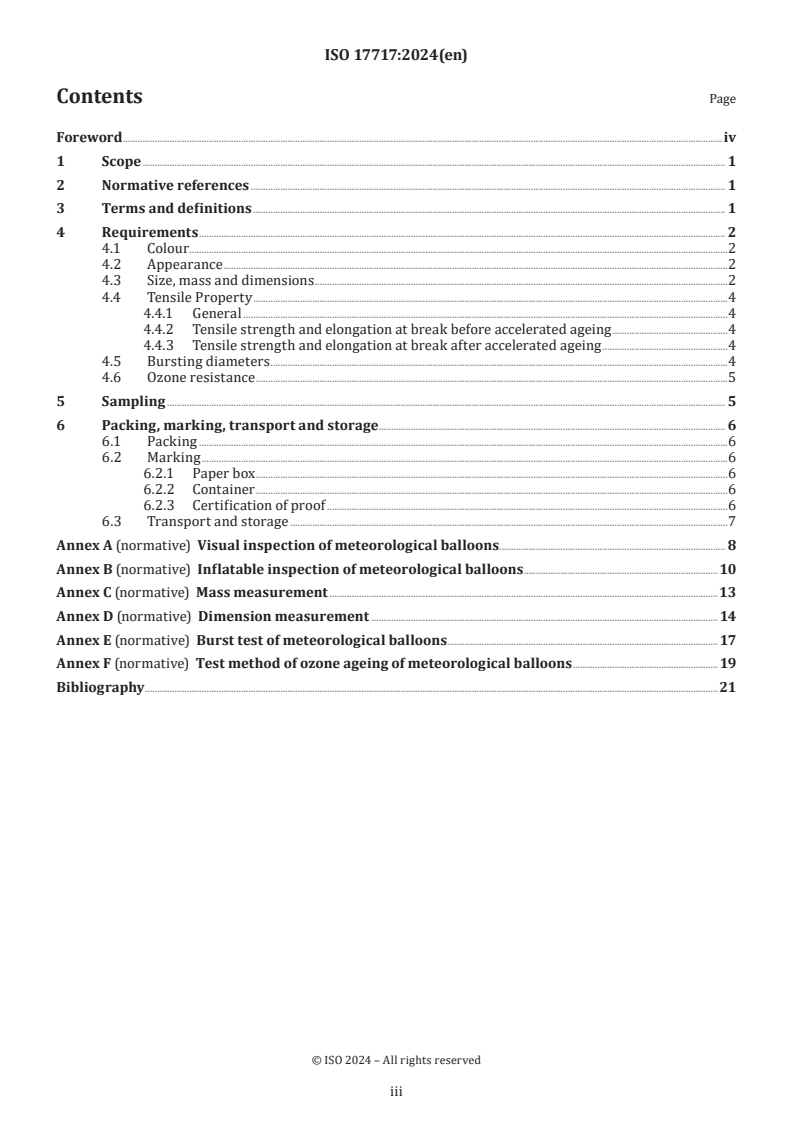
Contents Page
Foreword .iv
1 Scope . 1
2 Normative references . 1
3 Terms and definitions . 1
4 Requirements . 2
4.1 Colour .2
4.2 Appearance .2
4.3 Size, mass and dimensions .2
4.4 Tensile Property .4
4.4.1 General .4
4.4.2 Tensile strength and elongation at break before accelerated ageing .4
4.4.3 Tensile strength and elongation at break after accelerated ageing .4
4.5 Bursting diameters .4
4.6 Ozone resistance .5
5 Sampling . 5
6 Packing, marking, transport and storage . . 6
6.1 Packing .6
6.2 Marking .6
6.2.1 Paper box .6
6.2.2 Container .6
6.2.3 Certification of proof .6
6.3 Transport and storage .7
Annex A (normative) Visual inspection of meteorological balloons . 8
Annex B (normative) Inflatable inspection of meteorological balloons .10
Annex C (normative) Mass measurement .13
Annex D (normative) Dimension measurement . 14
Annex E (normative) Burst test of meteorological balloons . 17
Annex F (normative) Test method of ozone ageing of meteorological balloons . 19
Bibliography .21
iii
Foreword
ISO (the International Organization for Standardization) is a worldwide federation of national standards
bodies (ISO member bodies). The work of preparing International Standards is normally carried out through
ISO technical committees. Each member body interested in a subject for which a technical committee
has been established has the right to be represented on that committee. International organizations,
governmental and non-governmental, in liaison with ISO, also take part in the work. ISO collaborates closely
with the International Electrotechnical Commission (IEC) on all matters of electrotechnical standardization.
The procedures used to develop this document and those intended for its further maintenance are described
in the ISO/IEC Directives, Part 1. In particular, the different approval criteria needed for the different types
of ISO document should be noted. This document was drafted in accordance with the editorial rules of the
ISO/IEC Directives, Part 2 (see www.iso.org/directives).
ISO draws attention to the possibility that the implementation of this document may involve the use of (a)
patent(s). ISO takes no position concerning the evidence, validity or applicability of any claimed patent
rights in respect thereof. As of the date of publication of this document, ISO had not received notice of (a)
patent(s) which may be required to implement this document. However, implementers are cautioned that
this may not represent the latest information, which may be obtained from the patent database available at
www.iso.org/patents. ISO shall not be held responsible for identifying any or all such patent rights.
Any trade name used in this document is information given for the convenience of users and does not
constitute an endorsement.
For an explanation of the voluntary nature of standards, the meaning of ISO specific terms and expressions
related to conformity assessment, as well as information about ISO's adherence to the World Trade
Organization (WTO) principles in the Technical Barriers to Trade (TBT), see www.iso.org/iso/foreword.html.
This document was prepared by Technical Committee ISO/TC 45, Rubber and rubber products, Subcommittee
SC4, Products (other than hoses).
This second edition cancels and replaces the first edition (ISO 17717:2017), which has been technically
revised.
The main changes compared to the previous edition are as follows:
— in Table 3, the size 10 and its specified values have been added;
— in Table 6, the sizes 10 to 100 and their specified values have been added;
— in Table B.2, the sizes of 10 to 100 and their specified values have been added;
— in Table 8 and C.3.2, the mass range has been changed to size range;
— in A.2.4 and B.3.1, thin cotton gloves without coating on palm for precision work have been added;
— in E.3, the statement has been changed to "the number of samples shall be in accordance with Table 8".
Any feedback or questions on this document should be directed to the user’s national standards body. A
complete listing of these bodies can be found at www.iso.org/members.html.
iv
International Standard ISO 17717:2024(en)
Meteorological balloons — Specification
Warning — Persons using this document should be familiar with laboratory practice. This document
does not purport to address all of the safety problems, if any, associated with its use. It is the
responsibility of the user to establish appropriate safety and health practices and to determine the
applicability of any other restrictions.
1 Scope
This document specifies the minimum requirements and the test methods for meteorological balloons made
from natural rubber latex or natural rubber latex compounded with synthetic rubber emulsion.
This document applies to two types of balloons:
— Type 1: meteorological balloon by dipping process;
— Type 2: meteorological balloon by moulding process.
2 Normative references
The following documents are referred to in the text in such a way that some or all of their content constitutes
requirements of this document. For dated references, only the edition cited applies. For undated references,
the latest edition of the referenced document (including any amendments) applies.
ISO 37, Rubber, vulcanized or thermoplastic — Determination of tensile stress-strain properties
ISO 188, Rubber, vulcanized or thermoplastic — Accelerated ageing and heat resistance tests
ISO 2859-1, Sampling procedures for inspection by attributes — Part 1: Sampling schemes indexed by acceptance
quality limit (AQL) for lot-by-lot inspection
3 Terms and definitions
For the purposes of this document, the following terms and definitions apply.
ISO and IEC maintain terminological databases for use in standardization at the following addresses:
— ISO Online browsing platform: available at https:// www .iso .org/ obp
— IEC Electropedia: available at https:// www .electropedia .org/
3.1
air bubble
thin portion with definite edge, concave or convex, which is created by air in the balloon film
3.2
body thickness
single-walled thickness of a meteorological balloon
3.3
cracking
localized cracks in the balloon film
3.4
grease mark
stains on the balloon film due to machine grease or oil
3.5
hole
opening due to a ruptured air bubble (3.1), foreign body impurities or other external factors
3.6
latex coagulum
gel adhered to inside and outside of the balloon film
3.7
permanent creases with adhesion of the film
localized occurrence of the balloon film folding over and sticking to itself
3.8
thin spot
portion of the balloon which has no defined edge and has a film thickness which is less than that of the
average thickness of the balloon film
4 Requirements
4.1 Colour
The balloon shall be natural colour unless otherwise specified.
4.2 Appearance
When inspected in accordance with Annex A, the appearance of the balloon shall conform to the requirements
in Table 1. If the defect cannot be confirmed by visual inspection, then Annex B shall be carried out.
Table 1 — Appearance
Defects Requirements
hole, cracking Non-existent
Serious grease mark Non-existent
defects
permanent creases with
Non-existent
adhesion of the film
Air bubble and latex coagulum are allowed to exist, which is not concentrat-
air bubble, latex coagulum ed, obviously thin, not more than 5 mm in diameter and does not affect the
balloon film stretching.
Light
defects
The thin spot is allowed to exist. which is not concentrated, not obvious, and
thin spot does not affect the balloon film stretching and the length is not more than
10 mm, double layer thickness is not more than 0,12 mm.
4.3 Size, mass and dimensions
When measured in accordance with Annex C and Annex D, the size, masses and dimensions of the type 1
meteorological balloons shall conform to the values given in Table 2, the size, masses and dimensions of the
type 2 meteorological balloons shall conform to the values given in Table 3.
Table 2 — Size, mass and dimensions of the type 1 meteorological balloons
Dimension
Mass
Size
Body length Body thickness Neck diameter Neck length Neck thickness
g
mm mm mm mm mm
10 10 ± 4 200 to 300 0,05 to 0,3 18 to 26 40 to 80 0,5 to 0,9
20 20 ± 4 245 to 355 0,05 to 0,3 20 to 28 40 to 80 0,5 to 0,9
30 30 ± 4 340 to 460 0,05 to 0,3 24 to 32 60 to 100 0,5 to 0,9
50 50 ± 5 520 to 680 0,05 to 0,3 25 to 33 60 to 100 0,5 to 0,9
70 70 ± 5 540 to 740 0,05 to 0,3 25 to 35 60 to 100 0,6 to 1,0
100 100 ± 10 560 to 800 0,05 to 0,3 26 to 40 70 to 110 0,8 to 1,2
200 200 ± 20 950 to 1 250 0,05 to 0,3 28 to 54 70 to 110 0,8 to 1,2
300 300 ± 30 1 300 to 1 700 0,05 to 0,3 38 to 65 100 to 160 0,8 to 1,2
350 350 ± 30 1 450 to 1 850 0,05 to 0,3 39 to 65 100 to 160 0,8 to 1,2
400 400 ± 35 1 500 to 1 900 0,05 to 0,3 40 to 65 100 to 160 0,8 to 1,2
500 500 ± 40 1 800 to 2 200 0,05 to 0,3 46 to 70 100 to 160 0,8 to 1,2
600 600 ± 50 2 000 to 2 400 0,05 to 0,3 49 to 75 100 to 190 0,8 to 1,2
700 700 ± 50 2 100 to 2 500 0,05 to 0,3 49 to 75 100 to 190 0,8 to 1,2
800 800 ± 60 2 100 to 2 500 0,05 to 0,3 51 to 80 100 to 190 1,0 to 1,4
1 000 1 000 ± 70 2 100 to 2 500 0,05 to 0,3 51 to 86 100 to 190 1,1 to 1,7
1 200 1 200 ± 100 2 700 to 3 300 0,05 to 0,3 55 to 86 100 to 210 1,1 to 1,7
1 600 1 600 ± 150 2 900 to 3 700 0,05 to 0,3 73 to 90 100 to 210 1,1 to 1,7
2 000 2 000 ± 150 2 900 to 3 700 0,05 to 0,3 74 to 90 100 to 210 1,1 to 1,7
3 000 3 000 ± 200 2 900 to 3 700 0,05 to 0,3 75 to 90 100 to 210 2,1 to 2,7
NOTE In addition to the above sizes, balloons of other sizes are also available for customers with special requirements.
Table 3 — Size, mass and dimensions of the type 2 meteorological balloons
Size Mass Dimension
g
Body length Body thickness Neck diameter Neck length Neck thickness
mm mm mm mm mm
10 10 ± 4 200 to 300 0,15 ± 0,05 12 to 18 70 to 100 1,1 ± 0,5
20 20 ± 4 250 to 380 0,15 ± 0,05 12 to 18 70 to 100 1,1 ± 0,5
30 30 ± 4 300 to 420 0,15 ± 0,05 12 to 18 70 to 100 1,1 ± 0,5
50 50 ± 4 360 to 560 0,15 ± 0,05 12 to 18 70 to 100 1,1 ± 0,5
70 70 ± 5 550 to 750 0,15 ± 0,05 12 to 18 70 to 100 1,1 ± 0,5
100 100 ± 10 600 to 800 0,15 ± 0,05 12 to 18 70 to 100 1,1 ± 0,5
200 200 ± 12 850 to 1 050 0,15 ± 0,05 25 to 35 100 to 140 1,5 ± 0,5
300 300 ± 15 950 to 1 150 0,15 ± 0,05 25 to 35 100 to 140 1,5 ± 0,5
350 350 ± 20 1 100 to 1 350 0,15 ± 0,05 25 to 35 100 to 140 1,5 ± 0,5
400 400 ± 22 1 150 to 1 400 0,15 ± 0,05 25 to 35 100 to 140 1,5 ± 0,5
500 500 ± 25 1 400 to 1 700 0,15 ± 0,05 25 to 35 100 to 140 1,5 ± 0,5
600 600 ± 27 1 600 to 1 900 0,15 ± 0,05 25 to 35 100 to 140 1,5 ± 0,5
700 700 ± 28 1 700 to 1 950 0,15 ± 0,05 25 to 35 100 to 140 1,5 ± 0,5
800 800 ± 30 1 800 to 2 050 0,15 ± 0,05 25 to 35 100 to 140 1,5 ± 0,5
1 000 1 000 ± 35 1 950 to 2 150 0,15 ± 0,05 25 to 35 100 to 140 1,5 ± 0,5
1 200 1 200 ± 40 2 200 to 2 500 0,15 ± 0,05 25 to 35 100 to 140 1,5 ± 0,5
NOTE In addition to the sizes given in this table, balloons of other sizes are also available for customers with special requirements.
TTabablele 3 3 ((ccoonnttiinnueuedd))
Size Mass Dimension
g
Body length Body thickness Neck diameter Neck length Neck thickness
mm mm mm mm mm
1 500 1 500 ± 45 2 300 to 2 600 0,15 ± 0,05 25 to 35 120 to 160 2,15 ± 0,55
1 600 1 600 ± 50 2 300 to 2 700 0,15 ± 0,05 25 to 35 120 to 160 2,15 ± 0,55
2 000 2 000 ± 80 2 800 to 3 300 0,15 ± 0,05 40 to 60 160 to 200 2,15 ± 0,55
3 000 3 000 ± 110 3 200 to 3 800 0,15 ± 0,05 40 to 60 160 to 200 2,15 ± 0,55
NOTE In addition to the sizes given in this table, balloons of other sizes are also available for customers with special requirements.
4.4 Tensile Property
4.4.1 General
Tensile properties of balloons shall be measured in accordance with ISO 37, using three test pieces of Type
1 or Type 1A dumb-bell and taking the median value as the test result. Test pieces shall be taken from the
middle part of balloon and equidistantly distributed along the circumference of the balloon body. The test
pieces shall also be flat and the edge shall be smooth.
4.4.2 Tensile strength and elongation at break before accelerated ageing
Tensile strength and elongation at break of the balloons before accelerated ageing shall conform with the
requirements given in Table 4.
4.4.3 Tensile strength and elongation at break after accelerated ageing
Accelerated ageing shall be conducted in accordance with the method specified in ISO 188. The accelerated
ageing condition is (8 ± 0,25) h at (100 ± 1) °C or (168 ± 2) h at (70 ± 1) °C. For reference purposes, the
accelerated ageing conditions shall be (168 ± 2) h at (70 ± 1) °C. Tensile strength and elongation at break of
the balloons after accelerated ageing shall comply with the requirements given in Table 4.
Table 4 — Tensile properties
Property Requirement
Tensile strength before accelerated ageing, MPa ≥17,0
Elongation at break before accelerated ageing, % ≥600
Tensile strength after accelerated ageing, (8 ± 0,25) h at (100 ± 1) °C or (168 ± 1) h at
≥16,0
(70 ± 1) °C, MPa
Elongation at break after accelerated ageing, (8 ± 0,25) h at (100 ± 1) °C or (168 ± 1) h at
≥600
(70 ± 1) °C, %
4.5 Bursting diameters
When tested in accordance with Annex E, the bursting diameters of the type 1 meteorological balloons shall
conform to the values given in Table 5. The bursting diameters of the type 2 meteorological balloons shall
conform to the values given in Table 6.
Table 5 — Bursting diameters of the type 1 meteorological balloons
Size 10 20 30 50 70 100 200 300 350 400
Bursting
≥ 0,4 ≥ 0,9 ≥ 1,1 ≥ 1,3 ≥ 1,5 ≥ 1,6 ≥ 2,9 ≥ 3,7 ≥ 4,1 ≥ 4,4
Diameter, m
Size 500 600 700 800 1 000 1 200 1 600 2 000 3 000 —
Bursting
≥ 4,9 ≥ 5,8 ≥ 6,1 ≥ 6,6 ≥ 7,6 ≥ 8,0 ≥ 9,2 ≥ 10,0 ≥ 12,0 —
diameter, m
Table 6 — Bursting diameters of the type 2 meteorological balloons
Size 10 20 30 50 70 100 200 300 350 400
Bursting
≥ 0,4 ≥ 0,9 ≥ 1,2 ≥ 1,4 ≥ 1,6 ≥ 1,8 ≥ 3,5 ≥ 4,3 ≥ 4,8 ≥ 5,2
diameter, m
Size 500 600 700 800 1 000 1 200 1 500 1 600 2 000 3 000
Bursting
≥ 5,7 ≥ 6,8 ≥ 6,9 ≥ 7,4 ≥ 8,2 ≥ 8,9 ≥ 10,0 ≥ 10,5 ≥ 11,3 ≥ 13,5
diameter, m
4.6 Ozone resistance
When testing the test pieces in accordance with Annex F, crack, hole, split and other deterioration shall not
be visible on the test pieces during the time given in Table 7.
Table 7 — Ozone resistance
Size 300 350 400 500 600 700 800 1 000 1 200 1 600 2 000 3 000
Time, h 2 3
5 Sampling
The unit of product to be inspected is one balloon, the extent of nonconformity shall be expressed in terms
of nonconformities per 100 items. This document does not specify the size of a lot, but it is possible for
a purchaser to do so as part of the purchasing contract. Attention is drawn to the diff
...