

ISO 3536:2026
(Main)Road vehicles — Safety glazing materials — Vocabulary
General Information
- Abstract
This document defines terms relating to safety glazing materials for road vehicles.
- Status
- Published
- Publication Date
- 11-Jan-2026
- Technical Committee
- ISO/TC 22/SC 35 - Lighting and visibility
- Drafting Committee
- ISO/TC 22/SC 35/WG 2 - Safety glazing
- Current Stage
- 6060 - International Standard published
- Start Date
- 12-Jan-2026
- Due Date
- 18-Sep-2026
- Completion Date
- 12-Jan-2026
Overview
ISO 3536:2026 - Road vehicles - Safety glazing materials - Vocabulary is an internationally recognized standard developed by the International Organization for Standardization (ISO). This document provides a comprehensive and harmonized set of definitions and terminology regarding safety glazing materials used in road vehicles. By standardizing the vocabulary, ISO 3536:2026 facilitates clear communication and uniform understanding among stakeholders across the automotive and glass manufacturing industries, regulatory bodies, and enforcement agencies.
Safety glazing materials play a critical role in vehicle occupant protection, visibility, and durability. With advancements in automotive design and technology, having a current, shared vocabulary is essential for ensuring compliance with safety requirements and enabling innovation.
Key Topics
- Safety glazing material: Definitions and types of materials constructed or treated to minimize injury risk to vehicle occupants during impact.
- Types of glass and plastics:
- Toughened (tempered) safety glass
- Laminated safety glass
- Glass-plastic and plastic safety glazing materials
- Double glazed units and double windows
- Components and features:
- Interlayers in laminated glass
- Shade bands and opaque obscuration zones
- Security and bullet-resistant glazing
- Optical properties and measurements:
- Luminous transmittance and reflectance
- Optical deviation, distortion, secondary images
- Vision area, primary vision area, and transparent areas
- Glazing design characteristics:
- Curved and flat pane definitions
- Height of segment and radius of curvature
- Design glazing outline and installation (rake angle)
- Testing and performance criteria:
- Test specimens and head injury criteria (HIC)
Applications
The standardized terminology defined in ISO 3536:2026 is essential for several key automotive industry applications:
- Product Design and Manufacturing: Automotive engineers and glass manufacturers use these definitions to develop and specify compliant glazing systems for passenger and commercial vehicles.
- Global Trade and Regulation: Consistent vocabulary helps ensure alignment with international safety regulations and supports easier certification and approval of vehicle glass products in different markets.
- Testing and Certification: Laboratories and regulatory authorities rely on standardized terms when conducting performance tests, such as impact resistance and optical clarity.
- Procurement and Quality Assurance: Clear definitions help buyers, suppliers, and quality control teams verify product specifications and ensure compatibility.
- Innovation and Research: R&D teams utilize precise terminology when developing and evaluating new glazing technologies, including advanced laminates, coatings, and safety features.
- Vehicle Maintenance and Aftermarket: Professionals in the repair and replacement sector benefit from common terminology for correct identification and installation of glazing components.
Related Standards
ISO 3536:2026 is part of a broader framework of automotive and glass-related international standards. Relevant standards include:
- ISO 3917 - Road vehicles - Safety glazing materials - Determination of mechanical strength
- ISO 614 - Road vehicles - Safety glazing - Testing for optical quality
- ISO 12543 Series - Glass in building - Laminated glass and laminated safety glass
- ECE R43 - Uniform provisions concerning the approval of safety glazing and glazing materials
By utilizing ISO 3536:2026 in conjunction with related standards, organizations can achieve consistent quality and performance, meet regulatory requirements, and ensure the safety of road users worldwide.
Keywords: ISO 3536:2026, road vehicles, safety glazing materials, automotive glass terminology, laminated safety glass, toughened glass, security glazing, vehicle safety standards, optical properties, international standard, automotive industry.
Relations
- Effective Date
- 23-Sep-2023
Get Certified
Connect with accredited certification bodies for this standard

TÜV Rheinland
TÜV Rheinland is a leading international provider of technical services.

TÜV SÜD
TÜV SÜD is a trusted partner of choice for safety, security and sustainability solutions.

DEKRA Certification Inc.
DEKRA US certification services.
Sponsored listings
Frequently Asked Questions
ISO 3536:2026 is a standard published by the International Organization for Standardization (ISO). Its full title is "Road vehicles — Safety glazing materials — Vocabulary". This standard covers: This document defines terms relating to safety glazing materials for road vehicles.
This document defines terms relating to safety glazing materials for road vehicles.
ISO 3536:2026 is classified under the following ICS (International Classification for Standards) categories: 01.040.43 - Road vehicle engineering (Vocabularies); 01.040.81 - Glass and ceramics industries (Vocabularies); 43.040.65 - Glazing and wiper systems; 81.040.30 - Glass products. The ICS classification helps identify the subject area and facilitates finding related standards.
ISO 3536:2026 has the following relationships with other standards: It is inter standard links to ISO 3536:2016. Understanding these relationships helps ensure you are using the most current and applicable version of the standard.
ISO 3536:2026 is available in PDF format for immediate download after purchase. The document can be added to your cart and obtained through the secure checkout process. Digital delivery ensures instant access to the complete standard document.
Standards Content (Sample)
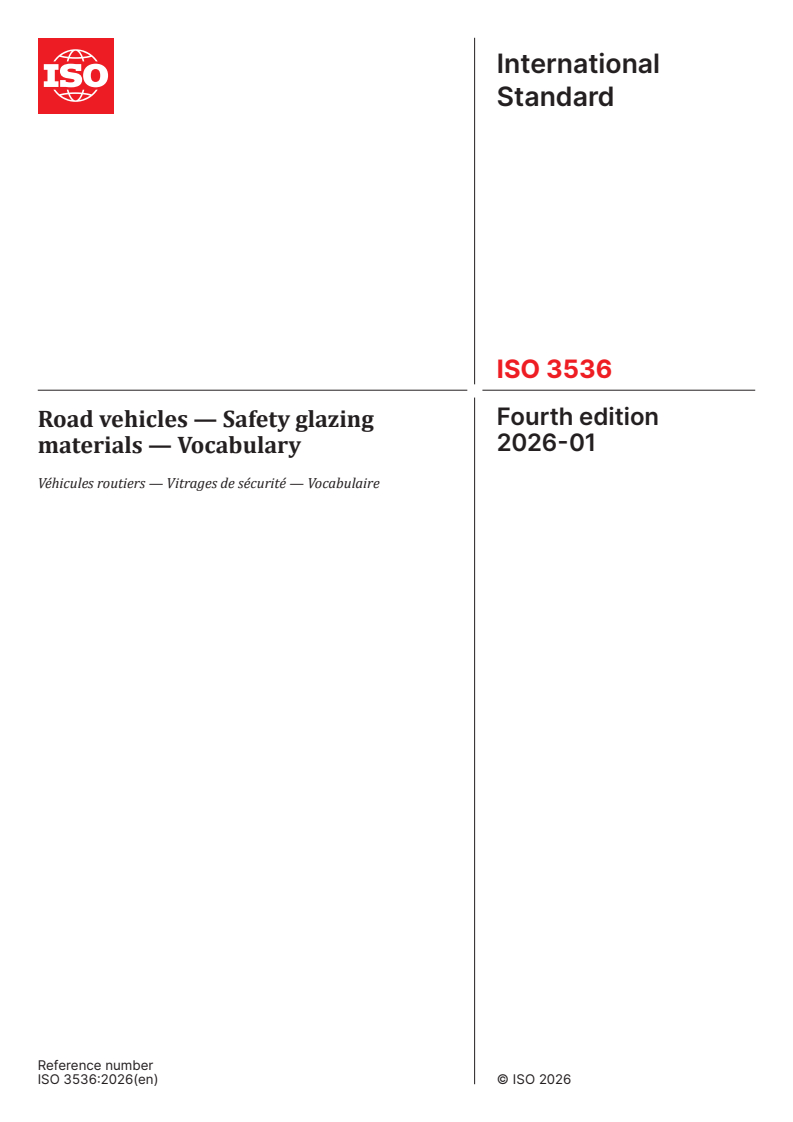
International
Standard
ISO 3536
Fourth edition
Road vehicles — Safety glazing
2026-01
materials — Vocabulary
Véhicules routiers — Vitrages de sécurité — Vocabulaire
Reference number
© ISO 2026
All rights reserved. Unless otherwise specified, or required in the context of its implementation, no part of this publication may
be reproduced or utilized otherwise in any form or by any means, electronic or mechanical, including photocopying, or posting on
the internet or an intranet, without prior written permission. Permission can be requested from either ISO at the address below
or ISO’s member body in the country of the requester.
ISO copyright office
CP 401 • Ch. de Blandonnet 8
CH-1214 Vernier, Geneva
Phone: +41 22 749 01 11
Email: copyright@iso.org
Website: www.iso.org
Published in Switzerland
ii
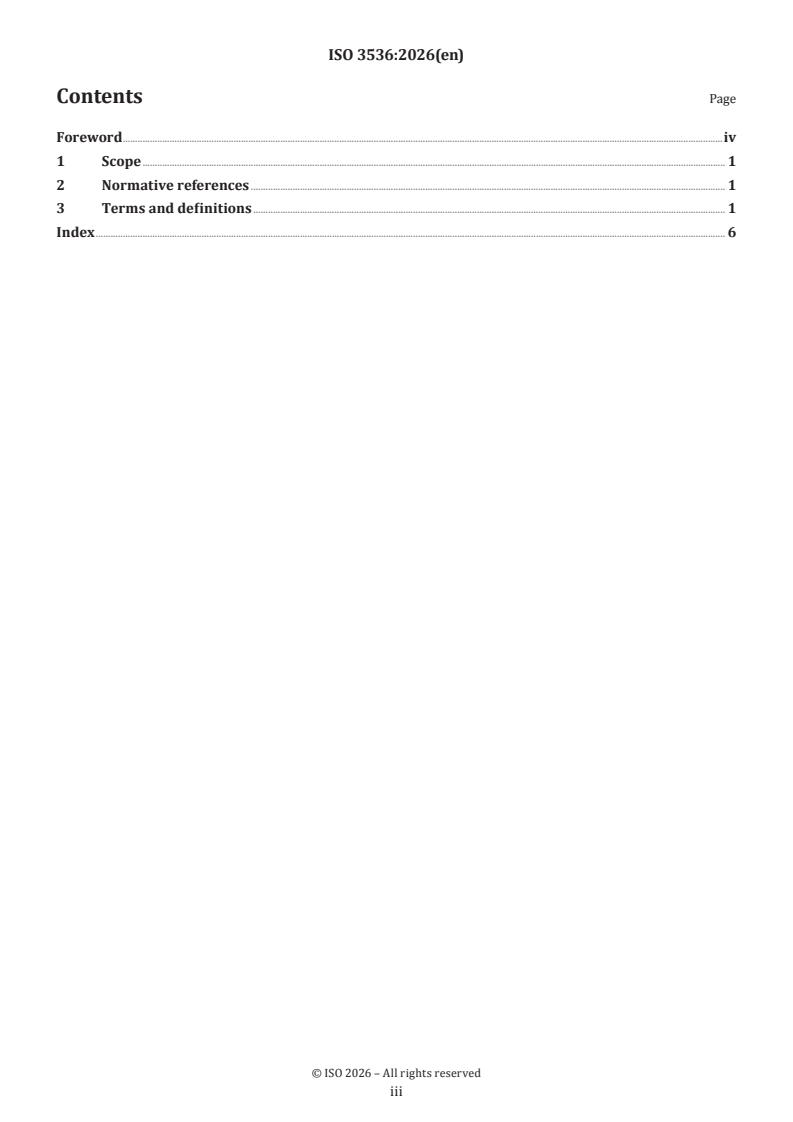
Contents Page
Foreword .iv
1 Scope . 1
2 Normative references . 1
3 Terms and definitions . 1
Index . 6
iii
Foreword
ISO (the International Organization for Standardization) is a worldwide federation of national standards
bodies (ISO member bodies). The work of preparing International Standards is normally carried out through
ISO technical committees. Each member body interested in a subject for which a technical committee
has been established has the right to be represented on that committee. International organizations,
governmental and non-governmental, in liaison with ISO, also take part in the work. ISO collaborates closely
with the International Electrotechnical Commission (IEC) on all matters of electrotechnical standardization.
The procedures used to develop this document and those intended for its further maintenance are described
in the ISO/IEC Directives, Part 1. In particular, the different approval criteria needed for the different types
of ISO document should be noted. This document was drafted in accordance with the editorial rules of the
ISO/IEC Directives, Part 2 (see www.iso.org/directives).
ISO draws attention to the possibility that the implementation of this document may involve the use of (a)
patent(s). ISO takes no position concerning the evidence, validity or applicability of any claimed patent
rights in respect thereof. As of the date of publication of this document, ISO had not received notice of (a)
patent(s) which may be required to implement this document. However, implementers are cautioned that
this may not represent the latest information, which may be obtained from the patent database available at
www.iso.org/patents. ISO shall not be held responsible for identifying any or all such patent rights.
Any trade name used in this document is information given for the convenience of users and does not
constitute an endorsement.
For an explanation of the voluntary nature of standards, the meaning of ISO specific terms and expressions
related to conformity assessment, as well as information about ISO's adherence to the World Trade
Organization (WTO) principles in the Technical Barriers to Trade (TBT), see www.iso.org/iso/foreword.html.
This document was prepared by Technical Committee ISO/TC 22, Road vehicles, Subcommittee SC 35,
Lighting and visibility.
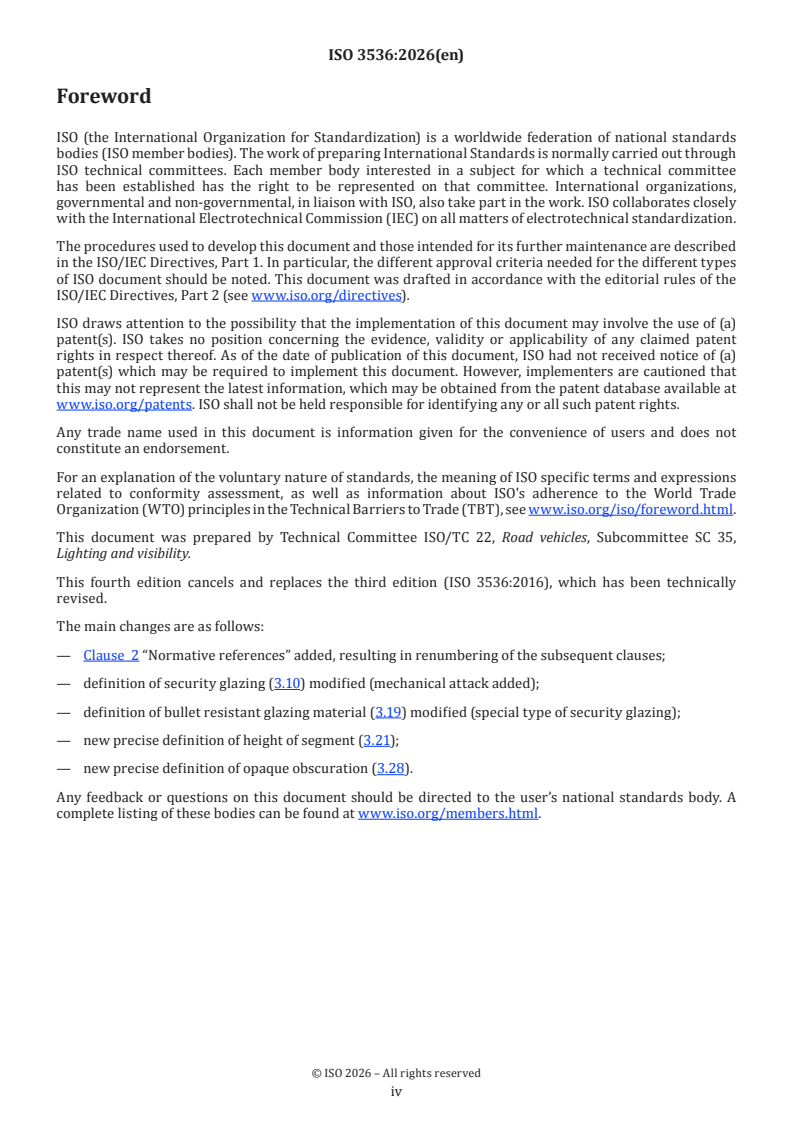
This fourth edition cancels and replaces the third edition (ISO 3536:2016), which has been technically
revised.
The main changes are as follows:
— Clause 2 “Normative references” added, resulting in renumbering of the subsequent clauses;
— definition of security glazing (3.10) modified (mechanical attack added);
— definition of bullet resistant glazing material (3.19) modified (special type of security glazing);
— new precise definition of height of segment (3.21);
— new precise definition of opaque obscuration (3.28).
Any feedback or questions on this document should be directed to the user’s national standards body. A
complete listing of these bodies can be found at www.iso.org/members.html.
iv
International Standard ISO 3536:2026(en)
Road vehicles — Safety glazing materials — Vocabulary
1 Scope
This document defines terms relating to safety glazing materials for road vehicles.
2 Normative references
There are no normative references in this document.
3 Terms and definitions
ISO and IEC maintain terminology databases for use in standardization at the following addresses:
— ISO Online browsing platform: available at https:// www .iso .org/ obp
— IEC Electropedia: available at https:// www .electropedia .org/
3.1
safety glazing material
glazing material consisting of organic and/or inorganic materials constructed or treated to minimize the
likelihood of injury to persons as a result of contact when used in a vehicle and which complies with specified
requirements for visibility, strength and durability
3.2
toughened safety glass
glazing material consisting of a single layer of glass which has been subjected to special thermal or chemical
treatment to increase its mechanical strength and to condition its fragmentation after shatter
Note 1 to entry: The term “tempered safety glass” may also be used as an alternative to “toughened safety glass”.
3.3
laminated safety glass
glazing material consisting of two or more layers of glass held together by one or more interlayers (3.4)
Note 1 to entry: The following two types are recognized:
— ordinary: when none of the layers of glass, of which it is composed, have been treated, i.e. normal annealed glass;
— treated: when at least one of the layers of glass, of which it is composed, is a toughened safety glass (3.2) or glass
which has been treated in any controlled process in order to give it increased resistance to mechanical and thermal
stress.
3.4
interlayer
plastic material designed to be used to permanently bond together the component layers of laminated safety
glass (3.3)
3.5
glass-plastic glazing material
glazing material which may be comprised of one layer of glass and one or more layers of plastic in which a
plastic surface faces inward towards the vehicle passenger compartment when installed in the vehicle
3.6
plastic safety glazing material
safety glazing material (3.1) that contains, as an essential ingredient, one or more layers of organic polymeric
substances
Note 1 to entry: The following two types are recognized:
— rigid plastic: organic polymeric material which maintains its structural stiffness over the intended use range;
— flexible plastic: organic polymeric material which remains conform
...