

ISO 17468:2023
(Main)Microbiology of the food chain — Technical requirements and guidance on the establishment or revision of a standardized reference method
General Information
- Abstract
This document gives technical requirements and guidance on the establishment or revision of standardized reference methods used for the analysis of microorganisms in: — products intended for human consumption; — products for feeding animals; — environmental samples in the area of food and feed production and handling; — samples from the primary production stage. This document specifies the technical stages of the establishment of a new standardized reference method and of the revision of an existing standardized reference method. It includes, in particular, requirements and guidance on the validation of the selected method. This document is intended to be implemented in particular by ISO/TC 34/SC 9 and its corresponding structure at CEN level, which is CEN/TC 463.
- Status
- Published
- Publication Date
- 12-Nov-2023
- Technical Committee
- ISO/TC 34/SC 9 - Microbiology
- Drafting Committee
- ISO/TC 34/SC 9/WG 3 - Method validation
- Current Stage
- 6060 - International Standard published
- Start Date
- 13-Nov-2023
- Due Date
- 16-Nov-2023
- Completion Date
- 13-Nov-2023
Buy Documents
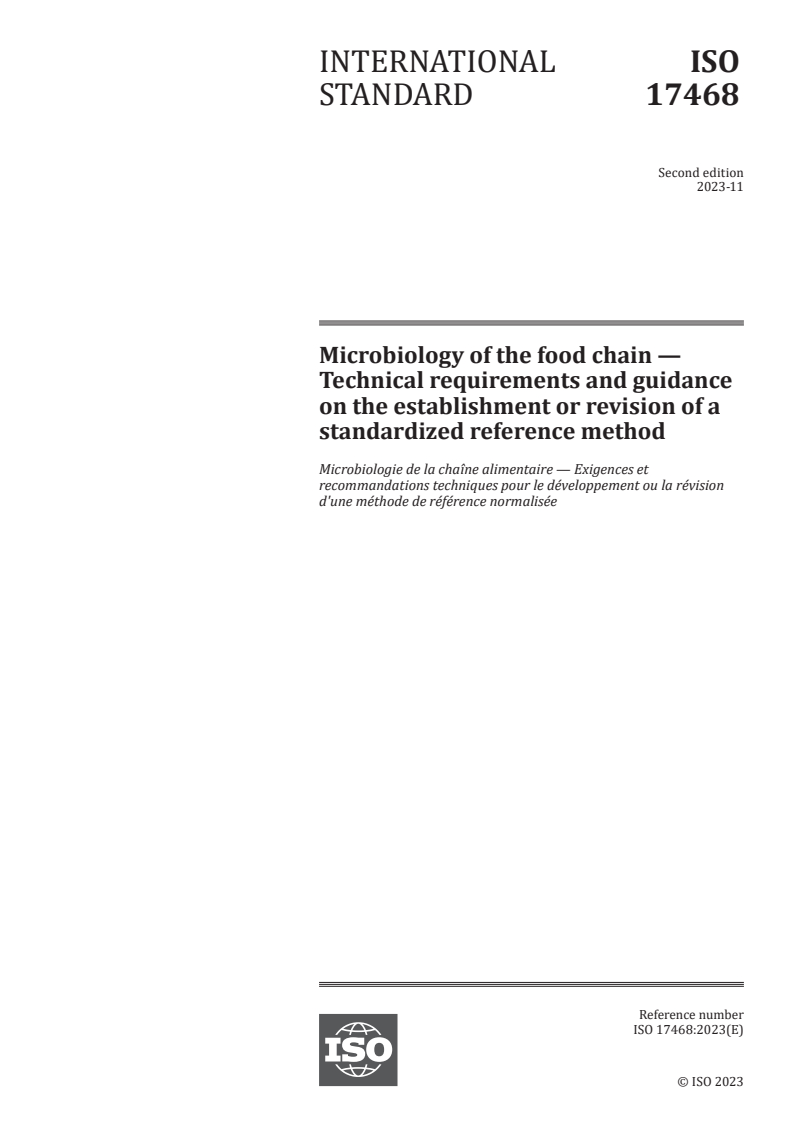
ISO 17468:2023 - Microbiology of the food chain — Technical requirements and guidance on the establishment or revision of a standardized reference method Released:13. 11. 2023
ISO 17468:2023 - Microbiologie de la chaîne alimentaire — Exigences et recommandations techniques pour le développement ou la révision d'une méthode de référence normalisée Released:13. 11. 2023
Overview - ISO 17468:2023 (Microbiology of the food chain)
ISO 17468:2023 provides technical requirements and practical guidance for the establishment or revision of standardized reference methods used to detect, confirm, type or quantify microorganisms across the food chain. The scope covers:
- Products intended for human consumption
- Products for feeding animals (pet food, animal feed)
- Environmental samples from food/feed production and handling
- Samples from primary production stages
This second edition updates procedures for method development and revision, adds an optional method optimization step, and cross-references ISO 16140 series parts related to method validation.
Key technical topics and requirements
- Six staged technical procedure for standardizing a new reference method:
- Method(s) selection (mandatory)
- Method(s) optimization (optional) - new in 2023
- Method(s) evaluation study (recommended)
- “Real life” study (recommended) - not applicable to confirmation/typing methods
- Selection of one candidate reference method (mandatory)
- Interlaboratory study (ILS) (mandatory)
- Validation requirements include single-laboratory and interlaboratory performance assessment (repeatability, reproducibility), inclusivity/exclusivity, limit of detection (LOD) and, for quantitative methods, trueness and precision - following ISO 16140-2, -4 and -6 where appropriate.
- Roles and terminology: ILS organizer, ILS participant, candidate reference method, and standardized reference method are defined to guide study organization and reporting.
- Confidentiality during study phases is emphasized; final validation data should be made publicly available (e.g., ISO Standards Maintenance Portal).
- Specific guidance for culture media preparation (ISO 11133) and statistical accuracy (ISO 5725-2) are referenced.
Practical applications and who uses ISO 17468
- Intended users:
- National and international working groups (e.g., ISO/TC 34/SC 9, CEN/TC 463)
- Method developers and manufacturers of microbiological test kits
- Diagnostic and food microbiology laboratories conducting method validation
- Accreditation bodies, regulators and risk assessors evaluating method fitness-for-purpose
- Practical uses:
- Developing new standardized reference methods for pathogen detection (e.g., Salmonella detection in large test portions)
- Revising existing reference methods while assessing nature of changes (minor/major)
- Planning and conducting interlaboratory validation studies and publishing validation reports
- Ensuring harmonized, traceable approaches across the food chain for reliable microbial testing
Related standards
- ISO 16140 series (method validation): Parts 1, 2, 4, 6
- ISO 5725-2 (accuracy: repeatability/reproducibility)
- ISO 11133 (culture media preparation)
Keywords: ISO 17468:2023, standardized reference method, microbiology of the food chain, method validation, interlaboratory study, ISO/TC 34/SC 9, ISO 16140.
Relations
- Effective Date
- 12-Feb-2026
- Effective Date
- 06-Jun-2022
- Consolidated By
ISO 14890:2026 - Conveyor belts — Specification for rubber- or plastics-covered conveyor belts of textile construction for general use - Effective Date
- 09-Dec-2023
- Effective Date
- 23-Apr-2020
Buy Documents
ISO 17468:2023 - Microbiology of the food chain — Technical requirements and guidance on the establishment or revision of a standardized reference method Released:13. 11. 2023
ISO 17468:2023 - Microbiologie de la chaîne alimentaire — Exigences et recommandations techniques pour le développement ou la révision d'une méthode de référence normalisée Released:13. 11. 2023
Frequently Asked Questions
ISO 17468:2023 is a standard published by the International Organization for Standardization (ISO). Its full title is "Microbiology of the food chain — Technical requirements and guidance on the establishment or revision of a standardized reference method". This standard covers: This document gives technical requirements and guidance on the establishment or revision of standardized reference methods used for the analysis of microorganisms in: — products intended for human consumption; — products for feeding animals; — environmental samples in the area of food and feed production and handling; — samples from the primary production stage. This document specifies the technical stages of the establishment of a new standardized reference method and of the revision of an existing standardized reference method. It includes, in particular, requirements and guidance on the validation of the selected method. This document is intended to be implemented in particular by ISO/TC 34/SC 9 and its corresponding structure at CEN level, which is CEN/TC 463.
This document gives technical requirements and guidance on the establishment or revision of standardized reference methods used for the analysis of microorganisms in: — products intended for human consumption; — products for feeding animals; — environmental samples in the area of food and feed production and handling; — samples from the primary production stage. This document specifies the technical stages of the establishment of a new standardized reference method and of the revision of an existing standardized reference method. It includes, in particular, requirements and guidance on the validation of the selected method. This document is intended to be implemented in particular by ISO/TC 34/SC 9 and its corresponding structure at CEN level, which is CEN/TC 463.
ISO 17468:2023 is classified under the following ICS (International Classification for Standards) categories: 07.100.30 - Food microbiology. The ICS classification helps identify the subject area and facilitates finding related standards.
ISO 17468:2023 has the following relationships with other standards: It is inter standard links to EN ISO 17468:2023, ISO/IEC 17000:2020, ISO 14890:2026, ISO 17468:2016. Understanding these relationships helps ensure you are using the most current and applicable version of the standard.
ISO 17468:2023 is available in PDF format for immediate download after purchase. The document can be added to your cart and obtained through the secure checkout process. Digital delivery ensures instant access to the complete standard document.
Standards Content (Sample)
INTERNATIONAL ISO
STANDARD 17468
Second edition
2023-11
Microbiology of the food chain —
Technical requirements and guidance
on the establishment or revision of a
standardized reference method
Microbiologie de la chaîne alimentaire — Exigences et
recommandations techniques pour le développement ou la révision
d'une méthode de référence normalisée
Reference number
© ISO 2023
All rights reserved. Unless otherwise specified, or required in the context of its implementation, no part of this publication may
be reproduced or utilized otherwise in any form or by any means, electronic or mechanical, including photocopying, or posting on
the internet or an intranet, without prior written permission. Permission can be requested from either ISO at the address below
or ISO’s member body in the country of the requester.
ISO copyright office
CP 401 • Ch. de Blandonnet 8
CH-1214 Vernier, Geneva
Phone: +41 22 749 01 11
Email: copyright@iso.org
Website: www.iso.org
Published in Switzerland
ii
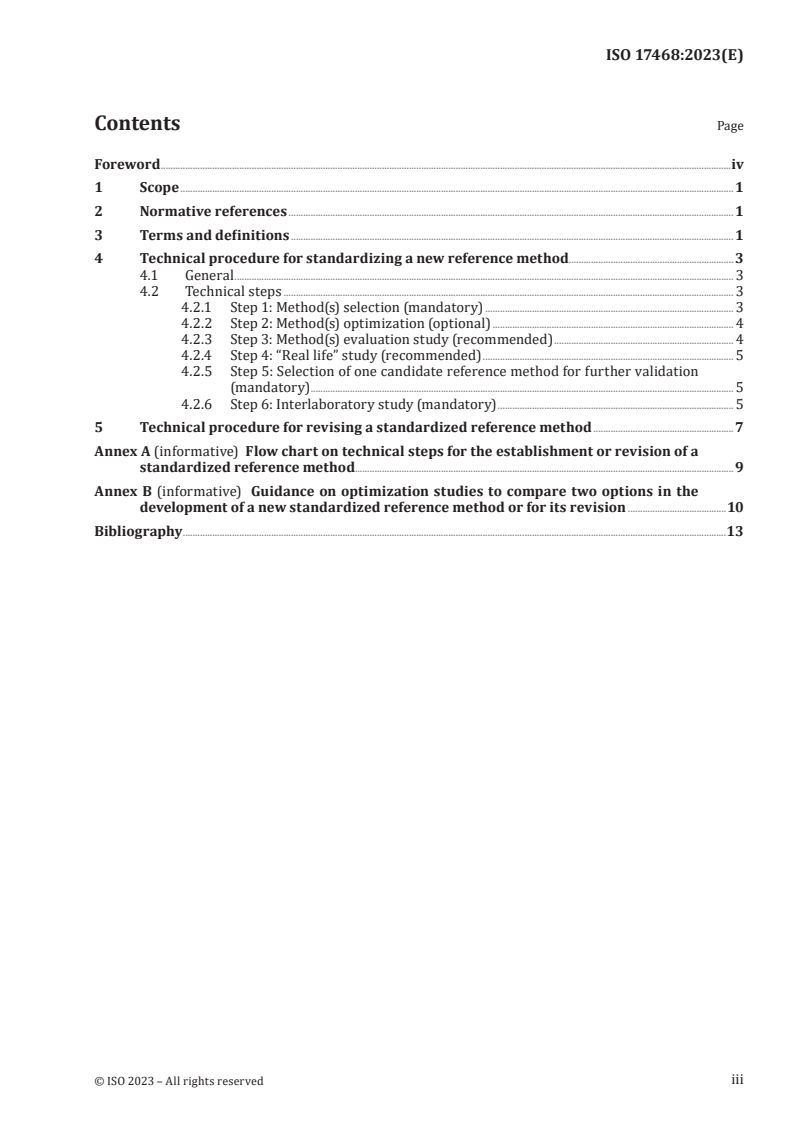
Contents Page
Foreword .iv
1 Scope . 1
2 Normative references . 1
3 Terms and definitions . 1
4 Technical procedure for standardizing a new reference method.3
4.1 General . 3
4.2 Technical steps . 3
4.2.1 Step 1: Method(s) selection (mandatory) . 3
4.2.2 Step 2: Method(s) optimization (optional) . 4
4.2.3 Step 3: Method(s) evaluation study (recommended) . 4
4.2.4 Step 4: “Real life” study (recommended) . 5
4.2.5 Step 5: Selection of one candidate reference method for further validation
(mandatory) . 5
4.2.6 Step 6: Interlaboratory study (mandatory) . 5
5 Technical procedure for revising a standardized reference method .7
Annex A (informative) Flow chart on technical steps for the establishment or revision of a
standardized reference method.9
Annex B (informative) Guidance on optimization studies to compare two options in the
development of a new standardized reference method or for its revision .10
Bibliography .13
iii
Foreword
ISO (the International Organization for Standardization) is a worldwide federation of national standards
bodies (ISO member bodies). The work of preparing International Standards is normally carried out
through ISO technical committees. Each member body interested in a subject for which a technical
committee has been established has the right to be represented on that committee. International
organizations, governmental and non-governmental, in liaison with ISO, also take part in the work.
ISO collaborates closely with the International Electrotechnical Commission (IEC) on all matters of
electrotechnical standardization.
The procedures used to develop this document and those intended for its further maintenance are
described in the ISO/IEC Directives, Part 1. In particular, the different approval criteria needed for the
different types of ISO document should be noted. This document was drafted in accordance with the
editorial rules of the ISO/IEC Directives, Part 2 (see www.iso.org/directives).
ISO draws attention to the possibility that the implementation of this document may involve the use
of (a) patent(s). ISO takes no position concerning the evidence, validity or applicability of any claimed
patent rights in respect thereof. As of the date of publication of this document, ISO had not received
notice of (a) patent(s) which may be required to implement this document. However, implementers are
cautioned that this may not represent the latest information, which may be obtained from the patent
database available at www.iso.org/patents. ISO shall not be held responsible for identifying any or all
such patent rights.
Any trade name used in this document is information given for the convenience of users and does not
constitute an endorsement.
For an explanation of the voluntary nature of standards, the meaning of ISO specific terms and
expressions related to conformity assessment, as well as information about ISO's adherence to
the World Trade Organization (WTO) principles in the Technical Barriers to Trade (TBT), see
www.iso.org/iso/foreword.html.
This document was prepared by Technical Committee ISO/TC 34, Food products, Subcommittee SC 9,
Microbiology, in collaboration with the European Committee for Standardization (CEN) Technical
Committee CEN/TC 463, Microbiology of the food chain, in accordance with the Agreement on technical
cooperation between ISO and CEN (Vienna Agreement).
This second edition cancels and replaces the first edition (ISO 17468:2016), which has been technically
revised.
The main changes are as follows:
— a cross-reference is made not only to ISO 16140-2, but also to ISO 16140-4 and ISO 16140-6;
— a new optional step has been added, "method(s) optimization". In addition, a new annex providing
guidance on method optimization studies is included, to compare two options during the development
of a new standardized reference method or for its revision;
— the inclusion of the case of confirmation and typing methods;
— the assessment of the nature of a change (minor/major) during the revision of a standardized
reference method.
Any feedback or questions on this document should be directed to the user’s national standards body. A
complete listing of these bodies can be found at www.iso.org/members.html.
iv
INTERNATIONAL STANDARD ISO 17468:2023(E)
Microbiology of the food chain — Technical requirements
and guidance on the establishment or revision of a
standardized reference method
1 Scope
This document gives technical requirements and guidance on the establishment or revision of
standardized reference methods used for the analysis of microorganisms in:
— products intended for human consumption;
— products for feeding animals;
— environmental samples in the area of food and feed production and handling;
— samples from the primary production stage.
This document specifies the technical stages of the establishment of a new standardized reference
method and of the revision of an existing standardized reference method. It includes, in particular,
requirements and guidance on the validation of the selected method.
This document is intended to be implemented in particular by ISO/TC 34/SC 9 and its corresponding
structure at CEN level, which is CEN/TC 463.
2 Normative references
The following documents are referred to in the text in such a way that some or all of their content
constitutes requirements of this document. For dated references, only the edition cited applies. For
undated references, the latest edition of the referenced document (including any amendments) applies.
ISO 5725-2, Accuracy (trueness and precision) of measurement methods and results — Part 2: Basic method
for the determination of repeatability and reproducibility of a standard measurement method
ISO 11133, Microbiology of food, animal feed and water — Preparation, production, storage and
performance testing of culture media
ISO 16140-1:2016, Microbiology of the food chain — Method validation — Part 1: Vocabulary
ISO 16140-2:2016, Microbiology of the food chain — Method validation — Part 2: Protocol for the validation
of alternative (proprietary) methods against a reference method
1)
ISO 16140-2:2016/Amd.1:— , Microbiology of the food chain — Method validation — Part 2: Protocol for
the validation of alternative (proprietary) methods against a reference method — Amendment 1: Revision
of qualitative MCS data evaluation, RLOD calculations in the ILS, calculation and interpretation of the RT
study, and inclusion of a commercial sterility testing protocol for specific products
ISO 16140-6:2019, Microbiology of the food chain — Method validation — Part 6: Protocol for the validation
of alternative (proprietary) methods for microbiological confirmation and typing procedures
3 Terms and definitions
For the purposes of this document, the terms and definitions given in ISO 16140-1 and the following
apply.
1) Under preparation. Stage at time of publication ISO 16140-2:2016/DAmd.1:2023.
ISO and IEC maintain terminology databases for use in standardization at the following addresses:
— ISO Online browsing platform: available at https:// www .iso .org/ obp
— IEC Electropedia: available at https:// www .electropedia .org/
3.1
candidate reference method
method selected and likely to become the standardized reference method (3.7)
3.2
ILS organizer
organizing laboratory
laboratory with responsibility for managing all of the technical and statistical activities involved in the
organization of the interlaboratory study
[SOURCE: ISO 16140-1:2016, 2.45, modified - “validation study, i.e. method comparison study and the
interlaboratory study” has been replaced by “organization of the interlaboratory study” and the Note 1
to entry has been deleted.]
3.3
ILS participant
participating laboratory
individual laboratory technician, who works completely independently from other ILS participants,
using different sets of blind samples or test portions
[SOURCE: ISO 16140-1:2016, 2.13, modified - “collaborator” has been replaced by “ILS participant”.]
3.4
interlaboratory study
study performed by multiple laboratories testing identical samples at the same time, the results of
which are used to estimate performance characteristics of the candidate reference method
Note 1 to entry: The aim of an interlaboratory study is to determine the variability of the results obtained in
different laboratories using identical samples.
[SOURCE: ISO 16140-1:2016, 2.33, modified - “alternative-method performance parameters” has been
replaced by “performance characteristics of the candidate reference method”.]
3.5
pre-standardization stage
technical stage prior to the standardization stage and comprising the different steps described in this
document
Note 1 to entry: The standardization stage starts with the proposal stage which is the approval of a New Work
Item Proposal (ISO/NP) for inclusion of the Work Item on the work programme of ISO/TC 34/SC 9.
3.6
“real life” study
study of one or several methods, conducted in different laboratories, using their own routine samples
and with preference given to naturally contaminated samples
3.7
standardized reference method
reference method described in a standard
Note 1 to entry: See ISO 16140-1 for the definition of “reference method”.
4 Technical procedure for standardizing a new reference method
4.1 General
The validation of a method in view of its standardization as a reference method includes six technical
steps (see 4.2):
— step 1: method(s) selection (mandatory);
— step 2: method(s) optimization (optional);
— step 3: method(s) evaluation study (recommended);
— step 4: “real life” study (recommended) (this step does not apply to confirmation and typing
methods);
— step 5: selection of one candidate reference method for further validation (mandatory);
— step 6: interlaboratory study (mandatory).
The first five technical steps correspond to a pre-standardization stage and are usually performed
before launching the standardization process. Step 6 (see 4.2.6) is usually performed during the
standardization process [preferably after the committee stage (ISO/CD) and before the enquiry stage
(ISO/DIS)].
The flow chart of the technical steps for the establishment of a new standardized reference method is
given in Annex A.
The working group in charge of organizing the studies on a qualitative method shall consider the
inclusion of a test portion size larger than, for example, 10 g or 25 g, when it is relevant and feasible.
This will facilitate the use of the standardized reference method without the need for further validation
when a larger test portion size is routinely used.
EXAMPLE Detection of Salmonella in 375 g infant formula test portions.
Information on the studies conducted in step 1 to step 6 should not be shared publicly until their
completion. Once these studies are completed, all relevant data as obtained in step 1 to step 6 should
become publicly available, by reporting it either in a scientific publication or in a report. The report
associated to each standardized reference method can be made available on the ISO Standards
Maintenance Portal (https:// standards .iso .org/ iso/ ) and/or by including a link in the Bibliography of
the standardized reference method to the website where the report is publicly available.
NOTE Data, e.g. regarding inclusivity and exclusivity, can be derived from earlier studies as long as the
information is traceable to the originally published data or made available on the ISO Standards Maintenance
Portal associated to the standardized reference method.
The performance characteristics obtained from the interlaboratory study (step 6, also see 4.2.6) shall
be incorporated into the corresponding standardized reference method.
4.2 Technical steps
4.2.1 Step 1: Method(s) selection (mandatory)
Information from different sources (e.g. national/regional standardized methods, scientific papers on
methods with evaluation data, evaluation/validation reports on methods, practicability of the method)
shall be collated for the choice of (a) candidate reference method(s). Based on the information available,
the working group in charge of developing the standard (referred to as ‘the working group’ from this
point forward) shall select one or several candidate reference methods.
4.2.2 Step 2: Method(s) optimization (optional)
If, after the step of method(s) selection (see 4.2.1), one (or several) candidate reference method(s)
comprise(s) two options for one factor (e.g. culture medium, incubation time, incubation temperature),
a method(s) optimization study can be conducted, comparing the two options.
Annex B provides guidance on how to compare these two options, and how to make a choice for the
method to be standardized and to be further evaluated (see 4.2.3).
If the candidate reference method(s) does (do) not comprise(s) any factor with options, proceed directly
to step 3 (see 4.2.3).
4.2.3 Step 3: Method(s) evaluation study (recommended)
4.2.3.1 General
An evaluation study of the candidate reference method(s) (see 4.2.1 and 4.2.2) should be conducted,
normally by one laboratory, but more than one laboratory may also be involved.
If several candidate reference methods are evaluated at this step, the outcome of this evaluation study
should enable the relevant working group to reduce the number of candidate reference methods, ideally
to one (step 5, also see 4.2.5).
The working group shall check that the candidate reference method(s) work(s) using culture media
prepared in the laboratory from individual ingredients described in the candidate reference method(s).
4.2.3.2 Detection and quantification methods
When conducted, the method(s) evaluation study enables the estimation of performance characteristics
listed below and aims at assessing them for a large variety of (food) types and (food) items, within
the (food) categories studied, representative of the scope of the method. In accordance with
ISO 16140-2:2016, 5.1.3.1, if the method is to be applied to a broad range of food, at least five food
categories shall be studied. If the method is to be validated for a restricted number of food categories,
then only these categories need to be studied. In addition to the food categories, pet food and animal
feed samples, environmental samples and primary production stage samples can be included as
additional categories.
NOTE The working group can assess, possibly through an inventory among users, whether it is sufficient to
validate the method for a restricted number of (food) categories.
This study should fulfil the requirements of the single-laboratory method validation study without
comparison to a reference method, as stated in ISO 16140-4:
— for qualitative methods:
— factorial approach (in accordance with ISO 16140-4:2020, 5.1.2): sensitivity, level of detection
(LOD ), inclusivity/exclusivity; or
— conventional approach (in accordance with ISO 16140-4:2020, 6.1.2): specificity, LOD ,
sensitivity, inclusivity/exclusivity;
— for quantitative methods:
— factorial approach (in accordance with ISO 16140-4:2020, 5.2.2): relative trueness, accuracy
profile, in-house precision study (repeatability and in-house reproducibility), inclusivity/
exclusivity; or
— conventional approach (in accordance with ISO 16140-4:2020, 6.2.2): relative trueness, accuracy
profile, in-house precision study (repeatability and in-house reproducibility), inclusivity/
exclusivity, and if applicable, limit of quantification.
4.2.3.3 Confirmation and typing methods
When conducted, the method(s) evaluation study shall fulfil the requirements of the method comparison
study for the validation of alternative (proprietary) methods for microbiological confirmation and
typing pr
...
NORME ISO
INTERNATIONALE 17468
Deuxième édition
2023-11
Microbiologie de la chaîne
alimentaire — Exigences et
recommandations techniques pour le
développement ou la révision d'une
méthode de référence normalisée
Microbiology of the food chain — Technical requirements and
guidance on the establishment or revision of a standardized reference
method
Numéro de référence
DOCUMENT PROTÉGÉ PAR COPYRIGHT
© ISO 2023
Tous droits réservés. Sauf prescription différente ou nécessité dans le contexte de sa mise en œuvre, aucune partie de cette
publication ne peut être reproduite ni utilisée sous quelque forme que ce soit et par aucun procédé, électronique ou mécanique,
y compris la photocopie, ou la diffusion sur l’internet ou sur un intranet, sans autorisation écrite préalable. Une autorisation peut
être demandée à l’ISO à l’adresse ci-après ou au comité membre de l’ISO dans le pays du demandeur.
ISO copyright office
Case postale 401 • Ch. de Blandonnet 8
CH-1214 Vernier, Genève
Tél.: +41 22 749 01 11
E-mail: copyright@iso.org
Web: www.iso.org
Publié en Suisse
ii
Sommaire Page
Avant-propos .iv
1 Domaine d’application . 1
2 Références normatives .1
3 Termes et définitions . 2
4 Procédure technique de normalisation d’une nouvelle méthode de référence .3
4.1 Généralités . 3
4.2 Étapes techniques . 4
4.2.1 Étape 1: sélection de la ou des méthodes (obligatoire) . 4
4.2.2 Étape 2: optimisation de la ou des méthodes (facultative) . 4
4.2.3 Étape 3: étude d’évaluation de la ou des méthodes (recommandée) . 4
4.2.4 Étape 4: étude «en conditions réelles» (recommandée) . 5
4.2.5 Étape 5: sélection d’une méthode de référence candidate pour validation
supplémentaire (obligatoire) . 6
4.2.6 Étape 6: étude interlaboratoires (obligatoire) . 6
5 Procédure technique de révision d’une méthode de référence normalisée .7
Annexe A (informative) Logigramme des étapes techniques pour le développement ou la
révision d’une méthode de référence normalisée . 9
Annexe B (informative) Recommandations relatives aux études d’optimisation visant à
comparer deux options dans le cadre de l’élaboration d’une nouvelle méthode de
référence normalisée ou de la révision d’une telle méthode .10
Bibliographie .13
iii
Avant-propos
L’ISO (Organisation internationale de normalisation) est une fédération mondiale d’organismes
nationaux de normalisation (comités membres de l’ISO). L’élaboration des Normes internationales est
en général confiée aux comités techniques de l’ISO. Chaque comité membre intéressé par une étude
a le droit de faire partie du comité technique créé à cet effet. Les organisations internationales,
gouvernementales et non gouvernementales, en liaison avec l’ISO participent également aux travaux.
L’ISO collabore étroitement avec la Commission électrotechnique internationale (IEC) en ce qui
concerne la normalisation électrotechnique.
Les procédures utilisées pour élaborer le présent document et celles destinées à sa mise à jour sont
décrites dans les Directives ISO/IEC, Partie 1. Il convient, en particulier, de prendre note des différents
critères d’approbation requis pour les différents types de documents ISO. Le présent document
a été rédigé conformément aux règles de rédaction données dans les Directives ISO/IEC, Partie 2
(voir www.iso.org/directives).
L’ISO attire l’attention sur le fait que la mise en application du présent document peut entraîner
l’utilisation d’un ou de plusieurs brevets. L’ISO ne prend pas position quant à la preuve, à la validité
et à l’applicabilité de tout droit de brevet revendiqué à cet égard. À la date de publication du présent
document, l’ISO n’avait pas reçu notification qu’un ou plusieurs brevets pouvaient être nécessaires à sa
mise en application. Toutefois, il y a lieu d’avertir les responsables de la mise en application du présent
document que des informations plus récentes sont susceptibles de figurer dans la base de données de
brevets, disponible à l’adresse www.iso.org/brevets. L’ISO ne saurait être tenue pour responsable de ne
pas avoir identifié tout ou partie de tels droits de brevet.
Les appellations commerciales éventuellement mentionnées dans le présent document sont données
pour information, par souci de commodité, à l’intention des utilisateurs et ne sauraient constituer un
engagement.
Pour une explication de la nature volontaire des normes, la signification des termes et expressions
spécifiques de l’ISO liés à l’évaluation de la conformité, ou pour toute information au sujet de l’adhésion
de l’ISO aux principes de l’Organisation mondiale du commerce (OMC) concernant les obstacles
techniques au commerce (OTC), voir www.iso.org/iso/fr/avant-propos.html.
Le présent document a été élaboré par le comité technique ISO/TC 34, Produits alimentaires, sous-
comité SC 9, Microbiologie, en collaboration avec le comité technique CEN/TC 463, Microbiologie de la
chaîne alimentaire, du Comité européen de normalisation (CEN), conformément à l’Accord de coopération
technique entre l’ISO et le CEN (Accord de Vienne).
Cette deuxième édition annule et remplace la première édition (ISO 17468:2016), qui a fait l’objet d’une
révision technique.
Les principales modifications sont les suivantes:
— un renvoi est fait non seulement à l’ISO 16140-2, mais également à l’ISO 16140-4 et à l’ISO 16140-6;
— une nouvelle étape facultative, "l’optimisation de la ou des méthodes". En outre, une nouvelle
annexe fournissant des recommandations relatives aux études d’optimisation des méthodes, en
vue de comparer deux options possibles lors de l’élaboration d’une nouvelle méthode de référence
normalisée ou de sa révision;
— l’ajout du cas des méthodes de confirmation et de typage;
— l’évaluation de la nature d’un changement (mineur ou majeur) lors de la révision d’une méthode de
référence normalisée.
Il convient que l’utilisateur adresse tout retour d’information ou toute question concernant le présent
document à l’organisme national de normalisation de son pays. Une liste exhaustive desdits organismes
se trouve à l’adresse www.iso.org/fr/members.html.
iv
NORME INTERNATIONALE ISO 17468:2023(F)
Microbiologie de la chaîne alimentaire — Exigences et
recommandations techniques pour le développement ou la
révision d'une méthode de référence normalisée
1 Domaine d’application
Le présent document établit des exigences et des recommandations techniques pour le développement
ou la révision de méthodes de référence normalisées pour l’analyse des micro-organismes dans:
— les produits destinés à la consommation humaine;
— les produits destinés à l’alimentation animale;
— les échantillons environnementaux dans les zones de production et de manipulation des aliments;
— les échantillons prélevés au stade de la production primaire.
Le présent document spécifie les stades techniques du développement d’une nouvelle méthode de
référence normalisée et de la révision d’une méthode de référence normalisée existante. Il inclut, en
particulier, les exigences et les recommandations applicables à la validation de la méthode sélectionnée.
Le présent document est destiné à être mis en œuvre en particulier par l’ISO/TC 34/SC 9 et sa structure
équivalente au niveau du CEN, à savoir le CEN/TC 463.
2 Références normatives
Les documents suivants sont cités dans le texte de sorte qu’ils constituent, pour tout ou partie de leur
contenu, des exigences du présent document. Pour les références datées, seule l’édition citée s’applique.
Pour les références non datées, la dernière édition du document de référence s'applique (y compris les
éventuels amendements)
ISO 5725-2, Exactitude (justesse et fidélité) des résultats et méthodes de mesure — Partie 2: Méthode de
base pour la détermination de la répétabilité et de la reproductibilité d'une méthode de mesure normalisée
ISO 11133, Microbiologie des aliments, des aliments pour animaux et de l'eau — Préparation, production,
stockage et essais de performance des milieux de culture
ISO 16140-1:2016, Microbiologie de la chaîne alimentaire — Validation des méthodes — Partie 1:
Vocabulaire
ISO 16140-2:2016, Microbiologie de la chaîne alimentaire — Validation des méthodes — Partie 2: Protocole
pour la validation de méthodes alternatives (commerciales) par rapport à une méthode de référence
1)
ISO 16140-2:2016/Amd.1:— , Microbiologie de la chaîne alimentaire — Validation des méthodes —
Partie 2: Protocole pour la validation de méthodes alternatives (commerciales) par rapport à une méthode
de référence — Amendement 1: Révision de l’évaluation des données des études de comparaison de méthodes
qualitatives, des calculs de RLOD de l'étude interlaboratoires ainsi que du calcul et de l’interprétation de
l’étude de justesse relative, et ajout d’un protocole pour la détermination de la stérilité commerciale pour
des produits spécifiques
ISO 16140-6:2019, Microbiologie de la chaîne alimentaire — Validation des méthodes — Partie 6: Protocole
pour la validation de méthodes alternatives (commerciales) pour la confirmation microbiologique et le
typage
1) En cours d’élaboration. Etape au moment de la publication: ISO 16140-2:2016/DAmd.1:2023.
3 Termes et définitions
Pour les besoins du présent document, les termes et définitions de l’ISO 16140-1 ainsi que les suivants
s’appliquent.
L’ISO et l’IEC tiennent à jour des bases de données terminologiques destinées à être utilisées en
normalisation, consultables aux adresses suivantes:
— ISO Online browsing platform: disponible à l’adresse https:// www .iso .org/ obp
— IEC Electropedia: disponible à l’adresse https:// www .electropedia .org/
3.1
méthode de référence candidate
méthode sélectionnée qui est susceptible de devenir la méthode de référence normalisée (3.7)
3.2
organisateur de l’EIL
laboratoire organisateur
laboratoire ayant la responsabilité de gérer toutes les activités techniques et statistiques que
l’organisation de l’étude interlaboratoires implique
[SOURCE: ISO 16140-1:2016, 2.45, modifié – «que l’étude de validation impliquent, c’est-à-dire l’étude
comparative des méthodes et l’étude interlaboratoires» a été remplacé par «que l’organisation de l’étude
interlaboratoires implique» et la Note 1 à l’article a été supprimée.]
3.3
participant à l’EIL
laboratoire participant
technicien de laboratoire individuel, qui travaille de manière totalement indépendante vis-à-vis d’autres
participants de l’EIL et qui utilise différents ensembles d’échantillons ou prises d’essai sélectionné(e)s
en aveugle
[SOURCE: ISO 16140-1:2016, 2.13, modifié – «collaborateur» a été remplacé par «participant à l’EIL ».]
3.4
étude interlaboratoires
étude menée par plusieurs laboratoires analysant des échantillons identiques au même moment, dont
les résultats sont utilisés pour estimer les caractéristiques de performance de la méthode de référence
candidate
Note 1 à l'article: L’étude interlaboratoires vise à déterminer la variabilité des résultats obtenus par les différents
laboratoires ayant analysé des échantillons identiques.
[SOURCE: ISO 16140-1:2016, 2.33, modifié – «les paramètres de performance de la méthode alternative»
a été remplacé par «les caractéristiques de performance de la méthode de référence candidate».]
3.5
stade de prénormalisation
stade technique qui précède le stade de normalisation et qui comprend les différentes étapes décrites
dans le présent document
Note 1 à l'article: Le stade de normalisation débute par l’étape proposition, à savoir le vote d’une proposition
de nouveau sujet de travail (ISO/NP) pour l’inclusion du sujet de travail dans le programme de travail
de l’ISO/TC 34/SC 9.
3.6
étude «en conditions réelles»
étude d’une ou de plusieurs méthodes, menée dans différents laboratoires, à l’aide de leurs propres
échantillons de routine, donnant la préférence à des échantillons contaminés naturellement
3.7
méthode de référence normalisée
méthode de référence décrite dans une norme
Note 1 à l'article: Voir l’ISO 16140-1 pour la définition de «méthode de référence».
4 Procédure technique de normalisation d’une nouvelle méthode de référence
4.1 Généralités
La validation d’une méthode en vue de sa normalisation comme méthode de référence comprend six
étapes techniques (voir 4.2):
— étape 1: sélection de la ou des méthodes (obligatoire);
— étape 2: optimisation de la ou des méthodes (facultative);
— étape 3: étude d’évaluation de la ou des méthodes (recommandée);
— étape 4: étude «en conditions réelles» (recommandée) (cette étape ne s’applique pas aux méthodes
de confirmation et de typage);
— étape 5: sélection d’une méthode de référence candidate pour validation supplémentaire (obligatoire);
— étape 6: étude interlaboratoires (obligatoire).
Les cinq premières étapes techniques correspondent au stade de prénormalisation et sont généralement
exécutées en amont du lancement du processus de normalisation. L’étape 6 (voir 4.2.6) est généralement
exécutée au cours du processus de normalisation (de préférence après le stade comité [ISO/CD] et avant
le stade enquête [ISO/DIS]).
Le logigramme des étapes techniques pour le développement d’une nouvelle méthode de référence
normalisée est donné à l’Annexe A.
Le groupe de travail chargé d’organiser les études sur une méthode qualitative doit envisager l’inclusion
d’une prise d’essai de taille supérieure à, par exemple, 10 g ou 25 g, lorsque cela est pertinent et
réalisable. Cela facilitera l’utilisation de la méthode de référence normalisée sans qu’il ne soit nécessaire
de procéder à une validation supplémentaire lorsque l’on utilise en routine une prise d’essai plus grande.
EXEMPLE Détection de Salmonella dans des prises d’essai de 375 g de préparation pour nourrissons.
Il convient de ne pas partager publiquement les informations relatives aux études menées aux
étapes 1 à 6 avant que ces études ne soient terminées. Une fois ces dernières terminées, il convient
de rendre publiques toutes les données pertinentes obtenues aux étapes 1 à 6, en les présentant dans
une publication scientifique ou dans un rapport. Le rapport associé à chaque méthode de référence
normalisée peut être mis à disposition sur le portail de maintenance des normes ISO (https:// standards
.iso .org/ iso/ ) et/ou en incluant un lien dans la bibliographie de la méthode de référence normalisée
vers le site web où le rapport est accessible au public.
NOTE Les données, par exemple celles concernant l’inclusivité et l’exclusivité, peuvent être dérivées d’études
antérieures à condition que les données publiées à l’origine soient traçables ou que celles-ci soient disponibles
sur le portail de maintenance des normes ISO associé à la méthode de référence normalisée.
Les caractéristiques de performance obtenues à partir de l’étude interlaboratoires (étape 6, voir
également 4.2.6) doivent être incorporées dans la méthode de référence normalisée correspondante.
4.2 Étapes techniques
4.2.1 Étape 1: sélection de la ou des méthodes (obligatoire)
Des informations en provenance de différentes sources (par exemple, méthodes normalisées nationales
ou régionales, articles scientifiques sur les méthodes avec des données d’évaluation, rapports
d’évaluation ou de validation des méthodes, praticabilité de la méthode) doivent être compilées dans le
but de sélectionner une ou plusieurs méthodes de référence candidates. Le groupe de travail chargé de
l’élaboration de la norme (appelé «le groupe de travail» ci-après) doit choisir une ou plusieurs méthodes
de référence candidates d’après les informations disponibles.
4.2.2 Étape 2: optimisation de la ou des méthodes (facultative)
Si, après l’étape de sélection de la ou des méthodes (voir 4.2.1), une (ou plusieurs) méthode(s) de
référence candidate comprend deux options pour un facteur (par exemple, milieu de culture, pour la
durée d’incubation, la température d’incubation), une étude d’optimisation de la (ou des) méthode(s)
comparant les deux options peut être menée.
L’Annexe B fournit des recommandations sur la manière de comparer ces deux options, et sur la manière
de faire un choix pour la méthode à normaliser et à évaluer (voir 4.2.3).
Si la ou les méthodes de référence candidates ne comprennent aucun facteur avec options, passer
directement à l’étape 3 (voir 4.2.3).
4.2.3 Étape 3: étude d’évaluation de la ou des méthodes (recommandée)
4.2.3.1 Généralités
Il convient qu’une étude d’évaluation de la ou des méthodes de référence candidates (voir 4.2.1 et
4.2.2) soit menée, généralement par un seul laboratoire, bien que plusieurs laboratoires puissent être
impliqués.
Si plusieurs méthodes de référence candidates sont évaluées à cette étape, il convient que le résultat
de l’étude d’évaluation permette au groupe de travail concerné de réduire le nombre de méthodes de
référence candidates, pour qu’il n’en reste idéalement qu’une seule (étape 5, voir également 4.2.5).
Le groupe de travail doit vérifier que la ou les méthodes de référence candidates fonctionnent en
utilisant des milieux de culture préparés en laboratoire à partir des ingrédients individuels décrits
dans la ou les méthodes de référence candidates.
4.2.3.2 Méthodes de détection et de quantification
Lorsqu’elle est menée, l’étude d’évaluation de la ou des méthodes permet d’estimer les caractéristiques
de performance énumérées ci-dessous et vise à les évaluer pour un grand nombre de types (d’aliments)
et de matrices (d’aliments), au sein des catégories (d’aliments) étudiées, représentatives du domaine
d’application de la méthode. Conformément à l’ISO 16140-2:2016, 5.1.3.1, si la méthode est destinée à
être appliquée à une vaste gamme d’aliments, alors au moins cinq catégories d’aliment doivent être
étudiées. Si la méthode doit être validée pour un nombre limité de catégories d’aliments, alors seules
ces catégories ont besoin d’être étudiées. Outre les catégories d’aliments, il est possible d’inclure comme
catégories supplémentaires des échantillons d’aliments pour animaux et d’aliments pour animaux de
compagnie, des échantillons environnementaux et des échantillons du stade de la production primaire.
NOTE Le groupe de travail peut évaluer, éventuellement par le biais d’un état des lieux auprès des
utilisateurs, s’il est suffisant de valider la méthode pour un nombre restreint de catégories (d’aliments).
Il convient que cette étude réponde aux exigences de l’étude de validation de méthodes dans un seul
laboratoire sans méthode de référence, comme indiqué dans l’ISO 16140-4:
— pour les méthodes qualitatives:
— approche factorielle (conformément à l’ISO 16140-4:2020, 5.1.2): sensibilité, niveau de détection
(LOD ), inclusivité/exclusivité; ou
— approche conventionnelle (conformément à l’ISO 16140-4:2020, 6.1.2): spécificité, LOD ,
sensibilité, inclusivité/exclusivité;
— pour les méthodes quantitatives:
— approche factorielle (conformément à l’ISO 16140-4:2020, 5.2.2): justesse relative, profil
d’exactitude, étude de fidélité interne (répétabilité et reproductibilité interne), inclusivité/
exclusivité; ou
— approche conventionnelle (conformément à l’ISO 16140-4:2020, 6.2.2): justesse relative, profil
d’exactitude, étude de fidélité interne (répétabilité et reproductibilité interne), inclusivité/
exclusivité et, le cas échéant, limite de quantification.
4.2.3.3 Méthodes de confirmation et de typage
Lorsqu’elle est menée, l’étude d’évaluation de la ou des méthodes doit satisfaire aux exigences de l’étude
de comparaison de méthodes pour la validation de méthodes alternatives (commerciales) en ce qui
concerne les procédures de confirmation microbiologique et de typage, comme indiqué dans l’Article 6
de l’ISO 16140-6:2019 sur l’inclusivité et l’exclusivité. Comme il n’y a pas de comparaison avec une
méthode de référence, comparer les résultats de l’inclusivité et de l’exclusivité directement à l’identité
des souches
...