

ISO/IEC Guide 99:2007
(Main)International vocabulary of metrology — Basic and general concepts and associated terms (VIM)
General Information
- Abstract
ISO/IEC Guide 99:2007 provides a set of definitions and associated terms, in English and French, for a system of basic and general concepts used in metrology, together with concept diagrams to demonstrate their relations. Additional information is given in the form of examples and notes under many definitions. This Vocabulary is meant to be a common reference for scientists and engineers, as well as teachers and practitioners, involved in planning or performing measurements, irrespective of the level of measurement uncertainty and irrespective of the field of application. It is also meant to be a reference for governmental and inter-governmental bodies, trade associations, accreditation bodies, regulators and professional societies.
- Status
- Published
- Publication Date
- 13-Dec-2007
- Technical Committee
- ISO/TMBG - Technical Management Board - groups
- Drafting Committee
- ISO/TMBG - Technical Management Board - groups
- Current Stage
- 9092 - International Standard to be revised
- Start Date
- 11-Feb-2021
- Completion Date
- 29-Aug-2026
Buy Documents
ISO/IEC Guide 99:2007 - International vocabulary of metrology — Basic and general concepts and associated terms (VIM) Released:9/14/2010



ISO/IEC Guide 99:2007 - International vocabulary of metrology — Basic and general concepts and associated terms (VIM) Released:3/18/2010


V ISO/IEC Vodilo 99:2012
Overview
ISO/IEC Guide 99:2007 (VIM) - International vocabulary of metrology - provides a harmonized, bilingual (English/French) set of definitions, concept diagrams, examples and notes for the basic and general concepts used in metrology. Intended as a common reference, the VIM clarifies terms related to quantities and units, measurement, measuring devices, properties of measuring devices and measurement standards. The Guide supports consistent terminology across disciplines and is suitable for all measurement uncertainty levels and application fields.
Key topics
- Quantities and units: standardized treatment of quantities, unit concepts and links to the SI system.
- Measurement concepts: definitions for measurement, measurand, measurement result, and related ideas.
- Measuring devices and properties: vocabulary for instruments, measuring systems and device characteristics.
- Measurement standards (étalons): terminology for reference standards and calibration hierarchy.
- Measurement uncertainty and traceability: conceptual foundations for the Uncertainty Approach (GUM) and metrological traceability.
- Concept diagrams, examples and notes: graphical and textual clarifications to show relationships among terms and to illustrate application.
- Bilingual presentation and corrections: first edition 2007 with corrected 2010 version; reproduction rules for educational use.
Practical applications
- Harmonizes terminology used in measurement procedures, technical reports, calibration certificates and teaching materials.
- A reference for designing measurement protocols, writing specifications, and documenting uncertainty and traceability chains.
- Supports cross-disciplinary measurement consistency in physics, chemistry, laboratory medicine, biochemistry, food science, forensic science, molecular biology and engineering.
- Used by accreditation bodies, regulators and trade associations to ensure consistent interpretation of metrological concepts in standards, conformity assessment and regulation.
Who uses this standard
- Scientists and engineers planning or performing measurements.
- Laboratory managers, metrologists and calibration personnel.
- Teachers and students in measurement science.
- Accreditation bodies, regulators, governmental and inter‑governmental organizations, and professional societies.
Related standards (for further reference)
- ISO/IEC Guide 98-3:2008 (GUM) - Guide to the expression of uncertainty in measurement (referenced by VIM).
- ISO 80000 / IEC 80000 series - Quantities and units.
- SI Brochure (BIPM) - International System of Units.
- IEC 60050 (IEV) - for device-specific electrotechnical vocabulary.
ISO/IEC Guide 99:2007 (VIM) is essential for anyone seeking clear, internationally agreed terminology in metrology to improve communication, documentation and the comparability of measurement results.
Relations
- Effective Date
- 15-Apr-2008
- Effective Date
- 12-Aug-2026
- Effective Date
- 29-Jul-2026
- Effective Date
- 15-Jul-2026
- Effective Date
- 22-Apr-2026
- Effective Date
- 31-Mar-2026
- Effective Date
- 31-Mar-2026
- Effective Date
- 20-Feb-2026
- Effective Date
- 20-Feb-2026
- Effective Date
- 20-Feb-2026
- Effective Date
- 20-Feb-2026
- Effective Date
- 20-Feb-2026
- Effective Date
- 20-Feb-2026
- Effective Date
- 20-Feb-2026
- Effective Date
- 20-Feb-2026
Buy Documents
ISO/IEC Guide 99:2007 - International vocabulary of metrology — Basic and general concepts and associated terms (VIM) Released:9/14/2010
ISO/IEC Guide 99:2007 - International vocabulary of metrology — Basic and general concepts and associated terms (VIM) Released:3/18/2010
V ISO/IEC Vodilo 99:2012
Get Certified
Connect with accredited certification bodies for this standard

BSMI (Bureau of Standards, Metrology and Inspection)
Taiwan's standards and inspection authority.
Sponsored listings
Frequently Asked Questions
ISO/IEC Guide 99:2007 is a guide published by the International Organization for Standardization (ISO). Its full title is "International vocabulary of metrology — Basic and general concepts and associated terms (VIM)". This standard covers: ISO/IEC Guide 99:2007 provides a set of definitions and associated terms, in English and French, for a system of basic and general concepts used in metrology, together with concept diagrams to demonstrate their relations. Additional information is given in the form of examples and notes under many definitions. This Vocabulary is meant to be a common reference for scientists and engineers, as well as teachers and practitioners, involved in planning or performing measurements, irrespective of the level of measurement uncertainty and irrespective of the field of application. It is also meant to be a reference for governmental and inter-governmental bodies, trade associations, accreditation bodies, regulators and professional societies.
ISO/IEC Guide 99:2007 provides a set of definitions and associated terms, in English and French, for a system of basic and general concepts used in metrology, together with concept diagrams to demonstrate their relations. Additional information is given in the form of examples and notes under many definitions. This Vocabulary is meant to be a common reference for scientists and engineers, as well as teachers and practitioners, involved in planning or performing measurements, irrespective of the level of measurement uncertainty and irrespective of the field of application. It is also meant to be a reference for governmental and inter-governmental bodies, trade associations, accreditation bodies, regulators and professional societies.
ISO/IEC Guide 99:2007 is classified under the following ICS (International Classification for Standards) categories: 01.040.17 - Metrology and measurement. Physical phenomena (Vocabularies); 17.020 - Metrology and measurement in general. The ICS classification helps identify the subject area and facilitates finding related standards.
ISO/IEC Guide 99:2007 has the following relationships with other standards: It is inter standard links to ISO/DGuide 99999.2, EN ISO 15193:2026, EN ISO 15548-1:2026, EN ISO 22248:2026, EN ISO 10012:2026, EN IEC 62264-2:2026, EN IEC 61757:2026, EN 61260-2:2016, EN 62129-2:2011, EN 60731:2012, EN 61331-2:2014, EN 60398:2015, EN IEC 62343-5-2:2018, EN 61672-3:2013, EN 60846-1:2014. Understanding these relationships helps ensure you are using the most current and applicable version of the standard.
ISO/IEC Guide 99:2007 is available in PDF format for immediate download after purchase. The document can be added to your cart and obtained through the secure checkout process. Digital delivery ensures instant access to the complete standard document.
Standards Content (Sample)
GUIDE 99
International vocabulary of
metrology — Basic and general
concepts and associated terms
(VIM)
Vocabulaire international de
métrologie — Concepts
fondamentaux et généraux et
termes associés (VIM)
First edition 2007
Corrected version 2010
Première édition 2007
Version corrigée 2010
©
ISO/IEC 2007
PDF disclaimer
This PDF file may contain embedded typefaces. In accordance with Adobe's licensing policy, this file may be printed or viewed but
shall not be edited unless the typefaces which are embedded are licensed to and installed on the computer performing the editing. In
downloading this file, parties accept therein the responsibility of not infringing Adobe's licensing policy. The ISO Central Secretariat
accepts no liability in this area.
Adobe is a trademark of Adobe Systems Incorporated.
Details of the software products used to create this PDF file can be found in the General Info relative to the file; the PDF-creation
parameters were optimized for printing. Every care has been taken to ensure that the file is suitable for use by ISO member bodies. In
the unlikely event that a problem relating to it is found, please inform the Central Secretariat at the address given below.
PDF – Exonération de responsabilité
Le présent fichier PDF peut contenir des polices de caractères intégrées. Conformément aux conditions de licence d'Adobe, ce fichier
peut être imprimé ou visualisé, mais ne doit pas être modifié à moins que l'ordinateur employé à cet effet ne bénéficie d'une licence
autorisant l'utilisation de ces polices et que celles-ci y soient installées. Lors du téléchargement de ce fichier, les parties concernées
acceptent de fait la responsabilité de ne pas enfreindre les conditions de licence d'Adobe. Le Secrétariat central de l'ISO décline toute
responsabilité en la matière.
Adobe est une marque déposée d'Adobe Systems Incorporated.
Les détails relatifs aux produits logiciels utilisés pour la création du présent fichier PDF sont disponibles dans la rubrique General Info
du fichier; les paramètres de création PDF ont été optimisés pour l'impression. Toutes les mesures ont été prises pour garantir
l'exploitation de ce fichier par les comités membres de l'ISO. Dans le cas peu probable où surviendrait un problème d'utilisation,
veuillez en informer le Secrétariat central à l'adresse donnée ci-dessous.
DOCUMENT PROTÉGÉ PAR COPYRIGHT
© ISO/IEC 2007
The reproduction of the terms and definitions contained in this International Standard is permitted in teaching manuals, instruction
booklets, technical publications and journals for strictly educational or implementation purposes. The conditions for such reproduction are:
that no modifications are made to the terms and definitions; that such reproduction is not permitted for dictionaries or similar publications
offered for sale; and that this International Standard is referenced as the source document.
With the sole exceptions noted above, no other part of this publication may be reproduced or utilized in any form or by any means,
electronic or mechanical, including photocopying and microfilm, without permission in writing from either ISO at the address below or
ISO's member body in the country of the requester.
La reproduction des termes et des définitions contenus dans la présente Norme internationale est autorisée dans les manuels
d'enseignement, les modes d'emploi, les publications et revues techniques destinés exclusivement à l'enseignement ou à la mise en
application. Les conditions d'une telle reproduction sont les suivantes: aucune modification n'est apportée aux termes et définitions; la
reproduction n'est pas autorisée dans des dictionnaires ou publications similaires destinés à la vente; la présente Norme internationale
est citée comme document source.
À la seule exception mentionnée ci-dessus, aucune partie de cette publication ne peut être reproduite ni utilisée sous quelque forme que
ce soit et par aucun procédé, électronique ou mécanique, y compris la photocopie et les microfilms, sans l'accord écrit de l'ISO à
l'adresse ci-après ou du comité membre de l'ISO dans le pays du demandeur.
ISO copyright office
Case postale 56 • CH-1211 Geneva 20
Tel. + 41 22 749 01 11
Fax + 41 22 749 09 47
E-mail copyright@iso.org
Web www.iso.org
Published in Switzerland/Publié en Suisse
ii © ISO/IEC 2007 – All rights reserved/Tous droits réservés
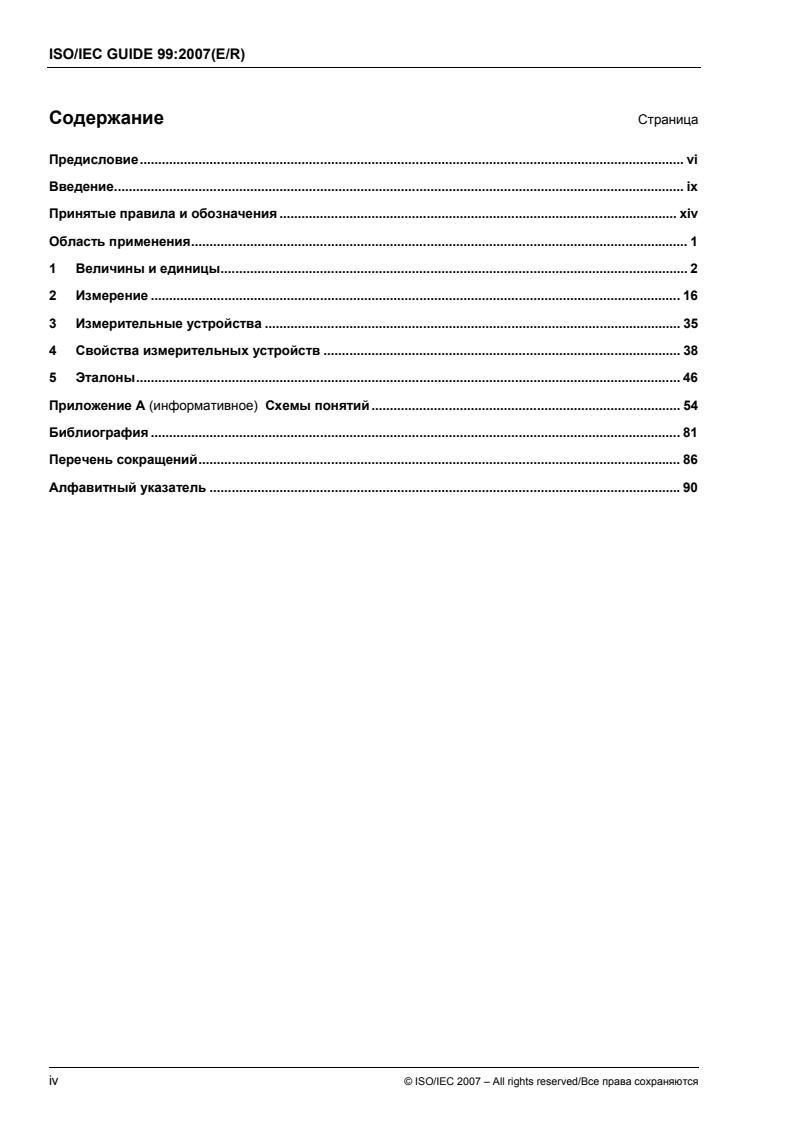
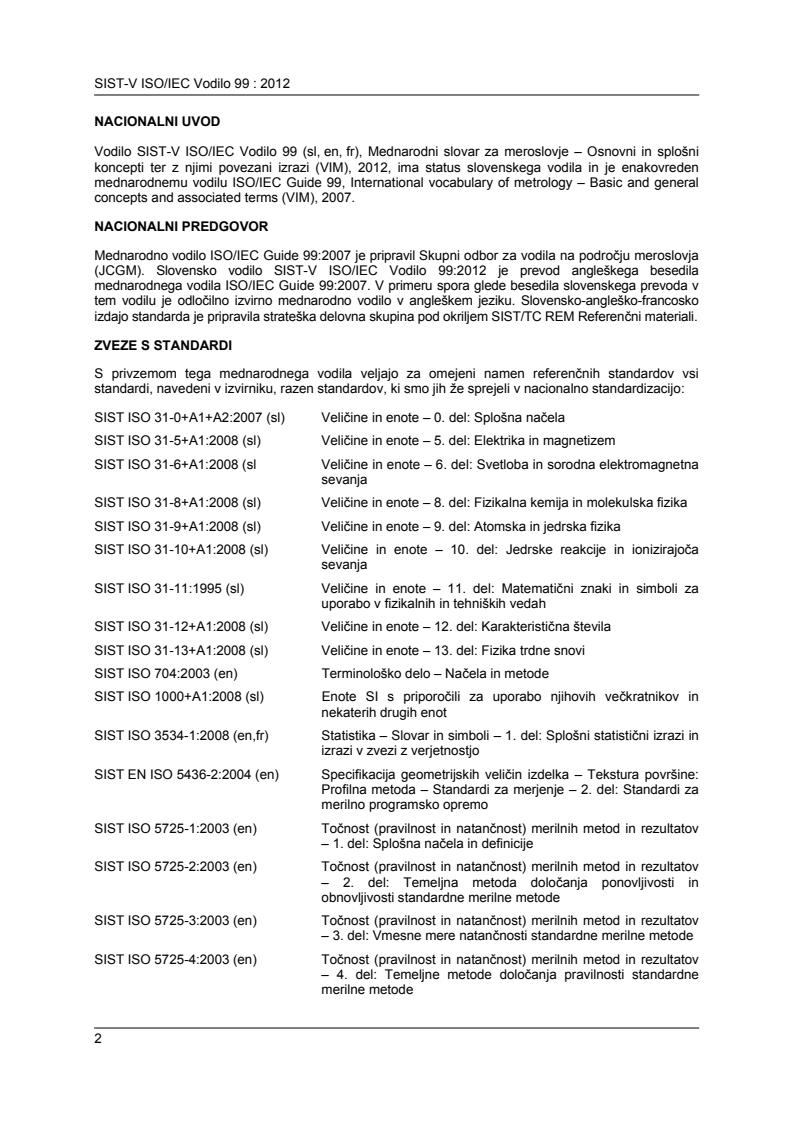
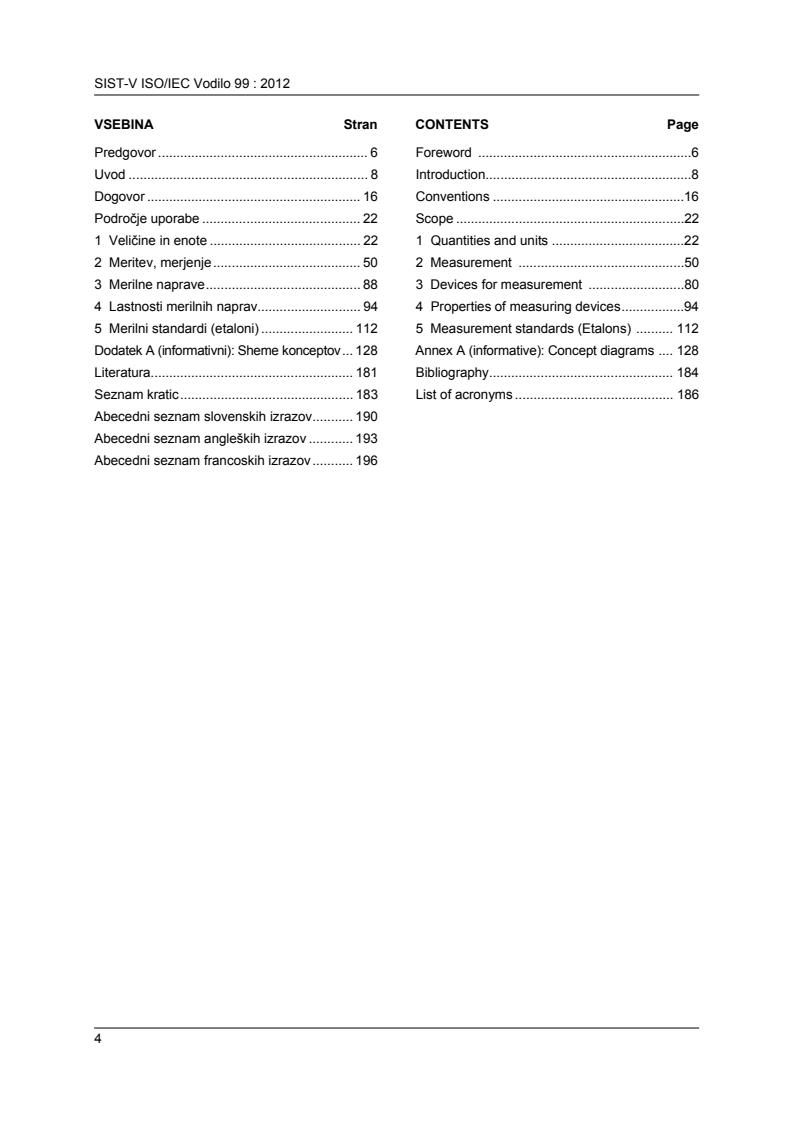
Contents Page
Foreword .v
Introduction.vii
Conventions.xi
Scope.1
1 Quantities and units.2
2 Measurement .16
3 Devices for measurement .34
4 Properties of measuring devices.37
5 Measurement standards (Etalons) .46
Annex A (informative) Concept diagrams .54
Bibliography.81
List of acronyms.86
Alphabetical index.88
© ISO/IEC 2007 – All rights reserved/Tous droits réservés iii
Sommaire Page
Avant-propos. vi
Introduction . ix
Conventions . xiii
Domaine d'application. 1
1 Grandeurs et unités. 2
2 Mesurages. 16
3 Dispositifs de mesure . 34
4 Propriétés des dispositifs de mesure . 37
5 Étalons. 46
Annexe A (informative) Schémas conceptuels . 54
Bibliographie . 81
Liste des sigles . 86
Index alphabétique . 91
iv © ISO/IEC 2007 – All rights reserved/Tous droits réservés
Foreword
ISO (the International Organization for Standardization) is a worldwide federation of national standards bodies
(ISO member bodies). The work of preparing International Standards is normally carried out through ISO
technical committees. Each member body interested in a subject for which a technical committee has been
established has the right to be represented on that committee. International organizations, governmental and
non-governmental, in liaison with ISO, also take part in the work. ISO collaborates closely with the
International Electrotechnical Commission (IEC) on all matters of electrotechnical standardization.
International Standards are drafted in accordance with the rules given in the ISO/IEC Directives, Part 2.
Draft Guides adopted by the responsible Committee or Group are circulated to the member bodies for voting.
Publication as a Guide requires approval by at least 75 % of the member bodies casting a vote.
Attention is drawn to the possibility that some of the elements of this document may be the subject of patent
rights. ISO shall not be held responsible for identifying any or all such patent rights.
This first edition of ISO/IEC Guide 99 cancels and replaces the second edition of the International vocabulary
of basic and general terms in metrology (VIM). It is equivalent to the third edition of the VIM. For further
information, see the Introduction (0.2)
Note that in this document, GUM is used to refer to the industry-recognized publication, adopted as
ISO/IEC Guide 98-3:2008. When a specific subclause number is cited, the reference is to ISO/IEC
Guide 98-3:2008.
This corrected version of ISO/IEC Guide 99:2007 incorporates the following corrections.
Conventions: Interval separator corrected in text and example.
Range of interval: Interval separator corrected in example.
Rewording: 1.1 Note 1 (last row of table), 1.2 Note 1, 1.19 Examples 7 and 10,
2.1 Note 2, 2.3 Note 2, 2.10 Note 3, 2.14 Note 3, 2.45 Example,
4.6 Note, 4.7, 4.13 Note 1, 4.24, Note 2, 4.25, 5.1 Example 4,
5.15 Note 3, 5.17 Examples 1 and 2,
Annex A introductory text (first line after figure at the top of p. 55 changed
and duplicate sentence on p. 56 deleted).
Presentation 1.5, 1.11, 1.13, 1.14, 1.17, 2.3 Note 3, 2.13 Note 2, 2.31, 2.52
(use of regular/bold Example 3, 5.2 Example 3, 5.3, 5.13 Note 3, Annex A Introductory text.
type faces):
Punctuation: 1.23 Examples 1 and 2, 1.25 Example 1, 2.3 Note 2, 3.6 Examples, 4.26,
5.14 Note 5.
Term: 2.10: second admitted term changed to “value of a measured quantity”.
Alphabetical index corrected in consequence.
Cross-references: 2.15 Note 2: “5725-3” changed to “5725-1”.
2.42: Added “(6.10 Note 2)” after the number 2.42.
4.18: Added “(4.15 Note 1)” after the number 4.18.
Figures: Replaced figures in Conventions and Introductory text of Annex A.
Replaced Figures A.1, A.3, A.6, A.7, A.12.
Bibliography: Corrected References [44], [47], [49].
List of acronyms: Corrected spacing.
© ISO/IEC 2007 – All rights reserved/Tous droits réservés v
Avant-propos
L'ISO (Organisation internationale de normalisation) est une fédération mondiale d'organismes nationaux de
normalisation (comités membres de l'ISO). L'élaboration des Normes internationales est en général confiée
aux comités techniques de l'ISO. Chaque comité membre intéressé par une étude a le droit de faire partie du
comité technique créé à cet effet. Les organisations internationales, gouvernementales et non
gouvernementales, en liaison avec l'ISO participent également aux travaux. L'ISO collabore étroitement avec
la Commission électrotechnique internationale (CEI) en ce qui concerne la normalisation électrotechnique.
Les Normes internationales sont rédigées conformément aux règles données dans les Directives ISO/CEI,
Partie 2.
Les projets de Guides adoptés par le comité ou le groupe responsable sont soumis aux comités membres
pour vote. Leur publication comme Guides requiert l'approbation de 75 % au moins des comités membres
votants.
L'attention est appelée sur le fait que certains des éléments du présent document peuvent faire l'objet de
droits de propriété intellectuelle ou de droits analogues. L'ISO ne saurait être tenue pour responsable de ne
pas avoir identifié de tels droits de propriété et averti de leur existence.
Cette première édition du Guide ISO/CEI 99 annule et remplace la deuxième édition du Vocabulaire
international des termes fondamentaux et généraux de métrologie (VIM). Elle est équivalente à la troisième
édition du VIM. Pour plus d'information, voir l'Introduction (0.2)
Dans le présent document, «GUM» renvoie à la publication reconnue dans l'industrie qui a maintenant été
adoptée sous la référence Guide ISO/CEI 98-3:2008. Lorsqu'un paragraphe spécifique est cité, il est fait
référence au Guide ISO/CEI 98-3:2008.
La présente version corrigée du Guide ISO/CEI 99:2007 incorpore les corrections suivantes:
Conventions: Dans l'exemple concernant l'étendue d'un intervalle, «r[−4, 2]» a
été remplacé par «r[−4; 2]».
Modifications rédactionnelles: 1.1 Note 1 (première ligne du tableau),
1.1 Note 1 (dernière ligne du tableau), 1.1 Note 6,
1.19 Exemples 7 et 10, 2.1 Note 2, 2.1 Note 3, 2.3 Note 2,
2.13 Note 1, 2.13 Note 2, 2.14 Note 3, 2.36, 3.4, 3.5,
3.10 Exemple 2, 4.6 Note, 4.13 Note 1, 5.1 Exemple 1,
5.1 Exemple 2, 5.1 Exemple 3, 5.1 Exemple 4, 5.1 Note 3,
5.2 Exemple 3, 5.15 Note 3, 5.17 Exemple 1, 5.17 Exemple 2,
Annexe A texte introductif (la première ligne après la figure en
haut de la page 55 a été modifiée).
Présentation (utilisation de 1.5, 1.11, 1.13, 1.14, 1.17, 2.3 Note 3, 2.31, 2.52 Exemple 3,
caractères normaux/gras): 4.5, 4.10 Note 2, 5.13 Note 3.
Ponctuation: 4.26
Références croisées: 2.15 Note 2: «5725-3» a été remplacé par «5725-1».
Figures: Les figures dans «Conventions» et dans le texte introductif de
l'Annexe A ont été remplacées, de même que les Figures A.1,
A.3, A.5, A.6, A.7 et A.12.
Bibliographie: Les Références [12], [44], [47], [49] et [51] ont été corrigées.
Liste de sigles: La description des sigles CODATA, UICPA-CIAAW,
JCGM/WG 1 et JCGM/WG 2 a été corrigée.
vi © ISO/IEC 2007 – All rights reserved/Tous droits réservés
Introduction
0.1 General
In general, a vocabulary is a “terminological dictionary which contains designations and definitions from one or
more specific subject fields” (ISO 1087-1:2000, 3.7.2). The present Vocabulary pertains to metrology, the
“science of measurement and its application”. It also covers the basic principles governing quantities and
units. The field of quantities and units could be treated in many different ways. Clause 1 of this Vocabulary is
one such treatment, and is based on the principles laid down in the various parts of ISO 31, Quantities and
units, currently being replaced by ISO 80000 and IEC 80000 series Quantities and units, and in the
SI Brochure, The International System of Units (published by the BIPM).
The second edition of the International vocabulary of basic and general terms in metrology (VIM) was
published in 1993. The need to cover measurements in chemistry and laboratory medicine for the first time, as
well as to incorporate concepts such as those that relate to metrological traceability, measurement
uncertainty, and nominal properties, led to this third edition. Its title is now International vocabulary of
metrology — Basic and general concepts and associated terms (VIM), in order to emphasize the primary role
of concepts in developing a vocabulary.
In this Vocabulary, it is taken for granted that there is no fundamental difference in the basic principles of
measurement in physics, chemistry, laboratory medicine, biology, or engineering. Furthermore, an attempt
has been made to meet conceptual needs of measurement in fields such as biochemistry, food science,
forensic science, and molecular biology.
Several concepts that appeared in the second edition of the VIM do not appear in this third edition because
they are no longer considered to be basic or general. For example, the concept 'response time', used in
describing the temporal behaviour of a measuring system, is not included. For concepts related to
measurement devices that are not covered by this third edition of the VIM, the reader should consult other
vocabularies such as IEC 60050, International Electrotechnical Vocabulary, IEV. For concepts concerned with
quality management, mutual recognition arrangements pertaining to metrology, or legal metrology, the reader
is referred to documents given in the bibliography.
Development of this third edition of the VIM has raised some fundamental questions about different current
philosophies and descriptions of measurement, as will be summarized below. These differences sometimes
lead to difficulties in developing definitions that could be used across the different descriptions. No preference
is given in this third edition to any of the particular approaches.
The change in the treatment of measurement uncertainty from an Error Approach (sometimes called
Traditional Approach or True Value Approach) to an Uncertainty Approach necessitated reconsideration of
some of the related concepts appearing in the second edition of the VIM. The objective of measurement in the
Error Approach is to determine an estimate of the true value that is as close as possible to that single true
value. The deviation from the true value is composed of random and systematic errors. The two kinds of
errors, assumed to be always distinguishable, have to be treated differently. No rule can be derived on how
they combine to form the total error of any given measurement result, usually taken as the estimate. Usually,
only an upper limit of the absolute value of the total error is estimated, sometimes loosely named
“uncertainty”.
In the CIPM Recommendation INC-1 (1980) on the Statement of Uncertainties, it is suggested that the
components of measurement uncertainty should be grouped into two categories, Type A and Type B,
according to whether they were evaluated by statistical methods or otherwise, and that they be combined to
yield a variance according to the rules of mathematical probability theory by also treating the Type B
components in terms of variances. The resulting standard deviation is an expression of a measurement
uncertainty. A view of the Uncertainty Approach was detailed in the Guide to the expression of uncertainty in
measurement (GUM) (1993, corrected and reprinted in 1995) that focused on the mathematical treatment of
measurement uncertainty through an explicit measurement model under the assumption that the measurand
can be characterized by an essentially unique value. Moreover, in the GUM as well as in IEC documents,
guidance is provided on the Uncertainty Approach in the case of a single reading of a calibrated instrument, a
situation normally met in industrial metrology.
© ISO/IEC 2007 – All rights reserved/Tous droits réservés vii
The objective of measurement in the Uncertainty Approach is not to determine a true value as closely as
possible. Rather, it is assumed that the information from measurement only permits assignment of an interval
of reasonable values to the measurand, based on the assumption that no mistakes have been made in
performing the measurement. Additional relevant information may reduce the range of the interval of values
that can reasonably be attributed to the measurand. However, even the most refined measurement cannot
reduce the interval to a single value because of the finite amount of detail in the definition of a measurand.
The definitional uncertainty, therefore, sets a minimum limit to any measurement uncertainty. The interval can
be represented by one of its values, called a “measured quantity value”.
In the GUM, the definitional uncertainty is considered to be negligible with respect to the other components of
measurement uncertainty. The objective of measurement is then to establish a probability that this essentially
unique value lies within an interval of measured quantity values, based on the information available from
measurement.
The IEC scenario focuses on measurements with single readings, permitting the investigation of whether
quantities vary in time by demonstrating whether measurement results are compatible. The IEC view also
allows non-negligible definitional uncertainties. The validity of the measurement results is highly dependent on
the metrological properties of the instrument as demonstrated by its calibration. The interval of values offered
to describe the measurand is the interval of values of measurement standards that would have given the
same indications.
In the GUM, the concept of true value is kept for describing the objective of measurement, but the adjective
“true” is considered to be redundant. The IEC does not use the concept to describe this objective. In this
Vocabulary, the concept and term are retained because of common usage and the importance of the concept.
0.2 History of the VIM
In 1997 the Joint Committee for Guides in Metrology (JCGM), chaired by the Director of the BIPM, was formed
by the seven International Organizations that had prepared the original versions of the Guide to the
expression of uncertainty in measurement (GUM) and the International vocabulary of basic and general terms
in metrology (VIM). The Joint Committee took on this part of the work of the ISO Technical Advisory Group 4
(TAG 4), which had developed the GUM and the VIM. The Joint Committee was originally made up of
representatives from the International Bureau of Weights and Measures (BIPM), the International
Electrotechnical Commission (IEC), the International Federation of Clinical Chemistry and Laboratory
Medicine (IFCC), the International Organization for Standardization (ISO), the International Union of Pure and
Applied Chemistry (IUPAC), the International Union of Pure and Applied Physics (IUPAP), and the
International Organization of Legal Metrology (OIML). In 2005, the International Laboratory Accreditation
Cooperation (ILAC) officially joined the seven founding international organizations.
The JCGM has two Working Groups. Working Group 1 (JCGM/WG 1) on the GUM has the task of promoting
the use of the GUM and preparing Supplements to the GUM for broad application. Working Group 2
(JCGM/WG 2) on the VIM has the task of revising the VIM and promoting its use. Working Group 2 is
composed of up to two representatives of each member organization, supplemented by a limited number of
experts. The third edition of the VIM has been prepared by Working Group 2.
In 2004, a first draft of the third edition of the VIM was submitted for comments and proposals to the eight
organizations represented in the JCGM, which in most cases consulted their members or affiliates, including
numerous National Metrology Institutes. Comments were studied and discussed, taken into account when
appropriate, and replied to by JCGM/WG 2. A final draft of the third edition was submitted in 2006 to the eight
organizations for review and approval.
All subsequent comments were considered and taken into account as appropriate by Working Group 2.
The third edition of the VIM has been approved by each and all of the eight JCGM Member organizations.
viii © ISO/IEC 2007 – All rights reserved/Tous droits réservés
Introduction
0.1 Général
En général, un vocabulaire est un «dictionnaire terminologique contenant des désignations et des définitions
tirées d'un ou plusieurs domaines particuliers» (ISO 1087-1:2000, 3.7.2). Le présent Vocabulaire concerne la
métrologie, «science des mesurages et ses applications». Il couvre aussi les principes de base régissant les
grandeurs et unités. Le domaine des grandeurs et unités peut être traité de différentes manières. Celle
retenue pour l'Article 1 de ce Vocabulaire est fondée sur les principes exposés dans les différentes parties de
l'ISO 31, Grandeurs et unités, en cours de remplacement par les séries ISO 80000 et CEI 80000 Grandeurs
et unités, et dans la Brochure sur le SI, Le Système international d'unités (publiée par le BIPM).
La deuxième édition du Vocabulaire international des termes fondamentaux et généraux de métrologie (VIM)
a été publiée en 1993. Le besoin de couvrir pour la première fois les mesures en chimie et en biologie
médicale, ainsi que celui d'inclure des concepts relatifs, par exemple, à la traçabilité métrologique, à
l'incertitude de mesure et aux propriétés qualitatives, ont conduit à cette troisième édition. Son titre est
devenu Vocabulaire international de métrologie — Concepts fondamentaux et généraux et termes associés
(VIM), afin de mettre en évidence le rôle primordial des concepts dans l'élaboration d'un vocabulaire.
Dans ce Vocabulaire, on considère qu'il n'y a pas de différence fondamentale dans les principes de base des
mesurages en physique, chimie, biologie médicale, biologie ou sciences de l'ingénieur. De plus, on a essayé
de couvrir les besoins conceptuels des mesurages dans des domaines tels que la biochimie, la science des
aliments, l'expertise médicolégale et la biologie moléculaire.
Plusieurs concepts qui apparaissaient dans la deuxième édition du VIM n'apparaissent pas dans la troisième
édition car il ne sont plus considérés comme étant fondamentaux ou généraux. Par exemple, le concept de
temps de réponse, utilisé pour décrire le comportement temporel d'un système de mesure, n'est pas inclus.
Pour des concepts relatifs aux dispositifs de mesure qui ne figurent pas dans cette troisième édition du VIM,
le lecteur pourra se reporter à d'autres vocabulaires comme la CEI 60050, Vocabulaire électrotechnique
international, VEI. Pour ceux se rapportant à la gestion de la qualité, aux arrangements de reconnaissance
mutuelle ou à la métrologie légale, le lecteur se reportera à la bibliographie.
Le développement de cette troisième édition du VIM a soulevé quelques questions fondamentales, résumées
ci-dessous, concernant différentes approches utilisées pour la description des mesurages. Ces différences
ont parfois rendu difficile le développement de définitions compatibles avec les différentes descriptions. Dans
cette troisième édition, les différentes approches sont traitées sur un pied d'égalité.
Le changement dans le traitement de l'incertitude de mesure, d'une approche «erreur» (quelquefois appelée
approche traditionnelle ou approche de la valeur vraie) à une approche «incertitude», a conduit à reconsidérer
certains des concepts correspondants qui figuraient dans la deuxième édition du VIM. L'objectif des
mesurages dans l'approche «erreur» est de déterminer une estimation de la valeur vraie qui soit aussi proche
que possible de cette valeur vraie unique. L'écart par rapport à la valeur vraie est constitué d'erreurs
aléatoires et systématiques. Les deux types d'erreurs, que l'on admet pouvoir toujours distinguer, doivent être
traitées différemment. On ne peut pas établir de règle indiquant comment les combiner pour obtenir l'erreur
totale caractérisant un résultat de mesure donné, celui-ci étant en général l'estimation. En général il est
seulement possible d'estimer une limite supérieure de la valeur absolue de l'erreur totale, appelée parfois
abusivement «incertitude».
La Recommandation INC-1 (1980) du CIPM sur l'expression des incertitudes suggère que les composantes
de l'incertitude de mesure soient groupées en deux catégories, Type A et Type B, selon qu'elles sont
évaluées par des méthodes statistiques ou par d'autres méthodes, et qu'elles soient combinées pour obtenir
une variance conformément aux règles de la théorie mathématique des probabilités, en traitant aussi les
composantes de Type B en termes de variances. L'écart-type qui en résulte est une expression de
l'incertitude de mesure. Une description de l'approche «incertitude» a été détaillée dans le Guide pour
l'expression de l'incertitude de mesure (GUM) (1993, corrigé en 1995), qui met l'accent sur le traitement
mathématique de l'incertitude à l'aide d'un modèle de mesure explicite supposant que le mesurande puisse
être caractérisé par une valeur par essence unique. De plus, dans le GUM aussi bien que dans les
documents de la CEI, des indications sont données sur l'approche «incertitude» dans le cas d'une lecture
unique d'un instrument étalonné, une situation qui se rencontre couramment en métrologie industrielle.
© ISO/IEC 2007 – All rights reserved/Tous droits réservés ix
L'objectif des mesurages dans l'approche «incertitude» n'est pas de déterminer une valeur vraie le mieux
possible. On suppose plutôt que l'information obtenue lors d'un mesurage permet seulement d'attribuer au
mesurande un intervalle de valeurs raisonnables, en supposant que le mesurage a été effectué correctement.
Des informations additionnelles pertinentes peuvent réduire l'étendue de l'intervalle des valeurs qui peuvent
être attribuées raisonnablement au mesurande. Cependant, même le mesurage le plus raffiné ne peut réduire
l'intervalle à une seule valeur à cause de la quantité finie de détails dans la définition d'un mesurande.
L'incertitude définitionnelle impose donc une limite inférieure à toute incertitude de mesure. L'intervalle peut
être représenté par une de ses valeurs, appelée «valeur mesurée».
Dans le GUM, l'incertitude définitionnelle est supposée négligeable par rapport aux autres composantes de
l'incertitude de mesure. L'objectif des mesurages est alors d'établir une probabilité que la valeur par essence
unique soit à l'intérieur d'un intervalle de valeurs mesurées, en se fondant sur l'information obtenue lors des
mesurages.
Les documents de la CEI mettent l'accent sur des mesurages comportant une seule lecture, qui permettent
d'étudier si des grandeurs varient en fonction du temps par détermination de la compatibilité des résultats de
mesure. La CEI traite aussi le cas d'incertitudes définitionnelles non négligeables. La validité des résultats de
mesure dépend grandement des propriétés métrologiques de l'instrument, déterminées lors de son
étalonnage. L'intervalle des valeurs attribuées au mesurande est l'intervalle des valeurs des étalons qui
auraient donné les mêmes indications.
Dans le GUM, le concept de valeur vraie est retenu pour décrire l'objectif des mesurages, mais l'adjectif
«vraie» est considéré comme étant redondant. La CEI n'utilise pas le concept pour décrire cet objectif. Dans
le présent Vocabulaire, le concept et le terme sont retenus, compte tenu de leur usage fréquent et de
l'importance du concept.
0.2 L'historique du VIM
En 1997 le Comité commun pour les guides en métrologie (JCGM), présidé par le Directeur du BIPM, a été
formé par les sept Organisations internationales qui avaient préparé les versions originales du Guide pour
l'expression de l'incertitude de mesure (GUM) et du Vocabulaire international des termes fondamentaux et
généraux en métrologie (VIM). Le Comité commun a repris cette partie du travail du Groupe technique
consultatif 4 (TAG 4) de l'ISO, qui avait élaboré le GUM et le VIM. Le Comité commun était constitué à
l'origine de représentants du Bureau international des poids et mesures (BIPM), de la Commission
électrotechnique internationale (CEI), de la Fédération internationale de chimie clinique et de biologie
médicale (IFCC), de l'Organisation internationale de normalisation (ISO), de l'Union internationale de chimie
pure et appliquée (UICPA), de l'Union internationale de physique pure et appliquée (UIPPA) et de
l'Organisation internationale de métrologie légale (OIML). En 2005, la Coopération internationale sur
l'agrément des laboratoires d'essais (ILAC) a rejoint officiellement les sept organisations internationales
fondatrices.
Le JCGM a deux Groupes de travail. Le Groupe de travail 1 (JCGM/WG 1) sur le GUM a la tâche de
promouvoir l'usage du GUM et de préparer des suppléments au GUM pour en élargir le champ d'application.
Le Groupe de travail 2 (JCGM/WG 2) sur le VIM a la tâche de réviser le VIM et d'en promouvoir l'usage. Le
Groupe de travail 2 est composé de deux représentants au plus de chaque organisation membre et de
quelques autres experts. Cette troisième édition du VIM a été préparée par le Groupe de travail 2.
En 2004, un premier projet de troisième édition du VIM a été soumis pour commentaires et propositions aux
huit organisations représentées dans le JCGM, qui pour la plupart ont consulté leurs membres ou affiliés, y
compris de nombreux laboratoires nationaux de métrologie. Le JCGM/WG 2 a étudié et discuté les
commentaires, les a éventuellement pris en compte et a élaboré des réponses. Une version finale de la
troisième édition a été soumise en 2006 aux huit organisations pour évaluation et approbation.
Tous les commentaires ultérieurs ont été examinés et éventuellement pris en compte par le Groupe de
travail 2.
Cette troisième édition a été approuvée à l'unanimité par les huit organisations membres du JCGM.
x © ISO/IEC 2007 – All rights reserved/Tous droits réservés
Conventions
Terminology rules
The definitions and terms given in this third edition, as well as their formats, comply as far as possible with the
rules of terminology work, as outlined in ISO 704, ISO 1087-1 and ISO 10241. In particular, the substitution
principle applies; that is, it is possible in any definition to replace a term referring to a concept defined
elsewhere in the VIM by the definition corresponding to that term, without introducing contradiction or
circularity.
Concepts are listed in five chapters and in logical order in each chapter.
In some definitions, the use of non-defined concepts (also called “primitives”) is unavoidable. In this
Vocabulary, such non-defined concepts include: system, component, phenomenon, body, substance,
property, reference, experiment, examination, magnitude, material, device, and signal.
To facilitate the understanding of the different relations between the various concepts given in this Vocabulary,
concept diagrams have been introduced. They are given in Annex A.
Reference number
Concepts appearing in both the second and third editions have a double reference number; the third edition
reference number is printed in bold face, and the earlier reference from the second edition is given in
parentheses and in light font.
Synonyms
Multiple terms for the same concept are permitted. If more than one term is given, the first term is the
preferred one, and it is used throughout as far as possible.
Bold face
Terms used for a concept to be defined are printed in bold face. In the text of a given entry, terms of concepts
defined elsewhere in the VIM are also printed in bold face the first time they appear.
Quotation marks
In the English text of this document, single quotation marks (‘…’) surround the term representing a concept
unless it is in bold. Double quotation marks (“…”) are used when only the term is considered, or for a
quotation. In the French text, quotation marks («.») are used for quotations, or to highlight a word or a group
of words.
Decimal sign
The decimal sign in the English text is the point on the line, and the comma on the line is the decimal sign in
the French text.
French terms “mesure” and “mesurage” (“measurement”)
The French word “mesure” has several meanings in everyday French language. For this reason, it is not used
in this Vocabulary without further qualification. It is for the same reason that the French word “mesurage” has
been introduced to describe the act of measurement. Nevertheless, the French word “mesure” occurs many
times in forming terms in this Vocabulary, following current usage, and without ambiguity. Examples are:
instrument de mesure, appareil de mesure, unité de mesure, méthode de mesure. This does not mean that
the use of the French word “mesurage” in place of “mesure” in such terms is not permissible when
advantageous.
Equal-by-definition symbol
The symbol := denotes “is by definition equal to” as given in the ISO 80000 and IEC 80000 series.
© ISO/IEC 2007 – All rights reserved/Tous droits réservés xi
Interval
The term “interval” is used together with the symbol [a, b] to denote the set of real numbers x for which
a u x u b, where a and b > a are real numbers. The term “interval” is used here for ‘closed interval’. The
symbols a and b denote the ‘end-points’ of the interval [a, b].
EXAMPLE [–4, 2]
The two end-points 2 and –4 of the interval [–4, 2] can be stated as –1 ± 3. The latter expression does not denote the
interval [–4, 2]. Nevertheless, –1 ± 3 is often used to denote the interval [–4, 2].
Range of interval
Range
The range of the interval [a, b] is the difference b − a and is denoted by r[a, b].
EXAMPLE r[–4, 2] = 2 – (–4) = 6
NOTE The term “span” is sometimes used for this concept.
xii © ISO/IEC 2007 – All rights reserved/Tous droits réservés
Conventions
Règles terminologiques
Les définitions et termes donnés dans cette troisième édition, ainsi que leurs formats, sont conformes autant
que possible aux règles de terminologie exposées dans l'ISO 704, l'ISO 1087-1 et l'ISO 10241. En particulier
le principe de substitution s'applique: il est possible dans toute définition de remplacer un terme désignant un
concept défini ailleurs dans le VIM par la définition correspondante, sans introduire de contradiction ou de
circularité.
Les concepts sont répartis en cinq chapitres et présentés dans un ordre logique dans chaque chapitre.
Dans certaines définitions, l'utilisation de concepts non définis (aussi appelés des concepts «premiers») est
inévitable. Dans ce Vocabulaire, on trouve parmi eux: système, composante ou constituant, phénomène,
corps, substance, propriété, référence, expérience, examen, quantitatif, matériel, dispositif, signal.
Pour faciliter la compréhension des différentes relations entre les concepts définis dans ce Vocabulaire, des
schémas conceptuels ont été introduits. Ils sont donnés dans l'Annexe A.
Numéro de référence
Les concepts figurant à la fois dans la seconde et la troisième éditions ont un double numéro de référence. Le
numéro de référence de la troisième édition est imprimé en gras, le numéro antérieur de la seconde édition
est placé entre parenthèses en maigre.
Synonymes
Plusieurs termes sont autorisés pour un même concept. S'il y a plusieurs termes, le premier est le terme
privilégié et est celui qui sera utilisé ailleurs dans le VIM dans la mesure du possible.
Caractères gras
Les termes désignant un concept à définir sont imprimés en gras. Dans le texte d'un article donné, les termes
correspondant à des concepts définis ailleurs dans le VIM sont aussi imprimés en gras à leur première
apparition.
Guillemets
Dans le texte anglais du présent document, un terme représentant un concept est placé entre marques
simples (‘.’) sauf s'il est en gras. Des marques doubles (“.”) sont utilisées lorsque seul le terme est
considéré ou pour une citation. Dans le texte français, les guillemets («.») sont employés pour les citations
ou pour mettre en évidence un mot ou un groupe de mots.
Signe décimal
Le signe décimal est le point sur la ligne dans le texte anglais, la virgule sur la ligne dans le texte français.
Mesure et mesurage
Le mot «mesure» a, dans la langue française courante, plusieurs significations. Aussi n'est-il pas employé
seul dans le présent Vocabulaire. C'est également la raison pour laquelle le mot «mesurage» a été introduit
pour qualifier l'action de mesurer. Le mot «mesure» intervient cependant à de nombreuses reprises pour
former des termes de ce Vocabulaire, suivant en cela l'usage courant et sans ambiguïté. On peut citer, par
exemple: instrument de mesure, appareil de mesure, unité de mesure, méthode de mesure. Cela ne signifie
pas que l'utilisation du mot «mesurage» au lieu de «mesure» pour ces termes ne soit pas admissible si l'on y
trouve quelque avantage.
Symbole d'égalité par définition
Le symbole := signifie «est par définition égal à», comme indiqué dans les séries ISO 80000 et CEI 80000.
© ISO/IEC 2007 – All rights reserved/Tous droits réservés xiii
Intervalle
Le terme «intervalle» et le symbole [a; b] sont utilisés pour désigner l'ensemble des nombres réels x tels que
a u x u b, où a et b > a sont des nombres réels. Le terme «intervalle» est utilisé ici pour «intervalle fermé».
Les symboles a et b notent les extrémités de l'intervalle [a; b].
EXEMPLE [–4; 2]
Les deux extrémités 2 et –4 de l'intervalle [–4; 2] peuvent être notées –1 ± 3. Cette dernière expression ne désigne pas
l'intervalle [–4; 2]. Cependant, –1 ± 3 est souvent utilisé pour désigner l'intervalle [–4; 2].
Étendue d'un intervalle
Étendue
L'étendue de l'intervalle [a; b] est la différence b – a, notée r[a; b].
EXEMPLE r[–4; 2] = 2 – (–4) = 6
NOTE En anglais, le terme «span» est parfois utilisé.
xiv © ISO/IEC 2007 – All rights reserved/Tous droits réservés
International vocabulary of metrology — Basic and general
concepts and associated terms (VIM)
Vocabulaire international de métrologie — Concepts
fondamentaux et généraux et termes associés (VIM)
Scope Domaine d'application
In this Vocabulary, a set of definitions and Ce Vocabulaire donne un ensemble de définitions
associated terms is given, in English and French, et de termes associés, en anglais et en français,
for a system of basic and general concepts used in pour un système de concepts fondamentaux et
metrology, together with concept diagrams to généraux utilisés en métrologie, ainsi que des
demonstrate their relations. Additional information is schémas conceptuels illustrant leurs relations. Pour
given in the form of examples and notes under un grand nombre de définitions, des informations
many definitions. complémentaires sont données sous forme
d'exemples et de notes.
This Vocabulary is meant to be a common
reference for scientists and engineers — including Ce Vocabulaire se propose d'être une référence
physicists, chemists, medical scientists — as well commune pour les scientifiques et les ingénieurs
as for both teachers and practitioners involved in — y compris les physiciens, chimistes et biologistes
planning or performing measurements, irrespective médicaux — ainsi que pour les enseignants et
of the level of measurement uncertainty and praticiens, impliqués dans la planification ou la
irrespective of the field of application. It is also réalisation de mesurages, quels que soient le
meant to be a reference for governmental and inter- domaine d'application et le niveau d'incertitude de
governmental bodies, trade associations, accredi- mesure. Il se propose aussi d'être une référence
tation bodies, regulators, and professional societies. pour les organismes gouvernementaux et inter-
gouvernementaux, le
...
SLOVENSKI STANDARD
01-marec-2012
Mednarodni slovar za meroslovje - Osnovni in splošni koncepti ter z njimi
povezani izrazi (VIM)
International vocabulary of metrology - Basic and general concepts and associated terms
(VIM)
Internationales Wörterbuch der Metrologie (VIM)
Vocabulaire international de métrologie - Concepts fondamentaux et généraux et termes
associés (VIM)
Ta slovenski standard je istoveten z: ISO/IEC Guide 99:2007
ICS:
01.040.17 Meroslovje in merjenje. Metrology and measurement.
Fizikalni pojavi (Slovarji) Physical phenomena
(Vocabularies)
17.020 Meroslovje in merjenje na Metrology and measurement
splošno in general
2003-01.Slovenski inštitut za standardizacijo. Razmnoževanje celote ali delov tega standarda ni dovoljeno.
GUIDE 99
International vocabulary of
metrology — Basic and general
concepts and associated terms
(VIM)
Vocabulaire international de
métrologie — Concepts
fondamentaux et généraux et
termes associés (VIM)
First edition 2007
Première édition 2007
©
ISO/IEC 2007
PDF disclaimer
This PDF file may contain embedded typefaces. In accordance with Adobe's licensing policy, this file may be printed or viewed but
shall not be edited unless the typefaces which are embedded are licensed to and installed on the computer performing the editing. In
downloading this file, parties accept therein the responsibility of not infringing Adobe's licensing policy. The ISO Central Secretariat
accepts no liability in this area.
Adobe is a trademark of Adobe Systems Incorporated.
Details of the software products used to create this PDF file can be found in the General Info relative to the file; the PDF-creation
parameters were optimized for printing. Every care has been taken to ensure that the file is suitable for use by ISO member bodies. In
the unlikely event that a problem relating to it is found, please inform the Central Secretariat at the address given below.
PDF – Exonération de responsabilité
Le présent fichier PDF peut contenir des polices de caractères intégrées. Conformément aux conditions de licence d'Adobe, ce fichier
peut être imprimé ou visualisé, mais ne doit pas être modifié à moins que l'ordinateur employé à cet effet ne bénéficie d'une licence
autorisant l'utilisation de ces polices et que celles-ci y soient installées. Lors du téléchargement de ce fichier, les parties concernées
acceptent de fait la responsabilité de ne pas enfreindre les conditions de licence d'Adobe. Le Secrétariat central de l'ISO décline toute
responsabilité en la matière.
Adobe est une marque déposée d'Adobe Systems Incorporated.
Les détails relatifs aux produits logiciels utilisés pour la création du présent fichier PDF sont disponibles dans la rubrique General Info
du fichier; les paramètres de création PDF ont été optimisés pour l'impression. Toutes les mesures ont été prises pour garantir
l'exploitation de ce fichier par les comités membres de l'ISO. Dans le cas peu probable où surviendrait un problème d'utilisation,
veuillez en informer le Secrétariat central à l'adresse donnée ci-dessous.
DOCUMENT PROTÉGÉ PAR COPYRIGHT
© ISO/IEC 2007
The reproduction of the terms and definitions contained in this International Standard is permitted in teaching manuals, instruction
booklets, technical publications and journals for strictly educational or implementation purposes. The conditions for such reproduction are:
that no modifications are made to the terms and definitions; that such reproduction is not permitted for dictionaries or similar publications
offered for sale; and that this International Standard is referenced as the source document.
With the sole exceptions noted above, no other part of this publication may be reproduced or utilized in any form or by any means,
electronic or mechanical, including photocopying and microfilm, without permission in writing from either ISO at the address below or
ISO's member body in the country of the requester.
La reproduction des termes et des définitions contenus dans la présente Norme internationale est autorisée dans les manuels
d'enseignement, les modes d'emploi, les publications et revues techniques destinés exclusivement à l'enseignement ou à la mise en
application. Les conditions d'une telle reproduction sont les suivantes: aucune modification n'est apportée aux termes et définitions; la
reproduction n'est pas autorisée dans des dictionnaires ou publications similaires destinés à la vente; la présente Norme internationale
est citée comme document source.
À la seule exception mentionnée ci-dessus, aucune partie de cette publication ne peut être reproduite ni utilisée sous quelque forme que
ce soit et par aucun procédé, électronique ou mécanique, y compris la photocopie et les microfilms, sans l'accord écrit de l'ISO à
l'adresse ci-après ou du comité membre de l'ISO dans le pays du demandeur.
ISO copyright office
Case postale 56 • CH-1211 Geneva 20
Tel. + 41 22 749 01 11
Fax + 41 22 749 09 47
E-mail copyright@iso.org
Web www.iso.org
Published in Switzerland/Publié en Suisse
ii © ISO/IEC 2007 – All rights reserved/Tous droits réservés
Contents Page
Foreword .v
Introduction.vii
Conventions.xi
Scope.1
1 Quantities and units.2
2 Measurement .16
3 Devices for measurement .34
4 Properties of measuring devices.37
5 Measurement standards (Etalons) .46
Annex A (informative) Concept diagrams .54
Bibliography.81
List of acronyms.86
Alphabetical index.88
© ISO/IEC 2007 – All rights reserved/Tous droits réservés iii
Sommaire Page
Avant-propos. vi
Introduction . ix
Conventions . xiii
Domaine d'application. 1
1 Grandeurs et unités. 2
2 Mesurages. 16
3 Dispositifs de mesure . 34
4 Propriétés des dispositifs de mesure . 37
5 Étalons. 46
Annexe A (informative) Schémas conceptuels . 54
Bibliographie . 81
Liste des sigles . 86
Index alphabétique . 91
iv © ISO/IEC 2007 – All rights reserved/Tous droits réservés
Foreword
ISO (the International Organization for Standardization) is a worldwide federation of national standards bodies
(ISO member bodies). The work of preparing International Standards is normally carried out through ISO
technical committees. Each member body interested in a subject for which a technical committee has been
established has the right to be represented on that committee. International organizations, governmental and
non-governmental, in liaison with ISO, also take part in the work. ISO collaborates closely with the
International Electrotechnical Commission (IEC) on all matters of electrotechnical standardization.
International Standards are drafted in accordance with the rules given in the ISO/IEC Directives, Part 2.
Draft Guides adopted by the responsible Committee or Group are circulated to the member bodies for voting.
Publication as a Guide requires approval by at least 75 % of the member bodies casting a vote.
Attention is drawn to the possibility that some of the elements of this document may be the subject of patent
rights. ISO shall not be held responsible for identifying any or all such patent rights.
This first edition of ISO/IEC Guide 99 cancels and replaces the second edition of the International vocabulary
of basic and general terms in metrology (VIM). It is equivalent to the third edition of the VIM. For further
information, see the Introduction (0.2)
Note that in this document, GUM is used to refer to the industry-recognized publication, adopted as
ISO/IEC Guide 98-3:2008. When a specific subclause number is cited, the reference is to ISO/IEC
Guide 98-3:2008.
© ISO/IEC 2007 – All rights reserved/Tous droits réservés v
Avant-propos
L'ISO (Organisation internationale de normalisation) est une fédération mondiale d'organismes nationaux de
normalisation (comités membres de l'ISO). L'élaboration des Normes internationales est en général confiée
aux comités techniques de l'ISO. Chaque comité membre intéressé par une étude a le droit de faire partie du
comité technique créé à cet effet. Les organisations internationales, gouvernementales et non
gouvernementales, en liaison avec l'ISO participent également aux travaux. L'ISO collabore étroitement avec
la Commission électrotechnique internationale (CEI) en ce qui concerne la normalisation électrotechnique.
Les Normes internationales sont rédigées conformément aux règles données dans les Directives ISO/CEI,
Partie 2.
Les projets de Guides adoptés par le comité ou le groupe responsable sont soumis aux comités membres
pour vote. Leur publication comme Guides requiert l'approbation de 75 % au moins des comités membres
votants.
L'attention est appelée sur le fait que certains des éléments du présent document peuvent faire l'objet de
droits de propriété intellectuelle ou de droits analogues. L'ISO ne saurait être tenue pour responsable de ne
pas avoir identifié de tels droits de propriété et averti de leur existence.
Cette première édition du Guide ISO/CEI 99 annule et remplace la deuxième édition du Vocabulaire
international des termes fondamentaux et généraux de métrologie (VIM). Elle est équivalente à la troisième
édition du VIM. Pour plus d'information, voir l'Introduction (0.2)
Dans le présent document, «GUM» renvoie à la publication reconnue dans l'industrie qui a maintenant été
adoptée sous la référence Guide ISO/CEI 98-3:2008. Lorsqu'un paragraphe spécifique est cité, il est fait
référence au Guide ISO/CEI 98-3:2008.
vi © ISO/IEC 2007 – All rights reserved/Tous droits réservés
Introduction
0.1 General
In general, a vocabulary is a “terminological dictionary which contains designations and definitions from one or
more specific subject fields” (ISO 1087-1:2000, 3.7.2). The present Vocabulary pertains to metrology, the
“science of measurement and its application”. It also covers the basic principles governing quantities and
units. The field of quantities and units could be treated in many different ways. Clause 1 of this Vocabulary is
one such treatment, and is based on the principles laid down in the various parts of ISO 31, Quantities and
units, currently being replaced by ISO 80000 and IEC 80000 series Quantities and units, and in the
SI Brochure, The International System of Units (published by the BIPM).
The second edition of the International vocabulary of basic and general terms in metrology (VIM) was
published in 1993. The need to cover measurements in chemistry and laboratory medicine for the first time, as
well as to incorporate concepts such as those that relate to metrological traceability, measurement
uncertainty, and nominal properties, led to this third edition. Its title is now International vocabulary of
metrology — Basic and general concepts and associated terms (VIM), in order to emphasize the primary role
of concepts in developing a vocabulary.
In this Vocabulary, it is taken for granted that there is no fundamental difference in the basic principles of
measurement in physics, chemistry, laboratory medicine, biology, or engineering. Furthermore, an attempt
has been made to meet conceptual needs of measurement in fields such as biochemistry, food science,
forensic science, and molecular biology.
Several concepts that appeared in the second edition of the VIM do not appear in this third edition because
they are no longer considered to be basic or general. For example, the concept 'response time', used in
describing the temporal behaviour of a measuring system, is not included. For concepts related to
measurement devices that are not covered by this third edition of the VIM, the reader should consult other
vocabularies such as IEC 60050, International Electrotechnical Vocabulary, IEV. For concepts concerned with
quality management, mutual recognition arrangements pertaining to metrology, or legal metrology, the reader
is referred to documents given in the bibliography.
Development of this third edition of the VIM has raised some fundamental questions about different current
philosophies and descriptions of measurement, as will be summarized below. These differences sometimes
lead to difficulties in developing definitions that could be used across the different descriptions. No preference
is given in this third edition to any of the particular approaches.
The change in the treatment of measurement uncertainty from an Error Approach (sometimes called
Traditional Approach or True Value Approach) to an Uncertainty Approach necessitated reconsideration of
some of the related concepts appearing in the second edition of the VIM. The objective of measurement in the
Error Approach is to determine an estimate of the true value that is as close as possible to that single true
value. The deviation from the true value is composed of random and systematic errors. The two kinds of
errors, assumed to be always distinguishable, have to be treated differently. No rule can be derived on how
they combine to form the total error of any given measurement result, usually taken as the estimate. Usually,
only an upper limit of the absolute value of the total error is estimated, sometimes loosely named
“uncertainty”.
In the CIPM Recommendation INC-1 (1980) on the Statement of Uncertainties, it is suggested that the
components of measurement uncertainty should be grouped into two categories, Type A and Type B,
according to whether they were evaluated by statistical methods or otherwise, and that they be combined to
yield a variance according to the rules of mathematical probability theory by also treating the Type B
components in terms of variances. The resulting standard deviation is an expression of a measurement
uncertainty. A view of the Uncertainty Approach was detailed in the Guide to the expression of uncertainty in
measurement (GUM) (1993, corrected and reprinted in 1995) that focused on the mathematical treatment of
measurement uncertainty through an explicit measurement model under the assumption that the measurand
can be characterized by an essentially unique value. Moreover, in the GUM as well as in IEC documents,
guidance is provided on the Uncertainty Approach in the case of a single reading of a calibrated instrument, a
situation normally met in industrial metrology.
© ISO/IEC 2007 – All rights reserved/Tous droits réservés vii
The objective of measurement in the Uncertainty Approach is not to determine a true value as closely as
possible. Rather, it is assumed that the information from measurement only permits assignment of an interval
of reasonable values to the measurand, based on the assumption that no mistakes have been made in
performing the measurement. Additional relevant information may reduce the range of the interval of values
that can reasonably be attributed to the measurand. However, even the most refined measurement cannot
reduce the interval to a single value because of the finite amount of detail in the definition of a measurand.
The definitional uncertainty, therefore, sets a minimum limit to any measurement uncertainty. The interval can
be represented by one of its values, called a “measured quantity value”.
In the GUM, the definitional uncertainty is considered to be negligible with respect to the other components of
measurement uncertainty. The objective of measurement is then to establish a probability that this essentially
unique value lies within an interval of measured quantity values, based on the information available from
measurement.
The IEC scenario focuses on measurements with single readings, permitting the investigation of whether
quantities vary in time by demonstrating whether measurement results are compatible. The IEC view also
allows non-negligible definitional uncertainties. The validity of the measurement results is highly dependent on
the metrological properties of the instrument as demonstrated by its calibration. The interval of values offered
to describe the measurand is the interval of values of measurement standards that would have given the
same indications.
In the GUM, the concept of true value is kept for describing the objective of measurement, but the adjective
“true” is considered to be redundant. The IEC does not use the concept to describe this objective. In this
Vocabulary, the concept and term are retained because of common usage and the importance of the concept.
0.2 History of the VIM
In 1997 the Joint Committee for Guides in Metrology (JCGM), chaired by the Director of the BIPM, was formed
by the seven International Organizations that had prepared the original versions of the Guide to the
expression of uncertainty in measurement (GUM) and the International vocabulary of basic and general terms
in metrology (VIM). The Joint Committee took on this part of the work of the ISO Technical Advisory Group 4
(TAG 4), which had developed the GUM and the VIM. The Joint Committee was originally made up of
representatives from the International Bureau of Weights and Measures (BIPM), the International
Electrotechnical Commission (IEC), the International Federation of Clinical Chemistry and Laboratory
Medicine (IFCC), the International Organization for Standardization (ISO), the International Union of Pure and
Applied Chemistry (IUPAC), the International Union of Pure and Applied Physics (IUPAP), and the
International Organization of Legal Metrology (OIML). In 2005, the International Laboratory Accreditation
Cooperation (ILAC) officially joined the seven founding international organizations.
The JCGM has two Working Groups. Working Group 1 (JCGM/WG 1) on the GUM has the task of promoting
the use of the GUM and preparing Supplements to the GUM for broad application. Working Group 2
(JCGM/WG 2) on the VIM has the task of revising the VIM and promoting its use. Working Group 2 is
composed of up to two representatives of each member organization, supplemented by a limited number of
experts. The third edition of the VIM has been prepared by Working Group 2.
In 2004, a first draft of the third edition of the VIM was submitted for comments and proposals to the eight
organizations represented in the JCGM, which in most cases consulted their members or affiliates, including
numerous National Metrology Institutes. Comments were studied and discussed, taken into account when
appropriate, and replied to by JCGM/WG 2. A final draft of the third edition was submitted in 2006 to the eight
organizations for review and approval.
All subsequent comments were considered and taken into account as appropriate by Working Group 2.
The third edition of the VIM has been approved by each and all of the eight JCGM Member organizations.
viii © ISO/IEC 2007 – All rights reserved/Tous droits réservés
Introduction
0.1 Général
En général, un vocabulaire est un «dictionnaire terminologique contenant des désignations et des définitions
tirées d'un ou plusieurs domaines particuliers» (ISO 1087-1:2000, 3.7.2). Le présent Vocabulaire concerne la
métrologie, «science des mesurages et ses applications». Il couvre aussi les principes de base régissant les
grandeurs et unités. Le domaine des grandeurs et unités peut être traité de différentes manières. Celle
retenue pour l'Article 1 de ce Vocabulaire est fondée sur les principes exposés dans les différentes parties de
l'ISO 31, Grandeurs et unités, en cours de remplacement par les séries ISO 80000 et CEI 80000 Grandeurs
et unités, et dans la Brochure sur le SI, Le Système international d'unités (publiée par le BIPM).
La deuxième édition du Vocabulaire international des termes fondamentaux et généraux de métrologie (VIM)
a été publiée en 1993. Le besoin de couvrir pour la première fois les mesures en chimie et en biologie
médicale, ainsi que celui d'inclure des concepts relatifs, par exemple, à la traçabilité métrologique, à
l'incertitude de mesure et aux propriétés qualitatives, ont conduit à cette troisième édition. Son titre est
devenu Vocabulaire international de métrologie — Concepts fondamentaux et généraux et termes associés
(VIM), afin de mettre en évidence le rôle primordial des concepts dans l'élaboration d'un vocabulaire.
Dans ce Vocabulaire, on considère qu'il n'y a pas de différence fondamentale dans les principes de base des
mesurages en physique, chimie, biologie médicale, biologie ou sciences de l'ingénieur. De plus, on a essayé
de couvrir les besoins conceptuels des mesurages dans des domaines tels que la biochimie, la science des
aliments, l'expertise médicolégale et la biologie moléculaire.
Plusieurs concepts qui apparaissaient dans la deuxième édition du VIM n'apparaissent pas dans la troisième
édition car il ne sont plus considérés comme étant fondamentaux ou généraux. Par exemple, le concept de
temps de réponse, utilisé pour décrire le comportement temporel d'un système de mesure, n'est pas inclus.
Pour des concepts relatifs aux dispositifs de mesure qui ne figurent pas dans cette troisième édition du VIM,
le lecteur pourra se reporter à d'autres vocabulaires comme la CEI 60050, Vocabulaire électrotechnique
international, VEI. Pour ceux se rapportant à la gestion de la qualité, aux arrangements de reconnaissance
mutuelle ou à la métrologie légale, le lecteur se reportera à la bibliographie.
Le développement de cette troisième édition du VIM a soulevé quelques questions fondamentales, résumées
ci-dessous, concernant différentes approches utilisées pour la description des mesurages. Ces différences
ont parfois rendu difficile le développement de définitions compatibles avec les différentes descriptions. Dans
cette troisième édition, les différentes approches sont traitées sur un pied d'égalité.
Le changement dans le traitement de l'incertitude de mesure, d'une approche «erreur» (quelquefois appelée
approche traditionnelle ou approche de la valeur vraie) à une approche «incertitude», a conduit à reconsidérer
certains des concepts correspondants qui figuraient dans la deuxième édition du VIM. L'objectif des
mesurages dans l'approche «erreur» est de déterminer une estimation de la valeur vraie qui soit aussi proche
que possible de cette valeur vraie unique. L'écart par rapport à la valeur vraie est constitué d'erreurs
aléatoires et systématiques. Les deux types d'erreurs, que l'on admet pouvoir toujours distinguer, doivent être
traitées différemment. On ne peut pas établir de règle indiquant comment les combiner pour obtenir l'erreur
totale caractérisant un résultat de mesure donné, celui-ci étant en général l'estimation. En général il est
seulement possible d'estimer une limite supérieure de la valeur absolue de l'erreur totale, appelée parfois
abusivement «incertitude».
La Recommandation INC-1 (1980) du CIPM sur l'expression des incertitudes suggère que les composantes
de l'incertitude de mesure soient groupées en deux catégories, Type A et Type B, selon qu'elles sont
évaluées par des méthodes statistiques ou par d'autres méthodes, et qu'elles soient combinées pour obtenir
une variance conformément aux règles de la théorie mathématique des probabilités, en traitant aussi les
composantes de Type B en termes de variances. L'écart-type qui en résulte est une expression de
l'incertitude de mesure. Une description de l'approche «incertitude» a été détaillée dans le Guide pour
l'expression de l'incertitude de mesure (GUM) (1993, corrigé en 1995), qui met l'accent sur le traitement
mathématique de l'incertitude à l'aide d'un modèle de mesure explicite supposant que le mesurande puisse
être caractérisé par une valeur par essence unique. De plus, dans le GUM aussi bien que dans les
documents de la CEI, des indications sont données sur l'approche «incertitude» dans le cas d'une lecture
unique d'un instrument étalonné, une situation qui se rencontre couramment en métrologie industrielle.
© ISO/IEC 2007 – All rights reserved/Tous droits réservés ix
L'objectif des mesurages dans l'approche «incertitude» n'est pas de déterminer une valeur vraie le mieux
possible. On suppose plutôt que l'information obtenue lors d'un mesurage permet seulement d'attribuer au
mesurande un intervalle de valeurs raisonnables, en supposant que le mesurage a été effectué correctement.
Des informations additionnelles pertinentes peuvent réduire l'étendue de l'intervalle des valeurs qui peuvent
être attribuées raisonnablement au mesurande. Cependant, même le mesurage le plus raffiné ne peut réduire
l'intervalle à une seule valeur à cause de la quantité finie de détails dans la définition d'un mesurande.
L'incertitude définitionnelle impose donc une limite inférieure à toute incertitude de mesure. L'intervalle peut
être représenté par une de ses valeurs, appelée «valeur mesurée».
Dans le GUM, l'incertitude définitionnelle est supposée négligeable par rapport aux autres composantes de
l'incertitude de mesure. L'objectif des mesurages est alors d'établir une probabilité que la valeur par essence
unique soit à l'intérieur d'un intervalle de valeurs mesurées, en se fondant sur l'information obtenue lors des
mesurages.
Les documents de la CEI mettent l'accent sur des mesurages comportant une seule lecture, qui permettent
d'étudier si des grandeurs varient en fonction du temps par détermination de la compatibilité des résultats de
mesure. La CEI traite aussi le cas d'incertitudes définitionnelles non négligeables. La validité des résultats de
mesure dépend grandement des propriétés métrologiques de l'instrument, déterminées lors de son
étalonnage. L'intervalle des valeurs attribuées au mesurande est l'intervalle des valeurs des étalons qui
auraient donné les mêmes indications.
Dans le GUM, le concept de valeur vraie est retenu pour décrire l'objectif des mesurages, mais l'adjectif
«vraie» est considéré comme étant redondant. La CEI n'utilise pas le concept pour décrire cet objectif. Dans
le présent Vocabulaire, le concept et le terme sont retenus, compte tenu de leur usage fréquent et de
l'importance du concept.
0.2 L'historique du VIM
En 1997 le Comité commun pour les guides en métrologie (JCGM), présidé par le Directeur du BIPM, a été
formé par les sept Organisations internationales qui avaient préparé les versions originales du Guide pour
l'expression de l'incertitude de mesure (GUM) et du Vocabulaire international des termes fondamentaux et
généraux en métrologie (VIM). Le Comité commun a repris cette partie du travail du Groupe technique
consultatif 4 (TAG 4) de l'ISO, qui avait élaboré le GUM et le VIM. Le Comité commun était constitué à
l'origine de représentants du Bureau international des poids et mesures (BIPM), de la Commission
électrotechnique internationale (CEI), de la Fédération internationale de chimie clinique et de biologie
médicale (IFCC), de l'Organisation internationale de normalisation (ISO), de l'Union internationale de chimie
pure et appliquée (UICPA), de l'Union internationale de physique pure et appliquée (UIPPA) et de
l'Organisation internationale de métrologie légale (OIML). En 2005, la Coopération internationale sur
l'agrément des laboratoires d'essais (ILAC) a rejoint officiellement les sept organisations internationales
fondatrices.
Le JCGM a deux Groupes de travail. Le Groupe de travail 1 (JCGM/WG 1) sur le GUM a la tâche de
promouvoir l'usage du GUM et de préparer des suppléments au GUM pour en élargir le champ d'application.
Le Groupe de travail 2 (JCGM/WG 2) sur le VIM a la tâche de réviser le VIM et d'en promouvoir l'usage. Le
Groupe de travail 2 est composé de deux représentants au plus de chaque organisation membre et de
quelques autres experts. Cette troisième édition du VIM a été préparée par le Groupe de travail 2.
En 2004, un premier projet de troisième édition du VIM a été soumis pour commentaires et propositions aux
huit organisations représentées dans le JCGM, qui pour la plupart ont consulté leurs membres ou affiliés, y
compris de nombreux laboratoires nationaux de métrologie. Le JCGM/WG 2 a étudié et discuté les
commentaires, les a éventuellement pris en compte et a élaboré des réponses. Une version finale de la
troisième édition a été soumise en 2006 aux huit organisations pour évaluation et approbation.
Tous les commentaires ultérieurs ont été examinés et éventuellement pris en compte par le Groupe de
travail 2.
Cette troisième édition a été approuvée à l'unanimité par les huit organisations membres du JCGM.
x © ISO/IEC 2007 – All rights reserved/Tous droits réservés
Conventions
Terminology rules
The definitions and terms given in this third edition, as well as their formats, comply as far as possible with the
rules of terminology work, as outlined in ISO 704, ISO 1087-1 and ISO 10241. In particular, the substitution
principle applies; that is, it is possible in any definition to replace a term referring to a concept defined
elsewhere in the VIM by the definition corresponding to that term, without introducing contradiction or
circularity.
Concepts are listed in five chapters and in logical order in each chapter.
In some definitions, the use of non-defined concepts (also called “primitives”) is unavoidable. In this
Vocabulary, such non-defined concepts include: system, component, phenomenon, body, substance,
property, reference, experiment, examination, magnitude, material, device, and signal.
To facilitate the understanding of the different relations between the various concepts given in this Vocabulary,
concept diagrams have been introduced. They are given in Annex A.
Reference number
Concepts appearing in both the second and third editions have a double reference number; the third edition
reference number is printed in bold face, and the earlier reference from the second edition is given in
parentheses and in light font.
Synonyms
Multiple terms for the same concept are permitted. If more than one term is given, the first term is the
preferred one, and it is used throughout as far as possible.
Bold face
Terms used for a concept to be defined are printed in bold face. In the text of a given entry, terms of concepts
defined elsewhere in the VIM are also printed in bold face the first time they appear.
Quotation marks
In the English text of this document, single quotation marks (‘…’) surround the term representing a concept
unless it is in bold. Double quotation marks (“…”) are used when only the term is considered, or for a
quotation. In the French text, quotation marks («.») are used for quotations, or to highlight a word or a group
of words.
Decimal sign
The decimal sign in the English text is the point on the line, and the comma on the line is the decimal sign in
the French text.
French terms “mesure” and “mesurage” (“measurement”)
The French word “mesure” has several meanings in everyday French language. For this reason, it is not used
in this Vocabulary without further qualification. It is for the same reason that the French word “mesurage” has
been introduced to describe the act of measurement. Nevertheless, the French word “mesure” occurs many
times in forming terms in this Vocabulary, following current usage, and without ambiguity. Examples are:
instrument de mesure, appareil de mesure, unité de mesure, méthode de mesure. This does not mean that
the use of the French word “mesurage” in place of “mesure” in such terms is not permissible when
advantageous.
Equal-by-definition symbol
The symbol := denotes “is by definition equal to” as given in the ISO 80000 and IEC 80000 series.
© ISO/IEC 2007 – All rights reserved/Tous droits réservés xi
Interval
The term “interval” is used together with the symbol [a; b] to denote the set of real numbers x for which
a u x u b, where a and b > a are real numbers. The term “interval” is used here for ‘closed interval’. The
symbols a and b denote the ‘end-points’ of the interval [a; b].
EXAMPLE [–4; 2]
The two end-points 2 and –4 of the interval [–4; 2] can be stated as –1 ± 3. The latter expression does not denote the
interval [–4; 2]. Nevertheless, –1 ± 3 is often used to denote the interval [–4; 2].
Range of interval
Range
The range of the interval [a; b] is the difference b − a and is denoted by r[a; b].
EXAMPLE r[–4; 2] = 2 – (–4) = 6
NOTE The term “span” is sometimes used for this concept.
xii © ISO/IEC 2007 – All rights reserved/Tous droits réservés
Conventions
Règles terminologiques
Les définitions et termes donnés dans cette troisième édition, ainsi que leurs formats, sont conformes autant
que possible aux règles de terminologie exposées dans l'ISO 704, l'ISO 1087-1 et l'ISO 10241. En particulier
le principe de substitution s'applique: il est possible dans toute définition de remplacer un terme désignant un
concept défini ailleurs dans le VIM par la définition correspondante, sans introduire de contradiction ou de
circularité.
Les concepts sont répartis en cinq chapitres et présentés dans un ordre logique dans chaque chapitre.
Dans certaines définitions, l'utilisation de concepts non définis (aussi appelés des concepts «premiers») est
inévitable. Dans ce Vocabulaire, on trouve parmi eux: système, composante ou constituant, phénomène,
corps, substance, propriété, référence, expérience, examen, quantitatif, matériel, dispositif, signal.
Pour faciliter la compréhension des différentes relations entre les concepts définis dans ce Vocabulaire, des
schémas conceptuels ont été introduits. Ils sont donnés dans l'Annexe A.
Numéro de référence
Les concepts figurant à la fois dans la seconde et la troisième éditions ont un double numéro de référence. Le
numéro de référence de la troisième édition est imprimé en gras, le numéro antérieur de la seconde édition
est placé entre parenthèses en maigre.
Synonymes
Plusieurs termes sont autorisés pour un même concept. S'il y a plusieurs termes, le premier est le terme
privilégié et est celui qui sera utilisé ailleurs dans le VIM dans la mesure du possible.
Caractères gras
Les termes désignant un concept à définir sont imprimés en gras. Dans le texte d'un article donné, les termes
correspondant à des concepts définis ailleurs dans le VIM sont aussi imprimés en gras à leur première
apparition.
Guillemets
Dans le texte anglais du présent document, un terme représentant un concept est placé entre marques
simples (‘.’) sauf s'il est en gras. Des marques doubles (“.”) sont utilisées lorsque seul le terme est
considéré ou pour une citation. Dans le texte français, les guillemets («.») sont employés pour les citations
ou pour mettre en évidence un mot ou un groupe de mots.
Signe décimal
Le signe décimal est le point sur la ligne dans le texte anglais, la virgule sur la ligne dans le texte français.
Mesure et mesurage
Le mot «mesure» a, dans la langue française courante, plusieurs significations. Aussi n'est-il pas employé
seul dans le présent Vocabulaire. C'est également la raison pour laquelle le mot «mesurage» a été introduit
pour qualifier l'action de mesurer. Le mot «mesure» intervient cependant à de nombreuses reprises pour
former des termes de ce Vocabulaire, suivant en cela l'usage courant et sans ambiguïté. On peut citer, par
exemple: instrument de mesure, appareil de mesure, unité de mesure, méthode de mesure. Cela ne signifie
pas que l'utilisation du mot «mesurage» au lieu de «mesure» pour ces termes ne soit pas admissible si l'on y
trouve quelque avantage.
Symbole d'égalité par définition
Le symbole := signifie «est par définition égal à», comme indiqué dans les séries ISO 80000 et CEI 80000.
© ISO/IEC 2007 – All rights reserved/Tous droits réservés xiii
Intervalle
Le terme «intervalle» et le symbole [a; b] sont utilisés pour désigner l'ensemble des nombres réels x tels que
a u x u b, où a et b > a sont des nombres réels. Le terme «intervalle» est utilisé ici pour «intervalle fermé».
Les symboles a et b notent les extrémités de l'intervalle [a; b].
EXEMPLE [–4; 2]
Les deux extrémités 2 et –4 de l'intervalle [–4; 2] peuvent être notées –1 ± 3. Cette dernière expression ne désigne pas
l'intervalle [–4; 2]. Cependant, –1 ± 3 est souvent utilisé pour désigner l'intervalle [–4; 2].
Étendue d'un intervalle
Étendue
L'étendue de l'intervalle [a; b] est la différence b – a, notée r[a; b].
EXEMPLE r[–4, 2] = 2 – (–4) = 6
NOTE En anglais, le terme «span» est parfois utilisé.
xiv © ISO/IEC 2007 – All rights reserved/Tous droits réservés
International vocabulary of metrology — Basic and general
concepts and associated terms (VIM)
Vocabulaire international de métrologie — Concepts
fondamentaux et généraux et termes associés (VIM)
Scope Domaine d'application
In this Vocabulary, a set of definitions and Ce Vocabulaire donne un ensemble de définitions
associated terms is given, in English and French, et de termes associés, en anglais et en français,
for a system of basic and general concepts used in pour un système de concepts fondamentaux et
metrology, together with concept diagrams to généraux utilisés en métrologie, ainsi que des
demonstrate their relations. Additional information is schémas conceptuels illustrant leurs relations. Pour
given in the form of examples and notes under un grand nombre de définitions, des informations
many definitions. complémentaires sont données sous forme
d'exemples et de notes.
This Vocabulary is meant to be a common
reference for scientists and engineers — including Ce Vocabulaire se propose d'être une référence
physicists, chemists, medical scientists — as well commune pour les scientifiques et les ingénieurs
as for both teachers and practitioners involved in — y compris les physiciens, chimistes et biologistes
planning or performing measurements, irrespective médicaux — ainsi que pour les enseignants et
of the level of measurement uncertainty and praticiens, impliqués dans la planification ou la
irrespective of the field of application. It is also réalisation de mesurages, quels que soient le
meant to be a reference for governmental and inter- domaine d'application et le niveau d'incertitude de
governmental bodies, trade associations, accredi- mesure. Il se propose aussi d'être une référence
tation bodies, regulators, and professional societies. pour les organismes gouvernementaux et inter-
gouvernementaux, les associations commerciales,
Concepts used in different approaches to describing
les comités d'accréditation, les régulateurs et les
measurement are presented together. The member
associations professionnelles.
organizations of the JCGM can select the concepts
and definitions in accordance with their respective Les concepts utilisés dans les différentes
terminologies. Nevertheless, this Vocabulary is approches de la description des mesurages sont
intended to promote global harmonization of présentés ensemble. Les organisations membres
terminology used in metrology. du JCGM peuvent sélectionner les concepts et
définitions en accord avec leurs terminologies
respectives. Néanmoins, ce Vocabulaire vise à la
promotion d'une harmonisation globale de la
terminologie utilisée en métrologie.
© ISO/IEC 2007 – All rights reserved/Tous droits réservés 1
1 Quantities and units 1 Grandeurs et unités
1.1 (1.1) 1.1 (1.1)
quantity grandeur, f
property of a phenomenon, body, or substance, propriété d'un phénomène, d'un corps ou d'une
where the property has a magnitude that can be substance, que l'on peut exprimer quantitativement
e
...
GUIDE 99
Международный словарь по
метрологии. Основные и
общие понятия и
соответствующие термины
(VIM)
International vocabulary of
metrology — Basic and general
concepts and associated terms
(VIM)
First edition 2007
Первое издание 2007
©
ISO/IEC 2007
PDF disclaimer
This PDF file may contain embedded typefaces. In accordance with Adobe's licensing policy, this file may be printed or viewed but
shall not be edited unless the typefaces which are embedded are licensed to and installed on the computer performing the editing. In
downloading this file, parties accept therein the responsibility of not infringing Adobe's licensing policy. The ISO Central Secretariat
accepts no liability in this area.
Adobe is a trademark of Adobe Systems Incorporated.
Details of the software products used to create this PDF file can be found in the General Info relative to the file; the PDF-creation
parameters were optimized for printing. Every care has been taken to ensure that the file is suitable for use by ISO member bodies. In
the unlikely event that a problem relating to it is found, please inform the Central Secretariat at the address given below.
Отказ от ответственности при работе в PDF
Настоящий файл PDF может содержать интегрированные шрифты. В соответствии с условиями лицензирования, принятыми
фирмой Adobe, этот файл можно распечатать или смотреть на экране, но его нельзя изменить, пока не будет получена
лицензия на установку интегрированных шрифтов в компьютере, на котором ведется редактирование. В случае загрузки
настоящего файла заинтересованные стороны принимают на себя ответственность за соблюдение лицензионных условий
фирмы Adobe. Центральный секретариат ISO не несет никакой ответственности в этом отношении.
Adobe — торговый знак Adobe Systems Incorporated.
Подробности, относящиеся к программным продуктам, использованным для создания настоящего файла PDF, можно найти в
рубрике General Info файла; параметры создания PDF оптимизированы для печати. Были приняты во внимание все меры
предосторожности с тем, чтобы обеспечить пригодность настоящего файла для использования комитетами – членами ISO. В
редких случаях возникновения проблемы, связанной со сказанным выше, просим информировать Центральный секретариат
по адресу, приведенному ниже.
ДОКУМЕНТ ЗАЩИЩЕН АВТОРСКИМ ПРАВОМ
© ISO/IEC 2007
The reproduction of the terms and definitions contained in this International Standard is permitted in teaching manuals, instruction
booklets, technical publications and journals for strictly educational or implementation purposes. The conditions for such reproduction are:
that no modifications are made to the terms and definitions; that such reproduction is not permitted for dictionaries or similar publications
offered for sale; and that this International Standard is referenced as the source document.
With the sole exceptions noted above, no other part of this publication may be reproduced or utilized in any form or by any means,
electronic or mechanical, including photocopying and microfilm, without permission in writing from either ISO at the address below or
ISO's member body in the country of the requester.
Копирование терминов и определений, содержащихся в настоящем международном стандарте, разрешено в учебниках,
инструкциях, технических публикациях и журналах только с целью обучения или внедрения терминологии. Условия для такого
копирования: не допускается никаких изменений в терминах и определениях; такое копирование не разрешается для словарей
или подобных публикаций, предназначенных для продажи; должна быть ссылка на этот международный стандарт как на
первоисточник.
Кроме случаев, обозначенных выше, никакие части этой публикации не могут быть перепечатаны или использованы в другом
виде или другим способом, электронным или механическим, включая фотокопирование или микрофильмирование, без
письменного разрешения или ISO (адрес приведен ниже), или комитет-члена ISO в стране, от лица которой делается запрос на
разрешение.
ISO copyright office
Case postale 56 • CH-1211 Geneva 20
Tel. + 41 22 749 01 11
Fax + 41 22 749 09 47
E-mail copyright@iso.org
Web www.iso.org
Published in Switzerland/Опубликовано в Швейцарии
ii © ISO/IEC 2007 – All rights reserved/Все права сохраняются
Contents Page
Foreword .v
Introduction.vii
Conventions.xii
Scope.1
1 Quantities and units.2
2 Measurement .16
3 Devices for measurement .35
4 Properties of measuring devices.38
5 Measurement standards (Etalons) .46
Annex A (informative) Concept diagrams .54
Bibliography.81
List of acronyms.86
Alphabetical index.88
© ISO/IEC 2007 – All rights reserved/Все права сохраняются iii
Содержание Страница
Предисловие. vi
Введение. ix
Принятые правила и обозначения . xiv
Область применения. 1
1 Величины и единицы. 2
2 Измерение . 16
3 Измерительные устройства . 35
4 Свойства измерительных устройств . 38
5 Эталоны. 46
Приложение A (информативное) Схемы понятий. 54
Библиография . 81
Перечень сокращений. 86
Алфавитный указатель .90
iv © ISO/IEC 2007 – All rights reserved/Все права сохраняются
Foreword
ISO (the International Organization for Standardization) is a worldwide federation of national standards bodies
(ISO member bodies). The work of preparing International Standards is normally carried out through ISO
technical committees. Each member body interested in a subject for which a technical committee has been
established has the right to be represented on that committee. International organizations, governmental and
non-governmental, in liaison with ISO, also take part in the work. ISO collaborates closely with the
International Electrotechnical Commission (IEC) on all matters of electrotechnical standardization.
International Standards are drafted in accordance with the rules given in the ISO/IEC Directives, Part 2.
Draft Guides adopted by the responsible Committee or Group are circulated to the member bodies for voting.
Publication as a Guide requires approval by at least 75 % of the member bodies casting a vote.
Attention is drawn to the possibility that some of the elements of this document may be the subject of patent
rights. ISO shall not be held responsible for identifying any or all such patent rights.
This first edition of ISO/IEC Guide 99 cancels and replaces the second edition of the International vocabulary
of basic and general terms in metrology (VIM). It is equivalent to the third edition of the VIM. For further
information, see the Introduction (0.2)
Note that in this document, GUM is used to refer to the industry-recognized publication, adopted as
ISO/IEC Guide 98-3:2008. When a specific subclause number is cited, the reference is to ISO/IEC
Guide 98-3:2008.
© ISO/IEC 2007 – All rights reserved/Все права сохраняются v
Предисловие
Международная организация по стандартизации (ISO) является всемирной федерацией национальных
органов по стандартизации (комитетов-членов ISO). Работу по подготовке Международных стандартов
обычно выполняют технические комитеты ISO. Каждый комитет-член, заинтересованный в теме, для
которой был создан технический комитет, имеет право быть представленным в этом комитете.
Международные организации, правительственные и неправительственные, связанные с ISO, также
принимают участие в работе. ISO тесно сотрудничает с Международной электротехнической
комиссией (IEC) по всем вопросам стандартизации в электротехнике.
Международные стандарты подготавливаются в соответствии с правилами, приведенными в
директивах ISO/IEC, Часть 2.
Проект Руководства, одобренный ответственным Комитетом или Группой, рассылается комитетам-
членам для голосования. Публикация документа в качестве Руководства требует одобрения не менее
75 % комитетов-членов, которые участвовали в голосовании.
Обращается внимание на возможность того, что некоторые элементы этого документа могут быть
субъектами патентного права. ISO не должен нести ответственность за выявление любых таких
патентных прав.
Настоящая первая редакция Guide ISO/IEC 99 отменяет и заменяет вторую редакцию Международного
словаря основных и общих терминов в метрологии (VIM). Она эквивалентна третьей редакции VIM.
Для дальнейшей информации см. Введение (0.2).
Заметим, что в настоящем документе используются ссылки на GUM как на ISO/IEC Guide 98-3:2008 в
качестве публикации признанной промышленностью. В случае ссылки на определенный номер
подпункта, эта ссылка относится к ISO/IEC Guide 98-3:2008.
vi © ISO/IEC 2007 – All rights reserved/Все права сохраняются
Introduction
0.1 General
In general, a vocabulary is a “terminological dictionary which contains designations and definitions from one or
more specific subject fields” (ISO 1087-1:2000, 3.7.2). The present Vocabulary pertains to metrology, the
“science of measurement and its application”. It also covers the basic principles governing quantities and
units. The field of quantities and units could be treated in many different ways. Clause 1 of this Vocabulary is
one such treatment, and is based on the principles laid down in the various parts of ISO 31, Quantities and
units, currently being replaced by ISO 80000 and IEC 80000 series Quantities and units, and in the
SI Brochure, The International System of Units (published by the BIPM).
The second edition of the International vocabulary of basic and general terms in metrology (VIM) was
published in 1993. The need to cover measurements in chemistry and laboratory medicine for the first time, as
well as to incorporate concepts such as those that relate to metrological traceability, measurement
uncertainty, and nominal properties, led to this third edition. Its title is now International vocabulary of
metrology — Basic and general concepts and associated terms (VIM), in order to emphasize the primary role
of concepts in developing a vocabulary.
In this Vocabulary, it is taken for granted that there is no fundamental difference in the basic principles of
measurement in physics, chemistry, laboratory medicine, biology, or engineering. Furthermore, an attempt
has been made to meet conceptual needs of measurement in fields such as biochemistry, food science,
forensic science, and molecular biology.
Several concepts that appeared in the second edition of the VIM do not appear in this third edition because
they are no longer considered to be basic or general. For example, the concept 'response time', used in
describing the temporal behaviour of a measuring system, is not included. For concepts related to
measurement devices that are not covered by this third edition of the VIM, the reader should consult other
vocabularies such as IEC 60050, International Electrotechnical Vocabulary, IEV. For concepts concerned with
quality management, mutual recognition arrangements pertaining to metrology, or legal metrology, the reader
is referred to documents given in the bibliography.
Development of this third edition of the VIM has raised some fundamental questions about different current
philosophies and descriptions of measurement, as will be summarized below. These differences sometimes
lead to difficulties in developing definitions that could be used across the different descriptions. No preference
is given in this third edition to any of the particular approaches.
The change in the treatment of measurement uncertainty from an Error Approach (sometimes called
Traditional Approach or True Value Approach) to an Uncertainty Approach necessitated reconsideration of
some of the related concepts appearing in the second edition of the VIM. The objective of measurement in the
Error Approach is to determine an estimate of the true value that is as close as possible to that single true
value. The deviation from the true value is composed of random and systematic errors. The two kinds of
errors, assumed to be always distinguishable, have to be treated differently. No rule can be derived on how
they combine to form the total error of any given measurement result, usually taken as the estimate. Usually,
only an upper limit of the absolute value of the total error is estimated, sometimes loosely named
“uncertainty”.
In the CIPM Recommendation INC-1 (1980) on the Statement of Uncertainties, it is suggested that the
components of measurement uncertainty should be grouped into two categories, Type A and Type B,
according to whether they were evaluated by statistical methods or otherwise, and that they be combined to
yield a variance according to the rules of mathematical probability theory by also treating the Type B
components in terms of variances. The resulting standard deviation is an expression of a measurement
uncertainty. A view of the Uncertainty Approach was detailed in the Guide to the expression of uncertainty in
measurement (GUM) (1993, corrected and reprinted in 1995) that focused on the mathematical treatment of
measurement uncertainty through an explicit measurement model under the assumption that the measurand
can be characterized by an essentially unique value. Moreover, in the GUM as well as in IEC documents,
guidance is provided on the Uncertainty Approach in the case of a single reading of a calibrated instrument, a
situation normally met in industrial metrology.
© ISO/IEC 2007 – All rights reserved/Все права сохраняются vii
The objective of measurement in the Uncertainty Approach is not to determine a true value as closely as
possible. Rather, it is assumed that the information from measurement only permits assignment of an interval
of reasonable values to the measurand, based on the assumption that no mistakes have been made in
performing the measurement. Additional relevant information may reduce the range of the interval of values
that can reasonably be attributed to the measurand. However, even the most refined measurement cannot
reduce the interval to a single value because of the finite amount of detail in the definition of a measurand.
The definitional uncertainty, therefore, sets a minimum limit to any measurement uncertainty. The interval can
be represented by one of its values, called a “measured quantity value”.
In the GUM, the definitional uncertainty is considered to be negligible with respect to the other components of
measurement uncertainty. The objective of measurement is then to establish a probability that this essentially
unique value lies within an interval of measured quantity values, based on the information available from
measurement.
The IEC scenario focuses on measurements with single readings, permitting the investigation of whether
quantities vary in time by demonstrating whether measurement results are compatible. The IEC view also
allows non-negligible definitional uncertainties. The validity of the measurement results is highly dependent on
the metrological properties of the instrument as demonstrated by its calibration. The interval of values offered
to describe the measurand is the interval of values of measurement standards that would have given the
same indications.
In the GUM, the concept of true value is kept for describing the objective of measurement, but the adjective
“true” is considered to be redundant. The IEC does not use the concept to describe this objective. In this
Vocabulary, the concept and term are retained because of common usage and the importance of the concept.
0.2 History of the VIM
In 1997 the Joint Committee for Guides in Metrology (JCGM), chaired by the Director of the BIPM, was formed
by the seven International Organizations that had prepared the original versions of the Guide to the
expression of uncertainty in measurement (GUM) and the International vocabulary of basic and general terms
in metrology (VIM). The Joint Committee took on this part of the work of the ISO Technical Advisory Group 4
(TAG 4), which had developed the GUM and the VIM. The Joint Committee was originally made up of
representatives from the International Bureau of Weights and Measures (BIPM), the International
Electrotechnical Commission (IEC), the International Federation of Clinical Chemistry and Laboratory
Medicine (IFCC), the International Organization for Standardization (ISO), the International Union of Pure and
Applied Chemistry (IUPAC), the International Union of Pure and Applied Physics (IUPAP), and the
International Organization of Legal Metrology (OIML). In 2005, the International Laboratory Accreditation
Cooperation (ILAC) officially joined the seven founding international organizations.
The JCGM has two Working Groups. Working Group 1 (JCGM/WG 1) on the GUM has the task of promoting
the use of the GUM and preparing Supplements to the GUM for broad application. Working Group 2
(JCGM/WG 2) on the VIM has the task of revising the VIM and promoting its use. Working Group 2 is
composed of up to two representatives of each member organization, supplemented by a limited number of
experts. The third edition of the VIM has been prepared by Working Group 2.
In 2004, a first draft of the third edition of the VIM was submitted for comments and proposals to the eight
organizations represented in the JCGM, which in most cases consulted their members or affiliates, including
numerous National Metrology Institutes. Comments were studied and discussed, taken into account when
appropriate, and replied to by JCGM/WG 2. A final draft of the third edition was submitted in 2006 to the eight
organizations for review and approval.
All subsequent comments were considered and taken into account as appropriate by Working Group 2.
The third edition of the VIM has been approved by each and all of the eight JCGM Member organizations.
viii © ISO/IEC 2007 – All rights reserved/Все права сохраняются
Введение
0.1 Общие положения
В общем, словарь – это “терминологический словарь, содержащий наименования и определения из
одной или более определенных предметных областей” (ISO 1087-1:2000, 3.7.2). Настоящий Словарь
относится к метрологии, “науке об измерениях и их применении”. Он также содержит основные
правила, которыми руководствуются при применении величин и единиц. Существует множество
способов, с помощью которых можно рассматривать область величин и единиц. Один из таких
способов, принятый в Разделе 1 настоящего Словаря, основан на принципах, сформулированных в
различных частях ISO 31, Величины и единицы, которые в настоящее время заменяются системой
Международных стандартов ISO 80000 и IEC 80000, Величины и единицы, и в Брошюре SI
Международная система единиц, (опубликованной BIPM).
Второе издание Международного словаря общих и основных терминов в метрологии (VIM) было
опубликовано в 1993 году. Потребность впервые охватить измерения в области химии и лабораторной
медицины, а также включить понятия, связанные с метрологической прослеживаемостью,
неопределенностью измерения и качественными свойствами стала причиной создания третьей
редакции словаря. Теперь словарь называется: Международный словарь по метрологии. Основные и
общие понятия и соответствующие термины (VIM). Название изменено, чтобы подчеркнуть
первичную роль понятий при создании словаря.
В настоящем Словаре принимается, что нет фундаментальных различий в основных принципах
измерений в физике, химии, лабораторной медицине, биологии или инженерии. Кроме того, была
сделана попытка удовлетворить потребности в понятиях, касающихся измерений в таких областях, как
биохимия, наука о питании, криминалистика и молекулярная биология.
Некоторые понятия, которые вошли во второе издание VIM, не были включены в настоящее третье
издание, потому что они более не рассматриваются как общие и основные. Например, не было
включено понятие “время отклика” (response time), используемое при описании поведения во времени
измерительной системы. Что касается понятий, связанных с измерительными устройствами, которые
не охвачены настоящим третьим изданием VIM, то читатель может обращаться к другим словарям,
таким как IEC 60050, Международный электротехнический словарь (IEV). Относительно понятий,
связанных с менеджментом качества, договорённостями о взаимном признании применительно к
области метрологии или законодательной метрологии, читатель может обращаться к документам,
приведенным в библиографии.
Разработка настоящего третьего издания VIM подняла ряд фундаментальных вопросов, касающихся
различных подходов, используемых при описании измерений, что будет просуммировано ниже. Эти
различия иногда усложняли разработку определений, которые могли бы использоваться параллельно
для различных описаний. В настоящем третьем издании не отдается предпочтения ни одному из
различных подходов (концепций).
Эволюция трактовки неопределенности измерения от “Концепции погрешности” (который иногда
называют Традиционным подходом или Концепцией истинного значения) к “Концепции
неопределенности” повлекло за собой пересмотр некоторых связанных понятий, содержащихся во
втором издании VIM. Целью измерения в “Концепции погрешности“ является нахождение оценки
истинного значения, насколько возможно близкой к этому единственному истинному значению.
Отклонение от истинного значения состоит из случайных и систематических погрешностей. Два вида
погрешностей, которые по предположению всегда можно различить, должны обрабатываться по-
разному. Невозможно определить правило относительного того, как их объединять для получения
полной погрешности любого данного результата измерения, обычно получают только её оценку.
Обычно оценивается только верхняя граница абсолютного значения полной погрешности, иногда
ошибочно называемая “неопределенностью”.
© ISO/IEC 2007 – All rights reserved/Все права сохраняются ix
В Рекомендации INC-1(1980) Международного комитета по мерам и весам, заявившей о
неопределённостях, предлагается, чтобы составляющие неопределенности измерений
группировались в две категории, типа А и типа В, в соответствии с тем, были ли они оценены
статистическими методами или иным способом, и чтобы они объединялись с целью получения
дисперсии в соответствии с правилами теории вероятностей, при этом составляющие типа В также
рассматриваются как дисперсии. Результирующее стандартное отклонение является выражением
неопределенности измерений. Концепция неопределенности была детально представлена в
Руководстве по выражению неопределенности в измерениях (GUM) (1993, исправлено и переиздано
в 1995), которое сконцентрировано на математической трактовке неопределенности измерений через
детально проработанную модель измерения в предположении, что измеряемая величина может
характеризоваться по существу единственным значением. Кроме того, в GUM, также как и в
документах IEC, дается руководство на основе Концепции неопределенности в случае единичного
показания калиброванного прибора – ситуация обычная в промышленной метрологии.
Цель измерения в Концепции неопределенности не в том, чтобы определить истинное значение
насколько возможно точно. Скорее здесь предполагается, что информация, полученная при
измерении, позволяет только приписать обоснованный интервал значений для измеряемой величины,
основываясь на предположении, что при выполнении измерений не было сделано ошибок.
Дополнительная значимая информация может уменьшить размеры интервала значений, которые
можно обоснованно приписать измеряемой величине. Однако, даже самое точное измерение не может
уменьшить этот интервал до единственного значения из-за конечного количества деталей в описании
измеряемой величины. По этой причине, неопределённость самого определения измеряемой
величины (дефинициальная неопределённость) устанавливает минимальный предел для любой
неопределенности измерений. Интервал может быть представлен одним из своих значений,
называемым “измеренным значением величины”.
В GUM дефинициальная неопределенность рассматривается как пренебрежимо малая по сравнению с
другими составляющим неопределенности измерений. В этом случае целью измерения является
установление на основании информации, доступной при измерении, вероятности того, что это по
существу единственное значение лежит в пределах интервала измеренных значений величины.
В IEC внимание фокусируется на измерениях с единичными показаниями, что позволяет исследовать,
изменяются ли величины во времени и на этой основе сделать вывод о совместимости результатов
измерений. Подход IEC позволяет рассматривать также случаи, когда дефинициальные
неопределенности не являются пренебрежимо малыми. Достоверность результатов измерения в
значительной степени зависит от метрологических свойств средства измерений, которые
определяются через его калибровку. Интервал значений, предлагаемых для описания измеряемой
величины, является интервалом значений эталонов, которые могли бы дать такие же показания.
В GUM понятие истинного значения сохраняется для описания цели измерения, но прилагательное
“истинный” считается избыточным. IEC не использует это понятие для описания цели измерения. В
настоящем Словаре это понятие и термин сохранены по причине их широкого использования и важности.
0.2 История VIM
В 1997 году Объединенный комитет по руководствам в метрологии (JCGM), который возглавил
директор Международного Бюро мер и весов (BIPM), был создан семью Международными
организациями, подготовившими исходные версии Руководства по выражению неопределенности в
измерениях (GUM) и Международного словаря основных и общих терминов в метрологии (VIM).
Объединенный комитет взял на себя часть работы 4-ой Технической консультативной группы ISO
(ISO TAG 4), которая разрабатывала GUM и VIM. Первоначально Объединенный комитет состоял из
представителей Международного Бюро мер и весов (BIPM), Международной электротехнической
комиссии (IEC), Международной федерации клинической химии и лабораторной медицины (IFCC),
Международной организации по стандартизации (ISO), Международного союза по теоретической и
прикладной химии (IUPAC), Международного союза по теоретической и прикладной физике (IUPAP),
Международной организации законодательной метрологии (OIML). В 2005 году к семи международным
организациям-основателям официально присоединилось Международное сотрудничество по
аккредитации лабораторий (ILAC).
x © ISO/IEC 2007 – All rights reserved/Все права сохраняются
JCGM состоит из двух Рабочих групп. Рабочая группа 1 (JCGM/WG 1) по GUM имеет задачу
содействия применению GUM и подготовки Дополнений к GUM для широкого применения. Рабочая
группа 2 (JCGM/WG 2) по VIM имеет задачу пересмотра VIM и содействия его применению. Рабочая
группа 2 сформирована из одного-двух представителей каждой организации-члена, с дополнением
ограниченного числа экспертов. Третье издание VIM было подготовлено Рабочей группой 2.
В 2004 году первый проект третьего издания VIM был представлен на рассмотрение для обсуждения и
предложений восьми организациям, входящим в JCGM, который в большинстве случаев
консультировался со своими постоянными членами или ассоциированными участниками, включая
многочисленные национальные метрологические институты. JCGM/WG 2 изучила и обсудила замечания,
в обоснованных случаях приняла их во внимание и дала ответы. Окончательный проект третьего
издания был представлен этим восьми организациям на рассмотрение и одобрение в 2006 году.
Все последующие замечания были рассмотрены и соответствующим образом учтены Рабочей группой 2.
Третье издание VIM было одобрено единогласно восемью организациями-членами JCGM.
© ISO/IEC 2007 – All rights reserved/Все права сохраняются xi
Conventions
Terminology rules
The definitions and terms given in this third edition, as well as their formats, comply as far as possible with the
rules of terminology work, as outlined in ISO 704, ISO 1087-1 and ISO 10241. In particular, the substitution
principle applies; that is, it is possible in any definition to replace a term referring to a concept defined
elsewhere in the VIM by the definition corresponding to that term, without introducing contradiction or
circularity.
Concepts are listed in five chapters and in logical order in each chapter.
In some definitions, the use of non-defined concepts (also called “primitives”) is unavoidable. In this
Vocabulary, such non-defined concepts include: system, component, phenomenon, body, substance,
property, reference, experiment, examination, magnitude, material, device, and signal.
To facilitate the understanding of the different relations between the various concepts given in this Vocabulary,
concept diagrams have been introduced. They are given in Annex A.
Reference number
Concepts appearing in both the second and third editions have a double reference number; the third edition
reference number is printed in bold face, and the earlier reference from the second edition is given in
parentheses and in light font.
Synonyms
Multiple terms for the same concept are permitted. If more than one term is given, the first term is the
preferred one, and it is used throughout as far as possible.
Bold face
Terms used for a concept to be defined are printed in bold face. In the text of a given entry, terms of concepts
defined elsewhere in the VIM are also printed in bold face the first time they appear.
Quotation marks
In the English text of this document, single quotation marks (‘…’) surround the term representing a concept
unless it is in bold. Double quotation marks (“…”) are used when only the term is considered, or for a
quotation. In the French text, quotation marks («.») are used for quotations, or to highlight a word or a group
of words.
Decimal sign
The decimal sign in the English text is the point on the line, and the comma on the line is the decimal sign in
the French text.
French terms “mesure” and “mesurage” (“measurement”)
The French word “mesure” has several meanings in everyday French language. For this reason, it is not used
in this Vocabulary without further qualification. It is for the same reason that the French word “mesurage” has
been introduced to describe the act of measurement. Nevertheless, the French word “mesure” occurs many
times in forming terms in this Vocabulary, following current usage, and without ambiguity. Examples are:
instrument de mesure, appareil de mesure, unité de mesure, méthode de mesure. This does not mean that
the use of the French word “mesurage” in place of “mesure” in such terms is not permissible when
advantageous.
Equal-by-definition symbol
The symbol := denotes “is by definition equal to” as given in the ISO 80000 and IEC 80000 series.
xii © ISO/IEC 2007 – All rights reserved/Все права сохраняются
Interval
The term “interval” is used together with the symbol [a; b] to denote the set of real numbers x for which
a u x u b, where a and b > a are real numbers. The term “interval” is used here for ‘closed interval’. The
symbols a and b denote the ‘end-points’ of the interval [a; b].
EXAMPLE [–4; 2]
The two end-points 2 and –4 of the interval [–4; 2] can be stated as –1 ± 3. The latter expression does not denote the
interval [–4; 2]. Nevertheless, –1 ± 3 is often used to denote the interval [–4; 2].
Range of interval
Range
The range of the interval [a; b] is the difference b − a and is denoted by r[a; b].
EXAMPLE r[–4; 2] = 2 – (–4) = 6
NOTE The term “span” is sometimes used for this concept.
© ISO/IEC 2007 – All rights reserved/Все права сохраняются xiii
Принятые правила и обозначения
Терминологические правила
Определения и термины, приведенные в настоящем третьем издании, так же как и их формат,
соответствуют насколько это возможно правилам терминологических работ. Эти правила приведены в
ISO 704, ISO 1087-1 и ISO 10241. В частности, применяется принцип замещения; это подразумевает
возможность в любом определении заменять термин, который ссылается на понятие, определенное в
другом месте VIM, через определение, соответствующее этому термину, без введения противоречий
или круговых определений.
Понятия перечислены в пяти главах и в логическом порядке в каждой главе.
В некоторых определениях неизбежно использование так называемых неопределимых понятий (также
называемых “исходных” — “primitives”) понятий. В настоящем Словаре такими неопределенными
понятиями будут: система, компонент (составляющая, элемент), явление, тело, вещество, свойство,
отличительный признак, эксперимент, исследование, размер, материал, устройство, сигнал.
Чтобы сделать более понятным связи между различными понятиями, приведенными в настоящем
Словаре, были введены схемы понятий. Они приведены в Приложении А.
Ссылочный номер
Понятия, фигурирующие как во втором, так и в третьем изданиях, имеют двойной номер ссылки; номер
ссылки третьего издания напечатан жирным шрифтом, а номер ссылки второго издания – в круглых
скобках и обычным шрифтом.
Синонимы
Для одного и того же понятия допускается несколько терминов. Если для понятия приведен более чем
один термин, то первый термин является предпочтительным, и он используется всюду, насколько это
возможно.
Жирный шрифт
Термины, используемые для понятия, которому дается определение, напечатаны жирным шрифтом.
Термины в тексте данной статьи для понятий, определенных в другом месте VIM, также печатаются
жирным шрифтом, если они упоминаются в ней впервые.
Кавычки
В английском тексте Словаря термин, обозначающий некоторое понятие, заключён в одинарные
кавычки (‘…’), если он не выделен жирным шрифтом. Двойные кавычки (“…”) используются при
рассмотрении только термина или при цитировании. В русском переводе в первом из указанных выше
случаев применения кавычек используются двойные кавычки (“…”) и курсив.
Десятичный знак
В качестве разделительного знака десятичного числа в английском языке используется точка, а в
русском языке используется запятая.
Символ равенства по определению
Символ:= означает “по определению равен” как установлено в стандартах серий ISO 80000 и
IEC 80000.
Интервал
Термин “интервал” применяется вместе с символом [a; b] для обозначения набора действительных
чисел x, для которых a u x u b, где a и b > a – действительные числа. Термин “интервал” применяется
здесь для “замкнутого интервала”. Символы a и b обозначают “конечные точки” интервала [a; b].
xiv © ISO/IEC 2007 – All rights reserved/Все права сохраняются
ПРИМЕР [–4: 2]
Две конечные точки 2 и –4 интервала [–4; 2] могут указываться как –1 ± 3. Последнее выражение не
обозначает интервал [–4; 2]. Тем не менее, форму –1 ± 3 часто используют для обозначения интервала
[–4; 2]
Ширина интервала
Диапазон
Ширина интервала [a; b] есть разность b – а и обозначается r[a; b].
ПРИМЕР r[–4; 2] = 2 – (–4) = 6
ПРИМЕЧАНИЕ Для этого понятия на английском языке иногда используется термин “размах” (“span”).
© ISO/IEC 2007 – All rights reserved/Все права сохраняются xv
Международный словарь по метрологии. Основные и
общие понятия и соответствующие термины (VIM)
Scope Область применения
In this Vocabulary, a set of definitions and В настоящем Словаре приведен набор
associated terms is given, in English and French, определений и соответствующих терминов для
for a system of basic and general concepts used in системы основных и общих понятий (в
metrology, together with concept diagrams to оригинале — на английском и русскомязыках),
demonstrate their relations. Additional information is применяемых в метрологии, вместе со схемами
given in the form of examples and notes under понятий, которые демонстрируют их связь.
many definitions. Дополнительная информация приведена в
форме примеров и примечаний ко многим
определениям.
This Vocabulary is meant to be a common
reference for scientists and engineers — including
Настоящий Словарь предназначен быть общим
physicists, chemists, medical scientists — as well
пособием для ученых и инженеров, включая
as for both teachers and practitioners involved in
физиков, химиков, ученых-медиков,а также для
planning or performing measurements, irrespective
преподавателейи практикующих специалистов,
of the level of measurement uncertainty and
имеющих отношение к планированию или
irrespective of the field of application. It is also
выполнению измерений, независимо от уровня
meant to be a reference for governmental and inter-
неопределенности измерений и независимо от
governmental bodies, trade associations, accredi-
области применения. Он также может быть
tation bodies, regulators, and professional societies.
справочным материалом для государственных
или межгосударственных органов, торговых
ассоциаций, органов по аккредитации, органов
Concepts used in different approaches to describing
регулирования и профессиональных обществ.
measurement are presented together. The member
organizations of the JCGM can select the concepts
Понятия, используемые в различных подходах
and definitions in accordance with their respective
для описания измерения, представлены вместе.
terminologies. Nevertheless, this Vocabulary is
Организации-члены JCGM (Объединенный
intended to promote global harmonization of
комитет по руководствам в метрологии) могут
terminology used in metrology.
выбрать понятия и определения в соответствии
с принятой у них терминологией. Тем не менее,
настоящий Словарь предназначен для содей-
ствия глобальной гармонизации терминологии,
используемой в метрологии.
© ISO/IEC 2007 – All rights reserved/Все права сохраняются 1
1 Quantities and units 1 Величины и единицы
1.1 (1.1) 1.1 (1.1)
quantity величина
property of a phenomenon, body, or substance, свойство явления, тела или вещества, когда это
where the property has a magnitude that can be свойство имеет размер, который может быть выражен
expressed as a number and a reference числом с указанием отличительного признака
NOTE 1 The generic concept ‘quantity’ can be divided ПРИМЕЧАНИЕ 1 Основное понятие “величина”
into several levels of specific concepts, as shown in the может быть разделено на несколько уровней
following table. The left hand side of the table shows конкретных понятий, как показано в таблице ниже. В
specific concepts under ‘quantity’. These are generic левой части таблицы показаны конкретные понятия
concepts for the individual quantities in the right hand под общим понятием “величина”. Эти понятия сами
column. являются общими понятиями для отдельных величин
в правой колонке.
length, l radius, r radius of circle A, r or r(A)
A
длина, l радиус, r радиус окружности А, r или r(A)
A
wavelength, λ wavelength of the sodium D radiation, λ or λ(D; Na)
D
длина волны, λ длина волны излучения натрия D, λ или λ(D; Na)
D
energy, E kinetic energy, T kinetic energy of particle i in a given system, T
i
Энергия, E кинетическая энергия, Т кинетическая энергия частицы i в данной системе, T
i
heat, Q heat of vaporization of sample i of water, Q
i
теплота, Q теплота, выделяемая при испарении пробы i воды, Q
electric charge, Q electric charge of the proton, e
электрический заряд, Q электрический заряд протона, е
electric resistance, R electric resistance of resistor i in a given circuit, R
i
электрическое сопротивление, R электрическое сопротивление резистора i в данной цепи, R
i
amount-of-substance concentration of amount-of-substance concentration of ethanol in wine sample i,
entity B, c c (C H OH)
B i 2 5
молярная концентрация объекта В, с молярная концентрация этанола в образце вина i, c (C H OH)
В i 2 5
number concentration of entity B, C number concentration of erythrocytes in blood sample i, C(Erys; B )
B i
Счётная концентрация объекта В, С счётная концентрация эритроцитов в образце крови i, C(Erys; B )
В i
Rockwell C hardness (150 kg load), Rockwell C hardness of steel sample i, HRC (150 kg)
i
HRC(150 kg)
твердость по шкале С Роквелла образца стали i, HRC (150 кг)
i
твердость по шкале С Роквелла (нагрузка
150 кг), HRC (150 кг)
NOTE 2 A reference can be a measurement unit, a ПРИМЕЧАНИЕ 2 Отличительным признаком может
measurement procedure, a reference material, or a быть единица измерения, методика выполнения
combination of such. измерения, стандартный образец или их
комбинация.
NOTE 3 Symbols for quantities are given in the
ПРИМЕЧАНИЕ 3 Условные обозначения для величин
ISO
...
SLOVENSKI SIST-V ISO/IEC Vodilo 99
STANDARD
marec 2012
Mednarodni slovar meroslovja – Osnovni in splošni koncepti ter z njimi
povezani izrazi (VIM)
International vocabulary of metrology – Basic and general concepts and
associated terms (VIM)
Vocabulaire international de métrologie – Concepts fondamentaux et généraux et
termes associés (VIM)
Referenčna oznaka
ICS 01.040.17; 17.020 SIST-V ISO/IEC Vodilo 99:2012 (sl, en, fr)
Nadaljevanje na straneh od 2 do 198
© 2012-03. Standard je založil in izdal Slovenski inštitut za standardizacijo. Razmnoževanje celote ali delov tega standarda ni dovoljeno.
SIST-V ISO/IEC Vodilo 99 : 2012
NACIONALNI UVOD
Vodilo SIST-V ISO/IEC Vodilo 99 (sl, en, fr), Mednarodni slovar za meroslovje – Osnovni in splošni
koncepti ter z njimi povezani izrazi (VIM), 2012, ima status slovenskega vodila in je enakovreden
mednarodnemu vodilu ISO/IEC Guide 99, International vocabulary of metrology – Basic and general
concepts and associated terms (VIM), 2007.
NACIONALNI PREDGOVOR
Mednarodno vodilo ISO/IEC Guide 99:2007 je pripravil Skupni odbor za vodila na področju meroslovja
(JCGM). Slovensko vodilo SIST-V ISO/IEC Vodilo 99:2012 je prevod angleškega besedila
mednarodnega vodila ISO/IEC Guide 99:2007. V primeru spora glede besedila slovenskega prevoda v
tem vodilu je odločilno izvirno mednarodno vodilo v angleškem jeziku. Slovensko-angleško-francosko
izdajo standarda je pripravila strateška delovna skupina pod okriljem SIST/TC REM Referenčni materiali.
ZVEZE S STANDARDI
S privzemom tega mednarodnega vodila veljajo za omejeni namen referenčnih standardov vsi
standardi, navedeni v izvirniku, razen standardov, ki smo jih že sprejeli v nacionalno standardizacijo:
SIST ISO 31-0+A1+A2:2007 (sl) Veličine in enote – 0. del: Splošna načela
SIST ISO 31-5+A1:2008 (sl) Veličine in enote – 5. del: Elektrika in magnetizem
SIST ISO 31-6+A1:2008 (sl Veličine in enote – 6. del: Svetloba in sorodna elektromagnetna
sevanja
SIST ISO 31-8+A1:2008 (sl) Veličine in enote – 8. del: Fizikalna kemija in molekulska fizika
SIST ISO 31-9+A1:2008 (sl) Veličine in enote – 9. del: Atomska in jedrska fizika
SIST ISO 31-10+A1:2008 (sl) Veličine in enote – 10. del: Jedrske reakcije in ionizirajoča
sevanja
SIST ISO 31-11:1995 (sl) Veličine in enote – 11. del: Matematični znaki in simboli za
uporabo v fizikalnih in tehniških vedah
SIST ISO 31-12+A1:2008 (sl) Veličine in enote – 12. del: Karakteristična števila
SIST ISO 31-13+A1:2008 (sl) Veličine in enote – 13. del: Fizika trdne snovi
SIST ISO 704:2003 (en) Terminološko delo – Načela in metode
SIST ISO 1000+A1:2008 (sl) Enote SI s priporočili za uporabo njihovih večkratnikov in
nekaterih drugih enot
SIST ISO 3534-1:2008 (en,fr) Statistika – Slovar in simboli – 1. del: Splošni statistični izrazi in
izrazi v zvezi z verjetnostjo
SIST EN ISO 5436-2:2004 (en) Specifikacija geometrijskih veličin izdelka – Tekstura površine:
Profilna metoda – Standardi za merjenje – 2. del: Standardi za
merilno programsko opremo
SIST ISO 5725-1:2003 (en) Točnost (pravilnost in natančnost) merilnih metod in rezultatov
– 1. del: Splošna načela in definicije
SIST ISO 5725-2:2003 (en) Točnost (pravilnost in natančnost) merilnih metod in rezultatov
– 2. del: Temeljna metoda določanja ponovljivosti in
obnovljivosti standardne merilne metode
SIST ISO 5725-3:2003 (en) Točnost (pravilnost in natančnost) merilnih metod in rezultatov
– 3. del: Vmesne mere natančnosti standardne merilne metode
SIST ISO 5725-4:2003 (en) Točnost (pravilnost in natančnost) merilnih metod in rezultatov
– 4. del: Temeljne metode določanja pravilnosti standardne
merilne metode
SIST-V ISO/IEC Vodilo 99 : 2012
SIST ISO 5725-5:2003 (en) Točnost (pravilnost in natančnost) merilnih metod in rezultatov
– 5. del: Alternativne metode določanja natančnosti standardne
merilne metode
SIST ISO 5725-6:2003 (en) Točnost (pravilnost in natančnost) merilnih metod in rezultatov
– 6. del: Uporaba vrednosti za točnost v praksi
SIST EN ISO 9000:2005 (sl,en) Sistemi vodenja kakovosti – Osnove in slovar (ISO 9000:2005)
SIST EN ISO 10012:2003 (sl,en) Sistemi vodenja meritev – Zahteve za procese merjenja in
merilno opremo (ISO 10012:2003)
SIST EN ISO 15189:2007 (an,fr,de) Medicinski laboratoriji – Posebne zahteve za kakovost in
usposobljenost (ISO 15189:2007)
SIST EN ISO 17511:2003 (en) Diagnostični medicinski pripomočki in vitro – Merjenje količin v
vzorcih biološkega izvora – Meroslovna sledljivost vrednosti,
dodeljenih kalibratorjem in kontrolnim materialom (ISO
17511:2003)
SIST-TS ISO/TS 21748:2006 (en) Napotek za uporabo ocen ponovljivosti, obnovljivosti in
pravilnosti pri ocenjevanju merilne negotovosti
SIST IEC 60050-300:2008 (sl) Mednarodni elektrotehniški slovar – Električne in elektronske
meritve in merilni instrumenti – 311. del: Splošni izrazi,
povezani z meritvami – 321. del: Splošni izrazi, povezani z
električnimi meritvami – 313. del: Tipi električnih merilnih
instrumentov – 314. del: Posebni izrazi, povezani s tipom
instrumenta (IEC 60050-300:2001)
SIST EN 60359:2002 (en) Električna in elektronska merilna oprema – Izražanje lastnosti
(IEC 60359:2001)
PREDHODNA IZDAJA
– Mednarodni slovar osnovnih in splošnih izrazov s področja meroslovja, 1999.
OSNOVA ZA IZDAJO STANDARDA
– Privzem vodila ISO/IEC Guide 99:2007.
OPOMBE
– Povsod, kjer se v besedilu vodila uporablja izraz “merilni pogrešek”, to pomeni tudi “merilna
napaka“.
– Angleški izraz »verification« ima v slovenščini dva pomena; na področju zakonskega meroslovja
je overjanje, sicer pa preverjanje.
– Nacionalni uvod in nacionalni predgovor nista sestavni del standarda.
SIST-V ISO/IEC Vodilo 99 : 2012
VSEBINA Stran CONTENTS Page
Predgovor.6 Foreword .6
Uvod.8 Introduction.8
Dogovor.16 Conventions.16
Področje uporabe . 22 Scope .22
1 Veličine in enote . 22 1 Quantities and units .22
2 Meritev, merjenje. 50 2 Measurement .50
3 Merilne naprave. 88 3 Devices for measurement .80
4 Lastnosti merilnih naprav. 94 4 Properties of measuring devices.94
5 Merilni standardi (etaloni) . 112 5 Measurement standards (Etalons) . 112
Dodatek A (informativni): Sheme konceptov. 128 Annex A (informative): Concept diagrams . 128
Literatura.181 Bibliography. 184
Seznam kratic. 183 List of acronyms . 186
Abecedni seznam slovenskih izrazov. 190
Abecedni seznam angleških izrazov . 193
Abecedni seznam francoskih izrazov. 196
SIST-V ISO/IEC Vodilo 99 : 2012
SOMMAIRE Page
Avant-propos . 7
Introduction. 9
Conventions. 17
Domaine d'application . 23
1 Grandeurs et unités. 23
2 Mesurages. 51
3 Dispositifs de mesure . 89
4 Propriétés des dispositifs de mesure . 95
5 Étalons. 113
Annexe A (informative):
Schémas conceptuels . 129
Bibliographie. 187
Liste des sigles . 189
SIST-V ISO/IEC Vodilo 99 : 2012
Predgovor Foreword
ISO (Mednarodna organizacija za standardizacijo) ISO (the International Organization for
je svetovna zveza nacionalnih organov za Standardization) is a worldwide federation of
standarde (članov ISO). Mednarodne standarde national standards bodies (ISO member
ponavadi pripravljajo tehnični odbori ISO. Vsak bodies). The work of preparing International
član, ki želi delovati na določenem področju, za Standards is normally carried out through ISO
katero je bil ustanovljen tehnični odbor, ima technical committees. Each member body
pravico biti zastopan v tem odboru. Pri delu interested in a subject for which a technical
sodelujejo tudi mednarodne vladne in nevladne committee has been established has the right to
organizacije, povezane z ISO. V vseh zadevah, be represented on that committee. International
ki so povezane s standardizacijo na področju organizations, governmental and non-
elektrotehnike, ISO tesno sodeluje z governmental, in liaison with ISO, also take part
Mednarodno elektrotehniško komisijo (IEC). in the work. ISO collaborates closely with the
International Electrotechnical Commission (IEC)
on all matters of electrotechnical standardization.
Mednarodni standardi so pripravljeni v skladu s International Standards are drafted in
pravili, podanimi v 2. delu Direktiv ISO/IEC. accordance with the rules given in the ISO/IEC
Directives, Part 2.
Osnutki vodil, ki jih sprejmeta odgovorni odbor Draft Guides adopted by the responsible
ali skupina, se pošljejo vsem članom v Committee or Group are circulated to the
glasovanje. Za objavo vodila je treba pridobiti member bodies for voting. Publication as a
soglasje najmanj 75 odstotkov članov, ki se Guide requires approval by at least 75 % of the
udeležijo glasovanja. member bodies casting a vote.
Opozoriti je treba na možnost, da je lahko nekaj Attention is drawn to the possibility that some of
elementov tega dokumenta predmet patentnih the elements of this document may be the
pravic. ISO ne prevzema odgovornosti za subject of patent rights. ISO shall not be held
identifikacijo katerih koli ali vseh takih patentnih responsible for identifying any or all such patent
pravic. rights.
Ta, prva izdaja vodila ISO/IEC Guide 99 This first edition of ISO/IEC Guide 99 cancels
preklicuje in nadomešča drugo izdajo and replaces the second edition of the
Mednarodnega slovarja osnovnih in splošnih International vocabulary of basic and general
izrazov s področja meroslovja (VIM) in je terms in metrology (VIM). It is equivalent to the
enakovredna tretji izdaji VIM. Za nadaljnje third edition of the VIM. For further information,
informacije glej uvod (0.2) see the Introduction (0.2)
Opomba: V tem dokumentu se GUM uporablja Note that in this document, GUM is used to
za sklicevanje na publikacijo, ki se priznava v refer to the industry-recognized publication,
industriji in je sprejeta kot vodilo ISO/IEC Guide adopted as ISO/IEC Guide 98-3:2008. When a
98-3:2008. Kadar je navedena številka specific subclause number is cited, the
določenega podpoglavja, velja sklicevanje na reference is to ISO/IEC Guide 98-3:2008.
ISO/IEC Guide 98-3:2008.
SIST-V ISO/IEC Vodilo 99 : 2012
Avant-propos
L'ISO (Organisation internationale de
normalisation) est une fédération mondiale
d'organismes nationaux de normalisation (comités
membres de l'ISO). L'élaboration des Normes
internationales est en général confiée aux comités
techniques de l'ISO. Chaque comité membre
intéressé par une étude a le droit de faire partie
du comité technique créé à cet effet. Les
organisations internationales, gouvernementales
et non gouvernementales, en liaison avec l'ISO
participent également aux travaux. L'ISO
collabore étroitement avec la Commission
électrotechnique internationale (CEI) en ce qui
concerne la normalisation électrotechnique.
Les Normes internationales sont rédigées
conformément aux règles données dans les
Directives ISO/CEI, Partie 2.
Les projets de Guides adoptés par le comité ou
le groupe responsable sont soumis aux comités
membres pour vote. Leur publication comme
Guides requiert l'approbation de 75 % au moins
des comités membres votants.
L'attention est appelée sur le fait que certains
des éléments du présent document peuvent
faire l'objet de droits de propriété intellectuelle
ou de droits analogues. L'ISO ne saurait être
tenue pour responsable de ne pas avoir
identifié de tels droits de propriété et averti de
leur existence.
Cette première édition du Guide ISO/CEI 99
annule et remplace la deuxième édition du
Vocabulaire international des termes
fondamentaux et généraux de métrologie (VIM).
Elle est équivalente à la troisième édition du VIM.
Pour plus d'information, voir l'Introduction (0.2)
Dans le présent document, «GUM» renvoie à la
publication reconnue dans l'industrie qui a
maintenant été adoptée sous la référence
Guide ISO/CEI 98-3:2008. Lorsqu'un
paragraphe spécifique est cité, il est fait
référence au Guide ISO/CEI 98-3:2008.
SIST-V ISO/IEC Vodilo 99 : 2012
Uvod Introduction
0.1 Splošno 0.1 General
Slovar je na splošno "terminološki besednjak, ki In general, a vocabulary is a “terminological
vsebuje imena in definicije z enega ali več dictionary which contains designations and
specifičnih področij" (ISO 1087-1:2000, 3.7.2). definitions from one or more specific subject fields”
Ta slovar se nanaša na meroslovje, "vedo o (ISO 1087-1:2000, 3.7.2). The present Vocabulary
merjenju in njegovi uporabi". Zajema tudi pertains to metrology, the “science of
osnovna načela glavnih veličin in enot. measurement and its application”. It also covers
Področje veličin in enot je mogoče obravnavati the basic principles governing quantities and units.
na veliko različnih načinov. Poglavje 1 v tem The field of quantities and units could be treated in
slovarju je eno od takšnih obravnavanj in temelji many different ways. Clause 1 of this Vocabulary is
na načelih, določenih v različnih delih standarda one such treatment, and is based on the principles
ISO 31, Veličine in enote, ki se pravkar laid down in the various parts of ISO 31, Quantities
nadomešča s skupino standardov ISO 80000 in and units, currently being replaced by ISO 80000
IEC 80000, Veličine in enote, ter v brošuri SI and IEC 80000 series Quantities and units, and in
Mednarodni sistem enot (ki jo je izdal BIPM). the SI Brochure, The International System of Units
(published by the BIPM).
Druga izdaja Mednarodnega slovarja osnovnih The second edition of the International
in splošnih izrazov s področja meroslovja (VIM) vocabulary of basic and general terms in
je izšla leta 1993. Do te tretje izdaje je privedla metrology (VIM) was published in 1993. The
potreba, da bi se prvič zajele tudi meritve na need to cover measurements in chemistry and
področju kemije in laboratorijske medicine, laboratory medicine for the first time, as well as
vključeni pa naj bi bili tudi koncepti, povezani z to incorporate concepts such as those that relate
meroslovno sledljivostjo, merilno negotovostjo to metrological traceability, measurement
in nazivnimi lastnostmi. Njen naslov je sedaj uncertainty, and nominal properties, led to this
Mednarodni slovar meroslovja – Osnovni in third edition. Its title is now International
splošni koncepti ter z njimi povezani izrazi vocabulary of metrology – Basic and general
(VIM), s čimer je poudarjena prvenstvena vloga concepts and associated terms (VIM), in order to
konceptov pri pripravi slovarja. emphasize the primary role of concepts in
developing a vocabulary.
Ta slovar temelji na prepričanju, da ni bistvene In this Vocabulary, it is taken for granted that
razlike med osnovnimi načeli merjenja v fiziki, there is no fundamental difference in the basic
kemiji, laboratorijski medicini, biologiji ali principles of measurement in physics, chemistry,
inženirstvu. Prav tako naj bi se z njim izpolnila laboratory medicine, biology, or engineering.
potreba po vključitvi konceptov iz merjenja na Furthermore, an attempt has been made to meet
področjih, kot so biokemija, veda o živilih, conceptual needs of measurement in fields such
forenzika in molekularna biologija. as biochemistry, food science, forensic science,
and molecular biology.
Nekaterih konceptov, ki so se pojavili v drugi Several concepts that appeared in the second
izdaji slovarja VIM, v tej tretji izdaji ni, ker se nič edition of the VIM do not appear in this third
več ne štejejo za osnovne oziroma splošne. edition because they are no longer considered to
Tako na primer ni več vključen koncept "odzivni be basic or general. For example, the concept
čas", ki se uporablja za opisovanje časovnega 'response time', used in describing the temporal
obnašanja merilnega sistema. Koncepte, behaviour of a measuring system, is not included.
povezane z merilnimi napravami, ki niso zajeti v For concepts related to measurement devices that
tej tretji izdaji VIM, naj bralec poišče v drugih are not covered by this third edition of the VIM,
slovarjih, na primer v IEC 60050, Mednarodni the reader should consult other vocabularies such
elektrotehniški slovar (IEV). Za koncepte, ki se as IEC 60050, International Electrotechnical
nanašajo na vodenje kakovosti, vzajemno Vocabulary, IEV. For concepts concerned with
priznavanje dogovorov v zvezi z meroslovjem quality management, mutual recognition
ali zakonskim meroslovjem, naj si bralec ogleda arrangements pertaining to metrology, or legal
dokumente, navedene v literaturi. metrology, the reader is referred to documents
given in the bibliography.
SIST-V ISO/IEC Vodilo 99 : 2012
Introduction
0.1 Général
En général, un vocabulaire est un «dictionnaire
terminologique contenant des désignations et des
définitions tirées d'un ou plusieurs domaines
particuliers» (ISO 1087-1:2000, 3.7.2). Le présent
Vocabulaire concerne la métrologie, «science des
mesurages et ses applications». Il couvre aussi les
principes de base régissant les grandeurs et uni-
tés. Le domaine des grandeurs et unités peut être
traité de différentes manières. Celle retenue pour
l'Article 1 de ce Vocabulaire est fondée sur les prin-
cipes exposés dans les différentes parties de l'ISO
31, Grandeurs et unités, en cours de remplacement
par les séries ISO 80000 et CEI 80000 Grandeurs
et unités, et dans la Brochure sur le SI, Le Système
international d'unités (publiée par le BIPM).
La deuxième édition du Vocabulaire international
des termes fondamentaux et généraux de
métrologie (VIM) a été publiée en 1993. Le besoin
de couvrir pour la première fois les mesures en
chimie et en biologie médicale, ainsi que celui
d'inclure des concepts relatifs, par exemple, à la
traçabilité métrologique, à l'incertitude de mesure et
aux propriétés qualitatives, ont conduit à cette
troisième édition. Son titre est devenu Vocabulaire
international de métrologie – Concepts
fondamentaux et généraux et termes associés
(VIM), afin de mettre en évidence le rôle primordial
des concepts dans l'élaboration d'un vocabulaire.
Dans ce Vocabulaire, on considère qu'il n'y a pas
de différence fondamentale dans les principes de
base des mesurages en physique, chimie, biologie
médicale, biologie ou sciences de l'ingénieur. De
plus, on a essayé de couvrir les besoins
conceptuels des mesurages dans des domaines
tels que la biochimie, la science des aliments,
l'expertise médicolégale et la biologie moléculaire.
Plusieurs concepts qui apparaissaient dans la
deuxième édition du VIM n'apparaissent pas dans
la troisième édition car il ne sont plus considérés
comme étant fondamentaux ou généraux. Par
exemple, le concept de temps de réponse, utilisé
pour décrire le comportement temporel d'un
système de mesure, n'est pas inclus. Pour des
concepts relatifs aux dispositifs de mesure qui ne
figurent pas dans cette troisième édition du VIM, le
lecteur pourra se reporter à d'autres vocabulaires
comme la CEI 60050, Vocabulaire électrotechnique
international, VEI. Pour ceux se rapportant à la
gestion de la qualité, aux arrangements de
reconnaissance mutuelle ou à la métrologie légale,
le lecteur se reportera à la bibliographie.
SIST-V ISO/IEC Vodilo 99 : 2012
Pri nastajanju te tretje izdaje VIM se je zastavilo Development of this third edition of the VIM has
nekaj temeljnih vprašanj o trenutnih različnih raised some fundamental questions about
filozofijah in opisih merjenja, kot je povzeto v different current philosophies and descriptions
nadaljevanju. Te razlike včasih privedejo do of measurement, as will be summarized below.
težav pri razvoju definicij, ki bi jih bilo mogoče These differences sometimes lead to difficulties
uporabljati z vsemi različnimi opisi. V tretji izdaji in developing definitions that could be used
ni dana prednost nobenemu posebnemu across the different descriptions. No preference
pristopu. is given in this third edition to any of the
particular approaches.
Zaradi spremembe pristopa pri obravnavanju The change in the treatment of measurement
merilne negotovosti iz "pristopa pogreška - uncertainty from an Error Approach (sometimes
napake" (včasih imenovanega tudi "tradicionalni called Traditional Approach or True Value
pristop" oziroma "pristop prave vrednosti") v Approach) to an Uncertainty Approach
"pristop negotovosti" je bilo treba ponovno necessitated reconsideration of some of the
razmisliti o nekaterih sorodnih konceptih, ki so related concepts appearing in the second
bili vključeni v drugo izdajo VIM. Pri "pristopu edition of the VIM. The objective of
pogreška" je cilj merjenja podati oceno prave measurement in the Error Approach is to
vrednosti, ki je čim bližja eni sami pravi determine an estimate of the true value that is
vrednosti. Odklon od prave vrednosti je as close as possible to that single true value.
sestavljen iz naključnih in sistematičnih The deviation from the true value is composed
pogreškov. Ti dve vrsti pogreškov, ki sta of random and systematic errors. The two kinds
domnevno vedno razločljivi, je treba of errors, assumed to be always
obravnavati različno. Razviti ni mogoče distinguishable, have to be treated differently.
nobenega pravila, kako se oba pogreška No rule can be derived on how they combine to
združujeta, da tvorita celotni pogrešek katerega form the total error of any given measurement
koli danega merilnega rezultata, ki se ponavadi result, usually taken as the estimate. Usually,
vzame kot ocena. Ponavadi je ocenjena samo only an upper limit of the absolute value of the
zgornja meja absolutne vrednosti celotnega total error is estimated, sometimes loosely
pogreška, ki je včasih ohlapno imenovana named “uncertainty”.
"negotovost".
Priporočilo CIPM INC-1 (1980) o navajanju In the CIPM Recommendation INC-1 (1980) on
negotovosti predlaga, da naj bi se komponente the Statement of Uncertainties, it is suggested
merilne negotovosti razvrstile v dve kategoriji, in that the components of measurement uncertainty
sicer v tip A in tip B, glede na to, ali so bile should be grouped into two categories, Type A
ovrednotene s statističnimi metodami ali kako and Type B, according to whether they were
drugače, ter da naj bi se združile v varianco evaluated by statistical methods or otherwise, and
skladno s pravili matematične teorije verjetnosti, that they be combined to yield a variance
s tem da se tudi komponente tipa B according to the rules of mathematical probability
obravnavajo kot variance. Tako nastali theory by also treating the Type B components in
standardni odklon izraža merilno negotovost. terms of variances. The resulting standard
Pogled na "pristop negotovosti" je bil podrobno deviation is an expression of a measurement
opisan v Vodilu za izražanje merilne uncertainty. A view of the Uncertainty Approach
negotovosti (GUM) (1993, popravljeno in was detailed in the Guide to the expression of
ponatisnjeno 1995), ki se je osredotočilo na uncertainty in measurement (GUM) (1993,
matematično obravnavanje merilne negotovosti corrected and reprinted in 1995) that focused on
z eksplicitnim merilnim modelom ob domnevi, the mathematical treatment of measurement
da je mogoče merjenec označiti z njemu lastno uncertainty through an explicit measurement
vrednostjo. Razen tega so v vodilu GUM in v model under the assumption that the measurand
dokumentih IEC podani napotki za "pristop can be characterized by an essentially unique
negotovosti" v primeru enega samega odčitka value. Moreover, in the GUM as well as in IEC
umerjenega instrumenta, v situaciji, ki je documents, guidance is provided on the
pogosta v industrijskem meroslovju. Uncertainty Approach in the case of a single
reading of a calibrated instrument, a situation
normally met in industrial metrology.
SIST-V ISO/IEC Vodilo 99 : 2012
Le développement de cette troisième édition du
VIM a soulevé quelques questions fonda-
mentales, résumées ci-dessous, concernant
différentes approches utilisées pour la description
des mesurages. Ces différences ont parfois rendu
difficile le développement de définitions
compatibles avec les différentes descriptions.
Dans cette troisième édition, les différentes
approches sont traitées sur un pied d'égalité.
Le changement dans le traitement de l'incertitude
de mesure, d'une approche «erreur» (quelquefois
appelée approche traditionnelle ou approche de la
valeur vraie) à une approche «incertitude», a
conduit à reconsidérer certains des concepts
correspondants qui figuraient dans la deuxième
édition du VIM. L'objectif des mesurages dans
l'approche «erreur» est de déterminer une
estimation de la valeur vraie qui soit aussi proche
que possible de cette valeur vraie unique. L'écart
par rapport à la valeur vraie est constitué d'erreurs
aléatoires et systématiques. Les deux types
d'erreurs, que l'on admet pouvoir toujours
distinguer, doivent être traitées différemment. On
ne peut pas établir de règle indiquant comment
les combiner pour obtenir l'erreur totale
caractérisant un résultat de mesure donné, celui-
ci étant en général l'estimation. En général il est
seulement possible d'estimer une limite
supérieure de la valeur absolue de l'erreur totale,
appelée parfois abusivement «incertitude».
La Recommandation INC-1 (1980) du CIPM sur
l'expression des incertitudes suggère que les
composantes de l'incertitude de mesure soient
groupées en deux catégories, Type A et Type B,
selon qu'elles sont évaluées par des méthodes
statistiques ou par d'autres méthodes, et qu'elles
soient combinées pour obtenir une variance
conformément aux règles de la théorie
mathématique des probabilités, en traitant aussi
les composantes de Type B en termes de
variances. L'écart-type qui en résulte est une
expression de l'incertitude de mesure. Une
description de l'approche «incertitude» a été
détaillée dans le Guide pour l'expression de
l'incertitude de mesure (GUM) (1993, corrigé en
1995), qui met l'accent sur le traitement
mathématique de l'incertitude à l'aide d'un modèle
de mesure explicite supposant que le mesurande
puisse être caractérisé par une valeur par
essence unique. De plus, dans le GUM aussi bien
que dans les documents de la CEI, des
indications sont données sur l'approche
«incertitude» dans le cas d'une lecture unique
d'un instrument étalonné, une situation qui se
rencontre couramment en métrologie industrielle.
SIST-V ISO/IEC Vodilo 99 : 2012
Pri "pristopu negotovosti" cilj merjenja ni čim The objective of measurement in the
natančnejše določanje prave vrednosti, temveč Uncertainty Approach is not to determine a true
se domneva, da z meritvijo dobljena informacija value as closely as possible. Rather, it is
omogoča samo pripisati merjencu območje assumed that the information from
sprejemljivih vrednosti, ob predpostavki, da je measurement only permits assignment of an
bila meritev izvedena brez napak. Z dodatnimi interval of reasonable values to the measurand,
koristnimi informacijami je mogoče zmanjšati based on the assumption that no mistakes have
obseg območja vrednosti, ki jih je upravičeno been made in performing the measurement.
mogoče pripisati merjencu. Vendar pa tudi Additional relevant information may reduce the
najbolj prefinjena meritev ne more zmanjšati range of the interval of values that can
tega območja na eno samo vrednost zaradi reasonably be attributed to the measurand.
končnega števila podrobnosti v opredelitvi However, even the most refined measurement
merjenca. Z negotovostjo definicije je zato cannot reduce the interval to a single value
postavljena najmanjša meja vsake merilne because of the finite amount of detail in the
negotovosti. Območje vrednosti lahko zastopa definition of a measurand. The definitional
ena od njegovih vrednosti, t. i. "vrednost uncertainty, therefore, sets a minimum limit to
merjene veličine". any measurement uncertainty. The interval can
be represented by one of its values, called a
“measured quantity value”.
V vodilu GUM se šteje negotovost definicije za In the GUM, the definitional uncertainty is
zanemarljivo glede na druge komponente considered to be negligible with respect to the
merilne negotovosti. Torej je cilj meritve na other components of measurement uncertainty.
podlagi informacij, pridobljenih z meritvijo, The objective of measurement is then to
ugotoviti verjetnost, da se ta, ena in ena sama establish a probability that this essentially
vrednost nahaja v območju vrednosti merjene unique value lies within an interval of measured
veličine. quantity values, based on the information
available from measurement.
Scenarij IEC se osredotoča na meritve z enim The IEC scenario focuses on measurements
samim odčitkom in omogoča raziskavo, ali se with single readings, permitting the investigation
veličine s časom spreminjajo, s tem da prikaže, of whether quantities vary in time by
ali so merilni rezultati združljivi. Po mnenju IEC demonstrating whether measurement results
so dovoljene tudi nezanemarljive negotovosti are compatible. The IEC view also allows non-
definicije. Veljavnost merilnih rezultatov je negligible definitional uncertainties. The validity
močno odvisna od meroslovnih lastnosti of the measurement results is highly dependent
instrumenta, ki se dokažejo z njegovo on the metrological properties of the instrument
umeritvijo. Območje vrednosti, ki so na voljo za as demonstrated by its calibration. The interval
opis merjenca, je območje vrednosti etalonov, of values offered to describe the measurand is
ki bi kazali enake vrednosti. the interval of values of measurement
standards that would have given the same
indications.
V vodilu GUM je koncept prave vrednosti In the GUM, the concept of true value is kept for
ohranjen za opisovanje cilja merjenja, pridevnik describing the objective of measurement, but
"prava" pa se šteje za odvečnega. IEC tega the adjective “true” is considered to be
koncepta ne uporablja za opisovanje tega cilja. redundant. The IEC does not use the concept
V tem slovarju pa smo ta koncept in izraz to describe this objective. In this Vocabulary,
obdržali zaradi splošne rabe in pomena the concept and term are retained because of
samega koncepta. common usage and the importance of the
concept.
SIST-V ISO/IEC Vodilo 99 : 2012
L'objectif des mesurages dans l'approche
«incertitude» n'est pas de déterminer une
valeur vraie le mieux possible. On suppose
plutôt que l'information obtenue lors d'un
mesurage permet seulement d'attribuer au
mesurande un intervalle de valeurs
raisonnables, en supposant que le mesurage a
été effectué correctement. Des informations
additionnelles pertinentes peuvent réduire
l'étendue de l'intervalle des valeurs qui peuvent
être attribuées raisonnablement au mesurande.
Cependant, même le mesurage le plus raffiné
ne peut réduire l'intervalle à une seule valeur à
cause de la quantité finie de détails dans la
définition d'un mesurande. L'incertitude
définitionnelle impose donc une limite inférieure
à toute incertitude de mesure. L'intervalle peut
être représenté par une de ses valeurs,
appelée «valeur mesurée».
Dans le GUM, l'incertitude définitionnelle est
supposée négligeable par rapport aux autres
composantes de l'incertitude de mesure.
L'objectif des mesurages est alors d'établir une
probabilité que la valeur par essence unique
soit à l'intérieur d'un intervalle de valeurs
mesurées, en se fondant sur l'information
obtenue lors des mesurages.
Les documents de la CEI mettent l'accent sur
des mesurages comportant une seule lecture,
qui permettent d'étudier si des grandeurs
varient en fonction du temps par détermination
de la compatibilité des résultats de mesure. La
CEI traite aussi le cas d'incertitudes
définitionnelles non négligeables. La validité
des résultats de mesure dépend grandement
des propriétés métrologiques de l'instrument,
déterminées lors de son étalonnage. L'intervalle
des valeurs attribuées au mesurande est
l'intervalle des valeurs des étalons qui auraient
donné les mêmes indications.
Dans le GUM, le concept de valeur vraie est
retenu pour décrire l'objectif des mesurages,
mais l'adjectif «vraie» est considéré comme
étant redondant. La CEI n'utilise pas le concept
pour décrire cet objectif. Dans le présent
Vocabulaire, le concept et le terme sont
retenus, compte tenu de leur usage fréquent et
de l'importance du concept.
SIST-V ISO/IEC Vodilo 99 : 2012
0.2 Zgodovina slovarja VIM 0.2 History of the VIM
Leta 1997 je sedem mednarodnih organizacij, ki In 1997 the Joint Committee for Guides in
so pripravile izvirnika Vodila za izražanje merilne Metrology (JCGM), chaired by the Director of the
negotovosti (GUM) in Mednarodnega slovarja BIPM, was formed by the seven International
osnovnih in splošnih izrazov s področja Organizations that had prepared the original
meroslovja (VIM), ustanovilo Skupni odbor za versions of the Guide to the expression of
vodila na področju meroslovja (JCGM) pod uncertainty in measurement (GUM) and the
predsedstvom direktorja Mednarodnega urada za International vocabulary of basic and general
uteži in mere (BIPM). Skupni odbor je prevzel ta terms in metrology (VIM). The Joint Committee
del dela Strokovne posvetovalne skupine 4 (TAG took on this part of the work of the ISO Technical
4), ki je razvila GUM in VIM. Prvotno so skupni Advisory Group 4 (TAG 4), which had developed
odbor sestavljali predstavniki Mednarodnega the GUM and the VIM. The Joint Committee was
urada za uteži in mere (BIPM), Mednarodne originally made up of representatives from the
elektrotehniške komisije (IEC), Mednarodne International Bureau of Weights and Measures
zveze klinične kemije in laboratorijske medicine (BIPM), the International Electrotechnical
(IFCC), Mednarodne organizacije za Commission (IEC), the International Federation of
standardizacijo (ISO), Mednarodne zveze za čisto Clinical Chemistry and Laboratory Medicine
in uporabno kemijo (IUPAC), Mednarodne zveze (IFCC), the International Organization for Stan-
za osnovno in uporabno fiziko (IUPAP) ter dardization (ISO), the International Union of Pure
Mednarodne organizacije za zakonsko meroslovje and Applied Chemistry (IUPAC), the International
(OIML). Leta 2005 se je sedmim mednarodnim Union of Pure and Applied Physics (IUPAP), and
organizacijam ustanoviteljicam uradno pridružilo the International Organization of Legal Metrology
Mednarodno združenje za akreditacijo (OIML). In 2005, the International Laboratory
laboratorijev (ILAC). Accreditation Cooperation (ILAC) officially joined
the seven founding international organizations.
Skupni odbor JCGM ima dve delovni skupini. The JCGM has two Working Groups. Working
Naloga delovne skupine 1 (JCGM/WG 1) za Group 1 (JCGM/WG 1) on the GUM has the
GUM je pospeševati uporabo vodila GUM in task of promoting the use of the GUM and
pripravljati dodatke k vodilu GUM za širšo preparing Supplements to the GUM for broad
uporabo. Naloga delovne skupine 2 (JCGM/WG application. Working Group 2 (JCGM/WG 2) on
2) za VIM je revidirati slovar VIM in pospeševati the VIM has the task of revising the VIM and
njegovo uporabo. Delovno skupino 2 sestavljajo promoting its use. Working Group 2 is
največ po dva predstavnika vsake organizacije composed of up to two representatives of each
članice ter omejeno število izvedencev. member organization, supplemented by a limited
Delovna skupina 2 je pripravila tretjo izdajo number of experts. The third edition of the VIM
slovarja VIM. has been prepared by Working Group 2.
Leta 2004 je bil prvi osnutek tretje izdaje VIM In 2004, a first draft of the third edition of the
predložen vsem osmim organizacijam, zastopanim VIM was submitted for comments and proposals
v skupnem odboru JCGM, za pripombe in to the eight organizations represented in the
predloge. Te organizacije so se v večini primerov JCGM, which in most cases consulted their
posvetovale s svojimi člani ali pridruženimi člani, ki members or affiliates, including numerous
vključujejo številne nacionalne meroslovne inštitute. National Metrology Institutes. Comments were
Pripombe je skupina JCGM/WG 2 proučila in o njih studied and discussed, taken into account when
razpravljala, jih upoštevala, če so bile primerne, in appropriate, and replied to by JCGM/WG 2. A
nanje odgovorila. Končni osnutek tretje izdaje je final draft of the third edition was submitted in
leta 2006 poslala vsem osmim organizacijam v 2006 to the eight organizations for review and
pregled in potrditev. approval.
Vse nadaljnje pripombe je delovna skupina 2 All subsequent comments were considered and
obravnavala in ustrezno upoštevala. taken into account as appropriate by Working
Group 2.
Tretjo izdajo slovarja VIM je soglasno potrdilo The third edition of the VIM has been approved
vseh osem organizacij članic skupnega odbora by each and all of the eight JCGM Member
JCGM. organizations.
SIST-V ISO/IEC Vodilo 99 : 2012
0.2 L'historique du VIM
En 1997 le Comité commun pour les guides en
métrologie (JCGM), présidé par le Directeur du
BIPM, a été formé par les sept Organisations
internationales qui avaient préparé les versions
originales du Guide pour l'expression de l'incertitude
de mesure (GUM) et du Vocabulaire international
des termes fondamentaux et généraux en
métrologie (VIM). Le Comité commun a repris cette
partie du travail du Groupe technique consultatif 4
(TAG 4) de l'ISO, qui avait élaboré le GUM et le VIM.
Le Comité commun était constitué à l'origine de
représentants du Bureau international des poids et
mesures (BIPM), de la Commission
électrotechnique internationale (CEI), de la
Fédération internationale de chimie clinique et de
biologie médicale (IFCC), de l'Organisation
internationale de normalisation (ISO), de l'Union
internationale de chimie pure et appliquée (UICPA),
de l'Union internationale de physique pure et
appliquée (UIPPA) et de l'Organisation
internationale de métrologie légale (OIML). En 2005,
la Coopération internationale sur l'agrément des
laboratoires d'essais (ILAC) a rejoint officiellement
les sept organisations internationales fondatrices.
Le JCGM a deux Groupes de travail. Le Groupe de
travail 1 (JCGM/WG 1) sur le GUM a la tâche de
promouvoir l'usage du GUM et de préparer des
suppléments au GUM pour en élargir le champ
d'application. Le Groupe de travail 2 (JCGM/WG 2)
sur le VIM a la tâche de réviser le VIM et d'en
promouvoir l'usage. Le Groupe de travail 2 est
composé de deux représentants au plus de chaque
organisation membre et de quelques autres
experts. Cette troisième édition du VIM a été
préparée par le Groupe de travail 2.
En 2004, un premier projet de troisième édition du
VIM a été soumis pour commentaires et
propositions aux huit organisations représentées
dans le JCGM, qui pour la plupart ont consulté
leurs membres ou affiliés, y compris de nombreux
laboratoires nationaux de métrologie. Le
JCGM/WG 2 a étudié et discuté les com-mentaires,
les a éventuellement pris en compte et a élaboré
des réponses. Une version finale de la troisième
édition a été soumise en 2006 aux huit
organisations pour évaluation et approbation.
Tous les commentaires ultérieurs ont été examinés
et éventuellement pris en compte par le Groupe de
travail 2.
Cette troisième édition a été approuvée à
l'unanimité par les huit organisations membres
du JCGM.
SIST-V ISO/IEC Vodilo 99 : 2012
Dogovori Conventions
Terminološka pravila Terminology rules
Definicije in izrazi, podani v tej tretji izdaji, ter The definitions and terms given in this third
tudi njihova oblika so v okviru možnosti v skladu edition, as well as their formats, comply as far
s pravili terminološkega dela, začrtanimi v as possible with the rules of terminology work,
standardih ISO 704, ISO 1087-1 in ISO 10241. as outlined in ISO 704, ISO 1087-1 and ISO
Velja zlasti načelo zamenjave, to pomeni, da je 10241. In particular, the substitution principle
v kateri koli definiciji mogoče izraz, ki se nanaša applies; that is, it is possible in any definition to
na koncept, definiran drugod v slovarju VIM, replace a term referring to a concept defined
brez vnašanja protislovij zamenjati z definicijo, elsewhere in the VIM by the definition
ki ustreza temu izrazu. corresponding to that term, without introducing
contradiction or circularity.
Koncepti so razvrščeni v pet poglavij, v vsakem Concepts are listed in five chapters and in
poglavju pa po logičnem vrstnem redu. logical order in each chapter.
V nekaterih definicijah se ni mogoče izogniti In some definitions, the use of non-defined
uporabi nedefiniranih konceptov (imenovanih concepts (also called “primitives”) is
tudi "osnovni koncept"). V tem slovarju sodijo unavoidable. In this Vocabulary, such non-
med take nedefinirane koncepte: sistem, defined concepts include: system, component,
komponenta, pojav, telo, snov, lastnost, phenomenon, body, substance, property,
referenčen, poskus, pregled, velikost, material, reference, experiment, examination, magnitude,
naprava in signal. material, device, and signal.
Za lažje razumevanje različnih razmerij med To facilitate the understanding of the different
posameznimi koncepti iz tega slovarja so bile relations between the various concepts given in
uvedene sheme konceptov, ki so podane v this Vocabulary, concept diagrams have been
dodatku A. introduced. They are given in Annex A.
Referenčna številka Reference number
Koncepti, ki se pojavljajo tako v drugi kot v tretji Concepts appearing in both the second and
izdaji, imajo dvojno referenčno številko; third editions have a double reference number;
referenčna številka tretje izdaje je natisnjena the third edition reference number is printed in
polkrepko, referenčna številka iz druge izdaje bold face, and the earlier reference from the
pa je navedena v oklepaju in nepoudarjeno. second edition is given in parentheses and in
light font.
Sinonimi Synonyms
Dovoljenih je več izrazov za isti koncept. Če je Multiple terms for the same concept are
navedenih več izrazov, je prednosten prvi, ki permitted. If more than one term is given, the
se, kolikor je le mogoče, vseskozi uporablja. first term is the preferred one, and it is used
throughout as far as possible.
Polkrepki tisk Bold face
Izrazi, uporabljeni za definirani koncept, so Terms used for a concept to be defined are
natisnj
...