

ISO 1750:2023
(Main)Pesticides and other agrochemicals — Common names
General Information
- Abstract
This document provides a link to an XML file that contains the common names for more than 1 200 pest control chemicals and plant growth regulators of international importance. For each substance, the XML file also contains systematic names, molecular formula, structural formula, CAS Registry Number®, InChI, InChIKey and use. The XML file is updated each year to add newly-approved common names and to make any necessary corrections or additions to the data.
- Status
- Published
- Publication Date
- 27-Sep-2023
- Technical Committee
- ISO/TC 81 - Common names for pesticides and other agrochemicals
- Drafting Committee
- ISO/TC 81 - Common names for pesticides and other agrochemicals
- Current Stage
- 9092 - International Standard to be revised
- Start Date
- 21-Nov-2024
- Completion Date
- 29-Aug-2026
Overview
ISO 1750:2023 establishes internationally recognized common names for pesticides and other agrochemicals. Published by the International Organization for Standardization (ISO), this standard provides a direct link to an XML file containing the approved common names for over 1,200 substances of global significance in agricultural and pest control sectors. Each entry is supported by systematic chemical names, molecular formulas, structural formulas, CAS Registry Numbers®, InChIs, InChIKeys, and designated uses.
The XML database linked within ISO 1750:2023 is updated annually to incorporate new approvals and corrections, ensuring up-to-date reference information for industry professionals, regulators, and researchers. This approach supports harmonization and clarity in chemical communication across international borders and regulatory frameworks.
Key Topics
- Common Names: Standardized non-proprietary names for pesticides and plant growth regulators to facilitate clear identification and labeling.
- Comprehensive Chemical Data: Every substance entry includes systematic names, molecular and structural formulas, CAS Registry Number, InChI and InChIKey codes, and practical uses.
- Annual Updates: The XML data is revised yearly to reflect newly approved substances and corrections, providing current and reliable information.
- Regulatory and Industry Collaboration: Common names are proposed by sponsors, reviewed by the ISO/TC 81 Maintenance Agency, and validated through international consultation before inclusion.
Applications
ISO 1750:2023 is an essential resource in several key areas:
- Regulatory Compliance: Regulators and governmental agencies rely on standardized common names for drafting legislation, permit approval, and enforcing pesticide regulations.
- Labeling and Trade: The agrochemical industry uses ISO 1750 common names to ensure accurate labeling, packaging, and international trade documentation, reducing confusion from diverse proprietary or technical names.
- Research and Extension Services: Academics, advisory services, and extension professionals use these standardized names in educational materials, databases, and scientific communication, promoting clarity in global literature and information systems.
- Information Systems and Software: The XML format allows for integration into digital databases, search engines, regulatory tracking systems, and inventory management to streamline chemical information retrieval and compliance checks.
Related Standards
Several international standards and resources complement ISO 1750:2023:
- ISO 257: Principles for the selection of common names for pesticides and agrochemicals, providing the foundational guidelines used in ISO 1750.
- IUPAC Recommendations: Rules for chemical nomenclature and identification, supporting systematic names and identifiers included in this standard.
- CAS Registry Numbers®: Managed by the Chemical Abstracts Service, offering unique numeric identifiers for chemical substances in conjunction with ISO 1750 entries.
For further reference, comprehensive chemical nomenclature resources and graphical standards (including guidance from the International Union of Pure and Applied Chemistry - IUPAC) are also highly relevant for those utilizing ISO 1750:2023 in technical and regulatory settings.
By standardizing the terminology and chemical identifiers for pesticides and other agrochemicals, ISO 1750:2023 streamlines international communication, enhances regulatory transparency, and supports safe and efficient use of chemical products across the agricultural and pest management industries.
Relations
- Effective Date
- 30-Aug-2025
- Effective Date
- 30-Aug-2025
- Effective Date
- 06-Jun-2022
- Effective Date
- 06-Jun-2022
- Effective Date
- 06-Jun-2022
- Effective Date
- 06-Jun-2022
- Effective Date
- 06-Jun-2022
- Effective Date
- 06-Jun-2022
- Effective Date
- 06-Jun-2022
- Effective Date
- 06-Jun-2022
Get Certified
Connect with accredited certification bodies for this standard

Control Union Certifications
Global certification for agriculture and sustainability.

ECOCERT
Organic and sustainability certification.

FSC International
Forest Stewardship Council certification.
Sponsored listings
Frequently Asked Questions
ISO 1750:2023 is a standard published by the International Organization for Standardization (ISO). Its full title is "Pesticides and other agrochemicals — Common names". This standard covers: This document provides a link to an XML file that contains the common names for more than 1 200 pest control chemicals and plant growth regulators of international importance. For each substance, the XML file also contains systematic names, molecular formula, structural formula, CAS Registry Number®, InChI, InChIKey and use. The XML file is updated each year to add newly-approved common names and to make any necessary corrections or additions to the data.
This document provides a link to an XML file that contains the common names for more than 1 200 pest control chemicals and plant growth regulators of international importance. For each substance, the XML file also contains systematic names, molecular formula, structural formula, CAS Registry Number®, InChI, InChIKey and use. The XML file is updated each year to add newly-approved common names and to make any necessary corrections or additions to the data.
ISO 1750:2023 is classified under the following ICS (International Classification for Standards) categories: 65.100.01 - Pesticides and other agrochemicals in general. The ICS classification helps identify the subject area and facilitates finding related standards.
ISO 1750:2023 has the following relationships with other standards: It is inter standard links to ISO 1750:1981/Add 2:1983, ISO 1750:1981/Add 1:1983, ISO 1750:1981/Amd 7:2021, ISO 1750:1981/Amd 3:2001, ISO 1750:1981/Amd 1:1982, ISO 1750:1981/Amd 6:2018, ISO 1750:1981/Amd 5:2008, ISO 1750:1981/Amd 4:2008, ISO 1750:1981/Amd 2:1999, ISO 1750:1981. Understanding these relationships helps ensure you are using the most current and applicable version of the standard.
ISO 1750:2023 is available in PDF format for immediate download after purchase. The document can be added to your cart and obtained through the secure checkout process. Digital delivery ensures instant access to the complete standard document.
Standards Content (Sample)
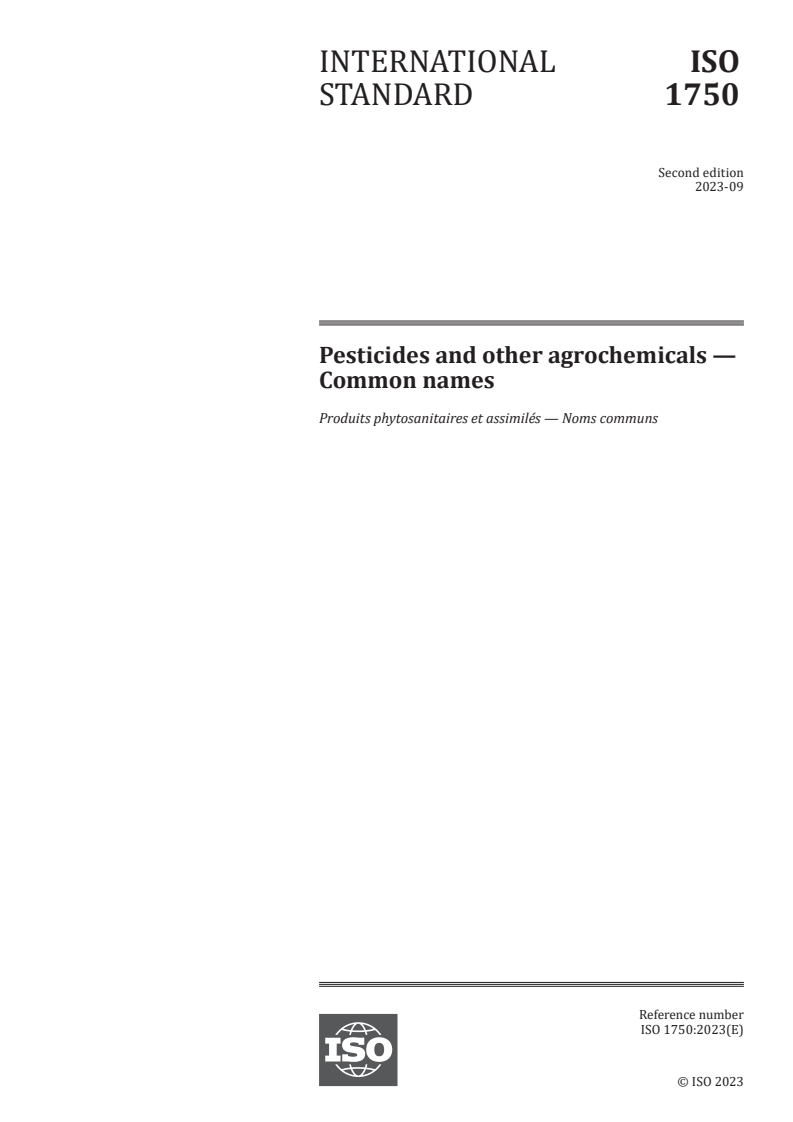
INTERNATIONAL ISO
STANDARD 1750
Second edition
2023-09
Pesticides and other agrochemicals —
Common names
Produits phytosanitaires et assimilés — Noms communs
Reference number
© ISO 2023
All rights reserved. Unless otherwise specified, or required in the context of its implementation, no part of this publication may
be reproduced or utilized otherwise in any form or by any means, electronic or mechanical, including photocopying, or posting on
the internet or an intranet, without prior written permission. Permission can be requested from either ISO at the address below
or ISO’s member body in the country of the requester.
ISO copyright office
CP 401 • Ch. de Blandonnet 8
CH-1214 Vernier, Geneva
Phone: +41 22 749 01 11
Email: copyright@iso.org
Website: www.iso.org
Published in Switzerland
ii
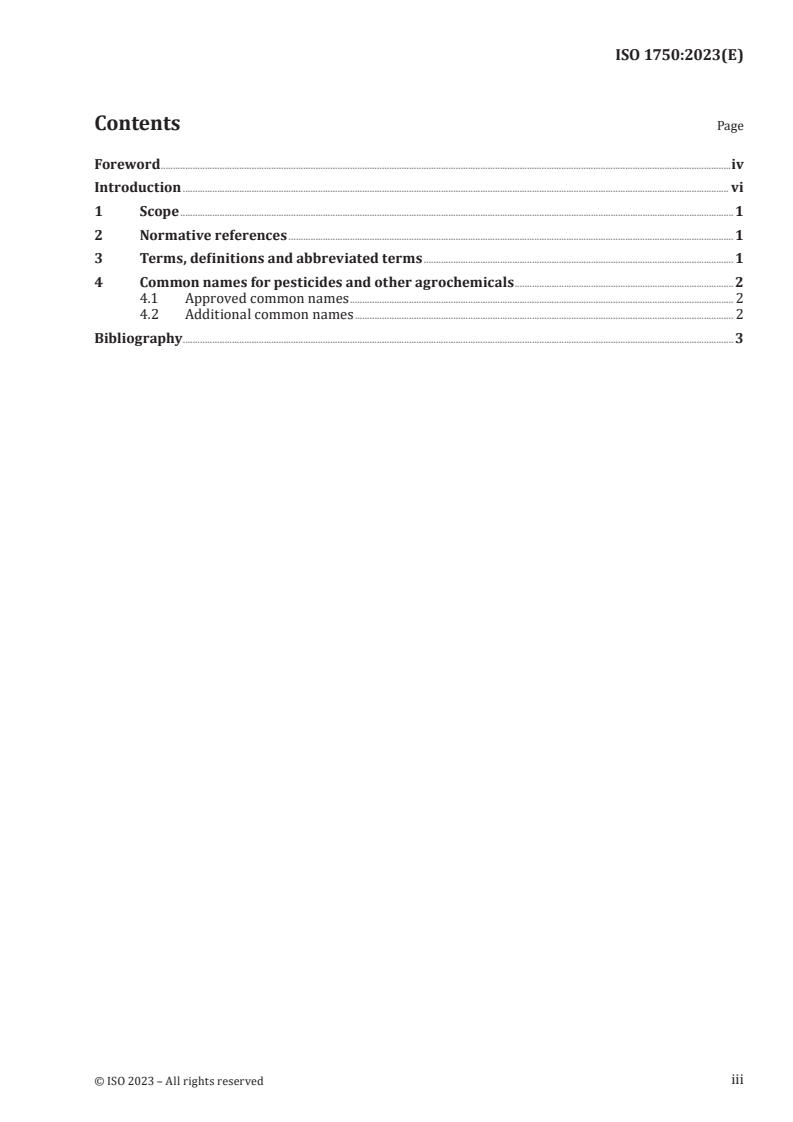
Contents Page
Foreword .iv
Introduction . vi
1 Scope . 1
2 Normative references . 1
3 Terms, definitions and abbreviated terms . 1
4 Common names for pesticides and other agrochemicals . 2
4.1 Approved common names . 2
4.2 Additional common names . 2
Bibliography . 3
iii
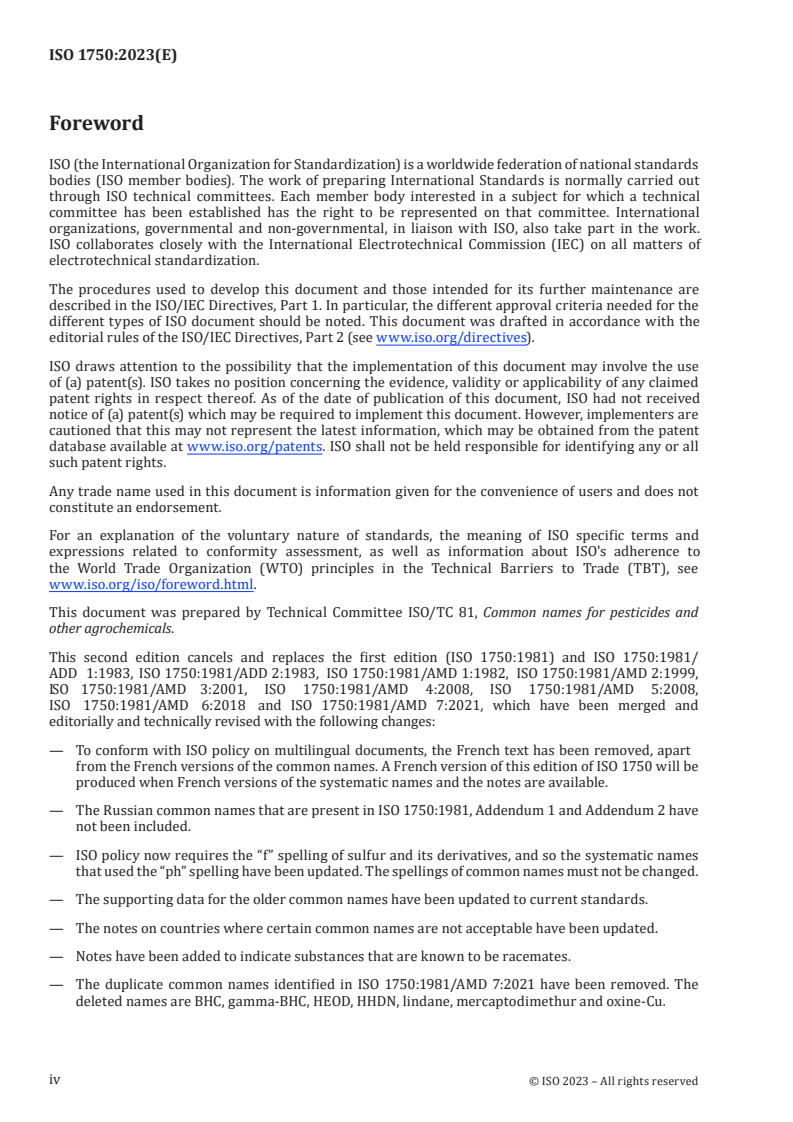
Foreword
ISO (the International Organization for Standardization) is a worldwide federation of national standards
bodies (ISO member bodies). The work of preparing International Standards is normally carried out
through ISO technical committees. Each member body interested in a subject for which a technical
committee has been established has the right to be represented on that committee. International
organizations, governmental and non-governmental, in liaison with ISO, also take part in the work.
ISO collaborates closely with the International Electrotechnical Commission (IEC) on all matters of
electrotechnical standardization.
The procedures used to develop this document and those intended for its further maintenance are
described in the ISO/IEC Directives, Part 1. In particular, the different approval criteria needed for the
different types of ISO document should be noted. This document was drafted in accordance with the
editorial rules of the ISO/IEC Directives, Part 2 (see www.iso.org/directives).
ISO draws attention to the possibility that the implementation of this document may involve the use
of (a) patent(s). ISO takes no position concerning the evidence, validity or applicability of any claimed
patent rights in respect thereof. As of the date of publication of this document, ISO had not received
notice of (a) patent(s) which may be required to implement this document. However, implementers are
cautioned that this may not represent the latest information, which may be obtained from the patent
database available at www.iso.org/patents. ISO shall not be held responsible for identifying any or all
such patent rights.
Any trade name used in this document is information given for the convenience of users and does not
constitute an endorsement.
For an explanation of the voluntary nature of standards, the meaning of ISO specific terms and
expressions related to conformity assessment, as well as information about ISO's adherence to
the World Trade Organization (WTO) principles in the Technical Barriers to Trade (TBT), see
www.iso.org/iso/foreword.html.
This document was prepared by Technical Committee ISO/TC 81, Common names for pesticides and
other agrochemicals.
This second edition cancels and replaces the first edition (ISO 1750:1981) and ISO 1750:1981/
ADD 1:1983, ISO 1750:1981/ADD 2:1983, ISO 1750:1981/AMD 1:1982, ISO 1750:1981/AMD 2:1999,
ISO 1750:1981/AMD 3:2001, ISO 1750:1981/AMD 4:2008, ISO 1750:1981/AMD 5:2008,
ISO 1750:1981/AMD 6:2018 and ISO 1750:1981/AMD 7:2021, which have been merged and
editorially and technically revised with the following changes:
— To conform with ISO policy on multilingual documents, the French text has been removed, apart
from the French versions of the common names. A French version of this edition of ISO 1750 will be
produced when French versions of the systematic names and the notes are available.
— The Russian common names that are present in ISO 1750:1981, Addendum 1 and Addendum 2 have
not been included.
— ISO policy now requires the “f” spelling of sulfur and its derivatives, and so the systematic names
that used the “ph” spelling have been updated. The spellings of common names must not be changed.
— The supporting data for the older common names have been updated to current standards.
— The notes on countries where certain common names are not acceptable have been updated.
— Notes have been added to indicate substances that are known to be racemates.
— The duplicate common names identified in ISO 1750:1981/AMD 7:2021 have been removed. The
deleted names are BHC, gamma-BHC, HEOD, HHDN, lindane, mercaptodimethur and oxine-Cu.
iv
— The results of the unpublished rationalisation exercise in 1989–1990 have been incorporated. The
affected names are benzoylprop, chlorfenprop, chlorthal, dicamba, dodemorph, endothal, metam,
oxapyrazon, proxan, quinacetol and TCA.
— Many of the structural formulae have been drawn to emphasise the relationships between related
compounds. They also conform as far as possible with the IUPAC Recommendations for structure
[1] [2]
diagrams and for stereochemical configuration. They are now all in SVG format, so that they
display well at any size on computer screens.
— The common names and their supporting data are not included within this document. They are
included in an XML file that will be updated annually and is available via a link in 4.1.
— Twenty-nine common names that have been approved since ISO 1750:1981/AMD 7:2021 was
prepared are included in the initial version of the XML file. They are anisiflupurin, benquitrione,
bipyrazone, broclozone, chloroinconazide, cyproflanilide, cypyrafluone, dioxopyritrione,
fenmezoditiaz, fenpyrazone, fluchloraminopyr, fluchlordiniliprole, flufenoxadiazam, flufenoximacil,
flumetylsulforim, fluoxytioconazole, flusulfinam, indazapyroxamet, iptriazopyrid, ledprona,
metarylpicoxamid, pyriflubenzoxim, rimisoxafen, seboctylamine, spidoxamat, spirobudifen,
tiorantraniliprole, trifluenfuronate and tripyrasulfone. Further common names will be added in
the annual updates of the XML file.
— The XSL stylesheet for the XML file produces a set of HTML tables that are not fixed width, unlike
a PDF. This responsive layout is designed to give the best user experience on all screen sizes. The
text re-flows without changing size and the structural formulae resize when necessary. To improve
accessibility, the text re-flows when it is enlarged.
Any feedback or questions on this document should be directed to the user’s national standards body. A
complete listing of these bodies can be found at www.iso.org/members.html
v
Introduction
Pesticide common, non-proprietary, names are required by the agrochemical industry, regulatory
bodies, advisory se
...