

ISO/IEC 19583-26:2026
(Main)Information technology — Concepts and usage of metadata — Part 26: XML for representation of ISO/IEC 11179-3:2013 content
General Information
- Abstract
This document specifies the structure of ISO/IEC 11179-3:2013 representation in W3C XML Schema suitable for communication of content between compliant registries. The schema described in this document will implement a class and attribute vocabulary that matches the conceptual model presented in ISO/IEC 11179-3:2013 in W3C XML Schema format. The purpose of the schema is for the exchange of compliant metadata, and to support the validation of messages exchanged between registries. It is not intended for the communication of data element metadata alongside the data to which the metadata refers. The document specifes the schema and the principles and conventions that were followed to map classes, attributes, and associations of the conceptual model into an acyclic, directed graph suitable for an unambiguous document-based representation.
- Status
- Published
- Publication Date
- 21-Apr-2026
- Technical Committee
- ISO/IEC JTC 1/SC 32 - Data management and interchange
- Drafting Committee
- ISO/IEC JTC 1/SC 32 - Data management and interchange
- Current Stage
- 6060 - International Standard published
- Start Date
- 22-Apr-2026
- Due Date
- 12-Jul-2026
- Completion Date
- 22-Apr-2026


Overview
ISO/IEC 19583-26:2026 is an international standard developed by ISO and IEC, which specifies the representation of the ISO/IEC 11179-3:2013 metadata registry content using W3C XML Schema (XSD). The primary goal of this standard is to provide a common XML Schema for the exchange of compliant metadata between ISO/IEC 11179-3:2013-compatible registries. By mapping the conceptual model of ISO/IEC 11179-3:2013 into a structured, acyclic, and directed graph in XML, this standard ensures interoperable communication, robust message validation, and supports consistent content exchange across diverse information technology systems.
Key Topics
- XML Schema Definition: Describes the structure and vocabulary for ISO/IEC 11179-3:2013 in XML Schema, enabling the creation and validation of metadata exchange messages.
- Class and Attribute Mapping: Implements a vocabulary that mirrors classes, attributes, and associations from the ISO/IEC 11179-3:2013 conceptual model.
- Interoperability: Supports both strictly conforming and conforming implementations, balancing interoperability needs with extendibility.
- Schema Components:
- Common Facilities Schema: Base types and reusable definitions.
- Four Corners Schema: Assembles primary metadata registry content types.
- Message Schema: Defines document structures for message exchanges between registries.
- Conventions and Principles: Establishes mapping rules regarding namespace usage, class representation, and identifier references to ensure unambiguous data representation.
- Modelling Principles: Addresses directionality, relationship representation, and strategies for handling recursive and cyclic structures in XML.
- Use Cases: Caters to a range of registry interactions, from large-scale replication to targeted content exchanges, including integration with configurable information systems.
Applications
ISO/IEC 19583-26:2026 delivers practical solutions for organizations that manage or exchange metadata using the ISO/IEC 11179-3 framework. Its main applications include:
- Metadata Registry Interoperability: Enables diverse registry software to exchange metadata in a standardized format using XML, regardless of platform or vendor differences.
- Data Integration: Facilitates the integration of metadata registries within and across organizations by providing a validated, machine-readable schema.
- Validation of Metadata Content: Supports automated validation of exchanged messages, ensuring compliance with ISO/IEC 11179-3:2013 concepts and reducing errors in metadata sharing.
- XML Database Implementation: Offers a framework for building native XML database systems that store and maintain ISO/IEC 11179-compliant content.
- Support for Configurable Information Systems: Allows customizable applications such as survey systems and data collection tools to exchange partial or complete metadata records with central registries.
Related Standards
- ISO/IEC 11179-3:2013 - Information technology - Metadata registries (MDR) - Part 3: Registry metamodel and basic attributes.
- ISO/IEC 11179-6:2015 - Information technology - Metadata registries (MDR) - Part 6: Registration.
- ISO/IEC 19583 Series - Concepts and usage of metadata, various parts.
- W3C XML Schema (XSD) - W3C language for describing the structure and constraining the content of XML documents.
- ISO/IEC TR 19583-24 - Resource Description Framework (RDF) specification related to ISO/IEC 11179-3.
- ISO/IEC 19763 Family - Framework for metadata registry and metamodels.
By aligning metadata exchange methods with global best practices, ISO/IEC 19583-26:2026 ensures robust, efficient, and interoperable communication of metadata registry content across information technology environments. This makes it a vital resource for improving data governance, metadata quality, and system integration using XML standards.
Get Certified
Connect with accredited certification bodies for this standard

BSI Group
BSI (British Standards Institution) is the business standards company that helps organizations make excellence a habit.

NYCE
Mexican standards and certification body.
Sponsored listings
Frequently Asked Questions
ISO/IEC 19583-26:2026 is a standard published by the International Organization for Standardization (ISO). Its full title is "Information technology — Concepts and usage of metadata — Part 26: XML for representation of ISO/IEC 11179-3:2013 content". This standard covers: This document specifies the structure of ISO/IEC 11179-3:2013 representation in W3C XML Schema suitable for communication of content between compliant registries. The schema described in this document will implement a class and attribute vocabulary that matches the conceptual model presented in ISO/IEC 11179-3:2013 in W3C XML Schema format. The purpose of the schema is for the exchange of compliant metadata, and to support the validation of messages exchanged between registries. It is not intended for the communication of data element metadata alongside the data to which the metadata refers. The document specifes the schema and the principles and conventions that were followed to map classes, attributes, and associations of the conceptual model into an acyclic, directed graph suitable for an unambiguous document-based representation.
This document specifies the structure of ISO/IEC 11179-3:2013 representation in W3C XML Schema suitable for communication of content between compliant registries. The schema described in this document will implement a class and attribute vocabulary that matches the conceptual model presented in ISO/IEC 11179-3:2013 in W3C XML Schema format. The purpose of the schema is for the exchange of compliant metadata, and to support the validation of messages exchanged between registries. It is not intended for the communication of data element metadata alongside the data to which the metadata refers. The document specifes the schema and the principles and conventions that were followed to map classes, attributes, and associations of the conceptual model into an acyclic, directed graph suitable for an unambiguous document-based representation.
ISO/IEC 19583-26:2026 is classified under the following ICS (International Classification for Standards) categories: 35.040.50 - Automatic identification and data capture techniques. The ICS classification helps identify the subject area and facilitates finding related standards.
ISO/IEC 19583-26:2026 is available in PDF format for immediate download after purchase. The document can be added to your cart and obtained through the secure checkout process. Digital delivery ensures instant access to the complete standard document.
Standards Content (Sample)
International
Standard
ISO/IEC 19583-26
First edition
Information technology — Concepts
2026-04
and usage of metadata —
Part 26:
XML for representation of ISO/IEC
11179-3:2013 content
Reference number
© ISO/IEC 2026
All rights reserved. Unless otherwise specified, or required in the context of its implementation, no part of this publication may
be reproduced or utilized otherwise in any form or by any means, electronic or mechanical, including photocopying, or posting on
the internet or an intranet, without prior written permission. Permission can be requested from either ISO at the address below
or ISO’s member body in the country of the requester.
ISO copyright office
CP 401 • Ch. de Blandonnet 8
CH-1214 Vernier, Geneva
Phone: +41 22 749 01 11
Email: copyright@iso.org
Website: www.iso.org
Published in Switzerland
© ISO/IEC 2026 – All rights reserved
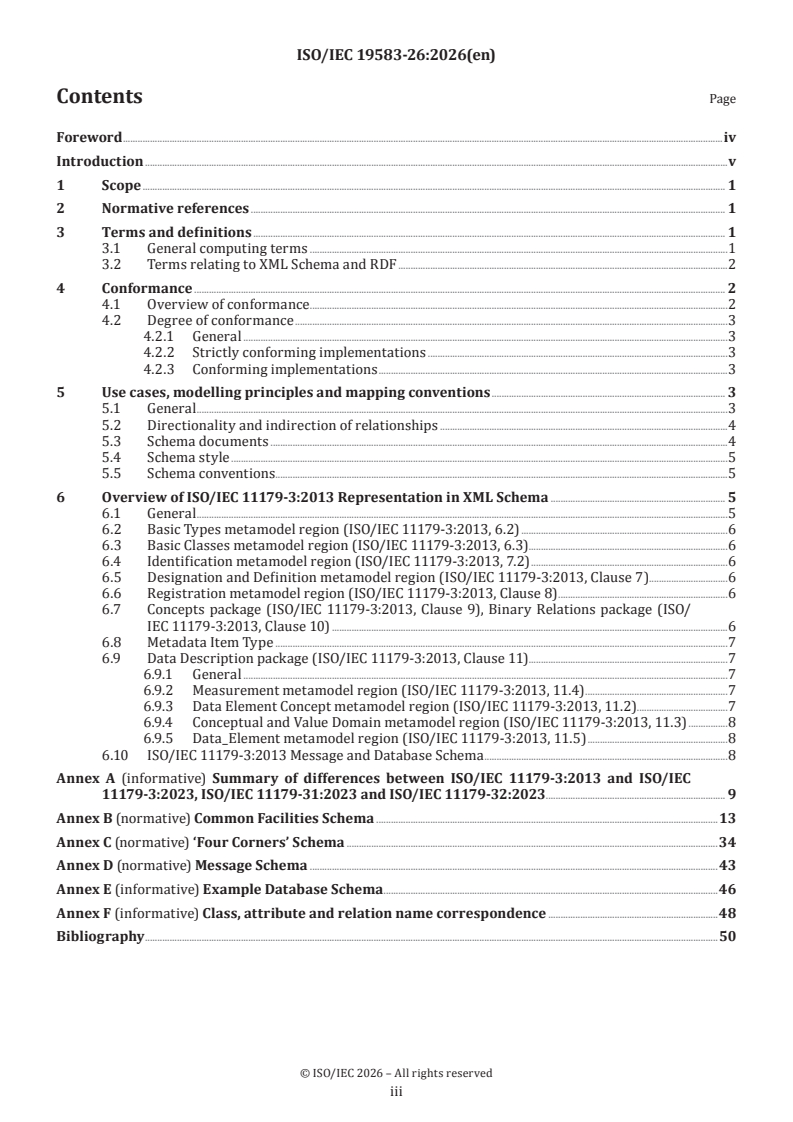
ii
Contents Page
Foreword .iv
Introduction .v
1 Scope . 1
2 Normative references . 1
3 Terms and definitions . 1
3.1 General computing terms .1
3.2 Terms relating to XML Schema and RDF .2
4 Conformance . 2
4.1 Overview of conformance . .2
4.2 Degree of conformance .3
4.2.1 General .3
4.2.2 Strictly conforming implementations .3
4.2.3 Conforming implementations .3
5 Use cases, modelling principles and mapping conventions . 3
5.1 General .3
5.2 Directionality and indirection of relationships .4
5.3 Schema documents .4
5.4 Schema style .5
5.5 Schema conventions .5
6 Overview of ISO/IEC 11179-3:2013 Representation in XML Schema . 5
6.1 General .5
6.2 Basic Types metamodel region (ISO/IEC 11179-3:2013, 6.2) .6
6.3 Basic Classes metamodel region (ISO/IEC 11179-3:2013, 6.3).6
6.4 Identification metamodel region (ISO/IEC 11179-3:2013, 7.2) .6
6.5 Designation and Definition metamodel region (ISO/IEC 11179-3:2013, Clause 7).6
6.6 Registration metamodel region (ISO/IEC 11179-3:2013, Clause 8) .6
6.7 Concepts package (ISO/IEC 11179-3:2013, Clause 9), Binary Relations package (ISO/
IEC 11179-3:2013, Clause 10) .6
6.8 Metadata Item Type .7
6.9 Data Description package (ISO/IEC 11179-3:2013, Clause 11).7
6.9.1 General .7
6.9.2 Measurement metamodel region (ISO/IEC 11179-3:2013, 11.4) .7
6.9.3 Data Element Concept metamodel region (ISO/IEC 11179-3:2013, 11.2).7
6.9.4 Conceptual and Value Domain metamodel region (ISO/IEC 11179-3:2013, 11.3) .8
6.9.5 Data_Element metamodel region (ISO/IEC 11179-3:2013, 11.5) .8
6.10 ISO/IEC 11179-3:2013 Message and Database Schema .8
Annex A (informative) Summary of differences between ISO/IEC 11179-3:2013 and ISO/IEC
11179-3:2023, ISO/IEC 11179-31:2023 and ISO/IEC 11179-32:2023 . 9
Annex B (normative) Common Facilities Schema .13
Annex C (normative) ‘Four Corners’ Schema .34
Annex D (normative) Message Schema .43
Annex E (informative) Example Database Schema .46
Annex F (informative) Class, attribute and relation name correspondence .48
Bibliography .50
© ISO/IEC 2026 – All rights reserved
iii
Foreword
ISO (the International Organization for Standardization) and IEC (the International Electrotechnical
Commission) form the specialized system for worldwide standardization. National bodies that are
members of ISO or IEC participate in the development of International Standards through technical
committees established by the respective organization to deal with particular fields of technical activity.
ISO and IEC technical committees collaborate in fields of mutual interest. Other international organizations,
governmental and non-governmental, in liaison with ISO and IEC, also take part in the work.
The procedures used to develop this document and those intended for its further maintenance are described
in the ISO/IEC Directives, Part 1. In particular, the different approval criteria needed for the different types
of document should be noted. This document was drafted in accordance with the editorial rules of the ISO/
IEC Directives, Part 2 (see www.iso.org/directives or www.iec.ch/members_experts/refdocs).
ISO and IEC draw attention to the possibility that the implementation of this document may involve the
use of (a) patent(s). ISO and IEC take no position concerning the evidence, validity or applicability of any
claimed patent rights in respect thereof. As of the date of publication of this document, ISO and IEC had not
received notice of (a) patent(s) which may be required to implement this document. However, implementers
are cautioned that this may not represent the latest information, which may be obtained from the patent
database available at www.iso.org/patents and https://patents.iec.ch. ISO and IEC shall not be held
responsible for identifying any or all such patent rights.
Any trade name used in this document is information given for the convenience of users and does not
constitute an endorsement.
For an explanation of the voluntary nature of standards, the meaning of ISO specific terms and expressions
related to conformity assessment, as well as information about ISO's adherence to the World Trade
Organization (WTO) principles in the Technical Barriers to Trade (TBT) see www.iso.org/iso/foreword.html.
In the IEC, see www.iec.ch/understanding-standards.
This document was prepared by Joint Technical Committee ISO/IEC JTC 1, Information technology,
Subcommittee SC 32, Data management and interchange.
A list of all parts in the ISO/IEC 19583 series can be found on the ISO and IEC websites.
Any feedback or questions on this document should be directed to the user’s national standards
body. A complete listing of these bodies can be found at www.iso.org/members.html and
www.iec.ch/national-committees.
© ISO/IEC 2026 – All rights reserved
iv
Introduction
The ISO/IEC 11179 series addresses the semantics of data, the representation of data, and the registration
of the descriptions of that data. At the time of the publication of ISO/IEC 11179-3:2013 to which this
document refers, ISO/IEC 11179 was a six-part series of standards, whose conceptual model was specified in
ISO/IEC 11179-3. Since this time, part three has continued to be refined, developed and factorized.
ISO/IEC 11179-3:2013 does not define a physical implementation and thus need not be implemented as
specified, which makes exchanging content between even compliant registries difficult. A common physical
implementation is required if automatic content exchange is to be achieved.
ISO/IEC 11179-3:2013 representation in W3C XML Schema is such a physical representation. It also provides
a potential model for its implementation as an XML database focused on units of content that are readily
created and maintained – particularly if reasoning over the ‘meaning’ of that content can be delegated to an
accompanying RDF database as described in ISO/IEC TR 19583-24.
As the adoption of 11179 MDRs expands, metadata registries will need to reuse and extend definitions
from other MDRs, together with definitions reflecting local information types. The schema allows metadata
registry content to be exchanged in a standard format regardless of the kind of registry software in use.
The schema is presented in ‘Venetian Blind’ style, where each of the components of the model are rendered
as reusable types. These types are assembled into discrete documents suitable for creation and exchange.
The main body of the document describes the schema together with the principles and conventions that
were followed to map classes, attributes, and associations of the conceptual model into an acyclic, directed
graph suitable for an unambiguous document-based representation. The schema is specified in three
parts in Annex B, C and D. Additionally, Annex A describes the relationship between the 2013 and current
editions of ISO/IEC 11179-3, ISO/IEC 11179-31 and ISO/IEC 11179-32; Annex E suggests a schema derived
from Annex B and C to support a XML database system holding ISO/IEC 11179 content; Annex F contains a
compliant, example message communicating data elements between two registries.
Where direct reference is made to class, attribute and relationship names from models described in
parts of ISO/IEC 11179, class names are emboldened with initial capital letters and have spaces replaced
by underscore characters, attribute names are enboldened in lower case and have spaces replaced by
underscore characters, and relationship names are italicised in lower case with spaces replaced by
underscore characters.
© ISO/IEC 2026 – All rights reserved
v
International Standard ISO/IEC 19583-26:2026(en)
Information technology — Concepts and usage of metadata —
Part 26:
XML for representation of ISO/IEC 11179-3:2013 content
1 Scope
This document specifies the structure of ISO/IEC 11179-3:2013 representation in W3C XML Schema
suitable for communication of content between compliant registries. The schema described in this
document will implement a class and attribute vocabulary that matches the conceptual model presented
in ISO/IEC 11179-3:2013 in W3C XML Schema format. The purpose of the schema is for the exchange of
compliant metadata, and to support the validation of messages exchanged between registries. It is not
intended for the communication of data element metadata alongside the data to which the metadata refers.
The document specifes the schema and the principles and conventions that were followed to map classes,
attributes, and associations of the conceptual model into an acyclic, directed graph suitable for an
unambiguous document-based representation.
2 Normative references
The following documents are referred to in the text in such a way that some or all of their content constitutes
requirements of this document. For dated references, only the edition cited applies. For undated references,
the latest edition of the referenced document (including any amendments) applies.
1)
ISO/IEC 11179-3:2013 , Information technology — Metadata registries (MDR) Part 3: Registry metamodel and
basic attributes
2)
ISO/IEC 11179-6:2015 , Information technology — Metadata registries (MDR) Part 6: Registration
W3C XML Schema https:// www .w3 .org/ XML/ Schema
3 Terms and definitions
For the purposes of this document, the terms and definitions given in ISO/IEC 11179-3:2013,
ISO/IEC 11179-6:2015 and the following apply.
ISO and IEC maintain terminology databases for use in standardization at the following addresses:
— ISO Online browsing platform: available at https:// www .iso .org/ obp
— IEC Electropedia: available at https:// www .electropedia .org/
3.1 General computing terms
3.1.1
extension
feature not defined by this document
1) Withdrawn and replaced by ISO/IEC 11179-3:2023.
2) Withdrawn and replaced by ISO/IEC 11179-6:2023.
© ISO/IEC 2026 – All rights reserved
3.1.2
namespace
classification scheme that permits a given name to identify multiple objects that are distinguished by context
[SOURCE: ISO/IEC 39075:2024, 3.6.5]
3.1.3
namespace prefix
short name to uniquely identify the namespace
[SOURCE: ISO 24531:2013, 4.40]
3.1.4
schema
formal definition of a model
[SOURCE: ISO 19101-1:2014, 4.1.34]
3.2 Terms relating to XML Schema and RDF
3.2.1
internationalized resource identifier
IRI
sequence of characters that conforms to the syntax defined in RFC 3987
[SOURCE: ISO/IEC 19788-7:2019, 3.7, modified – domain and Note to entry deleted.]
3.2.2
World Wide Web Consortium
W3C
international community that develops open standards to ensure the long-term growth of the Web
[SOURCE: ISO 8:2019, 3.5.6]
3.2.3
XML schema
language for describing the structure and constraining the contents of XML documents
[SOURCE: ISO 25720:2009, 4.32]
3.2.4
resource
element from a universe of discourse denoted by an IRI (3.2.2)
3.2.5
Resource Description Framework
RDF
W3C (3.2.2) standard defining a formal syntax and semantics for expressing descriptions of resources (3.2.4)
that can be represented as a directed data graph
[SOURCE: ISO/IEC TR 19583-24:2025, 3.3.6, modified – references made local to this document and Note to
entry deleted.]
4 Conformance
4.1 Overview of conformance
Conformance claims shall specify a degree of conformance. Where the schemas are used to validate a
message, the degree of conformance shall be defined as described in 4.2. Where these schemas are used
as part of a data model for an XML implementation of a registry, conformance may additionally be claimed
© ISO/IEC 2026 – All rights reserved
against ISO/IEC 11179-3:2013. While such conformance must be established on a case-by-case basis, it is to
be expected that such a registry will be able to claim to be ‘conforming’.
4.2 Degree of conformance
4.2.1 General
The distinction between “strictly conforming” and “conforming” implementations is necessary to address
the simultaneous needs for interoperability and extensions. This document describes specifications that
promote interoperability.
A strictly conforming implementation can be limited in usefulness but is maximally interoperable with
respect to this document. A conforming implementation can be more useful but can be less interoperable
with respect to this document.
4.2.2 Strictly conforming implementations
A strictly conforming registry shall emit XML documents that validate against the schema described
in this document without error when using a validator that is fully conformant with the W3C XSD 1.1
Recommendation of 5 April 2013.
4.2.3 Conforming implementations
A conforming registry shall emit XML documents that use the namespace, document, element and attribute
names together with the containment hierarchy described in this document. It need not meet the explicit
cardinality requirements of the schema; it may include extra elements and attributes in other namespaces
where extension elements are allowed. Mandatory elements and attributes may be omitted entirely, or
repeated in greater numbers than the schema allows.
5 Use cases, modelling principles and mapping conventions
5.1 General
The contained schema is intended principally for the exchange of Data Element and Value Domain content
between registries and modelling environments and for the use of such content in the configuration
of information systems. It may also be used – in part or as a whole – as a foundation of a compliant XML
database implementation of ISO/IEC 11179-3:2013.
There are three broad use cases for information exchange between registries:
a) detailed replication of large amounts of content between ISO/IEC 11179-3:2013 compliant registries
whose audiences are in agreement on the conceptualisation of the data elements exchanged;
b) smaller scale exchange of data elements between registries in partly overlapping domains that have
different conceptual models;
c) exchange of data element content between configurable information systems or local data dictionaries
and registries that have no published conceptual models and registries in their domain.
The first use case requires a sophisticated way of exchanging a broad range of content and its
interrelationships. ISO/IEC TR 19583-24 describes a resource description framework schema (RDFS) for
ISO/IEC 11179-3:2013, which is capable of faithfully representing the ISO/IEC 11179-3:2013 conceptual
model with few compromises, and this is recommended here.
For the second, while understanding the original context of data element and value domain content is
important, imported content will be relocated in the conceptual model of the target registry. An example
here is the reuse of specific data element content for the Identification of Medicinal Products (ISO 11615;
ISO 11616; ISO 11238) in registries whose audiences run pharmacies and prescribe and administer drugs.
It is not necessarily the case that the Conceptual Domains, Object Classes, Properties and Data Element
© ISO/IEC 2026 – All rights reserved
Concepts that support such data elements for regulatory purposes translate directly to ones that help people
reuse product identification information in patient care.
For the last use case content will be partial – data element names, units of measure, datatypes, valid values
and meanings, and versioning information will be present, but rigorous notions corresponding to the upper
half of ISO/IEC 11179-3:2013, Figure 11 (i.e. data element concept and conceptual domain) will not. Examples
include survey systems – such as Google Forms, SurveyMonkey, RedCap OpenClinica – and more generally
from information systems where user-facing forms or data elements may be configured within the product
as part of its deployment.
Where the schema is intended to support the development of an XML database, the design fits in with an
overall approach where the model is factored into units that map to content creation workflows, and for each
identified item there is one (or a small number) of related content creation forms. In such an implementation,
XQuery would be used to navigate from shared leaf classes, and to hide administrative metadata from
summary views such as content maps, tree browsers, alphabetic listings and search forms. Implementers
will need to provide simple additional schemas that declare XML elements for the types they wish to offer to
the users as content creation points, or alternatively they could include these element definitions in a choice
element in a single schema.
The goal of ISO/IEC 11179-3 Representation in XML Schema is to provide a near complete and faithful mapping
of all classes, attributes, and associations of the ISO/IEC 11179-3:2013 conceptual model to a schema based
on W3C XML Schema language in a more deterministic, fixed model that can be easily deployed, focused on
creating, managing and exchanging Data Element and Value Domain content. The assumptions made in the
translation of the conceptual model into a physical representation are outlined in general within this clause,
and in specific in the narrative in Clause 6.
5.2 Directionality and indirection of relationships
In ISO/IEC 11179-3:2013, relationship directionality and end point visibility are not specified, and there
are many points in the model where it is possible to create content that indirectly references itself either
immediately or as part of larger cyclic structures. While direct implementation of such models is possible
in XML Schema, additional code – Schematron rules or an XForm/XQuery API – is required to ensure
documents that validate against the schema make sense. To avoid this problem, the schemas specified here
assert directionality, and implement certain important relationships as references.
The default directionality can be generally stated as having Data Element, Value Domain, Data Element
Concept and Conceptual Domains as the base units of content and exchange, with reference relationships
between these classes. It is assumed that these items will be ‘identified items’ according to the definition of
ISO/IEC 11179-3:2013, and thus the reference is to the item identifier for that item. Within each of these units,
dependent content is represented as a hierarchy of nodes. An exception to this principle is made for value
meanings where a choice between referring to the meaning in a separate Conceptual Domain definition, or
including the meaning directly in the Value Domain is offered to implementers who have the third use case
in 5.1.
The model additionally defines many shared classifiers including Context, Object Class, Property, and Units
of Measure. To avoid duplication of this content at every point of reference in the XML document, these are
also required to be identified items. However, for the sake of brevity these classifiers are strictly leaves,
without explicit navigability back to the related classes: for example each Data Element Concept instance that
is classified by a particular Object Class instance is not enumerated in that Object Class instance. Reverse
links can be computed using XQuery inside an XML database representation. Additionally it is possible to
separately specify Organisations, Individuals and Contacts for large exchanges of content between registries.
5.3 Schema documents
Three normative schema documents are presented in Annexes B, C and D:
a) iso11179-3_common_facilities.xsd presents the types described as common facilities in
ISO/IEC 11179-3:2013. This schema document is widely applicable to standards from the 11179 and
19763 families (Annex B) and is declared in the ISO/IEC 11179-3 namespace.
© ISO/IEC 2026 – All rights reserved
b) iso11179-3_four_corners.xsd assembles the common facilities into the main content types of an
ISO/IEC 11179-3:2013 compliant registry (Annex C) and is declared in the ISO/IEC 11179-3 namespace.
c) iso11197-3_message.xsd imports the previous schema in the ISO/IEC 11179-3 namespace to define
a document structure for exchanging content between compliant registries (Annex D), new message
elements are declared in the ISO/IEC 19583-26 namespace.
A further, informative schema demonstrating how schemas (a) and (b) can be used to implement an XML
database is presented in Annex E, imported types are in the ISO/IEC 11179-3 namespace, root elements for
database content are declared in the the ISO/IEC 19583-26 namespace.
An account of differences between ISO/IEC 11179-3:2013 and the current 2023 versions is presented in
Annex A (informative), and a list of any class or attribute names that have been added or changed in these
schemas is presented in Annex F.
All four schemas are available in file form for download at https:// standards .iso .org/ iso -iec/ 19583/ -26/ ed
-1/ en
5.4 Schema style
The style of the schema is to define a large number of global type definitions at various levels of complexity
and integration and to make these specific with local element definitions that tightly specify the kinds
of elements that can be used to compose documents. As such, a Postal_Address type is defined without
presumption that a root element of type Postal_Address will actually appear as a stand-alone XML document,
it being left to the user as to how these types are presented as a collection of documents.
The schema is presented in three parts: a ‘common facilities’ schema containing global base type definitions
for use in all implementations; a ‘four corners’ schema that assembles these common facilities into a selection
of types most useful for the creation of content interchange messages, and an overarching ‘message’ schema
that assembles these types into an XML document that is used to exchange content.
It is expected that the underlying implementations of ISO/IEC 11179-3 that registry users will interact
with to create content will be most often relational, with XML representations used for content exchange
and RDF representations used for computation. Therefore, these schemas do not make use of specific XML
capabilities such as ID/IDREF for the reuse of content by reference, or any of the proposed mechanisms for
content inclusion such as XInclude. XML database implementers may wish to modify elements of the schemas
to utilise such features in their implementation platform.
5.5 Schema conventions
The following conventions have been used for mapping the ISO/IEC 11179-3:2013 model elements to W3C
XML Schema.
Every model element is represented in W3C XML Schema in the namespace http:// standards .iso .org/ iso
-iec/ 11179/ -3/ ed -3/ en/ and is abbreviated with the namespace prefix iso-11179, except for those model
elements introduced by this document, which are in the https:// standards .iso .org/ iso -iec/ 19583/ -26/ ed -1/
en/ namespace.
Every class of ISO/IEC 11179-3:2013 is represented by a simple or complex type. Names maintain the
capitalization and underscores as specified in the parent standard.
6 Overview of ISO/IEC 11179-3:2013 Representation in XML Schema
6.1 General
ISO/IEC 11179-3:2013 specifies ‘item types’ such that later classes can be typed by one or more of these
types. Each of these item types is rendered as an xsd: group since W3C XML Schema does not support
multiple inheritance. e.g. Identified_Item; Designatable_Item.
© ISO/IEC 2026 – All rights reserved
Certain relationships between classes have been replaced by reference to their scoped identifier rather than
by inclusion of content, e.g. Namespace from Scoped_Identifier, designation_context from Designation.
6.2 Basic Types metamodel region (ISO/IEC 11179-3:2013, 6.2)
Basic types defined in ISO/IEC 11179-3:2013 are declared as simple types, indirected from the corresponding
XML base datatypes. It is expected that the base datatypes will function correctly in interchange and
database use cases, but indirection allows users of the schema components to further restrict the base types
if required, such as disallowing symbols in a datatype expected to hold a filename.
6.3 Basic Classes metamodel region (ISO/IEC 11179-3:2013, 6.3)
Basic classes are faithfully represented from the standard.
6.4 Identification metamodel region (ISO/IEC 11179-3:2013, 7.2)
It is at this point that the model in ISO/IEC 11179-3:2013 becomes more conceptual with the implementer
invited to decide what items to identify, name and define, together with some structures that have the
potential to be recursive. This implementation has made the following assumptions:
— Namespaces are required to be identified and referenced by identifier when used. To avoid the recursive
relationship, attributes for identifier and version have been directly included in the type.
— Scoped identifiers exist as part of an identified item that refers to their namespace by reference, rather
than existing within a namespace node, as implied by a simple reading of the class diagram.
Identified_Item is rendered from the standard as a schema group for inclusion in later classes. It is assumed
in this schema that Scoped_Identifier will not exist separately of an Identified_Item.
6.5 Designation and Definition metamodel region (ISO/IEC 11179-3:2013, Clause 7)
This implementation has made the following assumptions:
— Naming Conventions are identified items, instances are referenced by their scoped identifiers.
— Context is set to be both an identified item and a designatable item. The recursive relationships to
designation and definition contexts have been removed by localising appropriate attributes from the
definition and designation classes within the Context type.
— Relationships between designations have been supported in the following way: it is possible to include
a specific definition local to a designation, and a designation may be listed as a designation_heading,
assuming that the specific definition only has context alongside its designation, and that designations
are unique.
6.6 Registration metamodel region (ISO/IEC 11179-3:2013, Clause 8)
Implementation of the registration and administration classes is mostly as described in the standard except
for the implementation of relationships between registered item, administered item and attached item.
The combination of the inheritance relationship between registered, administered and attached item and
the composition relationship between administered and attached item creates errors in later parts of the
schema if both the administered and attached item types contain registered item attributes. Implementation
of the inheritance relationship is deferred until the introduction of the ‘Metadata_Item’ type to encapsulate
the notions of identification, naming, classification, registration, administration and attachment.
6.7 Concepts package (ISO/IEC 11179-3:2013, Clause 9), Binary Relations package (ISO/IEC
11179-3:2013, Clause 10)
As modelled, the concepts and binary relations packages contain the greatest scope for recursion and
repetition of content when implementing the conceptual model as a hierarchical structure. Since it is best
© ISO/IEC 2026 – All rights reserved
practice for every concept in a concept system to be explicitly identified and named, this implementation has
taken the opportunity to replace many of the relationships between classes in this part of the model with
scoped identifier references, with attributes at both endpoints of the relationship.
It is also best practice to administer/publish a concept system as a complete entity, rather than in pieces.
Thus administration and attachment are reserved for the Concept_System type, rather than being applied to
its components.
6.8 Metadata Item Type
The overall approach of the modelling in ISO/IEC 11179-3:2013 is to define a number of conceptual
‘types’ that may be applied to content classes. Thus identification, classification, designation, registration,
administration and attachment all have associated types that are applied by the implementer according to
the policies specified by the registrar. This allows the standard to support a wide variety of registries from
those that create and maintain content in detail to ones that aggregate content that is registered elsewhere.
W3C XML schema does not support multiple inheritance. The approach taken has been to declare an
abstract class of ‘Metadata_Item’ – which can optionally be identified, named, classified, registered and
either administered or attached – and for the classes in the data description class to inherit from this. This
simplifies the definition of types in the data description package, and provides a basis for further work
developing schemas for other parts of ISO/IEC 11179 together with the ISO/IEC 19763 family that share
these notions.
6.9 Data Description package (ISO/IEC 11179-3:2013, Clause 11)
6.9.1 General
The approach taken to the data description package is to broadly support content kinds according to the ‘four
corners’ high level conceptual model for the data description package (ISO/IEC 11179-3:2013, Figure 11) – a
complex type is defined for each concrete class at the four corners. Implementers of XML databases can find
this causes performance issues with enumerated conceptual and value domains and may wish to factorize
these classes differently.
One issue with an XML schema implementation of the data description package is in the choice of class to
inherit from. Object Class, Property, Data Element Concept, Conceptual Domain and Value Meaning are
all kinds of Concept, but unlike concepts in a concept system – which are administered as a system – they
often require individual administration. This implementation treats these objects as being distinct from
any general concept system – i.e. either designatable or metadata items – with an additional, optional
relationship to a concept in a concept system. This is semantically safest – an assertion of association from
one of these objects to a concept cannot dislocate the target concept from its proper place in the concept
system, whereas stating equivalence between – say – a value meaning and a concept introduces to the
concept system associations with the other value meanings and the containing conceptual domain that risks
changing the concept’s meaning.
6.9.2 Measurement metamodel region (ISO/IEC 11179-3:2013, 11.4)
Since value domains measured with comparable/convertible units will usually fall naturally into the same
conceptual domain, a registry may simply maintain a flat list of units of measure and exchange these as
required when they exchange value domains. If more order is desired, since conceptually different units
of measure may share the same dimension (e.g. frequency, angular velocity), Measure_Class is the natural
containing class of this region, the compromise being that this prevents units of measure belonging to more
than one measure class.
6.9.3 Data Element Concept metamodel region (ISO/IEC 11179-3:2013, 11.2)
Data element concepts, object classes and properties are all set to be kinds of Metadata_Item, with an
additional concept reference to represent the assertion of association/equivalence with a concept in a
registered concept system.
© ISO/IEC 2026 – All rights reserved
6.9.4 Conceptual and Value Domain metamodel region (ISO/IEC 11179-3:2013, 11.3)
Conceptual and Value Domains are set to be kinds of Metadata_Item, with an additional concept reference
to represent the assertion of association/equivalence with a concept in a registered concept system. Value
Meanings include groups for identification and designation, and additionally also have a concept reference.
It is assumed that the set of Value Meanings are part of the Conceptual Domain and thus share their
administration record, the same assumption applies to Permissible Values and Value Domains. However, the
option is available to exchange meanings within a Value Domain where Conceptual Domains are unavailable.
6.9.5 Data_Element metamodel region (ISO/IEC 11179-3:2013, 11.5)
Data Elements, their derivations, and derivation rules themselves each are set to be Metadata Items with
their own administration records.
6.10 ISO/IEC 11179-3:2013 Message and Database Schema
Finally, the types defined in 6.9 are brought together into a ‘metadata bundle’, a simple sequence of nodes of
the main content kinds in an ISO/IEC 11179-3:2013 registry, together with the registry specification and the
date and time of export (see Annex C). An example database schema is also offered in Annex D, although it
is anticipated that the basic components of ISO/IEC 11179-3:2013, and the schema elements suggested here,
could be brought together in many different ways.
© ISO/IEC 2026 – All rights reserved
Annex A
(informative)
Summary of differences between ISO/IEC 11179-3:2013
and ISO/IEC 11179-3:2023, ISO/IEC 11179-31:2023 and
ISO/IEC 11179-32:2023
A.1 Overview
This document is targeted at ISO/IEC 11179-3:2013, which has been superseded by ISO/IEC 11179-3:2023
and other parts of the ISO/IEC 11179 series, such as ISO/IEC 11179-31:2023 and ISO/IEC 11179-32:2023.
This annex provides an overview of the differences.
A.2 Modularization of ISO/IEC 11179-3:2013
In the 2023 edition, ISO/IEC 11179-3:2013 has been split into multiple parts to make it more manageable.
The following are the new parts:
— ISO/IEC 11179-30 Basic attributes of metadata;
— ISO/IEC 11179-31 Metamodel for data specification registration;
— ISO/IEC 11179-32 Metamodel for concept system registration.
A.3 Simplification of the UML metamodel
Some changes were made in the 2023 edition to simplify the UML model:
— elimination of the use of UML stereotypes;
— addition of an explicit 'Item' class as the superclass of all types of registry items;
— removal of role names on associations;
— removal of redundant specification of attributes and associations in the text.
A.4 Refactoring of some of the packages to reduce dependencies
Some changes were made in the 2023 edition to reduce dependencies among packages:
— moving the Concept class to the Basic and Core package where it is referenced from multiple metamodel
regions, including: the Data Specification package in ISO/IEC 11179-31, the Concept System package in
ISO/IEC 11179-32, the Data Set package in ISO/IEC 11179-33 and the Model package in ISO/IEC 11179-35;
— moving the Context class to the Basic and Core package where it is referenced from the Designation and
Definition package in ISO/IEC 11179-3:2023, the Data Specification package in ISO/IEC 11179-31 and the
Data Set package in ISO/IEC 11179-33;
— moving the Slot class to the Basic and Core package, a more appropriate location than the Identification
package;
— restoring a Classification region, based on the style of ISO/IEC 11179-3:2003, to remove dependency on
the Concept System region for classification.
© ISO/IEC 2026 – All rights reserved
A.5 Use of UML stereotypes in ISO/IEC 11179-3:2013
UML stereotypes were used in ISO/IEC 11179-3:2013. Each of these types (except Registered_Item which is
abstract and cannot be instantiated) can be applied to any of the instances of metadata items in the registry.
In ISO/IEC 11179-3:2023, the use of stereotypes has been replaced by subclassing from the superclass Item,
which is specified in the new Core metamodel region and which did not exist in the 2013 edition.
A.6 Differences in the Identification metamodel region
In the 2013 edition, Identified_Item is a <> which needs to be applied to instances of metadata items
that are to be identified. In the 2023 edition, Identified_Item is a regular class related to Item by the item_
identification association.
Also, Slot in the 2013 edition is related to Identified_Item, whereas in the 2023 edition it is related to Item
in the Core metamodel region.
A.7 Differences in the Designation and Definition metamodel region
In the 2013 edition, Designatable_Item is <> which needs to be applied to instances of metadata
items that are to be designated or defined;
In the 2023 edition, Designatable_Item is replaced by Item, which can be directly related to the Designation
and Definition classes;
In the 2013 edition, designation_definition_pairing is a simple association between Designation and
Definition. In the 2023 edition, Designation_Definition_Pairing is an association class, which is also
associated with Context, and has an attribute acceptability.
A.8 Differences in the Registration metamodel region
In the 2013 edition, Administered_Item and Attached_Item are <> which need to be applied to
instances of metadata items that are to be administered or attached. In the 2023 edition, Administered_
Item and Attached_Item are regular classes which are associated with Item through the item_identification
association of the grandparent class Identified_Item;
In the 2013 edition, Registration is an association class, with a registration_state attribute, and an
Administered_Item can be associated with multiple Registration_Authorities;
In the 2023 edition, registration is a simple association with a sing
...