

ISO/IEC 19763-3:2020/Amd 1:2024
(Amendment)Information technology — Metamodel framework for interoperability (MFI) — Part 3: Metamodel for ontology registration — Amendment 1: Alignment with Edition 4 of ISO/IEC 11179-3
General Information
- Abstract
- Status
- Published
- Publication Date
- 27-Feb-2024
- Technical Committee
- ISO/IEC JTC 1/SC 32 - Data management and interchange
- Drafting Committee
- ISO/IEC JTC 1/SC 32 - Data management and interchange
- Current Stage
- 6060 - International Standard published
- Start Date
- 28-Feb-2024
- Due Date
- 04-Jul-2025
- Completion Date
- 28-Feb-2024
Buy Documents
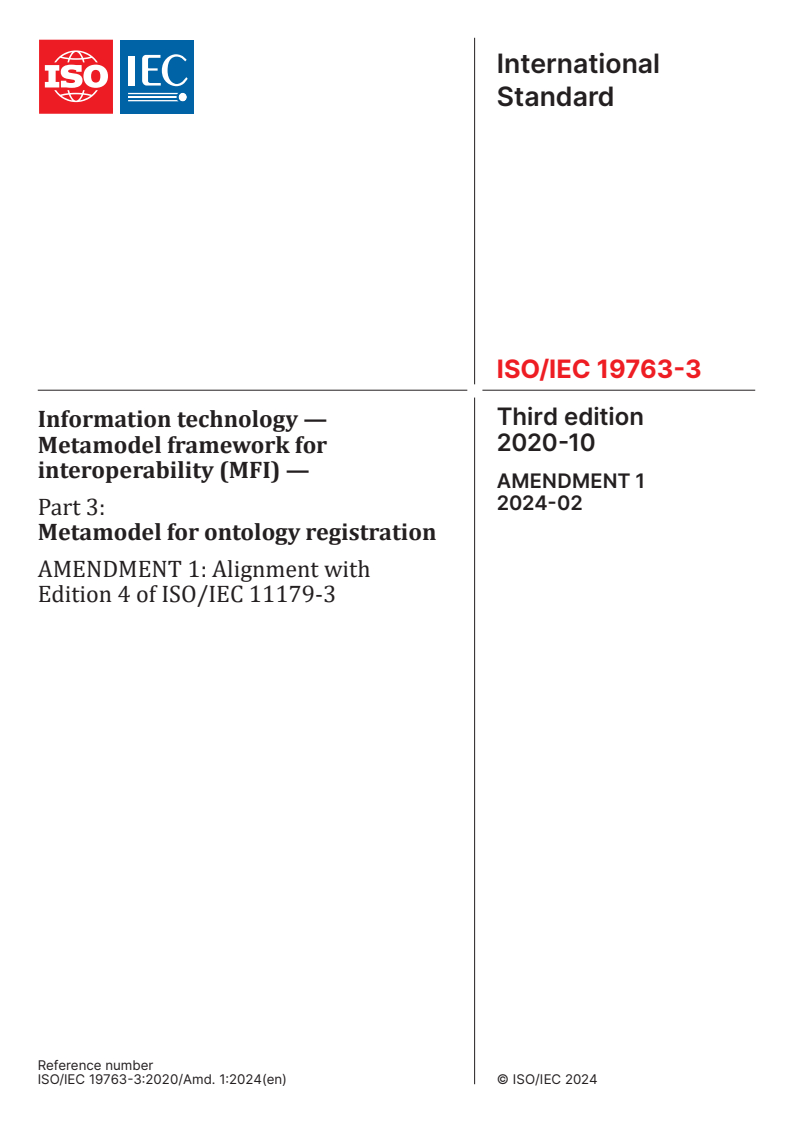


ISO/IEC 19763-3:2020/Amd 1:2024 - Information technology — Metamodel framework for interoperability (MFI) — Part 3: Metamodel for ontology registration — Amendment 1: Alignment with Edition 4 of ISO/IEC 11179-3 Released:2/28/2024
Overview
ISO/IEC 19763-3:2020/Amd 1:2024 is an important amendment to the Metamodel Framework for Interoperability (MFI) standard, specifically addressing Part 3: Metamodel for Ontology Registration. Issued jointly by the International Organization for Standardization (ISO) and the International Electrotechnical Commission (IEC), this amendment aligns the metamodel for ontology registration with Edition 4 of ISO/IEC 11179-3, the standard for metadata registries (MDR).
This update enhances the interoperability framework by integrating the latest concepts and structures defined in ISO/IEC 11179-3, ensuring that ontology registration mechanisms remain consistent with advances in metadata registry standards. It supports improved data interchange, semantic interoperability, and alignment of ontology governance practices across diverse IT systems.
Key Topics
- Metamodel Framework for Interoperability (MFI): A structured approach to enable syntactic and semantic interoperability between heterogeneous systems.
- Ontology Registration Metamodel: Defines how ontologies can be registered, managed, and utilized within interoperable IT environments.
- Alignment with ISO/IEC 11179-3 Edition 4: Updates the reference and normative requirements to conform with the fourth edition of the metadata registry standard, enhancing registry common facilities.
- Semantic Interoperability: Facilitates consistent meaning and understanding of data across different systems using registered ontologies.
- Data Management and Interchange: Strengthens governance models for metadata and ontology repositories, supporting data quality, traceability, and reuse.
- Normative References: Revised to include the latest ISO/IEC 11179-3 edition for registry common facilities, ensuring compatibility and coherence with metadata registry practices.
Applications
- Enterprise Data Integration: Organizations can use the updated standard to better manage and register ontologies that provide common semantic frameworks, enabling smoother integration of disparate data sources and systems.
- Metadata Registries: Enhances the functionality of metadata registries by incorporating ontology registration capabilities aligned with current registry standards.
- Information Systems Interoperability: Supports government, healthcare, financial, and other sectors requiring consistent semantic frameworks to enable cross-system data sharing and interpretation.
- Knowledge Management Platforms: Facilitates organization-wide ontology management, improving data governance and enabling advanced applications such as AI and machine reasoning.
- Software Development: Assists developers and architects in designing interoperable systems and applications with standardized ontology registration and metadata management components.
Related Standards
- ISO/IEC 11179-3: Information technology - Metadata registries (MDR) - Part 3: Metamodel for registry common facilities, Edition 4. This standard provides the foundational metamodel for metadata registries referenced and updated in this amendment.
- ISO/IEC 19763 Series: A series of international standards defining the Metamodel Framework for Interoperability (MFI). The parts cover various aspects such as metamodels, methodologies, and ontologies to foster interoperability.
- ISO/IEC 11179: The overall metadata registry standard family, providing guidelines on metadata definitions and registry management crucial for semantic data governance.
- Other ISO/IEC JTC 1/SC 32 Standards: Data management and interchange standards related to data representation, metadata, and interoperability frameworks.
For organizations and professionals engaged in enterprise data interoperability, metadata management, and ontology governance, ISO/IEC 19763-3:2020/Amd 1:2024 is a key update that ensures alignment with the latest international practices and standards. Employing this amendment supports robust, scalable, and semantically consistent information technology solutions worldwide.
Keywords: ISO/IEC 19763-3:2020, ontology registration, metamodel framework, interoperability, ISO/IEC 11179-3 alignment, metadata registries, semantic interoperability, data management, information technology standards, international standard amendment.
Relations
- Effective Date
- 07-Jul-2022
Buy Documents
ISO/IEC 19763-3:2020/Amd 1:2024 - Information technology — Metamodel framework for interoperability (MFI) — Part 3: Metamodel for ontology registration — Amendment 1: Alignment with Edition 4 of ISO/IEC 11179-3 Released:2/28/2024
Get Certified
Connect with accredited certification bodies for this standard

BSI Group
BSI (British Standards Institution) is the business standards company that helps organizations make excellence a habit.

NYCE
Mexican standards and certification body.
Sponsored listings
Frequently Asked Questions
ISO/IEC 19763-3:2020/Amd 1:2024 is a standard published by the International Organization for Standardization (ISO). Its full title is "Information technology — Metamodel framework for interoperability (MFI) — Part 3: Metamodel for ontology registration — Amendment 1: Alignment with Edition 4 of ISO/IEC 11179-3". This standard covers: Information technology — Metamodel framework for interoperability (MFI) — Part 3: Metamodel for ontology registration — Amendment 1: Alignment with Edition 4 of ISO/IEC 11179-3
Information technology — Metamodel framework for interoperability (MFI) — Part 3: Metamodel for ontology registration — Amendment 1: Alignment with Edition 4 of ISO/IEC 11179-3
ISO/IEC 19763-3:2020/Amd 1:2024 is classified under the following ICS (International Classification for Standards) categories: 35.040.50 - Automatic identification and data capture techniques. The ICS classification helps identify the subject area and facilitates finding related standards.
ISO/IEC 19763-3:2020/Amd 1:2024 has the following relationships with other standards: It is inter standard links to ISO/IEC 19763-3:2020. Understanding these relationships helps ensure you are using the most current and applicable version of the standard.
ISO/IEC 19763-3:2020/Amd 1:2024 is available in PDF format for immediate download after purchase. The document can be added to your cart and obtained through the secure checkout process. Digital delivery ensures instant access to the complete standard document.
Standards Content (Sample)
International
Standard
ISO/IEC 19763-3
Third edition
Information technology —
2020-10
Metamodel framework for
interoperability (MFI) —
AMENDMENT 1
2024-02
Part 3:
Metamodel for ontology registration
AMENDMENT 1: Alignment with
Edition 4 of ISO/IEC 11179-3
Reference number
ISO/IEC 19763-3:2020/Amd. 1:2024(en) © ISO/IEC 2024
ISO/IEC 19763-3:2020/Amd. 1:2024(en)
© ISO/IEC 2024
All rights reserved. Unless otherwise specified, or required in the context of its implementation, no part of this publication may
be reproduced or utilized otherwise in any form or by any means, electronic or mechanical, including photocopying, or posting on
the internet or an intranet, without prior written permission. Permission can be requested from either ISO at the address below
or ISO’s member body in the country of the requester.
ISO copyright office
CP 401 • Ch. de Blandonnet 8
CH-1214 Vernier, Geneva
Phone: +41 22 749 01 11
Email: copyright@iso.org
Website: www.iso.org
Published in Switzerland
© ISO/IEC 2024 – All rights reserved
ii
ISO/IEC 19763-3:2020/Amd. 1:2024(en)
Foreword
ISO (the International Organization for Standardization) and IEC (the International Electrotechnical
Commission) form the specialized system for worldwide standardization. National bodies that are
members of ISO or IEC participate in the development of International Standards through technical
committees established by the respective organization to deal with particular fields of technical activity.
ISO and IEC technical committees collaborate in fields of mutual interest. Other international organizations,
governmental and non-governmental, in liaison with ISO and IEC, also take part in the work.
The procedures used to develop this document and those intended for its further maintenance are described
in the ISO/IEC Directives, Part 1. In particular, the different approval criteria needed for the different types
of document should be noted. This document was drafted in accordance with the editorial rules of the ISO/
IEC Directives, Part 2 (see www.iso.org/directives or www.iec.ch/members_experts/refdocs).
ISO and IEC draw attention to the possibility that the implementa
...