


ISO 11300-1
(Main)Piping systems for rehabilitation of underground drains, sewers and water supply networks — Part 1: Polyethylene (PE) material
Piping systems for rehabilitation of underground drains, sewers and water supply networks — Part 1: Polyethylene (PE) material
This document specifies requirements and test methods for pipes and fittings which are part of piping systems for the rehabilitation by means of renovation and trenchless replacement of underground non-pressure and pressure drainage and sewerage networks and water supply networks, which transport water intended for human consumption, including raw water pipelines. It is applicable to polyethylene (PE) pipes, fittings and assemblies, as manufactured and as installed. It is not applicable to the existing pipeline. It is applicable to technique families for renovation: — lining with continuous pipes; — lining with close-fit pipes; and technique families for trenchless replacement: — pipe bursting and pipe extraction; — horizontal directional drilling and impact moling. and intended to be used at an operating temperature of 20 °C as the reference temperature. NOTE For applications operating at constant temperatures greater than 20 °C and up to 40 °C, see ISO 4427 1:2019, Annex A. When used with lining with continuous pipes, lining with close-fit pipes and trenchless replacement technique families, this document is applicable to: PE solid wall single layered pipes, (nominal outside diameter, dn), including any identification stripes; PE pipes with co-extruded layers on either or both the outside and inside of the pipe (total outside diameter, dn), as specified in Annex E, where all layers have the same MRS rating. Furthermore, when used with lining with continuous pipes and trenchless replacement this document is applicable to: — PE coated pipes (outside diameter, dn) having a peelable, contiguous, thermoplastics additional layer on the outside of the pipe (“coated pipe”), as specified in Annex E. This document is applicable to jointing by means of butt fusion and electrofusion and to fabricated and injection-moulded fittings and mechanical connections of PE.
Systèmes de canalisations pour la réhabilitation des branchements, des collecteurs d’assainissement et des réseaux d’alimentation en eau enterrés — Partie 1: Matériau polyéthylène (PE)
General Information
- Status
- Not Published
- Technical Committee
- ISO/TC 138/SC 8 - Rehabilitation of pipeline systems
- Drafting Committee
- ISO/TC 138/SC 8 - Rehabilitation of pipeline systems
- Current Stage
- 6000 - International Standard under publication
- Start Date
- 01-Jan-2026
- Completion Date
- 17-Jan-2026
Relations
- Effective Date
- 16-Mar-2024
- Effective Date
- 05-Nov-2022
- Effective Date
- 05-Nov-2022
- Effective Date
- 05-Nov-2022
- Effective Date
- 05-Nov-2022
- Effective Date
- 05-Nov-2022
- Effective Date
- 05-Nov-2022
- Effective Date
- 05-Nov-2022
- Effective Date
- 05-Nov-2022
- Effective Date
- 05-Nov-2022
- Effective Date
- 05-Nov-2022
- Effective Date
- 05-Nov-2022
Overview
ISO/FDIS 11300-1 specifies requirements and test methods for polyethylene (PE) pipes, fittings and assemblies used in the rehabilitation of underground drainage, sewer and water supply networks. The standard covers products used for renovation and trenchless replacement techniques and is applicable to PE solid-wall, co-extruded and coated pipe constructions where layers share the same MRS rating. The reference temperature for design and testing is 20 °C (see ISO 4427:2019 Annex A for applications up to 40 °C).
Key benefits: improved durability, compatibility with trenchless methods, and prescriptive jointing and installation guidance to support reliable rehabilitation projects.
Key Topics
- Scope and applicability: Defines use for renovation (lining with continuous or close-fit pipes) and trenchless replacement (pipe bursting, pipe extraction, horizontal directional drilling (HDD) and impact moling). Not applicable to existing pipelines themselves.
- Materials and constructions: Addresses virgin, reprocessable and recyclable PE materials, single-layer and layered (co-extruded) pipes, and coated PE pipes where applicable.
- Jointing methods: Covers butt fusion and electrofusion jointing, as well as fabricated and injection-moulded fittings and mechanical connections for PE.
- Fitness for purpose and testing: Specifies general characteristics, mechanical and physical properties, geometric tolerances, marking and sampling requirements to ensure performance in rehabilitation applications.
- Installation and quality assurance: Includes requirements for preparatory work, storage, handling, equipment (butt fusion, electrofusion, skids, winching and inspection tools), simulated installations, process-related testing and final inspection.
- Normative annexes: Additional, technique-specific requirements are provided in annexes covering continuous lining, close-fit lining, trenchless replacement methods, layered pipes, and factory-folded heat-reverted PE pipe memory testing.
Applications
ISO/FDIS 11300-1 is aimed at stakeholders involved in sewer and water network rehabilitation and replacement projects:
- Utilities and municipal engineers specifying materials for trenchless renewal projects.
- Designers and contractors executing lining works (continuous or close-fit) and trenchless replacement (pipe bursting, HDD, impact moling).
- Manufacturers and suppliers of PE pipes, fittings and jointing systems seeking conformity with international requirements.
Practical advantages include minimizing open excavation, maintaining service continuity during works, and ensuring material compatibility with common rehabilitation techniques.
Related Standards
- ISO 4427:2019 (referenced for elevated operating temperatures up to 40 °C)
- Other ISO and regional standards on PE piping materials, fusion jointing and potable water suitability may be relevant; consult the normative references listed in ISO/FDIS 11300-1.
This document provides a consolidated framework for specifying PE materials and assemblies used specifically in trenchless and renovation rehabilitation, helping project teams select compliant products and apply consistent installation and testing practices.

ISO/FDIS 11300-1 - Piping systems for rehabilitation of underground drains, sewers and water supply networks — Part 1: Polyethylene (PE) material Released:22. 10. 2025
REDLINE ISO/FDIS 11300-1 - Piping systems for rehabilitation of underground drains, sewers and water supply networks — Part 1: Polyethylene (PE) material Released:22. 10. 2025

ISO/FDIS 11300-1 - Systèmes de canalisations pour la réhabilitation des branchements, des collecteurs d’assainissement et des réseaux d’alimentation en eau enterrés — Partie 1: Matériau polyéthylène (PE) Released:15. 12. 2025
Frequently Asked Questions
ISO 11300-1 is a draft published by the International Organization for Standardization (ISO). Its full title is "Piping systems for rehabilitation of underground drains, sewers and water supply networks — Part 1: Polyethylene (PE) material". This standard covers: This document specifies requirements and test methods for pipes and fittings which are part of piping systems for the rehabilitation by means of renovation and trenchless replacement of underground non-pressure and pressure drainage and sewerage networks and water supply networks, which transport water intended for human consumption, including raw water pipelines. It is applicable to polyethylene (PE) pipes, fittings and assemblies, as manufactured and as installed. It is not applicable to the existing pipeline. It is applicable to technique families for renovation: — lining with continuous pipes; — lining with close-fit pipes; and technique families for trenchless replacement: — pipe bursting and pipe extraction; — horizontal directional drilling and impact moling. and intended to be used at an operating temperature of 20 °C as the reference temperature. NOTE For applications operating at constant temperatures greater than 20 °C and up to 40 °C, see ISO 4427 1:2019, Annex A. When used with lining with continuous pipes, lining with close-fit pipes and trenchless replacement technique families, this document is applicable to: PE solid wall single layered pipes, (nominal outside diameter, dn), including any identification stripes; PE pipes with co-extruded layers on either or both the outside and inside of the pipe (total outside diameter, dn), as specified in Annex E, where all layers have the same MRS rating. Furthermore, when used with lining with continuous pipes and trenchless replacement this document is applicable to: — PE coated pipes (outside diameter, dn) having a peelable, contiguous, thermoplastics additional layer on the outside of the pipe (“coated pipe”), as specified in Annex E. This document is applicable to jointing by means of butt fusion and electrofusion and to fabricated and injection-moulded fittings and mechanical connections of PE.
This document specifies requirements and test methods for pipes and fittings which are part of piping systems for the rehabilitation by means of renovation and trenchless replacement of underground non-pressure and pressure drainage and sewerage networks and water supply networks, which transport water intended for human consumption, including raw water pipelines. It is applicable to polyethylene (PE) pipes, fittings and assemblies, as manufactured and as installed. It is not applicable to the existing pipeline. It is applicable to technique families for renovation: — lining with continuous pipes; — lining with close-fit pipes; and technique families for trenchless replacement: — pipe bursting and pipe extraction; — horizontal directional drilling and impact moling. and intended to be used at an operating temperature of 20 °C as the reference temperature. NOTE For applications operating at constant temperatures greater than 20 °C and up to 40 °C, see ISO 4427 1:2019, Annex A. When used with lining with continuous pipes, lining with close-fit pipes and trenchless replacement technique families, this document is applicable to: PE solid wall single layered pipes, (nominal outside diameter, dn), including any identification stripes; PE pipes with co-extruded layers on either or both the outside and inside of the pipe (total outside diameter, dn), as specified in Annex E, where all layers have the same MRS rating. Furthermore, when used with lining with continuous pipes and trenchless replacement this document is applicable to: — PE coated pipes (outside diameter, dn) having a peelable, contiguous, thermoplastics additional layer on the outside of the pipe (“coated pipe”), as specified in Annex E. This document is applicable to jointing by means of butt fusion and electrofusion and to fabricated and injection-moulded fittings and mechanical connections of PE.
ISO 11300-1 is classified under the following ICS (International Classification for Standards) categories: 23.040.20 - Plastics pipes; 23.040.45 - Plastics fittings; 91.140.80 - Drainage systems; 93.025 - External water conveyance systems; 93.030 - External sewage systems. The ICS classification helps identify the subject area and facilitates finding related standards.
ISO 11300-1 has the following relationships with other standards: It is inter standard links to ISO 11992-2:2023, ISO 11296-2:2018, ISO 11298-3:2018, ISO 11296-3:2018, ISO 11298-1:2018, ISO 11298-2:2018, ISO 11297-1:2018, ISO 21225-1:2018, ISO 11297-2:2018, ISO 21225-2:2018, ISO 11297-3:2018, ISO 11296-1:2018. Understanding these relationships helps ensure you are using the most current and applicable version of the standard.
ISO 11300-1 is available in PDF format for immediate download after purchase. The document can be added to your cart and obtained through the secure checkout process. Digital delivery ensures instant access to the complete standard document.
Standards Content (Sample)
FINAL DRAFT
International
Standard
ISO/FDIS 11300-1
ISO/TC 138/SC 8
Piping systems for rehabilitation
Secretariat: JISC
of underground drains, sewers and
Voting begins on:
water supply networks —
2025-11-05
Part 1:
Voting terminates on:
2025-12-31
Polyethylene (PE) material
Systèmes de canalisations pour la réhabilitation des
branchements, des collecteurs d’assainissement et des réseaux
d’alimentation en eau enterrés —
Partie 1: Matériau polyéthylène (PE)
RECIPIENTS OF THIS DRAFT ARE INVITED TO SUBMIT,
WITH THEIR COMMENTS, NOTIFICATION OF ANY
RELEVANT PATENT RIGHTS OF WHICH THEY ARE AWARE
AND TO PROVIDE SUPPOR TING DOCUMENTATION.
IN ADDITION TO THEIR EVALUATION AS
BEING ACCEPTABLE FOR INDUSTRIAL, TECHNO-
ISO/CEN PARALLEL PROCESSING LOGICAL, COMMERCIAL AND USER PURPOSES, DRAFT
INTERNATIONAL STANDARDS MAY ON OCCASION HAVE
TO BE CONSIDERED IN THE LIGHT OF THEIR POTENTIAL
TO BECOME STAN DARDS TO WHICH REFERENCE MAY BE
MADE IN NATIONAL REGULATIONS.
Reference number
ISO/FDIS 11300-1:2025(en) © ISO 2025
FINAL DRAFT
ISO/FDIS 11300-1:2025(en)
International
Standard
ISO/FDIS 11300-1
ISO/TC 138/SC 8
Piping systems for rehabilitation
Secretariat: JISC
of underground drains, sewers and
Voting begins on:
water supply networks —
Part 1:
Voting terminates on:
Polyethylene (PE) material
Systèmes de canalisations pour la réhabilitation des
branchements, des collecteurs d’assainissement et des réseaux
d’alimentation en eau enterrés —
Partie 1: Matériau polyéthylène (PE)
RECIPIENTS OF THIS DRAFT ARE INVITED TO SUBMIT,
WITH THEIR COMMENTS, NOTIFICATION OF ANY
RELEVANT PATENT RIGHTS OF WHICH THEY ARE AWARE
AND TO PROVIDE SUPPOR TING DOCUMENTATION.
© ISO 2025
IN ADDITION TO THEIR EVALUATION AS
All rights reserved. Unless otherwise specified, or required in the context of its implementation, no part of this publication may
BEING ACCEPTABLE FOR INDUSTRIAL, TECHNO-
ISO/CEN PARALLEL PROCESSING
LOGICAL, COMMERCIAL AND USER PURPOSES, DRAFT
be reproduced or utilized otherwise in any form or by any means, electronic or mechanical, including photocopying, or posting on
INTERNATIONAL STANDARDS MAY ON OCCASION HAVE
the internet or an intranet, without prior written permission. Permission can be requested from either ISO at the address below
TO BE CONSIDERED IN THE LIGHT OF THEIR POTENTIAL
or ISO’s member body in the country of the requester.
TO BECOME STAN DARDS TO WHICH REFERENCE MAY BE
MADE IN NATIONAL REGULATIONS.
ISO copyright office
CP 401 • Ch. de Blandonnet 8
CH-1214 Vernier, Geneva
Phone: +41 22 749 01 11
Email: copyright@iso.org
Website: www.iso.org
Published in Switzerland Reference number
ISO/FDIS 11300-1:2025(en) © ISO 2025
ii
ISO/FDIS 11300-1:2025(en)
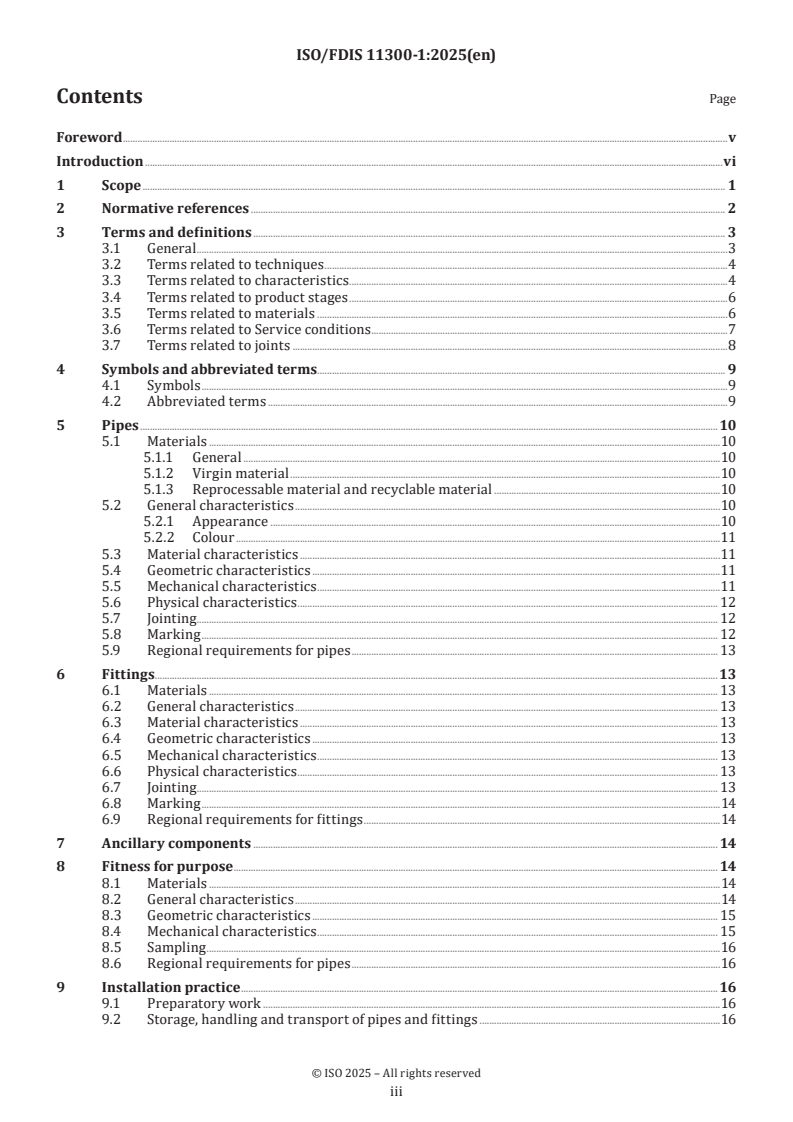
Contents Page
Foreword .v
Introduction .vi
1 Scope . 1
2 Normative references . 2
3 Terms and definitions . 3
3.1 General .3
3.2 Terms related to techniques .4
3.3 Terms related to characteristics.4
3.4 Terms related to product stages .6
3.5 Terms related to materials .6
3.6 Terms related to Service conditions .7
3.7 Terms related to joints .8
4 Symbols and abbreviated terms. 9
4.1 Symbols .9
4.2 Abbreviated terms .9
5 Pipes .10
5.1 Materials .10
5.1.1 General .10
5.1.2 Virgin material .10
5.1.3 Reprocessable material and recyclable material .10
5.2 General characteristics .10
5.2.1 Appearance .10
5.2.2 Colour .11
5.3 Material characteristics .11
5.4 Geometric characteristics .11
5.5 Mechanical characteristics .11
5.6 Physical characteristics . 12
5.7 Jointing. 12
5.8 Marking . 12
5.9 Regional requirements for pipes . 13
6 Fittings .13
6.1 Materials . 13
6.2 General characteristics . 13
6.3 Material characteristics . 13
6.4 Geometric characteristics . 13
6.5 Mechanical characteristics . 13
6.6 Physical characteristics . 13
6.7 Jointing. 13
6.8 Marking .14
6.9 Regional requirements for fittings .14
7 Ancillary components . 14
8 Fitness for purpose . 14
8.1 Materials .14
8.2 General characteristics .14
8.3 Geometric characteristics . 15
8.4 Mechanical characteristics . 15
8.5 Sampling .16
8.6 Regional requirements for pipes .16
9 Installation practice .16
9.1 Preparatory work .16
9.2 Storage, handling and transport of pipes and fittings .16
iii
ISO/FDIS 11300-1:2025(en)
9.3 Equipment .17
9.3.1 General .17
9.3.2 Butt fusion equipment and de-beading equipment .17
9.3.3 Pipe skids/rollers . .17
9.3.4 Winching and rod-pulling equipment . .17
9.3.5 Pipe entry guides .18
9.3.6 Electrofusion equipment .18
9.3.7 Inspection equipment .18
9.3.8 Lifting equipment .18
9.4 Installation .18
9.4.1 General .18
9.4.2 Safety precautions .19
9.4.3 Simulated installations .19
9.5 Process-related inspection and testing . 20
9.6 Pipe end termination . 20
9.7 Reconnection to the existing pipeline system . 20
9.8 Final inspection and testing .21
9.9 Documentation .21
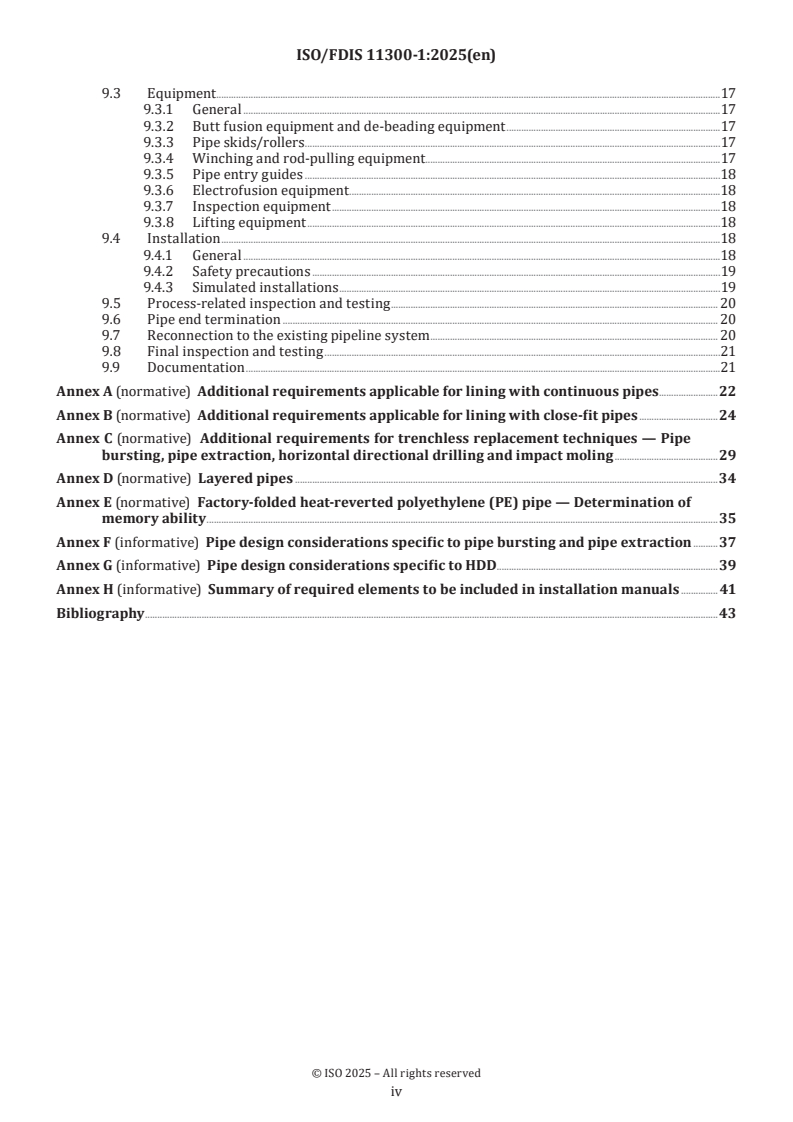
Annex A (normative) Additional requirements applicable for lining with continuous pipes .22
Annex B (normative) Additional requirements applicable for lining with close-fit pipes .24
Annex C (normative) Additional requirements for trenchless replacement techniques — Pipe
bursting, pipe extraction, horizontal directional drilling and impact moling .29
Annex D (normative) Layered pipes .34
Annex E (normative) Factory-folded heat-reverted polyethylene (PE) pipe — Determination of
memory ability .35
Annex F (informative) Pipe design considerations specific to pipe bursting and pipe extraction .37
Annex G (informative) Pipe design considerations specific to HDD.39
Annex H (informative) Summary of required elements to be included in installation manuals . 41
Bibliography .43
iv
ISO/FDIS 11300-1:2025(en)
Foreword
ISO (the International Organization for Standardization) is a worldwide federation of national standards
bodies (ISO member bodies). The work of preparing International Standards is normally carried out through
ISO technical committees. Each member body interested in a subject for which a technical committee
has been established has the right to be represented on that committee. International organizations,
governmental and non-governmental, in liaison with ISO, also take part in the work. ISO collaborates closely
with the International Electrotechnical Commission (IEC) on all matters of electrotechnical standardization.
The procedures used to develop this document and those intended for its further maintenance are described
in the ISO/IEC Directives, Part 1. In particular, the different approval criteria needed for the different types
of ISO documents should be noted. This document was drafted in accordance with the editorial rules of the
ISO/IEC Directives, Part 2 (see www.iso.org/directives).
ISO draws attention to the possibility that the implementation of this document may involve the use of (a)
patent(s). ISO takes no position concerning the evidence, validity or applicability of any claimed patent
rights in respect thereof. As of the date of publication of this document, ISO had not received notice of (a)
patent(s) which may be required to implement this document. However, implementers are cautioned that
this may not represent the latest information, which may be obtained from the patent database available at
www.iso.org/patents. ISO shall not be held responsible for identifying any or all such patent rights.
Any trade name used in this document is information given for the convenience of users and does not
constitute an endorsement.
For an explanation of the voluntary nature of standards, the meaning of ISO specific terms and expressions
related to conformity assessment, as well as information about ISO's adherence to the World Trade
Organization (WTO) principles in the Technical Barriers to Trade (TBT), see www.iso.org/iso/foreword.html.
This document was prepared by Technical Committee ISO/TC 138, Plastics pipes, fittings and valves for the
transport of fluids, Subcommittee SC 8, Rehabilitation of pipeline systems, in collaboration with the European
Committee for Standardization (CEN) Technical Committee CEN/TC 155, Plastics piping systems and
ducting systems, in accordance with the Agreement on technical cooperation between ISO and CEN (Vienna
Agreement).
This first edition of ISO 11300-1, together with ISO 11300-2, ISO 11300-3, ISO/DIS 11300-4 (in preparation)
and ISO 11301-1, cancels and replaces ISO 11296-1:2018, ISO 11296-2:2018, ISO 11296-3:2018,
ISO 11297-1:2018, ISO 11297-2:2018, ISO 11297-3:2018, ISO 11298-1:2018, ISO 11298-2:2018,
ISO 11298-3:2018, ISO 21225-1:2018 and ISO 21225-2:2018, which have been technically revised.
The main changes are as follows:
— for piping systems made from polyethylene (PE) material, this document replaces the related content,
including requirements, of the documents listed above.
A list of all parts in the ISO 11300 series can be found on the ISO website.
Any feedback or questions on this document should be directed to the user’s national standards body. A
complete listing of these bodies can be found at www.iso.org/members.html.
v
ISO/FDIS 11300-1:2025(en)
Introduction
This document is a part of a series of International Standards concerning piping systems of various materials
used for the rehabilitation of existing pipelines in a specified application area:
— ISO 11300 series: Piping systems for rehabilitation of underground drains, sewers and water supply
networks;
— ISO 11301 series: Piping systems for rehabilitation of underground gas supply networks.
The ISO 11300 series and the ISO 11301 series are subdivided into parts covering a specific material per
pipe system.
The ISO 11300 series is subdivided in four parts:
— Part 1: Polyethylene (PE) material (this document);
— Part 2: Thermoset composite materials;
— Part 3: PVC-U material;
— Part 4: Thermoplastic composite materials.
These documents cover various techniques for renovation and trenchless replacement. Furthermore, they
are distinguished from those for conventionally installed plastics piping systems by the requirement to
verify certain characteristics in the “as-installed” condition, after site processing. This is in addition to
specifying requirements for piping system components “as manufactured”.
A consistent structure of clause headings has been adopted for all parts of the ISO 11300 series and the
ISO 11301 series, in order to facilitate direct comparisons across renovation technique families.
Figure 1 shows the clause structure and the relationship between the ISO 11300 series and the ISO 11301 series.
For complementary information, see ISO 11295.
[3]
For assessment of conformity to the requirements of this document, see ISO/TS 23818-1 .
vi
ISO/FDIS 11300-1:2025(en)
a
In preparation.
Figure 1 — Clause structure of the ISO 11300 series and the ISO 11301 series
The various techniques for rehabilitation of underground drains, sewers and water supply networks,
within the scope of pipeline rehabilitation techniques generally, are shown schematically in Figure 2. For
definitions of standardized renovation techniques shown in Figure 2, but outside the scope of this document,
see ISO 11295.
vii
ISO/FDIS 11300-1:2025(en)
a
This document is applicable, for pipe systems made from PE materials.
Figure 2 — Technique families for rehabilitation of underground drains, sewers and water supply
networks using plastics pipes, within the scope of pipeline rehabilitation techniques
viii
FINAL DRAFT International Standard ISO/FDIS 11300-1:2025(en)
Piping systems for rehabilitation of underground drains,
sewers and water supply networks —
Part 1:
Polyethylene (PE) material
1 Scope
This document specifies requirements and test methods for pipes and fittings which are part of piping
systems for the rehabilitation, by means of renovation and trenchless replacement, of underground non-
pressure and pressure drains and sewers and water supply networks, which transport water intended for
human consumption, including raw water pipelines.
It is applicable to polyethylene (PE) pipes, fittings and assemblies, as manufactured and as installed. It is not
applicable to the existing pipeline.
It is applicable to the following technique families for renovation, intended to be used at an operating
temperature of 20 °C as the reference temperature:
— lining with continuous pipes;
— lining with close-fit pipes.
This document is applicable to the following technique families for trenchless replacement, intended to be
used at an operating temperature of 20 °C as the reference temperature:
— pipe bursting and pipe extraction;
— horizontal directional drilling and impact moling.
NOTE For applications operating at constant temperatures greater than 20 °C and up to 40 °C, see ISO 4427-1:2019,
Annex A.
When used with lining with continuous pipes, lining with close-fit pipes and trenchless replacement
technique families, this document is applicable to:
— PE solid wall single layered pipes (nominal outside diameter, d ), including any identification stripes;
n
— PE pipes with co-extruded layers on either or both the outside and inside of the pipe (total outside
diameter, d ), as specified in Annex D, where all layers have the same MRS rating.
n
Furthermore, when used with lining with continuous pipes and trenchless replacement this document is
applicable to:
— PE coated pipes (outside diameter, d ) having a peelable, contiguous, thermoplastics additional layer on
n
the outside of the pipe (“coated pipe”), as specified in Annex D.
This document is applicable to jointing by means of butt fusion and electrofusion and to fabricated and
injection-moulded fittings and mechanical connections of PE.
ISO/FDIS 11300-1:2025(en)
2 Normative references
The following documents are referred to in the text in such a way that some or all of their content constitutes
requirements of this document. For dated references, only the edition cited applies. For undated references,
the latest edition of the referenced document (including any amendments) applies.
ISO 1167-1, Thermoplastics pipes, fittings and assemblies for the conveyance of fluids — Determination of the
resistance to internal pressure — Part 1: General method
ISO 1167-2, Thermoplastics pipes, fittings and assemblies for the conveyance of fluids — Determination of the
resistance to internal pressure — Part 2: Preparation of pipe test pieces
ISO 2505, Thermoplastics pipes — Longitudinal reversion — Test method and parameters
ISO 3126, Plastics piping systems — Plastics components — Determination of dimensions
ISO 4427-1:2019, Plastics piping systems for water supply and for drainage and sewerage under pressure —
Polyethylene (PE) — Part 1: General
ISO 4427-2, Plastics piping systems for water supply, and for drainage and sewerage under pressure —
Polyethylene (PE) — Part 2: Pipes
ISO 4427-3, Plastics piping systems for water supply, and for drainage and sewerage under pressure —
Polyethylene (PE) — Part 3: Fittings
ISO 4427-5, Plastics piping systems for water supply, and for drainage and sewerage under pressure —
Polyethylene (PE) — Part 5: Fitness for purpose of the system
ISO 4633, Rubber seals — Joint rings for water supply, drainage and sewerage pipelines — Specification for
materials
ISO 8772, Plastics piping systems for non-pressure underground drainage and sewerage — Polyethylene (PE)
ISO 9967, Thermoplastics pipes — Determination of creep ratio
ISO 9969, Thermoplastics pipes — Determination of ring stiffness
ISO 11295, Plastics piping systems used for the rehabilitation of pipelines — Classification and overview of
strategic, tactical and operational activities
ISO 12176-1, Plastics pipes and fittings — Equipment for fusion jointing polyethylene systems — Part 1: Butt fusion
ISO 12176-2, Plastics pipes and fittings — Equipment for fusion jointing polyethylene systems — Part 2:
Electrofusion
EN 681-1, Elastomeric seal — Material requirements for pipe joint seals used in water and drainage
applications — Part 1: Vulcanized rubber
EN 681-2, Elastomeric seals — Material requirements for pipe joint seals used in water and drainage applications
— Part 2: Thermoplastic elastomers
EN 681-3, Elastomeric seals — Material requirements for pipe joint seals used in water and drainage applications
— Part 3: Cellular materials of vulcanized rubber
EN 681-4, Elastomeric seals — Material requirements for pipe joint seals used in water and drainage applications
— Part 4: Cast polyurethane sealing elements
EN 12201-1, Plastics piping systems for water supply, and for drainage and sewerage under pressure —
Polyethylene (PE) — Part 1: General
EN 12201-2, Plastics piping systems for water supply, and for drainage and sewerage under pressure —
Polyethylene (PE) — Part 2: Pipes
ISO/FDIS 11300-1:2025(en)
EN 12201-3, Plastics piping systems for water supply, and for drainage and sewerage under pressure —
Polyethylene (PE) — Part 3: Fittings
EN 12201-5, Plastics piping systems for water supply, and for drainage and sewerage under pressure —
Polyethylene (PE) — Part 5: Fitness for purpose of the system
EN 12666-1, Plastics piping systems for non-pressure underground drainage and sewerage — Polyethylene (PE)
— Part 1: Specifications for pipes, fittings and the system
3 Terms and definitions
For the purposes of this document, the terms and definitions given in ISO 11295 and the following apply.
ISO and IEC maintain terminology databases for use in standardization at the following addresses:
— ISO Online browsing platform: available at https:// www .iso .org/ obp
— IEC Electropedia: available at https:// www .electropedia .org/
3.1 General
3.1.1
characteristic
property, dimension or other feature of a material or component
3.1.2
declared value
limiting value of a characteristic (3.1.1) declared in advance by the rehabilitation systemsupplier (3.1.5),
which becomes the requirement for the purposes of assessment of conformity
3.1.3
coated pipe
pipe with a peelable, contiguous thermoplastic additional layer on the outside of the pipe
3.1.4
solid wall single layered pipe
pipe with smooth internal and external surface, extruded from the same compound throughout the wall
3.1.5
rehabilitation system supplier
entity that specifies the field and range of application and brings together the components of a rehabilitation
system to meet the requirements of the product standard at the “M” stage (3.4.1), so that when installed
in accordance with the installation manual they meet the requirements of the product standard at the “I”
stage (3.4.2)
3.1.6
system installer
entity that prepares the host pipe, takes the rehabilitation system at the “M” stage (3.4.1) and installs it so
that it is at the “I” stage (3.4.2)
3.1.7
type testing
testing performed to prove that a material, component, joint or assembly is capable of conforming to the
requirements given in the applicable standard
ISO/FDIS 11300-1:2025(en)
3.2 Terms related to techniques
3.2.1
close fit
situation of the outside of the installed liner relative to the inside of the existing pipeline, which may either
be an interference fit or include a small annular gap resulting from shrinkage and tolerances only
3.2.2
close-fit pipe
continuous lining pipe of thermoplastic material reshaped or otherwise expanded after insertion to achieve
a close fit (3.2.1) to the existing pipeline
3.3 Terms related to characteristics
3.3.1
nominal size
DN
numerical designation of the size of a component related to the inside or outside diameter
Note 1 to entry: It is a convenient round number approximately equal to the manufacturing dimension in millimetres
(mm). It is not applicable to components designated by thread size.
[SOURCE: ISO 4427-1:2019, 3.1.1, modified — inside diameter has been included in the definition.]
3.3.2
nominal size
DN/OD
numerical designation of the size of a component related to the outside diameter
[SOURCE: ISO 4427-1:2019, 3.1.1]
3.3.3
nominal outside diameter
d
n
specified outside diameter, in millimetres, assigned to a nominal size DN/OD (3.3.2)
Note 1 to entry: For thermoplastics solid-wall components, the value of nominal outside diameter is identical to the
minimum mean outside diameter (3.3.5), d .
em,min
[SOURCE: ISO 4427-1:2019, 3.1.2, modified — Note 1 to entry has been added.]
3.3.4
mean outside diameter
d
em
value of the measurement of the outer circumference of the pipe or spigot end of a fitting in any cross-section
divided by π (= 3,142) and rounded to the next greater 0,1 mm
[SOURCE: ISO 4427-1:2019, 3.1.4]
3.3.5
minimum mean outside diameter
d
em,min
minimum value of the mean outside diameter (3.3.4) as specified for a given nominal size (3.3.1)
[SOURCE: ISO 4427-1:2019, 3.1.5]
3.3.6
wall thickness
e
value of the measurement of the wall thickness at any point around the circumference of a component
ISO/FDIS 11300-1:2025(en)
3.3.7
mean wall thickness
e
m
arithmetic mean of a number of measurements of the wall thickness (3.3.6), regularly spaced around the
circumference and in the same cross-section of a component, including the measured minimum and the
measured maximum values of the wall thickness in that cross-section
[SOURCE: ISO 4427-1:2019, 3.1.12]
3.3.8
minimum wall thickness at any point
e
min
minimum value of the wall thickness (3.3.6) at any point around the circumference of a component, as
specified
[SOURCE: ISO 4427-1:2019, 3.1.10]
3.3.9
nominal wall thickness
e
n
numerical designation of the wall thickness (3.3.6) of a component, which is a convenient round number,
approximately equal to the manufacturing dimension in millimetres (mm)
Note 1 to entry: For thermoplastics components conforming to the different parts of the ISO 4427 series, the value of
nominal wall thickness, e , is identical to the specified minimum wall thickness at any point (3.3.8), e .
n min
[SOURCE: ISO 4427-1:2019, 3.1.8]
3.3.10
nominal thickness of the coating
e
coating
arithmetic mean of a number of measurements of the coating thickness around the circumference and in the
same cross-section of a component
3.3.11
standard dimension ratio
SDR
numerical designation of a pipe series, which is a convenient round number, approximately equal to the
dimension ratio of the nominal outside diameter (3.3.3), d , and the nominal wall thickness (3.3.9), e
n n
[SOURCE: ISO 4427-1:2019, 3.1.14]
3.3.12
ring stiffness
resistance of a pipe to diametric deflection in response to external loading applied along one longitudinal
diametric plane
Note 1 to entry: This definition applies to both long and short-term values.
3.3.13
minimum bending radius
minimum radius at any point throughout the length of the pipeline, measured to the longitudinal axis of the pipe
Note 1 to entry: This is usually expressed as a multiple of the pipe diameter.
3.3.14
lower confidence limit of the predicted hydrostatic strength
σ
LPL
quantity, with the dimensions of stress, which represents the 97,5 % lower confidence limit of the predicted
hydrostatic strength at a temperature θ and time t
Note 1 to entry: It is expressed in megapascals.
ISO/FDIS 11300-1:2025(en)
3.3.15
melt mass-flow rate
MFR
value relating to the viscosity of the molten material at a specified temperature and load
Note 1 to entry: It is expressed in grams per 10 min (g/10 min).
[SOURCE: ISO 4427-1:2019, 3.3.5]
3.3.16
minimum required strength
MRS
value of σ at 20 °C and 50 years, rounded down to the next smaller value of the R10 series when σ is
LPL LPL
below 10 MPa, or to the next lower value of the R20 series when σ is 10 MPa or greater
LPL
[1] [2]
Note 1 to entry: the R10 series conform to ISO 3 and the R20 series conforms to ISO 497 .
[SOURCE: ISO 4427-1:2019, 3.3.2]
3.3.17
oxidation induction time
relative measure of a stabilized material’s resistance to oxidative decomposition, determined by the
calorimetric measurement of the time interval to the onset of exothermic oxidation of the material at a
specified temperature in an oxygen or air atmosphere, under atmospheric pressure
3.4 Terms related to product stages
3.4.1
“M” stage
stage as manufactured, before any subsequent site processing of components associated with the particular
renovation technique
Note 1 to entry: For pipes and fittings at the “M” stage, see Clauses 5 and 6, respectively.
3.4.2
“I” stage
stage as installed, i.e. in final configuration after any site processing of components associated with the
particular renovation technique
Note 1 to entry: For pipes and fittings at the “I” stage, see Clause 8.
3.5 Terms related to materials
3.5.1
virgin material
material in a form such as granules, powder or liquid, which has not been subjected to use or processing
other than that required for its manufacture and to which no reprocessable or recyclable material (3.5.4) has
been added
3.5.2
own reprocessable material
material prepared from clean, rejected and unused pipes, fittings, or valves, including trimmings from the
production of pipes, fittings or valves, that is reprocessed in a manufacturer’s plant after having previously
been processed by the same manufacture in the production of a component by, for example, injection
moulding or extrusion
[SOURCE: ISO 4427-1:2019, 3.2.2]
ISO/FDIS 11300-1:2025(en)
3.5.3
external reprocessable material
material from unused products or trimmings which will be reprocessed and which were originally processed
by another manufacturer
Note 1 to entry: If a manufacturer has a production of products other than pipes and fittings, reprocessable material
from that production is considered as external reprocessable material when used for pipes or fittings production.
3.5.4
recyclable material
material prepared from used products which have been cleaned and crushed or ground
3.5.5
compound
homogeneous extruded mixture of base polymer (PE) and additives, i.e. anti-oxidants, pigments, carbon
black, UV-stabilisers, at a dosage level necessary for the processing and use of components conforming to
the requirements of this document
[SOURCE: ISO 4427-1:2019, 3.2.3]
3.5.6
crazing
microstructural phenomenon associated with the short-term application of tensile bending strain exceeding
the material-related critical yield strain
3.5.7
drilling mud
fluid created by mixing water and additives to facilitate drilling and transport of drill cuttings from the drill
bit to the surface
3.6 Terms related to Service conditions
3.6.1
nominal pressure
PN
numerical designation used for reference purposes related to the mechanical characteristics of the
component of a piping system
Note 1 to entry: For thermoplastics piping systems conveying water, it corresponds to the allowable operating
5 2
pressure(PFA) (3.6.3) in bar (1 bar = 0,1 MPa = 10 Pa; 1 MPa = 1 N/mm .), which can be sustained with water at 20 °C
with a design basis of 50 years, and based on the minimum design coefficient (3.6.2):
20×()MRS
PN=
C×−()SDR 1
Note 2 to entry: Research on long term performance prediction of PE water distribution systems shows a possible
service life of at least 100 years, see ISO 4427-1:2019, Reference [4] and Reference [5].
[SOURCE: ISO 4427-1:2019, 3.4.1]
3.6.2
design coefficient
C
coefficient with a value greater than 1 which takes into consideration service conditions as well as properties
of the components of a piping system other than those represented in the lower confidence limit
[SOURCE: ISO 4427-1:2019, 3.3.3]
ISO/FDIS 11300-1:2025(en)
3.6.3
allowable operating pressure
PFA
maximum hydrostatic pressure that a component is capable of withstanding continuously in service
5 2
Note 1 to entry: It is expressed in bar (1 bar = 0,1 MPa = 10 Pa; 1 MPa = 1 N/mm .)
[SOURCE: ISO 11295:2025, 3.3.2]
3.6.4
surge
rapid fluctuations of pressure, either positive or negative, caused by flow alterations over short periods of
time e.g. due to the switching on or off of pumps or the opening or closing of valves
3.6.5
allowable maximum operating pressure
PMA
maximum internal hydrostatic pressure occurring from time to time, including surge (3.6.4), that a
component is capable of withstanding in service
5 2
Note 1 to entry: It is expressed in bar (1 bar = 0,1 MPa = 10 Pa; 1 MPa = 1 N/mm .)
3.6.6
surge factor
F
surge
value of the ratio PMA/PFA, which is generally a function of pipe material and rate of pressure rise
Note 1 to entry: The value assigned for design can also vary depending upon the anticipated frequency of the surge
conditions.
3.7 Terms related to joints
3.7.1
butt fusion joint
joint made by heating the planed ends of matching surfaces by holding them against a flat heating plate
until the PE material reaches fusion temperature, quickly removing the heating plate and pushing the two
softened ends against one another
[SOURCE: ISO 4427-1:2019, 3.5.2]
3.7.2
electrofusion joint
joint between a PE socket or saddle electrofusion fitting and a pipe or fitting with spigot ends, made by
heating the electrofusion fittings by the Joule effect of the heating element incorporated at their jointing
surfaces, causing the material adjacent to them to melt and pipe and fitting surfaces to fuse
[SOURCE: ISO 4427-1:2019, 3.5.1]
3.7.3
fusion compatibility
ability of two similar or dissimilar PE materials to be fused together to form a joint which conforms to the
performance requirements of this document
3.7.4
mechanical joint
joint made by assembling a PE pipe to another PE pipe, or any other element using a fitting that generally
includes a compression part, to provide for pressure integrity, leaktightness and resistance to end loads
[SOURCE: ISO 4427-1:2019, 3.5.3]
ISO/FDIS 11300-1:2025(en)
3.7.5
integral joint
joint at the pipe end, either by means of a socket at one pipe end (single-socket pipe) or matching joint parts
integrated in the pipe wall at either end of the pipe (rubber ring joints or screwed joints).
4 Symbols and abbreviated terms
4.1 Symbols
C design coefficient
d outside diameter
e
d mean outside diameter
em
d minimum mean outside diameter
em,min
d original circular outside diameter of the pipe (before processing for insertion)
manuf
d nominal outside diameter
n
e wall thickness
e mean wall thickness
m
e maximum mean wall thickness
m, max
e minimum wall thickness at any point
min
e nominal wall thickness
n
e nominal thickness of the coating
coating
F value of the ratio PMA/PFA
surge
I second moment of area of the profiled plastics strip
w
l length of the sample for short-term tensile force resistance test of the locked seam
s
S ring stiffness of the pipe
T temperature at which stress rupture data have been determined
t time to occurrence of a leak in
...
ISO/FDIS 11300-1:2025(en)
ISO/TC 138/SC 8
Secretariat: JISC
ISO/TC 138/SC 8/WG 2
Secretariat: DIN
Date: 2025-08-0310-21
Piping systems for rehabilitation of underground drains, sewers and
water supply networks — —
Part 1:
Polyethylene (PE) material
Systèmes de canalisations pour la réhabilitation des réseaux enterrés de branchements et de, des collecteurs
d'assainissementd’assainissement et des réseaux d’alimentation en eau — enterrés —
Partie 1: Matériau Polyéthylènepolyéthylène (PE)
ISO #####-#:####(X)
FDIS stage
Warning for WDs and CDs
This document is not an ISO International Standard. It is distributed for review and comment. It is subject to change
without notice and may not be referred to as an International Standard.
Recipients of this draft are invited to submit, with their comments, notification of any relevant patent rights of which
they are aware and to provide supporting documentation.
A model document of an International Standard (the Model International Standard) is available at:
https://www.iso.org/drafting-standards.html
2 © ISO #### – All rights reserved
ISO/FDIS 11300-1:2025(en)
All rights reserved. Unless otherwise specified, or required in the context of its implementation, no part of this publication
may be reproduced or utilized otherwise in any form or by any means, electronic or mechanical, including photocopying,
or posting on the internet or an intranet, without prior written permission. Permission can be requested from either ISO
at the address below or ISO’s member body in the country of the requester.
ISO copyright office
CP 401 • Ch. de Blandonnet 8
CH-1214 Vernier, Geneva
Phone: + 41 22 749 01 11
EmailE-mail: copyright@iso.org
Website: www.iso.orgwww.iso.org
Published in Switzerland
© ISO 2025 – All rights reserved
iii
ISO #####-#:####(X/FDIS 11300-1:2025(en)
Contents
Foreword . ix
Introduction . x
1 Scope . 1
2 Normative references . 2
3 Terms and definitions . 3
4 Symbols and abbreviated terms . 9
5 Pipes . 11
6 Fittings . 14
7 Ancillary components . 15
8 Fitness for purpose . 15
9 Installation practice . 17
Annex A (normative) Additional requirements applicable for lining with continuous pipes . 24
Annex B (normative) Additional requirements applicable for lining with close-fit pipes . 26
Annex C (normative) Additional requirements for trenchless replacement techniques — Pipe
bursting, pipe extraction, horizontal directional drilling and impact moling . 31
Annex D (normative) Layered pipes . 37
Annex E (normative) Factory-folded heat-reverted polyethylene (PE) pipe — Determination of
memory ability . 38
Annex F (informative) Pipe design considerations specific to pipe bursting and pipe extraction41
Annex G (informative) Pipe design considerations specific to HDD . 43
Annex H (informative) Summary of required elements to be included in installation manuals . 45
Bibliography . 47
Foreword . vii
Introduction . viii
1 Scope . 1
2 Normative references . 1
3 Terms and definitions . 3
3.1 General . 3
3.2 Terms related to techniques . 4
3.3 Terms related to characteristics . 4
3.4 Terms related to product stages . 6
3.5 Terms related to materials . 6
3.6 Terms related to Service conditions . 7
3.7 Terms related to joints . 8
4 Symbols and abbreviated terms . 9
4.1 Symbols . 9
4.2 Abbreviated terms . 9
5 Pipes . 10
iv © ISO #### 2025 – All rights reserved
iv
ISO/FDIS 11300-1:2025(en)
5.1 Materials . 10
5.1.1 General . 10
5.1.2 Virgin material . 10
5.1.3 Reprocessable material and recyclable material . 10
5.2 General characteristics . 10
5.2.1 Appearance . 10
5.2.2 Colour . 11
5.3 Material characteristics . 11
5.4 Geometric characteristics . 11
5.5 Mechanical characteristics . 11
5.6 Physical characteristics . 11
5.7 Jointing . 12
5.8 Marking . 12
5.9 Regional requirements for pipes . 12
6 Fittings . 13
6.1 Materials . 13
6.2 General characteristics . 13
6.3 Material characteristics . 13
6.4 Geometric characteristics . 13
6.5 Mechanical characteristics . 13
6.6 Physical characteristics . 13
6.7 Jointing . 13
6.8 Marking . 13
6.9 Regional requirements for fittings . 13
7 Ancillary components . 14
8 Fitness for purpose . 14
8.1 Materials . 14
8.2 General characteristics . 14
8.3 Geometric characteristics . 15
8.4 Mechanical characteristics . 15
8.5 Sampling . 15
8.6 Regional requirements for pipes . 16
9 Installation practice . 16
9.1 Preparatory work . 16
9.2 Storage, handling and transport of pipes and fittings . 16
9.3 Equipment . 17
9.3.1 General . 17
9.3.2 Butt fusion equipment and de-beading equipment . 17
9.3.3 Pipe skids/rollers . 17
9.3.4 Winching and rod-pulling equipment . 17
9.3.5 Pipe entry guides . 17
9.3.6 Electrofusion equipment . 18
9.3.7 Inspection equipment . 18
9.3.8 Lifting equipment . 18
9.4 Installation . 18
9.4.1 General . 18
9.4.2 Safety precautions . 19
9.4.3 Simulated installations . 19
9.5 Process-related inspection and testing . 20
9.6 Pipe end termination . 20
9.7 Reconnection to the existing pipeline system . 20
9.8 Final inspection and testing . 21
© ISO 2025 – All rights reserved
v
ISO #####-#:####(X/FDIS 11300-1:2025(en)
9.9 Documentation . 21
Annex A (normativ) Additional requirements applicable for lining with continuous pipes . 22
A.1 General . 22
A.2 Pipes . 22
A.2.1 Materials . 22
A.2.2 General characteristics . 22
A.2.3 Material characteristics . 22
A.2.4 Geometric characteristics . 22
A.2.5 Mechanical characteristics . 22
A.2.6 Physical characteristics . 22
A.2.7 Jointing . 22
A.2.8 Marking . 22
A.3 Installation practice . 23
Annex B (normative) Additional requirements applicable for lining with close-fit pipes . 24
B.1 General . 24
B.2 Pipes . 24
B.2.1 Materials . 24
B.2.2 General characteristics . 24
B.2.3 Material characteristics . 24
B.2.4 Geometric characteristics . 24
B.2.5 Mechanical characteristics . 26
B.2.6 Physical characteristics . 27
B.2.7 Jointing . 27
B.2.8 Marking . 27
B.3 Installation practice . 27
B.3.1 Preparatory work . 27
B.3.2 Storage, handling and transport of pipes and fittings . 27
B.3.3 Equipment . 27
B.3.4 Installation . 28
B.3.5 Process-related inspection and testing . 28
Annex C (normative) Additional requirements for trenchless replacement techniques - pipe
bursting, pipe extraction, horizontal directional drilling and impact moling . 29
C.1 General . 29
C.2 Pipes . 29
C.2.1 Materials . 29
C.2.2 General characteristics . 29
C.2.3 Material characteristics . 29
vi © ISO #### 2025 – All rights reserved
vi
ISO/FDIS 11300-1:2025(en)
C.2.4 Geometric characteristics . 29
C.2.5 Mechanical characteristics . 29
C.2.6 Physical characteristics . 29
C.2.7 Jointing . 29
C.2.8 Marking . 29
C.3 Installation practice . 30
C.3.1 Preparatory work . 30
C.3.2 Storage, handling and transport of pipes and fittings . 30
C.3.3 Equipment . 30
C.3.3.1 Pipe bursting equipment . 30
C.3.3.2 Pipe extraction equipment . 31
C.3.3.3 HDD equipment . 31
C.3.3.4 Impact moling equipment. 32
C.3.4 Installation . 33
C.3.5 Process-related inspection and testing . 33
Annex D (normative) Layered pipes . 34
D.1 General . 34
D.2 Pipes with co-extruded layers . 34
D.3 Coated pipe . 34
D.4 Regional requirements for pipes . 34
Annex E (normative) Factory-folded heat-reverted polyethylene (PE) pipe — Determination of
memory ability . 35
E.1 General . 35
E.2 Principle . 35
E.3 Testing . 35
E.3.1 Sampling . 35
E.3.2 Procedure . 35
E.3.3 Requirements . 36
E.4 Test report . 36
Annex F (informative) Pipe design considerations specific to pipe bursting and pipe extraction37
F.1 General . 37
F.2 Installation loads . 37
F.3 External service loads . 38
Annex G (informative) Pipe design considerations specific to HDD . 39
G.1 General . 39
G.2 Installation loads . 39
G.3 External service loads . 40
© ISO 2025 – All rights reserved
vii
ISO #####-#:####(X/FDIS 11300-1:2025(en)
Annex H (informative) Summary of required elements to be included in installation manuals . 41
Bibliography . 43
viii © ISO #### 2025 – All rights reserved
viii
ISO/FDIS 11300-1:2025(en)
Foreword
ISO (the International Organization for Standardization) is a worldwide federation of national standards
bodies (ISO member bodies). The work of preparing International Standards is normally carried out through
ISO technical committees. Each member body interested in a subject for which a technical committee has been
established has the right to be represented on that committee. International organizations, governmental and
non-governmental, in liaison with ISO, also take part in the work. ISO collaborates closely with the
International Electrotechnical Commission (IEC) on all matters of electrotechnical standardization.
The procedures used to develop this document and those intended for its further maintenance are described
in the ISO/IEC Directives, Part 1. In particular, the different approval criteria needed for the different types of
ISO documents should be noted. This document was drafted in accordance with the editorial rules of the
ISO/IEC Directives, Part 2 (see www.iso.org/directives).
ISO draws attention to the possibility that the implementation of this document may involve the use of (a)
patent(s). ISO takes no position concerning the evidence, validity or applicability of any claimed patent rights
in respect thereof. As of the date of publication of this document, ISO had not received notice of (a) patent(s)
which may be required to implement this document. However, implementers are cautioned that this may not
represent the latest information, which may be obtained from the patent database available at
www.iso.org/patents.www.iso.org/patents. ISO shall not be held responsible for identifying any or all such
patent rights.
Any trade name used in this document is information given for the convenience of users and does not
constitute an endorsement.
For an explanation of the voluntary nature of standards, the meaning of ISO specific terms and expressions
related to conformity assessment, as well as information about ISO's adherence to the World Trade
Organization (WTO) principles in the Technical Barriers to Trade (TBT), see www.iso.org/iso/foreword.html.
This document was prepared by Technical Committee ISO/TC 138, Plastics pipes, fittings and valves for the
transport of fluids, Subcommittee SC 8, Rehabilitation of pipeline systems, in collaboration with the European
Committee for Standardization (CEN) Technical Committee CEN/TC 155, Plastics piping systems and ducting
systems, in accordance with the Agreement on technical cooperation between ISO and CEN (Vienna
Agreement).
This first edition of ISO 11300-1:2025, along, together with ISO 11300-2:2025, ISO 11300-3:2025,
ISO/DIS 11300-4 (in preparation) and ISO 11301-1, cancels and replaces ISO 11296-1:2018, ISO 11296-
2:2018, ISO 11296-3:2018, ISO 11297-1:2018, ISO 11297-2:2018, ISO 11297-3:2018, ISO 11298-1:2018,
ISO 11298-2:2018, ISO 11298-3:2018;, ISO 21225-1:2018 and ISO 21225-2:2018, which have been
technically revised. The main changes are as follows:
The main changes are as follows:—
— for piping systems made from polyethylene (PE) material, this document replaces the related content,
including requirements, of the documents listed above.
A list of all parts in the ISO 11300 series can be found on the ISO website.
Any feedback or questions on this document should be directed to the user’s national standards body. A
complete listing of these bodies can be found at www.iso.org/members.html.
© ISO 2025 – All rights reserved
ix
ISO #####-#:####(X/FDIS 11300-1:2025(en)
Introduction
This document is a part of a series of International Standards concerning piping systems of various materials
used for the rehabilitation of existing pipelines in a specified application area:
— — ISO 11300 series: Piping systems for rehabilitation of underground drains, sewers and water supply
networks;
— — ISO 11301 series: Piping systems for rehabilitation of underground gas supply networks.
The ISO 11300 series and the ISO 11301 series are subdivided into parts covering a specific material per pipe
system.
The ISO 11300 series is subdivided in four parts:
— — Part 1: Polyethylene (PE) material (this document);
— — Part 2: Thermoset composite materials;
— — Part 3: PVC-U material;
— — Part 4: Thermoplastic composite materials.
These documents cover various techniques for renovation and trenchless replacement. Furthermore, they are
distinguished from those for conventionally installed plastics piping systems by the requirement to verify
certain characteristics in the “as-installed” condition, after site processing. This is in addition to specifying
requirements for piping system components “as manufactured”.
A consistent structure of clause headings has been adopted for all parts of the ISO 11300 series and the ISO
11301 series, in order to facilitate direct comparisons across renovation technique families.
Figure 10 shows the clause structure and the relationship between the ISO 11300 series and the ISO 11301
series.
For complementary information, see ISO 11295.
[
For assessment of conformity to the requirements of this document, see ISO/TS 23818-1[3]. Error!
]
Reference source not found. .
x © ISO #### 2025 – All rights reserved
x
ISO/FDIS 11300-1:2025(en)
a
In preparation.
a
In preparation.
Figure 1 — Clause structure of the ISO 11300 series and the ISO 11301 series
The various techniques for rehabilitation of underground drains, sewers and water supply networks, within
the scope of pipeline rehabilitation techniques generally, are shown schematically in Figure 2.0. For
definitions of standardized renovation techniques shown in Figure 2,0, but outside the scope of this document,
see ISO 11295.
© ISO 2025 – All rights reserved
xi
ISO #####-#:####(X/FDIS 11300-1:2025(en)
a
This document is applicable, for pipe systems made from PE materials.
xii © ISO #### 2025 – All rights reserved
xii
ISO/FDIS 11300-1:2025(en)
a
This document is applicable, for pipe systems made from PE materials.
Figure 2 — Technique families for rehabilitation of underground drains, sewers and water supply
networks using plastics pipes, within the scope of pipeline rehabilitation techniques
© ISO 2025 – All rights reserved
xiii
ISO/FDIS 11300-1:2025(en)
Piping systems for rehabilitation of underground drains, sewers and
water supply networks — —
Part 1:
Polyethylene (PE) material
1 Scope
This document specifies requirements and test methods for pipes and fittings which are part of piping systems
for the rehabilitation, by means of renovation and trenchless replacement, of underground non-pressure and
pressure drains and sewers and water supply networks, which transport water intended for human
consumption, including raw water pipelines.
It is applicable to polyethylene (PE) pipes, fittings and assemblies, as manufactured and as installed. It is not
applicable to the existing pipeline.
It is applicable to the following technique families for renovation, intended to be used at an operating
temperature of 20 °C as the reference temperature:
— — lining with continuous pipes;
— — lining with close-fit pipes.
ItThis document is applicable to the following technique families for trenchless replacement, intended to be
used at an operating temperature of 20 °C as the reference temperature:
— — pipe bursting and pipe extraction;
— — horizontal directional drilling and impact moling.
NOTE For applications operating at constant temperatures greater than 20 °C and up to 40 °C, see ISO 4427-1:2019,
Annex A.
When used with lining with continuous pipes, lining with close-fit pipes and trenchless replacement technique
families, this document is applicable to:
— — PE solid wall single layered pipes (nominal outside diameter, d ), including any identification stripes;
n
— — PE pipes with co-extruded layers on either or both the outside and inside of the pipe (total outside
diameter, d ), as specified in Annex D,Annex D, where all layers have the same MRS rating.
n
Furthermore, when used with lining with continuous pipes and trenchless replacement this document is
applicable to:
— — PE coated pipes (outside diameter, d ) having a peelable, contiguous, thermoplastics additional layer
n
on the outside of the pipe (“coated pipe”), as specified in Annex D.Annex D.
This document is applicable to jointing by means of butt fusion and electrofusion and to fabricated and
injection-moulded fittings and mechanical connections of PE.
© ISO 2025 – All rights reserved
ISO/FDIS 11300-1:2025(en)
2 Normative references
The following documents are referred to in the text in such a way that some or all of their content constitutes
requirements of this document. For dated references, only the edition cited applies. For undated references,
the latest edition of the referenced document (including any amendments) applies.
ISO 1167--1, Thermoplastics pipes, fittings and assemblies for the conveyance of fluids — Determination of the
resistance to internal pressure — Part 1: General method
ISO 1167--2, Thermoplastics pipes, fittings and assemblies for the conveyance of fluids — Determination of the
resistance to internal pressure — Part 2: Preparation of pipe test pieces
ISO 2505, Thermoplastics pipes — Longitudinal reversion — Test method and parameters
ISO 3126, Plastics piping systems — Plastics components — Determination of dimensions
ISO 4427--1:2019, Plastics piping systems for water supply and for drainage and sewerage under pressure —
Polyethylene (PE) — Part 1: General
ISO 4427--2, Plastics piping systems for water supply, and for drainage and sewerage under pressure —
Polyethylene (PE) — Part 2: Pipes
ISO 4427--3, Plastics piping systems for water supply, and for drainage and sewerage under pressure —
Polyethylene (PE) — Part 3: Fittings
ISO 4427--5, Plastics piping systems for water supply, and for drainage and sewerage under pressure —
Polyethylene (PE) — Part 5: Fitness for purpose of the system
ISO 4633, Rubber seals — Joint rings for water supply, drainage and sewerage pipelines — Specification for
materials
ISO 8772, Plastics piping systems for non-pressure underground drainage and sewerage — Polyethylene (PE)
ISO 9967, Thermoplastics pipes — Determination of creep ratio
ISO 9969, Thermoplastics pipes — Determination of ring stiffness
ISO 11295, Plastics piping systems used for the rehabilitation of pipelines — Classification and overview of
strategic, tactical and operational activities
ISO 12176--1, Plastics pipes and fittings — Equipment for fusion jointing polyethylene systems — Part 1: Butt
fusion
ISO 12176--2, Plastics pipes and fittings — Equipment for fusion jointing polyethylene systems — Part 2:
Electrofusion
EN 681--1, Elastomeric seal — Material requirements for pipe joint seals used in water and drainage
applications — Part 1: Vulcanized rubber
EN 681--2, Elastomeric seals — Material requirements for pipe joint seals used in water and drainage
applications — Part 2: Thermoplastic elastomers
EN 681--3, Elastomeric seals — Material requirements for pipe joint seals used in water and drainage
applications — Part 3: Cellular materials of vulcanized rubber
2 © ISO #### 2025 – All rights reserved
ISO/FDIS 11300-1:2025(en)
EN 681--4, Elastomeric seals — Material requirements for pipe joint seals used in water and drainage
applications — Part 4: Cast polyurethane sealing elements
EN 12201--1, Plastics piping systems for water supply, and for drainage and sewerage under pressure —
Polyethylene (PE) — Part 1: General
EN 12201--2, Plastics piping systems for water supply, and for drainage and sewerage under pressure —
Polyethylene (PE) — Part 2: Pipes
EN 12201--3, Plastics piping systems for water supply, and for drainage and sewerage under pressure —
Polyethylene (PE) — Part 3: Fittings
EN 12201--5, Plastics piping systems for water supply, and for drainage and sewerage under pressure —
Polyethylene (PE) — Part 5: Fitness for purpose of the system
EN 12666--1, Plastics piping systems for non-pressure underground drainage and sewerage — Polyethylene (PE)
— Part 1: Specifications for pipes, fittings and the system
3 Terms and definitions
For the purposes of this document, the terms and definitions given in ISO 11295 and the following apply.
ISO and IEC maintain terminology databases for use in standardization at the following addresses:
— ISO Online browsing platform: available at https://www.iso.org/obp
— IEC Electropedia: available at https://www.electropedia.org/
3.1 General
3.1.1 3.1.1
characteristic
property, dimension or other feature of a material or component
3.1.2 3.1.2
declared value
limiting value of a characteristic (3.1.1)(Error! Reference source not found.) declared in advance by the
rehabilitation system supplier (3.1.5),systemsupplier (Error! Reference source not found.), which becomes
the requirement for the purposes of assessment of conformity
3.1.3 3.1.3
coated pipe
pipe with a peelable, contiguous thermoplastic additional layer on the outside of the pipe
3.1.4 3.1.4
solid wall single layered pipe
pipe with smooth internal and external surface, extruded from the same compound throughout the wall
3.1.5 3.1.5
rehabilitation system supplier
entity that specifies the field and range of application and brings together the components of a rehabilitation
system to meet the requirements of the product standard at the “M” stage (3.4.1),(Error! Reference source
not found.), so that when installed in accordance with the installation manual they meet the requirements of
the product standard at the “I” stage (3.4.2)(Error! Reference source not found.)
© ISO 2025 – All rights reserved
ISO/FDIS 11300-1:2025(en)
3.1.6 3.1.6
system installer
entity that prepares the host pipe, takes the rehabilitation system at the “M” stage (3.4.1)(Error! Reference
source not found.) and installs it so that it is at the “I” stage (3.4.2)(Error! Reference source not found.)
3.1.7 3.1.7
type testing
testing performed to prove that a material, component, joint or assembly is capable of conforming to the
requirements given in the applicable standard
3.2 Terms related to techniques
3.2.1 3.2.1
close fit
situation of the outside of the installed liner relative to the inside of the existing pipeline, which may either be
an interference fit or include a small annular gap resulting from shrinkage and tolerances only
3.2.2 3.2.2
close-fit pipe
continuous lining pipe of thermoplastic material reshaped or otherwise expanded after insertion to achieve a
close fit (3.2.1)(Error! Reference source not found.) to the existing pipeline
3.3 Terms related to characteristics
3.3.1 3.3.1
nominal size
DN
numerical designation of the size of a component related to the inside or outside diameter
Note 1 to entry: It is a convenient round number approximately equal to the manufacturing dimension in millimetres
(mm). It is not applicable to components designated by thread size.
[SOURCE: ISO 4427-‑1:2019, 3.1.1, modified — inside diameter has been included in the definition.]
3.3.2 3.3.2
nominal size
DN/OD
numerical designation of the size of a component related to the outside diameter
[SOURCE: ISO 4427-1:2019, 3.1.1]
3.3.3 3.3.3
nominal outside diameter
d
n
specified outside diameter, in millimetres, assigned to a nominal siz
...
PROJET FINAL
Norme
internationale
ISO/FDIS 11300-1
ISO/TC 138/SC 8
Systèmes de canalisations pour la
Secrétariat: JISC
réhabilitation des branchements,
Début de vote:
des collecteurs d’assainissement et
2025-11-05
des réseaux d’alimentation en eau
Vote clos le:
enterrés —
2025-12-31
Partie 1:
Matériau polyéthylène (PE)
Piping systems for rehabilitation of underground drains, sewers
and water supply networks —
Part 1: Polyethylene (PE) material
LES DESTINATAIRES DU PRÉSENT PROJET SONT
INVITÉS À PRÉSENTER, AVEC LEURS OBSERVATIONS,
NOTIFICATION DES DROITS DE PROPRIÉTÉ DONT ILS
AURAIENT ÉVENTUELLEMENT CONNAISSANCE ET À
FOURNIR UNE DOCUMENTATION EXPLICATIVE.
OUTRE LE FAIT D’ÊTRE EXAMINÉS POUR
ÉTABLIR S’ILS SONT ACCEPTABLES À DES FINS
INDUSTRIELLES, TECHNOLOGIQUES ET COM-MERCIALES,
AINSI QUE DU POINT DE VUE DES UTILISATEURS, LES
PROJETS DE NORMES
TRAITEMENT PARALLÈLE ISO/CEN
INTERNATIONALES DOIVENT PARFOIS ÊTRE CONSIDÉRÉS
DU POINT DE VUE DE LEUR POSSI BILITÉ DE DEVENIR DES
NORMES POUVANT
SERVIR DE RÉFÉRENCE DANS LA RÉGLEMENTATION
NATIONALE.
Numéro de référence
ISO/FDIS 11300-1:2025(fr) © ISO 2025
PROJET FINAL
ISO/FDIS 11300-1:2025(fr)
Norme
internationale
ISO/FDIS 11300-1
ISO/TC 138/SC 8
Systèmes de canalisations pour la
Secrétariat: JISC
réhabilitation des branchements,
Début de vote:
des collecteurs d’assainissement et
2025-11-05
des réseaux d’alimentation en eau
Vote clos le:
enterrés —
2025-12-31
Partie 1:
Matériau polyéthylène (PE)
Piping systems for rehabilitation of underground drains, sewers
and water supply networks —
Part 1: Polyethylene (PE) material
LES DESTINATAIRES DU PRÉSENT PROJET SONT
INVITÉS À PRÉSENTER, AVEC LEURS OBSERVATIONS,
NOTIFICATION DES DROITS DE PROPRIÉTÉ DONT ILS
AURAIENT ÉVENTUELLEMENT CONNAISSANCE ET À
FOURNIR UNE DOCUMENTATION EXPLICATIVE.
DOCUMENT PROTÉGÉ PAR COPYRIGHT
OUTRE LE FAIT D’ÊTRE EXAMINÉS POUR
ÉTABLIR S’ILS SONT ACCEPTABLES À DES FINS
© ISO 2025 INDUSTRIELLES, TECHNOLOGIQUES ET COM-MERCIALES,
AINSI QUE DU POINT DE VUE DES UTILISATEURS, LES
Tous droits réservés. Sauf prescription différente ou nécessité dans le contexte de sa mise en œuvre, aucune partie de cette
PROJETS DE NORMES
TRAITEMENT PARALLÈLE ISO/CEN
INTERNATIONALES DOIVENT PARFOIS ÊTRE CONSIDÉRÉS
publication ne peut être reproduite ni utilisée sous quelque forme que ce soit et par aucun procédé, électronique ou mécanique,
DU POINT DE VUE DE LEUR POSSI BILITÉ DE DEVENIR DES
y compris la photocopie, ou la diffusion sur l’internet ou sur un intranet, sans autorisation écrite préalable. Une autorisation peut
NORMES POUVANT
être demandée à l’ISO à l’adresse ci-après ou au comité membre de l’ISO dans le pays du demandeur.
SERVIR DE RÉFÉRENCE DANS LA RÉGLEMENTATION
NATIONALE.
ISO copyright office
Case postale 401 • Ch. de Blandonnet 8
CH-1214 Vernier, Genève
Tél.: +41 22 749 01 11
E-mail: copyright@iso.org
Web: www.iso.org
Publié en Suisse Numéro de référence
ISO/FDIS 11300-1:2025(fr) © ISO 2025
ii
ISO/FDIS 11300-1:2025(fr)
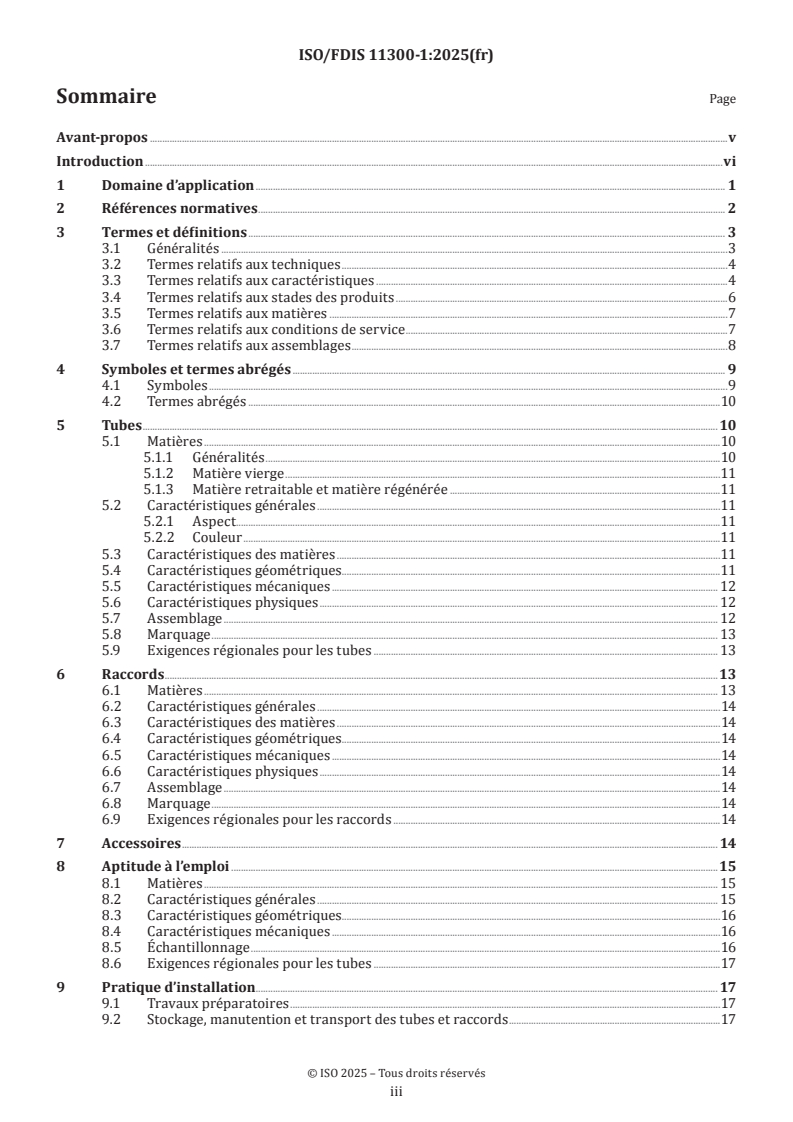
Sommaire Page
Avant-propos .v
Introduction .vi
1 Domaine d’application . 1
2 Références normatives . 2
3 Termes et définitions . 3
3.1 Généralités .3
3.2 Termes relatifs aux techniques .4
3.3 Termes relatifs aux caractéristiques .4
3.4 Termes relatifs aux stades des produits .6
3.5 Termes relatifs aux matières .7
3.6 Termes relatifs aux conditions de service .7
3.7 Termes relatifs aux assemblages .8
4 Symboles et termes abrégés . 9
4.1 Symboles .9
4.2 Termes abrégés .10
5 Tubes . 10
5.1 Matières .10
5.1.1 Généralités .10
5.1.2 Matière vierge .11
5.1.3 Matière retraitable et matière régénérée .11
5.2 Caractéristiques générales .11
5.2.1 Aspect . .11
5.2.2 Couleur .11
5.3 Caractéristiques des matières .11
5.4 Caractéristiques géométriques.11
5.5 Caractéristiques mécaniques . 12
5.6 Caractéristiques physiques . 12
5.7 Assemblage . 12
5.8 Marquage . 13
5.9 Exigences régionales pour les tubes . 13
6 Raccords . .13
6.1 Matières . 13
6.2 Caractéristiques générales .14
6.3 Caractéristiques des matières .14
6.4 Caractéristiques géométriques.14
6.5 Caractéristiques mécaniques .14
6.6 Caractéristiques physiques .14
6.7 Assemblage .14
6.8 Marquage .14
6.9 Exigences régionales pour les raccords .14
7 Accessoires . 14
8 Aptitude à l’emploi .15
8.1 Matières . 15
8.2 Caractéristiques générales . 15
8.3 Caractéristiques géométriques.16
8.4 Caractéristiques mécaniques .16
8.5 Échantillonnage .16
8.6 Exigences régionales pour les tubes .17
9 Pratique d’installation . 17
9.1 Travaux préparatoires .17
9.2 Stockage, manutention et transport des tubes et raccords .17
iii
ISO/FDIS 11300-1:2025(fr)
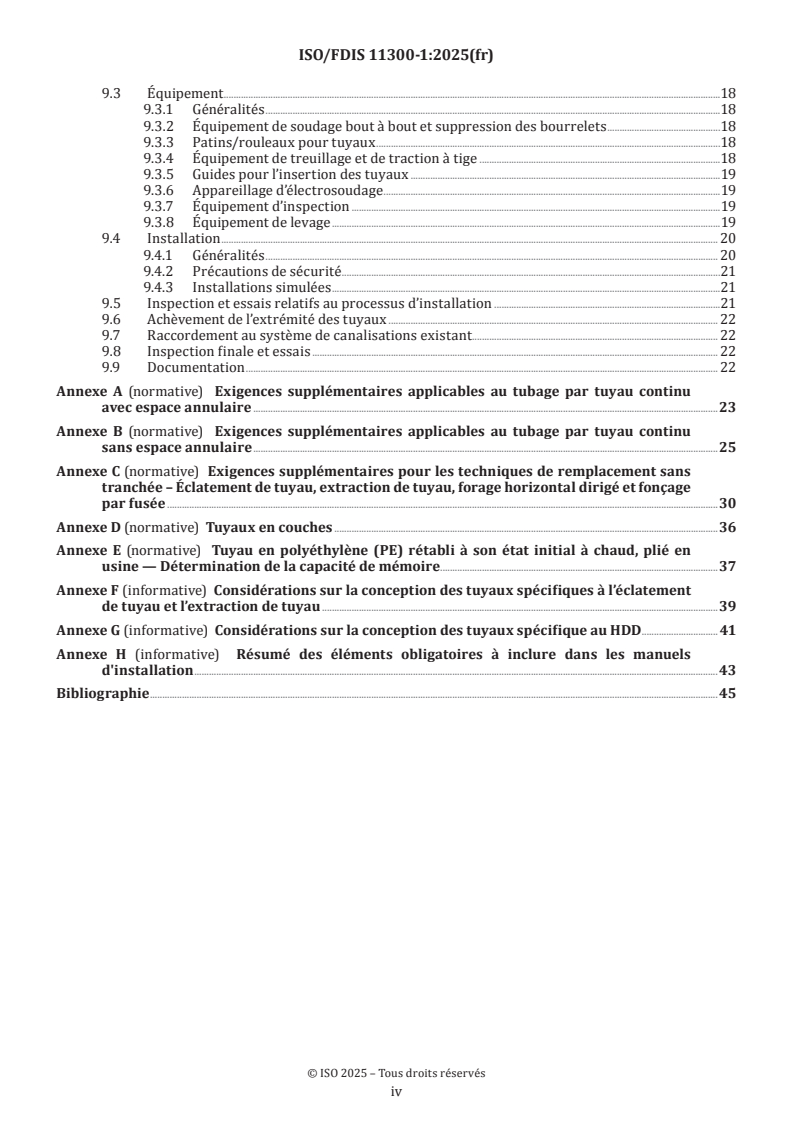
9.3 Équipement .18
9.3.1 Généralités .18
9.3.2 Équipement de soudage bout à bout et suppression des bourrelets .18
9.3.3 Patins/rouleaux pour tuyaux .18
9.3.4 Équipement de treuillage et de traction à tige .18
9.3.5 Guides pour l’insertion des tuyaux .19
9.3.6 Appareillage d’électrosoudage .19
9.3.7 Équipement d’inspection .19
9.3.8 Équipement de levage .19
9.4 Installation . 20
9.4.1 Généralités . 20
9.4.2 Précautions de sécurité .21
9.4.3 Installations simulées .21
9.5 Inspection et essais relatifs au processus d’installation .21
9.6 Achèvement de l’extrémité des tuyaux . 22
9.7 Raccordement au système de canalisations existant . 22
9.8 Inspection finale et essais . 22
9.9 Documentation . 22
Annexe A (normative) Exigences supplémentaires applicables au tubage par tuyau continu
avec espace annulaire .23
Annexe B (normative) Exigences supplémentaires applicables au tubage par tuyau continu
sans espace annulaire .25
Annexe C (normative) Exigences supplémentaires pour les techniques de remplacement sans
tranchée – Éclatement de tuyau, extraction de tuyau, forage horizontal dirigé et fonçage
par fusée .30
Annexe D (normative) Tuyaux en couches .36
Annexe E (normative) Tuyau en polyéthylène (PE) rétabli à son état initial à chaud, plié en
usine — Détermination de la capacité de mémoire.37
Annexe F (informative) Considérations sur la conception des tuyaux spécifiques à l’éclatement
de tuyau et l’extraction de tuyau .39
Annexe G (informative) Considérations sur la conception des tuyaux spécifique au HDD . 41
Annexe H (informative) Résumé des éléments obligatoires à inclure dans les manuels
d'installation .43
Bibliographie .45
iv
ISO/FDIS 11300-1:2025(fr)
Avant-propos
L’ISO (Organisation internationale de normalisation) est une fédération mondiale d’organismes nationaux
de normalisation (comités membres de l’ISO). L’élaboration des Normes internationales est en général
confiée aux comités techniques de l’ISO. Chaque comité membre intéressé par une étude a le droit de faire
partie du comité technique créé à cet effet. Les organisations internationales, gouvernementales et non
gouvernementales, en liaison avec l’ISO participent également aux travaux. L’ISO collabore étroitement avec
la Commission électrotechnique internationale (IEC) en ce qui concerne la normalisation électrotechnique.
Les procédures utilisées pour élaborer le présent document et celles destinées à sa mise à jour sont
décrites dans les Directives ISO/IEC, Partie 1. Il convient, en particulier, de prendre note des différents
critères d’approbation requis pour les différents types de documents ISO. Le présent document a
été rédigé conformément aux règles de rédaction données dans les Directives ISO/IEC, Partie 2 (voir
www.iso.org/directives).
L’ISO attire l’attention sur le fait que la mise en application du présent document peut entraîner l’utilisation
d’un ou de plusieurs brevets. L’ISO ne prend pas position quant à la preuve, à la validité et à l’applicabilité de
tout droit de brevet revendiqué à cet égard. À la date de publication du présent document, l’ISO n’avait pas
reçu notification qu’un ou plusieurs brevets pouvaient être nécessaires à sa mise en application. Toutefois,
il y a lieu d’avertir les responsables de la mise en application du présent document que des informations
plus récentes sont susceptibles de figurer dans la base de données de brevets, disponible à l’adresse
www.iso.org/brevets. L’ISO ne saurait être tenue pour responsable de ne pas avoir identifié tout ou partie de
tels droits de brevet.
Les appellations commerciales éventuellement mentionnées dans le présent document sont données pour
information, par souci de commodité, à l’intention des utilisateurs et ne sauraient constituer un engagement.
Pour une explication de la nature volontaire des normes, la signification des termes et expressions
spécifiques de l’ISO liés à l’évaluation de la conformité, ou pour toute information au sujet de l’adhésion de
l’ISO aux principes de l’Organisation mondiale du commerce (OMC) concernant les obstacles techniques au
commerce (OTC), voir le lien suivant: www.iso.org/iso/fr/avant-propos.html.
Le présent document a été élaboré par le comité technique ISO/TC 138, Tubes, raccords et robinetterie en
matières plastiques pour le transport des fluides, sous-comité SC 8, Réhabilitation des systèmes de canalisations,
en collaboration avec le comité technique CEN/TC 155, Systèmes de canalisations et de gaines en plastiques, du
Comité européen de normalisation (CEN), conformément à l’Accord de coopération technique entre l’ISO et
le CEN (Accord de Vienne).
Cette première édition de l’ISO 11300-1, conjointement avec l’ISO 11300-2, l’ISO 11300-3, l’ISO/DIS 11300-4 (en
préparation) et l’ISO 11301-1, annule et remplace l’ISO 11296-1:2018, l’ISO 11296-2:2018, l’ISO 11296-3:2018,
l’ISO 11297-1:2018, l’ISO 11297-2:2018, l’ISO 11297-3:2018, l’ISO 11298-1:2018, l’ISO 11298-2:2018,
l’ISO 11298-3:2018, l’ISO 21225-1:2018 et l’ISO 21225-2:2018, qui ont fait l'objet d'une révision technique.
Les principales modifications sont les suivantes:
— pour les systèmes de canalisations en matériau polyéthylène (PE), le présent document remplace le
contenu correspondant, y compris les exigences, des documents listés ci-dessus.
Une liste de toutes les parties de la série ISO 11300 se trouve sur le site web de l’ISO.
Il convient que l’utilisateur adresse tout retour d’information ou toute question concernant le présent
document à l’organisme national de normalisation de son pays. Une liste exhaustive desdits organismes se
trouve à l’adresse www.iso.org/fr/members.html.
v
ISO/FDIS 11300-1:2025(fr)
Introduction
Le présent document est une partie d’une série de Normes Internationales concernant les systèmes de
canalisations à base de matières variées, utilisés pour la réhabilitation de canalisations existantes pour une
zone d’application spécifiée:
— série ISO 11300: Systèmes de canalisations pour la réhabilitation des branchements, des collecteurs
d’assainissement et des réseaux d’alimentation en eau enterrés;
— série ISO 11301: Systèmes de canalisations pour la réhabilitation des réseaux enterrés de distribution de
gaz.
La série ISO 11300 et la série ISO 11301 sont subdivisées en parties couvrant une matière spécifique par
système de canalisations.
La série ISO 11300 est subdivisée en quatre parties:
— Partie 1: Matériau polyéthylène (PE) (le présent document);
— Partie 2: Matériaux composites thermodurcissables;
— Partie 3: Matériau PVC-U;
— Partie 4: Matériaux composites thermoplastiques.
Ces docuemnt couvrent diverses techniques de rénovation et de remplacement sans tranchée. En outre, elles
se distinguent de celles relatives aux systèmes de canalisations en plastique installées traditionnellement
du fait qu’elles établissent des exigences concernant certaines caractéristiques liées aux conditions «tel
qu’installé», après mise en œuvre sur le site. Ces exigences viennent s’ajouter à celles des composants du
système de canalisations «tels que fabriqués».
Une structure cohérente des titres des articles a été adoptée pour toutes les parties de la série ISO 11300 et
de la série ISO 11301 afin de faciliter des comparaisons directes entre les différentes familles de techniques
de rénovation.
La Figure 1 illustre la structure des articles et la relation entre la série ISO 11300 et la série SO 11301.
Pour toute information complémentaire, voir l’ISO 11295.
[3]
Pour l’évaluation de la conformité aux exigences du présent document, voir l’ISO/TS 23818-1 .
vi
ISO/FDIS 11300-1:2025(fr)
a
En préparation.
Figure 1 — Structure des articles de la série ISO 11300 et de la série ISO 11301
Les différentes techniques de réhabilitation des branchements, collecteurs d’assainissement et réseaux
d’alimentation en eau enterrés, dans le cadre des techniques de réhabilitation de canalisations en général,
sont schématisées à la Figure 2. Pour les définitions des techniques de rénovation normalisées données à la
Figure 2, mais en dehors du domaine d’application du présent document, voir l’ISO 11295.
vii
ISO/FDIS 11300-1:2025(fr)
a
Le présent document est applicable aux systèmes de canalisation fabriqués à partir de matériaux PE.
Figure 2 — Familles de techniques de réhabilitation des branchements, collecteurs d’assainissement
et réseaux d’alimentation en eau enterrés au moyen de tuyaux en plastique dans le cadre des
techniques de réhabilitation de canalisations
viii
PROJET FINAL Norme internationale ISO/FDIS 11300-1:2025(fr)
Systèmes de canalisations pour la réhabilitation des
branchements, des collecteurs d’assainissement et des
réseaux d’alimentation en eau enterrés —
Partie 1:
Matériau polyéthylène (PE)
1 Domaine d’application
Le présent document spécifie les exigences et les méthodes d’essai pour les tubes et raccords qui font partie
de systèmes de canalisations pour la réhabilitation par la rénovation et le remplacement sans tranchée de
branchements et de collecteurs d’assainissement et de réseaux d’alimentation en eau enterrés sans pression
et avec pression, qui transportent de l’eau destinée à la consommation humaine, y compris les canalisations
d’eau brute.
Il est applicable aux tubes, raccords et assemblages en polyéthylène (PE), tels que fabriqués et tels
qu’installés. Il n’est pas applicable à la canalisation existante.
Il s’applique aux familles de techniques de rénovation suivantes, destinées à être utilisées à une température
de service de 20 °C, qui est la température de référence:
— tubage par tuyau continu avec espace annulaire;
— tubage par tuyau continu sans espace annulaire;
Il s’applique aux familles de techniques de de remplacement sans tranchée suivantes, destinées à être
utilisées à une température de service de 20 °C, qui est la température de référence:
— éclatement de tuyau et extraction de tuyau;
— forage horizontal dirigé et fonçage par fusée.
NOTE Pour les applications à température de service constante supérieure à 20 °C et jusqu’à 40 °C, voir
l’ISO 4427-1:2019, Annexe A.
Lorsqu’il est utilisé avec les familles de techniques tubage par tuyau continu avec espace annulaire, tubage
par tuyau continu sans espace annulaire et remplacement sans tranchée, le présent document est applicable:
— aux tuyaux en PE monocouches à paroi compacte (diamètre extérieur nominal, d ), y compris les bandes
n
d’identification éventuelles;
— aux tuyaux en PE avec des couches co-extrudées à l’extérieur et/ou à l’intérieur du tuyau (diamètre
extérieur total, d ), tels que spécifiés dans l’Annexe D, toutes les couches ayant la même classification
n
MRS.
En outre, lorsqu’il est utilisé avec un tubage par tuyau continu avec espace annulaire et un remplacement
sans tranchée, le présent document s’applique:
— aux tuyaux revêtus de PE (diamètre extérieur, d ) comportant une couche supplémentaire thermoplastique
n
contiguë pelable sur leur surface externe («tuyau revêtu»), tel que spécifié dans l’Annexe D.
Le présent document s’applique à l’assemblage par soudage bout à bout et par électrosoudage, ainsi qu’aux
raccords façonnés et moulés par injection et aux raccordements mécaniques en PE.
ISO/FDIS 11300-1:2025(fr)
2 Références normatives
Les documents suivants sont cités dans le texte de sorte qu’ils constituent, pour tout ou partie de leur
contenu, des exigences du présent document. Pour les références datées, seule l’édition citée s’applique. Pour
les références non datées, la dernière édition du document de référence s’applique (y compris les éventuels
amendements).
ISO 1167-1, Tubes, raccords et assemblages en matières thermoplastiques pour le transport des fluides —
Détermination de la résistance à la pression interne — Partie 1: Méthode générale
ISO 1167-2, Tubes, raccords et assemblages en matières thermoplastiques pour le transport des fluides —
Détermination de la résistance à la pression interne — Partie 2: Préparation des éprouvettes tubulaires
ISO 2505, Tubes en matières thermoplastiques — Retrait longitudinal à chaud — Méthode d'essai et paramètres
ISO 3126, Systèmes de canalisations en plastiques — Composants en plastiques — Détermination des dimensions
ISO 4427-1:2019, Systèmes de canalisations en plastique destinés à l'alimentation en eau et aux branchements et
collecteurs d'assainissement sous pression — Polyéthylène (PE) — Partie 1: Généralités
ISO 4427-2, Systèmes de canalisations en plastique destinés à l'alimentation en eau et aux branchements et
collecteurs d'assainissement sous pression — Polyéthylène (PE) — Partie 2: Tubes
ISO 4427-3, Systèmes de canalisations en plastique destinés à l'alimentation en eau et aux branchements et
collecteurs d'assainissement sous pression — Polyéthylène (PE) — Partie 3: Raccords
ISO 4427-5, Systèmes de canalisations en plastique destinés à l'alimentation en eau et aux branchements et
collecteurs d'assainissement sous pression — Polyéthylène (PE) — Partie 5: Aptitude à l'emploi du système
ISO 4633, Joints étanches en caoutchouc — Garnitures de joints de canalisations d'adduction et d'évacuation
d'eau (égouts inclus) — Spécification des matériaux
ISO 8772, Systèmes de canalisations en plastique pour les branchements et les collecteurs d'assainissement
enterrés sans pression — Polyéthylène (PE)
ISO 9967, Tubes en matières thermoplastiques — Détermination du taux de fluage
ISO 9969, Tubes en matières thermoplastiques — Détermination de la rigidité annulaire
ISO 11295, Systèmes de canalisation en plastique destinés à la réhabilitation des réseaux enterrés —
Classification et vue d’ensemble des activités stratégiques, tactiques et opérationnelles
ISO 12176-1, Tubes et raccords en matières plastiques — Appareillage pour l'assemblage par soudage des
systèmes en polyéthylène — Partie 1: Soudage bout à bout
ISO 12176-2, Tubes et raccords en matières plastiques — Appareillage pour l'assemblage par soudage des
systèmes en polyéthylène — Partie 2: Électrosoudage
EN 681-1, Garnitures d’étanchéité en caoutchouc — Spécification des matériaux pour garnitures d’étanchéité
pour joints de canalisations utilisées dans le domaine de l’eau et de l’évacuation — Partie 1: Caoutchouc vulcanisé
EN 681-2, Garnitures d’étanchéité en caoutchouc — Spécification des matériaux pour garnitures d’étanchéité
pour joints de canalisations utilisées dans le domaine de l’eau et de l’évacuation — Partie 2: Élastomères
thermoplastiques
EN 681-3, Garnitures d’étanchéité en caoutchouc — Spécification des matériaux pour garnitures d’étanchéité
pour joints de canalisations utilisées dans le domaine de l’eau et de l’évacuation — Partie 3: Matériaux cellulaires
en caoutchouc vulcanisé
EN 681-4, Garnitures d’étanchéité en caoutchouc — Spécification des matériaux pour garnitures d’étanchéité
pour joints de canalisations utilisées dans le domaine de l’eau et de l’évacuation — Partie 4: Polyuréthane moulé
ISO/FDIS 11300-1:2025(fr)
EN 12201-1, Systèmes de canalisations en plastique pour l’alimentation en eau et pour les branchements et les
collecteurs d’assainissement avec pression — Polyéthylène (PE) — Partie 1: Généralités
EN 12201-2, Systèmes de canalisations en plastique pour l’alimentation en eau et pour les branchements et les
collecteurs d’assainissement avec pression — Polyéthylène (PE) — Partie 2: Tubes
EN 12201-3, Systèmes de canalisations en plastique pour l’alimentation en eau et pour les branchements et les
collecteurs d’assainissement avec pression — Polyéthylène (PE) — Partie 3: Raccords
EN 12201-5, Systèmes de canalisations en plastique pour l’alimentation en eau et pour les branchements et les
collecteurs d’assainissement avec pression — Polyéthylène (PE) — Partie 5: Aptitude à l’emploi du système
EN 12666-1, Systèmes de canalisations en plastique pour les branchements et les collecteurs d’assainissement
sans pression enterrés — Polyéthylène (PE) — Partie 1: Spécifications pour les tubes, les raccords et le système
3 Termes et définitions
Pour les besoins du présent document, les termes et définitions donnés dans l’ISO 11295 ainsi que les
suivants, s’appliquent.
L’ISO et l’IEC tiennent à jour des bases de données terminologiques destinées à être utilisées en normalisation,
consultables aux adresses suivantes:
— ISO Online browsing platform: disponible à l’adresse https:// www .iso .org/ obp
— IEC Electropedia: disponible à l’adresse https:// www .electropedia .org/
3.1 Généralités
3.1.1
caractéristique
propriété, dimension ou autre caractéristique d’une matière/d’un matériau ou d’un composant
3.1.2
valeur déclarée
valeur limite d’une caractéristique (3.1.1), déclarée à l’avance par le fournisseur du système de réhabilitation
(3.1.5), qui devient l’exigence pour les besoins de l’évaluation de la conformité
3.1.3
tuyau revêtu
tuyau comportant une couche thermoplastique supplémentaire pelable et contiguë sur sa partie extérieure
3.1.4
tuyau monocouche à paroi compacte
tuyau ayant une surface interne et externe lisse, extrudé en utilisant la même composition sur toute la paroi
3.1.5
fournisseur de systèmes de réhabilitation
entité qui spécifie le domaine et le champ d'application et rassemble les composants d'un système de
réhabilitation afin de satisfaire aux exigences de la norme produit au stade «M» (3.4.1), de sorte que, lorsqu'ils
sont installés conformément au manuel d'installation, ils satisfont aux exigences de la norme produit au
stade «I» (3.4.2)
3.1.6
installateur de système
entité qui prépare la canalisation hôte, prend le système de réhabilitation au stade «M» (3.4.1) et l'installe de
manière à ce qu'il se trouve au stade «I» (3.4.2)
ISO/FDIS 11300-1:2025(fr)
3.1.7
essai de type
essai effectué pour prouver qu'un matériau, un composant, un joint ou un assemblage est capable de se
conformer aux exigences énoncées dans la norme applicable
3.2 Termes relatifs aux techniques
3.2.1
absence d’espace annulaire
sans espace annulaire
situation de l’extérieur du tubage installé par rapport à l’intérieur de la canalisation existante, qui peut soit
être un contact avec interférence, soit inclure un petit espace annulaire dû uniquement au retrait et aux
tolérances
3.2.2
tuyau continu sans espace annulaire
tuyau de tubage continu en matière thermoplastique reformé, ou dilaté d’une autre manière après l’insertion,
assurant l’absence d’espace annulaire (3.2.1) avec la canalisation existante
3.3 Termes relatifs aux caractéristiques
3.3.1
dimension nominale
DN
désignation numérique de la dimension d’un composant relatif au diamètre intérieur ou extérieur
Note 1 à l'article: Il s’agit d’un nombre rond pratique approximativement égal à la cote de fabrication en millimètres
(mm). Il n’est pas applicable aux composants désignés par leur filetage.
[SOURCE: ISO 4427‑1:2019, 3.1.1, modifiée — le diamètre intérieur a été introduit dans la définition]
3.3.2
dimension nominale
DN/OD
désignation numérique de la dimension d’un composant relatif au diamètre extérieur
[SOURCE: ISO 4427-1:2019, 3.1.1]
3.3.3
diamètre extérieur nominal
d
n
diamètre extérieur spécifié, en millimètres, attribué à une dimension nominale DN/OD (3.3.2)
Note 1 à l'article: Pour des composants thermoplastiques à parois compactes, la valeur du diamètre extérieur nominal
est identique au diamètre extérieur moyen minimal (3.3.5), d .
em,min
[SOURCE: ISO 4427‑1:2019, 3.1.2, modifiée — la Note 1 à l’article a été ajoutée]
3.3.4
diamètre extérieur moyen
d
em
valeur du mesurage de la circonférence externe d’un tube ou du bout mâle d’un raccord dans une section
droite quelconque, divisée par π (= 3,142), et arrondie au 0,1 mm supérieur le plus proche
[SOURCE: ISO 4427-1:2019, 3.1.4]
ISO/FDIS 11300-1:2025(fr)
3.3.5
diamètre extérieur moyen minimal
d
em,min
valeur minimale du diamètre extérieur moyen (3.3.4), spécifiée pour une dimension nominale (3.3.1) donnée
[SOURCE: ISO 4427-1:2019, 3.1.5]
3.3.6
épaisseur de paroi
e
valeur du mesurage de l’épaisseur de paroi en un point quelconque sur la circonférence d’un composant
3.3.7
épaisseur de paroi moyenne
e
m
moyenne arithmétique d’un certain nombre de mesurages de l’épaisseur de paroi (3.3.6), régulièrement
espacées sur la circonférence d’un composant dans la même section droite, y compris les valeurs minimale
mesurée et maximale mesurée de l’épaisseur de paroi dans cette section droite
[SOURCE: ISO 4427-1:2019, 3.1.12]
3.3.8
épaisseur de paroi minimale en un point quelconque
e
min
valeur minimale spécifiée de l’épaisseur de paroi (3.3.6) en un point quelconque de la circonférence d’un
composant, comme spécifié
[SOURCE: ISO 4427-1:2019, 3.1.10]
3.3.9
épaisseur de paroi nominale
e
n
désignation numérique de l’épaisseur de paroi (3.3.6) d’un composant, qui est un nombre rond pratique
approximativement égal à la cote de fabrication en millimètres (mm)
Note 1 à l'article: Pour les composants en thermoplastiques conformes aux différentes parties de la série ISO 4427, la
valeur de l’épaisseur de paroi nominale, e , est identique à l’épaisseur de paroi minimale en un point quelconque (3.3.8),
n
e spécifiée.
min
[SOURCE: ISO 4427-1:2019, 3.1.8]
3.3.10
épaisseur nominale du revêtement
e
coating
moyenne arithmétique d’un certain nombre de mesurages de l’épaisseur du revêtement sur la circonférence
et dans la même section transversale d’un composant
3.3.11
rapport des dimensions nominales
SDR
désignation numérique d’une série de tubes, qui est un nombre rond pratique approximativement égal au
quotient du diamètre extérieur nominal (3.3.3) d , et de l’épaisseur de paroi nominale (3.3.9), e
n n
[SOURCE: ISO 4427-1:2019, 3.1.14]
3.3.12
rigidité annulaire
résistance d’un tube à la déformation diamétrale en réponse à un chargement externe appliqué le long d’un
plan diamétral longitudinal
Note 1 à l'article: Cette définition s’applique à la fois aux valeurs à court terme et à long terme.
ISO/FDIS 11300-1:2025(fr)
3.3.13
rayon de courbure minimal
rayon minimal en un point quelconque de la longueur de canalisation, mesuré par rapport à l’axe longitudinal
de celle-ci
Note 1 à l'article: Il est généralement exprimé en multiple du diamètre du tuyau.
3.3.14
limite inférieure de confiance de la résistance hydrostatique prévue
σ
LPL
grandeur ayant la dimension d’une contrainte, qui représente la limite inférieure de confiance à 97,5 % de la
résistance hydrostatique prévue à une température θ et un temps t
Note 1 à l'article: Elle est exprimée en mégapascals.
3.3.15
indice de fluidité à chaud en masse
MFR
valeur se rapportant à la viscosité d’un matériau en fusion à une température et à une charge spécifiées
Note 1 à l'article: Il est exprimé en grammes par 10 min (g/10 min).
[SOURCE: ISO 4427-1:2019, 3.3.5]
3.3.16
résistance minimale requise
MRS
valeur de σ à une température de 20 °C et pour une durée de vie de 50 ans, arrondie à la valeur inférieure
LPL
la plus proche de la série R10 lorsque σ est inférieure à 10 MPa, ou à la valeur inférieure la plus proche de
LPL
la série R20 lorsque σ est supérieure ou égale à 10 MPa
LPL
[1] [2]
Note 1 à l'article: La série R10 est conforme à l’ISO 3 et la série R20 à l’ISO 497 .
[SOURCE: ISO 4427-1:2019, 3.3.2]
3.3.17
temps d’induction à l’oxydation
mesure relative de la résistance du matériau stabilisé à la décomposition par oxydation, déterminée par le
mesurage calorimétrique de l’intervalle de temps au début de l’oxydation exothermique du matériau à une
température spécifiée dans une atmosphère d’oxygène ou d’air à la pression atmosphérique
3.4 Termes relatifs aux stades des produits
3.4.1
stade «M»
stade tel que fabriqué, c’est-à-dire avant toute transformation ultérieure des composants sur site associée à
la technique de rénovation particulière
Note 1 à l'article: Pour les tubes et raccords au stade «M», voir respectivement les Articles 5 et 6.
3.4.2
stade «I»
stade tel qu’installé, c’est‑à‑dire lors de la configuration finale après toute transformation des composants
sur site associée à la technique de rénovation particulière
Note 1 à l'article: Pour les tubes et raccords au stade «I», voir l’Article 8.
ISO/FDIS 11300-1:2025(fr)
3.5 Termes relatifs aux matières
3.5.1
matière vierge
matière sous forme de granulés, de poudre ou de liquide, qui n’a pas été utilisée ni traitée autrement que
pour les besoins de sa fabrication, et à laquelle il n’a été ajouté aucune matière retraitable ou régénérée (3.5.4)
3.5.2
matière retraitable interne
matière provenant de tubes, de raccords ou de robinets propres non utilisés, rejetés, y compris des chutes
provenant de la fabrication de tubes, raccords ou robinets, qui sera retraitée dans l’usine du fabricant après
avoir été préalablement traitée par le même fabricant au cours de la production de composants par un
procédé comme le moulage par injection ou l’extrusion
[SOURCE: ISO 4427-1:2019, 3.2.2]
3.5.3
matière retraitable externe
matière provenant de produits ou de chutes non utilisés, qui sera retraitée et qui a été à l’origine traitée par
un autre fabricant
Note 1 à l'article: Si un fabricant a une production autre que celle de tubes et de raccords, les matières retraitables
issues de cette production sont considérées comme des matières retraitables externes lorsqu’elles sont utilisées pour
la production de tubes ou de raccords.
3.5.4
matière régénérée
matière préparée à partir de produits déjà utilisés qui ont été nettoyés et écrasés ou broyés
3.5.5
composition
mélange extrudé homogène du polymère de base (PE) et d’additifs, à savoir, antioxydants, pigments, noir
de carbone, stabilisants UV, en quantité nécessaire pour la transformation et l’utilisation des composants
conformes aux exigences du présent document
[SOURCE: ISO 4427-1:2019, 3.2.3]
3.5.6
fissuration
phénomène microstructural associé à l’application à court terme d’une contrainte de flexion en traction
dépassant la contrainte critique d’élasticité propre au matériau
3.5.7
boue de forage
fluide créé par mélange d’eau et d’additifs pour faciliter le forage et le transport des déblais de forage du
trépan à la surface
3.6 Termes
...
Questions, Comments and Discussion
Ask us and Technical Secretary will try to provide an answer. You can facilitate discussion about the standard in here.
Loading comments...