

ISO 11992-2:2023
(Main)Road vehicles — Interchange of digital information on electrical connections between towing and towed vehicles — Part 2: Application layer for brakes and running gear
General Information
- Abstract
This document specifies the SAE J1939-based application layer, the payload of messages, and parameter groups for electronically controlled braking systems, including anti-lock braking systems (ABS), vehicle dynamics control systems (VDC), and running gears equipment, to ensure the interchange of digital information between road vehicles with a maximum authorized total mass greater than 3 500 kg and their towed vehicles, including communication between towed vehicles. Conformance and interoperability test plans are not part of this document.
- Status
- Published
- Publication Date
- 09-Mar-2023
- Technical Committee
- ISO/TC 22/SC 31 - Data communication
- Drafting Committee
- ISO/TC 22/SC 31/WG 4 - Network applications
- Current Stage
- 9092 - International Standard to be revised
- Start Date
- 13-Feb-2025
- Completion Date
- 29-Aug-2026



Overview
ISO 11992-2:2023 defines the SAE J1939-based application layer for exchanging digital information on electrical connections between towing and towed road vehicles (vehicles > 3 500 kg). It specifies the message payloads and parameter groups used by electronically controlled braking systems (including ABS and Vehicle Dynamics Control - VDC) and running‑gear equipment so that tractors, trailers and other towed vehicles can interoperate. Note: conformance and interoperability test plans are not part of this document.
Keywords: ISO 11992-2:2023, application layer, SAE J1939, towing and towed vehicles, electronic braking systems, ABS, VDC, running gear, trailer communication
Key topics and technical requirements
- SAE J1939-based application layer: Defines how braking and running‑gear information is formatted and carried over the vehicle network for towing/towed connections.
- Parameter groups and payloads: Detailed APP (application parameter) specifications for identification, braking and running‑gear parameters.
- Braking system parameters: Wheel speeds, brake demand (service/park), brake cylinder pressures, ABS status, retarder control, brake temperatures, tyre pressure, spring brake and pneumatic supply statuses, stop-lamp and warning requests.
- Identification and geometry: Axle/wheel identification, indexed identification data, geometric data indexes and indexed content to map sensors/actuators across vehicles.
- Running‑gear equipment: Driven-axle load, vehicle body level (nominal and relative), level control requests/status, lift-axle positions, steering axle locking, traction help and ride‑height/ramp‑level parameters.
- Inter-vehicle and intra-towed communication: Supports communication between towing and towed vehicles and among towed vehicles in a combination.
- Conventions and terminology: Standardized symbols, definitions and abbreviated terms to ensure consistent implementation.
Practical applications and users
Who benefits:
- Vehicle OEMs and trailer manufacturers implementing electronic braking and running‑gear interfaces
- ECU and telematics suppliers building compliant CAN/J1939 modules for tractor–trailer communications
- Systems integrators and calibration engineers ensuring correct message mapping and parameter interpretation
- Fleet operators and maintenance teams deploying advanced braking and trailer control features
- Regulatory bodies and safety assessors referencing standardized message semantics for heavy vehicles
Practical uses:
- Enabling coordinated ABS/VDC behavior across tractor and trailer
- Sharing wheel-speed, brake-pressure and tyre data for advanced stability and diagnostics
- Remote control of lift axles, ride height and level control between towing and towed units
- Standardized signalling for emergency, warning lights and brake requests across combinations
Related standards
- SAE J1939 (application-layer foundation referenced by ISO 11992-2)
- Other parts of the ISO 11992 series (complementary layers and profiles for towing/towed communication)
For implementers, ISO 11992-2 provides the parameter definitions and message payload structure needed to achieve interoperable braking and running‑gear communication in heavy vehicle combinations.
Relations
- Effective Date
- 16-Mar-2024
- Effective Date
- 23-Apr-2020
Get Certified
Connect with accredited certification bodies for this standard

TÜV Rheinland
TÜV Rheinland is a leading international provider of technical services.

TÜV SÜD
TÜV SÜD is a trusted partner of choice for safety, security and sustainability solutions.

DEKRA Certification Inc.
DEKRA US certification services.
Sponsored listings
Frequently Asked Questions
ISO 11992-2:2023 is a standard published by the International Organization for Standardization (ISO). Its full title is "Road vehicles — Interchange of digital information on electrical connections between towing and towed vehicles — Part 2: Application layer for brakes and running gear". This standard covers: This document specifies the SAE J1939-based application layer, the payload of messages, and parameter groups for electronically controlled braking systems, including anti-lock braking systems (ABS), vehicle dynamics control systems (VDC), and running gears equipment, to ensure the interchange of digital information between road vehicles with a maximum authorized total mass greater than 3 500 kg and their towed vehicles, including communication between towed vehicles. Conformance and interoperability test plans are not part of this document.
This document specifies the SAE J1939-based application layer, the payload of messages, and parameter groups for electronically controlled braking systems, including anti-lock braking systems (ABS), vehicle dynamics control systems (VDC), and running gears equipment, to ensure the interchange of digital information between road vehicles with a maximum authorized total mass greater than 3 500 kg and their towed vehicles, including communication between towed vehicles. Conformance and interoperability test plans are not part of this document.
ISO 11992-2:2023 is classified under the following ICS (International Classification for Standards) categories: 43.040.15 - Car informatics. On board computer systems. The ICS classification helps identify the subject area and facilitates finding related standards.
ISO 11992-2:2023 has the following relationships with other standards: It is inter standard links to ISO 11300-1:2026, ISO 11992-2:2014. Understanding these relationships helps ensure you are using the most current and applicable version of the standard.
ISO 11992-2:2023 is available in PDF format for immediate download after purchase. The document can be added to your cart and obtained through the secure checkout process. Digital delivery ensures instant access to the complete standard document.
Standards Content (Sample)
INTERNATIONAL ISO
STANDARD 11992-2
Fourth edition
2023-03
Road vehicles — Interchange of digital
information on electrical connections
between towing and towed vehicles —
Part 2:
Application layer for brakes and
running gear
Véhicules routiers — Échange d'informations numériques sur
les connexions électriques entre véhicules tracteurs et véhicules
tractés —
Partie 2: Couche d'application pour les équipements de freinage et les
organes de roulement
Reference number
© ISO 2023
All rights reserved. Unless otherwise specified, or required in the context of its implementation, no part of this publication may
be reproduced or utilized otherwise in any form or by any means, electronic or mechanical, including photocopying, or posting on
the internet or an intranet, without prior written permission. Permission can be requested from either ISO at the address below
or ISO’s member body in the country of the requester.
ISO copyright office
CP 401 • Ch. de Blandonnet 8
CH-1214 Vernier, Geneva
Phone: +41 22 749 01 11
Email: copyright@iso.org
Website: www.iso.org
Published in Switzerland
ii
Contents Page
Foreword .vii
Introduction .viii
1 Scope . 1
2 Normative references . 1
3 Terms and definitions . 1
4 Symbols and abbreviated terms.4
4.1 Symbols . 4
4.2 Abbreviated terms . 4
5 Conventions . 5
6 APP – Parameter specification . 5
6.1 General definitions. 5
6.2 APP – Identification parameter specification . 6
6.2.1 APP – Axle/wheel identification . 6
6.2.2 APP – Identification data index . 8
6.2.3 APP – Identification data indexed content . 9
6.3 APP – Braking systems parameter specification . 10
6.3.1 APP – Park brake demand relative pressure . 10
6.3.2 APP – Service brake demand pressure . 10
6.3.3 APP – Vehicle service brake status . 11
6.3.4 APP – Braking system wheel-based vehicle speed . 11
6.3.5 APP – Vehicle retarder control status . 11
6.3.6 APP – Retarder demand relative torque .12
6.3.7 APP – Retarder wheel torque reference .13
6.3.8 APP – Retarder relative peak torque . 14
6.3.9 APP – Retarder actual maximum positive torque . 14
6.3.10 APP – Retarder actual maximum negative torque . 14
6.3.11 APP – Axle load sum .15
6.3.12 APP – Pneumatic supply pressure . 15
6.3.13 APP – Brake lining . 15
6.3.14 APP – Brake temperature . 16
6.3.15 APP – Tyre pressure . 16
6.3.16 APP – Automatic towed vehicle braking status . 16
6.3.17 APP – Vehicle ABS status . 17
6.3.18 APP – Vehicle electrical supply status . 17
6.3.19 APP – Vehicle pneumatic supply status . 18
6.3.20 APP – Spring brake installation status . 18
6.3.21 APP – Electrical load proportional function installation status . 18
6.3.22 APP – Load proportional function installation status . 19
6.3.23 APP – ABS off-road request . 19
6.3.24 APP – ASR brake control status . 19
6.3.25 APP – ASR engine control status . 20
6.3.26 APP – Pneumatic control line status . 20
6.3.27 APP – Two electrical circuits brake demand status .20
6.3.28 APP – Tyre pressure status . 21
6.3.29 APP – Brake lining status . 21
6.3.30 APP – Brake temperature status . 22
6.3.31 APP – Brake light switch . 22
6.3.32 APP – Vehicle type . 22
6.3.33 APP – Red warning signal request . 23
6.3.34 APP – Amber warning signal request . 23
6.3.35 APP – Electrical supply of non-braking systems status .23
6.3.36 APP – Loading ramp approach assistance status . . 24
iii
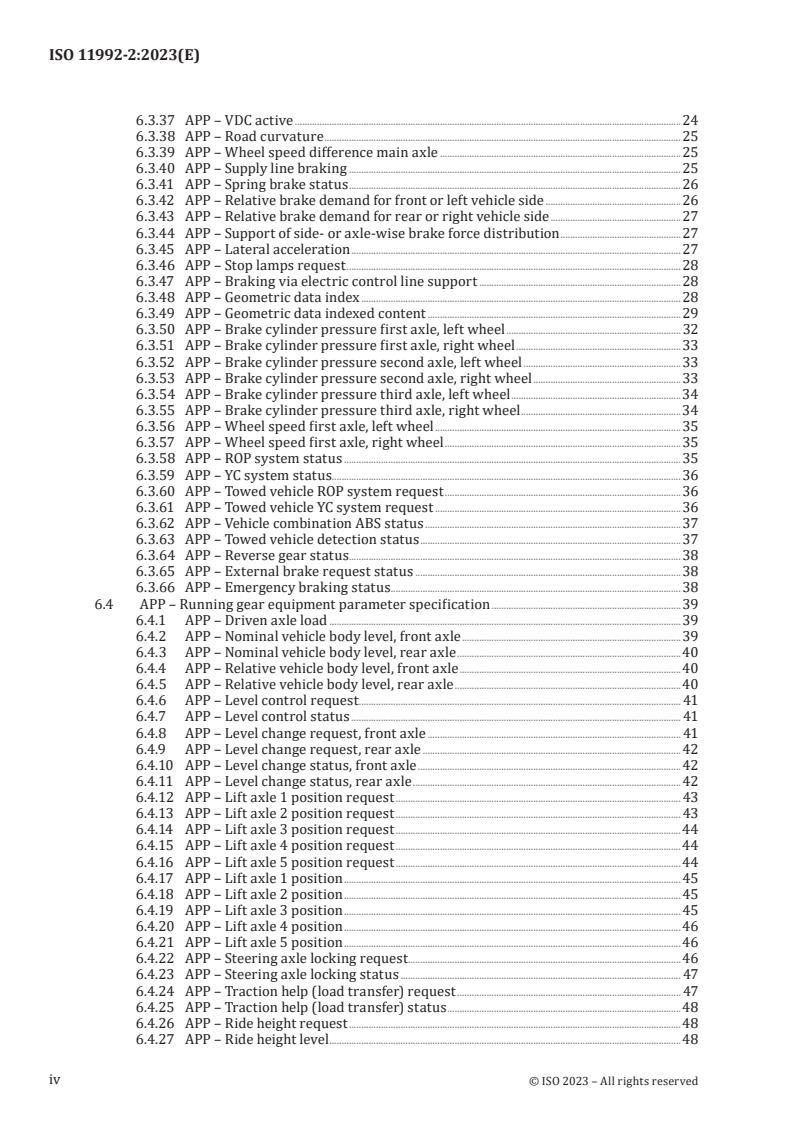
6.3.37 APP – VDC active . 24
6.3.38 APP – Road curvature . 25
6.3.39 APP – Wheel speed difference main axle . 25
6.3.40 APP – Supply line braking . 25
6.3.41 APP – Spring brake status . 26
6.3.42 APP – Relative brake demand for front or left vehicle side .26
6.3.43 APP – Relative brake demand for rear or right vehicle side . 27
6.3.44 APP – Support of side- or axle-wise brake force distribution . 27
6.3.45 APP – Lateral acceleration . 27
6.3.46 APP – Stop lamps request .28
6.3.47 APP – Braking via electric control line support .28
6.3.48 APP – Geometric data index .28
6.3.49 APP – Geometric data indexed content .29
6.3.50 APP – Brake cylinder pressure first axle, left wheel . 32
6.3.51 APP – Brake cylinder pressure first axle, right wheel . 33
6.3.52 APP – Brake cylinder pressure second axle, left wheel .33
6.3.53 APP – Brake cylinder pressure second axle, right wheel .33
6.3.54 APP – Brake cylinder pressure third axle, left wheel .34
6.3.55 APP – Brake cylinder pressure third axle, right wheel .34
6.3.56 APP – Wheel speed first axle, left wheel . 35
6.3.57 APP – Wheel speed first axle, right wheel . 35
6.3.58 APP – ROP system status . 35
6.3.59 APP – YC system status. 36
6.3.60 APP – Towed vehicle ROP system request .36
6.3.61 APP – Towed vehicle YC system request .36
6.3.62 APP – Vehicle combination ABS status . 37
6.3.63 APP – Towed vehicle detection status . 37
6.3.64 APP – Reverse gear status . .38
6.3.65 APP – External brake request status .38
6.3.66 APP – Emergency braking status .38
6.4 APP – Running gear equipment parameter specification .39
6.4.1 APP – Driven axle load . 39
6.4.2 APP – Nominal vehicle body level, front axle .39
6.4.3 APP – Nominal vehicle body level, rear axle .40
6.4.4 APP – Relative vehicle body level, front axle .40
6.4.5 APP – Relative vehicle body level, rear axle .40
6.4.6 APP – Level control request . 41
6.4.7 APP – Level control status . 41
6.4.8 APP – Level change request, front axle . 41
6.4.9 APP – Level change request, rear axle . 42
6.4.10 APP – Level change status, front axle . 42
6.4.11 APP – Level change status, rear axle . 42
6.4.12 APP – Lift axle 1 position request . 43
6.4.13 APP – Lift axle 2 position request . 43
6.4.14 APP – Lift axle 3 position request .44
6.4.15 APP – Lift axle 4 position request .44
6.4.16 APP – Lift axle 5 position request .44
6.4.17 APP – Lift axle 1 position . 45
6.4.18 APP – Lift axle 2 position . 45
6.4.19 APP – Lift axle 3 position . 45
6.4.20 APP – Lift axle 4 position .46
6.4.21 APP – Lift axle 5 position .46
6.4.22 APP – Steering axle locking request .46
6.4.23 APP – Steering axle locking status . 47
6.4.24 APP – Traction help (load transfer) request . 47
6.4.25 APP – Traction help (load transfer) status .48
6.4.26 APP – Ride height request .48
6.4.27 APP – Ride height level .48
iv
6.4.28 APP – Normal level .49
6.4.29 APP – Ramp level request .49
6.4.30 APP – Ramp level .49
6.4.31 APP – Ramp level position .50
6.4.32 APP – Ramp level storage request .50
6.4.33 APP – Ramp level storage status .50
6.4.34 APP – Stop level change request . 51
6.4.35 APP – Stop level change request acknowledge . 51
6.4.36 APP – Parking and towed vehicle air pressure . 51
6.4.37 APP – Auxiliary equipment supply pressure . 52
6.4.38 APP – Tyre pressure threshold detection . 52
6.4.39 APP – Air leakage detection . 53
6.4.40 APP – Tyre temperature . 53
6.4.41 APP – Tyre module power supply status .54
6.5 APP – Axle load parameter specification .54
6.5.1 APP – Axle load .54
6.5.2 APP – Axle load calibration data storage request .54
6.5.3 APP – Axle load calibration data storage status . 55
6.5.4 APP – Axle load measured by external scale. 55
6.5.5 APP – Axle load measured by towed vehicle .56
6.5.6 APP – Axle load calibration data load level .56
6.5.7 APP – Axle load calibration type . 57
6.5.8 APP – Maximum driven axle load . 57
6.6 Ride height parameter specification .58
6.6.1 APP – Extended ride height and ramp level storage .58
6.6.2 APP – Ride height and ramp level set request .58
6.6.3 APP – Ride height storage request .58
6.6.4 APP – Ride height storage . 59
6.6.5 APP – Neutral gear request . 59
6.6.6 APP – Rear obstacle distance . 59
6.6.7 APP – Immobilizer status .60
6.6.8 APP – Fifth wheel load .60
6.6.9 APP – Ambient air temperature . 61
6.6.10 APP – Parking brake status . 61
6.6.11 APP – Neutral gear status. 61
6.7 APP – Software update parameter specification . 61
6.7.1 APP – Vehicle software update request . 61
6.7.2 APP – Vehicle software update request acknowledgement . 62
7 APP – PG specification .62
7.1 APP – Overview of PGs . 62
7.2 APP – Message transmission in case of multiple towed vehicles .64
7.3 APP – Towing vehicle .64
7.3.1 APP – General specification .64
7.3.2 APP – General PGs, transmitted from the towing to the towed vehicle .65
7.3.3 APP – Electronic brake system PGs, transmitted from the towing to the
towed vehicle .65
7.3.4 APP – Running gear equipment PGs, transmitted from the towing to the
towed vehicle . 67
7.4 APP – Towed vehicle . 70
7.4.1 APP – General PGs, transmitted from the towed to the towing vehicle . 70
7.4.2 APP – Electronic brake system PGs, transmitted from the towed to the
towing vehicle . 70
7.4.3 APP – Running gear equipment PGs, transmitted from towed to towing
vehicle . 75
8 APP – Address assignment .78
8.1 APP – General requirements . 78
8.2 APP – Road train configuration . 79
v
8.3 APP – Address assignment method of a towing and towed vehicle .79
8.4 APP – Vehicle node capabilities .80
9 SI – Service interface definition between application and OSI layers .82
9.1 SI – A_Data.req, A_Data.ind, and A_Data.con service interface .82
9.2 SI – A_Data.req, A_Data.ind, and A_Data.con service interface parameter mapping .82
9.3 SIP – Service interface data type definitions .83
10 AL – Application layer .83
10.1 AL – Message PDU format .83
10.2 AL – A_PDU specification .83
11 PL – Presentation layer .83
Annex A (normative) Geometric dimensions .84
Annex B (normative) Software update request and acknowledge interaction between
towing and towed vehicles .90
Annex C (informative) Message flow .99
Bibliography . 103
vi
Foreword
ISO (the International Organization for Standardization) is a worldwide federation of national standards
bodies (ISO member bodies). The work of preparing International Standards is normally carried out
through ISO technical committees. Each member body interested in a subject for which a technical
committee has been established has the right to be represented on that committee. International
organizations, governmental and non-governmental, in liaison with ISO, also take part in the work.
ISO collaborates closely with the International Electrotechnical Commission (IEC) on all matters of
electrotechnical standardization.
The procedures used to develop this document and those intended for its further maintenance are
described in the ISO/IEC Directives, Part 1. In particular, the different approval criteria needed for the
different types of ISO documents should be noted. This document was drafted in accordance with the
editorial rules of the ISO/IEC Directives, Part 2 (see www.iso.org/directives).
Attention is drawn to the possibility that some of the elements of this document may be the subject of
patent rights. ISO shall not be held responsible for identifying any or all such patent rights. Details of
any patent rights identified during the development of the document will be in the Introduction and/or
on the ISO list of patent declarations received (see www.iso.org/patents).
Any trade name used in this document is information given for the convenience of users and does not
constitute an endorsement.
For an explanation of the voluntary nature of standards, the meaning of ISO specific terms and
expressions related to conformity assessment, as well as information about ISO's adherence to
the World Trade Organization (WTO) principles in the Technical Barriers to Trade (TBT), see
www.iso.org/iso/foreword.html.
This document was prepared by Technical Committee ISO/TC 22, Road vehicles, Subcommittee SC 31,
Data communication.
This fourth edition cancels and replaces the third edition (ISO 11992-2:2014), which has been
technically revised.
The main changes are as follows:
— introduced requirements structure;
— added new parameter specifications;
— added new message definitions;
— updated all figures.
A list of all parts in the ISO 11992 series can be found on the ISO website.
Any feedback or questions on this document should be directed to the user’s national standards body. A
complete listing of these bodies can be found at www.iso.org/members.html.
vii
Introduction
The ISO 11992 series specifies the interchange of digital information between road vehicles with a
maximum authorised total mass greater than 3 500 kg, and towed vehicles, including communication
between towed vehicles in terms of parameters and requirements of the lower OSI layers (physical and
data link layer) of the electrical connection used to connect the electrical and electronic systems.
This document is structured according to the Open Systems Interconnection (OSI) Basic Reference
Model, in accordance with ISO/IEC 7498-1 and ISO/IEC 10731, which structures communication
systems into seven layers. When mapped on this model, the application layer protocol and data link
layer framework requirements specified/referenced in the ISO 11992 series standard are structured
according to Figure 1.
Figure 1 illustrates a simplified communication framework:
— vehicle normal communication framework,
— vehicle diagnostic communication framework,
— vehicle-specific use case framework, and
— vehicle lower-layers framework.
The vehicle normal communication framework is composed of this document and ISO 11992-3.
The vehicle diagnostic communication framework is composed of ISO 14229-1, ISO 14229-2, ISO 14229-3
and ISO 11992-4.
The vehicle-specific use case framework is composed of ISO 11992-4, ISO 22901-1 or vehicle
manufacturer-specific diagnostic data definition.
viii
Figure 1 — Referenced documents according to the OSI model
ix
INTERNATIONAL STANDARD ISO 11992-2:2023(E)
Road vehicles — Interchange of digital information
on electrical connections between towing and towed
vehicles —
Part 2:
Application layer for brakes and running gear
1 Scope
This document specifies the SAE J1939-based application layer, the payload of messages, and parameter
groups for electronically controlled braking systems, including anti-lock braking systems (ABS), vehicle
dynamics control systems (VDC), and running gears equipment, to ensure the interchange of digital
information between road vehicles with a maximum authorized total mass greater than 3 500 kg and
their towed vehicles, including communication between towed vehicles.
Conformance and interoperability test plans are not part of this document.
2 Normative references
The following documents are referred to in the text in such a way that some or all of their content
constitutes requirements of this document. For dated references, only the edition cited applies. For
undated references, the latest edition of the referenced document (including any amendments) applies.
ISO 3779, Road vehicles — Vehicle identification number (VIN) — Content and structure
ISO 11992-1, Road vehicles — Interchange of digital information on electrical connections between towing
and towed vehicles — Part 1: Physical and data-link layers
ISO 11992-3:2021, Road vehicles — Interchange of digital information on electrical connections between
towing and towed vehicles — Part 3: Application layer for equipment other than brakes and running gear
ISO 80000-1, Quantities and units — Part 1: General
SAE J1939-21, Recommended Practice for a Serial Control and Communications Vehicle Network — Data
Link Layer
SAE J1939-71: Recommended Practice for a Serial Control and Communications Vehicle Network — Vehicle
Application Layer
SAE J1939-DA, Recommended Practice for a Serial Control and Communications Vehicle Network — J1939
Digital Annex
3 Terms and definitions
For the purposes of this document, the terms and definitions given in ISO 11992-1 and the following
apply.
ISO and IEC maintain terminology databases for use in standardization at the following addresses:
— ISO Online browsing platform: available at https:// www .iso .org/ obp
— IEC Electropedia: available at https:// www .electropedia .org/
3.1
ABS
anti-lock braking system
control function, which automatically modulates the pressure producing the braking forces at the
wheels to limit the degree of wheel slip, or a system that provides an anti-lock braking function
3.2
ASR
anti-spin regulation
control function, which automatically modulates the engine torque or the pressure producing the
braking forces at the wheels to limit the degree of wheel spin, or a system that provides an anti-spin
control
3.3
axle group
assembly of two or more consecutive axles considered together in determining their combined load
effect
3.4
centre-axle towed vehicle
towed vehicle (3.19) equipped with a rigid towing device, and in which the axle(s) is (are) positioned
close to the centre of gravity of the vehicle
3.5
converter towed vehicle
dolly unit that couples to a semi towed vehicle (3.18) with a fifth-wheel coupling (3.8) and thereby
“converts” the semi towed vehicle to a full towed vehicle (3.9)
3.6
EBS
electronic braking system
braking system in, which control is generated and processed as an electrical signal in the control
transmission
3.7
ECU
electronic control unit
electronic item consisting of a combination of basic parts, subassemblies, and assemblies packaged
together as a physically independent entity
3.8
fifth-wheel coupling
link between a towing vehicle (3.22) and a towed vehicle (3.19), designed for towing a semi towed vehicle
(3.18)
3.9
full towed vehicle
towed vehicle (3.19) equipped with a towing device, which can move vertically (in relation to the towed
vehicle), and in which the axle(s) is (are) positioned farther from the centre of gravity of the vehicle
3.10
gateway
unit connecting different networks or parts of one network and performing any necessary protocol
translation
3.11
link towed vehicle
towed vehicle (3.19) with a fifth-wheel coupling (3.8), designed for towing a semi towed vehicle (3.18)
3.12
network segment
part of a network that is within the domain of a single link layer
3.13
node
device capable of sending or receiving data whose identification will be unambiguous for authentication
purposes
3.14
RGE
running rear equipment
equipment of a vehicle, including steering, suspension, and tyres
3.15
road train
combination of towing vehicle (3.22) and towed vehicles (3.19) connected via a communication link
3.16
road train session number
randomised number that is used to identify a set of vehicles that are connected via a communication
link with their ECUs (3.7) powered up
3.17
ROP
roll-over prevention
roll-over protection
control function to prevent roll-over situations of a vehicle
Note 1 to entry: ROP is part of a VDC (3.23) function.
3.18
semi towed vehicle
towed vehicle (3.19), which is designed to be coupled to a semi towed vehicle towing vehicle and to
impose a substantial part of its total weight on the towing vehicle (3.22)
3.19
towed vehicle
non-power-driven road vehicle, which, on account of its design and appointments, is used to transport
persons or goods and is intended to be towed by a motor vehicle
3.20
towing full towed vehicle
towed vehicle (3.19) equipped with a towing device, which can move vertically (in relation to the towed
vehicle), and in which the axle(s) is (are) positioned less close to the centre of gravity of the vehicle that
is capable of towing another vehicle
3.21
towing semi towed vehicle
towed vehicle (3.19), which is designed to be coupled to a semi towed vehicle towing vehicle and
to impose a substantial part of its total weight on the towing vehicle (3.22) that is capable of towing
another vehicle
3.22
towing vehicle
motor vehicle or non-power-driven vehicle, which tows a succeeding vehicle
3.23
VDC
vehicle dynamic control
control function as part of the braking system that reacts to stabilize the vehicle during dynamic
manoeuvres
Note 1 to entry: VDC has the possible sub-functions ROP (3.18) and YC (3.25).
3.24
wheel base
horizontal distance between the centres of the front axle group (3.3) and rear axle group
3.25
YC
yaw control
control function to reduce an unwanted lateral movement of a vehicle
Note 1 to entry: Yaw control is part of a VDC (3.23) function.
4 Symbols and abbreviated terms
4.1 Symbols
p position number of axle
axle number
— empty table cell or feature undefined
4.2 Abbreviated terms
ABS anti-lock braking system
AI address information
ASR anti-spin regulation
Cvt convention
CAN controller area network
DA destination address
DLC data length code
DP data page
EDP extended data page
GE group extension
LSb least significant bit
LSB least significant byte
MSb most significant bit
MSB most significant byte
Msg message
P priority
PDU protocol data unit
PF PDU format
PG parameter group
PGN parameter group number
PS PDU specific
ROP roll-over prevention/protection
SA source address
TA target address
TOS type of service
UTC universal time coordinate
VDC vehicle dynamic control
XBR external brake request
YC yaw control
5 Conventions
This document is based on OSI service conventions as specified in ISO/IEC 10731.
6 APP – Parameter specification
6.1 General definitions
Parameter ranges are of 1-byte, 2-byte, and 4-byte in size. Discrete and control request parameters are
coded as 2-bit values.
REQ 8.1 APP – Parameter specification – General definitions
Interpretation of suspect parameter values shall be followed according to SAE J1939-71, unless otherwise spec-
ified in this document.
The data parameter attributes are composed of data length, resolution, offset, data range, operating
range and type.
The type of data parameters is either control request or measured status.
— Control request data specifies a command requesting an action to be performed by the receiving
node. Examples of control request-type data are “service brake demand value” and “ride height
request”.
— Measured status data conveys the current value of a parameter as measured or observed by the
transmitting node to determine the condition of the defined parameter. Examples of measured-
type data are “wheel-based vehicle speed” and “lift axle 1 position”. A measured-type parameter
can indicate the condition of the defined parameter, even if no measurement has been taken. For
example, the measured-type parameter can indicate that a solenoid has been activated, even if no
measurement has been taken to ensure the solenoid accomplished its function.
Table 1 defines the parameter attributes.
Table 1 — Attribute definition
Attribute Definition
data length required number of bits/bytes of the parameter
resolution weight of a bit in physical unit
offset value of the binary value 0 (zero) in physical unit
data range physical range of data that the parameter is able to hold
operating range physical range of data that can be used
type type of data, for example, measured or control request
6.2 APP – Identification p
...