


ISO 16924:2026
(Main)Natural gas fuelling stations — Liquefied natural gas (LNG) stations for fuelling road vehicles
Natural gas fuelling stations — Liquefied natural gas (LNG) stations for fuelling road vehicles
This document specifies requirements for the design, construction, operation, maintenance and inspection of stations for fuelling liquefied natural gas (LNG) to vehicles, including equipment, safety and control devices. This document also specifies the design, construction, operation, maintenance and inspection of fuelling stations using LNG as an onsite source for supplying compressed natural gas (CNG) to vehicles, commonly referred to as liquefied-to-compressed natural gas (LCNG) fuelling stations, including safety and control devices of the station and specific LCNG fuelling station equipment. NOTE Specific CNG equipment is dealt with in ISO 16923. This document is applicable to fuelling stations receiving LNG and other liquefied methane-rich gases such as bio LNG which comply with local applicable gas composition regulations or with the gas quality requirements of ISO 13686. This document covers all equipment from the LNG storage tank unloading connection up to (but not including) the fuelling nozzle on the vehicle. The LNG storage tank unloading connection itself and the vehicle fuelling nozzle are not covered in this document. This document applies to fuelling stations having the following characteristics: private access; public access (self-service or assisted); metered dispensing and non-metered dispensing; fuelling stations with fixed LNG storage; fuelling stations with mobile LNG storage; movable fuelling stations; mobile fuelling stations; multi-fuel stations. This document does not apply to: equipment, piping, or tubing downstream of the gas pressure regulator for closed boil-off gas systems; liquefaction equipment.
Stations-service de gaz naturel — Stations de gaz naturel liquéfié (GNL) pour le ravitaillement de véhicules routiers
Le présent document spécifie les exigences relatives à la conception, la construction, l'exploitation, la maintenance et l'inspection des stations-service de gaz naturel liquéfié (GNL) pour véhicules, y compris les équipements et les dispositifs de sécurité et de contrôle. Le présent document spécifie également la conception, la construction, l'exploitation, la maintenance et l'inspection des stations-service utilisant du GNL servant de site de ravitaillement des véhicules en gaz naturel comprimé (GNC), communément appelées stations-service de gaz naturel liquéfié/comprimé (GNLC), y compris les dispositifs de sécurité et de contrôle des stations et les équipements propres aux stations-service GNLC. NOTE Les équipements propres aux stations de GNC sont couverts par l'ISO 16923. Le présent document s'applique aux stations-service ravitaillées en GNL et autres gaz liquéfiés riches en méthane, comme le bio GNL, conformes aux réglementations locales applicables aux compositions gazeuses ou aux exigences en matière de qualité des gaz de l'ISO 13686. Le présent document couvre tous les équipements, du connecteur pour le dépotage de GNL dans le réservoir de stockage GNL (mais sans inclure) au pistolet de ravitaillement destiné aux réservoirs des véhicules. Le raccord de dépotage du réservoir et le pistolet de ravitaillement des véhicules à proprement dits ne sont pas couverts par le présent document. Le présent document s'applique à toutes les stations-service présentant les caractéristiques suivantes: accès privé; accès public (self-service ou avec assistance);borne de distribution de carburant avec ou sans compteur; stations-service avec stockage de GNL fixe; stations-service avec stockage mobile de GNL; stations-service déplaçables; stations-service mobiles; stations-service multi-carburants. Le présent document ne s'applique pas: à l'équipement, aux canalisations ou aux conduites en aval du régulateur de pression de gaz pour les systèmes de gaz d'évaporation fermés; à l'équipement de liquéfaction.
General Information
- Status
- Published
- Publication Date
- 15-Jan-2026
- Technical Committee
- ISO/TC 340 - ISO/TC 340
- Drafting Committee
- ISO/TC 340 - ISO/TC 340
- Current Stage
- 6060 - International Standard published
- Start Date
- 16-Jan-2026
- Due Date
- 25-Oct-2025
- Completion Date
- 16-Jan-2026
Relations
- Effective Date
- 12-Feb-2026
- Consolidates
ISO 16844-2:2022 - Road vehicles — Tachograph systems — Part 2: Recording unit communication interface - Effective Date
- 05-Nov-2022
- Effective Date
- 29-Oct-2022
Overview
ISO 16924:2026 sets out comprehensive requirements for the design, construction, operation, maintenance, and inspection of liquefied natural gas (LNG) fuelling stations intended for road vehicles. This international standard also addresses stations that use LNG as an onsite source to supply compressed natural gas (CNG) to vehicles, known as liquefied-to-compressed natural gas (LCNG) fuelling stations. The standard covers all critical equipment and safety requirements from the LNG storage tank unloading connection up to, but not including, the vehicle fuelling nozzle. It applies to a range of station configurations, including private and public access, fixed and mobile LNG storage, movable stations, and multi-fuel stations.
By specifying best practices and mandatory safety measures, ISO 16924:2026 promotes the safe, efficient, and environmentally responsible delivery of LNG and LCNG to road vehicles. This is essential for supporting the global adoption of natural gas vehicles (NGVs) and helping stakeholders meet regulatory and market expectations.
Key Topics
ISO 16924:2026 encompasses a wide scope of requirements and recommendations, including:
- Design and Construction: Guidance for site layout, separation distances, civil works, environmental considerations such as noise and gas venting, and installation of equipment.
- Safety and Risk Management: Risk assessment procedures, fire protection measures, emergency shut-down (ESD) systems, equipment compatibility, and personnel safety protocols.
- Operational Procedures: Receiving and handling LNG deliveries, tanker unloading, fuelling procedures, signage, safety labeling, and training requirements.
- Equipment Specifications: Detailed requirements for LNG and LCNG dispensers, storage vessels, pumps, compressors, vaporizers, heaters, pipework, and electrical systems.
- Testing and Commissioning: Methods for electrical and pressure testing, leak testing, purging, functional testing, and first filling of storage tanks.
- Inspection and Maintenance: Regular inspection protocols, preventive and corrective maintenance planning, and guidelines for the maintenance of safety systems.
Applications
This standard is relevant to a variety of practical applications in the growing market for natural gas-driven transportation:
- Fuel Retailers and Station Operators: Ensuring LNG and LCNG fuelling station projects comply with internationally recognized safety, performance, and environmental standards.
- Design and Engineering Firms: Applying consistent criteria during the planning, engineering, and installation phases of station projects, for both new builds and retrofits.
- Fleet Operators and Logistics Companies: Supporting safe and reliable refuelling infrastructure for heavy-duty vehicles and commercial fleets using LNG or LCNG as alternative fuels.
- Regulators and Inspectors: Establishing a recognized reference for auditing compliance and promoting public safety in the deployment of natural gas fuelling infrastructure.
- Equipment Manufacturers: Aligning product designs with stringent international requirements for pumps, tanks, dispensers, and control systems.
Related Standards
For effective implementation and compatibility, ISO 16924:2026 should be used in conjunction with related standards, including:
- ISO 16923: Natural gas fuelling stations - CNG stations for fuelling vehicles (specific CNG equipment)
- ISO 13686: Natural gas - Quality designation (gas composition and quality requirements)
- Additional relevant ISO and national regulations covering LNG transport, storage, and handling
Summary
ISO 16924:2026 delivers a robust framework for safe, efficient, and compliant development and operation of LNG and LCNG fuelling stations serving road vehicles. By following its requirements, stakeholders in the natural gas vehicle sector can foster operational excellence, meet safety and environmental obligations, and support wider adoption of clean fuel technologies. This international standard is an essential resource for anyone involved in the design, construction, regulation, or operation of natural gas fuelling infrastructure.
Buy Documents
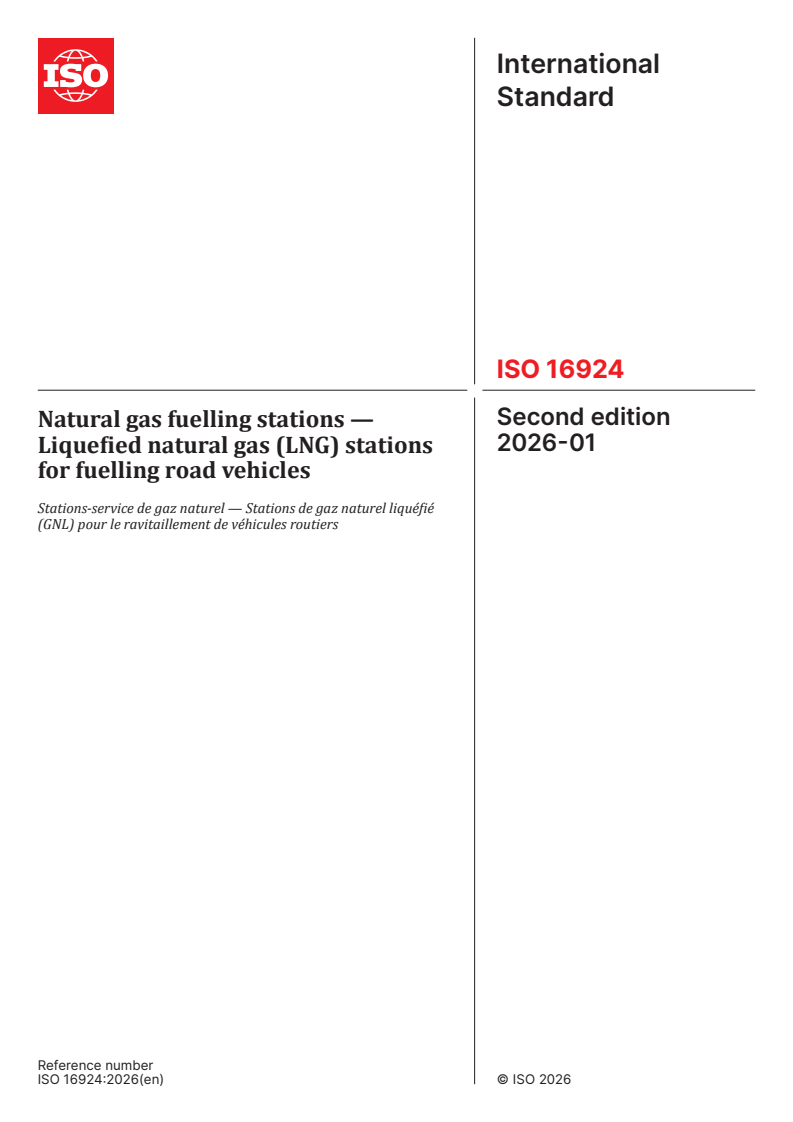

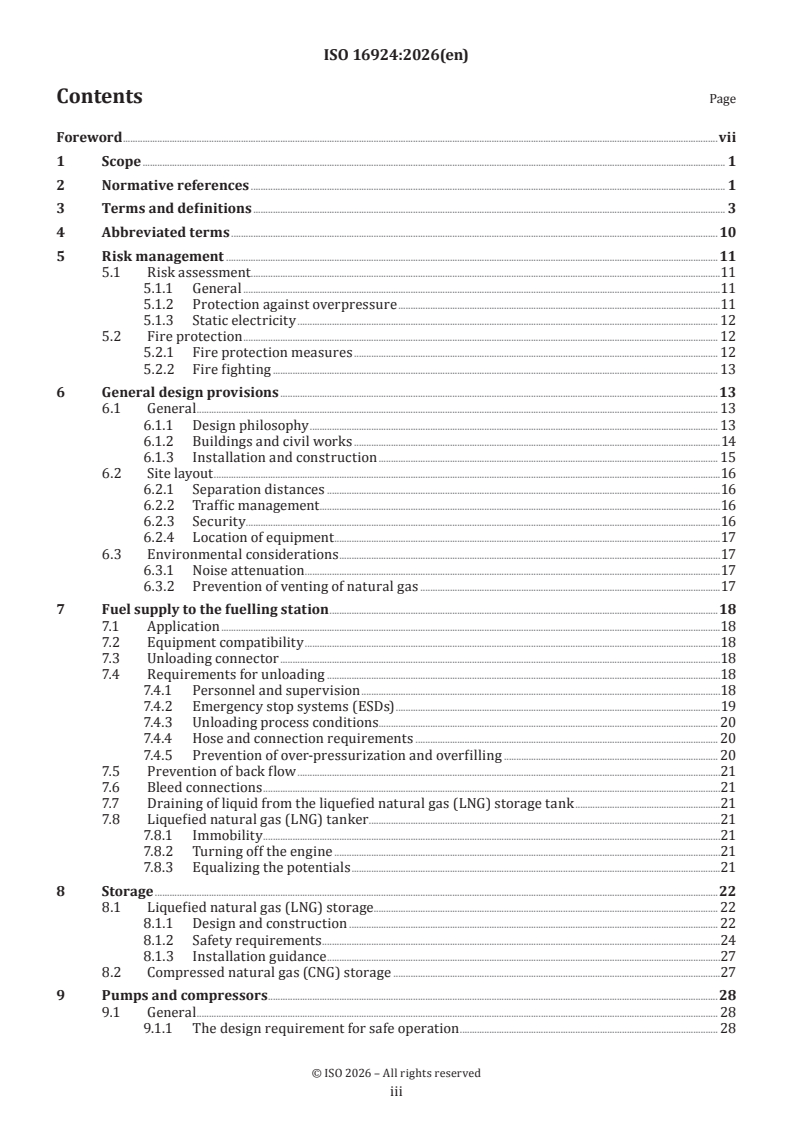
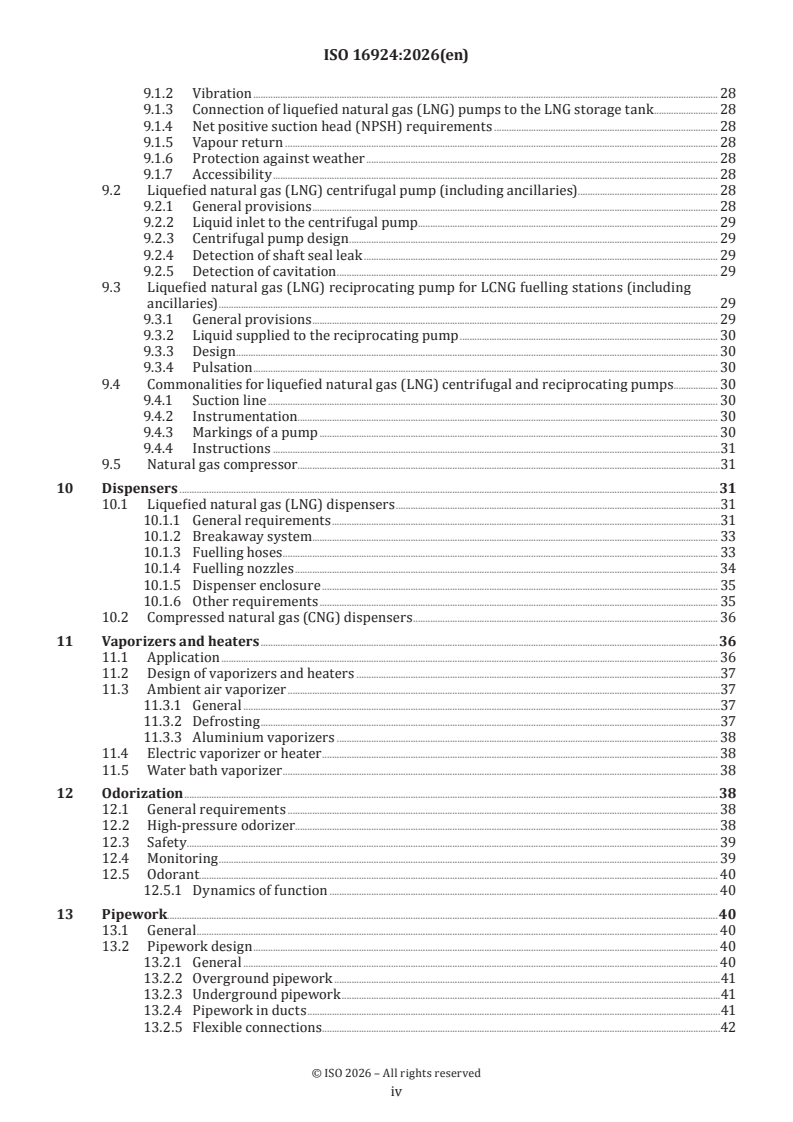
ISO 16924:2026 - Natural gas fuelling stations — Liquefied natural gas (LNG) stations for fuelling road vehicles Released:16. 01. 2026
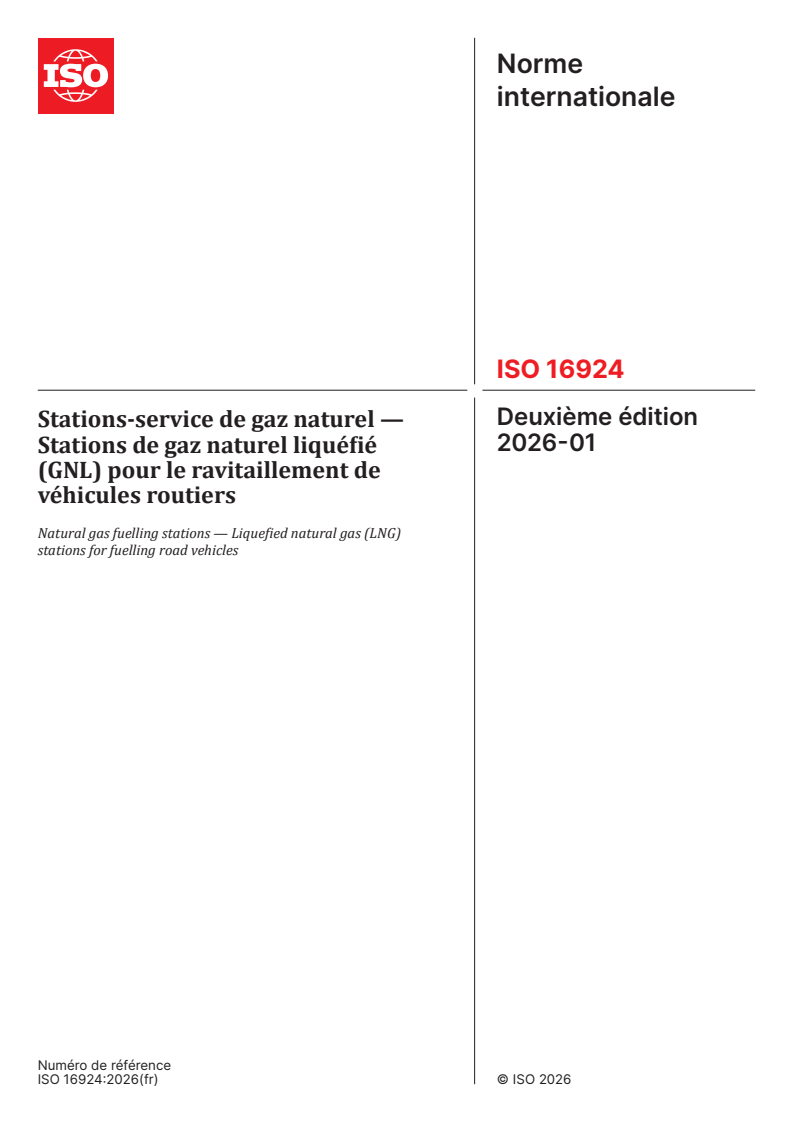
ISO 16924:2026 - Stations-service de gaz naturel — Stations de gaz naturel liquéfié (GNL) pour le ravitaillement de véhicules routiers Released:16. 01. 2026
Get Certified
Connect with accredited certification bodies for this standard

Element Materials Technology
Materials testing and product certification.

ABS Group Brazil
ABS Group certification services in Brazil.

ABS Quality Evaluations Inc.
American Bureau of Shipping quality certification.
Sponsored listings
Frequently Asked Questions
ISO 16924:2026 is a standard published by the International Organization for Standardization (ISO). Its full title is "Natural gas fuelling stations — Liquefied natural gas (LNG) stations for fuelling road vehicles". This standard covers: This document specifies requirements for the design, construction, operation, maintenance and inspection of stations for fuelling liquefied natural gas (LNG) to vehicles, including equipment, safety and control devices. This document also specifies the design, construction, operation, maintenance and inspection of fuelling stations using LNG as an onsite source for supplying compressed natural gas (CNG) to vehicles, commonly referred to as liquefied-to-compressed natural gas (LCNG) fuelling stations, including safety and control devices of the station and specific LCNG fuelling station equipment. NOTE Specific CNG equipment is dealt with in ISO 16923. This document is applicable to fuelling stations receiving LNG and other liquefied methane-rich gases such as bio LNG which comply with local applicable gas composition regulations or with the gas quality requirements of ISO 13686. This document covers all equipment from the LNG storage tank unloading connection up to (but not including) the fuelling nozzle on the vehicle. The LNG storage tank unloading connection itself and the vehicle fuelling nozzle are not covered in this document. This document applies to fuelling stations having the following characteristics: private access; public access (self-service or assisted); metered dispensing and non-metered dispensing; fuelling stations with fixed LNG storage; fuelling stations with mobile LNG storage; movable fuelling stations; mobile fuelling stations; multi-fuel stations. This document does not apply to: equipment, piping, or tubing downstream of the gas pressure regulator for closed boil-off gas systems; liquefaction equipment.
This document specifies requirements for the design, construction, operation, maintenance and inspection of stations for fuelling liquefied natural gas (LNG) to vehicles, including equipment, safety and control devices. This document also specifies the design, construction, operation, maintenance and inspection of fuelling stations using LNG as an onsite source for supplying compressed natural gas (CNG) to vehicles, commonly referred to as liquefied-to-compressed natural gas (LCNG) fuelling stations, including safety and control devices of the station and specific LCNG fuelling station equipment. NOTE Specific CNG equipment is dealt with in ISO 16923. This document is applicable to fuelling stations receiving LNG and other liquefied methane-rich gases such as bio LNG which comply with local applicable gas composition regulations or with the gas quality requirements of ISO 13686. This document covers all equipment from the LNG storage tank unloading connection up to (but not including) the fuelling nozzle on the vehicle. The LNG storage tank unloading connection itself and the vehicle fuelling nozzle are not covered in this document. This document applies to fuelling stations having the following characteristics: private access; public access (self-service or assisted); metered dispensing and non-metered dispensing; fuelling stations with fixed LNG storage; fuelling stations with mobile LNG storage; movable fuelling stations; mobile fuelling stations; multi-fuel stations. This document does not apply to: equipment, piping, or tubing downstream of the gas pressure regulator for closed boil-off gas systems; liquefaction equipment.
ISO 16924:2026 is classified under the following ICS (International Classification for Standards) categories: 75.200 - Petroleum products and natural gas handling equipment. The ICS classification helps identify the subject area and facilitates finding related standards.
ISO 16924:2026 has the following relationships with other standards: It is inter standard links to EN ISO 16924:2026, ISO 16844-2:2022, ISO 16924:2016. Understanding these relationships helps ensure you are using the most current and applicable version of the standard.
ISO 16924:2026 is available in PDF format for immediate download after purchase. The document can be added to your cart and obtained through the secure checkout process. Digital delivery ensures instant access to the complete standard document.
Standards Content (Sample)
International
Standard
ISO 16924
Second edition
Natural gas fuelling stations —
2026-01
Liquefied natural gas (LNG) stations
for fuelling road vehicles
Stations-service de gaz naturel — Stations de gaz naturel liquéfié
(GNL) pour le ravitaillement de véhicules routiers
Reference number
© ISO 2026
All rights reserved. Unless otherwise specified, or required in the context of its implementation, no part of this publication may
be reproduced or utilized otherwise in any form or by any means, electronic or mechanical, including photocopying, or posting on
the internet or an intranet, without prior written permission. Permission can be requested from either ISO at the address below
or ISO’s member body in the country of the requester.
ISO copyright office
CP 401 • Ch. de Blandonnet 8
CH-1214 Vernier, Geneva
Phone: +41 22 749 01 11
Email: copyright@iso.org
Website: www.iso.org
Published in Switzerland
ii
Contents Page
Foreword .vii
1 Scope . 1
2 Normative references . 1
3 Terms and definitions . 3
4 Abbreviated terms . 10
5 Risk management .11
5.1 Risk assessment .11
5.1.1 General .11
5.1.2 Protection against overpressure .11
5.1.3 Static electricity . 12
5.2 Fire protection . 12
5.2.1 Fire protection measures . 12
5.2.2 Fire fighting . 13
6 General design provisions .13
6.1 General . 13
6.1.1 Design philosophy . 13
6.1.2 Buildings and civil works .14
6.1.3 Installation and construction . 15
6.2 Site layout .16
6.2.1 Separation distances .16
6.2.2 Traffic management . .16
6.2.3 Security . .16
6.2.4 Location of equipment .17
6.3 Environmental considerations .17
6.3.1 Noise attenuation .17
6.3.2 Prevention of venting of natural gas .17
7 Fuel supply to the fuelling station .18
7.1 Application .18
7.2 Equipment compatibility .18
7.3 Unloading connector .18
7.4 Requirements for unloading .18
7.4.1 Personnel and supervision .18
7.4.2 Emergency stop systems (ESDs) .19
7.4.3 Unloading process conditions. 20
7.4.4 Hose and connection requirements . 20
7.4.5 Prevention of over-pressurization and overfilling . 20
7.5 Prevention of back flow .21
7.6 Bleed connections .21
7.7 Draining of liquid from the liquefied natural gas (LNG) storage tank .21
7.8 Liquefied natural gas (LNG) tanker .21
7.8.1 Immobility . .21
7.8.2 Turning off the engine .21
7.8.3 Equalizing the potentials .21
8 Storage .22
8.1 Liquefied natural gas (LNG) storage . . 22
8.1.1 Design and construction . 22
8.1.2 Safety requirements .24
8.1.3 Installation guidance .27
8.2 Compressed natural gas (CNG) storage .27
9 Pumps and compressors .28
9.1 General . 28
9.1.1 The design requirement for safe operation . 28
iii
9.1.2 Vibration . 28
9.1.3 Connection of liquefied natural gas (LNG) pumps to the LNG storage tank . 28
9.1.4 Net positive suction head (NPSH) requirements . 28
9.1.5 Vapour return . 28
9.1.6 Protection against weather . 28
9.1.7 Accessibility . 28
9.2 Liquefied natural gas (LNG) centrifugal pump (including ancillaries) . 28
9.2.1 General provisions . 28
9.2.2 Liquid inlet to the centrifugal pump . 29
9.2.3 Centrifugal pump design . 29
9.2.4 Detection of shaft seal leak . 29
9.2.5 Detection of cavitation . 29
9.3 Liquefied natural gas (LNG) reciprocating pump for LCNG fuelling stations (including
ancillaries) . 29
9.3.1 General provisions . 29
9.3.2 Liquid supplied to the reciprocating pump . 30
9.3.3 Design . 30
9.3.4 Pulsation . 30
9.4 Commonalities for liquefied natural gas (LNG) centrifugal and reciprocating pumps . . 30
9.4.1 Suction line . 30
9.4.2 Instrumentation. 30
9.4.3 Markings of a pump . 30
9.4.4 Instructions .31
9.5 Natural gas compressor.31
10 Dispensers .31
10.1 Liquefied natural gas (LNG) dispensers .31
10.1.1 General requirements .31
10.1.2 Breakaway system . . 33
10.1.3 Fuelling hoses . 33
10.1.4 Fuelling nozzles . 34
10.1.5 Dispenser enclosure . 35
10.1.6 Other requirements . 35
10.2 Compressed natural gas (CNG) dispensers . 36
11 Vaporizers and heaters .36
11.1 Application . 36
11.2 Design of vaporizers and heaters .37
11.3 Ambient air vaporizer .37
11.3.1 General .37
11.3.2 Defrosting .37
11.3.3 Aluminium vaporizers . 38
11.4 Electric vaporizer or heater . 38
11.5 Water bath vaporizer . 38
12 Odorization .38
12.1 General requirements . 38
12.2 High-pressure odorizer. 38
12.3 Safety. 39
12.4 Monitoring . 39
12.5 Odorant. 40
12.5.1 Dynamics of function . 40
13 Pipework.40
13.1 General . 40
13.2 Pipework design . 40
13.2.1 General . 40
13.2.2 Overground pipework .41
13.2.3 Underground pipework .41
13.2.4 Pipework in ducts .41
13.2.5 Flexible connections . . .42
iv
14 Electrical equipment and wiring .42
14.1 General .42
14.2 Main considerations.42
14.2.1 Grounding .42
14.2.2 Lightning .42
14.2.3 Contact with live parts . . .42
14.2.4 Cables . .42
14.2.5 Static electricity .43
14.3 Other considerations .43
14.3.1 Interface .43
14.3.2 Primary seal .43
14.3.3 Additional seal .43
14.3.4 Conduit seals .43
14.3.5 Detection vents . 44
15 Instrumentation and control system .44
15.1 General . 44
15.2 Gas detectors . 44
15.3 Flame detectors . 44
15.4 Pressure gauges . 44
15.5 Temperature sensors . 44
15.6 Manual emergency shutdown devices . 44
15.7 Uninterruptible power supply unit (UPS) .45
16 Emergency shutdown .45
16.1 Application .45
16.2 Procedure .45
16.3 Activation .45
16.4 Emergency shut-down (ESD) action . 46
16.5 Reset . 46
17 Special configurations .46
17.1 Movable liquefied natural gas (LNG) fuelling station . . 46
17.1.1 General requirements . 46
17.1.2 Anchoring . 46
17.1.3 Containment .47
17.1.4 Configurations .47
17.2 Mobile liquefied natural gas (LNG) fuelling station .47
17.2.1 General requirements .47
17.2.2 Anchoring .47
17.2.3 Containment .47
17.2.4 Design .47
17.2.5 Additional requirements for operation . 48
18 Testing and commissioning .48
18.1 Testing . 48
18.1.1 Electrical testing . 48
18.1.2 Pressure strength testing . 48
18.1.3 Leak testing. 49
18.2 Commissioning . 49
18.2.1 General provisions . 49
18.2.2 Purging . 49
18.2.3 Functional testing . 49
18.2.4 First filling of the liquefied natural gas (LNG) storage tank and other
components . 50
19 Operations .50
19.1 Liquefied natural gas (LNG) tanker unloading . 50
19.2 Fuelling procedure . 50
19.3 Safety signs . 50
19.3.1 General on identification labels . 50
v
19.3.2 Equipment marking .51
19.4 Equipment and pipework identification .52
19.5 Training .52
19.6 Installation and operating instructions .52
19.7 Emergency plan . 53
19.8 Maintaining the emergency shutdown (ESD) . 53
20 Inspection and maintenance .53
20.1 Inspection . 53
20.1.1 General requirements . 53
20.1.2 Inspection and testing of electrical systems . 54
20.1.3 Inspection and re-testing of the safety relief valves . 54
20.1.4 Safety and fire protection equipment . 55
20.2 Maintenance . 55
20.2.1 Preventive maintenance planning . 55
20.2.2 Maintenance procedures. 56
20.2.3 Maintenance safety . 56
20.2.4 Draining of the liquefied natural gas (LNG) storage tank . 56
Annex A (informative) Examples of hazardous zones classification .57
Annex B (normative) Separation distances . 61
Annex C (informative) Example flow diagram of a liquefied natural gas (LNG) fuelling station .65
Annex D (informative) Example flow diagram of a liquefied-to-compressed natural gas (LCNG)
fuelling station .66
Annex E (informative) Example flow diagram of a liquefied natural gas (LNG) and liquefied-to-
compressed natural gas (LCNG) fuelling station . 67
Annex F (informative) Process requirements for the effective cryogenic pump operation .70
Annex G (informative) Recommendations for installation of a centrifugal pump .71
Annex H (informative) Recommendations for centrifugal pump design .73
Annex I (informative) Recommendations for installation of a reciprocating pump . 74
Annex J (informative) Recommendations on the content of the cryogenic pump operation
instructions .77
Annex K (informative) Liquefied natural gas (LNG) identification mark of an LNG fuelling
station .79
Annex L (informative) Explosion-proof static grounding control system .80
Bibliography .81
vi
Foreword
ISO (the International Organization for Standardization) is a worldwide federation of national standards
bodies (ISO member bodies). The work of preparing International Standards is normally carried out through
ISO technical committees. Each member body interested in a subject for which a technical committee
has been established has the right to be represented on that committee. International organizations,
governmental and non-governmental, in liaison with ISO, also take part in the work. ISO collaborates closely
with the International Electrotechnical Commission (IEC) on all matters of electrotechnical standardization.
The procedures used to develop this document and those intended for its further maintenance are described
in the ISO/IEC Directives, Part 1. In particular, the different approval criteria needed for the different types
of ISO document should be noted. This document was drafted in accordance with the editorial rules of the
ISO/IEC Directives, Part 2 (see www.iso.org/directives).
ISO draws attention to the possibility that the implementation of this document may involve the use of (a)
patent(s). ISO takes no position concerning the evidence, validity or applicability of any claimed patent
rights in respect thereof. As of the date of publication of this document, ISO had not received notice of (a)
patent(s) which may be required to implement this document. However, implementers are cautioned that
this may not represent the latest information, which may be obtained from the patent database available at
www.iso.org/patents. ISO shall not be held responsible for identifying any or all such patent rights.
Any trade name used in this document is information given for the convenience of users and does not
constitute an endorsement.
For an explanation of the voluntary nature of standards, the meaning of ISO specific terms and expressions
related to conformity assessment, as well as information about ISO's adherence to the World Trade
Organization (WTO) principles in the Technical Barriers to Trade (TBT), see www.iso.org/iso/foreword.html.
This document was prepared by Technical Committee ISO/TC 340, Natural gas fuelling stations, in
collaboration with the European Committee for Standardization (CEN) Technical Committee CEN/TC 326,
Natural gas vehicles – Fuelling and operation, in accordance with the Agreement on technical cooperation
between ISO and CEN (Vienna Agreement).
This second edition cancels and replaces the first edition (ISO 16924:2016), which has been technically
revised.
The main changes are as follows:
— revision of content based on operating experience and accident review, e.g. limited use of detachable
joints, use of fire-safe gaskets, use of gas detectors in critical areas;
— addition of requirements for the interface between the liquified natural gas (LNG) road tanker and LNG
fuelling station with reference to EN 17922 (LNG unloading stop system);
— addition of requirements for multi-fuel stations with reference to CEN-CENELEC GUIDE 38;
— addition of requirements to prohibit venting to the atmosphere;
— revision of Figures A.1 and A.2;
— deletion of Figure A.3;
— deletion of Annex K;
— addition of Annex L.
Any feedback or questions on this document should be directed to the user’s national standards body. A
complete listing of these bodies can be found at www.iso.org/members.html.
vii
International Standard ISO 16924:2026(en)
Natural gas fuelling stations — Liquefied natural gas (LNG)
stations for fuelling road vehicles
1 Scope
This document specifies requirements for the design, construction, operation, maintenance and inspection
of stations for fuelling liquefied natural gas (LNG) to vehicles, including equipment, safety and control
devices. This document also specifies the design, construction, operation, maintenance and inspection of
fuelling stations using LNG as an onsite source for supplying compressed natural gas (CNG) to vehicles,
commonly referred to as liquefied-to-compressed natural gas (LCNG) fuelling stations, including safety and
control devices of the station and specific LCNG fuelling station equipment.
NOTE Specific CNG equipment is dealt with in ISO 16923.
This document is applicable to fuelling stations receiving LNG and other liquefied methane-rich gases
such as bio LNG which comply with local applicable gas composition regulations or with the gas quality
requirements of ISO 13686.
This document covers all equipment from the LNG storage tank unloading connection up to (but not
including) the fuelling nozzle on the vehicle. The LNG storage tank unloading connection itself and the
vehicle fuelling nozzle are not covered in this document.
This document applies to fuelling stations having the following characteristics:
— private access;
— public access (self-service or assist
...
Norme
internationale
ISO 16924
Deuxième édition
Stations-service de gaz naturel —
2026-01
Stations de gaz naturel liquéfié
(GNL) pour le ravitaillement de
véhicules routiers
Natural gas fuelling stations — Liquefied natural gas (LNG)
stations for fuelling road vehicles
Numéro de référence
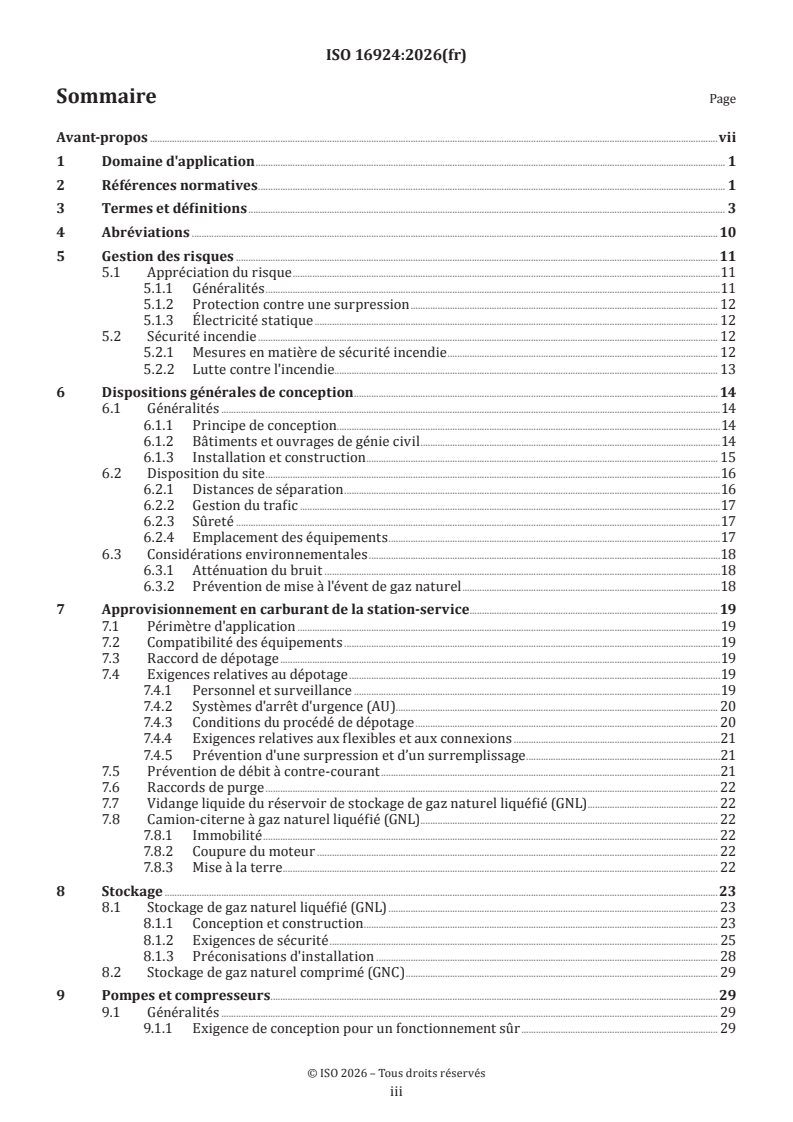
DOCUMENT PROTÉGÉ PAR COPYRIGHT
© ISO 2026
Tous droits réservés. Sauf prescription différente ou nécessité dans le contexte de sa mise en œuvre, aucune partie de cette
publication ne peut être reproduite ni utilisée sous quelque forme que ce soit et par aucun procédé, électronique ou mécanique,
y compris la photocopie, ou la diffusion sur l’internet ou sur un intranet, sans autorisation écrite préalable. Une autorisation peut
être demandée à l’ISO à l’adresse ci-après ou au comité membre de l’ISO dans le pays du demandeur.
ISO copyright office
Case postale 401 • Ch. de Blandonnet 8
CH-1214 Vernier, Genève
Tél.: +41 22 749 01 11
E-mail: copyright@iso.org
Web: www.iso.org
Publié en Suisse
ii
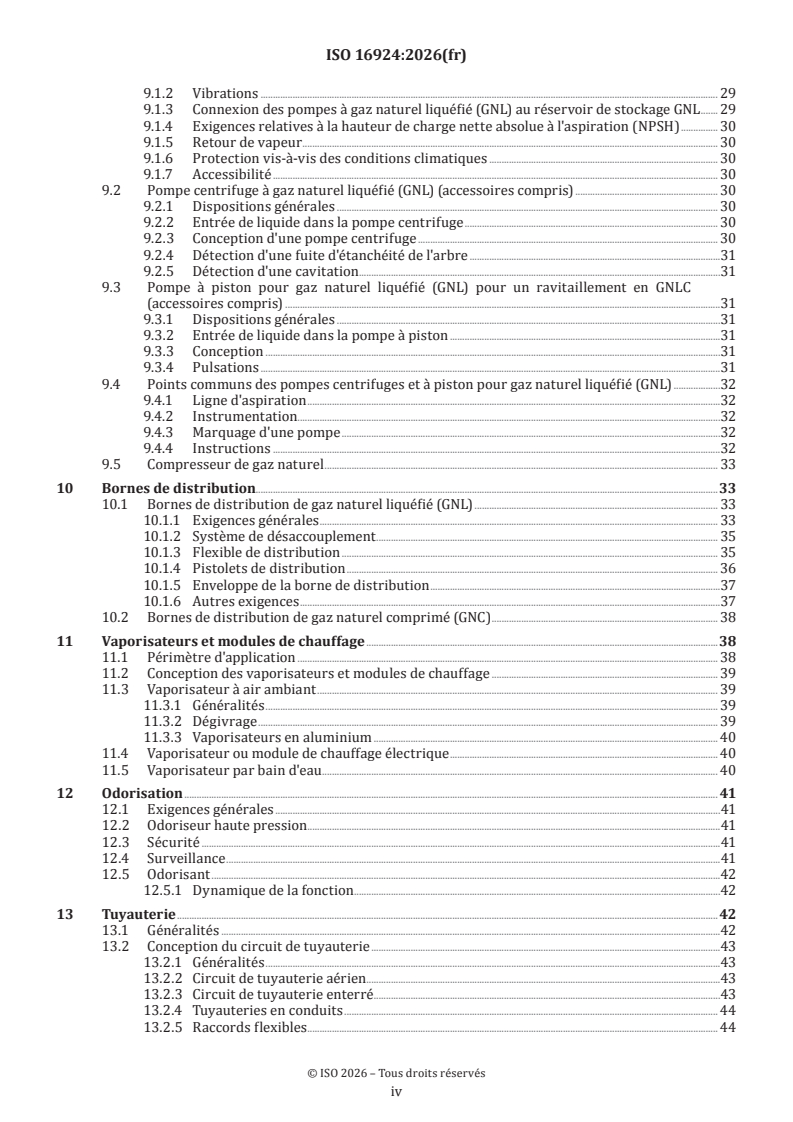
Sommaire Page
Avant-propos .vii
1 Domaine d'application . 1
2 Références normatives . 1
3 Termes et définitions . 3
4 Abréviations . 10
5 Gestion des risques .11
5.1 Appréciation du risque .11
5.1.1 Généralités .11
5.1.2 Protection contre une surpression . 12
5.1.3 Électricité statique . 12
5.2 Sécurité incendie . 12
5.2.1 Mesures en matière de sécurité incendie . 12
5.2.2 Lutte contre l'incendie. 13
6 Dispositions générales de conception . 14
6.1 Généralités .14
6.1.1 Principe de conception . . .14
6.1.2 Bâtiments et ouvrages de génie civil .14
6.1.3 Installation et construction . 15
6.2 Disposition du site .16
6.2.1 Distances de séparation .16
6.2.2 Gestion du trafic .17
6.2.3 Sûreté .17
6.2.4 Emplacement des équipements .17
6.3 Considérations environnementales .18
6.3.1 Atténuation du bruit .18
6.3.2 Prévention de mise à l'évent de gaz naturel .18
7 Approvisionnement en carburant de la station-service . 19
7.1 Périmètre d'application .19
7.2 Compatibilité des équipements .19
7.3 Raccord de dépotage .19
7.4 Exigences relatives au dépotage .19
7.4.1 Personnel et surveillance .19
7.4.2 Systèmes d'arrêt d'urgence (AU). 20
7.4.3 Conditions du procédé de dépotage . 20
7.4.4 Exigences relatives aux flexibles et aux connexions .21
7.4.5 Prévention d'une surpression et d’un surremplissage .21
7.5 Prévention de débit à contre-courant .21
7.6 Raccords de purge . 22
7.7 Vidange liquide du réservoir de stockage de gaz naturel liquéfié (GNL) . 22
7.8 Camion-citerne à gaz naturel liquéfié (GNL) . 22
7.8.1 Immobilité . 22
7.8.2 Coupure du moteur . 22
7.8.3 Mise à la terre . 22
8 Stockage .23
8.1 Stockage de gaz naturel liquéfié (GNL) . 23
8.1.1 Conception et construction . 23
8.1.2 Exigences de sécurité . 25
8.1.3 Préconisations d'installation . 28
8.2 Stockage de gaz naturel comprimé (GNC) . 29
9 Pompes et compresseurs.29
9.1 Généralités . 29
9.1.1 Exigence de conception pour un fonctionnement sûr . 29
iii
9.1.2 Vibrations . 29
9.1.3 Connexion des pompes à gaz naturel liquéfié (GNL) au réservoir de stockage GNL . 29
9.1.4 Exigences relatives à la hauteur de charge nette absolue à l'aspiration (NPSH) . 30
9.1.5 Retour de vapeur . 30
9.1.6 Protection vis-à-vis des conditions climatiques . 30
9.1.7 Accessibilité . 30
9.2 Pompe centrifuge à gaz naturel liquéfié (GNL) (accessoires compris) . 30
9.2.1 Dispositions générales . 30
9.2.2 Entrée de liquide dans la pompe centrifuge . 30
9.2.3 Conception d'une pompe centrifuge . 30
9.2.4 Détection d'une fuite d'étanchéité de l'arbre .31
9.2.5 Détection d'une cavitation.31
9.3 Pompe à piston pour gaz naturel liquéfié (GNL) pour un ravitaillement en GNLC
(accessoires compris) .31
9.3.1 Dispositions générales .31
9.3.2 Entrée de liquide dans la pompe à piston .31
9.3.3 Conception .31
9.3.4 Pulsations .31
9.4 Points communs des pompes centrifuges et à piston pour gaz naturel liquéfié (GNL) .32
9.4.1 Ligne d'aspiration .32
9.4.2 Instrumentation.32
9.4.3 Marquage d'une pompe .32
9.4.4 Instructions .32
9.5 Compresseur de gaz naturel . 33
10 Bornes de distribution.33
10.1 Bornes de distribution de gaz naturel liquéfié (GNL) . 33
10.1.1 Exigences générales . 33
10.1.2 Système de désaccouplement . 35
10.1.3 Flexible de distribution . 35
10.1.4 Pistolets de distribution . 36
10.1.5 Enveloppe de la borne de distribution .37
10.1.6 Autres exigences .37
10.2 Bornes de distribution de gaz naturel comprimé (GNC) . 38
11 Vaporisateurs et modules de chauffage .38
11.1 Périmètre d'application . 38
11.2 Conception des vaporisateurs et modules de chauffage . 39
11.3 Vaporisateur à air ambiant . 39
11.3.1 Généralités . 39
11.3.2 Dégivrage . 39
11.3.3 Vaporisateurs en aluminium . 40
11.4 Vaporisateur ou module de chauffage électrique . 40
11.5 Vaporisateur par bain d'eau . 40
12 Odorisation . 41
12.1 Exigences générales .41
12.2 Odoriseur haute pression .41
12.3 Sécurité .41
12.4 Surveillance .41
12.5 Odorisant .42
12.5.1 Dynamique de la fonction . .42
13 Tuyauterie .42
13.1 Généralités .42
13.2 Conception du circuit de tuyauterie .43
13.2.1 Généralités .43
13.2.2 Circuit de tuyauterie aérien .43
13.2.3 Circuit de tuyauterie enterré . . .43
13.2.4 Tuyauteries en conduits . 44
13.2.5 Raccords flexibles . . 44
iv
14 Équipements électriques et câblage .44
14.1 Généralités . 44
14.2 Principales considérations. 44
14.2.1 Mise à la terre . 44
14.2.2 Foudre . 44
14.2.3 Contact avec des parties sous tension . 44
14.2.4 Câbles . .45
14.2.5 Électricité statique .45
14.3 Autres considérations .45
14.3.1 Interface .45
14.3.2 Garniture d'étanchéité principale . 46
14.3.3 Garniture d'étanchéité supplémentaire . 46
14.3.4 Garnitures d'étanchéité de gaine . 46
14.3.5 Évents de détection . 46
15 Instrumentation et système de contrôle .46
15.1 Généralités . 46
15.2 Détecteurs de gaz . 46
15.3 Dispositifs de surveillance de flamme . 46
15.4 Manomètres .47
15.5 Capteurs de température .47
15.6 Dispositifs d’arrêt d’urgence .47
15.7 Unité d’alimentation électrique sans interruption (UPS) .47
16 Arrêt d'urgence . 47
16.1 Périmètre d'application .47
16.2 Procédure . 48
16.3 Activation . 48
16.4 Action d'arrêt d'urgence (AU) . 48
16.5 Réinitialisation . 49
17 Configurations particulières .49
17.1 Station-service de gaz naturel liquéfié (GNL) déplaçable . 49
17.1.1 Exigences générales . 49
17.1.2 Ancrage . 49
17.1.3 Bassin de rétention . 49
17.1.4 Configurations . 49
17.2 Station-service de gaz naturel liquéfié (GNL) mobile. 49
17.2.1 Exigences générales . 49
17.2.2 Ancrage . 50
17.2.3 Bassin de rétention . 50
17.2.4 Conception . 50
17.2.5 Exigences supplémentaires applicables à l'exploitation . 50
18 Essais et mise en service .50
18.1 Essais . 50
18.1.1 Essai électrique. 50
18.1.2 Essai de pression .51
18.1.3 Essai d'étanchéité .51
18.2 Mise en service .52
18.2.1 Dispositions générales .52
18.2.2 Purge .52
18.2.3 Essai fonctionnel .52
18.2.4 Premier dépotage du réservoir de stockage de gaz naturel liquéfié (GNL) et
d'autres composants .52
19 Exploitation .53
19.1 Dépotage du camion-citerne à gaz naturel liquéfié (GNL) . 53
19.2 Procédure de ravitaillement . 53
19.3 Panneaux de sécurité . 53
19.3.1 Généralités sur les plaques d'identification . 53
v
19.3.2 Marquage de l'équipement . . 54
19.4 Identification des équipements et conduites . 55
19.5 Formation . 55
19.6 Notice d'installation et d'utilisation . 55
19.7 Plan d'urgence . 56
19.8 Maintien de l'arrêt d'urgence (AU) . 56
20 Inspection et maintenance . .57
20.1 Inspection .57
20.1.1 Exigences générales .57
20.1.2 Inspection et essai des systèmes électriques .57
20.1.3 Inspection et nouvel essai des soupapes de sécurité .57
20.1.4 Équipements de sécurité et de sécurité incendie . 58
20.2 Maintenance . 58
20.2.1 Programme de maintenance préventive. 58
20.2.2 Procédures de maintenance .59
20.2.3 Sécurité lors de la maintenance .59
20.2.4 Vidange du réservoir de stockage de gaz naturel liquéfié (GNL) .59
Annexe A (informative) Exemples de classification de zones dangereuses .60
Annexe B (normative) Distances de séparation .64
Annexe C (informative) Exemple de schéma fonctionnel d'une station-service de gaz naturel
liquéfié (GNL) .68
Annexe D (informative) Exemple de schéma fonctionnel d'une station-service de gaz naturel
liquéfié-comprimé (GNLC) .69
Annexe E (informative) Exemple de schéma fonctionnel d'une station-service de gaz naturel
liquéfié (GNL) et de gaz naturel liquéfié-comprimé (GNLC) .70
Annexe F (informative) Exigences de procédé relatives à l'efficacité de fonctionnement des
pompes cryogéniques .73
Annexe G (informative) Recommandations relatives à une installation avec pompe centrifuge .75
Annexe H (informative) Recommandations relatives à la conception des pompes centrifuges .77
Annexe I (informative) Recommandations relatives à une installation avec pompe à piston .78
Annexe J (informative) Recommandations relatives au contenu des instructions de mise en
œuvre d'une pompe cryogénique . .81
Annexe K (informative) Marquage d'identification de gaz naturel liquéfié (GNL) d'une station-
service de gaz naturel liquéfié (GNL) .84
Annexe L (informative) Système de contrôle de mise à la terre statique antidéflagrant.85
Bibliographie .86
vi
Avant-propos
L'ISO (Organisation internationale de normalisation) est une fédération mondiale d'organismes nationaux
de normalisation (comités membres de l'ISO). L'élaboration des Normes internationales est en général
confiée aux comités techniques de l'ISO. Chaque comité membre intéressé par une étude a le droit de faire
partie du comité technique créé à cet effet. Les organisations internationales, gouvernementales et non
gouvernementales, en liaison avec l'ISO participent également aux travaux. L'ISO collabore étroitement avec
la Commission électrotechnique internationale (IEC) en ce qui concerne la normalisation électrotechnique.
Les procédures utilisées pour élaborer le présent document et celles destinées à sa mise à jour sont
décrites dans les Directives ISO/IEC, Partie 1. Il convient, en particulier, de prendre note des différents
critères d'approbation requis pour les différents types de documents ISO. Le présent document
a été rédigé conformément aux règles de rédaction données dans les Directives ISO/IEC, Partie 2
(voir www.iso.org/directives).
L'ISO attire l'attention sur le fait que la mise en application du présent document peut entraîner l'utilisation
d'un ou de plusieurs brevets. L'ISO ne prend pas position quant à la preuve, à la validité et à l'applicabilité
de tout droit de propriété revendiqué à cet égard. À la date de publication du présent document, l'ISO
n'avait pas reçu notification qu'un ou plusieurs brevets pouvaient être nécessaires à sa mise en application.
Toutefois, il y a lieu d'avertir les responsables de la mise en application du présent document que des
informations plus récentes sont susceptibles de figurer dans la base de données de brevets, disponible à
l'adresse www.iso.org/brevets. L'ISO ne saurait être tenue pour responsable de ne pas avoir identifié tout ou
partie de tels droits de brevet.
Les appellations commerciales éventuellement mentionnées dans le présent document sont données pour
information, par souci de commodité, à l'intention des utilisateurs et ne sauraient constituer un engagement.
Pour une explication de la nature volontaire des normes, la signification des termes et expressions
spécifiques de l'ISO liés à l'évaluation de la conformité, ou pour toute information au sujet de l'adhésion de
l'ISO aux principes de l'Organisation mondiale du commerce (OMC) concernant les obstacles techniques au
commerce (OTC), voir www.iso.org/avant-propos.
Le présent document a été élaboré par le comité technique ISO/TC 340, Stations de ravitaillement en gaz
naturel, en collaboration avec le comité technique CEN/TC 326, Remplissage et utilisation de véhicules au gaz
naturel, du Comité européen de normalisation (CEN), conformément à l'Accord de coopération technique
entre l'ISO et le CEN (Accord de Vienne).
Cette deuxième édition annule et remplace la première édition (ISO 16924:2016), qui a fait l'objet d'une
révision technique.
Les principales modifications sont les suivantes:
— révision du contenu sur la base de l'expérience de fonctionnement et du passage en revue des accidents,
par exemple utilisation limitée de raccords détachables, utilisation de joints anti-incendie, utilisation de
détecteurs de gaz dans les zones critiques;
— ajout d'exigences relatives à l'interface entre le camion-citerne à gaz naturel liquéfié (GNL) et la station-
service GNL en référence à l'EN 17922 (système d'arrêt de déchargement de GNL);
— ajout d'exigences pour les stations-service multi-carburants avec référence au GUIDE 38 du CEN-
CENELEC;
— ajout d'exigences pour interdire le dégazage à l'atmosphère;
— révision des Figures A.1 et A.2;
— suppression de la Figure A.3;
— suppression de l'Annexe K;
— ajout de l'Annexe L.
vii
Il convient que l'utilisateur adresse tout retour d'information ou toute question concernant le présent
document à l'organisme national de normalisation de son pays. Une liste exhaustive desdits organismes se
trouve à l'adresse www.iso.org/fr/members.html.
viii
Norme internationale ISO 16924:2026(fr)
Stations-service de gaz naturel — Stations de gaz naturel
liquéfié (GNL) pour le ravitaillement de véhicules routiers
1 Domaine d'application
Le présent document spécifie les exigences relatives à la conception, la construction, l'exploitation, la
maintenance et l'inspection des stations-service de gaz naturel liquéfié (GNL) pour véhicules, y compris
les équipements et les dispositifs de sécurité et de contrôle. Le présent document spécifie également la
conception, la construction, l'exploitation, la maintenance et l'inspection des stations-service utilisant du
GNL servant de site de ravitaillement des véhicules en gaz naturel comprimé (GNC), communément appelées
stations-service de gaz naturel liquéfié/comprimé (GNLC), y compris les dispositifs de sécurité et de contrôle
des stations et les équipements propres aux stations-service GNLC.
NOTE Les équipements propres aux stations de GNC sont couverts par l'ISO 16923.
Le présent document s'applique aux stations-service ravitaillées en GNL et autres gaz liquéfiés riches en
méthane, comme le bio GNL, conformes aux réglementations locales applicables aux compositions gazeuses
ou aux exigences en matière de qualité des gaz de l'ISO 13686.
Le présent document couvre tous les équipements, du connecteur pour le dépotage de GNL dans le réservoir
de stockage GNL (mais sans inclure) au pistolet de ravitaillement destiné aux réservoirs des véhicules. Le
raccord de dépotage du réservoir et le pistolet de ravitaillement des véhicules à proprement dits ne sont pas
couverts par le présent document.
Le présent document s'applique à toutes les stations-service présentant les caractéristiques suivantes:
— accès privé;
— accès public (self-service ou avec assistance);
— borne de distribution de c
...
Questions, Comments and Discussion
Ask us and Technical Secretary will try to provide an answer. You can facilitate discussion about the standard in here.
Loading comments...