


ISO 16844-2:2022
(Main)Road vehicles — Tachograph systems — Part 2: Recording unit communication interface
Road vehicles — Tachograph systems — Part 2: Recording unit communication interface
This document specifies the electrical interfaces of the data and the service interfaces. The electrical interfaces to the CAN-based in-vehicle networks are not in the scope of this document.
Véhicules routiers — Systèmes tachygraphes — Partie 2: Interface de communication de l'unité d'enregistrement
General Information
- Status
- Published
- Publication Date
- 10-Apr-2022
- Technical Committee
- ISO/TC 22/SC 31 - Data communication
- Drafting Committee
- ISO/TC 22/SC 31/WG 4 - Network applications
- Current Stage
- 6060 - International Standard published
- Start Date
- 11-Apr-2022
- Due Date
- 15-Oct-2021
- Completion Date
- 11-Apr-2022
Relations
- Consolidated By
ISO 16924:2026 - Natural gas fuelling stations — Liquefied natural gas (LNG) stations for fuelling road vehicles - Effective Date
- 05-Nov-2022
- Effective Date
- 23-Apr-2020
Overview
ISO 16844-2:2022 is an international standard specifying the recording unit communication interface for tachograph systems installed in road vehicles. This third edition update focuses exclusively on the electrical interfaces of the data and service connectors used by digital tachographs, excluding the electrical interfaces associated with CAN-based in-vehicle networks. It serves as a critical guideline for manufacturers and developers to ensure consistent, reliable communication between a vehicle’s recording equipment and external interfaces, facilitating proper data access and control.
The digital tachograph captures detailed data on driver activities and vehicle operations, providing valuable information to drivers, transport companies, authorities, and workshops. ISO 16844-2:2022 defines connector specifications, electrical requirements, and signal characteristics fundamental to the interface’s functionality.
Key Topics
Connector Standards
The recording equipment connector must comply with ISO 16844-1, ensuring compatibility across tachograph systems. The connector is divided into two parts:- Part A: Used for power supply and CAN connection, with electrical details harmonized with ISO 16844-4.
- Part B: Handles tachograph to motion sensor electrical connections with specific voltage, pulse, and frequency parameters.
Electrical Requirements
Precise voltage levels, current values, and signal characteristics are specified for various pins on the Part B connector. These include:- Positive and negative power supply pins.
- Speed signal and real-time data pins.
- Speed pulse output with defined pulse durations and frequencies.
- Optional distance signal output providing pulses representing movement increments.
Signal Timing and Circuitry
Detailed timing diagrams and circuit schematics demonstrate signal delays, jitter allowances, and pulse output behavior to standardize communication reliability. Relationships between vehicle speed, tachograph constant, and pulse timing are defined with formulae ensuring consistent data interpretation.Scope Exclusions
This standard does not address electrical interfaces linked directly to CAN-based networks inside vehicles, which are covered in other parts of the ISO 16844 series.
Applications
ISO 16844-2:2022 is essential for:
Tachograph Manufacturers
Designing recording units that adhere to international electrical interface standards for interoperability and regulatory compliance.Vehicle OEMs
Implementing tachographs with interface connectors meeting specified electrical requirements to ensure seamless integration with in-vehicle sensors and external diagnostic systems.Transport Companies and Regulatory Authorities
Accessing digital tachograph data for driver monitoring, compliance auditing, and transport safety enforcement, relying on standardized interfaces to read and download data securely.Workshops and Service Providers
Utilizing compatible equipment to service, calibrate, or inspect tachographs via defined data and service connectors.
Related Standards
- ISO 16844-1: Defines the recording equipment data and service connector physical and mechanical specifications.
- ISO 16844-3: Covers the communication interface between the motion sensor and the recording equipment.
- ISO 16844-4: Specifies the CAN-based data interface including parameter groups for broader vehicle communication.
- ISO 16844-7: Addresses data identifiers for optional service interfaces.
- Regulation (EU) No 165/2014: European regulation stipulating requirements for recording equipment in road transport enforcement.
By following ISO 16844-2:2022, stakeholders in the commercial transport and vehicle manufacturing sectors can ensure tachograph systems communicate correctly and comply with international standards. This contributes to safer transport operations, effective driver activity monitoring, and regulatory adherence worldwide.
Get Certified
Connect with accredited certification bodies for this standard

TÜV Rheinland
TÜV Rheinland is a leading international provider of technical services.

TÜV SÜD
TÜV SÜD is a trusted partner of choice for safety, security and sustainability solutions.

AIAG (Automotive Industry Action Group)
American automotive industry standards and training.
Sponsored listings
Frequently Asked Questions
ISO 16844-2:2022 is a standard published by the International Organization for Standardization (ISO). Its full title is "Road vehicles — Tachograph systems — Part 2: Recording unit communication interface". This standard covers: This document specifies the electrical interfaces of the data and the service interfaces. The electrical interfaces to the CAN-based in-vehicle networks are not in the scope of this document.
This document specifies the electrical interfaces of the data and the service interfaces. The electrical interfaces to the CAN-based in-vehicle networks are not in the scope of this document.
ISO 16844-2:2022 is classified under the following ICS (International Classification for Standards) categories: 43.040.10 - Electrical and electronic equipment. The ICS classification helps identify the subject area and facilitates finding related standards.
ISO 16844-2:2022 has the following relationships with other standards: It is inter standard links to ISO 16924:2026, ISO 16844-2:2011. Understanding these relationships helps ensure you are using the most current and applicable version of the standard.
ISO 16844-2:2022 is available in PDF format for immediate download after purchase. The document can be added to your cart and obtained through the secure checkout process. Digital delivery ensures instant access to the complete standard document.
Standards Content (Sample)
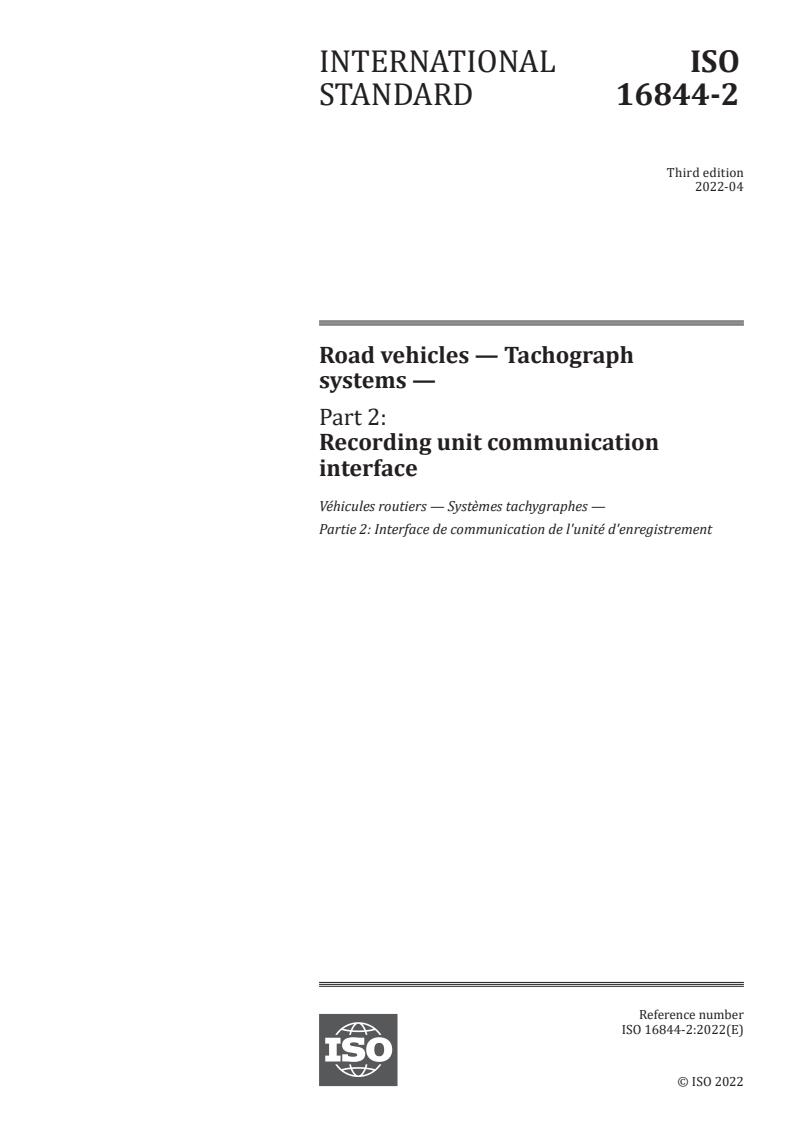
INTERNATIONAL ISO
STANDARD 16844-2
Third edition
2022-04
Road vehicles — Tachograph
systems —
Part 2:
Recording unit communication
interface
Véhicules routiers — Systèmes tachygraphes —
Partie 2: Interface de communication de l'unité d'enregistrement
Reference number
© ISO 2022
All rights reserved. Unless otherwise specified, or required in the context of its implementation, no part of this publication may
be reproduced or utilized otherwise in any form or by any means, electronic or mechanical, including photocopying, or posting on
the internet or an intranet, without prior written permission. Permission can be requested from either ISO at the address below
or ISO’s member body in the country of the requester.
ISO copyright office
CP 401 • Ch. de Blandonnet 8
CH-1214 Vernier, Geneva
Phone: +41 22 749 01 11
Email: copyright@iso.org
Website: www.iso.org
Published in Switzerland
ii
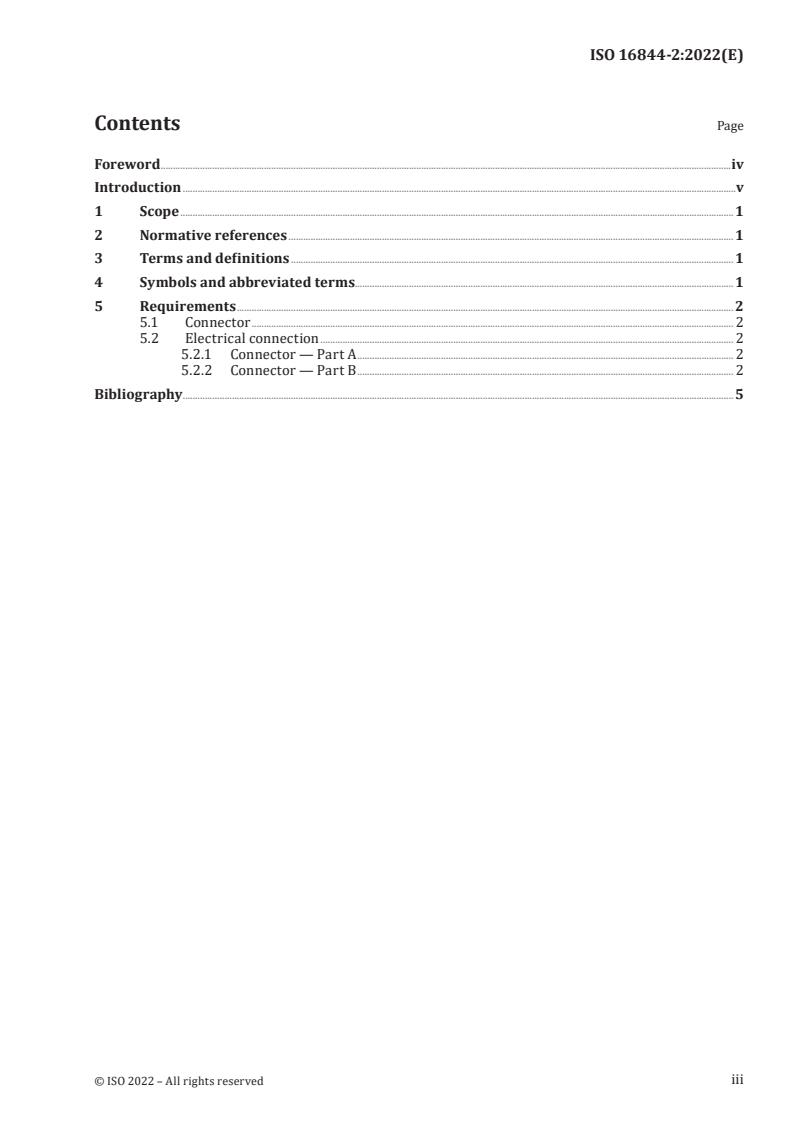
Contents Page
Foreword .iv
Introduction .v
1 Scope . 1
2 Normative references . 1
3 Terms and definitions . 1
4 Symbols and abbreviated terms.1
5 Requirements . 2
5.1 Connector . 2
5.2 Electrical connection . 2
5.2.1 Connector — Part A . 2
5.2.2 Connector — Part B . 2
Bibliography . 5
iii
Foreword
ISO (the International Organization for Standardization) is a worldwide federation of national standards
bodies (ISO member bodies). The work of preparing International Standards is normally carried out
through ISO technical committees. Each member body interested in a subject for which a technical
committee has been established has the right to be represented on that committee. International
organizations, governmental and non-governmental, in liaison with ISO, also take part in the work.
ISO collaborates closely with the International Electrotechnical Commission (IEC) on all matters of
electrotechnical standardization.
The procedures used to develop this document and those intended for its further maintenance are
described in the ISO/IEC Directives, Part 1. In particular, the different approval criteria needed for the
different types of ISO documents should be noted. This document was drafted in accordance with the
editorial rules of the ISO/IEC Directives, Part 2 (see www.iso.org/directives).
Attention is drawn to the possibility that some of the elements of this document may be the subject of
patent rights. ISO shall not be held responsible for identifying any or all such patent rights. Details of
any patent rights identified during the development of the document will be in the Introduction and/or
on the ISO list of patent declarations received (see www.iso.org/patents).
Any trade name used in this document is information given for the convenience of users and does not
constitute an endorsement.
For an explanation of the voluntary nature of standards, the meaning of ISO specific terms and
expressions related to conformity assessment, as well as information about ISO's adherence to
the World Trade Organization (WTO) principles in the Technical Barriers to Trade (TBT), see
www.iso.org/iso/foreword.html.
This document was prepared by Technical Committee ISO/TC 22, Road vehicles, Subcommittee SC 31,
Data communication.
This third edition cancels and replaces the second edition (ISO 16844-2:2011), which has been
technically revised.
The main changes are as follows:
— part 5 of this series (ISO 16844-5) has been removed due to its technical irrelevance,
— correction of the typos and mistakes in the text,
— adoption of the content according to the new version of the ISO guidelines,
— adoption of the content according to the new technical requirements,
— alignment of the content regarding to the referred standards.
A list of all parts in the ISO 16844 series can be found on the ISO website.
Any feedback or questions on this document should be directed to the user’s national standards body. A
complete listing of these bodies can be found at www.iso.org/members.html.
iv
Introduction
This document supports and facilitates the communication between electronic control units (ECUs)
and a digital tachograph.
The digital tachograph concept is based upon a recording equipment storing data, related to the
activities of the various drivers driving the vehicle, on which it is installed.
During the normal operational status of the recording equipment, data stored in its memory are
accessible t
...
Questions, Comments and Discussion
Ask us and Technical Secretary will try to provide an answer. You can facilitate discussion about the standard in here.
Loading comments...