


ISO 18962:2026
(Main)Ships and marine technology — Installation and operational requirements for swappable batteries on ships
Ships and marine technology — Installation and operational requirements for swappable batteries on ships
This document specifies the installation and operational requirements for the utilization of swappable batteries aboard ships.
Navires et technologie maritime — Exigences relatives à l'installation et au fonctionnement des batteries remplaçables sur les navires
General Information
- Status
- Published
- Publication Date
- 15-Jan-2026
- Technical Committee
- ISO/TC 8/SC 8 - Ship design
- Drafting Committee
- ISO/TC 8/SC 8 - Ship design
- Current Stage
- 6060 - International Standard published
- Start Date
- 16-Jan-2026
- Due Date
- 02-Mar-2026
- Completion Date
- 16-Jan-2026
Overview
ISO 18962:2026 is an international standard developed by the International Organization for Standardization (ISO) addressing the installation and operational requirements for swappable batteries aboard ships. As the shipping industry shifts towards cleaner energy and more efficient electrical systems, swappable shipboard batteries have become increasingly important for marine sustainability and vessel operations. This standard sets forth comprehensive guidelines to ensure the safe installation, secure handling, and effective operation of swappable battery systems on marine vessels.
Key Topics
This standard covers essential aspects related to the integration and operation of swappable batteries on ships, including:
- Installation Requirements: Guidance on storing, securing, and connecting swappable batteries on vessels, including requirements for containers (compliant with ISO 668) and proper lashing systems.
- Operational Protocols: Procedures to ensure batteries withstand vibration, mechanical shock, immersion in water, and exposure to fire. Safety features include emergency disconnect switches, emergency stop buttons, and monitoring systems for abnormal conditions.
- Safety and Protection: Measures designed to safeguard crew, passengers, and ship systems, including electrical isolation, thermal protection against overheating, fire suppression equipment, and secure connector systems.
- Testing Methodologies: Defined tests for vibration, shock, water ingress (IPX5 protection), fire exposure, and the effectiveness of lashing systems, following international and ISO referenced standards.
- Emergency Procedures: Protocols for handling emergency events such as fire, power outages, or hazardous battery conditions. Requirements include escape route availability and toxic fume management.
- Documentation: Obligations for manufacturers and suppliers to provide handling instructions, post-incident transport guidance, and safety procedures to ship operators and maintenance personnel.
Applications
ISO 18962:2026 is crucial for various stakeholders in the maritime sector, including:
- Shipbuilders and Marine Engineers: To integrate swappable batteries into vessel designs, supporting hybrid and electric propulsion solutions.
- Shipping Operators: To safely install, operate, and maintain battery systems while managing the logistics of battery swapping for operational flexibility and reduced downtime.
- Port Authorities: To ensure vessels using swappable batteries meet international safety and environmental regulations.
- Battery Manufacturers and Suppliers: To design marine battery systems compliant with recognized standards, supporting safe transportation and deployment in marine environments.
The adoption of ISO 18962:2026 enables improved energy management and faster vessel turnaround with reduced emissions, promoting environmentally responsible shipping practices.
Related Standards
ISO 18962:2026 references and aligns with multiple international standards to ensure robust shipboard battery safety and performance:
- ISO 668: Classification and requirements for freight containers
- ISO 10055: Vibration testing for shipboard equipment
- ISO 15371: Fire-extinguishing systems for marine galleys
- ISO 17631: Shipboard plans for fire control and life-saving appliances
- ISO 17905: Installation and maintenance of container securing devices for ships
- ISO 9367-2: Lashing arrangements on vehicles for sea transportation
- IEC 60092-201: Electrical installations in ships
- IEC 60529: Degree of protection (IP Code) provided by enclosures
- IEC 61851-1: Charging systems for electric vehicles
- IEC 62619: Safety requirements for industrial-use lithium batteries
By following this standard and its related references, marine industry professionals can ensure the safety, reliability, and operational efficiency of swappable battery systems, supporting the transition to greener marine technology.
Get Certified
Connect with accredited certification bodies for this standard

DNV
DNV is an independent assurance and risk management provider.

Lloyd's Register
Lloyd's Register is a global professional services organisation specialising in engineering and technology.

FSC International
Forest Stewardship Council certification.
Sponsored listings
Frequently Asked Questions
ISO 18962:2026 is a standard published by the International Organization for Standardization (ISO). Its full title is "Ships and marine technology — Installation and operational requirements for swappable batteries on ships". This standard covers: This document specifies the installation and operational requirements for the utilization of swappable batteries aboard ships.
This document specifies the installation and operational requirements for the utilization of swappable batteries aboard ships.
ISO 18962:2026 is classified under the following ICS (International Classification for Standards) categories: 47.020.60 - Electrical equipment of ships and of marine structures. The ICS classification helps identify the subject area and facilitates finding related standards.
ISO 18962:2026 is available in PDF format for immediate download after purchase. The document can be added to your cart and obtained through the secure checkout process. Digital delivery ensures instant access to the complete standard document.
Standards Content (Sample)
International
Standard
ISO 18962
First edition
Ships and marine technology —
2026-01
Installation and operational
requirements for swappable
batteries on ships
Navires et technologie maritime — Exigences relatives à
l'installation et au fonctionnement des batteries remplaçables sur
les navires
Reference number
© ISO 2026
All rights reserved. Unless otherwise specified, or required in the context of its implementation, no part of this publication may
be reproduced or utilized otherwise in any form or by any means, electronic or mechanical, including photocopying, or posting on
the internet or an intranet, without prior written permission. Permission can be requested from either ISO at the address below
or ISO’s member body in the country of the requester.
ISO copyright office
CP 401 • Ch. de Blandonnet 8
CH-1214 Vernier, Geneva
Phone: +41 22 749 01 11
Email: copyright@iso.org
Website: www.iso.org
Published in Switzerland
ii
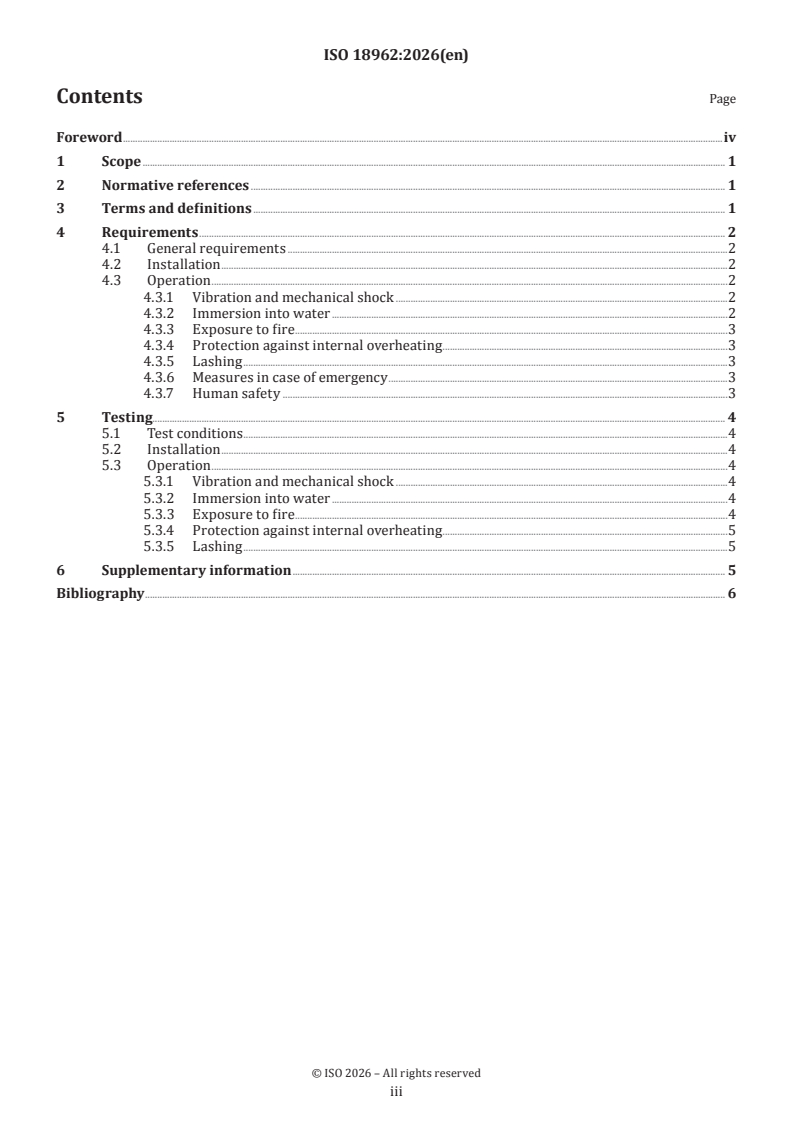
Contents Page
Foreword .iv
1 Scope . 1
2 Normative references . 1
3 Terms and definitions . 1
4 Requirements . 2
4.1 General requirements .2
4.2 Installation .2
4.3 Operation .2
4.3.1 Vibration and mechanical shock .2
4.3.2 Immersion into water .2
4.3.3 Exposure to fire . .3
4.3.4 Protection against internal overheating .3
4.3.5 Lashing .3
4.3.6 Measures in case of emergency .3
4.3.7 Human safety .3
5 Testing. 4
5.1 Test conditions .4
5.2 Installation .4
5.3 Operation .4
5.3.1 Vibration and mechanical shock .4
5.3.2 Immersion into water .4
5.3.3 Exposure to fire . .4
5.3.4 Protection against internal overheating .5
5.3.5 Lashing .5
6 Supplementary information . 5
Bibliography . 6
iii
Foreword
ISO (the International Organization for Standardization) is a worldwide federation of national standards
bodies (ISO member bodies). The work of preparing International Standards is normally carried out through
ISO technical committees. Each member body interested in a subject for which a technical committee
has been established has the right to be represented on that committee. International organizations,
governmental and non-governmental, in liaison with ISO, also take part in the work. ISO collaborates closely
with the International Electrotechnical Commission (IEC) on all matters of electrotechnical standardization.
The procedures used to develop this document and those intended for its further maintenance are described
in the ISO/IEC Directives, Part 1. In particular, the different approval criteria needed for the different types
of ISO document should be noted. This document was drafted in accordance with the editorial rules of the
ISO/IEC Directives, Part 2 (see www.iso.org/directives).
ISO draws attention to the possibility that the implementation of this document may involve the use of (a)
patent(s). ISO takes no position concerning the evidence, validity or applicability of any claimed patent
rights in respect thereof. As of the date of publication of this document, ISO had not received notice of (a)
patent(s) which may be required to implement this document. However, implementers are cautioned that
this may not represent the latest information, which may be obtained from the patent database available at
www.iso.org/patents. ISO shall not be held responsible for identifying any or all such patent rights.
Any trade name used in this document is information given for the convenience of users and does not
constitute an endorsement.
For an explanation of the voluntary nature of standards, the meaning of ISO specific terms and expressions
related to conformity assessment, as well as information about ISO's adherence to the World Trade
Organization (WTO) principles in the Technical Barriers to Trade (TBT), see www.iso.org/iso/foreword.html.
This document was prepared by Technical Committee ISO/TC 8, Ships and marine technology, Subcommittee
SC 8, Ship design.
Any feedback or questions on this document should be directed to the user’s national standards body. A
complete listing of these bodies can be found at www.iso.org/members.html.
iv
International Standard ISO 18962:2026(en)
Ships and marine technology — Installation and operational
requirements for swappable batteries on ships
1 Scope
This document specifies the installation and operational requirements for the utilization of swappable
batteries aboard ships.
2 Normative references
The following documents are referred to in the text in such a way that some or all of their content constitutes
requirements of this document. For dated references, only the edition cited applies. For undated references,
the latest edition of the referenced document (including any amendments) applies.
ISO 668, Series 1 freight containers — Classification, dimensions and ratings
ISO 9367-2, Lashing and securing arrangements on road vehicles for sea transportation on Ro/Ro ships —
General requirements — Part 2: Semi-trailers
ISO 10055, Mechanical vibration — Vibration testing requirements for shipboard equipment and machinery
components
ISO 15371, Ships and marine technology — Fire-extinguishing systems for protection of galley cooking equipment
ISO 17631, Ships and marine technology — Shipboard plans for fire control, damage control, life-saving
appliances and means of escape
ISO 17905, Ships and marine technology — Installation, inspection and maintenance of container securing
devices for ships
IEC 60068-2-27, Environmental testing — Part 2— 27: Tests — Test Ea and guidance: Shock
IEC 60092-201:2019, Electrical installations in ships — Part 201: System design — General
IEC 60529:1989/AMD1: 1999+ AMD2: 2013 CSV, Degrees of protection provided by enclosures (IP Code)
IEC 61851-1, Electric vehicle conductive charging system — Part 1: General requirements
IEC 62619:2022, Secondary cells and batteries containing alkaline or other non-acid electrolytes — Safety
requirements for secondary lithium cells and batteries, for use in industrial applications
3 Terms and definitions
For the purposes of this document, the following terms and definitions apply.
ISO and IEC maintain terminology dat
...
Questions, Comments and Discussion
Ask us and Technical Secretary will try to provide an answer. You can facilitate discussion about the standard in here.
Loading comments...