


ISO 29993:2017
(Main)Learning services outside formal education — Service requirements
Learning services outside formal education — Service requirements
ISO 29993:2017 specifies requirements for learning services outside formal education, including all types of life-long learning (e.g. vocational training and in-company training, either outsourced or in-house). These include any learning services provided by a learning service provider (LSP) that are addressed to learners themselves, as well as to sponsors who are acquiring the services on behalf of the learners. The key features of these kinds of services are that the goals of learning are defined and the services are evaluated, and that they involve interaction with the learner. The learning can be face-to-face, mediated by technology, or a blend of both. In cases where the learning service provider is part of an organization that delivers products (i.e. goods and services) in addition to learning services, ISO 29993:2017 only applies to learning services. ISO 29993:2017 is not aimed at schools, colleges and universities providing learning services as part of a formal education system, but it can be useful to them as a tool for reflection and self-evaluation.
Services de formation fournis en dehors du cadre de l'enseignement formel — Exigences de service
L'ISO 29993 :2017 spécifie les exigences relatives aux services de formation fournis en dehors du cadre de l'enseignement formel, y compris tous les types de formation tout au long de la vie (par exemple, formation professionnelle et formation en entreprise, externalisés ou internes). Ceux-ci comprennent tous les services de formation fournis par un prestataire de formation (PSF) qui s'adressent aux apprenants eux-mêmes, ainsi qu'aux commanditaires qui acquièrent les services pour le compte des apprenants. Les principales caractéristiques de ces types de services sont que les objectifs de la formation sont définis que les services sont évalués et qu'ils impliquent une interaction avec l'apprenant. La formation peut se faire en face à face, appuyée par la technologie, ou un mélange des deux. Lorsque le prestataire de services de formation fait partie d'un organisme fournissant d'autres produits (c'est-à-dire des biens et des services) en complément des services de formation, l'ISO 29993 :2017 s'applique uniquement aux services de formation. L'ISO 29993 :2017 ne s'adresse pas aux écoles, collèges et universités fournissant des services de formation dans le cadre d'un système d'enseignement formel, mais il peut leur être utile en tant qu'outil de réflexion et d'auto-évaluation.
General Information
- Status
- Published
- Publication Date
- 08-Aug-2017
- Technical Committee
- ISO/TC 232 - Education and learning services
- Drafting Committee
- ISO/TC 232 - Education and learning services
- Current Stage
- 9093 - International Standard confirmed
- Start Date
- 27-Mar-2023
- Completion Date
- 12-Feb-2026
Relations
- Effective Date
- 26-Dec-2015
Overview
ISO 29993:2017 - Learning services outside formal education - Service requirements - defines quality requirements for learning services outside formal education, covering lifelong learning, vocational training and in‑company training (outsourced or in‑house). The standard applies to any learning service provider (LSP) delivering interactive learning (face‑to‑face, IT‑mediated or blended) to learners or sponsors. ISO 29993 focuses on clear learning goals, measurable outcomes, evaluation and learner interaction; it is not aimed at formal school/college systems, though it can support their self‑evaluation.
Key topics and requirements
ISO 29993 specifies practical service requirements across the learner lifecycle. Major technical topics include:
- General information: LSP identity, contact details, locations, management, main services, facilitator qualifications, teaching methods and resources.
- Proposal development: understanding client context, objectives, facilitator profiles, teaching and assessment methods, pricing and terms.
- Pre‑acquisition information: course title, objectives, prerequisites, schedule, delivery modes, fees, cancellation/refund policies, feedback and complaints procedures.
- Needs analysis: qualified analysis of learner and sponsor needs, current competence, desired competence, context of application and agreed measurable outcomes (use of national/international scales where available).
- Design and curriculum: curriculum development by experienced designers; alignment of learning materials, assessment methods, facilitator:learner ratios, certificates and monitoring plans.
- Service delivery: qualified staff, appropriate learning materials and environments (physical and virtual), accessibility and cultural considerations.
- Facilitators and assessment: facilitator competence, continuous monitoring, assessment of individual learning outcomes.
- Monitoring, evaluation and invoicing: ongoing performance monitoring, systematic evaluation (including feedback and complaints handling), and transparent invoicing.
Other requirements include confidentiality of learner data and disclosure/consent for information use.
Applications and who uses it
ISO 29993 is used by:
- Corporate training departments and in‑company LSPs
- Commercial training organizations and vocational providers
- E‑learning and blended‑learning providers
- HR, procurement and learning consultants selecting or specifying training services
- Public agencies and NGOs that commission or provide non‑formal learning
Benefits include improved quality assurance, clearer proposals and contracts, measurable learning outcomes, better vendor selection and enhanced learner satisfaction.
Related standards
- ISO 29990:2010 - basic requirements for learning service providers (management system elements referenced)
- ISO 29991:2014 - language learning services outside formal education
- ISO 21001 - educational organization management system (under development referenced)
- ISO/TR 22411:2008 - guidance for services for older persons and persons with disabilities
ISO 29993 is an operational standard for anyone specifying, delivering or procuring learning services outside formal education who needs consistent, learner‑focused quality criteria.


ISO 29993:2017 - Learning services outside formal education -- Service requirements


ISO 29993:2017 - Services de formation fournis en dehors du cadre de l'enseignement formel -- Exigences de service
Get Certified
Connect with accredited certification bodies for this standard

Great Wall Tianjin Quality Assurance Center
Established 1993, first batch to receive national accreditation with IAF recognition.
Hong Kong Quality Assurance Agency (HKQAA)
Hong Kong's leading certification body.

Innovative Quality Certifications Pvt. Ltd. (IQCPL)
Known for integrity, providing ethical & impartial Assessment & Certification. CMMI Institute Partner.
Sponsored listings
Frequently Asked Questions
ISO 29993:2017 is a standard published by the International Organization for Standardization (ISO). Its full title is "Learning services outside formal education — Service requirements". This standard covers: ISO 29993:2017 specifies requirements for learning services outside formal education, including all types of life-long learning (e.g. vocational training and in-company training, either outsourced or in-house). These include any learning services provided by a learning service provider (LSP) that are addressed to learners themselves, as well as to sponsors who are acquiring the services on behalf of the learners. The key features of these kinds of services are that the goals of learning are defined and the services are evaluated, and that they involve interaction with the learner. The learning can be face-to-face, mediated by technology, or a blend of both. In cases where the learning service provider is part of an organization that delivers products (i.e. goods and services) in addition to learning services, ISO 29993:2017 only applies to learning services. ISO 29993:2017 is not aimed at schools, colleges and universities providing learning services as part of a formal education system, but it can be useful to them as a tool for reflection and self-evaluation.
ISO 29993:2017 specifies requirements for learning services outside formal education, including all types of life-long learning (e.g. vocational training and in-company training, either outsourced or in-house). These include any learning services provided by a learning service provider (LSP) that are addressed to learners themselves, as well as to sponsors who are acquiring the services on behalf of the learners. The key features of these kinds of services are that the goals of learning are defined and the services are evaluated, and that they involve interaction with the learner. The learning can be face-to-face, mediated by technology, or a blend of both. In cases where the learning service provider is part of an organization that delivers products (i.e. goods and services) in addition to learning services, ISO 29993:2017 only applies to learning services. ISO 29993:2017 is not aimed at schools, colleges and universities providing learning services as part of a formal education system, but it can be useful to them as a tool for reflection and self-evaluation.
ISO 29993:2017 is classified under the following ICS (International Classification for Standards) categories: 03.180 - Education. The ICS classification helps identify the subject area and facilitates finding related standards.
ISO 29993:2017 has the following relationships with other standards: It is inter standard links to ISO 29990:2010. Understanding these relationships helps ensure you are using the most current and applicable version of the standard.
ISO 29993:2017 is available in PDF format for immediate download after purchase. The document can be added to your cart and obtained through the secure checkout process. Digital delivery ensures instant access to the complete standard document.
Standards Content (Sample)
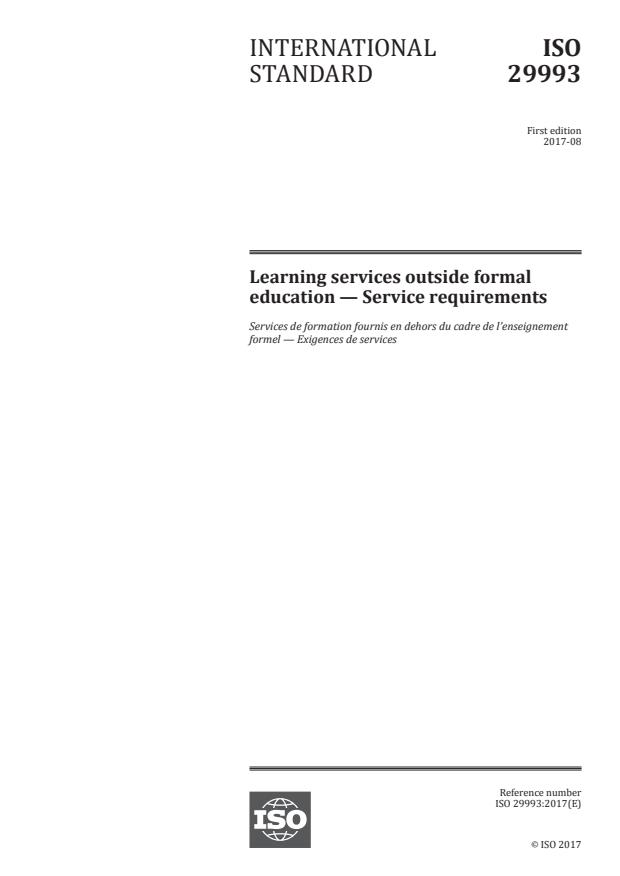
INTERNATIONAL ISO
STANDARD 29993
First edition
2017-08
Learning services outside formal
education — Service requirements
Services de formation fournis en dehors du cadre de l’enseignement
formel — Exigences de services
Reference number
©
ISO 2017
© ISO 2017, Published in Switzerland
All rights reserved. Unless otherwise specified, no part of this publication may be reproduced or utilized otherwise in any form
or by any means, electronic or mechanical, including photocopying, or posting on the internet or an intranet, without prior
written permission. Permission can be requested from either ISO at the address below or ISO’s member body in the country of
the requester.
ISO copyright office
Ch. de Blandonnet 8 • CP 401
CH-1214 Vernier, Geneva, Switzerland
Tel. +41 22 749 01 11
Fax +41 22 749 09 47
copyright@iso.org
www.iso.org
ii © ISO 2017 – All rights reserved
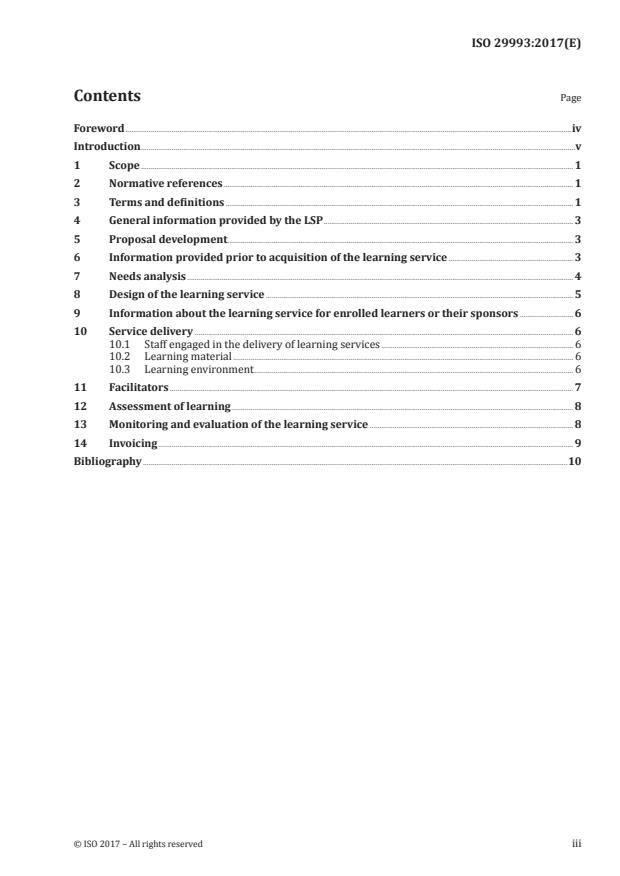
Contents Page
Foreword .iv
Introduction .v
1 Scope . 1
2 Normative references . 1
3 Terms and definitions . 1
4 General information provided by the LSP . 3
5 Proposal development . 3
6 Information provided prior to acquisition of the learning service .3
7 Needs analysis . 4
8 Design of the learning service . 5
9 Information about the learning service for enrolled learners or their sponsors .6
10 Service delivery . 6
10.1 Staff engaged in the delivery of learning services . 6
10.2 Learning material . 6
10.3 Learning environment . 6
11 Facilitators . 7
12 Assessment of learning . 8
13 Monitoring and evaluation of the learning service . 8
14 Invoicing . 9
Bibliography .10
Foreword
ISO (the International Organization for Standardization) is a worldwide federation of national standards
bodies (ISO member bodies). The work of preparing International Standards is normally carried out
through ISO technical committees. Each member body interested in a subject for which a technical
committee has been established has the right to be represented on that committee. International
organizations, governmental and non-governmental, in liaison with ISO, also take part in the work.
ISO collaborates closely with the International Electrotechnical Commission (IEC) on all matters of
electrotechnical standardization.
The procedures used to develop this document and those intended for its further maintenance are
described in the ISO/IEC Directives, Part 1. In particular the different approval criteria needed for the
different types of ISO documents should be noted. This document was drafted in accordance with the
editorial rules of the ISO/IEC Directives, Part 2 (see www .iso .org/ directives).
Attention is drawn to the possibility that some of the elements of this document may be the subject of
patent rights. ISO shall not be held responsible for identifying any or all such patent rights. Details of
any patent rights identified during the development of the document will be in the Introduction and/or
on the ISO list of patent declarations received (see www .iso .org/ patents).
Any trade name used in this document is information given for the convenience of users and does not
constitute an endorsement.
For an explanation on the voluntary nature of standards, the meaning of ISO specific terms and
expressions related to conformity assessment, as well as information about ISO’s adherence to the
World Trade Organization (WTO) principles in the Technical Barriers to Trade (TBT) see the following
URL: w w w . i s o .org/ iso/ foreword .html.
This document was prepared by Technical Committee ISO/TC 232, Learning services outside formal
education.
ISO/TC 232 has also developed the following documents:
1)
— ISO 29990:2010 , Learning services for non-formal education and training — Basic requirements for
service providers
— ISO 29991:2014, Language learning services outside formal education — Requirements
1) The service requirements for a learning service provider contained in ISO 29990:2010 are addressed in this
document. The management system elements for an educational organization contained in ISO 29990:2010 will be
addressed in the future ISO 21001.
iv © ISO 2017 – All rights reserved
Introduction
This document is intended to provide a generic frame of reference for quality learning services outside
formal education by specifying its various elements and delivery.
The structure of this document reflects a typical sequence of experiences of learners and sponsors in
a prototypical learning service, including advertising, information provided prior to acquisition of the
service, needs analysis, design, assessment and evaluation.
However, the way in which the learning service is planned and delivered can vary depending on the
context. The learning service provider (LSP) can implement a management system designed to ensure
consistent delivery of service and conformity with this document.
INTERNATIONAL STANDARD ISO 29993:2017(E)
Learning services outside formal education — Service
requirements
1 Scope
This document specifies requirements for learning services outside formal education, including all
types of life-long learning (e.g. vocational training and in-company training, either outsourced or in-
house). These include any learning services provided by a learning service provider (LSP) that are
addressed to learners themselves, as well as to sponsors who are acquiring the services on behalf of the
learners. The key features of these kinds of services are that the goals of learning are defined and the
services are evaluated, and that they involve interaction with the learner. The learning can be face-to-
face, mediated by technology, or a blend of both.
In cases where the learning service provider is part of an organization that delivers products (i.e. goods
and services) in addition to learning services, this document only applies to learning services.
This document is not aimed at schools, colleges and universities providing learning services as part of a
formal education system, but it can be useful to them as a tool for reflection and self-evaluation.
2 Normative references
There are no normative references in this document.
3 Terms and definitions
For the purposes of this document, the following terms and definitions apply.
ISO and IEC maintain terminological databases for use in standardization at the following addresses:
— ISO Online browsing platform: available at http:// www .iso .org/ obp
— IEC Electropedia: available at http:// www .electropedia .org/
3.1
assessment
gathering of data to determine the learning (3.9) outcomes of an individual learner (3.8) or group of
learners
3.2
blended learning
combination of different modes of learning (3.9)
Note 1 to entry: Modes of learning include face-to-face learning, IT-supported learning, among others.
[SOURCE: ISO 29991:2014, 2.4, modified]
3.3
competence
ability to apply knowledge and skills to achieve intended results
3.4
curriculum
plan of study prepared by the learning service provider (3.13) which describes the aims, content, learning
resources (3.11), and learning (3.9) outcomes
3.5
evaluation
systematic gathering of information, including the results of assessment (3.1) and monitoring (3.14), in
order to make decisions about possible adjustments to the learning service (3.12)
3.6
facilitator
person who works with learners (3.8) to assist them with learning (3.9)
Note 1 to entry: A facilitator (3.6) is also often referred to as a teacher, a trainer, a coach, a tutor or a mentor.
[SOURCE: ISO 29990:2010, 2.8]
3.7
interested party
individual, group or organization with a direct or indirect interest in the learning service (3.12),
including its management and outcomes, or the processes involved, or both
[SOURCE: ISO 29990:2010, 2.9]
3.8
learner
person engaged in learning (3.9)
[SOURCE: ISO 29990:2010, 2.11]
3.9
learning
acquiring knowledge, behaviour, skills, values, preferences or understanding
[SOURCE: ISO 29990:2010, 2.12]
3.10
learning environment
classrooms, multimedia rooms and other physical or virtual spaces used for learning (3.9)
3.11
learning resource
material, environment, human resource, information or other asset that can be drawn on by the learning
service provider (3.13) in order to facilitate learning (3.9) effectively
3.12
learning service
sequence of activities designed to enable learning (3.9)
[SOURCE: ISO 29990:2010, 2.13, modified]
3.13
learning service provider
LSP
organization or individual providing learning services (3.12) outside formal education, including any
associates involved in the provision of the learning service
[SOURCE: ISO 29990:2010, 2.14, modified]
3.14
monitoring
continuous examination of progress achieved during the implementation of the learning service (3.12)
to track conformity with the plan and to take necessary decisions to improve performance
2 © ISO 2017 – All rights reserved
3.15
sponsor
organization or individual that acquires learning services (3.12) on behalf of learners (3.8), that provides
financial or other support for them, or that has a vested interest in the outcome of the learning (3.9)
Note 1 to entry: Sponsors include corporations, government agencies and individuals.
[SOURCE: ISO 29990:2010, 2.17, modified]
4 General information provided by the LSP
4.1 Prior to enrolment, learners and interested parties need information about the learning services in
order to make an informed decision.
4.2 Information provided by the LSP shall be accessible, up-to-date, accurate and legible. This
information shall include at least the following elements:
a) name, address of headquarters, contact details, and locations where the learning services are
provided;
b) key management staff;
c) description of the main learning services offered by the LSP;
d) qualification or experience of facilitators in charge of the learning service, or both;
e) teaching methods;
f) description of learning environment and learning resources;
g) any certifications, awards, qualification and accreditation offered.
5 Proposal development
5.1 When provided, a proposal enables the learners or sponsors to make an informed decision
regarding the acquisition of the learning service.
5.2 Prior to developing the proposal, the LSP shall take appropriate steps to understand the learning
request, its context and any logistical factors. This proposal shall include at least the following:
a) the objectives and targets of the proposed learning services;
b) the capacity of the LSP to address the client’s needs (e.g. client references, technical characteristics,
facilitators profile, example of similar programmes);
c) the teaching and assessment methods to be used by the LSP in delivering the learning service;
d) the price, terms and conditions.
6 Information provided prior to acquisition of the learning service
Before agreeing to the acquisition of the learning service, the interested parties shall be provided with
the following information, as applicable:
a) the title and objectives of the learning service;
b) any prerequisites, technical or otherwise, such as a required level of competence;
c) dates, location, duration and timetable;
d) the proposed number
...
NORME ISO
INTERNATIONALE 29993
Première édition
2017-08
Services de formation fournis en
dehors du cadre de l'enseignement
formel — Exigences de services
Learning services outside formal education — Service requirements
Numéro de référence
©
ISO 2017
DOCUMENT PROTÉGÉ PAR COPYRIGHT
© ISO 2017, Publié en Suisse
Droits de reproduction réservés. Sauf indication contraire, aucune partie de cette publication ne peut être reproduite ni utilisée
sous quelque forme que ce soit et par aucun procédé, électronique ou mécanique, y compris la photocopie, l’affichage sur
l’internet ou sur un Intranet, sans autorisation écrite préalable. Les demandes d’autorisation peuvent être adressées à l’ISO à
l’adresse ci-après ou au comité membre de l’ISO dans le pays du demandeur.
ISO copyright office
Ch. de Blandonnet 8 • CP 401
CH-1214 Vernier, Geneva, Switzerland
Tel. +41 22 749 01 11
Fax +41 22 749 09 47
copyright@iso.org
www.iso.org
ii © ISO 2017 – Tous droits réservés
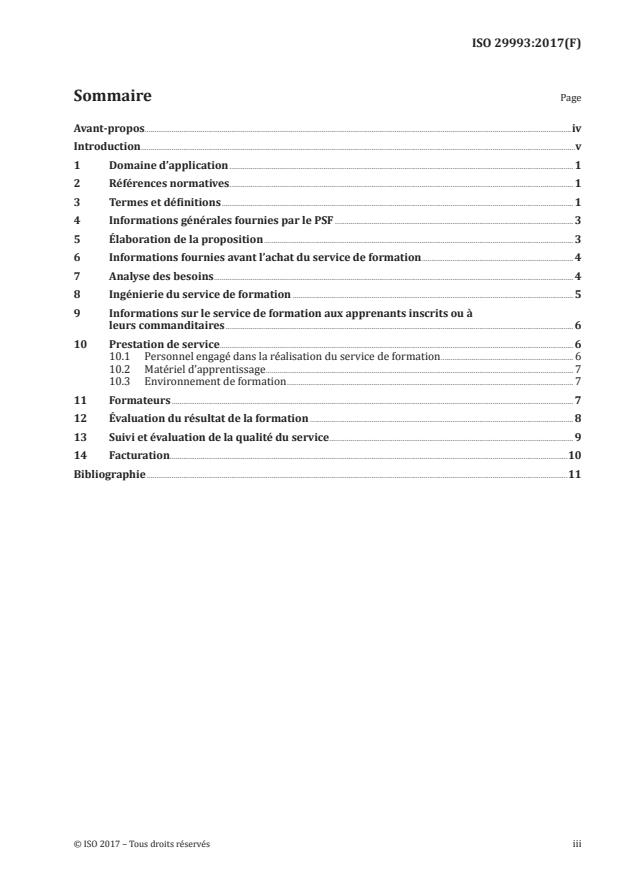
Sommaire Page
Avant-propos .iv
Introduction .v
1 Domaine d’application . 1
2 Références normatives . 1
3 Termes et définitions . 1
4 Informations générales fournies par le PSF . 3
5 Élaboration de la proposition . 3
6 Informations fournies avant l’achat du service de formation . 4
7 Analyse des besoins . 4
8 Ingénierie du service de formation . 5
9 Informations sur le service de formation aux apprenants inscrits ou à
leurs commanditaires . 6
10 Prestation de service. 6
10.1 Personnel engagé dans la réalisation du service de formation . 6
10.2 Matériel d’apprentissage . 7
10.3 Environnement de formation . 7
11 Formateurs . 7
12 Évaluation du résultat de la formation . 8
13 Suivi et évaluation de la qualité du service . 9
14 Facturation.10
Bibliographie .11
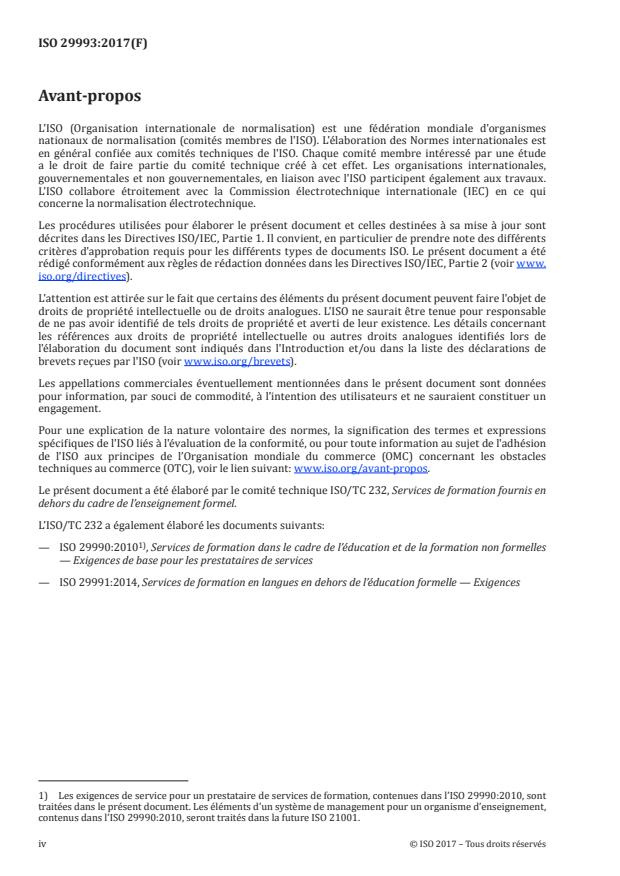
Avant-propos
L'ISO (Organisation internationale de normalisation) est une fédération mondiale d'organismes
nationaux de normalisation (comités membres de l'ISO). L'élaboration des Normes internationales est
en général confiée aux comités techniques de l'ISO. Chaque comité membre intéressé par une étude
a le droit de faire partie du comité technique créé à cet effet. Les organisations internationales,
gouvernementales et non gouvernementales, en liaison avec l'ISO participent également aux travaux.
L'ISO collabore étroitement avec la Commission électrotechnique internationale (IEC) en ce qui
concerne la normalisation électrotechnique.
Les procédures utilisées pour élaborer le présent document et celles destinées à sa mise à jour sont
décrites dans les Directives ISO/IEC, Partie 1. Il convient, en particulier de prendre note des différents
critères d'approbation requis pour les différents types de documents ISO. Le présent document a été
rédigé conformément aux règles de rédaction données dans les Directives ISO/IEC, Partie 2 (voir www.
iso.org/directives).
L'attention est attirée sur le fait que certains des éléments du présent document peuvent faire l'objet de
droits de propriété intellectuelle ou de droits analogues. L'ISO ne saurait être tenue pour responsable
de ne pas avoir identifié de tels droits de propriété et averti de leur existence. Les détails concernant
les références aux droits de propriété intellectuelle ou autres droits analogues identifiés lors de
l'élaboration du document sont indiqués dans l'Introduction et/ou dans la liste des déclarations de
brevets reçues par l'ISO (voir www.iso.org/brevets).
Les appellations commerciales éventuellement mentionnées dans le présent document sont données
pour information, par souci de commodité, à l’intention des utilisateurs et ne sauraient constituer un
engagement.
Pour une explication de la nature volontaire des normes, la signification des termes et expressions
spécifiques de l'ISO liés à l'évaluation de la conformité, ou pour toute information au sujet de l'adhésion
de l'ISO aux principes de l’Organisation mondiale du commerce (OMC) concernant les obstacles
techniques au commerce (OTC), voir le lien suivant: www.iso.org/avant-propos.
Le présent document a été élaboré par le comité technique ISO/TC 232, Services de formation fournis en
dehors du cadre de l’enseignement formel.
L’ISO/TC 232 a également élaboré les documents suivants:
1)
— ISO 29990:2010 , Services de formation dans le cadre de l’éducation et de la formation non formelles
— Exigences de base pour les prestataires de services
— ISO 29991:2014, Services de formation en langues en dehors de l’éducation formelle — Exigences
1) Les exigences de service pour un prestataire de services de formation, contenues dans l’ISO 29990:2010, sont
traitées dans le présent document. Les éléments d’un système de management pour un organisme d’enseignement,
contenus dans l’ISO 29990:2010, seront traités dans la future ISO 21001.
iv © ISO 2017 – Tous droits réservés
Introduction
Le présent document est destiné à fournir un cadre générique de référence pour la qualité des services
de formation fournis en dehors du cadre de l’enseignement formel, il en spécifie les différents éléments
et la mise en œuvre.
La structure du présent document reflète une séquence type d’expériences pour les apprenants et les
commanditaires d’un service de formation type, incluant la publicité, les informations fournies avant
l’achat du service, l’analyse des besoins, la conception, l’évaluation et l’appréciation.
Toutefois, la manière dont le service de formation est planifié et délivré peut varier selon le contexte.
Le prestataire de services de formation (PSF) peut mettre en œuvre un système de management conçu
pour assurer une prestation de services cohérente et conforme au présent document.
NORME INTERNATIONALE ISO 29993:2017(F)
Services de formation fournis en dehors du cadre de
l'enseignement formel — Exigences de services
1 Domaine d’application
Le présent document spécifie les exigences relatives aux services de formation fournis en dehors du
cadre de l’enseignement formel, y compris tous les types de formation tout au long de la vie (par exemple,
formation professionnelle et formation en entreprise, externalisés ou internes). Ceux-ci comprennent
tous les services de formation fournis par un prestataire de formation (PSF) qui s'adressent aux
apprenants eux-mêmes, ainsi qu'aux commanditaires qui acquièrent les services pour le compte
des apprenants. Les principales caractéristiques de ces types de services sont que les objectifs de la
formation sont définis que les services sont évalués et qu’ils impliquent une interaction avec l’apprenant.
La formation peut se faire en face à face, appuyée par la technologie, ou un mélange des deux.
Lorsque le prestataire de services de formation fait partie d’un organisme fournissant d’autres produits
(c’est-à-dire des biens et des services) en complément des services de formation, le présent document
s’applique uniquement aux services de formation.
Le présent document ne s’adresse pas aux écoles, collèges et universités fournissant des services de
formation dans le cadre d’un système d’enseignement formel, mais il peut leur être utile en tant qu’outil
de réflexion et d’auto-évaluation.
2 Références normatives
Le présent document ne contient aucune référence normative.
3 Termes et définitions
Pour les besoins du présent document, les termes et définitions suivants s’appliquent.
L’ISO et l’IEC tiennent à jour des bases de données terminologiques destinées à être utilisées en
normalisation, consultables aux adresses suivantes:
— ISO Online browsing platform: disponible à l’adresse https://www.iso.org/obp
— IEC Electropedia: disponible à l’adresse http://www.electropedia.org/
3.1
évaluation du résultat
collecte des données permettant de déterminer les résultats d’apprentissage (3.9) d’un apprenant (3.8)
individuel ou d’un groupe d’apprenants
3.2
apprentissage hybride
combinaison de différents modes d’apprentissage (3.9)
Note 1 à l'article: Les modes d’apprentissage comprennent entre autres l’apprentissage en face à face et
l’apprentissage basé sur les technologies de l’information.
[SOURCE: ISO 29991:2014, 2.4, modifiée]
3.3
compétence
capacité à appliquer les connaissances et les savoir-faire pour atteindre les résultats escomptés
3.4
référentiel de formation
document préparé par le prestataire de services de formation (3.13) qui décrit les objectifs, le contenu,
les ressources pédagogiques (3.11) et les résultats attendus de la formation (3.9)
3.5
évaluation de la satisfaction
collecte systématique d’informations, incluant les résultats de l’évaluation (3.1) et du suivi (3.14),
permettant de prendre des décisions sur des ajustements éventuels du service de formation (3.12)
3.6
formateur
personne qui travaille avec les apprenants (3.8) pour les aider dans leur apprentissage (3.9)
Note 1 à l'article: Un formateur (3.6) est aussi souvent désigné en tant qu’enseignant, coach, tuteur ou mentor.
[SOURCE: ISO 29990:2010, 2.8]
3.7
partie intéressée
individu, groupe ou organisme ayant un intérêt direct ou indirect dans le service de formation (3.12), y
compris sa gestion et ses résultats, et/ou les processus impliqués
[SOURCE: ISO 29990:2010, 2.9]
3.8
apprenant
personne engagée dans un apprentissage (3.9)
[SOURCE: ISO 29990:2010, 2.11]
3.9
apprentissage
acquisition de connaissances, de comportements, de savoir-faire, de valeurs, de préférences ou de
compréhension
[SOURCE: ISO 29990:2010, 2.12]
3.10
environnement de formation
salles de formation, salles multimédia et autres espaces physiques ou virtuels utilisés pour
l’apprentissage (3.9)
3.11
ressource de formation
matériel, environnement, ressources humaines, informations ou autres biens pouvant être utilisés par
le prestataire de services de formation (3.13) pour faciliter l’apprentissage (3.9)
3.12
service de formation
séquence d’activités conçue pour permettre l’apprentissage (3.9)
[SOURCE: ISO 29990:2010, 2.13, modifiée]
3.13
prestataire de services de formation
PSF
organisme ou individu fournissant des services de formation (3.12) en dehors du cadre de l’enseignement
formel, incluant tous les collaborateurs impliqués dans la fourniture du service de formation
[SOURCE: ISO 29990:2010, 2.14, modifiée]
2 © ISO 2017 – Tous droits réservés
3.14
suivi
examen continu des progrès réalisés pendant la réalisation de la formation (3.12) afin de vérifier la
conformité au référentiel et de prendre les décisions nécessaires pour améliorer la performance
3.15
commanditaire
organisation ou individu qui fait l’acquisition de services de formation (3.12) pour le compte d’apprenants
(3.8), qui leur assure un soutien financier ou autre, ou qui a un intérêt direct dans le résultat de
l’apprentissage (3.9)
Note 1 à l'article: Les commanditaires comprennent les entreprises, les organismes publics et les personnes.
[SOURCE: ISO 29990:2010, 2.17, modifiée]
4 Informations générales fournies par le PSF
4.1 Avant l’inscription, les apprenants et les parties intéressées pour prendre une décision éclairée ont
besoin d’informations sur les services de formation proposés.
4.2 Les informations fournies par le PSF doivent être accessibles, à jour, précises et lisibles. Ces
informations doivent comporter au moins les éléments suivants:
a) nom, adresse du siège social, coordonnées et lieux où les services de formation sont fournis;
b) principaux dirigeants;
c) description des principaux services de formation proposés par le PSF;
d) qualification et/ou expérience des formateurs en charge du service de formation;
e) méthodes d’enseignement;
f) description de l’environnement d’apprentissage et des ressources d’apprentissage;
g) toute certification, distinction, qualification et accréditation.
5 Élaboration de la proposition
5.1 Lorsqu’elle est fournie, la proposition permet aux apprenants ou aux commanditaires de prendre
une décision éclairée en ce qui concerne l’acquisition du service de formation.
5.2 Avant d’élaborer la proposition, le PSF doit prendre les mesures appropriées pour comprendre
la demande de formation, son contexte et les facteurs logistiques éventuels. Cette proposition doit au
moins comprendre les éléments suivants:
a) la finalité et les objectifs des services de formation proposés;
b) la capacité du PSF à répondre aux besoins du client (par exemple références clients, caractéristiques
techniques, profil des formateurs, exemple de programmes de formations similaires);
c) les méthodes d’enseignement et d’évaluation devant être utilisées par le PSF pour fournir le service
de formation;
d) le prix, les termes et conditions générales de vente.
6 Informations fournies avant l’achat du service de formation
Avant l’achat du service de formation, les parties intéressées doivent disposer des informations
suivantes, selon le cas:
a) l’intitulé et les objectifs du service de formation;
b) toutes les conditions préalables, techniques ou autres, telles que le niveau de compétence exigé;
c) les dates, le lieu, la durée et le planning;
d) le nombre d’heures de formation proposé et leur répartition entre les différents modes
d’apprentissage (par exemple apprentissage en face à face, apprentissage hybride, apprentissage
basé sur les technologies de l’information);
e) les méthodes pédagogiques et les moyens d’évaluation utilisés;
f) les licences des logiciels et les équipements techniques requis;
g) les frais afférents à la f
...
Questions, Comments and Discussion
Ask us and Technical Secretary will try to provide an answer. You can facilitate discussion about the standard in here.
Loading comments...