

ISO/TS 44006:2023
(Main)Collaborative business relationship management — Guidelines for university-business collaboration
General Information
- Abstract
This document gives guidance for universities, business partners and other interested parties on using the 12 principles of collaborative business relationships provided in ISO/TR 44000 to improve their capability in university-business collaboration (UBC).
- Status
- Published
- Publication Date
- 12-Oct-2023
- Technical Committee
- ISO/TC 286 - Collaborative business relationship management
- Drafting Committee
- ISO/TC 286 - Collaborative business relationship management
- Current Stage
- 9093 - International Standard confirmed
- Start Date
- 24-May-2024
- Completion Date
- 29-Aug-2026


Overview
ISO/TS 44006:2023 - "Collaborative business relationship management - Guidelines for university‑business collaboration" provides practical guidance for universities, business partners and other stakeholders on applying the 12 principles of collaborative business relationships (from ISO/TR 44000) to improve university‑business collaboration (UBC). The Technical Specification presents a concise what / why / how structure for each principle, helping organizations design, operate and continuously improve sustainable, ethical and outcome‑focused UBC arrangements.
Key Topics
The document covers implementation guidance across the 12 principle areas, including clear subclauses for What (intent), Why (relevance) and How (implementation). Major topics explicitly addressed are:
- Relationship management - establishing a joint Relationship Management Plan (RMP) to identify stakeholders, align expectations and coordinate engagement.
- Visions and values - aligning strategic intent and culture between partners.
- UBC objectives - defining shared goals for innovation, workforce and knowledge outcomes.
- Collaborative leadership - leadership roles that enable partnership success.
- Governance and processes - structures, decision‑making and documented engagement models.
- Collaborative competence and behaviour - skills, behaviours and capacities needed for effective collaboration.
- Trust and mutual benefit - building and sustaining trust and shared value.
- Value creation - identifying, measuring and optimizing benefits for all parties.
- Information and knowledge sharing - mechanisms for exchanging research, IP and tacit knowledge.
- Risk management - anticipating, assessing and mitigating partnership risks.
- Relationship assessment and optimization - ongoing review and continuous improvement.
- Exit strategy - planned, ethical termination or transition arrangements.
Applications
ISO/TS 44006 is practical for:
- Designing and operating formal university‑industry research projects, consortia and training programmes.
- Structuring technology transfer, internships, co‑development and applied research collaborations.
- Creating documented governance, knowledge‑sharing and risk‑management practices that scale across international or multidisciplinary UBCs.
- Supporting SMEs and universities to internationalize collaboration, improve employability outcomes and stimulate applied innovation.
Who will use this standard
- University leadership, research offices and technology transfer offices (TTOs)
- Corporate R&D, innovation managers and business development teams
- Public sector agencies and policymakers promoting university‑industry engagement
- Small and medium enterprises (SMEs) seeking structured university partnerships
Related standards
- ISO/TR 44000 (12 principles of collaborative business relationships) - the foundational reference for ISO/TS 44006
- Work developed under ISO/TC 286 (Collaborative business relationship management)
Keywords: ISO/TS 44006, university‑business collaboration, UBC, collaborative business relationship management, relationship management plan, knowledge sharing, value creation, risk management.
Get Certified
Connect with accredited certification bodies for this standard

BSI Group
BSI (British Standards Institution) is the business standards company that helps organizations make excellence a habit.

Bureau Veritas
Bureau Veritas is a world leader in laboratory testing, inspection and certification services.

DNV
DNV is an independent assurance and risk management provider.
Sponsored listings
Frequently Asked Questions
ISO/TS 44006:2023 is a technical specification published by the International Organization for Standardization (ISO). Its full title is "Collaborative business relationship management — Guidelines for university-business collaboration". This standard covers: This document gives guidance for universities, business partners and other interested parties on using the 12 principles of collaborative business relationships provided in ISO/TR 44000 to improve their capability in university-business collaboration (UBC).
This document gives guidance for universities, business partners and other interested parties on using the 12 principles of collaborative business relationships provided in ISO/TR 44000 to improve their capability in university-business collaboration (UBC).
ISO/TS 44006:2023 is classified under the following ICS (International Classification for Standards) categories: 03.100.01 - Company organization and management in general; 03.180 - Education. The ICS classification helps identify the subject area and facilitates finding related standards.
ISO/TS 44006:2023 is available in PDF format for immediate download after purchase. The document can be added to your cart and obtained through the secure checkout process. Digital delivery ensures instant access to the complete standard document.
Standards Content (Sample)
TECHNICAL ISO/TS
SPECIFICATION 44006
First edition
2023-10
Collaborative business relationship
management — Guidelines for
university-business collaboration
Management collaboratif des relations d'affaires — Lignes directrices
relatives à la collaboration université-entreprise
Reference number
© ISO 2023
All rights reserved. Unless otherwise specified, or required in the context of its implementation, no part of this publication may
be reproduced or utilized otherwise in any form or by any means, electronic or mechanical, including photocopying, or posting on
the internet or an intranet, without prior written permission. Permission can be requested from either ISO at the address below
or ISO’s member body in the country of the requester.
ISO copyright office
CP 401 • Ch. de Blandonnet 8
CH-1214 Vernier, Geneva
Phone: +41 22 749 01 11
Email: copyright@iso.org
Website: www.iso.org
Published in Switzerland
ii
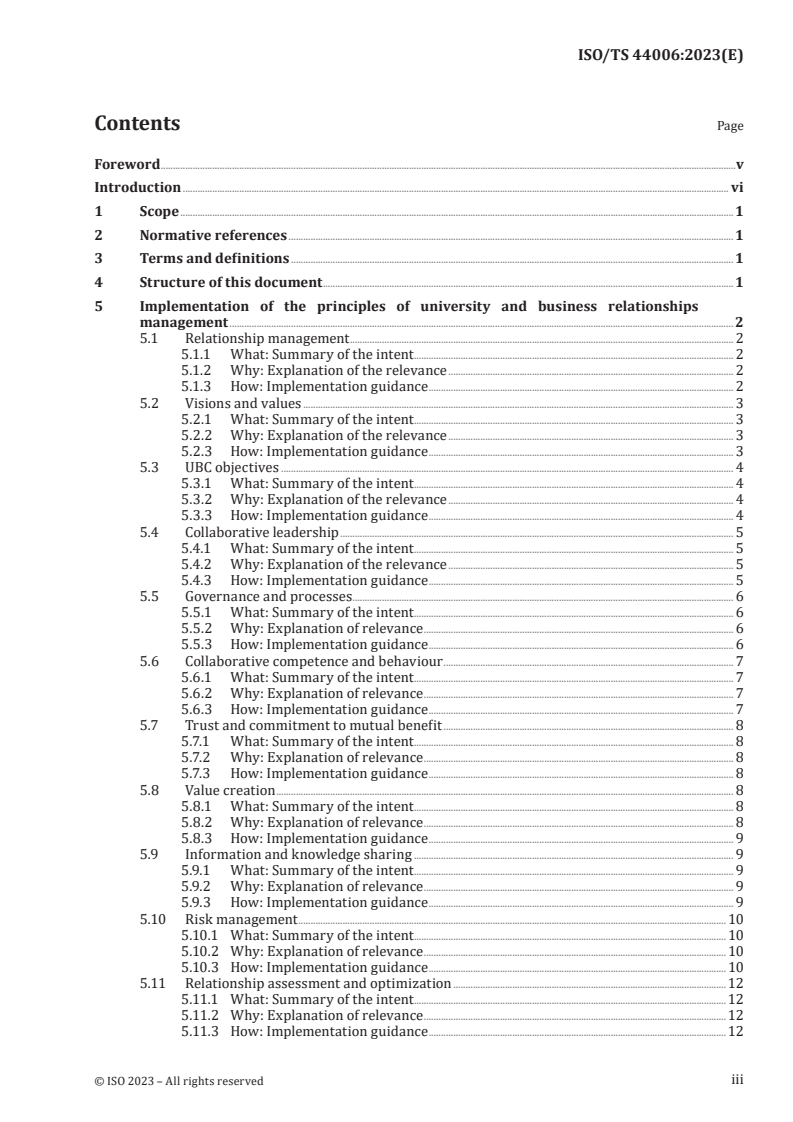
Contents Page
Foreword .v
Introduction . vi
1 Scope . 1
2 Normative references . 1
3 Terms and definitions . 1
4 Structure of this document .1
5 Implementation of the principles of university and business relationships
management . 2
5.1 Relationship management . 2
5.1.1 What: Summary of the intent . 2
5.1.2 Why: Explanation of the relevance . 2
5.1.3 How: Implementation guidance . 2
5.2 Visions and values . 3
5.2.1 What: Summary of the intent . 3
5.2.2 Why: Explanation of the relevance . 3
5.2.3 How: Implementation guidance . 3
5.3 UBC objectives . 4
5.3.1 What: Summary of the intent . 4
5.3.2 Why: Explanation of the relevance . 4
5.3.3 How: Implementation guidance . 4
5.4 Collaborative leadership . 5
5.4.1 What: Summary of the intent . 5
5.4.2 Why: Explanation of the relevance . 5
5.4.3 How: Implementation guidance . 5
5.5 Governance and processes . 6
5.5.1 What: Summary of the intent . 6
5.5.2 Why: Explanation of relevance . 6
5.5.3 How: Implementation guidance . 6
5.6 Collaborative competence and behaviour . 7
5.6.1 What: Summary of the intent . 7
5.6.2 Why: Explanation of relevance . 7
5.6.3 How: Implementation guidance . 7
5.7 Trust and commitment to mutual benefit . 8
5.7.1 What: Summary of the intent . 8
5.7.2 Why: Explanation of relevance . 8
5.7.3 How: Implementation guidance . 8
5.8 Value creation . 8
5.8.1 What: Summary of the intent . 8
5.8.2 Why: Explanation of relevance . 8
5.8.3 How: Implementation guidance . 9
5.9 Information and knowledge sharing . 9
5.9.1 What: Summary of the intent . 9
5.9.2 Why: Explanation of relevance . 9
5.9.3 How: Implementation guidance . 9
5.10 Risk management . 10
5.10.1 What: Summary of the intent . 10
5.10.2 Why: Explanation of relevance . 10
5.10.3 How: Implementation guidance . 10
5.11 Relationship assessment and optimization .12
5.11.1 What: Summary of the intent .12
5.11.2 Why: Explanation of relevance .12
5.11.3 How: Implementation guidance .12
iii
5.12 Exit strategy. 13
5.12.1 What: Summary of the intent . 13
5.12.2 Why: Explanation of relevance . 13
5.12.3 How: Implementation guidance . 13
Annex A (informative) Types of university-business collaboration .15
Bibliography .16
iv
Foreword
ISO (the International Organization for Standardization) is a worldwide federation of national standards
bodies (ISO member bodies). The work of preparing International Standards is normally carried out
through ISO technical committees. Each member body interested in a subject for which a technical
committee has been established has the right to be represented on that committee. International
organizations, governmental and non-governmental, in liaison with ISO, also take part in the work.
ISO collaborates closely with the International Electrotechnical Commission (IEC) on all matters of
electrotechnical standardization.
The procedures used to develop this document and those intended for its further maintenance are
described in the ISO/IEC Directives, Part 1. In particular, the different approval criteria needed for the
different types of ISO document should be noted. This document was drafted in accordance with the
editorial rules of the ISO/IEC Directives, Part 2 (see www.iso.org/directives).
ISO draws attention to the possibility that the implementation of this document may involve the use
of (a) patent(s). ISO takes no position concerning the evidence, validity or applicability of any claimed
patent rights in respect thereof. As of the date of publication of this document, ISO had not received
notice of (a) patent(s) which may be required to implement this document. However, implementers are
cautioned that this may not represent the latest information, which may be obtained from the patent
database available at www.iso.org/patents. ISO shall not be held responsible for identifying any or all
such patent rights.
Any trade name used in this document is information given for the convenience of users and does not
constitute an endorsement.
For an explanation of the voluntary nature of standards, the meaning of ISO specific terms and
expressions related to conformity assessment, as well as information about ISO’s adherence to
the World Trade Organization (WTO) principles in the Technical Barriers to Trade (TBT), see
www.iso.org/iso/foreword.html.
This document was prepared by Technical Committee ISO/TC 286, Collaborative business relationship
management.
Any feedback or questions on this document should be directed to the user’s national standards body. A
complete listing of these bodies can be found at www.iso.org/members.html.
v
Introduction
With the rapid development of economic globalization, international exchanges and collaboration in
education are also developing constantly. Good practices of university-business collaboration (UBC)
have been formed in many other countries. This document provides guidance on the development of a
sustainable UBC.
The participation of multinational business partners in UBC is becoming more common. However,
there are significant differences between UBCs across different countries, and establishing a common
standard for UBC will provide guidance to the varying UBC practices. Through this, different interested
parties to the internationalization of UBC can clearly understand expectations, realize in-depth
exchanges and collaboration in international human capital and science and technology innovation,
encourage business partners to explore international markets, and promote global industrial
transformation and economic development.
This document will stimulate the innovation and development of business partners, especially small
and medium-sized business partners and universities, cultivate applied and innovative talents through
the advantages of UBC, and improve the level of social innovation and the quality of talent employment.
vi
TECHNICAL SPECIFICATION ISO/TS 44006:2023(E)
Collaborative business relationship management —
Guidelines for university-business collaboration
1 Scope
This document gives guidance for universities, business partners and other interested parties on using
the 12 principles of collaborative business relationships provided in ISO/TR 44000 to improve their
capability in university-business collaboration (UBC).
2 Normative references
There are no normative references in this document.
3 Terms and definitions
For the purposes of this document, the following terms and definitions apply.
ISO and IEC maintain terminology databases for use in standardization at the following addresses:
— ISO Online browsing platform: available at https:// www .iso .org/ obp
— IEC Electropedia: available at https:// www .electropedia .org/
3.1
university-business collaboration
UBC
collaboration between a university and its business partners (3.2), in order to achieve innovation,
knowledge development, capacity building, workforce development, employment promotion and other
collaborative opportunities
Note 1 to entry: The term “university” in this document refers to an institution of higher (or tertiary) education
which awards academic degrees in several academic disciplines or offers vocational education, including but
not limited to research-oriented university, applied university, business school, art school, college, polytechnic,
higher vocational and technical university (college), and community university (college).
3.2
business partner
organization that can affect, be affected by, or perceive itself to be affected by the realization of the goal
of university and business
3.3
relationship management
series of management activities, such as systems, methods, consultation mechanism and evaluations,
which are carried out to achieve the collaborative relationship expected by a university, its business
partners (3.2) and their interested parties
4 Structure of this document
This document is based on the 12 principles of collaborative business relationship given in
ISO/TR 44000. For each principle there are the following three main subclauses:
— what: a summary of the intent of the principle;
— why: an explanation of its relevance to university and business;
— how: guidance on its implementation.
5 Implementation of the principles of university and business relationships
management
5.1 Relationship management
5.1.1 What: Summary of the intent
Relationship management is essential to sustaining collaborative relationships that are ethical and
socially responsible, and that underpin success. This does not have to be a complex process but should
be one which can be easily understood and communicated across the university, business and UBC
interested parties.
5.1.2 Why: Explanation of the relevance
Academia and business communities often operate very differently and can therefore have a varying
focus on outcomes. The UBC should have a joint focus on agreeing and effectively managing the
relationship, which can be supported by identifying and documenting a common process of engagement.
A collaborative working relationship management approach helps ensure consistent operation and
continual improvement due to the changes over time and in personnel. In addition, relevant personnel
can clarify the management mode of UBC and the expectations of interested party through a structured
and documented engagement model. It is possible to develop these relationships into a broader,
interdisciplinary and lasting relationship.
5.1.3 How: Implementation guidance
5.1.3.1 Establishment of the relationship management plan (RMP)
The university and its business partners can consider establishing a system of identifying and
evaluating interested parties and various relationships in the UBC, clarifying the contents and methods
of relationship management, and coordinating the relationship among the members of the project.
The university and its business partners should develop a joint RMP to clarify the objectives of the UBC
and its environment, and the external and internal factors of achieving their objectives. It also includes
the partners, collaboration environment and interested party expectations.
The formulation of a joint RMP can be an iterative and continual optimization process.
5.1.3.2 Identifying relationships
It is important to assess the collaborative relationship and determine the mode of collaboration in all
stages of the UBC, including current, future and possible collaboration.
Best practice alliance benchmarking is a continual improvement process utilized to continually seek
improvement to practices. When developing relationships, both the university and its business partners
should understand their individual and joint advantages from collaborative work, define where they
will have sustainable relationships, and define what methods can promote the sustainable development
of the UBC.
The existing or potential collaborative relationships can have different outcomes at different periods of
the UBC. The university should prioritize and distinguish various types of relationships and consider
where a collaborative approach can deliver maximum benefit.
5.1.3.3 Establishing organization and leadership
The UBC should establish a joint management team, including the leadership team, to clearly identify
the senior administrative personnel or its designated representatives responsible for the UBC, and
identify the members, their roles, responsibilities and powers.
The joint management team should build an environment to support the implementation of the UBC,
including but not limited to resources, equipment, property, personnel and risk management.
The joint management team should ensure continual management and upgrading of the UBC in
accordance with the objectives and governance requirements.
The joint management team can develop collaborative partners according to project needs, and
establish and implement the joint RMP, so that all partners can benefit from it.
5.2 Visions and values
5.2.1 What: Summary of the intent
The visions and values of a UBC should reflect the alignment objectives and concepts of collaborative
work, avoid moral or ethical clashes, and articulate the future direction, culture and values required to
effectively work with business partners.
5.2.2 Why: Explanation of the relevance
Visions and values provide guidance for universities, business partners and their interested parties
in order to align the direction of any development, culture, reputation, ethics and behaviour. The
consistent expression of the visions and values will help collaborators and interested parties in
optimizing collaborative outcomes.
5.2.3 How: Implementation guidance
5.2.3.1 Identifying the visions and values of collaboration
There are important factors that affect the development of collaborative work and the success of the
UBC, including the anticipation of visions and values and the profiles of relevant parties, and potential
compatibility between the university and its business partners. All interested parties to the UBC should
have a clear and consistent understanding of their visions and values, and maintain a clear focus on
value creation.
5.2.3.2 Implementing the visions and values of collaboration
UBC management should implement the visions and values of the university and its business partners
throughout the process of collaboration. Common goals and clear responsibilities should be established
for the university and its business partners. The university and its business partners should focus on
internal and external objectives, which include:
— strengthening the research quality and education capacity of the university;
— strengthening institutional collaboration between university researchers and potential users of
research in government, industry and communities;
— mobilizing resources for research from funding bodies while adhering to ethics guidelines;
— protecting the intellectual property rights of interested parties.
5.3 UBC objectives
5.3.1 What: Summary of the intent
The objectives of the university and its business partners can be achieved through collaborative work
and is established by identifying the driving factors. The interested parties of the UBC should agree on
the objectives and express them in their RMP. Interested parties should carry out their responsibilities
and provide adequate resources to realize the objectives. They should also consider key elements and
value embodiment of the UBC, so that they can address the differences in thoughts or behaviour that
can arise in the process of collaboration.
5.3.2 Why: Explanation of the relevance
Collaboration and exchange between universities and business partners is one of the important
channels for industry development and curriculum design, talent cultivation and resource mobility, and
also promotes innovation in society. The effectiveness and feasibility of the objectives are the basis
for restructuring any limited resources, enhancing competitive advantage, and realizing the value for
the university, its business partners and UBC interested parties. Clarity of the objectives is the basis
for effective collaboration and provides guidance on the implementation of activities, key points,
development direction and behaviour for all parties. A clear statement of the objectives of collaboration
directly contributes to the consistency of the actions and conduct of all parties.
5.3.3 How: Implementation guidance
5.3.3.1 Establishing objectives
All parties should have a clear and consistent understanding of their objectives and should consider the
value of participating in the collaborative arrangement.
In the process of collaborative working involving all interested parties, each party should define its
own objectives, understand the other party’s objectives and find the common objectives of all parties.
This is necessary to ensure compatibility between a party’s own objectives and the common objectives,
achieve effective participation of all parties, and maintain mutual benefit between and among the
parties.
5.3.3.2 Coordinating preparation
All parties should clarify the objectives and values of collaboration in advance, integrate resources and
establish effective collaboration mechanisms. Defining the objectives ensures that the collaborative
approach can be carried out better in order to improve the efficiency of the relationship and reduce the
negative impact of external conditions on the partnership.
5.3.3.3 Coordinating preparation
Consideration should be given to the individual risks of collaboration for each party. The joint risks
should be considered in a holistic manner.
5.3.3.4 Refining objectives
All parties should clarify the development direction of the objectives, and consider the setting of
milestones.
All parties can set small, phased objectives according to the time limitation. The objectives can be
divided into short-term, medium-term and long-term objectives.
All parties may set clear objectives for each sub-item according to the various contents of the
collaboration.
5.3.3.5 Implementing objectives
All parties should formulate clear action plans according to the collaboration objectives.
In the process of implementing a collaborative venture, all parties should effectively communicate and
implement the established objectives.
The formulation of the action plans should fully assess the actual capabilities and influencing factors of
all parties to ensure that the plans are able to be executed, quantified and assessed.
During the implementation process, the execution should be checked and monitored according to the
objectives, and all the relevant information should be summarized in a timely manner.
5.3.3.6 Adjusting objectives
In the process of achieving the objectives, the corresponding clear revision mechanism should be
established.
The revision mechanism should clearly define the conditions for the revision, the criteria for revising
the initiator, the revision process and the revision itself.
5.4 Collaborative leadership
5.4.1 What: Summary of the intent
The appointment of several senior leaders who are in charge of managing the relationship between the
university and its business partners is key to the success of the UBC. The senior leaders of the UBC are
jointly appointed, representing all the parties. They are fully empowered and supported, effectively
supporting and guiding the UBC, and creating an environment conducive for collaboration.
NOTE The title of the senior leaders of the UBC can be UBC Project Manager or UBC Manager.
5.4.2 Why: Explanation of the relevance
Senior leaders make a clear commitment to the relationship between the university and its business
partners. They set an example and work hard to achieve common visions, which are very important in
establishing and strengthening the relationship between the university and its business partners. The
participation of senior leaders provides direction, focus and trust for all parties directly involved in
the UBC, which in turn sets the tone and behaviour in all levels of the UBC. This promotes collaborative
behaviour and ensures the success and sustainable development of relationships and project outcomes.
5.4.3 How: Implementation guidance
5.4.3.1 Appointing senior leaders for UBC
All parties in the UBC should determine the requirements, responsibilities and powers of senior leaders.
All parties in the UBC should elect and appoint senior leaders who are competent in managing the
relationship between the university and its business partners.
Senior leaders should have the support of all levels of the UBC in supervision and management and
resource allocation.
5.4.3.2 Provisioning required resources
The UBC should allocate enough resources for senior leaders to manage it.
The resources required for managing the relationship between the university and its business partners
include
...