

ISO 5667-10:2026
(Main)Water quality — Sampling — Part 10: Guidance and requirements on sampling of waste water
- Abstract
This document specifies the sampling of urban and industrial waste water, i.e. the design of sampling programmes and techniques for the collection of samples. This document covers waste water in all its forms, i.e. industrial waste water, radioactive waste water, cooling water, raw and treated urban waste water. This document deals with various sampling techniques used and the rules to be applied to ensure the samples are representative. This document does not cover sampling of accidental spillages, although the methods described in certain cases can also be applicable to spillages. This document is not applicable to sampling of microplastics in waste waters. Appropriate guidance is given in ISO 5667-27.
- Status
- Published
- Publication Date
- 17-Nov-2026
- Technical Committee
- ISO/TC 147/SC 6 - Sampling (general methods)
- Drafting Committee
- ISO/TC 147/SC 6/WG 14 - Waste waters
- Current Stage
- 6060 - International Standard published - 60 Publication
- Start Date
- 18-Nov-2026
- Due Date
- 18-Nov-2026
- Completion Date
- 18-Nov-2026

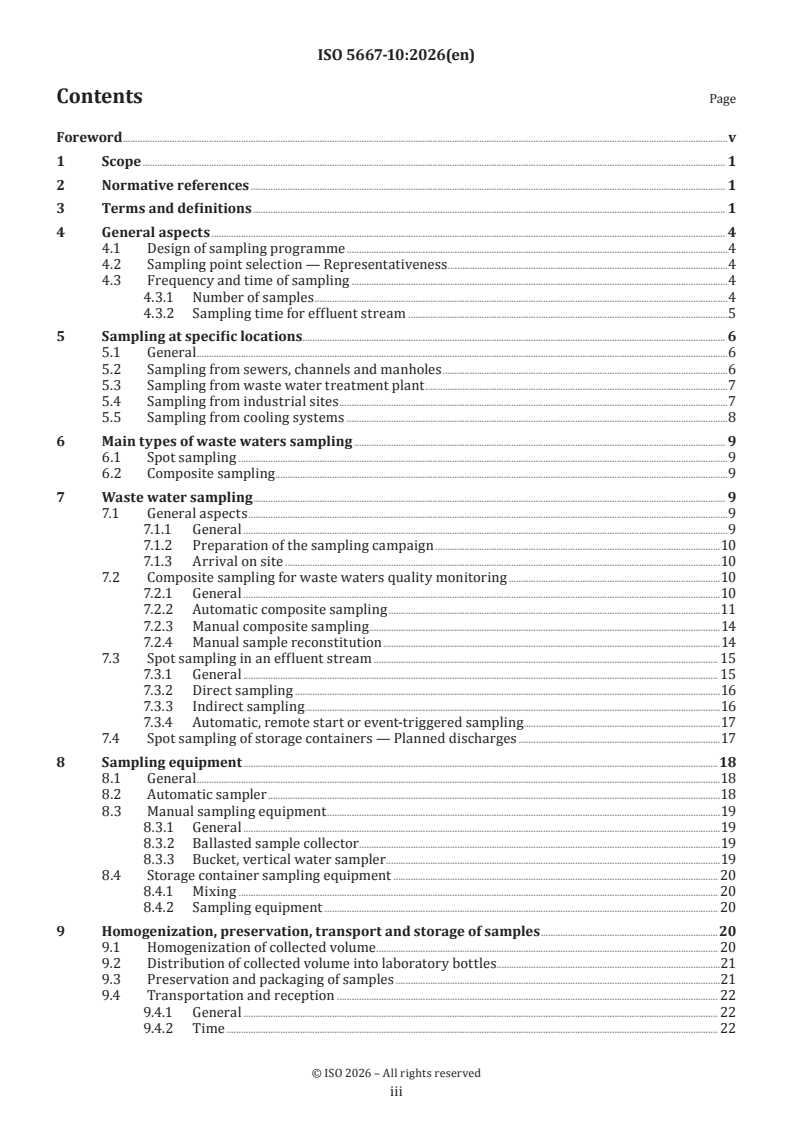
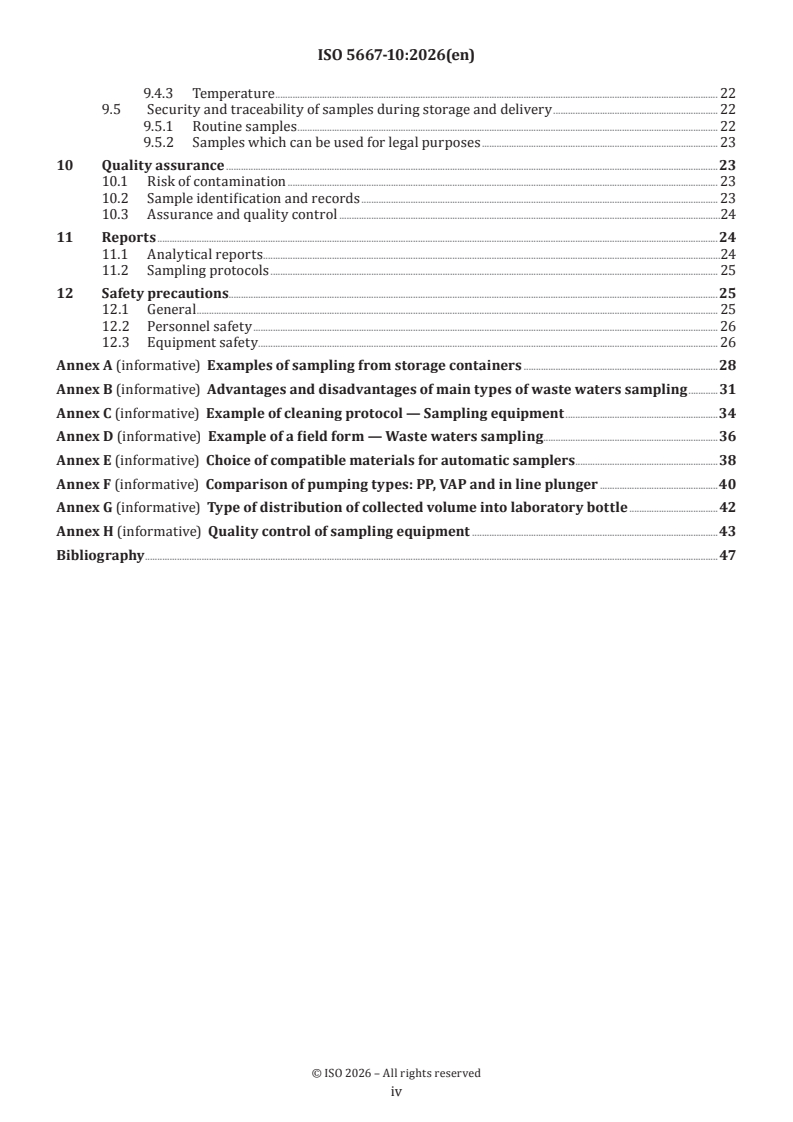
ISO 5667-10:2026, published by ISO, gives guidance and requirements for sampling urban and industrial waste water. It covers how to design a sampling programme, choose sampling points, collect representative samples, and handle them so laboratory results remain meaningful for monitoring, control and investigation.
This part of the ISO 5667 series is for people who need reliable waste water samples from sewers, treatment plants, industrial sites, cooling systems and storage containers. It focuses on representativeness, sampling equipment, sample preservation, quality assurance, reporting and safety.
What does ISO 5667-10:2026 specify?
ISO 5667-10:2026 specifies the sampling of urban and industrial waste water, including the design of sampling programmes and the techniques used to collect samples. The document covers industrial waste water, radioactive waste water, cooling water, and raw or treated urban waste water.
The scope is practical rather than laboratory-only. ISO 5667-10:2026 explains how to obtain samples that reflect the water body being checked, and it excludes accidental spillages and microplastics in waste waters.
The document is organized into 12 clauses and 8 informative annexes.
| Annex | What it covers |
|---|---|
| Annex A | Examples of sampling from storage containers |
| Annex B | Advantages and disadvantages of the main waste water sampling types |
| Annex C | Example cleaning protocol for sampling equipment |
| Annex D | Example field form for waste waters sampling |
| Annex E | Compatible materials for automatic samplers |
| Annex F | Comparison of pumping types: PP, VAP and in line plunger |
| Annex G | Distribution of collected volume into laboratory bottles |
| Annex H | Quality control of sampling equipment |
What are the key requirements of ISO 5667-10:2026?
ISO 5667-10:2026 is built around one central idea: waste water sampling must be representative of the source and suitable for the intended analysis. The document then breaks that into requirements for programme design, point selection, sampling method, equipment, handling, quality control, reporting and safety.
Sampling programme design and point selection
Clause 4 says the sampling programme should be planned carefully and based on the purpose of the investigation, with ISO 5667-1 as the general basis for programme design. In practice, this means the sampler needs to define what is being measured before choosing the method and location.
Clause 4.2 requires the sampling point to be chosen so the sample reflects the waste water or discharge being examined. The document stresses mixed, homogeneous flow and clear documentation of the point, site access and sampling technique. That matters because a poorly placed point can bias results even if the laboratory work is correct.
Choosing the right location
Clause 5 gives location-specific guidance for sewers, channels, manholes, waste water treatment plants, industrial sites and cooling systems. The standard distinguishes between flow-based sampling and storage-container sampling, because the representativeness problem is different in each case.
For treatment plants, the document ties the sampling point to the objective of the programme, such as checking overall plant performance or the operation of individual units. For industrial sites, it distinguishes planned discharges from permanent discharges, so the sampling approach matches the way the effluent is released.
Spot and composite sampling
Clause 6 sets out the two main sampling types: spot sampling and composite sampling. Composite sampling may be automatic or manual, and the document describes several composite approaches, including flow-proportional and time-proportional methods.
Clause 7 expands these methods into practical procedures for waste water quality monitoring, spot sampling in effluent streams, and sampling of storage containers for planned discharges. This is important in practice because the same plant may need different methods for routine monitoring, intermittent discharge control or special events.
Sampling equipment and material compatibility
Clause 8 requires sampling equipment materials to be compatible with the target parameter and free from unwanted physico-chemical interference. The document also warns against some materials for low-concentration parameters and gives guidance on automatic samplers, manual tools and storage-container equipment.
This matters because the sampler itself can change the result by contamination or adsorption. Annex E supports this by matching sampler materials to macro-pollutants and micropollutants.
Homogenization, preservation and transport
Clause 9 requires the collected sample to remain homogeneous when several bottles are filled or when subsampling is needed. It also points to preservation, packaging, transport, reception, storage, traceability and security.
In practice, this means the sample should not separate before the laboratory receives it. The document also links these steps to ISO 5667-3, so preservation and handling are treated as part of the sampling chain, not an afterthought.
Quality assurance, reporting and safety
Clause 10 covers contamination control, sample identification, records and quality control of sampling equipment. Clause 11 sets out what should be recorded in analytical reports and sampling protocols, including the sampling conditions, the method used, quality controls and any deviations.
Clause 12 requires risk assessment and safety precautions for personnel and equipment. The document treats waste water as a hazard and includes confined-space, explosive-atmosphere and site-security concerns. In practice, sampling must stop if the site cannot be made safe.
What terms does ISO 5667-10:2026 define?
ISO 5667-10:2026 defines key terms so users apply the sampling rules consistently.
- Composite sample - A sample made by mixing two or more samples or sub-samples in known proportions so an average characteristic can be assessed.
- Sampling point - The exact position within a sampling site where samples are taken.
- Sampling site - The general area or location from which samples are taken.
- Spot sample - A discrete sample taken at a specific time or place, usually manually, but it can also be taken automatically or by an event-triggered sampler.
- Qualified spot sample - A special composite made from several spot samples taken and mixed over a short period under controlled intervals.
- Storage container - A tank, lagoon, basin or similar vessel used to hold liquids before discharge or treatment.
- Planned discharge - A discharge agreed in advance against predefined parameters and limit values.
- Event-triggered sampling - Sampling started when a set condition is reached, such as rainfall or a change in water quality.
Who uses ISO 5667-10:2026?
ISO 5667-10:2026 is used by environmental sampling teams, wastewater treatment plant operators, industrial site operators, laboratory staff, consultants, regulators and quality managers. It is relevant wherever waste water samples must support monitoring, compliance checks, discharge control, process control or investigations.
The document is especially useful for people who plan field work, select samplers, document conditions on site, or assess whether a sample can be trusted for analysis and later decisions.
What changed in ISO 5667-10:2026 from the previous edition?
ISO 5667-10:2026 is the third edition and cancels and replaces ISO 5667-10:2020. The main changes stated in the document are the integration of EN 16479 and the exclusion of microplastic sampling from the scope.
Which standards are used with ISO 5667-10:2026?
ISO 5667-10:2026 depends on several related standards that support the sampling chain.
- ISO 5667-1 - Provides general guidance for designing sampling programmes and sampling techniques.
- ISO 5667-3 - Covers preservation and handling of water samples after collection.
- ISO 5667-7:1993 - Gives special guidance for water and steam sampling in boiler plants, used here for high-temperature cooling processes.
- ISO 5667-14:2014 - Supports quality assurance and quality control for environmental water sampling and handling.
- ISO 5667-16 - Gives guidance on biotesting of samples.
- ISO 19458 - Provides guidance for sampling for microbiological analysis.
What does the ISO 5667-10:2026 document contain?
ISO 5667-10:2026 contains guidance and worked structure for field sampling, not just high-level principles. It includes descriptions of sampling programmes, sampling point selection, and methods for spot and composite sampling in different waste water situations.
The annexes add practical material: examples for storage-container sampling, equipment cleaning, field recording, compatible materials, pump selection and bottle distribution. Annex H also shows how to apply quality control to automatic samplers and how to follow their performance over time.
The document is written for field use as much as for planning. It supports design, testing, routine monitoring, quality checks, and the preparation of defensible sampling records.
Relations
- Effective Date
- 29-Apr-2023
Get Certified
Connect with accredited certification bodies for this standard

CIS Institut d.o.o.
Personal Protective Equipment (PPE) certification body. Notified Body NB-2890 for EU Regulation 2016/425 PPE.

Kiwa BDA Testing
Building and construction product certification.
Kmetijski inštitut Slovenije
Agricultural Institute of Slovenia. Soil testing, plant health, agricultural product analysis.
Sponsored listings
Frequently Asked Questions
ISO 5667-10:2026 is a standard published by the International Organization for Standardization (ISO). Its full title is "Water quality — Sampling — Part 10: Guidance and requirements on sampling of waste water". This standard covers: This document specifies the sampling of urban and industrial waste water, i.e. the design of sampling programmes and techniques for the collection of samples. This document covers waste water in all its forms, i.e. industrial waste water, radioactive waste water, cooling water, raw and treated urban waste water. This document deals with various sampling techniques used and the rules to be applied to ensure the samples are representative. This document does not cover sampling of accidental spillages, although the methods described in certain cases can also be applicable to spillages. This document is not applicable to sampling of microplastics in waste waters. Appropriate guidance is given in ISO 5667-27.
This document specifies the sampling of urban and industrial waste water, i.e. the design of sampling programmes and techniques for the collection of samples. This document covers waste water in all its forms, i.e. industrial waste water, radioactive waste water, cooling water, raw and treated urban waste water. This document deals with various sampling techniques used and the rules to be applied to ensure the samples are representative. This document does not cover sampling of accidental spillages, although the methods described in certain cases can also be applicable to spillages. This document is not applicable to sampling of microplastics in waste waters. Appropriate guidance is given in ISO 5667-27.
ISO 5667-10:2026 is classified under the following ICS (International Classification for Standards) categories: 13.060.25 - Water for industrial use; 13.060.30 - Sewage water. The ICS classification helps identify the subject area and facilitates finding related standards.
ISO 5667-10:2026 has the following relationships with other standards: It is inter standard links to ISO 5667-10:2020. Understanding these relationships helps ensure you are using the most current and applicable version of the standard.
ISO 5667-10:2026 is available in PDF format for immediate download after purchase. The document can be added to your cart and obtained through the secure checkout process. Digital delivery ensures instant access to the complete standard document.
Standards Content (Sample)
Contents
- 1 Scope
- 2 Normative references
- 3 Terms and definitions
- 3.1 composite sample
- 3.2 sampling point
- 3.3 sampling site
- 3.4 spot sample
- 3.5 qualified spot sample
- 3.6 radioactive liquid effluent
- 3.7 supernatant
- 3.8 planned discharge
- 3.9 permanent discharge
- 3.10 storage container
- 3.11 event-triggered sampling
- 3.12 bias
- 3.13 measurement repeatability
- 3.14 representative sample
- 4 General aspects
- 4.1 Design of sampling programme
- 4.2 Sampling point selection — Representativeness
- 4.3 Frequency and time of sampling
- 5 Sampling at specific locations
- 5.1 General
- 5.2 Sampling from sewers, channels and manholes
- 5.3 Sampling from waste water treatment plant
- 5.4 Sampling from industrial sites
- 5.5 Sampling from cooling systems
- 6 Main types of waste waters sampling
- 6.1 Spot sampling
- 6.2 Composite sampling
- 7 Waste water sampling
- 7.1 General aspects
- 7.2 Composite sampling for waste waters quality monitoring
- 7.3 Spot sampling in an effluent stream
- 7.4 Spot sampling of storage containers — Planned discharges
- 8 Sampling equipment
- 8.1 General
- 8.2 Automatic sampler
- 8.3 Manual sampling equipment
- 8.4 Storage container sampling equipment
- 9 Homogenization, preservation, transport and storage of samples
- 9.1 Homogenization of collected volume
- 9.2 Distribution of collected volume into laboratory bottles
- 9.3 Preservation and packaging of samples
- 9.4 Transportation and reception
- 9.5 Security and traceability of samples during storage and delivery
- 10 Quality assurance
- 10.1 Risk of contamination
- 10.2 Sample identification and records
- 10.3 Assurance and quality control
- 11 Reports
- 11.1 Analytical reports
- 11.2 Sampling protocols
- 12 Safety precautions
- 12.1 General
- 12.2 Personnel safety
- 12.3 Equipment safety
- Annex A
- Annex B
- Annex C
- Annex D
- Annex E
- Annex F
- Annex G
- Annex H
- Bibliography
1 Scope
This document specifies the sampling of urban and industrial waste water, i.e. the design of sampling programmes and techniques for the collection of samples. This document covers waste water in all its forms, i.e. industrial waste water, radioactive waste water, cooling water, raw and treated urban waste water. This document deals with various sampling techniques used and the rules to be applied to ensure the samples are representative.
This document does not cover sampling of accidental spillages, although the methods described in certain cases can also be applicable to spillages.
This document is not applicable to sampling of microplastics in waste waters. Appropriate guidance is given [1] in ISO 5667-27 .
2 Normative references
The following documents are referred to in the text in such a way that some or all of their content constitutes requirements of this document. For dated references, only the edition cited applies. For undated references, the latest edition of the referenced document (including any amendments) applies. ISO 5667-1, Water quality — Sampling — Part 1: Guidance on the design of sampling programmes and sampling techniques ISO 5667-3, Water quality — Sampling — Part 3: Preservation and handling of water samples ISO 5667-7:1993, Water quality — Sampling — Part 7: Guidance on sampling of water and steam in boiler plants ISO 5667-14:2014, Water quality — Sampling — Part 14: Guidance on quality assurance and quality control of environmental water sampling and handling ISO 5667-16, Water quality — Sampling — Part 16: Guidance on biotesting of samples ISO 19458, Water quality — Sampling for microbiological analysis
3 Terms and definitions
For the purposes of this document, the following terms and definitions apply. ISO and IEC maintain terminology databases for use in standardization at the following addresses:
- ISO Online browsing platform: available at https:// www .iso .org/ obp
- IEC Electropedia: available at https:// www .electropedia .org/
ISO 5667-10:2026(en)
3.1 composite sample
two or more samples or sub-samples, mixed together in appropriately known proportions (either discretely or continuously), from which the average value of a desired characteristic can be obtained Note 1 to entry: The number of samples or sub samples are usually based on time, flow measurements, area or depth profile sampling.
EXAMPLE Composite sample can be made in different ways:
- constant volume variable time sampling (CVVT): flow proportional sampling based on collecting equal volumes of sample at frequencies proportional to flow.
- constant time variable volume sampling (CTVV): flow proportional sampling based on collecting samples at fixed time intervals but where the volume of sample is varied in proportion to the flow.
- constant time constant volume sampling (CTCV): equal volumes of sample or sub-sample collected at equal increments of time.
[2] [SOURCE: ISO 6107:2021, 3.126 , modified — the EXAMPLE has been added.]
3.2 sampling point
precise position within a sampling site (3.3) from which samples are taken [3] [SOURCE: ISO 5667-12:2017, 3.8 ]
3.3 sampling site
general area or location from which samples are taken [4] [SOURCE: ISO 5667-6:2014, 3.10 ]
3.4 spot sample
discrete sample taken randomly (with regard to either time or location, or both) from a body of water, usually taken manually, but can be taken by automatic sampling equipment or by event-triggered automatic samplers
3.5 qualified spot sample
special form of a composite sample (3.1), consisting of at least five spot samples (3.4), taken and mixed within a maximum period of two hours and at an interval of not less than two minutes Note 1 to entry: In this definition, mixing signifies to carry out using either constant volume or variable volume, in relation to the monitoring objective. The proportion in which spot sample need to be mixed should be clearly mentioned.
3.6 radioactive liquid effluent
water or waste water that contains radioactive substances, resulting from a process and that can be either recycled, treated or discharged to the environment, or all Note 1 to entry: The activity concentration of the radioactive liquid effluent is usually measured before being discharged in the environment to verify that it is lower than the authorized levels in order to comply with national regulations.
3.7 supernatant
solid or liquid phase present on the surface of an effluent
ISO 5667-10:2026(en)
3.8 planned discharge
discharge subject to prior agreement further to a consultation between several parties based on knowing certain predefined parameters and referring to limit values (regulatory or otherwise) Note 1 to entry: These parameters can be, for example, physical, chemical and radiological measurements, the estimated discharge volume, the discharge period or the maximum discharge flow rate.
3.9 permanent discharge
direct discharge into a channel or collector or water body, which is not subject to a specific prior agreement, but respects limit values
3.10 storage container
hollow object, very variable in size and shape, used to hold liquids Note 1 to entry: Covers the usual names such as tank, lagoons and basins. The content of this storage container is intended for direct and indirect liquid discharge to the environment or to a specific treatment.
3.11 event-triggered sampling
sampling which is triggered when a pre-determined criterion has been met (e.g. rainfall, change in electrical conductivity, pH or the introduction of a polluting substance), when samples need to be taken manually or by automatic equipment
3.12 bias
estimate of a systematic measurement error Note 1 to entry: The systematic measurement error is a component of measurement error that in replicate measurements remains constant or varies in a predictable manner. [5] [SOURCE: ISO/IEC Guide 99:2007, 2.18 , modified — Note 1 to entry has been added.]
3.13 measurement repeatability
repeatability measurement precision under a set of repeatability conditions of measurement Note 1 to entry: A repeatability condition of measurement is a condition of measurement, out of a set of conditions that includes the same measurement procedure, same operators, same measuring system, same operating conditions and same location, and replicate measurements on the same or similar objects over a short period of time Note 2 to entry: A condition of measurement is a repeatability condition only with respect to a specified set of repeatability conditions.
Note 3 to entry: In chemistry, the term “intra-serial precision condition of measurement” is sometimes used to designate this concept.
[5] [SOURCE: ISO/IEC Guide 99:2007, 2.21 , modified — Notes 1, 2 and 3 to entry have been added.]
3.14 representative sample
sample with the same quality and characteristics for the material of interest as that of its source at the time of sampling [6] [SOURCE: ISO 2889:2023, 3.63 ]
ISO 5667-10:2026(en)
4 General aspects
4.1 Design of sampling programme
Sampling is usually the first step in carrying out an investigation and largely determines the quality of the whole investigation. It is therefore recommended that a detailed sampling strategy be drawn up, often based upon a preliminary investigation in which an assessment has been carried out to identify the important aspects. Both the purpose and the ambient situation determine the way in which the sampling is to be carried out. General aspects for sampling programme design given in ISO 5667-1 shall be followed.
4.2 Sampling point selection — Representativeness
The selected sampling point should be appropriate for the collection of samples that are representative of the waste of discharge to be examined. In some waste waters, this representativeness can be difficult to obtain because of the spatial and temporal heterogeneity of the water body. It is necessary to carry out the sampling in the sections where the flow is well mixed and homogeneous. The term “representativeness” encompasses two notions depending on the type of environment to be sampled:
- representativeness in a flow (canal, sewer, manhole, pressurized pipes, etc.);
- representativeness in a storage container (tank, lagoons, basins, etc.). These two options should be treated in different ways, but the goal remains to obtain a representative sample of the water body.
Sampling points can be clearly identified by regulatory text. If they are not, a preliminary investigation is recommended. This is generally the case for the selection of sewer sampling locations. By first studying technical drawings of the sewer system, potential sampling points should be identified. Subsequently, a site inspection should be conducted to ensure that these sampling are representative. Each sampling point should be documented. It is important to gather, for example, the following information: sampling point identification, sampling site (photos, geographical coordinates), type of flow (open, closed), access conditions and sampling technique.
The following facilities should be available for the sampling sites involving a fixed automatic sampling device:
- access for suitable carrier to the immediate vicinity of the sampling site;
- flat working surfaces at appropriate height above the sampling point for the set-up of sampling devices;
- adequate lighting and power connection;
- water supply to clean the equipment after sampling;
- adequate safety precautions (e.g. grids, railings, fall arresting devices); and
- flow meters in the case of a flow-dependent sampling.
If the hydraulic conditions do not ensure the representativeness of the sample (e.g. absence of flow, reduced activity, abnormal load rise), this unusual situation should be noted on the sampling report and the customer and the analytical laboratory should be informed.
4.3 Frequency and time of sampling
4.3.1 Number of samples
The decision on the required number of samples taken during each period should be decided based on [7] [8] statistical techniques (see ISO 2602 , ISO 3534 (all parts) and ISO 5667-1). However, the number of samples to be taken can often be decided by a regulatory body or pollution control authorities.
ISO 5667-10:2026(en)
4.3.2 Sampling time for effluent stream
The objective of a sampling programme often dictates when and how a sample is collected and is often determined by legislation or directives. Generally, when sampling sewages and effluents, it is normal to make allowances for the following sources of variation in quality:
a) diurnal variations (i.e. within-day variability); b) variations between days of the week; c) variations between weeks and months; d) variations between seasons; e) variations due to storm water episodes; f) trends; and g) incident (general accident).
If there is little or no diurnal variation, or day-to-day variations, then the time of day or day of the week for sampling is relatively unimportant.
If the identification of the nature and magnitude of peak load are important, sampling should be restricted to those periods of the day, week or month when peak loads are known to occur. When assessing industrial effluent discharges that are either seasonal or batch-based, sampling times should be aligned with the process being monitored. As the discharge will not be continuous in either case, the sampling programme shall be take this into account.
Sampling for the detection of trends needs careful planning. For example, when detecting trends on a month-to-month basis, it can be appropriate to always sample on the same day of the week, in order that any diurnal and daily variations are eliminated from the overall variability of data, thus allowing trends to be more efficiently detected.
When the number of samples has been decided upon according to 4.3.1, the sampling times should be determined. The samples should normally be taken at fixed intervals during the whole sampling period. The sampling period may be one year, a number of months or weeks, or even shorter periods of time. If the sampling period covers one year, the days of sampling may be determined using a formula. An example of this is:
- Formula (1) should be applied when the number of samples (n) is equivalent or larger than 25 and Formula (2) should be applied when number of samples is less than about 25.
- Formula (1) indicates the day number during which sampling should take place. 365 365 2 365 3 365 n A ,,A A ,, A (1) n n n n where n is the number of samples;
A is a random number in the interval between − and 0.
n Formula (2) indicates the week number during which the sampling should take place. The day of each week should be determined so that samples are taken on every weekday.
ISO 5667-10:2026(en)
52 52 2523 52 n B ,,B B ,, B (2) n n n n where n is the number of samples;
B is a random number in the interval between − and 0.
n Similar formulae can be used for other periods, for example, one month, three months, six months, etc. The period chosen should cover any seasonal variations.
After determining the intervals and the day or week number, it should be ensured that the sampling does not lead to any risk of systematic error, for example, by always taking samples on one day, or by systematically omitting weekdays.
5 Sampling at specific locations
5.1 General
The concentration profiles of substances (hydrophilic and hydrophobic substances) to be measured in waste waters are often heterogeneous because they depend on the hydraulic conditions and transport conditions of the solid phase in the water body. The observations of concentration profile of these substances in body of water may be as following:
- a vertical gradient of concentration, due to the flow velocities or the shear stresses near the bottom are low;
- a very dense layer at the interface between the deposit of the bottom and the water circulating in the structure;
- an increase of the concentration near the walls;
- an increase of the concentration near the surface of the flow due to the presence of floating matter. To take a sample representative of the average concentration of the measured section, the sampling point should be placed about halfway up the water column and at a sufficient distance from the walls and from deposits at the bottom to avoid measurement bias.
5.2 Sampling from sewers, channels and manholes
The sampling point should be chosen where the effluent has a high turbulent flow to ensure good mixing conditions. Difficult access, lack of security or power supply unavailable can preclude the selection of alternative sampling points.
Sewers, channels and manholes are generally designed to cope with waste water or storm water discharge conditions. In some cases, channels have to cope with combined effluent and storm water discharges. In the absence of storm water discharge, this type of channel is oversized, resulting in laminar flow. In the absence of turbulent flow conditions at a permanent sampling point, means for restricting the flow should be implemented, for example using a baffle or weir. The restriction should be made in such a way that sedimentation upstream does not occur (e.g. foresee enlargement of the downstream effluent channel compared to the upstream channel, to avoid any pressure increase of the effluent downstream). The sampling intake point should always be located downstream from the restriction and, as a general rule, it should be located at least three times the pipe diameter, or width of the channel, downstream of the restriction. The inlet of the sampling probe should preferably face the direction of flow but may face downstream if too many blockages result.
ISO 5667-10:2026(en) The exact location of the sampling point should be evaluated with respect to variations in water level, types and concentrations of the determinands, etc. The sampling point should be at a minimum distance from the bottom and walls to avoid sample contamination by deposits or the biofilms that develop. Generally, a sampling point between one third and one half of the effluent water depth below the surface of the water may be recommended.
Whenever practicable, permanent sampling locations should be established, with care being taken to ensure reproducible sampling conditions.
Before proceeding with the sampling of industrial discharges and if the information is accessible, the conditions inside the plant (e.g. processes and production rates) should be noted and recorded along with any potential hazards.
5.3 Sampling from waste water treatment plant
When choosing sampling points for waste water treatment plant, it is again important to refer to the objective of the data collection programme, of which the sampling is a part. Typical objectives are:
- control of the performance of the entire treatment plant: samples should be collected at the main inlet and main outlet points;
- control of the operation of individual processing units, or groups of units: samples should be collected at the inlet and outlet of the units in question.
When sampling at the waste water treatment plant, the importance and the relevance of any bypass flow should be evaluated. Sampling of such bypass flows can be needed for the sampling to be representative of the overall effluent.
When sampling at the inlets of plants, there can be a need to sample raw sewage in the mixture with recirculated processing liquid (e.g. in the assessment of primary sedimentation tank loadings and efficiency). In other cases, it can be necessary to exclude the effect of these liquids (e.g. when collecting data designed to assess either domestic or industrial loadings to a plant, or both, and to assist in industrial effluent control). Representative sampling is often facilitated setting the sampling point downstream of a measuring flume or weir (see also 5.2).
When sampling effluents from processes employing more than one individual treatment unit (e.g. several sedimentation storage container), care should be exercised in ensuring that the sample is representative of the overall effluent stream rather than any one specific treatment unit (unless that unit forms the basis of a specific study).
Frequent reviews of a plant's sampling points need to be made to ensure that any relevant changes in the operation of unit processes are considered when sampling. For example, the percolating filter operation can be changed from a “single-pass” operation to a “recirculation” or “alternating-double filtration” operation. Treatment plant operation may involve changes in the manner in which feed or return liquors are introduced to the plant (e.g. return of sewage from storm tanks, changes in the position at which processing liquors are returned to the treatment plant).
Whenever sampling waste waters, great care should be exercised to overcome or minimize the substantial heterogeneity caused by suspended solids that are often present. Similarly, thermal stratification of separate industrial effluent streams may be found when sampling effluents or discharges from industrial processes, and measures have to be taken to promote the mixing of such streams before sampling.
5.4 Sampling from industrial sites
The sampling of industrial effluent can involve taking representative samples either before or after the transfer of effluent to discharge channels or collectors. In some cases, samples may be taken both before and after transfer.
ISO 5667-10:2026(en) The sampling method depends on the type of discharge or transfer taking place. The following should therefore be distinguished:
...